Glenn Greenwald, a journalist and constitutional lawyer whom I greatly admire, makes the error of treating liberalism not as a set of economic, ethical, philosophical, and political principles but as an ideological position accurately capturing the standpoint of progressive Democrats. This error occurs in a criticism of a FoxNews interview of Republican Congresswoman Liz Cheney (former Vice-President Dick Cheney’s daughter) embedded in an article in The Daily Beast. I share the tweet below.
Before moving to that critique, I want to stress how much I admire Greenwald and clarify that my criticism issues from a desire to strengthen the populist democratic movement against transnational corporate power and the authoritarian designs of its political establishment. I believe Greenwald has a big role to play in that movement. However, much like Thomas Frank, Jimmy Dore, Aaron Mate, and Max Blumenthal, he has yet to finish stepping over the populist threshold. Okay, on to the critique.
Greenwald gets this right in his critique of the interview (conducted by Chris Wallace): “The Cheney family’s primary tactic for four decades has been to brand everyone who disagrees with them as ‘un-American.’” I was myself smeared with this label first back in 2003 and for some years after when I exposed the reasons the United States under George Bush and Dick Cheney was invading and occupying Iraq before and after the invasion in speeches and essays (see, e.g., War Hawks and the Ugly American: The Origins of Bush’s Middle East Policy; Christian Neo-Fundamentalism and US Foreign Policy). Greenwald is also right that Cheney’s function in all this—part of which was pressing the impeachment of President Donald Trump on bogus charges of “insurrection”—is to make the politics of the Democratic Party look other that what they truly are “vile and toxic.”

But Greenwald is wrong to include liberal politics in this tweet. (I touch on this in The Problem of the Weakly Principled. I stress that the title and the essay has to do with people other than Greenwald.) The Democratic Party does not practice liberal politics and this becomes obvious when you treat liberalism not as a party ideology but as a set of economic, ethical, philosophical, and political principles that stand for individualism and liberty.
What is liberalism? Liberalism is the politics of assembly (for all sides, not just Antifa and BLM rioters), bodily autonomy and personal sovereignty (not just for women seeking abortions), free association (not just for blacks who seek black-only spaces), free speech and expression (not just for those who change their genders), humanism, privacy, and secularism. Liberalism is also the politics of private property and limited government. When people deviate from these principles the question of their liberal bonafides may be thrown into question. It depends on how great is the deviation (and there is a contradiction between private ownership of the means of production and the realization of other liberal rights). However, when a liberal turns authoritarian, he does not bring liberalism with him. Instead, he leaves liberalism behind.
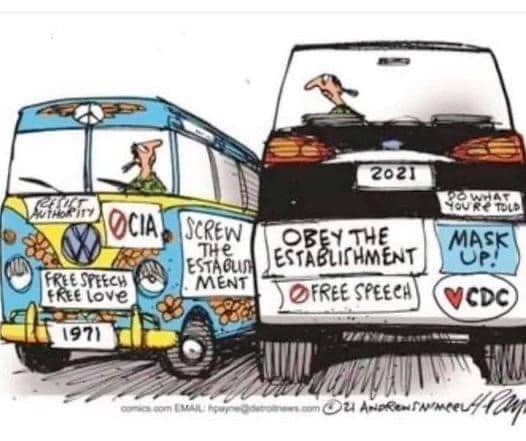
You don’t have to step back very far to see that the Democratic Party does not resemble these politics. Quite the contrary, in fact. The Democratic Party is the party of bullying, censorship and deplatforming, mandates and passports, double-standards (and doublethink), surveillance, religious zealotry, and big intrusive government. I have written numerous articles over the last several years documenting the Party’s transformation. The Party is now fully anti-humanist and illiberal. In a word, the Party is authoritarian and its rank-and-file has become reactionary. This explains why progressive Democrats and establishment Republicans like Liz Cheney have become allies in an elite war against the people: anti-democratic desire and sentiment bring them together around the imperatives of corporate state power.
What Greenwald means to say (and I apologize for attempting to speak for him, as he is so eloquent) is that progressivism (a term I believe he—like Jimmy Dore, Max Blumenthal, Aaron Mate, and others—desperately wants to reserve for those with his politics) is what is actually aligning with neoconservatism and especially neoliberalism and that these latter policy orientations are the priorities of both the Democratic Party and the corporate wing of the Republican Party, even if the latter would never speak the rhetoric of progressivism.
The alliance I am describing is not new. It became an open alliance in 1994 in the wake of the Republicans takeover of Congress (“Contract with America”) after forty years of progressive Democrat control over that branch of government. Clinton invited the alliance with his “New Democrat” politics, articulated by the Democratic Leadership Council and the Progressive Policy Institute. The alliance was reinforced during the Bush-Cheney years, as establishment Democrats, such as Hillary Clinton and Joe Biden, supported the war effort (which killed upwards of a million Iraqis in the first 3-5 years) and the construction of a vast surveillance apparatus (the PATRIOT Act). The Obama-Biden administration was a continuation of the alliance.
Mrs. Clinton was to keep things going when populist-nationalism threw a monkey wrench into the machinery named Donald Trump, who rose to power by blowing up the Establishment narrative. Thus began the long coup completed on January 20, 2021 with the installation of the decrepit former Vice-President Joe Biden in the White House, a ventriloquist dummy for the Establishment. The January 6 Commission is a concerted effort to prevent the return of Trump or one of his ilk to political power.
I understand why Greenwald is having trouble with all this. Like Thomas Frank, Naomi Wolf, Tulsi Gabbard, and others who are coming around to the realization, the politics they are instinctively drawn towards are presently represented by right-wing pundits and politicians and political organizations and parties across the trans-Atlantic space. There is a visceral reaction to the political rightwing among liberals, and so there is a degree of denial and rationalization. But the political right is where democratic populism is finding its fullest and most principled expression. I see in this an opportunity for coalition building. Wolf and Gabbard do, as well. Indeed, a growing number of liberals are appearing on the populist scene standing alongside such rightwing figures as Steve Bannon and Peter Navarro.
This has been a long time in coming. In a 2006 City Journal essay “Facing the Islamic Menace,” Christopher Hitchens notes that the character of the politics that gets the problem facing Europe, for example, religious extremism among mass immigration, is rightwing in character. In the essay, Hitchens recognizes the significance of Sam Harris’ observation in a Los Angeles Times column that ethnonationalism in Europe is at the forefront of recognizing what Hitchens calls “Fascism with an Islamic face.” This is no doubt a sticking point for Greenwald who has made his animosity towards Hitchens explicit.
I will explain Greenwald’s dilemma in a moment, but I need to elaborate Hitchens’ position so it is not unnecessarily misconstrued. What Harris writes in that essay is troubling: “The same failure of liberalism is evident in Western Europe, where the dogma of multiculturalism has left a secular Europe very slow to address the looming problem of religious extremism among its immigrants. The people who speak most sensibly about the threat that Islam poses to Europe are actually fascists. To say that this does not bode well for liberalism is an understatement: It does not bode well for the future of civilization.” Hitchens characterizes Harris’ words as “alarming” and “irresponsible.” At the same time, he grasps their significance, ending his City Journal essay by remarking “Not while I’m alive, they won’t.”
Hitchens’ remark was a call to the left to come home to democratic population and civic nationalism and defend their countries from the disorganizing force of theocratic desire. In the meantime, right-wing politics in Europe has moved away from the fascistic style towards a more libertarian populist-nationalism. No longer do racialist politics animate the European right. Indeed, populist-nationalist sentiment is, as we see also in the United States, rapidly spreading across racial groups, while progressives have constructed an elaborate racist ideology that is infecting major institutions in both public and private sectors.
Like Chris Hedges, Greenwald still clings to a politics of Muslim apologetics and the Chomsky-style rhetoric of anti-imperialism. I get it. Greenwald was politicized during this period. Chomsky fashioned his worldview. He admits it. Hitchens’ alignment with neoconservative policy under Bush and Cheney makes it difficult if not impossible for many of those who might otherwise admire Hitchens-style of populism and nationalism to avoid rejecting the corpus of Hitchens’ work for that reason. While I do not share that difficulty, I was as well very disappointed by Hitchens support for the war effort and publicly criticized him for it (while having to admit that his argument for war and occupation was the most compelling of the lot).
The difficulty Greenwald has with all this was evidenced only days ago by a reluctance to bring himself to condemn Chomsky for a truly hateful and authoritarian diatribe aimed at those who resist the COVID-19 vaccine (see Noam Chomsky is an Authoritarian). Hitchens recognized Chomsky’s growing derangement years before his death. We can only hope a man as passionate and as talented as Greenwald can also turn that corner.
This is the realization that inspired me to distance myself from the progressive Democratic establishment (as a college teacher, it surrounds me) and recheck my beliefs to make sure I was actually supporting a politics that reflected my values. My beliefs checked out.
Cheney and her ilk and the Democratic Party are the political functionaries of transnationalism. They are globalists, technocrats operating the administrative state that serves transnational corporate interests. They’re overseeing the managed decline of the American republic and, more generally, the nation-state. To their minds, no assembly could be more dangerous than that which gathered in Washington DC on January 6, 2021 to seek a redress of grievances.
When you listen to the substance of Greenwald’s arguments you can see that he is already a populist. Frank is, as well—he just needs to stop conflating populism with progressivism. These standpoints are, in fact, opposites, as the brilliant Richard Grossman pointed out so long ago. As I note above, Wolf and Gabbard are almost all the way there. Again, I understand why it’s hard to make the leap—or at least what feels like a leap given perception. People have been for so long gaslit over populism and nationalism that they have difficulty overcoming the internal resistance to the labels. That’s why Greenwald gets hung up over the label liberal. But Greenwald is a liberal. He shouldn’t let authoritarians steal the label.
The sooner those on the left and right understand their shared values the sooner they can come together and form a coalition against transnationalism. Such a coalition is necessary if we are to successfully resist the destruction of the Westphalian system and the Enlightenment values that sustain freedom and human rights. The character of populism is not fascist. It is the character that founded the American republic.