
“Judge not, that you be not judged”—the Gospel of Matthew
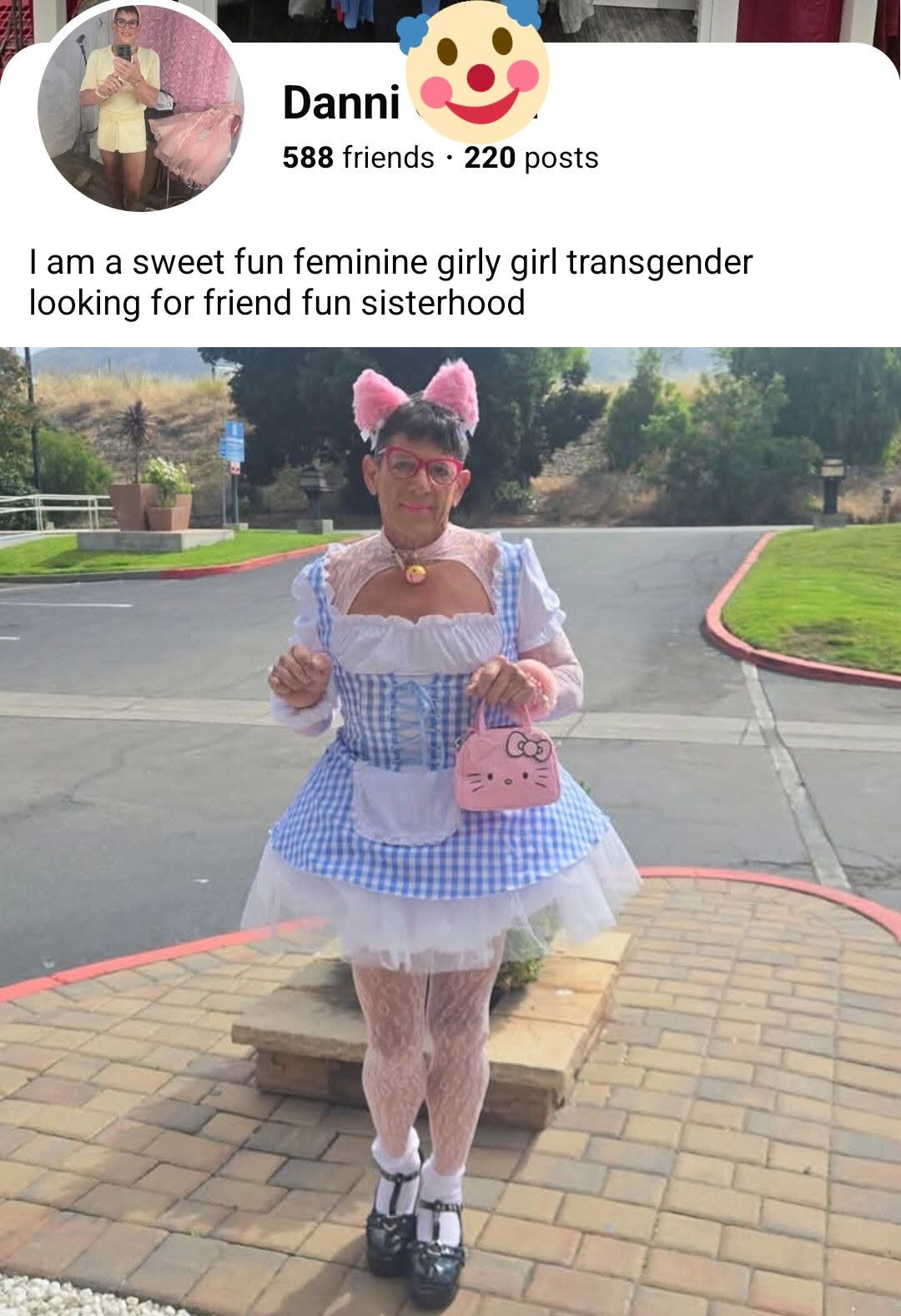
When I was growing up, everybody who saw a grown man dressed as a little girl—outside of a comedy skit—immediately recognized it as pathological behavior. We all saw a problematic person. Rightly so. There is no bigotry in fearing for the safety of children or expressing intolerance for perversion. We did not then deny the signals of danger. Like other animals, humans have an evolved capacity for threat detection. It is not a burden but a gift from nature.
It’s troubling that, today, millions of people see Danni and fail to recognize that he is disordered. It is just as troubling—perhaps more so—that millions recognize his behavior and its associated thoughts as abnormal, yet resist identifying it as such because they think doing so is being judgmental. But Danni’s public expression is a burden on the rest of us. So, too, is the burden of the pathological empathy that excuses him. These are burdens we need not suffer.
No responsible parent would trust their children with such a person. Yet parental irresponsibility has become widespread in contemporary society. This is why Drag Queen Story Hour is so objectionable. A healthy society would not allow this practice. We should all be horrified to see children sitting pretzel-legged around a man in womanface reading from a book designed to confuse them about gender. The performance is designed to disrupt the natural grasp children possess of the distinction between females and males. More generally, any person with a right mind would not want this man around anybody.
“Stay away from Danni. Something is not right with him.” That instinct is protective of normative standards, which are not mere social constructions. Normative systems are rooted in our nature. Yet, we are told to suppress our instincts and scolded when we don’t. The objective of Drag Queen Story House is to disable at an early age the natural proclivity to see gender. The linguistic trick of “preferred pronouns” is meant to disrupt this instinct in all of us by shaming us for recognizing gender. The project is designed to condition the population to think that gender is a subjective matter. It’s not. The project means to train people to lie.
I hear the objection. I am failing to distinguish between “is” and “ought.” I have moved from description to normative. But the Humean dichotomy denies naturalism. The fallacy of “the appeal to nature” must accept Hume’s distinction to be valid. I don’t accept the distinction. Moral facts are discoverable empirically by observing the structure and operation of normative systems in the natural world. Human beings and other organisms exhibit organized patterns of evaluation, regulation, and response—such as cooperative behavior, pain avoidance (which is conditional), reward learning, and social sanctioning—that together constitute normative systems.
Moral systems are not merely descriptive mechanisms but are the very phenomena from which moral facts are induced: morality is grounded in the observable features of how such systems function and stabilize behavior over time. Rather than treating “is” and “ought” as fundamentally separate categories, “oughts” are features of reality embedded in these systems and accessible through empirical investigation. Moral knowledge is continuous with scientific inquiry into natural processes, with normativity understood as an aspect of the world’s structure rather than an externally imposed evaluative layer.
Drag Queen Story Hour and preferred pronouns (an Orwellian inversion) advance the queer praxis of transgressing boundaries, arrangements we ought to observe because it is in our nature to do so. It is not that boundaries are always good, since some boundaries are not natural. Those imposed to normalize injustices, such as de jure racial segregation or the strict Islamic dress code imposed on women, are properly subject to criticism. However, it is also the case that normative rules preserving boundaries are generally necessary for the perpetuation of a good and decent society, that is, a social arrangements that promote safety and thriving, which are objectively determinable. Those actions that undermine these are therefore harmful to them.
The anarchist and the nihilist—these are the pathologies that lie behind queer praxis—do not seek to disorder norms for the sake of justice, but to establish inorganic “norms,” i.e., patterns of destructive behavior, that empower the few over the many. Those few do not have society’s best interest in mind, but rather seek a situation where they can freely impose their fetishes on others. They wish to involve all of us in their perversions to subvert the normative order. That’s part of the kink. It’s not enough to dress like a little girl and masturbate in front of a mirror. Danni needs an audience, and he needs the audience to applaud him.
The rot of queer praxis goes deep. Surely, as I suggested earlier, a great many people who defend such behavior and identity also see it as pathological. But they tell themselves that the virtuous person tolerates deviance—even accepts it. More than accepting it, they celebrate it. They take their children to Drag Queen Story Hour to signal their virtue. Some take their children to strip clubs to stuff dollar bills in the thongs of drag queens writhing about in front of them. They describe themselves as “allies.” The problem is with whom they ally. They ally with those striving to normalize abnormality. Because of this, the “norms” of anarchism and nihilism are being generalized. No society can survive these tendencies at scale. This is why we cannot tolerate them at our local public library. It is not a little thing. It’s everything.
Today, many people have been conditioned to wince at the words “abnormal” and “deviance.” Conditioning is a part of animal nature, and this evolved capacity is being wielded against us to override our instincts. To define our terms precisely, in psychology and psychiatry, abnormal refers to patterns of behavior, emotion, and thought that deviate significantly from social or statistical norms and are associated with distress or impairment; deviance is essentially a synonym for abnormal. Historically, the term is common to sociology and its subfields, criminology and deviance studies more broadly.
In sociology, deviance refers to behaviors, beliefs, or characteristics that violate the norms and expectations of a society or social group. The field developed to understand why some actions are labeled as normal while others are treated as criminal, immoral, or problematic. Over the last thirty years, as a professional sociologist, I have watched the controversy in my discipline over the concept of deviance grow, with many of my colleagues arguing that identifying deviant behavior reinforces the very judgments it seeks to analyze.
The assumption is that judgment is problematic. But is the problem judgment or the behavior that people judge? It seems odd that sociologists of all people would smuggle a vulgar interpretation of Matthew 7:1 into the discipline. Woke sociologists assume the “is” and “ought” distinction, and are thus rooting the latter not in naturalism and the emergent social order, but in an arbitrary transcendent moral ontology; without nature, the presumed moral order becomes entirely preferential and subjective (I will have more to say about this in a forthcoming essay). This corruption is inherent in the utilitarian variety of consequentialism.
To be sure, what counts as deviant is neither fixed nor universal; it varies across cultures, historical periods, and power structures. That is well established in sociology and its sister discipline, anthropology. This had led to the development of labeling theory, its practitioners pointing out that institutions such as courts, the media, medicine, and schools often have the power to define certain groups as deviant, sometimes in ways shaped by class, gender, politics, race, and sexuality. All this is true. But it does not mean that everything is arbitrary. Rather, it points to the necessity of determining what is arbitrary and what is not. Making this determination is not itself arbitrary.
Behaviors once widely classified as deviant—such as same-sex relationships—have been reevaluated and, in many societies, decriminalized and destigmatized. Sometimes this is for the better. This is true of homosexuality. Same-sex attraction is a natural fact. However, contemporary sociology tends to emphasize that deviance is a socially constructed category with no basis in nature. Here, the key question becomes not simply “Why do people break rules?” but “Who makes the rules, whose interests do they serve, and how do labels of deviance affect people’s lives?” Again, these are important questions, but while sociology can be political, it is a science, not politics. If it were politics, then what sort of politics should it be? The answer to this question lies in determining moral facts.
Daniel Patrick Moynihan observed in his influential essay “Defining Deviance Down,” a subtle critique of the social constructionist project published in the early 1990s, that downward redefining of standards is associated with rising crime and disorder. He recognized the liberal concern with upward redefining and the potential injustice this brings to individuals. I share the liberal concern (which also concerned the founders of the American Republic). But I also share the concern that conservatives have over downward redefining and the injustice this brings to society at large (this, too, concerned the Founders). Moynihan was likewise sympathetic to both concerns.
Moynihan notes Émile Durkheim’s distinction between the normal and the pathological. In his 1895 book, The Rules of Sociological Method, Durkheim, who saw social facts as objective (ways of acting, feeling, and thinking that are external to the individual and endowed with a power of coercion), argues that deviance is ever-present and that controlling it is functional by creating social solidarity. In this sense, some deviance is expected, even inevitable. However, deviance becomes pathological when it reaches excessive levels or reflects a breakdown in social regulation, a condition he famously described as anomie. In such cases, norms lose their guiding power, social cohesion weakens, and individuals may experience confusion or normlessness.
Thus, while moderate deviance is functional, deviance at scale, rather than signalling healthy diversity, signals instead instability in society’s regulatory structure. Crucially, for Durkheim, normative systems are not mere projections of power, as postmodernists would have it, but emergent systems generally conducive to human thriving. The moral system is a social fact. A free society tolerates individualism, but it also holds individuals responsible for the harm they cause others and society generally. A healthy society does not tolerate socially pathological deviance.
A major form of regulation in human society is shame and stigma. Yet, there is a push in psychology, psychiatry, and sociology to reduce shame and stigma in the areas their respective fields study. Some faculty and students have come to view the word “abnormal” as implying that people with mental disorders are somehow fundamentally “abnormal” as persons. Are there not abnormal people? Is society supposed to tolerate abnormality when it compromises its ability to protect individuals? By analogy, this is well illustrated in the immigration debate, where, when the problem of illegal alien presence is raised, one is told that “no one is illegal.” Plainly, they are; they are where they are not supposed to be, and there is a criminal statute regulating this. Likewise, men in spaces reserved for women are an illegal object. They are a harmful deviant.
It might be supposed that the concept of “psychopathology” in psychology shifts the emphasis toward the study of pathological psychological processes rather than labeling individuals. Yet the practice of identifying psychopathology in persons necessarily comes with labels. Psychopathy is not independent of the psychopath. Those with narcissistic personality disorders are by definition malignant narcissists. We label them to confront the problem. The distinction between psychopathy and abnormality is one without difference.
Some psychology programs have changed the name of the course “abnormal psychology” to “psychopathology.” What does that accomplish? Pathology is identified, but what is being sold beneath it is the idea that describing behavior and thoughts as “abnormal” is a bad thing. Yet, this in itself is a bad thing because it suggests that people who need help are told their problems are not in them but in those who notice them and treat them concretely. Is antisociality not an objective phenomenon? Are there no antisocial types? Is the problem not the man on the subway threatening to behead passengers, but the passengers who fear for their lives as any conscious animal would? Antisociality is no mere abstraction; the antisocial man is a person who disregards societal rules and harms others.
Moynihan was accused of shifting attention away from structural problems toward culture-based explanations, as if the shift were disallowed. Whatever one might think from a political standpoint about sociological theories that root social problems in the various structures to which the discipline has traditionally attended, the pathological behavior in blue-city tolerance of open-air drug use, defecation, urination, masturbation, etc., is largely the result of downward defining. The scientist must go where the facts lead him. He must avoid ideological thinking.
What lies behind this, whether intentional or in effect, is a creeping anarchism, and, while social science necessarily comes with political interests (because social scientists are people, and people are political), it is not a political project to undermine protective normative systems. At least it shouldn’t be if science is a universal system of discernment. The humanist side of social science should guide its disciplines in identifying and explaining social phenomena, and in proposing ways to address social problems in the interest of human flourishing. It should not deny social problems by reducing them to a standpoint.
Social science has never refuted the common-sense understanding that no society that allows individuals to follow their own rules, when these rules undermine the normative order, can long survive. Perhaps some societies should not survive, but this is a matter of whether they promote safety and thriving. Freedom also depends on normative systems, but normative systems must be structured to promote the freedom necessary for self-actualization. If normative systems are oppressive, then they are judged inadequate because they are contrary to this end. This is universal: all sustainable social arrangements devise rules governing individual conduct, many of these rooted in natural history. Tolerance for diversity of behavior and thought is a good thing—within reason. A society can’t tolerate everything.
Society certainly shouldn’t accept what we see in the image shared at the top of this essay because it is pathological. Men with the desire to publicly appear as women or children, apart from a performance where the role calls for it, should feel shame for their desire. This is why norms are internalized. Otherwise, upholding norms becomes regulation—outside forces compelling obedience to expectations. It is not that regulation is itself a bad thing. However, the need for external regulation is largely obviated by the development of conscience, that is, self-regulation. A man who cannot regulate himself must be regulated by others.
External regulatory systems can make people behave one way or another. But it does not make them good people. Immanuel Kant was right in saying that being “good” is not primarily about producing good outcomes or having good feelings; rather, it is about acting from duty in accordance with moral law, using reason. The good person avoids bad behavior in part because he would feel guilty if he did otherwise; feeling guilty or uneasy about doing something wrong can be a sign that one’s conscience is sensitive to moral law. But at its core, moral goodness depends on whether a man chooses not to do wrong because he recognizes it as his duty to be good, not simply because he feels bad about it. It is this duty that also causes him to protest unjust social arrangements.
Alas, not everybody chooses to be good; some individuals require regulation. Shame and stigma are, in the end, indispensable for reproducing the good society. Those who are made to feel this way by others, or who have internalized the generalized other, are aware of the norms conducive to prosocial behavior. Danni did not fully internalize such norms. And he has rejected his duty to be good. It’s possible that he feels shame but is encouraged by those who tell him he should not feel this way. He needs help from those around him, not their affirmation; his failure to observe norms should not be positively sanctioned. It is not cruel to shame him. On the contrary, it is cruel to affirm his abnormality. In his right mind, he would not want this burden for himself. Nor would he wish to impose it on others. It is harmful to children and society more broadly to allow him to behave as if his perversion were normal. And it is harmful to Danni. He needs help to be a good person, and that begins by making sure he knows he is not.
Durkheim is correct that there will always be deviance. Regulation will always be necessary. But pathological levels of deviance risk social disintegration, and the degrees of regulation needed to reintegrate individuals under conditions of widespread anomie potentially come with their own pathologies. It is far better to prevent chaos rather than bring order to it. The police are necessary, but a police state is undesirable; such a situation indicates that the people have lost the capacity for self-regulation. And heaven help us if the anarchists are the ones policing us.
There is no assurance that a better order will be reestablished in the wake of the one that has served us well. It is not as if the jury is out on the question of whether anarchism or socialism is a suitable replacement for liberal capitalism. There may be a better order, but it has not been presented to us, and the evidence that we would be better off under a different system would have to be demonstrated before upending the present social order (which itself has been warped by corporate power). The goal of queer praxis is that what will replace the present order will not be one conducive to human thriving, but will allow pathology to reign.
The future of a free society depends on ensuring that society never accepts Danni and his ilk as normal, for if pathology is normalized, then the society itself becomes pathological. This is what the queer movement seeks: to make us all destructive deviants.


