
With America approaching its 250th anniversary, former President Barack Obama has drawn renewed attention—as if there weren’t already an army of woke scolds reminding the country of this history at every turn—to the fact that some of those who founded America owned slaves. In a recent interview associated with the opening of his presidential library, Obama notes that George Washington, the first president of a fledgling republic, participated in a system that the nation he fathered abolished.
Did Obama tell his slavish audience that, in his will, the humans Washington owned would be freed after the death of his wife, Martha? Did Obama even look to determine the disposition of Washington’s slaves after his death? If he had, he would have learned that the First Lady, feeling uncomfortable delaying their freedom, signed a deed that freed them on January 1, 1801, a little over a year after Washington’s death. If the first black president, the son of a white woman, knew this, he wouldn’t have told those leaning into his words.
Obama exploits his status as a (manufactured) statesman to emphasize what progressives portray as the contradiction at the heart of the nation’s origins and therefore an inherent flaw in America’s present and future: the distant past of what Democratic Senator John C. Calhoun called the “peculiar institution.” The fact that America overcame slavery must be obscured. Like an abusive spouse who continually dredges up some past grievance his wife has apologized for a thousand times, the ghost of chattel slavery must always haunt us. No redemption is possible.

At the time of this writing, it’s been 218 years and 6 months since the United States ended legal importation of enslaved people from abroad, and 160 years and 7 months since slavery was abolished in the United States. To have known a relative who was enslaved, one would have to be born around the early 1930s or earlier, a vanishingly small percentage of the population. Yet we’re supposed to believe that black Americans are presently oppressed by a system that was overthrown decades before anybody living was born.
Progressives want Americans to have slavery in mind as we turn our attention to Washington and the other white men who established the American Republic in our national moment of reflection. We’re not to see the Washington Monument in the Lincoln Memorial Reflecting Pool, but instead algae and cracked blue paint. “I think sometimes we get confused in thinking that these two stories are separate,” Obama said. “They’re intertwined, right? Which is why I can be a great admirer of George Washington, and also acknowledge he was a slaveholder.”
The “we” Obama imagines doesn’t exist. Nobody sees America’s founding, chattel slavery, and the transatlantic slave trade as separate from the founding of the country. We acknowledge slavery and the fact that many colonists who fought for independence from England and established the American Republic participated in it. Even if we wanted to forget it, progressives are always there to remind us. But they don’t need to; we don’t want to forget it. The question is how we are supposed to regard the entanglement, not whether we acknowledge it.
* * *
In sociology, there is a concept called “hedging.” It refers to how people soften, qualify, or partially distance themselves from a claim or identity so they avoid sounding too absolute or committed. It’s a discursive strategy—language used in social interaction to manage credibility, meaning, and social consequences.
Obama uses the strategy of hedging to implicate white people—then and now—in the oppression of black people while seeming to honor those who founded the United States. He wants you to know he’s “a great admirer of George Washington” so that he can appear patriotic—and as a sophisticated thinker who can manage nuance—while delegitimizing the American Republic. The takeaway: the “Father of His Country” was an enslaver. And that means Washington could not possibly be a man worthy of admiration. That’s all you really need to know to make a judgment on the legitimacy of the country he fathered.
At the heart of identitarianism beats this primitive belief: the child bears the sins of the father. Delegitimizing the nation is the progressive plan. If progressives believed in our country and acknowledged its progress in fulfilling its promise, they would focus on what the people have overcome, recognizing that its many achievements prove its virtue. But progressives desire a corporate state and, therefore, must, at every opportunity, run down the Republic and cast the white majority as the enemy of the people. We must forever bear our father’s sins.
It is this sin that progressives use to explain persistent inequalities in America. Readers know the narrative all too well: The white majority did not come by its status because of faith, intact families, integral communities, and a strong work ethic. They are unjustly enriched because they have, for generations, exploited and oppressed black Americans. By denying the sin, whites perpetuate the system of racial inequality that privileges them.
Whites are conditioned to believe that this system explains why black Americans as a demographic category trail whites in nearly every metric of social standing. It is not because of fatherless households, disorganized communities, and idleness, but because of white privilege. One is not supposed to consider that these pathologies are the predictable consequences of decades of progressive policies devised and implemented by Democrats—globalization, mass immigration, and the welfare state. Whites are to blame for the situation of black Americans, and thus need reminding that the Founders were enslavers.
Instead of full integration into American society, blacks are given a quasi-religious framework perversely adapted from Christianity. Original sin casts humans as inherently sinful. Man is born sick and commanded to be well, to borrow Christopher Hitchens’ pithy formulation. In Obama’s telling, and this is a core tenet of the woke progressive faith, white people are not born morally neutral, but come into the world already inclined toward selfishness and always separated from the good. They must atone for this sin by seeking the impossible: redemption from a genetic state—a blood libel. To atone for this sin, from now until forever, those cast as the victims of whiteness must be afforded privileges that come at the expense of those whose success is explained by their inherent wickedness.
The ideological work of the woke narrative is spectacular in keeping down black Americans. One might think that successful families would serve as aspirational models. Those who sought to be like them, who emulated their attitudes and behaviors, might be expected to climb the socioeconomic ladder. Maybe they wouldn’t get to the top, but they would no longer find themselves on the bottom. At the very least, they tried. There is dignity in failure honestly come by. Instead, they are told that those whom they might emulate are the reason why they can’t get ahead in life—and why crime and welfare dependency are understandable modes of adaptation.
Instead of aspiration, blacks and other non-whites are steeped in ressentiment, a deep, lingering form of resentment among those who feel aggrieved and powerless, directed toward those they perceive as more privileged, as smarter and stronger. But rather than leaving the disaffected to wallow in their frustration, the Democratic Party organizes them into mobs and a voting bloc. Just as envy of Jewish success is rationalized by antisemites as a conspiracy to keep down the goyim, and therefore justifies hatred and violence directed at Jews and Israel, envy of the white majority is weaponized against them and the nation.
We see this today in the rabble on our streets and the electoral successes of democratic socialists across the country. The socialists assail the corporate elite. To be sure, so do populists on the right. But the left offers its followers not restoration of a nation beset by division, but administrative command and moral transgression. Their program brings technocratic control and nihilism. This is why the corporate elite do not fear democratic socialism. They know that the socialism progressives have in mind is state control over the people’s lives. The mass media is giddy over the election of New York City Mayor Zohran Mamdani and the success of those candidates he endorses. Indeed, corporate power fears those who pursue the Founders’ promise by making America great again.
* * *
In his July 3, 2026, America 250 address, Mayor Mamdani, a naturalized citizen and democratic socialist with king-making charisma, presented the United States as a nation defined by both remarkable ideals and enduring contradictions. Speaking from behind the desk used by George Washington at New York City Hall and surrounded by newly naturalized citizens (some wearing the flag of Islamization), Mamdani argued that patriotism should not mean ignoring the nation’s failures but working to fulfill its founding promises. He emphasized that American history includes the experiences of American Indians, enslaved Africans, immigrants, and others whose struggles have shaped the country alongside its celebrated achievements.
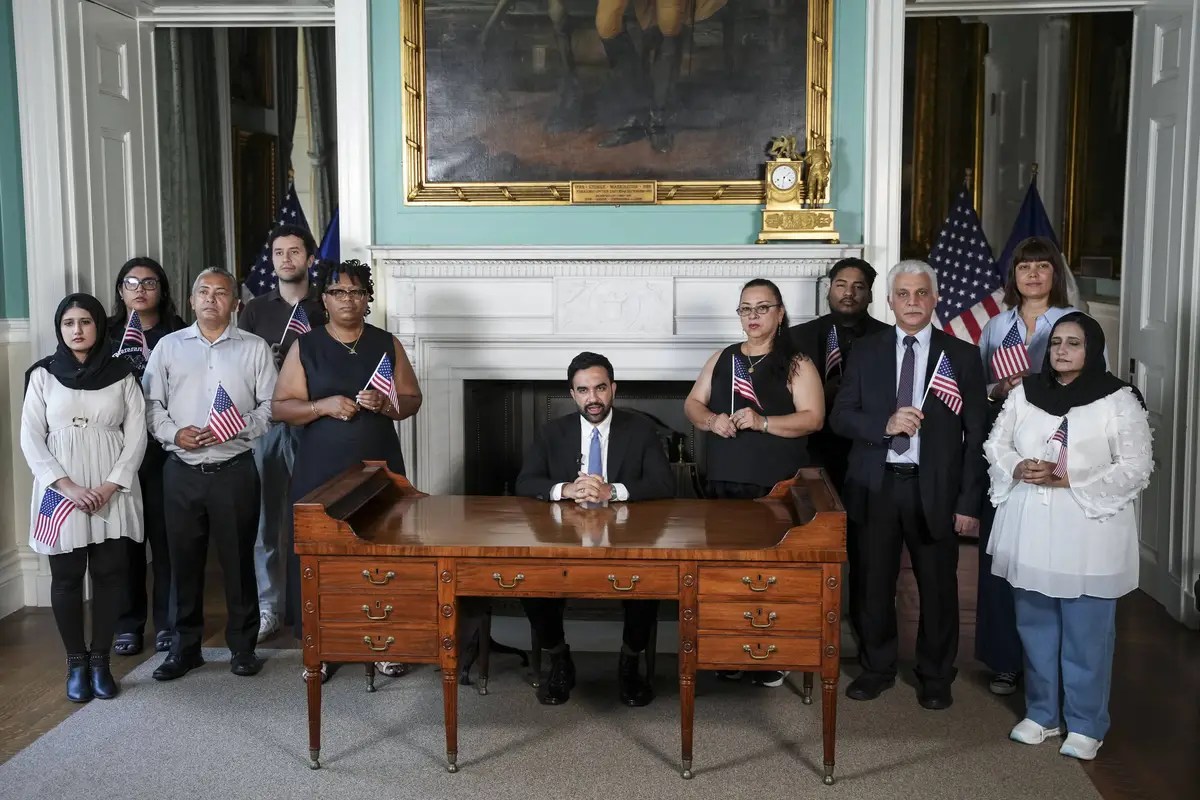
Mamdani described the United States as an “unfinished project” whose strength lies not primarily in its economic or military power, but in the efforts of ordinary people to expand democracy, equality, and liberty (read “diversity,” “equity,” and “inclusion”). He suggested that every generation inherits the responsibility to bring the nation closer to its ideals rather than assuming those ideals have already been realized. He suggests those ideals have not been realized.
But whose ideals? His or America’s? The presence of newly naturalized citizens is meant to underscore his argument that immigration remains central to the American story, props to punctuate the speech’s appeals to civic participation and democratic renewal. Of course, Republicans place symbols of their ideals around them, as well. Rhetoric and symbolism are used by politicians across place and time. But soaring words are checked by action. And symbolic choices are meaningful. We know what Mamdani means by his: color revolution, corporate statism, multiculturalism, and transnationalization.
The speech and media attention carried a clear political purpose. Delivered just hours before President Donald Trump’s own America 250 address at Mount Rushmore in the Black Hills of South Dakota, Mamdani offered an alternative vision of American identity. Where Trump’s celebration was expected to emphasize historical achievement and national greatness (and that was indeed its focus), Mamdani emphasized self-criticism and the belief that patriotism is demonstrated by continually striving to make the country more inclusive and socially just.
If Obama and the democratic socialists demand we pay attention to history, then we should take up the challenge. For actual history does more than straighten the distorted frame of progressive ideology; it exposes the disuniting ambitions and racist character of the Democratic Party. Such ambition and character are indeed genetic. As I have written about before on this platform, with a few exceptions (John F. Kennedy, most notably), Democrats have always been the party of serfdom.
In reminding us about Washington and slavery, Obama invites us to remember what actually happened and how it bears on the present moment. What we find in history tells us what to expect from Mamdani and the globalists who pull his strings.
* * *
The modern Democratic Party was established in 1828. Its roots trace back to the Democratic-Republican Party, founded in 1792 by Thomas Jefferson, the primary author of the Declaration of Independence, and James Madison, the primary author of the Constitution and the Bill of Rights. Both would become president—our third and fourth (two terms each). Jefferson had served as Secretary of State under Washington, and, as a Congressman, Madison was a close ally of our first president.
However, by the 1820s, the Democratic-Republican Party had fractured into competing factions as ideological and regional differences—cultural and economic— became more pronounced. The Northeast favored commerce, manufacturing, tariffs (and other protectionist measures), and a stronger national government. This is the path set by the Federalists, principal among them Alexander Hamilton and Henry Clay, the progenitors of the American System. These are the ideas that future great leaders Abraham Lincoln and Donald Trump would champion.
By contrast, the South emphasized agriculture, free trade, and a more limited federal role (so-called states’ rights). The emphasis on free trade made the plantation owners strongly protective of the legacy institution of chattel slavery, a legacy system the colonies had inherited from those who came before them. While the Founders recognized the moral problem of slavery, the plantation owners as a class were not prepared to discard their inheritance. They prioritized profit over people.
This divide came to a head in the presidential election of 1824. Andrew Jackson ran against John Quincy Adams (the son of John Adams, America’s second president), Henry Clay, and William Crawford. Jackson won around forty percent of the popular vote and received the most electoral votes, but failed to secure an electoral majority. Under the Constitution, the election was decided by the House of Representatives, where Clay threw his support behind Adams, who was subsequently elected president. Jackson’s supporters denounced the outcome as a corrupt bargain, and the controversy fueled the formation of the modern Democratic Party. This is the origin of the modern two-party system.
As president, Adams promoted an ambitious national agenda that included federal investment in education, infrastructure (canals, roads), and scientific advancement. However, many of his proposals were blocked by Congress as Jackson’s supporters became an increasingly powerful opposition. Jackson would use Adams’ record to defeat him in 1828 and serve two terms in office. In response, Adams and Clay’s supporters formed the National Republican Party and, in the 1830s, the Whig Party, which generally favored a stronger federal role in economic development and infrastructure.
After the Whig Party collapsed in the 1850s, Northern Whigs organized the Republican Party in 1854. Despite losing the 1856 election, the Republican Party became a national force and succeeded on the second try, electing Abraham Lincoln as president—just in the nick of time. Soon, the nation was at war with itself. The Democrats were not prepared to suffer nationalism, and so they chose the path of insurrection, a path they would return to again and again.
* * *
The debate over federal power and the schism of regional interests had deep roots extending back to the nation’s founding. In Jefferson’s original draft of the Declaration, he included a passage condemning the transatlantic slave trade and criticizing the British Crown for perpetuating it. However, before the Declaration was adopted on July 4, 1776, that passage was removed. Delegates from Georgia and South Carolina, whose economies depended heavily on slavery and the continued importation of Africans, strongly opposed the language. The Continental Congress ultimately chose unity among the colonies over retaining the anti-slave-trade passage.
The issue resurfaced during the Constitutional Convention of 1787. By then, several Northern states had begun abolishing slavery and restricting the slave trade. The Upper South, particularly Virginia and Maryland, had become less dependent on importing enslaved Africans and, in some cases, supported ending the international slave trade. The Lower South—especially Georgia and South Carolina—wanted to continue importing Africans to support the rapidly expanding cotton and other economies. Their delegates warned that they might refuse to join the Union if the Constitution immediately prohibited the trade in humans.
The resulting compromise became Article I, Section 9, Clause 1 of the Constitution. The provision prohibited Congress from banning the importation of such persons before 1808. The compromise guaranteed twenty additional years during which the international slave trade could legally continue while ensuring that Congress would have the authority to prohibit it after 1808. The compromise tells us that the problem of slavery was recognized at the beginning, and that many of our Founding Fathers had in mind the abolition of the institution. And so, with the moratorium’s end approaching, they acted.
It is important to note the timing of American and British laws abolishing the slave trade. It was remarkably close, and this was no accident. The near-simultaneous abolition of the international slave trade reflects the broader Atlantic movement against the trade. It reminds us that the United States was rooted in English culture and the spirit of individualism. However much the rise of corporate power has warped our shared values in the meantime, a sense of equality and liberty inheres in both. One might say that there’s nothing wrong with either nation that cannot be negated by what is right about them (and Britain is in dire need of remembering what is right about it).
Britain abolished its participation in the transatlantic slave trade through the Slave Trade Act of 1807, which received royal assent on March 25, 1807, and took effect on May 1, 1807. The Act ended the nation’s legal involvement in the transatlantic slave trade but did not abolish slavery itself within the British Empire. However, it was the beginning of the end of that dreadful institution. Britain was closely followed by the United States when Congress passed the Act Prohibiting Importation of Slaves on March 2, 1807. President Jefferson signed the act into law the same day. Because of the constitutional restriction established in 1787, however, the law could not take effect until January 1, 1808, the earliest date permitted under Article I, Section 9.
Only two countries abolished trade in slaves before America and Britain. Norway banned the practice in 1803. France preceded Norway in 1794 during the French Revolution; however, the ban was reversed by Napoleon in 1802, and France would not permanently end the slave trade until the 1830s. But the fact that the world hegemon and the fledging republic that shared its culture abolished the transatlantic slave trade set the example for the civilized world.
However, rather than being taught to acknowledge that leading lights of Western Civilization led the world in abolishing the trade—America fighting a bloody civil war to end the practice of slavery—Americans are led to believe that their country is uniquely responsible for slavery. They rarely learn that slavery is an ancient institution practiced by civilizations across the globe. If they do learn about it, they will be told that slavery then was different and not as bad. Today, ignorant of the scope and truth of the ancient practice, many Americans extol the virtue of non-Western cultures that still keep the institution. Mamdani and the democratic socialists welcome those from these cultures to our shores.
* * *
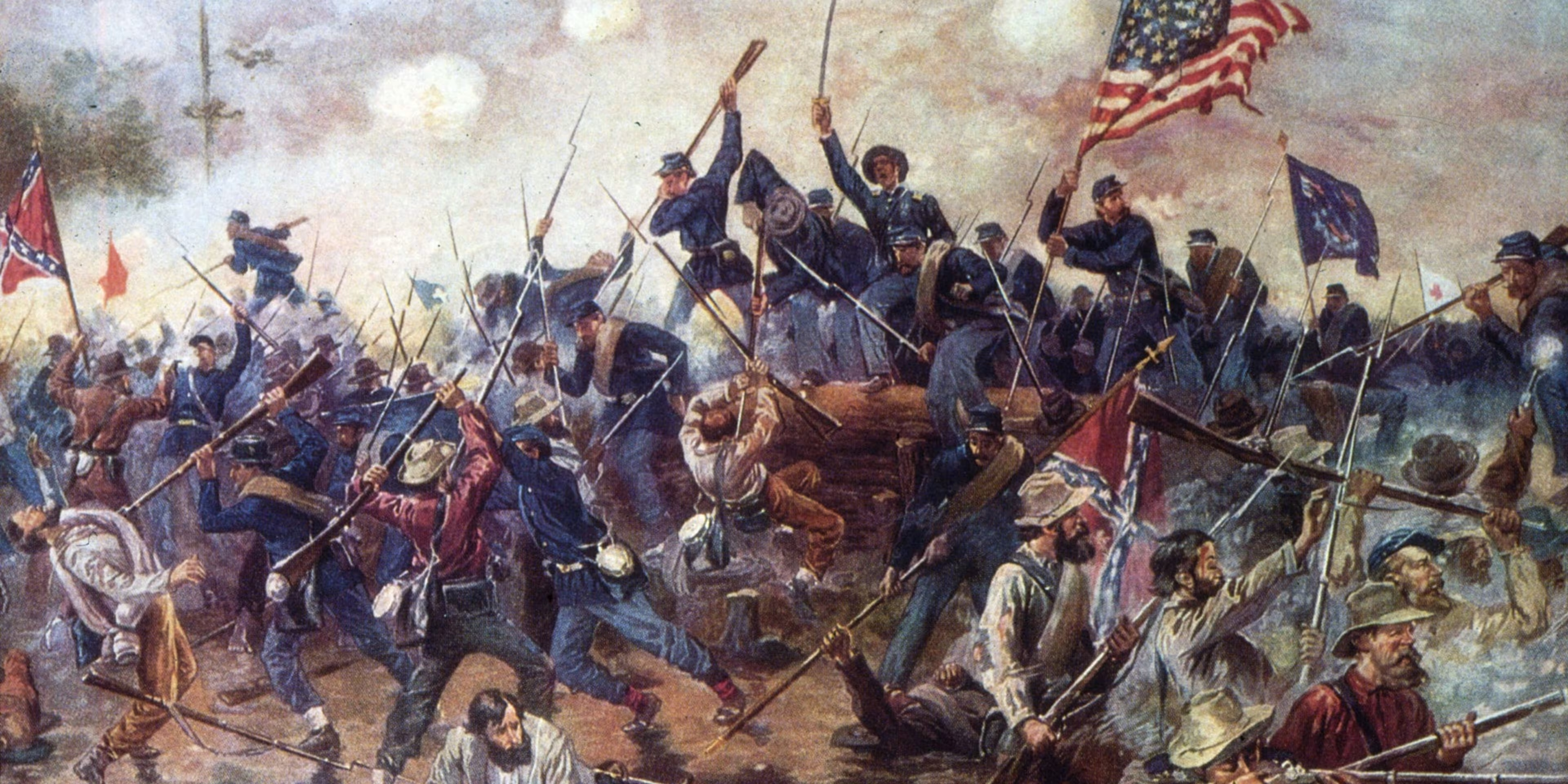
The Civil War was the culmination of decades of political conflict over federal authority and the balance of power between free and slaveholding states. As the United States expanded westward, disputes over whether new territories would permit slavery repeatedly threatened the Union, leading to compromises that only delayed a reckoning, just as compromise had before.
The election of Lincoln in 1860, on a platform opposing the expansion of slavery, convinced many Southern leaders that their political influence was permanently diminished. Beginning with South Carolina, eleven Southern states seceded and formed the Confederate States of America, asserting that states had the right to leave the Union and govern themselves. The new state put chattel slavery at the core of its way of life. Lincoln rejected secession as unconstitutional and maintained that preserving the Union was his foremost responsibility. He assumed in full the awesome powers of Article II of the Constitution. And so the nation went to war with itself.
As war unfolded, federal policy evolved from restoring the Union to also abolishing slavery, a shift marked by the Emancipation Proclamation and ultimately the Thirteenth Amendment to the United States Constitution, which permanently ended slavery nationwide. The Union’s victory—at the cost of as many as a million lives— preserved the United States as a single nation and greatly strengthened the authority of the federal government over the states.
However, the struggle over civil rights would continue long after the war ended, such was the recalcitrance of the Democratic Party. The Republican Party was the obstacle in their path to a disunited America—then as now.
In the aftermath of the Civil War, Reconstruction reunited the nation while defining the legal and political status of formerly enslaved people and the former Confederate states. Congress and the presidency often clashed over how the South should be governed and readmitted to the Union, with Congressional Republicans advocating stronger federal oversight and greater protections for black Americans.
During this period, the Fourteenth Amendment to the United States Constitution guaranteed citizenship and equal protection under the law, while the Fifteenth Amendment to the United States Constitution prohibited denying the vote based on race. Federal troops remained in much of the South to enforce these changes, but resistance from many white Southerners—including organized political opposition and violent intimidation—undermined Reconstruction governments. One manifestation of this was the formation of the Ku Klux Klan, the terrorist arm of the Democratic Party.
The disputed presidential election of 1876 resulted in the Compromise of 1877, under which federal troops were withdrawn from the South, effectively ending Reconstruction. This ushered in the era known as Redemption, during which Democratic governments regained control of Southern state governments, dismantled many Reconstruction reforms, restricted black American political participation through disenfranchisement and segregation, and inspired a reign of terror of lynching and nigger hunts. Democrats established a political order that endured until the mid-twentieth-century civil rights movement.
* * *
In the aftermath of decades of upheaval, corporate power emerged as a significant threat to self-government. Soon, the gates of the nation were thrown open to cheap foreign labor. There had been a wave of immigration before then, but the second wave of mass immigration differed in character and scope. To aid in the corporate takeover that would usher in the administrative state, the Fourteenth Amendment was repurposed by the judiciary. It was out of these arrangements that Progressivism and multiculturalism emerged to advance the interests of the corporate state.
The intent of the Fourteenth Amendment was to ensure citizenship for the children of freed slaves and guarantee equal treatment with respect to the immunities and privileges of the natural-born. However, in the headnote of Santa Clara County v. Southern Pacific Railroad (1886), the Justices of the Supreme Court reportedly did not wish to hear argument on whether the Equal Protection Clause applied to corporations, effectively treating the matter as settled. Later courts and legal doctrine interpreted the court reporter’s summary of the case as foundational law and handed corporations the rights of men.
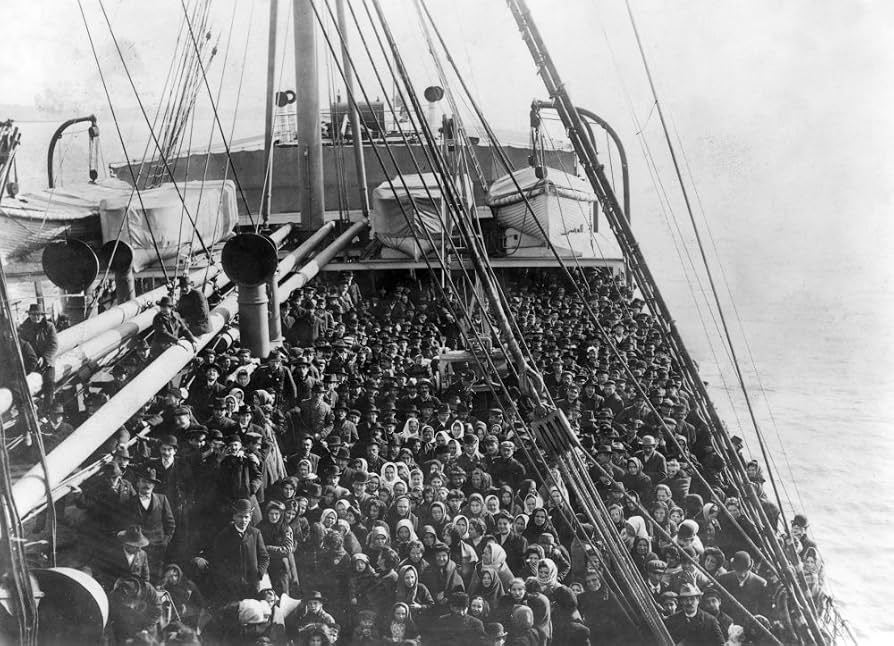
The second wave of mass migration was driven by a combination of push and pull factors. In many parts of southern and eastern Europe, people faced widespread poverty, land shortages, rapid population growth, political repression, and in some cases religious persecution. These pressures pushed millions to leave rural villages in search of relief. At the same time, the rapidly industrializing United States drew migrants with the promise of factory jobs, higher wages, and access to land and upward mobility. Improvements in steamship travel and expanding transportation networks made long-distance migration faster, cheaper, and more feasible than before. Chain migration and immigration networks helped newcomers to established urban enclaves.
Together, these forces produced one of the largest population movements in modern history. In 1880, the US population was just over 50 million. By the 1930 census, conducted just a few years after the passage of the Immigration Act of 1924, also known as the Johnson–Reed Act, which effectively closed America’s borders, the nation’s population had grown to nearly 123 million.
The Johnson–Reed Act was the initiative of the Republican Party, which controlled Congress at the time. The most influential figure behind the legislation was Representative Albert Johnson, a Republican from Washington, who chaired the House Committee on Immigration and Naturalization and became one of the leading advocates for sharply limiting immigration. In the Senate, the bill was shaped and advanced by figures such as Senator David Reed, a Republican from Pennsylvania. Together, Johnson and Reed designed the system of national-origins quotas that became the core of the law.
Support for the act came from a wider coalition beyond Congress. For example, the American Federation of Labor sought limits on immigration due to competition and wage suppression. More broadly, Americans grew concerned about cultural change and demographic transformation. Transnationalists, such as Horace Kallen, argued that diversity made the nation stronger. America should abandon assimilation and embrace multiculturalism, he argued in the pages of The Nation. The people saw the folly in his transnationalist vision and demanded that America close its gates to foreign culture-bearers. And so they did.
The bill was signed into law by President Calvin Coolidge. Coolidge had come to national prominence during the post-Progressive Era. He advanced entrepreneurship, fiscal restraint, and limited government, emphasizing balanced budgets, tax cuts, and limited federal intervention in the economy. Although he accepted some of the administrative and regulatory structures established in the early 1900s, Coolidge opposed expanding the administrative state, especially in areas like economic planning, labor regulation, and social welfare. One more, history reveals the fundamental and enduring differences between Democrats and Republicans.
* * *
In a 6-3 decision, the Supreme Court ruled this week that President Trump’s executive order restricting birthright citizenship violates the Fourteenth Amendment, reaffirming what is popularly believed to be the longstanding principle that nearly everyone born in the United States is a US citizen regardless of their parents’ immigration status. Chief Justice John Roberts wrote that the Constitution does not impose a parental legal-status requirement, preserving more than a century of judicial interpretation.
Not all Republicans have been reliable in adhering to the party’s principles. Roberts and two other Republican appointees—Associate Justices Amy Coney Barrett and Brett Kavanaugh—joined with progressives in betraying the intent of the Fourteenth Amendment. In doing so, they effectively scratched out a major clause of an amendment that granted citizenship to freed black slaves: “All persons born or naturalized in the United States, and subject to the jurisdiction thereof, are citizens of the United States and of the state wherein they reside.” Justices Roberts, Barrett, and Kavanaugh ignored the italicized clause to rewrite the purpose of the amendment. (It was a largely Republican-appointed Supreme Court that had affirmed corporate personhood in the aftermath of the Civil War.)
Upholding a bad interpretation of the Fourteenth Amendment is not only an insult to black Americans and to all those who died freeing their ancestors; it is an insult to all Americans, who, by the lights of the Constitution, have an inherent collective right to national self-determination. Missed was an opportunity not only to correct a historic mistake, but to prevent future developments that will likely bring about an end to the Republic. When Democrats get in power and open America’s gates to the world, they will resume the project of changing the demographic composition of the nation and achieve one-party rule. If this happens, there will not be a 300th anniversary of the Declaration of Independence.
* * *
The Democratic Party was the party of the slavocracy. The planter class sold primary commodities on the international market and thus sought to keep the United States in a peripheral position to the world capitalist economy. Despite the United States having overcome peripheral status to become world hegemon, Democrats seek a return to the prior arrangement. The Republican Party, by contrast, in its moments of clarity (the Bush tendency being the major exception), has sought a program of economic nationalism, enriching American citizens by establishing the United States as the world’s industrial powerhouse.
Achieving peripheral status depends on disorganizing American families and communities and pitting worker against worker. Just as Democrats used slavery and Jim Crow to divide the working class, the party used affirmative action and DEI to fracture the proletariat in the post-Civil Rights Era. The path represented by the Republican Party requires strengthening the foundation of a virtuous civilization through national unity. Via command of America’s sense-making institutions, Democrats have made nationalism a dirty word and those who oppose race-based discrimination into racists. Once history is properly ascertained, such smears lose their force.
The reality is that America overcame Jim Crow more than six decades ago with the Civil Rights Act of 1964. The law developed out of the broader civil rights struggle of the 1950s and early 1960s.
The legislative origins of the law are closely tied to the presidency of John F. Kennedy, whose policies aligned more with nationalism than with those advanced by the globalists. During his presidency, Kennedy proposed an across-the-board income tax reduction to stimulate economic growth. He believed in using tariffs as bargaining tools, reducing them when other countries reciprocated. Focused on expanding export markets for US agriculture and manufacturing, he advocated significant federal investment in industry and infrastructure. He greatly expanded defense spending to confront the communist menace. Frustrated with entrenched bureaucratic resistance to parts of his agenda, he favored efficiency and modernization of federal agencies. He even confronted the Deep State, in particular the CIA.
Sound familiar? Indeed, I note all this because today’s Democratic Party would be an inhospitable place for Kennedy. Kennedy’s nephew, Robert Kennedy, Jr., currently serving as the Secretary of Health and Human Services, still holds to his uncle’s values. He left the Democratic Party to join Trump’s administration. Like his uncle, who was assassinated in 1963, the president that Bobby serves was also struck by an assassin’s bullet. Trump survived the attempt. So they tried again. Trump gave his speech to the nation last night behind a wall of bulletproof glass. By contrast, Mamdani goes to the streets of New York without concern for his safety. Both know the world they live in.
Returning to the narrative, as president, in addition to unchaining the productive machinery of American industry, Kennedy became more engaged with civil rights issues, especially after events such as the Freedom Rides, the integration crisis at the University of Mississippi, and growing nationwide protests. Over the course of his term, Kennedy increasingly framed civil rights as a national imperative.
In June 1963, after the stand-off at the University of Alabama and rising national unrest, Kennedy delivered a televised address announcing that civil rights was a “moral issue” and calling for comprehensive legislation to guarantee equal access to public accommodations, schools, and employment. He formally sent a civil rights bill to Congress shortly afterward. That proposal became the foundation of what would later become the Civil Rights Act of 1964.
Kennedy was assassinated before the bill could pass. After his death, as he did with Kennedy’s tax cuts, President Johnson made passage of the bill a central political priority, explicitly invoking Kennedy’s legacy as a reason for immediate action. Johnson used his experience in the Senate to build coalitions, manage negotiations, and apply pressure to secure votes. He repeatedly told congressional leaders that failing to pass the bill would dishonor Kennedy’s memory.
The bill faced its greatest obstacle in the Senate, where Democrats mounted a prolonged filibuster to prevent a vote. Opponents of the bill used the filibuster for over two months in 1964. The filibuster was ultimately broken when the Senate voted 71–29 to invoke cloture, ending debate and clearing the way for a final vote. Crucially, this could not have happened without Republican votes. Indeed, a much greater proportion of Republicans supported the law in both chambers than did Democrats.
When the Senate voted on final passage, the Civil Rights Act passed 73–27. Sixty-nine percent of Senate Democrats supported the bill. Eighty-two percent of Senate Republicans supported it. A bipartisan coalition was essential. Opposition was concentrated in the Democratic Party, which held majorities in both chambers. In the House of Representatives, 63 percent of Democrats voted in favor, while 80 percent of Republicans voted in the affirmative. As in the Senate, Republican support and Northern Democratic support together overtook opposition to the law. The result was one of the most significant civil rights laws in American history, fundamentally reshaping federal authority over segregation and discrimination in public life.
With segregation out of the way, Southerners, generally opposed to big government intrusion in their lives, gradually left the Democratic Party and joined the Republicans. Democrats retooled the racial system by establishing racial preferences that systematically disadvantaged whites, promoting anti-white bigotry to justify these systems, and implementing a vast welfare state that trapped black Americans in a cycle of dependency. They also opened the country to mass immigration, passing the Hart-Celler Act the year after the Civil Rights Act, and entrenched free trade, leading to the mass exodus of high-wage, capital-intensive jobs to the Third World. These developments proved devastating to black Americans, who have been idled, their family system undermined (three-fourths of black children are born in single-parent homes), and their communities fraught with crime and disorder.
* * *

As Independence Day celebrations approach nationwide, Obama is exploiting the moment to argue that America’s founding ideals of liberty and equality cannot be fully understood apart from the history of slavery that coexisted with them—and the entanglement we all acknowledge must be understood in the worst light possible: slavery is our original sin. We are forever a fallen nation because of an ancient and global system in which some of our ancestors participated. This move allows Democrats to distract from the reality that the present situation of black Americans is not because of slavery, but because of the progressive policies the party champions.
Obama was intent on linking Washington and the Founders with slavery to continue his project of sowing racial division. Although not his intent, he invited us to reflect on the history that shatters the woke progressive narrative. It is not just the history of slavery in America that implicates the Democratic Party in racism, but the Civil War, Redemption, the Civil Rights Era, and what followed. The facts prove devastating to the progressive project of historical revisionism. Those who abolished the slave trade, chattel slavery, and Jim Crow—as well as affirmative action and DEI—are those we associate with the Republican Party and its forerunners.
As previously explained on this platform, the parties didn’t flip. The Democratic Party remains the party of free trade and identitarianism—which they have expanded well beyond racial antagonisms to include imaginary forms of oppression (e.g., gender identity). Despite regrettable deviations at various points along the way, Republicans today champion nationalism and individualism, just as they did during Lincoln’s days (who was assassinated by a Democrat’s bullet).
In abandoning liberalism altogether, which progressivism necessarily entails, the Democrats have jettisoned any redeeming qualities they once had. The home of liberalism today is the Republican Party. It is the Republicans who uphold the values of the Enlightenment, while Democrats pursue transhumanism and the managed decline of the American Republic.
Those who voted for Obama thought they were affirming America’s promise. A black man was elected president. I caught grief for refusing to vote for the man. A colleague thought it was what I always wanted. But, as I knew it would, the nation left Obama’s two terms in office more racially divided than before. During his first term, the corporate media aggressively pushed out the academic rhetoric of systemic racism and white privilege. Black Lives Matter emerged during his second term. He fed the emerging narrative of systemic racism. By the time he left office, racial antagonisms were at a level Americans had not experienced in decades. Out of office, he continues to fuel the hostilities.
Obama always stands ready to advance the agenda of managed decline. The elite can count on him to interject racial division at key moments. His pairing of the 250th anniversary with the Founding Fathers’ participation in the legacy institution of slavery is designed to delegitimize us. Rather than celebrating the force of the American spirit in overcoming obstacles to a higher unity, however much he may feign admiration for Washington, Obama intervenes to remind us that the nation’s original sin of slavery will always taint the moral authority of our beloved Republic, a sin that white Americans must atone for eternally. And Mamdani is there by Obama’s side to punctuate the narrative.
Obama’s intervention has slavery as the albatross that history has hung about America’s neck. What he hopes to obscure is that the true albatross is the Democratic Party. Progressivism is the deadly omen. That we have survived this long with the weight of this dead bird pulling us down strongly suggests divine providence. And I say that as a nonbeliever.


