
Have you seen this meme yet? It is often framed with a question that goes something like this: “Is Elon Musk a robot?” No, Musk is a sympathetic human. He’s right; empathy is a fundamental weakness of Western civilization. Indeed, the concept (like “cultural relativism” and other like concepts) was invented to weaken Western civilization. I have written several essays on this, but The Problem of Empathy and the Pathology of “Be Kind” is the most comprehensive. I will follow the meme with a brief treatment here, since I did not discuss Hannah Arendt in previous essays.
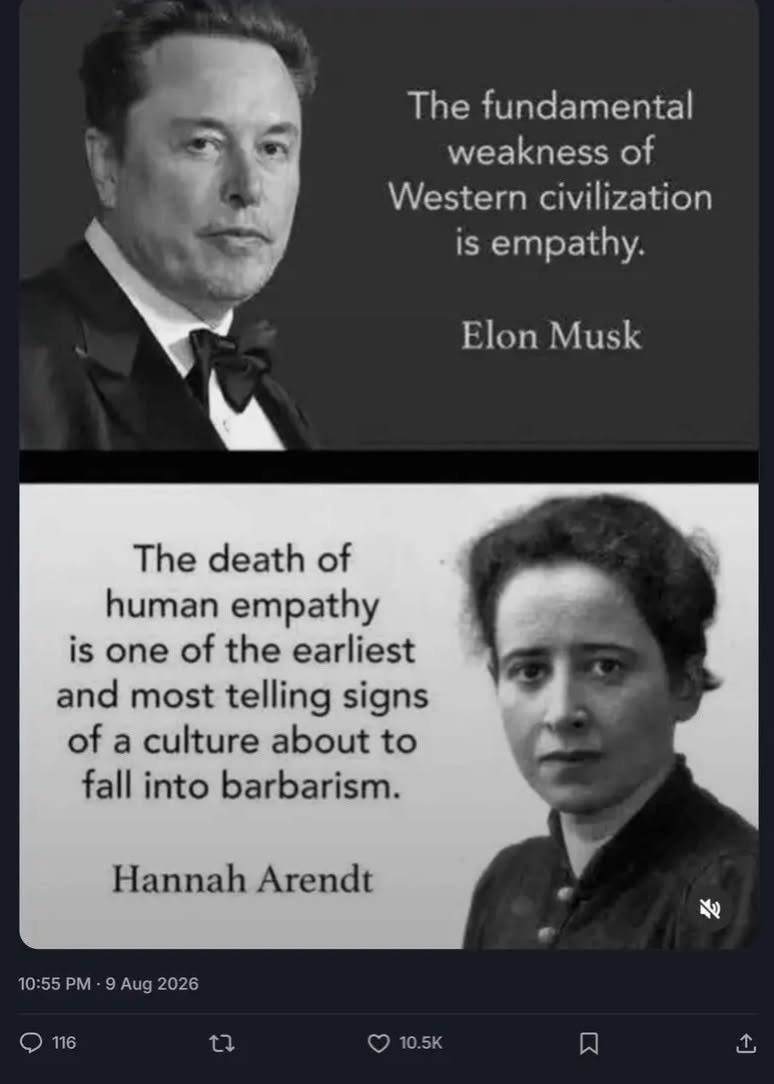
The meme is misleading. Hannah Arendt rejected empathy as a guide for political or critical thinking, viewing it instead as an illusion that erases the necessary distance between human beings. Where did she get this idea? In his Moral Sentiments argument (which you can download here for free), Scottish philosopher and economist Adam Smith argued that morality is rooted in imagination, sympathy, and the impartial spectator.
For Smith, sympathy is the ability to imaginatively understand others’ feelings by placing ourselves in their situations. However, one does not accept the moral frame of the person with whom one is imaginatively swapping places. He does this to gain an appreciation of the man’s situation so he can better understand him. Indeed, unless he is a psychopath, he cannot help but do this. Smith explores the subject to establish the foundations of ethical behavior and to show how self-interest serves society’s broader good. What may seem paradoxical is resolved by grasping human nature and bringing out the best in it.
Empathy, on the other hand, is a recent invention that invites people to assume the perspective of the other person (the drug addict, the alien, the pedophile), and not only imaginatively swap places but judge right and wrong from his perspective. Empathy is associated with the pathology of people identifying with the alien and the criminal. We see it in the demand that society affirm the false gender identity of a delusional man. Empathy negates the impartial spectator and robs a man of discernment. Divorced from rational discernment, a man is unable to judge individuals and right from wrong. He thus, perhaps unwittingly, puts his life, his family, and society in jeopardy.
Arendt makes the same argument as Smith, even down to the observations of imagination and place-taking. For the record, this is the foundation of sociology’s looking-glass self (Charles Horton Cooley’s formulation) and, more broadly, pragmatic ethics. Arendt was well educated in sociology and pragmatic ethics.
In the final analysis, sympathy is a destructive demand. That’s what Musk is talking about. Gad Saad wrote about it this May, in a book appropriately titled Suicidal Empathy: Dying to Be Kind. Folks should read Smith and Saad’s work instead of ignorantly posting memes that distort what people think and say.


