
Helen of Troy appears in director Christopher Nolan’s upcoming epic mythological film, The Odyssey. Academy Award-winner Lupita Nyong’o plays both Helen and her sister, Clytemnestra, in the film. For those unfamiliar with Nyong’o, she is black. Helen was white. Objections to her casting are met with various rationalizations, chief among them: actors can play any role; objecting to Nyong’o performing the role is rooted in white supremacy; and Helen was a mythological figure, euhemerized into history, so what does it matter?
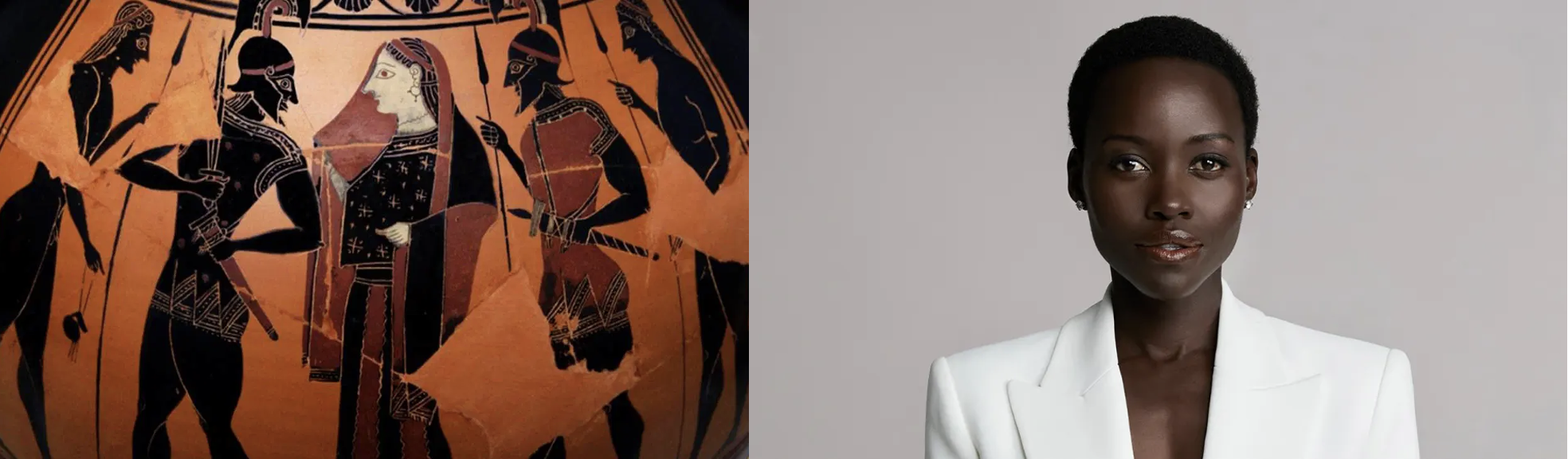
If Helen of Troy were a historical figure, given where she was purportedly from, what do you think she’d look like? Have you read descriptions of her? She’s described as especially white. It was her most remarkable feature. She would have stood out among the olive-skinned people around her. It wasn’t as if Sub-Saharan Africans were unknown to the peoples of the Mediterranean. If Helen were black, we’d have known about it.
Many of us know that Helen was fair-skinned and likely had blond or reddish-blond hair, but some people will watch this movie and walk away believing Helen was an African woman. The choice of actor distorts history—and for political reasons. It would be the same with depictions of Jesus. If Jesus were a historical person, he would have been male and Caucasian. Depicting Jesus as a woman or an African would rightly be seen as an ideological move.
The rule is not unconditional. Black performers participated in the production of Jesus Christ Superstar. That was a rock opera where vocal performances were centered. This is not the same as producing a historically-based drama where accuracy is integral. In that case, it compels the dramaturgist to contradict the integrity of his field for the sake of diversity. It is not that non-Jews cannot play the role of Jesus, but casting a Chinese man in the role would signal an agenda.
To be sure, movie studios can cast anybody they want in their movies. But when studios use the medium to push historical revisionism for ideological purposes, they should be called out for it. The controversy over the lack of diversity in The Promised Land arose from a tense exchange during a press conference at the Venice Film Festival, rather than from broad audience criticism of the film itself. Danish actor Mads Mikkelsen and director Nikolaj Arcel were confronted with the question and responded appropriately with astonishment. The discussion largely focused on the tension between Hollywood’s diversity standards and the historical realities of European settings. But the movie is set in eighteenth-century Denmark.
Part of movie magic is the ability to suspend disbelief. Taking liberties with characters is particularly hard when the subject matter is historical and well-known. Knowing that Helen and Jesus were Caucasian would make it impossible for somebody who knew these stories to participate in the magic.
This is true for movie roles in many different ways. When Robert De Niro depicted Jake LaMotta in Martin Scorsese’s Raging Bull, the actor bulked up to look like a middleweight and even put on 60lbs to portray the older LaMotta. Those of us who follow boxing history would have found a skinny De Niro unconvincing in the role. Suppose a black actor was cast as LaMotta? Sounds absurd, but this is where diversity rules take the industry.
Something must be said about hypocrisy here. Suppose Martin Luther King, Jr. were played by a white man? Ben Kingsley was criticized for portraying an Indian in Gandhi, specifically accused of “brown face”—even though Kingsley was of Indian ancestry on his father’s side and both the English and the Indians are Caucasian. A white man portraying King would be scandalous. I would not think to ask why it matters that King is played by a white man. I know why it matters. And knowing why something like this matters is not a matter of racism on my part. If racism is to be found here, it is to be found among those who are erasing the racial identity of historical figures for the sake of an identitarian agenda.


