
Advocates of racial gerrymandering argue from the assumption that white politicians cannot represent the interests of black citizens. Even though whites abolished slavery and apartheid, blacks need black politicians to advance their interests. Progressives ask you to imagine Congress with no black members, assuming that everybody shares the assumption of a racist America. The argument is thus presented as securing black power against white supremacy. But, in reality, the argument is propaganda for the ambition of progressive elites. Racially gerrymandered districts are, at their core, a political strategy for reclaiming power Democrats lost with the abolition of Jim Crow. In this essay, I expose the strategy by debunking the assumption. More than this, I show that the progressive argument is logically fallacious.
At the heart of the propaganda is the falsehood that systemic racism exists. There are two errors here. The first is the assumption that racial disparities result from racism. But any causal claim about the concrete world needs to be demonstrated with evidence. One might be able to show discrimination in individual cases, but to assume it for aggregate differences—and then base policy on it—is the work of a strange alchemy in which what requires justification becomes proof of justification. But, in the absence of de jure discrimination, the problem is much harder than this. One finds a second error is the fallacy of misplaced concreteness. This is where an actual thing is treated as a manifestation of an abstract category. The fallacy stands in place of the evidence needed to validate the claim of systemic racism. Blacks are presumed to be the victims of white supremacy. White supremacy must be presumed to exist for this to work. Critical race theory is the ideology that manufactures the necessary illusion.
There is, ironically, a racist truth that lies behind these presumptions: Democrats find useful black politicians to lead voting blocs organized by progressive social policy. Millions of black people have been made dependent on the government and privileged in educational and occupational opportunities, benefits advanced by the Democratic Party. The present practice is thus an adaptation of an ancient strategy for achieving hegemony. In the past, members of various tribes in an area were selected to collaborate with the ruling elite to manufacture the appearance that the ruling class represented tribal interests. This was standard statecraft in kingship systems. In today’s context, the tribes are manufactured by a stratum of elites. From these contrivances, individuals are selected to perform the same function as they did in ancient times. They are regarded as useful for political ends.
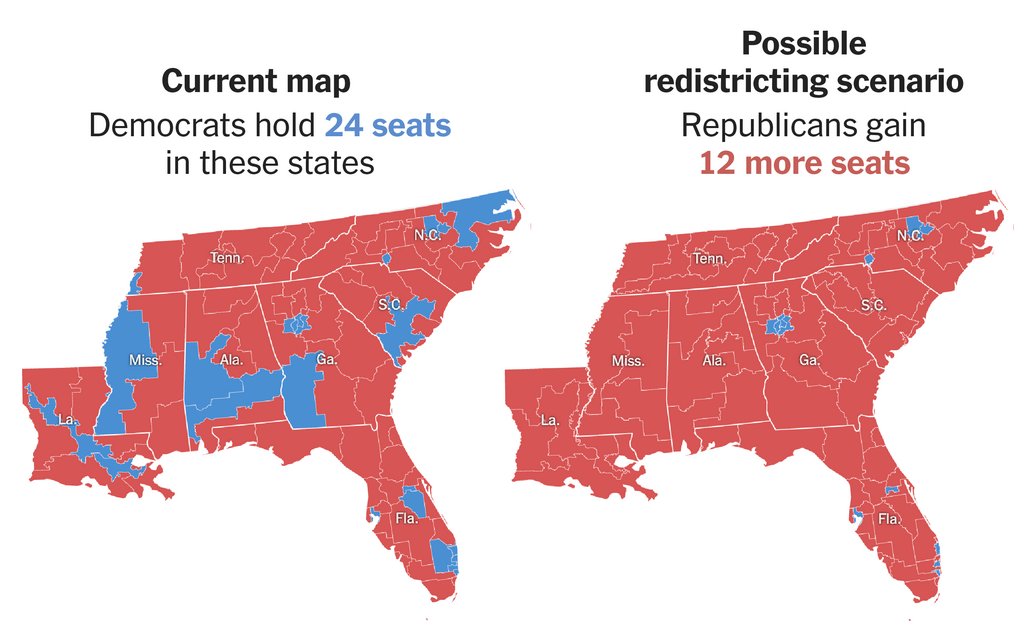
Rank-and-file progressives are horrified by the projected maps in the South. They see a sea of red, which they have been conditioned to perceive as a sea of white supremacy. They believe this despite historical facts. For the rank-and-file, America is genetically racist, with whites on top and blacks on the bottom. Hence, the rhetoric of “racial justice.” They believe this in the face of history: the party associated with red today ended slavery and segregation and remains committed to equality before the law. During the days of slavery and segregation, the sea was blue. Now there are but a few blue patches. What horrifies progressive elites about those shrinking blue patches has nothing to do with racial justice but rather the loss of political power. Democrats invested trillions in engineering voting blocs whose power was maximized by rigged maps. Now those rigged maps are being dismantled, and with them, electoral power. A situation Democrats spent decades creating is crumbling around them, just as it did when Republicans abolished slavery and led the way during the Civil Rights movement in ending segregation. In both historical cases, equality before the law shattered Democratic hegemony.
The Voting Rights Act of 1965, ostensibly designed to prevent racial discrimination in voting, assumed genetic white supremacy and misplaced concreteness to convey a sense of validity where there was none. Two elements of the law stand out in this regard. Section 5 required certain states with a history of discrimination to obtain federal approval before changing voting laws. Thus, the citizens of certain states were treated as second-class, deviants to be governed by the paternalistic state. Section 2 banned voting practices that weakened the political power of minority groups, as if it were “just” to privilege certain races over other races. Over time, the Supreme Court of the United States, in great measure because its composition has been changed, has limited how these provisions operate. Explicitly or not, the Court’s rulings are rooted in the recognition that neither provision is logically valid.
In Shelby County v. Holder (2013), the Court struck down the formula used to identify which states are subject to Section 5. Section 5 technically remains in the law, but it has been rendered effectively unusable because no jurisdictions are subject to it anymore. They should never have been, since section 5 only requires the presumption of racial discrimination. That is, it assumes as given what requires evidence. Moreover, it applies the assumption to the entire body of citizens of the affected state, thus negating their democratic power. In effect, all citizens of an affected state are presumed to be racist and directed on that basis. Shelby County permits states to change voting laws without federal preapproval. That those states are predominantly red reflects the will of people unconstrained by an arbitrary designation. The badge of racism has been removed.
In the April 2026 decision, Louisiana v. Callais, the Court narrowed Section 2. Previously, plaintiffs could challenge voting maps by showing that they had the effect of diluting minority votes, even without explicit proof of discriminatory intent. The question of why diluting minority votes should be meaningful is skirted. This goes to the heart of the point I am making in this essay: one cannot presume racial disparity is the result of racism; one must prove that racism explains racial disparity. Thus, the logic used in Shelby County is extended to Section 2. That this was unexpected is rather disingenuous. Propagandists feign unexpectedness to manufacture outrage and reinforce the assumption of white supremacy. The ruling makes those challenges much harder by requiring evidence that lawmakers intentionally discriminated. By requiring positive evidence for claims of discrimination, the decision negates the strange alchemy by returning adjudication of such matters to the realm of logical reasoning.
The Supreme Court ruling thus not only struck a blow to racial gerrymandering but also disallowed unproven claims of racial discrimination to stand as dispositive evidence, since heretofore, no evidence was needed, only assumptions based on bold conjecture derived from ideology. It moreover eschews the fallacy of misplaced concreteness. The error of presuming racism is the cause of disparity rests on this fallacy. I want to elaborate on this point to show how it corrupts democracy.
The fallacy of misplaced concreteness is a holdover from an ancient idea: Plato’s ontology of forms. For Plato, abstract entities are more real than the actual things themselves. Consider man’s best friend, the dog. Dogs are mammals that we have classified as such. The abstraction “dog” is the result of the common observation that some mammals can produce offspring with one another. Dogs constitute a species. Plato starts with an abstraction. The abstraction is the essence of “dogness” that dogs manifest in their concreteness. Humans have learned through selective breeding that they can manifest dogs according to an ideal type they and others have developed in their heads for whatever reason—function, aesthetics, and so forth. For Plato, the ideal type exists a priori. It is not that the breeds exist mind-independently (they are man-made); the idea of the dog does. Everything found in nature is a mind-independent form, according to Plato’s theory of forms.
In racialized thinking, racial categories represent ideal forms, and concrete individuals manifest these forms in the concrete. A black man is not merely an individual with a set of phenotypic characteristics that men identify as black, but an individual who carries in him the essence of blackness. It’s not just physical characteristics. It’s everything—the way he behaves and thinks, his aspirations and interests, and so forth. Thus, how he votes reflects his essence. This is how Joe Biden could say, “If you have a problem figuring out whether you’re for me or Trump, then you ain’t black.” Racial thinking flattens individuals into personifications of Platonic essences: if their actions or attitudes do not align with form, then they are not the thing itself. (This is also how men can say they’re women. “Womenness”is an essence which men can embody.)
In the case of the progressive adaptation of the Voting Rights Act, blackness and whiteness are the forms that determine individual actions and attitudes. Despite individual variation, blacks and whites manifest group essences that, in the main, determine their respective voting patterns. It follows that, as a white man, I should be concerned about the race of my representative, since I come with racial interests that can only really be represented by those who look like me. The assumption at work here is essentially collectivistic.
However, I might ask whether my interests are not the same as those of any other man. What interests do I have that are exclusive to my race? Races are, after all, abstractions, and I am a concrete individual. I have interests in common with black people. If I conclude that I have no exclusive interests, then that’s a good thing; after all, I am not allowed to have interests exclusive to my race, since, if I did, that would make me a racist. Only blacks—or those who presume to speak for them—are allowed to have race-based interests and preferences.
Those who presume to speak for blacks are allowed to be racist because of the relationship between essential forms. The essence of whites is that of the oppressor/perpetrator. The essence of blacks is that of the oppressed/victim. On this theory, the sea of red and the dwindling blue patches represent racism. A neutral map cannot really be neutral since it is presumed to benefit whites. Only a map where blacks are advantaged over whites can be non-racist.
This is true for racial thinking generally. Racial gerrymandering is affirmative action’s sister. The logic of affirmative action assumes racial disparity is a valid justification for differential treatment, i.e., establishing special circumstances for some along racial lines. The absence of special circumstances for blacks is said to privilege whites, a race of people for whom privileges are presumed based on ideology. They are presumed privileged based on averages found in abstract demographic categories. But abstractions are not people. There are rich blacks and poor whites. Moreover, group differences have to be explained. One cannot simply assume they are explained by oppression.
In the progressive worldview, ideology stands in place of evidence. Affirmative action is a “just” response to the discrimination progressives presume (or at least claim) exists. By claiming that racial discrimination exists in the structure of society, progressives locate the question in the realm of abstraction. Hence, the construct of “systemic racism.” However, the only actual manifestation of racism in the case of preferential treatment is affirmative action, which by definition and in intent is positive discrimination affecting white people. That millions believe that actual racial discrimination is the solution to imagined racial discrimination is a spectacular propaganda achievement.
The spectacular achievement notwithstanding, racial gerrymandering is coming to an end. The Court recognizes that, under the status quo, the vote of every white man and black man in a gerrymandered district is not cast on equal footing, but potentially canceled by an artificial majority constructed by rules based upon fallacious reasoning—rules established to advance party interests rather than the common interests. Elections have consequences, and although the present Court makes decisions with which I disagree, it has, so far, demonstrated a much greater depth of reason than previous Courts in recent memory. Elections have consequences. Remember that in November.


