
In a May 2024 essay, Gender and the English Language, there is a section on the construction of a moral panic around race matters. I included this section to note that the construction of gender identity is not the only instance of a project to rapidly alter mass perception via changing words and meanings. The manipulation of mass conscience is a multipronged project. Since then, I’ve thought about isolating that section in a new essay to make it more accessible. The persistence of the left to keep racism alive for political purposes, most notably in the Southern Poverty Law Center funding the far-right actors in Charlottesville, and the recent Supreme Court decision sharply limiting the way the Voting Rights Act has been used by the Democratic Party to achieve power (see The Project to Establish Voting Rights on Rational Grounds Thwarts Progressive Power Grab; Louisiana v. Callais and the Politics of Selective Collectivism), moves me to finally pull out that piece and put it in a standalone essay.
In a detailed content analysis of major media sources published in Tablet in 2020, “How the Media Led the Great Racial Awakening,” Zach Goldberg tells us that, “[y]ears before Trump’s election the media dramatically increased coverage of racism and embraced new theories of racial consciousness that set the stage for the latest unrest.” Not just unrest. The media played a key role in reinforcing the ideas that long before colonized America’s sense-making institution, most crucially, education. Moreover, as I have shown on this platform, as with queer theory, the jargon of critical race theory has colonized the medical science space.
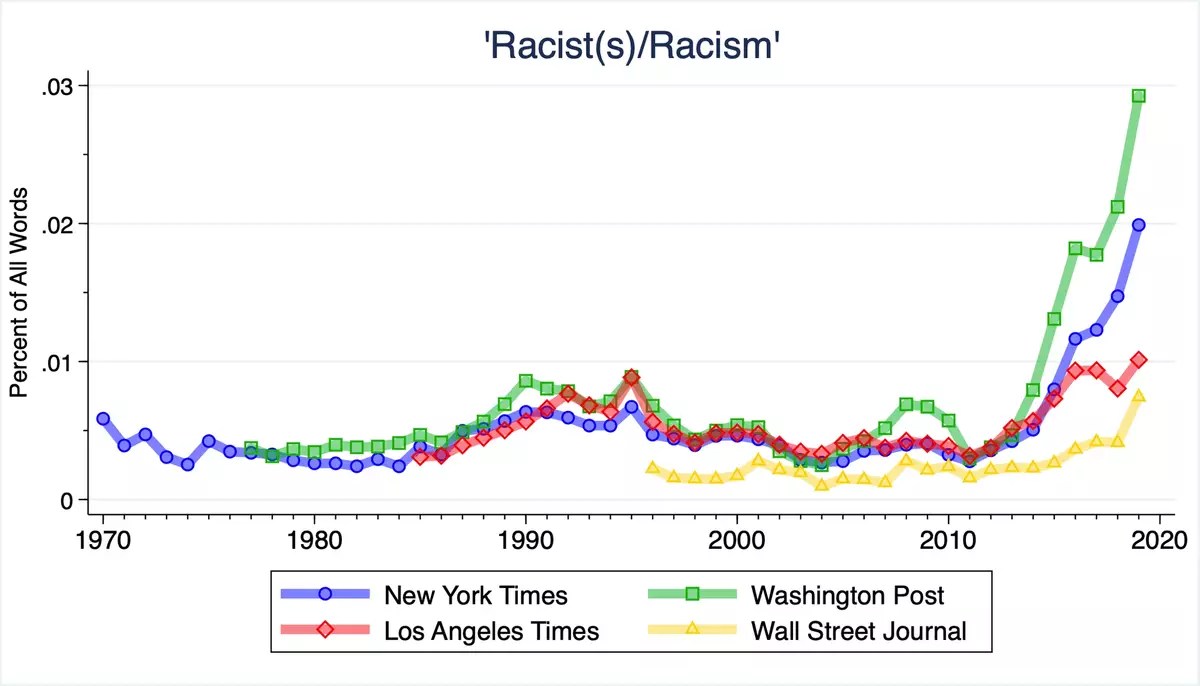
You can find Goldberg’s article here, and I strongly encourage you to read it, but I want to pull a few charts from the piece to make the point more immediate. In the first two charts, the reader can see that, beginning around 2010, a drastic increase in references to “racists” and “racism,” and a corresponding rise in the percentage of the population who reported that racism in the United States is a problem. This rise in concern follows a period of long decline. If you ever needed to see the evidence of how the corporate media constructs and drives mass perception of social problems, Goldberg delivers it in spades.

Indicated by the next several charts, the use of terms like “racists” and “racism” were buttressed by a slew of novel or academic terms developed by progressive historians and social scientists, pushed out by the corporate media and culture industry: “systemic racism,” “structural racism,” and “institutional racism”; “racial privilege” and “white privilege”; “racial hierarchies,” “whiteness,” and “white supremacy”; “racial disparities,” “racial inequalities,” and “racial inequities.”
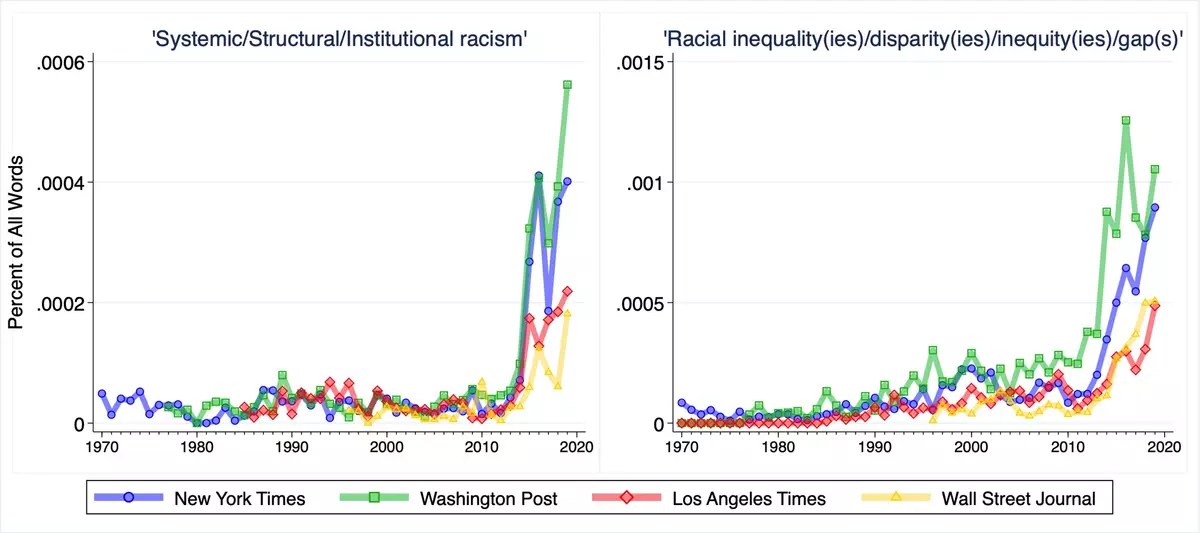


In this way, the alleged effects of “whiteness,” “systemic racism,” etc., were identified as causing racial disparities and inequities without any demonstration of the validity of the alleged independent variables or their explanatory power. No matter, the terms comprised an assumption in force that America remained a profoundly racist country. Reinforced by race hustlers like Ibram X Kendi and Robin DiAngelo, and through constant repetition, the abstract facts of racial disparity became their own cause, so much so that even suggesting they were explicable by reference to causes outside of the antiracist narrative risked being labeled a racist.
I argue in Manipulating Reality by Manipulating Words, that reducing definitions to mere instruments of power—treating language primarily as a way to shape or impose reality—undermines the fundamental purpose of words. Language, in its evolved function, exists to describe and communicate reality with accuracy, precision, and integrity. Repurposing language to construct reality distorts that purpose. When words are no longer trusted as reliable vehicles for truth, those who control the production and dissemination of ideas gain greater freedom to justify their aims, in part by eroding the distinction between fact and fiction. This is not a novel observation. In his 1946 essay “Politics and the English Language,” George Orwell observes that “if thought corrupts language, language can also corrupt thought. A bad usage can spread by tradition and imitation even among people who should and do know better.”
Any of you who have more recently attended college and taken any humanities and social sciences courses, usually required by the regime of “general education,” will have learned that what is and its nature (the ontological) is shaped by how we think about such things (the epistemological). Of course, the usefulness of this distinction and effect depends on whether one received an education or was indoctrinated. If the latter, then the experience was with teachers who, following the Greek philosopher Antisthenes, believed that language creates categories rather than uncovering reality. There is no reality to be uncovered. What is real is power projection. If the former, where one learns to be wary of acts of construction, then he knows those concerned with truth must purge the machinery of meaning production of the corrupting force of postmodernism and its children.


