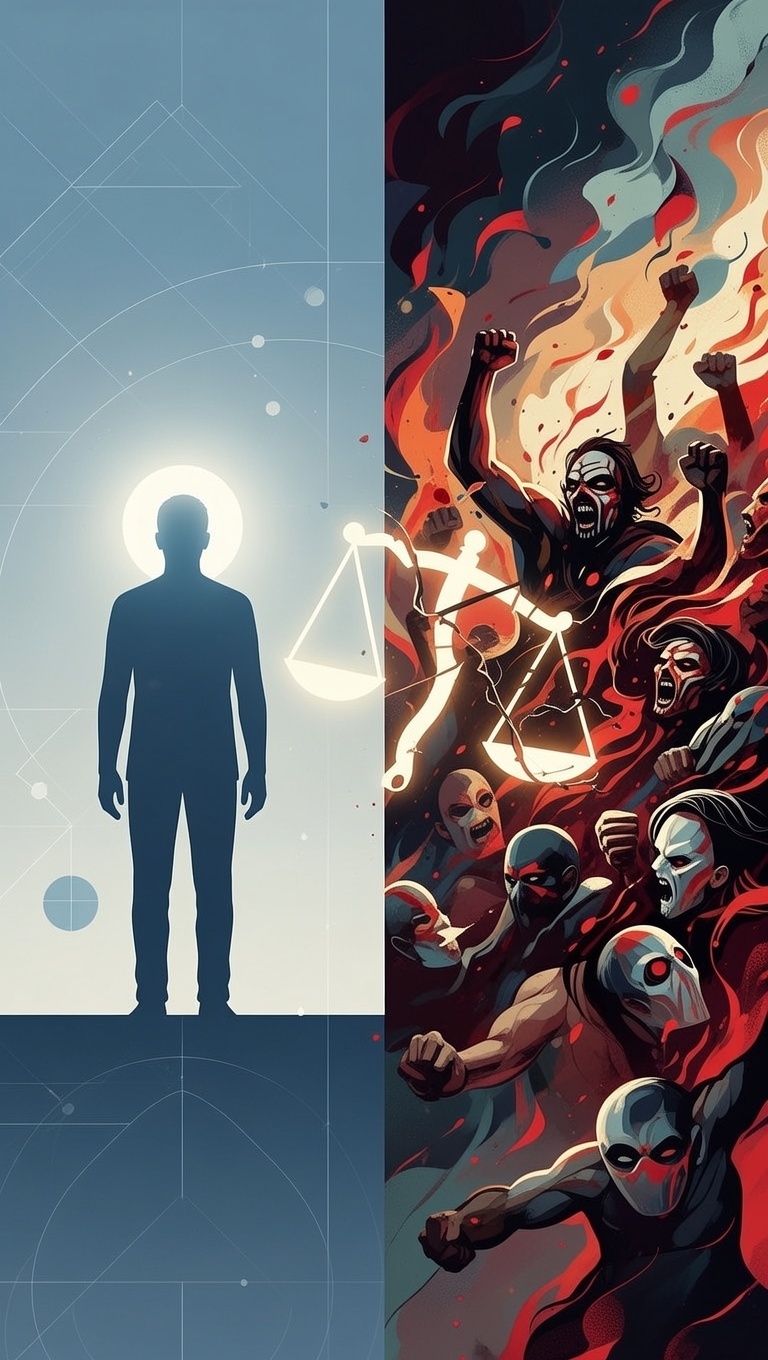
Today, on social media, fed up with fanatical posts elevating Alex Pretti to the status of martyr, I wrote, “You can honor Pretti’s life by not inserting yourself into law enforcement operations. If you don’t like immigration law, elect people who will change it. Don’t substitute direct action for the democratic process. Argue for your ideas like a mature adult. Take your failure to persuade others like a dignified and rational person—in stride. Don’t succumb to the madness of crowds. Don’t assault federal agents and police officers, especially if you are carrying a firearm.” I feel obligated to meet the madness with reason. Not that I think that as one man I can convince my fellow man to turn back from the path of irrationalism. I can only add my voice to those who also feel such an obligation.
After I wrote these words, and after leaving numerous comments on various accounts comparing the arrest of Don Lemon for storming a church and terrorizing children to “fascism,” I reflected once more on my sociological training and what it has to say about the madness the world is witnessing on the streets of American cities. In the past, I have informed my commentary by turning to C. Wright Mills and his kind. This time, however, modernization theory came to mind. Modernization theorists, most notably Harvard sociologist Talcott Parsons (who famously developed the concept of the “sick role”), argued that societies differ in the value orientations that shape social institutions and guide roles within them. Parsons distinguished between modern and premodern societies, the latter marked by primitive rituals and values. There, I thought, is a great source of applicable insight.
The applicability of modernization theory has dawned on others, which is why progressives and radicals have worked so hard over many decades to discredit it. With the rise of postmodernism and postcolonial studies in the academy, modernization theory was accused of rationalizing colonialism, imperialism, and Western oppression of Third World peoples. “It’s a racist theory!” students were told by their teachers. I know, I was among them. Now I see why I was taught to think this way: discrediting social theory supporting freedom and reason is part of the project to delegitimize Western rationality and the ethic of individualism to prepare populations for incorporation into a new world order: transnational corporate neo-feudalism. I’m not saying that my teachers, the most influential among them Marxists, were consciously part of the project. Indeed, it took me several years to come to terms with the reality that they had been duped and become functionaries of a project organized by those whom they continue to proclaim disdain for—and that I, too, had been bamboozled by those unwittingly conscripted in a war against the West.
This attitude followed me out of graduate school into my current teaching position, where it was institutionally reinforced. Professional tribalism is a powerful force. I learned that the department, then called Social Change and Development, was originally called Modernization Processes, back in the 1960s, when the university was founded as one of several progressive institutions of higher education. Those who came to the university in the 1970s, fresh from campus cultures radicalized by the student socialist movement and cultural revolution—a British Marxist historian, a world historian enamoured with Maoist China, and others with similar proclivities—changed the name because of what modernization suggested, namely that the Global North was superior to the rest of the world.
Over time, as I have explained in essays on Freedom and Reason, my early socialization in deontological liberalism allowed me to overcome progressive indoctrination. The greater the distance from my programming, the more obvious it became—and the more those theories I had been told to reject made sense. In this essay, I will show how modernization theory provides a useful analytical frame for understanding the madness the world is witnessing on the streets of American cities.
Following the founding sociologists Emile Durkheim and Max Weber, Parsons understood modernity as a distinctive stage of social development characterized by functional differentiation. In modern societies, social functions become separated into specialized institutions or systems—such as the economy, education, law, politics, and science—each governed by its own norms and forms of rationality. Whatever its downsides (explored in depth by Weber), this differentiation allows societies to handle greater complexity and achieve higher levels of efficiency. This development also requires new mechanisms of coordination and integration to maintain social order. This imperative transforms moral sensibilities (this was Durkheim’s lifework).
For Parsons, modern society is held together not primarily by kinship or tradition, but by formal institutions and shared universalistic values. Parsons classified societial types by pattern variables, which are presented in his 1951 book The Social System. I detail them below, but to overview, modern societies emphasize achievement over ascription, universal rules over particularistic ties, and individualism over collectivism, excepting the rational state, i.e., modern nationalism, which balances liberty with popular will.
Central among modern values is a commitment to individual rights, rationality, and the rule of law, which are institutionalized through bureaucratic organizations (here is where most of the downsides are found), democratic governance, and merit-based education and occupations. Parsons rightly saw modernity as an evolutionary advance in which social order is maintained through value consensus and the effective integration of parts in a differentiated social system. In modernity, the individual becomes the focus of moral philosophy. The old values are not merely moribund in complex systems; they are pathological.
A key distinction noted above is ascription versus achievement. In traditional societies, status is assigned at birth through ancestry and maintained by caste systems, whereas modern societies emphasize achievement, i.e., granting status based on education, personal accomplishment, and skills. No longer is status ascribed, chaining the person to a preordained station. Now, ideally, a person is free to become what he will, what he has the ambition and talent to be, and society is perfected towards this end.
A related shift occurs from particularism to universalism, meaning that instead of obligations and rules being shaped by group membership, modern societies apply generalized regulations and standards more equally across people. This is embodied in the principle of equal treatment before the law. A man is endowed with rights by Nature’s God, that is, by natural law to be discovered in natural history, not in social constructions of power. Gone—at least they are supposed to be—are collective and intergenerational guilt and punishment. Human rights replace the relative morality of tribes.
Equality of treatment based on individualism is closely tied to the continuum Parsons distinguished between collectivity orientation and self-orientation. Whereas traditional societies emphasize duties to clan or tribe, modern societies give greater legitimacy to individual goals, personal advancement, and self-expression. We see this idea at work in Abraham Maslow’s hierarchy of needs, where the end goal is self-actualization, which requires the state to secure the fundamental needs of citizens, such as public safety, and promote the nuclear family and societal tranquility.
Crucially, Parsons identified emotive postures associated with the orientations, contrasting affectivity with affective neutrality, noting that traditional social relations are associated with overly emotional expression within roles, while modern institutional life and logics—bureaucracies, courts, education, rational discourse, workplaces—require emotional restraint so that decisions are consistent and impartial.
Taken together, these shifts describe a transformation from tightly bound, tribalistic social orders to more impersonal, individual-centered, rule-based systems characteristic of modern technologically-advanced societies, societies that have fundamentally improved the lives of people wherever they have arisen and been sustained.
The last one—affectivity versus affective neutrality—is especially crucial to examine in the present moment, given the emotive pathologies of progressivism and its affinity with Islam, which constitutes the Red-Green Alliance. However, we see regression to the primitive in all of them. The readers should therefore keep them all in mind as he progresses through the analysis.
In the context of contemporary progressivism, particularly as manifested in street protests, property destruction, and violence, as well as patterns of harassment and intimidation that mark present-day interpersonal encounters, we observe a striking regression toward the premodern side of Parsons’ pattern variables, most notably in the embrace of affectivity over affective neutrality.
Street-level progressive movements prioritize raw emotional expression as a core mechanism for social change, channeling outrage and solidarity through chants, performative costumes, and ritualistic gatherings that evoke tribalistic fervor rather than the restrained, rational discourse that characterizes modern institutions. Affectivity is evident in the way protesters display symbols and don elaborate, symbolic attire—flags and placards, body paint, neon-dyed hair, and body piercings, most notably the septum ring—signifying emotional allegiance and group identity. The primitive draws to it those who feel left behind by modernity, a subjectivity that, with programmatic grooming, deranges them, preparing them to serve a footsoldiers for those who seek to disorder Western society.
These attributes mirror the ascriptive and particularistic bonds of primitive societies, where loyalty and status are tied to visible markers of belonging rather than achieved merit or universal principles. Such displays transform public spaces into arenas of emotive catharsis, where chants like “No justice, no peace” serve as incantations that reinforce collectivist orientation, subordinating individual nuance to the tribe’s impassioned narrative.
The insightful Meghan Murphy has it right when she opines, “These people 100% think they’re in a movie. It’s a performance. It’s all about their own egos and about imagining themselves as badass rebels fighting ‘the man.’ In reality, they’re privileged little nerds who have zero relationships with working class or poor people and have no idea how the real world works.”
The individuals in the above X post are the lost individuals Eric Hoffer describes in his 1951 classic The True Believer, in which the desire for a premade identity, combined with an embrace of ideology portraying personal failure at the work of the oppressor, gives rise to extremism and fanaticism.
The attitude we see in Murphy’s post, and the other videos one can watch, in which the mob turns violent after having been entrained by the chanting and marching, stands in stark contrast to the values of modernity, where affective neutrality ensures that social roles—whether in education, law, or politics—are performed with emotional detachment to uphold reason and impartiality, to participate in democratic-republican processes and obey the rule of law.
Progressivism’s emotive pathology thus risks undermining the integrative functions of differentiated societies, fostering polarization instead of consensus. What we are witnessing are manifestations of a style of solidarity out of step with the logic and structure of modern society. This is why progressives substitute for the rational democracy that marks the modern republic, the madness of crowds. Postmodernist ideology has unchained the premodern spirit that modernity had caged.
The parallels with Islamism further illuminate the primitive emotive force that has escaped the cage, as both Islam and woke progressivism exhibit a propensity for affective excess that harkens back to premodern social orders. Islamist protests, much like progressive ones, feature and valorize mass mobilizations, rhythmic chanting, veiled or uniformed costumes expressing tribal affinity that prioritize visceral ideological or religious fervor over the affective neutrality of secular governance.
This explains the quick succession of moral panics—each only a few years or even months after the last one. The Pandemic and the current We’re Next, where those in the clutches of mass psychogenic illness expect to be rounded up by Trump’s stormtroopers and thrown into concentration camps (an utterly fantastical belief), are not the only mass hysterias to occur within the last two decades. The Women’s March, March for Our Lives, Families Belong Together, Climate Justice, Trans Rights, Quiet Quitting, Black Lives Matter, Trans Genocide, Free Palestine, No Kings, ICE Out—these are not isolated, spontaneous grassroots efforts. Rather, they form a series of crazes and uprisings in an ongoing revolution-from-above. The revolution-from-above depends on a large subset of the population being prepared to panic whenever the panic button is pressed.
In both the Islamic and woke progressive cases, the street becomes a theater for enacting tribal rituals that attempt to blend collectivity with particularism, demanding loyalty to the group’s emotive truths—be it “intersectional justice” or “divine will”—while rejecting the universalistic rules that temper passion with reason.
“Why do Muslims pray en masse in streets when they have mosques to pray in?” We hear this question asked frequently. This is why: these are performative politics. This shared regressive dynamic tells us that progressivism, despite its professed commitment to progress, a fake aspiration smuggled into the narrative by the very name of its movement, and despite its desire for an administered world, aligns with premodern affectivity, where irrational emotional expression supplants rational integration. The need for an administered world and primitive emotive expression converge in the authoritarian desire to be controlled by power and tribal identity. This is not a paradox, but the pathology of totalitarian sentiment.
All this is by design. Individualism is an obstacle to authoritarianism and totalitarianism. Orchestrated regression or retardation serves the interests of a transnational corporate class, an elite cadre of global capitalists, institutional power brokers, and technocrats, who operate beyond national borders, leveraging multinational corporations, international organizations, and digital platforms to consolidate control. Unbound by the loyalties of modern nationalism or the constraints of democratic accountability, this class views the differentiated structures of modernity—individual rights, meritocracy, and rational governance—as barriers to their hegemony. By fomenting tribalism rooted in gender, race, and sexual identity, elites engineer a divide-and-conquer strategy that fragments the populace into warring identity silos, each clamoring for group privileges rather than universal justice based on individualism.
In this schema, progressivism’s emotive pathologies are not accidental aberrations but instrumental tools, amplified through corporate media, algorithmic social networks, and NGO funding streams controlled by the transnational elite. Identity-based tribalism revives ascriptive hierarchies, where status is conferred by group membership—be it “oppressed” racial categories, gender fluidity as a badge of authenticity, ethnic enclaves demanding reparative favoritism, or sexual identities elevated to sacred totems—rather than individual achievement.
This mirrors the premodern particularism Parsons described, but weaponized on a global scale: universal rules are supplanted by “equity” mandates that enforce affirmative discrimination, group quotas, and speech codes, all under the guise of inclusion. We know this as “social justice.” Affective excess fuels these divisions, as outrage cycles and panic waves on social media platforms—owned by the same corporate overlords—stoke perpetual grievance and engender trepidation, ensuring that emotional tribal bonds override rational discourse and collective action against systemic exploitation.
The endgame is the realization of global neo-feudalism, a dystopian order where the transnational corporate class reigns as a digital aristocracy, hoarding wealth and surveillance power while the atomized masses, ensnared in identity traps, revert to serf-like dependency. In this neo-feudal landscape, modern individualism is eroded by collectivist mandates—cancel culture enforcements, compulsory diversity trainings, and state-corporate partnerships that monitor “hate speech”—reducing citizens to interchangeable units in a stratified hierarchy. Functional differentiation gives way to a monolithic control grid, where education centers “problematize” history and indoctrinate tribal loyalties, law enforces identity-based reparations, and the economy funnels resources upward through “sustainable” ESG frameworks that mask elite extraction.
Parsons’ evolutionary optimism is thus inverted: what he saw as progress toward an integrative logic appropriate to a technologically advanced civilization becomes a deliberate devolution, orchestrated to dismantle the rational state and replace it with a borderless fiefdom under the thumb of a New Fascism marked by inverted totalitarianism and the managed democracy of a one-party world state.
No polemicist, Parsons’ framework nonetheless warned long ago that such deviations from modern norms and values represent a regressive atavism that threatens the direction of societal evolution that has yielded the fairest and most prosperous societies in human history. Woke progressivism and the praxis of social justice threaten human rights, which are necessarily based on the recognition of universalism of species-being; we are all members of the same species—the unalienable rights inhere in each of us. As affective neutrality is diminished, along with the associated pattern variables Parsons identified, modern society is fracturing under the weight of unchecked emotive primitivism, eroding the very foundations of individual rights and functional differentiation that define progress.
The hour is late. The scenes from the street are, frankly, terrifying. Those seeking to overthrow freedom are portrayed by captured sense-making institutions as the opposite of what they truly are. Make no mistake, they embody totalitarian desire. It’s not too late to turn back to reason and reclaim the modern nation-state. But it would be a mistake to dismiss the peril. The future of Western Civilization is at stake.
This design is not invincible. The resurgence of premodern affectivity, while serving neo-feudal ends, carries within it the seeds of its own unraveling, as fractured tribes can be turned inward to clash in ways that expose the manipulators above. The violence in the streets elevates the visibility of the madness. Those who see it for what it is can, by expanding the scope and depth of mutual knowledge and by ridiculing the rabble, reveal the madness to the broader public: elite-manufactured chaos exploiting the lost and gullible.
Reclaiming modernity’s core—affective neutrality (the true spirit of sympathy), personal achievement, and universalism—demands a vigilant defense of individualism against both emotive primitivism and corporate totalitarianism. Only through populist resistance and the light of clear reason can societies avert the slide into global serfdom and restore the promise of human flourishing. Emotive primitivism not only imperils the Common Man. Global elites are playing with fire. They must know that they, too, can be burned.