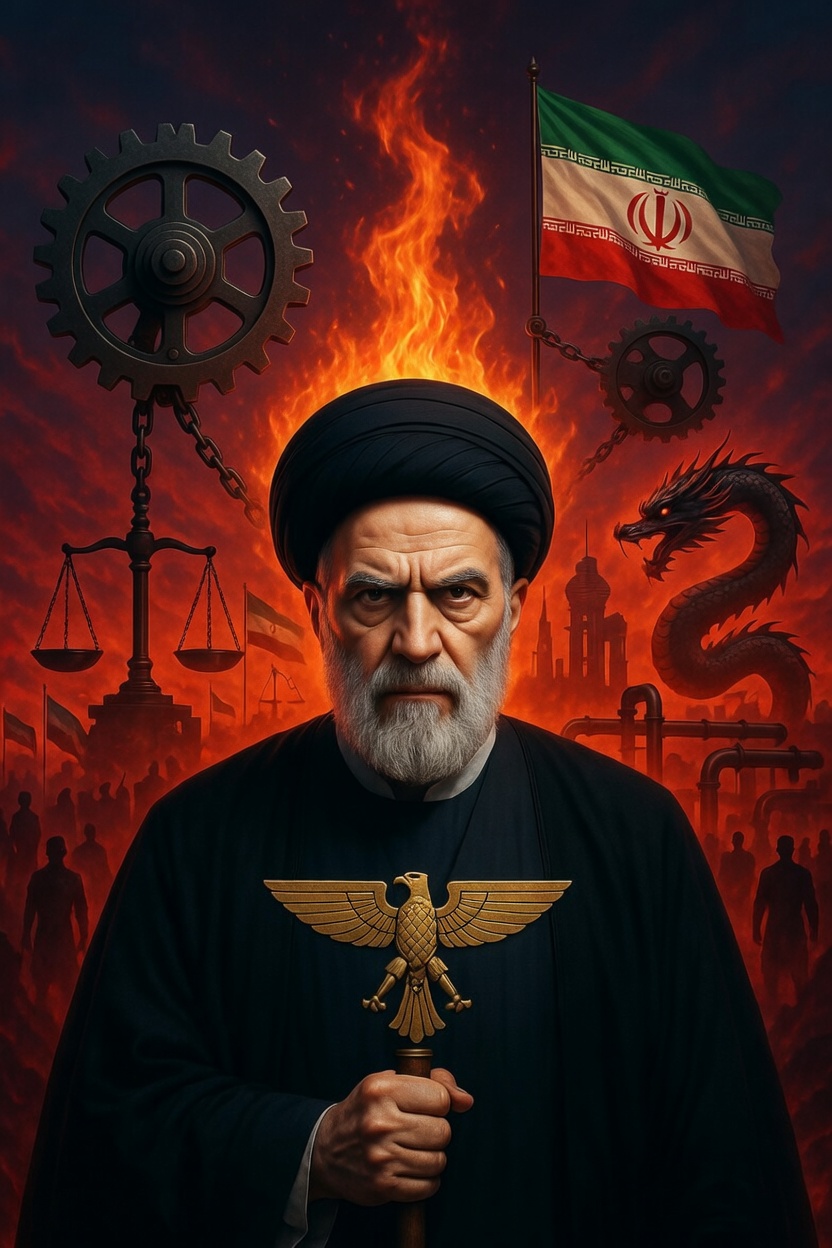
When I say “clerical fascism,” what do I mean? I am not saying that the Islamic Republic of Iran is identical to historical fascism, exemplified by Mussolini’s Regno d’Italia under the thumb of Partito Nazionale Fascista. What I am saying is that the Islamic Republic is the specter of fascism in the present day. It, moreover, shares elements with Hitler’s Nationalsozialistische Deutsche Arbeiterpartei (NSDAP), which governed the Deutsches Reich, commonly known as the Third Reich.
In this historical-comparative essay, I will show why describing the Islamic Republic as a fascist threat is appropriate. This necessitates a comparative analysis that delimits concepts. The sake of clarity demands disambiguating terms. In popular discourse, “fascism” is used loosely; glittering generalities rob terms of their usefulness in describing systems and things where they apply. I have used clerical fascism in the past without precisely defining it, so I will do so here. I will do more than this, however. I will show why opposition to preemptive war in Iran is rooted in the greater scheme of establishing a new world order. Whether aware of it or not, domestic opposition to Trump’s actions enables the transnationalist project.
I begin by explaining corporatism, an essential feature of fascism generally. Corporatism has implications beyond the Islamic Republic. The imperative of corporatism in the age of corporatocracy explains why progressives oppose preemptive military action in Iran. Corporatism is the planned governance model for the new world order. I next show why the Islamic Republic aligns with historic fascism in its essential nature, namely, palingenesis, an atavistic appeal to past civilizational glory. I then specify the Islamic Republic’s role in the transnationalist project, focusing on its relationship with China. I conclude by explaining why Donald Trump is not a neoconservative and why preemptive war in Iran does not parallel the motives behind the Second Persian Gulf War. This confusion is behind opposition to the President’s actions among factions of the political right. (Right-wing opposition to current hostilities is also rooted in the ancient hatred of Jews. However, I have covered this in numerous previous essays, so I will leave that to one side for today.)
* * *
The governing system of corporatism underpinned historical fascism. Corporatism is not unique to fascism. Fascism can be understood as authoritarian or state corporatism. Here, the government organizes society into officially sanctioned economic and social groups—employer associations, labor unions, and professional sectors—while tightly controlling them from above, in the fascist case via a one-party state. Behind these arrangements, one party or not, lurk powerful economic elites, namely, big corporations and financial institutions.
Unlike liberal capitalism or liberal pluralism, where, ideally, independent groups compete freely and are overseen by a republican government, fascist corporatism suppresses class conflict by forcing these groups to collaborate under state supervision. Labor representation is structured through state-approved corporations that claim to harmonize the interests of workers and employers for the collective good. This is also true for multiparty corporatism, as I will show in this section.
In practice, corporatism concentrates power in the state, limits genuine negotiation, and prioritizes political control and, in the fascist case, “national unity” over individual or class-based rights. The antagonisms between labor and capital are managed by incorporating labor into a corporatist structure to serve national interests as defined by the regime—again, sought and backed by elite economic power. Fascism, as Barrington Moore described it, is a revolution-from-above. But, then, so is corporatism generally.
Corporatism was not vanquished along with fascism. Corporatist arrangements prevail in present-day European states. Here, they are described as “neo-corporatist” to rhetorically distance them from historical fascism. However, as with fascism, the government organizes society into officially sanctioned economic and social groups—employer associations, labor unions, and professional sectors—while tightly controlling them from above.
Neo-corporatist arrangements operate within ostensibly democratic frameworks while remaining structured cooperation between employers’ organizations, labor unions, and the state. Rather than being imposed from above by a corporate state, neo-corporatists insist that these arrangements are based on negotiation and voluntary participation, described abstractly as “social partnerships.” Through formal and informal institutions, these partnerships collaborate on issues such as labor market policy and social welfare, ostensibly aiming to balance economic efficiency with social stability.
Countries such as Germany and the Scandinavian states are self-identified corporatist systems where centralized bargaining and consensus-building reduce labor-capital conflict and support coordinated economic policies for the sake of capitalist accumulation. Unlike authoritarian corporatism, modern European corporatism claims to preserve political pluralism, protect the autonomy of participating groups, and operate under the rule of law. Put simply, European elites dress corporatism in democratic garb.
It’s worth keeping in mind that Italian fascism was also a rule-of-law country. The regime did not immediately abolish all legal and institutional forms of the pre-fascist state. The monarchy remained, courts continued to function, and much of the bureaucratic and civil code structure was formally retained. The regime worked through existing legal frameworks while progressively subordinating them to fascist political control. Understanding this is useful for understanding the true nature of European neo-corporatism, where the existing institutional machinery is leveraged by corporate state elites to manage populations.
Not all forms of historical fascism are identical. Nazi Germany under Adolf Hitler departed from Mussolini’s approach in significant ways. Franz Neumann’s argument in Behemoth emphasizes a more fragmented and chaotic system in which competing power centers (military-industrial, party, SS, state bureaucratic interests) undermined coherent legal rationality. Nazi Germany was less a unified legal order and more a system of overlapping authorities and arbitrary power, where law became instrumental and contingent on regime priorities. The Nazi state governed by technocracy and terror rather than the rule of law. Nonetheless, Neumann describes National Socialism as “totalitarian state monopoly capitalism.”
Thus, an ostensible chief difference between historical fascism and neo-corporatism is that, whereas the former was a one-party state, the latter is a multiparty state. However, this is largely an illusion, since the corporatist structure cultivates one-party hegemony and marginalizes oppositional parties, as I explained in Monday’s essay (see Securing the Occidental Realm: Why US Action in Iran Serves Western Civilization, Not Just Israel).
The United States itself has long been on the corporatist path guided by progressive ideas and policies that emerged alongside the legal fiction of corporate personhood. The goal was to humanize corporate power through reform, regulation, and social welfarism. Over the course of development, progressivism and administrative governance increasingly supplanted liberalism and republicanism. These arrangements were institutionalized under the Franklin Roosevelt presidency, and administrative rule and technocratic control formed a fourth branch of government, corrupting and subordinating the three constitutionally specified branches. This is why deconstructing the administrative state is necessary to ensure a republican future.
We’re confronting a stubborn enemy. Although smashing fascist authoritarianism was noble, World War II was, in a very definite way, a struggle between what type of corporatism would rule the transatlantic space. The United States won, and administrative rule became the order of the day. This development prepared the United States for transnationalist reordering.
* * *
There is, however, a significant difference between historical fascism and neo-corporatism in one respect. Fascism in both Italy and Germany was deeply infused with palingenesis. Palingenesis involves a myth of national rebirth after a period of perceived decline. Mussolini and Hitler both framed their movements as a revolutionary force that would purge decadence, restore vitality, and create a renewed, unified nation.
Palingenesis is often used to portray Trump’s populist-nationalist project as fascist in character. However, the “Make America Great Again” movement is a call to return to a nation’s republican foundation and the American system, devised by Alexander Hamilton during George Washington’s presidency, and saved by Abraham Lincoln during the Civil War. Trump is calling for the restoration of the liberal-pluralist arrangements established by the American founders. That’s not palingenesis.
In contrast to America’s populist-nationalist revival, palingenesis is atavistic in that it draws on glorified visions of a heroic deep past—the Roman Empire in Italy or a mythic Aryan heritage in Germany—while promising a radical transformation of society in the present. The appeal to palingenesis was used by fascists to legitimate corporatist arrangements, justifying authoritarian control, mass mobilization, and exclusionary or violent policies, portrayed as necessary steps toward national regeneration. The liberal businessman from Queens has no ambitions of this sort.
What about the clerical piece in the term I frequently deploy? This is tied to the phenomenon of palingenesis. An analysis of historical clerical fascism finds that elements of organized religion—e.g., the Catholic hierarchy—entered into cooperative or mutually reinforcing relationships with authoritarian corporatist regimes, not merely out of coercion but because of perceived ideological overlap.
In Italy under Mussolini, for example, religious institutions supported and legitimized authoritarian governments that promised anti-communism, social order, and a restoration of traditional moral values. The clerical element does not mean that fascism was inherently religious (at least not in a traditional way), but that certain religious actors saw fascist movements as vehicles for doctrinal revitalization and protection against secular threats, aligning with the fascist emphasis on hierarchy and national rebirth.
That is the historical case. What about the present moment? When I use terms like “clerical fascism” or “Islamofascism” to describe, in particular, the Islamic Republic of Iran, I am describing a hybrid system that blends religious rule with authoritarian, ideologically driven governance. Here, “clerical” refers to the prominent role of religious authorities in shaping or directly controlling political power. The “fascism” piece highlights features such as an emphasis on collective identity and moral order over individual freedoms. Fascists seek limited political pluralism, strong state control over society, and suppression of dissent.
In this framing, the comparison is not that such regimes are identical to historical fascism and its clerical elements, but that they share certain structural or ideological similarities—especially the fusion of a unifying worldview with centralized authority and a project of social or cultural transformation.
* * *
Obviously, Iran is not a liberal capitalist system. Nor is it neo-corporatist in the European sense. Nonetheless, the Islamic Republic comes closer to the latter than the former. In Iran, private businesses and markets exist. There are corporations, and individuals can participate in market activity. However, the state, as it does in Europe, and did during the period of historical fascism, plays a dominant role in the economy, especially in major sectors like energy, finance, and heavy industry, subject to government control.
Iran is not governed by a one-party state in the strict sense. Like Europe, it doesn’t legally limit politics to a single party. However, in practice, opposition parties are heavily constrained; multiple political groupings exist and can participate in elections, but they must operate within strict ideological and constitutional limits set by the Islamic Republic. Moreover, parties or movements that are seen as challenging the core principles—the authority of the Supreme Leader or the Islamic framework of the state—are blocked from competing, disqualified from elections, restricted, or otherwise marginalized through legal and institutional mechanisms.
So, while Iran holds elections with multiple candidates and factions, those factions all operate within a tightly controlled system in which ultimate authority sits outside the party structure, and key institutions can decide who is allowed to run for office; the dominant institutions are ultimately controlled by Shi’a Islam. Thus, similar to European neo-corporatism, more than one political current is present, but the threat of pluralism is bounded by the overarching Islamist framework. For Europe, the overarching framework is corporatocracy.
As for the atavistic or palingenetic piece, in Iranian political discourse since 1979, the Islamic Republic is portrayed as a break from a corrupt or dependent past and the beginning of a renewed civilizational order. This includes narratives about restoring moral authenticity, reasserting independence from Western influence, and building a society grounded in Islamic principles after a period portrayed as decadence or foreign domination under the previous monarchy. In that sense, there is a recurring theme of national and moral “renewal” or “rebirth” that resembles what in historical fascism is described as palingenetic myth-making.
When I speak of “clerical fascism” in reference to the Islamic Republic of Iran, I am not claiming it is an exact replica of Mussolini’s Italy or Hitler’s Germany (neither of these historical forms of fascism replicates the other, for the record). Rather, I am identifying the Islamic Republic as the most prominent contemporary embodiment of fascism’s essential features: authoritarian corporatism fused with a totalizing ideological worldview, sharply constrained pluralism, state dominance over the economy, and a powerful palingenetic myth of moral and civilizational rebirth. Just as historical clerical fascism saw religious institutions align with corporatist authoritarianism in pursuit of shared goals of order, hierarchy, and anti-communism, Iran represents a modern hybrid in which Shi’a clerical authority provides the unifying ideological core. This fusion sustains centralized control while claiming the mantle of renewal.
Understanding these structural and ideological parallels is essential—not to flatten historical distinctions, but to recognize the persistent appeal and adaptability of such systems in the present day. Crucially, this reality justifies—morally and rationally—US military action in confronting the Islamic Republic.
* * *
When, after the Holocaust, we said “never again,” the hope was that the world would take that to heart and there would never be another regime like Hitler’s. It was understood then that, if Hitler had been confronted earlier, tens of millions of lives would have been spared from annihilation. But the world tolerated the Nazi state for twelve long years. It waited until Hitler had developed the capacity to make war on the world. It was only when it wreaked devastation, and its ally Imperialist Japan attacked Pearl Harbor, that the United States intervened. In hindsight, regrets emerged. The lesson was to never again regret failure to act in the moment.
The Islamic Republic of Iran has been in power for 47 years, developing its capacity to make war, terrorize the world, and oppress the Iranian people. It has long pursued a strategy of proxy warfare, regional aggression, and terrorism to expand its influence without engaging in direct, large-scale conventional wars. Through its powerful Islamic Revolutionary Guard Corps (IRGC) and the elite Quds Force, Tehran arms, funds, trains, and directs a network of militant groups—the “Axis of Resistance.”
This work includes supporting Hezbollah in Lebanon, which has built up a massive arsenal of rockets and engaged Israel in multiple conflicts while targeting Western interests, providing financial and military aid to Hamas and Palestinian Islamic Jihad in Gaza, materially backing of Houthi rebels in Yemen, who have attacked international shipping in the Red Sea and launched strikes toward Israel, and support for various Shiite militias in Iraq and Syria that have repeatedly targeted US forces.
The regime has been linked to direct terrorist plots abroad, including assassinations of dissidents and targeted attacks on Israeli and Jewish targets. Other aggressive actions include repeated threats to disrupt oil shipments through the Strait of Hormuz, advanced ballistic missile development, cyberattacks, and occasional direct missile and drone barrages against Israel. These efforts have fueled instability across Gaza, Lebanon, Syria, and Yemen, endangering, among other things, global energy routes and shipping lanes.
This proxy approach gives Iran, from its perspective, plausible deniability while projecting power across the region. But the denial is not plausible. The world can plainly see what Iran is about. These activities have led to the designation of Iranian-backed groups and the IRGC itself as terrorist organizations by multiple countries. Overall, Iran’s actions reflect a deliberate strategy of asymmetric confrontation aimed at weakening adversaries while advancing its ideological and geopolitical goals.
The Islamic Republic is not just a threat to the region, but plays a major role in advancing Chinese ambition. Iran and China maintain a deep strategic alignment rooted in long-term geopolitical interests, mutual economic dependence, and shared opposition to US influence. At the core of this partnership is the 25-year Comprehensive Strategic Partnership signed in 2021, under which China pledged hundreds of billions of dollars in investments—primarily in Iran’s infrastructure, petrochemical, and transportation sectors—in exchange for a reliable, heavily discounted supply of Iranian oil. China serves as Iran’s dominant trading partner, buying roughly 90 percent of its exported crude oil, providing Tehran with tens of billions in annual revenue that helps sustain its economy and government budget despite heavy Western sanctions.
This relationship extends beyond trade. Iran plays a key role in China’s Belt and Road Initiative (BRI), acting as a geographic bridge connecting Central Asia to the Middle East and offering potential overland energy routes that reduce reliance on vulnerable maritime chokepoints. Both nations cooperate closely in multilateral forums such as BRICS, of which Iran is a member, and the Shanghai Cooperation Organization, where they promote a multipolar world order that challenges Western dominance.
China provides diplomatic cover for Iran at the United Nations, helping broker regional deals (such as the 2023 Iran-Saudi rapprochement), and facilitating sanctions-evasion networks—including barter arrangements, front companies, and shadow fleets—that allow Iranian oil to reach Chinese refiners while generating revenue Tehran can redirect toward its military and proxy activities. On the security side, the alignment includes dual-use technology transfers, components for Iran’s missile and drone programs, and military cooperation.
China has stopped short of formal defense commitments or direct intervention in Iran’s conflicts. In practice, however, the partnership gives Iran a critical economic lifeline and international legitimacy, while giving China discounted energy, strategic footholds in the Persian Gulf region, and a partner in pushing back against US hegemony in the Middle East. The relationship is asymmetric—Iran depends far more on China than vice versa—but it has proven useful to Iran, serving as a cornerstone of the Islamic Republic’s ability to weather isolation and project regional power.
This relationship is what I have described in numerous essays as the twin totalitarian threat to the Peace of Westphalia, that is, the principle of autonomous sovereign nation-states in an international system governed by international law rooted in Enlightenment principles, which emerged in the West. The street-level manifestation of the twin totalitarian threat is the Red-Green Alliance, which enjoys major financial support from global elites and Democratic Party sympathies.
* * *
In The Clash of Civilizations and the Remaking of World Order, published in 1996, Samuel Huntington advanced a thesis arguing that, after the Cold War, global conflict would be driven less by economic and ideological differences and more by cultural and civilizational identities. Globalization and ideologies attendant to it have indeed weakened the liberal capitalist world order, bringing cultural differences to the fore. These differences have, in turn, been used to advance the transnational project to usher in a world neo-feudalist order.
Huntington described a world divided into major civilizations—Western, Islamic, Sinic (Chinese), Hindu, Orthodox, and others—and that these broad cultural blocs have deep-rooted differences in history, religious and moral values, and social organization. In this framework, Huntington suggested that future wars and tensions would most likely occur along the “fault lines” where these civilizations interact, rather than between individual nation-states competing primarily over systems, principally capitalism versus communism.
Huntington argued that modernization does not necessarily produce Westernization. Non-Western civilizations—especially Oriental ones—continue to develop on their own terms; more than this, they do not merely resist Western cultural and political dominance but seek to undermine Western hegemony and thus negate the principal moral force in world affairs.
In my graduate school days in the 1990s, during my studies in international political economy, influenced by the radical frame of postcolonial thought that had by then taken hold of sociology departments across the transatlantic space, I criticized in seminars Huntington’s thesis for what I then saw as an overgeneralization of cultures, a downplaying of internal diversity, and a risk of reinforcing the very divisions it described, insofar as his descriptions were accurate.
However, in a hallway conversation, one of my professors (who may not wish me to share his name) noted that while globalization was economically homogenizing the world, it was, by giving distinct cultures greater access to one another and increasing cross-cultural encounters, also creating the conditions in which civilizational tensions and conflicts could more readily emerge. The unfolding of history has proved his observation astute. Elites organizing the transnational project to bring the world under a global corporatist system could also see this development. They would leverage it to disorganize the international system and prepare the way to a new world order.
This is why Trump’s intervention in Iran is welcome—and why NATO has sidelined itself, while the corporate media portrays military action as folly. By weakening Iran, Trump marginalizes China. By restoring the American system and Western hegemony, Trump lays the groundwork for a rejuvenated Europe. Trump’s efforts to reorder the world along liberal lines retards the progress of the transnational project. Globalists understood the problem Trump presented the moment he descended the Golden Escalator in 2015. Even before he assumed the White House in 2017, the deep state moved to undermine him. Now Democrats demand the invocation of the Twenty-fifth Amendment and will certainly impeach him after the midterm elections.
* * *
The reduction of the Iran intervention to neoconservative ideology suffers from an impoverished understanding of what was essentially Cold War liberalism repurposed by the neoconservative wing of the pre-Trump Republican Party. This view, articulated by Richard Perle and Paul Wolfowitz, among others, and organized by the Project for a New American Century, was never merely hawkish; it insisted that the United States could and should use military power to export Western-style democracy, topple “rogue regimes,” and remake entire regions in its image. Beneath this was a project to command the world’s energy wealth. (See War Hawks and the Ugly American: The Origins of Bush’s Middle East Policy.)
This was the logic that drove the 2003 invasion of Iraq and subsequent occupation. Ba’athist Iraq under Saddam Hussein was a brutal secular dictatorship animated by Arab socialism and personalist tyranny, not an ideological civilization bent on global eschatological conquest. Removing Saddam was explicitly framed as an exercise in nation-building and democracy promotion, not narrow self-defense, albeit the imagery of chemical and nuclear weapons was used to frighten the public into support for the invasion and occupation. Nor was it about confronting globalization, but rather enabling it.
That project failed not because the intelligence was wrong but because the ideological premise—that every society is plastic enough to become a democracy once the dictator is gone—was false. Trump does not suffer from this illusion. Action in Iran is not a regime-change operation in the comprehensive meaning of that concept, even if regime change is a desirable outcome.
Iran is a categorically different situation. Its regime is neither Ba’athist nor Arab-socialist; it is a clerical totalitarian system that fuses Shi’a apocalyptic theology with modern totalitarian techniques. This is clerical fascism: an expansionist, anti-liberal ideology that rejects the very legitimacy of the Westphalian nation-state system in favor of exporting revolutionary theocracy through a cult of martyrdom, proxies, and nuclear blackmail. Like interwar European fascism, the Islamic Republic possesses a coherent worldview that is irreconcilable with liberal civilization. It denies the equality of peoples and faiths, explicitly seeks regional (and ultimately global) hegemony, and glorifies violence as redemptive.
Just as Nazi Germany in the 1930s was not just another authoritarian state but a civilizational threat that required early, decisive containment rather than endless negotiation and wishful thinking, the Islamic Republic represents a parallel danger today. Its nuclear program, its declared goal of erasing Israel, its arming of Hezbollah, Hamas, and the Houthis, and its doctrinal hatred of the “Great Satan” are doctrinal imperatives. A realist recognizes that some regimes are not partners to be appeased or democratized but enemies to be deterred or dismantled before they acquire the means to make their ideology unstoppable. The Islamic Republic cannot be reasoned with because it is an unreasonable entity. It can only be destroyed or marginalized (again and again). Moreover, its role in the scheme of things cannot be ignored. To be sure, Islam is a major security threat, but combined with the rise of China, the peril of tolerating Iran’s ambitions becomes existential.
Forceful pressure on Iran—maximum sanctions, targeted strikes on nuclear and other infrastructure, degradation of its military capabilities, support for internal dissent—is not neoconservative adventurism. The neocons wanted to transform the Middle East into a democratic utopia. In the words of the neoconservatives, the aim of the Second Persian Gulf War was to trigger a “democratic tsunami.” The realist case against clerical fascism, taken on its own, simply insists that we cannot allow a fascist-like power to acquire nuclear weapons and a delivery system.
We can no longer pretend Iran is merely a misunderstood nation-state. Nor can we fail to see links between Iran and those countries seeking to diminish the West. Saddam’s regime, however vicious, never posed that kind of existential ideological challenge that Iran and its alliances do. Recognizing the difference is not warmongering; it is learning the central lesson of the last century’s greatest failure of imagination. It moreover ignores the transnationalist project that shaped US foreign policy thinking before Trump.
Whether Democrats admit it or not, appeasement of Iran was not a rational strategy of containment, but a stance, intentional in action, that enabled the growth of Iranian power for purposes of entrenching the logic of globalization. We have to purge this mindset from America.