
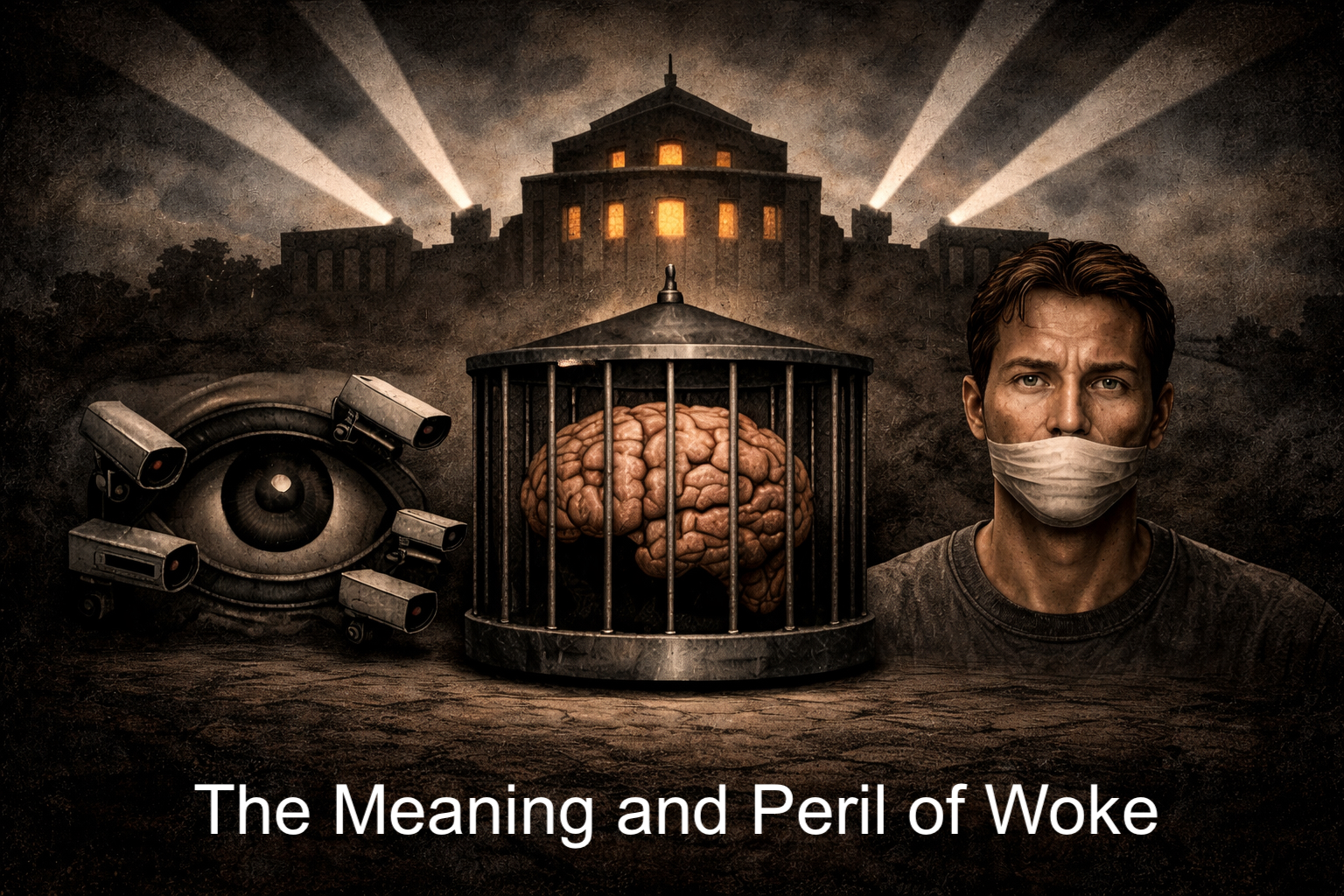
Do you understand what “woke” means? You should, because if you use the term, you might reasonably expect an interlocutor to ask you to define it. This may feel like an attack via semantics, but being asked to define one’s terms is a legitimate request. Many people use terms without knowing their meaning, and this can trip up an earnest man. I will define the term in this essay so that everyone is on the same page. I will do more than this. I will also show why woke imperils the American Republic.
“Woke” has a long history. It originated in black circles. I will set aside that history for now, since today’s woke ideology is a progressive adaptation used by paternalistic whites to ingratiate themselves with blacks and others (paternalism being an intrinsic characteristic of the Democratic Party mentality) to recruit them for the corporatist project, which is in the service of the corporatocracy. (See Stay Woke. The Corporate State is Counting on it. At the bottom of this essay, I provide URLs to several other essays and a search prompt to find more.)
Woke ideology (it did so at its origin) divides the world into “perpetrator/oppressor” and “victim/oppressed” classes. The modern construction rests on a bastardized reading of Karl Marx’s critique of a world organized into bourgeois/capitalist and proletarian/worker classes—an actual form of social segmentation. In the hands of woke activists and propagandists, however, the divisions are artificial. The United States abolished racial segregation over sixty-two years ago. And gay people can marry. one has to step into oppression these days.
The paradigm of stepping into oppression in the woke frame is the cisgender versus transgender dynamic. Cisgender is a propaganda term for those who do not believe or say they are a gender they cannot possibly be. It functions to pathologize normality. Men are thus transformed into oppressors, and those among them who identify as women (or something else) become the oppressed.
With the “perpetrator-victim” model in place, woke ideology dispenses with any argument about whether exploitation or oppression is actually occurring. One might ask whether blacks are, on average, poorer than whites because of culture, but this is dismissed out of hand as a feature of “white supremacy.” The woke person judges “good” or “bad,” “right” or “wrong” solely based on one’s location in the respective groups that constitute the binary. A white, heterosexual, cisgender man, for instance, is guilty of oppression regardless of what he does. He is guilty simply because he belongs to the “oppressor” class. No justification for the attribution of guilt is required. It is given by the binary.
This is why those who identify with “oppressed“ groups—and their allies—rage rather than reason. If one attempts to argue from facts and logic, especially if one proceeds from the modern, rational model of justice, in which individuals are responsible for their own actions and not for what other (past/present) individuals do or have done, then one is denying “guilt” or “privilege.” That denial itself is treated as a further act of oppression. Any institutional logic operating according to the modern, rational model of justice becomes an oppressive structure and must be “reformed“ or torn down. The “just” institution suppresses thought and speech.
This binary worldview explains why blacks or other designated “victims” who reject the woke model are not considered authentically black (or authentically whatever identity they assign themselves). They become “race traitors” or traitors of some other sort because they have denied the binary and are thereby excommunicated from the victim/oppressed group. Black men become “Uncle Toms” or “house niggers.” A detransitioner either never was really a queer person or is an attention-seeking or gullible person serving as a pawn of the cisgendered class of oppressors.
Woke works from the strategy of emotional blackmail. Those deemed “perpetrators/oppressors” are made to feel guilty of some collective offense and obligated to sacrifice their “privilege” and atone for their sins by paying some form of reparations—whether through cash payments, public assistance, or deference to members of the “oppressed” class, i.e, subordination to a new hierarchy—to repair the harm they have allegedly perpetrated. Many of those identified as oppressors fall in line with the demands of those who claim oppression. (See For the Good of Your Soul: Tribal Stigma and the God of Reparations.)
I earlier noted that I would not dig into the origins of the word. However, the woke mutation has a history before being labeled as such. Woke is ultimately rooted in the paternalism of the slavocracy, carried over into the corporatocracy it replaced in the latter nineteenth century, both represented by the Democratic Party. Progressivism is essentially a corporatist ideology suited to changed circumstances following Emancipation. As noted in previous essays, progressivism gained momentum during the Presidency of Woodrow Wilson and became fully established under Franklin Roosevelt and the New Deal. Afterwards, it shaped the development of the welfare state, which Friedrich Hayek critiques as the road to serfdom in his book by that title.
Published in 1944, The Road to Serfdom, widely recognized as a seminal work of political philosophy, Hayek argues that government planning inevitably leads to the loss of individual liberties and the rise of totalitarianism. He contends that even well-intentioned social policies erode the rule of law by centralizing power, eventually transforming free citizens into “serfs” of the state. For Hayek, a competitive market largely free of government intervention is the only system capable of preserving personal freedom and democratic institutions.
In The Constitution of Liberty, published in 1960, Hayek argues that individual freedom, or liberty, is not just a moral right but essential for social progress. He defines liberty as the “absence of coercion” by others, asserting that because human knowledge is inherently limited, society thrives best when individuals are free to use the information they select, pertinent to their situation, to pursue their goals. He emphasizes that this freedom must be protected by the rule of law—a system of general, predictable rules that apply equally to everyone—rather than by the arbitrary whims of government. Attempts to achieve “social justice” through redistribution of resources undermine the very legal framework that makes a free and prosperous society possible.
Progressivism has proved Hayek’s warning correct. Particularly through the expansive welfare programs of the Great Society era and subsequent policies, the administrative state and technocratic control fostered dependency in the black community by restructuring economic incentives in ways that undermined the two-parent family. Before the mid-1960s, black Americans maintained relatively stable family structures, with marriage rates often comparable to or higher than those of whites. The percentage of out-of-wedlock births was relatively small. In the wake of Civil Rights, Progressive policies penalized marriage and rewarded single motherhood: welfare benefits were structured so that a mother typically received far more support when the father was absent from the home, effectively trading a husband for a government check.
This paternalistic approach, rooted in the Democratic mentality of control and ingratiation, accelerated family breakdown, driving out-of-wedlock births among blacks to over 70 percent in subsequent decades and leaving only about 44 percent of black children living with their fathers today. The result has been generational reliance on state assistance rather than self-sufficiency, entrenching the very “victim” class that woke ideology requires while eroding the economic independence, personal responsibility, and social stability essential to genuine advancement.
The purpose, or at least the function, of the welfare state is to advance administrative control over the population. This development gave Democrats a dependable voting bloc by making the fate of blacks dependent on public assistance.
The “victim/oppressed” mentality is characteristically totalitarian. Operating from a collectivist logic, it demands that the supposed oppressors refrain from using words or articulating arguments that the alleged victims find objectionable or offensive. More than this, it insists that institutions adopt the woke model and establish codes and rules that systematically privilege members of the “victim” groups. Collectivism for the woke is contingent and selective. While it moves from collectivistic language, it demands individual expression exclusively for itself. Moreover, it denies group rights to the alleged oppressor class.
Consider the queer demand that women as a class (women, i.e., adult female humans, are an objective biological class) compromise sex-exclusive spaces and activities—bathrooms, locker rooms, sports, and so fort—by allowing men who identify as women, whether because they are delusional or because they wish to compel others to participate in their sexual fetish, into women’s spaces. The equity requirement is suspended for women and lesbians because, as a matter of social justice, members of the victim class deserve dispensation by virtue of their alleged oppression.
I want to emphasize this point to make sure readers understand what queers are demanding. The argument they make is that the man who thinks or says he is a woman belongs to an “oppressed” class—he steps into oppression—and is therefore entitled to make demands on half the population, and on those of the other class of gender who value them, that they sacrifice their privacy and need for safety. Any argument about why it is wrong for men—for whatever reason—to invade women’s spaces or participate in female-exclusive activities is met not with a counterargument but with accusations of bigotry, i.e., “transphobia.”
On April 15, in a speech at the University of Texas Austin Law School, Supreme Court Justice Clarence Thomas lambasts progressivism as a corrupting force. He begins by contrasting progressivism with the natural law foundation of the American Republic. “Progressivism seeks to replace the basic premises of the Declaration of Independence and hence our form of government,” he tells his audience. As a result, a spirit of “cynicism, rejection, hostility, and animus” toward America by Americans has taken hold. Progressivism “holds that our rights and our dignities come not from God, but from government,” he observes. “It requires of the people a subservience and weakness incompatible with a constitution premised on the transcendent origin of our rights.”
He argues that Washington has been overrun by appointed officials who lack commitment to “righteous cause, to traditional morality, to national defense, to free enterprise, to religious piety or to the original meaning of the Constitution.” “They recast themselves as Institutionalists, pragmatists or thoughtful moderates,” he observes, “as a way of justifying their failures to themselves, their consciences, and their country,” he said.
Thomas is here being charitable. It’s much darker than that. However, the judge points to the darkness by noting that the intellectual framework of progressivism is tied to totalitarian regimes, stating that the same ideas that brought about totalitarianism, including Nazism and Stalinism. These are “intertwined with the rise of progressivism,” he argued. Thomas identified the “administrative state” as a non-native and anti-democratic shift. He explicitly connected Wilsonian progressivism to the rise of European fascism.
Justice Thomas is not incorrect. One need only examine the birth-control movement to see the fingerprints of progressivism on the fascist movement. In the United States, those pushing the ideology advanced eugenics, which spread across the transatlantic world. In fact, Hitler drew heavily on the California sterilization laws when crafting his own racial hygiene policies; the Nazis modeled aspects of their program on American precedents and ultimately produced the Nuremberg Laws. Tens of thousands of poor, black, and disabled Americans were sterilized against their will in dozens of states. Tens of thousands more were sterilized in European countries. It is estimated that Germany sterilized over 400,000 men and women under its eugenics program.
Progressivism was also behind Planned Parenthood and the broader project to advance contraception as a means of population control. Moreover, the birth-control movement played a central role in the legalization of abortion. However much abortion was justified as an advance in women’s liberation, at its core, it sought to reduce the number of children born to impoverished and minority populations, who in the previous century had been dubbed the “dangerous classes.” Planned Parenthood targeted poor and black women (and it still does). The targeting dates back to the organization’s founding. Feminist icon Margaret Sanger (see the 1939 Negro Project) worked with progressive black clergy and community activists to reduce the black population as a means of confronting poverty. Today, Planned Parenthood continues to locate many of its offices in or near areas of poverty.
More broadly, progressivism champions corporatist arrangements, the organizational and structural logic common to fascism. Hayek understood this, and his efforts to inform the public about this connection drove much of his writing. When I had finished watching Justice Thomas’s speech, I predicted that corporate media would malign it. They can’t have the public learning that US progressivism is the paradigm of the type of technocratic control that underpinned fascism. The public cannot be allowed to hear unspun the fact that progressivism is profoundly illiberal.
A grand trick has been played on Americans. Progressives call themselves “liberals” and changed the meaning of the word in the public mind. A term that refers to a philosophy of legal equality, individualism, small government, freedom of thought, speech, and publishing, was repurposed to refer to preferential treatment, collectivism, big government, and suppression of thought, speech, and publishing—the diametric opposite of what liberalism actually means.
That progressives were able to repurpose liberalism, which tragically conservatives lean into, is proof of the extent to which progressives have captured America’s sense-making institutions. They control the administrative state, the culture industry, educational institutions, and the legacy media, as well as much of the social media. In Thomas’ words, we hear the true purpose of the republic and the force undermining that purpose. It’s not that the corporate media can’t see this. It’s that they can. Their job is to make sure you don’t.
Wokism is entirely antithetical to rational social relations. The woke insist on having everything on their own terms, and anyone who stands outside the oppressed groups, or who refuses to be an ally, is to be marginalized and, frequently, made the target of violence. It does this by engendering the spirit of “cynicism, rejection, hostility, and animus” among Americans toward America.
We see the woke at work in differential treatment for those who encounter the criminal justice system. When the “oppressed” engage in crime or violence, they are to be treated differently from those in the “oppressor” class. A black man who burglarizes a store is to be viewed sympathetically; his actions are seen by the woke as reparations-in-kind. He was driven to this by white supremacy, not the welfare and free-trade system Democrats engineered that left him without a father or a job. A black man who victimizes a white man is viewed the same way. Black-on-white crime is not a hate crime, but an act justified by racial oppression. (See Race and Violent Death in America; Demoralization and the Ferguson Effect; The Politics of Grievance: Primitive Rebellion and Rhetoric of Social Justice.)
Perpetrators from the “oppressed classes” are not merely to be excused for their behavior. The discursive formation of social justice encourages those classified as oppressed to pursue criminal and violent behavior. Their “victims” had it coming. Progressives saw in Friedrich Nietzsche’s concept of ressentiment—a psychological state of deep-seated hostility, envy, and powerlessness—a strategy. Nietzsche rightly saw the phenomenon as the origin of “slave morality,” arising when the weak cannot act on their natural impulses to dominate, turning their frustration and failure into a vengeful revaluation of values.
The strategy of ressentiment is so intrinsic to the progressive attitude that members of oppressed groups are excused not only for crime and violence visited upon those of the “oppressor classes,” but also predation on other members of the “oppressed class.” The logic of the perpetrator-victim model holds that it’s the conditions imposed upon them that explain the behavior, which must be excused because the behavior originates in collective oppression. A good person sympathizes with the real perpetrator and disregards the real victims.
We also see this in progressive attitudes to illegal immigration. The nonwhite immigrant is elevated above the citizens regardless of the citizen’s ethnicity or race because the factors that push millions of Third Worlders to violate borders were created by the oppressor class and its colonial and imperialist past. Only white Europeans can be colonizers. Only the global North can stand convicted of imperialism. And that is why they have to accept the stranger in their midst. (See The Progressive Politics of Mass Immigration; and Immigration, Colonialization, and the Struggle to Save the West.)
The white European immigrant has no business in America in the first place. Those Americans descended from white Europeans live on “stolen land.”
Progressives celebrate the coming white minority. Because whites are oppressors, reducing the white proportion of the American population can only be a good thing (see The Thing and Strategic Self-Loathing: The “Deny-Then-Justify” Response; “It’s Not Going to Stop.” The Managed Decline of the American Republic). They tell us that white concern over marginalization comes from a place of recognition of the grave sins of their forefathers. White people fear they have it coming to them because they know what they did. Actually, it comes from a recognition of what motivates progressives to marginalize whites. It’s progressives who enable by numbers the vengeance they have cultivated in the supposed oppressed class they have manufactured.
The perpetrator-victim model is indeed part of a dark project. The ultimate aim of woke ideology is not reform or justice, but the replacement of the liberal order—founded on individual rights, reason, equality under the law, and empirical reality—with a new hierarchy based on group identity and power. It proceeds via chaos (see The Woke Progressive Project of Catastrophism). In this new order, truth is subordinated to narrative, evidence yields to manufactured grievance, and freedom is sacrificed on the altar of selective equity.
What presents itself as compassion is, in reality, a mechanism of control. They tell us to “be kind” so they can be cruel. What claims to liberate the oppressed ultimately seeks to dominate the normal and sane. Unless this ideology is accurately named, confronted directly, and rejected unequivocally, it will continue to erode the foundations of a free and rational society until little remains worth defending.
The woke is not merely another way of looking at the world. It is not a classroom exercise in grasping a revised history and primitive justice. It is an existential threat to the West. The woke are the enemy of freedom and reason. Those indoctrinated with woke doctrine cannot be reasoned with because the doctrine is unreasonable. It is, by design, irrational and authoritarian. It can only be defeated, just as the totalitarian projects that came before—communism and fascism—and that confront us today, namely Islam, were and must continually be defeated. Birds of a feather flock together, they say. The flock is a mob, and understanding mob mentality is key to developing strategies that will defeat them.
* * *
I have written about woke many times before. Here are a few of my recent essays on the subject: The Function of Woke Sloganeering; Why the Woke Hate the West; Woke Standards: Resentment and the Good Jeans Problem; On the Atavistic Side of Pattern Variables: The Primitive Emotive Force of Woke Progressivism. There are many more. Now that Google has indexed my essays, the easiest way to find more of my essays on this subject is to type in the browser window “site:andrewaustin.blog woke.”


