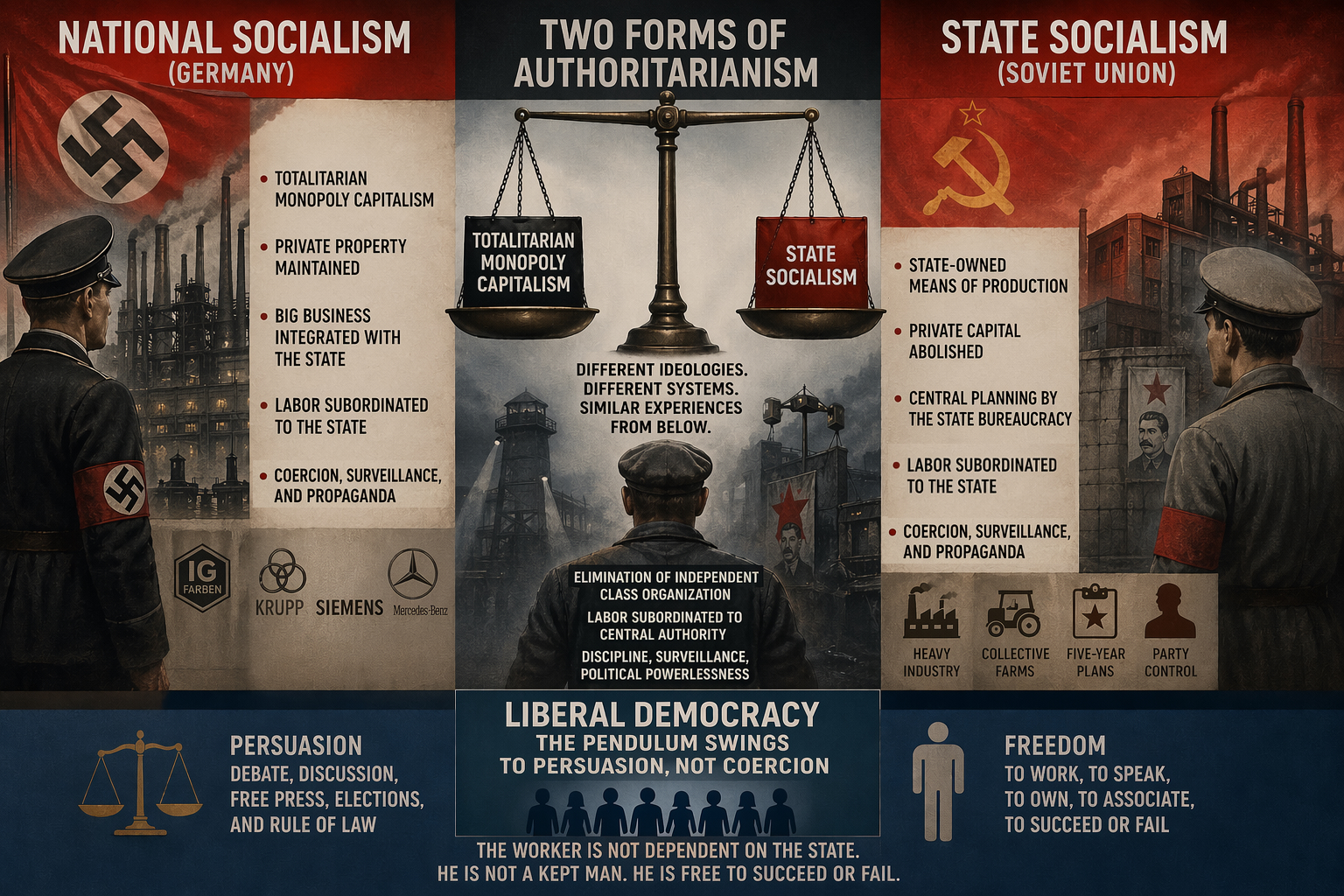
National Socialism in Germany was not socialist in any meaningful analytical sense. As Franz Neumann argued in Behemoth: The Structure and Practice of National Socialism, the regime can be understood as a form of “totalitarian monopoly capitalism,” in which large financial and industrial interests were integrated into a coercive, authoritarian state rather than abolished. I assert Neumann’s description as definitive.
By contrast, the Soviet Union was a bureaucratically organized, state-directed economy in which private capital was formally abolished and replaced by centralized planning. Whether described as “bureaucratic collectivism,” “state capitalism,” or “state socialism” (the term I use), the common thread in these interpretations is that economic life was subordinated to a centralized state apparatus rather than liberated through markets.
The persistent confusion—especially among conservatives—that National Socialism was socialist stems less from its name or a theory describing its character than from intuition. At the level of lived experience, workers in Nazi Germany and in the Soviet Union both confronted systems that eliminated independent class organization, subordinated labor to centralized authority, and sharply constrained autonomy.
From below, the everyday experience of discipline, surveillance, and political powerlessness could appear comparable, even though the underlying relations of production and ideological foundations were fundamentally different. So, in a way, conservatives are right. They can easily imagine what life would be like in these totalitarian systems. They aren’t wrong.
The chief difference between a liberal democracy and an authoritarian state, whether totalitarian monopoly capitalism or state socialism, is the pendulum swing to coercion and away from persuasion. Persuasion is the method of control in free and open societies. To be sure, capitalism is associated with inequality. But the average citizen is free to fail. In a liberal capitalist society, the worker is not dependent on the state. He is not a kept man.
George Orwell has been criticized for dwelling on the Soviet Union and downplaying the problem of National Socialism and fascism generally. Orwell did focus very strongly on criticizing the Soviet Union, especially Stalinist authoritarianism, most famously in Animal Farm and Nineteen Eighty-Four, which led some critics—particularly on the political left—to argue that he emphasized Soviet communism more than other forms of oppression. But it’s not accurate to say the man ignored fascism. Orwell actively opposed fascism, including fighting against Franco’s forces in the Spanish Civil War and writing journalism that criticized European fascist movements in the 1930s.
Orwell’s broader concern was authoritarianism in general rather than any single ideology. Since Western academics downplayed the problems of Soviet-style communism (many were sympathetic to socialism), he felt a need to shine light on that form of authoritarianism. The perception among antifascists that Orwell focused too much on the Soviet Union was amplified by the Cold War, when his books were read primarily as anti-communist texts.
But for Orwell, it’s not a matter of choosing between authoritarianisms. There’s no dilemma. Another way is possible. This explains the continuing popularity of his work. The man teaches us what to look for. And why we need to look for it.