
I’m an atheist. My ethics are rooted in natural history and in the tradition of natural rights that informed the American founding. I have written about this several times on this platform, and this won’t be my final word on the matter. We are celebrating this year the 250th anniversary of a nation founded on this idea. These ethics are not exclusively secular-humanist—nor do all those identifying as secular-humanist subscribe to them. Many Jews and Christians also live according to these ethics. Indeed, the authors of the Declaration of Independence were profoundly influenced by Christian ethics shaped by the rationalism and science that the Enlightenment elevated and promoted.
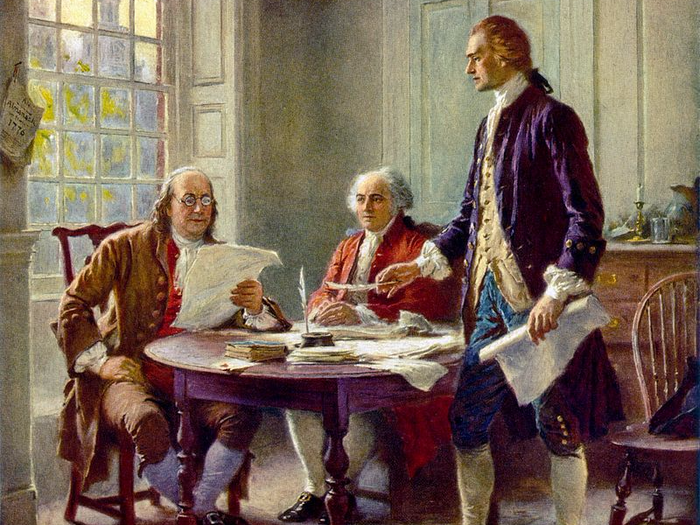
The authors of the Declaration appealed not merely to human preferences or secular political arrangements, but to the “Laws of Nature and of Nature’s God” as the source of certain unalienable rights. Whether one interprets Nature’s God in a traditional religious sense, as a rational Creator who established the order of the universe, or as the spirit of natural history, the essential claim is the same: human rights exist independently of the state and are not granted by governments. Governments may recognize or violate those rights, but they do not create them. The rational state exists to recognize and preserve the natural rights of man.
This conception of God is not one of constant intervention or miraculous acts. Rather, it is the God of reason, order, and natural law. Such a Creator established a universe governed by intelligible principles and endowed human beings with the capacity to understand them. The uncorrupted species-being of man projects these virtues naturally. We see this in the story of Israel. And that story is the story of any moral nation. Once forced out of Eden, man makes history. He makes history through hard work and sacrifice, and he does so shoulder to shoulder with his comrades.
God’s design is thus expressed through human agency. Men and women make history and act within it courageously, exercising judgment and reason, and in solidarity. Actions that advance and protect natural rights are good because they align with the moral order embedded in creation, i.e., the natural order. Means achieving those ends are informed by an ethics rooted in a moral ontology. Actions that suppress or violate those rights are bad because they conflict with that order. The ends and the means to reach them are objectively determinable.
Thus, morality is neither arbitrary nor merely the product of social convention. It is grounded in the realities of human nature and the conditions necessary for human flourishing. Rights are not preferences elevated by consensus, nor are they permissions or privileges granted by rulers. They arise from the nature of human beings themselves and therefore impose obligations on both governments and individuals. The measure of a society is the degree to which it secures and respects those rights and assigns duties to citizens to uphold a good society and to defeat those who would undermine it, on the field of battle if necessary.
When President John F. Kennedy said, “Ask not what your country can do for you—ask what you can do for your country,” he was appealing to the idea that a free society requires active participation, responsibility, and sacrifice from its citizens. The statement assumes that citizenship is not merely a claim upon benefits but a commitment to the common good.
Providence, in this (rational secular) understanding, is recognized not through supernatural signs but through the course of events after the fact. What was achieved? When justice prevails, when liberty advances, and when the rights of a people are preserved against oppression, one may see evidence of a larger moral order in his achievements.
This does not mean that every victory is divinely sanctioned or that history inevitably bends toward justice. As history shows, bad things happen when moral men fail to act or impose good on the world. Rather, it suggests that when free people act in accordance with reason and natural rights, they participate in a process that reflects the underlying order. Providence is not an interruption of nature; it is revealed through the success of human efforts that accord with the laws of nature and the rights and duties those laws imply. Man sees providence in his work—if he has the capacity to discern goodness. In this way, belief in natural rights provides a foundation for ethics that stands above both personal preference and political power. It offers a standard by which governments, institutions, and individuals may be judged.
I have written about this before, as well, but here the moral philosophy of Adam Smith must once more be noted. In his The Moral Sentiments of Man, Smith described what he called the “impartial spectator.” For Smith, inherent in human beings is the capacity to step outside their immediate passions and interests and view their conduct (and the conduct of others) through the eyes of a detached and unbiased observer. Man is not merely capable of sympathy. He is also capable of reason. Man is at once an emotional and rational animal. The impartial spectator serves as a guide to moral judgment, allowing individuals to evaluate whether their actions are just, honorable, and worthy of approval.
In a philosophy grounded in natural rights and reason, the impartial spectator is understood as the faculty by which human beings discern the moral order embedded in nature. It is through this exercise of reasoned self-examination that individuals align their conduct with justice, temper self-interest with concern for others, and contribute to a society founded upon liberty and mutual respect. For many men today, that capacity has been corrupted and deranged. In this year of America’s anniversary, we rededicate ourselves to rooting out corruption and overcoming derangement.
Whether one approaches this standard as an atheist, a Christian, a deist, a historian, or a philosopher, the central principle remains: human rights are inherent, objective, and worthy of defense because they arise from the very nature of humanity and the ordered universe we inhabit. If we are to save the American Republic and the West, we must regain this understanding of rights and obligations and commit the coming generations to it.


