
When I first read The Lord of the Rings as a teenager, my immediate impression was that it must be an allegory for the Second World War. It seemed obvious enough. Sauron represented Hitler, with National Socialism and the German war machine personifying his wickedness, and the peoples of the West stood for the Allies and the goodness of the West. In sum, the struggle against Mordor mirrored the struggle of free people against the evil of totalitarianism. Given that J.R.R. Tolkien lived through the turmoil of the twentieth century and experienced the bombing of Britain, it was tempting to read his great work as a personal meditation on that conflict.
Tolkien, however, I later learned, repeatedly denied that The Lord of the Rings was an allegory. With the benefit of age and after years of studying political economy and international relations (an expertise in my PhD), I have come to believe that his denial was sincere. Not simply because I appreciate the man’s sincerity, but because, returning to the books this spring and immersing myself in his legendarium, I see a much larger struggle across those three volumes, as well as in his other works. The story is not about one war or one dictator. Instead, it appears to be a meditation on a much older and deeper conflict: the clash of civilizations and the rise of instrumental rationality. The fight for Middle-earth is an allegory for the struggle for the integrity of the West and for the preservation of good. It is the struggle of free people against the evil of totalitarianism across time.
Political scientist Samuel Huntington caused quite a stir when he wrote about a “clash of civilizations.” In his influential article (1993) and later book (1996), The Clash of Civilizations and the Remaking of World Order, he divided the world into major civilizations—Hindu, Islamic, Orthodox, Sinic, and Western—and suggested that tensions along the boundaries between these civilizations would become the main drivers of international politics in the aftermath of the Cold War. Huntington believed that deep-rooted differences in history, identity, religion, and values were more enduring than political ideologies. The theory has been widely criticized for oversimplifying cultures, treating civilizations as internally uniform. Under the influence of neo-Marxism during my PhD studies (1996-2000), I subscribed to this critique. Professors and graduate students alike saw the book as reactionary. I no longer do, and Tolkien helped me to understand why.
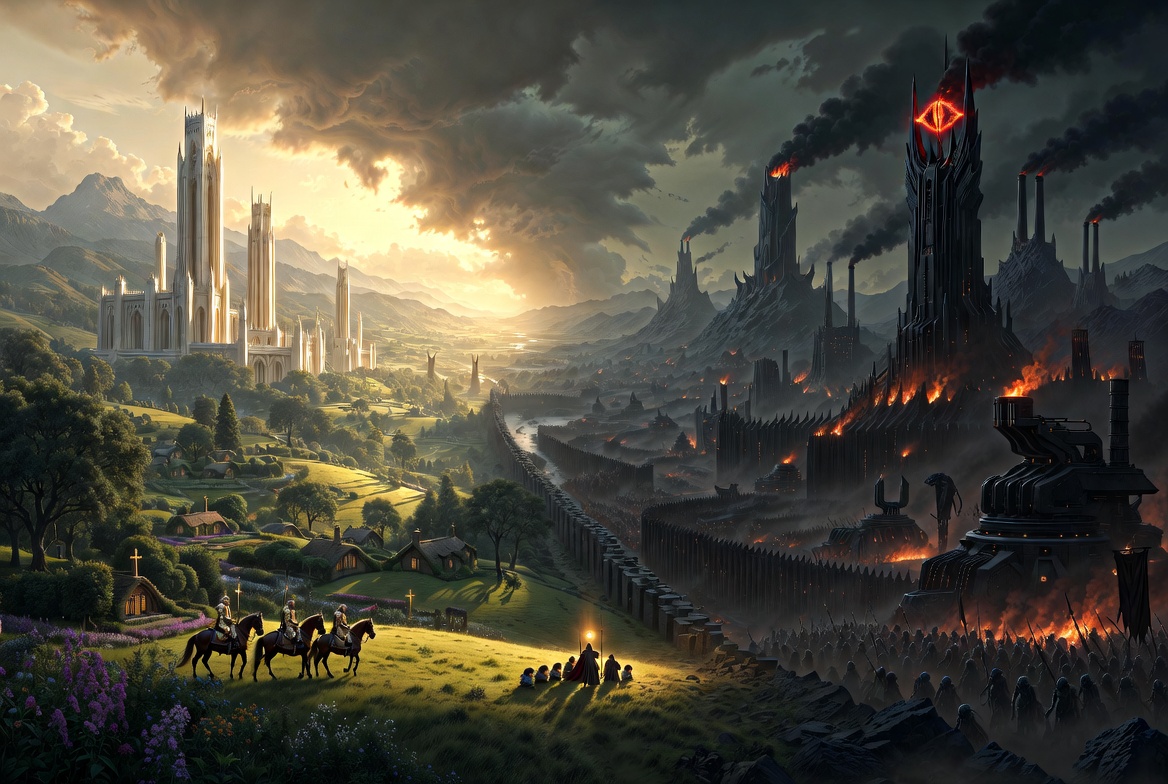
While Tolkien’s work predates Huntington by decades, the geography and imagery of Middle-earth suggest a similar concern. The free peoples occupy the West and Northwest: Gondor, Rivendell, Rohan, and the Shire. They represent a world of continuity, beauty, and rootedness. The Shire symbolized homeliness. On the moral compass, the people of these lands, and the other beings associated with the West—dwarves, elves, and hobbits—are good. By contrast, evil rises in the East and Southeast. The armies of Harad (South) and Rhûn (East) march from distant lands with exotic beasts and strange customs. Nearby lie Mordor and Isengard, centers not merely of military power but of corruption and domination. The East and the South are allied with Sauron, the Dark Lord, who resides in Mordor. The corrupt wizard sitting in Isengard, Sarumon, is his lieutenant. They are evil because the good eludes them; it is displaced by power for power’s sake.
Tolkien’s division is not simply racial or geographical (although it is certainly those things). It is civilizational and moral. The West in Tolkien’s imagination is characterized by harmony with nature. The beings dwelling there see God in Earthly beauty. Hobbits delight in gardens, meals, and pipe-weed (or leaf). Elves cultivate beauty and preserve memory. They also reason. The architecture of Gondor reflects elegance, order, and permanence. Societies are governed by fidelity, honor, and sacrifice. Leaders understand that there are some things worth dying for and some things that must never be done, even in the pursuit of victory. Their artifacts and structures are classical, with an emphasis on gold, silver, and whiteness, integrated with the colors and textures of nature. History is embedded in a living world. And that world is intrinsically good—albeit corruptible—and worth dying for.
In the philosophical terms I have been using on this platform of late in my explorations of Christian ethics and the Enlightenment, the free peoples of Middle-earth operate according to a moral ontology that reflects the Creator’s intentions, even if He rarely intervenes in earthly affairs. It is the obligation of His creation to preserve the world and keep its virtues. Thus, there is a transcendent order that informs terrestrial action and ethics. Means are constrained by this end: to keep the world good. The beings of the West recognize that noble purposes cannot be pursued through ignoble methods. Morality is not a tool, but an objective reality. Those who move in its name are accountable to it. They do what is right for its own sake. For the most part. Those who don’t meet terrible fates.
Tolkien’s tale of the Númenóreans is vital to understanding the men of the West and the corruptibility of man’s nature. The Númenóreans were a race of men in Tolkien’s legendarium, rewarded by the Valar after helping defeat Morgoth at the end of the First Age with the gift of the island kingdom of Númenor, located between Middle-earth and the Undying Lands. There, they developed into a highly advanced civilization renowned for its craftsmanship, enlightenment, and seafaring. Known for their long lifespans, they were nonetheless mortal.
Over time, however, many Númenóreans grew resentful of their mortality and turned away from the Valar under the influence of Sauron. They attempted to invade the Undying Lands to obtain immortality. This led to the catastrophic downfall of Númenor. The city-state was destroyed and sank beneath the sea. A faithful minority, those who resisted Sauron, led by figures such as Elendil and his sons, escaped to Middle-earth and founded the kingdoms of Arnor and Gondor.
In Tolkien’s history, the Númenóreans represent both the highest achievements of humanity and the dangers of pride, ambition, and the desire to escape death. To be sure, the longing for immorality is common among men. However, for the Númenóreans, natural longing became a consuming ambition that inspired offensive war. Those who survived the downfall of Númenor thus bore their sin. Their descendants, represented by Aragorn in the novel, organized their ethical system around the need to contain destructive ambition. They were mindful of the error of their forebearers. They did not abandon war. Their warriors were great men of renown. Rather, organized violence was a means to defend the good that their ancestors had abandoned. Good confronted evil for the sake of good. They fought to keep the world right and open, not straight and narrow.
The powers of darkness, by contrast, embody instrumentalism. For Sauron and his lieutenant Saruman, power itself is the highest “good.” Any means are acceptable if they advance domination over nature and its creatures. Betrayal, coercion, deception, and terror are merely techniques. Nothing but power possesses intrinsic value—not beauty, not forests, not traditions, and certainly not individuals. The architecture is brutalist, the emphasis on blackness, a blackness that stands apart from nature, at the same time, corrupting it. Sauron’s lair of Barad-dûr was dark and forbidding, its gates black. Orthanc, in Isengard, where Saruman perched, was black and bladed. The abode of the Witch-king of Angmar, Minas Morgul, is an exception only because this city was originally Minas Ithil (“Tower of the Moon”) and belonged to Gondor. Captured by the Nazgûl, its beauty was replaced by an unnatural, corpse-like glow. The good was pushed out, and wickedness rushed into the vacuum.
We have to leave the events of The Lord of the Rings and travel back in time, to the First Age, to understand how central these concerns are in Tolkien’s moral universe. Morgoth—originally Melkor—was the most powerful of the Ainur (angelic beings) created by Eru Ilúvatar (the God of Middle-earth). Melkor became the first Dark Lord through pride and a desire to impose his own will upon creation. He rebelled against God and the Ainur. So he became Morgoth. Over time, Morgoth poured his native power into the physical world itself, becoming increasingly bound to it.
His lieutenant and later successor, Sauron, originally a Maia (wizard) of great stature who first served Aulë, the Valor of craft and smithing (the Valar are those among the Ainur who governed the created world), before being seduced by Morgoth’s promise of control and efficiency. Sauron helped organize Morgoth’s forces, forge weapons, and spread corruption among elves and men. There are also in the West the orcs, who are corrupted beings of some sort. After Morgoth’s defeat and expulsion into the Void at the end of the First Age, Sauron emerged as the new Dark Lord in Middle-earth, especially in the Second and Third Ages, seeking dominion through cunning, deception, and the forging of the One Ring—the ring to rule them all.
Nowhere is the contrast between good and evil in the events of The Lord of the Rings clearer than in Isengard. Saruman, like Gandalf, a Maia, a lesser being to the Ainur but nonetheless very powerful, possessing the art of magic, was once wise. He was the greatest of wizards of his day. However, he abandoned his reverence for creation in favor of mastery over it. He tears down forests to feed furnaces to manufacture the Uruk-hai, a breed of stronger, more disciplined orcs in Tolkien’s legendarium.
Under Saruman’s designs, nature becomes raw material. His realm is one of wheels, smoke, and terrible machines—and of industrial efficiency. The Uruk-hai themselves are Promethean products rather than the natural results of inheritance—a kind of grotesque parody of creation. Saruman, like Victor Frankenstein, makes monsters. These are not nurtured beings, but abominations engineered by destructive ambition. The technocracy of Isengard stands near Fangorn Forest, and it is this forest that Saruman exploits to feed his machine, eventually incurring the wrath of the tree-like beings that live there, the Ents.
To put this in the terms I have been writing about on Freedom and Reason, Saruman represents a nightmare vision of technocracy: the reduction of life to process, production, and utility bereft of aesthetics. The organic world is sacrificed to mechanism. Human beings become resources to be manipulated rather than souls to be cultivated. Natural design is replaced by synthetic substitutes, evil because they defy God’s creation.
Long before contemporary discussions about technological domination and transhumanism, Tolkien sensed the danger of a civilization that worships efficiency while forgetting wisdom—that replaces the natural with the artificial (in this way, his insights resonate with those of Walter Benjamin in his essay “Art in the Age of Mechanical Reproduction”). The orcs are not merely a sinister force against which Tolkien’s heroes battle; the orcs symbolize corruption rather than authentic creation. Although Tolkien wrestled throughout his life with their origins, he consistently emphasized that evil cannot truly create. It can only distort and mutilate what already exists. Evil is parasitic. It produces counterfeits. Against this darkness stand ordinary people, humble and noble.
One of the most remarkable features of The Lord of the Rings is that salvation does not come through overwhelming force alone. Our heroes are often outnumbered. On the brink of catastrophe, tides miraculously turn. The eagles are not merely an instance of the literary device of deus ex machina, which seems to many a contrivance, but are representative of what Tolkien meant by his coined term eucatastrophe, the opposite of catastrophe. He wondered: can’t dramatic twists be of good fortune? No, salvation comes because the cause is honorable: it defends the good of the world, whatever the cost in blood and treasure (although, admittedly, the dwarves are stubborn on that last point).
Crucially, the West does not seek to wield the One Ring to defeat Sauron. Instead, it seeks to destroy the weapon entirely, thus thwarting Sauron’s ambition. Without the Ring, he cannot rule them all (indeed, the personal power he fused with the ring at its forging proves lethal). The temptation to use evil for good must be rejected by our heroes. But the heroes are flawed, and some among them succumb to temptation. Boromir of Gondor, his kingdom’s proximity to and struggle against Sauron far less abstract and remote than the others of the Fellowship, moves him to claim the ring. Even if we regard his reasoning as noble, we admit that he is also prideful and reckless. And this is his undoing.
This is perhaps the deepest moral lesson of the story. Boromir illustrates the tragedy of noble intentions corrupted by pride. He loves Gondor and genuinely wishes to save his people, yet he falls prey to the Ring’s promise of power. His flaw is not wickedness but grandiosity. He believes that strength can be trusted in the hands of the righteous, but his loyalty is to Gondor at the exclusion of the greater good. For Tolkien, power itself corrupts. The war is not for Gondor alone. And, in any case, the One Ring cannot aid in the greater struggle. It therefore must be destroyed. The mission to destroy it is for the sake of the West and all that is good in the world. And, so, the task falls to the smallest among those dwelling in the West, those with the least ambition of all beings, the least interested in power, the Hobbits.
Boromir’s father is also beset by narrow concern. Aragorn, the heir of Isildur, son of Elendil, the man who cut the One Ring from Sauron’s hand in the Second Age in the Battle of the Last Alliance (but failed to cast it into the fires of Mount Doom), is destined to be king and restore integrity to Middle-earth. Boromir’s father, Denethor II, the ruling Steward of Gondor, does not wish for the return of the king. It is a threat to his power. He is moreover in possession of a palantír. Like others who use this technology, he draws the wrong conclusion from its visions across distance and time. He believes the war is lost and, thus, his power. Death is preferable to such an end.
In Tolkien’s world, bad deeds are punished. Boromir dies at the hands of the Uruk-hai near the borders of the northern realm of Rohan, in the region of Amon Hen, on the western shore of the Great River Anduin. Denethor self-immolates at Minas Tirith, the great fortified capital of Gondor, during the siege of the city in the Battle of the Pelennor Fields. Likewise, good deeds are rewarded. Denethor’s younger son, Faramir, by contrast, embodies wisdom. He loves his brother and mourns his death, yet he understands what destroyed him.
Unlike Boromir, Faramir recognizes that some victories are too costly. When Frodo and Sam come into his hands, he refuses to seize the Ring and allows the hobbits to continue their seemingly hopeless mission. Faramir’s greatness lies not in conquest but in restraint (he is a lesser warrior in the shadow of his older brother). Faramir possesses the strength to take the Ring and the humility not to. He is perhaps the finest example of Tolkien’s ideal of nobility: a man governed by honor rather than ambition. Aragorn makes Faramir the Prince of Gondor after the enemy is defeated and the heir of Isildur returns to the throne. Faramir and his bride, Éowyn, the niece of Rohan’s king, live happily ever after.
This same spirit prevails throughout the free peoples. Aragorn, of the Dúnedain, the noble descendants of the Númenóreans, accepts burdens rather than privileges. He dwells in the wilderness among the remnants of his race as a ranger until he is called to action. Freed from Saruman’s spell, King Théoden of Rohan rides to almost certain death for the sake of others. Sam remains loyal to Frodo and the quest when hope itself has vanished because he must believe there is good in the world. The men of the West march upon the Black Gate not because they expect victory but because duty demands it. They are willing to lay down their lives so that others may live free.
The Lord of the Rings speaks directly to our present age. Sauron, the Dark Lord whose shadow spreads from Mordor, embodies the instrumental spirit of technocratic globalism and transnational corporate power. The One Ring is not merely a weapon but the promise of total control: addictive and corrosive to all who grasp it. This manifests as the fusion of financialized capital and supranational institutions, enabled by Big Tech algorithmic governance and surveillance architecture, that seek to remake humanity and nature alike into raw material for optimization, prediction, and profit. The Eye of Sauron watches from digital panopticons, reducing persons to data profiles. His power reduces societies to nodes in a global supply chain. Computer terminals are palantír from which users draw mistaken conclusions.
Beauty, memory, and moral limits are obstacles. They are also opportunities to be monetized, transcended, or twisted. The architecture of the New Mordor is brutalist and black: server farms consuming energy and devouring landscapes, sterile glass towers of Davos and Silicon Valley, and a culture of inversion where the inherited and natural are pathologized, while the artificial and transgressive are elevated—and celebrated. The bodies of men are modified to escape their natural form.
In my reading, Saruman stands for the internal betrayal within the West itself. Sitting at the southern end of the valley called Nan Curunír, in the western part of Rohan’s neighborhood, Isengard is part of the geography of the West. Once a steward of order and wisdom, Saurman turns Isengard into a forge of machines, fells the ancient trees of Fangorn, and breeds the Uruk-hai as disposable shock troops of offensive warfare. One might say that Isengard goes south. Today, Saruman is plural—the globalist technocrats and managerial elites who have hollowed out Western institutions from within. They tear down the cultural forests, so to speak—the inherited norms of family, faith, nation, and local community—to fuel the furnaces of growth and the destruction of nature. The traditional ways of life are scheduled for liquidation.
Amid the rise of the corporate state and technocracy, the organic bonds of civilizational inheritance are replaced by synthetic constructs: bureaucratic process, engineered demographics, and financial abstraction. Like Saruman and the power over him, these forces ally with the darkness beyond the West, importing or empowering the barbarians of the South and East (Huntington’s civilizational fault lines), not out of genuine universalism (however much they peddle the ideology of multiculturalism), but because these populations serve as both cheap labor and a battering ram against the true universalism of the West, its virtues standing as the embodiment of good. The resulting clash is not abstract; it is the collision of rooted, morally ordered civilization with rootless, power-oriented instrumentalism.
The corruption of the West by corporatocracy and globalism mirrors the fall of Númenor and the tragic flaws of Boromir and Denethor. At least if evil is allowed to prevail. Many of the descendants of the faithful who escaped the Downfall—those who should steward the best of Judeo-Christian ethics, Enlightenment reason tempered by natural limits, and republican self-government—have grown prideful and shortsighted. Those who know better are consumed by personal ambition. Some men, like Denethor, gazing into the palantír, see decline as inevitable. Others grasp at the ring of technological power, believing they can wield it for “good” outcomes. They wrap their designs in the language of “progress.”
The faithful remnant of Númenor’s spirit before the corruption of the desire for immortality—Aragorn’s line, Faramir’s wisdom—appears today in those who refuse the Ring entirely: cultural conservatives, decentralizers, localists, and ordinary citizens who resist mass surveillance and transhumanist futures, who reject the sacrifice of sovereignty on the altar of efficiency and profit. They understand that some powers are too great for mortal hands, no matter how righteous the cause appears. They seek not to destroy technology altogether. Science brings many conveniences. Rather, they seek to limit its reach and power by wrapping it in an ethical system that puts man and nature first.
Like our heroes, we can see other enemies. The peoples of the East and South, mobilized or drawn into Sauron’s orbit, represent the external civilizational pressures Huntington identified. Not every individual from those regions is an orc, any more than every Westerner is noble; Tolkien’s world is nuanced. Yet the alliance of instrumental technocracy with mass movements from incompatible civilizational zones produces the same pattern: waves of disruption that weaken the West’s capacity for self-defense, while the Dark Tower grows stronger. Harad and Rhûn march not always with conscious malice toward the West’s soul, but their differing demographic vitality and cultural and religious systems are weaponized by Saruman’s calculus of power. In the great scheme of things, this makes the Haradrim and the Easterlings evil by default because the West is good, and the barbarians seek to subdue it.
Meanwhile, the free peoples—the Shire’s hobbits tending their gardens, the Riders of Rohan defending their hearths, the men of Gondor bracing the walls—are the citizens of the West who still value beauty, continuity, restraint, and transcendent accountability. Their strength lies not in matching the enemy’s brutality or adopting its tools without limit, but in refusing to become like the enemy. They march to the Black Gate not because victory is assured by material superiority, but because duty to good demands it.
Patriotic men of the West, who seek restoration of the sovereign nation-state and all the rights that sovereignty entails, grasp that there are no entitlements without duties. They are subservient not to instrumental rationality, but to their peoples and their great works. They recognize that defending their nations and their virtues requires alliances among other peoples of like mind and sometimes war to secure their future. Thus, a warrior class remains battle-ready and vigilant. Great stories are spun commemorating their deeds. They are made models of courage and valor.
Civilization endures not through superior technique or by out-maneuvering the forces of domination with their own methods, but through the moral refusal to let the world be reduced to a resource. The West’s renewal cannot come from demographic replacement, endless economic globalization, or ever more sophisticated systems of control. It can only happen despite these things (for these things portend its doom): from a humble recommitment to the moral ontology that lies at the heart of Western civilization, that is the belief that the created world is intrinsically good, that humans are accountable to a transcendent order, and that some things—the beauty of inherited landscapes and cultures, the dignity of the person, the integrity of the family and polity—must never be forsaken.
The greatest victories belong to those like Sam, who carry the burden through darkness because they remember the stars and the Shire, to Faramir and the decision to see the ring destroyed rather than brought to Gondor, and to Aragorn, who accepts kingship as a burdensome duty rather than personal apotheosis. In this reading, The Lord of the Rings is far from an exercise in escapism. It is a call to defend what remains of the West against the gathering shadow of technocratic Mordor and its allies, with hope rooted not in power, but in fidelity to the good.
In the end, The Lord of the Rings is not simply a fantasy novel, nor is it merely a disguised retelling of World War II. It is a profound reflection on the perennial struggle between two visions of existence. One vision sees the world as something to be inherited, loved, and protected. It prizes beauty, loyalty, memory, and moral limits. The other sees the world as material to be dominated and manipulated. It exalts efficiency above virtue and power above wisdom. Tolkien’s enduring message is that civilization survives not because good is stronger than evil in a material sense, but because there remain men who refuse to surrender their souls to destructive ambition. The greatest victory is not the conquest of one’s enemies, but the refusal to become like them.
* * *
For much of my career as a professional sociologist (more than thirty years now), I have principally relied on a methodology derived from Marxist historiography and its anthropological framing. The materialist conception of history provides a compelling account of the rise of capitalism and industrialism in the context of feudal social relations.
The Lord of the Rings echoes this transformation with the rise of Isengard and the peril it brings to the inhabitants of the West. The obvious difference is that the extreme resource exploitation under industrialization and the warping of social relations associated with it are defeated in the book, and the characters live happily ever after (except for the elf-maiden Arwen, who, having forsaken immortality, dies of grief after Aragorn’s death). In the real world, industrialization has triumphed, and the character of the social relations Tolkien valued has been degraded. In this sense, the tale of the One Ring is a reimagining of modernity’s trajectory, obvious in the author’s day. This, I think, is what makes the book so timeless. The reader cannot help but wish to return to the values of our heroes.
However, the materialist conception of history is not the only sociological frame Tolkien’s tale brings to mind for somebody who has dedicated half of his life to the discipline. Striking also is the relevance of the sociologies of Émile Durkheim and Max Weber, the other two founders of the discipline in the nineteenth century. Another body of social theory that also stands out in this regard is the work of Theodor Adorno and the Frankfurt School. Known as Critical Theory (a boogeyman for the political right), this work synthesizes Marx and Weber along with the psychodynamic approach developed by Sigmund Freud to form a critique of instrumental rationality and the total transformation of social life. I will deal with each in turn in this section.
In Durkheim’s account, the transition in the character of social solidarity from mechanical (face-to-face communal relations) to organic (impersonal cosmopolitan relations) brought immense gains in productivity and social complexity. At the same time, it weakened the shared moral consciousness that had once bound communities together. As social life became increasingly differentiated and specialized—inherent tendencies in bureaucratic and industrial logic—occurring alongside the emergence of individualism, individuals were integrated less by common beliefs and shared values than by functional interdependence.
Tolkien’s lament for the destruction wrought by Saruman’s “mind of metal and wheels” mirrors Durkheim’s concern that social development can outpace moral integration. The uprooting of traditional communities, the subordination of inherited ways of life to economic efficiency, and the resulting condition of anomie—Durkheim’s term for the loss of meaning in normative structures—find echoes in Tolkien’s portrayal of a world in which ancient bonds between people, place, and memory are progressively eroded by the demands of production and power.
Weber’s analysis complements this theme by describing the triumph of instrumental rationality and bureaucratic organization. The Protestant ethic, which once invested economic activity with transcendent meaning (“the calling”), paradoxically gave rise to a system that no longer required the religious convictions that had animated it. What remained was the “spirit of capitalism” stripped of its religious foundations, leaving individuals trapped in what Weber famously called an “iron cage” of rational calculation and administrative efficiency.
Tolkien’s distrust of machinery was never merely a rejection of technology itself, but of the mentality that reduces forests to timber, landscapes to resources, and creatures to objects of utility. Saruman exemplifies precisely this kind of disenchanted rationality: brilliant, efficient, and technically sophisticated, yet blind to the intrinsic value of the natural world and ultimately destructive of the very order he seeks to master. This is the paradox of the irrationalism of rationality. Personality and enchantment have always been central to human thriving, yet, from the standpoint of capitalism, especially in its corporate form, depersonalization and disenchantment are necessary to a rational and secular world. In this sense, Weber’s diagnosis of modernity illuminates Tolkien’s concern that the means of control and organization can come to dominate the ends they were originally intended to serve. Tolkien’s elves elevated reason, yet they never abandoned nature and tradition.
In his synthesis of Marx, Weber, and Freud, Adorno, a contemporary of Tolkien, deepened this critique by arguing that modern societies increasingly become “administered worlds,” in which bureaucratic and technological systems penetrate every sphere of life and subordinate human purposes to the imperatives of organization, efficiency, and control. Under such conditions, reason itself becomes instrumental, losing its capacity for reflection and moral judgment. Nature, culture, and even persons are transformed into objects to be exploited and managed.
Tolkien’s vision resonates profoundly with this concern. The devastation of Isengard and the scouring of the Shire (in the movie, only a vision in the Mirror of Galadriel of what may come to pass) depict not simply environmental destruction but the spread of an ethos in which everything is under the command of Saruman’s instrumental rationality. Against this tendency stands Tolkien’s insistence upon beauty, memory, stewardship, and tradition—values that resist quantification and refuse to subordinate the created world entirely to human purposes.
In this way, the applicability of Tolkien’s work to the present age lies not in any one-to-one correspondence with contemporary events, but in its capacity to disclose the moral and spiritual costs of a civilization increasingly organized according to the logic of administration and the domination of man and nature.
* * *
I worked on this essay all of last week. I kept poring over the draft from fear that I had read too much into Tolkien. Last night, rather than trudging back through the vast body of Tolkien’s work and the scholarship surrounding it, I returned to the extended DVDs I have been watching for the last few weeks. The set contains six appendices containing twenty-plus hours of material, including, crucially, the life and works of J.R.R. Tolkien with commentary by experts. There, I learned I was not off the mark, that the concerns I have for the world Tolkien also shared, even if he did not live to see the last several decades of world history.
Commentators made a distinction between allegory and applicability that I find essential for understanding the message of The Lord of the Rings. I do not reject allegory; far from it. One of the most influential books in my life is George Orwell’s Animal Farm, a powerful allegory for the perils of state socialism. We know to whom Orwell is referring in this work. Tolkien famously disliked allegory, and he was adamant that his novel was not one. He felt the practice imposed the author’s intended meaning on readers, believing instead that readers should be free to find their own connections between the story and real life. Still, Tolkien worked from a moral standpoint, and this standpoint guides his writing. The themes of corruption, death, hope, mercy, providence, and sacrifice are present throughout the work.
Tolkien’s position was not that stories should be meaningless or lack symbolism. Rather, he believed symbolism should remain rich and open-ended, not reduced to a fixed code where elements correspond to a single real-world counterpart. That said, there are recurring patterns in Tolkien’s work that readers must take to heart: the imagery of growth, decay, and restoration; his affection for forests, rivers, and unspoiled landscapes; a suspicion of factories, machines, and industrial domination; consideration of the moral weight given to stewardship versus domination; and the trauma of oppression and war. His pitting of industrialization against nature can be read as a moral framing of domination over creation, the corruption of good (for Tolkien, evil is the absence of good), the blunting of ecological sensitivity, and nostalgia for pre-industrial England.
Even more than pre-industrial nostalgia, Tolkien appears to have pined for an English history unalterated by French ideas. His admiration for Anglo-Saxon heroic culture is obvious. His depiction of Rohan. Love of the Old English language and its poetry. Fascination with Germanic mythology. His sensitivity to cultural layering in English vocabulary. These lay at the heart of his interest in linguistics and moved him to invent a mythology, suggesting what might have developed but for events such as the Normandy invasion (significantly, after 1066, French became the language of the ruling class in England). Tolkien lamented the absence of English mythology comparable to that of the Greeks and the Norse. But now I stray beyond the scope of the present essay.
At any rate, the result of Tolkien’s work was a mythology—presented as if found history—with applicability to the times we now endure. It seems unlikely that an English mythology would have yielded stories that bear so powerfully on the present. The tales were informed by a world not so remote from our time. Tolkien’s myths are a warning. He could see the trajectory of the West. We experience the results. But myth also gives us hope that we are not locked into present circumstances. Tolkien avoids inevitabilities. Meant to be unsure of the outcome, the reader nonetheless begins the journey expecting a happy ending. Perhaps this is why, for the entirety of the twentieth century, only the Bible was read more often than The Lord of the Rings. The twenty-first century will surely find it as often read.
* * *


