President Donald Trump often qualifies his criticisms of progressives by noting that he avoids using the word “progressive” to describe the political left because he considers it an inherently “nice word,” one that implies positive forward movement, instead preferring terms like “communist,” “liberal,” “radical left,” or “socialist” to characterize their ideology. As readers would expect, I disagree with him on the liberal label, but his point has merit; it’s a shame that such a nice word is associated with reactionary and regressive politics.
* * *
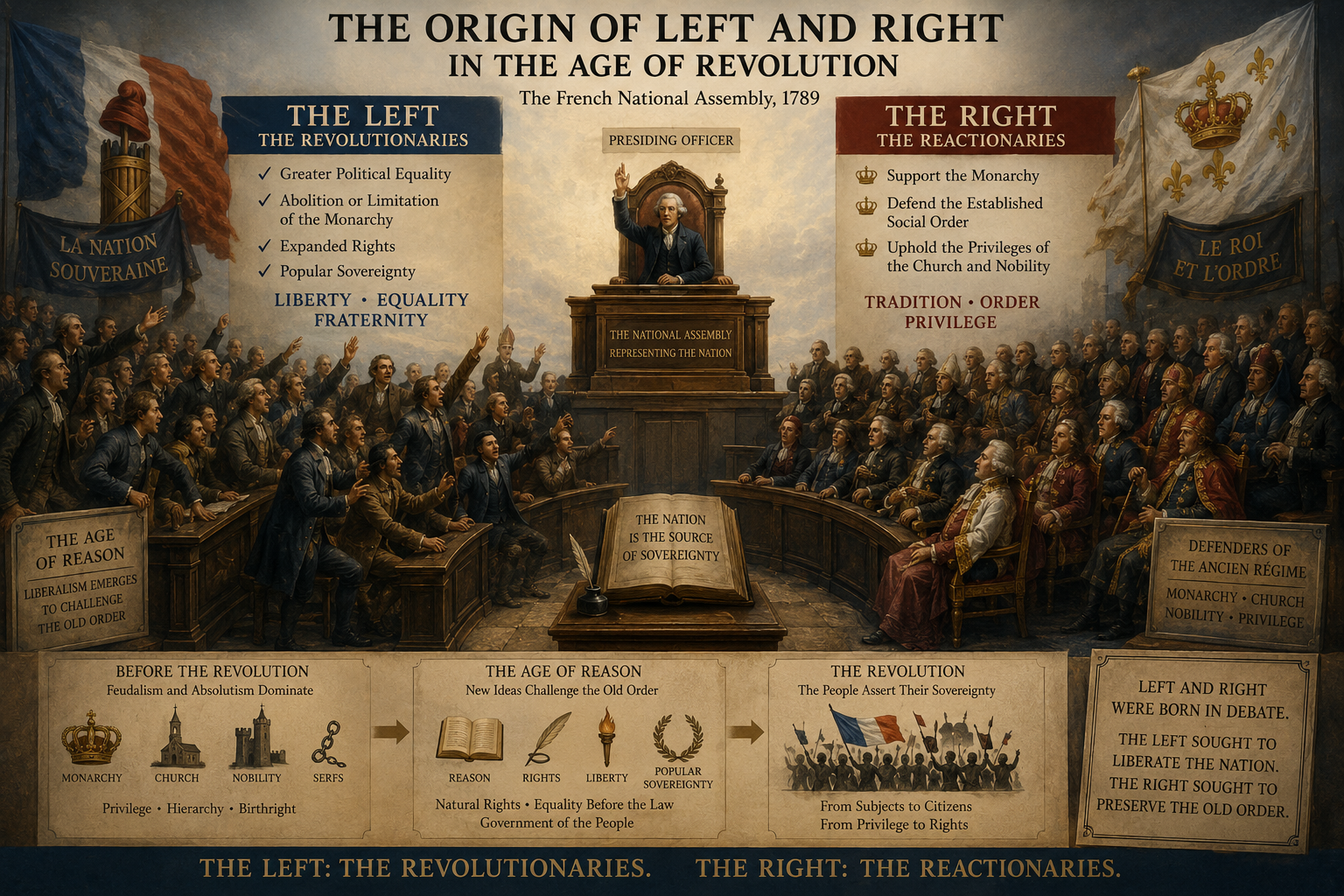
Liberalism emerged from the Age of Reason to challenge the cultural, legal, and political systems that had grown up around feudalism. Conservatism was the reactionary movement defending the ancien régime. It is in this period that notions of left-wing and right-wing first appeared. The left sat to the left of the presiding officer. They supported greater political equality, the abolition or limitation of the monarchy, and expanded rights and popular sovereignty. The right sat to the right. They supported the monarchy, the established social order, and the privileges of the Church and the nobility. The left were the revolutionaries. The right, the reactionaries.
Over time, the success of the bourgeois revolution and the institution of republican politics changed sensibilities on the right. The old conservatives died off. The newcomers had to admit that the liberal order was better than the old one. Over time, conservatives incorporated core elements of liberalism into their worldview. The new conservatism emphasizes free-market capitalism and limited government alongside Christian ethics (which liberals had already integrated into their secular worldview). Conservatives and liberals formed a unified front against the communists and socialists, who threatened the liberal order of individualism and private property with their notion of replacing equal treatment with substantive equality and liberty with statism.
With the rise of corporate personhood and the new aristocracy in the wake of slavocracy’s demise, elites elaborated an administrative state, replacing liberal capitalism with a hierarchical bureaucratic-technocratic order of administrative controls. Elites called this “progressivism” to obscure a counter-revolutionary force defending the new and regressive order of things. The liberation of the people that the Republican Party intended by freeing the slaves and deconstructing the racial separation between black and white workers—to realize the promise of a government of, by, and for the people—was thwarted by the establishment of the corporate state. To be sure, demonstrating its robustness, the bourgeois revolution continued and has been mounting a comeback of late. The new conservative represents today’s revolutionary; he carries forward the founding intent of the American Republic.
In what may at first blush seem paradoxical, progressives are the present-day manifestation of the old conservatives. The monarchal attitude projected onto the revolutionary by the mob is intended to deceive the masses into obedience to elite command and subjection to unelected authority; the corporation, once subordinate to the king under the monarchy, has replaced the sovereign; the worker has become the subject once more. The socialists, once opposed to this system of concentrated economic power, having sought to replace it with their own, but thwarted many times, joined the progressives in the hope of finding a conduit to power. This is today’s democratic socialist. Today, they steer the Democratic Party.
Having obtained control over the West’s sense-making institutions after the long march through them, progressives and social democrats portray their praxis as a righteous movement representing the least among the people, various oppressed and vulnerable groups past and present—the colonized, poor, the black and brown—, as well as those who step into oppression for status and style (queer people). But the truth is the inverse of this framing. Progressives exploit historically oppressed groups and manufacture new ones to advance the corporate state. The rising that the revolution made possible has an obstacle thrown before it.
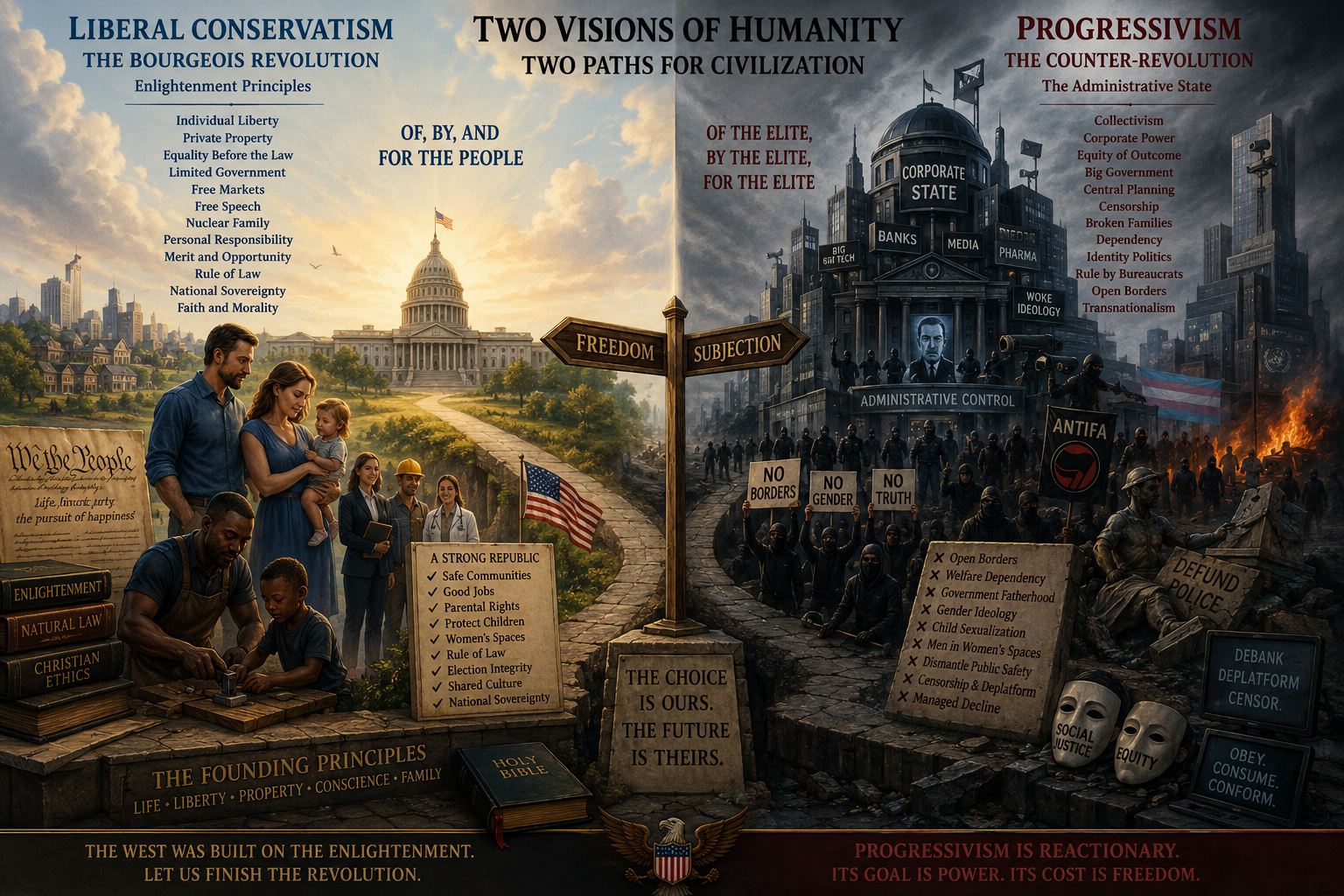
Consider the choice of comrades in my righteous arguments to right the image. I advocate for workers having good jobs with good pay, the integrity of the nuclear family and parental rights, protecting the innocence of children by keeping them safe from sexualization, preserving the activites, opportunities, and spaces exclusive to women, nurturing and safe neighborhoods for citizens by maintaing a robust measure of public safety, and defending a shared culture and language where the inheritances of the free nation are enjoyed by its offspring.
The progressive agenda opposes all this. Progressives call for open borders and the presence of illegal aliens in our communities, the practice of multiculturalism and the establishment of identitarian hierarchies, dismantling public safety, substituting government for fathers, idleness and welfare dependency, transgressing child-safeguard boundaries, granting men engaged in sex-deception access to female-only spaces, activities, and opportunities. Progressives endorse the transnational project of managed decline. They even endorse the Islamist project, which seeks to put children, Christians, Jews, and women under the thumb of Sharia.
In their project to return the world to tribalism by undermining the common national culture and deconstructing the individual, progressives pursue a regressive politics—an atavistic reaction to the Enlightenment and the bourgeois revolution it nurtured. The pleasant branding of their worldview is a deception, an Orwellian illusion. The real scene of progress is the liberal conservatism that desires to keep America and the West going. What made the West the leader in human rights and shared prosperity is Enlightenment principles, the two-parent family, and private property. This is where actual forward thinking and action live.
How can a liberal like me be characterized as somebody who doesn’t care about the least among us? I want to see black children born to intact and stable families where the father works and receives a wage that allows him to provide for his wife and children, a masculine role model that raises upright men. I want to see children grow up in nurturing and safe environments wth emotionally available parents, protected from those who seek to sexualize them. I want to see women afforded the opportunities and spaces in which they may develop their capacities and take advantage of what autonomy makes possible. I want to see a strong republic where the liberties and rights of citizens are protected from the ambition of a backwards and totalitarian religion that seeks to fracture Western culture and force Westerners to live under Sharia.
The contrast could not be clearer. The sides today are these: On the one side are the liberals and conservatives who defend the bourgeois revolution. On the other side, the progressives and socialists, counterrevolutionaries who seek an end to the Enlightenment and its entailments: free conscience, thought, speech, and publishing; nuclear families; the institution of private property; and equality before the law (i.e., equal and equitable treatment). Progressivism is reactionary. We see the violence on Western streets—the assassinations, the riots, the intimidation. What is Antifa? The paramilitary arm of progressivism.
A big part of the counterrevolution is portraying the revolutionaries as backwards and regressive. They do this by commanding the nation’s sense-making institutions and deploying the weapon of language contamination. Don’t look at what they say. Look at what they do and have done. They expose children to sexual perversion. They impose male presence on women when and where women are at their most vulnerable, in bathrooms, locker rooms, and domestic abuse shelters. They replace native-born workers with foreign labor. They manage black and brown Americans by making them dependent on public assistance. They raise an administrative-technocratic apparatus above the people, sharply curtailing individual freedom. The debank, deplatform, and censor. They lord their elitism over the working and rural man, mocking the Salt of the Earth. They make a plumber appear as a fool.
Karl Marx told us long ago that, just as you cannot judge a man by what he says but rather judge him by what he does, you cannot judge a historical system by the claims its organic intellectuals make for it (to borrow Antonio Gramsci’s apt concept). One must instead judge historical systems as one could any other system: via objective analysis. I should add to this methodology the vital importance of discernment. As I have emphasized in past essays, it is imperative to work from a moral ontology that puts such judgment beyond the political-ideological frame that reduces everything to elite preference. This is what the Declaration of Independence had in mind when it recognized the unalienable rights of man.
Although I derive my moral ontology from natural law, the ethical epistemology that results from it lands in the same place as that which derives its path from divine command of a special sort. This is Christian ethics, the principled system that guided the men who founded our republic. Philosophers have identified this as deontological liberalism, which is distinct from the utilitarianism reflected in progressive thought and action. In utilitarianism, the means to reach preferred ends—whatever the apparent majority seeks— are not governed by morality. What is more, some ends must never be sought because they are immoral in themselves. Deontological liberalism does not rule out preferences, but rather steers political action towards ends that are objectively beneficial to the people and align with ethical principles.
We see this in the struggle over election integrity. For progressives, because election integrity threatens their power and thus derails the ends they seek, namely corporate power, population control, and the transgression of protective norms, ends objectively harmful to people, especially the most vulnerable among them, a safe and secure voting system is an affront to the manufactured and pretentious ethics of “social justice.” Progressives do not work from principle because utilitarianism has none. It is a totalitarian praxis that dresses itself in a rhetoric of “fairness,” “kindness,” and “justice.”
This isn’t Orwell’s democratic socialism. It’s the modern-day substantiation of fascism. Left and right have been inverted. Popular confusion reigns.