
This essay does several things. First, it explains the difference between communism and socialism and their relationship to one another. Second, whatever their differences, it clarifies the problem of collectivism in complex societies. Third, it details the self-described character of the Democratic Socialists of America (DSA) using these understandings. Finally, it analyzes the DSA’s role in Democratic Party politics. Since the Democratic Party is a bourgeois party, why would it associate with a political organization actively promoting socialist ambition? This association raises a question about the actual function of the DSA and other openly socialist organizations in corporate state society. Are these organizations really socialist? Or are they something else?
* * *
Semantics are important. Communism is not socialism. Socialism is a social formation in which workers control the means of production through a proletarian state. To the extent that private firms and therefore a capitalist class exist, they are subjected to law and policy determined by a committee of the working class. By contrast, communism is a classless/stateless society.
In the above sense, communism is no different from anarchism, as Alexander Berkman told us. At least in the end that they seek. Anarchists and communists disagree over the means to achieve that end, and this disagreement is what differentiates them. Communists do not think man gets to a classless society by overthrowing the state. Instead, workers must seize and command the state, using it to dismantle the class structure. At this point, the state will wither away, and the common goal will have been achieved. Anarchists believe class relations exist as long as the state remains, since it is an instrument of the ruling class; therefore, abolishing the state removes the instrument of class power that perpetuates its existence.
Both anarchists and communists see the future society as, in principle, the same society in which prehistoric man lived. At least that is the framing. Karl Marx and Frederich Engels describe the original society as “primitive communism.” Such societies were clan-based and family-centered. Admitting to relatively insignificant or symbolic status hierarchies, these societies were otherwise democratic and egalitarian. With the absence of class relations in prehistory, no state apparatus was required. Everybody had the same interests and preferences and, moreover, shared the same worldview (its beliefs, norms, and values).
For Marxists, the state (as well as organized religion and the patriarchy) comes into existence with the emergence of segmented social formation. In segmented societies, people must navigate a complex system of exchange and production relations, as well as social divisions. These divisions come with competing interests and perspectives. This complexity requires law, governing institutions, and a formal social control apparatus. The emergent situation has been true in many places for thousands of years. Today, it is true almost everywhere.
The reader will note that I have strayed from the theory that reduces social relations to class relations. There is an important reason for doing this. Seizing the state and dismantling social class will not alter the complexities of modern life. Complexity requires a greater level of social organization. The state will not wither away with the abolition of social class. The proliferation of social divisions since the emergence of social class make the complexity of the situation irreducible to property relations. Hence the need for coercive institutions persists in the wake of their abolition.
As noted, socialism puts ownership of the means of production in the worker’s hands. This requires coordination and planning, i.e., bureaucratic administration of the population. Socialists will claim that, in ideal terms, the state is proletarian; it is no longer the bourgeoisie’s purview. For communists, socialism is seen as a necessary step towards a stateless society after the bourgeoisie is abolished as a class. However, beyond theory, in part for the reason stated above, it never works like that.
But there is another reason socialism is not a precondition to communism: accepting the complexities of modern life, the theory must also presume that all workers have the same interests and preferences—and share the same beliefs and commitments. Since this is not true of large, diverse populations, this requires shaping individual minds to align with a collective worldview. This raises two questions: Whose worldview? Furthermore, is it possible to bring all the minds of millions to a singular worldview?
The answer to the first question, which I will come to, is obvious. The answer to the question seems just as obvious. Because some will always resist such an alignment, since they do not prefer it and their preferences are stubborn, especially those that are rooted in natural history, alignment requires coercive institutions. Those who prefer liberty over collectivism represent a discordant element in the attempt to impose a singular worldview.
Many—if not most—individuals want to be free from intrusive government. They prefer market-based systems; they believe (correctly) that such systems maximize liberty and the pursuit of self-actualization. Marx argues this is because of socialization in a world shaped by bourgeois logic. Since capitalists rule over others, their ideas are the ruling ideas. The masses have been conditioned to think in bourgeois terms. Replace the present ruling class, and new ideas will inhabit mass consciousness. Here is the answer to the first question: the new ideas are those of the communist.
This ignores another crucial fact about humans. In addition to the love of liberty among many, some are overly ambitious and seek not just the good life, but also power over others. This problem is not exclusive to capitalist society. Thousands of years of history make clear that the overly ambitious individual is a perennial problem. Under primitive communism, the tribe could bring such persons to heel (and did so without law and state). The tribe knew who the overly ambitious were and could put them in their place. But in large and complex societies, the few become many, command enormous resources, and move beyond awareness. The power dynamic becomes dissimulated in vast, impersonal social relations. Therefore, the question is not whether some rule over others, but who rules, and what structures have been emplaced to prevent the rule from becoming totalitarian in character.
Democratic socialists insist that true socialism is democratic, substituting the rhetoric of democracy for socialism to smuggle socialism in under cover of a glittering generality. As a system of individual freedom, democracy remains undefined. Democratic socialists promise freedom, what they describe as liberation from controlling private power. A more thorough-reaching democracy is the goal. Thus, a crucial question to ask here is: what type of democracy leaves the individual free?
If democracy means the right of the individual to have a say-so in the major decisions that affect him (this definition seems reasonable), but not having a say-so over decisions men make that do not affect him (the liberty principle), then man remains free. If the second principle falls to the wayside, then democracy becomes majoritarianism, a situation where the individual is subjected to the tyranny of the majority—not because he is necessarily overly ambitious, as in the tribal situation (and, again, without the means of formal coercive institutions), but because he must be aligned with a plan to administer a complex society.
What will democracy be under socialism? Could it be anything other than majoritarian? It is hard to imagine how. To be sure, a technocratic core could manufacture the appearance of majority rule. It could dress the whims of a governing elite as the common good to which individuals must submit. Indeed, it would have to maintain control over the population. In this case, freedom would be a simulation.
To protect the individual from the tyranny of the majority, which is, in truth, a cover for the overly ambitious few, the individual must have unalienable rights, that is, immunities and privileges that governments cannot intrude upon without rationally justifying limitations. Any limitations on freedom in such arrangements must be for others’ rights under conditions of formal equality. Such a situation is only possible under a republican government governed by liberal principles. These principles preserve individualism among social animals. Individualism, which we grant as a basic human desire, is not possible under any other arrangement. Legal and political arrangements based on these principles allow for the many to check the majority and the overly ambitious few.
I have tried to falsify this proposition. I cannot. I conclude that socialism cannot be reconciled with the demand for a free and open society. Either socialism is, and freedom isn’t, or the other way around. It is not that capitalism does not come with discontents. Inequality, for example, is inevitable. It is that capitalism, for all its flaws, when governed by republican principle, is the only system that allows for maximal personal freedom. Capitalism leaves space for individuals to choose their path in life. Indeed, inequality to a substantial degree is the result of liberty.
This explains why socialism, wherever it has been instituted, has always been illiberal and undemocratic. It’s not because man isn’t doing it right. Socialism always works out this way when it moves from theory to practice. This is the result of natural history. Evolution made people both self-interested and social for reasons of survival. Self-interestedness is not the result of bourgeois indoctrination. Nor is singular social consciousness a thing the organized proletariat can grasp.
Natural history operates via variability in individual attributes in a population, with some being smarter, stronger, faster, and more motivated than others. These differences become more consequential in larger populations. Achieving equal outcomes—the goal of substantive equality embraced by communists—necessitates state control over all aspects of social life. The control socialism necessitates is qualitatively different from the control type required in a market-based economy.
* * *
Marx described the communist motto this way: “From each according to his ability, to each according to his needs.” Many readers will know the motto. But many are less familiar with the socialist motto: “From each according to his ability, to each according to his work.” The socialist motto may at first blush sound rather Protestant, but it is stamped on a society in which private property has been or is being abolished. Socialist arrangements thus preclude the entrepreneurial spirit; the state replaces the exceptional individual. The “dictatorship of the proletariat”—technocrats of the communist party (which becomes the only party)—determines what is produced and who receives the fruit of collective labor. Socialism is necessarily totalitarian.
Marx did not call this phase of social formation socialism. He called it the “lower phase of communism.” That’s known as truth in advertising. The party platform announced in the Communist Manifesto, as radical as it is, is modest given the final destination—it is an initial step to the final solution. Thus, for communists, what we call socialism is a pupal stage in the transition from caterpillar to butterfly. Socialism is not the final destination. It paves the road to communism—which it never does; the state never “withers away,” as Marx promised, for all the reasons I have already explained.
If you examine the DSA platform, it is essentially lifted from the Communist Party platform. As radical (and awful) as it is, it is still modest. This is because it is a means to an end. When the DSA objects to being called communists, they’re being disingenuous. The end goal is communism—at least this is what the rank-and-file hope for. Thus, when Donald Trump calls the DSA communists, he is not wrong, if by using this designation he means to say that this is what the DSA comrades believe.
There’s a reason that actually existing socialist societies are run by parties openly calling themselves communist. Once in power, they openly declare their ambition. But some do not wait to make their ambitions known. For Marx and the First International, they felt it was important to announce this upfront. They sought to haunt the bougeoisie with the specter of communism. The DSA lies about itself.
We don’t need to wait for them to admit to the end they seek. We have history. It’s not just the end that is objectionable—however unobtainable given the complexities of the modern world. The means are more objectionable than the end because socialism is obtainable. One need only study the history of the Soviet Union or the present reality of Red China to know what awaits.
* * *
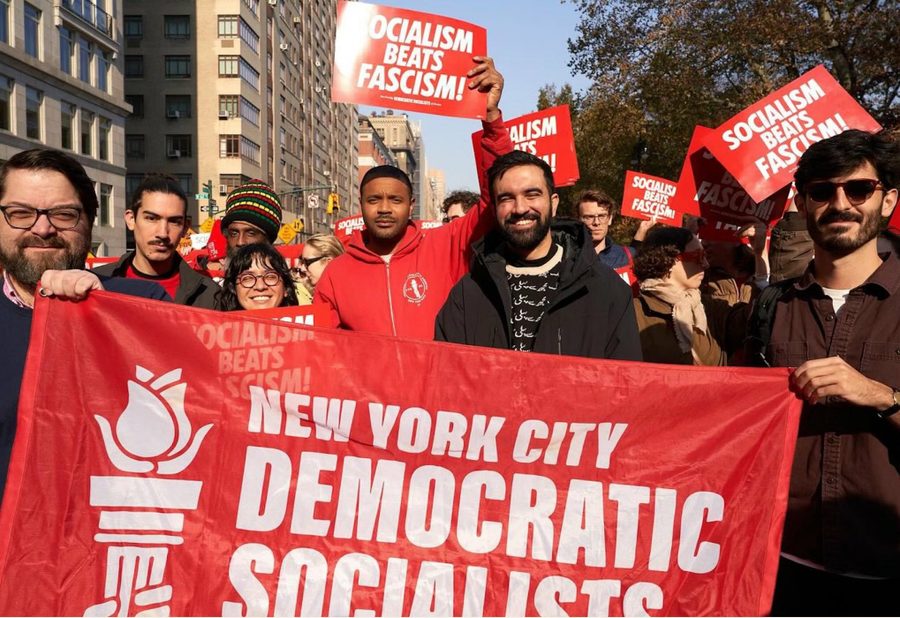
However, there’s a twist. All this presumes that those who run the DSA actually seek communism. Moreover, it presumes that socialism is the end sought. That the DSA is joined at the hip of the corporate-controlled Democratic Party—even when the Party keeps the DSA at arm’s length—suggests that the DSA functions to dissimulate corporate power. It is absurd to suggest the Democratic Party is a socialist party. Democrats defend administrative rule not to achieve socialism, but to manage the population and entrench corporate power. So why would they associate with an openly socialist organization?
Is it not obvious? The DSA is not a revolutionary organization but a tool of hegemony. In the early twentieth century, the Italian communist Antonio Gramsci argued that a ruling class maintains power not merely through coercion—laws, police, military force, and the suppression of dissent—but through consent: it persuades subordinate groups to accept the existing social order as legitimate and natural. The ruling class—today, this is the corporate class—exercises cultural and intellectual leadership by shaping institutions such as education, the mass media, political organizations, and religion, thereby influencing what people regard as common sense, desirable, and possible.
This does not mean the masses are simply brainwashed; rather, Gramsci saw political stability as depending on a combination of coercion and active or passive consent, with ruling groups making concessions and incorporating some subordinate interests while maintaining the basic structure of their dominance. Thus, for Gramsci, effective rule involves not only commanding people, but also leading them—winning enough acceptance that the existing order can reproduce itself without constant reliance on force. Progressivism and social democracy are not socialist. They are ideologies designed to disrupt organized socialist sympathies.
The DSA is an arm of the hegemonic structure of the corporate-dominated Democratic Party. The DSA’s relative independence from the Democratic Party gives the Democrats plausible deniability. It keeps a distance to keep those who oppose socialism in the fold. At the same time, it downplays the DSA’s significance, with a wink to those who think the DSA is actually socialist. It need not reject the DSA since the DSA isn’t oppositional—not because the Democratic Party is socialist, but because the DSA isn’t. The DSA is a simulacrum of a socialist organization. It exists to steer those who find socialism appealing to the Democratic Party and rob them of the capacity to disrupt corporate power. The DSA is an instrument elites use to transmit corporate desire in popular terms.
At the core of Democratic politics is the essentiality of administrative rule. Administrative governance reproduces existing illiberal power relations. The DSA provides an ideological framework for people whose preferences conflict with those relations. The DSA deceives the socialist-minded into believing that they are participating in a transformative political project. The end sought is not socialism, terrible as that end is, but the corporate state, which is just as terrible. What the DSA calls socialism is an illusion masking the true collectivism elites are entrenching, namely the corporate state. And the rank-and-file socialist has fallen for the ruse.
The DSA is a method of controlled opposition, a vehicle for hegemonic incorporation. By channeling discontent with capitalism into institutions and political practices that ultimately remain compatible with the existing order, the DSA should be understood as a containment field. The elite need not suppress opposition and alienate millions; instead, they incorporate and redirect oppositional aspirations in ways that help stabilize the very system those aspirations seek to transform. The rank-and-file socialist has been coopted and neutralized. An obstacle has been removed from the path to total corporate power.


