
The left has a history of conscripting free-market, republican figures into its propaganda. Abraham Lincoln is an obvious example (see History as Ideology: The Myth that the Democrats Became the Party of Lincoln; Flipping the Script: Democrats Made Republicans Wear Their Dress). Another is Frederick Douglass, a former slave whose voice was a powerful one for the cause of freedom.
The Democratic Socialists of America (DSA) have a long history of portraying Douglass as a champion of its cause. Born the same year as Karl Marx, Douglass’s defense of individual liberty, free labor, and property rights provides a useful contrast to Marx’s advocacy of socialism and communism. Douglass is not one of them. He is one of us.
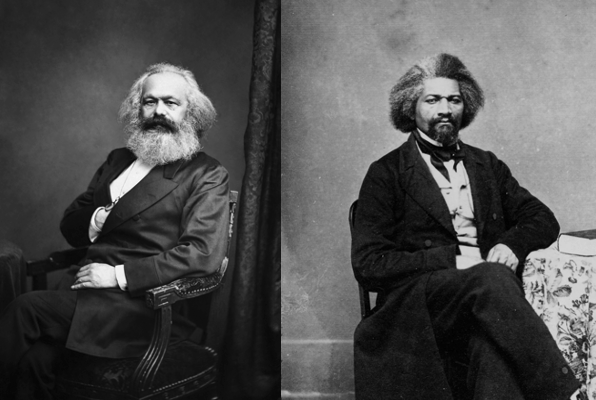
It’s not as if we don’t have Douglass’s own thoughts on hand to tell truth from fiction. The man’s political philosophy was focused on individual liberty, self-ownership, private property, and free labor. Having personally experienced slavery (he was a slave from birth in February 1818 until his emancipation in September 1838), Douglass regarded the ability of a person to own his labor and dispose of it freely as central to freedom. Douglass was foremost an individualist and committed to liberty and equality before the law. In a word, the man was a liberal.
Douglass rejected the socialist argument that wage labor and private property are essentially forms of slavery, even if under certain conditions the wage labor situation appeared similar to that of the chattel slave. In 1848, responding to a socialist speaker who equated private property with property in human beings, Douglass dismissed the argument as “arrant nonsense.” Owning property is legitimate, whereas owning a person violates the most fundamental principle of human freedom. Human beings are not property.
Marx, by contrast, was deeply critical of private ownership of the means of production, envisioning in its place a society in which productive property would be held collectively. However much he believed that the end of socialist transformation of social life and man himself would be a classless and stateless arrangement, Marx advocated a politics that required the coercive power of the state to control every aspect of human life. Marx was right about a lot of things. He was dead wrong about communism. The state never withers away.
Marxists insist Marx never mapped the final destination. But inherent in communist desire is totalitarianism. The communist imagination is confronted by the reality of history. Communism cannot be done right. It is always wrong.
As readers well know, Marx saw capitalism as a system of class exploitation. Douglass did not see the problem in these terms. He saw the fundamental problem as coercion and the denial of individual freedom. That rules out socialism. Socialism is inherently coercive and destructive to liberty.
I have written about Marx and his championing of the Union during the Civil War in the United States (see, e.g., Marx and Americanism: From One Revolutionary to Another). Marx’s support for the Union cause was more in line with republicanism at the time. Marx was often of two minds, one rooted in principle, the other in dogma. Moreover, the Republican Party was founded with a degree of socialist sympathy, at least in the labor question. (See Republicanism and the Meaning of Small Government and the aforementioned History as Ideology essay).
Marx and Douglass were on the same page about slavery. But they departed on the question of what should come after slavery. Marx ultimately saw the end of slavery as an opportunity for black and white workers to rise up and overthrow the capitalist class (which ran counter to his republicanism). Douglass’s ideal was a society in which black people stood on their own as independent workers, property owners, entrepreneurs, and citizens. Douglass maintained that a worker’s right to own land, sell their labor, and accumulate personal wealth was the absolute foundation of human dignity. That’s not socialism in any conventional sense.
Douglass was not a conflicted man when it came to the question of republicanism. It’s not that Douglass believed capitalism was perfect—far from it. Like Lincoln, he was concerned about the enormous power of capital over labor. After the Civil War, Douglass wrote extensively about the labor question and recognized that workers could be exploited. He supported organized labor at various points and acknowledged that workers might receive an unfairly small share of the value they produced.
But Douglass explicitly rejected Marx’s fundamental premise of class antagonism. The problems of capitalism did not dissolve into a contradiction resolved by proletarian revolution. Rather, the problems were to be addressed through reform and reconciliation. There is no contradiction, just an imbalance of power.
Douglass believed that the interests of capital and labor could be reconciled through political reform, equal rights, and just laws. He asserted popular power to the extent that it could achieve this end. Revolution did not follow from the exercise of that power.
New National Era, one of the newspapers he edited, expressed the principle that there should be no effort to array “the employer against the employee” or “the rich against the poor”; instead, society should seek to “harmonize” apparently conflicting interests. This was Lincoln’s view of things as well. Neither Lincoln nor Douglass expressed the views of today’s socialist movement or the Democratic Party. Both men were republicans, in principle and party.
From “The Labor Question” in the New National Era:
“There is no justice or safety in any organization which seeks to specially promote the interests of any one class of citizens at the expense of others. A capitalists’ party, a producers and manufacturer’s party, or a workingman’s party within the circumscribed meaning of these terms, would be at once a menace to all other class interests, and would not only provoke the organization of political parties or factions for the special protection of each distinctive class, but create such divisions that anarchy and violence would sooner or later become inevitable.
“Hence, we must not for a moment tolerate the idea of arraying the employer against the employee, the capitalist against the business man, the manufacturer and producer against the laborer, the rich against the poor, the strong against the weak, nor encourage any of the antagonisms, so freely prated about and advocated by the shallow if not vicious demagogue. We must seek rather, by just laws and efficient administration, to harmonize all these superficially antagonistic interests, justice, universal justice, and not special privileges and advantages, is what we should perpetually aim at. Equal justice will wrong no man, and give no good cause for complaint even to the most selfish.”
The essay concludes:
“Such an organization is the Republican party, and such are its aims, as is abundantly testified by its record. It is the working man’s and every other man’s party, and deserves the support of all.”
Reaction to the Paris Commune in 1871 highlights the difference between Marx and Douglass. Marx regarded the Commune as an extraordinary experiment in working-class political power. Douglass, by contrast, was deeply suspicious of the Commune and the purpose of revolutionary violence.
This did not mean that Douglass opposed collective violence in confronting tyranny. No rational man does. For example, he looked favorably on the French Revolution of 1848, seeing in it the model for the overthrow of the slavocracy. The fruit of revolution, however, must not be socialism but the overthrow of monarchy and despotism, the establishment of republican government, the extension of political rights, the abolition of slavery, and the institution of the principle of equality before the law.
Douglass was hostile to the Commune because he believed its revolutionary character threatened republican government and individual liberty. He saw in it lawless violence and the “tyrannical disposition” to regulate matters properly belonging to individuals.
As noted earlier, in his arguments concerning slavery versus the wage-labor system, Douglass was critical of the wage-labor arrangement, but he marked a key distinction: a chattel slave cannot leave his position; a free laborer can. That distinction points to a fundamental problem with socialism. Under capitalism, people are free to associate with whom they wish. Under socialism, the state ultimately determines the conditions under which economic association takes place.
Douglass understood that, however much value the worker may create for the capitalist, he does so voluntarily under contract. However difficult it may be to accomplish, he is free to set up his own business. Under socialism, by contrast, the worker’s economic choices are constrained by collective ownership and state power. He is not free to disassociate from the collective economic arrangement or establish his own private firm. He must do what the state tells him.
Douglass’s fundamental political objective was democratic republicanism, not proletarian revolution. The DSA platform is essentially a call to abolish the constitutional order and establish a socialist state in America. Based on everything we know about Douglass, he would have been horrified by such a project. He loved the Constitution and wanted to perfect the Union, not dissolve it.


