
As I have stated many times, one cannot change history, and bringing its ghosts into conversations about justice reflects a primitive ethic ill-fitted for modernity (The Ghosts of Conquest; The Matter of Collective Guilt; About Those Fifty-Nine Afrikaners). That said, history is not unimportant, and the accounts of those who appeal to it should be accurate and truthful.
Yet those who appeal to history often revise it to meet their present political ends. Revisionism is a means to ends—not always a legitimate means, of course, but a means, nonetheless. Therefore, if a debate is to proceed via historical appeal, then it is important to clear away the tangle of deceit to behold actual history. Live by the sword, die by the sword, so to speak.
The left today appeals to an epistemological framework that promotes ignorance and permits those in the know to rationalize lying. This framework is most famously articulated in the work of historians such as Howard Zinn, the author of A People’s History of the United States, which informs the teaching of history to American youth. Progressives long ago colonized Western institutions, and this is no clearer than in our education system.
Zinn argues that history is never neutral but rather is shaped by ideology—specifically, by the interests and perspectives of those in power. “Traditional history,” he contends, is a “top-down” view of the past, downplaying or ignoring the experiences of enslaved peoples, indigenous populations, farmers and workers, and other marginalized groups.
In his view, this selective emphasis (Zinn himself is highly selective in whom he counts among the marginalized) is ideological because it subtly reinforces the legitimacy of existing power structures by making them appear inevitable or universally beneficial. He wants to “reveal” a history “from below,” showing how inequality, resistance, and social conflict have shaped history.
Zinn and his lot are often understood to be Marxists of some sort. However, the epistemology that shapes Zinn’s narratives is not to be confused with Karl Marx’s materialist conception of history. Whatever you think of his conclusions or his politics, Marx proceeds on objective grounds. There is a truth, for Marx. By contrast, Zinn’s radicalism is corrosive to truth in that it asserts that what counts as “history” depends on whose interests are being served and whose stories are being told—and this is the case whatever the sides in question.
It is not that revision is a problem of historiography. New facts emerge, and good historiography accounts for these facts without rationalization. Revisionism is a problem in the work of Zinn and his ilk. They are guilty of the very thing they decry. They do not decry traditional historiography because it is ideological per se. They reduce history to ideology. They decry it because it is not the ideology they seek to advance.
This finds historians of Zinn’s type participating in the same corruption of knowledge as critical race theory, postcolonial studies, and queer theory. Like those standpoints, A People’s History of the United States is skeptical of “master narratives” that present a single, authoritative story of national progress. It emphasizes that historical accounts are constructed from particular perspectives rather than discovered as neutral facts. The emphasis on standpoint—especially the praxis of centering marginalized voices—aligns with postmodern and post-structural critiques of objectivity and power/knowledge relationships.
This essay is not about Zinn. I note Zinn because his work is illustrative, useful because he is well-known (even assigned reading), exemplary of the type of knowledge production that begins with presupposition, typically rooted in the irrationalism of unwarranted hatred, and then organizes historical materials as a means of valorizing irrationalisms to manifest in reality: the destructive and oppressive desire of activists left and right.
In this way, the progressive telling of history is not at all unlike the manner in which Nazis construct history. The Nazis revised history to support their racist ideology by manipulating facts, controlling education, and spreading propaganda. The Nazi rewrote textbooks, censored books and media, and distorted historical events to justify political goals. By controlling how history was taught and remembered, the Nazi regime sought to gain public support, strengthen loyalty to Adolf Hitler, and legitimize discrimination, violence, and eventually genocide. With eyes open, one cannot avoid the hallmarks: identitarianism, an obsession with race, and the genetic attribution of designated evil.
Today, I am going to tell the true history of a territory in terms of what the French Annales school calls the longue durée. With antisemitism once again ascendant, on the left and the right in the West, and as always with the Muslims wherever they are, with the focus on the alleged injustice suffered by the so-called Palestinians, the story of what appears on many maps as “Palestine” is the case at hand.
The Islamic standpoint on this question is not just about driving the Jews out of the Middle East (and ultimately from the world). The Islamic telling, widely adopted by Western minds, is part of the Islamic project to finally conquer the world. This ambition makes Islam useful to transnationalists, those who are denationalizing the world. Hubris convinces them that they can manage the outcome. Muslims have set their sights on the West because Western tolerance makes it vulnerable to Islamization. Transnationalists exploit tolerance to push mass migration and multiculturalism because they know these undermine the nation-state.
The Blue Hat American Firsters are keen to tell us that putting America first does not entail concern for Israel—indeed, it requires rejecting the US-Israel alliance—but the threat posed by Islam compels an alliance between the United States and Israel. Tucker Carlson, Nick Fuentes, Candace Owens, Marjorie Taylor Greene, Mehgan Kelley, and others represent a faction on the populist/right-wing nationalist side of American politics that argues Trump and mainstream MAGA figures have betrayed “America First” principles by remaining strongly pro-Israel and launching a preemptive war against the Islamic Republic of Iran. I say “Blue Hat” because their politics effectively bolster the Democrats and the transnationalists the party represents. Lately, some of the Blue Hats have even taken to ingratiating themselves with Muslims.
Concern for Israel’s future and security is America First. Islam is the common enemy. This is why preemptive action against Iran is just war. Perhaps Israel is capable of defending itself. But a Middle East without Israel would only strengthen Islam. Israel represents the only modern liberal democratic state in the Orient. And the Islamic Republic represents a real threat to Israel’s existence—long-range ballistic missiles, nuclear weapons, and genocidal proxies at the borders of the Jewish state. Carlson, Kelley, and their ilk are downplaying that threat, and condemning the war, going so far as to treat Muslims as if they are like Christians—and not at all like Jews, whom the Blue Hats see as the true enemy. If the US were to withdraw its support for Israel in any significant way, it would imperil Israel, and this, in effect, empowers Islam. It is not as if the Blue Hats have neutral ground on which to stand. Either one stands with Israel, or one stands with Islam.
The conservatives expressing affinity to Islam, when pressed on the issue, can be expected to draw a distinction between Islam and Islamists. But Islamism is not a wayward branch or perversion of Islam. Originally, the term Islamism meant the religion of Islam. The meaning was changed in the late twentieth century after the 1978–79 Iranian Revolution led by Ruhollah Khomeini. Western scholars and journalists revived the old word Islamism and narrowed it to mean political movements seeking to organize government or society according to Islamic principles or law. There are, thus, good Muslims and bad Muslims.
Yet, Islam is a political movement. And, so, the old term has been repurposed for subtefuge, to rhetorically differentiate between those who believe in Allah, in the way Jews do with Yahweh (setting aside the antisemites), and those who faithfully practice Islam with all its entailments, which are destructive and violent. This is a deception. Muslims are not like Jews. Judaism is a solid guide to the good life for peaceful people. Judaism, working through the rational Christianity that pushed through the Reformation, gave rise to liberal capitalism (Anticipating Weber: Revisiting Marx and the “Jewish Question”). It is the moral and practical spirit of the Enlightenment. Islam is a guide for aggressive war and totalitarianism.
It is worth noting that this differentiation came powerfully with the expansion of ecumenism beyond the tolerance developed among Christians for its many different sects. This gave rise to an interfaith project that welcomed Islam. Huge mistake. (See Defensive Intolerance: Confronting the Existential Threat of Enlightenment’s Antithesis.) The differentiation allowed Islamic propagandists and their allies to claim that Islamism is an unfair designation because it blurs the line between the faithful and the extremist.
They’ve got us coming and going, don’t they? But Islam is an extremist belief system. Islam is Islamism. The best one can hope for is that Muslims don’t take their religion to heart. But hoping for the best can be suicidal, especially in this case. An increasing proportion of Muslims take matters to heart, and their growing numbers in the West—which should terrify all good and decent people—are emboldening them.
Muslims have a great many mosques in which to pray, but you may have noticed that they pray out on the sidewalks and streets, blocking traffic, disrupting the lives of the indigenous peoples of those countries they are colonizing. They even gather and pray on church grounds. In our law and institutions, they are establishing Sharia, the rules of Islam, demanding, among other things, that their dietary restrictions and other rituals be observed everywhere. They’re harassing people for eating during the days they fast. Be respectful, progressives chastize men of the West. In our communities, Muslims blare the call to prayer five times a day through megaphones from Mosque rooftops. They’re telling women how to dress—and using “immodesty” as an excuse to rape. They’re demanding we stop walking our dogs around them. They are holding non-Muslims accountable according to the blasphemy rules of their religion.
These are displays of aggression, and they’re often accompanied by violence. Muslims are telling us that they’re taking over the spaces of the host countries that have succumbed to the pathology of misplaced empathy and a warped sense of humanitarianism that tolerates extremist ideologies. They are using the freedoms and virtues of the West, our open-mindedness and tolerance, as well as Western concern for the downtrodden, and the gullibility produced by the postmodernist notion of standpoint, to subvert the West. And they’re amplifying antisemitism to conscript people on both the left and the right in the Islamization project, which we see in the pro-Palestinian crowd and the far-right that has rejected Trump and the Red Hat America First movement. We have but a generation to turn this around—if that. Some Western countries may be beyond saving.
I appreciate the reader’s patience in allowing me to critique the progressive epistemic and note the threat of Islam (I have written several essays on the latter, which I will leave the reader to seek out if interested). I now turn to history, since if Muslims and their allies are going to appeal to it, it is important to ensure that historical truth is known—and understood.
* * *
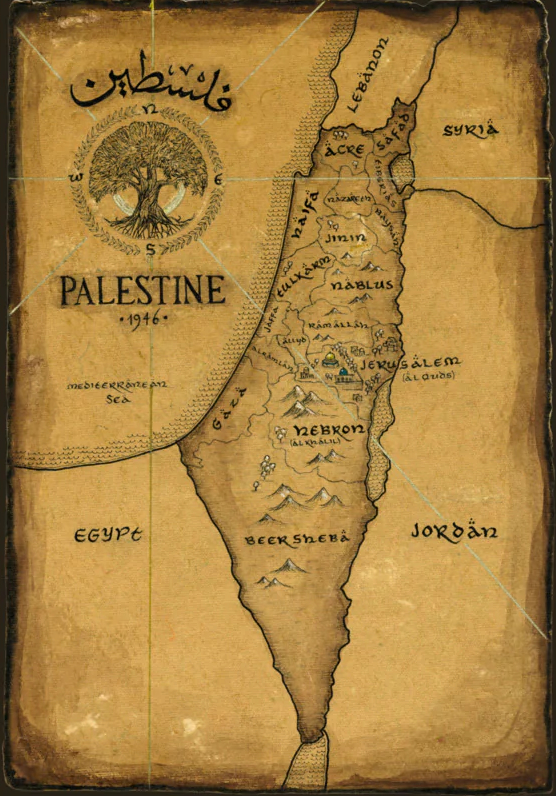
The legitimacy of the Jewish claim to the territory is well established. The Jews are not only an indigenous people of the territory, but for millennia have been the dominant ethnic group there. It is an incontrovertible fact that the territory that came under British rule following World War I, then called “Mandatory Palestine” or the “British Mandate for Palestine,” administered under a League of Nations mandate system established after the collapse of the Ottoman Empire, is the ancestral homeland of the Jews. And so, it remains today. The state of Israel is an established member of the international community.
In a moment, I will get into how the territory came to be called “Palestine.” For the present, however, it is important to note the significance of other indigenous populations there—Bedouin, Samaritans, and others. If we go back further in time, we find living alongside the Israelites, groups known as the Canaanites, Philistines, and Phoenicians. Today, those calling themselves “Palestinians” are among the various groups presently identified, but there is no nation, either in ethnic or state terms, called “Palestine.” In the centuries before the establishment of the State of Israel, all the groups living in that territory were known as Palestinians, not because there were ethnic Palestinians, but because the name of the territory identified them as such. Jews were also Palestinians for this reason. If a state ever exists, called Palestine, it will not be rooted in anything organic. It will be yet another Arab state among many such constructs beyond the Arabian Peninsula.
Those identifying themselves as Palestinians today, in the sense of an alleged distinct national group, indeed speak Arabic, but they did not always. Before Arabization, which occurred around the Seventh Century AD, recent in terms of the longue durée, they spoke other Semitic languages. Arabization of Palestine is a late historical development, occurring with the spread of Islam beyond the Arabian Peninsula via conquest, colonization, and slavery. This history cannot be told separately from the spread of Islam. Within the Arabic-speaking and Islamic intellectual traditions, the Qur’an is widely regarded as the supreme model of classical Arabic eloquence and style. Its language had an enormous influence on the development, preservation, and standardization of Arabic grammar, rhetoric, and literary culture.
We need to go back in time to understand the situation, especially to understand how that territory came to be called “Palestine.” Before then, it had another name: Judea, which was a Jewish nation. Like many kingdoms, its historic borders shift to-and-fro for various reasons beyond the scope of this essay. But that it was an established place of successive Jewish kingdoms is beyond dispute. I pick up the history of imperial control over Jewish territories under Rome.
In the middle of the last century BC, the Roman general Pompey conquered Judea, bringing the region under Roman influence. Initially, Rome governed indirectly through client kings rather than direct imperial administration. One of the most significant of these rulers was Herod the Great, who ruled from roughly 37 BC until 4 BC as a Roman client king.
I digress here to elaborate on a point I made in a May 2024 essay (Is the Progressive Left Flirting with Christophobia?) regarding Herod’s son Herod Antipas. Herod’s family background was not traditionally Judean-Israelite in the narrow ethnic sense. His father, Antipater, was an Idumean, or Edomite, from a neighboring Semitic people who lived south of Judea. In the Second Century BC, the Hasmonean rulers conquered Idumea, compelling, or at least encouraging, the population to adopt Judaism. As a result, Herod’s family became integrated into the Jewish political and religious world of Judea. Some historical sources also suggest that Herod’s mother may have had Nabataean ancestry. Technically, perhaps not ethnically Jewish as such things are reckoned (through the mother’s line), Herod was born a Jew culturally and religiously. He did many things for Jews, including the expansion of the Second Temple.
After a period of political instability following Herod’s death, Judea was reorganized as a directly administered Roman province governed by Roman prefects and procurators, including Pontius Pilate, mentioned in the New Testament (whom I discussed in that earlier essay). Crucially, all this was centuries before Muhammad plagiarized the Old and New Testaments in the Seventh Century AD to produce Islam. Indeed, this was centuries before the Arabic language took its classical and recognizable literary form, a process that did not begin until the Fifth Century AD.
As an aside, Muhammad claimed the archangel Gabriel dictated the scriptures to him, which he then dictated to somebody else, since Muhammad was illiterate. I note this because I find it fascinating how this parallels the story of the North American Christian cult leader Joseph Smith, who claimed that the ghost of an ancient prophet, Moroni, delivered the revelation that became the Book of Mormon to Smith, which, like Muhammad, he dictated to scribes, who wrote it down. Like Muhammad, Smith was a polygamist who included juveniles among his wives.
During the First Century AD, tensions between Rome and the Jewish population intensified, and in 66 AD, the First Jewish–Roman War erupted. The conflict culminated in 70 AD, when the Roman general Titus captured Jerusalem and destroyed the Second Temple, which had been rebuilt in the Sixth-Fifth Centuries BC and, as noted, later expanded by Herod (the father) in the first century BC. The area known today as the Temple Mount in Jerusalem is the site where the Second Temple once stood. After the Islamic conquest of Jerusalem in 638 AD, the area came under Muslim rule, and over time, major Islamic religious structures were built on the platform.
Several decades after the destruction of the Second Temple came the Bar Kokhba revolt in the Second Century AD during the reign of Emperor Hadrian. After suppressing the revolt, Hadrian undertook measures intended to diminish Jewish association with the land. This is a crucial fact of history, for among these actions was renaming the province from Judea to “Syria Palaestina,” the term “Palaestina” derived from earlier Greek terminology associated with the Philistines, an ancient people who had lived along the southern coastal region centuries earlier. This Roman renaming is the origin of the later geographic term “Palestine.” When pro-Hamas activists share older maps of the region that identify the territory as such, they do not tell of this history. They leave this part out because it affirms the territory as the Jewish homeland.
The Roman province of Syria Palaestina encompassed what is now Israel, the West Bank, and the Gaza Strip, as well as portions of modern Jordan. Depending on the administrative period and how historians define provincial boundaries, it may also have extended into parts of present-day Lebanon and Syria. The region’s borders changed repeatedly under Roman and later Byzantine administration. All this is crucial to understanding the present conflict—if history matters.
Returning to the matter of Arabization, before the Islamic conquest of the Levant, the region the Romans called Syria Palestina was home to multiple Semitic-speaking populations. Languages commonly spoken included Aramaic, Greek, and Hebrew (there were other regional dialects). Arabic, when it emerged centuries later, was spoken primarily in the Arabian Peninsula, though some northern Arab tribes and trading groups interacted with Levantine populations before Islam.
I noted earlier that the classical form of Arabic began emerging in the Fifth Century AD. By the Seventh Century, around the time of Muhammad, Classical Arabic had developed into a highly standardized literary language. The Qur’an was thus written in a recently codified language and itself substantially codified that language. Following the early Islamic conquests that spread outward from the Arabian Peninsula across the Levant, Mesopotamia, North Africa, and beyond, many local populations gradually adopted the Arabic language and culture.
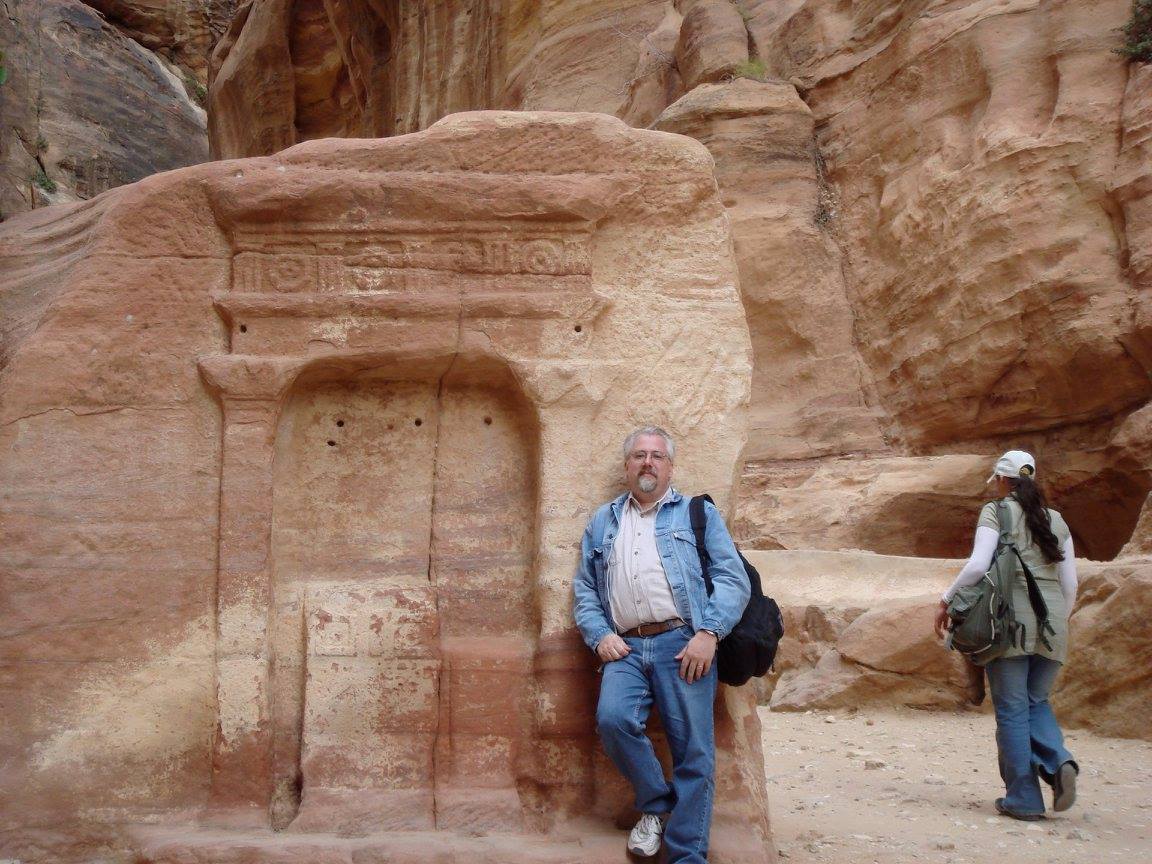
The Nabataean Kingdom, centered around Petra in present-day southern Jordan, illustrates the linguistic complexity of the ancient Near East. I have been to Petra twice and have seen the proto-Arabic scripts myself. Nabataean inscriptions include Aramaic, Greek, and early forms of Arabic script, reflecting the multicultural and multilingual character of the region under Hellenistic and Roman influence. My point here is not to deny the origins of the language and culture, but to show that it is not original to the Levant.
The process that began with the Islamic conquest occurred over centuries and did not necessarily involve large-scale population replacement. Instead, many indigenous peoples of the Levant adopted Arabic while retaining significant genetic and ancestral continuity with earlier populations of the region. Most of those who speak Arabic today in the region were not originally from the Arabian Peninsula, nor did their ancestors speak Arabic. They would have spoken other languages in ancient times and been the subjects of various Jewish kingdoms. (For perspective, ancient history ends with the fall of the Western Roman Empire in the Fifth Century AD, long before the Arabization of the Levant.)
To be sure, modern populations in the Levant—including Bedouins, Druze, Jews, Samaritans, and those calling themselves Palestinians, along with various Christian communities—often show deep genetic roots connected to ancient populations of the region. However, while those identifying as Palestinians today largely speak Arabic and identify culturally as Arabs, historians and genetists describe them as descended from earlier Levantine populations who became linguistically and culturally Arabized over centuries following the Islamic conquests.
The genetics of the people in this region are often used to argue that Palestinians have a right to the territory. This typically comes with the claim that the European background of many Jews living in Israel means they are colonizers. However, most Jewish diaspora groups (Ashkenazi, Sephardi, Mizrahi, etc.) share ancestry with ancient Near Eastern/Levantine populations. Jewish communities remained relatively endogamous for many centuries, which preserved an identifiable shared ancestry. Ancient DNA studies comparing modern Jews with remains from the Bronze Age and Iron Age Levant show measurable genetic continuity. Are there differences? Of course, admixture affects all populations. No modern population is identical to ancient peoples.
The significance of this history is that had Jewish rule not been overthrown by Roman imperialism, all these populations, even if not Jewish by ancestry, would have been Judean subjects and citizens. Jews have historically tolerated non-Jews, and many Israeli citizens today are not Jews, yet fully participate in Israel’s political and social life. This history is apparent in geography. Major cities in Judea included Bethlehem, Hebron, Jericho, and Jerusalem. Under Herod, Judea included Samaria (today northern West Bank), Galilee (northern Israel), Coastal plain cities (e.g., Jaffa), and Perea, which is east of the Jordan River, in today’s Jordan. People of many ethnicities dwelt in these cities—and still do.
After the decline of Roman rule and the later Byzantine Empire, the territory once known as Syria Palaestina passed through the control of numerous dynasties and empires over more than a millennium. In the Seventh Century AD, the region was conquered by the early Islamic caliphates following the Muslim Arab expansion out of the Arabian Peninsula. Control later shifted among several Islamic powers. During the medieval period, parts of the region were seized by the Crusaders. Muslim control was later reestablished under various leaders. In 1517, the Ottoman Empire conquered the region and ruled it for roughly four centuries until World War I. After the Ottoman defeat, Britain occupied the territory, eventually leading to the establishment of the British Mandate for Palestine under the League of Nations in the early 1920s.
We can now leave the longue durée and move to recent history. After the 1948 war between Arabs and Jews, which the Arabs initiated following the establishment of the State of Israel, the West Bank came under Jordanian control. In 1950, Jordan formally annexed the territory and incorporated it into the Hashemite Kingdom of Jordan. Many Palestinian Arab residents of the West Bank were granted Jordanian citizenship as a result (although, given the terms of the kingship system, they were and are more properly identified as subjects). This is why it is often said that the so-called Palestinians, who refused to be part of Israel, already have a country, namely, Jordan. Jordan retained control of the West Bank until the 1967 Six-Day War, also initiated by the Arabs, when Israel captured the territory.
From that point onward, Jordan no longer had control over the West Bank, and Israel established military occupation there. Unfortunately, Israel did not annex and incorporate the West Bank, a mistake currently, albeit slowly, amid international opposition (shaped by Third Worldism), under rectification. In any case, in 1988, Jordan formally renounced its claims to the West Bank, ceding its administrative and legal ties to the territory and recognizing the Palestine Liberation Organization (PLO) as the representative of the Palestinian people. Founded by the Arab League, the PLO was charged with the “liberation of Palestine” through armed struggle. The PLO is not the only terrorist organization pursuing this goal. Hamas emerged in 1987 during the First Intifada, originating in the Gaza branch of the Muslim Brotherhood.
The story of the Gaza Strip is crucial to this history. In ancient times, Gaza was a coastal city-region known as Philistia, controlled by various powers over the centuries. The Philistines were a major rival of the ancient Israelites. This was long ago, between the Eleventh and Tenth Centuries BC. The Philistines gradually disappeared as a distinct people between roughly the Seventh and Fifth Centuries BC. Those claiming to be Palestinians today have no relationship to this ancient people.
After the 1948 war, Gaza came under Egyptian military administration. Egypt governed the territory but did not annex it, and Gaza’s residents were not granted Egyptian citizenship. This arrangement lasted until 1967, when Israel captured the Gaza Strip during the Six-Day War, ending Egyptian control. Unlike the Sinai Peninsula, which was later returned to Egypt under the 1979 Egypt–Israel Peace Treaty, Gaza was not included in any such agreement. Egypt did not formally cede Gaza in a treaty; rather, it had administered the territory until 1967 and then did not regain it afterward. Thus, it fell under Israeli administration. In 2005, under Prime Minister Ariel Sharon, Israeli civilians were evacuated. All Israeli soldiers left before the year was out. Hamas assumed control in the wake of Israeli withdrawal, which, in hindsight, was a grave error.
Taken as a whole, the historical record of the region reveals a long, continuous sequence of demographic, political, and linguistic transformations, rather than a single, stable national identity unchanged across millennia, except for the Jews. The land has been governed by successive empires, inhabited by overlapping populations, and repeatedly redefined by conquest, administration, and cultural change, but, throughout it all, the Jewish character of the land has remained.
Within the longue durée framework, and even narrower historical frames, the Jewish connection to the territory appears not as a recent political construction, but as an ancient and persistent historical reality that predates later imperial overlays. At the same time, the region’s complexity is shaped by the layering of subsequent populations and languages, particularly following the Arabization of the Levant after the Seventh Century AD. All this may be admitted. But it does not change the central claim. Israel is yet another instance of Jewish political organization on their indigenous lands.
Betraying his concern for indigenous populations, Howard Zinn was sharply critical of Israeli government actions toward Palestinians, particularly military occupations and large-scale military responses in Gaza and Lebanon. He ostensibly framed the conflict through his broader antiwar philosophy: that state violence and retaliation tend to perpetuate cycles of suffering rather than resolve them. In interviews and essays, he compared some Israeli policies to apartheid and argued that Palestinians were denied basic rights and self-determination. In these works, he accepted the historical revisionism of Islamic propagandists, which we might say is unbecoming for a professional historian, except for those operating from his epistemological frame. Still unbecoming, on second thought.
The point I wish to make is that, if modern political claims cannot be meaningfully separated from the deep historical processes that produced the present demographic and cultural landscape, then those who oppose Israel’s existence lose their appeal to history. Any serious account of justice or legitimacy in the region on these terms must engage with the full historical depth rather than selectively compressing or simplifying it. The continuity of Jewish historical presence, alongside the later regional transformations, forms the essential backdrop against which contemporary claims and political arrangements are meaningfully and validly understood.
Ironically, this exposes the pro-Palestinian crowd as genocidal in intent. When pro-Palestine activists chant “From the River to the Sea, Palestine Will Be Free,” what they mean is the elimination of Jews from the territory Arabs now claim as their own, justifying their eliminationist sentiment on the false claim that the Palestinians are a people colonized by an external force, which presumes they are a people.
The land upon which Israel is established is not indigenous Arab lands. The pro-Palestine movement is, therefore, not merely a colonial movement that seeks to assume control of the territory by Arabs—it is colonialism to be sure—but a genocidal project to eradicate the Jews in the Middle East. The rhetoric of genocide used to delegitimize the Jewish state is thus a projection by those intent on continuing the Judaicide that marked the Nazi horror. Indeed, as I have shown on this platform, the Arabs not only admired Hitler’s eliminationist ambitions but also explicitly allied with him in the project to cleanse the world of Jewish presence.


