
The big complaint on the far right today—the rogue America First crowd—is that Trump has morphed into a neoconservative. In 2004, I penned two chapters in Bernd Hamm’s Devastating Society: The Neo-Conservative Assault on Democracy and Justice. One of those chapters (you can read the article version War Hawks and the Ugly American: The Origins of Bush’s Middle East Policy on this platform) was a deep dive into neoconservatism and the Project for a New American Century (PNAC) and their plans to instigate a “democratic tsunami” across the MENA space. I know a bit about this ideology.
Trump is no ideologue. He’s a pragmatist. It’s an error to group him with the PNAC crowd of warmongers whose grand vision is rooted in American imperialism and globalism. When Trump said “no new wars,” he was explicitly separating himself from the war hawks; he was not saying that America would never go to war (see Trump Never Promised to Eschew Military Power to Confront Tyranny). Such a stance is suicidal. It allows evil to gather strength. The America Firster who thinks like this is the same America Firster who delayed America’s entry into World War II. Isolation bolsters our enemies’ ambitions. Millions died needlessly because America sat on its hands while Nazi Germany gathered strength. It took the attack on Pearl Harbor to finally move the United States to action.
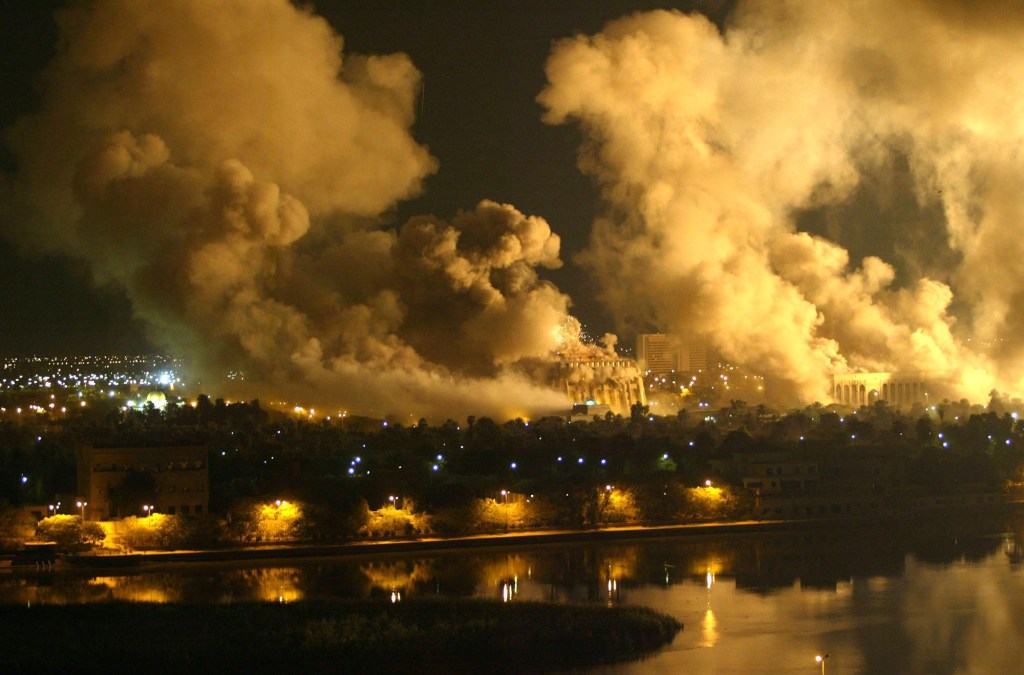
The term “neoconservative” is used in popular speech as a synonym for “hawkish” policy or looking favorably upon military action, but historically it referred to a much broader strategic doctrine. The neoconservatives associated with the George W. Bush administration—figures such as Paul Wolfowitz, Richard Perle, Douglas Feith, and others—influenced a vision that extended well beyond removing specific threats.
Crucially, neoconservativism was a rebranding of Cold War progressivism. The ideology was hatched and raised by the Democratic Party and then migrated to the Republican Party when conservatism fully returned from the wilderness following the Great Depression. Neoconservatism corrupted the party. The Bush family was their political vehicle. It then returned to the Democratic Party with Barack Obama’s election. Hillary Clinton was meant to carry the torch for transnationalism. However, there are Republicans in power who remain committed to neoconservative ambition. They loathe Donald Trump.
Even before 9/11, the neoconservatives argued that authoritarianism in the Middle East bred terrorism and that the United States should actively reshape the region by overthrowing hostile regimes and fostering democratic governments. This is not altogether untrue. The question is how America and the West should address the problem. For neoconservatives, the invasion of Iraq was presented not merely as eliminating Saddam Hussein or addressing alleged weapons of mass destruction (which Hussein did not possess), but as the first step in a “democratic domino effect” that would transform Iraq into a model for political liberalization throughout the Middle East. This ambitious project was often described as the “Freedom Agenda.”
Trump’s approach, by contrast, has generally not been framed in those transformational terms. Although he authorized significant military actions—including the 2020 strike that killed Qasem Soleimani and later strikes against Iranian-linked targets—his rhetoric has consistently emphasized deterrence, retaliation, and protecting American interests rather than remaking the political order of the Middle East. Even when using force, Trump has repeatedly stated that he does not seek long-term nation-building or regime-change occupations. His foreign policy has tended to combine military assertiveness with skepticism toward prolonged interventions, reflecting a transactional worldview rather than the ideological internationalism that characterized neoconservatism.
This does not mean there is no overlap, as alluded to above. Islam is an existential threat to the world. Both Trump and the neoconservatives have at times endorsed the use of overwhelming military power, maintained close strategic ties with Israel, and viewed Iran as a principal regional adversary. These are views to which any rational actor may—must—subscribe. Those similarities explain why some observers perceive continuity. However, the underlying strategic logic differs considerably. For the Bush-era neoconservatives, military force was often a means of transforming political systems and spreading liberal democracy, i.e., corporate transnationalism. For Trump, military force has generally been presented as a tool to punish adversaries, deter attacks, or eliminate perceived threats without assuming responsibility for rebuilding societies or exporting democratic institutions.
Describing Trump as a neoconservative solely because he ordered military action against Iran conflates tactical decisions with grand strategy. The defining characteristic of neoconservatism is not simply a willingness to use force but a belief that American military power could and should be used to reshape international politics by promoting a simulation of democratic governance. Unless one sees Trump’s actions as part of a broader commitment to regional political transformation, the comparison is faulty. The evidence that Trump is committed to regional political transformation just isn’t there. A more precise characterization is that Trump has at times adopted policies resembling neoconservative tactics while rejecting the larger ideological project that made neoconservatism distinctive.

As for neoconservatism, it will not escape the reader who reads my chapter in Hamm’s book that, at the time I penned those words, I was not a supporter of intervention in the MENA space. I have softened my view on military intervention after consideration of the threat Islam poses to the world. More than twenty years have passed between then and now, and the advance of a barbaric ideology has made considerable strides in capturing the West. This does not make me a neoconservative, but rather it aligns me with, as I put it in the April 2026 essay, Donald Trump’s Grand Vision: Make Western Civilization Great Again. It’s not as if Trump didn’t explain it to his MAGA followers. Where was panic then? Did they not read Trump’s National Security Strategy and the Case for Democratic Nationalism? In truth, Trump’s vision is America First without the isolationism that corrupted the first iteration. Trump is a pragmatic nationalist.
There is nothing in Trump’s actions on Iran that contradicts his long-held position on war. Indeed, it is very clear that he did not want to have to deal with Iran and that he is trying to find a way to bring the Islamic Republic to the table and negotiate a resolution to the problem of Iranian belligerence and the desire to acquire nuclear weapons. However, the events of October 7, 2023, in which Hamas, an Iranian proxy, invaded Israel and massacred civilians in the most horrific ways imaginable, changed the situation. Iran is the chief sponsor of international terrorism. Its goal is the destruction of Israel and the West. (See Israel and the Existential Threat of a Determined Iran.)
October 7 was a wake-up call. The West has been sitting on its hands while genocidal Islam has gathered strength. The pragmatist reassesses circumstances and responds appropriately (see Securing the Occidental Realm: Why US Action in Iran Serves Western Civilization, Not Just Israel). If any criticism is to be made of Trump, it is that he is not aggressive enough (see Trump’s Very Bad Deal With Iran; Tehran Scuttles the Islamabad MoU).
There is nothing intrinsically wrong about regime change when that regime seeks world conquest and nuclear weapons (see US Strikes Iran’s Nuclear Facilities). The West, with America leading the charge, changed regimes in Germany and Japan during World War II. Regime change in Iran is a perfectly reasonable objective. At the very least, the Islamic Republic needs to be defanged and put on a tight leash. If we want a safer world, the West must confront Iran and Shi’a Islam—not just abroad, but at home. Europe should join the fight (see Not a Modest Proposal: Repurposing NATO for the War on Islamofascism).


