
Christian hate for the Jews—not all Christians, but an alarming number of them—is rising again in the West. Antisemitism among Christians strives to disconnect Jewish law from Christian ethics. It supposes that, more than a paradigm shift from a practical religion to a salvation faith, Jesus represents a clean break from Judaism. Even more than this, Judaism is oppositional to the gospel of Jesus. The Jew becomes the enemy of the Christian. One must wonder why Christians include the Old Testament at all if it is Jewish law. What is one to make of the fact that, if Jesus were a historical person, he was a Jewish person?
The New Testament traditionally attributes 13 letters, or epistles, to Paul. His contributions are to be taken seriously. Christians are indebted to his vision and works. According to Paul, Gentiles who became followers of Jesus were not required to take on the full obligations of the Jewish law, for example, the practice of circumcision, to belong to God’s people. Paul argued that people are made right with God through faith in Jesus Christ rather than through “works of the law.” He pointed to the example of Abraham, who was counted as righteous because of faith before the giving of the law.
In those letters, Paul insists that requiring Gentile believers to become Jews would undermine the significance of Christ’s work. Paul describes Jesus as existing “in the form of God,” taking on “the form of a servant” and becoming human, with the power to perform miracles and open the path to salvation. According to Paul, Christ is the “image of the invisible God,” the one in whom “all the fullness of God was pleased to dwell.” This is high Christology, emphasizing divine presence in Christ. Paul’s position became a defining feature of the Christian movement, opening the faith to non-Jewish converts without requiring full adherence to the Mosaic covenant.
If the Jewish question weren’t so important to the early Church fathers, then they would never have debated whether Christians should follow Jewish law, such as the dietary rules, or whether Christians should circumcise their male children, and so on. The clear meaning of the New Testament is that Jesus’s purpose was to pour God’s love into the world, and that meant accepting Gentiles, as well as Jews, the descendants of Abraham, whom God commanded to settle the Promised Land. After all, God created the first man and woman, from whom we are all descended. For Christians, people come to the understanding willingly. And they may leave the faith without Earthly penalty. The Creator permits free will.
There are different kinds of law in the Old Testament. The faithful need to understand which laws a Christian is obligated to follow. In Judaism, the “law” generally refers to the commandments of the Torah, which divides into several overlapping categories: moral laws (ethical commands such as prohibitions against dishonest, murder, and theft), ceremonial laws (regulations concerning dietrary rules, festivals, ritual purity, sacrifices, and worship), and civil or judicial laws (rules governing community life in ancient Israel, such as penalities and property disputes).
In Christian teaching, believers are not considered bound to the full Mosaic Law as a covenantal system. Instead, Christians are taught to follow the “law of Christ,” understood as living by faith, guided by the Holy Spirit. Many Christians hold that moral teachings of the Old Testament remain relevant insofar as they are reaffirmed or fulfilled in Jesus, while ceremonial and civil requirements tied to Israel’s temple-based covenant are not binding on Gentiles.
Plainly, Gentiles are not Jews. However, the moral code set down by God is the Christian path. The practical side of Judaism is affirmed in the Protestant faith (more on this in a moment). Historically, Catholics and Orthodox Christians do not affirm Judaism in this way. Most of the Jew-hatred we see today emanates from the latter. This is not to say all Catholics or Orthodox Christians are antisemites, only that the unreformed are more likely to take up this hatred.
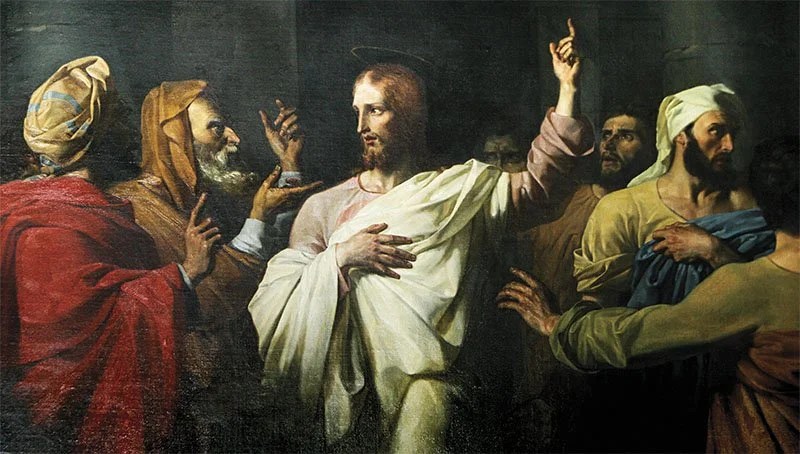
All Christians would do well to remember what Jesus told the Pharisees. The stories of Jesus interacting with the Pharisees are told primarily in the four Gospels of the New Testament, which come after Paul’s epistles. Jesus told the Pharisees that he had not come to abolish the law but to fulfill it. Christianity is thus the salvation phase of Jewish prophecy. One can read the Old Testament differently, to be sure. Most Jews don’t accept Jesus as the fulfillment of prophecy. But from a Christian standpoint, Jesus is the fulfillment, and the Old Testament is included in the Christian Bible across all the divisions I earlier noted. Put another way, Jesus does not negate the law; he makes the law possible for anyone prepared to accept it.
Those who doubt the centrality of Judaism to Christianity would also do well to read Max Weber’s two works, Ancient Judaism and the Protestant Ethic and the Spirit of Capitalism, which I have written about extensively on this platform. It suggests that Protestantism liberates Judaism by allowing Christians to engage in this-worldly (Earthly) endeavors, albeit works imbued with an other-worldly purpose. As I have noted numerous times in these essays, a young Karl Marx anticipates Weber’s thesis by several decades (see Anticipating Weber: Revisiting Marx and the “Jewish Question”).
Don’t let the mention of Marx’s name put you off. Weber was not a follower of Marx. However, the young Marx was a liberal and a republican. His ideas influenced those who formed the Republican Party, which Abraham Lincoln led through the crisis of Southern secession and the Civil War initiated by the Democratic Party. Kneejerk anticommunism has made it impossible for reactionaries to consider what Marx said on the matter, and thus robbed them of the insight that Protestantism is the logic underpinning world capitalism, which has, in turn, brought Catholics and Orthodox Christians into modernity. (I do not spare Marx in my criticism; see Marx’s Misstep: Human Nature and the Limits of Class Reductionism.)
As a result, antisemitism has, for most Christians, fallen away. This explains why the antisemitism we see today on the far right is marked by criticism of the Protestant faith. The reactionary rejects reformation because of its Jewish character. This leads him also to reject the liberal foundations of American civilization. It has misshapen some so badly that they can no longer tell the difference between liberalism and socialism. (See The Left-Far Right Convergence and Notes on the Fourth Political Theory.)
Marx’s 1843 essay “On the Jewish Question,” a response to Bruno Bauer, does more than anticipate Weber. The main point of the essay concerns who should be included in the sphere of citizenship, a debate occurring in Prussia at the time. I cover this matter in other essays on Freedom and Reason (see, e.g., A Humanist Take on Marx’s Irreligious Criticism). However, it is relevant here. To briefly summarize, Bauer had argued that Jews could not be fully emancipated in Germany unless they abandoned Judaism. To make this personal for Christians, he argued the same for them. In his view, a truly secular state required citizens to give up religious identities in the public sphere. By contrast, Marx argued that political emancipation does not require individuals to renounce their faith or deny their identity.
Marx pointed to countries such as the United States, where citizens could enjoy political rights while remaining religious, to illustrate the principle of religious liberty. Rather than demanding that Jews cease to be Jews, Marx argued that the state itself should cease to be confessional altogether—that is, it should no longer be a specifically Christian state. As a matter of civil liberties, then, individuals enjoy a right to their religious beliefs. Far from calling for the end of Christianity, Marx affirms the stance of the founding fathers of the American Republic. So impressed was Marx with Lincoln that he wrote to the President to praise him for pursuing war against the Southern slaveowners. For Marx, the fate of the working man was bound up in that righteous war. (See The FAR Podcast Episode # 21 Marx and Americanism: From One Revolutionary to Another.)
The Christians who portray the Jews as the enemy of Christians have not merely forgotten their Bible, but they have forgotten the history and animating spirit of the American Republic. Perversely, turning against Jews, they have expressed an affinity with Muslims, who, along with them, loathe Jews and the Enlightenment. They appear oblivious to the fact that Muslims came long after the Resurrection and plagiarized the Bible for their own political aspirations. Are they unaware that Muslims deny the divinity of Jesus? In allying with Islam, they also reject the principle that a man who comes to God on his own accord can freely leave Christianity. A patriotic Christian cannot find affinity with such people. Yet we see far-right influencers hitching their wagon to the Islamist cause.
I can hear the objection that Jews deny that Jesus was the Son of God. This objection is terribly misguided. The reluctance of Jews to see in Jesus the fulfillment of the prophecy God delivered to them is very different from the Islamic denial of Jesus as divine. In Judaism, Jesus is generally not accepted as the fulfillment of prophecy because Jewish expectations of the Messiah—such as restoring Israel, fully reestablishing Davidic rule, and bringing universal peace—were not seen as accomplished in his lifetime; therefore, his role is not recognized as divinely definitive within Jewish interpretation of the Hebrew Scriptures.
In contrast, Islam, while explicitly affirming Jesus as a major prophet and messianic figure, rejects the Passion as central to salvation history; God does not become incarnate or share divinity with any human being. Jews do not deny God’s power, but do not see the fulfillment of prophecy in Jesus. Muslims claim to know what God can and cannot do. Islam admits that God is manmade. Yet it pretends to be a transcendent faith. While Judaism’s hesitation is primarily about whether Jesus fulfills specific prophetic criteria, Islam’s rejection of divinity is rooted in a broader doctrinal principle about the nature of God and prophecy itself.
Islam rewrites the scriptures of Judaism and Christianity and projects the Muslim faith backwards onto all of history. Islam teaches that earlier scriptures—the Torah, Psalms, and the Gospel—have been corrupted. Corrupted by whom is not clearly articulated, but it is not difficult to guess who Muslims think was behind it. Revision history clears the path for Islam as the one true religion. Muslims portray the Qur’an as the final and integral revelation that confirms earlier truths while correcting what they claim are deviations in previous scriptures.
Despite these obvious facts, the far right finds affinity with Muslims while rejecting Jews, the very people whose religion forms the foundation of Christianity. Rejecting history, far-right Christians share with Muslims an antipathy towards Jews. However, while anti-Jewish sentiment is inherent in Islam, it is not intrinsic to Christianity. The far-right antisemite is a man corrupted by a hatred foreign to Christianity. He loses his authority to speak as a Christian.
As I have stated many times on this platform, I am not a Christian. I do not subscribe to any religion. This is not about me. This is about professed believers. Whether one is a believer or not, the correct position on such matters is discernible to anybody with a brain and a clear and honest mind. Christianity is rooted in Judaism. The earliest Christian movement was almost entirely Jewish in origin. Jesus himself was Jewish, as were his first disciples, and the first community in Jerusalem described in Acts was made up of Jews who believed Jesus was the promised Messiah. These early believers continued to worship in the Temple and observe many Jewish practices while also teaching that Jesus’ death and resurrection marked the fulfillment of God’s promise.
Those who established the Islamic movement were obviously not Jews. Nor did they regard Jews as friends. Jews were “tolerated” as long as they subjected themselves to their Muslim masters. The many conflicts between the early Muslim community and Jewish tribes in seventh-century Arabia testify to this fact. Jewish tribes who defended their autonomy were expelled from Medina. The men of tribes not expelled were beheaded, and the women and children were enslaved and dispersed among the Muslims. I know that some will point to instances in the Old Testament where similar patterns appear; however, the matter of one’s choice of comrades forces one to contextualize what is presented as a one-to-one correspondence. Christianity makes clear appropriate comradeship. Moreover, no civilized person subscribes to ancient practices. Muslims do, however, subscribe to ancient practices. Following the model of Muhammad yields very different results than appealing to Jesus as one’s guide.
Paradoxically, Catholicism and Orthodox Christianity (especially Eastern Orthodoxy) may appear to be generally closer to Judaism than most forms of Protestantism—emphasizing a communal, ritualized, and liturgical form of worship, with fasting cycles, set prayers, sacred calendars, and strong continuity of tradition. Yet, as noted, rigid rituals were not required of early Christians; Christianity began as a Jewish movement with a reduced legal requirement for Gentiles. Over time, it evolved into a distinct religion with its own set of rituals and institutional forms—different in content, but sometimes sociologically similar in structure to Jewish communal life.
What is most relevant here is Christianity’s relationship to antisemitism. I discussed Orthodox Christianity in this regard in a previous essay. It will suffice to say here that many on the far right are enamoured by this church. I will now note that Catholicism has the longest and most institutionally embedded historical association with antisemitic structures in Europe. Whatever antisemitism was carried forward after the Reformation, the Protestant movement moved toward stronger philo-Semitic views, particularly in modern times. To be sure, some of the Founding Fathers were not Christian; however, the ethical system that guided their actions is rooted in the Protestant faith. Defending the American Republic requires recognition of the path these men trod to establish the greatest country in world history and reaffirming a commitment to keep it.
The far-right Christian is on the wrong side of the faith to which he feigns loyalty, even if he is convinced of his righteousness. This betrayal concerns me as an atheist, because modernity is rooted in Christian ethics and practical Judaism. I don’t have to be religious to recognize the importance of the practical side of Judaism and Protestantism to the Enlightenment and the liberal principles Western men derived from development and legacy. If I were a religious man, I would take to heart the history that finds obstacles thrown into the path of Jews with the expectation that they overcome such dialectical moments to rise to a higher positional unity. Christians should open the Old Testament and reconsider what they read there in those terms. Then they might understand that the story of Jesus is also a dialectical moment in which elements of Judaism are retained to produce a higher unity, one that makes Jews comrades instead of enemies.
Does this make me a Christian Zionist? Of course not. I am not a Christian. But I am a man of the West. I regret that some Catholics and Orthodox Christians will take offense at this critique. I mean no offense. These churches are part of the West. But there is no room in the West for antisemitism. As I stressed earlier, most Orthodox Christians and Catholics are not antisemites. But some are, and the congregants of these churches who are reviving that ancient hatred must push this corruption from their hearts and minds. This is the point of my intervention. And this: there is no room for Islam here. For the life of me, I don’t see a path for reformation for this religion. It should remain in the East. (See Defensive Intolerance: Confronting the Existential Threat of Enlightenment’s Antithesis; Epic City and The Muslim Problem: Confronting the Presence of Exceptional Doctrine in American Society.)


