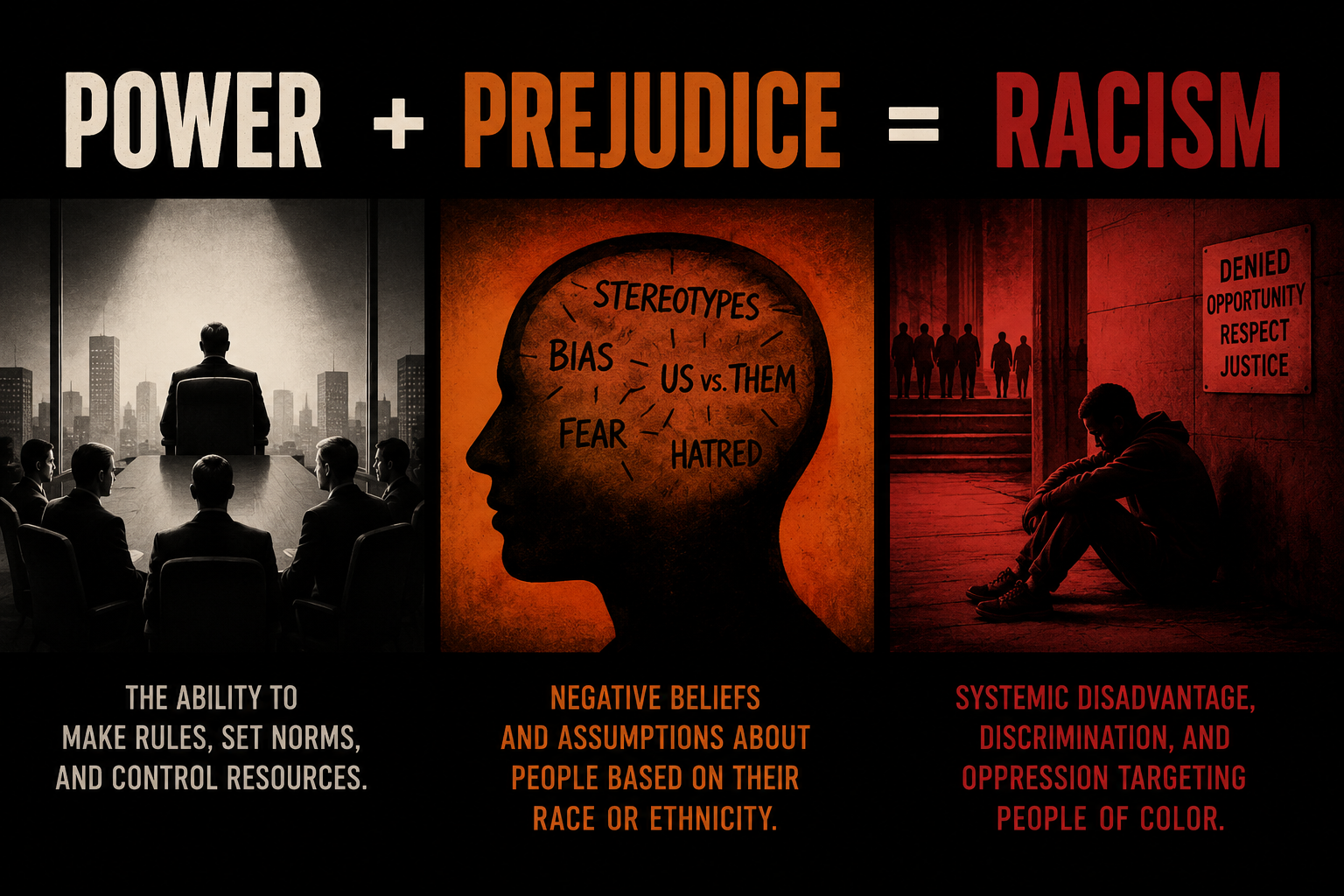
This is the definition of racism pushed in the academy: power + prejudice = racism. They further assume blacks have no power. It follows that blacks cannot be racist. However, the definition of racism is a belief that ranks human groups based on inherited traits and entitlements, asserting the superiority of one group over others. Those with little or no power can believe such a thing. If they do, they are racist. A black man can be just as racist as a white man.
The power + prejudice = racism formula cuts both ways. A system established by law that codifies this belief is indeed a racist society. In the past, parts of the United States imposed such laws to privilege whites, and these laws were rooted in the belief that all members of non-white racial groups were justifiably subordinated because of their inferiority. A racist social order prevailed in parts of America. No serious student of history denies this fact.
But, today, these laws are no longer present (struck down over sixty years ago)—at least with respect to blacks. However, many institutions in the United States impose policies disfavoring whites, and the logic of those policies rests on the belief that all members of the white race benefit intergenerationally from systemic racism—even though there are no laws systematically benefiting whites.
The belief that all whites are oppressors is racist, since it necessarily assumes that whites are genetically (in the broad sense of that term, as encoded in a population group) predisposed to prejudice and that all enjoy racial privilege in the absence of any law or policy privileging them. As I have noted in past writings, the claim that all whites enjoy racial privilege commits the fallacy of misplaced concreteness. To claim that any one person from a demographic category necessarily carries with him through life an abstraction derived from aggregated data, such as a lesser likelihood of being poor, is betrayed by the fact that there are millions of white people living in poverty. At the same time, the greater likelihood of an affluent life among certain demographic groups does indicate the presence of a culture of striving. Rather than demeaning that culture, a decent society promotes that culture for everyone. Aggregate statistics predict probable outcomes, but abstractions can never indict or convict individuals.
A society founded on formal equality and individual liberty does not structure itself to privilege any group on racial grounds. It treats all individuals as equals under the law. A black man received the same sentence as a white man for criminal homicide despite the statistical fact that black men as a group are overrepresented in murder. True antiracism requires colorblindness, not in the recognition that there are different races (there is nothing racist about observing the natural fact of grouped human variation), but in the principle that the color of one’s skin should not determine opportunity (see Colorblindness and Blindness to Color). What determines opportunity in a free society is one’s talents and tenacity, not one’s race.
Progressives decry colorblindness and the meritocratic society. Progressives don’t merely see race but organize society around it. This is why redrawing congressional maps to remove racial gerrymandering is so offensive to them—that and losing partisan political power. So they assert or imply that present-day discrimination is warranted by past discrimination. A white man can be told to go to the back of the line because black men were, in the past, oppressed by the law. The individual must suffer because of the sins of the father.
In reality, Democrats don’t really care about black people, as evidenced by the conditions progressive social policy has produced in the cities they control. Here, we might say that white racism still prevails. But that is even more reason to recommit ourselves to colorblindness—and the defeat of Democrats at the polls.
The difference between yesterday and today is that the racial hierarchy has been inverted in the operation of our institutions. There should be no racial hierarchy at all. Since they are designed to systematically privilege one racial group over another (however symbolic that privilege, however tokenized its people), policies and laws such as affirmative action, DEI, and racial gerrymandering are racist and should be abolished. They never had a place in a free society. And the same party has pushed racial identitarianism for centuries: the Democratic Party.
For this and many other reasons, progressivism is intrinsically antagonistic to the liberal foundation of the American Republic because it rejects the principle of equal treatment. Even where equity is required to achieve the goals of equality, Democrats reject the principle, as evidenced by the assault on women’s rights by transgender madness.
At least Soviet Communism, however terrible the results, officially declared that equality was the goal of the Revolution. In this way, progressivism is closer to National Socialism than Communism. It does not seek equality of any sort, but privileges based on identity. However, a free and decent people should find none of these systems acceptable.
Friedrich Hayek, in The Constitution of Liberty (1960), argues that the only kind of equality compatible with a free society is equality before the law, or formal equality. All individuals, he argued, should be treated the same under general laws, without special privileges or discrimination based on class, race, status, or wealth. Attempts to create substantive equality—equal outcomes in income, social conditions, or wealth—require governments to intervene heavily in personal life. In Hayek’s view, achieving such equality demands constant control over people’s choices, opportunities, and property, giving the state excessive power. As a result, individual freedom and spontaneous market processes are undermined.
The Constitution of Liberty is an elaboration on Hayek’s 1945 book, The Road to Serfdom (1945). There, he argues that when governments take extensive control over economic planning and individual decision-making, they inevitably threaten personal freedom and democratic institutions. Central economic planning requires authorities to decide what should be produced, who receives resources, and how people should work and live.
Because societies are complex and individuals have different goals, governments cannot achieve such planning without coercion and expanding state power. Over time, this concentration of authority weakens the rule of law, limits free expression and economic choice, and can lead to authoritarianism or tyranny. Hayek’s central warning was that even well-intentioned efforts to control the economy for social goals unintentionally create conditions that erode liberty and pave the way for oppressive government. Hayek insists that protecting liberty requires limiting the state to enforcing impartial laws rather than trying to engineer equal social or economic results.
This is the spirit of colorblindness, which lies at the heart of Supreme Court Justice John Marshall Harlan’s lone dissent in Plessy v. Ferguson, which granted authority to the states to segregate by race. (See Our Colorblind Constitution: What Justice Harlan Can Teach Justice Jackson About Equality and Fairness; Justice Harlan’s Colorblind Constitution and the Abolition of Racial Gerrymandering; Louisiana v. Callais and the Politics of Selective Collectivism; The Constitution is Colorblind—So Why Do Democrats Insist that the Country is White Supremacist?) We should never have deviated from this principle. And now we must insist that we return to it.
For the record, there was a time when I accepted the progressive argument. You can read my previous take on the matter in this 2014 essay: Why Black People Can’t Be Racist…At Least Not Against Whites. I overcame embarrassment and migrated that essay from my old Blogger platform to WordPress because I believe it’s instructive for readers to see how a mind can change, as well as the influence of ideology on a man who should’ve known better. I know better now. I have penned numerous essays correcting my error (see, e.g., “Blacks Can’t Be Racist” and the So-Called “Myth of Reverse Racism”). The educator has been educated.