“Throughout history, outbreaks of social contagion have typically spread in small, close-knit groups, most commonly in schools and factories. Investigators are often able to identify an index case—the first person to exhibit symptoms—which then spreads to other group members. Unbeknownst to the rest of the group, the index case is often suffering from a medical condition. There is a common saying in the social contagion literature that mass psychogenic illness is spread by sight and sound—that is, by hearing or watching others who are affected. But what would happen if outbreaks could spread over the internet and on social media sites by a virtual index case? This appears to be exactly what has happened in the current outbreak. It represents a major shift in the presentation of psychogenic illness. In the past, most episodes of mass psychogenic illness were limited to a specific location or community, but this is no longer true in the Internet Age.”
— Robert Batholomew, Psychology Today
Social contagion, or mass psychogenic illness, is the rapid spread of an irrational or pathological activity, behavior, belief, or perception in a population. Thoughts and actions can move rapidly through social networks of like-minded people or those who share similar traits, such as age, gender, and so on. Individuals calibrate their self-image to align with those with whom they identify or have an affinity; when one individual adopts a certain attitude or behavior those in her social network catch the pathogen. Girls and young women are especially susceptible to social contagion because of greater innate sociability compared to men. But men are susceptible to psychogenic illness, as well. Adolescence is a risk factor because of rapid changes in cognitive, emotional, and physiological developments occurring during puberty make a person vulnerable to suggestion. But, as we see with the COVID-19 and white guilt hysterias, people of all ages can suffer from mass psychogenic illness.
Pathogenic thoughts and behaviors spread rapidly across social networks.
We see this social phenomenon at work in the appearance of fads, or crazes, which are intense and popular albeit often short-lived enthusiasms for some activity, style, or thing. Many crazes are harmless; while they are irrational, they are not always pathological. But some crazes are pathological—they are literally crazes. For example, adolescents who learn that peers have engaged in self-harm, such as cutting, are more likely to cut themselves. We see the phenomenon in anorexia nervosa and other eating disorders. Self-harm is not always a random personal event, but often a social phenomenon. The power of social forces in corrupting reason and causing self-destructive attitudes and behaviors has been known for more than a century at least (see, e.g., Émile Durkheim’s Suicide).
Those suffering from social contagion are more likely to receive a psychiatric diagnosis and treated as medical patients by a profession that doesn’t typically consider the social causes of disorders for which there is no objective physiological evidence. This is not to say that the effects of psychogenic illness are not real. Remember the Thomas Theorem: “If men define situations as real, then they are real in their consequences.” Hysteria is a crippling disorder. But it is to say that, just as placebos can make a subject feel better, medical intervention can produce in a person’s mind the belief that he is actually unwell—or confirm for him what he suspected all along.
Last fall, Robert Batholomew, a medical sociologist, penned “The Girls Who Caught Tourette’s from TikTok,” in Psychology Today. He cites several studies concerning the rise in Tourette’s syndrome, what researchers call “functional tic-like behaviors,” in users of TikTok and social media generally. Bartholomew’s article is a useful thumbnail sketch of the phenomenon and a taste of what is a vast literature on the subject. He concludes his brief with this: “In the future, we can expect more outbreaks of social contagion in which the primary vector of spread is the internet and social media.” (See also Jonathan Haidt’s writings concerning the effect of social media on the emotional and mental wellbeing of America’s youth.)
The body of scientific study one can bring to bear on this matter goes well beyond self-harm and the Tourette’s contagion. Multiple Personality Disorder (MPD) or, as it’s now called, Dissociative Identity Disorder (DID), a disorder about which mental health officials are highly skeptical, is spreading across networks of social media users. One source of MPD is iatrogenic, that is caused by the therapeutic experience. When it occurs outside the therapeutic context it is often pseudogenic, its cause an invention of the subject. A young woman with a diagnosis or who imagines trauma and learned than DID can be an outcome may spread her symptoms to other women in her social circle.
Despite their being such a vast literature on the problem of social contagion, and the significance of the problem, one almost never hears about the phenomenon in the media or from policymakers or politicians. Noting the character of these exceptions is part of understanding the politics of the silence. When an individual suspects there is an organized attempt to gaslight, mob, and terrify him, authorities, professionals, and influencers are eager to portray him as a delusional paranoid and schizophrenic (see The Psychiatrization of Gangstalking). When individuals are on to something about the world that threatens power, then they’re crazy. This is how authorities and the corporate media portrayed claims made by the Black Panthers before COINTELPRO came to light (see The Black Panthers: Black Radicalism and the New Left).
However, when the person’s is actually delusional, or several people share an illusion, and these false beliefs are useful to some group with power, as profitable or enabling social control, then the pathogen is normalized or treated as unremarkable. I suspect that if the problem of social contagion ever becomes the topic of popular conversation that it will be censored and its proponents cancelled. Indeed, when the related phenomenon of mass formation psychosis drew the attention of the public thanks to Dr. Robert Malone’s appearance on the Joe Rogan Experience, the corporate media launched a comprehensive delegitimization campaign before dropping the subject entirely. (See The Future of a Delusion: Mass Formation Psychosis and the Fetish of Corporate Statism.)
One of the arguments I have made (I suggested moments ago), and this explains both media silence and delegitimization campaigns, is that mass hysteria and moral panics are not always accidentally emergent but rather are manufactured for various purposes, from taking advantage of vulnerable populations (the medical-industrial complex is, after all, a profit-generating endeavor) to realizing political agendas. I discussed an example of profiting from delusions in my blog Disordering Bodies for Disordered Minds.
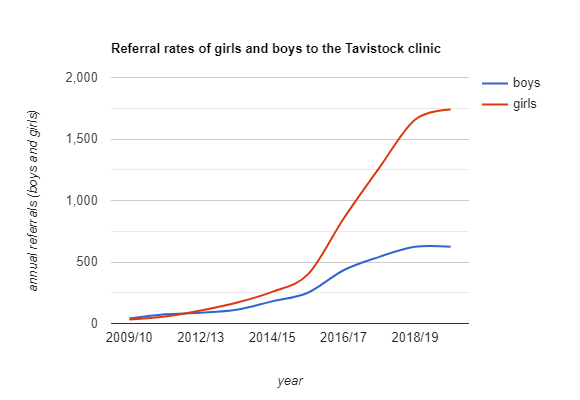
In light of all this, there is good reason to be concerned that the sharply rising cases of rapid-onset gender dysphoria we see among young people, a phenomenon disproportionately affecting girls and young women, is the result of social contagion. In his article, “Why is Transgender Identity on the Rise Among Teens?,” Samuel Paul Veissière, an anthropologist and cognitive scientist at McGill University, summarizes research indicating that the rise of rapid-onset gender dysphoria “points to a complex web of social pressures, changing cultural norms, and new modes of distress and coping that warrant further investigation.” He encourages parents, educators, and clinicians to be cautious in dealing with this growing phenomenon.
Referrals to the Tavistock Gender Clinic 2009-2019. The clinic was shuttered by the NHS in summer 2022.
Gender dysphoria, previously identified in the DSM as gender identity disorder, or GID, is defined as persistent and powerful feelings of discomfort with one’s “assigned” gender or sex, or identification with another gender or sex. Gender, according to social scientists, refers to the attitudes, behaviors, and feelings that one’s culture associates with sex, which is a biological and, in mammals, an immutable reality. Gender is related to sex but is culturally and social constructed. Gender is variable across time and space. Indeed, as the ideology metastasizes, the relation of sex to gender flips so as to see gender is fixed and a priori and sex as mutable. Some individuals come to believe that they are not the gender they are and this causes significant distress. This distress is medicalized and the individual is sent to the doctor. To qualify for the disorder the subject must present with feelings that cause significant distress or impairment. There is no objective criteria for determining whether a person is suffering from dysphoria; it relies entirely on the sufferer’s subjective perception. This subjective perception is feed by an ideology asserting that the patient is the gender he thinks he is.
Unlike anorexia and other disorders, the psychiatric community is not for the most part approaching gender dysphoria with caution, nor are sociologists linking the concept of social contagion to the rapid rise of the phenomenon, but rather the push is for the Orwellian-named “gender-affirming” treatment, which may result in individuals amputating their breast or their genitals, many losing forever the enjoyments of a normal sex life and most becoming life-long medical patients. Thus what makes this particular social contagion especially dangerous is that it is backed by popular academic theory and the authority cultivated by medical professionals, and pushed by politicians and social influencers in a way other crazes are not. There is no learned theory aggressively advocating cutting or anorexia as a solution to the distress that causes individuals to take a sharp object to their forearms or emaciate themselves, yet there is one enabling self-harm as “affirming care.”
Although the role social contagion plays in rapid-onset gender dysphoria does not enjoy public awareness, there is growing concern among some political leaders and health authorities that the approach taken by medical professionals to this disorder is the wrong approach. Texas recently passed a law to protect children from medical interventions in these cases (see State Action in Texas Concerning Medical Interventions for Minors Suffering from Gender Dysphoria Explained). Florida governor Ron DeSantis has been a leader in raising awareness about the problem (see the video below). And only a few weeks ago, on the basis of a damning report concerning the treatment of children, the National Health Service of Great Britain shut down the Tavistock gender clinic, prompting writer Douglas Murray to state, “We pretend that we protect children and that we want to help them—and actually it’s not just unhelpful but actively cruel to say to a child that is confused if you feel a bit strange in your body maybe you’re of the opposite sex.”
.@GovRonDeSantis: “They want to castrate these young boys. That’s wrong … I think these doctors need to get sued for what’s happening.”
Social contagion, or mass psychogenic illness, the rapid spread of an irrational or pathological activity, behavior, belief, or perception in a population, is something that we need to talk more about. Because of the technological leap in communication, thoughts and actions can move rapidly through networks of like-minded people or those who share similar traits, such as age, gender, and so on, and profoundly affect their choices. Although girls and young women are especially at risk, other categories of people are susceptible to psychogenic illness. Adolescence is a special risk factor because of rapid changes in cognitive, emotional, and physiological developments occurring during puberty make a person vulnerable to suggestion. Parents need to limit their children’s use of social media and pay more attention to the things going on in the lives of their kids.
We hear a lot about these horrible conservatives—especially those deplorable MAGA types—complaining about critical race theory in our schools. Audiences are told, as if they didn’t know, that CRT is not history, etc., and therefore the complaints aren’t legitimate. Most conservatives know CRT is not about history. They’re not stupid. They can see that it’s ideology. Most conservatives don’t have a problem teaching American history—slavery, Jim Crow, all the rest of it. They have a problem with CRT. There is nothing wrong with criticizing CRT. (It’s not like criticizing Islam or gender ideology.) And they’re right to have a problem with CRT. Put into practice, CRT rationalizes unjust practices and produces unfair outcomes. Conservatives—and heterodox, i.e., actual liberals—are objecting to that and to public school curriculum based on CRT that trains children to think in terms of racial animosity and resentment.
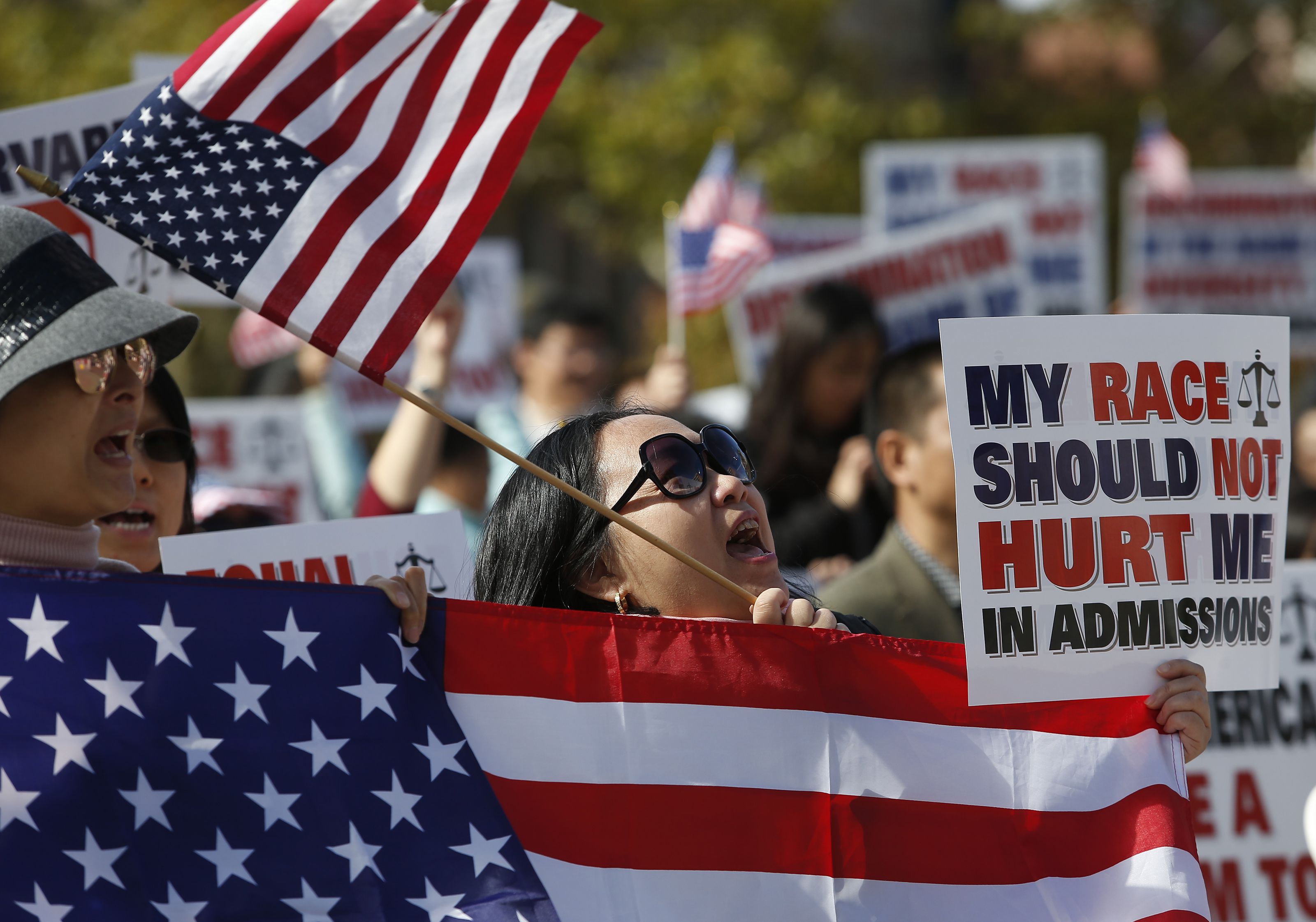
The Supreme Court appears ready to ban or significantly modify the regime of affirmative action
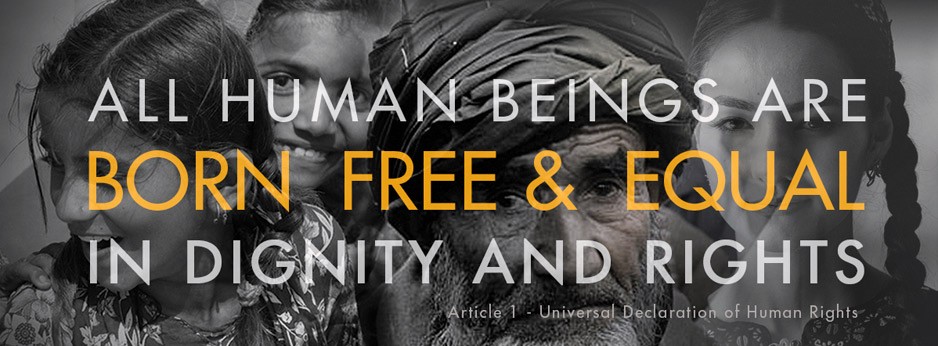
The core idea of CRT, that abstract demographic categories are real things (they’re not—they’re abstractions), and, following from that, that concrete individuals identified as members of groups are personifications of those categories, is in diametric opposition to the principles of equality before the law and equal treatment, which (rightly, as in correctly) presume not groups but individuals are the proper subject of justice. Liberties and rights are first and foremost properties of individuals, not abstract groups, most of which are socially constructed. The idea that groups have human rights has become a widespread idea. We see in the various “human rights” campaigns that advocate for this or that identity group to enjoy some privilege in society. But human rights inhere in individuals and, by their very definition, belong to each human independent of group membership apart from actual and substantial genetic differences. A German is entitled to no privileges based on his ethnicity. A Muslim is entitled to no privileges based on his faith. Only women can make a claim to unique rights, rights that are few but crucial, because women are substantially biologically different from men.
This is not a political judgment. In its treatment of concrete individuals as automatically representative of everyone who shares an identity, in its reification of race specifically, CRT is false on rational and scientific grounds—to wit, CRT commits the fallacy of misplaced concreteness, which is the error of confusing an abstraction for the concrete—that is, an idea for a thing (this is why I argue that CRT is a form of neo-Hegelianism, not neo-Marxism as conservatives and CRT advocates both claim). I will use myself as an example of the problem. I am a white man. While sex is an objective reality that differentiates males and females from each other (albeit my sex tells you very little beyond what unique rights I don’t have), my being white, a social construct, tells you nothing about me other than I am identified by a constellation of phenotypic traits. The claim that these phenotypic traits are predictive of group-level differences of behavioral proclivities, cognitive ability, or moral aptitude is not supported in the evidence—at least in a causal sense (there are cultural reasons for the differences attributed to race, which is a biological construct).
The point is that all individuals identified as members of a racial group cannot be judged—or we must say that it is wrong to do so—in terms of that identification before the law or in the operation of organizations that operate on the principle of public accommodations. To treat individuals differently on the basis of race is racist, and branding discriminatory law, policy, or action “anti-racism” does not make it less racist. Any policy that advantages or disadvantages any individual on the basis of his skin color is a racist policy—yes, affirmative action is a racist policy because it is based on the false notion that individuals are personifications of abstract racial categories and therefore enjoy benefits on that basis (i.e., privileges). In contrast, colorblindness is a just policy because it obligates those who hold an individual’s fate in their hands to treat that person as an individual and not on the basis of their presumed or announced racial identity. This is why CRT and the antiracist reject the standard of colorblindness—even branding it “racist” using the tortured logic that eliminating race-based policy advantages whites as a group, which is irrelevant in the case of race from the standpoint of rational jurisprudence (again, this is only relevant with respect to sex, a category that is being erased in law and policy across the West, replaced with the construct of “gender identity”).
Despite standing in opposition to rational jurisprudence, CRT ideas are playing a major role in changing the character of our legal system and our institutions, taking our society away from one that defends the liberties and rights of individuals, and pushing us towards a system that discriminates against individuals on the basis of race. As noted above, we are already doing this with affirmative action. With the concept of equity, we are seeing policies rolled out in health care (The Problem of Critical Race Theory in Epidemiology: An Illustration). And reparations for acts committed by people long deceased are a very really possibility (A specter is haunting America—the specter of reparations; Reparations and Blood Guilt; For the Good of Your Soul: Tribal Stigma and the God of Reparations). Many of these ideas and trends, e.g., affirmative action, precede the formal articulation of CRT in the 1990s. Indeed, in many ways, CRT is a contrived intellectual system that strives to rationalize those changes that are proving to be profoundly detrimental to individual liberty and human rights.
The Supreme Court has announced that on October 31 of this year, it will hear two cases concerning race-based affirmative action at Harvard and the University of North Carolina. Race-based affirmative action allows colleges to consider a student’s race when deciding which students should be admitted. This practice has benefitted black applicants while disadvantaging whites and East Asian applicants. Lower courts have ruled in favor of Harvard and the University of North Carolina on the grounds that the programs advance what judges see as a compelling interest in promoting diversity, a major political-ideological project of elites across American institutions. Remember that the original purpose of affirmative action as a program of reparations was canceled in the 1978 Bakke decision, which held that using race as a exclusive basis for admission (the quota system) violated the Equal Protection Clause of the Fourteenth Amendment and Title VI of the Civil Rights Act of 1964. But there is no rational reason why any given individual’s life chances should be determined by an elite political-ideological project that works by compromising the principle of equal treatment. What’s the difference between reparations and diversity? Nothing. The rhetoric of diversity is newspeak concealing the goal of reparations. Critical race theory is designed to rationalize an elite project of racial discrimination.
Breaking: Government officials in Washington, D.C., on Aug. 26 postponed a policy that would have required proof of vaccination for COVID-19 for all students age 12 and over for the new school year.See the story in The Defender.
On the eve of the delta variant chapter of the COVID-19 pandemic hysteria, I commented on a Twitter thread initiated by 1619 Project co-founder Nikole Hannah-Jones, in which I noted that vaccine uptake among blacks was much lower than among whites, with the implication that the draconian COVID-19 policies of progressive cities and states would disproportionately impact the freedom of black people. For some reason this was controversial.
Below you will find the thread to which I was responding. Note that it specifically cites critical race theory. My response: “Given that tens of millions of blacks don’t want the vaccine, in light of restrictions, then is even more than an analogy.” I got back this: “Besides the ludicrous point that things Black people don’t like = Jim Crow, there are only 40 million Black people in this country. So please cite your source for the tens of millions of ‘blacks’ who oppose vaccines.” Stunned by the irrelevance of Hannah-Jones’ response and her ignorance about something she should know about, I wondered out loud, “Aren’t you a journalist?”
This is why y’all need critical race theory because this is just so insulting and pathetic. pic.twitter.com/WjbWCLwjbk
Before I turn to the controversy (which was minor in the scheme of things but not insignificant), I want to take a moment to note why it was important to make this observation (beyond the point about the equal treatment of black people to somebody who should have immediately identified with the spirit of the observation, since critical race theory purports to put central to its logic the relative effects of law and policy and enforcement across racial groupings). The nation recently learned that the District of Columbia does not have a contingency plan for unvaccinated students, who are banned from attending schools in person this fall after the first 20 days, and the absence of a plan appears to be by design. Washington, DC Mayor Muriel Bowser, who you will remember as a zealous advocate of the Black Lives Matter riots over the summer of 2020, riots that ran simultaneous with the COVID-19 pandemic, admitted during a press conference that there are no alternative options, including virtual learning. According to data supplied by the city, over 40 percent of blacks ages 12-17 are not vaccinated.
That’s what I was trying to help Hannah-Jones and her audience understand: vaccine mandates and restrictions based on vaccinated status are discriminatory since they disproportionately impact black and brown groups. Instead of acknowledging the importance of my observation to her standpoint, either Hannah-Jones or one of her fans contacted the administration of my university and complained, portraying my comment as somehow outside the scope of acceptable racial discourse. Me, a sociologist, who specializes in race and ethnicity—my observation was somehow problematic.
I won’t name any names here, because there are people involved whom I value, but, instead of educating the person who complained about freedom of speech and academic freedom and the political and intellectual autonomy of teachers and researchers in the university’s employ, the complaint was sent down the chain of command and I was asked to consider not identifying my affiliation with the university in my Twitter profile (I am almost certain the person who made this suggestion to me was instructed to make the suggestion). My response was to ask the colleague, who is also on Twitter, and politically active in Democratic Party politics, as well as the activities of organized labor, whether his university affiliation also appears in his profile. After admitting that it did, the point was taken and the matter dropped. I have been determined to not let this episode have a chilling affect on me. I have become even more prolific and aggressive on Twitter (while Twitter continues to shadow ban me).
I am sharing this here and now (it has been nearly a year since this occurred) because the double standard involved in this case should be obvious but isn’t because of the depth of self-righteousness felt by progressives and the problem is growing every worse. The certainty of truth of progressive opinion on matters is such that it renders in the minds of progressives as hardly political speech at all, whereas the opposition’s point of view, not only obviously completely wrong, but also evil from a moral standpoint, is beyond the pale and thus reflects poorly on the institution—more than this, such opinions should be exorcised from the university. Of course, what reflects badly on the institution, especially an institution that, before all others, is supposed to embrace and defend the spirit of cognitive diversity, is precisely a lack of collective self-consciousness about its double standard.
I said my case was minor but hardly insignificant. There is a real crisis in today’s university. I recently wrote about the resistance among administrators and faculty in the UW-system to perform a self-examination on the question of free speech (see Science Politics at the University of Wisconsin—Deliberate Ignorance About the State of Cognitive Liberty and Viewpoint Diversity on College Campuses). There is a history of censorship and political bullying concerning speech in the UW system. In 2017, I wrote about a case, Don’t Talk About Innate Bisexuality at UW-River Falls, in which the campus pursued a “Check Yourself” campaign, the purpose of which was to teach faculty and students proper etiquette surrounding talk about sex, race, immigration, and so on. In effect, it was a speech code designed to impose terms of political correctness by those who have appointed themselves bearers of truth on the matter.
The University of Wisconsin’s strained relationship with free speech and academic freedom is what led the free speech organization FIRE (Foundation for Individual Rights in Education) to issue a rather poor report card for several of its campuses. My campus at Green Bay is festooned with yellow flags. And while explicit policy problems remain, the chilling effect of indirect public denunciation and vilification has become a growing problem. As I discuss at length in Refining the Art and Science of Propaganda in an Era of Popular Doubt and Questioning, the campus last year established as its Common Theme, “Truth: Information, Misinformation, and Democracy.” The series of events reeked of progressive angst over the rise of the popular voice and the concomitant decline in the faith in the academic priesthood, with the implication that faculty should be aware of some line established by some commissar in some high office somewhere. I reported in The Rules of Inclusion Represent the Totalitarian Desire to Punish Heretics and Infidels the scuttled survey will be supplanted by a year-long series of free speech events emphasizing civil discourse, often a euphemism for the rule of inclusion. I am watching the kick off even on Teams as I write this blog.
The next time I am asked whether I want to think about what post on social media (an implicit threat) or whether I want to conceal the identity of my employers from those who read my tweets, I have questions to ask back: Does the administration have any position on faculty extolling the virtue of critical race theory, gender theory, or queer theory? Are faculty admonished for criticizing conservative politics or Republican politicians? If this were the policy—or the instinct—administrators would have their hands full admonishing faculty. I can testify to the fact that nearly every day in the faculty suite is a hatefest with conservatives and Republicans the targets of hate. That’s fine with me. But when it comes to criticizing woke progressive ideas, then one has to worry not only about disciplinary action, but promotion, etc. I am neither a conservative or a Republican, but I have one thing in me that most of my colleagues do not: a healthy respect for cognitive liberty and the free expression opinions. My colleagues should be allowed to talk openly about most anything.
I remember faculty being extremely critical of Donald Trump for his policies regarding immigration. I authored the faculty senate resolution in support of Dreamers and that was widely praised and passed unanimously. Had the prevailing ideology been the other way around, I might have worried about whether I should have pursued that resolution. Not me personally, but others who are less obnoxious on this topic than me. As it was, I not only didn’t have to worry, I could count on accolades for having done good work on behalf of students currently in limbo (which was not my motivation). I am concerned, and so should you be, that the metric for acceptable speech would be determined based on partisan political ideology. If the speech is woke progressive, then it is acceptable. If it is populist-nationalist, classically liberally or libertarian (left or right), or orthodox Marxist, then it is problematic. It should not be this way. But it is.
I promise this will not be a digression, but what does this word “woke” mean? The question is often asked as if the word had no actual meaning, but it does. Woke means adherence to an ideology that sees contemporary society in terms of oppressive and intersecting hierarchies, and that treats concrete individuals as personifications of abstract categories with the white cis-gendered heterosexual male automatically representing the primary oppressor class—marked by numerous unearned privileges—and therefore justifiably subject to censorship and marginalization. As I will write about in my next blog (albeit on a different topic), the importance of language to the restructuring of society the woke worldview demands lies at the heart of the double standard: the university is no longer viewed as a neutral space for the rational and rigorous interrogation of ideas whatever they are, from wherever they hail, but a political vehicle to prepare through indoctrination America’s youth for incorporation into the corporate state bureaucracy.
If there is a requirement for all faculty to mark their tweets and other social media communications with a disclaimer saying they do not speak for the university or its administration, then I may not resist that—if everybody does the same. But I am not going to conceal my employer or my position. I worked goddamned hard for my PhD and to obtain tenure at a university so I could say whatever the hell needed to be said. I didn’t accidentally chose a profession where free speech is—or should be—respected. I have things to say. I expect all faculty to be treated equally with respect to politics, which means that the administration should take no position on the content of political speech and cultural and social criticism. Again, free speech is a neutral vehicle for the expression of ideas and opinions, not an identity. (See Abandoning the Principle of Individual Liberty for the Politics of Identity.)
I briefly take up five issues in this blog: partisan pandering on college debt, establishment newspeak, the COVID-19 pivot, the Islamization of the West, and Biden characterizing “MAGA” as “semi-fascist.” I will be back soon with a dedicated blog, likely on the topic of social contagion.
How much tuition could be paid with the money Biden gave the neo-Nazis in Ukraine? Has anybody run the numbers?
Biden is out of touch. Even Democrats are turning on his plan to cancel ten thousand dollars in student debt for each borrower making less than $125,000 (twenty thousand for Pell Grant recipients), a huge swatch of the indebted population (President Biden Announces Student Loan Relief for Borrowers Who Need It Most). Estimates are being widely reported indicating that American taxpayers will pay north of half a trillion dollars over the next decade to pay for what is self-evidently a cynical political move in the face of midterm elections that populist-nationalist movement is well positioned to dominate.
The unfairness of this move betrays the claim that Democrats represent working class families. Working people who didn’t take out student loans or who have already paid off their loans (my wife and I fall in the latter group) will not benefit from the program. In fact, we will be paying to bail out those who took out loans—while many of us out here are struggling to put our own kids through college.
"I've saved all my money. [My daughter] doesn't have any student loans. Am I going to get my money back?"
Elizabeth Warren: "Of course not."
“I worked a double shift…you’re laughing at me…we did the right thing and we get screwed.”pic.twitter.com/xGWKOZi9av
This move does nothing to fix the systemic problems of college financing, the consequence of, among other things, making enrollment in college available to those unprepared to undertake the rigors of academic work, many or whom will seek degrees that provide no useful employment after college, and reduction in state financing of higher education thereby shifting the burden to families and individuals.
Instead of cancelling student debt, the government should invest half a trillion dollars to reinvigorate the nation’s network of trade schools, as well as invest in infrastructure projects that use those trades to rebuild industrial capacity in America, which will provide good paying jobs for our citizens. To ensure that Americans will have those jobs, the federal government must sharply restrict immigration.
Have you heard? Pedophiles are being rebranded. They are now to be known as “MAPs,” or “minor attracted persons,” and recognized as a vulnerable and oppressed minority. Twitter has been one fire since videos of Berkeley police letting a transgender pedophile, Sophia Westfall, grooming who she believed were children (including a one-year-old) go (twice!) after being exposed in a citizen-organized sting operation led by Alex Rosen waiting at a park where children were playing. (Westfall, who identifies as a lesbian, also likes to take clandestine pictures of women in public places.)
Rosen received this picture from Sophia Westfall who believed she was giving children directions to a park to meet her. Westfall appears to have a Twitter presence under the name Phia Westfall @SophiaNOTLoren. Her page has been set to “protected.”
Berkeley police tweeted rationalizations about the incident (I am being charitable, they were demonstrable lies). I tweeted the following in response:
I watched the videos. It looks to me like covering for a predator for the sake of a style of political correctness practiced virtually nowhere else in the world.
From the first review: "The most important thing we can do is let them do wherever feels good with whom ever they choose, no matter the gender, the partners age, the types of sexual activity as long as its CONSENSUAL.” Maybe fake. But there are believers. https://t.co/BuKlcTkqTx
This is how they do it. “They” meaning the power elite. They change the language to disrupt ordinary understanding and shift sympathies—and, since they control institutional life, they can do this (which is why they must be removed from power).
Father Calvin Robinson explains why the left trying to rebrand pedophiles as "minor-attracted people" is "the greatest evil there is."
MAPs is an instantiation of Orwellian Newspeak (it joins such euphemisms as “gender-affirming care,” “top surgery,” and “bottom surgery,” i.e., non-medically necessary castration and mastectomy).
Newspeak is the fictional language of Oceania, the totalitarian superstate in Orwell’s 1949 novel Nineteen Eighty-Four. The Party created Newspeak to bring the masses in line with the ideology of Ingsoc (Newspeak for English Socialism).
In real-life today, the Party is the constellation of cultural and political forces comprising the Establishment, which, in the United States, presents with Democrats as its most visible front. The corporate state is transnational, so there are analogs in Europe, e.g., the Labour Party of Great Britain. (This is not socialism, of course, but corporate statism. Both the US Democratic Party and the UK Labour Party are neoliberal in orientation.)
In its pivot to blame Trump for pressuring the FDA on vaccines, the media is now admitting that vaccines are a problem. Take note of this moment. Elites are going to walk back the panic on COVID-19 and wash their hands of their responsibility in sickening and killing scores.
Why do they need to pivot? Haven’t you wondering when the media is going to come around and say, “What’s up with all these young healthy athletes dropping dead?” What about the vast increased in unexplained deaths in the trans-Atlantic sphere? Unexplained deaths surpassed all other causes of death in Alberta, Canada.
I wondered out loud a couple of days ago on Facebook whether elites would even attempt to pivot after they pushed mRNA so hard. They literally mocked those who refused to be injected with spike protein. They celebrated hospitalizations and deaths of the “unvaccinated,” gleefully reporting cases that put those who avoided the shot in the worst possible light while hiding the cases that contradicted the corporate state narrative. And governments mandated the damn thing. I asserted in that thread that the truth will have to be a popular truth, since elites will continue to lie. But I underestimated how clever the elite are. They do need to pivot.
* * *
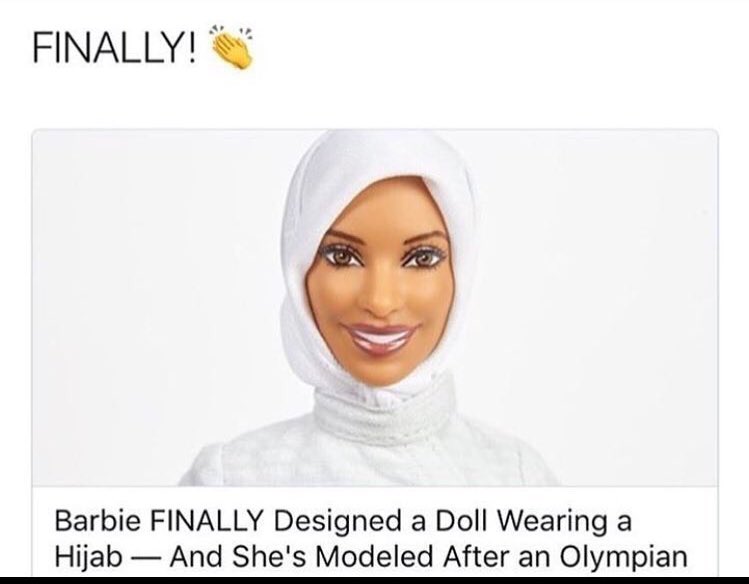
Good Lord, how did I miss this? Miley Cyrus made a big to-do about this in 2017. Brothers and sisters, you have to keep me up on what’s happening in the pop culture world. Good thing it says “diversity” and not “equality.” I mean, it could have been worse: it could have been inaccurate. (Maybe you have noticed that “diversity” and “equity” have replaced equality as the goals of a “just society,” as determined by the ruling class. Equality is such a liberal value—and liberalism is white supremacist.)
I posted this on Facebook and a friend wondered why they didn’t just come out with a new character. I explained that they needed Barbie to put on the hijab. It’s a political act by the Culture Industry—as well as a marketing strategy to bring new customers to the Barbie franchise. Folks may claim that it is only about latter, but Mattel says openly that the doll, modeled after Olympic fencer Ibtihaj Muhammad, is part of its “Sheroes” series and that the doll serves as an “inspiration for countless little girls who never saw themselves represented in sports and culture.” The goal is to manufacture the perception that Muslim women do not have a presence in American society by visibly “rectifying” their “marginal status” with a doll celebrating a cultural requirement that signals subordination to a patriarchal god. (I have written quite a lot on the subject of the hijab and the problem of multiculturalism. Here’s a sampling: Squaring the Panic over Misogyny with World Hijab Day; The Democratic Party and the Doctrine of Multiculturalism.)
Another friend (whom I have known since kindergarten) remarked that he has never seen a Barbie nun. Good point. Where is Catholic Barbie? Or Pentecostal Barbie? Or Satanic Barbie? A relative then asked when transgender Barbie was coming out. I responded with:
Some doctors believe persons who want to transform their bodies in disfiguring ways should be allow to do so. Such surgery is already occurring in the United States. Align Surgical Associates Inc., a medical firm based in San Francisco, endorsed by, among others, the American Society of Plastic Surgeons, the American Medical Association, and the Aesthetic Society, will perform a surgical procedure known as “nullification” on those who wish “to enjoy a relatively smooth genital area,” a “mostly unbroken transition from the abdomen down.” The firm offers this procedure for those who wish to “enjoy a body that looks closer on the outside to the way they feel on the inside.” Some people wish to have no genitals and Align Surgical Associates Inc. will make that happen. For a fee, of course. (The firm’s website has a gallery, if you are interested.)
I learned about Hijab Barbie from a YouTuber named Persy who I discovered upon reading this tweet:
The Danes should see Sweden as a warning. They’re on the same trajectory, just a bit behind. Even smaller towns are noticeably more ‘diverse’ than just a couple of decades ago, now that all those millennium babies from huge families are growing up. https://t.co/h6R4QDoQ2i
What comes with Islamization is not only misogyny and homophobia and a sharply reduced capacity for free thought (and a profound hatred of dogs), but drastically higher crime rates and greater social disorganization. It’s bad for everybody—as every totalitarian ideology is. Let this happen and prepare for clerical fascism.
We sure do need this man right now
Ask a truthful Swede what’s in store for the rest of civilization if western nations allow this trend to continue. But recognize that a lot of Swedes are deluded by a pathological displaced humanitarianism and will deny the empirical evidence. The fact is that Sweden is very different now than it was when I first started traveling there.
“In 2020, you and 81 million Americans voted to save our democracy,” Biden told a roaring crowd. “That’s why Donald Trump isn’t just a former president. He is a defeated former president.” Was the crowd roaring? I didn’t see the speech. Biden makes me feel uncomfortable. I don’t like being made to pity a man I loathe. But I can understand how CNN could describe the crowd this way given the headline of the story: “Biden criticizes ‘semi-fascism’ underpinning the ‘extreme MAGA philosophy’ in fiery return to the campaign trail.” Fiery? Biden?
Every time Biden says this all I hear is insecurity. He doesn’t really believe he won. He may not fully grasp everything that went on during 2020 (Too Soon to Call: Developments in the Improbability of a Biden Election Victory; “A republic, if you can keep it.”) , but he surely saw those huge Trump rallies and reflected on his own pathetic events those few times he poked his head up out of his basement. He can’t believe he got more votes than the wildly popular Obama or even Clinton. Of course, maybe he is that egotistical and self-deluded.
Breaking: Kevin McCarthy is demanding Mark Zuckerberg testify before Congress following his admission on the Joe Rogan Experience that Facebook censored Hunter Biden’s laptop stories for ten days in run-up to election.
For those of you who aren’t up on this, the FBI met Facebook employees and told them Hunter Biden’s laptop was “Russian propaganda.” They knew that wasn’t true. Facebook took direction from a deep state operation to protect Joe Biden from information that would have changed the outcome of the election.
The FBI—or some group internal to it—worked for the Establishment to prevent Trump’s re-election. And they are today working to prevent Trump’s return and, more generally, stifle the populist-nationalist movement. The FBI has become the Gestapo of the Democratic Party.
A couple of days ago Sp¡ked published “How trans ideology hijacked the gay-rights movement.” It author, David Allen, was chair of the Tory Campaign for Homosexual Equality (TORCH) from 1996 to 1999. An old warrior for the struggle for the right of gays and lesbians to stand equally before the law with straight men and women.
I will leave you to read the piece (it’s a terrific read). In this blog, I want to share something Allen’s piece moved me consider: the trouble an academic would seek for sharing this essay in a college classroom or suggesting to the director of a Pride center that perhaps the diverse needs of students are not met by a single office.
Why are there risks associated with such things? Because the ethic of free speech is not really a valued one in institutions of higher education. Don’t be misled by stories of universities hastily moving to take up the free speech question; this is occurring in the face of conservative and libertarian challenges to the culture of diversity, equity, and inclusion (DEI), a system of woke progressive attitudes and theories that have taken root everywhere in America. That’s right, it’s not happening because faculty and administrators are worried about where woke has taken the institution. It’s public relations.
As I reported in April (Science Politics at the University of Wisconsin—Deliberate Ignorance About the State of Cognitive Liberty and Viewpoint Diversity on College Campuses), the University of Wisconsin System delayed a free speech survey scheduled for the spring (2022), pushing out its administration at least until the fall semester (where it enjoyed no funding), because they did not want the public to know how intellectually closed our institutions of higher education have become. It now appears the survey will be supplanted by a year-long series of free speech events emphasizing civil discourse, often a euphemism for the rule of inclusion. I fully anticipate the exercise will be an attempt at a deft recoding of DEI indoctrination.
It won’t be my first rodeo. Given that free speech should be a core value of every public university in the country, one should expect periodic refreshers on the importance of upholding everybody’s right to think and speak freely in order to move civilization towards greater heights of justice and technological prowess. Indeed, a common defense of free speech concerns its function in promoting positive social change. And it’s true: all modern-day social movements have depended on the ability of activists to speak freely—and on those brave enough to speak up for justice even when facing consequences for doing so.
HR image that checks every visible box
However, what is often neglected in the defense of free speech on college campuses is the practice as intrinsic good, that is the recognition of the human right to cognitive liberty—the right belonging to every human to think and express his thoughts without consequence (which is what it means to say that speech is free).
To be sure, the functionality of speech to the dynamic of social change depends on cognitive freedom—which is precisely why authoritarian and illiberal types want to stifle speech! This is the imperative of blasphemy laws: to prevent heretics and even infidels from challenging the legitimacy of religious doctrine. This is also the imperative of rules compelling inclusive language: to exclude opinions that challenge the legitimacy of crackpot theories currently circulating through modern-day cultural and social institutions. When you are educated about “microaggressions” know that you are being subjected to the practical deployment of a crackpot theory.
When speech is rationalized on the grounds of functionality towards progressive ends, utterances determined to be dysfunctional for those ends are “justifiably” restricted. Thus “regressive” and “reactionary” ideas are disallowable under the speech regime envisioned by the progressives in charge of the institution or organization. This move presupposes what speech is for—and there are always people doing the presupposing (and it’s not hard to identify the commissar). But the free speech right is a neutral vehicle for the expression of human liberty that allows for any utterance to be emitted including (and, I would argue, especially) those utterances that offend the sensibilities of other people whatever their ideology, whatever their worldview—whatever their identity. That’s the human right: your entitlement to the universal freedom to offend others.
We must, therefore, in sussing out the essence of cognitive liberty, consider its obverse: thought control. Thought control is mind control. And if an entity can control a person’s mind, then that person is unfree. The rules of inclusion are thus in the service of mind control. Moreover, where undesirable opinions continue their lives in the privacy of skulls, insistence on inclusion encourages bad faith. The rules foster the development of clandestine groups where members, often suspicious of one another, try to feel free to let down their hair—just like Chinese Christians who meet in secret to pray (the house church). The rules create a culture that causes even comrades to lower their voices when sharing disallowed opinions. You know, like it was the former Soviet Union or in Nazi Germany. Most people don’t even bother to discuss effectively banned ideas anymore; they go along to get along.
"I enunciate 'nigger' in full, out loud w/ some purpose in mind. Usually the aim is to drive home to audiences the pervasiveness of anti-Black prejudice and, more specifically, the way in which this troublesome word has been an integral part of the soundtrack of American racism." pic.twitter.com/7CGkG7eA4r
What is often neglected in the defense of free speech, then, is the false claim that individuals or groups possess a right to be free from insult and offense. One often hears this false claim wrapped in the lofty defense of “human dignity.” Yes, the Muslim is man who believes in a religious doctrine, which is, in the final analysis, an ideology (as all religious doctrines are), and, yes, in theory, all ideologies are subject to criticism, but the man’s identity is at stake, and he has a right to that, so do not insult him for his deeply-felt religious convictions or offend his prophet. Well, to hell with his delusions and fuck his prophet. He has no right to tell me what to think or say. It’s not my religion.
We hear this same claptrap associated with rules punishing those who contradict gender ideology. Contradicting the claim that “transwomen are women” (on the grounds that women are adult human females and transwomen are males and thus cannot be women) are accused of an act approximating genocide. The criticism of gender ideology thus become a speech act erasing the existence of transpeople, an assumption that presumes as given what the critic is doubting (it is thus rendered undebatable) and, moreover, that a speech act is capable of such a thing. But if a man is permitted to doubt God, and surely he must be if he is a free man, then surely he is permitted to doubt the claim that there are “true selves” and “wrong bodies.”
This is why the rigorous defense of free speech is portrayed as “right wing”: it allows criticisms that challenge the legitimacy opinions uttered by those controlling the nation’s cultural and social institutions—while anti-white racism, anti-male sexism, and the remarkable denial that there are such things as men and women at all, are assumed as truth and uttered without consequence and even expecting affirmation. The free speech crowd is given its own identity and left to compete with the myriad other identities who, on the grounds of social justice, claim the right to silence speech they don’t like. Of course, folks are entitled to their crackpot theories. The Muslim enjoys his religious liberty. What they are not allowed to do, however, is establish rules that prevent others from challenging those theories. And that is precisely what the rules of inclusion aim to do—and are doing.
This therefore must be made plain: There is no right to dignity as such because, if there were, then those who claim to take offense at speech are given control over the cognitive liberty of others—and this is a human rights violation, rights to which we are all entitled. This is why those who claim to take offense seek to have the law or some rules at their backs: they desire to control others by punishing them for their opinions. And it should not have escaped your attention that those who complain about offensive speech are not those who might be offended but others who presume to speak for those people. How authoritarian is that? Very authoritarian.
Those who love freedom have allowed this to happen because the love of freedom is at once love for humanity. But this sentiment is misplaced humanitarianism, for it is in the end destructive to humanity.
Before I conclude, I want you to know that I hear your objections: “Fire in a crowded theater” (do I really need to debunk this one?) and “Libel and slander.” On the question of libel and slander, first it cannot apply to identity, as this is group-level abstraction and libel and slander, or defamation, applies to the action of damaging the good reputation of concrete individuals (I am skeptical even of this). Moreover, defamation can only be said to have occurred if a demonstrable lie had been told that causes a demonstrable consequence—all of this wrapped in malice. What demonstrable lie has been told when I openly doubt the claims of imams or gender theorists? Shall I be punished then for telling the truth?
“With bright knives he releases our souls.” —Pink Floyd, “Sheep”
When today we find conservatism to be the closest thing to classical liberalism in the West, the left made a wrong turn somewhere. Several wrong turns. A major one was abandoning the principle of individual liberty for tribalism.
With this illustration, Nate Kitch implies that free speech and national integrity are on the same political plane as identitarian moral panic. They are not.
A free man is under no obligation to accept or affirm the delusions, illusions, or lies of others. He is only obligated to tolerate these in those who are not harming others or depriving them of the liberties and rights to which we are each entitled. Toleration does not mean avoiding criticism or ridicule of their beliefs. The fool can stand babbling on the hill. And we can make fun of him.
The desire to compel an individual to accept or affirm delusions, illusions, or lies, or punish him for mocking people who hold or spread them, is an authoritarian desire. The force of law and policy behind such desire cancels the obligation to be tolerant.
The existence of Muslims does not depend on my faith in Islam. Muslims do not need my affirmation to exist. They only need to be convinced of the truth of their doctrine. I only need to tolerate them. Without faith there are no Muslims. But this is their problem, not mine.
To say a man is not exempt from a mandate or a requirement because he does not profess the relevant religious doctrine is to punish him for believing some irrelevant doctrine or no doctrine at all. This is discrimination.
Integration with western society does not require abandoning one’s faith commitments or other opinions. It does, however, require accepting as part of living in the West adherence to the ethics of secularism, rule of law, and diversity of opinion—the very things that permit those who choose to reside in our countries the right to keep or abandon their faith commitments and other opinions. You faith cannot give you any privileges in a free society.
Yet Americans are being told they have to accept and affirm delusions, illusions, and lies and that they will be subject to mandates for not holding approved belief.
Illiberalism is being normalized by the corporate state and its attendant technocracy. Our civil liberties and human rights are at stake. We must recommit ourselves to the Enlightenment. Insist that reason and secularism govern our institutions. Push this woke insanity to the hill where the fool stands babbling.
* * *
If you’re wondering why progressives are so gullible when it comes to accepting the pseudoscience of the state corporate apparatus, you have to grasp postmodernist corruption of the academy and our cultural institutions (A Judge Stands on His Head to Save Woke Progressive Indoctrination and “DeSantis is a Nazi” and the Hysterical Left’s Anti-Working Class Politics covers this issue and provides numerous links to past writings about this). Once academics, administrators, and cultural managers, and the progressives who came through their indoctrination programs, became convinced that science is just another ideology—and, worse, cisgendered, heterosexist, patriarchal, white supremacist ideology—it was only a matter of time before well-known and obvious truths were overthrown for pseudoscientific notions to be displayed on placards and profiles for the tribal purpose of signaling virtue.
One blatant giveaway that science has been rejected are these yardsigns telling us that “This house believes in science.” No it doesn’t. If it did, that sign wouldn’t be in the front yard. (See “In this House…” The Slogans of Woke Progressivism.)
Headline from this morning’s The Hill: “Judge blocks DeSantis’s ‘Stop WOKE Act,’ says Florida feels like a ‘First Amendment upside down’.” US District Court for the Northern District of Florida Chief Judge Mark Walker (the same judge who exploited the COVID pandemic to help engineer voting procedures that advantaged Democrats in 2020 and will again in the upcoming 2022 elections) issued a preliminary injunction blocking the private employer provisions in the law saying it violates free speech protections under the First Amendment and that it violates the Fourteenth Amendment’s Due Process Clause for being impermissibly vague.
US District Court for the Northern District of Florida Chief Judge Mark Walker
“Recently, Florida has seemed like a First Amendment upside down,” the Obama appointee and activist judge wrote in the ruling (in which he compared the law to the fictional “upside down” in the Netflix series Stranger Things). “Normally, the First Amendment bars the state from burdening speech, while private actors may burden speech freely,” Walker continued. “But in Florida, the First Amendment apparently bars private actors from burdening speech, while the state may burden speech freely.” Here is the text of the Stop WOKE Act.
Walker’s understanding of burden is embarrassingly superficial but not unusual among progressive judges (and rightwing libertarians) who erroneously use the private status of corporations as justification for the regulation of speech. Burdening speech is not only suppressing certain utterances, which must be disallowed; lifting burdens must be concerned with protecting the cognitive liberty of individuals, which means prohibiting the practice of compelling political and religious speech, which is precisely what Diversity, Equity, and Inclusivity training conveys (see The Bureaucratic Tyranny of DEI).
The innovation of the Florida law lies in the act of extending the principle of free speech rights to state-regulated private sector entities, i.e., corporations, in the same way the Civil Rights Act of 1964 prohibits private corporations from discriminating against individuals based on race, sex, etc. Speech is as much a civil right as one’s racial or sexual status—rights individuals do not lose upon entering private institutions. After all, these are places of public accommodations; they cannot discriminate for these reasons. Moreover, corporations exist because they chartered by and answerable to governments. DeSantis’s law should be the law of the land. It plainly follows from the First Amendment (as well as the Ninth).
What this judge clearly fails to understand—or to take into account—is the fact (not the feeling) that DeSantis’ law is not burdening speech but instead preventing an institution or organization from compelling an individual to speak and think in ways he wishes not to. The law does not burden speech by prohibiting mandatory DEI training; on the contrary, it is mandatory DEI training that burdens speech. The law is correcting this problem by protecting individuals from the imposition of having political and religious speech forced down their throats in required struggle sessions at institutions where they are receiving an education or earning a living, activities in which they must engage to enjoy an acceptable quality of life. Forced into such training sessions, as such they are captive populations—who are moreover required to affirm the political and quasi-religious ideologies they are receiving. Judge Walker must be standing on his head to get the law so wrong.
* * *
DEI training and other instruction in critical theories where these are presented as the definitive explanations of the phenomenon people experience is an attempt by the administrative state and technocracy to indoctrinate employees and students with a moral philosophy derived from a illiberal ideology. I was therefore excited to hear the thoughts of Christian theologian and ecclesiastical historian Carl Trueman speak to the comedians on Triggernometry about how technocracy cannot answer moral questions. However, I was struck by how quickly the guest made it impossible to actually take up the question posed as the title of the podcast.
Trueman argued that, without the absolute standard of religion, morality is merely an exercise in pragmatism. But there are plainly many religions and they differ drastically from each other. It follows that religion cannot be an absolute standard for anything. (You will recall that Feuerbach blew up Hegel over this point nearly two centuries ago. See A Humanist Take on Marx’s Irreligious Criticism.) This is why we have religious liberty. Religion, like critical race theory, gender theory, queer theory, and the other quasi-religious standpoints of the moment, fails to provide adequate moral rules, even while, unlike these critical theories, claiming there are such things.
Moreover, religion is notorious for undermining those moral rules that must necessarily lie beyond religion, for example, women’s rights. How are we otherwise able to objectively determine what is a just law or policy if there is no universal standard? There must be such a thing as an objective standard if we are to judge the adequacy of any given religious system to human thriving and well-being, which are objective criteria. The Jewish Bible positively sanctions slavery. Is slavery not wrong? On what basis is it wrong? Plainly not a biblical one (see Slavery and the Abrahamic Traditions).
Fortunately, there is such a standard: human rights as determinable by the approach secular humanism, i.e., a concern for and the science of our species: Homo sapiens. This is possible because human rights are inherent in our species-being, however much they are warped by such ideologies as Christianity, queer theory, etc. This is pragmatic if by that word we mean discovering the truth and putting it into practice (see Abraham Maslow’s hierarchy of needs). We find, then, that religion—or anything approximating it—is unnecessary. More than this, it is oppressive. Yet new religious are being forced upon employees and students across the West in the form of DEI training, new religious that contract human rights, indeed that deny the species being necessary for human rights to be possible.
* * *
Thinking about this morning as I was dropping my son off at work, I was reminded that I wanted to put down something I have said in discussions with family and friends—and in classroom instruction (via the arguments of Antonio Gramsci in his Prison Notebooks and Max Weber in The Protestant Ethic and the Spirit of Capitalism)—that there are those who are desperate to deny the animality of man, to deny that the species is the product of natural history and that the ideas people express, rational and irrational, result from environmental contexts and social arrangements that either promote or corrupt development and justice.
Slogans that find their way into boardrooms and classrooms, such as “transwomen are women,” or the compelled use of pronouns, or statements recognizing the spiritual connection an American Indian tribe has to the land upon which the buildings of a university stand—these are political and quasi-religious activities that must deny reality in order to work. And to do this destructive work, the activists must shift the function of education from one of enlightenment and the ruthless search for the truth to one of indoctrination and ideological production. Replacing truth with doctrine requires indoctrination. It’s right there in the name. Such beliefs as individuals can change sex or American Indians are in possession of transcendent privilege require compelling since most free and rational person would rightly dismiss such irrational claims and therefore wouldn’t come to them naturally. The goal is to conscript all of us in the project to make falsehoods appear as the truth. This is the essence of all religion.
It should terrify all of us that, increasingly, an individual will be disciplined, ostracized, and punished for not only telling the truth but for failing to affirm a lie. DEI is part of the system seeking to supplant the ordinary understanding of humans, which is generally intuitive correct, and even knowledge of natural facts, with a political-ideological view of the world prepares employees and future employees for incorporation into an illiberal existence beneficial to corporate power and profit. This is an environment where the administrator, cultural manager, and employer can depends on the student and employee believing whatever those in authority tell them (this was a major objective of the COVID-19 mask and vaccine compliant strategies). DEI training, its basis in critical race theory, gender theory, etc., demands of those compelled those attending affirmation of the lie—and to go forth and spread this lie throughout the institution and the community.
* * *
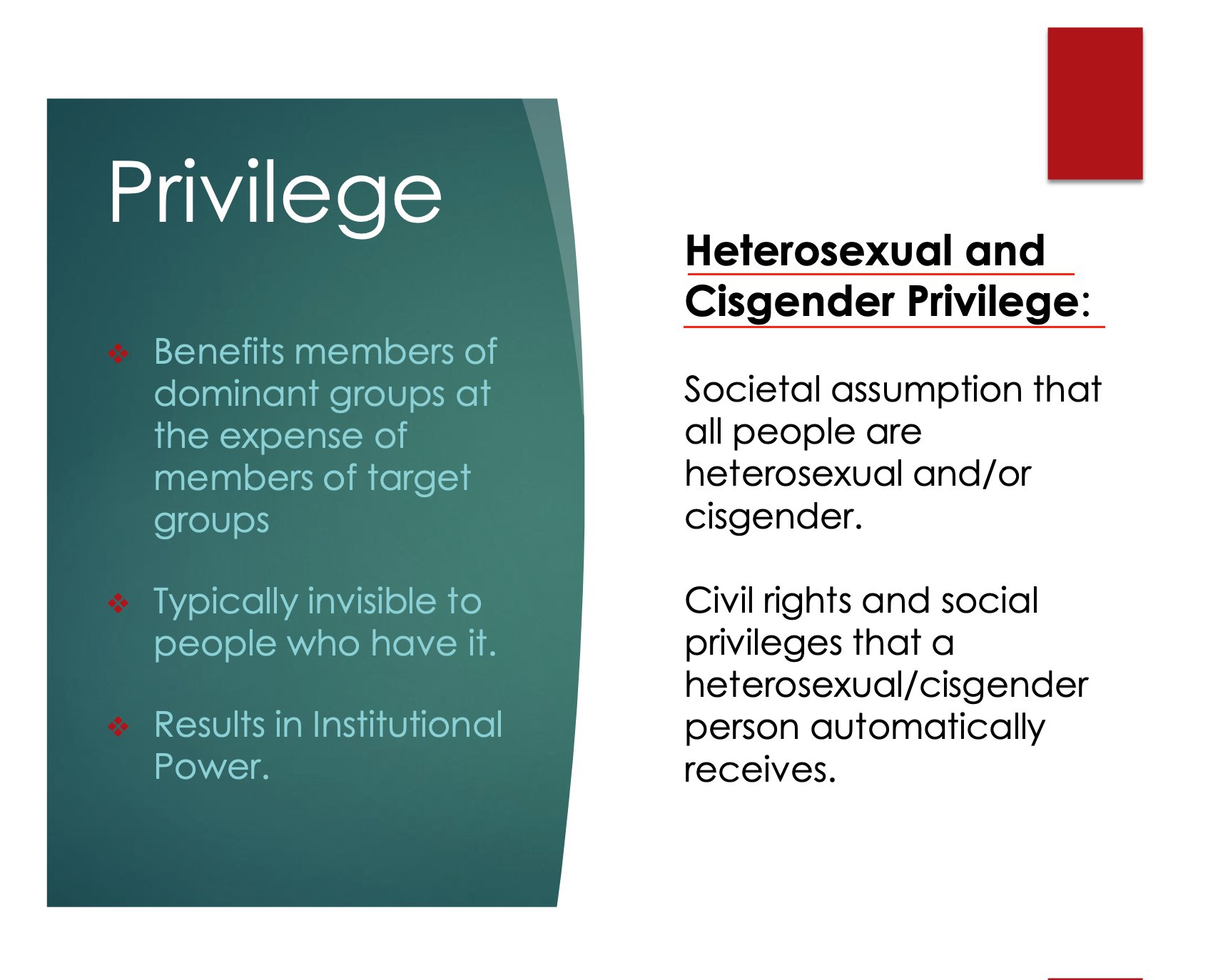
Consider the appearance of the term “cisgender,” a transparent and cynical attempt to erase the notion of the abnormal by defining the ordinary as so problematical as to require a qualifying prefix. Such propaganda terms proliferate as the transgressive practice of postmodernist critical theory colonizes academic jargon. This is why Freedom and Reason does not critique gender ideology independent of the consequences of doing so—gender ideology is at once a system of claims about the world and an authoritarian politics that punishes people for skepticism regarding those claims. If I am hauled before a disciplinary committee for this blog, the truth of what I am saying will enjoy dramatic confirmation.
Consider the preachment found in the programming that heteronormativity and cisnormativity are at once oppressive ideologies (see the work of Christopher Rufo). These notions depend on the denial of necessary facts in human evolution and the perpetuation of the species across time and space. It is a religious notion even if expressed in a nominally secular fashion, one that sees man as not merely separate from nature but not really a natural being at all. Rhetoric about the “dominantly situated” and “negatively privileged” and “marginalized” groups, terms that populate the transgressive literature of critical gender studies and find their way into DEI training manuals—such rhetoric cannot obviate reality if we remain free from compelled speech.
Some will object that those forced into struggle sessions over these matters are not really compelled to accept the programming. They are still free to believe as they did. At best then, you will have forced everybody into bad faith. We all know that those who, for example, deny that males can be women will be attacked for “denying the existence” of transpeople. But what is denied is the claim that a transwoman is a woman on the grounds that a woman is an adult human female and, with the transwoman’s sex determined by such objective unchangeable things as chromosomes and gametes, the individual cannot actually meet the definition. I other words, those who refuse to affirm the slogan do so on definitional grounds that a woman must be a female which is rooted in scientific truth. For this, they are demoted, disciplined, expelled, ostracized, and smeared.
But rejecting transgenderism is no more discriminatory against transpeople as rejecting Islam is discriminatory against Muslims. The existence of Muslims does not depend on my faith in Islam. Muslims do not need my affirmation to exist. They only need to be convinced of the truth of the doctrine. And I only need to tolerate them. Without faith there are no Muslims. But this is their problem, not mine. Yet employees and students across the country are being compelled to undergo training in which affirming these ideas are a requirement for certification.
* * *
I risk being accused of transphobia for this blog (and for future ones dealing with this topic). However, readers should consider the history of using accusations of phobia to delegitimize criticisms of their views. Consider, for example, the propaganda term “Islamophobia.” Exploiting the construct “xenophobia” as inspiration, Islamists invented the term at the end of the 1970s to portray rational criticisms of Islam as a type of racism. But Islam is an ideology. It is the rational obligation of free people to criticize indeed resist ideology.
“Transphobia” is a propaganda term designed to accomplish the same thing. It’s designed to silence critics by making them out to be the equivalent of racists. You see this in the slogan “Transrights are human rights,” which Antifa chants while physically assaulting women demanding their rights. A male identifying as a woman has her human rights. There is no human right to be regarded by others as a woman when they perceive you as a male. This is for the obvious reason that an individual cannot force other people to live according to his perception of himself. A white may wish to be black, but those around her are under no obligation to recognize her as such. Indeed, it is violative of the human rights of others to insist they affirm the delusions of other persons.
Yet, while it would be outrageous to compel employees and students to undergo training sessions in Christianity, it is considered so obvious that they should be compelled to undergo training sessions in gender ideology that to pass a law forcing institutions to abide by the fundamental law of this country is somehow oppressive. (I considered using Islam as the example, but with Islamophilia so rampant among woke progressives, I cannot be sure they won’t attempt at some future point to have employees and students affirm the tenets of that totalitarian belief system).
In light of claims to the contrary, then, there is something therefore to be said about the emergence of novel religious standpoints as the old religious institutions fall away in the radical force of modernity. Indeed, the return of religion in new forms marks the postmodern condition. But this condition is not in the end the result of ideas, but the way the death throes of late capitalism manifest in the behavior of the corporate state and attendant technocratic arrangements expressed as ideas in universities corrupted by corporate state propaganda.
Trueman is right about this: technocracy cannot answer moral questions. However, extremists have infiltrated the technocracy and they’re making policy appealing to morality. They dress the appeal in the rhetoric of “social justice.” This must be resisted. We have to unwind all this. We have to bring western society back to reason and the principles of liberty and equality.
* * *
Alongside my libertarianism is a commitment to scientific truth and a concern for human rights, which I argue are universal and objectively determinable things. Because truth matters, while I may choose to lie or go along with a fiction to spare a vulnerable person’s feelings, I must not be made to lie for the sake of affirming the person’s imaginary world. No person should be forced to participate in the manufacture and perpetuation of untruths.
As readers of Freedom and Reason know, I am an atheist. Because I enjoy religious liberty, I cannot be made to repeat Islamic scripture. Also, Islamic belief is false and wrong. There is no God. Muhammad did not talk to an angel named Gabriel. There are no angels (no supernatural ones, anyway). Islam harms people subjected to it. I am not a bigot because I do not use the sacred language of Islam or refuse to affirm the claims made by that religion. More than this, I am free—or at least should be free—to criticize that religion; I am not subject in a secular society to that religion’s blasphemy rules because I am not a Muslim. If ever I am so compelled, then I am no longer a free man.
Today, woke gender ideology is very much a religious praxis. Gender ideology comes with a cosmology positing nonexistent entities, principally a concept of gender as something existing independent of bodies, the truth of which depends entirely on the testimony of the person who, like somebody claiming to have been abducted by aliens, presents an entirely subjective case, one that is, as with alien abduction, more likely to be delusional than anything approximating a true claim. Unlike in the case of Islam (or Christianity), those of us who do not subscribe to the woke religion are nonetheless expected to affirm its slogans. It is not just in the public education system that one is expected to rehearse the slogans of Wokism. Many of those working in corporate bureaucracies are also expected to repeat the preachments.
This slogan “transwomen are women” represents perhaps more than any other the special problem with gender and queer ideologies and the authoritarian desire to impose upon the world a crackpot theory of sex and gender. While I could not be expected to affirm the slogan “There is no God but Allah and Muhammad is His Messenger,” or, perhaps more certainly, “Jesus Christ is the way, and the truth, and the life; no one comes to the Father, but through Him,” I am expected to affirm the slogan “transwomen are women.” That I fear or risk discipline or punishment for publicly refusing to affirm this slogan indicates that gender ideology has become a threat to liberty in America in a way that religion never has been.
Growing up in a Christian community, son to a minister with his own church, I was never expected to openly affirm Christian slogans. Admittedly, other children were not so fortunate. But, then, almost nobody ever had to think about it. They believed by virtue of early socialization (and perhaps genes that predisposed them to religiosity). Yet, several times over the last few years, I have been asked to affirm the slogan that transwomen are women. I have had individuals unfriend and unfollow me on social media not because I said anything critical of transgenderism but because I would not affirm the slogan. When I voice my support for gays and lesbians, which I often do, I am sometimes asked why I neglected transpeople in my advocacy. I ignore the question, which then becomes evidence itself that I am transphobic.
When people refuse or fail to affirm the tenets of this quasi-religion, the gaze cast upon them condemns them of anti-science, as if the science confirms the truth of the ideology, assuming as given that which requires proving (another strange alchemy). Failing to provide proof (as I have shown in past blogs and will show in upcoming ones, all this is far more religious-like than scientific), why, then, is race or gender ideology different from Scientology or Mormonism? Of course, even if the science were there, one should still be free to reject its claims. The state would be no more justified in punishing a person for rejecting Charles Darwin’s theory of natural selection as it would punishing a person for rejecting L. Ron Hubbard’s theory of dianetics. (Where are the struggle sessions over Darwinism?) But race and gender ideology is so obviously religious in character how did we even get to the point where one has to risk one’s reputation and livelihood for refusing to accept doctrine? Because of the woke progressive assault on scientific truth. Why would it do that? Consider that science has to be delegitimized so that “other ways of knowing” can be used in medicine.
* * *
Here’s what has happened. Scientific truth, however tentative in its self-correcting character (there are things yet to be discovered and concepts still to be worked out), is the rational standard of knowledge, as it is based on verified belief and is universal, that is, it is true regardless of the cultural and historical context, what we may therefore properly call knowledge (over against belief). Scientific truth is challenged by a neo-idealism instantiated by a critical theory, as well as the postmodernist movement in French philosophy. (I am not talking about all critical theory, but specifically the 1960s deformation of critical theory and its offspring, e.g., critical race theory, gender theory, queer theory, etc.) These other ways of knowing have found their way into our major institutions because they are functional to corporate governance and profit-making.
These developments have not merely warped ordinary understanding, but have found their way into law and public policy, which find popular support among rank-and-file progressives socialized in the woke church the academia has become. Critical theory in its postmodern turn represent a deviation from reason by defining science as ideology and then, in a move conflating ontology with a subjectivist epistemology expressing distrust of “grand narratives,” reducing scientific theory to “discourses,” thus denying the method for determining objective reality. The radical relativism expressed by these perspectives treat scientific truth and those things concerning reasonable minds as “problematic.” Law and policy proceeds not on the basis of fact and reason but on the basis of a politics corrupted by ideology. In a nation founded on separation of church and state, woke ideology has become the state religion. One only needs to look at the administrative state under President Joe Biden to confirm this.
We have arrived at a point where “indigenous knowledge systems” are elevated to the status of science—which only means that science has been demoted from its position as the rational standard of knowledge to lay alongside voodoo and witchcraft. Actually, as some would have it, we must go out of our way to value nonscientific ways of knowing. This is a core element of postcolonial consciousness. Critical theory and postmodernism come with a praxis of transgression that portrays normality as arbitrary, imperial, and oppressive, and therefore in obvious need of overthrowing. Science is a western notion, and the West is wicked. Science is white supremacist and cisgendered. The world is in need of purification from this corruption. This is at least the view of the rank-and-file science deniers of woke progressive praxis—despite those obnoxious yard signs that say “In this house…we believe science.” Social media profile pictures extolling the virtues of masks and gene therapies should make things obvious enough.
Because it rests on a neo-idealism that is derivative of Hegelian thought, which sees history as the manifestation of ideas rather than than the other way around (as the materialists do), the arguments are circular. For example, “cisnormativity,” a construct depicting the natural fact that the vast majority of the human population intuitively recognizes the sexual dimorphism inherent (and obvious) in the species as an oppressive expression of gendered power, finds the source of that power in cisnormativity itself, as if males and females who identify as men and women—oppressors the both of them—managed at a point long before modern humans emerged as a species to conspire to construct an oppressive ideology just in case their offspring ever decided to question their gender. (I have more to say about this, but this blog is getting long. Stay tuned.)
* * *
The theories that underpin DEI training are crackpot. They are so religious-like as to qualify as such. I spent some time with them here to give you an idea of the ideology that underpins the training many of you are forced to undergo. Children are being subjected to these ideas and the consequences are becoming apparent. Understanding what and why this is happening is key to understanding why DeSantis and a handful of other political visionaries are acting to stop it.
DEI training and other programs of indoctrination represents political and religious programming of the sort that is strictly prohibited by the First Amendment, these rights and liberties made available to all citizens via the Ninth and Fourteenth Amendments. This is the whole ball of wax: if these rights and liberties are negated we live in a totalitarian state in which the Party tells us was to think and say. The Orwellian nightmare world under construction is what Florida governor Ron DeSantis is trying to tear down. We need to help him. We need these laws in all of our states.
A few days ago, Fox News posted an article, “Parents push back on American colleges promoting DEI initiatives: ‘DEI is dangerous’,” by Elizabeth Economou and Nicole Pelletiere. They write, “Some universities across America are requiring compliance from faculty in the form of signed diversity, equality, and inclusion (DEI) statements, as conditions for tenure or promotion—arguing that DEI across college campuses is a top priority.” Their article then sounds an optimistic note: “However, there may be growing pushback in some areas from faculty as well as from parents—who claim that the DEI agenda actually challenges the diversity of viewpoints and opinions of students within the college environment. Some say it also promotes a culture of fear and intimidation.”
With little clamoring from the public, DEI is now everywhere.
The DEI agenda is indeed becoming ubiquitous these days and, while there is some pushback from faculty, parents, and students, it is not nearly enough. The lack of resistance, especially among faculty and students, is in part because of the culture of fear and intimidation that controls discourse and interaction on the modern university campus. I work at a university, and the fear and intimidation is palpable.
I have written about DEI programming on Freedom and Reason (e.g., The Origins and Purpose of Racial Diversity Training Programs. It’s Not What you Think; Can I Get an “Amen” to That? No, But Here’s Some Fairy Dust). Many of us are required to attend DEI workshops or perform online trainings as a consequence of our necessary existence in helping, learning, and working spaces where DEI ideas and practices are the guiding objectives. The notice just went out at my institution that new staff and faculty are required to undergo DEI training. It is incorporated in the program of employee orientation. Given what universities are turning out, I am sure many of the new arrivals will be eager to express their wokism. For those who aren’t so enthusiastic, they will sit silently or forced into pronouncements of bad faith.
Achieving diversity at any institution, according to DEI doctrine, requires drawing employees, students, etc., from a myriad of identity groups based on gender, race, religion, etc. If, e.g., blacks are “underrepresented” at an organization, then administrators and managers will aggressively seek black applicants and prefer those applicants over white or East Asian applicants. The same is true for advancement and promotion. Managers are not looking for the most qualified individual, but instead looking for personifications of an abstract demographic category to build an institution that “looks like America,” or more ambitiously, since universities are international, that “looks like the world.” (As the most racially, ethnically, and religiously diverse society on the planet, America looks like the world.)
Management is also, it must be said, looking for personifications (it goes beyond tokenism) who agree with the progressive agenda of the institution. A black conservative or Republican is highly undesirable. (Is he even black?) It is important to recruit those who are also woke as they will promote the agenda and extend progressive hegemony in their “community.” This is functional, as Swedish Marxist and populist Malcom Kyeyune argues, as “progressive theories of race and gender” secure “influence, employment, and prestige for underemployed university graduates.” He characterizes wokism as the highest form of managerialism. (His participation in Oikos suggests he also understands wokism also as a denationalizing force destructive to individual liberty and civil rights.)
One of the objectives of DEI, whether explicit or not, is to achieve a reduction in the number of straight white men at an institution by replacing them with representatives of the various groups deemed significant and useful to the establishment justified by the problem of “underrepresentation.” East Asians are increasingly unwelcome to help fulfill the scheme, as well, as they tend to excel in various fields central to the work of the university. One finds justification for the diminishment of straight white men, hereafter SWMs, in institutional life in the claim, informed by postmodernism and critical theory (critical race, gender, and queer theories), as well as postcolonial ideology and third worldism, that SWMs reside at the intersection of oppressor categories. (The question of why oppressors are leading the way in disempowering themselves through the deployment of DEI rules left unexplained.)
Achieving equity, a euphemism for SWM depowerment, requires eliminating aggregate differences among individuals in bureaucratic life, a goal that often demands the elimination of any norm or standard that prevents individuals from achieving parity with SWMs, norms and standards said are erected by SWMs to achieve systemic privileges—cis privilege, male privilege, straight privilege, white privilege. However, since all modern institutions are structurally bureaucratic and thus necessarily order roles and statuses hierarchically, parity requires, independent of merit, deliberate promotion of those mired in the intersections of oppressed categories to stations with more power and prestige. In this fashion, members of minority groups possessing victim subjectivities are integrated into the structure of power where their loyalty to the goals of DEI becomes useful for tightening the hegemony of the command-and-control structure.
Inclusion means adopting interaction rituals that, on the surface, make members of various identity groups feel included (hence the inclusivity rhetoric—but we might also say “useful” and “welcome”) in a world unjustly run by SWMs, rules of engagement necessarily requiring that individuals accept the very ideology that, with required speech acts all members are expected to affirm, manufacture and sustain the identity groups based on the oppressor-oppression matrix. Thus by officially treating individuals as personifications of abstract groups, the system reifies the progressive ideology of identity. It is a desire to live in air castles that denies their lords.
This desire leads to am authoritarian end. Why, if employees and students are tolerating the behaviors (that do not physically harm or interfere with the liberty of others), identities, and opinions of others, is that not good enough? That is all that is required in a free society. Why must employees and students affirm behaviors, identities, and opinions with which they disagree? Perhaps the chief difference between the liberal and the authoritarian is that the liberal advocates toleration while insisting on cognitive liberty, while the authoritarian, intolerant of opinions with which he disagrees, desires to censor and compel the speech of others. This desire reveals a deep and pathological insecurity, no? Why is it so important to have others affirm one’s beliefs and behaviors? Is the authoritarian unsure of them? Are these delusions that require illusions to sustain? (Recall what S. Freud said about the difference there.) I think so.
What is the character of the modern bureaucratic institution? Is it liberal or authoritarian? A member of a modern organization shaped by DEI goals and objectives is compelled to adopt ideological, political, and subcultural ideas that he may in fact, and for good reason, oppose. These goals and objectives run contrary not only to the individual’s rational interests but to the principles upon which free and open societies are based. The demands of DEI force employees and participants to either change their way of thinking by affirming doctrine and rehearsing slogans drawn from it or to act in bad faith, thereby simulating adherence to doctrine.
Why would freedom of thought and opinion be constrained in the modern university? Isn’t free thought and debate the main purpose of the modern university—it’s raison d’etat? Did we not win the right to be free from compelled speech in centuries of struggle with authority and tradition? No, diversity in the DEI scheme does not mean diversity of ideas, or cognitive liberty, where individuals at an institution can refuse to affirm the ideology of the various groups represented in that space without discipline, ostracization, or punishment. Intellectual diversity is subordinated in this scheme, even negated by the principles of inclusion. If criticism of or non-adherence to an ideology, such as transgenderism, makes trans people feel excluded, then it follows from the goals of inclusivity that such criticism is to be excised from the common space, which may involve removing from that space the critic, redefined as a bigot. Criticism of ideology is replaced by affirmation of the ideology in question, which must be, without any attempt to achieve a consensus, accepted as truth.
Oftentimes, the ability of a critic of one ideology or another to make his criticisms is not only restricted on the grounds of specific form and content, but the meta-act of criticizing the system that disallows such criticisms (the sin I am committing in this blog) becomes itself the target of suppression. Individuals may be disciplined, ostracized, or punished for asking whether such a system that excludes a range of opinions or recruits, hires, and promotes people on the basis of their race, is fair and just. It is the same here as it is in strict religious systems where criticism of both the doctrine and the mindset and the ruleset that insist on adherence to doctrine is blasphemous and heretical.
That the practice of censoring heretics may not appear as rampant as the defenders of DEI demand it should be for it to be considered a real problem, self-censorship is rampant. What people talk about at social gatherings where they can let down their hair is a lot different than what people talk about at the office. They know—or at least believe—that if they were to express their real opinions publicly they would be risk desired committee and teaching assignments, positions and promotion, and their reputation.
For those of us who are genuinely on the left, it is crucial to understand that, in this way of thinking, equity does not mean achieving class or economic equality but rather obtaining arbitrary advancement in the bureaucratic hierarchy by virtue of membership in imagined communities, the relative aggregate inequalities of which are “explained” by the theorized matrix of group-level oppressions. If not designed to do this work (and I am convinced it is so designed), DEI programming functions to entrench corporate power by directing management to marginalize and make disreputable ordinary understanding and the majority standpoint.
For example, Chris Rufo has documented that, at San Diego Unified School District (and he has found this elsewhere), teachers and students are being taught that heteronormativity, the fact of natural history that heterosexual relations are normative, simply meaning standard and ordinary (not arbitrary), a necessary truth found throughout the animal kingdom of which human beings are a part (necessary for perpetuation of the various species), is “straight privilege.” This notion is especially absurd in light of the fact that same-sex activity is documented among thousands of other animal species. But the goal, or at least the function, of DEI ideology is depicting ordinary understanding as bigoted and hateful in order to marginalize the majority and fracture the proletariat. As a general rule, DEI program exaggerates, manufactures, and promotes inter-group antagonisms and ressentiment and then provides the means to act on those psychological feelings of envy and hatred.
SCOOP: San Diego Unified School District claims that heterosexuality is “a system of oppression,” promotes the idea that girls can have penises, and encourages children to adopt synthetic sexual identities such as “pansexual,” “genderqueer,” and “two-spirit.”
Here's the story.🧵
— Christopher F. Rufo ⚔️ (@realchrisrufo) August 3, 2022
DEI is authoritarian and oppressive because it orders it program with a narrow range of theories selected by elites from a plethora of theories explaining various societal inequities—and the theories selected are the worst of the plethora from an objective and scientific standpoint. However, they are selected not because they are rationally valid or enjoy empirical soundness, but because they advance the interests of the corporate state or some interest group, which for the former functions in much the same way as a king in securing popular legitimacy for his rule by tapping members of the various tribes to sit on his court.
Have readers ever considered this function of DEI before? When you start going through the program with the ethic of individualism in mind and determined to rationally adjudicate its logic, it becomes very obvious very quickly what the program is about: DEI is a corporate state strategy of control that integrates into the command structure individuals drawn from a myriad of groups each of which is created and sustained by the strategy itself. It works by reducing individuals to personifications of imagined communities and, on the basis of a “theory,” determines their “rightful” place in the order of things. It moreover requires all individuals accept the overarching ideology that rationalizes all this. In other words, it is a racist and sexist project governed by a racist and sexist ideology. And, like racism and sexism historically, it functions to divide the working class and advance the interests of elites.
The assumption that inequality in demographic representation is de facto racism has smuggled into recruitment a new racism where concrete individuals are regarded as personifications of abstract categories and discriminated against on this basis. This should be illegal (and the Supreme Court will take up the matter soon). But affirmative action is only one of the more explicit ways the corporate state transgresses the principles of liberalism. There are more subtle maneuvers.
Consider the lie that critical race theory is not being taught in our nation’s public schools. There is a slight-of-hand at work in this claim. Finding few lesson plans specifically identifying CRT as the learning objective, we are supposed to believe that CRT is not present in the curriculum. But CRT doesn’t need to be explicitly taught to be present in the curriculum. What is required is that CRT is part of the operating system of the school system. The curriculum is then developed consistent with the “normative” framework of the institution. And so it is (see The Ethic of Transparency in Public Education—and the Problem of Indoctrination; Banning CRT in Public Instruction). We see the same thing with normalization of gender and queer theory in public education (see If QAnon is Not a Deep State Construct, It Certainly Functions that Way; The LGBTQ Lobby Sues Florida). I raise the issue of CRT and other ideologies because these are in back of DEI training.
DEI is antithetical to the struggle for free and open societies based on the ethic of individualism and equality. DEI and its guiding ideologies are anti-Enlightenment and illiberal. They are anti-democratic and anti-republican. That DEI is a major component of the prevailing corporate operating system, which also marks the university (which pioneered it) indicates that the institutions of the West have been hijacked by a powerful force the goals of which are contrary to the principles establishing and sustaining western nation-states, especially the United States. These forces are not mysterious. It is the work of transnational corporate power.
* * *
“Disagreement is not oppression. Argument is not assault. Words, even provocative and repugnant ones, are not violence. The answer to speech we do not like is more speech.” —Douglas Murray
Have you ever wonder how society became confused about the role of words in our lives? The errors that disagreement is oppression, argument is assault, and words are violence are, in part, the result of a theory derived from literary thinking wherein words do the work of actions in the minds of readers who have difficulty living in the real world. It may be said that words do violence to one thing or another, but words don’t do actual violence. The figurative is not real. However, those who live in fictional worlds find the things in it real.
It is very much the same with religious doctrine. This is why challenging the speech of the (quasi)religiously-minded produces such a profound reaction—up to and including actual violence. Short of that, excommunication, ostracization, and disciplinary action.
“Disagreement is not oppression. Argument is not assault. Words, even provocative and repugnant ones, are not violence. The answer to speech we do not like is more speech.” —Douglas Murray
Here with some Sunday thoughts. There is so much that can be thunk. First up are some of the things I am not going to talk about.
The Biden Administration has quietly resumed building the wall at the southern border. Biden’s press secretary characterized it as cleaning up the mess Biden’s predecessor left.
The mayor of Washington DC has called out the National Guard to deal with the problem of illegal aliens who have been arriving in large numbers to her city on busses. Other cities are also experience large influxes of illegal aliens.
The economy is in recession, but the Biden Administration changed the definition of that term (and so did Wikipedia for a short time), so it’s okay.
Speaking of changing definitions, Merriam-Webster has changed the definition of “girl.” A girl is now “a person whose gender identity is female.” While they were at it, they changed the definition of “female,” too. A female is now a person “having a gender identity that is the opposite of male.”
And speaking of gender identity, more sports associations are banning transwomen in female sports.
* * *
I have been involved in a long twitter thread started by Laurence Fox:
The point of contention in the thread is free speech. I defended free speech as a human right. Humans rights, the counter ran, are invented by law, so their restriction is tautological.
“If rights are invented,” I pointed out, “then they can be anything—even their opposite.” I them demonstrated how one can know that rights are a priori: “There is no reason to deny women the franchise, therefore they must be allowed equal access to the ballot box. Women, therefore, a priori, possess the right to vote. The law denies—not gives—them that right.”
There was a lot more to back-and-forth, but I will summarize my argument and move one: Humans come with rights. See Maslow’s hierarchy. Human nature. Natural history. Law does not create rights. Rights are not given by men. Rights are discovered and recognized. Or denied. Rights were not established by the United Nations in 1948 or the United States in 1789. They are progressively found and articulated in law and defended by government—if law and government are just.
The notion that rights are invented is a dangerous subjectivist game with very real consequences. As I note in a recent blog, The Behemoth Returns: The Nazis Racialized Everything, it is a characteristic of National Socialism to see the law as politically constructed, unmoored to any universal ethical or moral system. This makes human rights merely a tool of social control.
* * *
Some on the left appeal to populism and progressivism in the same breath. They used to do it a lot more. Awareness that populism comes along with nationalism has causes a general distaste for the term. However, progressivism was invented to supplant populism. And, so far, progressivism has been winning.
Want to know why the left today pushes the agenda of the corporate state? Progressivism. The problem with the left is not, as the conservative believes, creeping socialism or communism. The problem is that progressivism cannot lift up working people because it was evolved to do the opposite.
I have a blog pending on this topic, but it may be a while before I post it, so this earlier blog will have to tie you over: Why I am not a Progressive.
* * *
I am Dr. Ian Malcolm.
The “explanation” for the marked increase in “unexplained” (non-COVID-19) deaths (heart attacks and strokes) among 18-49 year olds now appears to be “cold showers. These deaths have nothing to do with being injected with the spike protein associated with cardiovascular trauma. Right. Textbook instantiation of “blame the victim.” Nobody forces you to take a “cold shower.”
Okay, so tell your loved ones in this age cohort—especially if they’re young men—to avoid “cold showers.” Make sure you to enlighten them about euphemism while you’re at it. Buried lede: At least the corporate media and sellout physicians and scientists are admitting that it’s not just selective attention that’s causing all these young healthy people to drop dead.
(With all the synthetic estrogens in the environment, why do young people even need cold showers?)
It will be damn hard for many more than the tens of millions who have expressed regret at taking the shots and repeating the corporate state narrative to admit regret after they fell for the deception hook, line, and sinker. Admitting regret reveals gullibility. Gullibility indicates a larger judgment problem. Moreover, they’d have to admit that the Dr. Ian Malcolms of the world were right after all. Good Lord, we can’t give those insufferable skeptics any encouragement.
I knew from the beginning the medical-industrial complex and the administrative state were lying and that they will keep on lying. It has been fascinating to watch people around me buy into obvious lies and then scold those who told the truth. Of course people can’t admit they were wrong. Their gullibility goes to judgment.
I applaud Republicans for exposing the persistent FBI strategy of manufacturing the threat of “white supremacy” by entrapping dumb and confused Americans in plots to commit domestic terrorism hatched and bankrolled by the FBI themselves. Remember how outraged progressives were when the FBI did this to Islamists? They don’t care at all if the targets of FBI machinations are Christians conservatives.
What we need to know (and there is evidence indicating this) is whether and to the extent January 6, 2021 was at least in part an DHS/FBI operation. But how can we in the context of a hearing that does not follow the basis rules of rationally adjudicating facts?
The establishment, including many Republicans (Liz Cheney, most prominently), does not care about the truth. The establishment only cares about thwarting the populist-nationalist movement, because the movement threatens the corporate state and its ambitions.
Remember Casey Kasem? The voice of Shaggy on Scooby Doo? Those sweet tones lulled you to sleep as a kid—not the cartoon character, but American Top 40. You always knew Kasem was white. His full name was Kemal Amin Kasem. He was Lebanese Druze. Does his Middle Eastern origin make him nonwhite? Of course not. Remember Jamie Farr? Maxwell Q. Klinger, the crossdressing corporal from M.A.S.H.? Farr was Lebanese, too. But you also always saw him as white. To be sure, Farr was thought by many to be “ethnic.” But, then, most Americans are in some sense ethnic. Italian. Jewish. Greek. Polish. German. If assimilation works right, those differences go away over time. But all the people remain racially white.
Casey Kasem was the original host American Top 40.
As I explained in a recent blog, Almost Everybody in the Bible is White, I agree with the late Harvard professor Richard Lewontin that race is not really about types but about ancestry. Offspring look like their parents and, given thousands of years of relative geographical and sociocultural independence, albeit fuzzy around the margins thanks to admixture, inherited traits cluster. However, they do so in a manner that corresponds with long-standing intuitive understandings of racial groups operationalized by physical anthropologists in the twentieth century: Amerindian, Australoid, Caucasoid, Mongoloid, and Negroid—with the last three groups comprising most of the world’s population. So the matter is not as straightforward as the “race is a social construction” line would have it.
I have argued in the past that, if racial is a social construction, then we should stop socially constructing it. However I think about the matter today, I still don’t care personally whether Kasem and Farr are white in some essential way. I never thought about it growing up. In fact, by the 1970s, most people didn’t think much about race at all. But it appears that people today are obsessed by race, so much so that they feel the need to center it and engage in a project to reracialize the world’s population. That there is a project underway to disrupt common-sense understanding that Arabs, Indians, Jews, and Hispanics are for the most part white is undeniable. You don’t have to be obsessed with essentialist notions of race to wonder what’s up with that.
In this blog, which is a followup to Almost Everybody in the Bible is White, I argue that the reracialization of selected world populations, in particular the majorities of peoples of West Eurasia and Central and South America, functions as a gaslighting project with two ulterior motives: (1) redefinition of Western resistance to foreign culture as not merely nativist but racist (of course the negative connotations nativism has assumed does much of this work itself); (2) the reflexive portrayal of Western civilization as intrinsically white supremacist and the spread and entrenchment of its ideals, values, and norms as representing the imperialist expansion of white-racial power.
Using this frame, the rational humanism that conceptualizes humans as individuals equal in moral worth is supplanted by romantic schemes depicting humans as personifications of abstract demographic and racial categories arrayed in a hierarchy of oppressed and oppressor. Moreover, race and culture are conflated. Even science is under attack, with the postmodernist offering up “indigenous” and “marginalized” “ways of knowing” as alternatives to fact and reason, which the disaffected zealously put central to a leftwing identitarian ideology.
The war on the West is prosecuted with an arsenal of lies and half-truths—and that’s why I care about this issue. Race could disappear tomorrow for the right reasons, namely colorblindness and individualism, and I would be ecstatic. But when race is used as a weapon to advance racism in another form, I can’t standby. And racism in another form is, as I have documented in numerous blogs on my Freedom and Reason, is what antiracism represents. As somebody who has opposed racism his entire life, I have to be concerned about this. Indeed, I would describe my ethic as “antiracism,” except that today’s antiracism is a euphemism for anti-white. (See Is There Systemic Anti-White Racism? and The Metaphysics of the Antiracist Inquisition.)
We see growing awareness of the racism against whites. Douglas Murray tells Lex Fridman in a recent interview concerning his book, The War on the West, “that today in America the only group you’re actually allowed to be consistently vilely racist against are white people. If you say disgusting things about black people in America in 2022 you will be over. You will be over. If you decide to talk about people’s white tears, their white female tears, their white guilt, their white privilege, their white rage, and all these other pseudo-pathologizing terms, you’ll be just fine. You could be the Chairman of Joint Chief of Staff. You could lecture at Yale University. Absolutely fine. And the white people are going to have to suck that up as if that’s fine because there was racism in another direction in the past.” (I have been on to this for some time. See Reparations and Blood Guilt; For the Good of Your Soul: Tribal Stigma and the God of Reparations; A specter is haunting America—the specter of reparations.)
To be sure, races may be redefined over lengthy periods of time; however, when race is redefined over a relatively short period of time by elite and popular forces hailing from a particular political-ideological framework, it is reasonable to assume an agenda. Moreover, while concepts may make non-things appear real, they do not in the final analysis create reality; whatever a people may call something does not change what it is. A man remains an adult human male regardless of whether the Merriam-Webster dictionary redefines “male” as a person who identifies as such. Being a male, whatever word one wishes to use, is ultimately defined by natural history. Unless, of course, one is a postmodernist, in which case he is useless as a source of knowledge.
Gaslighting is when a person or persons attempts to disrupt common sense understandings by disordering perceived reality. When all your life you have understood some thing or situation in a certain way and would continue to understand that thing or situation that way but for efforts to disrupt your understandings, then either you’re being enlightened or you’re being gaslit. The difference depends on whether there is a rational or empirical reason for disrupting common sense understandings, such as in educating a person with knowledge, i.e. validated or verified belief, serving greater benevolent interests, or whether the disruption is motivated by some ideological or ulterior purpose, such as to deceive or manipulate for destructive or selfish reasons. (I have written quite a bit on this. See, e.g., Intelligent, well-meaning, young people are willing to call white black and The Future of a Delusion: Mass Formation Psychosis and the Fetish of Corporate Statism.)
Race, however much the prevailing typology is supported by evidence, is neither a matter of genotype nor indicates essence. The claim that the races ascertained through common sense represent distinct genotypes of the human species (apart from rare anomalies, there are only two genotypes in our species, namely female and and male), has been debunked by the scientific fields of genetics and physical anthropology. There are indeed clusters of phenotypic constellations, but the differences are small. This does not, however, necessary mean the differences are insignificant (we want to avoid the Lewontin fallacy), but it does mean that the differences do not amount to distinct genotypes. Race, if we wish to keep the term, refers to factors revealed by statistical analysis of genetic traits (factor analysis).
The claim that race is the manifestation of an essence of one sort or another is a mystification that comes with a catalog of irrationalisms, such as the fallacy of cultural appropriation. Again, what we call race is the product of a long historical practice of categorizations organized around selected phenotypic characteristics acquired through inheritance of allele pairs across geographical areas. We are beneath the skin and hair and behind the color of our eyes the same with the same basic needs of happiness, liberty, life, and love. It follows that culture is neither produced by nor belongs to any particular race. Our outward appearances may not be pleasing to all who scan us, but we are not more or less on account of them. Moreover, the averages differences and overlapping distribution between racial groups are abstractions. Concrete individuals may be anything and each has his own intrinsic worth.
What we have in a common-sense fashion referred to as race all these years is thus actually reference to ancestry (see Richard Lewontin’s “Confusion About Human Races”). Those with white or light skin, anomalies aside, are descended from those who had white or light skin in the past. Of course, different races may have light skin. Or dark skin. There are individuals on the Indian subcontinent who are dark. A team of geneticists led by Sarah Tishkoff has documented a remarkable amount of variation of skin color within Africa, ranging from skin as light as some Asians to the darkest skin found in the world (see The varying skin colors of Africa: light, dark, and all in between). There are light-skinned people in the West and in the East who are said to be of different races. However, majorities in North Africa, Western Asia (ethnic Arabs), Central Asia, and much of South Asia, Europe, and North, Central, and South America (descendants of ethnically Europeans) with light skin have historically been classified as white. Light-skinned East Asians have not been, but are often treated as such either analogically in hierarchies or similarly in Western societies.
Factor analysis finds that phenotypic traits cluster consistent with historically intuitive conceptions of race
There is a conversation that can be had about the history of race as a concept in the development of science and the current notion of clines as described by scientists that I will leave to one side except to express concern that such a standard might become in the hands of the new racialists a tool to further Balkanize populations. I discuss these matters in other entries on Freedom and Reason, but it should suffice to reiterate that we know from large-scale populations genetics studies, archeology, and physical anthropology that our common sense notions of race align with the geographical distribution of phenotypic features. It is not likely that, despite common sense understandings existing on a different plane from scientific ones, populations around the world, operating from varied worldviews, would arrive at a simultaneously false yet uniformly common understanding of race. The evidence would have to be radically different from what we know or what we expect to undermine those common-sense understandings.
As noted earlier, the inspiration for this blog entry is a meme claiming that nobody in the Bible was white. As if this “truth” is common knowledge among those who are not made stupid by white supremacy, something that the wise meme-maker already in the know already know, the meme obnoxiously condescends: “Take all the time you need.”
Popular meme on Facebook.
I encounter this argument quite frequently. Here is a recent example from the Mission Resource Network (MRN): “Why There are No White People in the Bible.” The article gives itself away in the opening paragraphs. “Did you know there are no white people in the Bible? Does that surprise you? It’s true, I assure you. Not Adam, Abraham, Moses, Deborah, David, Elijah, Jezebel, Daniel, Jesus, Peter, Paul, or even Lydia or the church in Rome were white. Most of the people in the Bible were Jews of middle eastern origin. The few people in the Bible from the region we now call Europe may have had light-colored skin and would be considered white today, but they were not white in their day.”
The author of that MRN essay, Dan Bouchelle, the president of the organization, offers this as his reason for making the claim: “How can I say this? Because the concept of whiteness didn’t exist yet.” Whether he knows it or not, Bouchelle is making a postmodernist move, one that means to deny the existence of some thing or situation by noting that it was not known as then by the name it goes by now, as if something exists only because language creates it—and, moreover, that language is but the oppressive expression of power asymmetry. If people of today were able to time travel, would they not find that the people living in “the region we now call Europe” were white? Or, by some yet unidentified process underpinning an unobserved phenomenon, would their minds be caused to forget the common racial terms we use to describe people? This is a bizarre conclusion, but one nonetheless following from the claims made in the essay.
The reality is that reality is not called into existence by words. That is the work of religious mentality. If you were to time travel to the Levant of biblical times and see people you would recognize as white, then those are white people. Of course. They don’t suddenly become not white because somebody told you that these people did not define themselves as white. Moreover, the color “white” is a shorthand for the constellation of phenotypic traits identified as caucasian, which, as I have documented, covers West Eurasia (as far east as the Indian subcontinent) and North Africa. The “There are No White People in the Bible” thesis could not be more incorrect from a scientific standpoint—or a common sense one.
Ashkenazi Jews were white Europeans, many of whom were blonder than the Nazis who exterminated them. This did not make the Nazis less white.
This rhetorical move does not save Bouchelle (it couldn’t anyway) from the claims he made in the essay regarding middle eastern Jews and light-skinned Europeans. As I explain in Almost Everybody in the Bible is White, the natural history of skin color runs in the other direction. It is a common error to assume that light-skin originates in Europe. Light skin among those understood to be white (however they may have been understood in the past) are the result of mutation and natural selection, migration patterns, and large-scale changes in food production in the Fertile Crescent, an area that extends from Northeast Africa through Mesopotamia in Southwestern Asia. This history means that white skin first appears in the geographical area from which the myths taken up by the ancient Hebrews lived and spread to Europe from there.
If white skin originated in the Levant, which all archeological and anthropological evidence demonstrates, confirmed by population genetics studies, then the Hebrews, the focal tribe of the Bible, and the tribes around them, were white people, differentiated in their day from those who were not—those in East Asia and in Sub-Saharan Africa (they could not have known about the Amerindian). The white farmers of the Levant migrated to Europe, spreading the genes for white skin and other phenotypic traits there. The original inhabitants of Europe, those who had not developed large-scale agriculture, were dark-skinned (it is likely that those who built Stonehenge, for example, where dark-skinned). Over time, through assimilation, conquest, and interbreeding, dark-skinned Europeans were replaced by light-skinned people. The fact is that, while Abraham, Isaac, Moses, and, yes, even Jesus, may be (and very likely are) mythical figures, they would have been, were their historicity actual (which is doubtful), white.
Those of us who have always known that the leading characters in the biblical stories we read or heard as children were white are not wrong. There is no rational or empirical reason to suggest we were. So why the gaslighting? Our common-sense understandings are not being disrupted to enlighten us. Except for the attempt to purge scientific language of terms disliked by woke progressives, the science hasn’t changed. If anything, advancements in genetics and biomedicine are strengthening claims about human variation (which is why I do not as easily as I did in the past reduce race to social construction). Those who make and spread these memes and write and promote these essays do not have privileged knowledge. Their condescension is not justified. Either they are ignorant themselves or they are gaslighting those they mean to manipulate. Manipulate to what end? We’re coming to that now.
Bouchelle’s motive is ostensibly a religious one: “Jesus wasn’t white. Seventy percent of Christians globally are not white. And all people matter equally to our creator.” In fact, of the approximately 2.2 million Christians in the world, more than 60 percent of them are white. I doubt those who make these arguments or most of those who share them are ignorant of this fact. They have reasons, and Bouchelle’s reasons does not exhaust the catalog. At the very least, the reracialization of selected human populations has functions and consequences. Bouchelle’s argument is therefore essentially political. There are two reasons that emerge from this effort to gaslight the world that strongly suggest that reracialization is not being pursued for the sake of enlightenment (in which case it would still be wrong).
First, it is not the case that the West became the most highly developed civilization in world history because the people there are white. As documented, Europe became white with the westward migration of near eastern farmers from the Fertile Crescent. It is thus the case that modern Europeans are white, as are the peoples of North Africa and Southwest Asia, etc., because they descended from those with white skin. The West developed for many reasons, including norms and values associated with European culture. Only white supremacists claim it is the result of racial superiority, and white supremacists are a vanishing segment of western populations.
Sumerians, the first civilized people, were white. But they were not civilized because of their skin color.
But critics of the West, on the basis of the skin color of Europeans, claim that Western civilization and its values represent white supremacy. The spread of Western ideals around the world are interpreted not as the great civilizing force in world history that developed humanity, abolishing slavery, liberating women, freeing people from grinding poverty and autocratic rule, etcetera, but instead as racist colonialism—even an instantiation of metaphysical evil. It is true what Murray says: anti-white racism is deep and dangerous. Yet this is the standard history now being taught in the Western university; it is no accident that this interpretation is widespread. And this interpretation has been pushed down into public education. Our children are being taught race hatred and the white kids in particular self-loathing.
What is the function of all this? Is it no obvious? To delegitimize the civilization that gave the world the modern nation-state with its democratic-republican form of government, and its liberal values of humanism and secularism, by claiming that it is the work of the white race which carries in its heart great evil. Why would such a thing be desired? In order to advance the globalization project of denationalizing the West while transnationalizing corporate power. Thus nationalism, that great detribalizing force that liberated humanity from ancient institutions, becomes redefined as a racist and oppressive force that itself warrants dismantling.
In contrast, those ancient institutions supplanted by western norms and values become exoticized, heroized, and romanticized, and its backwards-kept populations portrayed as the racialized victims owed the wealth of the West “stolen” by the “white oppressor.” The notion that the wealth and progress produced by the ingenuity not of white people but of Europeans is portrayed as an expression of eurocentrism, of racist chauvinism. To avoid implicating all Eurasian populations, non-European whites are redefined as non-white. What are they? Nobody can answer that question. They have become either raceless or their geographic location or ethnic and religious identities are substituted.
But race is not culture. Race is not ethnicity. European culture is superior to other cultures not because most of its population is white, but because it does a better job of realizing, among other things, human rights. If this culture were the product of whiteness, then why is the Middle East so underdeveloped? (The Third Worldist has a quick answer, and it is not entirely wrong, but I assure you that it will fail to account for the atavistic force of Islam. Such is ideology.)
In light of all this, since the antiracists are representing not only nonwhites, but also whites in much of Africa, Asia, and the Americas, there is a need to redefine these white populations as nonwhite in order to divide the world in a clean way: Europe, with its nation-states modeling and serving prominent role in the interstate system, recast as the source and sole expression of white supremacy, over against the rest of the world, over against the oppressed masses, so oppressed because they are not white, having been redefined as such.
We are thus witnessing to the emergence of a false ideology that serves the transnationalization project. It should not escape anyone’s attention that you are to pay attention to all this and not the fact of world economic forces who establish the class systems that finds the vast majority of us, whatever our racial identity, as exploited labor or labor made redundant by technological development—a development not made available to the masses to end their suffering, but to stuff the coffers of those who run the system. And those who run the system are the very ones who are gaslighting the masses.
The strategy to change the dynamic is to feed resentment, to provoke reracialized populations to demand racial reparations for colonialism, for Europe and the United States open their borders to the world, for example, in the European case, Arab populations that are overwhelmingly Muslim. The end goal is to transfer the wealth of the West to the transnational administrative state. European elites, convinced of antiracist revisionism, have opened their borders, much to the suffering of Europeans. When elites and masses seek to restrict the flows because of the chaos it brings even to their doorstep, they are accused of racism. Why? Because they are closing the borders to nonwhites? No. They’re closing the borders to culture-bearers who refuse to assimilate to western norms and values who will do the work they used to do. But reracialization permits the recasting of resistance to incompatible culture and to economic displacement as racism.
Thus we see the hypocritical demand that the world observe the right of nonwhites to cultural integrity, whether in their own nations or as minorities in western nations, while at the same time depictions of the demand for the same right to cultural integrity of whites as racist and chauvinist. Europeans have no right to their culture because they’re white. This is racism. This racism incentivizes groups external and internal to the West to redefine their populations as nonwhite in order to portray themselves of victims of racist colonialism (external and internal) and justifying their demand that Europe given them the things they want, especially access to the wealth produced by other people. The project is expressed in the West as postcolonialism, third-worldism, critical race theory, etc., all of this underpinned by cultural and moral relativism relativism, cultural pluralism, postmodernism, and New Left critical theory.
This portrayal of race and history obscures deep truths about the world. The first is the role of Western culture in the development across economic, legal, moral, and political domains throughout the world. The modern nation-state and human rights are but a couple of these developments. Reaching the zenith of historical and social development testifies to the superiority of western norms and values. The second deep truth is the role of capitalism, a class system organized on the basis of the private ownership and control of the means of production for purposes of profit generation and capitalist accumulation, in the development and expansion of western culture, the good and the bad of it. Capitalism is an economic force that is at once founded upon the exploitation of human labor while raising the living standards of the majority of people incorporated in the system.
This is the real struggle: the struggle of the peoples of the world against transnational corporate capitalism. The real struggle, if it is just, requires democratization of the means of production in the context of responsive nation-states in an international liberal order that preserves the values and practices of civic nationalism, equality before the law, humanism, individualism, liberalism, republicanism, and secularism. The reracialization project functions to derail the development of the shared proletarian consciousness and politics that threatens the power of corporate elites.
By disrupting common-sense understandings and manufacturing and promoting antagonisms based on racial animosity, corporate elites rule via a divide-and-conquer strategy. Because the most developed regions of the world are majority white, shrinking the numbers of those understood as such, turning white people into a pariah, incentivizing populations to escape association with such a pariah, the transnational powers-that-be seek to denationalize the trans-Atlantic system and appropriate its technology and wealth.
When I was in graduate school in the 1990s, the prevailing (and I still believe correct) explanation for global inequality and the dynamic of development and underdevelopment identified the capitalist mode of production and its attendant class system as the primary causal forces. From the standpoint of the materialist conception of history, the history of the racialization of human populations was theorized as false consciousness justifying exploitative economic relations.
I became interested in the possibility of a synthesis of historical materialism and critical race theory in which the latter would be articulated in language indicating the ontological status of the former. I was drawn to this synthesis because, as I was preparing the proposal for my dissertation, I became increasingly frustrated with description of racism as largely ideological (see the work of Barbara Fields, whom I now believe to have been correct) and endeavored instead to conceptualize racism as a material relation in the manner of social class. I used the model in my dissertation, which I successfully defended in the summer of 2000, a two-volume 800-plus page study of America’s history of class, race, and criminal justice.
However, as time went on, it became increasingly clear that this synthesis confused categories of things and, moreover, lacked empirical support, especially with respect to criminal justice. Whereas economic modes of production and social class relations are material, objective, oppressive, and protected in law, oppression on the basis of race had been abolished in law and the explanation for inequality along lines of race as the work of race oppression was not compelling; too many other factors (breakdown of family structure, culture of idleness and violence, neighborhood disorganization, progressive politics) were in play.
The core problem in theorizing inequality today is the centering of race in the explanation, a centering that works to obscure the actual source of exploitative and oppressive social relations: the system of social class. I write about this in my essay The New Left’s War on Imaginary Structures of Oppression in Order to Hide the Real Ones. This problem is why I write so much about the problem of racism.