
Federal employee unions and the administrative state present a fundamental challenge to democratic governance. Federal courts have joined them to thwart the will of the people by preventing elected government from shrinking the size, scope, and influence of an intrusive bureaucracy. If left unchecked, this trend threatens the integrity of our democratic republic by entrenching a technocratic elite unaccountable to the electorate.
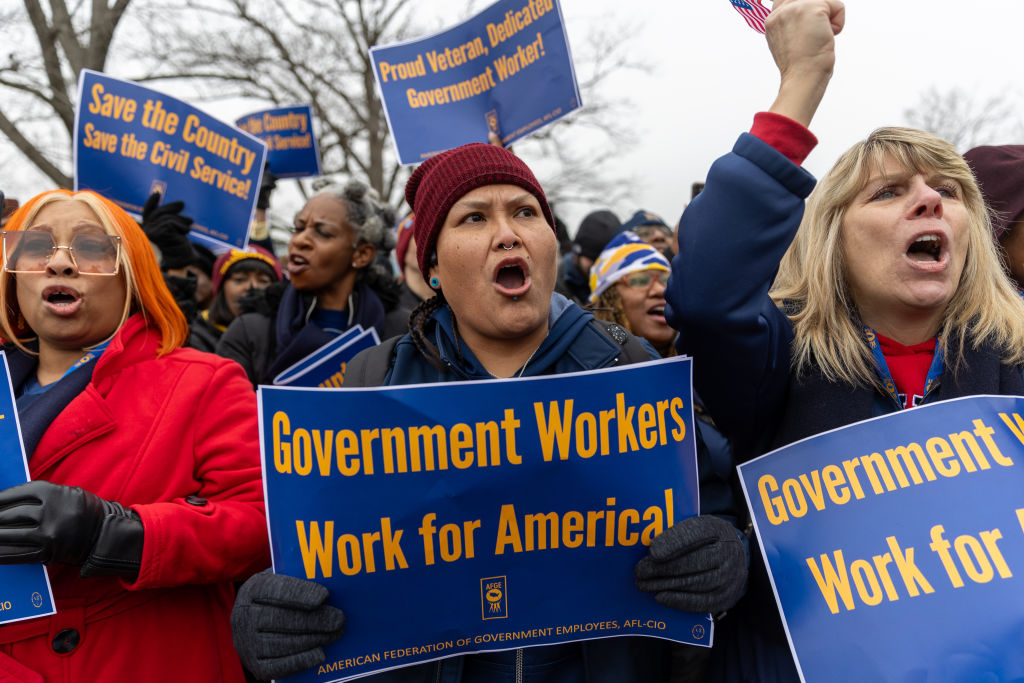
One need only look at the military to understand why unionization within government structures presents a conflict of interest. The military operates under a strict hierarchy that demands discipline, obedience, and readiness for national defense. This hierarchy falls under civilian command, with the President of the United States serving as the commander in chief. Unionizing the military would create conflicts between command structures and service members, undermining cohesion, military effectiveness, and operational security. Imagine a scenario in which a commander issues an order, only for soldiers to refuse, citing a labor dispute. The consequences of such an event on national security would be catastrophic. For this reason, laws such as 10 USC § 976 explicitly prohibit military unions to maintain order, prevent disruptions, and ensure that command decisions remain free from labor negotiations.
Yet, at both the state and federal levels, unions within government agencies wield enormous political power, shaping policies in ways that often contradict the public interest. Correctional workers, for example, are permitted to unionize and, as a result, exert significant influence over criminal justice policies. These unions lobby for laws that maintain or expand prison populations because their job security and funding depend on incarceration rates. They have opposed sentencing reductions, parole expansions, and decriminalization efforts, instead advocating for “tough-on-crime” policies, such as mandatory minimum sentences and three-strikes laws. These measures contribute directly to mass incarceration, often at the expense of broader societal efforts to implement rehabilitative and community-based alternatives.
The ability of correctional unions to shape legislation that benefits their own job security, even when it contradicts public policy goals, raises a broader question: should government employees be allowed to form unions that can actively obstruct the will of elected officials? If the military is prohibited from unionizing due to concerns over national security and hierarchical integrity, why should other government institutions—many of which hold immense power over public policy—be granted such influence? To be sure, government workers have a first amendment right to advocate for such things as cannabis prohibition, but what right to they have to carry out their own agendas when in the service of the American taxpayer? If you cite associational rights, then why can’t service members unionize?
The problem is not confined to correctional facilities. Across federal agencies, entrenched bureaucrats have developed mechanisms to resist the agendas of elected leadership. These agencies have been effectively colonized by ideologically aligned career employees who use their unions and the courts to shield themselves from oversight. When elected officials attempt to implement reforms that challenge the entrenched bureaucracy, these unions mobilize to sue the government, leveraging judicial intervention to block change. The result is a system where unelected officials subvert the policies of duly elected representatives, undermining democratic accountability.
The consequences of this dynamic are particularly evident in many of our cities, where progressive policies have led to widespread dependency and social disorder. Welfare dependency, idleness, and broken families have become endemic, exacerbated by policies crafted by federal agencies that, past and present, prioritize government intervention over personal responsibility and community-based solutions. These agencies, often working in tandem with public-sector unions, assert independence from elected officials and use legal challenges to resist reforms, further entrenching the administrative state. How can the American people put an end to government paternalism if the bureaucrats are going to continue the status quo?
In recognizing this problem, one must distinguish between private sector unions and public sector unions. While private sector unions operate within the constraints of market forces and collective bargaining with employers, public sector unions negotiate with the government—securing benefits at taxpayer expense while reinforcing the power of unelected bureaucrats advancing a progressive political ideology. The rapid decline of private sector union membership contrasts sharply with the expansion of public sector unions, highlighting a shift where the bureaucratic state now holds greater power over the working class rather than serving it. It’s almost as if growth in one is associated with decline in the other. Does that have anything to do with the decades long war corporate state war on labor?
This bureaucratic apparatus, deeply embedded in government institutions, has become a vehicle for corporate statism and transnationalism, advancing policies such as offshoring and open borders. These institutions socialize future generations into accepting a system that prioritizes bureaucratic governance over democratic republicanism. As this structure strengthens, it increasingly repels efforts by the electorate to reclaim control over their government. It is “we the people,” right?
We are not yet in a position where elections are mere formalities, as was the case in the Soviet Union, but we are moving in that direction, despite the tremendous victory popular forces secured on November 5, 2024. The growing power of the unelected bureaucracy, insulated by unions and protected by the courts, represents an intermediate stage in this transformation. The progressive left speaks frequently of “democracy,” but what they truly advocate is technocracy—government by bureaucrats who share their ideological commitments. When the electorate chooses leaders with whom they disagree, they resort to mass protests and legal obstruction, leveraging their control over the administrative state to resist change.
The American people must recognize that the struggle to reclaim their government is not only a battle against bureaucrats working at cross-purposes with elective officials, but a counterrevolutionary struggle against the imposition of a revolution-from-above, driven by corporate and bureaucratic interests. The administrative state and technocratic elite have become the primary instruments through which corporate power has eroded the republican system envisioned by the Founders. If we fail to confront this reality, we risk losing our democratic republic altogether.
* * *
Update (March 4): After publishing this essay I remembered that Franklin D. Roosevelt, while generally supportive of labor unions in the private sector, was opposed to collective bargaining and strikes by federal employees. In a 1937 letter to the president of the National Federation of Federal Employees (NFFE), FDR made it clear that while he believed government workers had the right to join employee associations and advocate for better working conditions, they should not have the right to bargain collectively or strike.
His reasoning was that public service is fundamentally different from private industry because government employees work for the people, not private employers. Public worker are accountable to the public. He argued that allowing federal workers to negotiate wages and conditions in the same way as private-sector unions could interfere with government functions and the interests of taxpayers. The logic of his argument follows from the argument against unions in the military.
Federal employees should still have the right to join associations to present their views to the government, he argued. However, FDR had strong views on federal employment and job protections, which are relevant to modern debates about shrinking the size of government. While he supported fair treatment and merit-based hiring for federal workers, he also believed that government jobs existed to serve the public interest, not as a guaranteed right for employees.
Roosevelt was a strong supporter of the civil service system, which ensured government jobs were awarded based on merit rather than political loyalty. He expanded civil service protections to prevent political corruption, but he did not believe in absolute job security for federal workers. Government jobs could not be permanent entitlements. This is a crucial point, and FDR made it clear in his letter: that the public service existed to benefit the public, not the employees themselves. This strongly suggests he would not have supported rigid job protections that prevented a president from restructuring or reducing the government workforce if it was deemed necessary for efficiency. If he did, then he would contradict the logic of his argument.
While FDR supported worker protections against political retaliation or unfair treatment, he also recognized the need for flexibility in managing the federal workforce. During his presidency, he expanded agencies, but he did not advocate for indefinite job security—only fair treatment under civil service rules. Given this, it is unlikely he would have supported court interventions blocking a president’s ability to reduce the size of government through workforce reductions. His approach suggests he would have expected federal employees to accept reductions if they were made for legitimate governmental purposes.
Today, federal employee unions often argue that reductions in workforce violate civil service rules or labor agreements, leading to legal challenges. However, under current law, the president does have authority to reduce federal employment levels, though it must be done within civil service protections (e.g., through buyouts, early retirements, or reductions in force (RIFs)).


