
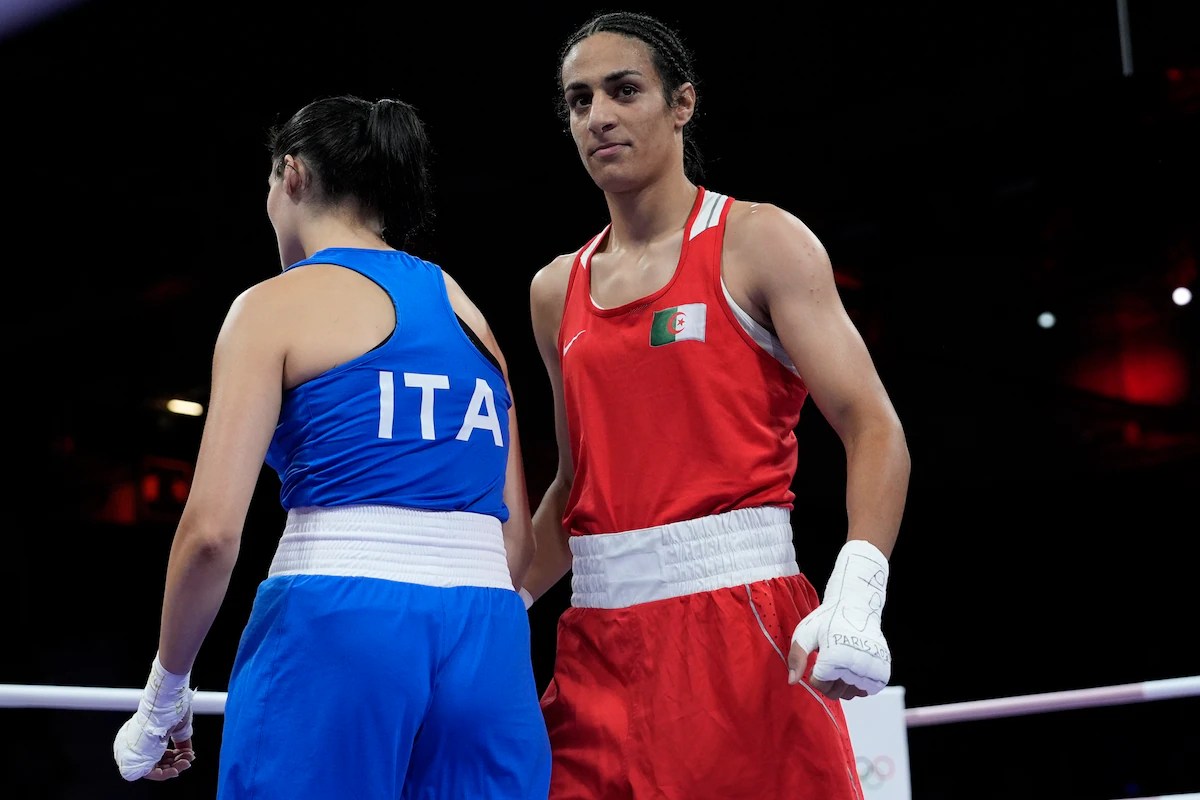
PBS: “Olympic boxer Imane Khelif says misconceptions about her gender ‘harms human dignity.’” Saying that the criticisms of the inclusion of males in women’s boxing is “something that harms human dignity,” Khelif said in Arabic, “I send a message to all the people of the world to uphold the Olympic principles and the Olympic Charter, to refrain from bullying all athletes, because this has effects, massive effects.” He continued: “It can destroy people, it can kill people’s thoughts, spirit and mind. It can divide people. And because of that, I ask them to refrain from bullying.”
(Note, I use pronouns based on gender, which is a synonym for sex. The male of our species, and every other mammalian species, is referenced in the English language using “he/him” pronouns. The demand that society use pronouns corresponding to the gender an individual prefers to be, rather than using the pronouns that refer to the person’s gender, is a project to rewire our native understanding of gender. See Manipulating Reality by Manipulating Words; Linguistic Programming: A Tool of Tyrants; Neutralizing the Gender-Detection Brain Module. There is no controversy concerning the accurate gendering of other mammals. For example, if one uses “she/her” pronouns in reference to a dog (not a bitch), the owner will likely correct you. Admittedly, I struggle a bit in these cases because it may be the case that these individuals were raised as female. I do sympathize with a person who discovered they are not the gender they thought they were.)
But the question of dignity lies in the opposite direction. Keeping males out of women’s sports may hurt their feelings, but it does not harm their dignity. However, allowing males to compete in women’s sports does harm the dignity of girls and women. You can have sympathy for individuals who suffer from a disorder, and you can accommodate them—as long as doing so does not violate the liberties and rights of others.
In the context of sex-based rights, dignity for girls and women involves recognizing and upholding our respect and their inherent worth by ensuring they live free from discrimination, exploitation, and violence. It encompasses providing them with equal access to meaningful and rewarding opportunities, while also ensuring their voices are heard and valued in decision-making processes. Upholding dignity means acknowledging the contributions of girls and women and fostering an environment where they can thrive without fear of harm or prejudice.
Equitable conditions are essential in this regard, as they involve recognizing and addressing the differences between females and males to achieve substantive or true equality. This means acknowledging that, while all individuals deserve equal respect and opportunities, their unique experiences and needs—shaped by biological, cultural, and social factors—require class-based approaches. Such approaches include combating gender-based discrimination and violence. By considering these differences and providing the necessary framework for securing opportunities, the dignity of girls and women is upheld by ensuring everyone has the conditions they need to thrive, reflecting both their specific circumstances and their worth as persons. (See Sacrificing Equity Upon the Altar of Exclusive Inclusivity.)
The practice of allowing males to compete against girls and women in sports violates the sex-based rights that modern societies have instituted to make sure that, in light of the vast differences between female and male bodies, girls and women enjoy equitable conditions in which they may thrive and realize their potential. Sex-segregation where it does not harm girls and women, that is where it does not impede their liberties and rights, is established to ensure that girls and women are not treated as second class citizens in a historically patriarchal world with a natural history of substantial sexual dimorphism, but as equal and full members of society.
Contrary to Khelif’s claim, criticizing the practice of allowing males to trespass upon girls’ and women’s activities is not harmful—it is not bullying—but rather it affirms the demand for and righteousness of human dignity. Indeed, to know one is male, with all the natural advantages that entails, and continue to step into the ring with females suggests an act of bullying. It is to elevate one’s own selfish interests over the collective interests of an entire class of people in a way that violates the principle of fairness in an act of physical domination. In reality, the harm Khelif claims is the harm that critique causes his argument, which is in substance that girls and women have no absolute sex-based rights, which is the argument made when the demand is that trans identifying males or males with DSD conditions should be allowed to compete against girls and women in athletic competition.
The belief that gender identity is an internal sense of one’s gender and that this supposed identity should be allowed to trump the material interests of girls and women is to assert as universal criteria the specific and suspect belief of an ideological system. Objectively, the identity of something is what that thing is in-itself not what it thinks it is (which most things have no capacity to do). Gender identity in the ideological sense is subjective and cannot meet objective criteria. Boxing is physical. It is not imaginary. Saying or believing oneself to be female does not make one female. Femaleness is not a subjective category. It is a natural or biological category. The claim that gender identity in the subjective sense entitles anybody to anything beyond tolerance is identical to the claim that because the child is Muslim, no children at the school shall eat pork.
Khelif declined to answer reporters when asked whether there were tests given other than doping tests. We know that there was. There was a test that determined that Khelif has XY chromosomes. Moreover, the DSD condition in this case, if we accept the claim that this is a DSD case (and photographs seem to indicate that Khelif was raised as a girl), is either of the type that allows for significant natural testosterone production, or androgens were given to produce or enhance male puberty.
Khelif was given an opportunity to appeal the IBA decision but dropped the appeal (the other boxer, Lin Yu-ting, never sought one). This was strategic, as both camps knew it would allow their athletes to compete in the Olympics in the women’s division (they would have never made it into the men’s division). The IOC does not test for gender eligibility (it drop genetic testing decades ago), rather accepting sex designation on passports, which is not a valid objective determination of sex for obvious reasons.
If one believes in equity and fairness, which I do, then all athletes, in addition to subjecting themselves to doping tests, must also subject themselves to tests determining whether they meet sex-based criteria for eligibility based on objective evidence, chromosome test being the most useful since, unlike hormonal tests, karyotyping determines the overall degree of physical advantage an athlete has over other athletes belonging to the specific class in which that athlete seeks to compete. Because of the myriad of advantages males enjoy over women as a class, XY karyotype is disqualifying. These individuals should never have been allowed to compete in the Olympics.
I have compassion for males who were misgendered at birth and raised as females. I have compassion for anybody with a disorder. Khelif recently asserted that he is female and that he will stay female. Perhaps he did not know he was male and it determined to now allow a test change his perception of himself. However, it is not the burden of girls and women to sacrifice their aspirations and put their health and safety at risk because of somebody else’s disorder or situation. Moreover, it violates the ethics of competition to fail to guarantee as best as can be a level playing field for athletes in light of significant group-based differences.
As a society, we have worked very hard to create opportunities for girls and women in athletic competition. We must not go backwards in this area—or any involving girls and women. Girls and women have a right to expect an equitable treatment so that they have the same opportunities as boys and men. Justice demands this.


