Rise of the Domestic Clerical Fascist and the Specter of Christian Nationalism

“Our constitution was made only for a moral and religious people. It is wholly inadequate to the government of any other.” —John Adams, 1798

“Government is instituted to protect property of every sort; as well that which lies in the various rights of individuals, as that which the term particularly expresses. This being the end of government, that alone is a just government, which impartially secures to every man, whatever is his own. According to this standard of merit, the praise of affording a just securing to property, should be sparingly bestowed on a government which, however scrupulously guarding the possessions of individuals, does not protect them in the enjoyment and communication of their opinions, in which they have an equal, and in the estimation of some, a more valuable property.

“More sparingly should this praise be allowed to a government, where a man’s religious rights are violated by penalties, or fettered by tests, or taxed by a hierarchy. Conscience is the most sacred of all property; other property depending in part on positive law, the exercise of that, being a natural and unalienable right. To guard a man’s house as his castle, to pay public and enforce private debts with the most exact faith, can give no title to invade a man’s conscience which is more sacred than his castle, or to withhold from it that debt of protection, for which the public faith is pledged, by the very nature and original conditions of the social pact.”James Madison, 1792

Before I turn to the substance of this essay, which concerns the establishment of a secular constitutional republic whose creed tolerates religious belief while permitting the absence of such beliefs in the lives of its citizens, with the specter of Christian Nationalism as one of the present concerns regarding the future of this arrangement, I want to say a few things about the anthropological-sociological view of religion. In addition to my duties in my tenure home of Democracy and Justice Studies at the University of Wisconsin-Green Bay, I am also on the faculty of the Sociology and Anthropology program. My training is in sociology (also psychology and anthropology), and I have published and lectured in the sociology of religion for many years. More broadly, my overall approach is political sociology, which involves the study of ideological systems.

Recently, on X (Twitter), I have been engaged in a debate about the religious character of gender ideology. The doctrine of the authentic self, the non-falsifiable construct of gender identity, the ritual of physical transitioning from one gender to another, objectively an impossible transformation, and much more, require gender ideology’s classification as a religious faith (see my recent Affirmation, the Authentic Self Doctrine, and Rule by Assumption). As the reader will see, the classification is accomplished by straightforwardly applying the social science standpoint, but also the standard definition of religion to the ideology in question. However, as I have pointed out in previous essays, this is a religious faith that enjoys the backing of governments and corporations, powerful entities that impose the beliefs and practices of gender ideology regardless of whether persons subscribe to the religion (see, e.g., See NIH and the Tyranny of Compelled Speech).

The imposition of gender ideology, seen in the requirement that people avoid “deadnaming” those who have “transitioned” to their “authentic self,” as well as the use of pronouns incongruent with and thus denying the gender of the congregant, in general the compelled involvement of every citizen in the “affirmation” of the individual in his delusion, or his community’s illusion, to use Freud’s observation in his The Future of an Illusion, is a clear violation of the rights of individuals in the United States to be free from impositions of conscience, thought, speech, and association, rights articulated in the First Amendment, as well as in international law. This violation of our fundamental rights can occur because of the political-ideological denial that gender ideology is a religion but is instead a valid scientific system (which is plainly not).

This fallacy is reinforced by the involvement of a corrupt medical-industrial complex, a corporate web of institutions and organizations (including academic, chemical manufacturing, clinical psychology, and medical associations) generating billions of dollars in profit for shareholders and exorbitant salaries for administrators and physicians at the expense of vulnerable people, including children. I have written quite a lot on this and will soon roll out more essays on this topic (see, e.g., Making Patients for the Medical-Industrial Complex; Thomas Szasz, Medical Freedom, and the Tyranny of Gender Ideology; Simulated Sexual Identities: Trans as Bad Copy; Disordering Bodies for Disordered Minds).

What is religion, then? The term originates from the Latin words religio, which means respect for what is sacred, and religare, which means “to bind.” Thus the term at its core indicates an obligation to the sacred; in practice, religion encompasses diverse systems of belief and practice that revolve around what social groups consider sacred or spiritual. The French sociologist Émile Durkheim captures the essence of such systems in The Elementary Forms of the Religious Life, published in 1915, when he defines religion as “a unified system of beliefs and practices relative to sacred things.” These systems “set apart” people and things from others, and in doing so “unite into a single moral community, called a church, all those who adhere to them.” For Durkheim, religion is about community; binding people together (social cohesion), prescribing and proscribing speech and action (social control), and providing meaning and motive (social purpose) for people during transitions and tragedies . 

By applying the methods of science to the study of society, Durkheim shows that the source of religious morality refracts the collective conscience of society and that the cohesive bonds of the social order result from common values in a society (this was Ludwig Feuerbach’s insight in his 1841 book The Essence of Christianity, the catalyst for Karl Marx in developing his materialist conception of history). Durkheim understands that these values need to be maintained to secure dependable and enduring social stability—at the same time he understands that the religious pluralism of Western civilization poses a problem for social solidarity. In his 1893 The Division of Labor in Society, Durkheim argues that a cohesive set of cultural beliefs and moral values is crucial for societal integration and solidarity; throughout his career, he expresses concerns about the potential for decreased social solidarity in diverse, modern societies. Durkheim observes that as societies become more complex, with increased divisioning and specialization, traditional sources of moral unity weaken.

To return for a moment to the problem of gender ideology, those who resist the obvious religious designation often do so because of a stereotypical view of what religion is. They do not see in their beliefs appeal to a god or gods—and they miss seeing the angels as such (see my essays Resisting the Imposition of Non-Existing Things and Step Away from the Crazy). Thus, the scope of religious formation is reduced to a cartoonish singularity, typically signaled by adherence to those religions descended from the Jewish faith (although Islam, because of its third world status, finds a special place in the their hearts, hence the slogan “Queers for Palestine”). Admitting the scope of religion produces a different conclusion. For some, religion is associated with places of worship with a god at the focus; for others, it involves practices like meditation; others view it as a guiding concept in their daily lives, such as the concepts of dharma. Despite these varied perspectives, there is a common understanding that religion encompasses a system of beliefs, values, and practices centered around what an individual deems sacred or spiritually significant. One should not allow appeals to atheism to fool them. There are many self-proclaimed atheists who possess profoundly religious personalities.

Throughout history and across the planet, figures have employed religious narratives, symbols, and traditions to impart greater meaning to life, explore the mysteries of the universe, and lead people to certain ends, often ends that are quite profitable for spiritual leader. Nearly every known culture embraces some form of religion, typically practiced openly within a community. Religious practices can encompass various elements such as feasts and festivals, worship of one or more deities, marriage and funeral ceremonies, expressions of music and art, initiatory and meditative rites, acts of sacrifice or service, and other cultural facets. Anthropologists and sociologists thus conceptualize religion as a structured and cohesive system encompassing actions, beliefs, and norms that revolve around fundamental social needs and values. Religion is recognized as a cultural phenomenon present to some degree in all human society and down through time.

One of chief features of religious systems is the ritualization of the transitioning of persons from one status to another, a liminality marked by a ceremony that often makes reference to the divine, that is, to supernatural or transcendent things, which are, from a scientific standpoint, impossible or unknowable things. Humans are enchanted by such things, using them to sublimate vulgar features of their animality or giving themselves a higher purpose. Marriage is an obvious example. To be sure, there are individuals who simply obtain a marriage certificate from their town’s courthouse and have it witnessed by a justice of the peace, but we all recognize that, for many others, there’s an obligation to participate in an elaborate rite of passage, known in the literature as the “status elevation ceremony,” which is consecrated by appeal to transcendent entities or forces. Funeral rites constitute another example. The specific customs vary between cultures and even within different religious affiliations, but despite variation, certain common elements persist in ceremonies marking an individual’s death: the announcement of passing, the handling of the body, the final disposition, and the inclusion of specific ceremonies or rituals throughout the process.

In our studies of religion, we anthropologists and sociologists recognize that religious experience is accompanied by a profound conviction or sensation of being connected to a divine entity. Religious beliefs encompass the specific ideas deemed true by members of a particular faith, such as the doctrine of salvation in Christianity, reincarnation in Buddhism and Hinduism, the presence of the thetan in the human body in Scientology, or the doctrine of the authentic gendered self in gender ideology. Religious rituals involve actions and practices expected or mandated within a specific group. Here individuals are forbidden to speak about certain things and required to speak in certain ways.

One hallmark of religion is the singling out of those who resist doctrine, ritual, and scripture, marking them off from the group as apostates (those who leave the religion), heretics (those who challenge the religion), and infidels (those who do not subscribe to the religion). Those who utter forbidden speech are labeled as blasphemers. These indicators of religious force are often coded in other labels, seen in references to “bigots,” “fascists,” “racists,” and so forth. Sometimes the code reveals its religious character by referencing the faith in some way, e.g., “Islamophobe” or “transphobe.” Punishing the non-adherent is a central feature of religious belief, which is why it is so vital to remind people of the importance of the secular foundation of the US republic. 

In summary, religion has four elements: beliefs, mythology, practices, and social organization. Beliefs are the ideas and values the make up the doctrine and its motivations. Mythology concerns the sacred stories, including etiological tales. Practices are the rituals and rites of passage, the status elevation (and degradation) ceremonies, and speech requirements. Social organization is not only the community of congregants but also the institutional frame in which the religion is legitimized and sustained. Successive generations are socialized in the institutional frame. Now onto the substance of today’s essay.

* * *

A few days ago, a Baphomet statue, a Satanic Temple display, installed at the Iowa Capitol in Des Moines, was vandalized. Michael Cassidy, a former US Navy fighter pilot, recently defeated in a Mississippi statehouse election, is accused of causing the damage. He was arrested, charged with fourth-degree criminal mischief, and released. According to a Facebook post by the Satanic Temple on Thursday, the Baphomet statue was “destroyed beyond repair,” although remnants of the installation still exist.

The incident sent Christian zealots seeking an argument that would allow them to celebrate Cassidy’s actions without betraying their devotion to the constitutional republic to which they’d loudly sworn allegiance—not to mention risking negating their complaints about Antifa/BLM defacing monuments and toppling statues. Criticism from conservatives including presidential candidate Ron DeSantis (whose campaign has really been a disappointment, I must interject). Matt Walsh’s crack at the problem (I rather like Walsh, so his monologue on that day was disappointing) was to perpetrate the same fallacy he so effectively condemned with his “What is a woman?” question. “Good is good and bad is bad,” he said. What are those things? He never says, offering only elaborations that spiraled down into ever greater depths of circularity.

Others, beside themselves, found the December 2021 Harvard Law Review note “Blasphemy and the Original Meaning of the First Amendment.” “Until well into the twentieth century, American law recognized blasphemy as proscribable speech,” the note begins. “The blackletter rule was clear. Constitutional liberty entailed a right to articulate views on religion, but not a right to commit blasphemy— the offense of ‘maliciously reviling God,’ which encompassed ‘profane ridicule of Christ.’” (There’s goes Monty Python’s The Life of Brian.)

English common law had indeed punished blasphemy. But did the Founders carry over everything from the Motherland? Apparently even this. “Looking to this precedent, nineteenth-century American appellate courts consistently upheld proscriptions on blasphemy, drawing a line between punishable blasphemy and protected religious speech.” “At the close of the nineteenth century,” the note continues, “the US Supreme Court still assumed that the First Amendment did not ‘permit the publication of … blasphemous … articles.’ … Even on the eve of American entry into World War II, the Tenth Circuit upheld an anti-blasphemy ordinance against a facial First Amendment challenge.”

The note then announces the great free speech awakening of the post-WWII period, the period that delivered civil rights for blacks and women and homosexuals: “Only in the postwar period did the doctrine promulgated by appellate courts begin to shift. In Joseph Burstyn, Inc. v. Wilson, the US Supreme Court invoked the Free Speech Clause to invalidate a prior restraint on ‘sacrilegious’ films. Burstyn did not directly hold anti-blasphemy laws unconstitutional, but its obiter dicta gave aid and comfort to the laws’ enemies. And although two state appellate courts sustained blasphemy proscriptions after Burstyn, a third struck down a state anti-blasphemy law under the First Amendment’s Religion Clauses. Most recently, a federal district court invalidated a state blasphemy statute under the Free Speech Clause and the Establishment Clause.”

“Present-day scholars often assume that anti-blasphemy laws are unconstitutional, celebrating the absence of such laws as a core First Amendment principle.” Given the tone and structure of argument, it feels like the next sentence should be: “It is not so.” But the note is wrong because its premise is wrong. It’s not that the post-WWII era discovered a right to religious liberty that protected the right of individuals to engage in speech acts the majority found objectionable; that right, as I will show, is inherent in the foundational law of the nation. Indeed, it’s hard to believe that it took more than a century and a half to realize the promise of religious liberty and free thought in prevailing precedent (which is to suggest how fragile that realization is).

Given this, how is it that there are Christians who profess their allegiance to the American Republic who oppose this? This is what we should be celebrating: standing at the threshold of breaking the chains on our minds that blasphemy represents—not the criminal action of some bigot who won’t instead insist that the public square remove all religious symbols (and we know he wouldn’t make such an insistence because he picked the Baphomet installation to vandalize and not the Nativity—that is, he is a self-appointed censor). But no. They like it that at least one or a small committee for lawyers find that “none of the constitutional clauses currently thought to make anti-blasphemy laws unconstitutional—Free Exercise, Free Speech, Establishment—originally prohibited blasphemy prosecutions. In other words, the original public meaning of the First Amendment, whether in 1791 or in 1868, allowed for criminalizing blasphemy.”

Curiously, smartly perhaps, the zealots typical quote those suspect in their commitment to Christianity. They focus on George Washington, James Madison, and John Adams—while avoiding Thomas Jefferson, dismissing Thomas Paine, and ignoring Benjamin Franklin, in an attempt to show the Christian bona fides of the most important of the Founders. This finds the first president, Washington, a modern-day instantiation of the Roman statesman and military leader Lucius Quinctius Cincinnatus, and the fourth president, Madison, the principal author of the Constitution and its Bill of Rights, as the most virtuous fathers, with the second president, John Adams, enjoying a quote.

You will see in a moment the problem with the Adams quote (and it is a problem of his religious affiliation), but more broadly, the attitude expressed betrays the doubt zealots have that the Christians figures they single out share with them the same vision. What the focus on the recalcitrant and the skeptic and the Unitarian does is distract from the obvious fact that most of the Founders were not only Christian, but that they went along with the establishment of a secular republic. There is an important lesson in all of this (and it would behoove the gender ideologues to pay attention here): one can enjoy his faith while leaving others out of it.

Among those who who signed the Declaration of Independence were Congregationalists, Anglicans (Church of England), Presbyterians, and those of the Dutch Reformed and Lutheran traditions. Deists Jefferson and Franklin are notable among the major players. Adams played a major role, too. These were the big three. Maryland’s Charles Carroll was the sole Catholic among the signers. Also notable: there were no Quaker signers (this owing to pacifist principles which precluded answering or agreeing to a call to arms such as the Declaration of Independence expressed). As for the Constitution, there were Episcopalians, Congregationalists, Presbyterians, and Lutherans among the signers. This time a Quaker was present: John Dickinson.

Recalling the epigraph at the top, it’s good that Adams, could separate his opinion concerning the religious character of those worthy of our constitution from the constitution he swore an oath to defend as president, a constitution that explicitly eschews requiring any declaration of faith (which I prove below), the first amendment to which segregates church and state. Others will never mind about that, of course. This quote by Adams, they will tell you, is definitive proof that ours is a “Christian nation.” These are the Christian nationalists, and they pose a growing threat to the future of this great American Experiment.

Christian Nationalism (AI generated)

But to whom was Adams’ statement addressed and when was it formed? It was to the Officers of the First Brigade, Third Division of the Militia of Massachusetts in the context of the Quasi War against the French, a formative moment in the Republic’s history, the letter penned on October 11, 1798. These are remarks of encouragement to a god-fearing people. It was not uncommon for political figures then (and to some extent today) to dress their troop rallying in the language of God and Providence and Whatnot. Oftentimes men need something above themselves to fight for.

None other than that “filthy little atheist” (President Teddy Roosevelt’s characterization of), America’s greatest pamphleteer, Thomas Paine, wrote in The American Crisis, “I have as little superstition in me as any man living, but my secret opinion has ever been, and still is, that God Almighty will not give up a people to military destruction, or leave them unsupportedly to perish, who have so earnestly and so repeatedly sought to avoid the calamities of war, by every decent method which wisdom could invent. Neither have I so much of the infidel in me, as to suppose that He has relinquished the government of the world, and given us up to the care of devils; and as I do not, I cannot see on what grounds the king of Britain can look up to heaven for help against us: a common murderer, a highwayman, or a house-breaker, has as good a pretence as he.”

George Washington had Paine’s words read aloud to his soldiers at McConkey’s Ferry on the Delaware River (among them were John Marshall, Alexander Hamilton, James Monroe, and Aaron Burr). Whatever an admitted infidel’s faith in God Almighty could possibly be (see the man’s scandalous Age of Reason), Paine could not have had any in the reality of devils. His appeal to such supernatural forces was meant to inspire not proselytize, as his words in fact did: Washington’s troops powered through the Christmas Day Nor’easter and routed the Hessian garrison at Trenton.

However you wish to take them, Adams’ words do no violence to the truths that Trenton and other battles won, and the Constitution and Bill of Rights that established the American Republic, were for religious and irreligious men alike. To be sure, many of those who put down on paper the fundamental laws of the republic were Christian (mostly Protestants of various sects), but there were also deists and atheists among them—likely more than would admit it. Franklin was almost certainly an atheist, at most a deist who oozed Paine-level skepticism. He thought religion useful if it promoted virtue; but jettisoned theological belief. Several denied the divinity of Jesus and the miracles he allegedly performed.

One also has to read between the lines with the Founders, as their audiences were often a bit less enlightened Tham they were—much like the Christian nationalists who have taken to social media of late. As an atheist navigating the Christian world in the buckle of the Bible Belt, I know the pressure to modulate one’s tone about such matters. But the fact that some of the founders rejected the supernatural and the divinity of Christ (Jefferson cut from the Bible all references to miracles), as well as the sublimation of human rights in such terms as “Creator” and “Nature’s God,” rhetorical sterilizations betrayed by the more direct “Laws of Nature” (referencing here the Declaration, penned by Jefferson), tell us they were pragmatically atheist.

That’s why, after the supreme law of the Constitution requiring all federal and state legislators and officers to swear or affirm to support the Constitution, Article VI specifies that “no religious Test shall ever be required as a Qualification to any Office or public Trust under the United States.” Even then, not content with the explicitly secular character of the Constitution (there is no mention of God or Christianity anywhere in the document), the people demanded a bill of rights to protect them from the federal government and from governments closer to them. Madison and crew gave them one, the first article of which explicitly protects religious liberty, a right that necessarily includes the nonbeliever: “Congress shall make no law respecting an establishment of religion, or prohibiting the free exercise thereof; or abridging the freedom of speech, or of the press; or the right of the people peaceably to assemble, and to petition the Government for a redress of grievances.”

The idea that the Founders were thinking, “We don’t care what religion you believe as long as you believe in one” is so absurd as to require no further comment except for the Christian nationalist spin that the First Amendment actually prohibits the government from choosing any one Christian sect to be the state church not that it allows for religious expression beyond what James Madison declared to the “the best and purist [sic] religion,” namely Christianity.

When this was put to me on X (Twitter), my off-the-cuff remark was, You mean that same man who ensured the Virginia Declaration of Rights did not elevate any faith over all others by changing the language from “fullest toleration” of religion to the “free exercise of religion”? The same man who said, “The religion then of every man must be left to the conviction and conscience of every man.” That man? But, again, to whom was this statement addressed and when was it formed? Moreover, as you can see by the sic erat scriptum note, the quote is not even accurate?

This oft-botched quote is taken from the conclusion of a letter that Madison wrote to Reverend Jasper Adams in response to a request for his opinion on the reverend’s sermon “The Relation of Christianity to Civil Government in the United States.” It was penned September 1833—long after the Constitution became operative in 1789. Madison was eighty-three years old. In the letter, Madison observes that religious desire appears, despite exceptions here and there, as something common to man. He then quickly moves to “the simple question to be decided”: “whether a support of the best & finest religion, the Christian Religion itself ought not, so far at least as pecuniary means are involved, to be provided by the Government, rather than be left to the voluntary provision of those who profess it.” As, is often the case, context changes everything. Madison point: Should the government provide for the financing of religion. Or should religion finance itself. I don’t think I have to tell how the principal author of the US Constitution and its Bill of Rights comes down on the question, but I will anyway: religion shall finance itself.  

But let’s not leave the letter yet, because Madison shows the reverend his work and, in doing so, definitively settles the matter. “And in this question,” he writes, “experience will be an admitted umpire the more adequate as the connexion between Government & Religion, has existed in such various degrees & forms, & now can be compared with examples where the connexion has been entirely dissolved.” Madison then provides a historical-comparative analysis of the connection, noting the motherland’s fraught relationship with religious entanglement and how “[i]t remained for North America to bring the great & interesting subject to a fair, & finally, to a decisive test.”

He saw the American Republic as a great experiment; the religion question was the central question. “It is true that the New England States have not discontinued establishments of Religion formed under very peculiar circumstances,” he explains; “but they have by Successive relaxations, advanced towards the prevailing example; & without any evidence of disadvantage, either to Religion, or to good government.” See here that Madison has in mind the ideal: progressive and ultimately final disentanglement of church and state. “But the existing character, distinguished as it is by its religious features, & this lapse of time, now more than fifty years, since the legal support of Religion was withdrawn, sufficiently prove, that it does not need the support of Government. And it will scarcely be contended that Government has suffered by the exemption of Religion from its cognizance, or its pecuniary aid.” Put another way, government has not suffered by removing religion not only from its laws and operations but even from its awareness.

Madison employs the principle of charity in argumentation that the Christian nationalist misconstrues in his zealousness as affirmation of the reverend’s argument, but it is not so. “Whilst I thus frankly express my view of the subject presented in your sermon, I must do you the justice to observe, that you have very ably maintained yours.” He continues in this vein. “I must admit, moreover, that it may not be easy, in every possible case, to trace the line of separation, between the rights of Religion & the Civil authority, with such distinctness, as to avoid collisions & doubts on unessential points.” He then lowers the boom: “The tendency to a usurpation on one side, or the other, or to a corrupting coalition or alliance between them, will be best guarded against by an entire abstinence of the Government from interference, in any way whatever, beyond the necessity of preserving public order, & protecting each sect against trespasses on its legal rights by others.”

That Madison finds Christianity to be “the best & finest religion” is an expression of opinion, one that as an atheist I happen to share (if we’re talking about the secular spirit of Protestantism), has nothing to do with his insistence as both a representative in Virginia and for the federal government that, as his comrade Thomas Jefferson put so well in his letter to the Danbury Baptist church (which I will discuss a moment; see also The Virginia Statute for Religious Freedom), that government and religion become and remain disentangled. Moreover, in the letter offered as proof of Christian nationalism, Madison clearly takes the side in opposition to that form of nationalism. Madison’s nationalism is a civic and secular one.

The myth of “Christian America” moreover neglects the sociological facts at the Founding. As Rodney Stark and Roger Finke’s show in their careful empirical study of America’s relationship with Christianity, The Churching of America, far from a righteous nation falling away from God, as the zealots claim, America has been a country increasingly governed by religious sentiment; the United States wasn’t as nearly as religious in the early years of its history as commonly believed. In addition to the godless Constitution and the First Amendment, Stark and Finke note that, in 1796, Thomas Jefferson, Secretary of State under President George Washington, negotiated the Treaty of Tripoli between the United States of America and modern-day Libya. Article 11 of the treaty states that “the Government of the United States of America is not, in any sense, founded on the Christian religion.” The treaty was ratified by a unanimous vote of the Senate in 1797, and signed by President John Adams. Reread that so you catch it. It’s a big deal.

In his aforementioned letter to the Danbury Baptists of Connecticut, on account of their concern for the dominance of the Congregationalist Church of Connecticut, Thomas Jefferson, then president, wrote, “Believing with you that religion is a matter which lies solely between Man & his God, that he owes account to none other for his faith or his worship, that the legitimate powers of government reach actions only, & not opinions, I contemplate with sovereign reverence that act of the whole American people which declared that their legislature should ‘make no law respecting an establishment of religion, or prohibiting the free exercise thereof,’ thus building a wall of separation between Church & State. Adhering to this expression of the supreme will of the nation in behalf of the rights of conscience, I shall see with sincere satisfaction the progress of those sentiments which tend to restore to man all his natural rights, convinced he has no natural right in opposition to his social duties.” 

I want to stress that Stark and Finke find that religious vitality increased in the United States during the nineteenth century rather than at its founding. The authors contend that the competitive religious environment in America, with various religious groups vying for followers, contributed to the growth and vitality of religion in the country. Over time, a significant shift occurred. It’s noteworthy here that the initial version of the pledge of allegiance lacked the expression “under God.” In 1954, prompted by President Eisenhower, Congress passed a law incorporating “under God” into the Pledge. This addition, readers might be surprised to learn, stemmed from a Catholic tradition, particularly the Knights of Columbus, and later became widespread. Upon approving the legislation, Eisenhower remarked, “From this point onward, millions of our school children will daily declare, in every city, town, village, and rural schoolhouse, the dedication of our nation and our people to the Almighty.”  He emphasized the reaffirmation of religious faith’s transcendence in America’s heritage and future.

Historian Kevin Kruse suggests that beneath the decision to modify the Pledge was an attempt to associate Christianity with capitalism. America, a capitalist nation, seeking to contrast itself with the “godless communism” of the Soviet Union, positioning itself as a Christian nation against the atheism of the Soviet Union. This influence would extend beyond the pledge, as the motto “In God We Trust,” which replaced “E pluribus unum” in 1956, became a mandatory inscription on paper money in 1957. The religious right gained momentum during the 1970s and 1980s. America today remains a profoundly religious country. If you are an atheist or an unaffiliated believer, you can thank the Founders for establishing the principle of secularism that keeps you free of most religious imposition, gender ideology presently excepted (which needs to change, obviously).

Jefferson and Madison’s attitude is the liberal attitude. Yes, Virginia, liberals founded this country. Some of them were Christians. Others were atheists and deists. The meaning of the First Amendment hasn’t changed in principle. Rather it was fully realized over time as the Court incorporated the states. The Harvard note is wrong. Blasphemy laws have always violated the First Amendment in principle. That states proscribed speech in the past only means state and local power was not properly constrained by the fundamental rights articulated by the US Bill of Rights. This has largely been rectified. 

John Adams son, John Quincy, took his oath for president on a secular law book—not the Bible. He, like his father, was a Unitarian. Unitarianism, for those who don’t know, is a non-creedal, non-doctrinal religion that affirms the individual’s freedom of belief. The joke in the Christian community is that unitarianism is essentially a euphemism for atheist or deist. This is what the First Amendment protects: freedom of conscience. When Adams said what the Christian nationalist amplifies he was talking about virtue among men of conscience. Deism is important to the founding because, by locating rights in “Nature’s God,” the founders put our fundamental rights beyond the control of man thus making them unalienable. This forces the government to defend our rights.

One of the rights government is compelled to defend is religious freedom, which by definition requires freedom from religion, since, obviously, a man cannot be free to practice his faith or no faith at all if he is not free from the demands of the faiths of others. (This is so basic it’s concerning that it even needs saying.) This is why Islam is incompatible with freedom: it believes political and juridical authority comes from Allah to be administered by religious clerics. America is founded on an entirely different premise. So central is secularism to the United States Republic that the Constitution explicitly states that no office holder can be required to swear allegiance to any god (hence John Quincy taking his oath on a book of secular law), Article VI stating that “no religious Test shall ever be required as a Qualification to any Office or public Trust under the United States.” The Constitution is the supreme law of the country. It is a secular constitution for a secular nation.

* * *

You haven’t read Thomas Paine’s The Age of Reason? If he believed in a god at all it was nature’s god, not Abraham’s. “But Paine asked to be buried in a Quaker cemetery!” Yes, but he was buried on his farm in New Rochelle. His request to be buried on Quaker ground was for this reason: his father was a Quaker. But because the Quakers were already suspected of deism, they denied Paine’s request to avoid confirming those suspicions.

This is for sure: the Founders were liberal men of the Enlightenment who founded a secular republic set down in documents that reduced god to nature (which god could only be—that and a social construction), forbid the requirement of religious oaths, and disentangled religion and government. To argue otherwise is to reject the foundation of the republic. Folks are free to do that, of course, but they can’t have their cake and eat it, too. “In proscribing blasphemy, nineteenth-century Americans did not flout constitutional guarantees of free speech, free exercise, and non-establishment. Rather, they conceptualized those guarantees in a way that permitted anti-blasphemy laws.” Wrong.

These Christian nationalists, if they really want to make a claim on patriotism, need to get their heads on straight about the secular character of the American Republic. To be sure, Protestantism played a role in the development of the Enlightenment, and the Republic is the result of the Enlightenment, but this is not a Christian nation. It’s bad enough that we have to fight clerical fascist (the Islamist) abroad. Now we have to fight clerical fascist (the Christian nationalist) at home.


The Continuing Campaign to Unperson Donald Trump

On Tuesday evening, in a 4-3 decision, the Colorado Supreme Court took the unprecedented step to exclude former President Donald Trump from the state’s 2024 presidential Republican primary ballot. The court also prohibited the counting of any write-in votes for Trump, citing a violation of Section 3 of the Fourteenth Amendment. In Establishing the One-Party State (see also The Unprecedented Resort to Lawfare—Is it Desperation or Provocation?), I discuss the tactic of waging lawfare against one’s political enemies and review the many court cases against Trump. The Colorado Supreme Court’s actions are part of the lawfare strategy. Let’s take a look at it and what it means.

Section 3 of the Fourteenth Amendment, adopted in the aftermath of the American Civil War and ratified on July 9, 1868, states, “No person shall be a Senator or Representative in Congress, or elector of President and Vice-President, or hold any office, civil or military, under the United States, or under any State, who, having previously taken an oath, as a member of Congress, or as an officer of the United States, or as a member of any State legislature, or as an executive or judicial officer of any State, to support the Constitution of the United States, shall have engaged in insurrection or rebellion against the same, or given aid or comfort to the enemies thereof. But Congress may by a vote of two-thirds of each House, remove such disability.”

The historical context of the Fourteenth Amendment is the Reconstruction era, a period following the Civil War during which the United States sought to address the aftermath of the conflict, rebuild the Southern states that had seceded, and redefine the status of newly freed slaves. The Fourteenth Amendment itself was a significant addition to the Constitution, designed to secure the civil rights of newly emancipated slaves and provide a constitutional foundation for the principle of equal protection under the law. Section 3 addressed issues related to individuals who had participated in insurrection or rebellion against the United States. For more on this, listen to the first several minutes of this podcast:

The primary purpose of Section 3 was to address concerns about the potential reentry into government positions of individuals who had actively participated in the Confederate rebellion during the Civil War. It targeted those who had taken an oath to support the US Constitution but had later engaged in insurrection or rebellion against the United States. In other words, it concerned traitors to the Union. The section aimed to prevent those with Confederate sympathies from holding public office unless Congress, by a two-thirds majority vote in both the House of Representatives and the Senate, chose to lift the disqualification.

In the Colorado decision, expected to be appealed by Trump’s legal team, the majority asserted that the former president had “engaged in insurrection” on January 6, 2021. As bizarre as this assertion is, the repetition of it has led to a growing sense that January 6 actually was actually such a thing, a false accusation that redefines the crime. This is coupled with the suggestion that acts the establishment dislikes “hide behind” the First Amendment. But Trump didn’t hide behind anything on January 6, 2021. Alongside tens of thousands of his fellow Americans, the President exercised his First Amendment rights of conscience, speech, assembly, and petition. The right to petition is one of the fundamental freedoms of all Americans. The people have the right to appeal to government in favor of or against processes/decisions/policies that affect them or in which they feel strongly.

Here’s the text of the First Amendment for your convenience: “Congress shall make no law respecting an establishment of religion, or prohibiting the free exercise thereof; or abridging the freedom of speech, or of the press; or the right of the people peaceably to assemble, and to petition the Government for a redress of grievances.” The Fourteenth Amendment in no fashion abrogates this right, and Trump did nothing on January 6 that stood outside the scope of fundamental law.

What is more, January 6 was a police riot. Tossing into the crowd flash bang grenades, and firing upon the throng with rubber bullets and canisters of tear gas, the police instigated the violence outside the Capitol, while officers on the other side of the building invited protestors inside, where they milled about admiring the place and mostly staying within the velvet roped queue. Officers even invited the protestors into the chambers where legislators debate and vote—protestors adorned in patriotic garb and paraphernalia. Elsewhere, they murdered a veteran. Evidence is accumulating that these events were, at least in part, orchestrated by deep state elements of the US government. We know for a fact that Trump, through Kash Patel, chief of staff to acting Defense Secretary Christopher Miller, requested National Guard troops to protect the Capitol four days before the supposed insurrection but was turned down but met resistance from then-House Speaker Nancy Pelosi and the mayor of Washington DC Muriel Bowser. Patel has not been charged with perjury.

Whatever the details, that the police instigated a riot at the Capitol that day does not make the political rally that occurred in Washington DC earlier that day an insurrection. However you define the thing, Trump didn’t cause it. He insisted to the assembled that they “peacefully and patriotically make [their] voices heard.” He invoked the people’s right to petition the government when he said moments before, “We have come to demand that Congress do the right thing and only count the electors who have been lawfully slated, lawfully slated.”

Donald Trump on January 6, 2021

Chapman University’s Pete Simi, a sociologist who specializes in the study of far-right extremism, testified on Tuesday that, in the aftermath of President Joe Biden’s victory in the 2020 election, Trump spearheaded through the use of coded language an initiative to sway violent extremist factions, culminating in the assault on the Capitol. He highlighted, for example, the recurrent use of the term “1776” by Trump supporters leading up to January 6. According to Simi, such references constitute a “violent call for revolution” and exemplify the “doublespeak” employed by extremist groups and their associates to advocate for violence while maintaining plausible deniability. “Outsiders would perceive it with a certain meaning,” Simi explained, “but insiders would understand and interpret that word differently.” An abstract academic theory from an ideological worldview obsessed with right-wing politics now stands in place of fact.

During testimony, Simi was asked to examine various instances of Trump’s inflammatory rhetoric over the years. These instances included Trump’s assertion that there were “very fine people on both sides” of the clash between white supremacists and counter-protesters in Charlottesville, Virginia, in 2017; his encouragement of the “roughing up” of protesters at his campaign rallies; his alleged directive to the Proud Boys, an extremist group, to “stand back and stand by” during a 2020 presidential debate; a social media post urging supporters to assemble in DC on Jan. 6, which Trump predicted would be a “wild” event (he got that right). That the Charlottesville canard was given as an example betrays the objectivity of the Court’s expert witness. This is one of many canards promulgated by the corporate state media.

Recall that Charlottesville had already made the decision to remove the statue of Lee, following the democratic process through its city council. Protestors assembled to let their objection of the council’s actions be known. Counterprotestors, led by Antifa, assembled also, their goal to disrupt the First Amendment event (as they are wont to do). On the Monday before Trump’s press conference, demonstrators in Durham, NC, chose a more direct approach; they placed a rope around the neck of a Confederate soldier statue and toppled it. This was the context.

At that August 15, 2017 press conference, after condemning neo-Nazis (which the President had done numerous times before and continues to do), Trump correctly observed that not all the people as Charlottesville were white supremacists. The people had gathered “to protest the taking down of a statue of Robert E. Lee.” Many of my Tennessee friends and family are good people who object to the progressive erasure of history. We debate the removal of Confederate era statues, but they’re not bad people because we disagree. “So this week it’s Robert E. Lee. I noticed that Stonewall Jackson is coming down,” Trump noted. “I wonder, is it George Washington next week? And is it Thomas Jefferson the week after? You know, you really do have to ask yourself, where does it stop?”

The President noted the presence of Antifa, who came to the rally with clubs and other weapons and instigated the violence. A reporter objected, trying to distract from Antifa action: “You said there was hatred, there was violence on both sides.” “Yes,” Trump responded, “If you look at both sides—I think there’s blame on both sides. And I have no doubt about it, and you don’t have any doubt about it either. And if you reported it accurately, you would say.” As if the mere presence of neo-Nazis justified the violence actions of Antifa, a reporter shouted: “The neo-Nazis started this. They showed up in Charlottesville to protest.” 

This is when Trump said, “Excuse me, excuse me. They didn’t put themselves—and you had some very bad people in that group, but you also had people that were very fine people, on both sides. You had people in that group. Excuse me, excuse me. I saw the same pictures as you did. You had people in that group that were there to protest the taking down of, to them, a very, very important statue and the renaming of a park from Robert E. Lee to another name.” Across the media, Trump’s words were taken out of context to distort their meaning.

A reporter then said, rather ignorantly, “George Washington and Robert E. Lee are not the same,” whereupon Trump educated him: “George Washington was a slave owner. Was George Washington a slave owner? So will George Washington now lose his status? Are we going to take down—excuse me, are we going to take down statues to George Washington? How about Thomas Jefferson? What do you think of Thomas Jefferson? You like him?”

Trump on August 15, 2017

The Colorado District Court’s ruling, which arbitrarily aligned with several arguments presented by those opposing Trump’s eligibility under Section 3, is being reported as having dealt a significant blow to Trump’s campaign. Notably, this case represents the first successful disqualification challenge against Trump in court. In dissent, the minority of the Colorado Supreme Court objected on procedural grounds, echoing the reasons cited by other courts that have dismissed Fourteenth Amendment challenges, mostly over the lack of due process, i.e., when was Trump convicted of insurrection?

Over nine such challenges have failed nationwide due to procedural inconsistencies, but also over about the judiciary’s authority to enforce the ban. Those keen on disqualifying Trump are quick to note that in none of these cases has the rejection of the plaintiffs’ case been on the basis that the former president did not incite or engage in insurrection. David Becker, the director and founder of the Center for Election Innovation and Research, insisted, “The three minority Justices of the Colorado Supreme Court didn’t make any ruling with regard to the insurrection.“

If you’re wondering why Democrats are in such a frenzy to stop Trump by extra-electoral means, it’s because they know he’s the front runner and if he wins (again) he will do several things that may very likely end the establishment’s globalist project of managed decline. He is almost sure to launch an investigation into the 2020 election, as well as the 2022 election, the finds of which may result in massive delegitimization of the hegemonic system. Couple this with an investigation of January 6, 2021 and you can see the writing on the wall.

Trump will also end forever wars and pull the United States out of WHO, NATO, and other entanglements with elements of the international system. The military-industrial complex, the medical-industrial complex, and the rest of the web of corporate power stands to loose not billions but trillions of dollars. He will deconstruct the administrative state and its technocratic apparatus, and sharply curtail the permanent political class that currently runs the government without democratic input (the Heritage Foundation has a plan ready to go; see Project 2025). The deep state (DHS, ATF, FBI, CIA, etc.) is in real trouble. He will sharply curtail immigration, which will in turn sharply curtail the corporate strategy of superexploitation of cheap foreign labor and the use of that labor to drive down the wages of native workers, as well as disrupt the electoral strategy of tilting demography towards support for the Democratic Party.

There is more in store for the establishment if Trump is reelected. But there’s one thing that truly terrifies them: the disruption of the pseudo-history they have constructed over the several decades since assuming control over the means of intellectual production. Trump already put the elites on notice with the President’s Advisory 1776 Commission, dissolved by Biden by executive order on his first day in office. What Trump sought to accomplish with this commission, established early November 2020, was a more accurate and objective history curriculum. The progressive tactic of historical revision clearly troubling him.

Trumps could see in the historical revisionism of, for example, the 1619 Project, parallels with George Orwell’s warning in Nineteen Eighty-Four, spoken through the character of Syme, a colleague of the protagonist Winston. Syme works on the development of the Newspeak language, which is used by the totalitarian regime in the novel to control thought and eliminate dissent. He warns of a relentless process wherein “every book has been rewritten, every picture has been repainted, every statue and street and building has been renamed, every date has been altered.”He emphasizes the ongoing nature of this transformation, stating, “And that process is continuing day by day and minute by minute. History has stopped.”

From Tim Elliot’s Politico article, “America Is Eerily Retracing Rome’s Steps to a Fall. Will It Turn Around Before It’s Too Late?

The question Trump raises is this: Is this the path a free people follow? Orwell’s wisdom suggests that Trump was astute in raising concerns about the trajectory of these changes. As president, asking Americans to reflect on the consequences of upending our cultural foundation and altering historical narratives, Trump exposed the revisionism: “You are changing history, you’re changing culture.” We all know who the revisionists are. And some of us know what ends they seek.

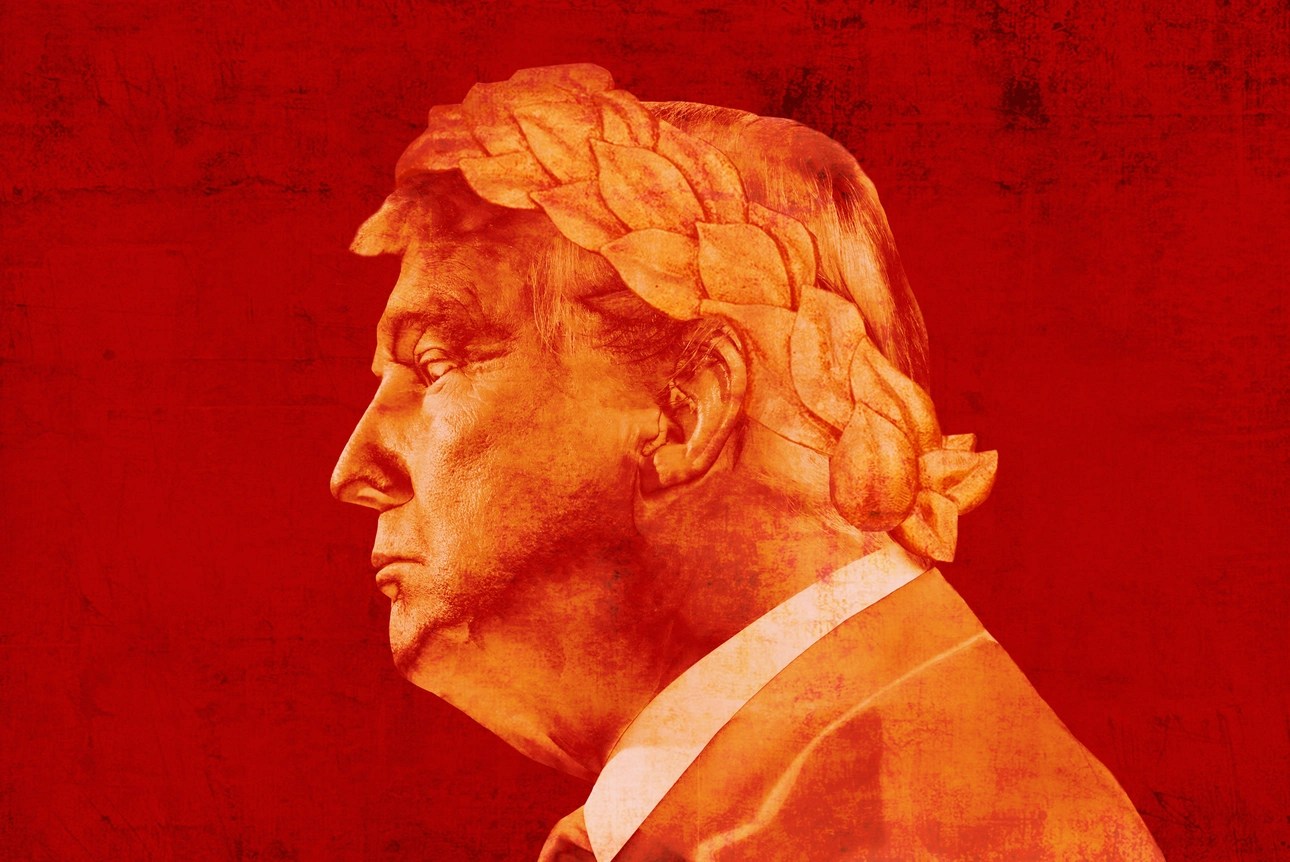
Is it any wonder elites are inviting the worst possible outcome for the man they despise by alluding to the fate of Julius Caesar ? Tim Elliot, in a November 2020 article for Politico warned: “America Is Eerily Retracing Rome’s Steps to a Fall. Will It Turn Around Before It’s Too Late?” Never mind that Trump sought and seeks the opposite of what Caesar represented, tagged by Elliot a “dangerous populist.” Focus on the fact that Caesar was assassinated on the Ides of March (March 15), 44 BCE, in the Theatre of Pompey in Rome, by a group of Roman senators, led by Gaius Cassius Longinus and Marcus Junius Brutus. Focus on the fact that the assassination of Caesar played a pivotal role in the downfall of the Roman Republic and the rise of the Roman Empire. Now remember how, night after night, in New York City’s Public Theater production of William Shakespeare’s play Julius Caesar in Central Park, the conspirators stabbed to death Donald Trump in effigy.

So far, with everything they have thrown at the man, dragging him through show trials in a federal and multi-state coordinated constellation of lawfare actions, now removing him from Colorado state ballot (with other states exploring the same), Trump continues rising in the polls. I’m worried. American history is not unblemished by assassination.

On the night of April 14, 1865, while Lincoln was attending a play at Ford’s Theatre, John Wilkes Booth, a Democrat, entered the president’s private theater box and shot him in the back of the head. Booth’s goal was to remove an obstacle to the reconstitution of the Slavocracy, which was resurrected as the Corporate State only a few decades later. There have been other assassination, as well, Jack and Bobby Kennedy, who represented threats to the deep state, being the most notable in the Twentieth Century. My barber suspects the hesitancy in the present case is that the man is not merely seeking the presidency but is the leader of a social moment, in which case extreme action risks making a martyr. I suspect he’s right.

Affirmation, the Authentic Self Doctrine, and Rule by Assumption

The construct “authentic self” betrays the religious character of queer ideology. In the queer religion, the authentic self refers to the notion of a gendered soul. According to queer doctrine, during ensoulment, which occurs at some point in utero, the authentic self may enter the wrong body, i.e, a body that will be assigned at birth a sex incongruent with that of the authentic self. Upon discovering the error, the congregant himself, or his parents, teachers, counselors, or other congregants, seek out a cleric (a doctor of some sort), and, through a ritual process, often involving powerful potions and sharp knives, release the authentic self.

Illustration by Bea Hayward for Undark

This religion is particularly aggressive in its expectations of others who are, even if not adherents of it, expected to accept its doctrines and embrace its rituals—or at least act in bad faith and remain silent. This religion is furthermore unique among religions, at least in the West, in that it enjoys a considerable degree of state support and, by extension, corporate buy-in. In this way, the governments and corporations of the West have become theocratic in character, the queer religion supplying the scriptural content. Those who are skeptical or resist the queer religion are a special kind of heretic called a “transphobe.” In some places, when discovered, the queer church delivers the witch to the secular arm of the state, or, under corporatist arrangements, to the human resources department, where he is admonished, disciplined, reformed, or purged.

All this is to reassure the authentic self that he is a brave and beautiful angel. This is called “affirmation.”

I am introducing a term to describe this situation that I haven’t found anywhere: “rule by assumption.” It’s based loosely on the idea behind the concept of the “law of assumption,” which states that, by believing the thing you want already exists in your life, you manifest it into existence, as well as the slogan “the long march through the institutions” coined by student activist Rudi Dutschke in the 1960s to describe a strategy to implement radical change in government by becoming part of it.

In rule by assumption, political actors, expecting opposition to their agenda, insinuate themselves into positions of power and quietly implement the agenda without the input of those affected by it. In other words, others are assumed as part of an emergent organic state of affairs to which any decent and normal person would accede. Already ensnared in a web of assumption, objectors and resisters are then portrayed as lying outside the manufactured norms, justifiably branded heretics and witches and subject to the consequences described above.

Reductio ad Hitlerum and the Witch Problem

Former President Donald Trump has taken to warning Americans that immigrants are “poisoning the blood of our country.” His poll numbers in free-fall, his opponent Joe Biden, the man whose policies have seen millions of foreigners pouring across the souther border of the United States, is alleging that Trump lifted the phrase from Adolf Hitler. In Mein Kampf, Hitler uses terms like “blood poisoning” and “blood pollution” to promote the idea of racial purity, arguing that racial intermixing, particularly between Aryan and non-Aryan races, would lead to the degradation of the Aryan race.

The controversy, which is having some trouble findings its legs, comes with the Supreme Court of Colorado, in a 4-3 vote (all of the dissenting justices in the Colorado court’s decision were Democrat appointees, for the record), exploiting the Fourteenth Amendment as a pretext for removing Trump from that state’s 2024 presidential ballot. This action is being used by corporate state propagandists to raise the specter of the Confederacy alongside the specter of National Socialism.

Leading presidential candidate Donald Trump

Whether they know it or not, the fallacy of reductio ad Hitlerum embarrasses those who use it. The confusion over the literal and the metaphorical is obvious and deliberate. The question of whether something is fascist or not is not a line in a book or in a speech by Hitler. The question of whether something is an instantiation of fascism or nazism is a political-economic determination. Questions to be asked: Is this social formation a belligerent form of corporatism, e.g., the corporate state resorting to lawfare to disqualify political actors it doesn’t want interfering with the establishment agenda? Are citizens punished for their utterances and compelled to act in bad faith by using speech aligning with a particular ideological line? Are street-level subalterns being mobilized by corporate state actors to intimidate and terrorize groups the establishment seeks to silence? Are the organs of the administrative state issuing decrees and mandates that bypass the democratic process and violate civil liberties and rights? Is the security state apparatus engaged in surveillance and harassment of citizens? If these things are present, then the corporate state has arguably moved from its soft corporatist character to a hard corporatism associated with fascism. In the current period, all these things are manifest.

What is not fascism is the desire by citizens and their leaders to defend national integrity. There’s nothing fascist about defending the republic, its national borders and its cultural traditions, which are the bases for having a functional and integral nation-state. Most European countries (most countries around the world, in fact) reckon citizenship through ancestry, literally using the Latin phrase for “right by blood.” The American principle of jus soli, i.e, citizenship by virtue of having been born in a territory, is, in it unrestricted form, unique to the hemisphere. If European countries are fascist (and many of these countries increasing are), it’s not because of jus sanguinis, but because of the political-economic character of the system. There’s nothing racist about recognizing that governments exist for a people, i.e., citizens who share a language, a culture, and a heritage. Ancestry is not race. Ethnicity is not race. Nation is not race. The Japanese are not racist because they wish to keep Japan Japanese. Etcetera.

The multiculturalists (or cultural pluralists) who accuse patriots of “fascism,” “nativism,” “racism,” and “xenophobia” are hard at work undermining social and national integrity in a decades-long project to culturally and politically disorganize the people in order to deconstruct the free republic and reintegrate depoliticized civilians in a global order of things. The slurs all reduce to “witch,” the accusation here being that the patriot is a heretic in the eyes of a religion progressives, i.e., those advancing the transnationalist agenda, have assumed for all of us. It’s the same trick being played with gender ideology, a project designed to disrupt intuitive and ordinary understandings of natural history. Gas lighting is a trick authoritarians play. You know them by their actions not their speech acts. They don’t seek deliberative democratic input on decisions that affect everybody because they know the people will resist. So they colonize the institutions, implement policies, create a web of assumption, and then target individuals for marginalization and cancellation when they bear witness and resist. If any one thing that is the chief characteristic of fascism—and it’s not coming the patriots who have put Trump at the top of the polls. It’s coming from the progressives who are doing everything they can to eliminate Trump as a possibility.

DEI Has Got to Go

Whenever one leans into something, it behooves them to consider all the while whether the day will come when they will regret having done so. I went from supporting affirmative action to being skeptical of it before realizing it’s a bad idea. The skepticism piece is the key part of the step. Sometimes you come back to where you were. Sometimes you find yourself on the other side of things.

DEI (AI generated)

However, even when I supported affirmative action, I opposed quota systems either explicit or implicit. DEI is an instantiation of an implicit quota system. But it’s worse than that. DEI is a system of tokenism, where members of various tribes, inherited and inescapable or invented and stepped into, are selected to sit on the court of power to achieve a type of hegemony characteristic of imperial regimes. Because individuals are picked as tokens, aptitude and talent are neglected and mediocrity results. That’s the practical effect of diversity. In principle, diversity is antithetical to the ethic of individualism, which is the core of any free society. Diversity in inimical to individualism because it subsumes concrete persons into abstract groups.

Equity has its place, such as in the recognition that treating men and women equally requires recognizing that there are group differences (e.g., sports), but as a euphemism for equality of outcome, it has no place in a free society. See Kurt Vonnegut, Jr.’s “Harrison Bergeron” for a dramatic illustration of the problem. The quick version: mediocrity (again). Inclusion of identities, real or made up, demands not only the exclusion of certain opinions but submission to politics and ideologies that individuals may not support. In other words, inclusion is characteristic of authoritarian and illiberal desire. Compelled speech is a good useful example. While proper nouns are arbitrary, pronouns indicate real things.

In local news, on Wednesday, the University of Wisconsin System Board of Regents changed its stance on DEI, approving a previously rejected deal on diversity positions and salary increases with an 11-6 vote. Just four days earlier, the board had turned down the same deal but succumbed to political and financial pressures, ultimately accepting the agreement facilitated by UW System President Jay Rothman and Assembly Speaker Republican Robin Vos. Amy Bogost, the board vice president, emphasized the significant challenges confronting the universities as a driving force behind the decision. Three members, including Regent President Karen Walsh and UW-Parkside student Regent Jennifer Staton, altered their votes in favor of the agreement.

“You can attempt to justify it, that these roles are going to be reallocated or we’re going to improve the system in the future,” Regent Evan Brenkus said before his colleagues flip flopped. “But the truth is this: You are selling our minorities out for millions of dollars.” Many of my colleagues agree with Regent Brenkus. But there’s no selling out of minorities here. This was a compromise (which doesn’t go nearly far enough in eliminating DEI) that will allow some relief from the group-based politics and policies pushed by the Democratic Party. Vos expressed my sentiments when he said, “It’s a shame they’ve denied employees their raises and the almost $1 billion investment that would have been made across the UW system, all so they could continue their ideological campaign to force students to believe only one viewpoint is acceptable on campus.” To be sure, the Regents came around, but let’s not forget how progressives feel about that matter. Without Republicans willing to stand on principle, this madness continues unabated.

We all know what this is about. The professional-managerial class is determined to quash attempts to open the system to viewpoint diversity and restore equality in the system. They’re so committed to woke progressive ideology that they were prepared to deny workers in the system a much needed raise in the face of Bidenomics. It’s frustrating to be forced to suffer on account of ideology. My salary was being held hostage to crackpot ideas. By relenting, 800 million dollars is now available for employee salary increases and construction projects. As part of the agreement, 43 diversity positions across campuses will undergo restructuring, and the overall job count within the UW System will remain unchanged until 2026.

Like I said, that doesn’t go nearly far enough. The Republican position was moderate to a fault. DEI should be uprooted entirely from higher education. There is no place in public colleges and universities for identitarian politics. No faculty position should be based on any ideological or political considerations. What needs to happen is the emplacement of a recruiting system that prevents the discrimination of applicants based on viewpoint. The reason why the college and universities are so woke is in part because administrators and faculty screen applicants based on politics. Another big piece is that conservatives do not feel anthropology, sociology, etc., are welcoming to their political leanings, and so they avoid those fields. They’re right. So, woke in, woke out.

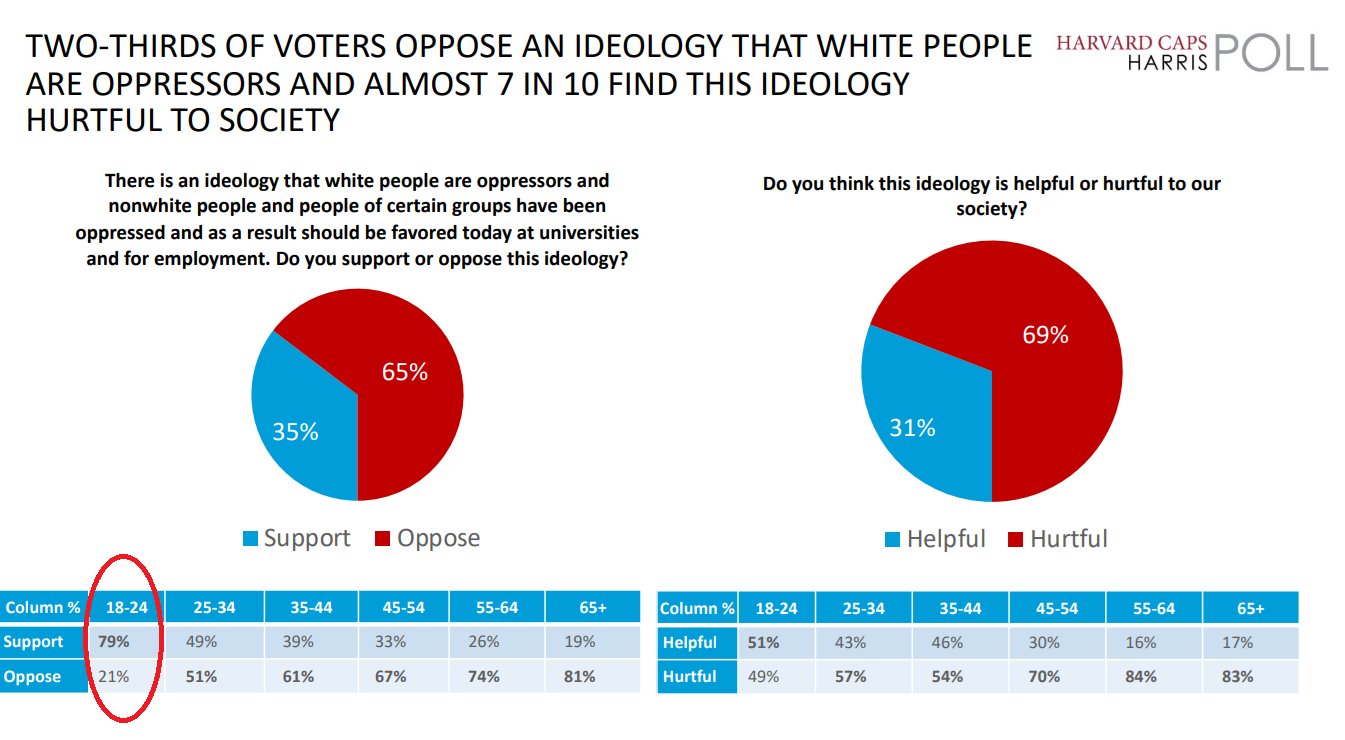
Here you can see how woke education has fucked up young Americans. Rufo has highlighted the 18-24 category. Nearly 80 percent of this cohort think white people are oppressors and should be passed over for opportunities in education and occupation. Look also at the 25-34 cohort. There it’s split. That’s bad enough. Taken together, tens of millions of Americans believe something that is empirically false and destructive to equality and freedom. Moreover, as we have seen, this ideology induces acts of harassment, intimidation, and violence against whites, especially Jews, and Asians. It is also associated with widespread mental illness and self-harm, on which the medical-industrial complex is all too eager to capitalize (literally).

This is no accident. This is the work of DEI. DEI is an anti-American/anti-Western project to disorganize the proletariat and prepare our youth for incorporation in the corporate state regime as dutiful subalterns, either professional-managerial types or docile bodies. DEI does this not only by turning non-whites against whites (and so-called white-adjacents) but by turning whites against themselves. It’s a project to engender in successive generations loathing of self and society.

DEI benefits the ruling elite and the professional-managerial class that operates the levers of corporate power, i.e., the administrative state and technocratic apparatus. This is the soft fascism of progressive corporatism and neoliberalism, what Sheldon Wolin called “inverted totalitarianism,” which is rapidly deteriorating into the hard fascism of the police state, the instruments for which have already been emplaced. The Democratic Party is the operational tip of the project’s political-ideological spear.

Concerning the alchemy of social justice, here are some recent essays you might find useful: The New Left’s War on Imaginary Structures of Oppression in Order to Hide the Real OnesRace-Based Discrimination as a Model for Social Justice; Frantz Fanon and the Regressive Ethics of the Wretched: Rationalizing Envy and Resentment—and Violent PraxisWhy the Woke Hate the WestWoke Progressivism and the Party of GodThe Peril of Left-Wing Identitarianism

National Socialism and the State of Israel: The Perpetuation of a False Equivalency

Have you seen the comparison I share below? It’s meant to imply that there is an equivalency between Jews and Nazis. In the bottom photo, taken during World War II, Jews stand before a trench awaiting extrajudicial execution. This is a moment in the Judeocide, an event that saw the extermination of millions of Jews by Nazis and their allies. The top photo shows Palestinians who have been captured by Israel soldiers in the ongoing war between the state of Israel and the terrorist organization Hamas (and allied terrorist groups). The captives are not kneeling before a trench. They will not be executed. They will be taken to a detention facility and processed. There they will be fed, given clean water, and receive medical attention. Eventually, they will face an orderly judicial process.

An Internet meme

Bad analogies are always in season, but this one isn’t merely bad, it’s dishonest. You might think it unnecessary to debunk the crude lie implied by this comparison, such an obvious piece of antisemitic propaganda, but intelligent people are sharing this image and they don’t think it’s antisemitic. They will tell you that there is a difference between antisemitism and criticisms of the Israeli military campaign in Gaza and what they claim is the larger project, a white settler project called Zionism, i.e., the colonization of Palestine by European Jewry.

The word “humiliation” is being heard quite a bit from the antisemitic left (if we can even characterize woke progressivism is left). But it’s hard to avoid humiliation when you’re a prisoner of war and suffer the consequences that come with the choices you made. You lost the battle and were captured. Captured Nazis were also humiliated. Even worse, perhaps you surrendered; you’re supposed to go down fighting. Your chance to be martyred gone, you will soon face justice for your crimes against humanity.

Members of the Fatah-affiliated al-Aqsa Martyrs Brigades wearing bomb vests during a ceremony in the town of Jenin, West Bank, to commemorate Palestinians martyred by Israeli security forces during months in 2021.

But why are they stripped to their waist? That’s not obvious? The original fascists didn’t routinely wear bomb vests and explosive belts, so it’s hard to find images of Nazis stripped down to their torsos. This wasn’t done to humiliate the prisoners in Gaza; it was done for the protection of the soldiers who have taken them captive. Why does the IDF share these pictures? To show the progress the Israeli military is making in neutralizing the threat to their countrymen. It’s the propagandist on the other side who misrepresents the situation the images convey.

There’s no rational justification for Hamas action. There is no rational justification for standing with Hamas. Hamas is a death cult. At best, there is only unexamined Jew-hatred. Even among some Jews, tragically. It’s an obvious point, I know, but even intelligent people are made stupid by ideology.

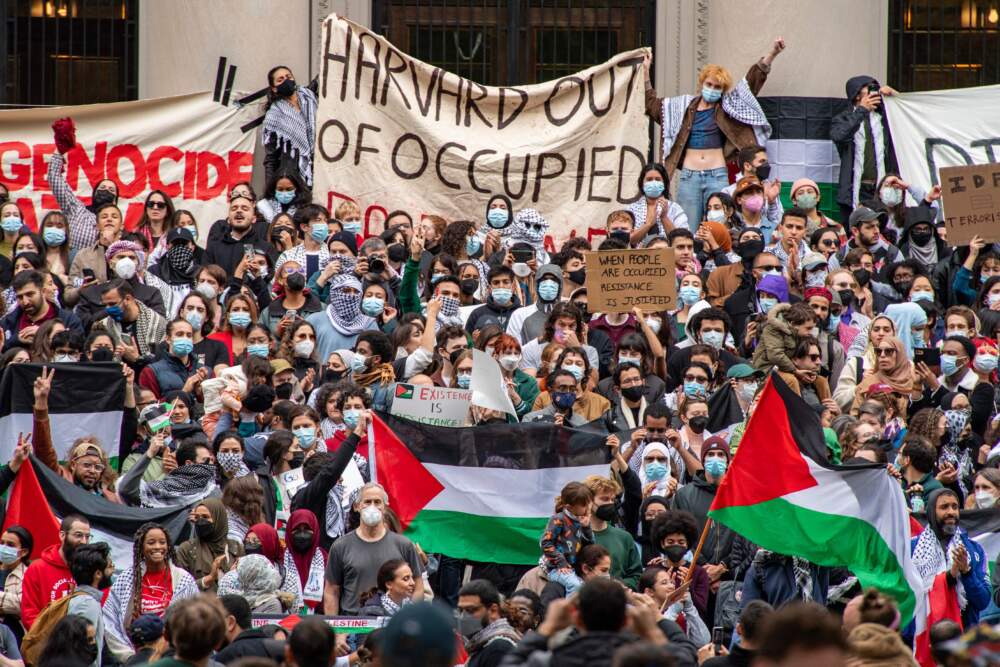
Emotions are running high. I’m aware that susceptibility to this sort of propaganda is great. So always keep in mind October 7, when sharia supremacists, clerical fascists, carried out a pogrom against Jews as part of a project to eliminate Jews in the region, a project with a long history (see Jew-Hatred in the Arab-Muslim World: An Ancient and Persistent Hatred). That is what the chants of “intifada” are all about. Basem Naim, former Palestinian minister of health and a member of the political bureau of Hamas, said, “The battle was fought and won on 7 October. That marked a strategic victory for the Palestinian people on the path to liberation, despite the high costs we have paid and will continue to pay on this journey.”

Know that Hamas actions are taken in the furtherance of a goal whose analog is Nazism. Hamas are not liberators. They are not freedom fighters. They are today’s Nazis. They seek totalitarian ends. And now they are prisoners of war. Good riddance to them.

Here’s an honest historical comparison, slit trenches in the genocide against the Jews and the American Indian.

As human beings, all prisoners of war deserve mercy. As fascists, they gave up any hope of enjoying the respect of decent people. May they be treated humanely and receive the justice due them. I will drink tonight to their capture and the crushing of the Party of God. May reason and civilization and the forces that defend human decency prevail over the forces of barbarism. This is an existential war. Understand this. It’s in moments like this that the enemies of freedom and reason make themselves known. They are among us.

Stripped down terrorists in Gaza is not a sign of genocide. Photos of Nazis standing naked Jews before slit trenches is. Stripping Hamas terrorists is a rational and standard step that must be taken when dealing with people who have no concern for human life, not even their own. These are the worst human beings on the planet—perhaps in history. They raped their captives before executing them. They burn alive in their cars civilians attempting to escape them. The analogy is not between Jews and Nazis; it’s between Muslims and Nazis. The war waged on the civilized world by this deranged ideology is waged on one side by people who were either found or made sociopathic. Those on the other side, the Jews, are once more facing the evil force of antisemitism.

I leave you with a voice of reason:

“Blacks Can’t Be Racist” and the So-Called “Myth of Reverse Racism”

“Blacks can’t be racist because as a group that have no institutional power.” This is also known as the “myth of reserve racism.” You’ve heard these assertions before I’m sure. The first formulation often comes with a caveat: blacks who deviate from the acceptable narrative about black suffering are the racist agents of white supremacy. Many years ago I accepted the premise of these assertions and even rehearsed them in public (see Why Black People Can’t Be Racist … At Least Not Against Whites). You can find that in some of my earliest blog essays the logic of this statement underpins the arguments. This logic remains fundamental to the post civil rights rhetoric of woke progressivism.

Stokely Carmichael speaking at a Black Power rally

Stokely Carmichael, later known as Kwame Ture, a major player in the Black Power movement, is believed to have coined the term “institutional racism” in the book Black Power: The Politics of Liberation in America, published in 1967. The book was coauthored with Charles Hamilton, professor of political science at Columbia University. Patricia Bidol introduced the formulation racism = power + privilege in her book The Black Woman’s Manifesto, published in 1970. These works argued that racism involves both prejudice and the power to enforce prejudice through institutional means.

The conceptualization emphasizes the structural and systemic aspects of racism, which requires a specialized theory to detect, which would arrive in its mature form as critical race theory (CRT). The theory posits that racism is not only about individual attitudes or biases but also about the ability of a particular racial group to enforce those attitudes through institutional power. In this view, members of historically marginalized groups, especially black people, may hold prejudiced views, but they lack the systemic power to enforce those views on a broad scale, therefore they cannot be racist (at least against whites).

What I didn’t realize when I was younger is that Black Power propaganda was taken up by rich and poor alike to (a) justify positive discrimination against whites and those considered white-adjacent (East Asians) and (b) rationalize crime and violence against whites, a category that includes Jews (but strangely not Arabs, who are also white), as well as East Asians. The concept of “positive discrimination” is a gloss for such practices as affirmative action, designated “positive” because these practices allegedly represent a good kind of discrimination. If institutional racism has any meaning, then, it’s manifest in the practice of positive discrimination and the assumption of white privilege (which is a fallacy).

These ideas have been taken up by corporate power to assemble a loyal court of “victims” from many tribes (the soul of diversity, equity, and inclusion, or DEI), at the same time disorder the proletariat by dissimulating class power in the rhetoric of racism, sowing division among working people.

This is the New Racism. The New Racism works much the same way as the old racism and its function is the same with only the direction of hate and resentment reversed. It’s no surprise, then, that the party of the Slavocracy and Jim Crow would be the party of the New Racism. I’m talking about the Democratic Party, of course. The corporate and professional-managerial classes recognize the role of racism in maintaining capitalist hegemony over the working class. After the success of Civil Rights in the 1960s, racism was rejiggered and respecified.

Cooper has a university press book, so an obvious question is: who writes her books for her? It could be that the University of Illinois Press gave her a pass in light of her race and politics. I will never know.

The truth is that blacks can be and often are racist. Many of you didn’t need me to tell you that. We see this in the black-on-white violence and the looting of white-owned stores that are daily occurrences in America, their frequency sharply increasing thanks to anti-racist politics. Anti-white prejudice has been internalized by many whites who go to great lengths to make their racial self-loathing in public spaces visible and shareable on social media. Seeing video of white progressives kissing the boots of black men in public is a disturbing sight. But that ritual practice of the Woke Church is only one signal that Western Civilization is in crisis.

Palestinian Hamas militants are seen during a military show in the Bani Suheila district on July 20, 2017 in Gaza City, Gaza.

In the new racial conceptions, racial self-loathing extends to an embrace of an especially pernicious political ideology that despises the West and seeks its destruction, namely the sharia supremacy of the clerical fascists. Polls are finding Holocaust denial, a form of antisemitism rampant in the Muslim world, more common among Democrats than other groups, especially the young. This is the fruit of postcolonial studies and the reductive oppressor-oppressed paradigm.

In this paradigm, the successful examples young people should be modeling are decried as the colonizer. Because Jews are an exceptional ethnic group, they’re the paradigm instantiation of oppressor/colonizer. Because the left has no critique of capitalism anymore, having been trained to see the world through the lens of race (and other social constructs), it was inevitable that we would arrive at a point where the myth of systemic racism (at least in the way the left thinks it works) would include the Party of God, the main reason hundreds of millions of Arabs and other Muslims live in shit-hole countries.

Jews are White. So Are Arabs

There is a particular kind of racism in history, the racism associated with national socialism, or Nazism, that denies Jews their whiteness. Whiteness is used here in the racial sense, as in caucasian. As I have shown on the pages of Freedom and Reason, there are reckoned on basis of population genetics a handful of racial categories, only five likely, these determined by constellations of phenotypic traits revealed by factor analysis, albeit intuitively known for centuries. The caucasian race is distributed across Europe, Middle East and North Africa (MENAs or Arabs), and into the Indian subcontinent (e.g., Persians).

Supporters of Hamas gather at Harvard shortly after the terrorist group massacred and kidnapped Jews and others in Israel.

Within this vast geographical area lie numerous ethnic groups that have in the development of the modern world become nation states. Israel, the only Jewish state in the world, is one of them. Nazis race science conflated ethnicity and race, seeing a myriad of racial groups in the myriad of ethnicities. Race theorists for the regime then endeavored to organize that myriad into a hierarchical system that placed ethnic Germans at the top of the ladder, with Jews located towards the bottom rungs. All along the truth was that Jews were as racially white as the ethic German. Both are caucasian. As we can understand, Nazis science was corrupted by ideology.

In June of 2019, I wrote a very lengthy (and frankly rather prescient) piece on the matter titled Race, Ethnicity, Religion, and the Problem of Conceptual Conflation and Inflation. In the epigraphs that often adorn my posts, this one, by David Bernstein, law professor at the George Mason University and contributor to the legal blog, The Volokh Conspiracy, appeared at the top of that analysis: “Note that this does not mean that the Irish, Italians, Jews, Poles, Arabs, and so on didn’t face discrimination, hostility, assertions of inferiority and occasionally even violence. They did. But historically, they were also considered white.” This quote was drawn from Bernstein’s essay “Sorry, but the Irish were always ‘white’ (and so were Italians, Jews and so on,” published in the Washington Post on March 2017.

Bernstein is right. It was always understood in the United States that Jews were white. The distribution Jews faced in America was not on account of racial distinction but because Jews were confronted by a Christian majority. Jews were never under the rules of Jim Crow. Nor did the rules applied to black Americans apply to any ethnicity from the geographical regions described in the previous paragraph (Asian populations are a different story). Bernstein stresses that such historical facts exposes the distortions of ideologically-driven academic literature and political rhetoric. Indeed. With this as a departure point, my June 2019 essay explored the emerging trend among Jews questioning their whiteness, with some deploying a rhetoric suggesting that Jews had never been white. We are seeing in the streets of cities and towns across the trans-Atlantic space confirmation of Jewish concern over their status in Western society. No longer outsiders, they are included in oppressor class.

I noted in June 2019 that, given political developments, “the pariah status of whiteness has produced some curious effects.” I provided several examples. One of them was Seth Frantzman, writing for The Jerusalem Post, December 2018 (“Now they call us ‘White Jews’”), he cautioned his readers about the whitening of Jews. Tagging it the “new American antisemitism,” he warned of a “creeping hatred” towards Jews. “The labeling of Jews as ‘white’ and debates on how to ‘treat Jews,’” he said, “is a form of dehumanizing rhetoric designed to force Jewish people into a binary of ‘white/non-white’ that is currently trendy in US discussions.” He continued: “The new toxic discussion taking place primarily in the United States is designed to label Jews as ‘white supremacists.’” Despite conflating qualitatively different categories of things—ethnicity, race, and religion—, Frantzman had put his finger on something.

Fast forward to today. Those young Americans and Europeans out on the streets calling for the elimination of the Jews from their homeland see as the racialized minority the Muslim, the follower of a religion founded by another white people, the Arabs, the actual majority in the region where Jews have for millennia made their home. The actual minority in the region, the Jew, driven from Arab lands, seven million living in a space one-fifth the size of the state of Kentucky, becomes a colonizer in his own land. In the strange alchemy of social justice, Jews become the bad guys. Antisemitism finds its dissimulation in the jargon of post-colonial ideology. Frantzman’s concerns were warranted.

Venture capitalist David Sacks, appearing on the All-In Podcast (see above for full episode), tells us that in the aftermath of recent events, a growing number of Jewish individuals are recognizing a sense of disconnect from the political left (as the mainstream defines left). He anticipates that a significant portion of the Jewish community will shift towards the right, aligning themselves with the Republican Party—an alignment Sacks has personally maintained for some time.

There are several reasons Jews have historically supported the Democratic Party. The community has longstanding ties to social movements, including the civil rights movement, that have shaped the cultural and historical connections that influence contemporary political preferences. Jewish values often emphasize social justice and compassion, aligning Jews with Democrats on issues such as the environment, healthcare, and income inequality. Concerns about discrimination have led many Jews to support the party that, at least ostensibly, emphasizes inclusivity and equal rights. Higher levels of education and urbanization, common among Jewish Americans, are associated with Democratic Party support, as well.

Sacks notes that, over the past few decades, there has been a notable shift within the civil rights movement and the left, marked by the emergence of woke ideology, which emphasizes identity groups over colorblindness. Rather than bridging racial differences, this ideology accentuates them, manifesting in an equity agenda characterized by the redistribution of resources among different racial groups. This dynamic generates division and resentment.

Many Jews had not fully acknowledged the transformation of the left in this direction, perhaps stemming from the belief that, under this woke paradigm, Jews would naturally be considered a victim group. However, a realization is dawning that, within the framework of this ideology, Jews are perceived simply as white individuals with a Jewish background, making them members of the oppressor class. Many within the Jewish community, Sacks contends, are awakening to the realization that this ideology becomes destructive by casting Jews as adversaries.

Sacks tells his audience that, under these circumstances, it’s expected that a considerable number of Jewish individuals will reevaluate their political allegiances. A shift towards the right seems to be underway, he suggests, as more Jewish individuals become attuned to the evolving landscape of political ideologies. It’s hard to listen to Bari Weiss’ moving speech addressing the Federalist Society and not hear a collective voice in her words and her passion.

But the problem isn’t that Jews are white. It will not do to abandon Christians to the woke mob and escaping into a self-serving reracialization. As the great sociologists have pointed out, geniuses as grand and different as Karl Marx and Max Weber, practical Jewish life is realized in the Christian world with the rise of Protestantism. It is this historic development that makes possible capitalism and the Enlightenment and the incorporation of Jews fully into Western society. In contrast, Islam has no capacity for the emancipation of religion from the state—it’s fated to be a totalitarian ideology. And Jews are white in any case. Social constructionism has its limitations. Rather, the problem is woke progressivism and its antipathy to equality, individualism, liberty, and republicanism.

Recently, hedge fund manager Bill Ackman raised the profile of this issue by going after the presidents of Harvard University, MIT and the University of Pennsylvania for applying a double standard with respect to speech codes. Ackman has focused on the disparity between Harvard’s commitment to free expression and its ranking in the Foundation for Individual Rights and Expression (FIRE) free speech rankings. He notes that faculty members there have expressed concerns about a perceived narrowing of acceptable speech and self-censorship on campus. They confirm the existence of a perspective that associates whiteness at Harvard with oppression, normalizing hostility towards Israel and Jews. The Office of Diversity, Equity, Inclusion, and Belonging (ODEIB) focuses on colonialism, denials of indigenous rights, and racism, which cases whites as oppressors. There are claims of discrimination against straight white males, Asians, and individuals of Indian origin in the hiring process.

This brings me to Emma Green’s 2016 Atlantic article penned a month after Donald Trump shocked the pollsters and won the presidency of the United States, defeating the establishment favorite Hillary Clinton. The article was titled simply “Are Jews White?” The subtitle is telling: “Trump’s election has reopened questions that have long seemed settled in America—including the acceptability of open discrimination against minority groups.” In the piece, Green goes after Steve Bannon, who she accuses of shilling for white nationalism, feeding an alt-right troll army engaged in antisemitism (i.e., shit-posting). Green noted that progressive groups were eager to mount a rebellion and Trumpism, and that Jews, three-quarters of whom voted for Hillary Clinton, believing that Trump won largely on account of racism and white supremacy, were eager to join in. However, some of the groups Jews sought allyship with had “singled out particular Jews for their collusion with oppressive power.” Green sense the approach storm before most did.

“These are rough sketches of two camps, concentrated at the margins of US political culture,” Green surmised. “On the extreme right, Jews are seen as impure—a faux-white race that has tainted America. And on the extreme left, Jews are seen as part of a white-majority establishment that seeks to dominate people of color. Taken together, these attacks raise an interesting question: Are Jews white?” The suggestion that the political right in the United States sees Jews as “impure” and “faux-white” is wrong. One might object that she is talking about the extreme right. But she is lumping Trump and Bannon in with that tendency. Trump is a liberal New York businessman adored by the cultural and political elite until he sought the presidency. Bannon is hardly the fascist and antisemite she thinks he is. It is the progressive left that fulfills Green’s worst dreams. This is the crow that images a white-majority establishment seeking to dominate racialized minorities. Moreover, how does any of this raise the question “Are Jews white?” Asserting that Jews do not fit neatly into American racial categories, despite admitting that “[f]rom the earliest days of the American republic, Jews were technically considered white, at least in a legal sense,” the rest of Green’s essay involves rehearsing the debunked thesis that Jews, like many European ethnic groups, underwent a process of “becoming white.”

I have written quite a lot on the distinctions between culture, ethnicity, race, and religion. Here are some of these essays: Almost Everybody in the Bible is WhiteMuslims are Not a Race. So why are Academics and Journalists Treating Them as if They Were?; Culture and Race—Not the Same Thing; Are Cultural Explanations of Racial Disparities Always Racist? Only By Conflating Race and CultureMultiracialism Versus Multiculturalism; The Myth of White Culture; Culture Matters: Western Exceptionalism and Socialist Possibility; Critical Race Theory: A New RacismSmearing Amy Wax and The Fallacy of Cultural Racism; Kenan Malik: Assimilation, Multiculturalism, and Immigration; Is There Systemic Anti-White Racism?

Concerning the alchemy of social justice, here are some essays you might find useful: The New Left’s War on Imaginary Structures of Oppression in Order to Hide the Real Ones; Race-Based Discrimination as a Model for Social Justice; see Frantz Fanon and the Regressive Ethics of the Wretched: Rationalizing Envy and Resentment—and Violent PraxisWhy the Woke Hate the WestWoke Progressivism and the Party of God; The Peril of Left-Wing Identitarianism. There are many others, so peruse the table of contents. Reach out with any questions.

Progressive Elites Condemn You for the Truth They Tell

Vivek Ramaswamy, who is seeking the nomination to be the presidential candidate for the Republican Party in 2024, writes, “Yesterday, Van Jones called me a ‘demagogue’ for discussing the Great Replacement Theory. Well, here are Van’s words in 2021: ‘The request from the racial justice left: we want the white majority to go from being a majority to being a minority and like it. That’s a tough request, and change is hard.’” Van Jones says a lot more. Here is the video Ramaswamy shared:

Ramaswamy is on to something very important here. But he’s not the first. Tucker Carlson saw this before him. At least Carlson beat him to articulating the observation. I blogged about the Great Replacement Theory conceit several times on Freedom and Reason back in the spring of 2021 (see The “Great Replacement” as Antiracist Propaganda; The Campaign to Cancel Tucker Carlson is Part of the Policy; Rationalizing the Border Crisis with Hysteria, Lies, and Smears). In fact, at the end of 2020, I told readers of my blog what was behind the migrant crisis (see Joe Biden and the Ultimate Source of Our Strength: “an unrelenting stream of immigration, nonstop, nonstop”). And just this past September, as the migrant crisis grew worse, I reminded readers about the reality of the great replacement project (see “It’s Not Going to Stop.” The Managed Decline of the American Republic).

The Great Replacement Theory isn’t a theory. It’s a project. Elites have admitted it. They didn’t need to admit it, of course; motive is always determined by fact pattern (criminals lie). The millions flooding into Western societies with no demand to assimilate to Western culture confirmed the motive before Van Jones did (see The Progressive Politics of Mass Immigration; Biden’s Policy is Open Borders). However, elites working to diminish the white majority in North America and Europe—and this includes members of parties that appear oppositional to the casual observer—have never been bashful about their plans. As I have shown Freedom and Reason, a major piece of the plan was announced more than one hundred years ago (see An Architect of Transnationalism: Horace Kallen and the Fetish for Diversity and Inclusion). Those who pursue this end cannot dissimulate the project by attaching the smear of antisemitism and white supremacy to those who speak the truth. Not now. Not ultimately. There is nothing intrinsically Jewish about the replacement project. Indeed, as we have seen, Jews are one of the groups targeted by the replacement project (see Frantz Fanon and the Regressive Ethics of the Wretched: Rationalizing Envy and Resentment—and Violent Praxis; Why the Woke Hate the West; Woke Progressivism and the Party of God). I will be blogging more about why the Jews are targeted by the progressive left this weekend.

AI crudely sketches the transnational corporate order

Let’s see what we see, shall we? The great replacement is an elite project to disrupt cultural integrity in the West in order to disintegrate the respective national proletariats of the trans-Atlantic space and reintegrate denationalized proletarians in a global system of transnational corporate control. Again, this is not a Jewish project. To be sure, Horace Kallen was a Jew. And, yes, George Soros is a Jew (never forget the way the elite went after Elon Musk for being critical of the tendency Soros represents; see Magneto, Soros, and Musk; more generally, George Soros and the Cudgel of Antisemitism). But then ask yourself, Is Klaus Schwab Jewish? For the record, Schwab is Swiss. He was raised a Catholic. Academic, media, and political elites really do think we’re stupid. They depend on you not knowing what’s going on, which should be incentive enough to get you looking into things. (See If We Allow This, We are Over. See also George Soros, Philanthrocapitalism, and the Coming Era of Global Neo-Feudalism.)

Progressive elites don’t really care about ethnicity and race except where they can weaponize it against the Enlightenment and Western Civilization. That’s what all this postcolonial gibberish is about. This is why such crackpot notions as poststructuralism and postmodernism and every nonsense theory that flows from them (gender identity theory aka queer theory, critical race theory, etc.) have colonized and corrupted our institutions (The Peril of Left-Wing Identitarianism). This is why a consequentialist frame of truth has replaced the ontological one, with the hierarchy of power in back of left identitarianism assumed. This is why BLM and Queers for Palestine. This is what underpins the color revolution of 2020 and the coming color revolution of 2024—already underway in 2023! None of this is accidental.

The world capitalist economy has long been in force. This was inevitable for reasons Karl Marx and Friedrich Engels explained in their 1848 pamphlet The Communist Manifesto (the criterion-related validity of which can no longer be reasonably questioned). The step being completed now is national dissolution and universalizing of a global legal and political structure under which all workers will be ruled undemocratically and without liberal freedoms—and those displaced and replaced by machines and other rationalizations managed by the custodial state. (See The Globalist Project: The Managed Decline of the Modern Nation-State and the Rise of Corporate State Tyranny. However, I discuss this in several essays on this blog, some of which I have cited above.) Though what brought us here feels inevitable, the end game is not. But the People have to move with haste to stop it.

Changing the culture of the West is vital to the replacement project, a project determined to preserve the wealth of the few as capitalism in its corporatist phase, what Ernest Mandel described in the early 1970s as “late capitalism.” Mandal describes in his landmark Late Capitalism the ascendance of multinational corporations (MNCs, or TNCs) in the global economy, transcending national borders and reshaping economic relations, analyzing the pivotal role of finance capital, its integration with industrial and commercial capital, the deepening relationship between the state and the economy, with state intervention (regulatory measures, fiscal policies, etc.) becomes a defining feature, these directed by capitalist elites (control dissimulated in neoliberal rhetoric). Mandel scrutinizes the impact of technological advancements on the capitalist mode of production documenting their transformative effects on labor and productivity (see my own Physical Capital, Human Capital, Technology, and Productive Work—These Drive the Real Economy). The inherent contradictions and crisis tendencies in capitalism become ever more pronounced in late capitalism.

The world is rapidly moving towards a global neo-feudal system where workers will become the new serfs (see Michel Luc Bellemare’s Techno-Capitalist-Feudalism and Joel Kotkin’s The Coming of Neo-Feudalism; see also Global Neo-Feudalism: Backwards to the Future). Changing the ethnic and religious composition of countries is a crucial step in changing Western culture to this end. The destruction of the family is a major part of the project (which the political right stupidly attributes to Marx and Engels; see my latest essay for details Queer Theory is Not Marxist: The Myth of Family Abolitionism in the Materialist Conception of History; here’s what’s really going on: Disrupting the Western-Prescribed Nuclear Family Requirement. What Does That Mean? A Lot More than You Think). Changing our language to change the way we think is a major part of the project (see Manipulating Reality by Manipulating Words). All these tactics and many more are the subject matter of Freedom and Reason.

This explains the anti-Western sentiment and authoritarian and truly imperialist character of progressivism and social democracy across the trans-Atlantic space. This is why Western Civilization is reduced to whiteness and condemned for its success (see The Myth of White Culture). Elites are delegitimizing the modern nation-state. They are delegitimizing democratic-republicanism and classical liberalism. Their aim is totalitarian control over all the earth. Democrats are the tip of the spear for the American wing of the project. This is why operatives like Van Jones, Jamaal Bowman, and Joe Biden work so hard (and with Biden that must be hard work) to confuse the public by projecting the ethnicism and racism inherent in left identitarianism onto others—then brag about it while admitting the end goal. They have said it out loud: they want whites to be a minority across North America and in Europe. This is why whites (which includes Jews and Asians, the latter labeled “white-adjacent”) are demonized by today’s left. In order to diminish the relative proportion of an ethnic or racial group in a population, a crucial step is to make them out to be the bad guys, to dehumanize them. If they’re the bad guys, then you can replace them with the good guys (Muslims, for example). Who determines who the good guys are tells us who is pulling the levers of power (hint: it’s not the Jews).

To drive home the point, according to queer theory, the eleven-year-old girl is a sexual being—was long before this, perhaps around the age of three—and knows what she wants. This is why “Queers for Palestine” does not strike the woke progressive as an odd slogan. From his standpoint, it isn’t odd at all. He shares the same ideas with respect to children as the man in the video, a widespread sentiment in this culture; children are to be controlled by the adults who seek to exploit them. These are the ideas that are borne by the culture bearers flooding the trans-Atlantic space. But they’re also ideas that find a source in Western paraphilias. There’s a reason why Michel Foucault wrote approvingly of the Islamic Revolution in Iran (see Foucauldian Seductions: Busty Lemieux and the Hijab; Since it is Not Possible to Change the Soul, the Body Must be Changed—Manifestations of Clerical Fascism; Simulated Sexual Identities: Trans as Bad Copy). The Western elite is inviting the barbarians inside the city walls and defending them against the People who would safeguard children against the evil expressed here. And the elite find their foot soldiers in street-level expressions like Trantifa. This is just one element of the culture war being waged against the People.

Queer Theory is Not Marxist: The Myth of Family Abolitionism in the Materialist Conception of History

“In its completely developed form, this family exists only among the bourgeoisie. But this state of things finds its complement in the practical absence of the family among the proletarians, and in public prostitution.” —Karl Marx and Friedrich Engels, The Communist Manifesto (1948)

To be sure, the left loves to call their political enemies “fascists” and “Nazis.” But they don’t spend any time talking about Adolf Hitler’s theories or spreading fear about “Hitlerism.” This is because Hitler’s work was the work of a hack. High in emotional intelligence, as sociopaths tend to be, Hitler’s writing is ordinary and his theories crackpot. But the political right works overtime to spread fear about Marxism. This is because Karl Marx’s work is chockfull of profound sociological insights and his theories enjoy considerable criterion-related validity. Marx is to social thought what Darwin is to natural history, or Einstein is to physics. This is why Marx is taught in college classrooms, while Hitler’s writings are unnecessary to consider. The fact that Marxism is recognized as a legitimate scientific endeavor drives right wing ideologues up the wall. And so everything left of center becomes “socialist”—and everything socialist, “Marxist.”

The obsession with Marx doesn’t mean that his right wing critics spend anytime reading his work. Jordan Peterson, an educated man, in preparing for his debate with Slavoj Zizek back in 2019, skimmed The Communist Manifesto. Before and beyond that, by his own admission, he had never bothered to read any Marx at all. Yet he feigned to talk about Marxist thought as if he had given it the attention he’d given Carl Jung or Friedrich Nietzsche’s work. But, to his credit, that’s more Marx than most other right-wing critics have read. Most people attribute to Marx things other right-wing thinkers say, especially the influential intellectual dark web (IDW). So, when Black Lives Matter co-founder Patrisse Cullors said in a 2015 video that surfaced in June that she and her fellow organizers are “trained Marxists,” she had for America’s right wing made clear the movement’s ideological foundation. But it’s not true. Cullors and her associated are adherents to critical race theory. Now queer theorists are held up by right-wingers (some left-wingers, too) as Marxists for wanting to “abolish the family.” This is not true, either.  

The importance of reading the corpus of Marx’s writings, as well as developing a good understanding of the work of Hegel and other relevant thinkers, is illustrated by the misreading of Marx’s fourth thesis on Feuerbach, a document he penned in 1845. There Marx writes, “Feuerbach starts out from the fact of religious self-alienation, of the duplication of the world into a religious world and a secular one. His work consists in resolving the religious world into its secular basis. But that the secular basis detaches itself from itself and establishes itself as an independent realm in the clouds can only be explained by the cleavages and self-contradictions within this secular basis. The latter must, therefore in itself be both understood in its contradiction and revolutionized in practice. Thus, for instance, after the earthly family is discovered to be the secret of the holy family, the former must then itself be destroyed in theory and in practice.” Many think that Marx is calling for the abolition of the family. See, for example Richard Weikart’s essay “Marx, Engels, and the Abolition of the Family,” published in a 1994 issue of the History of European Ideas. (Weikart is the Intelligent Design advocate who blamed Darwin for the Holocaust.)

But Marx isn’t talking about the family at all in that passage. He is using the term as a metaphor. Marx is critiquing traditional philosophical approaches, most immediately that of Ludwig Feuerbach, who, according to Marx, stops at the contemplation of the material world without moving on to practical, transformative action. In the quoted sentence, Marx is expressing the idea that once we understand that the “holy family,” which represents the abstract and idealistic philosophy, i.e., ideology, is, in reality, rooted in the “earthly family,” i.e., the actual material conditions and social relations, we must go beyond mere theoretical understanding. The phrase “the former must then itself be destroyed in theory and in practice” is Marx calling for a radical transformation of both theoretical and practical conditions. Put another way, the “earthly family” refers to actual social and material relationships among individuals, while the “holy family” represents the philosophical abstractions that have historically been detached from these real-world conditions. Marx is arguing for a dynamic and revolutionary approach that goes beyond contemplation and necessitates a transformation of both our understanding (theory) and the concrete social structures (practice). The goal is to move from understanding the world to actively changing it. He even says in the final thesis (thesis eleven): “The philosophers have only interpreted the world, in various ways; the point is to change it.” How embarrassing for Professor Weikart!

Where does this idea that Marxists advocate for the abolition of the family come from? What did Marx and Engels have to say about the family? Michèle Barrett, in her entry “Family” in the encyclopedic Dictionary of Marxist Thought, tells readers that “Marx himself did not develop an analysis of the family independently of that produced by Engels, and indeed the evidence suggests that his own conception of the family was naturalistic and uncritical.” She notes that The Communist Manifesto calls for the “abolition of the family,” but that this has often been interpreted as a call to replace the bourgeois family with a proletarian, socialist one, usually assumed to be based on heterosexual serial monogamy. Even if there are errors in Barrett’s entry (and there are—Marx had quite a lot to say about the subject and the polemic referenced is more subtle than the suppose consensus), there’s nothing there to support the claim that Marx and Engels call for the abolition of the family—or turn children over to the state, the warning that typically follows. If we cannot find support for the vulgar anti-socialism of the political right in an entry in Tom Bottomore’s definitive dictionary of Marxist thought, then perhaps we can find it elsewhere.

Karl Marx, the founder of the Materialist Conception of History

This is the matter I wish to take up in this essay, which is a continuation of my on-going exposé on postmodernist-corrupted ideology of the left, showing once more that gender ideology and elements of the academic and popular progressive agenda bears no resemblance to the materialist conception of history found in Marxism, but is instead an expression of a quasi-religious development commonly called “Wokism.” Wokism is not Marxist; it is the popular cultural and ideological expression of corporatism and managerialism under late capitalism. What feeds the culture and ideology is the nihilistic tribalism of poststructuralist/postmodernist and identitarian ideas and politics. These and other reactionary philosophies provide the source of queer theory (see Foucault), post-colonial studies (see Said), and all the rest of it—that is, the anti-Enlightenment and anti-Western movement currently threatening democratic-republicanism and liberal arrangements (see (see The Peril of Left-Wing Identitarianism; Why the Woke Hate the West). In academia and corporate boardrooms, woke manifests as soft fascism (speech codes, DEI, etc.; see The Bureaucratic Tyranny of DEI). On the streets, the fascism is quite a bit harder (Antifa, BLM, the Party of God; see The Woke-Islam Alliance and the Threat to Secularism; Woke Progressivism and the Party of God). Marxists loathe all of this. Moreover, where’s the class struggle? The alleged left today talks about everything but social class. References to capitalism are at best code for cisgendered white supremacy. As I recently clarified in a back-and-forth on X (Twitter): “Marxists are not the problem. It’s the people running struggle sessions at your workplace and marching around with ‘Queers for Palestine’ banners that ought to worry you,” before adding: “And corporate control over culture and information.”

I am moved to write this essay because of an Internet exchange. The day before yesterday I made a comment (which I will come to in a moment) vis-a-vis Karlyn Borysenko’s freakout on my X (Twitter) timeline yesterday (which was spectacular). Borysenko is an organizational psychologist who runs consulting business and wrote a book called Zen Your Work. I followed her on X (Twitter) because I had caught her on an August 2020 episode of Triggernometry “Anti-Racism Training Doesn’t Work” and found her interesting. She was saying many of the things I had been blogging about. I even referenced the episode in a September 2020 blog essay The Origins and Purpose of Racial Diversity Training Programs. It’s Not What You Think. In my comment to account (I had never commented there before), I merely clarified the Marxist position on the gender binary; Borysenko badly garbled the position in a question to a Marxist-turned-libertarian professor appearing on her Discord server. She blew up and blocked me and another user. To be sure, Borysenko’s personality borders on pathological narcissism (something I picked up from her Discord server), but the speed with which she went from zero to hyperventilating surprised me—that is until I realized that my intervention undermined her grift. An Internet acquaintance explained this to me (the one she blocked): she can’t have somebody who has read and understands Marx coming between her and her audience. It helped me understand why, despite closing her discussion with Francis Foster and Konstantin Kisin on Triggernometry with telling them that her central concern is the addiction to anger that marks the social justice movement, she would blow a gasket over a benign comment.

For context, in the comment I will share in a moment, I’m responding to comments implying that what I’m arguing is correct but then go on to say that this isn’t what today’s Marxists believe and therefore my point is irrelevant. “Why are we arguing over things men who died a long time ago said” was the general sentiment. By today’s Marxists, the crowd means adherents to queer theory, crackpots with whom I strongly disagree; as I will explain in a forthcoming essay on Freedom and Reason, elaborating arguments I have already made, queer theory is the result of postmodernism and sexology, deeply problematical projects that stand in opposition to Marxism with respect to the gender binary and the theorization/fate of the family. Indeed, the conflation of Marxism and queer theory is among the most vulgar of right-wing conceits about left wing politics.

So here’s my comment (it was to one user, but addressing several of them): “Thanks for recognizing I’m right about Marx and Engels. But it’s not just them. There’s a long history with historical materialism. However, for you and others desperate to avoid reworking the ‘critique’ you’ve been handed, pretending queers are Marxists because it fits your narrative is dishonest and self-deluding. To be sure, queers (not the slur for gays and lesbians, but adherents to gender ideology and the anarchist praxis of transgression) want to abolish the family. This is because they want to get at children. Marxists seek the abolition of capitalism because it’s destructive to working class families and harms children. That the exploitative bourgeois family is abolished in the process is not the abolition of the family per se. To not get that straightaway exposes the speaker as ignorant. I always assume people are willing to deepen their understanding. I’m charitable that way.” That final statement honestly contains no snark.

My clarification to Borysenko’s feed that started all of this was merely this: “Marx and Engels argue that there’s a natural sexual division of labor and that this division is a primordial fact of the species—just as it is for all mammalian species. The gender binary not only precedes capitalism, but all societies based on social class. Engels wrote a whole book about it, a book based on Marx’s notes on Ancient Society by Morgan. I don’t know of any Marxist who argues that the gender binary was created by capitalism. In fact, anybody who claims to be a Marxist who would tell you that doesn’t understand Marxism at even the most basic level.” Since Borysenko is not a Marxist, my criticism wasn’t meant to tear her down. Also, note that I said nothing of family abolition. I was specifically responding to Borysenko’s malformed question with a clarification. What I see now is that right wing certainty about the gender binary, which is warranted, is held in tandem with right wing certain about the patriarchal family, which is mistaken.

Borysenko responded to my clarification with the above video, which she purports expresses the Marxist standpoint, but which couldn’t possibly, since the speaker, Mary Bowman, assistant professor at DePaul University, argues that the gender binary is an ideological construction of bourgeois society. As I had already noted, correctly, Marx and Engels assume that the gender binary is primordial, i.e., that it has always existed. Moreover, they recognize that, from time immemorial, there has been a sexual division of labor. Even if they had made this explicit in their world, those familiar with their work infer this since Marx and Engels operate from a scientific materialist standpoint that accepts the Darwinian model of natural history. For Marx and Engels there are only men and women. Moreover, they seek to establish a social order that will allow men and women to live for one another rather than for capitalist production. In other words, Marx and Engels seek the opposite of what queer theorists seek, which truly is to abolish the family (as well as any solidity to gender categories); except where she apes the jargon, Marx and Engels’ work refutes everything Bowman says.

Refuting Bowman is no difficult task, to be sure. Ridiculously, Bowman argues that the gender binary is a white supremacist invention, a claim is so absurd that one can easily imagine Marx and Engels rolling their eyes at the corruption of knowledge in colleges and university—not the corruption of Marxism, mind you, but of basic historical and anthropological knowledge. And while there is a relation between class and family in capitalist society (which I will turn to in a moment), Bowman mystifies the relation by discussing men in general, something Marx insisted one never do in working from a materialist conception of history. Such questions concerning class, consumption, family, production, etc., must always specify the spatial-temporal and developmental context: Which class in what type of class-based system at what point in time? What type of consumption relative to what mode of production at what developmental stage? What type of family relative to what social class and what mode of production? And so on. This is what trips so many people up in reading, e.g.,  The Communist Manifesto: they miss the adjective (bourgeois) before the noun (family). 

Errors abound in this clip. Bowman claims that women’s work was “feminized.” Here, she is denying that women are natural beings, typical of queer theory where, as Judith Butler tells her audience, “woman” is a “performance” (how the performance was feminized is typically mystified). But the reality is that women are feminized because of natural history (albeit along a continuum, since plainly there are masculinized women, as evidenced by the Bowman’s visage). The gender binary is not, as Bowman claims, “one aspect of the cultural devastation wrought by colonization.” Or species is sexual dimorphic. The claim that follows that, prior to the emergence and spread of the Enlightenment via the world capitalist economy, there were other genders is therefore obviously false, since there are only two genders. To be sure, one can find a culture here or there that managed gender nonconformity and other deviations by creating unique statuses, but this doesn’t change the fact that, e.g., the fa’afafine in Samoan culture is a man (fa’afafine means “in the way of a woman”) anymore than the schizophrenic-cum-shaman in in actual communication with the spirit world. Moreover, the fact that women controlled their reproduction capacity in ancient times is an ordinary fact of human life. In fact, as a matter of natural history, the female of our species hides estrus for this purpose. Other animals control reproduction, as well. The claim that the oppression of women and other gender status categories is a unique tool of white supremacy is more nonsense. The oppression of women has been occurring for millennia, for reasons Marx and Engels explain. Frankly, I could not have selected a clip that illustrates my argument better so succinctly than the video Borysenko believes contradicts my point (it’s only 1:46 long).

So, let’s turn to Marx and Engels’ argument. For starters, I should remind the reader that Barrett’s article I cited at the top has errors. She is particularly interested in The Origin of the Family, where Engels contends that the bourgeois family is founded on a material basis of inequality between husband and wife. He describes the wife’s role as producing legitimate heirs for property transmission in exchange for necessities, likening it to a form of prostitution. Engels thesis is rather more sophisticated than Barrett lets on. Engels book is based on Marx’s notes on the American anthropologist Lewis Henry Morgan’s work, work that Barrett characterizes as “dubious.” Since Barrett doesn’t appear to know that Marx had a rather well-developed theory of the family, which I will cover in detail in this essay, it is unclear her source in making the claim. However, Barrett does have a point in noting that Engels account “underplays the palpable domination of men in the proletarian family as ‘residual,’ and fails to consider the domestic division of labor and the burdens imposed on women undertaking a ‘double shift’ of wage labor along with childcare and housework at home.” We cannot expect Engels to fully escape his place in time.

Friedrich Engels, author of The Origin of the Family, Private Property and the State

While Engels’ analysis has faced criticism, notably in that it minimizes male dominance in proletarian families and overlooks the domestic division of labor and the added burdens on women juggling childcare, housework, and wage labor, it provides a distinctively materialist perspective on the family, explaining variations in family forms across different social classes. Engels, in his 1884 The Origin of the Family, Private Property and the State, famously writes, “According to the materialistic conception, the determining factor in history is, in the final instance, the production and reproduction of the immediate essentials of life. This, again, is of a twofold character. On the one side, the production of the means of existence, of articles of food and clothing, dwellings, and of the tools necessary for that production; on the other side, the production of human beings themselves, the propagation of the species. The social organization under which the people of a particular historical epoch and a particular country live is determined by both kinds of production: by the stage of development of labor on the one hand and of the family on the other.” (Obviously, this formulation precludes any significant jettisoning or even skirting of the reality of sex differences.)

Moreover, in “actually existing” socialism rooted the Marxist-Leninist tradition, Marx and Engels’ arguments form the basis of official family policy. For example, in the Soviet Union, there was an emphasis on involving women into productive labor (which was the case of proletarian women already under capitalism), while combining the wage with a social provision of childcare facilities. Official ideology exalted the “working mother.” To be sure, as Barrett points out, while Lenin argued for the socialization of housework, such socialization was never understood as involving men undertaking domestic chores. However, whatever other problems state sociological had, the demand that women would participate in the work force without having to abandon their children to uncertainty or impoverishment was met. (This is not an endorsement of the state socialist model. For my assessment of this mode of production, see my 2003 review essay The Soviet Union: “State Capitalist” or “Siege Socialist”?)

Barrett is disappointed that Marx and Engels don’t present a more radical critique and solution to the problem of the family (here her post-structuralist leanings poke through). Such a “socialist family,” she tells the reader, falls far short of critiques of the family in more general radical thought. “Marxist thought on the family has therefore tended to be less uncompromisingly critical than utopian socialist, libertarian, anarchist and feminist positions.” The anarchist piece covers queer theory. This is not to say that Barrett would agree with Bowman’s assessment of history; rather it is to say that Barrett wouldn’t endorse Bowman via the Marxist route. (Without reading into Barrett’s work I cannot say for sure, but from what I have read, her work is leagues more substantial than Bowman’s, who appears as a graduate student waved through and put on the tenure track for reasons of diversity and inclusion. Sorry to sound cruel, but this is not high-quality stuff.)

To understand Marx, one must start from his starting point, which is the question of property, as well as grasp his critique of Georg Hegel’s theorization of the family, and his use of Ludwig Feuerbach’s transformative method. Perhaps there is no more compelling voice on the matter than Shlomo Avineri and his Social & Political Thought of Karl Marx, published in 1968. Before I turn to an analysis incorporating his work, I want to briefly acknowledge Avineri’s passing on Friday, December 1 at the age of ninety. This news shook me. Amid the discussion of Marx’s views on gender and the family, and in preparing to pen this blog essay, I pulled from my shelf the next morning Avineri’s book. I wanted to see what he thought about my argument. His work affirms it. I then turned to the Internet to see what Avineri was up to these days and discovered that he had died. I met Avineri at the United Nations University in Amman, Jordan back in 2006, when we were assigned the task of lecturing on religion and politics (see Journey to Jordan). We stayed in the same hotel and had lunch and dinner together for several nights. He was a fascinating man and I regret not staying in touch.

Some of what follows are close paraphrases from his book. You can find his words on pages 28-29, 89-91, and 163 of the 1996 edition to compare. Avineri begins by noting Marx’s use of Feuerbach’s transformative method to show that property inverts the relations between the human subject and the world of objects. To summarize Feuerbach’s method, which he presents in his book The Essence of Christianity, published in 1842, a critique of Hegel’s The Phenomenology of the Spirit, in the same way that Absolute Spirit attains self-awareness through manifesting itself in the finite world, the finite spirit attains self-knowledge by projecting itself into the concept of God, recognizing the outward projection as merely serving as the framework through which the human spirit unveils its intrinsic essence. Put another way, being is not the result of thought, but rather thought comes from being. According to Marx, Hegel transforms property in his method from being an object of the will into the master of the will. By asserting that an individual is defined by their class status, one essentially declares that humanity becomes a predicate of its possessions.

In the passages that draw Marx’s focus, Hegel examines the status of the landed gentry holding entailed estates. Comparable to England, in Prussia, primogeniture was applied to the landed property of the gentry. This practice ensured that the family estate transferred in its entirety from the father to the first-born son. The eldest son inherited both the title and the estate, with all other children excluded from the inheritance concerning landed property. This arrangement, by rendering the landed estates of the nobility and gentry essentially inalienable through sale, effectively curtailed the potential fragmentation of noble estates, preserving them in their entirety. Thus, the form of family was functional to the reproduction of the property structure, which means that the class imperative used the wife as a producer of heirs. 

Hegel not only endorses this arrangement but also perceived it as a manifestation of, and assurance for, the elevated ethical conduct of the gentry. He contends that the entailed estate (a type of ownership where property on transfers to specific family members) places the property of the aristocracy not in the hands of arbitrary individuals but within the family unit. According to Hegel’s system, the family serves as the repository of substantive ethical life; thus, any social group linking its property to the family minimizes the capricious impacts of civil society on its members. Possessing property immune to state interference and relatively impervious to unforeseen market fluctuations, the aristocracy is exceptionally equipped for roles in civil service and political leadership (this is a view advanced by James Madison and other elites during the founding of the American Republic). Hegel asserts that individuals within this group could be anticipated to exhibit greater freedom from interpreting their functions as public servants through the lens of self-interest compared to any other segment of society.

Marx criticizes this perspective by highlighting the inconsistency in Hegel’s advocacy for a form of property immune to the influences of both civil society and the state, which contradicts Hegel’s earlier conceptualizations of property (obviously, a complete account of this is beyond the scope of this essay). By shielding the noble estate from reliance on state authority and societal demands, Hegel implies that the unadulterated concept of property, as exemplified in the entailed estate, exists in isolation from its social surroundings. While Hegel initially defined property as an object subject to the free disposal of its owner, he now appears to suggest that property is entirely divorced from individual will. Moreover, the detachment of entailed property from the social fabric poses an even more profound dilemma. The Hegelian state was initially depicted as a universality that reconciles concrete interests; however, it now appears that the class deemed most suitable for governing the state possesses a form of property whose social connections have been severed entirely. The claimed ethical significance for the nobility becomes susceptible to criticism. Hegel asserts that the nobility’s dependence on family enhances its ethical character, but Marx highlights the contrary reality for the noble estate. In essence, entailed property undermines family solidarity, as only the eldest son holds any stake in it. Hegel envisions the family as the “ethical spirit in its natural and immediate phase,” yet he diminishes this solidarity, stripping it of genuine significance.

Marx reflects on this: “That class founded [according to Hegel] on the family [the aristocracy] lacks therefore the basis for family life—love as the real, active, and determining principle. It is family life without spirit, the illusion of family life. In its highest form of development, the principle of private property contradicts the principle of family.” This understanding never changes in Marx’s work (contradicting Weikart’s superficial understanding). “This is then the sovereign magnificence and superiority of private property, landed property, about which in modern times so many sentimentalities have been uttered and for whose sake so many multicolored crocodile tears have been shed.” Marx exposes the inconsistency in Hegel’s stance by comparing his definition of private property in the Philosophy of Right as alienable and freely disposable with his subsequent observations on entailed estates. According to Marx, these statements are incompatible. Entailed property, in Hegel’s view, shapes self-consciousness and the essence of personality. However, Marx contends that if property is deemed inalienable, it renders all other aspects of human existence, such as personality, self-consciousness, ethical life, and religion, alienable: “‘The non-transferability of property amounts to the transferability of free will and ethics.”

“Marx’s way to socialism is not a collectivism which subsumes the individual under an abstract whole; it is rather an attempt to break down the barriers between the individual and society and to try to find the key to the reunion of these two aspects of human existence,” Avineri writes. “Within this context Marx sees communism as the ultimate trend of human life, the identity of man with the circumstances of life.” Marx defines communism as “the positive abolition of private property, of human self-alienation [and] therefore as the return of man to himself as a social, i.e. really human, being, a complete and conscious return which assimilates all the wealth of previous development.” The desired outcome allows man to live according to his natural other-directedness, which is more sensually expressed in his sexual relations with his betrothed.

Marx thus identifies a blueprint for the future paradigm in the family, or more precisely, in the dynamics between the sexes. According to Marx, the distinctive nature of these relationships holds a systematic significance, allowing them to serve as a general model for the structure of human relations in a socialist society. Sexual relations, in Marx’s view, possess both necessity and spontaneity, epitomizing an exceptional focus on the other. The inherent interdependence in the sexual relationship, where one’s satisfaction relies on the satisfaction of another, signifies a reciprocal nature. Marx contends that if these relations become one-sided, they lose their character as a true relationship, reducing the other person to a mere object rather than an equal participant. In the chapter on communist society in the Economic-Philosophical Manuscripts, Marx extensively delves into sexual relationships, emphasizing their integral role in shaping the envisioned societal structure. 

“The immediate, natural, and necessary relation of human being to human being is also the relation of man to woman,” Marx writes. “In this natural species-relationship man’s relation to nature is directly his relation to his own natural function. Thus, in this relation it is sensuously revealed, reduced to an observable fact, the extent to which human nature has become nature for man and to which nature has become human nature for him. From this relationship man’s whole level of development can be assessed. It follows from the character of this relationship how far man has become, and has understood himself as, a species-being a human being. The relation of man to woman is the most natural relation of human being to human being. It indicates, therefore, how far man’s natural behavior has become human, and how far his human essence has become a natural essence for him, how far his human nature has become nature for him. It also shows how far man’s needs have become human needs, and consequently how far the other person, as a person, has become one of his needs, and to what extent he is in his individual existence at the same time a social being.”

Reread that passage and note this line in particular: “The relation of man to woman is the most natural relation of human being to human being.” Here Marx is saying, in the most explicit way possible, that there are men and women and that their relations are the most natural relations between humans. This is not a person who denies the gender binary. Nor is it a person who seeks the abolition of the family—if by family one means the separation of men and women in committed relationships marked by the sexual dynamic. This is what Marx meant when he said this.

Avineri writes, “These considerations may also help to explain Marx’s vicious, if not vulgar, attack on the bourgeois family in The Communist Manifesto. The text of the Manuscripts reveals the depths of Marx’s feelings about what he conceived to be the utmost travesty of sexual relations. According to him, the nineteenth-century bourgeois world made even the limited reciprocity of family life impossible and turned the woman into a mere object.” (I’d say this does in fact explain Marx’s polemic.) Avineri then quotes Marx directly: “The bourgeois sees in his wife a mere instrument of production…. On what foundation is the present family, the bourgeois family, based? On capital, on private gain…. The bourgeois clap-trap about the family and education, about hallowed co-relation of parent and child, becomes all the more disgusting the more, by the action of modem industry, all family ties among the proletarians are tom asunder, and their children transformed into simple articles of commerce and instruments of labor.” Marx wasn’t seeking to dissolve the family but to save it. Save it from what? Exploitation and estrangement under capitalism. 

Avineri writes, “There are clear Hegelian overtones in this discussion, though Marx’s construction of them is highly original.” In Philosophy of Right, Hegel perceives the family as inherently ethical due to its foundation on reciprocity. However, he believed that the egoism prevalent in civil society erodes this reciprocity, leaving it preserved only within the confines of internal family relations. Marx, in contrast, argues that civil society, characterized by egoistic pursuits, renders even this ethical sense of family life impossible. As long as civil society persists, it will obstruct the reciprocal essence of family life. Marx rejects the notion of constructing a society modeled on the family, considering it a romantic fallacy. Instead, he sees the family and sexual relations as a potential paradigm only insofar as they indicate the feasibility of other-oriented relations. The challenge lies in avoiding romantic idealization of the family or sexuality while simultaneously devising a solution that transforms the fundamental structural principle of sexual relations into a universal guiding principle for social organization. According to Marx, achieving this transformation hinges on a correct understanding and overhaul of the production system within the societal framework.” This is everything.

The source most people cite to make the claim that Marxist want to abolish the family is The Communist Manifesto. The foregoing renders the meaning of the pamphlet clearly. Marx and Engels tell their audience that, according to their critics, communists propose the abolition of the family and note that this is a notion that even the most radical individuals find shocking. But to understand the proposal, an examination of the foundation of the present family, specifically the bourgeois family, which is rooted in capital and private gain, is in order. This familial structure the communists are critical of is fully developed only among the bourgeoisie, while among the proletarians, the practical absence of the family is evident. Both parents are forced into wage labor, the children either left to fend for themselves or forced into wage labor, as well. Indeed, bourgeois rhetoric on the sanctity of family and education (a response to the communist plan for public education) becomes repulsive in the context of capitalism’s impact, tearing apart family ties among the proletarians and reducing their children to mere commodities and labor instruments.

Marx and Engels theorize that the existence of the bourgeois family is intricately linked to the presence of capital. This feels somewhat like a tautology, but it is part of the materialist conception of history that family and sexual relations are tied to modes of production and to class positions with those modes. The family’s demise, both the bourgeois family and the proletarian family, is envisioned as a natural consequence when its complement, i.e., capital and the exploitation of labor, vanishes. Consequently, the bourgeois family and capital will both cease to exist together. If the proletarian family is abolished, it is only in the sense that the demoralizing conditions under which the working class attempts to make families will be replaced by conditions that allow the man and woman to have a truly sensual relationship on egalitarian grounds as described above. 

Marx and Engels also take on the related accusation that communists aim to introduce the “community of women.” The community of women is a situation where all women are available to any man seeking to have sex with them. Weikart and other conservatives want to make this about the problem of “free love.” But it is really about prostitution. The bourgeois perspective is biased on the matter since they view women as mere instruments of production. As explained in the earlier discussion about the entailed estate, the elite see the family as a mechanism for transmitting wealth down the father’s line (patrilineage), the eldest son receiving the inheritance. As instruments to this end, the wives of the bourgeoisie are already in a sense prostitutes. Thus the bourgeois misconception arises from the belief that common exploitation of production tools implies a shared fate for women.

The goal of communism, as Marxists see it, is to eliminate the subjugation of women as instruments of production. The bourgeois indignation towards the supposed introduction of community of women by communists is therefore deemed ridiculous, as this arrangement has existed for centuries. Have you yet picked up on the fact that the The Communist Manifesto is a polemic and Marx and Engels are debunking bourgeois propaganda, a polemic that is at times dripping with ferocious sarcasm? Go back and read the document with new eyes. The critique is devastating, punctuated by Marx and Engels observation that bourgeois marriage is in fact a system of shared wives, with the bourgeoisie not limiting themselves to the wives and daughters of proletarians. This is no call for the abolition of family, but the abolition of conditions that make the other-directedness of a loving man-woman dyad difficult if not impossible. 

The proposed abolition of the family by Marx and Engels in The Communist Manifesto is thus intricately tied to the elimination of the bourgeois family, which is fundamentally based on capital. The critique of communists as promoting a community of women is unfounded, as the true objective is to eradicate the exploitation of women as mere instruments of production, a notion that has persisted throughout history and is evident in bourgeois practices. The goal is the abolition of the present system of production, leading to the eradication of both public and private forms of prostitution. Marx and Engels are feminists. Not queers in the sense conveyed by gender ideology. They are socialist feminists.

As the reader can see, the argument that capitalism created the gender binary and the standard model of the family, the man-woman dyad, i.e., the idea of a heterosexual pair forming the core of a family unit, is rather easily blown up. The gender binary is primordial and all the rest of is has cultural and historical foundations that extend far beyond the capitalist economic systems and its emergence. The man-woman dyad is traceable back to ancient civilizations, where marriage and family structures were integral to societal organization. To be sure, various factors, including cultural norms, economic forces, and religious beliefs, have influenced the development of family models throughout history, but the man-woman dyad is the most common form—and remains the most common form. 

Therefore, while it’s true that societal changes, including economic shifts such as the Industrial Revolution, influence family structures, the man-woman dyad is not a creation by capitalism or of white supremacy. To make such a claim is to profess profound ignorance of anthropology and history. One must accept that capitalism, or any other economic mode of production, even if the Marxist standpoint is rejected and economics is seen as lesser part of a broader historical and cultural context, has played a role in shaping societal structures, including family dynamics. It’s essential in any scientific analysis of history and society to consider the multifaceted influences on family structures, acknowledging the contributions of cultural and religious traditions, economic systems, and social norms throughout history. The man-woman dyad has been a prevalent family model across various societies and time periods, shaped by a complex interplay of historical, cultural, and social factors. Moreover, the gender binary is an anthropological truth, timeless and unchanging. Queer theory rejects all this, and is therefore crackpot.

As for Borysenko, like many animals of the Internet, she seeks and consumes information from a rather closed circuit containing ideas that conform to ossified and reductive thought, what I call the practice of cerebral hygiene, a practice reinforced by the fans she has accumulated. Why grow when one’s ideas find such a receptive audience who don’t know enough to challenge you, especially when you can always block those who do? Her PhD obtained from an online for-profit degree mill, in the field of organizational psychology no less, it’s doubtful Borysenko attended many seminars of substance or bothered to read deeply into the literature she feigns to critique, all of which is evident in the output. Before the Internet, individuals of this sort were marginal, as their self-assessment as intellectuals wouldn’t have sufficed to get them where they would have a critical audience, namely the academy (which, today, is itself a closed circuit). The rationalization for all this is, of course, Freud’s defense mechanism of reaction formation, which finds right wing figures boasting about not having taught at a college or university, which they tells us is a hellscape of Marxist corruption, despite the fact that the academy, with a few notable exceptions, is almost entirely devoid of Marxists. The boasting and resentment now has purchase, thanks to the Internet. Since this avenue allows a few to distort the knowledge base, and because the academy has become corrupted by woke postmodernism, I, too, have become an animal of the Internet.