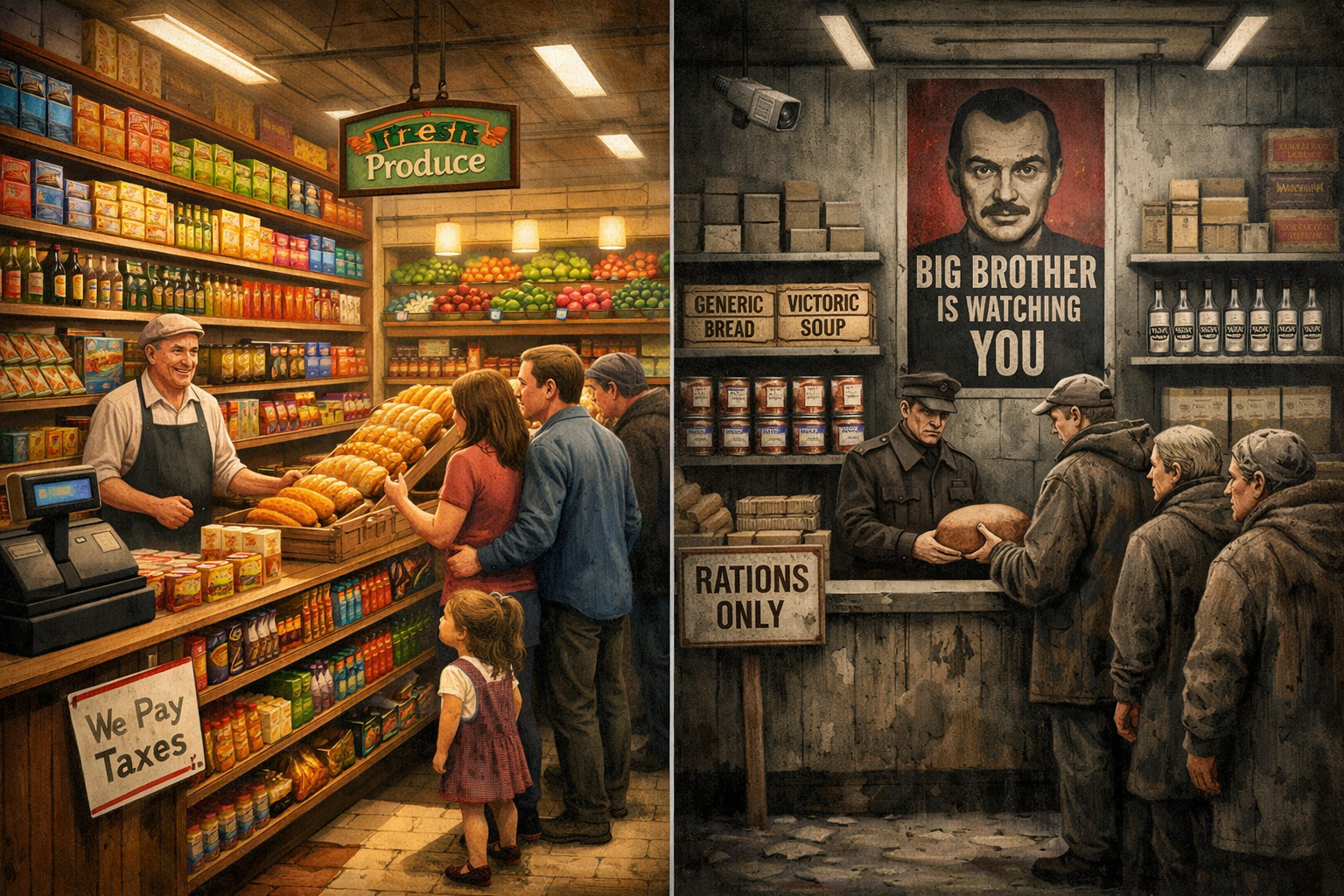
A private grocer stocks shelves according to customer demand. He pays taxes and offers both premium and generic products to keep customers satisfied and returning. Both consumer desire and state coffers benefit.
A government grocer, by contrast, stocks shelves according to bureaucrats’ whims while consuming tax dollars. No revenue is generated, only consumed. Generic products dominate to reduce costs. Customer satisfaction is secondary; shoppers make do with what is available.
In the first case, customer needs are met, and revenue is generated. In the second, customers accept what the government decides is best, while public resources are diverted elsewhere, or public debt grows. As private grocers disappear, revenues decline, and the specter of austerity looms. To the extent that they survive, a two-tiered system of choice and quality prevails.
Risk shifts from the private sector to the public, placing the burden of failure on taxpayers. Grocers no longer compete to offer a variety of breads; instead, customers line up for whatever the government provides, carrying it back to cramped apartments, both purchased with modest state support. The wide selection of alcoholic drinks is replaced with something like Victory Gin. It dulls the senses well enough, but the government will not pay for it.
Imagine such a world: Orwell’s Nineteen Eighty-Four made real. There, the proles accept what Big Brother allows them to have. They love Big Brother—or at least, they must. What choice do they have?
Remember when Joe Biden said he decided to run for president because of the “Unite the Right” event in Charlottesville, Virginia? Apparently, there were “very fine people, on both sides” in Charlotteville—at least from the perspective of the Southern Poverty Law Center (SPLC).
Yesterday, FBI Director Kash Patel and the Department of Justice announced an eleven-count federal indictment against the SPLC, alleging that the organization secretly paid over 3 million dollars to individuals connected to extremist or hate groups between 2014 and 2023. The SPLC used shell companies or disguised entities to route those payments, and failed to fully disclose the activities to donors or financial institutions. The charges include wire fraud, bank fraud, and conspiracy to commit money laundering. Patel characterized the conduct as the SPLC “not dismantling extremist groups, but manufacturing extremism,” and accused it of misleading donors about how their contributions were being used.
I have written about the SPLC previously. In 2018, I published The Irony of the Southern Poverty Law Center’s Authoritarian Desire, in which I criticize the organization’s double standard, especially its failure to treat black nationalism and Islam as extremist movements. More recently, in 2023, I published Southern Poverty Law Center Defames Parents Invested in Safeguarding Children, which defends the parents’ rights group Moms for Liberty against the SPLC’s attempt to designate that organization as a hate group. The SPLC manufactures hate groups to maintain the perception on the left that conservative Christianity and white supremacy remain significant threats to ethnic, religious, and sexual minorities.
In a twist that would make even the most jaded satirist blush, the very organization that once lectured the nation about spotting “hate” now stands accused of secretly funneling millions to the very extremists it claimed to be fighting. While the SPLC busied itself branding half the country as bigots and elevating Charlottesville into a sacred parable of American wickedness, it was apparently writing checks—through layers of shell companies—to the very dragons it professed to slay. The irony is almost poetic: the self-appointed guardians of tolerance didn’t just fail to dismantle extremism—they allegedly helped bankroll it, all while harvesting donations from those who trusted them to do the opposite.
In the Maddax song “Bitch,” from the 1987 Speed Demon, I do not sing that all women are bitches. I sing, “Some women are bitches.” The lyric goes, “Some women are bitches / telling me their lies / Best not fool with bitches / ’cause I ain’t got the time.” (Readers can hear the song here.)
This observation has implications not merely for personal relationships but also for the workplace and society more broadly.
Image borrowed from Yoko Ono’s webpage “Imagine Peace.”
As occupations are feminized, some women decide who’s hired, promoted, disciplined, or terminated, and how the organization functions, based on a worldview in which men are portrayed as oppressors, with women portrayed as victims deserving of special treatment for recompense. The feminized organization sees through a particular gaze and organizes work and its public face accordingly.
Men and women are different. They think and act differently. This is natural history. A feminized organization will accentuate traits common to women. And while such traits work in many areas of human endeavor (women are essential), this is not always true. And that’s okay. But since men are dismissed as oppressors, in whatever beneficial ways men may think or act, their thoughts and actions are, by definition, bad.
Hence, “toxic masculinity” and the need to feminize boys, or at least make them manageable with discipline or drugs. Masculinity is redefined as a “disorder.” Men should be more like women.
The knock-on effect is the presence of feminized men demanding to enter women’s spaces. In some places, they are allowed to, even if women object or are afraid to speak up out of fear of what will happen to them if they do. Most men are also afraid to speak up for the same reason. Many of them have also been feminized. Moreover, who wants to be a bigot? Who wants to be disciplined or dismissed?
Why are feminized men allowed to invade women’s spaces? “Kindness.” Society’s values have become feminized.
Cross-cultural psychological studies find that women score higher on measures of compassion, empathy, and prosocial behavior. They are higher on the personality dimension of “agreeableness.” Girls and women are more sociable. They are more collectivist in orientation. Men, by contrast, are more individualistic. The two orientations can only coexist if society is free and open.
To be sure, not all women are agreeable. Some women are bitches. They sit together at the mean-girls table. Their coffee mugs get shit done. Bitches use agreeableness to manipulate others. It’s an instrument of control. They demand compassion, empathy, and prosocial behavior from others to gain compliance. They wield these as weapons in a feminized context.
Another knock-on effect is a sharp decline in fertility. Nations can’t reproduce themselves. Borders are thrown open to foreigners to replenish the nation’s numbers. Why are the borders open? “Kindness.” Why the opposition to deportation? “Kindness.”
The maternal instinct to care for the future of the nation becomes transferred to the infantilized foreigner and the inner-city menace. Criminals are memorialized. Their victims’ murals are powerwashed from buildings.
Nor can the men in a feminized social order defend the nation from threats foreign and domestic. Men object to just war. Standards in the military (and policing) are lowered. Male aggression increasingly takes the form of primitive rebellion, which is channeled by globalists into societal disruption.
Are men not a danger to women? Some men are. On average, men are more likely to rape than women. Much more likely. Rapists are almost exclusively male, in fact. And that is why we don’t let them into women’s spaces.
Not all of us rape. Most of us don’t. We understand some do, and that’s why men established women-only spaces. Men know that the desire of some men to enter women’s spaces is because either they want access to women at their most vulnerable or they aren’t right in the head, in which case we don’t trust them around women (or children). Men are not as kind as women. Nature prepares men for danger.
The problem isn’t that women aren’t rational; it’s that men are. Some men are not afraid to say all this. We need more men to be unafraid.
(Note: This post is inspired by observations made by Helen Andrews. Readers can find her work here. I am also inspired by two others. Lionel Shriver and Andrew Wilson. Readers can find Shriver’s work in numerous outlets. Wilson’s work can be found here. I do not agree with everything Wilson says, but entertaining his arguments is worth one’s while. Part of pulling one’s head out of the progressive space is waking up to how progressivism, which in part views the world through the feminist gaze, distorts normal human relations. This is one of the chief elements of woke.)
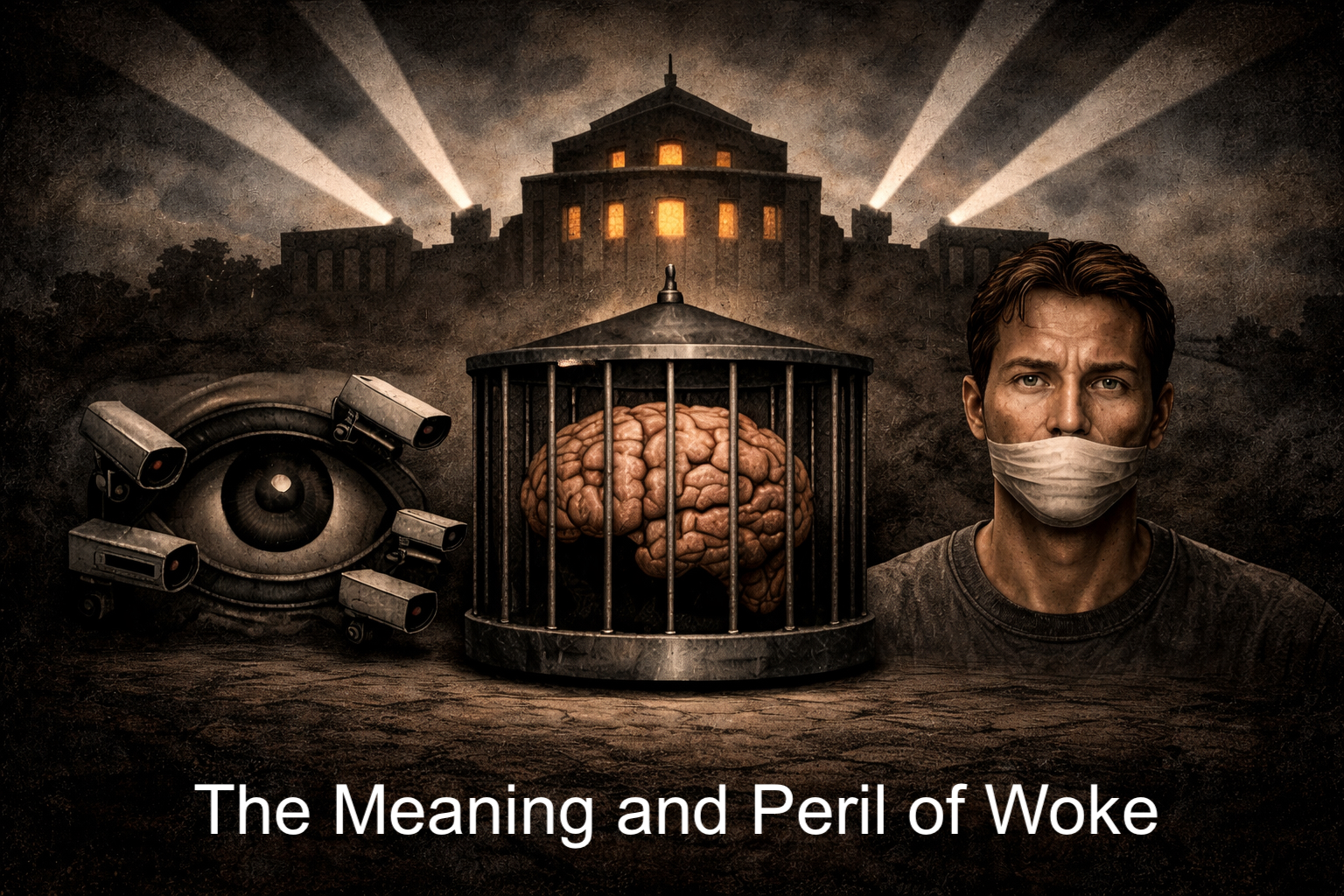
Do you understand what “woke” means? You should, because if you use the term, you might reasonably expect an interlocutor to ask you to define it. This may feel like an attack via semantics, but being asked to define one’s terms is a legitimate request. Many people use terms without knowing their meaning, and this can trip up an earnest man. I will define the term in this essay so that everyone is on the same page. I will do more than this. I will also show why woke imperils the American Republic.
“Woke” has a long history. It originated in black circles. I will set aside that history for now, since today’s woke ideology is a progressive adaptation used by paternalistic whites to ingratiate themselves with blacks and others (paternalism being an intrinsic characteristic of the Democratic Party mentality) to recruit them for the corporatist project, which is in the service of the corporatocracy. (See Stay Woke. The Corporate State is Counting on it. At the bottom of this essay, I provide URLs to several other essays and a search prompt to find more.)
Woke ideology (it did so at its origin) divides the world into “perpetrator/oppressor” and “victim/oppressed” classes. The modern construction rests on a bastardized reading of Karl Marx’s critique of a world organized into bourgeois/capitalist and proletarian/worker classes—an actual form of social segmentation. In the hands of woke activists and propagandists, however, the divisions are artificial. The United States abolished racial segregation over sixty-two years ago. And gay people can marry. one has to step into oppression these days.
The paradigm of stepping into oppression in the woke frame is the cisgender versus transgender dynamic. Cisgender is a propaganda term for those who do not believe or say they are a gender they cannot possibly be. It functions to pathologize normality. Men are thus transformed into oppressors, and those among them who identify as women (or something else) become the oppressed.
With the “perpetrator-victim” model in place, woke ideology dispenses with any argument about whether exploitation or oppression is actually occurring. One might ask whether blacks are, on average, poorer than whites because of culture, but this is dismissed out of hand as a feature of “white supremacy.” The woke person judges “good” or “bad,” “right” or “wrong” solely based on one’s location in the respective groups that constitute the binary. A white, heterosexual, cisgender man, for instance, is guilty of oppression regardless of what he does. He is guilty simply because he belongs to the “oppressor” class. No justification for the attribution of guilt is required. It is given by the binary.
This is why those who identify with “oppressed“ groups—and their allies—rage rather than reason. If one attempts to argue from facts and logic, especially if one proceeds from the modern, rational model of justice, in which individuals are responsible for their own actions and not for what other (past/present) individuals do or have done, then one is denying “guilt” or “privilege.” That denial itself is treated as a further act of oppression. Any institutional logic operating according to the modern, rational model of justice becomes an oppressive structure and must be “reformed“ or torn down. The “just” institution suppresses thought and speech.
This binary worldview explains why blacks or other designated “victims” who reject the woke model are not considered authentically black (or authentically whatever identity they assign themselves). They become “race traitors” or traitors of some other sort because they have denied the binary and are thereby excommunicated from the victim/oppressed group. Black men become “Uncle Toms” or “house niggers.” A detransitioner either never was really a queer person or is an attention-seeking or gullible person serving as a pawn of the cisgendered class of oppressors.
Woke works from the strategy of emotional blackmail. Those deemed “perpetrators/oppressors” are made to feel guilty of some collective offense and obligated to sacrifice their “privilege” and atone for their sins by paying some form of reparations—whether through cash payments, public assistance, or deference to members of the “oppressed” class, i.e, subordination to a new hierarchy—to repair the harm they have allegedly perpetrated. Many of those identified as oppressors fall in line with the demands of those who claim oppression. (See For the Good of Your Soul: Tribal Stigma and the God of Reparations.)
Image by Sora
I earlier noted that I would not dig into the origins of the word. However, the woke mutation has a history before being labeled as such. Woke is ultimately rooted in the paternalism of the slavocracy, carried over into the corporatocracy it replaced in the latter nineteenth century, both represented by the Democratic Party. Progressivism is essentially a corporatist ideology suited to changed circumstances following Emancipation. As noted in previous essays, progressivism gained momentum during the Presidency of Woodrow Wilson and became fully established under Franklin Roosevelt and the New Deal. Afterwards, it shaped the development of the welfare state, which Friedrich Hayek critiques as the road to serfdom in his book by that title.
Published in 1944, The Road to Serfdom, widely recognized as a seminal work of political philosophy, Hayek argues that government planning inevitably leads to the loss of individual liberties and the rise of totalitarianism. He contends that even well-intentioned social policies erode the rule of law by centralizing power, eventually transforming free citizens into “serfs” of the state. For Hayek, a competitive market largely free of government intervention is the only system capable of preserving personal freedom and democratic institutions.
In The Constitution of Liberty, published in 1960, Hayek argues that individual freedom, or liberty, is not just a moral right but essential for social progress. He defines liberty as the “absence of coercion” by others, asserting that because human knowledge is inherently limited, society thrives best when individuals are free to use the information they select, pertinent to their situation, to pursue their goals. He emphasizes that this freedom must be protected by the rule of law—a system of general, predictable rules that apply equally to everyone—rather than by the arbitrary whims of government. Attempts to achieve “social justice” through redistribution of resources undermine the very legal framework that makes a free and prosperous society possible.
Progressivism has proved Hayek’s warning correct. Particularly through the expansive welfare programs of the Great Society era and subsequent policies, the administrative state and technocratic control fostered dependency in the black community by restructuring economic incentives in ways that undermined the two-parent family. Before the mid-1960s, black Americans maintained relatively stable family structures, with marriage rates often comparable to or higher than those of whites. The percentage of out-of-wedlock births was relatively small. In the wake of Civil Rights, Progressive policies penalized marriage and rewarded single motherhood: welfare benefits were structured so that a mother typically received far more support when the father was absent from the home, effectively trading a husband for a government check.
This paternalistic approach, rooted in the Democratic mentality of control and ingratiation, accelerated family breakdown, driving out-of-wedlock births among blacks to over 70 percent in subsequent decades and leaving only about 44 percent of black children living with their fathers today. The result has been generational reliance on state assistance rather than self-sufficiency, entrenching the very “victim” class that woke ideology requires while eroding the economic independence, personal responsibility, and social stability essential to genuine advancement.
The purpose, or at least the function, of the welfare state is to advance administrative control over the population. This development gave Democrats a dependable voting bloc by making the fate of blacks dependent on public assistance.
The “victim/oppressed” mentality is characteristically totalitarian. Operating from a collectivist logic, it demands that the supposed oppressors refrain from using words or articulating arguments that the alleged victims find objectionable or offensive. More than this, it insists that institutions adopt the woke model and establish codes and rules that systematically privilege members of the “victim” groups. Collectivism for the woke is contingent and selective. While it moves from collectivistic language, it demands individual expression exclusively for itself. Moreover, it denies group rights to the alleged oppressor class.
Consider the queer demand that women as a class (women, i.e., adult female humans, are an objective biological class) compromise sex-exclusive spaces and activities—bathrooms, locker rooms, sports, and so fort—by allowing men who identify as women, whether because they are delusional or because they wish to compel others to participate in their sexual fetish, into women’s spaces. The equity requirement is suspended for women and lesbians because, as a matter of social justice, members of the victim class deserve dispensation by virtue of their alleged oppression.
I want to emphasize this point to make sure readers understand what queers are demanding. The argument they make is that the man who thinks or says he is a woman belongs to an “oppressed” class—he steps into oppression—and is therefore entitled to make demands on half the population, and on those of the other class of gender who value them, that they sacrifice their privacy and need for safety. Any argument about why it is wrong for men—for whatever reason—to invade women’s spaces or participate in female-exclusive activities is met not with a counterargument but with accusations of bigotry, i.e., “transphobia.”
Supreme Court Justice Clarence Thomas nails the problem with progressivism. https://t.co/mhn7pmDpRe
On April 15, in a speech at the University of Texas Austin Law School, Supreme Court Justice Clarence Thomas lambasts progressivism as a corrupting force. He begins by contrasting progressivism with the natural law foundation of the American Republic. “Progressivism seeks to replace the basic premises of the Declaration of Independence and hence our form of government,” he tells his audience. As a result, a spirit of “cynicism, rejection, hostility, and animus” toward America by Americans has taken hold. Progressivism “holds that our rights and our dignities come not from God, but from government,” he observes. “It requires of the people a subservience and weakness incompatible with a constitution premised on the transcendent origin of our rights.”
He argues that Washington has been overrun by appointed officials who lack commitment to “righteous cause, to traditional morality, to national defense, to free enterprise, to religious piety or to the original meaning of the Constitution.” “They recast themselves as Institutionalists, pragmatists or thoughtful moderates,” he observes, “as a way of justifying their failures to themselves, their consciences, and their country,” he said.
Thomas is here being charitable. It’s much darker than that. However, the judge points to the darkness by noting that the intellectual framework of progressivism is tied to totalitarian regimes, stating that the same ideas that brought about totalitarianism, including Nazism and Stalinism. These are “intertwined with the rise of progressivism,” he argued. Thomas identified the “administrative state” as a non-native and anti-democratic shift. He explicitly connected Wilsonian progressivism to the rise of European fascism.
Justice Thomas is not incorrect. One need only examine the birth-control movement to see the fingerprints of progressivism on the fascist movement. In the United States, those pushing the ideology advanced eugenics, which spread across the transatlantic world. In fact, Hitler drew heavily on the California sterilization laws when crafting his own racial hygiene policies; the Nazis modeled aspects of their program on American precedents and ultimately produced the Nuremberg Laws. Tens of thousands of poor, black, and disabled Americans were sterilized against their will in dozens of states. Tens of thousands more were sterilized in European countries. It is estimated that Germany sterilized over 400,000 men and women under its eugenics program.
Progressivism was also behind Planned Parenthood and the broader project to advance contraception as a means of population control. Moreover, the birth-control movement played a central role in the legalization of abortion. However much abortion was justified as an advance in women’s liberation, at its core, it sought to reduce the number of children born to impoverished and minority populations, who in the previous century had been dubbed the “dangerous classes.” Planned Parenthood targeted poor and black women (and it still does). The targeting dates back to the organization’s founding. Feminist icon Margaret Sanger (see the 1939 Negro Project) worked with progressive black clergy and community activists to reduce the black population as a means of confronting poverty. Today, Planned Parenthood continues to locate many of its offices in or near areas of poverty.
More broadly, progressivism champions corporatist arrangements, the organizational and structural logic common to fascism. Hayek understood this, and his efforts to inform the public about this connection drove much of his writing. When I had finished watching Justice Thomas’s speech, I predicted that corporate media would malign it. They can’t have the public learning that US progressivism is the paradigm of the type of technocratic control that underpinned fascism. The public cannot be allowed to hear unspun the fact that progressivism is profoundly illiberal.
A grand trick has been played on Americans. Progressives call themselves “liberals” and changed the meaning of the word in the public mind. A term that refers to a philosophy of legal equality, individualism, small government, freedom of thought, speech, and publishing, was repurposed to refer to preferential treatment, collectivism, big government, and suppression of thought, speech, and publishing—the diametric opposite of what liberalism actually means.
That progressives were able to repurpose liberalism, which tragically conservatives lean into, is proof of the extent to which progressives have captured America’s sense-making institutions. They control the administrative state, the culture industry, educational institutions, and the legacy media, as well as much of the social media. In Thomas’ words, we hear the true purpose of the republic and the force undermining that purpose. It’s not that the corporate media can’t see this. It’s that they can. Their job is to make sure you don’t.
Wokism is entirely antithetical to rational social relations. The woke insist on having everything on their own terms, and anyone who stands outside the oppressed groups, or who refuses to be an ally, is to be marginalized and, frequently, made the target of violence. It does this by engendering the spirit of “cynicism, rejection, hostility, and animus” among Americans toward America.
We see the woke at work in differential treatment for those who encounter the criminal justice system. When the “oppressed” engage in crime or violence, they are to be treated differently from those in the “oppressor” class. A black man who burglarizes a store is to be viewed sympathetically; his actions are seen by the woke as reparations-in-kind. He was driven to this by white supremacy, not the welfare and free-trade system Democrats engineered that left him without a father or a job. A black man who victimizes a white man is viewed the same way. Black-on-white crime is not a hate crime, but an act justified by racial oppression. (See Race and Violent Death in America; Demoralization and the Ferguson Effect; The Politics of Grievance: Primitive Rebellion and Rhetoric of Social Justice.)
Perpetrators from the “oppressed classes” are not merely to be excused for their behavior. The discursive formation of social justice encourages those classified as oppressed to pursue criminal and violent behavior. Their “victims” had it coming. Progressives saw in Friedrich Nietzsche’s concept of ressentiment—a psychological state of deep-seated hostility, envy, and powerlessness—a strategy. Nietzsche rightly saw the phenomenon as the origin of “slave morality,” arising when the weak cannot act on their natural impulses to dominate, turning their frustration and failure into a vengeful revaluation of values.
The strategy of ressentiment is so intrinsic to the progressive attitude that members of oppressed groups are excused not only for crime and violence visited upon those of the “oppressor classes,” but also predation on other members of the “oppressed class.” The logic of the perpetrator-victim model holds that it’s the conditions imposed upon them that explain the behavior, which must be excused because the behavior originates in collective oppression. A good person sympathizes with the real perpetrator and disregards the real victims.
We also see this in progressive attitudes to illegal immigration. The nonwhite immigrant is elevated above the citizens regardless of the citizen’s ethnicity or race because the factors that push millions of Third Worlders to violate borders were created by the oppressor class and its colonial and imperialist past. Only white Europeans can be colonizers. Only the global North can stand convicted of imperialism. And that is why they have to accept the stranger in their midst. (See The Progressive Politics of Mass Immigration; and Immigration, Colonialization, and the Struggle to Save the West.)
The white European immigrant has no business in America in the first place. Those Americans descended from white Europeans live on “stolen land.”
Progressives celebrate the coming white minority. Because whites are oppressors, reducing the white proportion of the American population can only be a good thing (see The Thing and Strategic Self-Loathing: The “Deny-Then-Justify” Response; “It’s Not Going to Stop.” The Managed Decline of the American Republic). They tell us that white concern over marginalization comes from a place of recognition of the grave sins of their forefathers. White people fear they have it coming to them because they know what they did. Actually, it comes from a recognition of what motivates progressives to marginalize whites. It’s progressives who enable by numbers the vengeance they have cultivated in the supposed oppressed class they have manufactured.
The perpetrator-victim model is indeed part of a dark project. The ultimate aim of woke ideology is not reform or justice, but the replacement of the liberal order—founded on individual rights, reason, equality under the law, and empirical reality—with a new hierarchy based on group identity and power. It proceeds via chaos (see The Woke Progressive Project of Catastrophism). In this new order, truth is subordinated to narrative, evidence yields to manufactured grievance, and freedom is sacrificed on the altar of selective equity.
What presents itself as compassion is, in reality, a mechanism of control. They tell us to “be kind” so they can be cruel. What claims to liberate the oppressed ultimately seeks to dominate the normal and sane. Unless this ideology is accurately named, confronted directly, and rejected unequivocally, it will continue to erode the foundations of a free and rational society until little remains worth defending.
The woke is not merely another way of looking at the world. It is not a classroom exercise in grasping a revised history and primitive justice. It is an existential threat to the West. The woke are the enemy of freedom and reason. Those indoctrinated with woke doctrine cannot be reasoned with because the doctrine is unreasonable. It is, by design, irrational and authoritarian. It can only be defeated, just as the totalitarian projects that came before—communism and fascism—and that confront us today, namely Islam, were and must continually be defeated. Birds of a feather flock together, they say. The flock is a mob, and understanding mob mentality is key to developing strategies that will defeat them.
A mass shooting in Shreveport, Louisiana, and, once more, the call goes up to restrict firearms. “You can’t fix people, but you can fix the gun laws.” Perhaps we can’t fix people, but does that mean citizens should lose the most effective means of self-defense from broken men who mean us harm?
We have to be able to defend our lives and the lives of others. Self-defense is among the most fundamental of human rights. Protecting the innocent is among our most sacred obligations. It may feel counterintuitive, but more guns are the answer. Studies show that as per capita firearm ownership increases, murder rates decrease. Firearms prevent gun violence.
The media directs the public to think that gun violence mostly takes the form of what occurred in Shreveport, which they describe as an act of violence in an ordinary town. Standing back, we see that gun violence is almost exclusively associated with the Blue City conditions and cultures. Gun violence—excluding suicide—disproportionately involves blacks.
But Shreveport is a Blue City. A few media outlets have shared photos of the Shreveport shooter. The man’s name is Shamar Elkins. Had the shooter been white, his name and image would be all over the media from the git-go. “Mass shooter” brings to mind young whites. But, in reality, white mass shooters are a minority in this type of violence.
Shreveport is 56 percent black. The Cedar Grove neighborhood is predominantly black. The shooting fits the pattern of many domestic-related shootings in urban areas. Shreveport has experienced a steady, long-term population decline, and violence is an endemic problem there.
French sociologist Émile Durkheim would ask observers to attend to that fact and consider it in the context of anomie, a condition of normative breakdown in disorganized communities. Combined with the dramatic overrepresentation of black men in gun violence, a picture emerges that our betters think we’d be better off not looking at or thinking about. Think instead about guns.
Excluding suicide is important in discussions about gun violence, since white rural males are overrepresented in suicide, and suicide with a gun is many times greater than gun homicides. Including suicide skews the statistics. However, Shreveport appears to be what’s called “family annihilation” or, more technically, “familicide.” In the end, the shooter was likely expecting to die. He may have sought suicide-by-cop.
You will hear about how America is different from other countries, given its level of gun violence. America is the “killing fields.” And Trump is ignoring the problem (people are even posting a video of Trump responding to a question about Alex Pretti and misrepresenting it as occurring yesterday). These things are being said across social media as I write this.
Gun violence is indeed greater in the US than in other similar countries. But, again, this has to do with inner-city violence. European states do not have large concentrations of blacks living in ghettos shaped by a culture of violence. This difference explains almost all of the variability in gun violence cross-nationally.
It’s irrational to call for restrictions on firearms because man annihilates his family, not because it is rare (it is), but because the argument gives guns agency, which, as inanimate objects, they cannot possess. Guns don’t shoot themselves. People pull the trigger. And broken people find other ways to perpetrate violence if denied guns. Moreover, the idea that restricting guns denies them to those who use them is a failure of imagination. Most of the guns used in America’s inner cities are not legally purchased by those who use them. And why should the freedoms of law-abiding citizens be taken away because of broken people?
Progressives mock “thoughts and prayers,” but that’s about the only thing one can do in situations like this—unless they mean to politicize gun rights. If society is serious about gun violence, it will have to confront the Blue City and the culture of violence dependency and fatherless entrenches there. It will, moreover, preserve the tools citizens require to defend themselves against the consequences of progressive social policies.
Mass shooter Shamar Elkins and his family, whom he annihilated
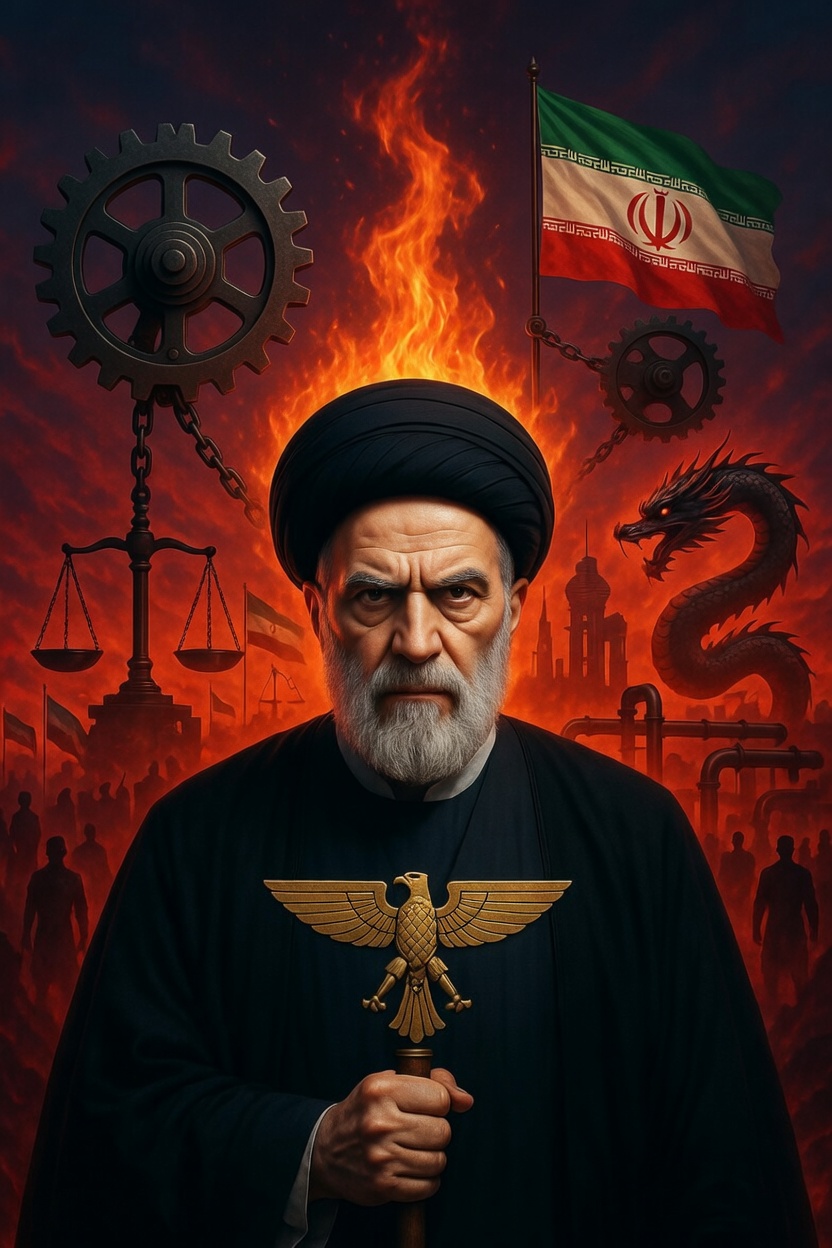
When I say “clerical fascism,” what do I mean? I am not saying that the Islamic Republic of Iran is identical to historical fascism, exemplified by Mussolini’s Regno d’Italia under the thumb of Partito Nazionale Fascista. What I am saying is that the Islamic Republic is the specter of fascism in the present day. It, moreover, shares elements with Hitler’s Nationalsozialistische Deutsche Arbeiterpartei (NSDAP), which governed the Deutsches Reich, commonly known as the Third Reich.
In this historical-comparative essay, I will show why describing the Islamic Republic as a fascist threat is appropriate. This necessitates a comparative analysis that delimits concepts. The sake of clarity demands disambiguating terms. In popular discourse, “fascism” is used loosely; glittering generalities rob terms of their usefulness in describing systems and things where they apply. I have used clerical fascism in the past without precisely defining it, so I will do so here. I will do more than this, however. I will show why opposition to preemptive war in Iran is rooted in the greater scheme of establishing a new world order. Whether aware of it or not, domestic opposition to Trump’s actions enables the transnationalist project.
I begin by explaining corporatism, an essential feature of fascism generally. Corporatism has implications beyond the Islamic Republic. The imperative of corporatism in the age of corporatocracy explains why progressives oppose preemptive military action in Iran. Corporatism is the planned governance model for the new world order. I next show why the Islamic Republic aligns with historic fascism in its essential nature, namely, palingenesis, an atavistic appeal to past civilizational glory. I then specify the Islamic Republic’s role in the transnationalist project, focusing on its relationship with China. I conclude by explaining why Donald Trump is not a neoconservative and why preemptive war in Iran does not parallel the motives behind the Second Persian Gulf War. This confusion is behind opposition to the President’s actions among factions of the political right. (Right-wing opposition to current hostilities is also rooted in the ancient hatred of Jews. However, I have covered this in numerous previous essays, so I will leave that to one side for today.)
* * *
The governing system of corporatism underpinned historical fascism. Corporatism is not unique to fascism. Fascism can be understood as authoritarian or state corporatism. Here, the government organizes society into officially sanctioned economic and social groups—employer associations, labor unions, and professional sectors—while tightly controlling them from above, in the fascist case via a one-party state. Behind these arrangements, one party or not, lurk powerful economic elites, namely, big corporations and financial institutions.
Unlike liberal capitalism or liberal pluralism, where, ideally, independent groups compete freely and are overseen by a republican government, fascist corporatism suppresses class conflict by forcing these groups to collaborate under state supervision. Labor representation is structured through state-approved corporations that claim to harmonize the interests of workers and employers for the collective good. This is also true for multiparty corporatism, as I will show in this section.
In practice, corporatism concentrates power in the state, limits genuine negotiation, and prioritizes political control and, in the fascist case, “national unity” over individual or class-based rights. The antagonisms between labor and capital are managed by incorporating labor into a corporatist structure to serve national interests as defined by the regime—again, sought and backed by elite economic power. Fascism, as Barrington Moore described it, is a revolution-from-above. But, then, so is corporatism generally.
Corporatism was not vanquished along with fascism. Corporatist arrangements prevail in present-day European states. Here, they are described as “neo-corporatist” to rhetorically distance them from historical fascism. However, as with fascism, the government organizes society into officially sanctioned economic and social groups—employer associations, labor unions, and professional sectors—while tightly controlling them from above.
Neo-corporatist arrangements operate within ostensibly democratic frameworks while remaining structured cooperation between employers’ organizations, labor unions, and the state. Rather than being imposed from above by a corporate state, neo-corporatists insist that these arrangements are based on negotiation and voluntary participation, described abstractly as “social partnerships.” Through formal and informal institutions, these partnerships collaborate on issues such as labor market policy and social welfare, ostensibly aiming to balance economic efficiency with social stability.
Countries such as Germany and the Scandinavian states are self-identified corporatist systems where centralized bargaining and consensus-building reduce labor-capital conflict and support coordinated economic policies for the sake of capitalist accumulation. Unlike authoritarian corporatism, modern European corporatism claims to preserve political pluralism, protect the autonomy of participating groups, and operate under the rule of law. Put simply, European elites dress corporatism in democratic garb.
It’s worth keeping in mind that Italian fascism was also a rule-of-law country. The regime did not immediately abolish all legal and institutional forms of the pre-fascist state. The monarchy remained, courts continued to function, and much of the bureaucratic and civil code structure was formally retained. The regime worked through existing legal frameworks while progressively subordinating them to fascist political control. Understanding this is useful for understanding the true nature of European neo-corporatism, where the existing institutional machinery is leveraged by corporate state elites to manage populations.
Not all forms of historical fascism are identical. Nazi Germany under Adolf Hitler departed from Mussolini’s approach in significant ways. Franz Neumann’s argument in Behemoth emphasizes a more fragmented and chaotic system in which competing power centers (military-industrial, party, SS, state bureaucratic interests) undermined coherent legal rationality. Nazi Germany was less a unified legal order and more a system of overlapping authorities and arbitrary power, where law became instrumental and contingent on regime priorities. The Nazi state governed by technocracy and terror rather than the rule of law. Nonetheless, Neumann describes National Socialism as “totalitarian state monopoly capitalism.”
Thus, an ostensible chief difference between historical fascism and neo-corporatism is that, whereas the former was a one-party state, the latter is a multiparty state. However, this is largely an illusion, since the corporatist structure cultivates one-party hegemony and marginalizes oppositional parties, as I explained in Monday’s essay (see Securing the Occidental Realm: Why US Action in Iran Serves Western Civilization, Not Just Israel).
The United States itself has long been on the corporatist path guided by progressive ideas and policies that emerged alongside the legal fiction of corporate personhood. The goal was to humanize corporate power through reform, regulation, and social welfarism. Over the course of development, progressivism and administrative governance increasingly supplanted liberalism and republicanism. These arrangements were institutionalized under the Franklin Roosevelt presidency, and administrative rule and technocratic control formed a fourth branch of government, corrupting and subordinating the three constitutionally specified branches. This is why deconstructing the administrative state is necessary to ensure a republican future.
We’re confronting a stubborn enemy. Although smashing fascist authoritarianism was noble, World War II was, in a very definite way, a struggle between what type of corporatism would rule the transatlantic space. The United States won, and administrative rule became the order of the day. This development prepared the United States for transnationalist reordering.
* * *
There is, however, a significant difference between historical fascism and neo-corporatism in one respect. Fascism in both Italy and Germany was deeply infused with palingenesis. Palingenesis involves a myth of national rebirth after a period of perceived decline. Mussolini and Hitler both framed their movements as a revolutionary force that would purge decadence, restore vitality, and create a renewed, unified nation.
Palingenesis is often used to portray Trump’s populist-nationalist project as fascist in character. However, the “Make America Great Again” movement is a call to return to a nation’s republican foundation and the American system, devised by Alexander Hamilton during George Washington’s presidency, and saved by Abraham Lincoln during the Civil War. Trump is calling for the restoration of the liberal-pluralist arrangements established by the American founders. That’s not palingenesis.
In contrast to America’s populist-nationalist revival, palingenesis is atavistic in that it draws on glorified visions of a heroic deep past—the Roman Empire in Italy or a mythic Aryan heritage in Germany—while promising a radical transformation of society in the present. The appeal to palingenesis was used by fascists to legitimate corporatist arrangements, justifying authoritarian control, mass mobilization, and exclusionary or violent policies, portrayed as necessary steps toward national regeneration. The liberal businessman from Queens has no ambitions of this sort.
What about the clerical piece in the term I frequently deploy? This is tied to the phenomenon of palingenesis. An analysis of historical clerical fascism finds that elements of organized religion—e.g., the Catholic hierarchy—entered into cooperative or mutually reinforcing relationships with authoritarian corporatist regimes, not merely out of coercion but because of perceived ideological overlap.
In Italy under Mussolini, for example, religious institutions supported and legitimized authoritarian governments that promised anti-communism, social order, and a restoration of traditional moral values. The clerical element does not mean that fascism was inherently religious (at least not in a traditional way), but that certain religious actors saw fascist movements as vehicles for doctrinal revitalization and protection against secular threats, aligning with the fascist emphasis on hierarchy and national rebirth.
That is the historical case. What about the present moment? When I use terms like “clerical fascism” or “Islamofascism” to describe, in particular, the Islamic Republic of Iran, I am describing a hybrid system that blends religious rule with authoritarian, ideologically driven governance. Here, “clerical” refers to the prominent role of religious authorities in shaping or directly controlling political power. The “fascism” piece highlights features such as an emphasis on collective identity and moral order over individual freedoms. Fascists seek limited political pluralism, strong state control over society, and suppression of dissent.
In this framing, the comparison is not that such regimes are identical to historical fascism and its clerical elements, but that they share certain structural or ideological similarities—especially the fusion of a unifying worldview with centralized authority and a project of social or cultural transformation.
* * *
Obviously, Iran is not a liberal capitalist system. Nor is it neo-corporatist in the European sense. Nonetheless, the Islamic Republic comes closer to the latter than the former. In Iran, private businesses and markets exist. There are corporations, and individuals can participate in market activity. However, the state, as it does in Europe, and did during the period of historical fascism, plays a dominant role in the economy, especially in major sectors like energy, finance, and heavy industry, subject to government control.
Iran is not governed by a one-party state in the strict sense. Like Europe, it doesn’t legally limit politics to a single party. However, in practice, opposition parties are heavily constrained; multiple political groupings exist and can participate in elections, but they must operate within strict ideological and constitutional limits set by the Islamic Republic. Moreover, parties or movements that are seen as challenging the core principles—the authority of the Supreme Leader or the Islamic framework of the state—are blocked from competing, disqualified from elections, restricted, or otherwise marginalized through legal and institutional mechanisms.
So, while Iran holds elections with multiple candidates and factions, those factions all operate within a tightly controlled system in which ultimate authority sits outside the party structure, and key institutions can decide who is allowed to run for office; the dominant institutions are ultimately controlled by Shi’a Islam. Thus, similar to European neo-corporatism, more than one political current is present, but the threat of pluralism is bounded by the overarching Islamist framework. For Europe, the overarching framework is corporatocracy.
As for the atavistic or palingenetic piece, in Iranian political discourse since 1979, the Islamic Republic is portrayed as a break from a corrupt or dependent past and the beginning of a renewed civilizational order. This includes narratives about restoring moral authenticity, reasserting independence from Western influence, and building a society grounded in Islamic principles after a period portrayed as decadence or foreign domination under the previous monarchy. In that sense, there is a recurring theme of national and moral “renewal” or “rebirth” that resembles what in historical fascism is described as palingenetic myth-making.
When I speak of “clerical fascism” in reference to the Islamic Republic of Iran, I am not claiming it is an exact replica of Mussolini’s Italy or Hitler’s Germany (neither of these historical forms of fascism replicates the other, for the record). Rather, I am identifying the Islamic Republic as the most prominent contemporary embodiment of fascism’s essential features: authoritarian corporatism fused with a totalizing ideological worldview, sharply constrained pluralism, state dominance over the economy, and a powerful palingenetic myth of moral and civilizational rebirth. Just as historical clerical fascism saw religious institutions align with corporatist authoritarianism in pursuit of shared goals of order, hierarchy, and anti-communism, Iran represents a modern hybrid in which Shi’a clerical authority provides the unifying ideological core. This fusion sustains centralized control while claiming the mantle of renewal.
Understanding these structural and ideological parallels is essential—not to flatten historical distinctions, but to recognize the persistent appeal and adaptability of such systems in the present day. Crucially, this reality justifies—morally and rationally—US military action in confronting the Islamic Republic.
* * *
When, after the Holocaust, we said “never again,” the hope was that the world would take that to heart and there would never be another regime like Hitler’s. It was understood then that, if Hitler had been confronted earlier, tens of millions of lives would have been spared from annihilation. But the world tolerated the Nazi state for twelve long years. It waited until Hitler had developed the capacity to make war on the world. It was only when it wreaked devastation, and its ally Imperialist Japan attacked Pearl Harbor, that the United States intervened. In hindsight, regrets emerged. The lesson was to never again regret failure to act in the moment.
The Islamic Republic of Iran has been in power for 47 years, developing its capacity to make war, terrorize the world, and oppress the Iranian people. It has long pursued a strategy of proxy warfare, regional aggression, and terrorism to expand its influence without engaging in direct, large-scale conventional wars. Through its powerful Islamic Revolutionary Guard Corps (IRGC) and the elite Quds Force, Tehran arms, funds, trains, and directs a network of militant groups—the “Axis of Resistance.”
This work includes supporting Hezbollah in Lebanon, which has built up a massive arsenal of rockets and engaged Israel in multiple conflicts while targeting Western interests, providing financial and military aid to Hamas and Palestinian Islamic Jihad in Gaza, materially backing of Houthi rebels in Yemen, who have attacked international shipping in the Red Sea and launched strikes toward Israel, and support for various Shiite militias in Iraq and Syria that have repeatedly targeted US forces.
The regime has been linked to direct terrorist plots abroad, including assassinations of dissidents and targeted attacks on Israeli and Jewish targets. Other aggressive actions include repeated threats to disrupt oil shipments through the Strait of Hormuz, advanced ballistic missile development, cyberattacks, and occasional direct missile and drone barrages against Israel. These efforts have fueled instability across Gaza, Lebanon, Syria, and Yemen, endangering, among other things, global energy routes and shipping lanes.
This proxy approach gives Iran, from its perspective, plausible deniability while projecting power across the region. But the denial is not plausible. The world can plainly see what Iran is about. These activities have led to the designation of Iranian-backed groups and the IRGC itself as terrorist organizations by multiple countries. Overall, Iran’s actions reflect a deliberate strategy of asymmetric confrontation aimed at weakening adversaries while advancing its ideological and geopolitical goals.
The Islamic Republic is not just a threat to the region, but plays a major role in advancing Chinese ambition. Iran and China maintain a deep strategic alignment rooted in long-term geopolitical interests, mutual economic dependence, and shared opposition to US influence. At the core of this partnership is the 25-year Comprehensive Strategic Partnership signed in 2021, under which China pledged hundreds of billions of dollars in investments—primarily in Iran’s infrastructure, petrochemical, and transportation sectors—in exchange for a reliable, heavily discounted supply of Iranian oil. China serves as Iran’s dominant trading partner, buying roughly 90 percent of its exported crude oil, providing Tehran with tens of billions in annual revenue that helps sustain its economy and government budget despite heavy Western sanctions.
This relationship extends beyond trade. Iran plays a key role in China’s Belt and Road Initiative (BRI), acting as a geographic bridge connecting Central Asia to the Middle East and offering potential overland energy routes that reduce reliance on vulnerable maritime chokepoints. Both nations cooperate closely in multilateral forums such as BRICS, of which Iran is a member, and the Shanghai Cooperation Organization, where they promote a multipolar world order that challenges Western dominance.
China provides diplomatic cover for Iran at the United Nations, helping broker regional deals (such as the 2023 Iran-Saudi rapprochement), and facilitating sanctions-evasion networks—including barter arrangements, front companies, and shadow fleets—that allow Iranian oil to reach Chinese refiners while generating revenue Tehran can redirect toward its military and proxy activities. On the security side, the alignment includes dual-use technology transfers, components for Iran’s missile and drone programs, and military cooperation.
China has stopped short of formal defense commitments or direct intervention in Iran’s conflicts. In practice, however, the partnership gives Iran a critical economic lifeline and international legitimacy, while giving China discounted energy, strategic footholds in the Persian Gulf region, and a partner in pushing back against US hegemony in the Middle East. The relationship is asymmetric—Iran depends far more on China than vice versa—but it has proven useful to Iran, serving as a cornerstone of the Islamic Republic’s ability to weather isolation and project regional power.
This relationship is what I have described in numerous essays as the twin totalitarian threat to the Peace of Westphalia, that is, the principle of autonomous sovereign nation-states in an international system governed by international law rooted in Enlightenment principles, which emerged in the West. The street-level manifestation of the twin totalitarian threat is the Red-Green Alliance, which enjoys major financial support from global elites and Democratic Party sympathies.
* * *
In The Clash of Civilizations and the Remaking of World Order, published in 1996, Samuel Huntington advanced a thesis arguing that, after the Cold War, global conflict would be driven less by economic and ideological differences and more by cultural and civilizational identities. Globalization and ideologies attendant to it have indeed weakened the liberal capitalist world order, bringing cultural differences to the fore. These differences have, in turn, been used to advance the transnational project to usher in a world neo-feudalist order.
Huntington described a world divided into major civilizations—Western, Islamic, Sinic (Chinese), Hindu, Orthodox, and others—and that these broad cultural blocs have deep-rooted differences in history, religious and moral values, and social organization. In this framework, Huntington suggested that future wars and tensions would most likely occur along the “fault lines” where these civilizations interact, rather than between individual nation-states competing primarily over systems, principally capitalism versus communism.
Huntington argued that modernization does not necessarily produce Westernization. Non-Western civilizations—especially Oriental ones—continue to develop on their own terms; more than this, they do not merely resist Western cultural and political dominance but seek to undermine Western hegemony and thus negate the principal moral force in world affairs.
In my graduate school days in the 1990s, during my studies in international political economy, influenced by the radical frame of postcolonial thought that had by then taken hold of sociology departments across the transatlantic space, I criticized in seminars Huntington’s thesis for what I then saw as an overgeneralization of cultures, a downplaying of internal diversity, and a risk of reinforcing the very divisions it described, insofar as his descriptions were accurate.
However, in a hallway conversation, one of my professors (who may not wish me to share his name) noted that while globalization was economically homogenizing the world, it was, by giving distinct cultures greater access to one another and increasing cross-cultural encounters, also creating the conditions in which civilizational tensions and conflicts could more readily emerge. The unfolding of history has proved his observation astute. Elites organizing the transnational project to bring the world under a global corporatist system could also see this development. They would leverage it to disorganize the international system and prepare the way to a new world order.
This is why Trump’s intervention in Iran is welcome—and why NATO has sidelined itself, while the corporate media portrays military action as folly. By weakening Iran, Trump marginalizes China. By restoring the American system and Western hegemony, Trump lays the groundwork for a rejuvenated Europe. Trump’s efforts to reorder the world along liberal lines retards the progress of the transnational project. Globalists understood the problem Trump presented the moment he descended the Golden Escalator in 2015. Even before he assumed the White House in 2017, the deep state moved to undermine him. Now Democrats demand the invocation of the Twenty-fifth Amendment and will certainly impeach him after the midterm elections.
* * *
The reduction of the Iran intervention to neoconservative ideology suffers from an impoverished understanding of what was essentially Cold War liberalism repurposed by the neoconservative wing of the pre-Trump Republican Party. This view, articulated by Richard Perle and Paul Wolfowitz, among others, and organized by the Project for a New American Century, was never merely hawkish; it insisted that the United States could and should use military power to export Western-style democracy, topple “rogue regimes,” and remake entire regions in its image. Beneath this was a project to command the world’s energy wealth. (See War Hawks and the Ugly American: The Origins of Bush’s Middle East Policy.)
This was the logic that drove the 2003 invasion of Iraq and subsequent occupation. Ba’athist Iraq under Saddam Hussein was a brutal secular dictatorship animated by Arab socialism and personalist tyranny, not an ideological civilization bent on global eschatological conquest. Removing Saddam was explicitly framed as an exercise in nation-building and democracy promotion, not narrow self-defense, albeit the imagery of chemical and nuclear weapons was used to frighten the public into support for the invasion and occupation. Nor was it about confronting globalization, but rather enabling it.
That project failed not because the intelligence was wrong but because the ideological premise—that every society is plastic enough to become a democracy once the dictator is gone—was false. Trump does not suffer from this illusion. Action in Iran is not a regime-change operation in the comprehensive meaning of that concept, even if regime change is a desirable outcome.
Iran is a categorically different situation. Its regime is neither Ba’athist nor Arab-socialist; it is a clerical totalitarian system that fuses Shi’a apocalyptic theology with modern totalitarian techniques. This is clerical fascism: an expansionist, anti-liberal ideology that rejects the very legitimacy of the Westphalian nation-state system in favor of exporting revolutionary theocracy through a cult of martyrdom, proxies, and nuclear blackmail. Like interwar European fascism, the Islamic Republic possesses a coherent worldview that is irreconcilable with liberal civilization. It denies the equality of peoples and faiths, explicitly seeks regional (and ultimately global) hegemony, and glorifies violence as redemptive.
Just as Nazi Germany in the 1930s was not just another authoritarian state but a civilizational threat that required early, decisive containment rather than endless negotiation and wishful thinking, the Islamic Republic represents a parallel danger today. Its nuclear program, its declared goal of erasing Israel, its arming of Hezbollah, Hamas, and the Houthis, and its doctrinal hatred of the “Great Satan” are doctrinal imperatives. A realist recognizes that some regimes are not partners to be appeased or democratized but enemies to be deterred or dismantled before they acquire the means to make their ideology unstoppable. The Islamic Republic cannot be reasoned with because it is an unreasonable entity. It can only be destroyed or marginalized (again and again). Moreover, its role in the scheme of things cannot be ignored. To be sure, Islam is a major security threat, but combined with the rise of China, the peril of tolerating Iran’s ambitions becomes existential.
Forceful pressure on Iran—maximum sanctions, targeted strikes on nuclear and other infrastructure, degradation of its military capabilities, support for internal dissent—is not neoconservative adventurism. The neocons wanted to transform the Middle East into a democratic utopia. In the words of the neoconservatives, the aim of the Second Persian Gulf War was to trigger a “democratic tsunami.” The realist case against clerical fascism, taken on its own, simply insists that we cannot allow a fascist-like power to acquire nuclear weapons and a delivery system.
We can no longer pretend Iran is merely a misunderstood nation-state. Nor can we fail to see links between Iran and those countries seeking to diminish the West. Saddam’s regime, however vicious, never posed that kind of existential ideological challenge that Iran and its alliances do. Recognizing the difference is not warmongering; it is learning the central lesson of the last century’s greatest failure of imagination. It moreover ignores the transnationalist project that shaped US foreign policy thinking before Trump.
Whether Democrats admit it or not, appeasement of Iran was not a rational strategy of containment, but a stance, intentional in action, that enabled the growth of Iranian power for purposes of entrenching the logic of globalization. We have to purge this mindset from America.
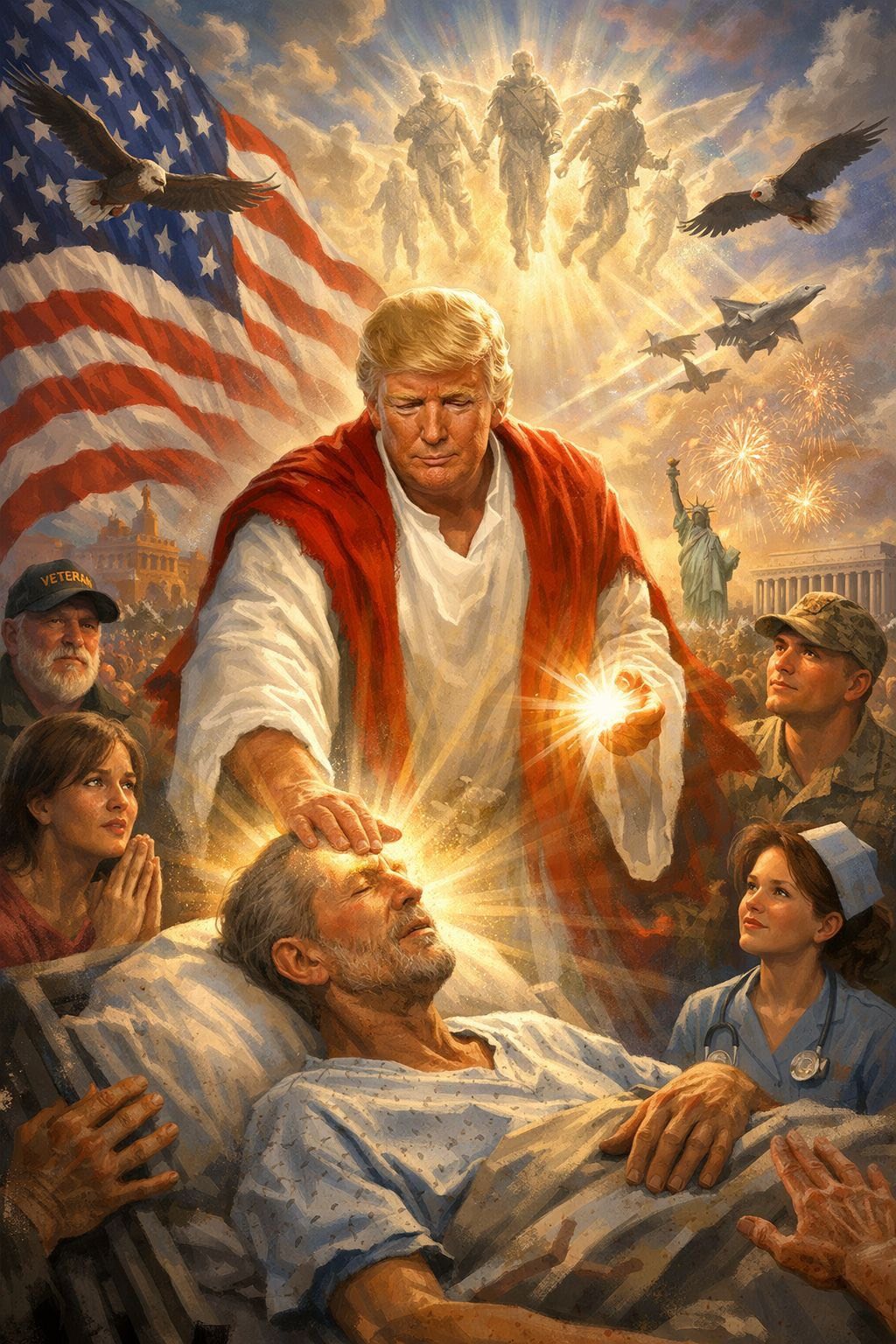
The recent furor over an illustration depicting Donald Trump in a quasi-religious pose—laying hands on a sick man, with the American flag behind him and surrounded by a nurse, soldiers, and veterans—perfectly illustrates the deranged mental state of much of the progressive left. Friedrich Nietzsche’s famous quip in Beyond Good and Evil puts the matter deftly: “In individuals, insanity is rare; but in groups, parties, nations, and epochs, it is the rule.”
The image the President shared evoked themes of national healing (a core part of Trump’s political message). It triggered an immediate and hysterical backlash. The hysteria was largely manufactured, as noted in yesterday’s essay (Trump Can’t Heal Mass Manufactured Hysteria), but impactful nonetheless, especially in the context of Democratic coordination with the Catholic Church hierarchy to split the MAGA coalition, already troubled by blue-hate American-only protest against the preemptive war in Iran.
Trump eventually had the image taken down, but he should not have. The overreaction reveals far more about his critics than about the image itself. But the President yielded to pressure from his own party. Establishment Republicans are terrified of the prospect of losing the mid-term elections. One might think that Trump should be, as well, but his instincts are channeled not by polls but by conviction. If he finds himself in a Senate trial adjudicating articles of impeachment, it will be because he was so committed to making America great again that he set aside political calculation. He knows what’s coming.
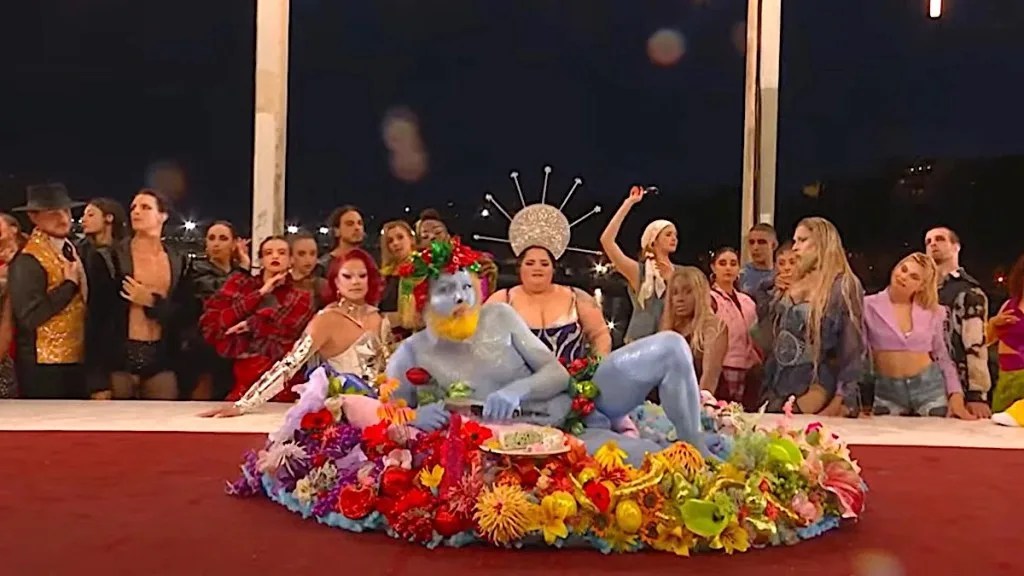
Readers may recall that, only two years earlier, during the 2024 Paris Olympics, the world witnessed a deliberate subversion of Leonardo da Vinci’s The Last Supper. A heavy-set woman portrayed Jesus Christ while performers pantomimed paraphilias around her. The scene was compounded by the appearance of Dionysus—the Greek god of debauchery and ecstasy—wheeled out on a platter overflowing with food.
The Paris spectacle was not merely a subtle artistic expression; it was an open mockery of one of Christianity’s most sacred moments, mixing it with Pagan imagery, staged at a global sporting event watched by millions across the planet. At the same Olympics, female boxers were punched in the face by individuals widely understood to be males; the opening ceremony was part of a greater propagandistic effort. Activists, authorities, and media insisted that what everyone could plainly see was not happening. In psychology, we know this as “gaslighting.”
Indeed, the juxtaposition of these images represents a textbook case of double gaslighting: the public is told to be horrified by Trump’s relatively tame spiritual imagery (not even a negative depiction of healing), while also being told that the Olympic scandals never really occurred, or at least were not what they appeared to be. There were no sexual perversions, no mockery of the Last Supper, and certainly no men beating women in the boxing ring. These males are women because they said or think they are. Move along—nothing to see here, bigot. Trump is the mad one.
This pattern of selective outrage and reality denial has become the defining feature of progressive discourse. When Donald Trump posts an image suggesting the healing of a divided nation, a button is pushed, and the left loses its collective mind. Yet when Christianity is openly mocked on the world stage and basic biological reality is denied in women’s sports, the same voices either celebrate it or pretend it didn’t happen. I am not a Christian; mocking the religion does not offend me. The problem isn’t mockery per se; it’s the weaponizing of religion to advance ideological and political agendas that’s the problem.
How can something so obviously propagandistic work? A comprehensive hegemonic apparatus—corporate media, cultural institutions, and political operatives—has created the preconditions for believing things that would otherwise be dismissed as obvious nonsense. They have conditioned the public to accept absurdities as truths.
It’s not just Trump’s supposed blasphemy. Many see American involvement in Iran as morally equivalent to Bush and Cheney’s folly in Iraq, forgetting (or never knowing) that leading Democrats gave the Bush regime authorization for military action in the Middle East and that much of the corporate media cheered it on at the time. Today, a just war or defensive action (both are applicable ethical standards) is treated as unforgivable aggression. Why? Because it occurs under the “wrong” administration. Imagine the Trump-as-healer image with Barack Obama in the place of the President. It’s not hard to. Nor is it hard to imagine how differently that would be taken.
If you are on the progressive left and find yourself dwelling in this level of unreality—where sacred imagery is only offensive when used by political enemies, males competing against women is “inclusive,” and wars of choice and a regime of torture are okay because they’re establishment—you are not engaging with the world as it is. You are living in a constructed narrative.
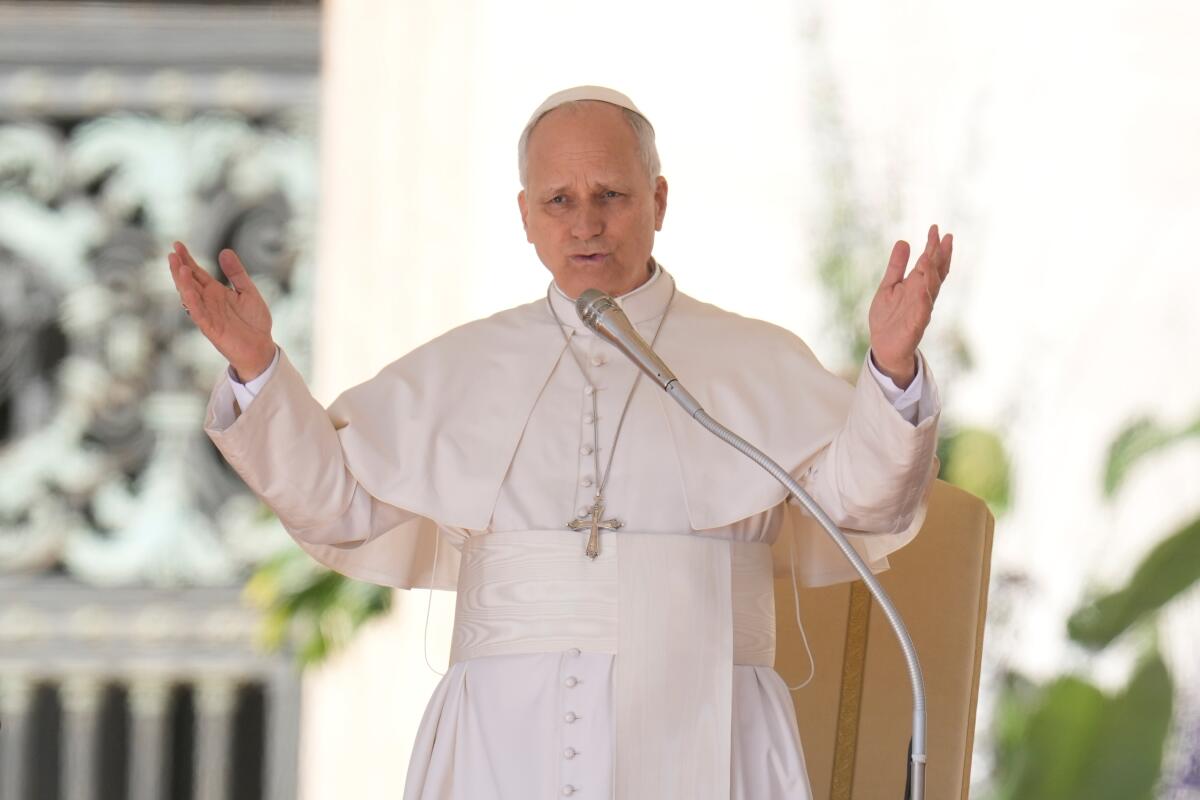
Progressive mass delusion is a given. They are too far gone. It’s conservatives who must be wary. The coordinated effort involving figures as high as the Pope and elements within the Democratic Party to turn faithful Christians against Trump by framing him as uniquely dangerous, mad, and ungodly is destabilizing the populist-nationalist project to reclaim the American Republic. If conservatives fall for this obvious ploy—if they allow themselves to be manipulated into opposing a leader who champions religious liberty and national renewal simply because the media and certain religious authorities tell them to—they should be ashamed of their gullibility. Conservatives, the Republic should be your calling now, if only because it will keep open the terrain for your religious faith. Progressive worship other gods.
The deeper question thoughtful persons must ask themselves is this: Who benefits from making so many people this susceptible to such crude manipulation? Who has spent decades shaping our institutions—education, media, and even parts of the Church—to erode critical thinking and replace it with reflexive ideological loyalty? How did they corrupt American culture? The Trump “healing” image controversy is not ultimately about one picture. It’s a symptom of a deeper sickness: a society in which tens of millions of people have lost their grip on reality, and demand that everyone else join in, exploding in rage when others refuse to play along. Don’t contract their madness.
The American people deserve leaders and institutions grounded in truth, not in performative outrage and gaslighting. Citizens deserve captains steady at the helm. The progressive left’s meltdown over a single image of national healing, while gaslighting the public about foundational truths, only proves how desperately that integrity and steadfastness are needed.
My first thought is that the Trump meme at the heart of l’indignation du jour, the one depicting the President as healer, a nurse by his side, surrounded by soldiers and veterans, doesn’t offend me because I’m not religious. Not being religious (and I include in this category quasi-religious doctrines like gender identity) unburdens a man from having to be offended by memes and satire.
Let’s put aside that the offensive meme doesn’t depict what people think it does (nowhere in the New Testament does it say Jesus wears a white tunic with a red cape—that’s Catholic fashion—or that the laying on of hands is forbidden). We’ll assume that it’s what they say it is for the sake of the point of today’s essay.
My second thought is that, even if I were a Christian, I can’t imagine Trump’s meme offending me. Now, if I were a Muslim and believed Trump was mocking Islam, I would be offended, because my religion infantilizes me. It regresses me to a childlike state in which I throw a tantrum anytime somebody pokes fun at Muhammad, the most perfect man in history. But Christianity? Shouldn’t the religion of reason yield reasonable adults?
The answer is no—albeit not uniformly. I should’ve expected some Christians to respond this way after witnessing the row over Monty Python’s The Life of Brian. The clergy missed the point of the film. Especially in the UK and the US, Christian organizations protested, arguing the film was blasphemous. The film was even banned or restricted in parts of the UK, Ireland, and (of all places) Norway. The public thought otherwise and embraced it. The Life of Brian was commercially successful and became one of the most popular comedies of its era. (It still holds up, and is at moments prophetic.)
The hysteria over Trump’s meme (which he took down a day after posting it) is about more than hurt religious sensibilities by humorless Christians; outrage is being manufactured to achieve a political end: the delegitimization of a US president. For what purpose does this end exist? The global elite must thwart the populist reclamation of the sovereign nation-state.
Global elites are livid that Trump degraded Iran’s capacity to wreak havoc in the region and especially that he threw a monkeywrench into the machinery of the Chinese project to project its governance model globally. Since rational thought can find no purchase in popular consciousness on the matter, elites avoid explaining why enabling totalitarian state monopoly capitalism is in the interest of the Common Man. Instead, they weaponize Christianity against the Peace of Westphalia. They selected another dogma that disregards the modern nation-state for their arsenal, as well: Islam.
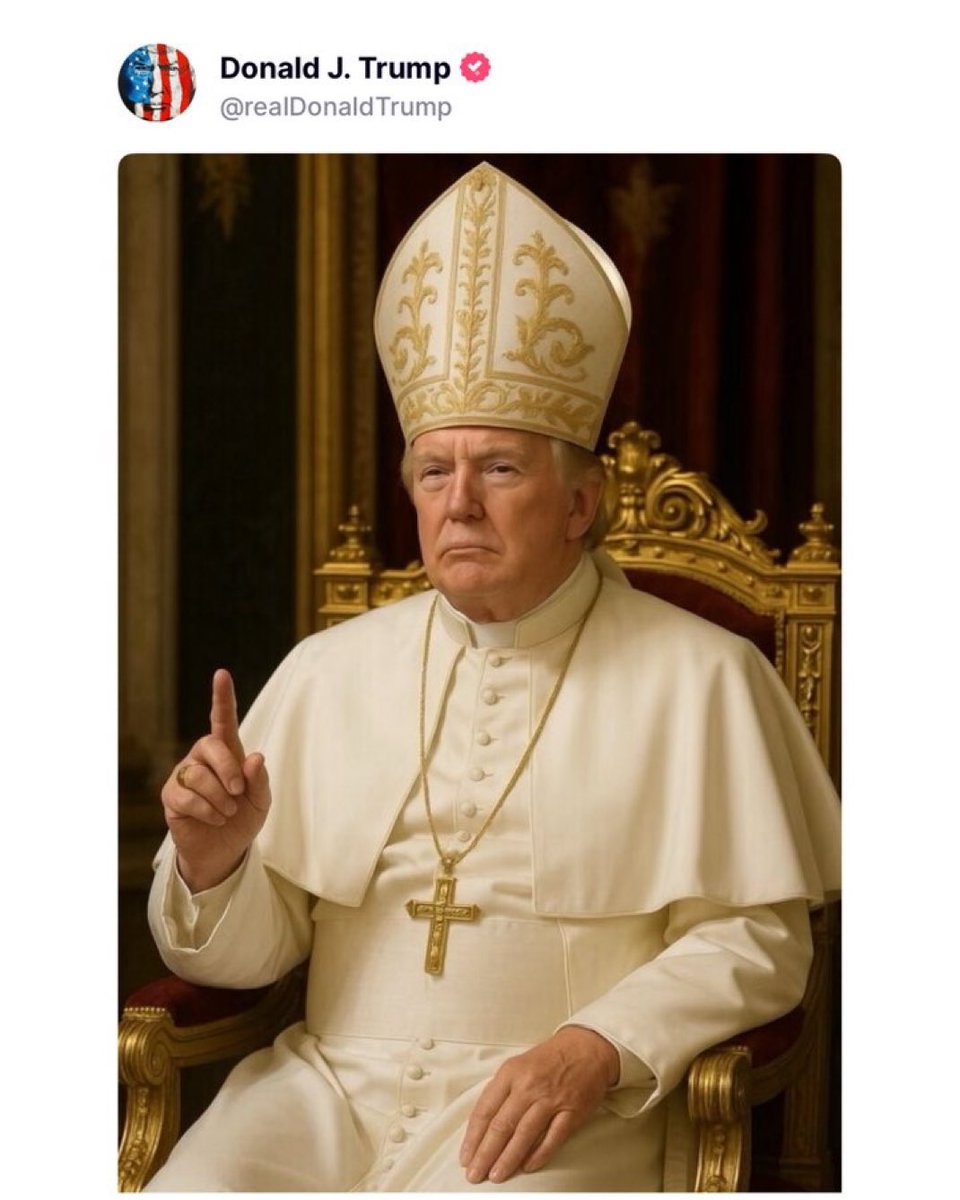
It mustn’t escape memory that progressives integrated the visage of Barack Obama with Christian iconography and declared him “The Second Coming” (of what exactly they were never clear). Nor will the attentive forget that Trump portrayed himself as the Pope in a May 3, 2025, TruthSocial post. Trump shared that meme just days before the Church elected Robert Francis Prevost (who took the name Leo XIV) as Pope. There was outrage over that meme, as well. Was their outrage over Obama’s usurpation of religious imagery for political gain? You will have trouble remembering any because there was so little.
It must be frustrating for elites. So much hysteria targeting the President has been manufactured that many are desensitized to the man’s memes and opinions. So, like a man developing tolerance to a drug, they have to keep upping the dosage for each fix.
I was never sensitive about Trump’s X posts in the first place (there was one several months ago that I thought did him no good, but I have forgotten the particulars like the rest of America). I recognized long ago that Trump is the same man who descended the Gold Escalator on June 16, 2015, and announced he was running for President. The world changed on that day. And elites are desperate to change it back.
US intervention in Iran is not solely for Israel’s sake (see America First is Not Israel First). Nor is it only about degrading Iran’s capacity to threaten its neighbors in the region and Europe. It’s about securing the Western realm, thwarting Communist China’s ambitions, and disrupting the transnational project to further undermine the Peace of Westphalia and establish a corporatist world order.
America can’t be first if it doesn’t lead the West, push Europe to reclaim the independent nation-state (Viktor Orbán’s loss in the Hungarian parliamentary elections is a setback), and extend the scope and depth of its security. “America Only,” the slogan of the blue-hat American First crowd, is America alone, and that means America last. Liberty and republicanism depend on US hegemony. (See Donald Trump’s Grand Vision: Make Western Civilization Great Again.)
For those unfamiliar with the Peace of Westphalia, it refers to a series of seventeenth-century treaties that marked a turning point in European history by establishing the principles of state sovereignty and non-interference in domestic affairs. The Peace of Westphalia is the foundation of the modern international system of independent nation-states. (I write about the Westphalia system in conjunction with the return of Lincolnesque Republicanism last year in my essay, Will They Break the Peace of Westphalia or Will We Save National Sovereignty for the Sake of the People?)
Regionalization is a direct assault on the Peace of Westphalia. To form the European Union (EU), member states “voluntarily” pool their sovereignty—in areas such as law, regulation, and trade—under common institutions. I say “voluntarily” because, whereas formally states join the European Union by choice and agree to its treaties, once inside, there are coercive or constraint-based elements that undermine their sovereignty. EU law enjoys supremacy in many areas, and its institutions enforce compliance through court rulings, financial penalties, or withholding funds. The European Commission can bring infringement proceedings against member states, and the European Court of Justice can issue binding decisions.
There are also more indirect pressures. Economically, abandoning or defying EU rules can be extremely costly, as seen in the disruption surrounding Brexit (the exception that proves the rule). Politically, smaller states have limited leverage compared to larger members like France or Germany, the latter the center of gravity for the pan-European superstate envisioned by National Socialism. Attendant to this is the advancement and entrenchment of progressive and social democratic forces in the various states, thereby cultivating popular loyalty to the superstate.
These forces are buttressed by the corporatist arrangements that mark the modern character of European states. Corporatism, often confused with socialism, is a government scheme in which the state organizes society into officially recognized groups—businesses, labor unions, professional associations—and coordinates them to manage economic and social policy. That corporatism is the essence of historical fascism is telling. At a minimum, corporatism is the instrument of corporatocratic governance.
Thus, the more accurate way to understand association with the EU is that entry is ostensibly voluntary, but membership creates binding obligations backed by enforcement and powerful incentives. Failure to comply can severely harm the populations of respective member states, principally through cultural disintegration.
It’s not only the smaller states that suffer national disorganization, but all the states, as seen in policies that open the French and German gates to non-Western populations with different cultural and religious systems who resist assimilation, forming ethnic enclaves that replicate those systems in the West. This phenomenon is the literal opposite of cultural integration.
Cultural disintegration is a feature of regionalization, and the loss of national integrity that results from it is an intentionally placed rot from within. The EU is thus antithetical to the Westphalian system on many fronts—it’s not cooperation between fully independent states, but a legal and political order that constrains and disrupts them from within by severely limiting national sovereignty and engineering cultural corruption.
The counterargument is that the EU doesn’t abolish sovereignty, but transforms it. But the counterargument actually bolsters my argument for this very reason; it admits what it is: transformation. Proponents of regionalization insist that member states choose to participate and can, at least in principle, leave, as Brexit demonstrated. But even if the sense of national sovereignty isn’t completely destroyed, populations are collectivized to achieve the goals of the transnational corporations and the world financial system. Proponents of regionalization argue that goals that individual states struggle to secure on their own are better achieved collectively. But this presumes that economic integration is a desirable goal. It’s rhetoric designed to justify the superstate by assuming the reasons for its existence are axiomatic and necessary.
The EU is described as a post-Westphalian system for a reason: it retains in rhetoric the ideals of the sovereign nation-state while adapting the various states under its control to a world where cooperation and interdependence are allegedly increasingly necessary, claims made by the very forces that seek to denationalize Europe.
The transnational world order is the same thing on a greater scale. Here, not only are the European states amalgamated into a regional corporatism that transcends national borders, but the nations of the world, including China, are integrated into the world capitalist system, not one based on sovereign nation-states but one shaped by transnational elites.
This development inevitably weakens the West and relatively strengthens the East. Oriental culture is antithetical to the Enlightenment principles of liberty and republicanism that mark the Occidental world. In contrast to the Occidental world, the Oriental world is characteristically collectivist, hierarchical, and traditional.
These terms—Oriental and Occidental—may be obscure to many and feel outdated to those who study such matters, but they are useful here. Oriental refers broadly to societies in Asia and the Middle East. Occidental refers to Europe and, later, the Americas. These labels often carried more than just geographic meaning—they were tied to assumptions about culture, economic organization, and governance, with Occidental societies representing individualism, modernism, and rationalism.
The Orientalism of the East is how communism (really totalitarian state monopoly capitalism) and Islam took hold of Eastern populations. Corporatist arrangements and the collectivism inherent in them prepared Europe for integration in the new world order. Throwing open the doors to Oriental culture undermines Western moral and political sensibilities—individualism, liberalism, and republicanism.
Why these terms feel old or sound obscure is a consequence of postmodernist colonization of the sensemaking institutions of Western societies. Students in universities across the transatlantic space are conditioned to perceive the terms as hallmarks of Western imperialist and racist thinking. Their professors leverage postcolonial scholarship, principally Edward Said’s book Orientalism, in which it is argued that such categories were not neutral descriptions but part of a broader system of thought that distorts understanding of non-Western societies and justifies imperialism.
Today, these terms are perceived as outdated or problematic because they allegedly oversimplify complex cultures and can carry colonial-era biases. The elite abandonment of the terms is exemplary of how transnationalist power shapes language to cut off avenues of critical thought to those who might resist globalization. By manufacturing a consensus that these terms provide cover for imperialism and racism, elites condition populations to perceive opposition to globalization as reactionary.
This linguistic and conceptual disarmament serves a deeper purpose: it prevents Occidentals from clearly recognizing the civilizational stakes in the struggle against regionalization and the nascent greater corporatist world order. An Occidental order rooted in the Westphalian system of sovereign nation-states, individual liberty, and republican self-government is being deliberately eroded from within by the very collectivist mechanisms—corporatist coordination between state and private power, mass demographic transformation, and supranational institutions—that ease the integration of European societies into a transnational framework. That framework, in turn, renders the West more compatible with, and ultimately subordinate to, the collectivist and hierarchical realities of the Oriental world.
The intervention in Iran must therefore be understood not as a narrow security operation or an act of altruism toward Israel, but as a necessary assertion of Occidental leadership. By disrupting Iran’s role as a node in the axis connecting radical Islam, China’s Belt and Road ambitions, and the broader transnational project, the United States reasserts the conditions under which the Westphalian order can be defended and renewed.
A sovereign, culturally coherent Europe—reclaiming its Occidental character—cannot emerge while it remains entangled in regional corporatism and exposed to Oriental influences that thrive on weakened national boundaries. Only American hegemony, exercised in the service of Western civilization rather than abstract globalism, can create the breathing room for European nations to reassert sovereignty, resist cultural disintegration, and reject the collectivist drift that prepares them for absorption into a post-Westphalian order.
An “America First” that refuses to lead the Occidental world is self-defeating. It leaves the field to China’s model of state capitalism fused with transnational corporate power, and to the Islamic and progressive forces (the Red-Green Alliance) that accelerate Europe’s internal rot.
Liberty and republicanism are not universal abstractions that flourish in a borderless corporatist vacuum; they are achievements of the Occidental tradition, sustained by independent nation-states capable of self-defense and cultural self-preservation. Securing the Western realm against Iran is thus inseparable from thwarting the larger project that seeks to dissolve the very distinctions that allow us to understand what is being lost and what must be reclaimed.
In this light, US action in Iran is not imperialism in the pejorative sense condemned by postmodern critics. Nor is it an expression of the neoconservatism that warped Cold War liberalism. It is the responsible exercise of hegemonic power by the leading Occidental republic to preserve the international system that made liberty possible. Without it, the transnational regionalization of the West will continue apace, the relative strengthening of the East will accelerate, and the promise of “Make Western Civilization Great Again” will remain an empty slogan rather than a governing vision.
The blue-hat American Alone crowd swarming X to express its collective disappointment with Donald Trump appears incapable of understanding what’s at stake. The ancient hatred of Jews has robbed them of the capacity for reason. They have been transformed into useful idiots for the transnational corporate project. Standing on the ground of such idiocy, they are also robbed of their capacity to feel embarrassment.
During most of World War II, the leader of the Catholic Church was Pope Pius XII. Pope Pius was a controversial figure because he did not clearly and explicitly condemn Nazi atrocities in official statements or public speeches. He avoided naming National Socialism, Adolf Hitler, or Jews directly in wartime messages.
Today, Pope Leo XIV criticizes Christians and Jews who take up arms and degrade the capacity of the new fascist threat to humanity, Shi’a Islam, while leaving free of criticism the clerical fascists who are massacring their own people, organizing terrorism, waging war by proxy, and seeking nuclear weapons.
If the Islamic Republic had its way with the world, if it were able to impose its vision on the West, we’d all be Muslim or dead. Women would be subordinated to male power. Homosexuals would suppress their nature to avoid public hanging. To ensure Islam can do none of these things, the West must degrade its capacity to wage war—and close the Western gate on mass migration from Muslim-majority countries.
The Red-Green Alliance couldn’t be happier with Pope Leo. He shames the enemies of unfreedom for resisting Islam’s ambitions. Anarchists and communists find useful those who tell their enemies to bow their heads and passively welcome the blow. Turn the other cheek lest you be a hypocrite—so that the other cheek may be struck.
Nietzsche criticized Christianity for promoting what he saw as a life-denying moral system. His disdain extended to the emphasis on pacifism. In The Antichrist, he argued that Christian ideals such as turning the other cheek, humility, and nonresistance were not virtues but symptoms of weakness—strategies developed by the powerless to restrain the strong.
For Nietzsche, pacifism suppressed natural human drives like ambition, strength, and the will to assert oneself. Denying these drives ultimately undermines human flourishing. A moral system that elevates conflict avoidance represents a dangerous decline in vitality. Such a system constitutes slave morality. I agree with that point for sure.
But not all Christians fit Nietzsche’s description. Christian men are not obliged to be the sheep of other men. In the Middle Ages, Christians took up swords against the barbarians and drove them out of Europe. They did not deny their natural right to defend themselves and their families. (See The Woke Emasculation of Christianity and the Road Back to Integrity.)
Pope Leo preaches today that we should not learn the lessons of history and leave the Islamic Republic and its proxies to gather power. Confronted with the oppressions of Islam and Communism, we should not fight but offer up our necks to the sword.
The strategies Nietzsche identifies are not the work of the powerless restraining the strong—at least not in the present case. In the present case, it’s the contrary. Today, those with ambitions of world domination—Shi’a Islam, Communist China—enjoy a pope who seeks to disarm those who would resist totalitarianisms by shaming them for their instinct to rise and fight—and for praying to God for protection and victory.
Readers must not forget Pope Leo’s criticism of restrictions on mass migration to the West. To be sure, he has—to appear reasonable—recognized the right of nations to enforce their borders; at the same time, he has condemned what he characterizes as harsh or inhumane treatment of migrants. His call for compassion, fairness, and respect for human dignity is for the migrant, not the people native to the Americas and Europe, who he asks to endure the effects of mass migration.
“Those who have built their lives over many years should not be cast aside without regard for their human story,” Pope Leo says. But what about the human stories of the native born and naturalized and well assimilated upon whom the consequences of mass migration are placed—the disordering of their cultures and communities, the loss of jobs and wage suppression, the drain on their resources, and the rise in crime and violence? “The suffering of migrants and refugees calls us to solidarity, not indifference,” he said. What about the suffering of nations caused by the migrant? What about the threat to the Western way of life? Shall we be indifferent to that? What solidarity is possible between those who love the West and those who despise and destroy it?
There’s a perfect metaphor for Pope Leo. Do I even need to say it? For the record, I warned you about this pope and his fondness for totalitarianism (see Pope Leo XIV and the Vatican-CCP Agreement). No man who asks Western men to turn the other cheek can speak for their civilization.
The globalists frame the contest between Trump and Pope Leo. In doing so, they elevate the status of a man whose loyalty is not to Western Civilization, but to its enemies. They legitimize the pontiff in a struggle between free societies and the twin totalitarianisms of Communism and Islam. They make holy an unholy father. They do this to diminish Trump to advance the transnational project.
Here’s my response to Pope Leo on X:
If our Christian ancestors had held this interpretation of the Word in the Middle Age, then they never would have taken up swords and expelled the Muslim hordes from Europe. Christianity would be dead or underground. And you couldn’t be the king of the Vatican. No throne upon…
To remind readers of the most prominent figures, they are Tucker Carlson, Alex Jones, Candice Owens, and Nick Fuentes. Their zombie followers are out in force at the moment (overnight was wild), attacking President Trump and his supporters. They gassed out on how much they sacrificed to see him elected to office, only to see him betray them and America First. For them, America First means severing ties to Israel (the Zionist puppetmaster) and going it alone in the world.
Three of the four are far-right Catholics. Carlson is Episcopalian, but is enamored by right-wing Catholicism. You’d think they’d get the threat Islam poses to the West. But antisemitism warps them. The zombies they control chant “America First,” but there is no America First until we’ve secured the realm. The West fought Islam and totalitarianism before. Were the Crusades orchestrated by the Jews? Would Carlson and his bunch have taken up swords? Did the Jews engineer the Cold War?
Pope Leo (who’s actually a king, by the way) is on their side, as well as the Reds and Greens who despise the West. Pope Leo spends his day condemning America and Israel and says not a damn thing about the thousands of Iranians butchered by the Islamic Republic. Antisemitism drives the madness common to the turncoats and woke types. How about Pope Leo? Is he antisemitic, as well? Do they altogether seek a Woke Reich?