What’s at Stake Tuesday

Hillary Clinton says voters don’t fully appreciate the consequences of voting GOP on Tuesday. I think they do. Republicans, especially the populists set to take over the party, or at least push it back towards its mid-nineteenth century roots, are better—much, much better—than Democrats on a range of issues: crime, culture, economy, education, immigration, medicine, and foreign policy. I will expand on some of those issues in this blog, but I will spend most of my words on the question of crime.

It’s obvious to attentive and compassionate Americans that standing down police and prosecutors and implementing various reforms, such as cashless bail, has compromised the criminal justice system’s ability to control serious deviant behavior; as a consequence, the United States is now experiencing a wave of crime, an increase that comes after decades of significant reductions in criminal offending—reductions that resulted largely from the vast expansion of the criminal justice apparatus in the early 1990s.

How serious is the crime problem? According to National Incident-Based Reporting System (NIBRS) data, between 2020 and 2021, violent crime incidents and offenses increased 29 and 27.5 percent respectively. Homicide for both increased by more than 40 percent. Robbery by 18 percent. Rape incidents and offenses by 38 and 37 percent respectively. Property-crime incidents and offenses 22 percent and 21 percent respectively. 

Taking a longer view, we can date the upward trend in serious crime to the year of Ferguson, the moment that decades of manufacturing of mass (false) belief in systemic racism found its poster child in Michael Brown. “Hands up.” (See Demoralization and the Ferguson Effect: What the Left and Right Get Right (and Wrong) About Crime and Violence.)

FBI

Clinton, who you will recall referred to black youth in the 1990s as “super predators,” claimed recently that red states are as bad for homicide as blue states. Wrong unit of analysis. Crime is worst in cities run by progressive Democrats. In fact, of the 30 American cities with the highest murder rates, 27 have Democratic mayors—and at least 14 Soros-backed prosecutors, with many more prosecutors politically progressive and sympathetic to the woke line.

As alluded to earlier, the increase in crime is not only because Democrats have weakened the criminal justice response; Democrats have given young black men and women permission to commit crime as reparations-in-kind. (See Is There Systemic Anti-White Racism?)

Over the last decade, the corporate state media, legitimizing its propaganda by appealing to the expertise of the progressional and managerial strata, functionaries (or effectively so) ensconced in academic institutions, and grievance merchants standing up activist organizations, have pursued a campaign to convince Americans that the nation is shot through with racism and that whites are to blame.

Zack Goldberg “How the Media Led the Great Racial Awakening,” Tablet (8/4/2020)

With the crackpot academic construction critical race theory in back of their public messaging, woke progressives aggressively disseminate the falsehoods promulgated by the corrupt Black Lives Matter campaign, myths such as that cops prowling America’s inner cities looking for young black men to murder. (For more on BLM, see What’s Really Going On with #BlackLivesMatter; Corporations Own the Left. Black Lives Matter Proves it.)

Here’s the empirical reality: According to the Bureau of Justice Statistics’ Police-Public Contact Survey, around 60 million residents 16 years of age and older report having at least one contact with police annually. It might surprise you to learn the number is that large. In fact, it’s much larger than that, given that many individuals reporting contact have more than one encounter with the police in a year. What this means is that, with the US population at more than 330 million citizens and residents (with tens of millions more here illegally), the police have their hands full.

It might also surprise you (given media coverage) that most contacts involve white civilians, with females slightly more likely to experience contact with a police officer than males. However, males (at around 3 percent) are more likely than females (around 1 percent) to experience threats of use of force. A higher percentage of blacks (around 3 percent) and Hispanics (also around 3 percent) are likely to report experiencing threats or use of force than whites (at around 2 percent). Around 4 percent of blacks and the same percent of Hispanics report having been cuffed during contact, compared to around 2 percent of whites and other races.

That cuffing is reported as the most common use of force when force is reported is a significant fact. Cuffing has become routine at agencies because of the risk to officers when detainees and arrestees have their hands free. This change in policy has contributed to a significant reduction in death and injury occurring to police officers. (It’s a workplace safety issue.) The negative public perception around routine cuffing is driven by the fact that blacks and Hispanics are more likely to come into contact with police given the overrepresentation in serious crime.

The worst outcome of civilian-police encounters is lethal violence, resulting in either the death of the civilian or the death of an officer. The latter is a rare occurrence these days, however police officers in the United States kill approximately a thousand civilians annually.

According to Mapping Police Violence (based on police data, the Washington Post, and the website Fatal Encounters), around 97 percent of deaths result from shootings. Most of those shot by the police are armed and the majority of those killed are male—96 percent in 2020, according to the Washington Post (see my blog The Police are Sexist, too).

According to numerous sources, whites make up the largest proportion of those shot by the police, approximately half of the total number, with blacks and Hispanics in roughly equal proportions representing the other half of fatalities. Since many sources (the Washington Post/Fatal Encounters) mix ethnicity and race, and since most Hispanics are racially white, the proportion of whites killed, if ethnicity is abstracted out, becomes larger. 

Again, these facts might surprise the reader given the message pumped out by the culture and media industries. To be sure, black males, constituting around six percent of the US population, are overrepresented among those who are killed by the police (at around between a quarter and a third of the total number). However, contrary to the popular perceptions, for example one survey finding a large percentage of blacks and white progressives believing the police kill a thousand or more unarmed blacks annually, fatal police shootings of unarmed blacks number around 22 per year (the number is much larger for unarmed whites).

Isn’t any number of unarmed fatalities too many? The category “unarmed” is misleading given that hands and feet are prehistorically the first weapons men utilized in violent encounters with other men. Hundreds of deaths occur every year in the United States from hands and feet, or “personal weapons.” In fact, in 2020, FBI crime statistics found that 662 homicides were committed with personal weapons. That’s more people than were killed by rifles that year.

Zack Goldberg “How the Media Led the Great Racial Awakening,” Tablet (8/4/2020)

The prevailing woke progressive narrative has very real effects. In a recent article by Justin T. Pickett, Amanda Graham, and Francis T. Cullen, “The American Racial Divide in Fear of the Police,” published in Criminology in January of this year, a review of surveys finds that about four in 10 blacks report being “very afraid” of being killed by the police, a statistic that is roughly twice the share of black respondents who reported being “very afraid” of being murdered by criminals, a statistically much greater risk, as well as about four times the share of whites who reported being “very afraid” of being killed by the police.

In a survey conducted by Eric Kaufmann of the Manhattan Institute in April of last year, eight in 10 blacks believed that young black men were more likely to be shot to death by police than to die in a car accident. The risk of dying in a car accident is much greater than being shot by the police.

At a recent conference held in Nashville on issues concerning the black community, where I presented an analysis on these numbers, a panelist, Debbie Griffith, affiliated with the University of Central Florida, shared her doctoral work, “Lessons My Parents Taught Me: The Cultural Significance of ‘The Talk’ within the Black Family,” concerning that moment wherein black parents and community members sit down young black boys and teach them how to behave when interacting with cops as a life-saving exercise, instructions that come with the claim that cops are racist and see black males as a criminal threat (she used videos from Trevor Noah’s The Daily Show on Comedy Central to illustrate). An audience member pointed out that white families also have a version of the talk, since it is widely understood that cops have a dangerous job and assume males of any race or ethnicity are a potential threat (see Jerome Skolnick’s pioneering work on the “symbolic assailant” in Justice Without Trial). But there is a difference, the audience member noted: the talk in white families is not racialized.

The expected rebuttal is that it doesn’t have to be racialized for whites because cops aren’t racist against whites. However, given that there is no evidence that cops are racist or that black males are any more likely to be shot by cops than white males after taking into account benchmarks, such as proportional involvement in serious crime, as well as situational factors, for example pointing a gun at an officer or rushing officers with a knife, the function of the talk in black families is to socialize young black males with a false perception of police officers, a perception that leads many black males to behave more aggressively towards police officers—a trend that police officers have not only taken in stride, but has led to their being less likely to escalate force on their end compared to similar encounters with white civilians, who, again, despite being much less likely to be involved in serious crime, account for most deaths at the hands of police officers.

Again, there are racial disparities when viewed in relation to population. The most common explanations for these, as well as other disparities in the criminal justice system, are implicit race bias and systemic racism. I’m sure readers have heard as truth the facts that racial bias is woven into the system and its institutions, in addition to existing in the minds of officers, prosecutors, judges, and juries, and that systemic racism, the complex of institutional arrangements, structures, and systems that disadvantages blacks and other minorities, is a serious problem in American society and across the West. However, these claims are unsupported by the evidence.

The problem of racial bias in civilian police encounters has been extensively studied. I want to mention two that highlight the problem with disproportionality and perceptions of bias before moving on to the hot-button issue of fatal police encounters.

Charles Epp, Steven Maynard-Moody, and Donald Haider-Markel’s 2014 Pulled Over: How Police Stops Define Race and Citizenship, finds that, of drivers stopped by police, many of these stops constituting investigatory stops with neither reasonable suspicion nor probable cause to justify them (what we used to call “aggressive patrolling”), the proportion of racial minorities is almost double that of whites. Using traffic stops to get around Fourth Amendment law is a serious problem, and there definitely needs to be reform in this regard, but racial disparities in such stops—or in anything else in life—is not evidence of racism.

To illustrate, as I write in The Police are Sexist, too, “males are overrepresented in police shootings compared to females. In 2020, men were more than 25 times more likely to be shot and killed than women…. Are we to conclude from this that police are therefore sexist? Of course not. No one would assume that police are biased towards men and therefore more likely to shoot and kill them. No one assumes this because it’s immediately obvious that males are overrepresented in serious crime, whereas females are underrepresented.” I go on to elaborate the point: “male overrepresentation in serious crime causes men to interact with police more frequently than women and, as result, the risk of a lethal encounter with police officers is greater for men than women.”

Jack Glaser, in Suspect Race: Causes and Consequences of Racial Profiling, also published in 2014, contends that, while implicit stereotyping is not racism but an aspect of normal cognition (this was suggested decades before by Skolnick), it is nonetheless harmful and undesirable. In response to these and other findings, implicit bias training programs have been stood up across the nation to develop officer awareness of how attitudes and actions contribute to demographic disparities in the administration of the law. The body of assessments of these programs is not encouraging.

One of the difficulties with arguments from implicit race bias and systemic racism is that claims made on these grounds often take as evidence unexplained variation in racial differences, treating these as indicators of racism. Perhaps this is partially understandable given the difficulty in accessing the interior mental states of officers and criminal justice practitioners and the abstractness of notions of systems. However, it means that conclusions are the work of interpretations that rest, especially on notions of implicit racism, on unfalsifiable assumptions and circularity, where the fact of disparity become evidence of the cause of disparity. On the other hand, if disparities can be accounted for by other factors, the claims of systemic racism become increasingly untenable. 

Awareness of the problem of racial disparities in the criminal justice system is long standing. William Wilbanks, in The Myth of a Racist Criminal Justice System, published in 1986, produced a comprehensive survey of contemporary research studies, searching for evidence of discrimination by police, prosecutors, judges, and prison and parole officers, finding that, although individual cases of racial prejudice and discrimination do occur in the system, there is insufficient evidence to support a charge of systematic racism against blacks in the criminal justice system. “At every point, from arrest to parole,” Wilbanks concludes, “there is little or no evidence of an overall racial effect.”

Robert Sampson and Janet L. Lauritsen’s 1997 comprehensive review of studies of the criminal justice system, a metanalysis published in Crime and Justice, also finds “little evidence that racial disparities result from systematic, overt bias.” In the early 1980s, Joan Petersilia of the RAND corporation came to a similar conclusion.

I have confessed in earlier blogs that I dismissed or was ignorant of these studies in the 1990s when I was researching the historic relationship between racism and criminal justice process (see The Myth of Systemic Racism in Lethal Police-Civilian Encounters). But it’s curious that I was hardly the only pundit to forget or never know that the question had been answered.

Doubt about the claims of racial bias and systemic raised were raised anew in 2016 with the high-profile publication of Heather Mac Donald’s book The War on Cops. The book was followed by Harvard economist Roland Fryer’s 2019 paper, “An Empirical Analysis of Racial Differences in Police Use of Force,” published in the Journal of Political Economy, available much earlier as a preprint (2018) and a working paper (2016). The New York Times covered the working paper in a 2016 article, so the findings were widely available well before the summer months of 2020.

While finding unexplained disparities in nonlethal civilian-police encounters involving force, when turning his attention to the most extreme use of force, i.e., officer-involved shootings, Fryer found no racial differences in either the raw data or when contextual factors are considered. Fryer argues that the patterns in the data are consistent with a model in which police officers are utility maximizers. Fryer suggests that lethal force carries costs great enough to deter officers from using the highest level of force at their disposal.

Fryer is hardly alone in his failure to find racist patterns in lethal police shootings In 2018, psychologist Joseph Cesario and colleagues, in Social Psychological and Personality Science, found, adjusting for crime, no systematic evidence of anti-black disparities in fatal shootings, fatal shootings of unarmed citizens, or fatal shootings involving misidentification of harmless objects. The authors concluded that, when analyzing all shootings, exposure to police, given crime rate differences, accounts for the higher per capita rate of fatal police shootings for blacks. The fact pattern indicating exposure: at least half of homicides and more than half of robberies in America are attributable to black males. Moreover, black males account for some one-third of other serious crimes (aggravated assault, burglary).

David Johnson, Cesario, and others, in the pages of the 2019 Proceedings of the National Academy of Sciences, refer to the effect of rates of violent crime as the “exposure hypothesis,” i.e., that serious criminal activity increases the likelihood of officer-civilian encounters, and this influences the frequency of policing shootings. The evidence Johnson and associates used in their study indicate that, taking crime rates into account, the bias in shootings actually appears to be against whites. 

In a study published in Journal of Crime and Justice, also in 2019, Brandon Tregle and colleagues, when focusing on violent crime arrests or weapons offense arrests, found that blacks appear less likely to be fatally shot by police officers. Rutgers’ Charles Menifield and colleagues found, in a study published in Public Administration Review in 2019 that, although minority suspects are disproportionately killed by police, white officers appear to be no more likely to use lethal force against minorities than nonwhite officers. Most people killed by police are armed at the time of their fatal encounter, and more than two-thirds possess a gun.

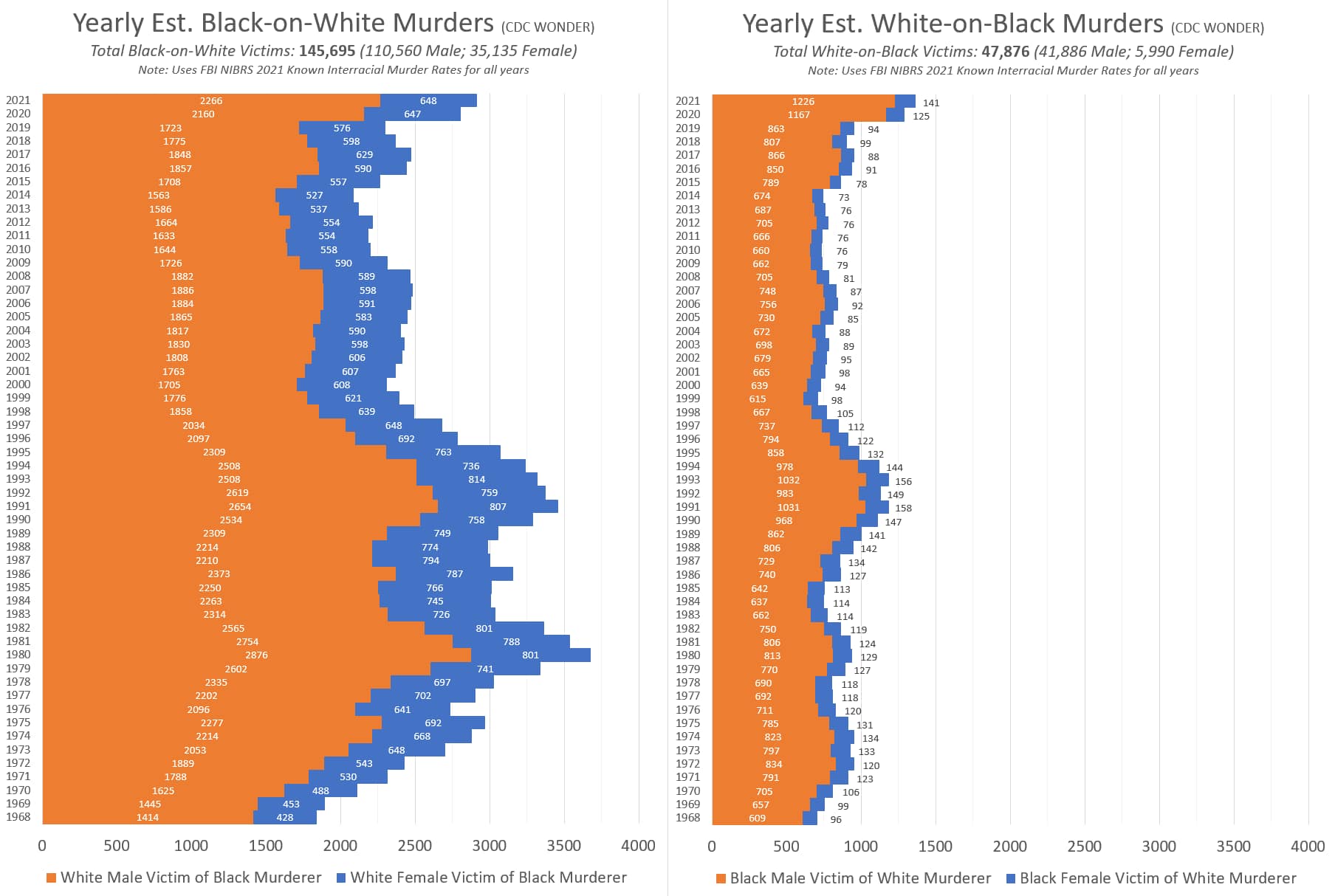
Public safety is a quality-of-life issue. Serious crime falls hardest on the poor and working class, especially black and brown people. The most recent statistics on homicide find that 8,543 blacks were murdered compared to 5,498 whites. On the offender side, 7,875 murders were black compared to 4,905 whites. And, although there are more white victims of robbery than black victims—79,566 to 43,164 respectively), there are disproportionately more black victims of robbery relative to population. At the same time, on the offender side, 93,252 robbers were black compared to 44,946. Numbers like these explain the disproportionality in black civilians in fatal police encounters—and why some studies find the unexplained bias actually running in the opposite direction from that claims by progressives.

FBI

The latest statistics from the FBI are horrifying. Consider that the vast majority of murderers are male and black males are only six percent of the population—black males are responsible for well over half of all murders, as well as account for well over half of the victims. Again, such prominent Democrats as Hillary Clinton are openly lying about all this by substituting for the statistics that condemn their policies irrelevant state-level statistics; serious crime is an urban problem. What else do we hear from them? Black lives matter. It doesn’t look like it, doesn’t it? 

Progressives cannot claim to speak for working people while undermining public safety. Ask yourself, why aren’t the progressives who run these cities working to fix the criminogenic conditions that disproportionately affect the marginal communities under their control? Why are they depolicing knowing that doing so makes these communities more dangerous, especially for the most vulnerable? Do not reason and compassion demand that, instead of rationalizing the situation in a manner that perpetuates crime and misery, and falsely accuses cops of racism, that those who claim to speak for marginalized populations would work to identify and solve the problems plaguing black people, the problems of idleness, dependency, fatherlessness, and mass immigration?

There are lots of other reasons to vote Democrats out of office. They have weakened the southern border, allowing millions of foreigners to enter the United States illegally. The empirical impact of mass immigration on the working class is not controversial in circles honest about evidence and effects. Foreign labor drives down wages for native and resident workers to the tune of hundreds of billions annually. Foreign labor takes the jobs of millions of native workers. Mass immigration disorganizes neighborhoods (especially black neighborhoods), fragments culture, and disrupts political formation. Mass immigration falls hardest on the poor and working class, especially black and brown people. Democrats cannot claim to speak for working people while undermining job and income security.

(I have written extensively on this topic on Freedom and Reason, Here’s a sampling: Joe Biden and the Ultimate Source of Our Strength; The Impact of Immigration on Labor and a Nagging Question; What is the Relationship of Immigration to Crime? The Situation at the Border and How to Respond to it; Bernie Sanders, Immigration, and Progressivism; Bernie Sanders Gets it on Open Borders Rhetoric—At Least He Did in 2015; Rationalizing the Border Crisis with Hysteria, Lies, and Smears; Democrats are Being Disingenuous on the Role of Security Fencing in Reducing Illegal Immigration and Crime; The Immigration Situation; The Need for Limits; Smearing Labor as Racist: The Globalist Project to Discredit the Working Class.)

The Democrats have weakened the educational system by prioritizing the dissemination of critical theories (gender, queer, race) over the teaching of critical subject areas. For Democrats, public instruction has become a vehicle for the indoctrination of children in woke progressive ideology.

(For a sampling of my writings on this topic, see Whose Spaces Are These Anyway? Political Advocacy in Public Schools; A Judge Stands on His Head to Save Woke Progressive Indoctrination; The Ethic of Transparency in Public Education—and the Problem of IndoctrinationBanning CRT in Public Instruction); If QAnon is Not a Deep State Construct, It Certainly Functions that WayThe LGBTQ Lobby Sues Florida.)

Central to the woke progressive project is disseminating the lie that the United States is essentially a white supremacist project (see Critical Race Theory: A New RacismWhat Critical Race Theory Is and Isn’t. Spoiler Alert: It’s Racist and Not MarxistCrenshaw Confesses: Critical Race Theory is About Racial ReckoningAwakening to the Problem of the Awokening: Unreasonableness and Quasi-religious Standards). This is the ideology that fed the BLM falsehoods about the criminal justice system—and the youth of America are being fed these falsehoods at a vulnerable age. Failing to teach children the necessary skills to be productive workers and rational thinkers effects poor and working-class children the most, especially black and brown students. Democrats would rather create future Democrats not autonomous individuals with the capacity to challenge their politics and policies.

The Democrats have compromised world peace through NATO expansion and waging a proxy against Russia by injecting tens of billions of dollars into Ukraine (see History and Sides-Taking in the Russo-Ukrainian War). To be sure, there are Republicans who have supported this effort, but Democrats are leading the project. These projects are schemes to drive hundreds of billions of dollars to transnational corporations and the armaments industry.

The Democrats were far and away the party most aggressively pushing lockdowns, social distancing, masks, and vaccines during the pandemic. (As with these other issues, my blogs on Freedom and Reason are many on this topic.) Have you wondered why Democrats aren’t running on the lockdowns, masks, and vaccines? I thought they saved us from the apocalypse. Millions would have died had they not taken away our freedoms and livelihoods—and robbed our children of years of social development. Such heroics sound like something politicians would be keen to run on. What gives?

Democrat policies are behind a series of shocks—COVID, Ukraine, monetary stimulus on a scale unprecedented since World War II—that is driving inflation. In short, supply chain disruption (bottlenecks, dislocations, shortages) caused by Democratic policies and their analogs across the trans-Atlantic sphere, fed by China and other foreign countries taking advantage of the weakness of the West. “On our watch, for the first time in 10 years, seniors are going to get the biggest increase in their Social Security checks they’ve gotten.” Mr. President, tell the people why: SS is chained to inflation.

I ask folks to consider why, now nearly half a century after Roe v Wade, Democrats did not in the meantime codify a woman’s right to her body. I will suggest to you that Democrats did not do so in order to conjure the specter of a conservative court to scare the votes out of women. The tactic failed. The court is conservative. And, with women divided on the question of abortion, and with the issue far down the list of voter concerns, the court’s ruling won’t make a difference at the polls. Conservatives are going to do what they do. Democrats failed to protect reproductive freedom. There’s no quick undoing of things. Other issues are more pressing: crime, war, and the corporate state. Don’t be a reflex. Think.

The overall problem with the Democrats I have discussed many times on Freedom and Reason. The United States was founded as a liberal republic, an instantiation of Enlightenment ideals, embodying the principles of democracy, humanism, rationalism, and secularism, codified in the Constitution and its Bill of Rights, signaled to the world as the American Creed. For the code and creed to live requires patriotism and attention to national integrity. The aims of the Democrats and their philosophy of progressivism are antithetical to the liberalism nationalism that founded the nation. The Democrats are transnationalist in ambition. Globalism undermines national sovereignty. The Democrats preach cultural pluralism, an ideology that undermines common culture and the solidarity built around a shared language and understanding of the establishment of America as a place where the individual is sovereign and the purpose of government is to enable each citizen to realize in total their human nature.

Censoring and Punishing the Heterodox

The practice of power that presumes an orthodoxy, i.e., that there is a right way to think about some matter, for example the claims of the genderist, such that a side can claim to be offended or harmed by contradiction and therefore justifiably censor any heterodox position and even punish the person expressing the contrary position, is quintessentially authoritarian in character. It follows that resisting censorship of, and punishment for, contrary speech has its own purpose: the preservation of liberty and democracy.

Censorship and punishment for heterodox views occur because those who assert the orthodoxy of their own view lack confidence in them and therefore exclude contradiction by censoring and silencing those who dissent from them. Those who truly have confidence in their views, that is, those who expect their views to win the day after a full airing of them and their contradictions, do not fear contradiction.

The geocentrists sought to prevent heliocentrism from having its day in the sun. Flat-earthers marginalized the round-earthers. Creationists sought to exclude the arguments of the evolutionists. But, today, the geocentrists, the flat-earthers, and the creationists are neither censored nor punished; their theories pose no real threat to the orthodoxies to which they now find themselves subordinated. These orthodoxies are confident in themselves because they won the debates on merit in the face of the censors. But the crackpot theory of the genderist cannot win the day on fact and reason, so he must censor and punish the contrarian.

For the genderist to operate–or at least count on others to operate for him–the machinery of censorship and punishment, his apparent orthodoxy must find purchase in the institutions of power, for this where lie the cultural, economic, political, and social forces necessary to impose ideologies upon the masses.

Whereas in the past, false orthodoxies were backed by dominant religious institutions, today, these forces converge in the corporate state, the intersection of big industrial and financial organizations, public administration, and the associated political framework that reproduces and normalizes that power through culture, law, and policy. If gender theory, as well as queer theory and critical race theory, did not have in back of them the corporate state, they would wither and die; their claims could not withstand the lights of fact and reason.

One question with which we must therefore concern ourselves is why the corporate state settled on these particular crackpot theories as the foundation of modern-day quasi-religious dogma. In Galileo’s day, the Church was concerned with his theory not merely because they lacked confidence in their own (many of them already knew they were wrong about the relationship of the sun to the earth) but because the apparent orthodoxy concerning the solar system preserved the dogma that legitimized their power–and not only the institution of religion, but the order of things that had prevailed all around for centuries. They knew that, if science were to replace religion, then the presence of the priest would diminish, and the forces the priest operated would be worked anew by those who had reason on their side.

Today, the body of critical theories, developed to transgress the normative structures of ordinary and stable human existence, is the new religious dogma of the corporate state. Alienating the man from his species-being, from the thing he is naturally, a fact objectively ascertained by science, critical theory prepares the ground for the incorporation of individuals into the bureaucratic collective by uprooting people from the soil of the common humanity.

It is not inevitable that science and technology should end in transhumanism. Science and technology are, after all human productions. Transhumanism is the consequence of science and technology in the hands of concentrated power. It is science as church. The corporate doctor who claims the alchemic power to transition men to women has become in priest in this new church.

Like the Church in Galileo’s day, through unchallengeable dogma, man was alienated from himself to perpetuate an elite structure of power. So it is today that, by denying the ability of man to challenge the dogma of the powerful, man is estranged from himself, the purpose of which is perpetuate elite power over man.

In this fight against the transhumanism of the corporate state, we cannot return to the previous transhumanism of the old religion. We must instead reclaim the ideas of the enlightenment–the ideas of secular humanism, of liberalism and democracy–and steel them against the forces of unreason and unfreedom.

There are those who argue that censoring and marginalizing those who disagree with the apparent orthodoxy is justified on the grounds that their objections are not rational–they do not hail from an appreciation of fact and reason–but are instead irrational expressions, issuing from a place of bigotry and hated. But this argument is a rationalization of the failure of their ideas to win the day. Geocentrism and evolution won the day in the face of irrational forces. So did those who struggled for racial equality. So did those who struggled for marriage equality.

Today, one can appear on social media expressing the view that human beings are divisible into racial groups with variable attributes or that marriage should remain between a man and a woman. In a free society, men will also be able to claim they are women without fear of censorship or punishment. What they won’t be able to do is expect that a social media company will punish other users of that platform for refusing the affirm delusions.

That is, if we can reform the structure of communications such that it reflects not the power of unaccountable corporate entities but instead the principles of free and open society. As we have learned over the last little while, the executive of the United States has instead been working hand-in-glove with the communications industry to push false orthodoxies across a range of issues.

David DePape and the Reek of Desperation

The facts and the time-line are not at all as clear as they should be by now (a lot of this doesn’t make sense, but I will wait for a more detailed and rational account of the incident before delving into that aspect of the case), but, based on media accounts, the man who broke into the Pelosi estate and attacked Mr. Pelosi looks to be a paradigm instantiation of Eric Hoffer’s “true believer.” David DePape’s beliefs, however apparently fervently held in any give moment, swung widely from far-left to far-right. The woman with whom he had children essentially described a schizophrenic.

David DePape is accused of attacking Paul Pelosi with a hammer in the Pelosi estate

I have not pursued a deep dive into DePape’s social media output (it will be hard to do with platforms (including this one) censoring his postings. From a cursory glance, however, I can see that his mix of opinions are being woven by the media into an alleged comprehensive worldview not only designed to make DePape appear MAGA, and thus a continuation of January 6, but to tie criticisms of power and others things (such as vaccines) to fringe thought as part of a continuing campaign to paint any criticism of power and profit as paranoia. This is not to say DePape’s thoughts aren’t delusional. At the same time, severely impaired individuals are capable of holding perfectly reasonable views.

From the Los Angeles Times: “DePape followed a number of conservative creators online, including Tim Pool, Glenn Beck, DailyWire+ and the Epoch Times.” So? These outlets are neither far-right nor paranoid. “He also followed an account on YouTube called Black Pilled and reposted several of its videos on his blog.” The LA Times then goes on to twist the meaning of black pill ideology to align with right-of-center libertarian critique of the corporate state. It is not possible that reporters over at the LA Times do not understand such things.

The effort by the Democratic Party and the corporate news to characterize this as MAGA violence in the eleventh hour of a historic election reeks of desperation. Five years ago, a left-wing activist (a Bernie Sanders devotee) opened fire on Republicans practicing for a charity baseball game, critically wounding Rep. Steve Scalise of Louisiana. (Remember that? It may feel vague in your brain because it didn’t get a lot of coverage.) Are we going to blame the Scalise shooting on the over-the-top rhetoric progressives routinely spew regarding conservatives, you know, that they’re “fascists,” “racist,” and “white supremacists”?

People are responsible for their actions. Those who criticize political figures and ideologies are not responsible for violence carried out by other people. This is a country of 330-plus million people. There are going to be mentally-disturbed individuals who do things like this. Fortunately, they are rare. And while progressives bite their nails over their revered leaders being threatened by marginal individuals, they ignore the reality of the murder and other forms of serious violence that occur daily in progressive big cities across the Northeast, violence that disproportionately takes the lives of the very subjects they claim to prioritize in their policies.

Civilizing Prisons: Contradictions in the New Penology

Phenomena surrounding the historic movement in European societies and societies of European origin over the last two hundred years from punishments bent on corrupting the body to correctional measures emphasizing the transformation of offenders into law-abiding citizens captured the imagination of philosophers, historians, and social scientists in the twentieth century. David Rothman’s The Discovery of the Asylum (Little, Brown, 1971) Michel Foucault’s Discipline and Punish (Vintage, 1977), Michael Ignatieff’s A Just Measure of Pain (Pantheon, 1979), Robin Evan’s The Fabrication of Virtue (Cambridge, 1982), Stanley Cohen’s Visions of Social Control (Blackwell, 1985), and John Bender’s Imagining the Penitentiary (Chicago, 1987) are a few of the more notable works exploring the transformation of punishment in the nineteenth and twentieth centuries.

John Pratt’s Punishment and Civilization: Penal Tolerance and Intolerance in Modern Society

Employing a theoretical framework adapted from German sociologist Norbert Elias, John Pratt’s Punishment and Civilization represents a twenty-first century attempt to theorize the transformation of punishment in the English-speaking world (England, New Zealand, Australia, the United States, and Canada).

In The Civilizing Process, published in 1939, Elias theorizes that the internalization of civilized sensibilities, what began as etiquette rules in courtier society, led to an enhanced sympathy for the suffering of others among elite and masses alike and the virtual disappearance of physical force in everyday interactions. A new “habitus” (a term used by Mauss, Bourdieu, and others for the collective psyche and behavioral responses of a people) emerged with capitalism—a rational and reflective mode of thinking and acting. Highlighting the rational sensibilities expressed in prison reports on policy and practices, Pratt argues that changes in penal thought and practices result from the “civilizing process” Elias identifies. 

With this logic in mind, Pratt sets out to accomplish two major things in this book. First, he aims to document how elites established a paradigm of punishment during the nineteenth and twentieth centuries that reflected qualities generally understood as civilized. To these ends, Punishment and Civilization represents a catalog of historic trends in the civilizing process manifest in the replacement of harsh physical punishments with rehabilitation and discipline regimes, as well as the shift from public to private punishment.

Elites are shown dissimulating the existence of a large-scale punishment system by removing prisoners and prisons from the public gaze, creating more humane prison conditions by improving food and hygiene, and sanitizing the language of punishment by shifting from a rhetoric imbued with moral passion to an impersonal, objective system of classification. In place of condemnatory proclamations now stood an official discourse and practice that emphasized scientific knowledge, bureaucratic authority, and public indifference.

In a fascinating account of the decline in the use of the death penalty, for example, Pratt shows how English retentionists, initially seen as the rational voices for their appeal to the deterrent effects of death in justifying the continuing advocacy of capital punishment, slowly came to be seen as excessively emotional and irrational in the face of evidence indicating a contrary effect. At the same time, the excessive sentimentality initially attributed to the abolitionists faded, as they took over the role of the rational voice in penal policy. 

Second, and more critically, Pratt explores what happens when trend and conjuncture combine in such as way as to cause the civilizing tendency to become unstable. In this way, Pratt’s approach to the study of the civilized habitus is more critical than Elias’. Incorporating the radical edge one finds in the works of Zygmunt Bauman (Modernity and the Holocaust) and Nils Christie (Crime Control as Industry), wherein the idea that humane treatment of others naturally accompanies the rise of civilization is rejected, Pratt approaches the question of civilization and barbarism less certain that the former transcends, negates, or is even inconsistent with the latter. Both the Holocaust and the phenomenon of mass incarceration are seen from these standpoints not as exceptions to civilization but as outgrowths of it. With these lessons in mind, Pratt is thus skeptical that Elias’ invention of “decivilizing tendencies” effectively explains contradictions in the progress of civilization.  

Pratt contends that, since 1970, the civilizing process, at least in the domain of punishment, has been undermined by a countermovement back towards retribution. A public that believes the state has failed to adequately protect them is a major impetus generating the shift towards law and order rhetoric and practice. The masses have come to believe (with the encouragement of political elites and conservative intellectuals) that the practice of the courts coddles criminals and that the rehabilitation regime as little more than a program for pampering inmates.

Pratt identifies several problems internal to the penal system that spurred public outcry. First, by civilizing the prisons, the state made prisoners more aware of their rights as citizens. At the same time, because of their position at the bottom of the prison hierarchy, prisoners had limited channels to legitimately pursue grievances. Disorder emerged in the prisons, dramatically symbolized by the Attica prison uprising of 1971.

Second, because of the public clamor in response to greater levels of societal disorder during the 1960s, as well as the shift in elite attitudes (especially in the United States) towards the crime control model, prison populations began to expand. The structure that had grown up under the reformist regime was ill equipped to handle the trend in mass incarceration.

Third, because of high profile failures and scandals, public sentiment turned against the deinstitutionalization movement of the 1960s. The legitimacy of the rehabilitation regime was cracking. The public grew increasingly intolerant of criminal offending. Whereas a sensibility had emerged previously that held society to be partly responsible for crime, the focus returned to the problem of individual criminality. The reintroduction of the death penalty in the United States is emblematic of the trend towards retributionist policy and practice.

The depth of public reaction has depended in part upon the collective position of the public with respect to the prison system. Pratt argues that the most civilized Western penal systems are in Northern European states (Scandinavia) and the most primitive in the southern United States (Georgia is representative).

In the Northern European countries, even though there is centralized bureaucracy (given the scope of the government apparatus), there is a greater level of participation of the public in the process of governance, which translates into a public perception of a measure of control over punishing. In those states lying towards the other end of the continuum, the bureaucracy is depicted as aloof from the public. Under these circumstances, the masses feel less in control over state functions. Here, the punishment systems tend to be harsher.

With the emergence of neo-liberalism in the 1970s, and especially after the 1980s, the punitive populism of the masses became more pronounced as the distance between the bureaucracy and the masses closed. Yet, Elites did not abandon the emphasis on rational organization and practice, hallmarks of civilization. Rather, the result was a retreat from due process and rehabilitation and a new emphasis on efficient law and order tactics.

Pratt forecasts two future possibilities. Either Western society will move towards the gulags described in Christie’s work, or its will conjure something worse (although it is not clear what this something worse might be). It depends, Pratt suggests, on whether the expansion of the prison system can absorb public hostility.

A lack of critical sociological depth in Punishment and Civilization constraints Pratt’s ability to follow up on this provocative question. Indeed, the major weakness of Punishment and Civilization is that the analysis remains too narrowly focused on internal changes in the penal system and fails to move beneath the surface level of societal change.

Inadequately explained is the shift to law and order rhetoric and practice that corresponds to large-scale transformations in the economics and demographics of the period. The question of what has unleashed the punitive public sensibilities remains vague. The United States, for instance, experienced as upheaval in the racial caste system in the 1960s with the overthrow of de jure apartheid, the exhaustion of the post WWII economic boom, and widespread popular revolt against the state’s imperial practices (for example, in Vietnam). Given the dramatic increase in the disproportionate numbers of blacks in US prisons and jails after 1970, one suspects that mass incarceration is, at least in part, another phase in the unfreedom of African Americans.

And what of the cycle between retribution and rehabilitation closely associated with the long swings of capitalist development identified in the work of such scholars as Christopher Adamson? Is the present historical phase a qualitative and secular movement towards efficient retribution or does it represent a temporary pendulum swing to harshness due to fall back the other way with the return of robust economic expansion and labor shortages.

Pratt touches on some of this by noting that the weakening of the state during the 1970s and the rise of neo-liberal hegemony unleashed populist sentiments among the masses and enabled them to make their collective voice heard on the matter of punishment. But the “get tough” approach—the reappearance of prisons, the deterioration of prison conditions, and a return to harsh law and order rhetoric—remains undertheorized at the deeper layers. By staying on the surface level, Punishment and Civilization remains too loyal to Elias’ framework, which, because of the problematic of civilization, limits its theoretical horizons. 

Had Pratt infused his theory with the logic Foucault develops in Discipline and Punish, arguably the definitive twentieth century work in this area, greater depth could have been achieved. Foucault builds upon the critical political economy of Georg Rusche and Otto Kirchheimer in Punishment and Social Structure (1939) by exploring the ideological and bureaucratic structures attendant to the bourgeois historical epoch. Developing a modified historical materialist framework, Foucault theorizes that the needs of French elites to reconfigure social control methods to align with the rise of liberal capitalism drove the shift from physical punishments to architectural and behavioral control over mind and sentiment. Punishment became discipline in the production of docile bodies—bodies suited for economic exploitation and political manipulation.

Thus, while the facts of modernity that Pratt and Foucault attempt to explain are substantively the same—restrained citizen involvement in punishment regimes, governmental monopoly over the legitimate use of violence, extensive deployment of scientific methods and classification systems, an architecture of control, bureaucratic organization, and emphasis on impersonal interpersonal relations—the end products of their respective efforts are quite different. Whereas Foucault’s analysis probes the surface forms of punishment to reveal the structural imperatives that lay beneath, Punishment and Civilization stays on its face, explaining not so much why punishment became civilized, but how elites civilized it. 

This criticism should not however detract from the importance of the Pratt’s work. The story Pratt tells is worth telling, and he tells it in a cogent manner producing important insights along the way. The thinking employed in Punishment and Civilization is more critical than that of Elias, and this makes the book an important corrective to the positivistic conflict theoretical character of figurational sociology.

When Pratt emphasizes that civilized forms of punishment do not necessarily bring about civilized consequences, that moral indifference may result from the civilized norm of self-restraint, indeed, that the conditions of civilization do not preclude the exercise of violence, he takes the Eliasian approach into unexplored territory. For this reason, along with his careful analysis of historical documents detailing the reform of the criminal justice system, Punishment and Civilization is fine work and is sure to become the basis for many future sociological investigations of the transformation of punishment in the world bourgeois epoch.

The Party Attempts to Undermine a Republican Politician and Tells On Itself in the Process

This is a line from an attack ad on Facebook that appeared at the top of my newsfeed this morning: “Ron Johnson ignored warnings that he was a target of Putin’s disinformation and propaganda.” The truth is wildly different from The Party’s propaganda line and demonstrates how The Party has weaponized the administrative state apparatus against Republicans who have not sufficiently indicated their loyalty to the corporate state establishment.

Senator Ron Johnson, a Republican from Wisconsin, speaks during a Senate Homeland Security and Governmental Affairs Committee confirmation hearing, February 9, 2021.

The Party is not only aggressively pushing the Big Lie that Russia was behind the “stolen election” of 2016 (and not the fact that one of the most despicable persons in American political history was The Party’s candidate) but has expanded the Big Lie to claim that Russia was behind an attempt to steal the 2020 elections and to influence the 2022 elections by using Republican politicians and figures. 

This is a classic McCarthyist tactic, perhaps especially ironic in Senator Johnson’s case given that Johnson represents the same state McCarthy himself served—and of from the same party. Despite the dissolution of the Soviet Union, Russia continues to function as a Red Scare tactic. The Party uses the Russia to scare voters in 2022 much the same way it used COVID-19 to scare voters in 2020. You may have noticed that the Ukrainian flag emojis tend to adorn the same profiles that featured masked do-gooders and vaccinated virtue signaling during the pandemic. Of course, the administrative state has been using Russia to scare voters for years.

Johnson knew about the intelligence. He suspected that the FBI briefing was a ploy to undermine his political messaging and his investigatory work by aligning these with Russian propaganda and Russian goals. Just to make sure readers understand how this works: the tactic involved briefing Johnson on “Russia disinformation” and then leaking the briefing to the public in order to manufacture the perception that Johnson is unwitting tool of Russian leader Vladimir Putin. That Johnson could see this for what it was contradicts the portrayal of naïveté. The motive of making Republican messaging out to be Russian propaganda is on its face obvious—at least it should be to anyone who understands the political weaponization of the nation’s security services over the last several years.

Johnson told the media in confirming the briefing of August 2020, “I asked the briefers what specific evidence they had regarding this warning, and they could not provide me anything other than the generalized warning.” What were they not telling Johnson? Hunter Biden’s laptop was real and its contents were damning. The laptop exposed the reality that the son was the father’s bag man in a global-level corruption scheme. (See New York Post Drops a Bombshell on the Biden Campaign; The Conspiracy to Overthrow an American President.)

As the chairman of the Homeland Security Committee, Johnson spent much of 2019 and 2020 investigating Hunter Biden’s activities. Among other things, Biden sat on the board of a Ukrainian energy company. The FBI, and US intelligence agencies generally, sought to obscure the Biden family’s relationship with Ukraine—a relationship to which Trump had become wise (his attempt to get to the bottom of matters moving The Party to impeach him)—by claiming to have “determined” that Russia had intervened in the 2016 election and spent subsequent years trying to create the perception that the election interference came from Ukraine, not Russia.

There is a direct link between The Party and the FBI in the effort to discredit Johnson. As it turns out, the Johnson briefing came weeks after Democratic leaders in Congress told the FBI they feared Johnson’s investigation was part of a Russian disinformation campaign. Johnson said in a 2021 statement, “Because there was no substance to the briefing, and because it followed the production and leaking of a false intelligence product by Democrat leaders, I suspected that the briefing was being given to be used at some future date for the purpose that it is now being used: to offer the biased media an opportunity to falsely accuse me of being a tool of Russia despite warnings.” Bingo.

During the 2020 campaign, the FBI planned to use the same tactic against  Trump attorney’s Rudy Giuliani (this was reported by the Washington Post). Instead, investigators searched Giuliani’s home in April 2021 and seized computers and cell phones as part of their probe into his interactions with Ukraine (this was reported in the New York Times). Curiously, investigators left behind the Hunter Biden’s hard-drives in Giuliani’s possession. Presumably this was because the FBI was already in possession of copies and they knew destroying them when other copies existed would only make it easier to expose the agency’s tactics.

The attempt to undermine Johnson’s credibility reveals the machinations of the administrative state: the burying of Hunter Biden’s laptop was the work of the establishment to deny Trump a second term in office. And it worked. As polls have shown, enough voters have acknowledged that, had they known about the laptop, or that the laptop they had heard about was real, they would not have voted for Joe Biden, and the election—even if you believe the results of the election were legitimate—would have swung to Trump. In fact, nearly four of five Americans surveyed who followed the Hunter Biden story reported that truthful coverage of the election would have changed the outcome of the 2020 presidential election.

Why It Harms the Liberty of Neither Teachers Nor Students to Restrict Ideology in the Classroom

Indeed, removing ideology from classrooms is vital for the liberty of both

I recently attended a dinner party. The attendees were devoted woke progressive types. As the evening grew long, the conversation moved to the subject of Florida and the restrictions the legislature and governor placed on the ability of teachers to touch upon sensitive subjects in their classrooms, such as gender and race. The confidence of the criticism expressed at the table indicated to me that ideology was preventing the party from recognizing that, if the ideas that were restricted were ideas with which they strongly disagreed, such as racist and sexist ideas, then they would have supported the legislation, but because the restrictions instead targeted ideas with which they agreed, the law in question was judged regressive, even reactionary.

Florida Gov. Ron DeSantis displays the signed Parental Rights in Education, aka the Don’t Say Gay bill, flanked by elementary school students during a news conference on Monday, March 28, 2022, at Classical Preparatory school in Shady Hills. (Douglas R. Clifford/Tampa Bay Times via AP)

I wanted to make this assumption explicit, so I argued that whether one agrees with critical race theory, gender theory, or queer theory, the question of whether these or curriculum based upon associated ideas should be “taught” in public schools (k-12) on principle is the relevant question to ask, not whether the theories are correct. The objection went up that these were not being taught in public schools so the controversy was manufactured. Of course, they are, I countered. I have been teaching critical theory in my sociology classes for more than a quarter century. I know what critical theory is, that it is being taught in public schools in one fashion or another, and then expressed the opinion that it is inappropriate on principle to teach it or anything based upon it in a public school classroom.

When asked my understanding of critical race theory (the tone suggesting that anybody who disagrees with the teaching of or from this standpoint doesn’t actually know what it is), I allowed myself to be (strategically) momentarily taken off message by explaining that, in direct opposition to the legal framework of the American system of law, as well as the ethical foundation of liberalism and the Enlightenment, CRT treats concrete individuals as if they are personifications of abstract racial categories worthy of being held responsible for the alleged actions of other persons dead or living. Blaming a white person for the actions of all white persons past and present is an irrational assignment of guilt contrary to Western jurisprudence and this is precisely what CRT advocates. Critical race theory, I furthered argued, operates on, if not explicitly religious sensibilities, then quasi-religious ones. The same is true for notions conveyed by gender and queer theory—notions such as “authentic selves.” Such notions are with the angels in heavens (or with the devils in hell). As such, these are not things to teach a seven year old, not only because they are abstract and ideological, but because they will confuse children, cause them anxiety, and take them away from the purpose of public education. This, I said, was the motivation behind the Florida law.

There was an attempt to drag the conversation further away from the question of public education’s purpose by seeking, couched in the progressive rhetoric of equity, the weeds of racial inequality. To get the discussion back on the matter of principle, I asked if I could give an example of a curriculum that I thought they would agree should not be taught in public school. I promised them it would be interesting as it was personal (and we know how progressives love “lived experience” stories). They allowed me to give my example and I expressed appreciation of their their charity (I am getting better at these discussions).

Here was my story: Several years ago, my second grader came home from school with a letter from his teacher informing his parents that his class would be participating in Junior Achievement, a program organized by the Chambers of Commerce to draw the attention of children to the righteousness of capitalism. Junior Achievement is pro-corporate propaganda, I explained to the party, in case it wasn’t obvious, the purpose of which is get children thinking in particular ways at a young age. Developmental psychology indicates that that seven years old is a good age to begin deep programming in corporate and other ideology (this is the age when children start doubting myth). Those who want to get our children find their way into their heads by infusing the curriculum with propaganda couched in an age-appropriate way.

I told them that I wrote a letter to the principal of the school explaining why I removed my child from class that day (a difficult decision), and why I did not believe Junior Achievement should be “taught” in school, at least not without equal time for a critique of the standpoint from which the “lesson” hailed: “Junior Achievement is dogma, not enlightenment. It takes capitalism and elevates it to a virtue and then systematically masks the history and reality of the system in order to brainwash children into accepting a system that exploits them. As such, it is out of place in a public educational setting and, really, not befitting a democratic society.” (This is from the actual letter, not verbatim what I summarized for them.)

However, I told the dinner party, Junior Achievement is really out of place in a public educational setting independent of whether capitalism is a righteous or exploitative system, since, as I noted in the first sentence: “Junior Achievement is dogma, not enlightenment.” The deconstruction of Junior Achievement is unnecessary in light of the principle that education is about enlightenment not indoctrination. It is just as unnecessary as having to explain the problems with gender theory and queer theory in an argument for removing these theories from the classroom. I stressed that the fact that we agreed that it is wrong to indoctrinate children with pro-capitalist propaganda should not depend on our opinion about capitalism, but instead on the purpose of public education. Education is not for the purpose of indoctrination whatever the dogma.

I had their attention, so I reinforced the point with another example. I asked those sitting at the table if it would be appropriate to teach children about Christianity? Not a lesson in which Christianity were noted as one of many religions in world history or similar content, I clarified. All that is fine, of course, because it educational. I mean the teaching of Christianity to affirm its message, to compel a captive audience of second graders to recite its scriptures and participate in its rituals. Would this be okay? My group agreed that this would be wrong. Of course. One person even noted the difference between taking a child to church over against enrolling the child in Sunday school. Excellent example, I said (thanks for making my point for me). The first instance is a cultural experience. In the latter, you’re giving up your child to indoctrination. And this is precisely what happens when you give up your child to public schools with curricula that includes affirming dogmas of various sorts. It’s like sending your kid to Vacation Bible School.

Here’s what we did not talk about. The reason that critical theory, accompanied by the language of diversity, equity, and inclusion, as well as rainbow and light blue, pink, and white flags, and all the rest of is, find their way into a second grade class room is the same reason Junior Achievement is there—a powerful lobby that knows this is the age where laying a foundation for this or that worldview enjoys a crucial development window, one that makes children resistant to receiving criticisms of lobby’s standpoint or reluctant to speak up about that standpoint, targeting the moment when they are close to, if they are not already, doubting the existence of Santa Claus and the Tooth Fairy, colonizes the curriculum and captures teachers, administers, and school boards members and directs them on a cushion of virtue to indoctrinate children in whatever the desired mythology is.

The lesson of this story is that it is important to be aware of the prejudices of an audience. For this reason, I did not interfere with the power of principle by explain that both Junior Achievement and CRT hail from the same standpoint: programming the corporate state seeks to install on the wetware of children in order to prepare them for incorporation in the bureaucratic and technocratic structure of late capitalism. These were progressives. That these are the ideas that are taught in corporate bureaucracies and in administrative training sessions do not impress the professional-managerial functionaries of the technocracy order. One has to know their loathings and appeal to those while avoiding their commitment to self-denial about the reality of corporate governance. This was the reason I used Christianity instead of Islam in my second example. There is a risk with progressives, having fully accepted the multicultural dogma, which holds that the other is exotic and the exotic is something to be fetishized and embraced, that they will likely find no problem with children chanting the Islamic slogans and rehearsing the rituals of this regressive ideology.

Equity is Racism

What is the Vice-President talking about? Equity is resource distribution based on race (and sex, somebody asked, but what does that mean anymore to a Democrat?). Under the Biden-Kamala scheme, white victims of the storm will receive less government support, whereas black victims of the storm will receive more. At least that’s what they say. And just saying it is bad enough.

Race-based distribution of resources is racism. Equality and equity understood in the way progressives define these terms are antithetical principles. I bet you’ve figured that out. Either everybody is treated equality or some group is shaken down on the premise that what they have is unearned, acquired at somebody else’s expense.

I find it fascinating how, in the 19th century, Democrats, the party of the slavocracy, used racism to extract wealth from the black population, then, after the Civil Rights Act, used racism to extract wealth from the white population. Racism isn’t a problem for this party; they only need to flip the racial hierarchy to keep the scheme going—the scheme to divide the working class by sowing racial resentment.

https://icma.org/race-equity-and-social-justice

Had equality been important to Democrats, i.e., if the party were actually principled or represented working class interests, then 1964 would have meant that decisions would be henceforth made on a colorblind basis, since, as individuals, we’re all equal before the law and therefore no individual should be treated on the basis of his skin color—i.e., that, on the basis of race, he should receive more or less than any other person whatever his skin color is.

Democrats have been playing the race-based distribution of resources game since the inception of the party. When were we going to reject their racism and demand the country honor the American Creed of equality established by the republicans who founded this nation?

Democrats, Immigration, and Neoliberalism

This is neoliberalism. Speaker Pelosi wants open borders. Joe Biden made a similar argument in 2015 (see Joe Biden and the Ultimate Source of Our Strength: “an unrelenting stream of immigration, nonstop, nonstop”). Progressive Democrats stand with the corporate state when they argue for open borders. (See The Immigration Situation; The Impact of Immigration on Labor and a Nagging Question.)

Migrants in Mexico headed towards the United States border

Pelosi is lying or repeating what she’s been told. There is no labor shortage. Real unemployment at the very least approaches eight percent of the work-force. It’s greater than that when considering the redundant population managed by the custodial state—not just the prison system, but the ghettos, too.

A smaller work force drives wages higher—and that’s why Democrats and the corporate elite seek open borders and desire to keep immigrant labor in the southern and western states. It’s also why they portray southern rural and urban working class families as “racist,” “reactionary,” and other nasty things. They delegitimize their concerns while conditioning the masses to lose empathy for them.

Corporations use open borders to draw super-exploitable labor to the United States in order to inflate the industrial reserve army of labor and push down wages for native workers. Half a trillion dollars is annually transferred from the US working class to the capitalist class via the super-exploitation of migrant labor—many more hundreds of billions from foreign labor super-exploited via offshoring. This is the transnational dynamic. This is why globalist push the denationalization agenda (see The Denationalization Project and the End of Capitalism; The Attack on Nationalism).

Foucauldian Seductions: Busty Lemieux and the Hijab

For Mahsa:

While we are shaking our heads at the image we see below, let’s also shake our heads clear of the fog of pathological political correctness and think about the safety of children—and ponder how this happened and where we’ll end up if we keep normalizing this behavior and presentation of self. (And if this dude is trying to make a point, I still worry about the kids. Let’s just hope it is effective.)

The Halton District School Board stands behind the “gender rights” of Kayla Lemieux.

Oakville High School and Halton District School Board in Canada are using that nation’s human rights model (making a mockery of a system that necessary includes the protection of children) to defend an adult male performing kink in front of a captive audience of minors for personal sexual gratification. Yes, this teacher appears this way in front of minors in a public school classroom.

I study psychopathology. The Oakville High School teacher appears to be a textbook case of autogynephilia. To quote from the abstract of a medical science journal: “Autogynephilia is defined as a male’s propensity to be sexually aroused by the thought of himself as a female. It is the paraphilia that is theorized to underlie transvestism and some forms of male-to-female (MtF) transsexualism. Autogynephilia encompasses sexual arousal with cross-dressing and cross-gender expression that does not involve women’s clothing per se.” The abstract continues: “Autogynephilia resembles a sexual orientation in that it involves elements of idealization and attachment as well as erotic desire.”

Perhaps we should feel sorry for this person. However, I think it’s fair to ask whether this public act of sexual fetishism around children is one step away from pedophilic acts with intent likely already present. That’s the criminologist in me talking. As a parent, I’m concerned, as well. Even if this individual is not a MAP, I’m still concerned.

I’m not saying it’s wrong for an adult male to strap on fake tits to cop wood. I’m no prude. As we used to say in the 1970s, “Different strokes for different folks.” (Remember, I’m a fan of the Rocky Horror Picture Show and took part in its rituals in the art district of Coconut Grove, South Florida—or have I not told you about this yet?) I’m saying that it’s wrong to do it in front of a captive audience of children and the school board’s defense of the man indicates the power of gender ideology in disorganizing the consciousness and conscience of otherwise intelligent people.

* * *

It’s hard to avoid the conclusion that Foucault’s Nietzschean analysis of power as substance woven into the very fabric of modernity results from an acutely felt need (having been socialized in something approximating a decent society) to escape the conscience pangs associated with child rape. Read: boy love in Tunisia. The more I read and see and learn, the more I’m convinced that Derrick Jensen is over the target in his carpet bombing of queer theory and its connection to pedophilia and gender ideology.

See a longer clip here: https://www.youtube.com/watch?v=Cb3-tlyuhVo

As it so often does, living history gives us an opportunity to make more connections. I am now speaking of the uprising in Iran against compulsory hijab wearing. Foucault’s despicable defense of the Iranian Revolution, a regime that, as noted in a recent blog on Freedom and Reason, force-transitions gay boys to hijab-wearing brides (and fates lesbians to find love in the secret community of women), only strengthens the connection. Patriarchal heteronormativity manifests in a myriad of (perverse) ways.

Know that Foucault would see the present-day revolt against the murderous hijab in Iran as an atavistic expression of oppressive modernism, getting the truth precisely backwards (as all neo-Hegelian reflex inevitably does). And so it is that a male wearing clownishly massive prosthetic tits in front of students in the high school shop class he teachers becomes a substitute for actual progress for women in the inverted totalitarianism of corporate state society.

In retrospect, we might have guessed this would be the next step in a culture where progressive feminist academics in the West were, in the wake of 9/11, taking their female students to mosques for hijab day to learn how to tie oppression around their heads. (I watched the cult snag not a few young women thanks to the inclusive desire of woke progressivism.)

Women are rebelling against the hijab in Iran

Remember when Ward Churchill caught flak for suggesting the Islamic attack on the World Trade Center was justified in light of New York’s role in world imperialism? Ultimately, it led to his dismissal from the University of Colorado (albeit, technically for alleged academic misconduct). Unknown to most, at that same time, another French postmodernist, Jean Baudrillard, Janet Afary and Kevin B Anderson document in Foucault and the Iranian Revolution: Gender and the Seductions of Islamism, wrote something similar, that the 9/11 attack “represents both the high point of the spectacle and the purest type of defiance,” which means, in Baudrillard’s view that “it could be forgiven.” Baudrillard was merely following in Foucault’s footsteps—as was Churchill.

* * *

CNN reporter Christiane Amanpour was scheduled to interview Iran’s president, Ebrahim Raisi, in New York. The interview would have come just days after a 22-year-old Iranian woman, Mahsa Amini, died in the custody of the Iranian Morality Police after being detained for allegedly wearing a hijab too loosely. As noted earlier, wearing the hijab is required of women in Iran. The control of women through compulsory dress codes is an expression of Islam’s deep-seated patriarchal heteronormativity. The Iran president sought to require the hijab of Amanpour (more on that in a moment.)

As noted, patriarchal heteronormativity in Islam also manifests as a homophobic impulse. I really want the reader to grasp this connection. The idea that a boy could be attracted to other boys or like the things that girls like horrifies not only the elites in Iran but the Iranian population at large. Besides being shunned, homosexuality is punishable with death in Iran.

So profound are Iran’s gender norms, in fact, that the regime has adopted the position that gay people are the opposite gender trapped in the wrong physical body (an error of ensoulment, I suppose). To remedy this problem, the regime compels the parents of gay boys into drastically altering their sons’ bodies to appear as a girls’ bodies. The regime even pays for the hormones and surgeries. The surgeries involve castrating the boy and reconstructing his penis and scrotum into a faux-vagina.

I reported this in Elite Hankerings for Obedience. It bears repeating here: many young Iranians and their parents opt for medical intervention not only to avoid being hanged from cranes in public or other serious punishments, but to meet the demands of social pressure—to find some semblance of normal life in Iranian society. To put this another way, Iran has a project to eliminate gay and lesbian people by making them appear as the other sex. It’s a medical alternative to “pray the gay away” (since prayer never works). It’s a radical form of conversion therapy.

The western media doesn’t seem to interested in the plight of gay boys in Iran (or gay boys in the West, for that matter). However, they appear to have become interested in the circumstances of Iranian women. Something new must be afoot, since this problem has been around since the 1970s only to be accompanied by crickets (with the exception of the Hitch, which I share below).

Remember this?

Back to Amanpour. The CNN journalist reported on Twitter that she was prepared to question Raisi about it. After all, the incident has triggered protests across Iran. But Raisi demanded Amanpour herself don a hijab, which, to her credit, she refused to do (as the interview was to occur outside of Iran, suggesting that she shamefully would have in Iran—and I have seen her in a hijab). So Raisi refused to participate in the interview.

Not only is the mainstream media covering the story. Antony Blinken of the State Department said on Thursday in response to Amini’s death that the United States has imposed sanctions on the Morality Police and on senior security officials the United States has accused of engaging in serious human rights abuses. Blinken condemned the country’s Law Enforcement Forces of arresting women for “wearing ‘inappropriate’ hijab” and enforcing “other restrictions on freedom of expression.” (The inappropriate hijab is akin to the way dispirited citizens haphazardly wore their cloth and surgical masks during the COVID-19 pandemic. See the image of Busty Lemieux above.)

Again, there must be an ulterior motive in all of this attention, but we will take the attention where we can get it, I suppose. So, how about some attention for gay boys?

* * *

In 1978-79, as the Islamist protests against the Shah of Iran were reaching their peak, two French newspapers, Corriere della Sera and le Nouvel Observateur, tapped philosopher Michel Foucault as “special correspondent.” In this capacity, Foucault traveled to Iran and met with leaders of the revolution, including Ayatollah Khomeini, and wrote a series of articles on his experience with revolution, which he supported (for this, he was heavily criticized by Marxist scholar Maxime Rodinson and the French intellectual community more broadly, which has not let the memory of this affair escape down the memory hole). 

Foucault’s love affair with the brutal Islamist regime in Iran is significant because Foucault’s postmodernism, organized around his loathing of the Enlightenment and modernity, affected his political attitudes (spiritual politics, as he would have it) towards his homosexuality, which in turn influenced the construction of queer theory.

Outside of France, the political and cultural left of the greater West, including the United States, has long adored Foucault and postmodernism, which dovetails with the Marcuse-perversion of critical theory, and so we already have part of the story of how we got here. (For an analysis of the Islamic Revolution in Iran see my 2019 essay Who’s Responsible for Iran’s Theocratic State?)

I am going to lean heavily on Michael J. Thompson’s 2005 review of Janet Afary and Kevin B Anderson’s Foucault and the Iranian Revolution: Gender and the Seductions of Islamism for much of this section. The book is important, but Thompson’s review in particular recognizes the Foucauldian reaction to Marxism, which is useful to my own project of pushing back against the rightwing misrepresentation of the origin of the perversions they rightly decry—the misrepresentation that postmodern critical theory has its roots in the materialist conception of history. On the contrary, as I have documented on Freedom and Reason, the present expression of critical theory that plagues our culture and politics has its roots in Hegelian idealism and resurrects these in spite of Marx’s efforts to correct the dialectic. It is neo-Hegelian, not neo-Marxist.

As I incorporate into my thoughts the intervention of Derrick Jensen concerning the pedophilia of Foucault and the perversions of other progenitors of queer theory (Jensen names Gayle Ruben, Pat Califia, and Judith Butler), I want to take care to specify where these ideas intrude so as not to expose Thompson to the wrath of TRAs. Thompson does not address the problem of queer theory in his essay. Nonetheless, queer theory is an instantiation of the profoundly unscientific, indeed antiscientific stance of the postmodernists. If you have been following these matters, whether you are on the left or right, I hope some lights will turn on.

Thompsons notes in his essay “a growing number of contemporary critics” who have themselves noted “a kind of marriage between postmodernism and religious fundamentalism.” You will recognize this argument in my writings on Freedom and Reason going back several years now (see also John McWhorter)—but not back to 2005. My ignorance of some earlier critiques of postmodernism allowed me (and McWhorter) to independently arrive at similar conclusions.

I would have benefitted from being a bit hipper a bit earlier. At the same time, in my own defense, I have been a vocal critic of postmodernism since the mid-1990s when it became clear that these ideas represented not a legitimate challenge to scientific rationalism but rather carried the potential to confuse people about the character of science with claptrap about “other ways of knowing.” I can now see that it amounts to a new religion.

Thompson cites Meera Nanda’s 2003 Prophets Facing Backward who argues that the postmodernist critique of scientific rationality as a left-wing attack on social domination and power “goes hand in hand with right-wing political and cultural projects.” I understand the spirit of Nanda’s observations, but the comparison is unfair to right-wing political and cultural projects. (For a critique of these ideas from a right-wing perspective, I highly recommend Roger Scruton’s 2017 Fools, Frauds and Firebrands: Thinkers of the New Left, a reworking of his 1985 Thinkers of the New Left.)

Thompson also cites Alan Sokal and Jean Bricmont’s well-known destruction of “the nonsensical approach of postmodern thinkers to science and mathematics” in Fashionable Nonsense (1999), “revealing postmodern thought as lacking any understanding of science or scientific rationality and therefore possessing no real ability to make a substantive critique of it.” Sokal has also associated the postmodernists’ difficulty with the truth with the assertion among those who call themselves liberals that conservative have, among other things, wrongly questioned COVID-19 policies and the 2020 presidential election. (See Alan Sokal descries the place of postmodernism in the alt-Right’s denial of facts, but neglects the Left. Unfortunately, Coyne also dismisses the concerns of conservatives. To his credit, Coyne criticizes Sokal for only focusing on the alleged perversions of the right.)

“These writers,” Thompson writes, “share a common concern to defend reason and science from the dismissive approach of postmodern thought.” The strength of Thompson’s essay is that he grasps the relevance of the critique to reclaiming the left, casting the defense of rationality and science as “a means to revive a left political discourse that can reclaim the political project dedicated to political equality, human rights and social justice.” This is why I have maintained on Freedom and Reason that an authentic left politics is not found in woke progressive ideology—critical race theory, gender theory, queer theory, and all the other ideologies cynically cribbing the language of science to create a false air of legitimacy while attempting to discredit science to create space for technocratic rule. An authentic left politics can only be found in a rights-based politics of individualism focused on class struggle and economic justice. 

I want to make sure the readers are following the line of argument here. History is relevant. Remember the Sokal Affair? This is what first got my attention on this matter. In 1996, Sokal submitted a hoax paper to Social Text, a journal of postmodern cultural studies: “Transgressing the Boundaries: Towards a Transformative Hermeneutics of Quantum Gravity.” Sokal proposed that quantum gravity was a linguistic and social construction—and Social Text published it! It was Paul Gross and Norman Levitt’s suggestion that, if the paper fit within the parameters of leftwing ideological thought, journals in the humanities were likely to publish it that inspired Sokal to give it a try. His stunt inspired James Lindsay, Peter Boghossian, and Helen Pluckrose to organized a hoax publishing campaign they tagged the “The Grievance Studies affair,” manufacturing pretentious papers on cultural, fat, gender, queer, race, and sexuality studies. They demonstrated that Sokal’s intervention had not slowed down the postmodern perversion of the Western academy.

The “seductions of Islamism” is Afary’s and Anderson’s construction. “Their central argument is that Foucault’s theoretical views allowed him to embrace a politics—radical Islam as it manifested itself in the Iranian revolution of 1979—which was wholly against the goals and imperatives of the tradition of progressive politics,” writes Thompson.

[I apologize for what may feel like too many asides, but I’m really bugged by the reckless use of language here. By “progressive politics,” I believe the authors really, or should, at least, mean liberal politics. Progressive politics is not an adequate euphemism for what the contents of left liberal thinking since progressivism is the politics of the technocratic core of the corporate state. Moreover, the construction “racial Islam” misrepresents the spirit of Islam, which is as a form of extremism. There is nothing radical about extremist ideologies. If we are going to reclaim a viable politics for the left, we need clarify in our language.]

So what are the “seductions of Islamism”? They are the seductions of Foucault. Afary and Anderson explain that Foucault and the Islamists “were searching for a new form of political spirituality as a counter discourse to a thoroughly materialistic world; both clung to idealized notions of pre-modern social orders; both were disdainful of modern liberal judicial systems; and both admired individuals who risked death in attempts to reach a more authentic existence.” (Note the concepts here, for example, “authentic existence.” Sound familiar?)

Thompson writes that Afary and Anderson show that “Foucault’s oeuvre is marked by a discourse that is hostile to grand narratives, totality, and modernity as a whole.” As a consequence, Foucault embraces the “totalizing ideology that radical Islam was presenting to the world, one that still has consequences today both in Iran and in the West.” 

Thompson tells us that Foucault and the Islamists “shared three core, overlapping ‘passions’: an opposition to imperialism and colonialism, a rejection of modernity, and ‘a fascination with the discourse of death as a path toward authenticity and salvation’.” Thompson continues: “These three points of commonality would shape Foucault’s interpretation of the Iranian revolution and lead him to interpret the anti-modernism of Khomeini and his coterie as a liberating political impulse against domination, power, and against the Enlightenment rationality and the institutions of modernity that had, in his view, plagued western consciousness, culture and political life.” 

One may be excused for finding great irony in all of this. Those familiar with Foucault’s work were likely seduced by his intellectual project to abolish what he called the “fascism of the mind,” a project declared in his 1968 preface to Deleuze and Guattari’s Anti-Oedipus in 1968. It is likely that many young people were seduced not by a comprehensive engagement with Foucault’s ideas but through the influence of a professor in a literature, philosophy, or sociology class. It is likely that I played a role in instilling in a young person’s mind the notion that Foucault was on an honorable mission by employing the principle of charity (a pedagogical tactic). They were not told of Foucault’s hostility towards Marxism, and had reinforced their already cultivated aversion to liberalism, as these “narratives of liberation and emancipation” had only, in Foucault’s eyes, “succeeded only in reproducing domination.” 

Really, this should have been obvious in Foucault’s best known work, Discipline and Punish, work I use in my class because, while there is certainly something to it, I see clearly now that there’s even more to it—or something else, if that makes my point clearer. By flipping matters upside-down Foucault convinced himself that the negation of Enlightenment in Iran, in cancelling the western project of modernization there, was actually what it wasn’t: an emancipatory moment in the lives of the Iranian people—a moment that represented, to borrow Thompson’s words, “the opening up of a new path that could serve as a guide for merging the spiritual and the political.” And there we have it: the paradigm of woke progressivism—a new religion of extremist politics that sees authentic selves released by the bright knives of surgeons. Or shop teachers with massive fake mammalian protruberances.

What a cluster-fucking several decades postmodernist bollocks has wrought on humanity. Can we at once rise up and bury this shit forever and be sure to bullhorn to the world what a complete catastrophe it’s all been (and always will be)? Fuck critical theory since and including Marcuse. And fuck the post-1950s French intellectual. If it were just babble, whatever. Babies babble. But this is destructive.

And it’s pushed out by real power. Not fantastical power embedded in the warp and woof of modernity (what crap), but real power from above: corporate state power. Next-level crazy doesn’t dominate the academy by accident. And now they are gaslighting you. You’re supposed to see an adult male with giant fake tits and visible nipples standing in front of a classroom full of students as neither mad nor dangerous, but brave and beautiful, as a subject worthy of protection by the Canadian human rights model. And so pedophilia is normalized. And the impressionable want fake tits, too.

I close by returning to the video embedded in the tweet at the top of this page. What’s happening in Iran makes quite obvious the unique matter of women’s rights. Women are oppressed because of who they are and the fact that they are not men. The sexual dimorphism of the species is the basis of the patriarchy, the rights of women overthrown with the emergence of the sate and law.

The women’s right movement has made great progress in dismantling the patriarchy. However, just as the faux-left politics of intersectionality, informed by postmodernist critical theory, has undermined the class struggle, so it is undermining women’s rights. Sex, family, and class antagonisms are the most important factors in driving world history and determining the life chances of concrete individuals.

Watch What You Say; Those Who Read and Hear Are Alive

You might be wondering from where this idea comes that it doesn’t matter what you intend with your words only what the listener hears—you know, this authoritarian and illiberal notion that you have to shut up because somebody might be offended by what you say or write. Words become violence. Words erase identities. Etcetera.

There is a complicated history here, but here’s a piece of it that I bet most of you don’t know—and that some of you will criticize as a leap: the French intellectual Roland Barthes, who was a major voice at the beginning of postmodernist thought. In the late 1960s, Barthes published an essay titled “The Death of the Author,” wherein he argued that a given text has multiple meanings that elude the author. According to Barthes, you are not the source of the meaning in the ideas expressed in your writing or speech. 

Roland Barthes at home in Paris

Indeed, since the author is (metaphorically) dead as the source of intended meaning of a text, we now have instead, according to Barthes, the “birth of the reader,” by which Barthes means that the source of meaning in the text is determined by the reader, and since there are many readers (or listeners), there are many readings, and all are equally valid. In fact, after injecting power and intersectionality into everything (thanks Foucault), some readings are more valid that others. If the author is white and male and heterosexual and other terrible things, then his intention isn’t really valid at all—as he is the super-oppressor. What do the oppressed hear?

With this idea, a core tenet in postmodernist thought (who cares whether he intended this), Barthes has stamped external interpretations of what you say with equal or superior validity such that a stupid person who cannot grasp the intended meaning of your words or the dishonest person who imposes upon your words his own agenda, if they lies at the intersection of oppressed identities, can twist your words to harm your reputation and make you fearful of speaking or writing—if you’re the wrong person or hold the wrong view, of course.

For example, you may have for some purpose used the word “nigger” in your writing (or in a joke you told or song you sang or poem you wrote), but if a person hears the word and is offended, then you are responsible not for your intended meaning (I was pushing the envelop at the Comedy Store) but for the listener’s imposed meaning (I have to go on The David Letterman Show and cop to something I didn’t do and tell the audience I will seek therapy because I don’t know why I say words like that). In this way, responsibility for utterances is turned on its head, with the utterer is punished for the listener’s intentions (supposing he has any).

This is why we find ourselves with a blanket ban on the word “nigger” (at least by those who are not black) rather than making any effort at all as to determine in what way and in what context the utterance was made (or walk away if we are too lazy to make the effort). And so we find woke progressives removing from the bookshelves of our nation’s public schools To Kill a Mocking Bird and Huckleberry Finn and a number of other books that contain the word “nigger.” And Dr. Seuss has to go, too, because he drew a Chinese man. And I have to watch Blazing Saddles on network television with a few minutes of dialogue festooned with beeping—a movie that was, at the time, an enlightened smackdown of bigotry. Never mind what Mel Brooks intended. The beeping is intolerable so I change channels.

Brilliant. Let art, language, and literature by some be suppressed by those who don’t get satire or who want to get even with the often imagined deeds of corpses or oppressors by suppressing the freedom of others.

You may be thinking, Andy, is this really that big of a deal? I don’t know, but it seems to me that one of the chief markers of nascent totalitarianism—maybe the chief marker—is conditioned fear to use certain words. When you know which words you can’t use, then you know which words will get you in trouble, and if words get you in trouble, then you have to learn to think differently. They called this “mind-control” when I was growing up. I still do.

In Nineteen Eight-Four, George Orwell called speaking and thinking in a disallowed way “thoughtcrime.” Orwell coined another term in Nineteen Eight-Four: “crimestop.” Crimestop is the mental discipline people develop in order to avoid the punishment meted out by the social controllers. Crimestop is the mark of an obedient person—the self-disciplined person, to put in virtuous terms. Obedient to whom? Disciplined for what ends? It doesn’t sound like freedom to me. So, yeah, it’s that big of a deal. 

As for Barthes, is he alone responsible for word policing? No. There are many others. His arguments is an intellectual spin on robbing words of their intended meaning and that’s why I making this connection. I don’t want to diminish the significance of his work. His impact is felt across the Western world and many disciplines. He is taught in college classrooms everywhere. Perhaps he didn’t intend for his work to be taken this way. But if we hold him to his own theory, then he’s dead and readers can interpret his words any way they wish.