“You know, someone very profoundly once said many years ago that if fascism ever comes to America, it will come in name of liberalism. And what is fascism? Fascism is private ownership, private enterprise, but total government control and regulation. Well, isn’t this the liberal philosophy? The conservative so-called, is the one that says less government, get off my back, get out of my pocket, and let me have more control of my own destiny.”
If Reagan said this (and I’m not getting into all the research concerning whether he did), he would have only put it this way because, at the time, the Democratic Party, having been taken over by progressive ideology, redefined the word “liberalism” to dissimulate its illiberal ambitions. This occurred during the Presidency of Franklin Roosevelt.
The description of fascism attributed to Reagan is accurate: “private ownership, private enterprise, but total government control and regulation.” And Reagan is right that this is the situation progressives seek to establish.
Fascism is rooted in the idea that individual rights must yield to the authority and goals of the state. In contrast, liberalism upholds civil rights, personal liberty, and viewpoint diversity.
For purposes of this essay, it doesn’t really matter whether Reagan said this or not. This quote, or some version of this, has been circulating for years. Therefore, it is crucial to clarify terms, meanings, and usages so there is no confusion about the intent of the quote. If one substitutes the word “progressive” for “liberal” in the alleged quote, if Reagan did indeed say this, then he is correct. And it would make sense that he would say this. It is very much in the spirit of Frederick Hayek and his most famous work, The Road to Serfdom.
Moreover, again, if the quote is accurate and rightly attributed, Reagan seems to understand that, when he says “so-called,” conservatism is, in fact, liberalism or in harmony with it. After all, the point of the Constitution and the Bill of Rights, written by Enlightenment liberals, is limited government and individual control over one’s destiny.
Many participants in Antifa function as what we might call “useful idiots.” This dynamic was studied decades ago by Eric Hoffer, an autodidact longshoreman who closely examined the psychology of mass movements. In 1951, Hoffer published The True Believer, an exploration of the types of individuals drawn to political and social movements—much like those we see active today. I have cited Hoffer’s work on this platform before (see A Fact-Proof Screen: Black Lives Matter and Hoffer’s True Believer). His insights have profoundly shaped my thinking. Readers should get this book and study it.
Eric Hoffer, author of The True Believer
In The True Believer, Hoffer argues that people often join mass movements not because they deeply understand the ideology, but because they are dissatisfied with their lives, searching for identity, longing for belonging, and for meaning in their lives. Such individuals—“true believers”—are willing to give themselves over to collective causes, often with self-sacrifice and, sometimes, lethal zeal. In doing so, they become instruments of elites who channel their energy and conviction toward broader agendas. While Hoffer did not use the phrase “useful idiot,” the concept flows naturally from his analysis.
What makes Hoffer’s work powerful is that he avoids simplistic moral judgments. Instead, he identifies the psychological needs that make mass movements attractive, showing how alienated people who might otherwise feel lost may suddenly acquire purpose when absorbed into a collective struggle. Hoffer himself valued rational judgment and individuality, and his writing reflects a concern for those who surrender their individuality to the pull of group identity.
In this way, disordered and emotionally dysregulated individuals are mobilized in service of the managed decline of the American Republic—and, more broadly, the West. They despise America and the West precisely because they do not feel they belong, and they displace their feelings of isolation onto those they see as marginalizing them. Their rhetoric, supplied by elites and their functionaries—academics, pundits, and teachers—reflects this bitterness. Indeed, they are told they don’t belong and to lash out against those who mistreat them. The same people who tell them this also identify the source of their troubles: the Christian, the conservative, the white man. This is why you hear disordered personalities chanting postmodernist jargon within the familiar “oppressor–victim” framework. All this is fed by critical race theory, queer theory, and related critical theories. Academic gloss gives these ideologies the feel of legitimacy.
For this reason, Antifa and its Transtifa wing should be designated as domestic terrorist organizations. Such a step would allow investigations to uncover the networks of influence behind these movements, tracing connections between grassroots activists and the elite actors and institutions that shape and direct their energy. Once exposed, those actors must be held accountable and their organizations dismantled. Without such structures, the true believers who orbit them lose their organizing center and fall into disarray.
At the core of Hoffer’s argument lies the recognition that without a mass movement, many “true believers” are simply failed individuals—disconnected, dissatisfied, and without direction. Stripped of their cause, some may find their way into normal and productive lives, often with the help of therapy (though psychology itself must be reformed to eliminate ideological corruption). It is these manufactured movements that offer disordered people a sense of meaning, even when they cannot fully articulate the ideology they are defending. This dynamic explains the intensity with which they propagate beliefs—regardless of rational coherence—and helps us confront the enduring problem of the true believer.
The trans movement, in particular, is irrational on its face. Its central doctrine claims that gender is a spectrum and that an individual’s “gender identity” can diverge from biological sex. What little in this doctrine is not wholly irrational is contradicted by science. Yet the irrationality itself serves a rational purpose for elites, who deploy it to destabilize cultural norms and consolidate power. As Michael Parenti has observed, this is the “rational use of irrationalism”—a hallmark of authoritarian and fascist systems. (See Why the Woke Hate the West; The Terrorist Embodies the Ideology in Reality; Totalitarian Monopoly Capitalism: Fascism Yesterday, Today, and Tomorrow.)
Why are progressives saying that the firebombing of the governor’s mansion in Pennsylvania was perpetrated by a Trump supporter?
A reporter assumed this in a question put to the president at Trump’s signing of an executive order to send troops into the crime-ridden city of Memphis yesterday.
This is more than trying to show that the violence is on “both sides.” The facts indict the left. This was one of theirs.
The aftermath of the bombing of Pennsylvania governor’s mansion
The facts:
In April 2025, Pennsylvania Governor Josh Shapiro and his family narrowly escaped injury when an assailant set fire to the Governor’s residence in Harrisburg.
The attacker, identified as 38-year-old Cody Balmer, scaled a security fence and hurled Molotov cocktails into the building.
The fires damaged several rooms, including areas where the Shapiro family had just celebrated the first night of Passover. Thankfully no one was hurt.
Balmer was arrested and charged with multiple counts, including attempted homicide and arson.
Cody Balmer, domestic terrorist
According to police and court documents, he admitted to harboring hatred toward Shapiro, telling investigators he would have attacked the governor with a hammer if given the chance.
Why?
In a 911 call made after the attack, Balmer referenced Shapiro’s “plans for what he wants to do to the Palestinian people.”
So, the foreign policy views and Shapiro’s Jewish identity motivated the assault? Antisemitism and pro-Palestinian sympathies? What does that sound like?
Balmer’s political affiliation? He is not a member of a major party, listed in public records as having “no affiliation.”
Trump supporter?
Bullshit.
No wonder the story faded away so quickly.
When you see this on the list of “MAGA” violence, call it that: bullshit.
"Charlie Kirk was mainstream. He had views that are held by millions, including more than half the country in the last election. So if you're saying this is justified, what you're actually saying is half the country, there's some justification to commit violence against them." pic.twitter.com/xStc3X76g6
Scott Jennings is a star. This is an excellent point. Charlie Kirk was a mainstream conservative; his views were far from extreme. Millions of Americans shared his opposition to affirmative action and DEI. One need not be conservative to believe that hiring and promotion should be based on merit rather than race.
The Constitution itself—the most liberal document of its time—is colorblind. It enshrines the principle that every individual is equal under the law. Slavery was a legacy institution inconsistent with that principle, and it had to be abolished so the promise of equality could be realized. But that does not mean race was written into the Constitution. In fact, white people also labored in conditions of involuntary servitude at the time. Nothing in the Constitution distinguishes between races in that regard. It was only after the Civil War, through the Thirteenth Amendment, that involuntary servitude was explicitly prohibited—except as punishment for a crime. Even then, this was not racial in nature: white and black prisoners alike were required to work.
This is the liberal position: the government cannot favor one race over another. By definition, liberalism rejects racial discrimination. To embrace discrimination is to abandon liberalism. That is why modern progressivism, which endorses racial preferences, is not liberal but illiberal. Ironically, on issues such as race, free speech, and freedom of thought, conservatism now occupies the liberal ground.
Kirk was also a Bible-believing Christian. You may disagree with his interpretation, but millions of Americans share it. The First Amendment guarantees that the government has no authority to impose one religious interpretation over another. Matters of conscience belong to the individual.
Image by Sora
When people claim Kirk “deserved to die” for his beliefs, they are in effect declaring that millions of Americans deserve the same fate for holding similar views. This is not only morally abhorrent but profoundly dangerous. A recent YouGov poll, conducted after Kirk’s assassination, found that roughly a quarter of self-identified “very liberal” respondents believed political violence is justified to achieve political goals. That is alarming. For liberals, political violence is never taken lightly; it can only be justified in the context of overthrowing genuine tyranny. No such tyranny exists today. Indeed, the political violence we see now is not resisting oppression—it is advancing it. The way to stop this is not through violence, but through the Constitution.
To clarify, in polling, “very liberal” is often shorthand for “progressive.” This linguistic sleight of hand allows elites to blur distinctions and sow confusion. I call myself liberal, precisely because I oppose racial discrimination and defend freedom of conscience. If you believe Kirk deserved what happened to him, you’re not a liberal. It’s that simple. Liberalism, since John Locke, has insisted on religious tolerance precisely because intolerance produces disorder and violates the unalienable rights of conscience. Any ideology that sanctions violence against dissenters is fundamentally illiberal.
They don’t kill you because you’re a Nazi, they call you a Nazi so they can kill you.
What other worldview endorses violence against people for their political or religious beliefs? Islam. This is why the Islamization of the West is such a terrible thing—it creates an environment of religious intolerance and violence. Islam is incapable of tolerating other religions. Even when Muslims become a significant minority of the population, they begin to interfere with the religious and secular liberties of others, while appealing to the principle of religious tolerance.
Governments in the West are allowing millions of Muslims into the West and permitting them to intrude on the religious and secular liberties of all those around them. This is the progressive and social democratic turn in Western institutions. We have to stop and reverse this tendency.
Islam is a colonizing force. It seeks a world in which there’s only one religion, its own. In Muslim-majority countries, Jews and Christians are marginalized and either expelled or compelled to leave because of religious oppression. Islam is a totalitarian ideology.
Like Islam, which uses religious violence to achieve its aims, progressives use violence to achieve the ends they seek. And the ends both seek are the same: the destruction of the Enlightenment and the institutions that operate according to liberal principles.
The affinity between progressivism and Islam thus reflects a deeper totalitarian impulse in the West: a shared hatred of liberalism, secularism, Christianity, and Judaism. This is why we see the affinity between Islam and progressivism. Both seek to establish a culture that is incompatible with the core values of religious tolerance and freedom of speech and thought.
While we tolerate the speech and thought of others, even those who hold totalitarian notions, we do not tolerate violence except in self-defense—and not the absurd postmodernist construction of self-defense that endorses violence as a means for dealing with disagreeable opinions. Self-defense is justified when the actions of others oppress us.
Liberalism does not mean tolerating violence. We may tolerate speech we dislike—even speech that rejects tolerance itself—but violence crosses the line. Speech is not violence. Silence is not violence. As Jefferson reminded the Danbury Baptists, government has power only over action, not opinion. And when individuals commit violence or incite it, the government has the duty to respond.
This is why I am deeply concerned about the spread of totalitarian impulses—whether in the form of militant progressivism or authoritarian religious movements. Both share a disdain for liberal principles. Both seek to silence dissent, enforce conformity, and dismantle the institutions of free thought and free expression. This is the New Fascism.
As my previous essays make clear, this difficulty is not unique to X users; it extends to academics as well. Many academics, especially those who push the social justice narrative (what Thomas Sowell calls the “unconstrained” vision), routinely commit the fallacy of misplaced concreteness, treating living individuals as though they were nothing more than statistical abstractions (this is how one gets absurd notions like “white privilege”).
Another problem I’ve run into, in trying to clarify basic social science, is the lack of distinction between different kinds of demographic categories: natural, ascribed, achieved, identity-based, and so on. This is not unrelated to the first problem.
When we talk about demographic classifications, it is important to recognize that not all categories are of the same type. The classifications are designed by demographers or pollsters to capture different aspects of human life, some rooted in biology, others in society, and still others in belief or ideology. A clear typology helps us avoid conflating things that are fundamentally distinct, while also highlighting the ways categories are constructed, chosen, or imposed—whether by nature or by law.
Putting on my sociology hat, here’s a brief primer before getting to the point of the present essay:
The most fundamental demographic category is the natural type. This type captures attributes rooted in biological or physical facts about human beings. Age and sex are paradigmatic: they are empirically observable and not subject to belief or choice. One cannot opt out of being a certain age or having been born male or female, even if these realities can be misunderstood or misdescribed. Natural categories are, in this sense, immutable—permanent and unchangeable.
Some traits—such as race—are often treated as natural but depend on social interpretation. For that reason, they blur the line between natural and ascribed classification. Ascribed categories are social positions assigned at birth or imposed involuntarily, regardless of personal agency. Caste, ethnicity, and race (if one subscribes to the social construction thesis) are examples. In many societies, even religion can function as an ascribed category when one’s identity is determined by birth into a family or community (this is typical of Jews and in some communities Muslims). The defining feature of ascribed categories is that they are socially enforced rather than individually chosen or naturally given, although they can often feel natural.
In contrast, achieved categories are those attained through action, attainment, or performance. Education, income, marital status, and occupation all fall under this heading. These categories mark outcomes of agency, though they remain shaped by larger social structural factors. For example, completing a college degree is an achieved rather than an ascribed status. Achieved, unlike natural or ascribed categories, describe what people do rather than what they are.
Image by Sora
A fourth type, increasingly prominent in contemporary discourse, is the identity-based or ideological category. These are grounded in belief systems or self-identification/understanding rather than natural or immutable characteristics. Gender identity, political ideology, and religious conversion all illustrate this type. Someone may believe he was “born in the wrong body,” just as another may believe he is “born again” in a spiritual sense. These categories are powerful in shaping behavior (and that’s the point we’re coming to), but they belong to the realm of self-conception rather than the realm of natural fact. They are, in this sense, adopted rather than observed.
There are also relational or situational categories, which only exist in relation to others or within particular contexts. Being a colonizer, an immigrant, or a minority is not a permanent feature of an individual, but positions that depend on the social or political environment. A person may be a minority in one country but part of the majority in another. These categories are thus contingent, arising from the relational dynamics of populations.
Finally, administrative/legal categories are defined and maintained by institutions and states. Citizenship, disability status, residency, and veteran status are classifications dependent on formal recognition and legal authority, even if they are sometimes rooted in natural fact. They may also overlap with achieved or ascribed statuses, but they are distinct in that they exist at the level of policy and enforcement. One is a citizen not because of nature or belief but because a legal system says so, even if citizenship is ultimately natural or organic (such as in jus sanguinis).
These different demographic classifications represent how demographers group and understand human populations. Some categories describe immutable facts, others reflect social impositions, others depend on individual agency, and others rest on belief or institutional authority. Clarity about which type we are dealing with is essential to making sense of demographic data, interpreting social patterns, or asking meaningful questions about human behavior. This is what X users have so much difficulty understanding.
This suggestion was met with a familiar objection: “Most mass shootings are committed by white heterosexual males.” I could have simply replied, “So?” But I didn’t, because I saw a teachable moment (though in hindsight I assumed too much from my audience). Not only is the claim factually misleading (in fact, black heterosexual males commit more mass shootings), but it also reflects a deeper conceptual confusion. The categories being compared—race, sexuality, gender, and transgender identity—are not of the same type.
As I noted above, gender, race, and sexuality are natural categories—although perhaps race is better treated as ascribed (although I am leaning towards the opinion that it’s both, since the attributes are immutable). Gender and sexuality, however, are not “assigned.” They are natural facts, empirically observed. This is why the popular phrase “assigned male at birth” is so grating: it suggests arbitrariness where there is, in reality, none. Gender is observed, sometimes mistakenly, but observed nonetheless. Upon closer examination, one will always be found to be either a male or a female. There is no in between. Nor does one stand outside the binary.
By contrast, gender identity (“cis” vs. “trans”) is a qualitatively different kind of category. It is not a natural or immutable characteristic but an ideological, belief-based identity claim, closer to political or religious ideology than to gender or race (really, gender identity is both those things). No one is literally “born in the wrong body.” Ideology can lead a boy to believe he is a girl in a boy’s body, just as a religion can lead someone to believe there is an immortal soul or that he will reach paradise after death. These are beliefs—powerful and consequential, to be sure—not natural facts. Can we treat them as demographic categories? Sure. But we cannot change their type. They necessarily fall into the identity-based or ideological classification.
This distinction matters when we ask causal questions—that is, when we ask why something happened. If a white heterosexual male who embraces fascism commits political violence, the explanation is not that he is white, heterosexual, or male. It is his fascist beliefs that motivated his actions. Categories like gender and race do not possess agency; people do. And people act because of ideas, commitments, and cultural conditioning. Here, identity and ideology are decisive.
The same logic applies to disparities in violence between groups. Black heterosexual males are disproportionately represented among perpetrators of mass shootings. But the explanation cannot be reduced to “being black” or “being male.” Instead, we must ask about the cultural, ideological, and social environments shaping behavior: What beliefs, values, and experiences make violence seem like an available or meaningful option? The demographic disparity compels us to explain why disparities are statistically significant, but the category itself explains nothing. It possesses no agency.
The same applies when examining trans-identifying individuals. If some commit acts of violence, the root cause cannot be reduced to their observed gender. Most trans shooters are male; they can be lumped in with other male mass shooters progressives like to talk about—but that’s not an explanation. The relevant causal domain lies in belief: identity claims, ideology, and cultural narratives. Here, the distinction between natural demographic categories (immutable facts such as gender or race) and constructed demographic categories (belief-based identities such as gender identity or religion) becomes crucial.
In short, natural categories describe what people are, whereas constructed categories describe what people believe. The former are observed; the latter are adopted. The former have no agency. Personalities have agency, and personalities are moved by their beliefs. And if we want to understand violence—or any form of human behavior—our explanations must look not to what people are but to what they believe, what they do, and how they do it.
The problem of trans shooters cannot be sidestepped by pointing to the fact of white heterosexual male shooters. The trans shooter, like the Islamic terrorist, is moved by the same ideology that determines his identity—an identity self or other imposed but not natural. The white heterosexual male, by contrast, is simply an intersection of demographic classes organized around observed attributes. Reference to the latter cannot be a causal explanation.
For the record, the US Census does not (presently) include a question about gender identity. It only asks about gender, with response options “Male” or “Female.” Makes sense, since that is all there is. So, sure, gender identity can be a demographic category, and there is polling on the question (which indicates a social contagion; see Why Aren’t We Talking More About Social Contagion?Luring Children to the Edge: The Panic Over Lost Opportunities). But so also can those who live in reality, with such attributes as “Roundearthers” or “Flatearthers.” There’s polling on that question, too. It doesn’t mean it should be a demographic category in a government census. And so it isn’t.
Here’s what we know as of this morning. Tyler Robinson, the suspect in the fatal shooting of Charlie Kirk, is reportedly refusing to cooperate with investigators; Robinson has neither confessed nor assisted the FBI or local police in their probe. His family, friends, and others close to him, on the other hand, have been providing information. They’re helping authorities move the case forward.
Robinson’s roommate, Lance, aka Luna, Twiggs, who is described as his romantic partner, is a transidentifying male. Twiggs also appears to be a devotee to furry culture, appearing in images in furry-themed attire. Unlike Robinson, Twiggs is said to be fully cooperating with investigators. Reports suggest that he was shocked by the incident and had no prior knowledge of any plot. According to multiple outlets, he has shared communications and other evidence with the FBI, including messages in which Robinson allegedly referenced bullet casings and retrieving a rifle. (The media is referring to Twiggs using feminine pronouns. Talk about tenacity. They’re not giving up that ghost.)
Typical of the way corporate media handles cases inconvenient to the narrative, the reporting tells its readers that it remains unclear whether Robinson’s relationship with his transgender partner had any connection to his motive. Authorities are examining whether his hostility toward Kirk’s views on gender identity might have played a role, but that is not confirmed. You think? For now, the roommate is not being treated as a suspect and faces no known legal consequences. Instead, Twigg’s role has been presented as that of a witness and cooperative source for investigators. Maybe they’re extracting more information before arresting him as a co-conspirator.
As I showed in Friday’s essay, the etchings on the bullet casings, taken in their totality, make it rather obvious that Robinson was motivated to murder Charlie Kirk because of Kirk’s insistence on the truth of gender, that it is binary and immutable, and that a rational people should not have to affirm the delusions of those who have groomed by a political ideology designed to disorder their thinking. For Robinson, it was personal.
Antifa has been involved in various disruptive actions aimed at groups or individuals they perceive as opposing transgender rights. This has included efforts to interrupt or break up assemblies, events, or talks associated with those whom trans activists identify as TERFs (trans-exclusionary radical feminists). Antifa’s actions have progressively moved up the escalatory ladder, with acts of violence now involving the murder of children and the assassination of conservative leaders, those Antifa identifies as “fascists.” This is how deranged the left has become: conservatives and liberals—those in the center of the political spectrum, and who defend the principles of constitutional republicanism—have become far right and fascist, while those with a compulsion to perpetrate violence are “social justice warriors.”
These violent actions are generally framed by participants and their apologists as a form of direct action against what they view as exclusionary and harmful ideologies. In anarchist jargon, this is termed “propaganda of the deed” (see Tesla and Propaganda of the Deed; On Riots and the Postmodern Corruption of the Culture of Protest). The disruptive actions at assemblies go beyond the heckler’s veto—bad enough, since it suppresses the free speech right of citizens. They also include clashes with opposing groups at rallies or events, resulting in injuries. Physical assaults and property damage aren’t accidental but inherent in Antifa action. Antifa members describe these measures as defensive or as direct action against perceived threats, but such behavior undermines civil discourse through the deliberate use of fear, intimidation, and violence.
We must put this matter as explicitly as possible so we are not misunderstood: Antifa and trans activism are associated with a range of actions that fall under the designation of domestic terrorism.
Terrorism is the deliberate use of fear, intimidation, or violence—often against civilians or symbolic targets—to achieve ideological, political, or religious goals. Unlike conventional warfare, terrorists do not rely on large armies but instead on sudden, disruptive acts such as bombings and shootings meant to silence voices and spread fear beyond the immediate victims. This is what Antifa and transactivism seek: to silence voices by frightening them and those around them with threats of violence and reputational harm.
That’s right, terrorism is not just violent action, but harassment and intimidation. Terrorists don’t fight with words. They aren’t civil. They don’t accept basic civil and human rights. They are illiberal and authoritarian. They use violence to terrorize their enemies.
We mustn’t study Antifa in isolation. The phenomenon is not self-caused. Authoritarian and totalitarian movements have historically relied on organized street-level enforcers whom they recruit to undermine democratic order and impose their will through intimidation and violence. In Italy, Mussolini’s Blackshirts, in Germany, Hitler’s Brownshirts, and in Maoist China, the Red Guards—all exemplify how it is not random disorder but the deliberate orchestration of party and ideology that mobilizes such groups. It doesn’t take a lot of brain power to see that leftwing youth roaming the West today are analogs to Mao’s Red Guard. Indeed, the ideology that moves them is strikingly similar to China’s Cultural Revolution. (See Maoism, Wokism, and the Tyranny of Bureaucratic Collectivism.)
History tells us, when Democrats and progressives tell us otherwise (except when it comes to the far right groups they tell us are the real threat—see Antifa, the Proud Boys, and the Relative Scale of Violent Extremism for comparative threat assessment), that paramilitary street fighters are organized, directed, and legitimized by the ruling movements themselves, serving as instruments to destabilize civil society, terrorize opponents, and erode the institutions of democracy. Far from spontaneous, terrorist violence is a central strategy of authoritarian power, designed to create chaos, fear, and submission in the public sphere. It has a source. Ideology plays a major role, of course. But elite power and financing do as well. Indeed, elite power is the ultimate source of the ideology.
To be sure, sometimes the terrorist is unaffiliated, organizationally speaking. Luigi Mangione’s fatal shooting of Brian Thompson, the CEO of UnitedHealthcare, in December 2024 is likely a lone wolf event. However, it is nonetheless inspired by left-wing advocacy of violence—and the left celebrated Mangione’s actions, just as they are celebrating the actions of Tyler Robinson only a few days ago.
This should terrify us. While the majority of Americans disapprove of Mangione’s actions, a significant portion of younger voters, particularly those aged 18–29, have expressed some degree of acceptance. In fact, an Emerson College poll found that more than forty percent of young voters considered the act “acceptable or somewhat acceptable.” Crosstabs reveal that the sentiment was coming from you know who: respondents who identified as Democrats and progressives. Mangione has garnered significant financial support, including over $1 million in crowdfunding for his legal defense.
Are other recent assassinations of the enemies of the left also lone wolf events? Here is where patterns and a grasp of power analysis matter.
On July 13, 2024, a man tried to assassinate Donald Trump in Butler, Pennsylvania. The assassin was 20-year-old Thomas Matthew Crooks of Bethel Park, PA. Following his actions, Crooks was shot dead by a Secret Service counter-sniper—but only after Crooks squeezed off several rounds, grazing Trump’s right ear, and killing a rally-goer. Crooks’ presence was conspicuous, and law enforcement was aware of it. I cannot know for sure if law enforcement allowed it to happen, but I will always wonder whether they did. (See They Tried to Kill Donald Trump Yesterday; Progressives Losing Their Shit Over the Attempt on Trump’s Life; see also A Second Attempt on Trump’s Life, as well as The Continuing Campaign to Unperson Donald Trump, where I express my concerns before the assassination attempt that Democrats and progressives were priming assassins.)
Was Crooks Antifa? I can’t say. Joe Biden, a man who used FBI Director Christopher Wray’s denial of Antifa as an organized domestic terrorist threat to dismiss Trump’s concern during the first debate of the 2020 presidential campaign, was the President in July 2024. And Wray was his FBI Director. Did they hide something from the public? Why don’t we know more about Crooks? Why does the media not seem to want to know more?
What we do know is suspiciously threadbare and murky. Crooks is portrayed by the media as a socially isolated loner with no clear political ideology. His politics are confusing, we’re told: a registered Republican who once donated $15 through Act Blue to the Progressive Turnout Project. He practiced with the AR-15 rifle he used at Butler and brought explosives and ammunition to the rally, suggesting a larger plan, though investigators found no co-conspirators.
Despite months of investigation, the FBI has not identified a motive for the attack. At least that’s what we’re told. Typical line when the government wants to muddy the waters (when Utah Governor Spencer Cox confirmed Robinson’s political commitments on NBC News’ Meet the Press yesterday, he emphasized that the motive remains unclear). We hear the same thing about the 2023 Nashville school massacre perpetrated by a trans identified shooter. (See Audrey Hale’s Manifesto: Blueprint for the Total Destruction of What?) We hear the same thing about the August 2025 Minneapolis school massacre perpetrated by a trans identified shooter. (See The Terrorist Embodies the Ideology in Reality.) Thanks to a change in administrations, we have a lot more access to information in the latter case. But have you noticed? The memory holing of Robert Westman? You have to force yourself to remember these things. Out of sight out of mind works wonders for disrupting one’s pattern recognition.
During a C-SPAN interview in July 2024, Representative Eli Crane remarked on the unsettling, sterile look of Crooks’s room, describing it as “almost like a lab,” with “no trash, no signs of being lived in.” The New York Times later confirmed that Crooks had been stockpiling explosive materials in the bedroom he shared with his parents—just steps away from where his family slept. But the media are disinterested in determining why the room appeared to have been professionally scrubbed. Crooks’s father suggested that Crooks was suffering from depression. Do people suffering from depression keep their bedrooms in lab-like sterility? Maybe. Unlikely, though.
Crooks had accounts on numerous social media platforms—Facebook, Instagram, Reddit, TikTok—as well as Discord. He searched gun/ammo sites, campaign routes, the specific rally location in Butler, and images of the rally grounds. His Discord account was “rarely utilized,” according to Discord, who told investigators they saw no evidence it was used to plan the attack or express political views. But Discord has said the said the same thing about Tyler Robinson, even though FBI took pictures of Robinson’s Discord account (thanks to Twigg’s cooperation) that clearly showed Robinson used Discord to plan the attack.
If Kamala Harris had won the presidency in 2024, and kept on Christopher Way (the FBI chief resigned in December 2024, well short of his ten-year tenure at the agency), does anybody honestly believe we would know anything about Robinson at all? The evidence from his Discord account the FBI collected? The engravings on his bullet casings? The Halloween images mocking Trump (riding him like a horse way back in 2017, when Robinson was 14 years old) and Groypers? His dinner conversations with his parents about how Charlie Kirk was a preacher of hate? The fact that his roommate, and probably lover, was a transgender woman?
The public should make no mistake about this: Antifa is a major domestic terrorist organization operating in America today, working alongside Black Lives Matter rioters during the summer of love, the antisemitic pro-Islamist groups harassing Jewish students and occupying college campuses, those fire bombing Tesla, and violent trans activists—all of which have enjoyed funding by dark money progressive groups associated with the Democratic Party.
Trump tweet from the Summer of Love
Shockingly, while some officials, including Donald Trump during his first term, have called for Antifa to be labeled as a terrorist group, no such designation has been made by the US Department of State or the Department of Homeland Security. Senator Bill Cassidy introduced S.Res. 279 in the 116th Congress (2019-2020), a resolution calling for Antifa to be designated as a domestic terrorist organization. It was referred to the Senate Judiciary Committee, but did not become law. Republicans controlled the Senate at the time. On January 9, 2025, Representative Marjorie Taylor Greene introduced H.Res. 26 in the 119th Congress, which would “Deem certain conduct of members of Antifa as domestic terrorism and designating Antifa as a domestic terrorist organization.” That resolution has likewise been referred to the Judiciary Committee. January seems like a lifetime ago.
The US does not have a legal framework under which domestic groups can be designated like foreign organizations (Foreign Terrorist Organization status) by the State Department. But there is existing law. Under 18 U.S.C. § 2331, domestic terrorism is defined as activities that involve acts dangerous to human life that violate US or state criminal laws, are intended to intimidate or coerce a civilian population, influence government policy through intimidation or coercion, or affect the conduct of government through mass destruction, assassination, or kidnapping, and that occur primarily within the territorial jurisdiction of the United States. The law provides all the tools necessary to confront Antifa, whose activities meet several of the elements of the definition.
This error must be corrected. Trump must designate Antifa a terrorist organization. Congress should follow up with enabling legislation. Reasonable people don’t reason with fanatics; zealots are entirely unreasonable. And a reasonable government certainly doesn’t compromise with extremist violence. It obliterates its source. This is how one returns a nation to reason. So what gives?
In a Friday morning interview on Fox & Friends, President Trump was asked how he planned to address the aftermath of Kirk’s shooting in Utah. Co-host Ainsley Earhardt posed the question: “How do we fix this country? How do we come back together?” She also (ridiculously) noted the presence of radicals on both the left and right sides of US politics. Trump response: “I’ll tell you something that’s going to get me in trouble, but I couldn’t care less.” He elaborated: “The radicals on the left are the real problem—they are vicious, horrible, and politically savvy. They push for men in women’s sports, advocate for widespread transgender policies, and support open borders. These are among the worst things to happen to this country.”
Nice rhetoric, and I want to be hopeful, but I’m concerned about what I am seeing from Republicans in their actions. The September 12 press briefing, where Kash Patel and the FBI allowed Utah Governor Spencer Cox to take the lead, was troubling. Cox has only recently moved to protect children from radical gender ideology; he came to that position very late and only after grassroots sentiment and the nationwide trend against transitioning minors compelled him to, it appears, out of political expediency. As recently as 2022, Cox vetoed House Bill 11, which sought to ban boys from participating in girls’ high school sports. He expressed concern about the bill’s impact on “transgender youth,” deploying the well-worn trans activist rhetoric of emotional blackmail: “These kids, they’re just trying to stay alive.”
The FBI, by failing to take the lead in the press conference, allowed Cox to deliver what media organizations characterized as a poignant call for national unity and de-escalation. Cox rightly condemned the rising tide of political violence, and, as noted above, admitted yesterday that Robinson is in the grip of leftist ideology, but he prioritized in the most critical moment healing over hostility at a time when righteous anger is needed to compel the government to take action. He set up the government to appear overbearing when—if ever—it acts decisively to combat the problem of domestic terrorism and political assassination.
Dutifully, the media almost uniformly portrayed Cox’s remarks as standing in stark contrast to the “divisive rhetoric” of some Republicans, positioning Cox as a voice of reason advocating for civility and unity at a time when the government needs to get ugly with a very serious threat to safety and security.
Which Republicans? The New York Times bemoans that “In an Era of Deep Polarization, Unity Is Not Trump’s Mission,” “President Trump does not subscribe to the traditional notion of being president for all Americans.” The article goes on about Trump “angrily blaming the murder on the American left and vowing revenge.”
Shawn McCreesh, a White House reporter for The New York Times covering the Trump administration, complains about Trump “running around with flamethrowers … torching the federal bureaucracy, the global order, the media, the opposition party, ” as if the federal bureaucracy, the global order, the media, and Democrats represent will partners in Trump’s desire to see all Americans succeed in a restored constitutional republic.
The image of Cox as the voice of reason was also contrasted with that of Wisconsin state representative, another Republican, Derrick Van Orden. Van Orden has faced criticism for his “inflammatory rhetoric” on social media. He posted a series of tweets blaming Democrats and the media for the murder, declaring that “the gloves are off.” In one tweet, Van Orden wrote, “The left and their policies are leading America into a civil war. And they want it. Just like the Democrat party wanted our 1st civil war.” How is this in any way inflammatory? The truth is now inflammatory?
Van Orden’s statements were predictably condemned by Wisconsin Democrats for escalating tensions and promoting a divisive narrative. As if political assassination is not divisive. As if civil war isn’t looming (I’m not sure we aren’t already in it). As if Democrats have no interest in tamping down criticism of their routine calls for political unrest and demonization of conservatives and their leaders. (Kudos to Van Orden on the historical point of reference: the Democrats did indeed take us into the first civil war. They wanted to keep their black slaves.)
The problem isn’t that Republicans are too divisive or that their rhetoric is inflammatory. The problem is that they’re not aggressive enough (in this and several other areas—immigration, the obstructionists in the federal judiciary, rampant crime in the blue cities). Is the Trump Administration shrinking in the face of domestic terrorism? Why hasn’t Trump declared Antifa a terrorist organization and gone after its members and their sponsors? The extremist spawn of progressive politics has twice tried to take the man’s life. One of them took the life of Charlie Kirk.
Are officials in the FBI scared? Have they gotten too close to the gravitational pull of the deep state? I’ve watched Patel over the last several years. He always exuded confidence. He looks timid to me now. Maybe it’s grief. Maybe he’s overwhelmed. After all, he and Dan Bongino are trying to lead an agency that was taken over by deep state actors years ago, filling the agency with recalcitrant bureaucrats with DEI training. Maybe he feels he needs to tone down his fiery persona, appear more stateman-like. But I wonder.
Our leaders are supposed to defend the homeland against terrorism, foreign or domestic, with gusto—whatever the risks may be to personal safety and political reputation. If they don’t, if they cower in the face of terrorist violence, then the terrorists win, because inaction is precisely what terrorist acts seek. That’s its raison d’être.
Democrats counter with instances of white supremacist extremism, but Antifa is a special problem because it does not represent a political movement operating from the fringes. It’s been mainstreamed and excused. (No Republican defends racist violence—conservatives and liberals abhor and condemn it.) Antifa exists because its members are the shocktroops of one of the two major political parties in the United States and the power that party represents: transnational corporations. For corporate ambition, democratic republicanism and the modern nation-state are fetters on the globalization project.
However, the rot runs deeper than the corporate elite, its command over our policymaking and sensemaking institutions, the Democratic Party, and the street-level thugs who disorder public spaces. Ask yourselves: why are millions of Americans voting for politicians who push extremist ideology and foment rebellion? Why would so many Americans hate their country? But they do, and this reality means we can’t merely refuse to compromise with Antifa, or with the party and power that makes Antifa possible, but even more than that, with the rank-and-file American who has been brainwashed with woke progressive ideology.
Progressives on social media have been freaking out now that the cat is out of the bag: Robinson, the man who assassinated Kirk, is Antifa. At first, they tried to deny the truth by posting pictures of the Robinson family, emphasizing how white, Republican, and Christian they are—as if many Antifa members don’t grow up in white conservative Christian households. The fact is that a family can do their best to raise their child, but once the child is given over to the public school system and Internet chat rooms, even the best socialization is at great risk of coming undone.
I don’t mean to suggest that progressives have given up their denialism. They’re still trying, and their attempts are becoming more absurd by the moment. However, as awareness began to spread that Robison was, in fact, Antifa, progressives resorted to the tactics of distraction by pointing to teenagers radicalized in online white supremacist networks. To be sure, this is a problem, but what does that have to do with Republicans?
More broadly, progressives have rehearsed the myth that white heterosexual males are mostly responsible for mass shootings (I have an essay coming soon on this topic). But, again, when have Republicans ever stood at the podium and called on their constituents to rise up and get in people’s faces? Five days have passed since Kirk’s murder. Where are the riots? No overturned cars. No vandalism of monuments. No mob violence. Just candlelight vigils.
You will NOT gaslight your way out of this.
NOT this time.
The Democrat Party must finally look in the mirror, condemn the political violence they’ve unleashed, and apologize for poisoning an entire generation into believing conservatives are “fascist threats” to democracy.… pic.twitter.com/iw8YnQJHah
None of the rationalizations will work. Progressives aside (they’re living the dream—just not the American Dream), America is waking up to the grim truth that Antifa, BLM, and trans violence are the consequence of progressive rhetoric in the halls of government, hegemonic cultural institutions, the mass media, in educational curricula, and the willful failure of the criminal justice system to effectively control the consequences of anti-white and anti-Western ideology. The source of the violence is well-known and well-understood. I have been documenting it on the pages of Freedom and Reason for years.
Democrats and progressives call for civility and unity not because they really believe in the intrinsic value of these ideals (such sentiments betrayed by the fact that they have preached incivility and disunity for years and clearly do not intend to stop), but so they can make it appear as if political violence is a problem on “both sides,” thus giving them space and time to keep doing what they’ve been doing. But the problem is self-evidently on one side—their side. Conservatives and liberals can’t be so stupid as to heed the call of those who started all this to lower the temperature now that the fruit of their harvest has come to fruition—the riots, the vandalism, the harassment, intimidation, and violence? I pray we’re not that stupid.
I have on this platform called for people to ignore the fool on the hill. Let him rant and rave up there where he can’t hurt anybody. This is a metaphor for the marginalization zealots deserve. However, we can no longer ignore the fool when he has come down off that hill. Nor can we ignore who or what called him to the village. We know who they are.
A few days ago on social media, I said that the monster the Frankensteins in the Democratic Party, the progressive movement, and the deep state they deny, created got away from them. I could have put that better. Indeed, the monster they deny they created remains on the chain. Trump and Kash Patel’s FBI have to follow that chain to its source—link by link. Until the deep state is smashed, everything populist nationalists have worked for will be lost. This is the moment when the Democratic Party can be fully exposed for what it is (what it has always been): the party of transnational corporate power. We cannot lose this moment.
Waking up to Antifa as an organized threat to domestic peace and tranquility is only the first step. Here’s the next step one has to take if he wants to save this beloved Republic:
Stephen Miller is going nuclear…
“This is not fringe anymore. Tape, after tape. Federal workers, bureaucrats, educators, professors, nurses… people celebrating and cheering the assassination of Charlie Kirk! There is a domestic terrorist movement growing in this country.” pic.twitter.com/dZZN4UFwyK
A 22-year-old Utah man named Tyler Robinson has been arrested in connection with the killing of Charlie Kirk at Utah Valley University. Authorities say Robinson confessed, or at least strongly implied responsibility, to a family member, which led to his surrender. Investigators recovered what they believe is the murder weapon—a high-powered bolt-action rifle—and surveillance footage showed Robinson arriving on campus, changing clothes, climbing onto a nearby roof believed to be the shooting site, and then fleeing. The case is being investigated as a politically motivated assassination.
It does not appear that Robinson was acting alone. His roommate cooperated with authorities, showing them Discord messages where Robinson discussed the rifle and other details. The evidence presented by Utah Governor Spencer Cox indicates communications about the assassination plot with the roommate, including the need to acquire the weapon—a high-powered, bolt-action Mauser .30-06 rifle—and where to leave the weapon. I am waiting for more information to nail down the timeline of events and the larger conspiracy to assassinate a leader of the American conservative youth movement.
My Facebook page, which is shared only with friends and family, often serves as a forward staging area for essays that wind up—elaborated and polished—on Freedom and Reason. Twenty-four hours ago, after learning from The Wall Street Journal reporting that the ammunition used in the Charlie Kirk assassination was engraved with antifascist slogans, I told my friends that the left can no longer feign ignorance about what is unfolding.
I have been warning readers of Freedom and Reason for years that Antifa—drawing Cluster B personality types to its mass like flies to shit and joined at the hip with radical gender ideology—is the street-level assassins and thugs of the reactionary progressive movement.
Trans rage is a major component of this movement. What happened to Charlie Kirk is the same rage that motivated the March 2023 mass shooting at Covenant School, a private Christian elementary school in Nashville, where Audrey Aiden Hale carried out the killing of three children and three adults. It is the same rage that, only a few weeks ago, drove Robert Westman, who also identified as transgender, to open fire during Mass at Annunciation Catholic School and Church in Minneapolis, killing two children and injuring several others.
This is why Democrats and progressives rationalize Antifa. Never forget that during the first 2020 US presidential debate, Joe Biden responded to Donald Trump’s remarks about Antifa by saying: “Antifa is an idea, not an organization” (see Buried Lede: Biden Fails to Condemn Antifa at First Presidential Debate). He was referencing a statement by then-FBI Director Christopher Wray describing Antifa as an ideology, not an organized terrorist threat. Trump warned you about this. Democrats and the corporate media told you not to believe him.
In my Facebook post, I wrote that, at first glance, “antifascism” sounds unobjectionable. Who wouldn’t oppose fascism? I have said the same on this platform. The Freedom and Reason project is, at its core, an antifascist project. Yet, as I’ve endeavored to show, what passes for antifascism on the woke progressive left is not a rejection of fascism but rather appears as a mirror image of it. In truth, it is the thing itself.
Antifa is hostile to the very liberal values that underpin a free society—democratic republicanism, freedom of conscience, speech, press, association, and assembly. Its reality is street violence: militants attacking conservatives for exercising their rights to gather and speak. It is the harassment and intimidation of anyone who affirms the reality of the gender binary in the face of trans ideology. It is the left’s alliance with Islamism—clerical fascism—and the resurgence of antisemitism that energizes the movement. They hate the Enlightened West and everything it stands for. They seek anarchy. All this is promoted because it advances ends sought by transnational corporate power.
Engravings on the bullet casings used by the shooter provide a window into his thinking, but one has to know what these engravings mean. The message on a fired casing read: “Notices. Bulges. OWO. What’s this?” Messages etched on other cases: “Hey fascist, catch!” “O bella ciao, bella ciao, bella ciao, ciao, ciao.” “If you read this, you’re gay, LMAO.”
The first line, a sexualized meme, is common in furry culture, which is a category of the trans movement, which in turn is an integral part of Antifa. It’s used in the online gaming community. The second line is a common sentiment expressed by Antifa. Fists, rocks, bullets, whatever, that’s what fascists are supposed to catch. The third line is from a folk song adapted by Italian antifascists during the resistance during WWII. The fourth line is rather typical in the trans community, which is hostile to gays. This might strike the reader as odd. Aren’t they in an alliance together? According to corporate marketing, sure. But, actually, trans is antithetical to gay.*
Charlie Kirk moments before he is shot
We are living in an era of political violence. The threat is not abstract; it’s concrete. We see it in trans shooters targeting children at schools and churches. We see it in the assassination of Charlie Kirk. We see it in the attempted assassinations of Donald Trump. We see it in the celebration of these acts of violence across social media from progressives. See what you see. Hear what you hear. It’s in your face.
Americans must denounce left-wing violence clearly and without qualification. This responsibility falls especially on Democrats and progressives, whose rhetoric has too often normalized and justified these ideologies. But how could we expect this when they’re the ones who have normalized and justified these ideologies? One could easily compile clips of progressive leaders stoking unrest (I am watching as I write this). I would like to hope that any readers with these sympathies would confront for themselves the intellectual and moral roots of this problem and turn back from the New Fascism. But I am not hopeful.
Law enforcement, from DHS to the FBI, must take seriously the task of aggressively monitoring and disrupting this reactionary movement. Now is not the time to “dial down the temperature.” This is the moment where the Republic must rise up and crush the enemies of liberty. When Democrats tell you that Trump and MAGA are the greatest threat to democracy, what they actually mean is that Trump and MAGA, by endeavoring to restore the American Republic to its greatness, is the greatest threat to the technocratic order progressives built and the globalist project they represent to take the world to a planetary corporate neofeudalism. Antifa exists to advance this project.
* * *
* I want to say more about the gay slur, because this is not obvious to many at first blush. In the trans worldview, a man who likes other men is not a homosexual but a heterosexual woman trapped in a man’s body. You hear this from men who date trans women, which means they are gay, deny they are gay, by saying that trans women are women, which they obviously aren’t and cannot be. Homophobia is deeply embedded in trans ideology.
This bizarre idea goes back to the crackpot sexologist Magnus Hirschfeld, who “theorized” that homosexual men are really women trapped in male bodies. Working with Nazi doctor Erwin Gohrbandt, Hirschfeld developed vaginoplasty. Hirschfeld and Gohrbandt’s idea was to liberate men by removing their testicles, slitting their penises, and shoving what remains up into the abdominal cavity, creating a neovagina. Their victims would then pretend to be women and experience “trans joy.” The idea was updated by another crackpot sexologist in the 1960s, Robert Stoller, who promoted the term “gender identity,” which became the central doctrine of radical gender ideology. This ideology is used by the medical industry to justify medical atrocities.
Update: September 13. If confirmed, this would explain a lot. Brooke Singman is a political correspondent and reporter for Fox News Digital, Fox News Channel and Fox Business Network. She has access to high-level sources. She tweeted this today:
Before getting to today’s essay, I want to say a few words about Charlie Kirk, who, in what Governor Spencer Cox called a “political assassination,” was shot and killed on Wednesday in an event at Utah Valley University in Utah by a shooter on a rooftop several hundred feet away.
I also pin a note to the end this essay on the matter of political violence.
Kirk, the co-founder of Turning Point USA, was instrumental in mobilizing young conservative voices on college campuses across the country. His energetic presence captivated audiences nationwide. He played a major role in Donald Trump’s return to the White House in 2025.
Kirk’s murder serves as a solemn reminder of the perilous state of political discourse today in America, where the political left has increasingly resorted to what anarchists call “propaganda of the deed.”
There are still many facts to be determined—the shooter remains at large and we do not yet know his identity or his motive (although there is some indication of his ideology in the evidence he left behind)—but whatever we may learn about these facts in the coming days, we can say now that there is an urgent need for civility and the safeguarding of public dialogue.
There are many posts and videos on TikTok, X, and other social media celebrating his death and condemning the man for his “divisive rhetoric.” But words are the opposite of violence, and Kirk, like every one of us, should be able to voice opinions without fear of harassment, intimidation, and violence.
Kirk leaves behind a wife and two small children.
Charlie Kirk with his family
* * *
The recent claim by Virginia Senator Tim Kaine that rights come from government, not from God, should not reignite—if Americans have their heads on straight about the matter—one of the oldest debates in political philosophy: where do rights originate? The answer matters, to be sure, because if rights are granted by government, they can be taken away by government. If, instead, they are inherent in human nature, then government’s role is not to bestow them but to protect them—and limit them only where the actions of particular citizens and governments interfere with the unalienable rights of the individual. But since Kaine raised the matter, I want to take a moment to clarify the matter (which I did last seek in my essay Tim Kaine and the Enemies of Liberty and Rights).
The American founding documents speak with remarkable clarity on this issue. The Declaration of Independence asserts that all men “are endowed by their Creator with certain unalienable Rights,” these being the rights to “life, liberty, and happiness,” and that governments are instituted “to secure these rights.” Rights, in this vision, are pre-political. They exist before constitutions, before judges, before kings, before legislatures. Governments do not create them, but arise because they exist, and are only just governments as long as they recognize and defend these rights. Otherwise, the people reserve the right to overthrow unjust governments.
Image generated by Sora
The “Creator” invoked by Jefferson and the committee that penned the Declaration was not the interventionist God of clerics or theocrats. To be sure, some of the founders of the American Republic were Christians, but many of the founders were deists or skeptics, and most were Enlightenment rationalists. They drew on John Locke, who argued that natural rights flowed from the “state of nature”—from what it means to be human. Thus, when the Declaration invokes “the laws of nature and of nature’s God,” it points not to dogma, but to principles discoverable by reason and observation. No priest is required to interpret these truths. Indeed, by separating government and matters of conscience, no priest can interpret these truths.
This framework also explains the language of the Bill of Rights. The First Amendment does not grant free speech; it recognizes it and its obligation to defend it. The Article declares, “Congress shall make no law…abridging the freedom of speech.” Such phrasing assumes that freedom already exists. The same is true for matters of conscience. The same is true of the rights to bear arms, to be secure against unreasonable searches, or to due process of law. The Bill of Rights restrains government precisely because rights precede it.
Anthropology and history confirm this point. For most of our existence, human beings lived without formal states. Yet they cooperated, shared food, and protected one another. These social instincts—cooperation, mutual protection, sympathy— were essential for survival. Thinkers like Adam Smith and David Hume described this moral sense as natural to humanity, while Darwin recognized its evolutionary advantage. Whether one believes these rights come from a creator who set the universe into motion, one observes that creator’s handiwork in nature, its signs determinable by reason and scientific observation.
eIn this light, rights reflect not arbitrary convention but enduring features of human existence. The right to life reflects the need for survival; the right to liberty reflects the need for autonomy and flourishing. The right to happiness follows logically from these rights, since one is not happy when his life and liberty are compromised by his fellows or governments. Even nonhuman animals demonstrate this fact: bears and wolves confined in cages do not thrive—not because they have a subjective sense of freedom but because they are objectively unfree. This is the fact that inspired Abraham Maslow to chart the hierarchy of needs. This is the fact that inspired the Universal Declaration of Human Rights, a declaration rejected by Muslim-majority countries, countries run by panels of clerics who interpret matters handed down by a supposed prophet of a theocratic conception of god. The creator in the Declaration is not a theocratic conception. It is a euphemism for nature.
Understanding this is crucial for the future of freedom. If rights are natural, then government is permanently limited. It cannot legitimately abolish free conscience or speech or any other unalienable right because doing so would violate what people are by nature. But if rights are merely governmental, then they are contingent: they last only as long as the state allows. That is the logic of tyranny. The founders understood this distinction, which is why Jefferson could write that when a government becomes destructive of these ends, “it is the Right of the People to alter or abolish it.” Natural rights provide the moral standard by which governments are judged. The upshot is that Senator Kaine is admitting that his standpoint, one shared by his party, seeks to realize in life the totalitarian desire.
Let us make this as clear as our founders did 250 years ago: The American experiment rests on the premise that rights are not created by government but recognized by it. They are rooted in human nature, discernible by reason, and essential for human flourishing. Government is legitimate only insofar as it secures these rights. In this, the founders aligned with both the ancient natural law tradition and modern psychology: human beings require freedom, life, and the pursuit of happiness, not as privileges conferred, but as necessary conditions of existence and thriving. If we lose this, it won’t be just Americans who will lose their freedom and happiness. The world will lose its best hope for establishing the principle of natural rights in societies around the world.
* * *
On September 11, 2001, Islamic terrorists attacked the United States.
Political violence comes in different forms and necessarily presumes an ideology. Democrats want us to not think about what lurks behind the violence by chanting “gun violence.” But Jihadists used planes on September 11, 2001. And Decarlos Brown used a knife to kill that “white girl” in Charlotte.
Today there is an affinity between left progressivism—“woke”—and Islamism. What unifies these ideologies is a loathing of Western Civilization, its core rights and values, among them free speech and tolerance for open dialogue; an inability to suffer the opinions of others; a belief that snuffing out the lives of those who offend them is righteous action—that it’s morally justified.
Folks on social media are wondering whether we are entering a new era of political violence. We’ve been here for a while now. We know what’s fueling it. It’s neither liberal nor conservative.
Trump, accompanied by Vice President JD Vance, Secretary of State Marco Rubio, Defense Secretary Pete Hegseth, and other senior officials, arrived by motorcade at Joe’s Seafood, Prime Steak and Stone Crab—just a short distance from the White House.
Outside the restaurant, he briefly spoke to reporters, drawing both cheers and chants of “Free Palestine!” Inside, protesters waving Palestinian flags escalated, confronting the President while chanting, “Free DC, free Palestine, Trump is the Hitler of our time.”
Code Pink misrepresents Benjamin Franklin in 2006
Let’s state the obvious: Washington, DC is far freer today than it was before Trump’s crackdown on crime in the capital. As Abraham Maslow noted decades ago, personal freedom rests on safety and security. The idea that safety and freedom exist in tension is a false dichotomy. Without protection from harassment, intimidation, and violence, no one is truly free to exercise their basic rights in public life.
As for equating Trump to Hitler, this is not only absurd, but dangerous. Just as waves of anti-white rhetoric from the progressive left, amplified by mainstream media, fuel racial violence targeting whites, the constant pairing of Trump with Hitler inspires violence against him. Do people have the First Amendment right to make this comparison? Yes. But why do so few leaders condemn it? The reason is plain: they want the rhetoric to persist.
Another urgent question: how did Code Pink get so close to the President, Vice President, and multiple Cabinet members? If even one protester had been armed, House Speaker Mike Johnson might be President today. The Secret Service knows who these radicals are—so why were they allowed within feet of the nation’s top leaders? After Butler, Pennsylvania, where Trump survived an assassination attempt (he was struck by a bullet), and another at his golf club in Florida, the idea that extremists could again get so close is alarming. At what point do we stop chalking these failures up to chance? Could there be something more sinister at play?
For those unfamiliar, Code Pink is a radical activist group led by Medea Benjamin, funded through opaque “dark money” channels. Beyond its rabidly pro-Islamist stance—an ideology that poses a very real threat to freedom and security across North America and Europe—Code Pink is notorious for harassing members of Congress and disrupting House and Senate hearings. The fact that such a group could breach security so easily should deeply concern every American.
Concerning the alleged quote by Benjamin Franklin on the supposed antithesis of security and freedom, the actual quote goes like this: “Those who would give up essential Liberty, to purchase a little temporary Safety, deserve neither Liberty nor Safety.”
This is from a 1755 letter written on behalf of the Pennsylvania Assembly in the context of the French and Indian War (1754–1763). Franklin penned the letter because of a conflict between the Pennsylvania Assembly and the Penn family (the colony’s proprietors). The Assembly wanted to raise funds for frontier defense against American Indian raids during the French and Indian War. The Penn family refused to allow their estates to be taxed. Franklin’s line was aimed at those unwilling to make fair sacrifices for the common defense.
The way this quote is used illustrates the problem of manufactured quotes wrenched from context for propaganda purposes. Franklin distinguished between core freedoms, e.g., self-government and fair taxation, on the one hand, and privileges and protections, namely the Penns’ wealth, shielded from taxation, on the other. In other words, what Franklin wrote is the inverse of what is intended by the manufactured quote Code Pink—and a lot of rightwing libertarians—put on their banners.
Franklin was actually saying this: If you (the Penn family) won’t give up some of your privileges for the sake of collective security, then you deserve neither liberty nor safety. When you understand the actual quote in context, an entirely different principle is laid bare.
I checked. Neil Stone is a real doctor. I thought at first this account was a bot, but nope, it’s real. This is how a profession affixes to one’s head blinkers that keep a man undistracted by obvious questions. That a doctor would ask this question is troubling. So is the fact that, at the time of the screenshot (a few days ago), 60 thousand X users would like his post. In this essay, I review two historical cases that illustrate why asking such a question is so troubling.
Screen grab from X
The scientific link between smoking and cancer was suspected as early as the 1930s (German researchers observed unusually high lung cancer rates among smokers). Epidemiological studies in the 1950s (for example, by British doctors Richard Doll and Austin Bradford Hill) established the connection between smoking and lung cancer. By the 1964 US Surgeon General’s report, the evidence was overwhelming.
Despite the evidence, the tobacco industry mounted one of the most aggressive denial and disinformation campaigns in modern history. For decades, companies funded research designed to sow doubt, launched public-relations offensives, and even testified under oath that nicotine was not addictive and cigarettes did not cause cancer. This resistance lasted until the 1990s, when lawsuits and landmark settlements finally forced accountability.
Concerns over talcum powder and ovarian cancer began appearing in medical literature in the 1970s, when researchers found talc particles (which naturally contain asbestos, a known carcinogen) embedded in ovarian tumors. The theory was that talc applied in the genital area could travel into the reproductive system and cause inflammation, potentially leading to cancer.
Over the years, epidemiological studies produced mixed results—some showing increased risk, others not. For decades, like the tobacco companies, Johnson & Johnson and other manufacturers denied the risks, emphasizing regulatory reviews that did not classify talc as a proven carcinogen. In this way, corporations hid behind government authority.
Lawsuits in the 2010s brought the issue into public view, with internal documents surfacing that suggested the companies were aware of possible risks but continued marketing talc products as safe. Since then, juries have awarded multi-billion-dollar verdicts against talc producers.
The medical industry is one of the largest sectors of the global economy, larger than automobiles, the military, and oil. Healthcare accounts for nearly 18 percent of US GDP—over $4.5 trillion annually—making it the dominant domestic industry.
Within this industry, the pharmaceutical sector is a massive money maker. Globally, the pharmaceutical industry generates more than $1.5 trillion in annual revenue, with profit margins often exceeding 15–20 percent, among the highest of any major sector. Of that, vaccines generate approximately 10 percent of total revenue—$150 billion dollars annually.
Pharmaceuticals consistently deliver high returns due to patent protections, exclusivity periods, and, with vaccines, immunity from liability. This makes Big Pharma both one of the most profitable and politically powerful industries worldwide.
Reflecting on the two historical examples I have given (and the two others cited in my recent essay The Tactic of Reputational Destruction: The Inquisition of Health Secretary Robert F. Kennedy Jr.), why would anybody with a rational mind think that the medical industry has less of an incentive to lie about the harms their procedures and products they produce than R.J. Reynolds or Johnson & Johnson?
Returning to Dr. Stone’s rhetorical question concerning the link between Tylenol and autism, Tylenol (acetaminophen, or paracetamol outside the US) has indeed been around for quite a while. However, for most of the twentieth century, aspirin was the go-to drug for parents in treating children to treat fever and pain. In the late 1970s–1980s, studies linked aspirin use in children with a condition called Reye’s syndrome. As a result, parents and doctors began avoiding aspirin in children. During the 1980s, Tylenol (and ibuprofen) quickly became the preferred fever and pain reducers for kids. This is what could not occur to Stone because of the blinkers of his profession.
In the 1970s–1980s, prevalence estimates for autism were very low, often 2–5 per 10,000 children. In the 1990s, reported rates began to rise sharply. For example, in the US, prevalence estimates rose from 1 in 2,500 (early 1980s) to about 1 in 500 (mid-1990s). Rates continued to climb in the 2000s. In 2000, the CDC’s Autism and Developmental Disabilities Monitoring (ADDM) Network estimated 1 in 150 US children had autism. By 2008, it was 1 in 88. As of 2023, the CDC reported that about 1 in 36 children in the US is identified with autism.
These alarming numbers were raised at the recent inquisition of Robert F. Kennedy, Jr., before the Senate Finance Committee (discussed in the previously cited essay). Yet Senators, especially on the Democratic side, seemed unconcerned about them. They were focused instead on discrediting Kennedy, demanding his resignation as Secretary of Health and Human Services. Kennedy rightly pointed out that those interrogating him had a vested interest in defending the medical industry. Kennedy’s motivation? Public health.
To be sure, broader diagnostic definitions (especially since the 1990s), greater awareness among parents, educators, and clinicians, and better screening and services that identify more children with this disorder account for some of this rise. But all of it? I have trouble believing that. I’ve been alive for six decades, and I don’t remember seeing the number of autistic kids I see today. My impression is anecdotal, to be sure, but I am hardly the only one with this impression. Obscuring potential environmental inputs with the rhetoric of social construction doesn’t sit well with me.
Nor is Kennedy the first to suggest a link between Tylenol and autism. The earliest explicit scientific suggestion linking the two came from a 2008 study by Stephen Schultz. Schultz raised the idea that regression into autism might not be triggered directly by the MMR vaccine (one of the theories explaining the rise of autism), but rather by acetaminophen administered afterward for fever or pain. The study reported an association between early childhood acetaminophen use and regressive autism.
Since then, a hypothesis has emerged from the broader biochemical and historical evidence: autism diagnoses began sharply rising in the early 1980s, coinciding with a widespread replacement of aspirin with acetaminophen for children, due to warnings about Reye’s syndrome. Perhaps this association is coincidental, but determining whether it is imperative—as imperative as determining whether the MMR vaccine or some other environmental factor is associated with the rise of autism.
Relatedly, Sabine Hazan has argued that mRNA COVID-19 vaccination may be associated with a sharp decline in certain beneficial gut microbes, particularly Bifidobacterium, in some individuals. She has suggested that this disruption could influence immunity and possibly wider health outcomes. You may recall that, similarly, Andrew Wakefield proposed in the late 1990s that the MMR vaccine caused gastrointestinal inflammation that, in turn, triggered autism, linking vaccination to both gut disruption and cognitive disorders.
While the reception of Hazan and Wakefield’s research differs in important ways—Wakefield’s claims allegedly having been discredited (reviews of the case scream this at the reviewer), while Hazan’s are under scrutiny (she is taking quite a risk speaking out)—both place the gut microbiome at the center of a vaccine-related hypothesis, suggesting that changes in intestinal bacteria may underlie broader effects on health and even cognition.
None of these connections should be a priori ruled out, and I am not at all convinced by claims that they have been. All connections should be thoroughly examined—and they haven’t been to my satisfaction. And I am hardly alone in lacking confidence that these matters have been thoroughly interrogated.
It would be naïve in the extreme to suppose that Big Pharma welcomes such an interrogation. There is no difference between the medical industry and any other—for all of them, the bottom line is to generate as much revenue for their stockholders as possible. This is why we don’t trust corporations to do their due diligence in determining whether their products are safe. We must leave that to those who have no stake in the profitability of any industry. And the politicians who protect the stockholder at the expense of the stakeholder to keep the campaign donations and other benefits flowing? They must be called out. The last voices to be discredited and pushed to the margins are the brave men and women who are asking the right questions.
Dr. Stone routinely makes posts like this. Here’s another one.
Another propaganda post by Stone
These viral memes with dramatic imagery crediting vaccines with the disappearance of the iron lung—the negative pressure ventilator—subconsciously work to obscure the actual reason the iron lung is no longer the standard way people struggling to breathe are ventilated: the invention and widespread adoption of the mechanical ventilator. The development of positive pressure ventilators is associated with the decline in iron lung use.
During the COVID pandemic, millions of Americans watched thousands of their countrymen ventilated with no awareness that the reason the iron lung was not used is because technology had changed. The dramatic memes work because of the power of propaganda to put awareness out of mind.

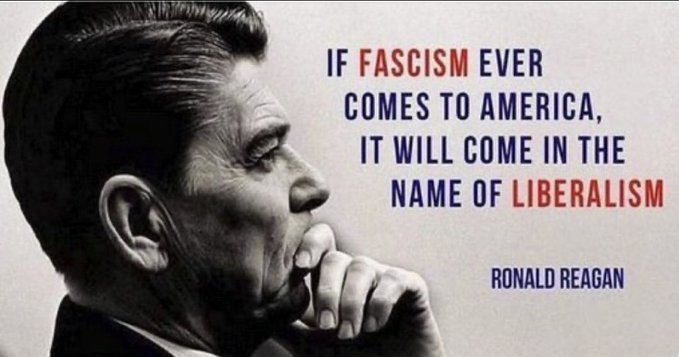




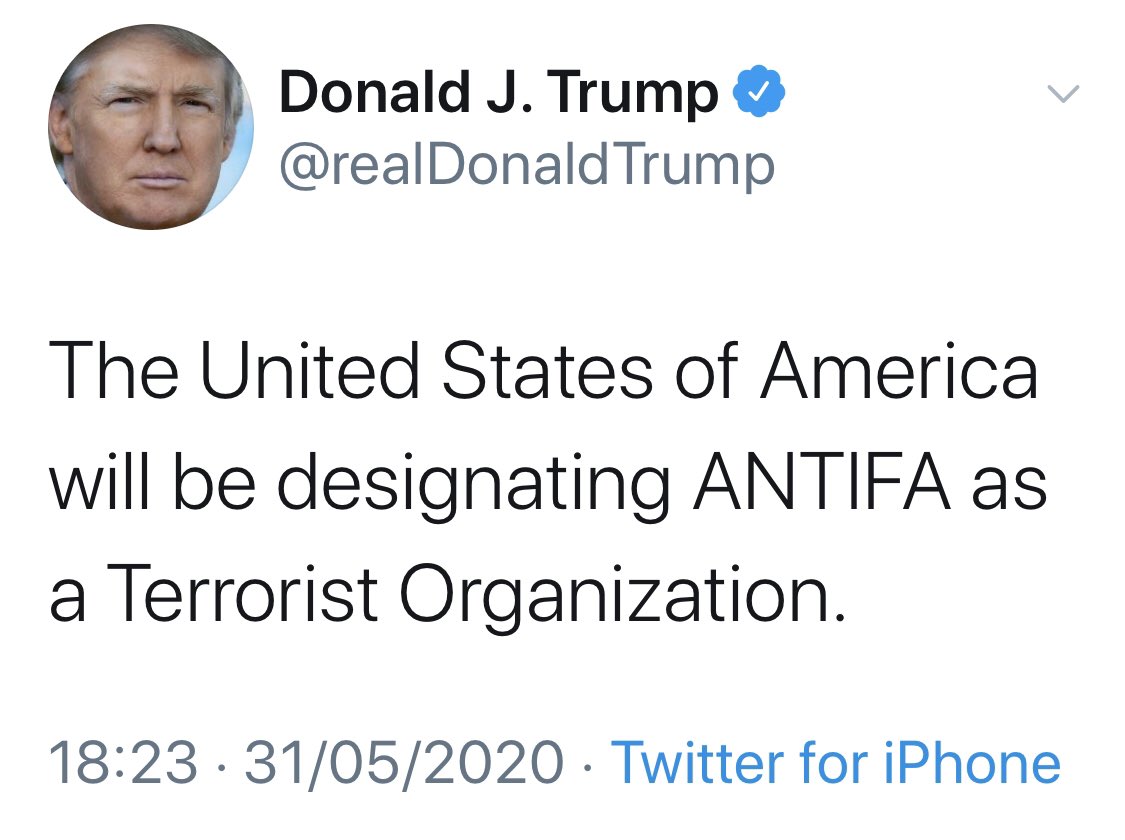
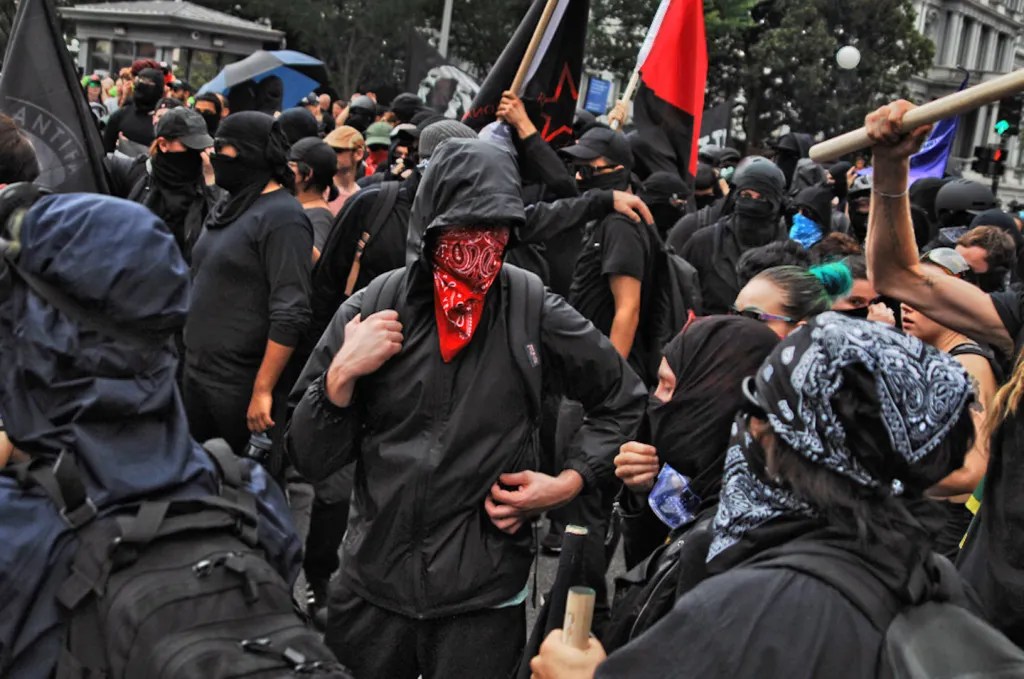

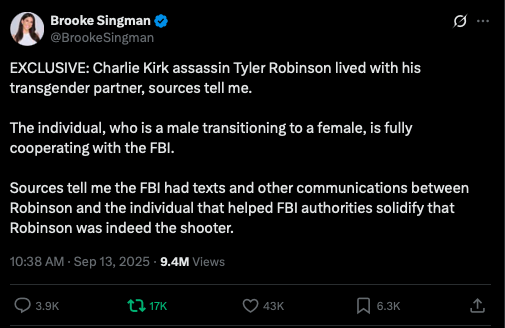


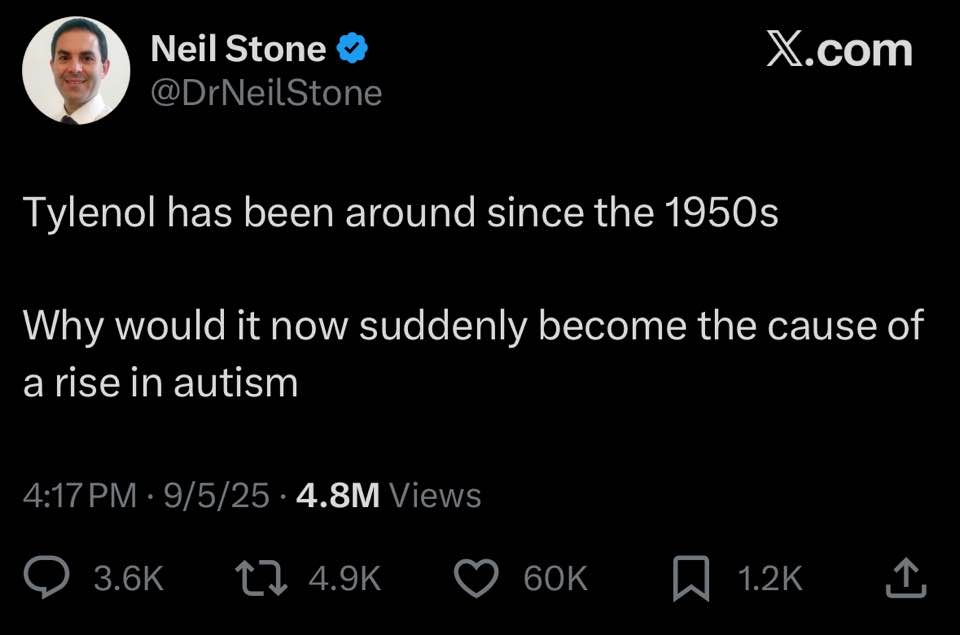
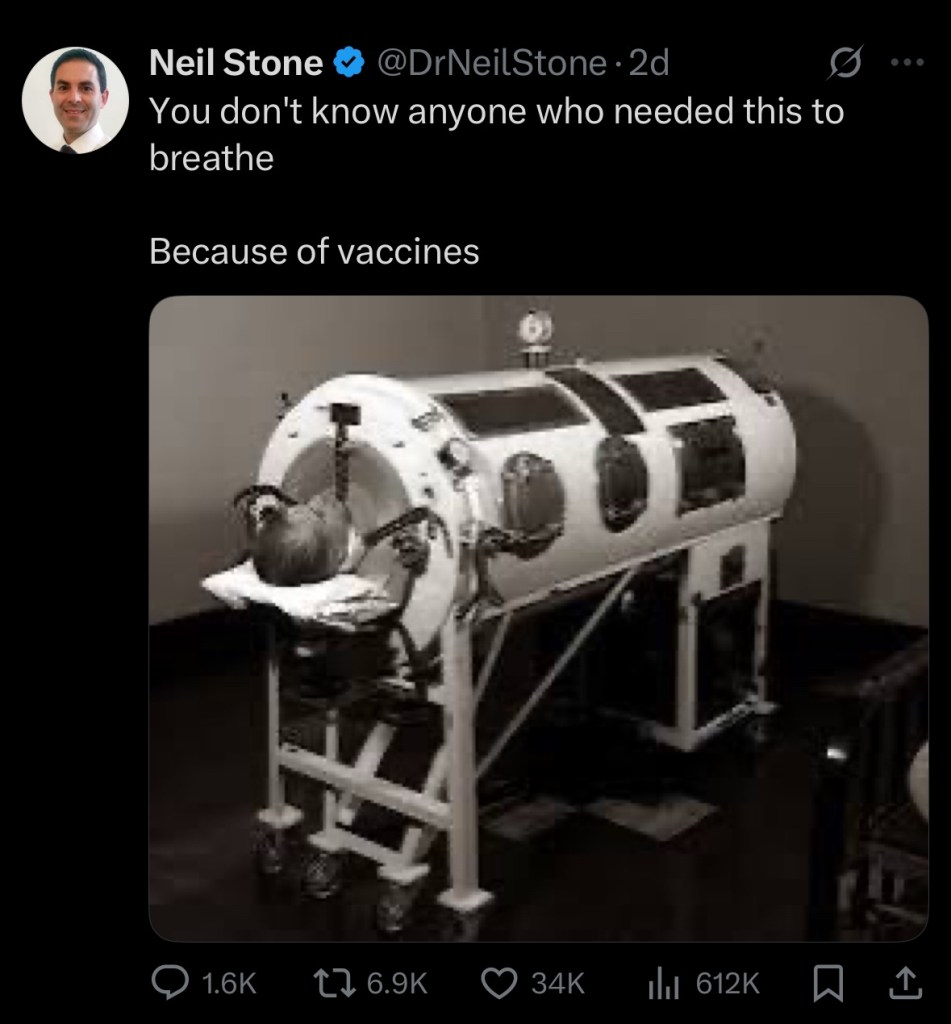
 freedom and reason