The Function of Gender Ideology in Rationalizing Physician Harm

On X (Twitter) I made the following comment to the shared video clip, which I will paraphrase below the link for convenience and clarification.

Trying as hard as I can to understand, I can see no difference between putting out ones eyes, or the famous cases of amputating legs (see The Exploitative Act of Removing Healthy Body Parts), and castrating a boy or a man or performing a mastectomy on a girl or a woman because they believed they have always been the other gender. A doctor who amputates the healthy breasts of a woman because she believes she is a man is acting no differently that a doctor who removes the healthy eyes of a woman who believes she is blind. If the latter is wrong, then so must also the former must be wrong.

I know the woman in the video clip did this to herself, but why shouldn’t a doctor safely remove her eyes? Why shouldn’t the doctor affirm her authentic self as a blind woman? That sounds absurd until we come to the matter of gender. It strikes me as some sort of bizarre internalization of loathing about sex to treat the elective castration of a boy as something different than removing his healthy arms or legs. The only difference I can see it that one body part is involved in sexual pleasure while the other is not. That and the fact that amputating a man’s limb makes an amputee while amputating a woman’s breasts don’t make her a man.

The older brother of a boy at my high school (this was in the 1970s) took LSD (or was schizophrenic—this part was always a bit unclear to me) and read the passage in Matthew that it is better to lose one part of your body than to have your whole body thrown into hell. The verbiage in that passage is dramatic, telling the faithful to cut the offending body part from his body and cast it away. And so the kid did. His mother found him with a bloody towel on his crotch and his severed penis on the desk in his room. I used to ride my bicycle past his house on my way to see my buddies at the apartment building at the end of the street. It made me sick to my stomach every time I rode past to think of about what he had done to himself because he had become deluded. I did not know then that doctors were already amputating penises in transsexual surgical procedures.

* * *

After making this comment, an X user called Boomer wrote, “For myself, the obvious distinction is she is surrendering an ability that allows her to be independent and self sufficient. Someone modifying body parts based on gender identification, by itself doesn’t necessarily affect their ability to be full functioning and self sufficient.” I responded that I know blind people who are independent and self-sufficient and that if Boomer didn’t know about the horror stories of people who have undergone gender affirming care, then Boomer needed to study the matter before commenting. Sort of rude thing to say, I admit, but the moment irked me. Why? Because it assumes that we let a person harm herself as long as she doesn’t become dependent on others. Who makes that determination?
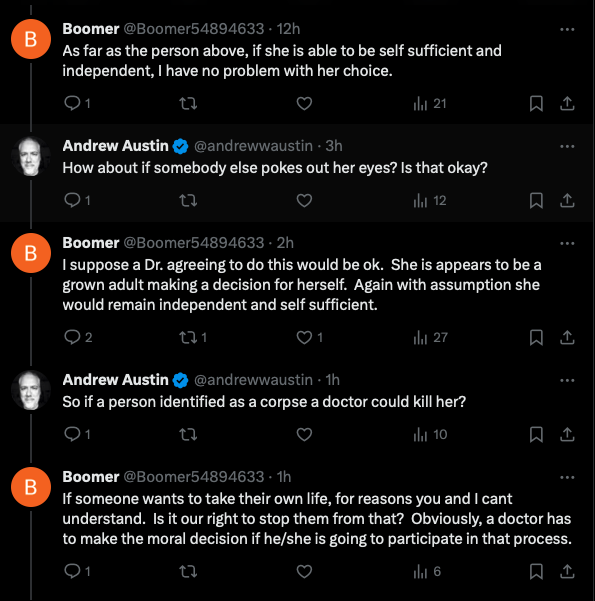
An X (Twitter) exchange

It’s one thing to put out your eyes, cut off your arm, etc. You’re responsible for that action. Whether I think it’s right or wrong, it might be odd to hold you accountable for self harm (if your actions were designed to become dependent on the system, it would be a fraudulent action). But I should intervene and stop you if I can. You may be suffering from a delusion, and the action you take in that moment you may regret. I certainly should regret not having helped you in your moment of need. Because it is not sane to want to put out your eyes or cut off your arm.

But it’s another thing when you harm another person. If you put out her eyes, or cut off her arm, then you are responsible for the action that maimed her. If there’s no justification for causing that harm, i.e., the eyes are not diseased, or the arm is healthy, then you have criminally maimed that person. This is especially odd for a doctor to do this; at least in principle, doctors are supposed to help people not hurt them.

During the holocaust, the Nazi doctors did all kinds of things to people in the name of advancing medical science. Moreover, they killed people for merciful reasons (see the T4 euthanasia program). From the standpoint of their ideological system, what they were doing was legal and justified. For those of us who stand outside that system, we can see it for what it was: maiming and murder. These were crimes against humanity. These were atrocities.

What Boomer is rationalizing here is crimes against humanity. Boomer is inside an ideological bubble, failing to see the reality of what is being done to deluded and vulnerable people by doctors (for profit). This is what ideology does to people: it confuses their judgment and finds them justifying atrocities. This is the function of gender ideology. It rationalizes physician harm. The harm perpetrated is a billion dollar industry.

* * *

One of the arguments Boomer made during our back-and-forth is that a doctor may do a better job of poking out a woman’s eyes, which is the one thing the woman regrets. I have a friend who worked for many years at a psychiatric hospital. There was a delusional man there who tried several times to poke out his eyes. My friend was on the ward the day that the man successfully poked out his eyes. He was haunted by the fact that he couldn’t get to the man in time to stop him. Nobody at the hospital thought that the solution to the problem was to have a doctor remove the man’s eyes.

This is because everybody at the hospital understood that a man who wants to poke out his eyes is delusional or in crisis. In judging such things, rational observers use the rational actor standard. People are not thinking rationally when they want to poke out their eyes. They’re not thinking rationally when they want to cut off their arms and legs. It’s not normal for an animal to want to do something like that. It’s ethically wrong for a doctor to do something like that to a person. It should be criminal. And this is why “gender affirming care” should be criminalized.

These examples are not analogies; they are concrete instantiations of the thing itself. They are real, tangible representations of the same thing. Just as a person is not thinking rationally when he wants to remove his arm, he is not thinking rationally when he wants to cut off his penis. How it came to pass that amputation of arms and penises are recognized as different things might be an interesting historical social science investigation, but that they are not different things is obvious.

We see a similar thing with the objection to transracialism among the advocates of transgenderism. The tweet I shared above is about transgender/racial man called Shontelle. As Genevieve Gluck correctly observes, Shontelle is a white man who engages in racial fetishization of black women. At least that’s one way of putting it, a gender ideologue would likely stress. I suspect that Shontelle will tell you that she identifies as a black woman. For Shontelle, trans black women are black women.

When I have raised the matter of transracialism in the past, I am told that the comparison is a bad analogy. But if gender and race are social constructions, if gender and race are essential identities, then if a man can change his gender, there is no reason a white man can’t change his race. Indeed, given the reality of genotypic sex, and in light of the absence of genotypic race, changing one’s gender is the more impossible thing. But they are analogous based not he logic of gender ideology, which raises several questions (which I asked in a 2020 essay The Strange Essentialisms of Identity Politics): Which identities may be taken up and which are forbidden? Who makes these rules? Who polices them? For what purpose? (See Adolph Reed, Jr. “From Jenner to Dolezal: One Trans Good, the Other Not So Much,” Common Dreams, June 2015.)

* * *

I have politely discontinued my conversation with Boomer. It was going nowhere. My last response to this individual was after he threw in my face something I had earlier said, when I responded that I know blind people who are independent and self-sufficient. But it was Boomer who suggested that as a condition on whether she should be blinded. I was hoping Boomer would get back around to that. He wouldn’t stop doctors from blinding people as long as the result meets his criteria for being independent and self sufficient. I want to stop doctors from hurting people. Boomer doesn’t care if they do as long as they don’t burden others.

That some people who are born blind or blinded accidentally are independent or self-sufficient doesn’t mean all people are. Saying “I know blind people who are independent and self-sufficient” doesn’t mean I don’t also know blind people who aren’t. Just as there are some transsexuals who get on fine in life after their procedure, others who become life-long medical patients. The point is whether physicians should knowingly or purposely harm people by removing healthy appendages and organs. People who want body parts cut off from them are delusional and vulnerable. Doctors who carry out their wishes are taking advantage of them. This is wrong.

A physician taking the life of a suicidal patient is not an acceptable intervention. The goal is to save the patient. If the person is suffering from an unbearable medical condition, such a terminal cancer or ALS, then there is an ethical discussion to be had. But if it’s because they are delusional or in crisis, there’s no debate. There is nothing physically wrong with a person who says or thinks they are the other gender. They are delusional. In the case of gender, they are especially delusional because they desire something that is impossible. At least the woman who blinded herself achieved the end state.

The bottomline is that you don’t take advantage of a delusional person. It’d the same if they thought they were a lizard or a walrus. You don’t surgically alter a person’s body who believes the impossible to make them appear as a simulation of that thing. It’s contrary to the essence of medicine. It’s perverse.

* * *

Left to her own accord generally, yes. I’d try to stop her if I were around when she attempted to blind herself. I can imagine a person in the presence of another person who is harming herself standing by and allowing it to happen, but if the person could have prevented it and didn’t, then I’d find them having failed in their duty as a human being to prevent self-harm.

On principle, we have a moral obligation to (a) refrain from acting intentionally to cause harm and (b) act to prevent harm that may occur in our presence if it is in our power to act. It is hard to imagine people intervening in an attempted suicide being scolded for not allowing the person to complete the act. It is expected that the reaction to allowing that to happen would be “What in the fuck is wrong with you? Why did you let her kill herself?” You know, “You didn’t try to stop her from pouring muriatic acid into her eyes?”

It gets tricky with self/other-harm with respect to GAC because there is legal and social approval for this type of harm, and intervening may result in a severe penalty and great social disapproval. I see somebody going to a hospital for an elective orchiectomy. What can I do about that without being hauled away by police officers? I can try to talk him out of it, but I have no legitimacy of action (as I would, say, intervening in an attempted suicide).

My argument is that we have to change the law to align social approval with correct moral action, a step towards which involves explaining why elective castration and vaginoplasty is not analogous to elective enucleation but an instantiation of the thing itself.
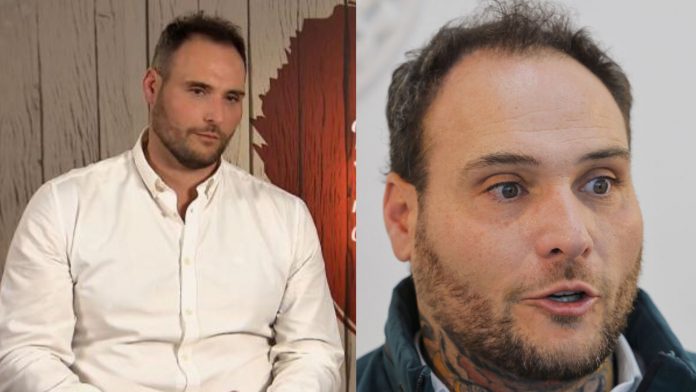

Francisco Javier is Keeping his Genitals. So Should You

Francisco Javier has stated that he has no intention of changing his name or undergoing any alterations to his body. He’s fine with his masculine appearance. “I like my body, I am happy with it and I do not intend to change it,” he said. The only change he is making is altering his gender marker on legal documents. Among the woke in Spain, Javier identifies as transgender, not transsexual. Activists and journalists there stress that the law supports his right to change his gender identity without undergoing physical transformation (in saying that, they would—and do—use female pronouns).

Because Javier is a heterosexual, he identifies as a lesbian. “I [am sexually attracted to] women, but I realized some things and I felt like a woman,” Francisco explains. “For example, I’m a beautician, and I feel better talking to women than men.” So being a beautician and preferring conversation with women than men makes Francisco a woman? How does a man know what if feels like to be a woman if he isn’t one. A woman feels like a women because she is one.

(I have to note here that, as with Busty Lemieux, the Canadian shop teacher, I am suspicious of Javier’s motivation. I wonder if he is trying to make a point by saying he is a woman when he is so obviously a man to mock the notion that men can ever be women.)

Ask yourself how a white women could feel like a black woman when she isn’t one. Rachel Dolezal says she feels that way. How would she know? How can anybody feel like they are something they are not? Moreover, what is the evidence that a subjective opinion of oneself can change a person’s gender or race or species (yesterday I watched a TikTok video of a young woman who identifies as an android)? We are our bodies, and an individual’s subjectivity has no power to alter the physical universe or natural history. Do these people think they’re gods? (Well, there is narcissism, isn’t there?)

People really do need to consider their position on this matter. I’m reading all the time stories, even from gender critical quarters, about how problematic it is that a man could declare that he is a woman but not make any alterations to his body, as if appearing more like the cultural stereotype of a woman, emulating her physiology, simulating her anatomy, would make him any more of a woman than making the declaration and not changing a thing (except a letter on his passport). If a man can say he is a woman and be recognized as such, then why does it matter that he alters his body?

Francisco Javier says he’s a woman

Do we really want to encourage boys and men who say or think they’re girls or women to become life-long medical patients (the medical-industrial complex does, of course, but the industry is today bereft of basic human decency and moral concern). The failure to recognize the assumption that a male has to go through a lengthy medical process in order to be recognized as a female is not benign. The demand on boys that, if they want to play on the girls team, that they need to have transitioned before puberty, is a powerful one. Why would athletic associations pressure boys to stop their puberty, take wrong sex hormones, and risk surgically altering their bodies to play on the girl’s team?

Some days, reflecting on the horror of all of this, I play with the position that, if we could save people from injuring themselves and harming their health by telling them it doesn’t matter for suspending our disbelief about the gender swapping, then by all means let’s do it. But, in the end, I could’t agree to suspend my disbelief even if it would save people from harming themselves—and I am not alone in this. I cannot dwell in the delusions of others. So here’s a better idea: let’s try to save people by socializing a consensus wherein a man cannot be woman even if he changes his body. This idea is a doubly good idea because it also happens to be the truth.

Slamming the Door and Saving America

Alexandria Ocasio-Cortez, of New York’s 14th congressional district, tells her colleagues,  “The idea of slamming the door when we desperately need these migrants, we have to make it easier for these individuals to participate in our economy, get a job, support themselves, and live the American dream.” 

What is happening to America isn’t about “we.” AOC doesn’t speak for the vast majority of this country, the working people. She’s a progressive. Progressives represent the professional-managerial class whose function it is to advance the material interests of corporate power. Progressivism is the ideological-political standpoint perpetuating corporate state hegemony. The corporate interests are not synonymous with the nation’s interests. Indeed, they are often antithetical to the nation’s interests. AOC’s working class rhetoric is phony.

Millions have poured into America since Joe Biden occupied the White House

It’s corporations who desperately need immigrants because of the fall in the rate or profit in late capitalism, the result of aggressive globalization and the ever rising organic composition of capital. The oversupply of cheap labor lowers the wage floor, driving down wages for native workers across sectors, transferring hundreds of billions of dollars in profits annually from the working class to the ruling class—with workers shouldering the immigration burden on housing, infrastructure, public schools, and social services. Democrats want immigrants because serving corporate interests requires staying in power—and staying in power means finding and making voters indebted to open border policies. Moreover, mass immigration disorganizes the working class politically by disordering community and culture.

Back in March, 2022, T. Willard Fair of the Philadelphia Tribute told his readers, “Congress continues to relentlessly push immigration policies that’ll make Black Americans poorer.” He continued, charitably, “That’s not their stated goal, of course. But that’ll nevertheless be the end result of their proposal to amnesty millions of illegal immigrants and boost the level of legal immigration. The lasting effects of uncontrolled, mass immigration on Black Americans are plainly obvious and have been well-documented throughout our country’s history. So how can any Black politician in good conscience advocate for a more expansive immigration policy that would continue to do us harm?”

Fair told us about the devastation mass immigration visits on black Americans

Workers desperately need good paying jobs with benefits and pensions so they can provide for their families and build strong stable communities that perpetuate the traditions of autonomy, democratic republicanism, individualism, and liberty. After decades of ghettoization, privation, and demoralization, black Americans especially need those jobs. Knowing the effect of immigration of the black community, it can only be intentional that corporations and the professional-managerial strata use mass immigration to keep millions of Americans jobless in the nation’s crimogenic and disorganized inner cities, dependent on the custodial state, where they’re left to vote for a living—yet another subjected population Democrats use to stay in political power (thus answering Willard Fair’s question).

If you want to know why the inner cities of America remain in this condition year after year, look at who governs them. Note the political affiliation of the mayors and city planners. It’s no accident that cities with the highest rates of homicide and robbery are run by progressives, the same political tendency smearing working people as racists and xenophobes when they resist open borders and demand national integrity. It’s all part of a strategy to feed the ruling class profits and keep the political party that promotes those ends in control of the administrative state. And to obscure the truth of it all, the same political-ideological tendency runs our academic institutions, the culture industry, and the mass media organizations.

Slam the door and save America. This is the year to throw out of office the party of managed decline.

Losing Control over the Narrative: The Rise of Social Media and the New Radical

Nowadays people often feel that their private lives are a series of traps. They sense that within their everyday worlds, they cannot overcome their troubles, and in this feeling, they are often quite correct. What ordinary people are directly aware of and what they try to do are bounded by the private orbits in which they live; their visions and their powers are limited to the close-up scenes of job, family, neighborhood; in other milieux, they move vicariously and remain spectators. And the more aware they become, however vaguely, of ambitions and of threats which transcend their immediate locales, the more trapped they seem to feel. —C. Wright Mills

“Who controls the past controls the future; who controls the present controls the past.” —O’Brien, from George Orwell’s Nineteenth Eighty-Four

“It is my contention that however imposing their power, and however acquiescent may seem the power over whom they exercise it, the eyes of the ruling classes reflect no surety and confident, but apprehension and anxiety. What is it that they see? What is it that they recognize. What is it that they know?” —Isaac Deutscher

Media outlets and political elites have told you to be careful with social media—and to be wary of those who consume a lot of it—because it can send you down a rabbit hole. The algorithms, they warn, put you in touch with the realm of extremism; if you’re not careful, you’ll be “radicalized” by the experience (elites have endeavored to make extremism and radicalism synonyms).

As the National Institute of Justice (NIJ) warned just last month, “An individual’s online interactions with others may increase their risk of exposure to hateful or potentially radicalizing content.” The NIJ cite research (a NIJ report by Costello et al.) that “shows that individuals (especially youths) who spend more time online and use certain websites (e.g., YouTube) may face an increased likelihood of being exposed to or engaging with hateful or potentially radicalizing content.” (Note: the document I am referencing uses the construction “ideological crimes.”)

This is propagandistic framing designed to misrepresent the effect of social media access to the world of individuals motivated to share their experiences in a way that, before social media, would have been entirely localized. Truth is concrete, and the monopoly over control of information by legacy media has allowed for the manufacture of one-sided abstractions about the world, often depictions of “reality” for which there are no empirical referents. Without access to the recorded experiences of others that contradict the media narrative, one cannot confirm his suspicions about the world, and is left to wonder whether his grasp of reality is sound.

It’s the sharing of recorded experience and the confirmation of one’s suspicions that the corporate state characterizes as the production of “online extremism.” The use of the terms “misinformation” and “disinformation” is designed to characterize the sharing of consciousness-raising information as an illegitimate (and even criminal). The individual receiving online confirmation of his experiences has been “radicalized” in order to discredit the production of mutual knowledge—for with the production of mutual knowledge comes the potential for collective action.

The ruling class has an advantage; they are in a position to access and generate the wealth of information that forms the hegemonic narrative—control over the means of intellectual production presupposing the power to form prevailing narratives—and therefore they are also in a position to see the world more comprehensively. (This is true for at least the Inner Party members. Those in the Outer Party are among the most deeply indoctrinated people in the system). In contrast, until recently, the proletariat has been largely isolated from the world beyond the worker’s immediate milieu. But social media gives the working man access to the experiences of others whose common experience doesn’t merely affirm his own in words, but in the hard evidence of audiography, photography, and videography.

To be sure, the value of popular access to hard evidence is rapidly becoming upended by the sophistication and scope of simulation; but, for now, the proletariat is able not only to document his experience, but to share the documents he records with those who do not live in his immediate milieu yet share with him his circumstance. Put simply, for now, at least, the experiences people share on social media let others see that what’s happening to them is also happening to others. Their fear that the knock at their door is a man or men who would rob them at point of a gun or knife is confirmed by the access to a body of security camera video that social media makes possible. The alleged prejudice that finds black men overrepresented among those who would be at their door for this reason is refuted by facts they can now see with their lying eyes. (These are the reasons gun sales are skyrocketing.) The world has now moved from doubting stereotypes to grasping the truth that what is dismissed as such is sound generalizations, a warning signal emanating from repeated instantiation.

C. Wright Mills

Perhaps America’s greatest sociologist, C. Wright Mills, a self-described “plain Marxist” (translation: left-libertarian), is renowned for his concept of the “sociological imagination,” which he introduced to the world in 1959. “The sociological imagination enables its possessor to understand the larger historical scene in terms of its meaning for the inner life and the external career of a variety of individuals,” he writes. “It enables him to take into account how individuals, in the welter of their daily experience, often become falsely conscious of their social positions. Within that welter, the framework of modern society is sought, and within that framework the psychologies of a variety of men and women are formulated. By such means the personal uneasiness of individuals is focused upon explicit troubles and the indifference of publics is transformed into involvement with public issues.”

At the heart of Mills’ idea is the radical act of bridging the gap between one’s biography and the historical circumstance and structural forces that shape his biography. This approach encourages individuals to develop the critical capacity to connect their personal challenges to wider societal problems, fostering a more comprehensive understanding of the social forces at play.

Power and social structure were central themes in Mills’ work (see his 1951 White Collar and 1956 The Power Elite, as well as his 1953 Character and Social Structure, coauthored with Hans Gerth). His analyses considers the distribution of power in society and how it shapes social interaction. Mills argues that sociologists should be attuned to power dynamics, and encourages them to investigate how power influences individuals and institutions alike.

In the Power Elite, he presents a thesis that challenges the comfortable and ideological notions of democracy in the United States, arguing that power is concentrated in the hands of a small, interconnected group of individuals who occupy key positions in the economic, political, and military apparatuses. This power elite, according to Mills, operates as a cohesive network, sharing common interests and influencing major societal decisions. His thesis emphasizes the interplay between corporate leaders, high-ranking politicians (the administrative state), and influential military figures (the military-industrial complex), forming a powerful network that shapes national policies. Mills is critical of the idea that formal democratic processes, such as elections, genuinely empower the masses, asserting that the power elite’s influence extends beyond formal democratic processes—and in many ways supplants them.

Mills’ thesis on the power elite offers a critical perspective on the distribution of power in society, challenging assumptions about the democratic nature of decision-making processes and highlighting the concentration of influence among a select few. Crucially, then, the methodology of the sociological imagination involves not only understanding the intricate interplay between an individual’s biography and historical and social structures, but also emphasizes the necessity of grasping the system of power those structures generate that, in turn, perpetuates those structures. By examining these intersections, one might unravel how personal lives are intricately woven into the fabric of broader societal forces and shaped by power cultural, economic, and political forces.

Social media makes the sociological imagination easy to cultivate. When a man understands the actual nature of the problem, and understands further that the solution to the problem is going to take collective action, then you can see that the real threat facing the powerful is mutual knowledge. It’s becoming aware that crime is not some abstraction out there, but that crime is in his neighborhood is just like the crime in my neighborhood. He can see who is responsible for perpetrating crime in his neighborhood. He can understand that it’s not just his experience, but that people everywhere are experiencing what he is experiencing. He sees patterns. And rather than being accused of stereotyping because he judges individuals based on an idea he may have about them, he begins to build valid generalizations from the patterns (humans are pattern recognition machines).

Social media is not legacy media pointing the camera at something they want you to see and leaving out everything they don’t want you to see. Social media is your fellow citizens, your brothers and sisters, your comrades, pointing out the reality of their experiences. When you see that you share those experiences, this can be an incredibly empowering experience.

* * *

It is a very old trick to hypostatize an aggressive and proselytizing ideology by taking action against imaginary injustices and manufactured threats. The Inquisition made real demons and witches by organizing the campaign against them. Where’s there’s smoke there’s fire, the peasants figured, and so cowards in fear or turned on their neighbors. This is what DEI is all about. Setting off smoke alarms when there’s no real fire. It’s the New Inquisition, designed to ferret out the demons and witches (the “racists,” “transphobes,” “xenophobes,” etc.) and entrench the Church of Woke.

Some might think that DEI is on the run. But we see the establishment of Cornell University’s Center for Racial Justice and Equitable Futures, committed to enforcing DEI across the faculty, administration and student body, that some folks are prepared to lean into discriminatory practice. The center at Cornell is designed to be “a permanent, institutionally-supported unit” to tackle “the anti-Black racism” that is “raging” at Cornell, in America, and across the world. I am here closely paraphrasing an article by Christopher Bedford published by Fox News.

“Far from looking toward the future, as the name suggests,” Bedford writes, “the center is geared toward cartoonish interpretations of the past, rooting out the ‘ongoing effects of a settler colonialism underwritten by principles of white supremacy.’” Bedford continues: “Some proposed initiatives include pushing ideological allies into positions ‘in all academic units and decision-making bodies,’ money for DEI grants, required DEI classes, and programs for Ivy League students DEI deems marginalized (based on their skin color, not their income or actual life stories).”

The New Inquisition means to crush the resistance to it. I’m already known as a heretic for speaking out against the illiberal character and totalitarian ambition of DEI. While I have reached that age where it’s hard to scare me (in my sixties, I have no more fucks to give, as they say), there are many younger administrators, staff, and teachers who are terrified to speak up for fear of being branded a witch and forced to undergo the struggle sessions, get passed over for promotion, and perhaps even be fired for speaking truth to power. But the struggle sessions and the less competent promoted before you will happen whether you object or not (depending of course on your tribal affiliations). To be sure, termination is a scary proposition, but I figure that if the elders speak up, maybe it will encourage the juniors to fight back, even if it’s in a subversive manner.

* * *

If the Supreme Court does the right thing, and reverses its 1984 opinion in Chevron USA v National Resources Defense Council, and if Trump can win reelection and implement the Heritage Foundation’s Project 2025 agenda, the nation may be set upon a path towards reclaiming the American Republic from the corporate state and the bureaucratic machinery that is crushing us beneath its gears. It is vitally important for us, as citizens of this republic, to be plugged into the debate, as deconstructing the administrative states is, alongside ending and unwinding transnationalization (of which globalization and mass immigration are major components), the most important task facing our constitutional democracy.

Decades ago, the state was captured by corporate power, which, mainly through the work of Democratic Party operatives, has used the administrative apparatus to dismantle or otherwise render ineffective democratic institutions. This power elite has turned the apparatus of government against its own citizens, systematically disempowering them. DEI and all the rest of it flow from these arrangements. The progressives have won the long march through the institutions and imposed an ideology on the public that is antithetical to the foundation of American republicanism. That foundation? Autonomy, liberty, and privacy. Progressives now enjoy the institutional power to command our children to believe in their warped ideology. They have turned the youth against the elders—just as Mao did during the Cultural Revolution.

It is no exaggeration to say that we are in the last stages of the managed decline of the republic and on the threshold of its replacement with a form of neo-feudalism, in which our children and grandchildren will become serfs managed on high-tech estates. The European continent is facing the same end. We are facing a totalitarian situation, and the Court is the only institution that can rectify the situation. Now you understand why Democrats strive every election to spread moral panic about the composition of the Court. Now you see why they’re trying to discredit the Supremes. Now you know why the corruption of court packing is routinely floated by progressives. Now you see why Roe was never codified into law—because Democrats needed the threat of its overturning to draw millions of dollars into their coffers and bring to the polls the powerless and the terrified.

* * *

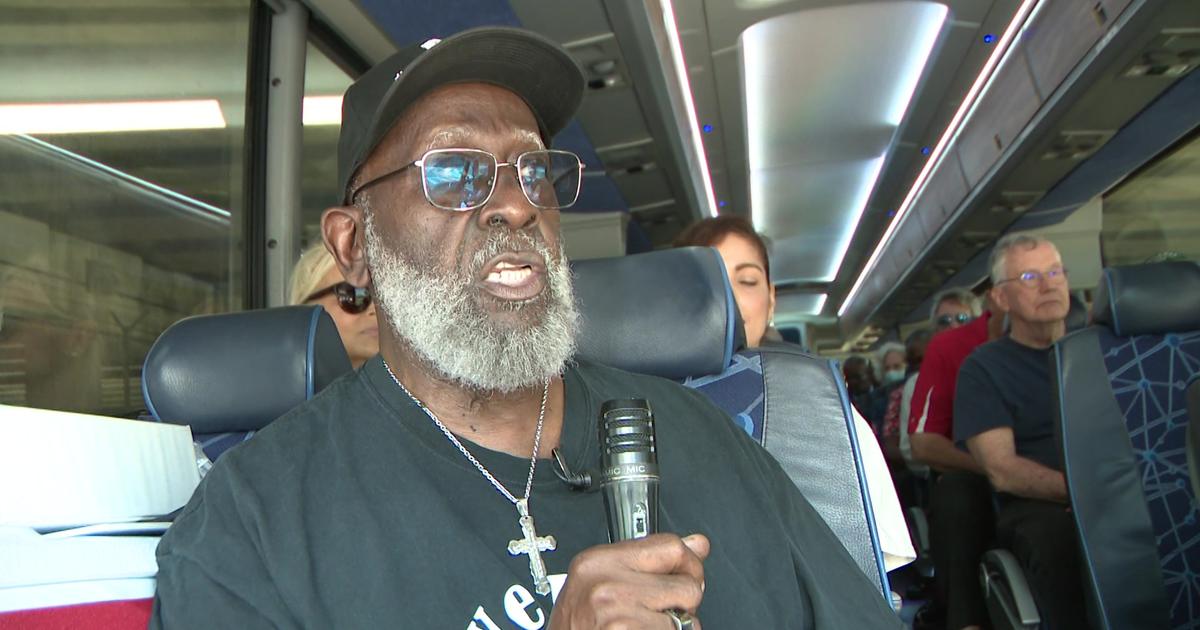
Update (Wednesday, January 17, 2024): The text below is from my Facebook page. Because my Facebook profile is not public, I will share the X (Twitter) thread about this video clip in place of the Facebook thread. But I wanted readers to read my Facebook post.

I saw this clip and Twitter and shared it on Facebook a while ago, but Facebook makes it difficult to see what Twitter content is being shared, so I appreciate it that this has now shown up on Facebook. Watch this. Take it in. Share it.

The man is Graham Linehan. He was canceled by trans activists who didn’t like his truth-based approach to the current debate regarding sex/gender matters. He has lost a fuck-ton of money standing with a handful of others in the desert of the real. Linehan is a very courageous individual.

What Linehan presents to the fellows on Triggernometry (which you should definitely check out) is proof of the importance of mutual knowledge. Ever wonder how an elite that does not share your interests and values came to rule over you? Because you don’t know who the werewolves are. But the werewolves know about you, and they use that knowledge to prey on you. And you know about you. I wrote about this recently on my blog [the one you have just been reading].

It is vitally important for you to work from a comprehensive reality-based theory about the world so you can identify and begin to specify the structure of power over you—then socialize that understanding with others so you can begin to build a platform for collective action.

Be like Linehan. Unless and until we work from a common understanding of the world, we will continue to be like the players of a game who hold a card that tells them who they are but are not allowed to know who anybody else is. The trick is to keep you in the dark.

MLK, Jr. and the Radical Redistribution of Political and Economic Power

“We must also realize that the problems of racial injustice and economic injustice cannot be solved without a radical redistribution of political and economic power.” —Martin Luther King, Jr.

Today is MLK, Jr. Day. Right wingers over at X (Twitter) are saying MLK, Jr. was an instantiation of “race Marxism.” This nonsense term was constructed by mathematician James Lindsay, who rose to fame on the basis of a series of hoax articles he published with Peter Boghossian and Helen Pluckrose, an event popularly known as the “grievance studies affair.” Since then he has come to believe he has special insight into Marxism. He’s wrong. Here’s what I told End Wokeness @EndWokeness:

MLK was not a Marxist—racial (whatever that means) or otherwise. He was a Christian socialist. The “radical redistribution of economic power” rhetoric was in line with what other christian socialists advocated at the time (many still do). MLK rejected communism and Marxism: (1) He denounced the materialistic interpretation of history. “Communism,” he wrote, “avowedly secularistic and materialistic, has no place for God.” (2) He denounced communism’s ethical relativism. “Since for the Communist there is no divine government, no absolute moral order, there are no fixed, immutable principles; consequently almost anything—force, violence murder, lying—is a justifiable means to the ‘millennial’ end,” he wrote. Finally (3) King opposed communism’s political totalitarianism. “In communism, the individual ends up in subjection to the state,” he wrote; “if man’s so-called rights and liberties stand in the way of that end, they are simply swept aside.” King argued that, under communism, man’s “liberties of expression, his freedom to vote, his freedom to listen to what news he likes or to choose his books are all restricted.” His conclusion: “Man becomes hardly more, in communism, than a depersonalized cog in the turning wheel of the state.”

Cartoon depicting the wrong turn civil rights took after the 1960s.

The reason for pairing King with communism is the (fallacious) belief that DEI programming is a communist project and, since King was a communist sympathizer, and since his remark concerning the radical redistribution of economic power sounds like a communist remark to a right-wing numskull, King’s famous line about judging a man by the content of his character and not the color of his skin was a deception. Leave aside that it is more political useful to take as genuine King’s powerful rhetoric about character and color, the fact is that King was a Baptist minister who was trying to move people to established the Beloved Community, a society in which homelessness, hunger, and poverty will not be tolerated because international standards of human decency forbid it—you know, that “What would Jesus do?” thing. As a left-libertarian, I’m suspicious of King’s theocratic ambition; I lose no sleep over the Beloved Community vision.

King’s (1) is correct. Communism as envisioned by Marx and Engels is indeed an atheist endeavor. This doesn’t mean that people cannot worship God. It just means that governments and the law cannot be established on that basis. This is position is not unique to communism. Liberalism also demands a secular state and knowledge based on fact and reason. From his earliest writings right through his life, Marx equated communism with democracy and affirmed the liberal values embodied in the First Amendment to the US Constitution. King’s (2) and (3) point are incorrect. What I just said contradicts (3). We can say more. For example, Marx and Engels argued that communist development creates the conditions for the abolition of the state as the administration of people—the opposite of what King suggests. As for (2) King is here suggesting a theocracy with his reference to “divine government” if he means anything more than did our Founders (I recently published an essay on this Rise of the Domestic Clerical Fascist and the Specter of Christian Nationalism). King’s concern about man becoming a depersonalize cog in the turning wheel of the state is correct if the instantiation of communism is the Soviet Union under Stalin. George Orwell made a similar argument at that time, only the metaphor was “a boot stamping on a human face—forever.” 

* * *

Update (January 16, 2024): Early this morning I received as a response, for user RoosterJuan @MedWerd1776 an old and well-known propaganda broadside from an entity called the Georgia Commission on Education.

Propaganda broadside produced by the pro-segregation Georgia Commission on Education.

I am very familiar with Highlander. I did my graduate training at the University of Tennessee which was the time affiliated with Highlander Center, as were a great number of churches in the region. There was in fact no center in Tennessee called the “Highlander Folk School for Communist Training.” What there was a Highlander Folk School that organized literacy programs, voter turnout efforts, and civil rights actions, including the Rosa Parks incident. What @MedWerd1776 shared is crude propaganda from white nationalists in the south who were trying to keep Jim Crow segregation in place. The Georgia Commission on Education was pro-segregation.

Where here were communists who attended workshops at that school? To be sure. There were communists at the Bridgestone/Firestone strike in Nashville Tennessee in the mid 1990s. I know, because I was there. They fed the striking workers. Communists are citizens who are free to participate in political action just like the rest of us. The attempt at guilt by association is very obvious in @MedWerd1776’s response and such a tactic should be beneath rational men. My charity is running low for those who share pro-segregationist propaganda.

The Queer Project and the Practice of Deceptive Mimicry

Have you noticed how the queer project reduces gender to fashion and colors and (simulated) phenotypic sex differences? If a man wants to “be” a woman, then he will wear clothes, makeup, accessories, etc., associated with the feminine stereotype generated by the corporate culture industry. He may also attempt to speak like a woman and act like a woman. He may turn to wrong sex hormones, radical cosmetic surgery, or starve himself to realize the industry standard of “womanhood.” His costume and performance are acts of deceptive mimicry.

Jame Gumb aka Buffalo Bill (performed by Ted Levine) from the 1991 movie Silence of the Lambs. Gumb was obsessed by the death’s-head hawkmoth as a symbol of his transition from a man to a woman, as well as an instance of aggressive mimicry, which involved manufacturing a woman’s costume from the skins of women he captured and killed.

Deceptive mimicry in the human species almost always result in bad simulation; despite his best efforts, a man rarely passes as a woman. Most men can see what he really is. Even more women can see through the deception. The man engaged in deceptive mimicry has trouble convincing himself that he is the thing he says or wants to be, demanding others participate in the simulation by referring to him using feminine pronouns and chanting obvious falsehoods like “trans women are women.”

Most of those who say they see a woman in the simulation are lying. Many people feel compelled to act in bad faith because they either want to believe the ideology or they know they will be canceled or disciplined if they don’t act like they do. This is why public education and other organs of indoctrination are confusing children at early ages: queering spaces is a strategy for disrupting the innate gender recognition faculty before it is fully primed.

Meanwhile, women walk about in jeans and tennis shoes, with no makeup. Women don’t need to put on all the sociocultural and phenotypic indicators of womanhood because everybody can see they’re women. They don’t have to try to be women because they are women. They have no need to deceive others (or themselves) in this way because they are psychologically ordered. To be sure, there are women who adopt and internalize—then externalize—the culturally-mediated stereotype of womanhood by drastically altering their bodies. Thankfully, most Western women don’t do the extreme things because they’re busy being themselves and have successfully negotiated the misogyny that surrounds them (the triumph of feminism has been impactful). But the queer project seeks more bodies to corrupt—as does the medical-industrial complex—and so their grasp on reality is always being challenged.

(There is also a growing number of women who, in trying to shed the signs of their gender, reach for sociocultural and phenotypic indicators of masculinity. Many women inclined in this way refer to themselves as “nonbinary.” Oddly, in establishing this identity, they do things to appear more stereotypically masculine, including taking testosterone and amputating their breasts. I may take up this matter in a future essay, but it is a serious problem that deserves at least mention in this context.)

In nature, mimicry is a phenomenon where one organism imitates another for survival-related purposes. In this essay, I overview the taxonomy of the different types of mimicry in nature to suggest metaphors for more effectively conveying the problem with deceptive mimicry among humans. I then turn to the disciplines of sociology and anthropology to show how mimicry in the human species is far more common that the reader might think. Here we move beyond metaphor to identify the deceptive and predatory forms of mimicry unique to our species.

* * *

Toxic mimicry is the form of mimicry where an organism mimics the appearance or behavior of a toxic or dangerous species in order to escape predation. In Batesian mimicry, an organism evolves to resemble a toxic or dangerous species; the mimic gains protection by being mistaken for the toxic species. An example is the viceroy butterfly, which mimics the toxic monarch butterfly. In Müllerian mimicry, two or more harmful species evolve to resemble each other. The shared resemblance helps reinforce the learned aversion in predators. For instance, species of stinging bees and wasps might evolve to share similar warning coloration.

There are other types of mimicry in nature. Automimicry or intraspecific mimicry occurs when different parts of the same organism mimic each other. Some butterflies, for instance, have wing patterns resembling eyes to deter predators. Social mimicry involves animals mimicking behaviors or appearances of other species for advantages. Hoverfly larvae mimic ant larvae to access ant colonies and feed on their resources. Plants also engage in mimicry. Some mimic the appearance or scent of other organisms to attract pollinators or deter herbivores. Orchids may mimic the scent of female insects to attract pollinating males. Put a pin in social mimicry. I will come back to it.

Aggressive mimicry is the opposite of toxic mimicry. It involves predators or parasites mimicking harmless organisms to deceive prey or potential hosts. The female anglerfish has a bioluminescent lure that hangs in front of her mouth. This lure attracts smaller fish, thinking it’s prey, only to become the anglerfish’s prey. Likewise, the alligator snapping turtle has a fleshy appendage on its tongue that resembles a worm, which it uses to attract fish. Some predatory fireflies mimic the light signals of other firefly species. The mimic’s deceptive flashes attract unsuspecting fireflies, which are then captured and eaten. The orchid mantis has evolved to resemble flowers, waiting on flowers for pollinators to come close and then ambushing them. Cuckoos are a bird species that practices a form of aggressive mimicry called brood parasitism. The cuckoo lays her eggs in the nests of another bird species, tricking the host birds into raising her chicks.

The death’s-head hawkmoth

The death’s-head hawkmoth is known for its skull-like pattern on the thorax and aggressive mimicry, imitating honeybees in both appearance and sound. By producing high-frequency clicks similar to foraging bees, the moth can infiltrate beehives undetected. Once inside, the death’s-head hawkmoth feeds on honey without posing a direct threat to the bees. It exploits the bees’ natural defense mechanisms for its own survival and reproduction.

The takeaway here is that mimic takes advantage of the target’s lack of defensive response to facilitate predation or parasitism. Most life is unaware of the way nature has generated these many forms of deception that make continued existence uncertain. Humans, in contrast, are aware, or can be made aware, of mimicry and thus can identify and stop deception, which is usually a choice made by the mimic seeking satisfaction of some sort or another, whether achieving sexual gratification at another’s expense, such as in autogynephilia, pedophilia, or other paraphilias, or perpetrating acts of violence on women or humiliating them by gaining access to their spaces (bathrooms, shelters, sports).

That humans engage in deceptive mimicry is a useful observation for more effectively engaging the struggle against the queer project. In social mimicry, the act of imitating or copying the behavior, expressions, and gestures of others in social situations can establish rapport or connection which can then be used to manipulate a target person or group. Adopting certain cultural practices, habits, or traditions of other people, either consciously or unconsciously is cultural mimicry. On the popular front, fashion mimicry occurs when an individual imitates trends in clothing and style to fit in or identify with a particular group or subculture. There is also accent mimicry, where an individual adopts the speech patterns of those around him, often occurring when spending a significant amount of time with individuals with distinctive speech patterns. When an individual imitates the body language and movements of others (sometimes done unconsciously) to build rapport and establish a connection this is called mirroring. Mimicking the emotional expressions of others, such as smiling in response to someone else’s smile, contributing to social bonding, is known as emotional mimicry.

As indicated, sometimes these forms of mimicry are taken up unconsciously. As Adam Smith noted centuries ago in his moral sentiments thesis, humans are intrinsically sympathetic or what today we would term empathetic or empathic. The emphatic character of humans can be illustrated easily, such as in the phenomenon of yawn contagion (as Frans de Waal has shown, humans are not the only species susceptible to yawn contagion). When unconsciousness forms of mimicry spread throughout a group or on a mass level this is what is known as social contagion. Other times, it’s intentional, the mimic using the deception expressively to reach some desired emotional or psychological state, or instrumentally to manipulate others for personal benefit or for advancing the agenda of the group to which he belongs.

It is remarkable that tolerance for deceptive mimicry has become so embedded in Western societies. This development signals a very dark prospect for the future. Watch this video clip from the UK television program Good Morning Britain and I will explain afterwards why it illustrates the problem.

The logic of the argument is almost identical to an argument about how many angels can dance on the head of a pin, or how many devils and demons there are in hell (7,405,926, according to Dutch demonologist Johann Weyer), except that the assumption at work here is even more absurd that those examples, since the proposition that a man can be a woman is a falsifiable one (and easily falsified). Yet the core assumption is that gender identity is a real thing.

What is gender identity? It is a self-opinion held by the person that is the gender he is not. The term was invented by psychiatrist and sexologist Robert Stoller. (Stoller also believed in the dream telepathy.) I will briefly review the basic concepts of sex and gender to clarify.

Gender (or sex—they’re synonyms) has four categories. Genotypic sex refers to the genetic or chromosomal sex of an individual. Humans typically have 23 pairs of chromosomes. The 23rd pair, known as the sex chromosomes, determines biological sex. XX denotes female; XY, male.

Phenotypic sex relates to the physical or observable characteristics that define an individual’s sex. This includes external genitalia, secondary sexual characteristics (such as facial hair or breast development), and other physical attributes typically associated with male or female.

There is associated with these types what sociologists have called sex or gender roles. The sex role refers to attitudes, behaviors, expectations, and societal norms associated with being male or female in a particular culture or society. Sex roles are often culturally defined and can vary significantly across different societies, encompassing societal expectations regarding how individuals of different genders should behave.

Finally, there is gender identity, which involves an individual’s deeply felt internal experience and sense of their own gender. This aspect is personal and may not necessarily conform to societal expectations.

Note that the last category is entirely subjective. That it is deeply felt doesn’t change the fact that there is no objective indicator that somebody other than a woman who identifies as a woman is one any more than there is such an indicator that shows that a white person who believes he is black really is black. When somebody tells us that they were abducted by aliens, it doesn’t make their claim any more compelling for them to insist that they genuinely believe they were abducted by aliens. The question must always be: what evidence can you provide that will allow us to independently confirm you were abducted by aliens?

Note also that while some aspects of the gender role are subjective, these aspects are shared across the population (they are intersubjective), and other aspects of gender roles are objective, that is they are observable, which is the matter of anthropological, historiographical, and sociological study. When John Money talked about gender roles and his sycophants treated the concept as if it were some great discovery, he was really simply taking the concept of the sex role from the social sciences and substituting “gender” for “sex,” at once cutting turf while manufacturing an assumption that sex and gender are distinct concepts. They’re not. There is nothing original or nontrivial in Money’s construct (the man was a hack).

Those who assume the truth of gender identity make several claims, e.g., gender identity may or may not align with the sex assigned at birth; as individuals may identify as male, female, both, neither, or somewhere along the gender spectrum. While these claims are true as personal opinions, there is no evidence they change the reality of gender. How could they? People remain either male or female regardless of self-opinion. Nor does the claim that the understanding of gender has evolved to recognize a spectrum beyond the traditional binary concept of male and female change the truth of the binary. If what has evolved for whatever reason is false, then, while it is certainly an understanding, it is not true.

India Willoughby believes he is a woman. At least he says he believes that. He is in fact a man. He not only cannot change that fact by adamantly asserting his delusion, but he also cannot change that fact by hormonally altering his physiology or surgically altering his body. Nor can he change that fact with the law at his back. Laws don’t determine objective reality.

Yet, Willoughby’s subjectivity must be taken as truth to debate whether it is a hate crime to “misgender” somebody. That the reality of angels is assumed by every person in the room is shown by treating as misgendering the practice of calling a trans woman a man. Once assumed it is, the question turns to whether the state should punish people who don’t believe that’s true by charging them with a hate crime. Leaving aside the problem of hate crime (which is really a euphemism for thought crime), in the real world, misgendering would be to call a trans woman a woman since his gender is in fact male. In other words, every time somebody refers to India Willoughby with feminine pronouns, his is misgendering him.

When I was in high school, I was very skinny (5’8” 118lbs), had no facial hair, my face had not yet masculinized, and I had hair down to my butt. Moreover, I dressed like Robert Plant (it was the 1970s). I was misgendered all the time (only by men, though; no girl ever misgendered me, but instead asked if she could brush my hair). When I was going to bars at aged 18-19, dudes would hit on me. They were chagrin when I opened my mouth and a man’s voice came out. They had misgendered me.

Had I claimed in these situations that I was a woman, left that assumption standing, it wouldn’t have changed my gender; mammals can’t do that as a matter of scientific fact. I would have instead deceived the heterosexual man who was looking for a date. If he had taken me home and we became intimate, then I would be guilty of sexual assault; the man did not consent to having sex with a man. (Maybe he wouldn’t care, but that’s beside the point. I still deceived him.)

Everybody in the Good Morning Britain clip is assuming the opposite of reality, accepting queer propaganda that literally inverts the meaning of misgendering. The construction “assigned sex at birth” is likewise propaganda. While observers may be mistaken, sex is never assigned. “Trans women are women” is also propaganda. All of this is so profoundly ideological that it should be immediately obvious to the rational person what it is.

So why is it not obvious to so many? This testifies to the power the queer lobby enjoys in shaping mass consciousness. This level and scope of control doesn’t happen by accident. There is behind it an intentional and well-organized project to confuse our language and construct an alternative reality where truth is subjective. This is why queer activists are desperate to get into public school classrooms and start confusing children at an early age. This is why we see the flags and books and placards in public spaces. The grooming of children is obvious in the deployment of children’s books and stickers of mermaids, rainbows, and unicorns.

If you cannot see this for what it is, then there are two possibilities. The first is that you have convinced yourself or somebody has convinced you that what is plainly untrue is real. You have assumed there are angels. The second possibility is that you are terrified at being canceled or disciplined. And for many, there is good reason to be afraid.

I, too, have been afraid. But I refuse to abide by such an obvious and destructive lie. I confess that a big part of this is pride. I don’t want to be made to look like a fool. At the same time, I am aware that if everybody around me can be convinced that men can become women, then I will certainly be made to look like a fool. I will be the sole sane man in open-air madhouse.

* * *

If you go to the AI (artificial intelligence) porn generator sexy.ai, and type “trans woman” and apply the Realistic Vision filter, it will consistently generate male faces and bodies that appear to have undergone feminizing procedures. AI scrapes from the massive body of photographic data available on the Internet to generate original images that simulate the search target. Because trans women are men, it is inevitable that AI will return male bodied simulations.

Why this is obvious to a human reviewing the images is because the human gender recognition system is primed by multiple observations from infancy that are then processed in an innate analog to factor analysis that naturally generates two factors: male and female bodies.

When an individual is gender ambiguous, a rare occurrence to be sure, the felt anxiety and curiosity generated is because the brain, knowing that every person (and other animals) is gendered, is tying to sort the observation into one of only two boxes. Children, who have not yet learned the skill of civil inattention, will often ask the person or another person about that person whether they are a boy or a girl. Tragically, those in charge of guiding children through their cognitive development will often lie to them about which gender the person really is.

Marburger has Died

Tragically, Perry High School Iowa principal Dan Marburger has succumbed to injuries sustained from gunshot wounds at the hands of a trans identified shooter. Marburger gave his life for his students.

Perry High School Iowa principal Dan Marburger

I anticipate some folks will scratch their heads over why it matters that the shooter was trans identified. They made these complaints after the Nashville shooting. “Why do you want to see the manifesto?” (Here’s why: Audrey Hale’s Manifesto: Blueprint for the Total Destruction of What?) A person with this thought should ask himself if it would be useful to know whether a school shooter identified as a homophobe.

I want to know such things because my interests don’t concern the means by which ideologically-driven individuals carry out their agenda but rather the content of the agenda itself. But we all know that the complaint doesn’t actually stem from a desire to never talk about the agendas that motivates mass shooting, but rather expresses the desire that society not talk about agendas when the perpetrators are from movements and sides with which the complainant associates.

The motivation to dissimulate motive in such instances is so powerful that it can even cancel out the concern for homophobic attacks if the representative of a more favored minority is responsible for the shooting. We saw this phenomenon when a Muslim murdered 49 people and injured another 53 people at a gay night club in Orlando Florida in 2016. Progressives went out of their way to downplay the fact that the shooter was motivated by Islamist beliefs. (See The Courage to Name the Problem.)

(This was an indicator that concern for homophobia was being moved downward in the hierarchy of oppressions even back then. Part of this was due to Trump’s realism concerning Islamic terrorism. This had the effect of transforming the Islamic terrorist into a hero in the progressive mind, a phenomenon we see today in the pro-Hamas marches—rallies for a terrorist organization that presents with, among other things, a profoundly homophobic character. See Woke Progressivism and the Party of God.)

We also see the phenomenon in the widespread ignorance that most mass shootings in America are perpetrated by inner-city youth in black and brown majority neighborhoods. (See How to Misrepresent the Racial Demographics of Mass Murder; Everything Progressives Say About Mass Shootings is Wrong…and Racist.)

If we want to end school and other shootings, we have to focus on the belief systems that motivate them and stop using these events as an excuse to gun grab. There is a significant trend of trans identifying people and their allies resorting to intimidation and violence to advance the movement. It is a serious development. We have to talk about it. (I have been. See, e.g., From Delusion to Illusion: Transitioning Disordered Personalities into Valid Identities.)

The Project to Confuse Our Language is a Global One

In the pages of The Spectator, feminist Julie Burchill says Munroe Bergdorf aka Ian Beaumont, a male model who identifies as a woman, looks like a mummified boy-pharaoh. Nailed it. A massive amount of surgery was used to obtain this hyperreality. The medical-industrial complex made a fuck ton of money off this dude—and my guess this isn’t the end of the transformation. See the results for yourself:

Munroe Bergdorf aka Ian Beaumont

This story seems like satire, I know. It’s not. In November 2023, UN Women named Bergdorf as its first “UN Women UK Champion.” Not only is this a man, but consider the message this sends to girls: “See your plastic surgeon so you, too, can look like men who simulate women.” Google Bergdorf to see the change overtime. The message is that men do women better than women do (a message debunked by collages and videos of trans-identifying men easily found on the Internet). Bergdorf joined UN Women UK as an advocate in 2019 supporting its campaign to put a stop to female genital mutilation (FGM). That’s right, a man with genitals surgically altered to look like female genitals joined a campaign to stop female genital mutilation. I swear I’m not making this up.

Fair Play for Women, on behalf of seventeen UK activist groups, wrote a letter titled “A letter to UN Women: this male does not represent us” condemning the decision. The letter expresses concerns about appointing a male who presents in a highly sexualized stereotype of womanhood as an ambassador for women. The letter emphasizes UN Women’s stance on males becoming women, stating that the organization’s credibility is compromised. You think? The groups conveys their “dismay and disappointment” regarding Munroe Bergdorf, referred to as a “male activist,” being appointed, highlighting that the UK has over 33 million females to choose one, yet a man was chosen. It is truly bizarre. The agenda could not be clearer: the elite project to confuse our language is a global one.

The agenda is a misogynistic and homophobic one. The letter reveals Bergdorf’s past objections to women referencing female bodies, citing his forced resignation as an LGBT+ adviser to the UK Labour Party. His resignation resulted from vulgar and derogatory posts targeting white people, lesbians, and gays, including labeling “all white people” as “violent racists” and using offensive terms like “faggot” and “old poof” to respond to critics. The letter references Bergdorf’s mocking of a friend’s fertility in uncovered tweets, stating, “How’s your barren womb? We all know your little secret … hairy lesbian!” Bergdorf has in past expressed a desire to engage in “gay bashing,” targeting a character from the TV show Glee. In recent social media posts, Bergdorf endorsed Palestine, sharing an image of a sign that reads “Queers for a free Palestine.”

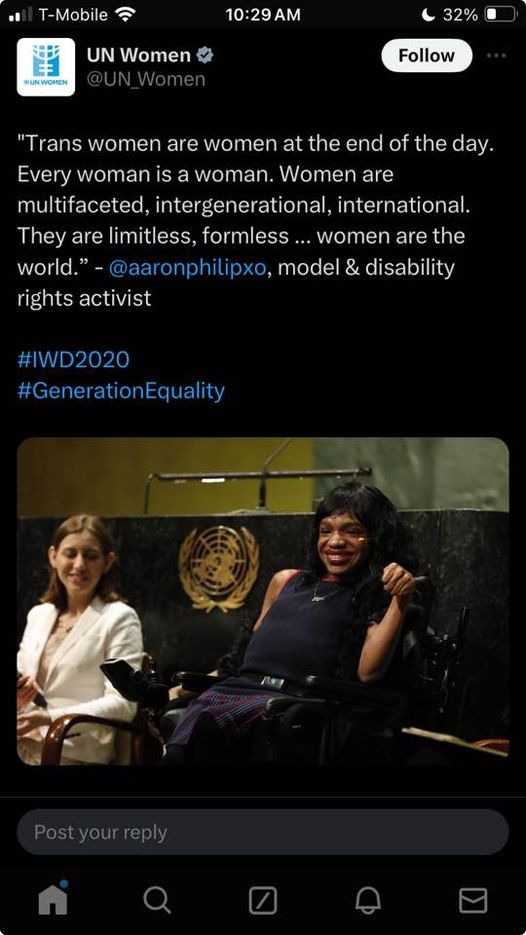
Disabled trans identifying man Aaron Rose Philip pushing the global woke agenda at UN Women. The IWD2020 hashtag is a reference to the International Women’s Day 2020 theme “I am Generation Equality: Realizing Women’s Rights”

The queer lobby has steered UN Women in this direction for a while now. Here is a screen shot of the UN Women campaign on Twitter (now X). Take the slogan “Every woman is a woman.” As is, it has no content. But those who use the slogan know what they mean to convey, namely that men who say they are women are women. It’s a restatement of what precedes it, the propaganda slogan “Trans women are women.” This is why the construct “cis woman” was invented, so there can be two types of women: trans and cis. Of course, there is only one type of human female now that neanderthals and denisovans are extinct. But the queer project is determined to erase physical anthropology and replace it with the quasi-religious system of gender ideology.

In pursuit of the project to confuse our language, the queer lobby words things every which way but true. Ask them “What is a woman?” and they will likely answer, “Somebody who identifies as a woman.” As Matt Walsh famously rebutted, what is that? They will never answer the question. What they’re saying is this: “A square is a thing we call a square,” as if there s non-tautological definition of a square isn’t available and necessary. Here they mean to substitute sophistry for fact and reason.

Gender ideology is a mess of contradiction and circularity, the entire system is predicated on an entirely subjective construct—“gender identity”—invented by a sexologist who believed that dream telepathy was a thing. It’s crackpot through and through. Nearly, identical in form to Scientology, the only outstanding practical difference is that Scientologists take your money but leave your nutsack intact. The medical-industrial complex wants both.

What is Privilege?

“Privilege,” according to Vanderbilt University’s Power and Privilege Definitions Handout “is a set of unearned benefits given to people who are in a specific social group. Privilege operates on personal, interpersonal, cultural and institutional levels, and it provides advantages and favors to members of dominant groups at the expense of members of other groups.”

Privilege is thus an element in the oppressor-victim dynamic articulated by woke progressive ideology. Those who enjoy unearned benefits are the oppressors, even when the elements of their identity that make them so are baked in, such as in gender and race; they are by virtue of bodies and ancestry automatically enrolled in social groups. As I have noted before on Freedom and Reason, an individual is reduced by this ideology to a personification of a demographic category and this judged on the basis of grouped means.

“In the United States,” the handout tells us, “privilege is granted to people who have membership in one or more of these social identity groups: white people, able-bodied people, heterosexuals, cisgender people, males, Christians, middle or owning class people, middle-aged people, and English-speaking people.” But for Christian part (I am an atheist), I am the apex oppressor, for I am a “member” of all of these social groups.

White privilege is a bandaid that doesn’t match your skin color

(Has you ever stopped to consider that, if one cannot earn whiteness, then how are the privileges said to accrue to it is unearned? Race is not an achievable thing; it’s an ascription, one based on socially selected phenotypic characteristics, these characteristics very real. As such, race is not only not unearned, it cannot be abandoned, either. Race is both a social construct and the result of natural history but not a choice. A man cannot shed his race. Nor can he put on another race as if it were costume. Rachel Dolezal, a white women, is not a black woman. She is her body. Nor did she earn her whiteness.)

“Privilege is characteristically invisible to people who have it,” the handout continues. “People in dominant groups often believe they have earned the privileges they enjoy or that everyone could have access to these privileges if only they worked to earn them. In fact, privileges are unearned and are granted to people in the dominant groups whether they want those privileges or not, and regardless of their stated intent.”

The author of the handout is abusing words for the sake of a political project, a project that Wesley Yang calls “successor ideology.” The typical definition of privilege is as follows: “a special right, advantage, or immunity granted or available only to a particular person or group.” When the word is used accurately, one expects it will be invisible to most of those on the list, since it doesn’t in fact exist for them.

I do not enjoy white heterosexual male privilege because I am white heterosexual man. Any privilege I enjoy is because I earned it. But the definition in the handout presupposes privileges are unearned. It sets up a situation where, if I say I earned a privilege, let’s say an advantage in purchasing power compared to some other person, it is something that people like me often believe that is not so. If I deny my privilege, then I am fragile and in denial. It is not enough to be non-racist, we are told; we must be anti-racist. And being anti-racist for a white man is admitting he is privileged because of phenotypic features he inherited from his parents.

Taking privilege as a special right, there is in fact no race privilege in America for whites. There used to be, but all laws and policies granting whites special rights (or immunities) were abolished sixty years ago this July 2. Indeed, white privilege became illegal with the passage of the Civil Rights Act of 1964. White people can no longer expect to get preferential treatment on the basis of their race. The vast majority of white Americans never lived at a time when they enjoyed a privilege based on race. The only race privilege that existed after that great law was reserved for nonwhites, in particular blacks, who were granted a special right under affirmative action, and now under DEI, to be given extra consideration in a pool of applicants on the basis of race. That is an example of race privilege.

Do males still have privilege? They certainly did before 1964. Of course, today, males have a privilege when identifying as women, when they, as I have put it, step into oppression. In many places in the West today, a man can enter a female-only space only if he says he is a woman. A man can play on a women’s sports team if he says he is a woman. A man identifying as a woman can in some business firms enjoy rules compelling those he works with to misgender him. It’s not an exaggeration to say that, in some places in society today, a man identifying as a woman will be the most privileged person in the room. This contradiction inheres in the logic of successor ideology.

By “cisgender people” the author of the handout means men and women (and their immature counterparts boys and girls). Because of this privilege, women today can’t even depend on their basic rights being respected, for example the right to feel safe in a female-only space. (Sex-segregation is not an example of privilege, to clarify, but of equity. Nor are age restricted spaces a matter of privilege; rather they are a matter of safeguarding. In these cases, objective differences between groups must be considered if equal treatment under the law is a desirable end.)

In a system based on property rights, property and wealth confer privilege. But this is not an unearned privilege. An employee may be legally barred from entering the executive suite, for example, because executives assert a privilege on the basis of property right. My tenure at my university, which I earned, is a property right. Property rights exist for workers, too. The law grants a working man exclusive domain over his property. For how much longer, I can’t say. Some people have more property than others, and thus will enjoy advantages others do not have. But for those not born with a sliver spoon, this is earned.

If by “unearned” it is meant that a privilege is given to an individual solely on the basis of skin color, a physical attribute he did not accomplish, then I admit that I can’t imagine what it would feel like to be placed on a list of “top white leaders” in a given field or metropolitan area, or be awarded “Outstanding Person of Noncolor” by some organization, or be recognized for being the “first heterosexual white man” in a given occupation or office. It’s such an odd thing, seeing people tribalized and tokenized in such a way. It’s recognition for something they didn’t do—something that cannot help. They did not earn the accolade. I’m glad that can’t happen to me.

Is never having to suffer the virtue signaling of social justice warrior one of those features of white supremacy I hear people constantly talking about? Is it another form of privilege that, as a white man, I am treated as an individual and not a personification of an abstract demographic category? (Of course, I am treated as such. I have white privilege, remember?)

Instead of leaning into racialization, would it not be preferable for blacks to be treated a individuals and not personifications of an abstract democratic category? It’s not a bad feeling to be treated as an individual instead of an aggregate. I’d hate the burden of having to be a “credit to my race” (the Woman of Color of the Year Award is just another way of putting that slight). Too bad other people can’t be privileged in that way.

Are Index Crimes Falling? Doubtful

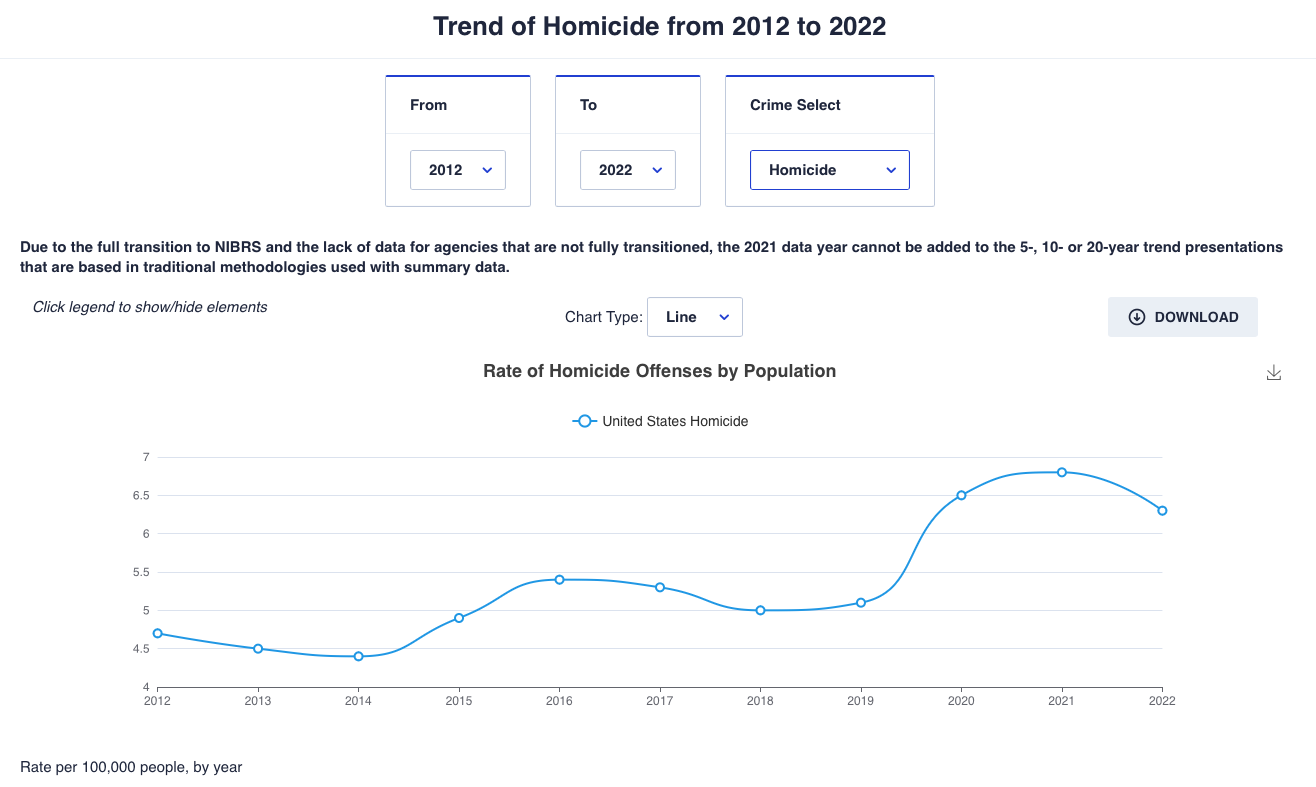
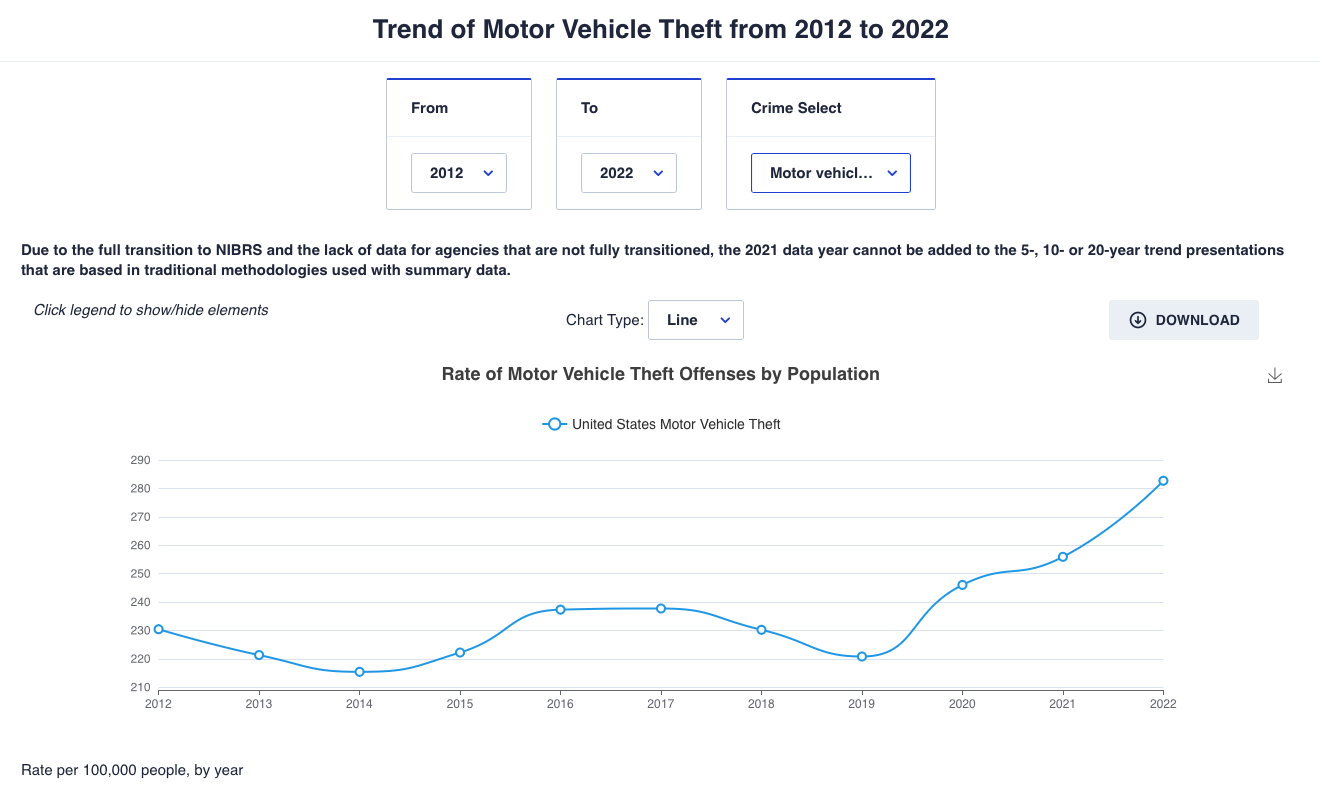
Index crimes are those crimes the FBI deems to be the most serous. There are two types: property crimes, which includes arson, burglary, motor vehicle theft, and theft-larceny; and violent crimes, includes aggravated assault, homicide, rape, and robbery. The New York Times wants you know as we approach the 2024 election that Index crime rates are falling—and not by a little: “Murder likely fell at record speed last year.” Here’s the chart they supply:

I want the reader to note that not only are the 2021, ‘22 murder rates higher than at any point in the new millennium, but also the newspaper’s own estimate of the ‘23 rate is higher, as well. The New York Times admits that its 2023 numbers are estimates based on 99 cities; that number could be higher or lower. I suspect it’s higher. I will put the matter of the 2023 estimate to the side and work with the numbers I have available, which is the FBI’s Crime Data Explorer (CDE) through 2022.

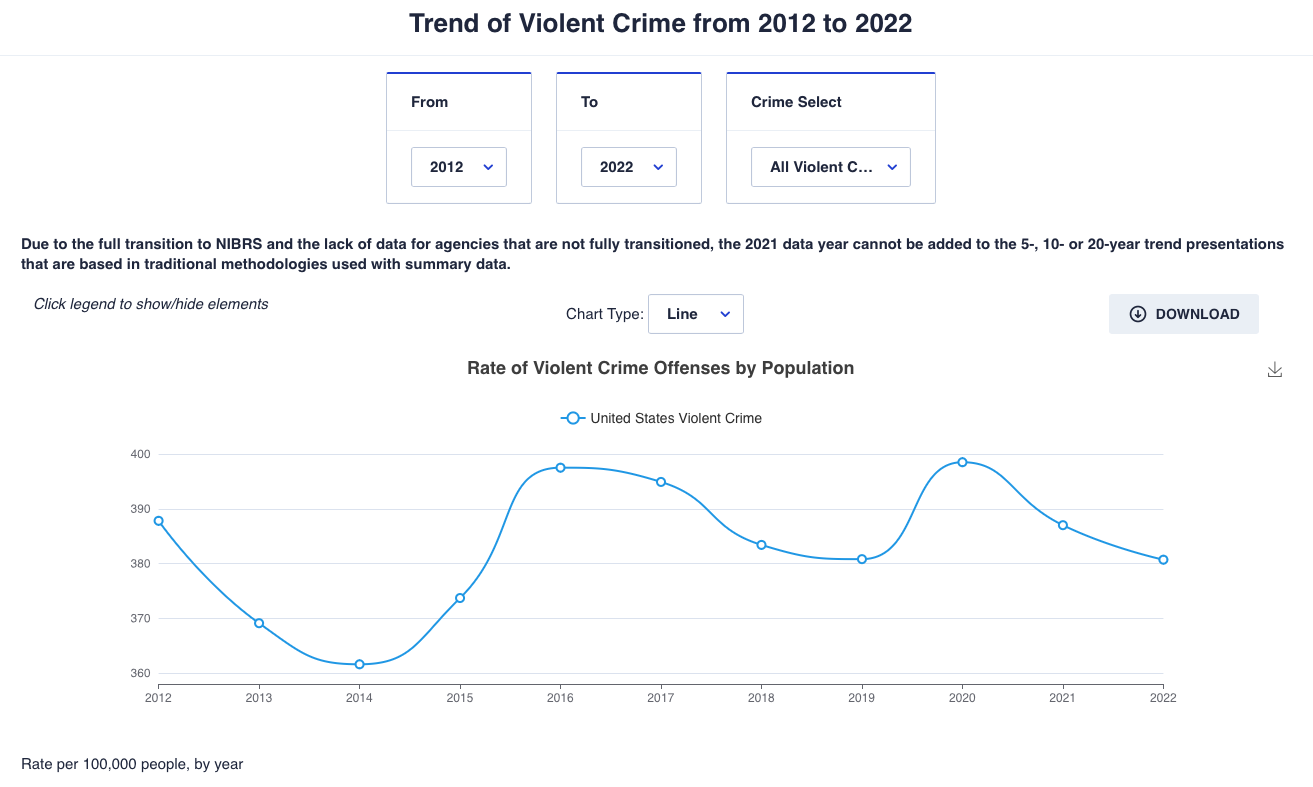
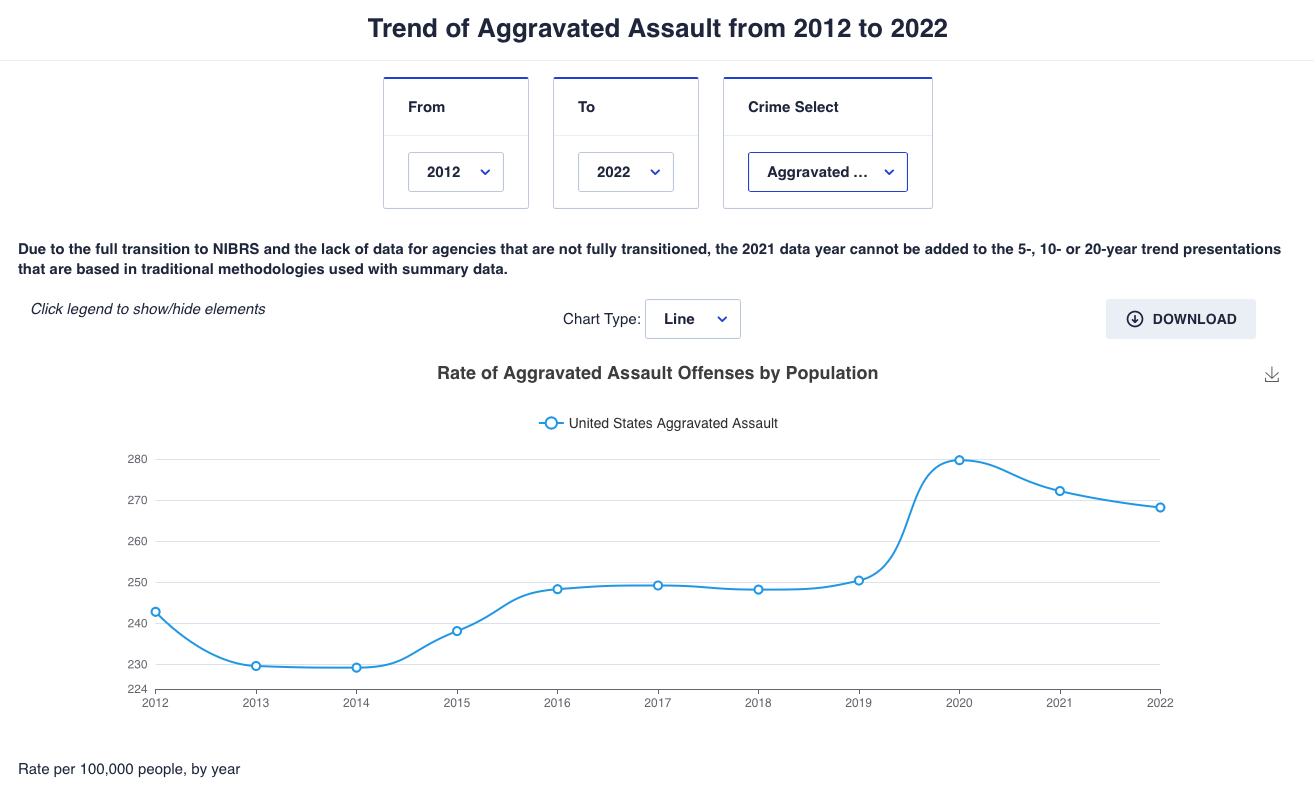
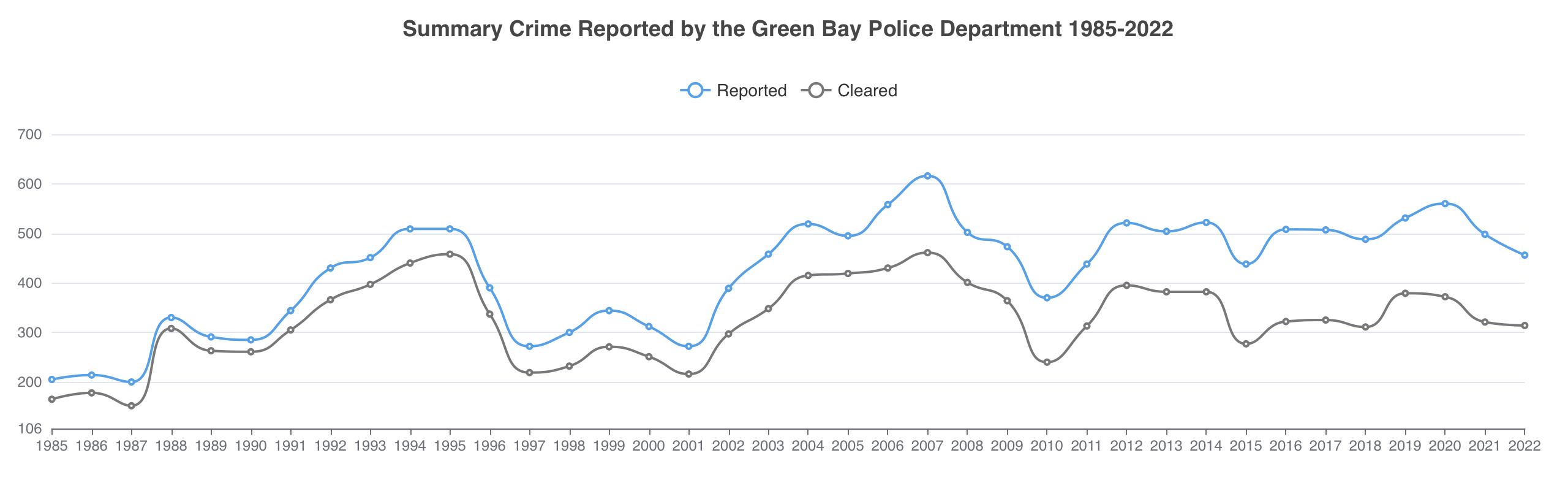
Keep in mind that the FBI recently shifted from the Uniform Crime Report (UCR) model to the CDE, the dash-boarding system based on the National Incident-Based Reporting System (NIBRS). For most of Biden’s presidency, the FBI was derelict in reporting crime statistics, which was frustrating for those of us who teach criminal justice at colleges and universities and advise law enforcement agencies on national trends. My suspicion is that the FBI was (and still is) foot dragging because of the explosion of crime under the Biden Administration.

It should be clarified that only some Index crime rates have been increasing over the last few years, namely aggravated assault, homicide, motor vehicle theft, and rape (the later likely the result of a more inclusive definition). Other Index crimes continue their historic declines, trends that begin in the second half of 1990s with the historic expansion of the criminal justice apparatus. Given the depolicing trend after 2014, I suspect significant underreporting for many of these crime types (aggravated assault, homicide, and motor vehicle theft are more likely to get through the filter).

Based on other sources of information, I have good reason to believe the recent FBI statistics underreport the incidence and prevalence of serious criminal offending. Based on the Justice Department’s National Crime Victimization Survey (NCVS), which depends on scientific survey methods rather than agency reporting, both total violent and property victimization rates were substantially higher in 2022 than in 2021. The NCVS finds that there is significant underreporting of crime. The discrepancies indicate that some of that underreporting is from the agencies themselves. Moreover, where as the NCVS covers the entire nation, approximately 75 percent of agencies report their numbers to the FBI.

Based on FBI numbers, it does not appear that crime is drastically declining. I begin with the ten-year trend for violent crime overall as indicated by the FBI’s CDE. Again, as 2023 just ended, these data stop at 2022, which is the last substantially completed year statistically-speaking.

The New York Times frames the recent rise in crime around the death of George Floyd. However, as longer trends indicate, the rise in violence crime begins after 2014, the year of Michael Brown’s death at the hands of a Ferguson, Missouri police officer, an event spawning the “hands up” myth that propelled the Black Lives Matter (BLM) movement to the national forefront. BLM organized violent resistance against government authorities resulting in an uprising promoted by the legacy and social media and the Democratic Party. This has been referred to as the “Ferguson Effect.” The origins of the rise in crime is obscured not only because the Michael Brown narrative was debunked but because the way the corporate state prepared the conditions for the uprising was comprehensive and intentional. Using the George Floyd case as the starting point gives the color revolution a more organic feel.

We can see the trend in the rates of aggravated assault, homicide, and motor vehicle theft (MVT) during the same decadal frame. In fact, MVT continues to climb and is now higher than any point after 2009.

* * *

Update (January 16, 2024): The Green Bay Police Department says crime is down from last year and is lower now that at any time before the pandemic. They cite three crime types: personal, property, and crimes against society (which covers non-Index crimes such as prostitution, public drug, drug possession, etc.). All of them are down, PD claims. This isn’t true in my neighborhood, which has seen a rash of burglaries. But I am more concerned about the rate of violent crime (aggravated assault, homicide, rape, and robbery).

Green Bay Policy Department Violence Crime. Rate per 100,000 people, by year

This is the trend line for FBI CDE violent crime rate for Green Bay. The blue line is reported crime (the clearance rates track it pretty much). Note that crime increases sharply after 2010. This is when the corporate media rolled out the propaganda terms “systemic racism” and “white privilege.” The crime rate has remains high throughout the period that follows, jumping up during Ferguson and peaking during the pandemic. As you can see, the rate for 2022 was higher than the rate in 2010 and is as high as at any time since 2015. I don’t have access to 2023 numbers, so maybe there is a sharp drop. That’s the claim, anyway. But I doubt it for reasons expressed above. Also, for data for the Ashwaubenon Police Department, Brown County Sheriff, De Pere Police Department, violent crime was up 2022 over 2021. I’ll keep you posted.