Are Progressives Smarter Than Everyone Else? Does it Matter? And What About France?

“All we can say from the current study is that there are likely to be causal pathways not mediated by education or income. We cannot say that the beliefs of high IQ people tell us what is right to believe, but rather only what smart people choose to believe.” Tobias Edwards at al. 2024

One of the recent minor buzzes on X (Twitter) concerns an article claiming that IQ predicts political ideology, described as either “left-wing” or “right-wing.” In the article, “Predicting political beliefs with polygenic scores for cognitive performance and educational attainment,” published in Intelligence (May-June 2024), Tobias Edwards et al., using measured IQ and polygenic scores for cognitive performance and educational attainment, found that intelligence is correlated with a range of left-wing and liberal political beliefs. (Here is the full text of the article.)

Predictably, there’s gloating by progressives on social media. There is a desire to see this line of research form a weapon in the war against the Party’s obsession, the “MAGA extremists,” those mouth-breathers who worship “Shitler.” As somebody with a high IQ (not quite genius) and professing a non-authoritarian left politics, the article interested me not only because of the alleged association between the two, but also because, given the confusion over terminology in today’s political-ideological parlance, including in academic disciplines captured by progressives (especially my own, i.e., sociology), I wanted to know exactly what attitudes count as “left-wing” and “right-wing” respectively. Spoiler alert: It isn’t at all clear in the paper.

At the core of the problem with this study and many other stories attempting to bring political science into the family of positive psychologies is the proper location of liberalism on the ideological continuum. While I define liberalism as left-wing based on historical meaning (which I come to in a moment), it is defined by others as right-wing. This is because liberalism is a bourgeois philosophy that puts central to its system of logic the principles of individual liberty, including the private ownership of capital. Because the left is ostensibly opposed to capitalism (I say ostensibly because the left these days embraces corporatism), capitalism must be rightwing in character. Associated liberal values, such as freedom of conscience, speech, and writing, are problematic for the same reason. Indeed, the whole Enlightenment project is problematic! As it happens, corporations rule the planet, and, together with the left, suppress liberal freedom in all its forms. (Are you listening, France?)

In Europe, because liberalism often aligns with classical liberal principles emphasizing free markets, individual liberties, and limited government intervention, it is positioned closer to the political right. Europeans see the liberal as that individual advocating economic freedom and personal responsibility, contrasting his advocacy with the more collectivist and interventionist praxis of the left. This right-wing view is often referred to as classical liberalism (reality check: it’s actually leftwing).

Conversely, in America, liberalism is associated with the progressive tradition, which emphasizes government intervention and social justice approaches to address economic and social inequalities. Here, liberalism aligns with left-wing politics, advocating for policies like universal healthcare and welfare programs. The American left focuses on using state power to rectify social injustices and promote a more equitable society, which contrasts with the conservative emphasis on limited government and free-market solutions.

This has been taken as the paradigm of what it means to be on the left. However, one should never forget that Otto von Bismarck, the Chancellor of the German Empire, used social welfare policies as a strategy to counter the rise of socialism in the late nineteenth century. Bismarck’s approach to dealing with the socialist movement combined repression with progressive social policies. Bismarck’s regime established health Insurance in 1883, which provided health care benefits to workers, accident insurance in 1884, which covered workers who were injured on the job, and old age and disability insurance in 1889, which provided pensions to workers who retired or were disabled.

By addressing some of the social and economic grievances of workers, Bismarck reduced their inclination to support radical socialist ideas. By providing state-sponsored welfare, Bismarck sought to demonstrate that government, not socialism, best met the needs of the proletariat. Although these moves were designed to undermine the Social Democratic Party (SPD) and the left generally, the SPD continued to grow and eventually became a major political force in Germany—not by seeking to negate the capitalist state, but by leaning into Bismarck’s corporatism through reformism. Indeed, via these developments, Bismarck’s social policies integrated the working class into the existing political system, mitigating the revolutionary fervor and contributing to the stability of the German Empire during his tenure. When the working class threatened the capitalist establishment in the world economic crisis of the late-1920s-early-1930s, capitalist countries either instituted a version of Bismarck’s corporatism, e.g., Roosevelt and the New Deal, or a harder version, e.g., Hitler and National Socialism.

Roosevelt played a key role in changing the meaning of liberalism in America. He did so to market progressive policy, which, as I have explained (and will again here) is a projection of corporate statism. Roosevelt referred to his approach as “New Liberalism.” This term was used to distinguish his policies from classical liberalism, which, as I have described, emphasizes limited government and free-market principles. Roosevelt’s New Liberalism, as embodied in the New Deal, embraced a more active role for the government in regulating the economy and providing social welfare. The agenda included elaborating the regulatory system and laying the foundation for the proliferation of agencies. He pursued massive infrastructure programs that served the material interests of the corporate elite in state-subsidized production and commerce. The New Deal introduced a range of Bismarckian social welfare programs, such as Social Security, unemployment insurance, and aid for dependent children, the later used by progressives to destroy the inner-city black family. To control labor, Democrats passed the National Labor Relations Act (Wagner Act) of 1935, which incorporated the proletariat into the political structure.

As noted, classical liberalism focuses on free markets, individual liberty, and minimal government intervention. In contrast, Roosevelt’s New Liberalism put the state machinery to work to secure economic stability and control over the proletariat. Even before Roosevelt, under the leadership of Woodrow Wilson, progressivism had already begun to shift the rhetoric of liberalism to cover ever greater government involvement in the lives of ordinary people. It was under Wilson, in 1913, that the Federal Reserve was established. The Fed is the central banking system of the United States. However, it is not a national bank. The Act Wilson signed aimed to create a decentralized central bank that balanced the interests of private banks and the federal government. It established twelve regional Federal Reserve Banks across the country to operate independently but under the supervision of a central Board of Governors. Also under Wilson, against in 1913, the federal income tax and the Internal Revenue Service (IRS) became integral parts of the United States’ financial and tax system.

By the mid-twentieth century, the term “liberalism” in the United States had come to be associated with the principles of the New Deal, i.e., institutionalized progressivism and a permanent corporatist arrangement, emphasizing state responsibility for economic management and social welfare. This massive and instructive state structure became understood as “on the left.” Of course its real function was to make the proletariat depended on a government ultimately under the control of the corporate state. These developments moved Friedrich Hayek to The Road to Serfdom, published in 1944 as WWII was drawing to a conclusion. Hayek warned against the dangers of government intervention and central planning in economic affairs, arguing that the increasing trend towards collectivism and state control, as seen in the rise of totalitarian regimes in the twentieth century, inevitably leads to the erosion of individual freedoms and the emergence of a tyrannical government. Hayek’s core thesis was that government intervention set society on a path toward oppression and loss of liberty. Since central planning requires coercion and concentrates power in the hands of a few, these developments ultimately undermine democratic institutions and personal freedoms. In 1949, George Orwell, a socialist, published Nineteen Eighty-Four, which envisioned a world that reflected Hayek’s fears.

In the European sense, liberalism, with its emphasis on individual liberties and limited government, is the less authoritarian standpoint on the spectrum, whereas the left-wing standpoint, with its collectivist attitudes and government interventionism, the more authoritarian. This should be obvious. It isn’t not because people are blind to it, but because they believe it is a good thing. They want the government to control their lives—and especially the lives of those they despise—while dissimulating their authoritarian desire by projecting it onto those who seek a return to democratic-republican principle and classical liberal values. The American left champions collectivism and government intervention while declaring that it is the political right that is authoritarian. Any time spend on X (Twitter) will confirm that those defining themselves as “liberal” (they are in fact progressives) are horrified by the Supreme Court’s decision regarding the Chevron deference and the details of Heritage’s Project 2025, both of which promise to dismantled the massive government bureaucracy and limit the ability of regulatory agency to administer the lives of people. Putting this another way, the left sees as authoritarian those who seek to return the nation to a constitutional republic based on the ethic of individualism. In a strange Orwellian alchemy, the liberal has become the authoritarian. If by “liberal” one means progressive, then literally. If by “conservative” one means liberal, then falsely.

I will take up the matter of the French elections in a separate section below

We might consider that attitudes of authoritarianism and totalitarianism are not inherently tied to the left-right political spectrum (see The Individual, the Nation-State, and Left-Libertarianism; Populism and Nationalism; Marxian Nationalism and the Globalist Threat). Nor are the attitudes of patriotism and nationalism, on the one hand, and globalism on the other tied to the left-right continuum. While it’s true that some left-wing ideologies have historically led to authoritarian regimes, the same can be said for certain right-wing ideologies; the degree of authoritarianism or totalitarianism in a political system may be more about how power is concentrated and exercised rather than specific policy preferences or economic systems. However, classical liberalism’s focus on individual liberties and limited government suggests a preference for a less intrusive state. This aligns with a right-wing stance that prioritizes personal freedom and private enterprise. So what right-stance would produce authoritarianism? Or, perhaps liberalism is actually a left-wing standpoint after all.

After all, liberalism is historically rooted in left-wing ideology in the European context, particularly during the French Revolution, representing a commitment to democratic governance, individual rights, and the rule of law. This was the ideology of the bourgeoisie, ie., the capitalists—in contrast to the reactionary supporters of the ancien régime, i.e., the feudalist mode of production with its ideology of natural hierarchy (appeal to an intrinsic or god-given hierarchy is really what animates right-wing logic and praxis). In the late eighteenth century, the French National Assembly saw those who advocated for the principles of the Enlightenment—“liberté, égalité, fraternité”—seated on the left. These liberals opposed the entrenched aristocratic and monarchal system represented by those seated on the right. This early association of liberalism with left-wing politics highlighted a transformative vision aimed at dismantling feudal privileges, establishing constitutional government, and promoting civil liberties.

Over time, you may be told, European liberalism evolved, just like US liberalism did, focusing on balancing individual freedoms with social justice, and often positioning itself against both authoritarianism and unchecked capitalism. Thus, in the European historical framework, liberalism’s left-wing legacy is tied to its foundational role in championing progressive reforms against conservative monarchical structures. But it was another left-wing standpoint, that of socialism, and the emergent standpoint of corporatism that limited liberal freedoms. (See my analysis of Bismarck above. See also my recent essay Republicans and Fascists.) As corporatism became identified with socialist politics, and thus the left, liberalism was redescribed as a right-wing standpoint.

On the other side of the pond, in a propaganda move, as I have explained, American liberalism’s left-wing orientation paradoxically came to emphasize the role of corporate and government power in regulating the working class, moving under the cover of economic equality and social justice. This is progressivism, the ideological projection of corporatism, and because corporatism involves increased government intervention in the economy and society, which put another way is greater control over society by corporate interest, it emerges as the main authoritarian threat over the last seventy or so years. Not incidentally, European fascism, also a species of corporatism, was the main authoritarian threat in the first half of the twentieth century. What may be confusing to people is that, whereas yesterday’s authoritarianism is defined as right-wing by historians and political scientists, today’s authoritarianism is left-wing be denied as being such. In fact, there is very little functional difference between different forms of conservatism (see my most recent essay Celebrating the End of Chevron: How to See the New Fascism).

Today, if you were to ask around, you would be told that the left opposes capitalism. That, historically, liberalism has been understood as a left-wing standpoint, in contrast with absolutism and feudalism, i.e., social hierarchy justified by right-wing ideology, I have gone to lengths in my essays (I have tired again today) to help readers understand that the term “liberalism” has, in the American context, been deceptively and illegitimately repurposed to denote progressivism, a collectivist ideology. At the same time, liberal views have been recoded as the inventory of conservatism. If liberalism is a right-wing view, and if right-wing attitudes are authoritarian, then how was it that the most technologically advanced and freest civilizations in world history were founded upon its ideas, while the crackpot theories of the world, such as critical race theory and queer theory, standpoints that enshrine anti-white and anti-woman bigotry (not to mention transgress the sexual boundaries between adults and children) herald the end of constitutional republicanism and classically liberal values?

Let’s now return to the article that has some folks geeking out over on X. Significantly, the researchers found both IQ and polygenic scores significantly predicted social liberalism and lower authoritarianism, even after controlling for socioeconomic variables. Crucially, one must be careful with claims of significance. Drawing inferences, such as by conducting significance tests, from clinical samples can present challenges that differ from those in other types of research settings. Clinical samples often involve individuals who seek treatment or are recruited, rather than obtained by inferential sample techniques, which can introduce biases or limitations when generalizing findings to broader populations. Moreover, even accepting significance tests, the beta coefficients explain much less than half of the variability in the dependent variable—and the independent variable is a problematic theoretical construct.

Putting the methodological problems aside for a moment, the authors write, “We might believe intelligence directly changes political beliefs. Political beliefs likely reflect our ethical values and our empirical beliefs, both of which might be altered by intelligence.” They then cite Onraet et al., who, in 2015, suggested that, quoting Edwards et al.’s summation of their conclusion, “the use of stereotypes and socially conservative beliefs function as heuristics, utilizing fewer cognitive resources than thinking about social issues on a case-by-case base. This could cause lower cognitive ability to be associated with right-wing views.” Odd way of putting it, but I think the meaning is plain: those who use fewer cognitive resources are rightwing and authoritarian.

Interestingly, another source the authors cite, DL Weakliem, in a 2002 article in the International Journal of Public Opinion Research, found that education is “associated with liberal values and support for capitalism,” significant because education, “may be in a reciprocal causal relationship with IQ scores,” a supposition I’m confident few would question (I am not here to bash smart and educated people). At the same time, in a paper published in 2023, Ahlskog “found a polygenic score for educational attainment had a positive effect on social liberalism and a negative effect on economic conservatism, using family fixed effects.” The question here, given confusion over language, is whether the concept “economic conservatism” is an ideological stand-in for liberalism and support for capitalism. This would, of course, make the claim a wash. I am sure some of you already have in mind the oft-heard personal statement “I am socially liberal and fiscally conservative” as indicating tolerance for individual choice and preference for capitalist relations. The question would be, then, how did these get decoupled? Moreover, what would it mean to be fiscally liberal and socially conservative?

I hold that, if the French Revolution means anything at all, both liberal attitudes and support for capitalism are both left-wing attitudes. I know I am flogging a dead horse, but bear with me a bit longer as I have a mythological point to make. Consider the title of Ahlskog 2023 article published in the Journal of Experimental Political Science: “It matters what and where we measure: Education and ideology in a Swedish twin design.” When one reads the study, he finds that Ahlskog believed it was important enough to put in the abstract that “education shows positive causal effects on economic, but not social, conservatism.” In other words, if education is a proxy for IQ, high IQ predicts pro-capitalist attitudes (i.e., liberalism) but not conservatism in its traditional sense. Ahlskog’s findings make sense. So why do Edwards et al. gloss over it?

Getting into the weeds with Edward et al., they “employ five scales about political attitudes that were given to parents and offspring during their third follow-up assessment. These were measures of political orientation, authoritarianism, egalitarianism, social liberalism and fiscal conservatism. We also include one social-attitude scale—religiousness” (which understandably fared poorly in predicting anything). How was political orientation assessed? Not based on an objective criterion. Rather it was based on self-declaration, “assessed with the single item ‘What is your political orientation?’ on a 1–5 scale ranging from ‘extremely conservative’ to ‘extremely liberal.’” I get this question all the time from telephonic survey-takers and I ask them to clarify “liberal.” Whether they’re robots or committed to the purpose of the severe, they can’t tell me. Sometimes I invalidate their survey.

Many of those who have been following my blog have in their mind already one of the problems I have with all this. Based on the historic tenets of liberalism, I am very liberal. I identify myself as such. But to many progressives, I am conservative and right wing. Why? Because I am critical of anti-racism, immigration, Islam, and gender ideology (see Am I Rightwing? Not Even Close). Moreover, I am a populist and a nationalist, which, in their view, attitudes relegating me to the right end of the spectrum. At the same time, while I am liberal on matters of assembly, association, conscience, speech, and press (my critics are not), I am less liberal on the question of capitalism, whereas my critics, while organized against free conscience, speech, press, etc., do not share with the Old Left the central concern of class struggle. Instead of class struggle, the New Left is identitarian, fetishizing gender, ethnicity, race, religion, etc. (See my essays Marxist but not Socialist and Why I am not a Socialist.)

Getting even further in the weeds, the authors measure authoritarianism “using 12 items capturing three facets of authoritarianism (subordination, aggression, and conventionalism) from Duckitt et al. (2010)’s tripartite authoritarianism-conservatism-traditionalism model.” They measure egalitarianism using eight items from Feldman and Steenbergen (2001) and Feldman (1988). Religiosity was assessed with the 9-item scale created by Koenig et al. (2005). They used eleven items to measure socialism and liberalism and six to measure fiscal conservatism. These items were adapted from similar questions in the General Social Survey items (Smith et al., 2018). Their test inventory is substantially similar to another study in Intelligence by Willoughby et al. (2021), so they tell the readers to go there (however, Willoughby at el. provides no more information that Edwards et al.).

Edwards et al. explain: “Due to the high correlations among the variables, we create a composite measure to summarize the relationship between intelligence and political opinion. Authoritarianism, egalitarianism, social liberalism and fiscal conservatism scales are combined to create a sum score called the political composite. Before summing, we change the signs of our scales so higher scores indicate left-wing views, ensuring that high composite scores indicate left-wing views too. A scale was coded as being left-wing or right-wing by its correlation with authoritarianism, which is assumed to be right-wing.” I quoted all that because they are telling us that the scales used were determined to be “right-wing” because of their association with authoritarianism. Based on what I just told you, or maybe you realized it before then, you know that this is a ridiculous assumption.

Here are their conclusions: “Across all political beliefs, phenotypic IQ significantly predicts views in a left-wing direction. The effect of IQ on our political composite is 0.35.” Keep in mind that the proper procedure involves squaring Pearson’s R to obtain R2, the proportion of variance explained. While R indicates the strength and direction of the linear relationship, R2 quantifies the proportion of the variance in the dependent variable that can be explained by the independent variable. For example, an R of 0.8 implies a strong positive relationship, but squaring it indicates that 64 percent of the variance in the dependent variable is explained by the independent variable. This is quite a bit of variance explained. This is because the R is quite large. The R cited in Edwards et al. study is not, yielding a R2 of 0.12, meaning that the variance explained by IQ is only 12 percent.

In multivariate analysis the authors found that, upon controlling for family fixed effects, IQ had a significant effect on the political composite (β= 0.26, p= 0.040), as well as on authoritarianism (β=−0.35, p= 0.011) and social liberalism (β= 0.28, p= 0.011). In IQ research, family fixed effects refer to a statistical method used to control for unobserved variables that are constant within families but vary between families. This approach purports to isolate the impact of variables of interest, such as genetic factors or environmental influences, by accounting for shared family characteristics that could confound the results. Again, the alphas are probably not relevant since this was not really a representative sample from the population, but if it were, the finding that, after controlling for income and education, the effect on the composite is no longer statistically significant is, as we see in a moment.

The authors then shift to genotypic IQ which “significantly predicts left-wing political views across the political scales.” Genotypic IQ pertains to the genetic potential or predisposition for intelligence. It is determined by the individual’s genetic makeup and the specific combination of genes that may influence cognitive abilities. Crucially, unlike phenotypic IQ, genotypic IQ is not directly measurable but inferred through genetic studies, such as twin studies or genome-wide association studies, which estimate the heritability of intelligence. “After controlling for the midparent PGS [midparent polygenic score refers to a method used in genetics to estimate an individual’s genetic predisposition for certain traits, based on the genetic information of their parents], genotypic IQ significantly predicted three of the seven political variables; the political composite(β= 0.54,p= 0.009), authoritarianism (β=−0.67,p= 0.002), and social liberalism (β= 0.58,p= 0.009).” Just as they found with phenotypic IQ, they could no longer significantly predict any of the political beliefs when controlling for education and income using genotypic IQ.

If these studies are valid, that is, if it is true that smart people are drawn to left-wing progressivism, and if it is also true, as I have shown many times on Freedom and Reason, and again here today, that progressivism is the ideological standpoint of corporate state, then what is it exactly that smart people are drawn to? You can begin answering that question by asking this question: Who are they? They’re the ones with the advanced degrees useful to those who run society. They comprise the credentialed class, the professional-managerial stratum. They run the administrative apparatuses of both government and organizational bureaucracies, the latter you know as the corporation. Corporations, especially transnational corporations, exhibit characteristics that resemble totalitarian or fascistic structures. Corporations operate hierarchically, with power concentrated at the top among executives and shareholders, paralleling the centralized authority typical of totalitarian regimes. Decision-making processes within corporations are top-down and authoritarian, with little input from workers or the communities affected by corporate actions. This is an effect of the system.

The hierarchical and top-down decision-making structure commonly found in corporations is characteristic of bureaucracies in general. Bureaucracies operate with a centralized authority where power and by design decision-making authority are concentrated at the top levels. In bureaucracies, whether governmental or organizational, decisions move downward from senior officials or managers to subalterns to lower-level employees. This hierarchical structure constitutes a rigid system where rules and procedures are strictly followed, limiting flexibility and innovation. Public and private bureaucracies operate within a hierarchical framework where executives and shareholders hold significant decision-making power. The executive leadership sets strategic directions, allocates resources, and makes key operational decisions, often with limited input from lower-level employees or external stakeholders. They need smart and educated people to run these systems.

To be sure, government and organizational bureaucracies may different in their explicit goals and purposes. Corporations are primarily driven by profit and shareholder value, aiming to maximize returns for investors, whereas bureaucracies, especially in government contexts, are tasked with implementing policies, delivering services, and ensuring regulatory compliance. However, the critique of the concentration of power and decision-making authority in ways that are undemocratic or authoritarian, limiting transparency, accountability, and broader stakeholder participation in decision-making processes, means seeing both as operating according to the same intrinsic logic—and, in the corporate state form, as functioning towards the same external ends: money-power.

Since the principle social logic of the late capitalist mode of production is corporate power, the influence corporations have over society and politics is entrenched and ubiquitous, we might even say intrinsic. Large corporations exert tremendous economic and political power over society, shaping policies and regulations to favor their interests over individual freedom and broader societal concerns. This concentration of power, unchecked by democratic mechanisms, undermines democratic governance and accountability—and the democratic mechanism is undermined by the administrative state and technocratic apparatus. It’s a vicious circle.

Even if the regulatory system were not designed to control people for the sake of corporate interests, corporate interests prioritize profit maximization and shareholder value above other social or environmental considerations and impose these on the public regulations notwithstanding. This profit-driven motive lead to environmental degradation, exploitative practices, and labor abuses, reminiscent of the disregard for human rights often associated with totalitarian regimes. Moreover, the global reach of transnational corporations transcends national boundaries, operating across countries with varying legal and regulatory frameworks. This global presence allows corporations to circumvent local laws and regulations, further consolidating their power and influence beyond democratic oversight. This is why I tell people that the matter has been misput. Big government doesn’t regulate corporations for the sake of the people. Big government regulates the people for the sake of corporations.

The speech and behavior of progressives during the COVID19 pandemic illustrated in dramatic fashion the problem of smart people captured by corporate power and the party representing it. Smart people believe science. They have signs in their yard to that effect. Smart people comprise the progressive left. Check their IQs if you don’t believe it. Progressives know science resides in the institutions of the corporate state, in the medical and pharmaceutical industries, and in the government agencies administering those and a myriad of other powerful interests. Those who doubt the corporate state consensus, and the experts and advocates who manufacture that consensus, are less intelligent. Their grasp of the world is inferior. More than this, they are more likely to be authoritarian, because authoritarianism is not defined in terms of the fascist bureaucracies that run our lives and employ the elite, but rather in terms of the populism, nationalism, and traditionalism expressed by the proletarian masses smeared as the deplorables.

The progressive left, the cognitive elite, expressing a technocratic desire that resides deep in their psyches, are the offspring of the corporate state. We now have generations growing up in the social logic of the system. They fetishize expertise—but, like dutiful subject, only those experts approved by the corporate state. This house believes science. But science is captured by corporate power. Corporate power is inherently authoritarian. The cognitive elite seek technocracy. In technocratic systems, leadership is entrusted to technocrats who possess specialized knowledge, with the emphasis on rational decision-making. This approach prioritizes the application of technical skills and empirical data to address societal problems, striving for efficiency—calculability, predictability, uniformity (with cosmetic difference), and control. In a technocracy, decisions are driven by the scientistic establishment rather than the people through democratic consensus formation. The primary goal is to optimize resource allocation and streamline processes to achieve practical outcomes—but for the sake of who? Expert leadership and rational decision-making can be applied across various sectors, creating a more efficient and effective form of governance—but to what end?

Naturally, the smart people are drawn into the authoritarian structure of corporate technocratic control. From this elite purchase, they see liberalism as a problem. The authoritarian character of bureaucratic collectivism squeezed the individualist ethic out of the system. We live in the irrationality of Max Weber’s stahlhartes Gehäuse. “Today the spirit of religious asceticism—whether finally, who knows?—has escaped from the cage. But victorious capitalism, since it rests on mechanical foundations, needs its support no longer. The rosy blush of its laughing heir, the Enlightenment, seems also to be irretrievably fading, and the idea of duty in one’s calling prowls about in our lives like the ghost of dead religious beliefs.” The great sociologist continues: “No one knows who will live in this cage in the future, or whether at the end of this tremendous development entirely new prophets will arise, or there will be a great rebirth of old ideas and ideals, or, if neither, mechanized petrification, embellished with a sort of convulsive self-importance. We can respond to some of this. The left has become the New Aristocracy in a future of mechanized petrification embellished with a convulsive self-importance. Fitting, as we stand at the threshold of the New Feudalism of a mechanized age.

* * *

The 2024 United Kingdom general election was held on Thursday, July 4, to elect 650 members of Parliament to the House of Commons. The Labour Party won in a landslide, taking 33.8 percent of the vote. Labour now holds 411 of the 650 seats, more than doubling the number of seats held by the party. This was an outright majority, a resounding victory for the UK left. A legislative election was held in France on June 30, with a second round held on July 7, to elect all 577 members of the seventeenth National Assembly of the Fifth French Republic. The threshold for a majority in the assembly is 289 seats. No party won an outright majority. However, the left wing (Nouveau Front populaire), which includes the communists and socialist parties, won more seats than the nationalists (Union de l’extrême droite). Macron’s centrist political coalition Ensemble pour la République also won more seats than the nationalists. The American left is ecstatic about the advance of the left in these two countries and what they hope it signals for the future of the populist-nationalist movement. They are particularly overjoyed by the French election results. But there is something very funny about those results.

In a recent essay, Three Big Lies About Trump—and Promising Developments in the Transatlantic Space, published a few days after the first round, I wrote about how “it’s a wonderful thing to see the French working class rising against the transnational corporate destruction of Western civilization and the international liberal order.” In the first round, Le Pen’s support was in evidence in nearly every city, town, and village in France, I noted. The nationalists had a chance to become the ruling party of one of Europe’s most imperiled nation-state. So I had hope. In the second round, the nationalists took 37.6 percent of the vote, an increase over their 33.2 percent take in the first round, winning 142 seats. Nice. The left wing won only 25.8 percent of the vote. However, the left wing emerged with 184 seats. Macron’s centrist coalition won 24.5 percent of the vote, coming in third. Yet, his Ensemble wound up with 159 seats. If the second and third place finishers form a coalition, which will weave together globalists, socialists, and Islamists, then France will move decidedly in the direction desired by the transnational corporate establishment, a direction that will see the cultural and national traditions of France deconstructed. Yet Marine Le Pen’s party was the most popular.

On the questions of how the promise of a nationalist majority could be dashed and the party that won the largest share of the votes is third in ranking by seats earned, the discrepancy between the percentage of votes and the number of seats won by different parties in the French election is attributable to the structure of the French electoral system for the National Assembly and machinations that structure allows. If in the first round no candidate gets more than 50 percent of the votes, a second round is held. Candidates who receive a certain threshold of votes in the first round advance to the second round, thus drawing potentially more voters. Moreover, in the second round, parties often form alliances or withdraw candidates to consolidate support around a single candidate to defeat their main opponent. This can lead to situations where a party with a lower national vote share wins more seats due to successful local alliances and strategic withdrawals. There are other complexities, but this is what happened: the nationalists increased their vote share in the second round but faced strategic alliances against them, leading to fewer seats.

I am trying to be optimistic, albeit I’m inclined to believe that this was the last chance France had at saving itself from a very bad end, one portending a bad end for all of Europe despite nationalist gains in European elections, especially in light of the results in the UK. I worry, too, that Biden or his replacement will be elected in November 2024 and the future of the American Republic. On the positive side, the French nationalists showed that they were the most popular party in France and gained seats, this despite coming in third in the seat count. And, who knows whether the other two parties will be successful in forging a coalition government. It could end in a mess that triggers another election.

For those readers who are trying to understand why a high IQ left-winger was hoping for a victory for the political right in France, the answer should be obvious to those who have been following me on Freedom and Reason. It should be obvious as well in what I argued in the essay. In case it’s not, I will explain/summarize. The West is in what J Habermas calls a legitimation crisis. The reason for this is the rise of the corporate state and globalist ambition. The elite of late capitalism has this overarching goal in its collective mind: dismantle the international system of relatively autonomous nations and replace it and its systems of democratic governance and human rights with a one world order administering the masses for the sake of preserving the power and privilege of the transnational elite, finally transitioning to a global neofeudalism where humanity will be managed on high-tech estates placated by diminishing expectations and provisioning of comfort (over freedom). The transition and its result require a technocratic apparatus that controls the population through authoritarian means. This apparatus—the administrative state—has been under construction for more than a century.

A key part of bringing this future to fruition is delegitimizing the secular order established upon Enlightenment values, an order that grasps the necessity of cultural, linguistic, and national integrity, democratic-republican principles of self-governance, and classical liberal values of civil liberties and rights. This is the role played by the left in France and elsewhere across the West, achieved by climate hysteria (dissimulating the regime of austerity), the transnationalization of production (offshoring), mass immigration and amnesty, multiculturalism (cultural pluralism), a shift from individualistic to collectivistic conceptions of accountability (social justice), and disruptive post-humanist ideologies (e.g., gender ideology).

What observers hailing from the left fail to recognize is that, far from the new left representing a challenge to capitalist power, the new left, i.e., the progressive tendency, serves two functions: at the street level, it provides the chaos, intimidation, and nihilism that undermines the cultural foundation of the rational nation-state, sapping the will of the citizen to defend it (loss of self-confidence often causes paralysis); at the governmental and institutional levels, it delivers the law and policies that prepare the citizen-cum-subject for incorporation into the new world order.

Celebrating the End of Chevron: How to See the New Fascism

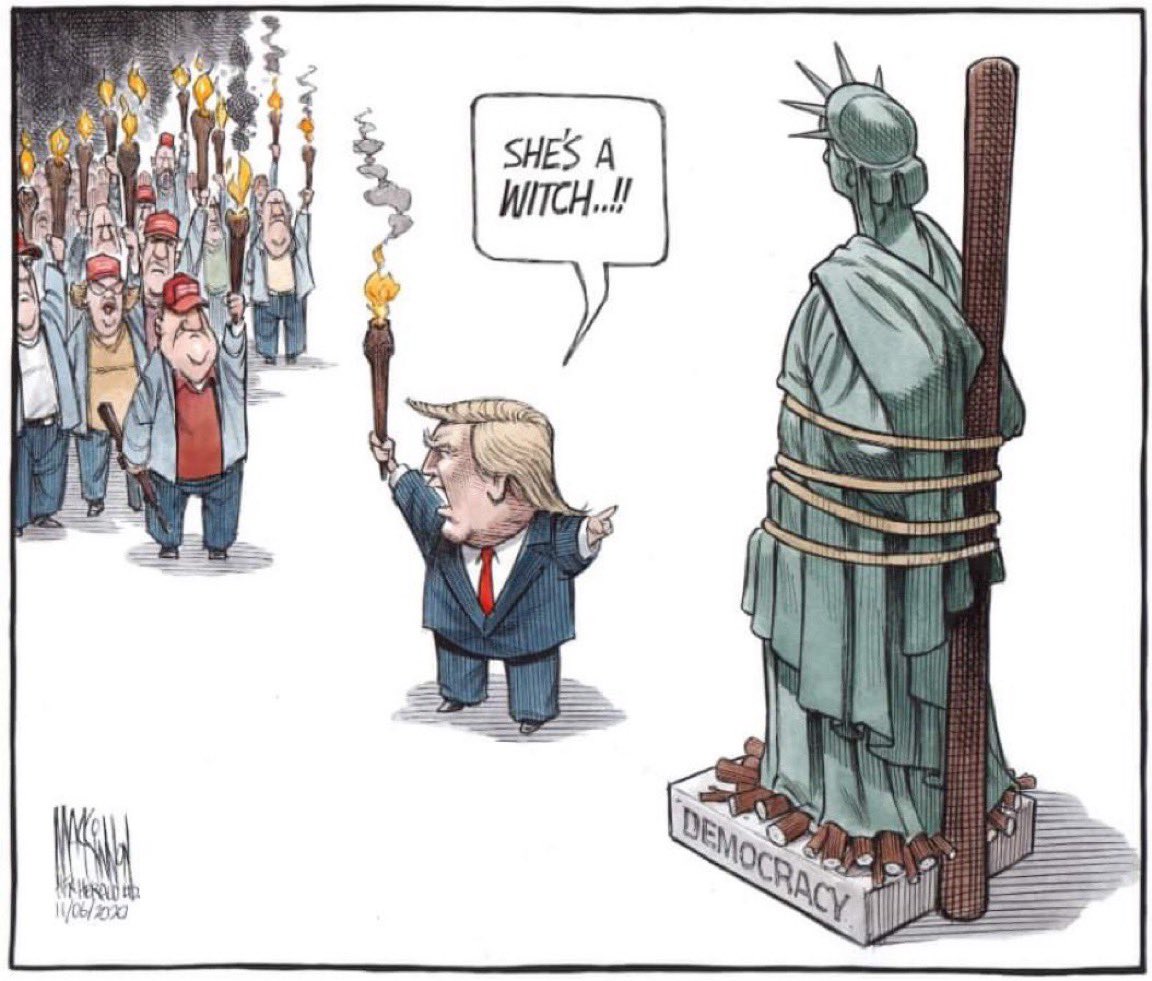
Bruce MacKinnon’s November 6, 2020 editorial cartoon, published only a few days after the disputed presidential election that led to the illegitimate Biden regime, still speaks to the urgent need to differentiate between actually-existing fascism and depictions of populist-nationalism as a manifestation of right-wing extremism.

Bruce MacKinnon. November 6, 2020

What is especially deceptive about the cartoon (albeit likely not intentional) is the suggestion that it is democracy the MAGA crowd seeks to immolate. As I have noted several times on Freedom and Reason, progressivism supplants democracy with technocracy. It is in fact the federal bureaucrat who has Lady Liberty bound and ready for destruction. Think censorship, corporate control, surveillance, etcetera.

You can check this by asking yourself who it is that desires freedom of movement and choice to be controlled by public health edict. There are many such revealing questions. Who is it that desires social media companies to censor and deplatform those who express ideas that offend groups favored by the Democratic Party? Why is it okay to festoon public school classrooms with Pride Progress propaganda but subject to FBI knock-and-talks those concerned parents who object? These indicators of the New Fascism require a proper analytical framework to see and assemble into an accurate picture of the threat confronting freedom in the transatlantic space.

I have published many essays describing and analyzing the “New Fascism” on Freedom and Reason (see, e.g., my August 2021 Totalitarian Monopoly Capitalism: Fascism Yesterday, Today, and Tomorrow for a lengthy analysis). One source of skepticism to this analysis comes not from a disagreement over facts but from a significant degree of incommensurability between methodologies. I’m a sociologist, while skeptics hail from the disciplines of history and political science. (There are skeptics in sociology, as well, but this is largely due to the discipline having become thoroughly corrupted by woke progressivism.)

Sociologists focus on the structure and function of social phenomena, abstracting core principles from various historical instances to understand broader patterns. In the case of fascism, sociologists, if working properly, identify essential characteristics such as authoritarianism, mass mobilization, and the suppression of dissent, and then examine how these elements manifest in different contexts. This approach allows for the identification of fascistic elements in systems that may not fit the historical instances of fascism in the first half of the twentieth century but operate on similar principles in functional terms and are therefore concrete instantiations of fascism.

Historians are concerned with the specificities of historical events, emphasizing the unique circumstances and developments that define instances of fascism. They document the rise of fascist leaders, detail the socio-political contexts, and periodize the chronological progression of events that lead to the establishment of fascist regimes. This approach may help in understanding the concrete manifestations of fascism in different historical periods and locations, but it often leads to time locking the phenomena that indicate fascism, which results in denial of really-existing fascism in contemporary Western societies. Even historians who work comparatively fail to see fascism in its contemporary manifestations.

Similarly, political science focuses on governance structures, institutional frameworks, and political behavior. While this can offer insights into how fascist regimes come to power and even how they function, it can also lead to an overemphasis on formal political processes and narrowly defined state structures, potentially overlooking the more subtle and pervasive social and cultural dimensions of fascism that sociologists are better equipped to analyze. Political science, with its tendency towards quantification and model-building, often misses the nuanced and dynamic ways in which fascist ideologies permeate everyday life and social relations.

Franz Neumann, a prominent political scientist and legal theorist, best known for Behemoth: The Structure and Practice of National Socialism, published in 1942, emphasizes the chaotic and polycratic nature of the Nazi regime. Unlike theories that stress the centralization and monolithic structure of fascist states, Neumann argues that Nazi Germany operated more like a “non-state” where various power blocs—the party, the military, the industrialists, and the bureaucracy—competed for dominance. Neumann’s critical theoretical approach allows for him to develop an account of fascism, which he defines as totalitarian monopoly capitalism, that grasps its function rather than its formal self-declarations.

For Neumann, fascism is an economic and political response to the crises of capitalism. He posits that fascism emerged as a reaction to the threats posed by both liberal democracy and socialism to the capitalist order. In his analysis, fascism served the interests of monopoly capitalism by dismantling democratic institutions and repressing labor movements, thus ensuring the dominance of capitalist elites. This perspective highlights the economic dimensions of fascist regimes and the ways in which fascists manipulate social and political structures to maintain capitalist hierarchies. In my analysis of fascistic systems, I insist on attention to function; instead of asking whether it is “populist,” “nationalist,” etc., I ask: what is it that fascism is seeking to achieve and how does it go about achieving it? Does it do the work of capitalism? Does it pursue work via authoritarianism, mass mobilization, and the suppression of dissent? If so, then it is fascism.

To draw out the contrast in methodology, historian and political theorist Roger Griffin, who developed a comprehensive analysis of fascism in his 1991 The Nature of Fascism, puts central to his definition of fascism the concept of “palingenetic ultranationalism.” This term refers to the notion of national rebirth or renewal, where fascist movements seek to revive a perceived lost golden age and create a new, purer national community. Griffin’s theory emphasizes that fascism is not merely about authoritarianism or violence but is fundamentally a revolutionary ideology aiming to transform society and culture. Griffin thus lends intellectual heft to the propaganda that fascism is at its core n extreme form of populism and nationalism, when in fact fascism has nothing to do with these time locked and culturally specific elements. In this way, Griffin makes fundamental to fascism what are peculiar and superficial elements.

Usefully, sociologist Barrington Moore Jr., in his 1966 Social Origins of Dictatorship and Democracy, identifies a phenomenon he describes as “revolution from above,” which he uses to describe the process through which the capitalist class initiates and controls social and political changes to maintain their dominance and prevent revolutionary upheaval from below. In this view, fascist regimes emerge when traditional elites feel threatened by the potential for revolutionary change led by the lower classes. To preempt or suppress these radical movements, capitalist elites collaborate with authoritarian movements, which promise to preserve the existing social order.

Moore conveys the possibility and unfolding of the “revolution from above” in this way: rapid industrialization and economic changes disrupt traditional social structures, leading to increased antagonisms between social classes; landowners and industrial capitalists fear losing their privileged positions in the hierarchy; liberal democratic institutions are unable to manage the economic and social upheavals caused by modernization, creating a political vacuum and disillusionment with democratic processes (this is the legitimation crisis Jürgen Habermas describes in his 1973 book by the same name); these developments make authoritarian alternatives appealing and, harnessing these means, capitalists suppress those who threaten their economic and political power.

An analysis of the current situation in the transatlantic space finds these basis for a fascistic revolution from above. The Third and Fourth Industrial Revolutions (3IR/4IR), which emerge in the post-WWII period, comprise a transformative era marked by the fusion of biological systems and digital technologies with physical systems. It represents a paradigm shift where advancements in fields like artificial intelligence, biotechnology, nanotechnology, and robotics redefine industries, economies, and societies globally. At its core, the situation is characterized by the blurring of boundaries between the biological, digital, and physical spheres. This convergence leads to innovations such as smart factories, where automation and data exchange optimize manufacturing processes, thus eliminating human labor; personalized medicine, where digital technologies and genetic information drive healthcare goals, including transhumanist desire; and smart cities, where interconnected infrastructure, ostensively to improve efficiency and quality of life, leads to the total control over the populations in high tech estates.

The impact of these developments extends beyond technological advancements, influencing socioeconomic dynamics and governance structures, introducing new challenges including accelerated job displacement due to automation, ethical concerns surrounding data privacy and artificial intelligence, and disparities in access to technology and its benefits. Moreover, the rapid pace of change during this period has necessitated adaptive strategies from businesses, governments, and individuals to harness its potential while addressing its implications for education, employment, and equality. In essence, in a period driven by innovation and technological integration, man confronts a world that is shaping a future where the digital, physical, and biological realms converge to redefine how he interacts, lives, and works. More than this, it is a world where the liberal democratic structures of constitutional republics are a hinderance to interests of corporate power thus necessitating a revolution from above. These are the conditions of the New Fascism.

Sociology, not in its woke progressive corruption, but as C. Wright Mills and others used it, is for this reason more relevant today than ever. Yet it is historians and political scientists the media seeks out for commentary. The superficialities of these disciplines lend themselves to a critique of contemporary populism and nationalism that promotes the corporate agenda. Although a political theorist, Sheldon Wolin’s constructs of “managed democracy” and “inverted totalitarianism,” presented in his 2008 Democracy Incorporated: Managed Democracy and the Specter of Inverted Totalitarianism, exemplify the sociological approach. I have discussed his work a few times on Freedom and Reason. I want to elaborate his views here . 

Wolin argues that modern forms of governance, while not fitting the historical template of fascism, share fundamental similarities. Managed democracy refers to a system where democratic processes exist but are controlled and manipulated by elites, reducing genuine democratic participation. Inverted totalitarianism describes a system where corporate power and state authority merge to exert control over society, without the need for a dictatorial figurehead. These constructs highlight how fascistic principles can operate in contemporary democracies, where the facade of democratic institutions masks the underlying authoritarian control.

At the heart of Wolin’s analysis is the idea that inverted totalitarianism represents a transformation of democratic governance into a system where corporate and economic power wield disproportionate influence over political processes and policies. Unlike classical totalitarianism, which relies on a centralized state apparatus and charismatic leadership, inverted totalitarianism thrives on the integration of corporate interests with governmental functions, resulting in a form of governance where economic elites and large corporations shape political agendas and decision-making.

Sheldon Wolin

Here are the chief elements of inverted totalitarianism identified by Wolin: Corporate interests exert significant influence over the electoral process, legislative bodies, and regulatory agencies through campaign contributions, lobbying, and revolving-door relationships between business and government. While inverted totalitarianism maintains the facade of democratic institutions and electoral processes, these mechanisms serve to legitimize corporate influence rather than empower citizens. Democratic participation becomes increasingly symbolic, with elections and political discourse controlled and manipulated to perpetuate corporate agendas and maintain the status quo. This is all elaboration on the structural logic of the capitalist state.

Wolin highlights the role of technological advancements in facilitating surveillance and control over public discourse and dissent. Technologies of communication and surveillance enable the monitoring of citizens’ activities, interactions, and preferences, fostering a climate of self-censorship and conformity conducive to maintaining corporate power. (This analysis aligns with Orwell’s Nineteen Eighty-Four, where a totalitarian regime exerts complete control over society through surveillance, propaganda, and the manipulation of truth, all without the traditional trappings of a historic fascist regime. Orwell’s work underscores the sociological insight that the essence of fascism can be abstracted and identified in various forms of governance, beyond the specific historical contexts that historians study.)

Inverted totalitarianism operates through the promotion of consumerism and the proliferation of spectacle in media and culture. Consumer culture encourages individual consumption as a distraction from political engagement, fostering a culture focused on materialism rather than systemic issues. Spectacle, in the form of entertainment and celebrity culture, distracts and pacifies the public, reinforcing the hegemony of corporate interests. Together, these dynamics create a societal framework where the appearance of democracy and freedom masks deeper structures of control, effectively maintaining existing power dynamics and discouraging meaningful political participation and critique. (In his 1967 The Society of the Spectacle, Guy Debord refers to the pervasive use of entertainment and celebrity culture to pacify and divert public attention. This spectacle saturates society with superficial distractions, suppressing critical thought and reinforcing corporate hegemony.)

The term “managed democracy” is often attributed to political scientist Peter Mair. He used it to describe a system where democratic processes are superficially maintained, but significant decisions and policies are tightly controlled by a ruling elite or a dominant political party, thereby limiting genuine political competition and citizen influence. This concept has been applied to various political contexts where democratic institutions exist but are effectively managed or manipulated to maintain certain power structures. Wolin uses the term to describe the illusion of choice and democratic participation within inverted totalitarian systems. Political elites and corporate interests collaborate to manage public opinion and limit alternatives outside the boundaries of acceptable discourse, thereby marginalizing dissent and alternative political movements.

Awareness that Wolin is describing our situation doesn’t require another several paragraphs of pulling under these analytical observations the concrete evidence demonstrating it. As you were reading my summation of the man’s work, your mind already went there. Wolin’s analysis of inverted totalitarianism serves as a critique of contemporary corporate states, correcting the distracting conventional understanding of totalitarianism as solely a relic of twentieth-century dictatorships. But it might be useful to make explicit the fact that the presidency and candidacy of Donald Trump and his tens of millions of supporters do not represent the fascistic impulse progressives and the Democratic Party tell us they do. Quite the contrary. The populist-nationalist movement is a movement to reclaim democratic-republican principles of governance and classical liberal values from the fascists who currently steer the masses via the fourth branch of government, i.e., the administrative states, and the technocratic apparatus—unconstitutional, unelected, unaccountable. 

This is why progressives are fear-mongering over the Heritage Foundation’s Project 2025 and the Supreme Court’s decision concerning the Chevron deference. I discuss Project 2025 in my recent essay Project 2025: The Boogeyman of the Wonkish. The agenda calls for, among other things, the deconstruction of the administrative state, i.e., the dismantling of federal agencies, shrinking the federal bureaucracy and replacing thousands of civil servants with those loyal to democratic-republican principles, and mass deportation of undocumented immigrants. “I know nothing about Project 2025,” Trump claimed yesterday, distancing himself from the plan. “I have no idea who is behind it. I disagree with some of the things they’re saying and some of the things they’re saying are absolutely ridiculous and abysmal. Anything they do, I wish them luck, but I have nothing to do with them.” However, many of the organic intellectuals associated with the populist-nationalist movement have embraced it.

I will however expound on the overturning of the Chevron deference for the balance of this essay since this goes directly to the problem of the administrative state. The case in question is Loper Bright Enterprises et al. v Raimondo, Secretary of Commerce, et. al. Noting that “Chevron, decided in 1984 by a bare quorum of six Justices, triggered a marked departure from the traditional judicial approach of independently examining each statute to determine its meaning,” held: “The Administrative Procedure Act requires courts to exercise their independent judgment in deciding whether an agency has acted within its statutory authority, and courts may not defer to an agency interpretation of the law simply because a statute is ambiguous; Chevron is overruled.” The June 28, 2024 decision may very well mark the beginning of the end of the fourth branch of government.

Established by the Supreme Court in the case Chevron USA, Inc. v Natural Resources Defense Council, Inc. (1984), the Chevron deference was a legal principle guiding courts in their review administrative agency decisions in the United States. The principle dictated that courts should defer to reasonable interpretations of statutes made by administrative agencies when Congress has not clearly addressed the specific issue in the law. The preference introduced a two-step framework for courts to determine when to defer to agency interpretations: First, the court would determine if Congress has clearly spoken on the issue in question. If the statute were clear and unambiguous, the court must adhere to Congress’ intended meaning. Secondly, if the statute were silent or ambiguous on the matter, the court evaluated whether the agency’s interpretation was reasonable. If it is deemed reasonable, the court deferred to the agency’s interpretation. In practice, Chevron deference applied primarily to federal agencies interpreting federal statutes within their regulatory authority.

The rationale behind Chevron deference was grounded ostensively in administrative law principles and separation of powers. It recognized that administrative agencies possess specialized expertise and knowledge in interpreting complex regulatory statutes and implementing legislative mandates. By deferring to agency interpretations, courts aimed to promote consistency in regulatory enforcement and allow agencies flexibility in adapting to evolving circumstances within their statutory authority.

However, critics argued that it can lead to excessive delegation of legislative and judicial powers to unelected bureaucrats, potentially undermining democratic accountability and judicial oversight. Regulatory agencies, despite their expertise, are subject to ideological capture. This means that their decisions may be influenced more by political agendas or the interests of powerful groups, such as corporations, rather than purely objective expertise. This is particularly concerning in cases where regulatory agencies oversee industries that have significant economic or political influence. Allowing agencies too much discretion led to biased regulatory decisions. Opponents of Chevron deference argue that judges, by virtue of their training and role in interpreting the law, are better equipped to determine legislative intent. They argue that judges have the legal expertise necessary to analyze statutes and regulations impartially, without being swayed by political pressures or corporate interests. By interpreting legislative intent themselves rather than deferring to agency interpretations, judges can ensure that the law is applied consistently and in line with legislative goals.

Contemporary analyses of fascism benefit from interdisciplinary perspectives but face challenges due to methodological differences among sociologists, historians, and political scientists. Sociologists emphasize identifying core principles of fascism, such as authoritarianism and suppression of dissent, across diverse contexts, while historians focus on specific historical manifestations. Political scientists often analyze governance structures but may overlook broader societal impacts. Concepts like inverted totalitarianism, which weave together political theory and sociological insight, highlight how corporate and state power intertwine in modern democracies, challenging traditional views of fascism.

The challenge posed by corporate state power finds its potential answer in populist-nationalism, a movement striving to revive democratic-republican principles and classical liberal values. At its core is a critique of the administrative state, often perceived as an unconstitutional and unaccountable fourth branch of government. This administrative state, bolstered by doctrines like Chevron deference, grants substantial authority to bureaucratic elites, diminishing the role of elected representatives and eroding democratic accountability. Populist-nationalism advocates for curtailing the administrative state’s influence, viewing it as a tool that concentrates power in non-elected hands, thereby circumventing traditional checks and balances. By negating doctrines such as Chevron deference, which defer to bureaucratic interpretations of laws, this movement aims to restore judicial oversight and enhance the role of elected officials in decision-making processes. Ultimately, it seeks to reclaim governance from what it sees as the undue influence of corporatist interests embedded within the administrative apparatus.

The Declaration of Independence

In Congress, July 4, 1776

The unanimous Declaration of the thirteen united States of America, When in the Course of human events, it becomes necessary for one people to dissolve the political bands which have connected them with another, and to assume among the powers of the earth, the separate and equal station to which the Laws of Nature and of Nature’s God entitle them, a decent respect to the opinions of mankind requires that they should declare the causes which impel them to the separation.

We hold these truths to be self-evident, that all men are created equal, that they are endowed by their Creator with certain unalienable Rights, that among these are Life, Liberty and the pursuit of Happiness.—That to secure these rights, Governments are instituted among Men, deriving their just powers from the consent of the governed.—That whenever any Form of Government becomes destructive of these ends, it is the Right of the People to alter or to abolish it, and to institute new Government, laying its foundation on such principles and organizing its powers in such form, as to them shall seem most likely to effect their Safety and Happiness. Prudence, indeed, will dictate that Governments long established should not be changed for light and transient causes; and accordingly all experience hath shewn, that mankind are more disposed to suffer, while evils are sufferable, than to right themselves by abolishing the forms to which they are accustomed. But when a long train of abuses and usurpations, pursuing invariably the same Object evinces a design to reduce them under absolute Despotism, it is their right, it is their duty, to throw off such Government, and to provide new Guards for their future security.—Such has been the patient sufferance of these Colonies; and such is now the necessity which constrains them to alter their former Systems of Government. The history of the present King of Great Britain is a history of repeated injuries and usurpations, all having in direct object the establishment of an absolute Tyranny over these States. To prove this, let Facts be submitted to a candid world.

Republicanism, Free Speech, and the Illiberal Impulse

“Congress shall make no law respecting an establishment of religion or prohibiting the free exercise thereof; or abridging the freedom of speech, or of the press; or the right of the people peaceably to assemble, and to petition the Government for a redress of grievances.” —The First Amendment to the United States Constitution (1789)

In today’s essay, which will be my Independence Day contribution, I discuss the six rights embedded in Article One of the United States Bill of Rights (the First Amendment)—conscience, speech, press, assembly, and petition, with a sixth right, namely, association, implied. Because free speech is a cornerstone of democratic societies, and reflects the spirit of freedom that the other rights model, I focus on the free speech right primarily.

I need also to briefly discuss what the founders of the American Republic intended by advocating for a republican form of government in contrast to establishing a democracy, since it might appear as if the founders were hostile to the idea of democratic processes. Conservatives frequently make this claim, but it is not so (see America is a Republic (It is also a Democracy). Crucially, the right to free speech is a republican value and functional to democratic governance from this standpoint.

Finally, I review the illiberal opposition to freedom of speech from progressives and debunk their attempts to justify cancellation and censorship.

***

I first take up the issue of republicanism and its relationship to democracy. In Federalist No. 10, James Madison, the central figure in the framing of the United States Constitution, as well as the Bill of Rights, offers a critique of democracy, focusing particularly on the dangers of factionalism (see A Scheme to Thwart Mob Rule; also CNN Gaslights Its Viewers Over the Republican Character of the United States of America).

Madison defines faction as “a number of citizens, whether amounting to a majority or a minority of the whole, who are united and actuated by some common impulse of passion, or of interest, adverse to the rights of other citizens, or to the permanent and aggregate interests of the community.” Madison’s primary concern is with the instability and injustices that may arise from factions.

Interpreters often use the constructs “pure democracy” and “direct democracy” to differentiate the target of Madison’s critique from the form of representative democracy republicanism entrails, where elected representatives make decisions on behalf of the people. In a pure democracy, decisions are made directly by the majority. Here, factions may emerge and oppress minority groups or pursue narrow interests at the expense of the common good. This is an inherent problem, Madison explains: “The latent causes of faction are thus sown in the nature of man; and we see them everywhere brought into different degrees of activity, according to the different circumstances of civil society.” 

The argument in Federalist No. 10 is thus not a rejection of democracy per se, but rather a critique of the dangers of unchecked majority rule, or majoritarianism, rightly maligned as the “tyranny of the majority,” and recognition of the need for institutional safeguards to protect minority rights and promote the public good. The founders believed that direct democracy lacked the mechanisms for accountability and deliberation necessary for responsible governance. They argued that representative institutions provided a more deliberative process, where elected representatives, held responsible at the ballot box for their decisions, could debate issues and make decisions on behalf of the people.

Republicanism emphasizes the importance of active and engaged citizenship, civic virtue, the rule of law, and the separation of powers to safeguard against the emergence of oppressive regimes. In essence, the founders sought to establish a system of government that balanced democratic principles with mechanisms to protect individual liberties and prevent the tyranny of the majority. While they recognized the value of popular sovereignty and the consent of the governed, indeed putting these values central to national integrity, they also understood the dangers inherent in majoritarianism and thus sought to mitigate them through the principles of republicanism.

***

“If there is a bedrock principle underlying the First Amendment, it is that the government may not prohibit the expression of an idea simply because society finds the idea itself offensive or disagreeable.” Snyder v. Phelps, 562 US 443, 458 (2011) 

A demonstration against restrictions on the sale of alcohol in the united states of America 1875

Free speech is a cornerstone of democratic societies, allowing individuals to express their beliefs, ideas, and opinions without fear of censorship or retaliation, which means to be free from discipline, punishment, and termination for utterances protected by the right. I often describe censorship and retaliation as “costs,” then note the obvious that, if something has costs associated with it, then it isn’t free. Beyond existing as a natural right, free speech is functional, serving as a mechanism for fostering dialogue, promoting progress, and safeguarding individual liberties.

John Stuart Mill

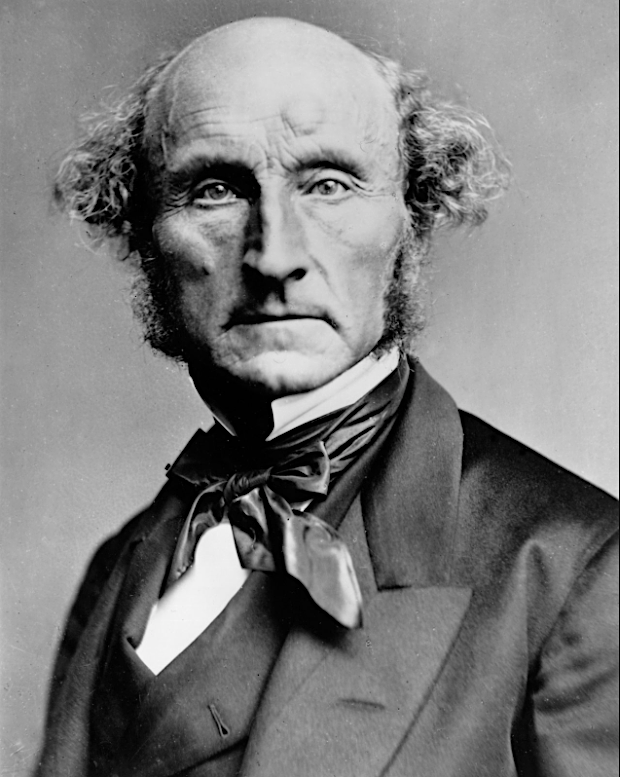
There are numerous texts on free speech. Two must-reads because of their historical importance and eloquence are John Milton’s 1644 Areopagitica and John Stuart Mill’s 1859 On Liberty. I recommend these pamphlets to everyone reading this essay. If you have read them, they are always worth revisiting. Milton argues against censorship and for the freedom of the press. He presents a powerful case for the importance of allowing diverse opinions and ideas to be expressed, even if they are controversial or unpopular. Mill argues for the importance of free expression and individual liberty. Mill posits that freedom of speech is essential for the pursuit of truth and the development of personal and societal growth. Allowing all ideas, even controversial ones, to be expressed freely allows society to discover and recognize truths. Through the clash of different opinions, even false ones, the truth will emerge more clearly. As did the founders of the American Republic, Mill was concerned about the tyranny of the majority. He warned against the tendency of democratic societies to suppress minority viewpoints through social pressure or legal means, arguing that this stifles progress and can lead to intellectual stagnation.

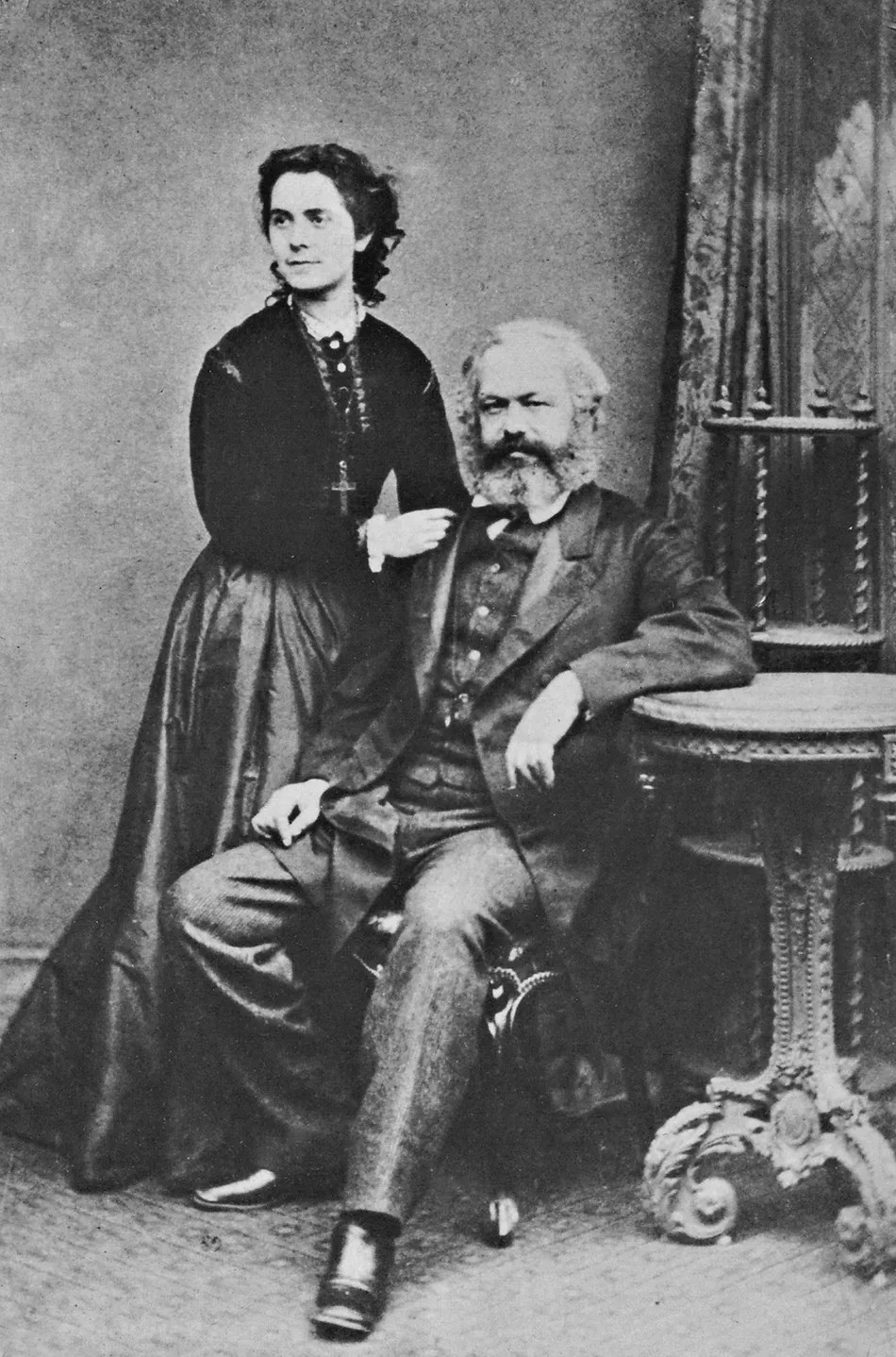
The defense of free speech is often associated with liberal thought. However, perhaps the most famous radical, socialist Karl Marx, vigorously defended the free press in the early 1840s, particularly in his articles for the Rheinische Zeitung, a Cologne newspaper for which he served as an editor. One of his most notable works on this subject is the article “On the Freedom of the Press,” published in 1842. At the time, Prussia had stringent censorship laws, which Marx vehemently opposed. His articles critiqued these laws and argued for the essential role of a free press in promoting truth and progress.

As I will argue in this essay, Marx argued that freedom of the press is a fundamental human right and a necessary condition for the development of society. He believed that the press serves as a platform for public discourse, enabling citizens to express their opinions and engage in critical debate. For Marx, the suppression of the press stifles the free exchange of ideas, which is crucial for social and political progress. He asserted that censorship is an instrument of oppression used by those in power to maintain their control and prevent the exposure of their injustices.

Karl Marx and his wife Jenny

Marx connected freedom of the press with broader issues of human emancipation. Thus he saw the struggle for press freedom as part of the larger struggle against economic subjection and political domination. In his view, a free press empowers the oppressed by giving them a voice and facilitating their participation in the democratic process. In these essays, which deliver a full-throated commitment to the principles of equality, justice, and liberty, Marx laid the groundwork for his later critiques of capitalism and advocacy for revolutionary change.

Just as the idea and practice of republicanism can be found in ancient Greece and Rome, their examples influencing the founders of the American Republic in the development of their scheme, so can the notion of free speech be traced to those ancient civilizations. The Greek philosophers advocated for the unrestricted exchange of ideas as essential for intellectual and moral development. In democratic Athens, for instance, the concept of parrhesia, or “fearless speech,” was celebrated as a civic virtue, allowing citizens to openly criticize authority and participate in public discourse without fear of retribution.

The primary purpose of free speech, then and now, is to facilitate the free exchange of ideas and information, which is vital for the functioning of a healthy democracy. It enables individuals to express their views, challenge prevailing beliefs, and contribute to public debate. It fosters creativity, innovation, and progress by allowing diverse perspectives to be considered, weighed and measured against other each other and reality. It serves as a check on state power, ensuring accountability and transparency in the exercise of juridical, military, and political authority. Free speech is thus essential to self-government and societal progress.

The concept of free speech is not absolute; it comes with reasonable limitations. However, any limitations must be inherent, which is to say that any imposition must facilitate and enlarge the intrinsic purpose of free thought and expression. Crucially, then, understanding restrictions on speech as limitations can be misleading. The matter is better put this way: the curtailment of certain speech-like acts are welcome when they serve to expand and deepen the essential character and purpose of the right. These curtailments concern speech that directly incites violence (“true threats”), harasses (repeated, unwelcome, and unavoidable utterances that annoy, degrade, or intimidate), disrupts (the “hecklers veto”), and utterances that cause reputational damage by making knowingly false claims about a person. i.e., defamation in the forms of libel and slander. Speech is also constrained by time and place restrictions, as well as relevance.

I take up the last curtailment first. Suppose a classroom where students are talking to one another about something unrelated to the topic at hand. They may be quieted or asked to leave the room without violating their First Amendment rights. Their free speech right is not being constrained by their speech-like acts being restricted; indeed, their speech-like acts are interfering with the free speech rights of the teacher and other students who have a right to not only impart but also to receive information, knowledge, and opinion. Utterances made in a lecture or in discussion that are not germane to the subject matter or purpose of the activity are not only justifiably disallowed but must be restricted if free speech is to be manifest in this situation. The association of the students is nor harmed by having them leave the room. They are free to continue their association at some other location.

Related to time and place restriction is speech-like acts used to suppress the free speech rights of others, or the “heckler’s veto.” The heckler’s veto describes a situation where an individual or individuals use noisemaking devices, obstructions, or speech-like utterances to disrupt speech and its reception. Although the appropriate response by authorities would be to ask the heckler to leave, and even forcibly remove him if he refuses, authorities often violate the speech of speaker and audience by limiting or suppressing speech due to hostile reactions or in anticipation of such reactions by a group of dissenters. This problem often arises in the context of protests or controversial speakers on college campuses. Administrators will cancel or restrict events out of concern for potential disruptions or violence from protesters. This is often referred to as “deplatforming” or “disinviting” speakers. Courts have ruled on the matter (see, e.g., the 2015 Sixth Circuit ruling in Bible Believers v Wayne County), but officials continue to violate the rights of speakers and their audiences.

The heckler’s veto poses a false dilemma for free speech principles, as under cover of maintaining order and security, authorities use the action or threat to justify the suppression of speech ostensibly not for its content or message, but because of the reaction it may provoke from others. Any restrictions on speech meant to prevent imminent violence or protect public safety must be narrowly tailored and content neutral. The heckler’s veto thus gives veto power to those who seek to silence opposing viewpoints through disruption and intimidation—if the authority legitimizes the action by canceling the event.

Progressives argue that the heckler’s veto is an act of civil disobedience, cloaking it as “counter-speech,” and therefore a form of expressive conduct that should be protected by the principles of free speech and assembly. While civil disobedience is a form of political expression, individuals engaged in such action are intentionally breaking laws or rules as a means of advocating for social change or protesting against perceived injustices. Put another way, advocates of such action argue that, while civil disobedience involves actions that may be illegal, it is First Amendment principle.

Stanford University Law School associate dean for DEI Tirien Steinbach ambushes Fifth Circuit judge Stuart Kyle Duncan.

As notable example can be seen as an act of civil disobedience and thus protected as counter-speech occurred at Stanford Law School (see FIRE’s “Stanford Law hecklers demanding ‘free speech’ don’t know what they’re asking for”). In March 2023, during a Federalist Society event featuring Fifth Circuit Judge Kyle Duncan, students shouted down and disrupted his speech, claiming his views were too harmful to be aired. The protesters wore masks with the slogan “counter-speech is free speech,” arguing that their disruptive actions were a form of expressive conduct protected under free speech principles. At the heart of the student protect was Duncan’s ruling denying a transgender prisoner’s request to have his pronouns changed in 2020. Tirien Steinbach, associate dean for diversity, equity, and inclusion, took the student’s side, accusing Judge Duncan of causing “harm.”

These acts of effective cancelling are often framed as “accountability.” An example of accountability in the press world, which also involved transgender issues, is found in the case of Ryan Anderson’s book When Harry Became Sally. In February 2021, Amazon removed the book from its platform without prior notice or explanation. Amazon framed the decision to remove the book an act of accountability, arguing that the content of the book violated Amazon’s policies regarding hate speech and offensive content​. (See Francis Menton’s essay in the Manhattan Contrarian, “Audacious Deplatforming: Some New Examples” for more examples.) Another example involves the deplatforming of former President Donald Trump from multiple social media platforms following the January 6th Capitol riot (I discuss this in my last essay Three Big Lies About Trump—and Promising Developments in the Transatlantic Space). Social media companies such as Twitter and Facebook justified their actions by claiming they were holding Trump accountable for inciting violence and spreading misinformation. These companies argued that their decision was a necessary measure to prevent further harm and protect the integrity of their platforms​.

Free speech refers to the lawful right to express oneself without interference or censorship from the government or other authorities. Dean Steinbach, acting in her official capacity, violated Judge Duncan’s First Amendment rights—as well as the rights of the students in attendance to hear his words. So did Amazon and social media companies in principle violate the free speech rights of Anderson and Trump respectively. Cancel culture is not about accountability. Holding somebody accountable for something they did requires that their actions was covered by some law or rule prohibiting or restricting those actions. Those giving opinions are not engaged in action subject to accountability. (See Accountability Culture is Cancel Culture: Double Think and Newspeak in Today’s America.)

Progressives make arguments regarding the potential harms that certain types of speech can cause. For example, free speech opponents argue that allowing free speech leads to the proliferation of “hate speech,” which can marginalize and oppress certain groups based on characteristics such as gender, race, religion, or sexual orientation. We see this occurring frequently on college campuses. Activists have frequently sought to prevent speakers with openly racist or anti-LGBTQ views from giving talks, arguing that such speech perpetuates stereotypes and hatred against marginalized communities. This stance is rooted in the belief that allowing such speech can create a hostile environment for students and staff belonging to these groups. For instance, at the University of California, Berkeley, controversial figures Milo Yiannopoulos and Ann Coulter faced significant opposition from students and community members who argued that their rhetoric constituted hate speech. In both cases, both examples of the “heckler’s veto,” concerns about potential violence led to the cancellation of their events.

These actions were framed by supporters as measures of accountability, aiming to protect the campus community from the harmful impacts of hate speech​. However, in Matal v Tam (2017), the Supreme Court unanimously affirmed that there is no “hate speech” exception to the First Amendment. The US government may not discriminate against speech on the basis of the speaker’s viewpoint. What constitutes the US government? Crucially, the incorporation of the First Amendment into all public settings has been a significant aspect of constitutional law in the United States. This process began with the passage of the Fourteenth Amendment, which extends the protections of the Bill of Rights to include actions by state governments. Through a series of Supreme Court decisions, the principles of the First Amendment have been applied to state and local governments, ensuring that these rights are protected not only at the federal level but also in all public settings across the nation.

In Gitlow v New York (1925), the Supreme Court held that the freedoms of speech and press are fundamental personal rights and liberties protected by the due process clause of the Fourteenth Amendment from impairment by the states. This case set a precedent for the incorporation doctrine, allowing for the application of First Amendment rights to the states. Another significant case was Near v Minnesota (1931), where the Court struck down a state law that allowed prior restraint on publications, reinforcing the idea that the freedom of the press is protected against state infringement. The incorporation of the First Amendment has been further expanded through cases like Mapp v Ohio (1961), which, although primarily about the Fourth Amendment, helped solidify the doctrine that states must adhere to the Bill of Rights. Additionally, cases like Tinker v Des Moines Independent Community School District (1969) extended First Amendment protections to public school settings, recognizing students’ rights to free speech, provided it does not disrupt the educational process. These legal precedents ensure that freedoms of speech, press, assembly, and petition are upheld in all public settings, fostering a broad and robust protection of civil liberties across the United States. (See my essay My Right to My Views is Your Right to Yours).

Progressives contend that hate speech contributes to social division, discrimination, and even violence against marginalized communities. More broadly, the argument is that false information, propaganda, or speech that incites violence, directly harm individuals or society as a whole. They suggest that limiting speech is necessary to protect people from harm and maintain social order. In the case of propaganda and speech that incites violence, what constitutes a “true threat,” courts have acknowledged that this is among the justifications for limiting utterances. A “true threat” refers to a statement or communication that conveys a serious intention to harm someone or something. It’s not just an expression of anger or frustration, but rather a statement that reasonably makes the recipient fear for her safety or well-being. True threats can take various forms, including verbal threats, written messages, gestures, or other actions that communicate an intent to cause harm. In legal contexts, determining whether a statement constitutes a true threat often involves considering the context, the intent of the speaker, and the reasonable interpretation by the recipient.

At the same time, appeals to incitement can be abused. The notion of harmful speech is subjective and can vary widely depending on cultural, political, and social contexts. Implementing restrictions on speech based on potential harm involving subjective judgments about what constitutes harm or the potential harm in question represents a slippery slope. This is why it is generally better to address harmful speech through (actual) counter-speech, education, and the fostering of social norms rather than through legal restrictions, which can have unintended consequences for freedom of expression. For example, the antisemitic sentiment rampant today on college campuses should not result in the targeting and punishment of antisemitic speakers, rather it should be addressed by counter-speech and the fostering of social norms that condemn antisemitism and the ideologies that promote it.

Indeed, while hate speech may be deeply hurtful and offensive, allowing it to be expressed can actually be beneficial in the long term. Permitting hateful ideas to be aired publicly provides an opportunity for them to be challenged and countered. It serves as a barometer for societal attitudes, highlighting areas where more education and understanding are needed. Moreover, restricting hate speech runs the risk of empowering authorities to censor any speech they deem offensive, which can be abused to suppress legitimate dissent. The question to be asked here is who will be the commissar? Who would you have over you telling you what you can and cannot say? Censorship also has the unintended effect of amplifying the speech in question, as resistance to its suppression can be represented as suppression of dissent.

The problem of subjectivity looms large in the hate speech debate. What’s perceived as hateful can vary based on personal viewpoints and cultural contexts—that is, it is observer- and context-dependent. What one person perceives as hateful, another might view as legitimate criticism or even as an expression of their own beliefs or identity. For example, a statement criticizing a particular religious belief—and I have made many of these in my writings—might be perceived as hate speech by some adherents of that religion while seen as protected speech or legitimate discourse by others. Hate speech is defined within a specific cultural and social context. Moreover, societal norms and values evolve over time, leading to changes in what is considered acceptable speech and what is deemed hateful. Expressions described as hateful sometimes stem from a sense of group identity and solidarity rather than malicious intent.

It is the same thing with so-called “offensive speech,” that is the act of restricting or prohibiting expressions that are deemed offensive or socially unacceptable (see See Offense-Taking: A Method of Social Control). This can take various forms, from legal regulations to self-censorship. Advocates of censoring offensive speech often argue that it’s necessary to protect individuals and groups from harm, maintain public order, and promote social cohesion. Consider again my record of irreligious speech. I have written a lot on the problem of Islam, and in so doing I have shared depictions of Muhammad that, according to the aniconism of Islamic doctrine, constitute blasphemy. But I am not a Muslim; therefore I am not obliged to follow the rules of that faith. More that this, I am permitted to use offensive imagery to make my point more effectively. Indeed, offensive-taking is often the first step towards enlightenment. This is why free speech advocates argue that censorship stifles open dialogue, impedes the exchange of ideas, and restrict individuals’ rights to express themselves freely. Giving authorities the power to determine what is considered offensive leads to censorship being used to suppress dissenting voices or unpopular opinions. I cannot effectively oppose dangerous ideologies like Islam if I am forbidden to offend their devotees.

Advocates for restricting free speech argue that certain groups, such as children or minority group members, have less power in society and thus need protection from potentially harmful or offensive speech. Limiting certain types of speech, they argue, is necessary to safeguard the rights and well-being of these vulnerable groups. Since I have argued for limiting materials available to children in public settings, I want to clarify my position on the matter. While it’s essential to protect vulnerable individuals from discrimination and harm, I have long argued that censoring speech may not the most effective way to achieve this. Instead, fostering an environment of open dialogue and debate can empower marginalized communities to challenge oppressive ideas and advocate for their rights. Restricting speech in the name of protecting vulnerable groups can have a chilling effect on all speech, stifling important discussions and hindering progress.

One obvious problem with calls to limit speech to protect vulnerable persons is the matter of who counts as a vulnerable person. This is very often a subjective matter. There are many instances of predatory groups claiming to be the vulnerable ones manufacture statuses and use the rhetoric of vulnerability and victimhood as a ruse to secure privileges and to access spaces safeguarding truly vulnerable individuals, what is sometimes referred to as “emotional blackmail.” (See The False Doctrine of “Weapons of the Weak”; Speech Acts as “Systemically Harmful”: More on the “Weapons of the Weak”.)

For example, girls and women require safe spaces given the drastic overrepresentation of males in the perpetration of sexual and other crimes against females. More than three-quarters of all violent crime offenders are male, with males accounting for a significant majority of violent crimes, including homicides, assaults, and robberies. When it comes to sexual offenses, the disparity is even more pronounced. According to data from the US Sentencing Commission, around 98 percent of sexual abuse offenders are male. This includes a wide range of sexual offenses, such as rape, sexual assault, and other forms of sexual violence. Trans identifying males claim vulnerability as a strategy for accessing spaces reserved for girls and women (bathrooms, crisis centers, hospital rooms, locker rooms, prisons). We also see the mainstreaming of male access to the vulnerable with the term “minority attracted person,” a term designed to rebrand pedophiles as a legitimate identity and depicted as a vulnerable group.

At the same time, when restricting speech is sought in the case of public school curriculum and spaces exposing children to age-inappropriate, often pornographic materials, opponents of free speech will decry such restrictions as unreasonable limitations on speech, misdescribing child safeguarding as “book banning,” etc. (See Defending Public Education from the Self-Righteous Martyr; Whose Spaces Are These Anyway? Political Advocacy in Public Schools; Civic Spaces and the Illiberal Desire to Subvert Them; Ideology in Public Schools—What Can We Do About It?; The LGBTQ Lobby Sues Florida; Seeing and Admitting Grooming; What is Grooming?; Kids Resisting Indoctrination.)

A variation on the vulnerable group or individual argument is the claim that exposure to certain types of speech, such as graphic violence or explicit content, can cause psychological harm, particularly to vulnerable individuals such as children or trauma survivors. Opponents of free speech advocate for restrictions on such utterances to protect emotional and mental wellbeing. If you remind them of the childhood rhyme about “sticks and stones,” they will indicate the body of scholarly literature showing that speech can harm a person psychologically. (See Reinforcing the Point of the Exercise: The Function of Safe Spaces.)

While certain types of speech may indeed cause emotional and psychological distress, and children should be protected from bullying and indoctrination, censorship is not always the most effective way to address this harm. Individuals should be empowered to make their own choices about what speech they consume and how they engage with it. Censoring speech based on its potential to cause psychological harm sets a dangerous precedent for limiting freedom of expression based on subjective criteria.

The argument that certain forms of speech, such as extremist rhetoric, hate speech, offensive imagery undermines social cohesion and threatens the stability of democratic societies is one of the more concerning rationalizations for controlling thought. This form of advocacy for restrictions on speech proceeds by citing the necessity of promoting tolerance, respect, and unity among diverse groups. While promoting social cohesion is a worthy goal, censoring speech in the name of unity is counterproductive. True cohesion is built on a foundation of empathy, mutual respect, and understanding, which cannot be legislated or policed. These goals must be achieved through open dialogue and the free exchange of ideas. Restricting speech, particularly dissenting or controversial speech, undermines the democratic principles of freedom of expression and pluralism, which are essential for a healthy and vibrant society.

One of the most serious dangers to free speech that has emerged is the control over so-called misinformation and disinformation (see The Deep State and Cognitive and Emotional Manipulation; Twitter Interfered in the 2020 ElectionRefining the Art and Science of Propaganda in an Era of Popular Doubt and QuestioningCognitive Autonomy and Our Freedom from Institutionalized Reflex). It’s not that such things don’t exist. Misinformation is false or inaccurate information spread unintentionally, often due to misunderstanding or lack of verification. Examples include bad statistics, urban legends, etc. Misinformation is everywhere. Indeed, Christianity and Islam feed their billions of devotees a steady diet of misinformation. They even hold that believing the misinformation is a noble act of faith. Disinformation is deliberately spread with malicious intent to deceive or manipulate. It includes fake news, hoaxes, and propaganda. Religion is also a source of disinformation.

To be sure, both misinformation and disinformation can damage trust, influence political decisions, and polarize communities. However, the defense of citizens’ rights to spread misinformation and disinformation is also protected by principles of free speech and freedom of expression. Moreover, the determination of what constitutes misinformation and disinformation can be subjective and dependent on one’s beliefs, cultural context, and perspective. What some people may consider factual information, others may view as false or misleading. For instance, beliefs held within religious contexts may be considered sacred and true by adherents but could be seen as misinformation by those who do not share those beliefs. Similarly, fringe beliefs like flat earth theory may be dismissed by the majority as misinformation, but individuals who subscribe to these beliefs may view them as legitimate interpretations of reality.

These complexities underscore the challenge in addressing misinformation and disinformation in a diverse and pluralistic society. In theory, we are told, it requires striking a balance between respecting individuals’ rights to hold and express diverse viewpoints, including those that may be considered fringe or controversial, while also promoting critical thinking, fact-checking, and the distribution of accurate information. In practice, this often becomes arbitrary and dependent on who controls the distribution of information—back to the problem of the commissar. In democratic societies, protecting freedom of expression and religious liberty while also combating harmful misinformation involves fostering an environment where diverse perspectives can coexist while promoting education and media literacy to help individuals discern between credible and false information. However, limiting individuals’ ability to spread false information can set a dangerous precedent for censorship and infringe upon basic freedoms.

Finally, critics of unrestricted free speech argue that it often benefits those in positions of power and privilege, allowing them to maintain their dominance. They contend that laws and norms surrounding free speech reflect and perpetuate existing power structures, allowing dominant groups to maintain control and silence dissenting voices. They contend that restrictions on speech can help to balance power dynamics and promote greater equality and social justice. Scholars within critical legal studies, critical race theory, feminist studies, queer theory, etc., have generated a plethora of opinions on how free speech reinforces inequalities and harm marginalized groups (see, e.g, Derrick Bell, Kimberlé Crenshaw, Duncan Kennedy, Catharine MacKinnon, and Roberto Unger). They suggest that restrictions on speech may be necessary to promote social justice by preventing the misuse of speech to oppress or discriminate against vulnerable populations. Even the stalwart liberal John Stuart Mill, in articulating the “harm principle,” argued that individual liberty is justifiably limited to prevent harm to others, implying that speech that directly incites violence or causes significant harm may warrant restriction.

While it is true that powerful individuals and groups may benefit from unrestricted free speech, censorship is not the solution to addressing power imbalances. Censorship reinforces existing power structures by silencing dissenting voices and limiting the ability of marginalized groups to challenge authority. True equality and justice are better served by promoting a marketplace of ideas where diverse perspectives can be heard and debated freely. Indeed, the argument against censorship as a solution to power imbalances centers the irony of reinforcing existing power structures in censorship. Censorship gives those in authority or privilege the ability to determine what is acceptable speech, potentially silencing dissent and limiting marginalized groups’ ability to challenge the status quo. Thus there is a paradox in using censorship to address power imbalances: those advocating for censorship are themselves seeking to exert a form of power by controlling the freedom of expression of others. This brings to mind the paradox that moved Christopher Hitchens to warn the opponents of free speech about making a rod for their own backs.

* * *

In examining the foundational principles of the United States as a republic and the founders’ intentions in advocating for such a system over direct democracy, it becomes evident that their concerns centered around the dangers of unchecked majority rule and the potential for factions to undermine the rights of individuals and the common good. Through the lens of James Madison’s Federalist No. 10, the critique of “pure democracy” highlights the need for institutional safeguards to protect minority rights and promote responsible governance. Republicanism, with its emphasis on active citizenship, civic virtue, and the separation of powers, offers a framework for balancing democratic ideals with mechanisms to safeguard individual liberties. Central to this balance is the protection of free speech, a fundamental right essential for ensuring governmental accountability, fostering dialogue, and promoting progress. While free speech is not without limitations, particularly in cases of speech that incites violence or harasses individuals, the broader goal is to facilitate the free exchange of ideas and information vital for a healthy democracy. The principles of republicanism, democracy, and free speech are intertwined, forming the foundation of a vibrant and truly inclusive society. By upholding these principles, we can strive towards a world where diverse perspectives are respected and the voices of all individuals are heard.

Before leaving this essay, I must mention the problem of free speech for corporations and articulate a caveat to the things I have said here. This clarification is necessary given the recognition by courts that corporations are in some senses legal persons. I disagree with the history of decisions and legislation conferring this status on business entities, but I live in a world in which this status has been conferred, whether finally who knows. However, it is flesh-and-blood individuals who possess inherent rights to free speech, which are considered fundamental to personal autonomy and democratic participation. These rights enable individuals to express themselves, engage in public discourse, criticize authority, advocate for social change, and share their unique perspectives and beliefs.

Corporations, on the other hand, are legal entities created by law for conducting business activities. While they enjoy certain legal rights and protections, such as contract and property rights, these are not inherent or natural in the way human rights are. The primary purpose of corporations is commercial activities and profit-making rather than the exchange of ideas or democratic participation. Granting corporations the same free speech rights as individuals leads to undue influence of corporate power in public discourse and democratic processes. Treating corporations as persons in the context of free speech distorts the original intent of free speech protections, which were designed to safeguard individual liberties and promote democratic ideals—the rights and purposes of concrete flesh-and-blood persons.

Nonetheless, courts have granted corporations free speech rights. One of the earliest significant cases addressing corporate speech was First National Bank of Boston v Bellotti (1978), in which the Supreme Court, Justice Lewis Powell writing the majority opinion, struck down (5-4) a Massachusetts law that prohibited corporations from spending money to influence the outcome of ballot initiatives. Powell reasoned that the value of speech does not depend on the identity of the speaker and that the public has a right to receive information and ideas from diverse sources, including corporations. Another case is Pacific Gas & Electric Co. v Public Utilities Commission of California (1986), wherein the Court ruled (5-3) that forcing a corporation to include speech with which it disagreed violated the First Amendment, emphasizing that freedom of speech includes both the right to speak and the right not to speak.

Perhaps the most notorious case is Citizens United v Federal Election Commission (2010), where the Court ruled (5-4) that the government cannot restrict independent expenditures for political communications by corporations, associations, or labor unions. This decision invalidated parts of the Bipartisan Campaign Reform Act (BCRA) that had prohibited such expenditures. The Court, in a majority opinion written by Justice Anthony Kennedy penned the majority opinion, emphasizing that political speech is indispensable to a democracy, which is no less true because the speech comes from a corporation. (I recently commented on this case in When Progressives Embrace Corporate Speech.)

Equating corporate speech with individual speech undermines efforts to regulate corporate influence in media, politics, and other spheres of public life. Additionally, being that corporations are artificial entities created for economic purposes, they cannot possess the same moral agency or human interests as people and should not be afforded the same rights and privileges. Therefore, the protections afforded by the First Amendment only apply to corporate expressions on a case-by-case basis in light of the principles articulated in this essay. In the long haul, however, humanity must endeavor to strip from this artificial person the rights and privileges of real persons. That the rulings made in the major cases cited above are close, there is reason to hope that we might in the end remove from corporations a right that should inhere only in flesh-and-blood persons. Heaven help us if the reverse of this is ever set down in precedent.

I am always reminded by this situation of the eighteenth century British lawyer and politician Baron Thurlow’s words, paraphrased in various forms, but essentially something to this effect: “Did you ever expect a corporation to have a conscience, when it has no soul to be damned, and no body to be kicked?” I read this as a statement concerning the difficulty in countering the speech of such a powerful entity as a corporation, which today is entangled with the state such that the latter, in doing the bidding of the former, can, as the Supreme Court just effectively held, by tossing out (in a 6-3 decision) a lawsuit (Murthy v Missouri et al.) that sought to restrict the federal government’s ability to communicate with social media companies (Google, Meta, and Twitter) about content moderation over what it saw as “misinformation,” instruct these quasi-private entities to censor information on vaccines efficacy and safety and election interference.

* * *

Note about intimidation and harassment:

Intimidation often falls under the broader umbrella of harassment, especially if it involves repeated or persistent actions that cause discomfort, distress, or fear. The intent behind the speech and its impact on the target are crucial in determining whether it constitutes intimidation; also context (it is in the workplace or in a public forum, and so on). Harassment can include verbal threats, stalking, or other behaviors intended to intimidate. If intimidation involves threats of violence or other harm, it may be treated as a criminal offense. Threats are usually not protected under free speech because they can cause immediate fear and have the potential to lead to violence. In schools or workplaces, intimidation can be categorized as bullying. Policies and laws often address bullying separately, with specific measures in place to prevent and respond to it.

While intimidation can be linked to harassment and may intersect with free speech issues, it is typically treated under specific legal frameworks that address threats and bullying. The exact categorization and handling of intimidation depend on the nature of the actions and the relevant laws and policies in the jurisdiction.

Three Big Lies About Trump—and Promising Developments in the Transatlantic Space

There are many lies told about Donald Trump (the Russia hoax, drinking bleach, the “bloodbath,” etc.). Here are three big ones I’m sure readers have heard and will continue to hear from the Democrats and Joe Biden (depending on how long this propped-up husk of a crooked and compromised politician is allowed to stay atop the Democratic Party ticket).

Trump watches a feeble Biden attempt to answer questions during their recent debate

Big Lie #1: Trump said that in his second term he will be dictator from day one.

In a December 2023 interview, in Iowa, Sean Hannity asked Trump if he “in any way” had “any plans whatsoever, if reelected president, to abuse power, to break the law to use the government to go after people.” Trump’s response was golden. “You mean like they’re using right now?” he replied. The fact of the matter is that it’s the Democrats who are behaving like authoritarians, using lawfare and extralegal means to eliminate Biden’s chief rival in the 2024 election.

Hannity pressed Trump: “Under no circumstances, you are promising America tonight, you would never abuse power as retribution against anybody.” “Except for day one,” Trump responded. Not “On day one,” but “Except for day one.” What did the president mean by this? He told you: “I love this guy. He says, ‘You’re not going to be a dictator, are you?’ I said: ‘No, no, no, other than day one. We’re closing the border and we’re drilling, drilling, drilling. After that, I’m not a dictator.’”

In a joking manner, Trump told the audience about sweeping executive orders to reverse Biden’s disastrous energy and open borders policies to be handed down on his first day in office. Yet Biden campaign manager Julie Chavez Rodriguez issued a statement twisting Trump’s words: “Donald Trump has been telling us exactly what he will do if he’s reelected and tonight he said he will be a dictator on day one. Americans should believe him.” The media put Rodriguez’s words in the echo chamber as if Trump had said them.

Big Lie #2: Trump defends white nationalist protesters at Charlottesville, NC, referring to them as “very fine people.”

The “very fine people” quote was wrenched out of context from a press conference by Trump in August 2017 after the Unite the Right rally protesting the removal of a statue of Confederate General Robert E. Lee. The protestors were met by Antifa who provoked a riot. “What about the alt-left that came charging at, as you say, at the alt-right?” Trump said. “Do they have any semblance of guilt?” He then said, “I’ve condemned neo-Nazis. I’ve condemned many different groups. But not all of those people were neo-Nazis, believe me.”

Both statements are true. Trump has condemned white supremacists more than any president in history—far more. Ever time he is asked to denounce white supremacy he has. Second, not everybody protesting the removal of the statue were neo-Nazis. I have a lot of friends and relatives who oppose removing those statutes. They aren’t neo-Nazis. The assumption that they are is a continuation of progressive contempt for working class people crystalized by Clinton’s “basket of deplorables” comment.

What did Trump actually say? “You had many people in that group other than neo-Nazis and white nationalists,” Trump said. “The press has treated them absolutely unfairly.” He then added, “You also had some very fine people on both sides.”

Big Lie #3: Trump incited an insurrection on January 6, 2021.

At a permitted event on the Ellipse, Trump said in defense of democratic-republican principles of governance, “We fight like hell. And if you don’t fight like hell, you’re not going to have a country anymore.” It’s disingenuous to construe fighting like hell for one’s country as a call for insurrection. However, the media ignored these words by Trump, which were said at the same event: “I know that everyone here will soon be marching over to the Capitol building to peacefully and patriotically make your voices heard.” Right before this he told the crowd the purpose of the assembly: “We have come to demand that Congress do the right thing and only count the electors who have been lawfully slated, lawfully slated.”

Remember the protections of the First Amendment, which include, “the freedom of speech [and] the right of the people peaceably to assemble, and to petition the Government for a redress of grievances.” Trump and his supporters had every right to assemble and question how a presidential candidate, who won more than 74 million votes in 2020, nearly twelve million more than he won in 2016, could lose to an obviously feeble old man who hardly campaigned. Without going through all the evidence of rigging and fraud (although I have, for example in The Hustle and its Cover: Burgeoning Evidence of Massive Fraud in the 2020 Election), the mere “fact” that Biden won more than 81 million votes—fifteen million more than Hillary Clinton—brings the result into serious question.

To be sure, a small group of protestors broke off from the crowd and, provoked by the police, rioted at the Capitol. But even here the corporate state and its propaganda arm lied about Trump’s actions. Trump tweeted to protesters to respect law enforcement and to remain peaceful. “No violence,” he wrote. In any earlier video he told the protestors “to go home now.” “We have to have peace,” he said. “We have to have law and order. We don’t want anybody hurt.” He said a lot more. Check it out:

Twitter removed three of Trump’s tweets, including his call for peace and law and order. Pre-Musk Twitter said the tweets were “severe violations of our Civil Integrity policy.” Think about that. Trump’s calls to defuse the situation were removed but Twitter as if Twitter wanted the riot to continue. When Musk assumed ownership of Twitter, now X, he restored Trump’s account so users could see for themselves what Trump actually said. Facebook also removed the video and deplatformed the president. Trump remains banned on Facebook.

There was no insurrection. In fact, none of those imprisoned for January 6 was even charged with insurrection. It was a police riot. Moreover, as the Supreme Court determined this session that a former Pennsylvania police officer who participated in the riot cannot be charged with obstructing an official proceeding unless a lower court rules otherwise. At the core of the case was the misapplication of a subsection of an early 2000s obstruction law. “To prove a violation of Section 1512(c)(2), the Government must establish that the defendant impaired the availability or integrity for use in an official proceeding of records, documents, objects, or as we earlier explained, other things used in the proceeding, or attempted to do so,” Justice John Roberts wrote. (He was joined by five other justices, with Justice Ketanji Brown Jackson delivering a concurring opinion.) The ruling casts doubt on the cases of potentially hundreds of January 6 defendants, as well as part of Department of Justice special counsel Jack Smith’s four-count indictment alleging that former President Donald Trump schemed to overturn the 2020 presidential election.

Far more significant than the January 6 riot was the months of violent riots through the summer and fall of 2020—riots encouraged by the Democratic Party. Antifa and BLM burned churches and other structures, overturned police cars, intimidate people in their houses and businesses, and killed more than two dozen people and injured scores more. They even attempted to invade the White House. (See Suppressing the Rabble: Portraying Conservatism and Republicanism as Fringe and Dangerous;  Antifa, the Proud Boys, and the Relative Scale of Violent Extremism.)

* * *

On a related note, it’s a wonderful thing to see the French working class rising against the transnational corporate destruction of Western civilization and the international liberal order. Le Pen’s support was in evidence in nearly every city, town, and village in France. People power is beautiful thing, especially coming with the showing of the populists in the European elections. The nationalists (Union de l’extrême droite, a descriptor the French Ministry of the Interior manufactured for the 2024 French legislative election to denote candidates from the Republicans party, or Les Républicains, endorsed by the National Rally, or Rassemblement National) won a plurality of both men and women and a majority (57 percent) of blue collar workers, as well as a plurality of white collar workers. The left wing (Nouveau Front populaire) won a plurality of those identified as belonging to the professional-managerial stratum. The French left today constitutes the functionaries of the corporate state. This is true of the left throughout the transatlantic space. The Western left no longer represents the working people. It represents the New Fascism.

Emmanuel Macron, the pawn of globalists, came in third. That was also a beautiful thing to behold. The so-called “left,” which has become the propaganda label of the credentialed class (not only in France, but throughout the corporatist West), the functionaries for the corporate state, i.e., the neoliberal/neoconservative consensus, came in second. Corporate forces are going to try very hard to prevent the populist ascension to power. The people will need to work even harder to counteract them. Populism hasn’t won yet, but the signs are hopeful. This is a transatlantic phenomenon that promises the restoration of democratic-republic principles of governance and the strengthening of the nation-state system. After Trump’s crushing victory in the debate the other night, and the overturning of the Chevron deference by the Supreme Court, which begins the end of the administrative state, the future of America looks promising, as well.

The technocratic apparatus is in full panic. Its subaltern and rank-and-file forces are out in force. X is inundated with the madness. It’s unfortunate to see the simple-minded reduction of working class populism to labels assigned by corporate state propaganda fear merchants. One always hopes the consumers of mass media will use their brains in critical and independent ways that analyze historical circumstances and social situations without partisan ideological tangling of meanings. But, as we know all too well, a great many people, including a great many who identify with the political left, think in limited categories that produce ignorant opinion. I think for some of them, the biggest impediment to clear thinking is an obnoxious, indeed even pathological sense of self-importance.

Shorthanding “Black Jobs”

When I was a kid growing up in the 1960s and 1970s, agricultural workers, cafeteria workers, groundskeepers, day laborers, custodians, housekeepers, etc., were disproportionately black men and women, as well as many assembly line and construction workers, living in safe neighborhoods with two parents raising children.

A Detroit Factory circa 1914-1918. Photo credit: Library of Congress.

In my dissertation, Caste, Class, and Justice: Segregation, Accumulation, and Criminalization in the United States, published in 2000, which explored a caste-class model of capitalist dynamics, I incorporated elements of the split labor market theory, proposed by sociologist Edna Bonacich in the early 1970s, which explains how labor markets are divided along ethnic, racial, or other social lines. Bonacich theorized that labor markets are split when employers exploit cheap labor, which often comes from minority groups or immigrants, over more expensive native or majority labor. This division creates division in the working class. At the same time, it provides stable employment for those relegated to it.

The theory posits that the dominant group, fearing economic competition and wage reduction, reacts by forming unions, lobbying for restrictive immigration policies, or supporting discriminatory practices to protect their material interests. Employers benefit from this situation as it suppresses wages and disrupts labor unity, generating greater surpluses and making it easier to control the workforce. The theory helps explain the persistence of ethnic and racial conflicts in labor markets and the structural economic forces that perpetuate discrimination. It highlights how economic factors drive and maintain divisions within the workforce.

Today brown immigrants work the jobs blacks used to work at, while millions of blacks are idled in the crime-ridden ghetto of the blue city, their children raised without fathers in the home, with one in three black men earning at least one felony conviction over the life course, many engaged in constant gang warfare. Black men commit most murders and robberies in the United States. This is the result of corporate globalization, off-shoring manufacturing and importing cheap labor, justified by multiculturalism, and Democrats relegating blacks to disorganized inner city areas and progressives addicting them to welfare, creating a subject class who votes for a living instead of working for a living.

The historic shift from black labor to immigrant labor in the United States can be analyzed through the lens of the split labor market theory. This shift is particularly evident in industries such as agriculture, manufacturing, and service sectors. Historically, black labor, especially in the post-Civil War South, was a significant part of the labor market. Black workers were often employed in low-wage, labor-intensive jobs. However, with industrialization and urbanization in the early 20th century, there was a growing demand for labor in northern cities, leading to the Great Migration of blacks from the rural South to the urban North.

Crucially, during the 20th century, US immigration policy underwent significant changes that spurred black migration to urban centers beyond the South and then later transformed them into redundant labor. Early in the century, there was a rising tide of nativism driven by fears of cultural and economic displacement due to increasing immigration. This led to legislative measures such as the Immigration Act of 1917, which introduced literacy tests and barred immigrants from much of Asia. The most restrictive phase came with the Immigration Act of 1924, which established national origins quotas. These quotas favored immigrants from Northern and Western Europe while severely limiting those from Southern and Eastern Europe and Asia. This era of restrictive immigration policies continued through the mid-20th century, coinciding with the Great Depression and World War II, when economic and security concerns further dampened enthusiasm for immigration.

During this period, capitalists in both the North and the South sought cheaper labor alternatives to black workers who had benefitted from economic development during this period. Changing attitudes towards race in the 1960s that promised gains for black Americans were exploited to push open borders. The Immigration and Nationality Act of 1965, signed by President Lyndon Johnson, abolished the national origins quota system. The 1980s saw further action with the Refugee Act of 1980, which aligned US policy with international standards for refugee protection, which open border activists used as cover for the recruitment of economic migrants, and the Immigration Reform and Control Act of 1986, which provided amnesty to millions of undocumented immigrants while imposing stricter border controls (easily skirted by subsequent presidents) and sanctions on employers hiring undocumented workers.

As immigration from Latin America increased in the late 20th and early 21st centuries, Latino workers became the dominant source of cheap labor, Hispanics eventually becoming the largest minority group in America. This shift further marginalized black workers across sectors and maintained the racialized division of labor. Employers continued to benefit from this dynamic by keeping wages low and exploiting the vulnerabilities of immigrant labor, who often had fewer legal protections and were more susceptible to exploitation.

In numerous essays published in Freedom and Reason, I show how the greatest period in American history occurred between closing the borders in 1924 and reopening them in 1965. The period was marked by rising wages and standards of living, safe and orderly communities, racial integration, women’s rights, and a high level of patriotism. Black Americans gained as never before during this period.

I have documented that the desire for open borders was a transnationalist plot to disorder America dating from the early 20th century (see, e.g., An Architect of Transnationalism: Horace Kallen and the Fetish for Diversity and Inclusion; The Work of Bourgeois Hegemony in the Immigration Debate; The Progressive Politics of Mass Immigration). It was also a scheme to drive down wages for workers which, in the context of the split labor market, proved devastating to workers.

Progressives can mock the shorthanding of “black jobs” all they want, but they can’t change the facts of the corporate destruction of the black family and the managed decline of the American Republic. That is what Donald Trump is talking about. If Democrats represented black Americans, that’s what they’d be talking about, too. But they don’t. So they mock. It’s all they’ve got.

Project 2025: The Boogeyman of the Wonkish

Project 2025 is boogyman of the wonkish. The Heritage Foundation’s executive action plan to change the rules and deconstruct the federal bureaucracy—by shrinking the regulatory apparatus, uprooting ensconced federal bureaucrats, and training a new class of policymakers working from framework of democratic-republican principles and classical liberal values—would have broad support in a Republican Congress, and this terrifies the permanent political class in Washington. Moreover, the Supreme Court is already making moves to reverse enabling precedents, which explains the attack on the Supreme Court.

The overturning of the 1984 Chevron USA., Inc. v. Natural Resources Defense Council, Inc. decision, which set forth a legal doctrine known as “Chevron,” a precedent that mandates that courts must defer to an administrative agency’s interpretation of a statute it administers unless Congress has directly spoken to the precise issue, would be a significant step forward in dismantling the administrative state by taking away its arbitrary power. The doctrine has given federal agencies wide latitude to bureaucrats and experts to interpret and implement laws according to their ideological predispositions.

Project 2025

That this is shop talk is a problem because of the lack of sophistication among those who play an outsized role in shaping our political discourse about administrative behavior and legal doctrines and their relation to political economic regimes. It would help for the “deplorables” (the proles and serfs of America) to understand the system a little better. What is presented as a threat to democracy is the antidote to the totalitarianizing nature of administrative rule. Administrative rule in an advanced society is technocracy not democracy (administrative rule is not democracy in any type of society). Indeed, the objectives of Project 2025 represent a program to return the nation to the robust constitutional republic the Founders envisioned.

Key to the propaganda war against the program is the way the term “fascism” is twisted to turn hopeful projects into evil ones. The cultural managers of the transatlantic sphere portray fascism as populist, nationalists, and dictatorial. Trump is a fascist, the public is told, and if he is reelected that will be the end of democracy. But your betters know that populism means democracy. So what are they really hoping to save? Nationalism in the modern period is the view that the following things are important: cultural and territorial integrity, a common language, an enduring and virtuous creed, the privileges and immunities of citizenship, the rule of law, and the role of one’s country in the interstate world order.

The dictatorial piece is prevented by a constitutional system of checks and balances, separation of powers (into executive, judicial, and legislative), robust federalism, and respect for classical liberal freedoms. At least one would hope so. But the phoenix that rose from the ashes of the slavocracy, inheriting many of the traits of its immolated predecessor, is a fourth branch of government, the administrative state, the inherent design of which is to bypass lawmakers, putting policymaking power in the hands of the technocrats who control the apparatus. This situation puts the apparatus at the whims of ideological predilection, and therefore not governed by the general will as conveyed by its representatives in government.

In theory and in practice, the administrative state and technocratic control is anathema to a representative democracy manifest in the form of a constitutional republic. Unelected, it is unaccountable to a representative democracy. It is moreover unconstitutional; it is not in the Founders’ design. Progressives, the social engineers, have captured the apparatus and direct its powerful bureaucracies. The administrative state is how public health officials were able to trample on our civil rights during the pandemic, to take an obvious example. Another is the imposition of curricular content and uniformity of instruction in public education. The United States is founded as a federated system. The administrative state centralizes power into the hands of a ruling class.

Don’t say “Manpower.” Say “People Power.” Unless You Mean Manpower.

Fox is reporting this (Pilot union suggests phasing out masculine terms, says ‘cockpit,’ ‘father’ is offensive to DEI culture). I’m cribbing their language because of the amble opportunities for sarcastic remarks (think of your own and contribute). I am really finding this hard to believe. It reads like satire.

The world’s largest airline pilot union, Air Line Pilots Association (ALPA), which represents over 70,000 pilots worldwide, and brags about its collaboration with United Nations agency on its DEI policies (now there’s some good news), has suggested airmen and airwomen stop using terms purportedly offensive to women and LGBTQ individuals. Because ALPA knows what offends women and LGBTQ individuals.

An example of a noninclusive term is “cockpit.” Now I will never be able to say that word without thinking about a place to put my junk.

According to the 2021 DEI language guide (Newspeak), ALPA lists terms and phrases to avoid for the sake of inclusion. Avoid “masculine generalizations.” I can’t generalize about men? No. In fact, stop using “man” and “men” altogether. Don’t say “manpower,” say “people/human power.” “People power.” Isn’t that a political slogan? (feeling the urge to make a fist)

The guide usefully provides an example: “Who will provide the people/human power to support this event?” How about “Who will provide the manpower to support this event?” Fewer letters. Meaning crystal.

Also, don’t say “guys,” when addressing groups. (Heaven help you if you say “gals.”) But if the gender binary is a myth, then what is “guys” not inclusive of? Never mind, “guys” is also not inclusive of “transgender people and people with different gender identities.”

You knew this was coming (too). ALPA advises against using “mother/father.” Not because the construction sounds hermaphroditic, but because this could alienate “different family structures, such as grandparents as caregivers, same-sex parents.” Holy fucking Christ.

And this: avoid “husband/wife” and “boyfriend/girlfriend” because those phrases ignore same-sex couples. Even if I’m not not talking about same-sex couples? Even if I’m not talking about husbands and their wives?

“Inclusive language in communications is essential to our union’s solidarity and collective strength and is an important factor in maintaining flight safety,” the guide states. “The purpose of this language guide is to offer examples of terms and phrases that promote inclusion and equity.” Gag me with a spoon.

ALPA suggests replacing “cockpit” with “flight deck.” Is that better? I hear some racy implications in “all hands on deck.” Here’s a way better word: “bridge.” Here’s an example: “I’ll meet you on the bridge.”

But why not “cockpit”? ALSP says that word “has been and may be used in a derogatory way to exclude women in the piloting profession.” According to the guide, women have heard that “it’s called a cockpit for a reason.” That’s what they said a male pilot told them. How many male pilots to them that? How many times? Or did we all hear that on the playground?

For the record, the word “cockpit” has nothing to do with the male appendage.

Where to Put the Ten Commandments

In case you were wondering, I could not object more to the posting of the Ten Commandments on the walls of public schools anywhere in the United States, even though I believe it is election season pandering and will be overturned by the Supreme Court. There’s no way they’re fucking with the founding vision. Not the conservatives anyway.

I want you to know that I recognize the substantial contributions the Judeo-Christian system of ethics made to American civilization. And I agree that, compared with Islam, and some of the other newer religions (woke in general), Christianity is leagues better. But this is a secular nation with a bill of rights that explicitly guarantees every citizen of the republic freedom of conscience and of speech (and of association and assembly). The only time religion is mentioned in the Constitution is where it says a man assuming public office cannot be forced to pledge allegiance to it.

These rights not only protect citizen expressions given the constraints of time and place, but they also protect the right of people to expect that government spaces are kept ideologically and politically neutral. This protection is especially important when it comes to children, who cannot consent to receiving ideological, political, and religious messages in public spaces without their parents present. The posting of a specific religious doctrine on the walls of public schools is government respecting the establishment of religion. This is not allowed by the First Amendment.

Don’t worry. This does not interfere with your religious liberty. You can post the Ten Commandments on the walls of your home. You need not take them down when atheist friends visit. You can post them on the walls of your business. You can tattoo them onto your body. You can do that because religious liberty is your birthright. It is our birthright.

This will sound dark before its unpacking, but German sociologist Max Weber told us, “Today the spirit of religious asceticism—whether finally, who knows?—has escaped from the cage. But victorious capitalism, since it rests on mechanical foundations, needs its support no longer. The rosy blush of its laughing heir, the Enlightenment, seems also to be irretrievably fading, and the idea of duty in one’s calling prowls about in our lives like the ghost of dead religious beliefs.”

Weber means that Protestantism, a reclamation of the ancient Jewish law, breaking the hegemony of Catholicism, because of this gave rise to the capitalist spirit and its attendant bourgeois values of individualism, liberalism, rationalism, and secularism. These values are beautiful things. We must try hard to preserve them. Because there is a warning in Weber’s words: the corporate form of late capitalism is not only disenchanting—it is depersonalizing.

But there is also promise in his words: “No one knows who will live in this cage in the future, or whether at the end of this tremendous development entirely new prophets will arise, or there will be a great rebirth of old ideas and ideals, or, if neither, mechanized petrification, embellished with a sort of convulsive self-importance. For of the last stage of this cultural development, it might well be truly said: ‘Specialists without spirit, sensualists without heart; this nullity imagines that it has attained a level of civilization never before achieved.’”

The Shirt Reads, “Voting for a Convicted Felon”

Trump wants to lower inflation by reducing the competition for housing that drives up home prices, mortgages, and rents. How will he do that? Deport illegal immigrants.

Progressives call this “fascism.”

Progressives depend on the administrative apparatus that manages the affairs of the corporate class. Ensconced in offices across the apparatus that retards understanding of the totality, some don’t realize who they work for. But others do.

An instance of the “convicted felon” motif

They know as well as you do the dynamics of supply and demand. When good and services are in demand the price goes up. This is just as true in the labor and housing markets as in any other market.

Increase the labor supply, wages go down. Who does that benefit? Not working people who depend on wages to pay mortgage/rent.

Increase the number of people seeking housing, prices and rents go up. Who does that benefit? Not working people who can’t earn enough to pay mortgage/rent.

Corporations and progressives flood the country with cheap foreign labor to drive down wages and extract a greater portion of the value labor produces.

By creating an oversupply of labor, hundreds of billions of dollars in surplus value are transferred from the native working class to the corporate class every year.

This is the same reason corporations offshore industry. Mass immigration and offshoring are both part of the corporate strategy of globalization. This is how elites devastated private-sector unions and decoupled productivity from wages.

The same is true with housing. Importing several million foreigners drives up the cost of housing for native workers by effectively reducing the number of housing units available to them.

The solution to these problems is a national economic strategy that rationalizes borders, deports those who are illegally here, and raises tariffs on the goods and services of transnational corporations that exploit cheap foreign labor.

The progressive, the animal of corporate governance, resorts to scare tactics to facilitate the transfer of the social surplus not only to the corporate class, but also to the administrative apparatus, that class established to manage the working class. That’s his source of affluence and privilege (for how long we will see).

Your corporate overlords have replaced democracy with technocracy and their minions have the temerity to turn around and call the populists (small “d” democrats) “fascists.”

Remember, kids, fascism is corporate statism. Nazism was a revolution-from-above. It was a political move by the bankers and the industrialists to further their war on labor.

The deplorables—the awakened proles and serfs of the transatlantic space—are mobilizing to deconstruct the apparatus that substituted itself for the democratic-republican system of governance the Founders established. Corporations have undermined the classical liberal values of free markets, free speech, free press, free conscience, etc.

Which raises an obvious question: Who are the real fascists?