Earlier this month I revisited the problem of crime Ferguson, Missouri (see Ferguson Ten Years Later). As a criminologist who began his career by examining the role of social structure and class inequality in fostering criminogenic conditions and public responses, I’ve come to recognize that the culture that pervades high-crime areas significantly contributes to the persistence of crime, disorder, and violence. While I continue to work from the materialist conception of history, and view culture as emergent from underlying structural conditions, I recognize that once a particular culture takes root, it not only persists but also dialectically reinforces the very structures that produced it. In this way, culture functions akin to an ideology, reproducing a system of social norms and relations that perpetuates the existing conditions. Therefore cultural critique cannot be eschewed by scholars working from the historical materialist standpoint. (See Mapping the Junctures of Social Class and Racial Caste; Marxist Theories of Criminal Justice and Criminogenesis)
The dissolution of the nuclear family can be seen as both a consequence and a catalyst within this dialectical relationship between structure and culture. Economic inequalities and structural dislocations, exacerbated by progressive state policies, have eroded traditional family structures, particularly in high-crime areas, leading to fragmented family units that struggle to provide stability and socialization for children. As these weakened family structures become more prevalent, they contribute to the perpetuation of a culture that normalizes and even necessitates alternative social arrangements, often reinforcing patterns of crime, disorder, and violence. This cultural shift further entrenches the structural conditions that undermine the nuclear family, creating a feedback loop that perpetuates social instability. In this way, the disintegration of the nuclear family both reflects and reinforces the broader systemic issues that drive inequality and social dysfunction.
In this essay, I explore the problem of culture and the family in high-crime areas, focusing on how the dissolution of the nuclear family both reflects and reinforces the broader systemic issues that perpetuate crime and social dysfunction. I argue that a scaling up of the defense mechanism of reaction formation, alongside the problem of learned helplessness, plays a critical role in this dynamic. As traditional family structures erode, the resulting cultural shifts contribute to a cycle of disempowerment and maladaptive behaviors, which in turn sustain the conditions that undermine social stability. To lay the groundwork for this analysis, I begin with a brief history of the nuclear family and the culture of dependency associated with slavery.
Western civilization is the most advanced and dynamic sociocultural system to appear in world history. At its core is the integrity and stability of the nuclear family. The history of the nuclear family in the West is deeply intertwined with broader cultural, economic, and social transformations over centuries. Typically defined as a household consisting of two parents and their children, the nuclear family has its roots in pre-industrial Europe, It became widespread with the advent of industrialization and the rise of modern capitalism. By the nineteenth century, the nuclear family ideal prevailed everywhere in the West, reinforced by the rising new middle class, which promoted values of individualism and the sanctity of the home. The nuclear family was a haven from the harsh realities of the industrial world, with the home being a place of emotional and moral support. Thus is served a protection function against the chaos generated by the dynamic of the capitalist mode of production. In the twentieth century, the nuclear family became even more entrenched, particularly in the post-World War II era. The economic boom of the 1950s in the United States and Western Europe saw a renewed emphasis on the nuclear family as the cornerstone of a stable and affluent society. The suburbanization of Western societies also played a role in perpetuating the nuclear family model, as planners designed suburban communities to accommodate this type of family structure.
We need to back up a bit in time and pick up a thread that weaves its way through the tapestry: the problem of slavery. Modern Western society emerged in a world where slavery had been a common practice for thousands of years. Slavery is inherently destructive to the family, as it imposes an external power that dictates the terms of people’s lives, fostering dependency and undermining family structures. In the West, some nations integrated slavery into their economic systems. For example, before the establishment of the United States, slavery had become widespread in the Southern colonies of the British Empire, giving rise to a slavocracy that persisted even after the American Revolution, where it became closely aligned with the Democratic Party. In this system, enslaved labor primarily consisted of people of African descent. Over time, Western civilization would abolish slavery throughout its territories, with the United States fighting a catastrophic civil war to end the practice. However, the legacy of centuries of slavery and its devastating impact on black families took decades to overcome.
Washington, DC, in 1997
After slavery was abolished in the United States, the Reconstruction era began, offering a brief period of hope and progress for newly freed black Americans. During this time, significant strides were made in establishing relatively autonomous black communities. Even after the end of Reconstruction, the nuclear family became increasingly common in black communities, providing stability and fostering a strong sense of determination and individualism. In the twentieth century, the Great Migration saw millions of black Americans move from the rural South to urban centers in the Northeast and Midwest. Black families continued to thrive amid ghettoization, developing a vibrant culture, marked by economic growth, educational advancement, and strong family bonds. However, this progress began to unravel in the 1960s, when a combination of factors, including urban decay, economic disenfranchisement, and the rise of welfare policies, led to the breakdown of the black nuclear family and the ghettoization of black communities.
This unraveling was overseen by the progressive wing of the Democratic Party. Divorce and never married rates rose drastically and the single-parent family emerged. Today, the dependent female-headed has become the norm in Blue Cities, that is those urban areas run by the Democratic Party. Today, around 80 percent of black children are born out of wedlock. This situation is perpetuated by a lack of education and dependency on public assistance for food, housing, and medicine. These conditions are further exacerbated by mass immigration, with foreign labor displacing the black worker. It is a vicious circle that blacks feel they cannot escape; demoralization and fatalism are hallmarks of the ghettoized population. The absence of the nuclear family is the single greatest predictor of crime and disorganized communities, and it is progressive social policy that has disintegrated the black nuclear family. (See America’s Crime Problem and Why Progressives are to Blame; The Crime Wave and its Causes; In Need of Cultural Reformation.)
How do progressives rationalize what they did to black people? How are they able to keep black Americans under the thumb of the Democratic Party? Progressives argue that the nuclear family is the oppressive expression of the white supremacy, which they not only attribute to conservatives in America’s heartland but the character of the Republic itself (see Disrupting the Western-Prescribed Nuclear Family Requirement). Conservatives don’t run the Blue Cities; they have no influence there. Ideological hegemony in America’s sense-making institutions allow progressives to manufacture and deploy a massive misdirection play; Democrats redirect the anger and resentment of black Americans justifiably feel towards their plight away from the progressive policies that secure the status quo and towards the foundational elements of American civilization—individualism, industriousness, initiative, limited government, respect for property—portrayed as the destructive expressions of whiteness. As a result, many people living in the ghetto resist doing the things that will improve their lives because they perceive these to be the very things that keep them down. Moreover, they generally lack the education and skills to achieve these things. To put this in psychoanalytic terms, Democrats have produced reaction formation on a mass level. Combined with learned helpless and demoralization, reaction formation perpetuates a destructive culture of dependency.
Reaction formation is a psychological defense mechanism in which a person unconsciously transforms an unacceptable or stress-inducing feeling, impulse, or thought into its opposite. For example, someone who harbors feelings of hostility towards a person who is oppressing or undermining them might behave in an overly friendly or affectionate manner toward that person. This mechanism helps to protect the individual from experiencing discomfort or guilt associated with his true feelings, which typically reside at the unconscious level, pushed deep down into the mind because of the individual’s inability to control the situation and the pain associated with the inability. In the societal-level version of reaction formation, collaborators in the ghetto—black activists, educators, intellectuals, politicians, social workers—are tapped and function to redirect the feelings of anger and resentment among the population towards the political party that did not cause their circumstances (the Republican Party) while portraying those responsible for the situation of blacks as allies (the Democratic Party). Mass reaction formation is pushed deep down into the collective unconsciousness of ghetto dwellers.
Reaction formation accompanies learned helplessness, which is a situation where individuals repeatedly face situations where they feel powerless to change their circumstances, leading them to believe that they have no control over their environment. This is expressed as fatalism. As a result, individuals suffering from this condition become passive and avoid taking action, even when opportunities for improvement arise. When this condition is coupled with dependency, it can lead to a preference for idleness over work, distraction over focus. The individual comes to rely on others or external support systems, believing that their own efforts are futile or unnecessary. Thus a cycle of dependency is perpetuated where the person becomes increasingly disengaged from education, work and other productive activities, reinforcing their sense of helplessness and therefore perpetuating dependency. The imposed reaction formation entrenches the vicious circle by turning the victims against those who might break the cycle and endearing them to those who perpetuate it.
In The Conditions of the Working Class in England, published in the mid-nineteenth century Friedrich Engels developed an early theory of demoralization, where the harsh realities of impoverished living conditions lead people to become disillusioned with society and its laws. According to Engels, the conditions faced by the underclass foster alienation, hopelessness, and resentment that, in turn, erode respect for legal and moral norms. As people struggle to survive in these conditions, they may turn to crime and violence as a means of coping with or resisting their circumstances. This breakdown of social order, rooted in systemic inequality, contributes to higher rates of crime and further perpetuates the cycle of poverty and social decay. Engels’ theory asks us to focus on the link between economic deprivation and the degradation of social and moral values, illustrating how structural conditions can lead to widespread disorder and lawlessness that finds it justification is a culture of nihilism. (See Demoralization and the Ferguson Effect.)
The complex interplay between structural conditions, cultural dynamics, and psychological mechanisms has deeply influenced the trajectory of black communities in the United States, particularly since the 1960s. The breakdown of the nuclear family, driven by a combination of economic disenfranchisement, urban decay, and welfare policies, has created a cycle of dependency, helplessness, and demoralization that continues to perpetuate social disorder. The progressive wing of the Democratic Party, through ideological manipulation and the promotion of reaction formation on a mass scale, has effectively redirected the legitimate grievances of black Americans away from the policies that have contributed to their plight and towards a destructive critique of the foundational values of American society. This misdirection play not only entrenches a culture of dependency but also inhibits efforts to break the cycle and foster genuine empowerment and self-reliance. Systemic inequality, coupled with the erosion of moral and social norms, demoralizes people, and this leads to the perpetuation of crime and violence.
Addressing these issues requires not just policy changes, but a fundamental shift in the cultural and mass psychological landscape of affected communities, where the nuclear family and individual agency are once again seen as cornerstones of social stability and cultural integrity. It moreover requires a change in the thinking of those who care about the plight of black people and are in a position to influence others. Over the course of my studies, I’ve come to a deeper understanding of the role that culture plays in sustaining high-crime areas. My analysis remains rooted in the materialist conception of history, and in this way of seeing society it is understood that once a culture is established it reinforces the structures that gave rise to it. This dynamic means that culture functions like an ideology, perpetuating the social norms and relations that maintain the status quo. Consequently, scholars who adhere to a historical materialist perspective cannot afford to overlook the importance of cultural critique in addressing the complex interplay between structure and culture in the perpetuation of social conditions. Doing so is not grafting conservative thought on historical materialism, but more fully understanding the analytical scope of Marxian method.
Does it trouble you at all that any group would think you have an obligation to believe in the constituents of its mythology? Yet here we are. I don’t use the term slavocracy lightly. But when one is expected to internalize the ideological hegemony of the corporate state everywhere in his life, the paternalism characteristic of slavocracy is manifest. At the very least, it is imminent—if we don’t resist it.
I don’t believe in subjective things for which there is no evidence beyond the individuals telling me that this is what he believes, even if what he believes is shared by others. Even if there is a book.
This is my rational default. You tell me you were abducted by aliens; I want evidence. You tell me your home is haunted by ghosts, I will need to see for myself—and even then, if I see something, I will suspect it is a trick, or you have put something in my drink.
I don’t believe in Scientology’s construct of the thetan, and I don’t have to. To be sure, if Scientology were the state religion, and those who wished I believed in thetans had the power to compel me to under threat of punishment (in which case they would compel bad faith only), then I will find people, and I may be among them, believing in thetans for the sake of others—for the sake of survival. But compelling belief in subjective things or in things for which there is no evidence is morally wrong and totalitarian. If you want this, you’re an authoritarian.
How did we get to a point where an organization or institution can compel a citizen or an employee to undergo a struggle session the end of which is a new congregant for the church in power?
Can you imagine if Scientology were the corporate state religion and you and I would have to undergo training in Dianetics and be compelled to undergo auditing to clear the tangle of trauma to reveal the thetan—to conjure from us our authentic selves?
You don’t have to imagine something like this. That is the world of DEI. You live in that world. Nobody asked you if this was the world you wanted to live in.
It’s as if we don’t live in a democratic republic with a bill of rights that guarantees us freedom of conscience, speech, press, and association, after all. It’s as if we have no privacy, no presumption of innocence, or the right to remain silent and aloof. It’s as if the constitutional republic we thought we knew as the United States of America was always only a hallucination, a simulation, where the phantoms of freedom were only situational and superficial—convenient to power to perpetuate our unfreedom.
You are not a child in need of being told how to regard others or how to think about the world. You don’t need offices and programs to reform your character and wash your brains when they suspect you’re guilty of wrong-think. Infantilization of the subjects under control is a technique of the slavocracy, or life on a hi-tech estate.
Wear your mask. Come inside. Take your medicine. Don’t call names. Watch your tone. It’s unsafe over there. I don’t like your friends. I am concerned about you. Are you okay? Can I help? I think you need help. Why are you being so difficult? What are you going through? What happened to you?
Update (2:42 pm). Thinking about Coleman’s truth bomb recounted in today’s essay Ledecky’s chances in the 800-meter freestyle and against the elite 17-year-old athlete….
If one believes scientific material is the best way to understand the actual world, which I do, and if one knows anything about natural history and physical anthropology, which I do, then one knows that Homo sapiens, and every other mammalian species, are sexual dimorphic, meaning that the female and the male of the species are different across a myriad of attributes, and not just in overlapping distributions. Gender is not a social construct. It is a scientific concept abstracted from empirical generalizations that exist in the real world. When we say that gender is a social construct in the way that, for example, the constituents of mythology are, and therefore is undetermined by the natural world, we are admitting that the concept of gender so understood is also a constituent of mythology.
Gender ideology thus admits it is a neoreligion. And if athletics competition is based on physical bodies moving in physical space-time, then religious systems are the inappropriate frame from which to fashion the rules of competition. Athletic competition is not a religious ritual, however much it might be framed in pomp and circumstance. Athletic competition is an experience of physical mechanics.
It is therefore action to undermine athletic competition by subjecting it to the demands of mythology. If athletics is no longer to adhere to the truth of the natural world, a truth ascertained by the demonstrated epistemological standards of scientific materialism, then athletics is no longer a legitimate activity for those whose lives are reality-based. It becomes—and by this example, I mean no offense to friends and family—professional wrestling or roller derby, which, however physical, has a predetermined outcome that only accident and happenstance may obviate.
* * *
“I will never understand athletes who blame a transgender competitor on their own athletic failures.” —Hailey Davidson, trans identifying male attempting to compete against females in the LPGA Tour.
According to the standard interpretation of scripture, sex and gender are not the same things. A person may be biologically male but identify as a woman, an alchemy that transmute him into a “she”—in Imane Khelif’s case yields gold. We have been told frequently and loudly that the Algerian boxer Khelif is not a “trans woman,” i.e., a man who identifies as a woman, but a “cis woman,” i.e., a woman who identifies as a woman. Why? Because Khelif was born a female and has always been a female. The birth certificate says so. The passport says so. Khelif says so. And he and his attorney will prosecute you if you suggest otherwise (Khelif’s Trainer Told a French Magazine Khelif is Male). All this is a mess and none of it can be sorted out without rejecting, in toto, gender ideology.
Algerian boxer Imane Khelif with his gold medal
The Khelif case is a bit odd in light of long-standing queer scripture, which holds that one is assigned a gender at birth and this assignment is arbitrary—the result of the imposition of gender categories—and mutable—one can throw off the straitjacket these categories represent. However, the scripture has been reinterpreted for Khelif to manage his circumstance. The assumption is not that a cis woman is born female (we know that Khelif is not female), but that a male assigned female at birth may identify as a woman and claim the truth of this identity on the basis of a birth certificate and a passport.
One might argue that gender identification on a birth certificate is cut-and-dry. It’s not. Queer advocates demand the ability to change gender on official documents according to the doctrine of gender self-identification. In the United Kingdom, for example, once a gender recognition certificate is granted, the individual’s gender is recognized for all legal purposes, including changes on official documents such as birth certificates and passports. In Khelif’s case, his gender was misidentified at birth, which might reasonably warrant a document change, and certainly justifies differential regard. In the case of a delusional male, documents may be changed to instantiate a fiction, while for somebody like Khelif documents become sacred writs to sustain one. In either case, because of the assignment, a magical thing happens: the male becomes female—and the IOC is fine with both. (See The IOC’s Portrayal Guidelines—a Real-World Instantiation of Newspeak.)
So which is the social construct? Which is mutable? Sex or gender? For some members of the congregation, sex is a biological reality, whereas gender is a social construct, and the individual is not required to match sex and gender (which admits they’re really synonyms). For others, female is a social construct and anyone can identify as female and therefore be a female. According to doctrine, a mammal can change its sex—and some presumably would if other species had a queer theory. For many churchgoers, adhering to Bob Stoller’s “gender identity” construct (which finds its roots in the madness of Magnus Hirschfeld), gender is innate, and so a woman can be born in a male body. Thus, according to the queer doctrine, which like all religious doctrine internally is contradictory and paradoxical, Khelif may be trans. Confused? Lots of people are. Queer theory is not a rational standpoint. However, the confusion is instrumental and the paradoxes strategic.
It's obvious what's going on. They're running a feminizing PR campaign for Khelif. This works on the woke because they equate womanhood with feminine stereotypes.
But remember, all of this ⬇️ is a lot more work than making the DNA test results public.pic.twitter.com/joFBuJFFVX
Since Khelif is a male identifying as a woman, Khelif a trans identifying person. It works also if we say that Khelif is a woman born in a man’s body. Or we can say that a female can have a Y chromosome, internal testes, achieve male puberty, and produce testosterone in the male range. —All of which are ontologically meaningless, however politically useful, since the categories are arbitrary, thus denying that it matters whether categories are empirical generalization abstracted from concrete facts. For queer activists, that Khelif’s gender was misidentified at birth is entirely beside the point, since such determinations are only arbitrary assignments of socially constructed categories produced and shaped by power.
The paradox at work here: since it is an article of faith that trans women are in fact women, the doctrine negates the existence of trans identifying individuals. That’s one way of looking at it (and one will be accused of “trans genocide” if he looks at it this way). Another is that Khelif is both a cis and a trans woman simultaneously. This is ideal. In his terminal liminality, the boxer becomes the perfect fetish of a neoreligion. And because Khelif is Muslim, he represents an extraordinary perfect fetish about which to organize ritual madness (“Queers for Palestine” and all that). This is why you know very little if anything about the other man who was allowed to punch women in the fact at the Paris games. Remember Lin Yu‑ting of Taiwan? (Lin is resorting the lawfare, as well: “Taiwan to sue IBA over Lin Yu-ting gender claims.”)
How is the madness going in the United States? There are some encouraging signs of sanity, actually. The New York Times reported yesterday that the “Supreme Court, for Now, Blocks Expanded Protections for Transgender Students in Some States.” The Supreme Court’s ruling concerned the Education Department’s rule change intended to protect transgender students from discrimination based on their gender identity in Republican states that had mounted challenges. (Neil Gorsuch’s take on this issue is notoriously bad, especially in light of the federalism and liberalism expressed by his opinions; see, e.g., Our Liberal Supreme Court; The Supreme Court Strikes a Blow Against Institutional Racism; The Supreme Court Affirms the Tyranny of Majorities.) This is an important development because allowing the rule change to take effect validates a manufactured minority group, manufactured because gender identity as defined in the doctrine of queer theory is a thing akin to the thetan (of Scientology lore), that is to say, it’s not actually a thing at all. The attempt to write Reverend Stoller’s crackpot construct into civil rights law and policy is, at least for the moment, frustrated.
Critics of the decision are arguing that the order erases “crucial safeguards for young people.” Cathryn Oakley, senior director of legal policy for the Human Rights Campaign said, “It is disappointing that the Supreme Court has allowed far-right forces to stop the implementation of critical civil rights protections for youth.” By “critical civil rights protections for youth,” Oakley means trans identifying youth. But it is the rule change, if allowed to go into effect, that erases crucial safeguards for young people. Validating gender identity in law and policy is one of the greatest threats to the safety and wellbeing of children and women in the history of the West. Those who care about women’s rights look forward to next summer SCOTUS rulings where the fiction of gender identity may meet its demise in law.
* * *
I want to close with a counterfactual and speculative scenario. Let’s see if this rings true to readers. Russia was effectively banned from the games this year because the West is at war with Russia. But imagine Russia weren’t banned and Imane Khelif had been on the Russian women’s boxing team. What would have been the propaganda frame? Here’s my guess: Putin would be accused of sending to the Games a male with a false passport to compete in the women’s division of boxing to bring home the gold. Not only would Putin and his regime be accused of faking Khelif’s passport, but all of the doctors’ and other expert reports insisting that Khelif was really a woman would be rejected. The West would demand that Khelif undergo a gender test. Putin and his defenders would deny any fraud because Russia is anti-gay. Why would they put forward a trans person? Russia is one of the most LGBTQ unfriendly places in the world. Khelif would refuse the test and the IOC would refuse Khelif’s entry into the Games. The queer community, waving Ukrainian flags, would back the IOC all the way.
Citizen journalism from actual domain experts and people actually on the ground is much faster, more accurate and has less bias than the legacy media! https://t.co/pbIzhjdbsq
Elon Musk noted on X a little while ago that citizen journalism from actual domain experts and people actually on the ground is much faster, more accurate, and has less bias than the legacy media. This is also true with public scholarship with respect to academic publishing, as well, a system of contrived authority for what has become something of a cloistered monastery. Yes, I am likening the university to a secluded religious community, where scholars, like clerics, are dedicated to the pursuit of knowledge, engaging with tacitly approved ideas in a controlled, introspective environment, often detached from the practical concerns of the outside world.
Just as monks focus on spiritual contemplation and esoteric ritual away from society, the institutional expectation in higher ed is that academics engage in specialized, abstract research, sometimes without direct engagement with broader societal issues. Paul Baran and Paul Sweezy noted this in their 1966 Monopoly Capitalism, critiquing how knowledge, particularly in the social sciences and humanities, has become increasingly compartmentalized and specialized. This process of specialization, they argue, has fragmented knowledge; scholars have become experts in narrow fields which has caused them to lose sight of the broader cultural, economic, and social that matter to the world.
In Baran and Sweezy’s view, this cloistering of knowledge into specialized disciplines serves the interests of monopoly capitalism by preventing a comprehensive understanding of how the system operates as a whole. By isolating intellectual inquiry into discrete areas, the critical, systemic analysis necessary to challenge the status quo is undermined. This compartmentalization mirrors the broader division of labor under capitalism, where different aspects of production are separated, making it harder for workers (or, in this case, professionals and scholars) to see the larger picture of how their work fits into the totality of the capitalist system. They argue that this fragmentation not only limits the potential for interdisciplinary understanding and collaboration, but also reinforces the power structures within capitalism by constraining critical thought within safe, manageable boundaries.
This was the purpose of my 2015 white paper “Notes on Problem-Focused Interdisciplinary Education,” , which was published on the UW-Green Bay chancellor’s News and Notes blog, wherein I cited Baran and Sweezy’s work. Arguing that knowledge had become fragmented in late capitalism, I urged the university community to stay true to the university’s select mission: “The University of Wisconsin-Green Bay provides an interdisciplinary, problem-focused educational experience that prepares students to think critically and address complex issues in a multicultural and evolving world.”
I concluded with this: “Therefore, as we prepare to celebrate our golden anniversary, let us remember that UW-Green Bay was founded upon a unique institutional arrangement that compels faculty and students to sustain a commitment to problem-focused research, teaching, and service. By fostering cross-fertilization of ideas, encouraging and facilitating collaboration, shaping research agendas and curriculum, and linking scholarly production to human needs, problem-focused practice integrates the work of faculty and students with the larger community. The intricate problems of the day demand a mission that dedicates the academy to problem-focused interdisciplinary endeavors. We should not doubt the value of what we do at UW-Green Bay. Instead, we should be bold and inspire other institutions with our example.”
(In the end, my intervention was for naught. Powerful forces saw to it that the unique institutional arrangement I described was disorganized. And in the intervening years, faculty witnessed a return to the siloing that the founding of the institution was meant to overcome.)
C. Wright Mills made a similar argument in The Sociological Imagination, published in 1959. Mills criticized the trend of increasing specialization within the social sciences, arguing that it led to what he called “abstracted empiricism.” Like Baran and Sweezy, Mills was concerned that the increasing specialization and compartmentalization of knowledge served to reinforce existing power structures by limiting the scope of critical inquiry. He saw this trend as detrimental to the potential for social science to contribute to meaningful social change. He believed that this narrow focus on specialized research methods and isolated topics diverted attention from the broader, more important questions about society and its structure.
Mills emphasized the need for a “sociological imagination,” which he defined as the ability to connect individual experiences with larger social and historical forces. He argued that scholars should move beyond specialized research to consider how their work fits into a broader understanding of society. This, Mills believed, would enable a more critical and comprehensive analysis of social issues, rather than the piecemeal and fragmented approach that was becoming more common in academic circles. More than any other scholar, it is Mills who inspired the establishment of Freedom and Reason. (See Public Sociology at Freedom and Reason).
So I mean the comparison of modern academia and the monastery to be taken very seriously; it has only gotten much worse since the days of Mills and Baran and Sweezy. Map over the top of this the force of postmodernist thought and you can see the problem (see What is Delegitimizing Science?). Thus there is in higher education a very real devotion to quasi religious purity, where the pursuit of a manufactured knowledge is held above more worldly concerns, divorced from concrete reality, estranged from scientific materialism. While the academic monastery is supposed to provides a space for deep reflection and scholarly advancement, it has in the context of administrative force and corporate power created a disconnect between academic work and the everyday experiences of society, making academia remote and, frankly, irrelevant to those living outside its walls—the very people and their interests to which this work should be devoted in a free and democratic society.
The woke scholar (AI generated)
As Musk observes with the problems of traditional media, one cannot get fast and unbiased information from a review process where ideologically and corporate-captured editors and referees act as gatekeepers who, if they choose to send manuscripts out for review, don’t turn them around for revisions for months, and if the papers survive review, don’t get published for many more months. After that, if published, the result lies behind paywalls that, even if the average citizen is prepared to cough up the money necessary to get past (the price is exorbitant and public libraries choose which databases licenses to purchase), uses jargon inaccessible to the public. What is more, the audience of academic scholarship in this publishing model is small and exclusive, which is why most journal articles and university press books are read by very few people, if at all, even when scholars cite them in literature review sections (often reading only abstracts).
Then there is the labor compensation piece. I have published many articles and review essays in professional academic journals over the years and haven’t seen a dime from that work. Academic journals are controlled by large publishing houses that not only have significant influence over the dissemination of scholarly research but generate mega profits from tapping superexploited labor. These companies manage a vast number of journals across various disciplines, making them central players in academic publishing globally, the ownership structures that sharply limits accessibility and affordability of academic knowledge. Because of their effective monopoly over academic publishing, with their vast resources and control over networks, they dominate the market and shape the landscape of academic research and publication to match the needs of elites and filter out those voices who challenge established power. The corporate state and its social logic have thus monopolized knowledge production and use this monopoly to control the public mind see Refining the Art and Science of Propaganda in an Era of Popular Doubt and Questioning).
This is why there’s a growing and democratic movement towards open access, where research is freely available to the public. This is what I am doing here. Visit my platform Freedom and Reason for free social studies content (read my welcome message here). The influence of corporations extends far beyond mere publication; their power and influence affects visibility of research, as well as the academic careers of scholars who institutions fetishize the model of peer-review and all the other fig leaves of neutrality demand that they publish in the high-impact journals owned by these companies (see The Science™ and its Devotees).
“Over the last two decades, the interactions between sex, neurobiology, and behavior have been extensively researched. However, these studies often report contradictory findings and fail to replicate. The growing literature on sex differences and the lack of reproducibility of many of those reported differences suggest a potential bias and/or misunderstanding in how we study, interpret, and report findings related to sex.”
That’s the first three sentences of the opening paragraph. So far, so good. But not for long. “More recently, researchers have begun to question whether these observed differences between males and females are driven by biology (e.g., sex) or whether they are a manifestation of social constructs (e.g., gender).” You see where this is going. “Here, we use the term ‘sex’ to indicate features of an individual’s physical anatomy, physiology, genetics, and/or hormones at birth, and we use the term ‘gender’ to indicate features of an individual’s attitude, feelings, and behaviors.”
The authors included in that long paragraph this observation: “The reality is more complicated in that sex and gender are both influenced by biological and social factors. Critically, associations between biological and social factors are intertwined and reciprocal in nature. As an example, personal experiences across the life span are shaped by an individual’s sex and gender as well as the sociocultural environment they are embedded within; complex relationships converge to influence brain organization and function.” To be sure, an obvious observation. Then the authors slip into queer theory mode and pursue a course of relentless nonsense.
Gilles Deleuze and Michel Foucault, two French philosophers who played major roles in derailing the train of clear reason.
Once you’ve begun attending to the corrupting force of queer theory, organized by postmodernist thought, the fundamental problem of scholarship on the question of gender raises a bigger question about the state of scientific inquiry. The premise of the article relies on the false distinction between gender and sex. The authors want to be slick, writing that “sex and gender are irreducible to one another not only in society but also in biology.” But sex and gender are the same thing, synonyms referring to gamete size, reproductive anatomy, and sex chromosome determinants. For example, plants have both phenotypic and genotypic gender. That’s right, gender is the word used in scientific studies of plant biology for centuries to present-day scholarship. The definitions provided by the authors, designed to manufacture the perception that gender and sex are different, reflect the ideological-political goals of queer theory. They have no basis in materialist science. This ensures that what follows is pretentious nonsense. (See Gender and the English Language).
Take this line from the abstract: “Here, we demonstrate that, in children, sex and gender are uniquely reflected in the intrinsic functional connectivity of the brain. Somatomotor, visual, control, and limbic networks are preferentially associated with sex, while network correlates of gender are more distributed throughout the cortex.” We can make this make sense by simply adding the word “role” to either the terms “sex” and “gender” and then differentiating between them. Let’s take gender as the preferred term and rework the sentence: “Somatomotor, visual, control, and limbic networks are preferentially associated with gender, while network correlates of the gender role are more distributed throughout the cortex.” You can do the same thing with the terms “sex” and “sex role.”
The piece becomes an exercise in irony because its stated goal is to sort through the muddle of contradictory findings and replication failure. Muddle and failure are actually the result of the pseudoscientific matrix generated by sexology. The trick to keeping the pseudoscience flowing is to remove from either sex or gender the necessary words “role” and “status.” Role refers to behaviors, duties, expectations associated with one’s gender. Status refers to the social position or rank that an individual holds in a group or society. You can use “sex” and “gender” interchangeably when discussing roles and statues. I recently published an essay on this and the matter of (see Gender and the Gender Role). This is an exercise in ideological obscurantism.
John P. A. Ioannidis’ 2005 article “Why Most Published Research Findings Are False” is a must read to understand why scientists fail so frequently. Of his six corollaries, these three ring true: (1) the greater the flexibility in designs, definitions, outcomes, and analytical modes in a scientific field, (2) the greater the financial and other interests and prejudices in a scientific field, and (3) the hotter a scientific field (with more scientific teams involved), the less likely the research findings are to be true. Academic science fails also because most research is replication of bias given paradigm dressed in the clothing of neutrality (see The Science™ and its Devotees). It’s akin to the practice of hermeneutics in the monastery. This is why I don’t bother with peer-review academic publishing, either refereed journals or university press books. Editors and reviewers are gatekeepers whose function is to keep out challenges to the prevailing hegemony of thought. I refuse to allow my work to be held up by religious clerics.
Colleges and universities have become corrupted by woke progressive ideology. Not only is there the ongoing replicability crisis and daily multiple retractions of published studies, but what is accepted and remains in print is crackpot. This is especially true across the humanities but also in the social sciences, including anthropology, psychology, and sociology.
Recall the hoax papers scandal, often referred to as the “Grievance Studies Affair,” was a significant academic controversy that unfolded in 2017 and 2018. It involved three academics, Peter Boghossian, James Lindsay, and Helen Pluckrose, who submitted intentionally absurd and fabricated research papers to academic journals in fields they collectively termed “grievance studies,” which includes areas like critical race theory, gender studies, and sociology. The goal of the exercise was to expose what they saw as a lack of academic rigor and ideological bias in the humanities and social sciences. Of the twenty hoax papers, seven were accepted for publication, with some even winning recognition for their contributions to the field. The papers included bizarre and deliberately ridiculous content, such as a paper that reimagined parts of Adolf Hitler’s Mein Kampf using feminist language and another that suggested that dog parks were sites of rampant “rape culture” among canines. Despite the contribution the three made to popular understanding of the ideological capture of these fields, Boghossian faced an investigation by his employer, Portland State University for alleged research misconduct. Boghossian is no longer working there.
The “Grievance Studies Affair” was not the first of its kind. In 1996 there as the “Sokal Affair,” orchestrated by physicist Alan Sokal who submitted a deliberately nonsensical paper titled “Transgressing the Boundaries: Toward a Transformative Hermeneutics of Quantum Gravity” to the cultural studies journal Social Text. The paper was a pastiche of bizarre theoretical claims wrapped in postmodern jargon, entirely devoid of meaningful scientific content. Sokal’s paper was accepted and published in a special issue of Social Text. After the paper’s publication, Sokal revealed the hoax in another journal, Lingua Franca, explaining that his aim was to expose what he viewed as the lack of rigor and the susceptibility to fashionable intellectual trends in certain areas of the humanities. So the “Grievance Studies” hoax was confirmation of the Sokal’s intervention.
Did it? No.
What is damaging the legitimacy of science today is not the critics of science but an industry that claims to be objective, rational, and scientific. Neutrality and peer-review are fig leaves for ideology. They are rhetorical props to false legitimize scientism and other ideologies. That queer theory is even a thing testifies to the woo-woo professional science has become. Postmodernism is a resilient political-ideological project taken up by corporate power. It isn’t going to be destroyed by Sokal or Boghossian, Lindsay, and Pluckrose. It will take all of the academy to vanquish the crackpot beast and as long as the educational system embraces progressivism, the beast will continue to wreak havoc on knowledge. If scientists want to save the profession, then they need to drive from the various disciplines the nonsense produced by woke ideologues—and this will be hard because the nonsense is ubiquitous. Meanwhile, I will be doing what scholars should be doing over here on Freedom and Reason.
Brendon O’Neill’s “It isn’t ‘cyberbullying’ to speak the truth.” O’Neill writes, “Imane Khelif’s criminal complaint against JK Rowling is an absurdist assault on reason.” He continues: “Imane Khelif has some balls. Not content with fighting in the women’s category at the Paris Olympics, despite previously failing a gender-eligibility test, now the Algerian boxer is going after women who raised concerns about that sporting abomination. Well, one woman in particular. The worst woman. The woman feared as a witch by gender ideologues and their squeaking woke-bro allies. Yes, it’s JK Rowling. Khelif has named Rowling in a criminal complaint filed in France, accusing her of ‘acts of aggravated cyber harassment.’ First Khelif takes down female boxers, now it seems it’s the turn of female critics of the sexist Olympics.”
Later in the essay he writes, “It isn’t ‘cyberbullying’ to slam the inclusion of people with XY chromosomes in women’s sports. It isn’t ‘cyber-harassment’ to lament the ‘distress’ of a woman who’d just been ‘punched in the head’ by a suspected biological male, as Rowling did following the shameful Khelif-Carini fight. No, this is legitimate, heartfelt, truthful commentary, from women concerned for women’s rights. Khelif might not be ‘trans,’ but this ill-advised criminal complaint borrows from the trans lobby’s tyrannical playbook. Just as feminism has pretty much been reimagined as ‘transphobia,’ and women’s rights activists are breezily defamed as ‘TERFs,’ now it seems criticism of men boxing women will be damned as ‘bullying.’”
“There’s hubris here, O’Neill writes, “As someone who also went through male puberty, my advice to Khelif would be to avoid accusing other people of ‘bullying’ when you’ve just been publicly fighting women and winning their medals.” He concludes: “Khelif needs to back off. It is not right for you to box women, and it is not right for you to file a complaint against people who only said what they believe to be true. This case speaks to one of the most troubling trends of our time: the Orwellian rebranding of criticism as a crime. That it is even possible people will be punished for using their voices to defend women’s rights is a testament to how far down the rabbit hole of gender lunacy we have tumbled..”
* * *
This Essentially Sports article claims the debate over Imane Khelif’s inclusion in the Olympic Games is over. Perhaps, but not in the way the author, Jaideep Unnithan, thinks. You’ve got to love the spin here; Unnithan turns what is obvious inside out. What in fact happened is that Imane Khelif’s trainer, George Cazorla, told French magazine Le Point that the boxer is male (you can read the August 8 French article here). Essentially Sports frames it like this: “the latest revelation by her trainer will come as massive vindication for those who stood by her.” So XX chromosomes, then? Of course not. I already reported Cazorla’s account here: THE IOC’s Portrayal Guidelines—a Real-World Instantiation of Newspeak. See also “Khelif’s Trainer Confirms ‘Problem With Chromosomes,’,” published in Reduxx. The Reduxx piece has a lot of detail (if you aren’t following Reduxx you really should).
Svetlana Staneva’s gesture
From Essentially Sports: “Khelif’s trainer, George Cazorla, told French magazine Le Point, that after her 2023 World Championships disqualification, he contacted Kremlin-Bicêtre, a renowned endocrinologist from the Parisian University Hospital. ‘He confirmed that Imane is indeed a woman, despite her karyotype and her testosterone level.’ He said: “There is a problem with her hormones, with her chromosomes, but she is a woman,”’ Cazorla mentioned before sharing the recent findings.”
“There is a problem with her hormones, with her chromosomes.” That’s the key. So Cazorla confirms that the IBA found a problem with Khelif’s chromosomes. This boxer is a XY (male) with a disorder of sexual development (SDS), i.e., dysfunction of the SRY gene; Khelif has abnormal testosterone levels for a woman, likely a condition known as 5-ARD. Why would Cazorla go to an endocrinologist if the tests had not uncovered anomalies? (Endocrinology, for the record, is one of the major players in the gender affirming care industry. The field claims that a man can be changed into a woman, using pseudoscientific rubbish to move product and manufacture patients.)
Cazorla continued, “We then worked with a doctor based in Algeria to monitor and regulate Imane’s testosterone level, which is currently within the female norm. Tests clearly show that all her muscular and other qualities have been diminishing since then.” In other words, a doctor suppressed Khelif’s abnormally high testosterone. Moreover, Cazorla admits there is a “female norm,” this recognizing the valid distinction between females and males. However, as I have shown (see Misogyny Resurgent: Atavistic Expressions of a Neoreligion), testosterone is far from the sole determining factor in male supremacy in athletics.
First, we have to state a simple truth: this is women’s sports. Khelif is male, so straight away he doesn’t belong in the female category—even if he has no individual advantage. Khelif belongs to a class that enjoys advantages over another class. Second, and why we have categories, male puberty is what really matters, for all the reasons I explain in Misogyny Resurgent. Khelif has all the advantages of a male, because he is one, whether or not his testosterone levels have been suppressed. Indeed, if the levels were suppressed to avoid abnormal levels of androgens in the blood stream, this means that the team was concerned about being found out (they didn’t care about potential harm to the other boxers or they would not have allowed Khelif to compete against them). This only deepens the fraud. Are journalists asking Cazorla why Khelif’s team was working with a doctor in Algeria to monitor and regulate their boxers testosterone? No, the mainstream media are propagandists, not journalists.
Joana Nwamerue with 50 Cent
In another Reduxx article “Khelif Is A Man,” Bulgaria’s Joana Nwamerue, who did not make the Olympic Games, comes forward to reveal that Imane Khelif had “male power” and used “male techniques,” which she recognized during sparring matches in Sofia, Bulgaria. “I think we played 3-4 sparring sessions. I have a record of everything. I can confirm that this is a man to me. Male power. Men’s techniques, everything,” Nwamerue explains. “I’m a tomboy, I take a lot of hits and I know how to hold on. But the other girls are not so strong.” And so Khelif swept the Olympic Games winning every round of every match on every judge’s card, forcing Italy’s Angela Carini to quit 46 seconds into he first round (who was then shamed into apologizing).
When questions were raised by Nwamerue and her coach about Khelif’s gender, “[Khelif’s] teammates came to me and told me ‘Imane is not a man. She is a woman and just lives high in the mountains with her relatives and parents and so there may be a change in her testosterone or chromosomes and the like.’ So myself and my coach watched [Khelif] and I said ‘that can’t be possible.’ Everywhere has people living in the mountains. It’s absurd.” This claim prompted evolutionary biologist Colin Wright, who runs Substack’s Reality’s Last Stand, to conceptually map Khelif’s team’s claim:
OK, I think I've successfully mapped the sex determining mechanism for Imane Khelif based on reports from the Algerian boxing team that Khelif's biology had been altered by "living in the mountains."
“Obviously there’s some competition between federations and they’re shitting on one another, but it’s extremely unfair. It’s like pitting a motorcycle against a bicycle,” Nwamerue explains. “For people who don’t understand combat sports. Motor vs bicycle. Will the bicycle be faster and win, or the motorbike?” This is a common analogy. Here is what evolutionary biologist Richard Dawkins posted on X on August 8. (There is a lot of controversy swirling around about Dawkins of late concerning his presence on Facebook. The question is whether Facebook deplatformed him or he deleted himself. But Dawkins is still on Twitter and has left this tweet up. If he takes it down, I have a screenshot ready to replace the tweet.)
Nwamerue’s coach noted that other world and European boxing federations had banned Khelif from boxing. Only the Olympics was allowing Khelif to compete. Nwamerue’s stablemate, Svetlana Staneva, boxed Khelif in the Olympic Games. It was Staneva who, in a clear nod to the chromosome controversy, launched an international movement following her featherweight match with Lin by making an “XX” symbol at the crowd using her fingers (a photo of the gesture is the initial image in this essay).
🚨TODAY🚨
Taiwan's Lin Yu-Ting, who was previously found to have XY chromosomes, has defeated Bulgaria’s Svetlana Staneva 5-0. Lin is now guaranteed a women's Olympic medal.
Meanwhile, according to Variety, J.K. Rowling and Elon Musk have both been named in a criminal complaint filed with French authorities over alleged “acts of aggravated cyber harassment” against Algerian boxer and newly crowned Olympic champion Imane Khelif. Nabil Boudi, the Paris-based attorney for Khelif told the magazine that both figures were mentioned in the body of the complaint, which was submitted to the anti-online hatred center of the Paris public prosecutor’s office on Friday (yes, such a thing exists). The lawsuit was filed against X, which under French law means it was filed against “unknown persons.” This “ensure[s] that the prosecution has all the latitude to be able to investigate against all people,” including those who may have written hateful messages under pseudonyms, said Boudi “What we’re asking is that the prosecution investigates not only these people but whoever it feels necessary. If the case goes to court, they will stand trial.”
Letter Nabil Boudi penned and circulated to chill speech
Boudi also claimed that while the lawsuit was filed in France, “it could target personalities overseas,” pointing out that “the prosecutor’s office for combating online hate speech has the possibility to make requests for mutual legal assistance with other countries.” He added that there were agreements with the US equivalent of the French office for combating online hate speech. According to Boudi, cyber harassment cases are now being taken much more seriously by judicial authorities and that, in some cases, “there are prison sentences.” Oh no, does that mean I should delete all my tweets and beg forgiveness? Boudi says apologies won’t matter. Okay then, the tweets stay up.
While Nabil Boudi’s complaint may mention figures like Rowling and Musk, pursuing legal action against American citizens for their speech poses significant challenges thanks to the strong protections afforded by the First Amendment in the United States. The First Amendment provides robust safeguards for free speech, including the expression of opinions and criticism, even if such speech is deemed offensive or harmful in other jurisdictions. Additionally, the principle of jurisdictional sovereignty limits the ability of foreign courts to enforce their laws on individuals residing outside their borders. For Boudi to successfully pursue legal action against Americans, he would need to overcome substantial legal hurdles, including navigating complex international treaties and mutual legal assistance agreements, which often do not extend to matters involving free speech. Furthermore, US courts are generally reluctant to enforce foreign judgments that conflict with constitutional rights, making it highly unlikely that any legal action initiated in France could be effectively pursued against American citizens.
Americans, don’t let Boudi’s lawsuit stop you from seeing what you see and telling the truth about it. Or, to put this another way, Nabil Boudi can fuck off.
On Fox News a couple of Sundays ago, Secretary of Transportation Pete Buttigieg stated that the Republican National Committee (RNC) falsely claims that illegal immigration is causing an increase in crime. Buttigieg argued that crime rates decreased under President Biden and increased under President Trump, questioning why America would want to return to higher crime rates under Trump.
To get this out of the way at the outset, on the question is immigration and crime, and the oft-heard claim that immigrants are less likely than native-born Americans to commit crime, the fact is that native-born status for immigrants is wrongly assigned in the data. Determination of a detainee’s citizenship or immigration status by police is not universally standardized and depends on a variety of local laws, policies, and practices.
If police officers make a determination of immigrant status it typically occurs during the booking process after an arrest. However, the frequency with which police make this determination, whether during the investigation or during booking, varies widely. Officer discretion plays a role, as officers may decide whether to inquire about immigration status based on the situation and their judgment. Departmental guidelines and jurisdictional policies play a role; some localities, often referred to as “sanctuary cities,” limit cooperation with federal immigration authorities and may not routinely ask about immigration status. The nature of the crime affects determination, as well; for more serious crimes or when there is suspicion of immigration violations, police may be more likely to determine a detainee’s immigration status.
As a result, in statistics showing immigrants commit less crime than native-born Americans, many of those who are identified as native-born are actually immigrants whose immigration status was not determined and recorded at the point where it would show up in the statistics.
As for whether crime has decreased or increased, there are several factors to consider. But we should make sure to note that the perception of Americans is that it has increased. A Gallup survey from November of last year showed that 92 percent of Republicans and 58 percent of Democrats believed crime was rising. Rasmussen Reports surveys from March last year to April this year consistently found that around sixty percent of Americans think violent crime is getting worse, with many more people believing crime is increasing rather than improving. This perception is not driven by corporate media reports of rising crime. Some of it is driven by engagement with social media where videos of crimes in progress are numerous. Some of it is driven by personal experience.
Corporate media personnel have an understanding of what readers are about to learn from Freedom and Reason, which is the crime is a real problem in America today, but they tell their audiences that popular perception is wrong. Their function here is not informing the populace but gaslighting them, telling them that they do not see what they see. Public perceptions are not mistaken. There’s something wrong with the statistics.
When police budgets are cut, arrest rates drop, and people stop reporting crimes, John Lott explains in the “The Truth about the Crime Explosion,” in National Review, crime statistics may appear better even as disorder increases. Many Americans can see for themselves that stores like CVS and Walgreens now keep products behind locked glass, which is inconvenient and costly for the stores—so it must be necessary. This was not the case a few years ago. But violent crime has also increased. In what follows I will be relying on Lott’s NR article, as it is very thorough and well argued (as his arguments are). Because NR is behind a paywall, I will summarize Lott’s reporting and analysis here. See his article if you can. This will be a close paraphrase. I will follow up in the coming weeks with my own analysis, but the time to focus on this issue is now, and Lott has made a vital contribution to our understanding. I don’t want to miss any of it.
Those claiming crime is falling rely on the FBI’s National Incident-Based Reporting System (NIBRS), which only counts reported crimes, not total crime. Additionally, the FBI’s crime measurement has significant flaws. For readers unfamiliar with crime statistics, there are two major crime measures: the FBI’s NIBRS counts reported crimes, while the Bureau of Justice Statistics’ National Crime Victimization Survey (NCVS) asks about 240,000 people each year if they have been victims of crime. Since 2020, these measures have been negatively correlated. The FBI reports fewer crimes while more people report being victims. In fact, the FBI reports fewer than half of the same Index crimes reported to the NCVS—and the gap appears to be growing.
According to Fox News, data from the Minnesota Department of Public Safety shows that in 2018, the year before Tim Walz took office, the state recorded 104 murders. Murders in 2020, when violent crimes spiked nationwide, skyrocketed to 185. In 2021, the state recorded 201 murders. Murders were down in 2022 and 2023, 182 and 172 respectively. But the number of murders is still much higher before the George Floyd incident—numbers that likely undercount homicides during this period
This discrepancy arises because law enforcement has weakened, Lott argues. When people believe criminals won’t be caught, they are less likely to report crimes. This is a function of depolicing. Comparing the five years before COVID-19 with 2022, the percentage of reported urban violent crimes resulting in an arrest dropped from 44 percent to 35 percent. In cities with over a million people, arrest rates fell from 44 percent to 20 percent, an unprecedented decline in FBI data. In 2022, in large cities, only eight percent of all violent crimes (reported and unreported) and one percent of all property crimes resulted in an arrest (not all arrests lead to charges, prosecutions, or convictions). Between 2015 and 2019, the arrest rate for murders in large cities fell by 38 percent, for rapes by 50 percent, for aggravated assault by 55 percent, and for robberies by 58 percent.
Since 2020, FBI reported crime and NCVS total crime have diverged. In 2022, the FBI reported a two percent drop in violent crime, whereas the NCVS showed a 42 percent increase, the largest one-year rise in violent crime ever recorded by the NCVS. The increase over 2020 was even greater. From 2008 to 2019, the FBI and NCVS measures of reported violent crimes generally moved together, but from 2020 to 2022, they were almost perfectly negatively correlated. As one measure rose, the other fell. In 2021 and 2022, the FBI reported a two percent decrease in reported violent crimes, while the NCVS showed increases of 14 percent and 29 percent. This inconsistency raises doubts about the FBI data.
The decline in reported crimes by police departments after a new reporting system was introduced in 2021 partly explains the discrepancies. In 2022, 31 percent of police departments, including those in Los Angeles and New York, didn’t report crime data to the FBI, and another 24 percent only partially reported. This is an improvement over 2021 but still much worse than the 97 percent of agencies reporting in 2020. The FBI also undercounts crimes in cities like Baltimore and Nashville. There are no 2023 numbers reported in Crime Data Explorer (CDE), the FBI’s dash-boarding system, at all.
Downgrading crimes by police departments also contributes to the drop in FBI numbers. Classifying aggravated assaults as simple assaults, which are excluded from FBI violent crime data, is one example. Progressive district attorneys nationwide are downgrading felonies to misdemeanors (while the upgrades misdemeanors to felonies in the hush money case prosecuted against Donald Trump). For instance, Manhattan’s DA downgraded felonies to lesser charges 60 percent of the time, with 89 percent of those downgraded to misdemeanors. Chicago has also misclassified murders as noncriminal “death investigations.” Moreover, police numbers declined due to budget cuts and retirements, departments stopped responding to nonemergency 911 calls. Instead, people had to go to the police station to report crimes. A crime officially counts only when police make out a report.
Concerning the most serious of crimes, murder, murder rates, which dropped by 13 percent in 2023, are still 7 percent above 2019 levels. The NCVS doesn’t survey about murder, but the Centers for Disease Control (CDC) has a measure that differs from FBI data: while the FBI shows murders peaking in 2020 and dropping in 2021 and 2022, the CDC shows murders peaking in 2021 and being higher in 2022 than in 2020.
Freedom and Reason was originally launched on Blogger (a Google product) in 2006. Due to frustration with that platform functionality and sporadic activity due to my duties as chair of my department, which at the time involved a bottom up revision of the program, program review, and rebuilding the faculty, Freedom and Reason languished. I was spurred to regularly blog again after witnessing firsthand the results of the migrant crisis in Sweden in the summer of 2018 while on a research expedition to study the criminal justice systems of Norway and Sweden. Upon returning from Scandinavia, I moved Freedom and Reason to WordPress, a much superior application. The site now enjoys thousands of visitors annually.
Your’s Truly
I started Freedom and Reason in 2006 because I came to believe that it was important to make my ideas available to audiences beyond academic outlets and the classrooms. This is known in my field as public sociology. Public sociology seeks to engage with a broader audience beyond academia. It involves the application of sociological insights to address public issues, influence policy, and foster public debate. Public sociologists aim to make their work accessible and relevant to the general public, by participating in public discourse and advocating for social change. This approach contrasts with more traditional forms of sociology, which may prioritize theoretical development or empirical research within academic circles. In 2018, I recommitted myself to this idea.
Public sociology is rooted in the idea that sociologists have a responsibility to contribute to society by making their findings useful and actionable. This can involve addressing inequality, social justice issues, and other pressing social problems. The practice often requires sociologists to communicate in a way that is understandable and meaningful to non-specialists, bridging the gap between academic knowledge and everyday social concerns. Public sociology can also be seen as a way of democratizing knowledge, as it seeks to involve a wider range of voices in sociological debates and to bring academic insights into public conversations.
Please subscribe to Freedom and Reason and share it with others to help me reach more people with my critical analyses and opinions on issues like authoritarianism, censorship, class, crime, culture, economics, gender, media, politics, race, and religion.
This analysis doesn’t have anything to do with the substance of the respective tickets. The Democrats play optics, and it looks like the Harris-Walz campaign got Trump good by manufacturing an AI-enhanced or generated photo scandal. This is the photo that suckered him.
What appears to be an AI-enhanced or generated photo of a Harris-Walz campaign stop in Detroit
Here’s what I think happened. On August 7, Harry Sisson, a social media influencer, shared on X an image of a Harris-Walz rally in Detroit Metro Airport that looks weird. It appears to be AI-enhanced or generated. I put it through three AI-generate image detectors: Maybe’s AI Art Detector, AI Image Detector, and Advance AI Image Detector. All three reported a 54-55% chance that the image is artificial (others social media users have reported higher percentages). Maybe Sisson was given the image to share. Maybe he saw it and shared it without considering that it might look AI-enhanced or generated (he’s not very bright, so a happy accident is not beyond the realm of possibility). Whatever the case, Trump took the bait and walked right into what may have been a trap. The Harris-Walz campaign was waiting in the wings with many pics and vids from the event that look to be authentic. Predictably, the media is having a field day.
The polls have the horse race neck-and-neck. But it feels like the Harris-Walz campaign has momentum. If the Trump-Vance campaign doesn’t recalibrate, it’s going to have a tough row to hoe to November. Vance is doing okay. But Trump needs to lay off the personality stuff and stop going off half-cocked and instead start talking about Biden-Harris record, the situation of America (crime, foreign entanglements, gender madness, immigration, inflation), and tell Americans what he will do for them in his second term. So far, he has given the mass media plenty of material to distract Americans with (e.g., the question of Harris’ race and ethnicity).
If Trump pivots to a disciplined campaign of seriousness and statesmanship, it would be even more dramatic in light of his reputation for being a loose cannon and penchant for insulting his opponents. He needs to quit obsessing over crowd size. He draws massive crowds. Moreover, if he gets out of his own way, the respective records of Harris and Walz become more visible. No candidate would wish to run on their records in this climate. Trump is stepping on his own campaign because he is too confident for his own good. To be sure, the man’s confidence has carried him far in life (his net worth is $6.5 billion), but he’s up against a well-funded campaign with the vast hegemonic apparatus at its back—and ballot harvesting, postal voting, voting machines, etc.
Trump needs to pivot to substance and stop trying to garner the mainstream media’s attention. It’s well known that he covets the attention the corporate media lavishes on establishment candidates. He believes there’s a legitimacy there that’s really illusory. This is from his decades as a media star. But there’s now a vast alternative media apparatus he can use. Tonight, for example, he sits down with Elon Musk on X, as Trump rejoins that social media platform. That’s a good start. He needs to pick up the phone and call Joe Rogan. If he works the alternative circuit, this will not only get his message out but he will pick up street cred among those who are sick of the system and are looking for a maverick to take charge. Trump cannot depends on MAGA alone. He can’t afford to alienate those voters attracted to RJK, Jr. He needs a big tent. Americans are tired of woke progressivism. Trump just needs to stop alienating them.
Update Friday, 8.16.2024. This clip of Douglas Murray.
This is a MUST watch.
"The desire to tar anyone who has not got a voice, and is wanting to make their voice heard, as a violent far-right neo-Nazi seems to me to be a big error by Keir Starmer."@DouglasKMurray nails it 🔥 pic.twitter.com/qddKEESvrm
“In Moulmein, in lower Burma, I was hated by large numbers of people – the only time in my life that I have been important enough for this to happen to me. I was sub-divisional police officer of the town, and in an aimless, petty kind of way anti-European feeling was very bitter. No one had the guts to raise a riot, but if a European woman went through the bazaars alone somebody would probably spit betel juice over her dress. As a police officer I was an obvious target and was baited whenever it seemed safe to do so.” —George Orwell, “Shooting an Elephant” (1936)
“As I look ahead, I am filled with foreboding; like the Roman, I seem to see ‘the River Tiber foaming with much blood.’ That tragic and intractable phenomenon which we watch with horror on the other side of the Atlantic but which there is interwoven with the history and existence of the States itself, is coming upon us here by our own volition and our own neglect.” —Enoch Powell, “The Birmingham Speech” (1968)
The dynamics of colonialism (and imperialism) can be understood as the incorporation of external areas into a global system of capitalist exploitation. In this dynamic, these regions are transformed into the periphery, or the Third World or Global South, where social surplus—in the form of cheap commodities appropriated through the exploitation (and superexploitation) of labor—is extracted to benefit the core, particularly the capitalist class and the managerial and professional strata that administer the corporate state.
In this global mode of production, the elite of the core countries, through their command of advanced industrial capabilities and military power, impose their dominance over peripheral regions. The periphery is systematically exploited, its resources drained to fuel the ceaseless capitalist accumulation that privilege a few at the expense of the many. This extraction process is often facilitated by local elites, or “colonial collaborators,” enriching themselves at the expense of their fellows. Thus, the local elites are co-opted into the colonial system, ensuring that the flow of resources to the core remains uninterrupted.
This dynamic also occurs internal to nation-states in the core. “Internal colonialism” refers to the systemic and often institutionalized exploitation of marginalized or minority groups within a dominant nation-state. Unlike external colonialism, where a foreign power imposes control over another region or people, internal colonialism manifests through the cultural, economic, and political subjugation of groups within a country’s borders. This involves the marginalization of indigenous cultures and the imposition of the dominant group’s language, social norms, and values. Internal colonialism often perpetuates socio-economic inequalities, where the dominant group benefits from the labor and resources of the oppressed communities, reinforcing a hierarchical structure that mirrors the dynamics of traditional colonialism.
Historically, religious ideology, particularly Christianity during the emergence and development of the capitalist mode of production, has been employed as a tool of ideological domination. The process of Christianization legitimized colonial rule and pacified colonized populations. Missionaries played a role in this process, promoting the colonial agenda under the guise of a “civilizing mission.” This ideological control mechanism complemented economic exploitation, embedding the colonial system more deeply into the social fabric of the periphery.
Through these mechanisms, colonialism reconfigured the mode of production in peripheral regions, subordinating it to the needs of the core. This system of exploitation and accumulation persists today, with the legacy of colonialism continuing to shape the economic and social realities of former colonies, maintaining their dependency and underdevelopment in the face of a dominant and thriving core. The wealth generated in the periphery is siphoned off, enriching the capitalist class and reinforcing the global hierarchy—a dynamic now often referred to as “globalism” or “globalization.” Globalization is marked by the offshoring of production and the importation of cheap foreign labor.
In the post-World War II period, advanced capitalist economies experienced a significant fall in the rate of profit, driven by rising labor costs, increasing competition, and the exhaustion of earlier waves of technological innovation. This decline posed a challenge to capitalists, who sought to restore profitability through various strategies. One approach was relocating production to lower-wage regions, especially in the Global South, where cheap labor could be exploited to reduce costs. Capitalists also pushed for deregulation and neoliberal economic policies, including tax cuts, the weakening of labor unions, and the privatization of public assets, to create more favorable conditions for profit-making. Financialization played a critical role as capital increasingly flowed into speculative activities and financial markets rather than productive investment. These efforts, while temporarily restoring profit rates, contributed to rising inequality, economic instability, and the entrenchment of a global capitalist system marked by deep structural imbalances.
China’s integration into the global economy represents a crucial development in the last several decades. After years of isolation, China embarked on a capitalist path in the late twentieth century, strategically aligning itself with global markets. By leveraging its vast labor force and adopting a state-capitalist model, China transformed into a central player in the global supply chain. While this allowed China to accumulate significant wealth and influence, it also entrenched the existing global economic order, concentrating power and capital in the hands of a few, as China itself became a formidable force within this hierarchy.
China’s rise as a global economic power was significantly fueled by the influx of foreign Western investment, which sought to exploit the country’s vast reserves of cheap labor. In the late twentieth and early twenty-first centuries, multinational and transnational corporations from the traditional capitalist core—historically the beneficiaries of colonialist and imperialist adventure and exploitation—shifted significant portions of their capital and technology to China. This migration was driven by the desire to maximize profits through lower production costs, enabled by China’s state-controlled labor market and favorable investment policies.
As a result, China became the world’s manufacturing hub, absorbing not only foreign capital but also advanced technologies that had previously been concentrated in the core. This transfer of resources and knowledge, while accelerating China’s development, also reconfigured global power dynamics, allowing China to emerge as a central player in the global capitalist system, even as the exploitation of its labor force mirrored the patterns of inequality established in earlier phases of capitalist expansion. Moreover, China’s vast apparatus of population control through censorship, surveillance, and social credit system provides a model for Western states in their ambition to control their populations. The United Kingdom is leading the way in the West.
Core areas of the West have undergone significant socioeconomic transformation amid these developments. Deindustrialization and economic stagnation have led to widespread poverty and social discontent, making these regions vulnerable to becoming the new periphery. The flow of cheap foreign labor into the capitalist core is reproducing the conditions of the Third World in the developed West. This shift is orchestrated by a transnational capitalist class that is reconfiguring capitalist flows and global labor, drawing populations from formerly colonized regions into the Western core. Migrants from externally colonized regions are integrated into the Western workforce (but not assimilated into the national culture with the doctrine of multiculturalism), often occupying low-wage and precarious jobs essential for sustaining the profits of the transnational capitalist class.
The West, thus, has become a new kind of periphery within its own borders, mapped onto the previous system, providing a reservoir of cheap labor and new market opportunities. This shift blurs the geographical distinctions between core and periphery while retaining the exploitative dynamics of colonialism. This is a new type of internal colonialism where the indigenous populations of the core are subordinated to colonial control now posed as globalism. These are the circumstances that native English, Irish, Scottish, and Welch find themselves in today.
The tools of ideological control have adapted to this new context. Islamization, through its strategic utilization by the transnational capitalist class, becomes a significant force in shaping social and cultural dynamics in the Western core. Capitalists leverage Islam to create divisions and maintain control over a fragmented workforce. The spread of Islam in the modern period is complemented by the rise of woke progressivism, an internal quasi-religious force serving corporate interests by promoting the doctrine of diversity, equity, and inclusion.
This dual ideological framework ensures that the new periphery within the West remains fragmented and focused on cultural conflicts rather than economic exploitation. This is not to say that the indigenous should not focus on the threat to cultural integrity and ethnic marginalization. It is to say that they must pay attention to what lies are the core of the fragmentation: the appropriation of the social surplus at their expense. The transnational capitalist class maintains its dominance, leveraging both external and internal forces to perpetuate a system of capital accumulation and labor exploitation. This perpetuates a cycle of dependency and underdevelopment, external and internal to the major nation-states of the international order, reinforcing the global hierarchy and sustaining the power and privilege of the capitalist class.
* * *
“That rifle hanging on the wall of the working-class flat or laborer’s cottage is the symbol of democracy. It is our job to see that it stays there.” —George Orwell
Enoch Powell, a member of the British Conservative Party, delivered his infamous “Birmingham Speech” on April 20, 1968. In that speech, later dubbed “Rivers of Blood” for its for its reference Virgil’s Aeneid, Powell expressed opposition to immigration and warned of dire consequences if immigration policies were not altered. He famously predicted that unchecked immigration would lead to community fragmentation, racial conflict, and social unrest. The speech was met with outrage because it evoked an apocalyptic vision of the future, suggesting that mass immigration would lead to racial conflict and bloodshed in Britain. Powell’s use of the phrase “foaming with much blood” and his comparison to the violent racial tensions in the United States were seen as racially divisive, inflaming racial prejudices.
Enoch Powell
Nearly sixty years later, Powell’s prophecy fulfilled, the United Kingdom is experiencing another type of outrage: widespread resistance to colonization by the indigenous people there, primarily ethnic English. The English people, marginalized and overwhelmed by an influx of foreigners, disproportionately Muslims, and suffering a rash of criminal violence and terrorist attacks by them, have taken to the streets in a series of demonstrations, protests, and riots, echoing the struggles of indigenous populations across the periphery of the world system who resisted Western colonization in the past. However, the organic intellectuals of the corporate class don’t hear that echo. At least they pretend not to. And they are determined to make sure the people are either oblivious to it or don’t act on it if they’re not.
Academics, activists, politicians, and pundits, especially those on the left, have long celebrated anti-colonial resistance. These voices depict the history of Third World resistance to colonialism using terms that emphasize liberation, resistance, and self-determination. To highlight the struggle for freedom from colonial rule and oppressive regimes, opposition to domestic authoritarianism and external control, the right of peoples to govern themselves and make their own political decisions, they describe these struggles variously as “anti-colonial movements,” “liberation movements,” “resistance movements,” and “struggles for self-determination.”
The United Nations has consistently supported anti-colonial and post-colonial struggles, advocating for the rights of colonized peoples to independence, self-determination, and sovereignty. This stance became particularly prominent after World War II, during the wave of decolonization that swept through Africa, Asia, and the Caribbean. The UN’s commitment to these principles was solidified in 1960 with the adoption of the Declaration on the Granting of Independence to Colonial Countries and Peoples, which asserted that all people have the right to self-determination and that colonialism should be brought to a speedy and unconditional end. The declaration emphasized the illegitimacy of colonial domination and the need for immediate action to support the transition to independence.
In addition to advocating for the end of colonial rule, the UN also recognized the right of colonized peoples to resist oppression, including the right to self-defense against colonial powers. This recognition was rooted in the broader framework of human rights and international law, which the UN sought to promote and uphold. The organization provided a platform for colonized nations and liberation movements to voice their demands for independence and to gain international support for their struggles. Throughout much of its history, the UN has maintained a clear commitment to the principles of anti-colonialism and self-determination, viewing the struggles of colonized peoples as an integral part of the broader quest for global equality and justice. This commitment has influenced international law and policy, reinforcing the rights of nations to pursue their own paths free from external control. Those in the West might ask whether they are free from external control.
One justifications given for Third World peoples colonizing Europe is that Europe colonized the Third World. Beyond the irrationality of original sin, the colonization of Europe is organized by the same capitalist mode of production that colonized the rest of the world.
These terms noted above used to describe these actions are intended to put colonial uprisings in a positive light, as well they should, focusing on the ideals of freedom, justice, and national sovereignty. UN and other international policies reinforcing the right of peoples to self-defense and self-determination are righteous. But if one were to use those same terms and same frame, and apply the same principles to explain, understand, and address the current situation in the United Kingdom, where the indigenous peoples of that island are rising up against the mass influx of foreigners organized by the transnational capitalist class and its colonial collaborators, colonization of the West by non-westerners, one would be marginalized and smeared. Without being able to explain why in a rational manner—without resort to original sin, blood guilt, and collective revenge—one would simply be told that the comparison is absurd. This would be accompanied by a lot of scoffing. The political economic development presented in the first section of this essay would be denied, since these facts identify and admit to the process by which the world population has proletarianized.
I want to emphasize that the point I am making is not analogical. The comparison occurs in the same world system, here in its late phase (hence the subtitle to this blog). And the double standard becomes even more obnoxious the more reality is described. For example, the movements and uprisings in the Third World were nationalist and populist in character, seeking to establish or maintain sovereign and independent nation-states, an obvious response to colonial domination, foreign intervention, and internal oppression. Third World nationalism is rooted in anti-colonial struggles where the indigenous fought to end colonial rule and achieve independence and self-determination. Nationalist movements sought to address economic inequalities by advocating for control over national resources and economic policies that prioritize the interests of the local population. But when nationalism and populism propel resistance to colonization and globalization in the core, those engaged in resistance are smeared as “bigots,” “fascists,” “nativists,” “racists,” and “xenophobes.”
The double standard is a blatant as the two-tiered justice system in the UK that I will come to in a moment. The UK demonstrations have been marked by fierce clashes with authorities, reflecting the deep-seated frustration of a population fighting to preserve its cultural identity and way of life. The imagery is like the uprisings seen in places like Algeria, India, and Zimbabwe, where indigenous peoples revolted against foreign domination (albeit more subdued). The sentiment on the ground is one of reclaiming sovereignty and pushing back against policies undermining the material interests of the indigenous English population. One of the flashpoints is the Islamization of the United Kingdom (and Europe more generally).
“National differences and antagonisms between peoples are daily more and more vanishing, owing to the development of the bourgeoisie, to freedom of commerce, to the world market, to uniformity in the mode of production and in the conditions of life corresponding thereto.” —Karl Marx and Friedrich Engels (1848)
Marx and Engels famously declared in The Communist Manifesto that “the working men have no country.” By this, they meant that the working class are estranged from their organic nationalistic interests; the true ruling power in any capitalist society is not the state or the nation, but the capitalist class. The state serves primarily to protect and advance the interests of capital, often at the expense of the working class, regardless of national borders. This exploitation is not confined to any one country; it is a global phenomenon, inherent to the capitalist mode of production. When Marx and Engels said that the proletariat has first to defeat the national bourgeois, they were referring to the idea that the working class could only truly claim a nation or a state as their own through revolutionary struggle. By overthrowing the capitalist class, the proletariat could create a society where the state serves the interests of the many rather than the few.
I am not advocating for international socialism. What I am borrowing from Marx and Engels’ analysis is the insight that the working class is alienated from its national identity. The power structure estranges workers from self-rule and reduces them to mere instruments of capitalist production, disconnected from any genuine sense of national belonging. While Marx and Engels saw the solution in socialism and international solidarity, another interpretation can be drawn, particularly when considering indigenous populations and other culturally distinct groups under global capitalism. It was, after all, not the goal of anti-colonial resistance to force a world socialist system (this was the goal of the Soviet Union and Communist Chine) but to reclaim for the people control over their culture and local economies.
Whether in the geographical periphery or within internal colonial contexts, working people are similarly estranged from self-rule by the overarching power of global capitalism. Yet, unlike the cosmopolitan nature of the capitalist class, these communities retain a strong sense of cultural identity, ethnicity, and nationhood. For them, the concept of having “no country” is not just about economic exploitation but also about the erosion of their cultural and political sovereignty by global capitalist forces that prioritize profit over people. The problem with global capitalism is its tendency to homogenize and commodify cultures, erasing the distinctiveness of national and ethnic identities in favor of a global market system that serves the interests of a transnational capitalist elite—even while a strategy of multiculturalism is pursued to keep immigrants from assimilating with their host cultures. This system undermines the autonomy and cultural integrity of communities around the world, reducing diverse cultures to mere resources to be exploited or markets to be conquered.
The solution, therefore, lies not in a socialist revolution but in a return to a national system of producers, where the focus is on preserving and respecting the cultural integrity of all peoples in their homelands. This means recognizing and supporting the right of every ethnic group, indigenous community, or nation to govern themselves according to their own needs, traditions, and values free from the dictates of global capital. In this vision, national integrity is not about isolationism or antagonism between different groups but about mutual respect for the distinct cultural heritage of each nation.
Just as we respect the cultural integrity of ethnic groups in Africa or Asia, we should equally respect the autonomy and cultural distinctiveness of all peoples, whether they are cultural communities, indigenous populations, or national minorities within larger states—including European peoples. Why wouldn’t we if believed in equal treatment for everybody? This approach promises a world where the diversity of cultures is celebrated and protected, and where economic systems are aligned with the values and needs of the people they serve, rather than subordinated to the imperatives of global capital. Are the indigenous peoples of the First World not also entitled to this?
There is nothing in this vision that precludes any people from adopting the superior elements of the cultural systems of other national groups, for example the Enlightenment principles such as feminism, liberalism, rationalism, science, and secularism found in the First World. One might suppose that Enlightenment values should be coercively imposed on non-Westerners, but however much the globetrotting capitalists have claimed that this was their goal (“modernization,” they called it), what they were really after was the value of the labor there and the natural wealth embedded in its territory. But what should be vigorously resisted is the introduction of backward cultural elements from the Third World and the destruction of Enlightenment principles in the West.
Why are the indigenous peoples of Africa and Asia admired for their populism and nationalism, encouraged to pursue anti-colonial resistance, their right to struggle recognized by the United Nations recognized, even celebrated, but when Europeans do the same, they are smeared and suppressed? It’s cannot be because Europeans were once the colonizers. This obscures the dynamic of world capitalism. The English didn’t colonize India—the English capitalists did. It also supposes a quasi religious doctrine in which the living are responsible for the evil deeds of their ancestors, a modern-day version of original sin that prompts blood guilt to be settled through collective violence against the indigenous peoples of Europe. The double standard is founded upon anti-White racism.
* * *
“I think that we’ve got to see that a riot is the language of the unheard.” —Martin Luther King, Jr. (1967)
As the streets of Birmingham, London, Birmingham, and other major cities in the United Kingdom are filled with impassioned citizens rallying against the new form of colonization, those who extolled the virtues of colonial resistance by the indigenous peoples of the colonized lands now turn against the colonial resisters at home. These are the colonial collaborators I spoke of earlier. And, from the capitalist standpoint, a better clique of them of them is now in charge. The Labour Party is the party of the transnational corporate elite. The pivot to authoritarianism after the election on July 4, 2024, has been swift and comprehensive.
During the George Floyd protests in 2020, marked by significant property damage and interpersonal violence, the government and many political leaders employed the rhetoric of “social justice,” emphasizing the importance of addressing systemic racism and supporting peaceful protests. More recently, following the October 7, 2023 Hamas terrorist attacks targeting Jews, pro-Palestinian protests in the UK, particularly in London, were massive and often violent. The police response was one of restraint, with the Metropolitan Police making arrests here and there and forming cordons around the protests to manage the crowd and maintain public order. In stark contrast, the indigenous revolt against the new colonialism, tagged as “far right,” “neo-Nazi,” etc., has been violently suppressed by the same political figures.
This disparity in framing reveals how the government addresses different forms of social unrest for political purposes—to advance the new colonial project. The George Floyd and pro-Palestinian protests, aligning with progressive social justice causes, received and continue to receive a sympathetic, often encouraging framing, while the current protests, which challenge immigration policies and highlight concerns of national identity, are quickly dismissed as extremist.
The reality is that the UK government, as many of is European counterparts, has been facilitating immigration to the country through various policies and programs aimed at attracting workers and seeking refugees (see Culture Matters: Western Exceptionalism and Socialist Possibility). Immigration has been a significant and contentious issue in the UK, with policies ostensibly aimed at addressing labor shortages, fulfilling international humanitarian obligations, and promoting diversity and economic growth, but which drive down wages, disorganize communities, enlarge the welfare rolls, and increase criminal violence. The facilitation of colonization has led to debates and tensions around national identity, resource allocation, and social cohesion. The current protests reflect a segment of the population’s dissatisfaction with these policies. The influx of immigrants threatens their cultural heritage, economic opportunities, and national integrity.
* * *
“For it is the condition of his rule that he shall spend his life trying to impress the ‘natives’ and so in every crisis he has got to do what the ‘natives’ expect of him.” —George Orwell, “Shooting an Elephant” (1936)
George Orwell discusses his experiences in the colonial police in his 1936 essay “Shooting an Elephant.” This essay reflects on his time as a police officer in Burma (now Myanmar) during the British colonial period. In the essay, Orwell recounts a specific incident where he felt compelled to shoot an elephant to maintain his authority and the expectations of the local population, despite his personal reluctance. The piece is a powerful commentary on the complexities and moral dilemmas of colonial rule and the impact it had on both the colonizers and the colonized. (Orwell’s 1934 novel Burmese Days offers further insights into his perspectives on colonialism and his experiences in Burma. This novel draws upon Orwell’s experiences as a colonial police officer, providing a critical portrayal of British imperialism and the effects of colonial rule.)
The colonial police were central to maintaining the grip of colonial powers over their territories. Their role was primarily to enforce order and uphold the colonial laws, which were often designed to benefit the colonizers and suppress the local population. These police forces operated with a mandate to prevent any form of dissent or resistance. They were the enforcers of a system that prioritized the extraction of resources and the maintenance of colonial dominance. The police acted as the visible arm of colonial authority, monitoring gatherings, patrolling streets, and swiftly quelling uprisings and protests. They were instrumental in implementing policies that restricted the movement and freedoms of the colonized, using intimidation and violence to ensure compliance. Their presence served as a deterrent to rebellion and as a means to protect the interests of the colonial elite. The police were not just enforcers of law, but also symbols of oppression. They embodied the colonial state’s authority, their actions reinforcing the hierarchical structure that kept the colonized subjugated and the colonizers in power.
The police in the United Kingdom are now opening their press conferences with Islamic greetings.
Today, the role of the “colonial” police is transformed but retains its essence of control and suppression. In this new context, where the West becomes the new periphery within its own borders, the function of the police is reimagined to suit the needs of the transnational capitalist class. The police are tasked with ensuring the stability of a system characterized by economic inequality and social tension. In this time, the police serve to enforce the new status quo. They manage the discontent arising from deindustrialization and economic stagnation, where a significant portion of the population finds itself in precarious, low-wage sectors. Crucially, the enforcement of order involves not only traditional policing activities but also the suppression of protests and movements that challenge the economic and social disparities perpetuated by the transnational capitalist class.
In the 2014 Guardian article “Chief constable warns against ‘drift towards police state,’” we can see concerns for the police state date at least as far back as a decade (of course, they date further back that than). Sir Peter Fahy, chief constable of Greater Manchester, warned, that in the battle against “extremism,” officers were being turned into “thought police.” He said police were being left to decide what is acceptable free speech in the state’s efforts to combat against “radicalization.” But he was not saying that the police should not have a role in suppressing speech. It’s the academics, politicians, and others in civil society who have to define what counts as extremist ideas, he said. Indeed, he stressed that he supported new counter-terrorism measures recently unveiled by the government, including bans on alleged extremist speakers from colleges. But the lines need to be made clear or it would be decided by the security establishment, so-called “securocrats,” including the police and security services.
* * *
“There was of course no way of knowing whether you were being watched at any given moment. How often, or on what system, the Thought Police plugged in on any individual wire was guesswork.” —George Orwell, Nineteen Eighty-Four
The UK’s surveillance system is one of the most extensive and sophisticated in the world. This system, ostensibly designed to ensure public order and national security, encompasses a vast network of CCTV cameras, data collection, and digital monitoring. However, its implementation and effects have raised concerns about a two-tiered justice system that treat different populations unequally. The UK’s surveillance network includes millions of CCTV cameras, which monitor public spaces around the clock. This infrastructure is supplemented by digital surveillance tools, including the monitoring of online activities, social media, and telecommunications. The stated goal is to prevent crime, terrorism, and maintain public safety. Yet, the surveillance disproportionately targets certain groups and enforces a biased administration of justice.
Police and a surveillance cameraThe UK deploys facial recognition technology.
A notable aspect of this perceived two-tiered system is the differential treatment of native-born populations and immigrant communities. Native-born individuals who express concerns about immigration or critique policies associated with it often find themselves under scrutiny. In some cases, they face legal consequences for speech deemed “discriminatory” and “hateful.” Online platforms, monitored by authorities, are quick to censor and punish individuals for content considered offensive or inflammatory, particularly if it critiques immigration policies or multiculturalism. In contrast, immigrant populations, especially those from marginalized or minority backgrounds, enjoy a different level of response from the state. Protests and even riots led by these communities are met with leniency and a more restrained approach by law enforcement. This disparity is said to be attributed to various factors, including the desire to avoid accusations of racism, maintain social cohesion, and uphold a commitment to diversity and inclusion—in other words the hegemony of the corporate state.
Thus the state’s differential response to dissent is shaped by broader ideological commitments to multiculturalism and anti-racism (i.e., anti-white bigotry). While these commitments are ostensibly said to protect vulnerable communities and promote social harmony, the rhetoric is designed to obscure the double standard. Native-born populations rightly come to feel that their grievances are disregarded or unfairly punished. This functions to deepen the sense of alienation and resentment by those whose concerns and needs are marginalized in favor of accommodating immigrant communities. In this context, the surveillance system becomes a tool not just for maintaining public order but for enforcing a particular social order.
Diversity of opinion and temperate speech are values sorely lacking in the USA. Thank goodness the UK police commissioner is holding Americans accountable for any speech offending alien immigrants.
I will close with this. Powell’s speech led to his dismissal from the Conservative frontbench. Many viewed his rhetoric as alarmist and xenophobic. To be sure, some supported his views (probably more than would admit it), arguing that he was highlighting real concerns about integration and social cohesion. But others condemned him for fear-mongering and promoting racism and on their judgment the country took no action. With the unfolding of history, the world can see that Powell’s concerns were valid. Millions of indigenous peoples on the island Powell called home can see it everyday. Better that he was never proven right. But the past cannot be altered (except through Orwellian means). So the question now is what to do about. Electing a Labour government was certainly not a wise choice.








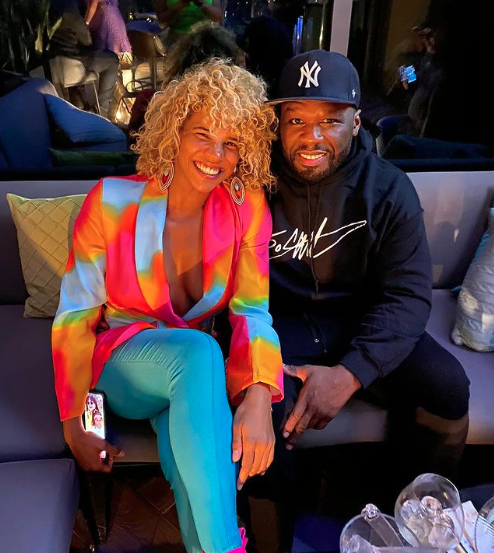
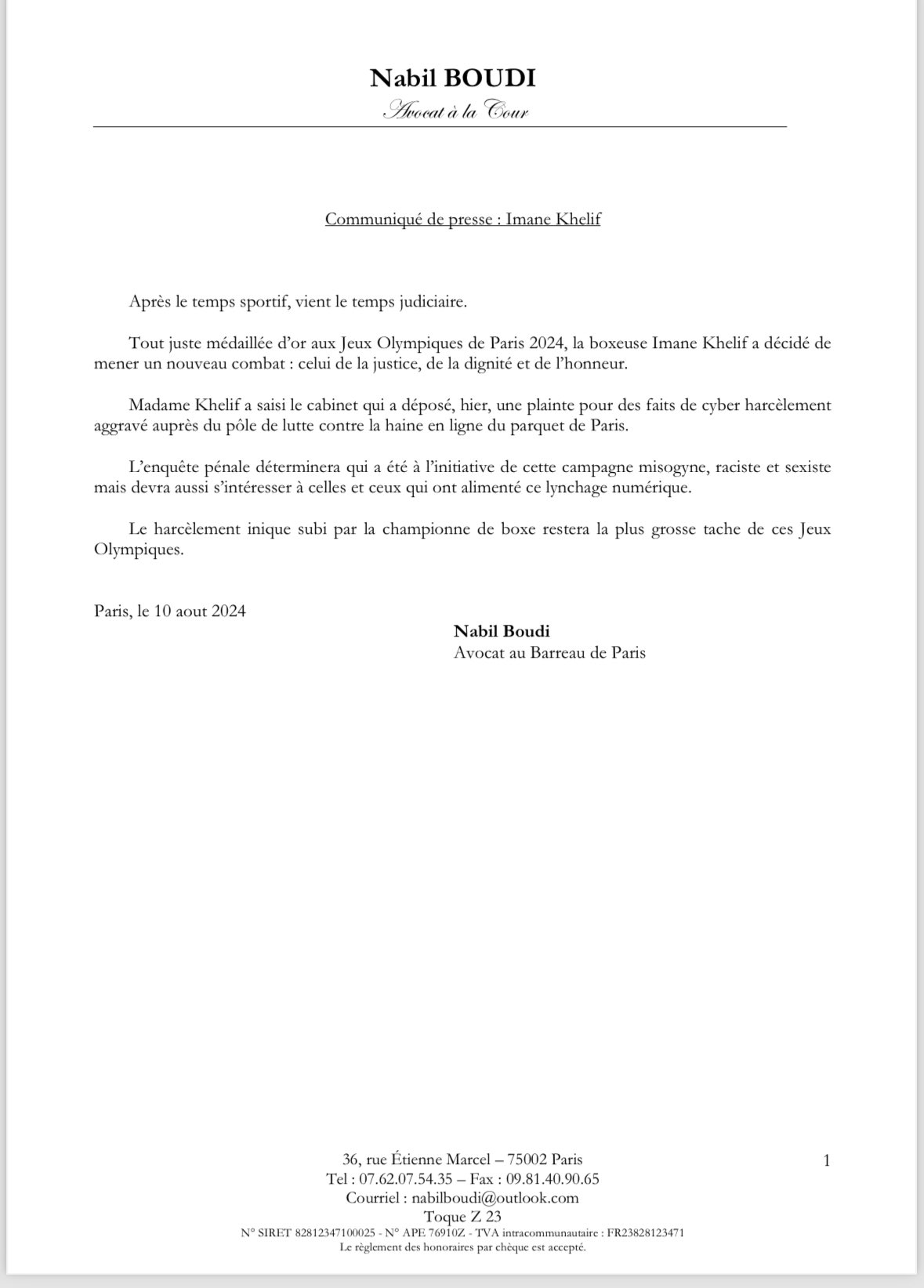


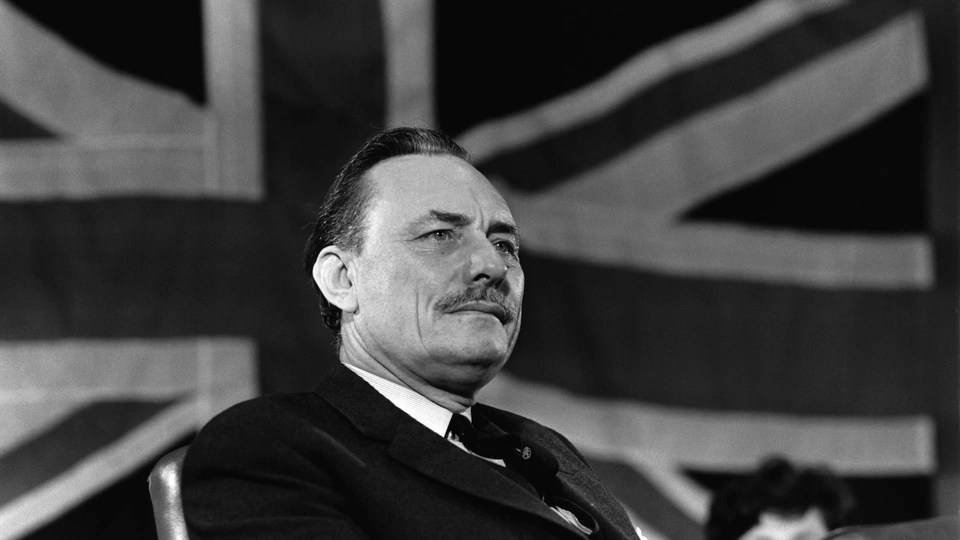
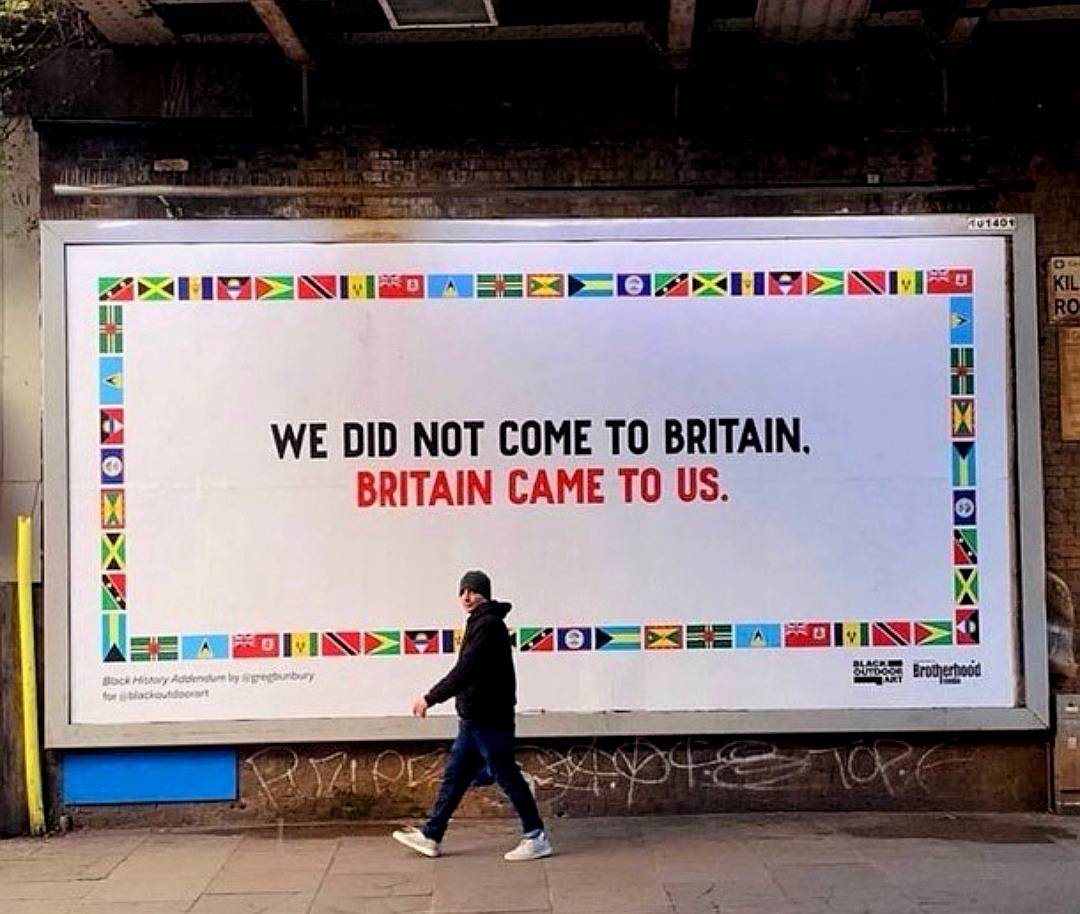



 freedom and reason