
The Associated Press today, “Michael Brown’s death 10 years ago sparked change in Ferguson.” But is it the change Ferguson needed? (I have written extensively on this topic. You will find in the following articles links to many other articles: Demoralization and the Ferguson Effect: What the Left and Right Get Right (and Wrong) About Crime and Violence; The Crime Wave and its Causes; G. Floyd’s Death May Have Changed the World. But in What Way? The Myth of Racist Criminal Justice Persists—at the Denial of Human Agency (and Logic); Debunking Mythologies Surrounding the American Criminal Justice System.)
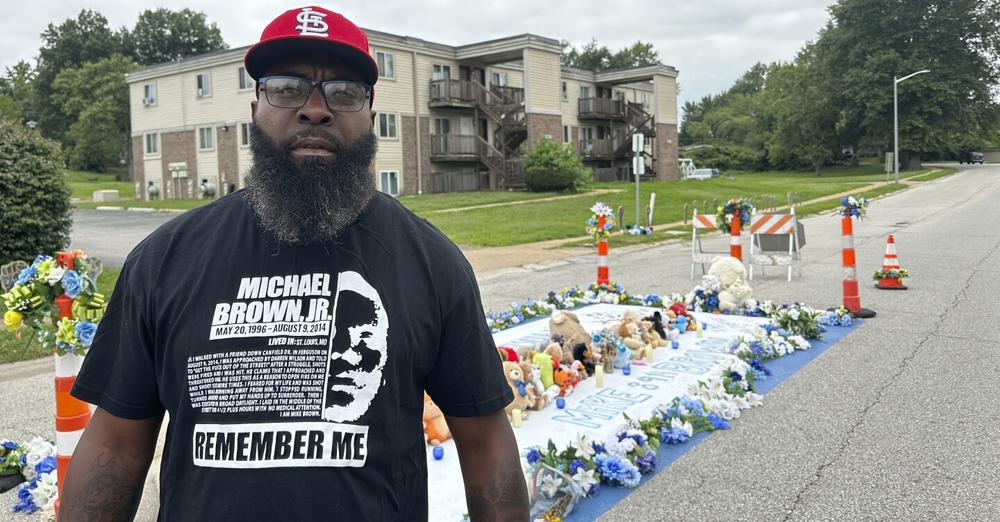
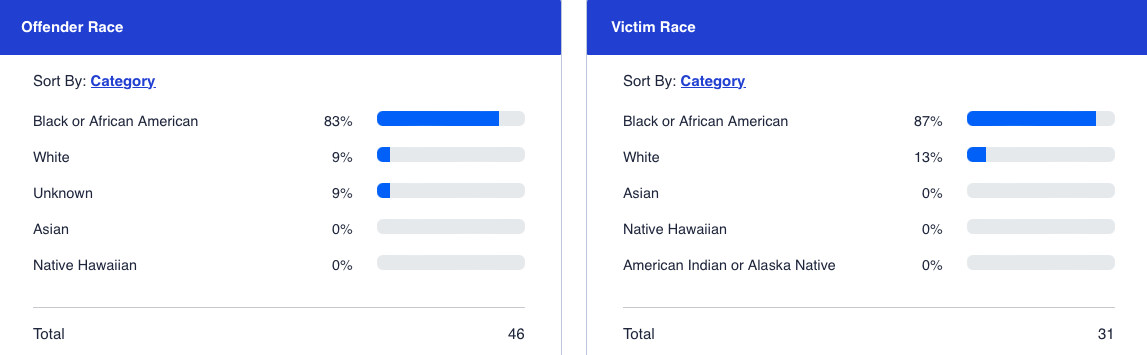
Ferguson is part of the Greater St. Louis metropolitan area. Per the 2020 census, the population was 18,527, predominantly black. Ferguson is where BLM really took off. It’s the origin of the “hands up” meme, based on mythic circumstances. Now public safety is a concern in Ferguson because of depolicing. Residents know that the police are unlikely to pull them over, so they flaunt traffic laws, the AP tells us. But that ignores the worst of it. Crime—violent and nonviolent—is much higher after the Ferguson riots than before. Moreover, the demographic pattern is alarming. One in five residents in Ferguson is white, yet only six percent of violent crimes and four percent of property crimes were perpetrated by whites in 2022. No whites are identified as perpetrators of either homicide or robberies. One hundred percent of all homicide victims in Ferguson that year were black.

In 2022, using the St. Louis Post-Dispatch Homicide Tracker, the Greater St. Louis metropolitan area, which includes both St. Louis City and St. Louis County, reported at least 360 homicides. This figure places the area among the highest in the United States for homicide rates. The two charts form the FBI’s Crime Data Explorer presented below, St. Louis Police Department and the St. Louis County Police Department, give the reader a sense of the drastic overrepresentation of blacks in homicide. There were a total of 231 homicide victims and 177 perpetrators that year. Whites comprise 77 percent of the population in the Greater St. Louis metropolitan area, according to the 2020 census.

Police presence is the single greatest deterrent to crime. The reason crime is up around the nation is explained in part by depolicing (see John Lott’s recent article “The Truth about the Crime Explosion,” in National Review). Public safety is a human right, so the progressive left’s influence over policing policies has made communities much less safe, especially for black people. The United States enjoyed a long period of declining crime rates after the mid-1990s. This was because of expanded police present and mass incarceration. Unfortunately, police and prisons are necessary because of the conditions of black-majority neighborhoods, the result of progressive urban policy, foremost the destruction of the black family, caused by the idling of the black proletariat and public assistance. Democrats have transformed the cities under their control into danger zones. (See America’s Crime Problem and Why Progressives are to Blame.)
From the AP story: “Brown’s death catalyzed massive change in Ferguson. In 2014, every city leader was white in the majority-Black city. Today, the mayor, police chief, city attorney and other leaders are Black. The mostly-white police force of a decade ago now has more officers that are Black than white.” One might wonder why it matters what race the mayor, police chief, city attorney, and most police officers are. The response would be that the majority of the city is black, so the government should reflect this fact. That the crime situation is so much worse now than before is not a consideration. I am not saying that whites would do a better job (if they are progressive whites, then they won’t, as the crime problem in the Greater St. Louis metropolitan area attests to); I am questioning a metric of progress based on racial identity and not lower crime rates.
Before concluding this essay, note that “Black” is capitalized throughout the story whereas “white” is not. Have you noticed this trend in reporting? Look for it the next time you read a mainstream news story. I capitalize neither, since neither are proper nouns; they are racial categories. Why would AP capitalize one and not the other? Do you think there is a politics in back of this? As these organizations explain it, “Black” is capitalized to honor it as a specific cultural identity with a shared experiences, heritage, and history among people of African descent. This capitalization trend gained traction with the rise of movements like Black Lives Matter as a way to affirm the dignity and significance of Black identity. “White” is often left lowercase because it is viewed as a racial category rather than a unified cultural identity with the same shared heritage and history.
Editorial guidelines from organizations like the AP have adopted these practices to better reflect the distinct social and political meanings attached to these terms. This is what they claim. But who are organizations like the AP to determine the distinct social and political meanings attached to these terms? I teach race and ethnicity as part of my duties as a sociologist, and I have published numerous articles and essays on the topic (race relations lies at the heart of my dissertation Caste, Class, and Justice: Segregation, Accumulation, and Criminalization in the United States), and I can think of only one reason to reduce white people to a racial category and elevate black people to the status of a significant cultural identity, and that is to reify the myth of the racial hierarchy based on white supremacy and then flip it in the public minds for social justice’s sake. So, yes, it’s political.

 freedom and reason