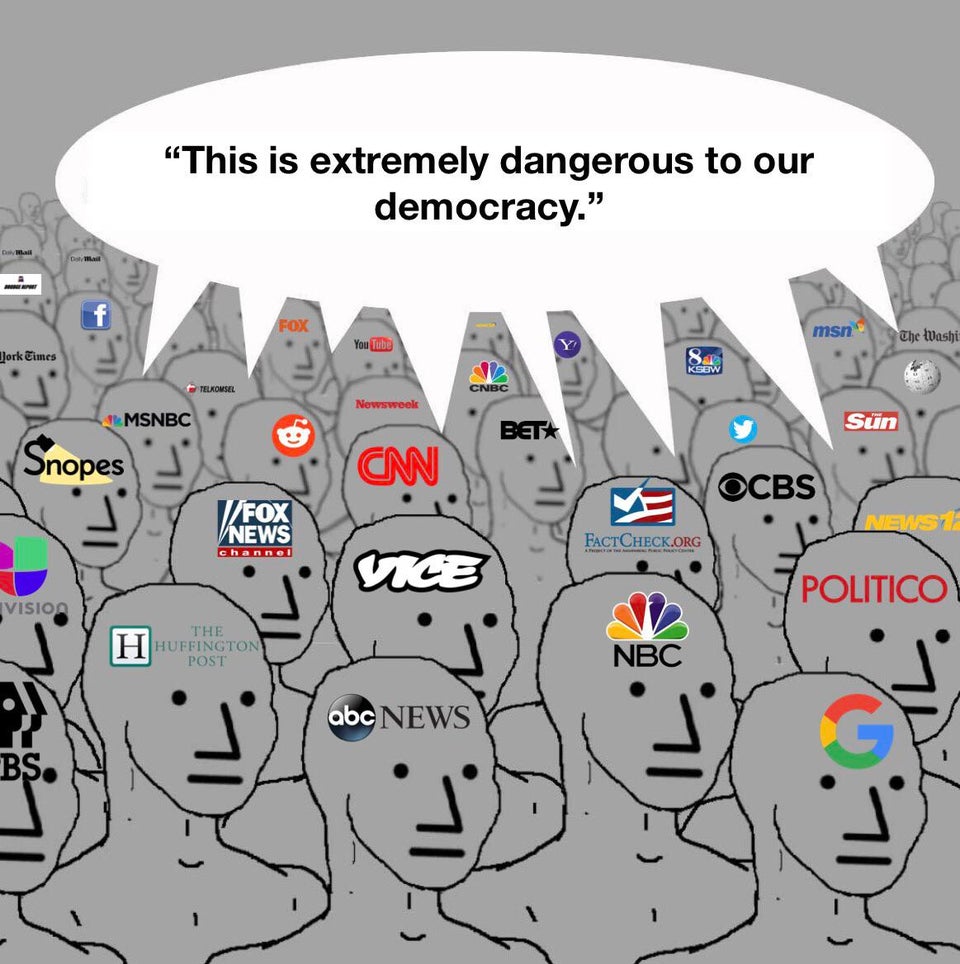
It’s a strange debate we’re having in the United States today about race. It’s as if our sense-making institutions have lost all historical memory about what it means to be black in America. That is exactly what has happened. But it is weird only because the weird ones have assumed power and taken control of the narrative. Have you seen this?
George Stephanopoulos repeatedly presses Rep. Byron Donalds on VP Harris' racial identity in heated exchange | https://t.co/iPXKAFbE8c
Growing up in the 1960s-1970s to parents who were civil rights activists, and then later becoming an expert in race and ethnic relations (my dissertation was on the subject of the political economy of race and many of my articles and courses concern the racial problematic), I learned that to be a black American meant that you were descended from Africans long ago brought to the United States (a very long time ago: the United States abolished the slave trade in 1800, the law taking effect in 1808) to serve as chattel—that “peculiar institution” Republicans abolished in the 1860s at the costs of hundreds of thousands of lives. The descendants of those Africans slaves would later by terrorized by lynch mobs (see Agency and Motive in Lynching and Genocide), and suffer under de jure segregation, abolished in the 1960s despite Democrats filibustering the Civil Rights Act of 1964 in the Senate (the longest filibuster in US Senate history).
Black Americans were the focus the Civil Rights movement. Affirmative action concerned black Americans in this sense, as well. It was widely understood that an African who immigrated to the United States should not count as an affirmative action hire because the program didn’t fetishize the racial concept but the historical one. After all, race is a social construct. Indeed, Africans who legally immigrate to America typically come from affluent families. They do not descend from those who suffered at the hands of plantation owners, lynch mobs, and Jim Crow—the badges of slavery. They therefore do not need equitable adjustment.
Slaves on the plantation
The same is true of Jamaicans, a remarkably successful immigrant group (in the UK, as well). If one is from Africa or the Caribbean, he is not black in the sense that MLK, Jr., was black. Moreover, many Africans are white, either Arab or European (Elon Musk is African, for example). Being African or African American (naturalized citizens) does not necessarily mean one is black in any sense.
The question of Harris’ racial identity is not an offensive question—at least not the way older observers understand it. (Donald Trump, for example; see The Perils of Racecraft.) It is treated as such because elites don’t want you asking questions about it, and the rank-and-file are ignorant enough of history to be bamboozled. When progressives and the media say that Harris’ racial background is off limits, what they are doing is trying to prevent young people from learning about the history of blackness in America. This is how younger generations are controlled—through the socialization of thought-stopping devices (Orwell warned us about it). The older folks are intimidated by the younger folks very much like they were during Mao’s cultural revolution in the 1960s.
We witnesses the same thing with Obama. Obama’s mother was white. Obama was raised by his white grandparents. He had an African father with whom he had limited interaction. Obama was not black in the historic sense of the term. He moved himself to Chicago and joined the black church to manufacture racial authenticity because he had political aspirations and these were advanced by sporting a black identity (which is why black critics in the day referred to Obama as a “Magical Negro”). Blacks and whites were told they were bigots for suggesting Obama was “not black enough,” even those this was mostly coming from black commentators—white guilt couldn’t wait vote for the man. Elites presented Obama as black because it was politically useful. (See Progressive Hypocrisy and scroll down the paragraph about Alan Keyes.)
Harris does the same thing. When it’s useful to push her Asian ancestry, she does so (San Francisco, for example, where black-Asian relations are notoriously antagonistic). When she needs to be black, however, Harris goes to a record store and buys albums to bolster her racial bona fides (does she even have a record player?). She puts on a stereotypical black accent, which the progressives dutifully rationalize as “code switching,” which is something white people wouldn’t understand.
Who gets to define race in America? The answer to that question is obvious: progressives. They get to define everything. They’ve captured the sense making institutions. They’re the gatekeepers of identity. They and their minions (the army of college students they’ve trained up Saul Alinsky style) get to decide whether you’re a racist. They get to decide what words you can use. What jokes you can tell. They’re the brain police.
This is why a white ABC talking head, George Stephanopoulos, who was a top strategist for the 1992 Clinton campaign (in charge of “bimbo eruptions,” i.e., Clinton’s many rape victims), can scold Byron Donalds, who is for sure a black man, for questioning Harris’ racial identity. You’d think that the rule is that only a black man can ask such a question, but you’d be wrong. Only a progressive can, since a progressive, even a white one (especially a white one), has been given the power to define people as such. Remember when Biden said that if you were a black man who didn’t know whether you were voting for him or Trump then aren’t really black? He was saying the quiet part out loud. Trump is excoriated for simply noting Kamala’s pandering. Biden says black people who don’t vote him aren’t really black. Crickets.
You’re supposed to believe that questioning a person’s racial identity is racist—but only if you’re not progressive. The media shredded Rachel Dolezal for identifying as black because they will tell you who is who is not black. Dolezal is not black. Khelif is not a man. The pattern is obvious. It’s why young progressives come my Facebook profile and show their ass. They believe they alone enjoy the privilege to define things for everybody else because of their political identification. They’re smarter than everybody else not because they know anything (as you can see, they don’t) but because they are progressive. They’re like Islamists: their religion is a formula for truth. Identity = correctness and virtue. This is why you will never hear an actual argument. They don’t know the rules of reasoning because they don’t need to. Universities don’t teach these anymore anyway (I do, but who cares?).
My problem with Dolezal is not that she presents herself as a black woman despite being born to white parents, but that she didn’t descend from black slaves. Had that been the case, even if she appeared white, she could claim to be black. Not an insignificant number of blacks appear white. My students will always wonder aloud in Race and Ethnicity who those white children are in the photographs of freed slaves. It’s possible that Dolezal lived in South Africa as a child, and we know for a fact that from 2002 to 2006 her parents and siblings lived in South Africa as Christian missionaries. So she might claim to be African American in some sense (which is not the same as black). But if it’s wrong to question somebody’s racial identity, then why was Dolezal so viciously attacked? Because it’s only wrong if you’re the wrong person. It depends on who is doing the questioning and whether that person is the right person. The right person is the progressive person. (See The Strange Essentialisms of Identity Politics.)
Remember when the Marxist political scientist Adolph Reed, Jr. (a black man) was attacked for asking why Dolezal couldn’t be black and was destroyed over it but Bruce Jenner could be a woman and given awards? (See “From Jenner to Dolezal: One Trans Good, the Other Not So Much” to learn about this case.) I asked the same question and people got really mad. Richard Dawkins (a white man) asked the same thing and his humanist award was revoked (see Racecraft and Witch Hunts). “It’s not the same thing,” progressives said. Yeah? Why not? “If you don’t understand why these cases are not analogous, you’re transphobe.” Really? Why? “It’s just not.” “Bigot.” These aren’t answers. Sometimes, like a case of Tourettes, the Cluster B comes out and “Go fuck yourself.”
The question of Harris’ racial identity is relevant. Identity is not what people say about themselves but what they are. Most things in the world have no capacity to identify themselves. It’s up to objective observers to identify what the thing is according to valid criteria. The question “what is a woman?” has an answer (this is why Matt Walsh’s documentary “What is a Woman?” is so powerful). A woman is an adult female human. What does female mean? In mammals it means XX karyotypic and large gametes with corresponding reproductive anatomy. There’s a Y present? Then this is not a woman. But the person identifies as a woman. Right, and that person identifies as a lizard. That’s subjective. People think all kinds of things about themselves. Dolezal believes she is black (to this day). But, if we’re rational, we work from objective criteria. What is a black American? There is valid criteria to consult (I showed it to you earlier in this post).
A historical note: the party of the slavocracy, of the Ku Klux Klan, of the people who lynched blacks, the authorities who instituted Jim Crow—that’s the Democratic Party. The progressive movement grew out of this, as did the corporate state progressive administer. This is same party of the modern-day ghetto that engineered the destruction of the black family (over 80 percent of black children in the inner city are born in one-parent households). This is the party who underprotects black neighborhoods, and are therefore responsible for the fact, while black men make up only 6-7 percent of the US population, more than half of all murder victims are black men. Half of all murderers are black men, as well.
As for the Republicans we’re instructed to loathe? They had nothing to do with that. They don’t run blue cities. But they did do these things: they abolished slavery; they organized and administered reconstruction; they voted in overwhelming numbers of end Jim Crow (80 percent of Republican in the House and the Senate). Republicans are the choice of the vast majority of US counties. In those counties, children have fathers and grow up in safe neighborhoods.
If you hear these truths and think “racist,” then you’re a progressive—which means you’re the racist (weird, right?). What you think and say about the world is corporate state programming, which socializes racial thinking to disorganized the working class. It is successful because progressive control the sense making institutions.
People on X have been saying this thing that Trump never laughs. It’s like that thing they say about him mocking a disabled reporter. That wasn’t true. Or the thing about him saying that if he were elected people wouldn’t need to worry about voting any more. He didn’t say that. Nor did he say he would by “dictator on day one.” He never told Americans to inject bleach or drink fish tank cleaner. The “very fine people” line in South Carolina is a myth. So I shared video of him laughing because those videos exist (just like the videos of him doing the spaz routine). Rational people would say, “Oh, okay, I was wrong.” But most people who say these types of things about Trump are never be wrong, so most came back with, “It was just a chuckle, not a laugh.” I’m not going to get into why that is an absurd rationalization, and I’m not exactly sure why Trump deranges people so, but he certainly does (I think it’s because they are manipulated into being deranged by him—and they want to be deranged). However, I had one person say that my video of Trump laughing at least proves he isn’t Jesus, because Jesus never laughed.
I like unique comments, and I vaguely remembered hearing something about Jesus never laughing. So I Googled it and ran across an article by Kevin Considine, a writer for US Catholic magazine, who, in 2022, said, “There is no evidence in scripture to confirm that Jesus laughed. He gets angry, he weeps, he shows affection, he agonizes over his fate. And the Jesus depicted in Revelation definitely lacks a sense of humor.” But Considine says that’s okay because “Jesus is also God, the author of life and master of the banquet. And this is the same Messiah who has friends, goes to dinner parties, and turns water into wine at a wedding.” And there you go. You don’t have to laugh to be a mighty and good fellow. (I like Jesus, even if he wasn’t real, and, if he was real, even if he was a charlatan.)
Happy Jesus
Over on Facebook, where Christians who are also Democrats (I know conservatives don’t think that’s possible) are still determined to rationalize the opening ceremony of the Paris Olympics, even though they should be troubled by it (not just for producers, directors, and performers mocking their religion but for what their mocking intended), they’re sharing this thing by a Baptist preacher who wants to make sure people know that Jesus would have supper with any of the people who were involved in that obnoxious production. I have seen this thing a few times now. I don’t want to make people upset, and that’s the reason I have moderated my irreligious criticisms over the years, but I will return to form for a moment to remind readers that I am unconvinced that Jesus was an actual person, albeit I am sure that he could not have done the things attributed to him, as these things are impossible, so I have good grounds to reject any accounts of his exploits, and I don’t think if he were real he would have had supper with that crew. (It will also give me an opportunity to represent some of my essays from several years ago when my interest in the topic was more keen. See, e.g., Zoroastrianism in Second Temple Judaism and the Christian Satan.)
I do have reason to think that Paul was a historical figure, and, moreover, reason to believe that the figure of Jesus was the work of Paul for the purposes of establishing a salvation cult (see my December 2017 essay Paul: “The gospel I preach is not of human origin.”) Paul did this work thought a process known as Euhemerization, a technique where a mythological figure is worked into history to make it appear as if he were an actual man (see my December 2019 essay The Trick of Euhemerus). This is opposite of deification, where a great man is made into a god. I agree with Richard Carrier that Jesus was likely based on an entity in Jewish angelology who had roots in ancient Middle Eastern and Persian mythologies (see videos here and here). Whatever we might imagine were Jesus’ views on the spectacle we witnessed last Friday at the Olympics, and the aims of it, it is certainly the case that Paul would have identified it as an instance of God turning people against themselves as a consequence of having wandered well of the righteous path with no desire to find their way back to it. Romans 1, which Paul is widely accepted to have authored, is brutal. At the very least, it is difficult to image that Paul would have broken bread with any of the individuals on that stage on Friday night.
Again, I want to remind readers that I am an atheist. Moreover, I see gays and lesbians as deserving of the same rights that I enjoy. I hold many gay and lesbians dear in my life (I want to be careful and not out anybody) and I have my whole life advocated for their movement (see, e.g., this 2007 essay Marriage, Equal Protection, and the Separation of Church and State). I have no ulterior motive in this essay other than engaging in a moment of critique regarding progressive interpretations of the Christian faith, which are deeply flawed, and revealing of an odd denial coming from that camp. While Jesus may have been an actual person, Jesus meek and mild is not the figure one reads about in the New Testament (see Cleansing the Temple: White Colonizer Jesus vs Brown Jesus Meek and Mild). I think Nietzsche had a point when he suggested that this interpretation turned the doctrines into a slave morality. (If that wasn’t exactly his argument, I will claim it.) If I might make one last point on this, as the myth has it, Jesus did not go to his death because he was a nonviolent man. His rampage in the temple indicated the opposite. Jesus went to the cross because it was his purpose to die and give up the ghost and pour God’s love into the world. But love is not unconditional. Neither testament tells us that. Certainly God’s love is not conditional. Hell is worse than annihilation if you think about it; you wouldn’t be in hell for long before you wished for annihilation. Jesus judged. Or at least Paul did. Often quite harshly. Here’s what I mean:
Romans 1 God’s Wrath Against Sinful Humanity (verses 18-32):
The wrath of God is being revealed from heaven against all the godlessness and wickedness of people, who suppress the truth by their wickedness, since what may be known about God is plain to them, because God has made it plain to them. For since the creation of the world God’s invisible qualities—his eternal power and divine nature—have been clearly seen, being understood from what has been made, so that people are without excuse.
For although they knew God, they neither glorified him as God nor gave thanks to him, but their thinking became futile, and their foolish hearts were darkened. Although they claimed to be wise, they became fools and exchanged the glory of the immortal God for images made to look like a mortal human being and birds and animals and reptiles.
Therefore, God gave them over in the sinful desires of their hearts to sexual impurity for the degrading of their bodies with one another. They exchanged the truth about God for a lie and worshiped and served created things rather than the Creator—who is forever praised. Amen.
Because of this, God gave them over to shameful lusts. Even their women exchanged natural sexual relations for unnatural ones. In the same way the men also abandoned natural relations with women and were inflamed with lust for one another. Men committed shameful acts with other men and received in themselves the due penalty for their error.
Furthermore, just as they did not think it worthwhile to retain the knowledge of God, so God gave them over to a depraved mind, so that they do what ought not to be done. They have become filled with every kind of wickedness, evil, greed and depravity. They are full of envy, murder, strife, deceit and malice. They are gossips, slanderers, God-haters, insolent, arrogant and boastful; they invent ways of doing evil; they disobey their parents; they have no understanding, no fidelity, no love, no mercy. Although they know God’s righteous decree that those who do such things deserve death, they not only continue to do these very things but also approve of those who practice them.
That last line is particularly interesting. It’s not just those whom Christians watched blaspheme God and Son during the opening ceremony of the Paris Olympics who deserve death according to Paul. Remember, Leviticus 20:13 states: “If a man practices homosexuality, having sex with another man as with a woman, both men have committed a detestable act. They must both be put to death, for they are guilty of a capital offense.” Paul also believes that those who approve of those who practice them are worthy of “God’s righteous decree.” I not asking Christians to get caught up in scripture per se, but to see scriptures in terms of what they consistently suggest about the faith, which is that it is heterosexist. Of course, it was written a long time ago and attitudes have changed (not everywhere, obviously). But the old and new testaments are the divinely inspired word of God, at least that’s what we’re told, and the latter submits to the person the path to salvation. Given that this is as direct a line there can be between the Christian and his savior, if the savior or his accepted mouthpiece condemns homosexuality, doesn’t the believer put himself above the authority of God’s word? The would suggest that the absolute were the product of man and that its form and content would be negotiable, or at least alterable. (As it turns out, it’s both.)
President Donald Trump recently spoke at the National Association of Black Journalists convention, where he was asked about Diversity, Equity, and Inclusion (DEI). The question came from ABC News correspondent Rachel Scott. Trump responded by questioning Vice President Kamala Harris’ racial background and expressed skepticism about DEI initiatives. In watching him answer the question I kept think about the man’s biography, how he was born in 1946 in Queens, New York City, which means that he have had a ringside seat to the Civil Rights Movement, and would surely have understood that at the heart of the struggle was ending de jure racial discrimination and segregation. He would also have an older view on the question of race. In many ways that’s a good thing. Scott was born in 1993, almost thirty years after Jim Crow was overthrown. Her world is DEI.
The Civil Rights Act (CRA) of 1964 was passed, and subsequent programs like affirmative action designed to address the historical injustices and systemic discrimination faced by black Americans due to the legacy of chattel slavery and Jim Crow segregation. These laws and policies (and court decisions, as well) aimed to dismantle legalized racial segregation and discrimination, promote equality, and create opportunities for those who had been systematically marginalized. The CRA of ’64 outlawed discrimination based on race, ended segregation in public places and places of accommodation, and banned employment discrimination. Affirmative action policies followed, aiming to correct the effects of past discrimination by providing better access to education and employment opportunities for underrepresented groups, particularly black Americans. These measures were part of a broader effort to promote racial justice and equality in the United States, recognizing the profound and lasting impact of slavery and segregation on black communities.
In contrast to affirmative action program, DEI is the environment Scott is steeped in as an employee of the super-woke Disney Corporation. DEI is a broader and more holistic approach that encompasses a wider range of initiatives and practices aimed at creating a more equitable environment for all individuals, who are seen in terms of racial and other identities. DEI goes well beyond merely addressing past discrimination to fostering a culture of inclusion and belonging within organizations and society as a whole. Obviously Trump knows what DEI means, but his philosophy does not include DEI programming as a necessary part of his business. He would not have asked for a definition of DEI per se, but rather in what way would DEI explain Kamala Harris’s career path. As is frequently the case with Trump, he found a way to give the mass media soundbite to make him look like he screwed up the answer to the question. It sounds bad, I know, especially when the curator of the interaction is MSNBC; MSNBC’s editors and producers are the masters of making Trump look bad. Here’s the propaganda version of the controversy.
What actually happened? If one practices charity, you can sort it out. Trump touched the poo because they asked him to. I will explain. It’s not fair to assume that saying somebody is a DEI hire is racist (why would it be?), not clean up the assumption, then pivot to, “Will you tell your supporters to stop calling Harris a DEI hire?” That’s not a question, that’s an ask. That’s MSNBC headline. How does one “falsely question” whether somebody is black? That’s a weird way of putting it. Race is a social construct. We conjure race into existence by talking about it and performing it (see Barbara and Karen Fields’ concept of “racecraft”). If MSNBC were charitable, and striving for some semblance of objectivity, would they have reported, in an attempt to answer whether Harris was a DEI hire, clarification for which Trump sought but did not enjoy, the possibility that the President assumed the answer might depend on her ethnic and racial identity. Because it does.
Putting racial classification to one side (that’s the poo), if the ethnicity question were to be answered in any concrete way, it would require determination of ancestry. As Richard Lewontin famously noted, people confuse race for ancestry. While race is a social construct, ancestry is genetically and geographically determined (unless you’re a race realist, in which case they are the same things). A person can think anything about herself, but to whom she is born is a material fact. (Ask Rachel Dolezal.) Unlike race, which is typically associated with phenotypic characteristics, ethnicity refers to a category of people who identify with each other based on shared ancestral, cultural, historical, or social characteristics. This often includes common language, heritage, religion, and traditions. Because humans are culture bearers, they take their culture with them when they move. The culture into which they move modifies their ethnicity as they become assimilated to the new society.
Harris was born in 1964 to a mother of South Asian ancestry (Shyamala Gopalan is a Tamil Indian immigrant, naturalized in America, therefore Asian America) and a father of Afro-Caribbean ancestry (Donald Harris was descended from the white slaveowner Hamilton Brown, who was of Irish descent). Since she was born in America, and neither parent is African, she is not African American. To be African American you have to have been born in Africa, immigrate to the America, and become a naturalized citizen. (An example of a prominent African American is Elon Musk.) What is more, I understand that Harris’ mother is listed as “Caucasian” on Kamala’s birth certificate. How did this happen? Because Indians are, according to racial theory (and factor analysis of the geographic distribution of phenotypic traits suggests this conclusion), Caucasian. (So are Arabs and Persians, by the way). It was 1964, so the physical anthropological classification system was still used in many places.
As noted above, historically, discrimination in America after the CRA of ’64 (affirmative action, DEI), has been focused on addressing the situation of blacks primarily (which would include Hispanic blacks). So, Trump’s response, while obnoxious in isolation and always perilous for a white man, was really an in-artful way of trying to get clarification on what being a DEI hire means in Harris’ case, since he presumed it would depend on whether she was Indian or black, and whether she identifies as either depends on her campaign strategy. Contrary to what the corporate media are saying, there is a record of Harris using one or the other ethnic identity at different times. The question is whether Harris is black is a historical question concerning whether Harris is descended from those of African descent enslaved in the United States. I understand that the word “black” does not appear on Harris’ birth certificate.
We are almost ready to answer the question that worked as the assumption in the reporter’s confrontational ask (it was also a loaded question). Harris is not a DEI hire unless we presume that her Indian and Jamaican heritage puts her in a historically marginalized group in America. The fact that Indians and Jamaicans do very well in the United States (and in the United Kingdom) suggests they are not marginalized communities. Therefore it would follow that if Harris were a DEI hire it would be based on an assumption about her identity. Biden did say he was going to choose a black woman for Vice-President (and for the Supreme Court).
Trump’s problem is that navigating this minefield requires expertise in the areas of anthropology, natural history, and sociology that Trump doesn’t have or is even interested in having. I teach the sociology of race and ethnicity, so I know how difficult this subject can be. The best Trump could have done with the question is to say, “Others are free to say what they say. What I will say is that Republican Party believes in hiring and promoting people based on accomplishment, hard work, initiative, and talents, not on the basis of their racial or ethnic identity.” If you hear that in your head in his voice, it’s a solid response. He would then be standing on principle that he knows some in the room disagree with, but it is still principle. He also gets a message out—if the media reports it. Instead he entered the minefield with no metal detectors. And he stepped in the poo.
Trump likely will have no do-over here. The corporate state media won’t allow it. They thought they got him this time (time will tell), but the moment seems to be fading the more people see that the audience was really enjoying themselves and when the entire thing is watched, one can see how antagonistic the ABC reporter was the Trump. What Trump might have considered doing in the moment, which I suggested at the time, was apologizing—something like, “I was a tired and irritable yesterday and I provided less than an optimal answer to a question put to me, and I regret that. What I should have said was that the Republican Party believes in hiring and promoting people based on accomplishment, hard work, initiative, and talents, not on the basis of their racial or ethnic identity. In America everybody is created equal and enjoys equality under the law. If there is evidence that Harris was hired or promoted on the basis of ethnicity or race, then she is a DEI hire.” This is why he wanted the reporter to define DEI. Responding by simply identifying the terms the acronym stands for is not defining anything. But this is what she did (the clip in context):
MUST WATCH: This clip shows what was probably Trump’s single most unhinged, outrageous, rude and openly racist exchange with a reporter at the National Association of Black Journalists conference. 👀 pic.twitter.com/H7MSSqfUW7
Is this bad for Trump? Yes, mainly because the corporate state media is crucifying him for it and they control the narrative. Racial thinking lies at the heart of the tribal logic of progressivism; there is no charity to be found among journalists, editors, and producers when it comes to Trump, a rich white man. They wait to pounce on the things he says, wrench them out of context, and lay them in the worst light. This is why he should not have accept an invitation to speak at this event (there are other more charitable black audiences he can speak to) and he should probably not debate Kamala Harris, although Fox News has extended an invitation to debate on their network, which Trump has accepted. (How is that is not a losing proposition?) At the same time, as the moment fades into the past, it almost provides a sort of stress inoculation, where the average viewer just expects these Trumpism and begins to focus more on policy and who Harris really is.
We heard calls for Trump to drop out of the race. That is the last thing that should happen. Here’s why. A Kamala Harris presidency will be disastrous for America in much the same way Hillary Clinton would have been disastrous for America. I voted for Clinton in the 2008 primaries in an attempt to deprive Obama of that primary win. This was before Clinton became Secretary of State and I got to see how truly sociopathic she is. At one point during her tenure, I turned to my wife and said, you remember Stephen King’s The Dead Zone, where Johnny Smith awakens from a five-year coma with psychic abilities—he can touch objects or people and see into their past or future—and he shakes hands with Greg Stillson, an ambitious politician campaigning for a seat in the US House of Representatives, and foresees Stillson instigating a nuclear war? (She said, “No.”) Well, Clinton is the real world Stillson. While Harris brings that authoritarian vibe, she possesses nothing like Clinton’s intellect (which is surprising given that Harris’ mother was a professional scientist and father a professional economist, both with PhDs and university posts). Trump did the nation a great service in 2016 defeating Clinton. And he needs to do the same in 2024. If Trump were to drop out, Harris would win, and America would be in a world of poo. But he doesn’t look like he is. After all, he took a bullet and stood up and rallied the crowd. This dude ain’t quitting.
(Note: I didn’t elaborate the justice question in remarks I first made on Facebook and then adapted to Freedom and Reason in The Ubiquity of Fallacious Reasoning on the Progressive Left, because I was focused on explaining the widespread problem of fallacious thinking among progressives. I am an educator and reflexively see teachable moments. In one thread on Facebook, for example, I applied the Socratic method to bring participants to enlightenment. Unfortunately, this was perceived as manipulative. This is the problem that often lies behind the unwillingness of progressives to participate in rational discussion: progressives (especially the youth) cling to an ideology that privileges artificially constructed classes of sexual minorities over women’s rights, which are organic and rooted in natural history. Readers might consider the present essay as Part Two of Thursday’s essay, although it carries its own title.)
The term “equity” is often misunderstood—or misrepresented, particularly in political discourse. Conservatives, and some progressives (Kamala Harris, for example, who just secured the requisite delegates to be the Democratic Party’s nominee for President), tell us that equity is striving for “equality of outcome.” But the actual meaning of the term concerns practices aimed at providing individuals with the opportunities and resources they need to reach their potential, considering their circumstances and the differences between individuals. This is something quite different from seeking equality of outcomes.
Equity involves recognizing that people face different barriers and have different advantages and needs. Equitable practices encompass targeted intervention, policies, and support designed to address those inequalities and provide opportunities tailored to individual and group differences. Equitable policies and practices are an attempt to level the playing field to ensure everyone has a fair chance at participation and success. Crucially, equity doesn’t guarantee participation and success; it attempts to clear the barriers that prevent participation and success. Individuals still need to possess the talents and take the initiative to seek and win success. These are the ethics that propel progress.
The establishment of sex-based rights is arguably the most significant instantiation of equity in this sense. The emergence of sex-based rights in Western society has deep historical roots, beginning with early feminist struggles and the honing of rational scientific thought in the Enlightenment era. The emergence of sex-based rights in America can be traced back to the early feminist movements of the nineteenth and early twentieth centuries. Title IX of the Education Amendments of 1972, which prohibited sex-based discrimination in education and sports, is the relevant advance for the present discussion. The struggle for equity-based equality more broadly addressed issues such as gender-based violence and reproductive rights violence.
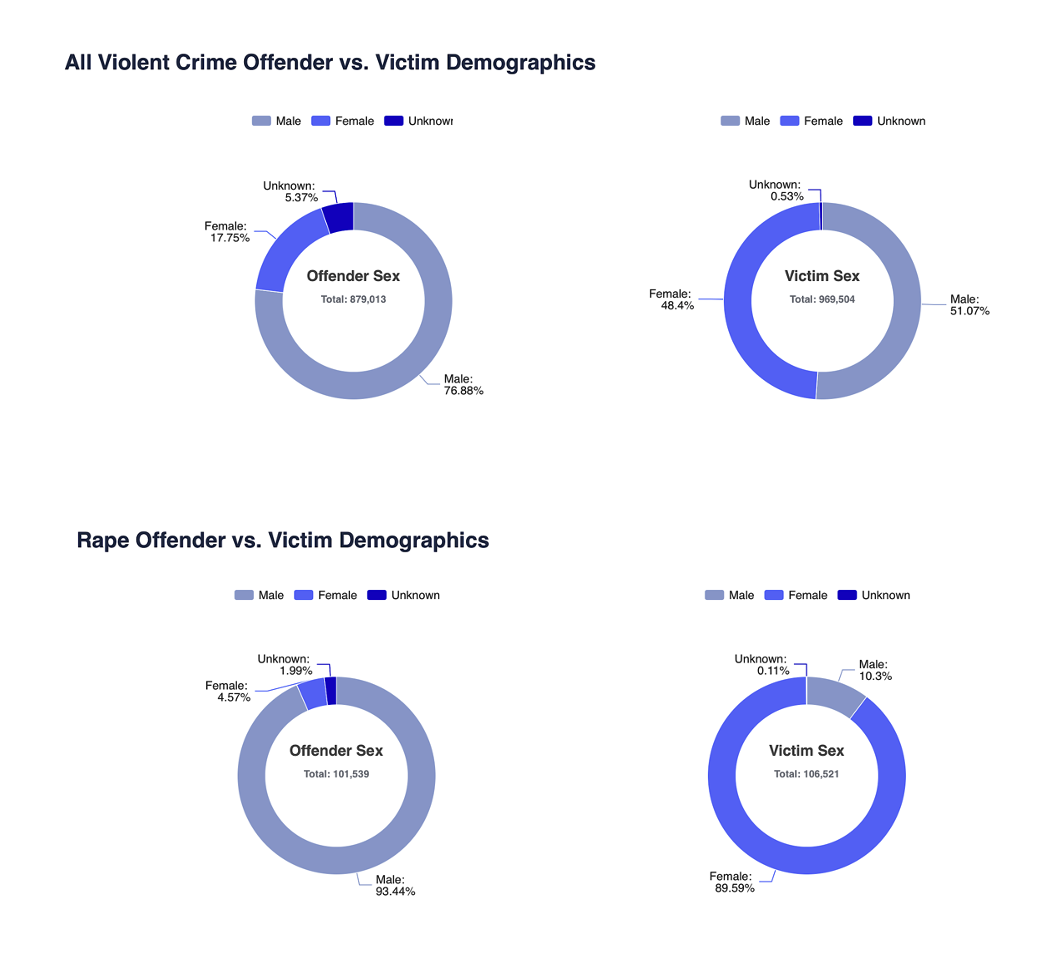
By acknowledging the distinct and profound differences and needs between males and females, sex-based rights aim to ensure equal opportunities and fair treatment for both sexes. Sex-based rights address various areas where females and males different challenges or disadvantages, such as in education, health, and in the workplace. Sex-based rights are also crucial to the need to protect women from violence, of which males are overwhelming the perpetrators. In the United States, for example, more than three-quarters of criminal violence is committed by males; nearly half of the victims of criminal violence are women. For rape, man are perpetrators in nearly 95 percent of offenses, with women representing 90 percent of victims. By implementing policies and protections that specifically consider these differences, such sex-segregated spaces (bathrooms, dressing rooms, locker rooms, prisons, rape and domestic violence shelters) societies can work towards creating conditions where both men and women may be safe and achieve their potential.
FBI 2022
Inclusion is the practice of ensuring that individuals from diverse backgrounds, experiences, and identities are respected, supported, and welcomed in a community or an organization. It involves creating an environment where everyone feels valued and has equal access to opportunities and resources, regardless of their individual or group characteristics, which requires addressing systemic barriers. Conflicts arise between the progressive doctrine of inclusion and the principle of equity, particularly when individual differences intersect with group or class-based differences.
This tension becomes especially pronounced in the case of gender. For example, allowing male athletes to compete in women’s sports conflicts with the equity principle of ensuring a level playing field for girls and women who face natural disadvantages in durability, endurance, speed, and strength. Indeed, sex-segregation in sports was instituted not only as an instantiation of equity but as a form inclusion: without sports of their own, girls and women could not participate in sports given the vast natural differences between female and male genders. Thus allowing males to compete in women’s sports is an expression of what I am calling “exclusive inclusivity” because it logically ends in women being unable to compete on a level playing field—and because it excludes all males the opportunity to compete against women (a point I will address towards the end of this essay).
Imane Khelif punches Angela Carini during the Women’s 66kg preliminary round match on day six of the Paris 2024 Olympic Games
The day before yesterday, in The Ubiquity of Fallacious Reasoning on the Progressive Left I took some time to explain why DSD, or disorders of sexual development (some prefer to say “differences in sexual development”) does not change the argument concerning males in women’s sports. Noting that male athletes in women’s boxing at the Paris Olympics have DSD is irrelevant to the problem. To be sure, a male with DSD did not choose to identify as a female as is the case with gender identity, but the DSD male is still a male. He has XY chromosomes and how feminine appeared his reproductive anatomy appears, an XY male with a disorder of sex development (DSD) can never have functioning female gametes (oocytes), which is the universal definition of sex. As I noted in that essay, the appeal to DSD is fallacious thinking, and these informal fallacies occur because either people don’t understand the rules of argumentation (and arrogantly refuse to learn them) or they eschew the rules because doing might would compel them to form the actual argument that refutes their position. Determined to sacrifice equity upon the altar of inclusion, they cannot form such an argument when they also wish to appear committed to science.
At the core of the desire to include males in women’s activities and spaces is a very dark force that I will come to, but before I do, I need to state the obvious: allowing males to compete in women’s sports negates sex-based rights in the most blatant way possible. It undermines an entire class of athletes—disregarding their aspirations, talents, and training—for the sake of a small number of individuals who either identify as the gender they are not nor can ever be or whose sex was misidentified at birth.
At Friday’s press conference, International Olympic Committee spokesman Mark Adams said, “What I would urge is that we try to take the culture war out of this and actually address the issues and think about the individuals and the people concerned.” Here is asking us to think of the male athletes. “Let’s be very clear here. We are talking about women’s boxing,” Bach said Saturday morning. Indeed. “We have two boxers who were born as woman [sic], been raised as woman, who have passports as a woman, and who have competed for many years as woman. This is legally the definition of a woman. There was never any doubt about them being a woman.” But this is not the scientific definition of a woman. A woman is an adult female human. These are males. The law is irrelevant here. There are many fictions in law. Resort to citing passports is a red herring (same with birth certificates, drivers licenses, etc.). Passports and other personal documents don’t determine sex. Nature determines. Do a cheek swab and get back to us.
USA’s Nikki Hiltz, a female who identifies as the nonsensical gender identity “nonbinary,” but is competing in the women’s class because she couldn’t qualify for a male team, weighed in on the controversy in an Instagram story Friday. She said that “transphobia” (this term is used to smear those who reject the demand to affirm delusional thinking) is “going crazy.” She continued: “Anti-trans rhetoric is anti-woman. These people aren’t ‘protecting women’s sports,’ they are enforcing rigid gender norms and anyone who doesn’t fit perfectly into those norms is targeted and vilified.” This is interesting considering what Hiltz said to Runner’s World in June 2023: “Going to the Olympics is such a dream of mine. But it’s also such a dream of mine to take testosterone or grow facial hair or have top surgery, and so I think sometimes I can really resent this sport.” How is taking testosterone, growing facial hair, and having your breasts removed not anti-woman? Hiltz literally wants to go to war with her female body.
Those who work from a conception of inclusion decoupled from equity, this conception an article of faith of the woke neoreligion, tell us that it is unjust to exclude a male from participating in girls and women’s sports because he has been raised a female. They believe—and they must believe this—that it is the responsibility of female athletes to accommodate males with DSD because they were born “ciswomen.” They believe also that it is right for an athletic organization to assume for female athletes the responsibility for and the risk involved with male inclusion in women’s sports. But the role of athletic organizations is to ensure fair competition—which is why, as explained above, sex-segregated sports exists in the first place, an establishment rooted in the ethic of equity, which is in turn based objective sex differences, again rooted in natural history—and to protect the health and safety of all athletes.
Allowing males to compete in female sports, whether those males identify as women or were misgendered at birth, violates the requirement to ensure fair and safe competition, thus treating women inequitably and puts them as risk of harm beyond the dangers already accepted by the sport. It strips women of their right to equitable treatment for the sake of an arbitrary doctrine in what is an ideological standpoint held by a minority but would be unjust even if the majority agreed with the minority. It means that the purpose of equity, which is the inclusion of girls and women in sports, is negated for a conception of inclusion that rests on no valid justice principle, unless one believes it is just for an entire class of human to sacrificed to the needs of a handful of individuals who objectively belong to the other class of humans. And since nobody who makes the argument for “trans” or “intersex” inclusion also agrees that sex-segregation in sports should be abolished—at least nobody I have been arguing with does. Indeed, their arguments are often prefaced with, “I agree that it is unfair for men to compete against women in athletics.” Disclaimer conceals the dark truth of their politics.
This is one of the many problems with DEI. Equity and inclusion are contradictory principles in DEI schemes, with the former potentially grounded in objective fact (but often not in practice as imagined communities are included in the programming) while the latter is a quasi-religious doctrine when asserted beyond material human need. Sex-segregated activities and spaces exist so women can compete on a level-playing field. Because our species is sexually dimorphic, the result of natural history, males and females are not the same. They are different classes, and it is unfair to pit different classes against each other in athletic competition. Therefore, any valid ethic of inclusion would defend equitable arrangements.
The charitable interpretation is that inclusion in the progressive sense demands allowing males into female sports because of a misplaced humanitarian compassion for the individual presumed either to suffer from “gender identity disorder” (recently recoded as “gender dysphoria”) or who suffers from a disorder of sexual development. Humanitarian compassion is misplaced precisely because it includes an individual from another class (even if we grant these individuals class status) at the expense of an entire other (materially indisputable) class, i.e., females, who are an objective and scientifically determinable category to make certain males feel included. But what about girls and women? When the interests and safety of girls and women are sacrificed for the sake of men this is misogyny. To develop policies and practices that violate sex-based rights is an expression of misogyny. In the field of combat sports, it is the most overt form of misogyny. Put bluntly, those who defend the IOC’s inclusion of Imane Khelif and Lin Yu-Ting in the Paris 2024 Games, endorse male violence against women.
This is the problem with progressive version of social justice (one of them anyway): it fetishes sexual identity for males—trans identifying, and intersex males are a sacred totem in realm of the woke progressivism—and then seeks to compel an entire class of humans to suffer on account of their religion. It is analogous to the demand that a population observe the rules of Islam; because Muslims don’t eat pork, nobody eats pork. In the case of trans or intersex inclusion, it is an expression of patriarchy desire. Because, as an article of faith, women are those who say they are—including men. Men get to define what a woman is, not science. Indeed, if those advocating for males in women’s sports were honest, they would advocate for the deconstruction of sex-based rights altogether. At present, the exceptions are just rationalizations. The distinction being made in this case is arbitrary. If it is wrong for athletics to exclude males from competition in women’s sports, then why are any males excluded from competing against women? Because they don’t identify as such or because they don’t suffer from a medical condition? That’s discriminatory. One must accept the fiction that trans women are women or that a male with genitalia resembling that of women are women for the scheme to work.
Accommodation is important in creating equitable situations. That’s another form of inclusion that doesn’t violate fairness. If a person has no legs, then wheelchair ramps are installed to make it possible for the individual to enter a building and do his business. This is inclusive equity. But the person with no legs is not entitled to be fitted with mechanical ones that allow him to compete against those with legs in athletic competition. How shall such a situation be managed to ensure fairness? His mechanical legs give him advantage. Do we adjust the device, so he won’t run so fast. How do we determine the metrics for standard limitations? Will it be set at the fastest time? Anything less than that would guarantee that he will lose to the person who is faster. And the upward adjustment will always guarantee that he is the fastest. Should set it at the average? Then he will never win. Should we handicap all the other runners (shades of Harrison Bergeron)?
Citing the importance of inclusivity, Oscar Pistorius, a South African sprinter, who had both of his legs amputated below the knee when he was 11 months old (he was both with fibular hemimelia, was allowed to compete in in the 2012 Olympic Games using carbon-fiber prosthetic limbs, known as “blades,” which produced remarkable speed and agility (predictably, the press nicknamed him “Blade Runner”). He became the first double-amputee to participate in the Olympics, running in the 400 meters and the 4×400 meters relay. His unfair advantage did not go unnoticed, and his inclusion sparked debates about the fairness of using prosthetic limbs in competition. The fact that he did not win any medals does not change the judgment I am coming to. What if he were to experiment with different composite materials to improve his speed? We won’t have an answer to that question because in 2013 was charged with the murder of his girlfriend, Reeva Steenkamp, convicted and subsequently found guilty of murder, resulting in a lengthy prison sentence, of which he served nine years and is now living under strict parole conditions at his uncle’s home in Pretoria, South Africa. The unfortunate reality is that his personal circumstances should have excluded Pistorius from participation, and the fact that he did not win any medals doesn’t change that judgment. The rebuttal “Who is to say his blades should be treated as artificial?” asks us to deny the fact that they are artificial—just as queer theory asks us to deny that trans identities are simulations.
Women will never be linebackers in the NFL. In that case, no rule is necessary to keep them from trying because women could never compete at that level. This is the same reality that compels Hiltz to compete against other women. We might consider allowing women to take performance enhancing drugs to match male bodies, but then we’re comprising their health and safety—and compelling them to modify their bodies for men. We don’t even want to incentivize that. Moreover, it is doping. Males will on average always have numerous physical advantages over women. In boxing, a man and a woman at the same weight are not the same. The distribution of fat and muscle on a145lbs man is different from the distribution of fat and muscle on a145lbs woman. As I write in Misogyny Resurgent:
“Physiologically, males tend to have greater muscle mass and a higher percentage of lean body tissue compared to females, who generally have a higher percentage of body fat. This difference in musculature is evident in attributes like upper body strength and punching power, where males typically outperform females. The enhanced musculature in males is linked to higher levels of testosterone, which promotes muscle growth and strength. However, the differences are not reducible to testosterone. Skeletal differences between males and females are pronounced. Males usually have larger and denser bones, contributing to greater overall body strength and support for larger muscles. The male pelvis is narrower and more robust, designed to support heavier loads and facilitate bipedal locomotion. In contrast, the female pelvis is wider and more adapted for childbirth. The center of gravity is different. Facial structural differences are another area of sexual dimorphism, with males generally exhibiting more pronounced brow ridges, a squarer jawline, and larger cheekbones. Again, these features are thought to be associated with greater levels of testosterone during puberty, which influence bone growth and facial morphology.”
Sex-based rights recognize and respect the inherent differences between the sexes, aiming to create a form of equity that acknowledges these distinctions while ensuring fair treatment and opportunities for all. This approach acknowledges that men and women, as a matter of natural history, the objective basis for human rights, are different. Maternity leave policies recognize the unique role of women in childbirth and early child-rearing, providing support that helps balance career and family responsibilities. Similarly, measures against gender-based violence recognize the higher rates of such violence against women and aim to offer specific protections and support systems. By focusing on the unique experiences and requirements of each sex, sex-based rights strive to create a more equitable society where both men and women can achieve their full potential without being disadvantaged by their biological differences.
The view that sex-based rights recognize differences between the sexes and aim to create equity aligns most closely with liberal feminism and difference feminism. Liberal feminism emphasizes the importance of equal rights and opportunities, advocating for legal and policy reforms that address the unique challenges and needs women face, such as reproductive rights and workplace equality. Difference feminism explicitly acknowledges and values the differences between men and women, arguing that these differences should be respected and accommodated within societal structures. This perspective supports the idea that true equality requires differential treatment to ensure that both genders can thrive, rather than a one-size-fits-all approach. Both forms of feminism share a commitment to fairness and justice, but difference feminism particularly highlights the importance of recognizing and valuing the distinct experiences and contributions of women. When asked what my brand of feminism is, it is this. It always has been.
Is progressivism really even a leftwing standpoint given that it is organic and functional to corporate state power? We will come back to that on another day. Today I want to talk about the problem of informal fallacies, which are being perpetrated in comments to my posts They are murdering reason. I hate to call out folks on this but I think everybody will benefit from understanding the problem of fallacious reasoning given that this style is rampant on the woke progressive side and I want to arm comrades with the technical weapons of reason so they can effective push back against the madness. My critique concerns many people beyond my Facebook threads. So this essay is an expanded version of comments I already made on Facebook.
I want to assure people that fallacious reasoning in many of these case is not because of any intellectual deficits by those engaging in it, but is the consequence of trying to defend irrational beliefs and a perverted sense of justice. Progressives work from party ideology and tribal affiliation and not from reason. Ideology and tribal thinking disorder cognition. People align their arguments with irrational doctrine rather than striving for clear and independent reason. Woke is a neoreligion, and, as I have explained, it comes with all the problems of the old religions, except in the woke case, there’s an additional problem: the claims of queer theory are falsifiable. That these demonstrably false claims continue to prevail in our sense-making institutions is proof of ideological-political capture. This capture is not benign, since policies are generated on the doctrines.
Which is precisely what we have in front of us in the current moment. Today, an Algerian named Imane Khelif dispatched Italy’s Angela Carini in less than a minute in the women’s welterweight preliminary boxing match at the 2024 Summer Olympics, held in Paris, France. Carini’s coach, Emanuele Renzini, said she was warned by many not to fight Khelif, who was disqualified from the 2023 World Championships due to failed gender eligibility tests (he has XY chromosomes). “Many people in Italy tried to call and tell her: ‘Don’t go please: it’s a man, it’s dangerous for you,” Renzini told reporters. Afterwards, Carini said through her tears that she had “never taken a punch like that.”
Algeria’s Imane Khelif, right, defeated, Italy’s Angela Carini in their women’s 66kg preliminary boxing match at the 2024 Summer Olympics on, Aug. 1, 2024, in Paris, France.
We say a fallacy is “informal” when it arises from the content and context of the argument rather than any structural flaw in logical form. Here’s the form of the fallacy: A person says that “trans identifying” male athletes should not be allowed to compete in women’s sports. The rebuttal is that the athlete is, allegedly, a DSD case. DSD is the acronym for ‘disorders of sexual development,” a legit scientific construct. The trick being played here is that DSD cases in women’s sports represent something other than a male identifying as a female. It is an irrelevant point, since DSD males enjoy the same advantages as other males because they are in fact males. You can plainly see in the side-by-side comparison that the athlete who punched the woman in the face today at the Olympics, forcing her to quit in the first minute, is male and in fact tested XY, which is the male karyotype.
The terminology of whether some Olympic athlete is "cis" or "trans" is irrelevant, as these are ideological terms that refer to whether a person's "gender identity" (a pseudoscientific term) aligns or does not align with their "sex assigned at birth."
(If it were the case that this was an XX karyotype who went through male puberty, many of those same advantages would accrue, in which case it would be analogous the doping scandals of the 1970s and 1980s. See Misogyny Resurgent: Atavistic Expressions of a Neoreligion.)
The rebuttal involves a misunderstanding or mischaracterization (which may or may not be intentional) of the original argument and commits an informal fallacy. In this case, the original argument is that male athletes should not be allowed to compete in women’s sports. The rebuttal that the athlete in question is a DSD case introduces an irrelevant issue. This misdirection can thus be classified as a “red herring fallacy,” where the rebuttal diverts attention from the operative point by bringing up a different topic. This could also be seen as an irrelevant conclusion (ignoratio elenchi), where the rebuttal fails to address the operative point directly. The rebutter thinks this is a gotcha moment, but this just shows a lack of understanding of the rules of rational argument. Again, entirely expected from those who hold irrational beliefs and don’t care to, or are incapable of doing so, change those beliefs because of ideological commitment and tribal affiliation. Moreover, the rebutter has perpetrated a “straw man fallacy” if the s/he misrepresents the original argument by focusing on an exceptional case. It seems obvious to me that this is also going on, since my posts come in the context of an ongoing critique with a very clear operative point, which is a defense of sex-based rights.
At the risk of sounding immodest, nobody ever attempts to rebut my actual argument. There’s a simple reason for this, at least in this case: there is no rational rebuttal. So, instead, they engage in sophistry, smears to turn people against me (as if I were a bigot), and petitions to have me fired from my job. I am not expressing a persecution complex. I didn’t ask for NBC to run a hit piece on me. And when I was asked to fuel the manufactured controversy, I declined to participate.
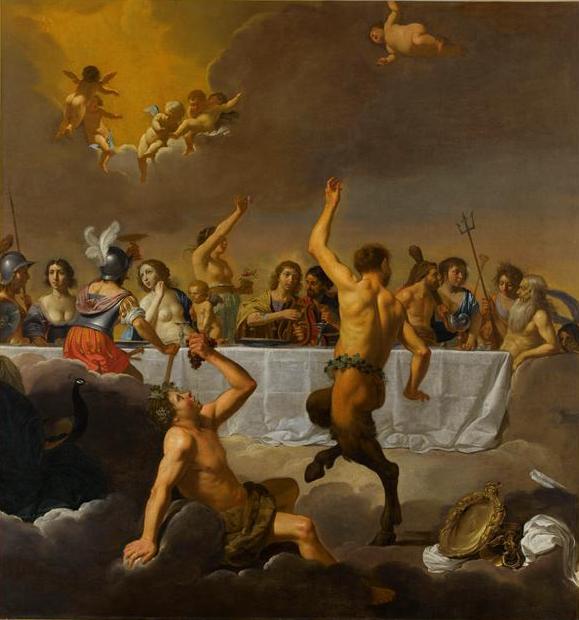
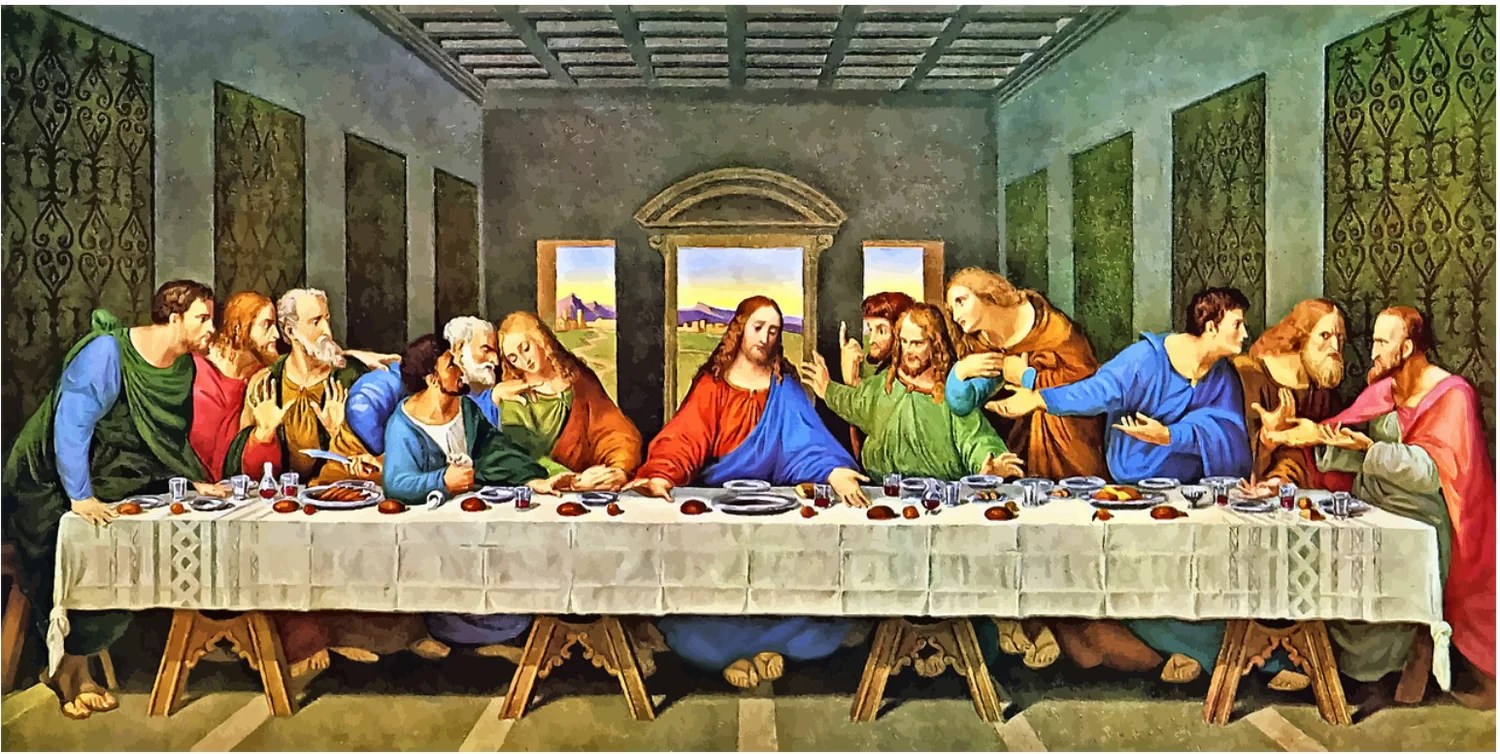
We see more sophistry in the criticisms of the opening ceremony of the Olympics, that the critics are wrong because the subject was not (allegedly) really “The Last Supper” but a representation of the Feast of Dionysus. And upon learning that it was “The Last Supper” after all, the fact they made such a big deal about is ignored or rationalized. Here, the argument aims to correct a factual misunderstanding about the ceremony’s subject matter. But this correction commits the straw man fallacy since the original criticisms concerns broader issues of artistic direction, cultural insensitivity, and political-ideological capture. The straw man fallacy is rampant on the progressive left. By focusing only on an alleged misunderstanding of the subject matter, the rebutter misrepresents the broader concerns expressed, thus attacking a weaker version of the argument and avoiding addressing the actual point. This case also involves a red herring fallacy because the “correction” about the Feast of Dionysus diverts attention from the core criticisms of the ceremony. If the main issues raised by the critics is not addressed by the factual correction, the rebuttal becomes a distraction rather than an actual rebuttal. (Moreover, it’s also paradoxical given that postmodernists argue that the intent of the performance doesn’t matter. What matters is how the audience receives the point. That’s the deal with deconstruction and poststructuralism. The work doesn’t belong to the author. It belongs to the audience.)
Here’s what’s going on. Those who raise these objections support the inclusion of male athletes in girl’s and women’s sports—and in other activities and spaces exclusive to women. They will vote for the political party that develops, interprets, and implements laws and politics that have made this a reality. But they don’t want to say that directly because they have enough awareness to hear how misogynistic that sounds. And that’s because it is misogynistic. So they resort to magical thinking and the art of rhetorical bamboozle. They say that these males as “trans,” as if that changes anything. That’s the alchemy I talk about all the time. It’s the belief that magical incantations change—and that simulations can stand in for—realities. It’s the woke religion’s version of transubstantiation. It confuses simulacra with the things the simulacra attempt to represent. When it is pointed out that what is presented as reality is simulation, they get mad, like the magician whose tricks are exposed—or the faith healer found with a receiver in his ear, his wife in the back with a transmitter and a stack of prayer request cards. The trans activities and their allies will pivot under stress and say that the males are DSD, as if the myth of the gender chimera (the hermaphrodite, which they try to make you stop from saying because it’s insulting even though it doesn’t exist anywhere in mammal world) changes the terms of reality of the gender binary (which is dimorphic and immutable).
The belief that men are women and should be treated as such compromises another political commitment: the profession of women’s rights. To say that males should have access to the gender-exclusive activities and spaces of girls and women is to abandon sex-based rights, the core of the feminism. Since one cannot simultaneously be committed to women’s rights and support the violation of those rights by inclusion of males in women’s activities and spaces, the resort to fallacious reasoning Orwell calls “doublethink,” the attempt to hold two contradictory positions in one’s head simultaneously, becomes required, and is sustained in this case because that’s what the Party and the tribe demand.
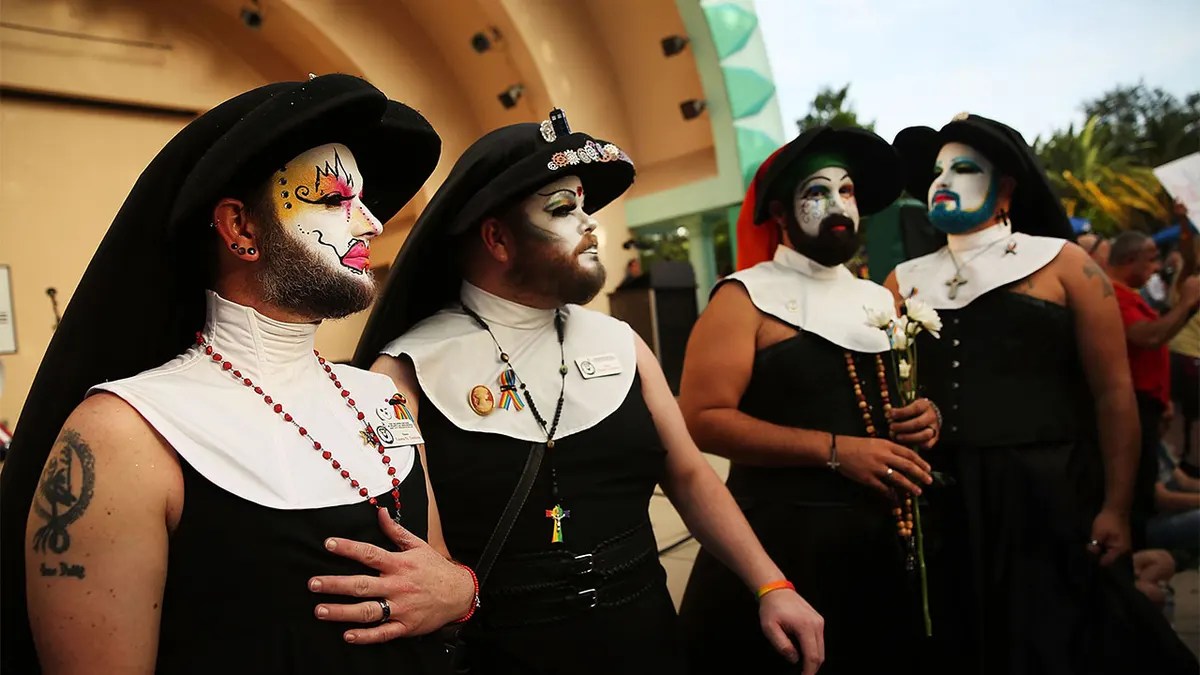
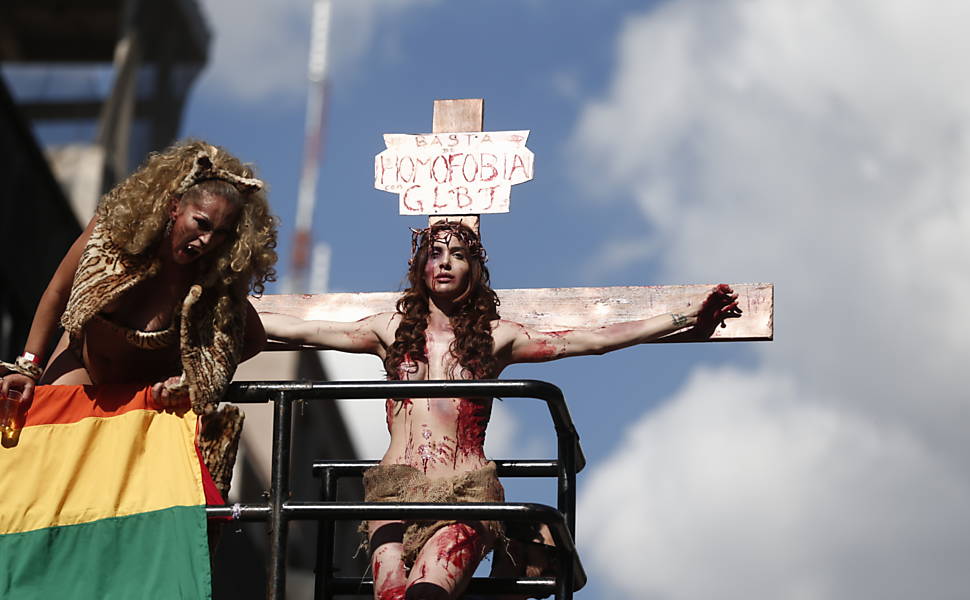
We see the same catalog of informal fallacies in the controversy surrounding the opening ceremonies (see Supper in the Spectacular Café; Apollo is Crucified and Butch Dines on Dionysus; The Paris Olympics and the War on Western Culture). Here, it was obvious that Dionysus made his appearance at “The Last Supper.” Those who say it wasn’t a sendup of da Vinci scene are committing the red herring fallacy because they need to divert attention from the point of the performance: the subversion “The Last Supper” by the introduction of Dionysus, the Greek god of debauchery and transgression, which is central to queer praxis—by its own lights. This is how gay burlesque became coopted by movement acts and emblematic of queer praxis, and why the targets of this praxis are children and their virtue-signaling parents—and why you will be accused of a made-up offense (“transphobia”) if you simply point that out even while they tell you that’s the point of it all. (This ideology is full of made-up words. “Cis gender” is one of the more obnoxious ones. “But, Andy, all words are made up.” yeah, but not all the things they refer are.)
Knowing that the performance was an instantiation of queer praxis, the desire to distract the public from the point of the performance was guaranteed. And because progressives think they’re the smartest people in room (the superciliousness of this bunch is truly obnoxious), they have to condescend to the mouth breathers out in MAGA land by telling them all about the Feast of Dionysus, as if an orgiastic pagan ritual promoting unbridled sexual ecstasy should concern no one. “Oh, Andy, it was so tame.” Of course it was tame. How could it have televised if it planned to go any further? It’s the Olympics, not PornHub. The point is to reach the audience—and then shame them when they predictably react to what is plainly before them. There’s a word for this that I left out of my Facebook post because I am think ice with that censorious organization. That word is grooming.
Perhaps, the ideological capture of our sense making institutions could not be better illustrated that a propaganda piece literally making sex-based rights a Nazi project in the August issue of The Nation asking, “Why There Are No Trans Women Competing at the Paris Games?” Among others, the magazine spoke with Travers (apparently just Travers), an associate professor of sociology at Simon Fraser University, said that, to quote the magazine’s summary of their views (pronouns “them/they”): “the rules governing male and female sports do more than marginalize trans girls and women at all levels of sports, from elementary school to the Olympics. They also feed a far greater right-wing current in the United States and around the world. Trans athletes are their stalking horse, but their goals extend well beyond that.”
“Female eligibility policies delegitimize trans identities, but that’s not all,” Travers told The Nation. “They have also become instruments to mobilize conservative and fascist movements both in the United States and across the globe. This is part of a process where they are using state power to eliminate all obstacles to the operation of racial capitalism and target people who are racialized, poor, disabled, LGBT, and undocumented.” Travers continues: “In the United States, this is taking the form of eliminating legal protections for all marginalized people as well as the transformation of educational institutions to eradicate critical content, the maintenance of horrific border and immigration systems, and the prioritization of the needs of capital over climate change.”
I would ask Travis if the fascists are in their room right now. They are but I don’t want to commit the ad hominem fallacy. Let us just say that what they said is delusional. But, seriously, this is a what passes for a professor as Simon Fraser? (Please don’t write the administration there and complain. Academic freedom is under enough fire without everybody participating in cancel culture. I am not doxxing this person. It’s in the pages of The Nation. And there are several other media outlets pumping out the same garbage.)
I fear that the madness Travis expresses above, to which progressives will nod their heads in agreement, is not something we can deal with on an intellectual basis. How could you persuade somebody who believes so adamantly that female eligibility policies delegitimize trans identities and therefore the norms safeguarding sex-based rights should be dismantled so men who want to be women can trample upon them? If at my worst I expressed similar sentiments (I have an essay coming on my previous beliefs about the matter of gender ideology), the way out for me was not others talking me out my position. I found my way out of the morass by redoubling my efforts at cogitating on the basis of reason, which means that the spark of enlightenment was still burning inside me. As the saying goes, you cannot reason a man out of a position that he did not reason himself into. Moreover, the incentive and disciplinary structures are such that they induce people into believing the most irrational things, which entrenches the problem, since the unreasonable man may never hear the arguments that refute his irrational views—or if he does, either reflex will have him plugging his ears and shutting tight his eyes and chanting the thought-stopping cliches, or he will act in bad faith because of what will happen to him if he doesn’t.
This is a cult, and deprogramming those who have fallen prey to cults cannot occur without violating their cognitive freedom. It’s a real dilemma. We can’t whisk away the folx to remote places and get out their heads what the total institutions of their lives have stuffed into them. We aren’t like them after all. We aren’t authoritarians. But we can retake control over our institutions and leave these people to find hills upon which they can be fools without disturbing the rest of us and trying to get at the little ones. The good news is that this will disorganize their politics and many of them will eventually find their way back into normal society and regain their capacity for reason.
Note: My essay on this nightmare was auto-published this morning. I wrote it yesterday before the matches. I will update when the dirty deeds are done.
“First of all, she’s not really a she. She’s a transgender, post-op person. The operation doesn’t shave down your bone density. It doesn’t change. You look at a man’s hands and you look at a woman’s hands and they’re built different. They’re just thicker, they’re stronger, your wrists are thicker, your elbows are thicker, your joints are thicker. Just the mechanical function of punching, a man can do it much harder than a woman can, period.” —Joe Rogan, 2013
“For the record, I knocked two out [women]. One woman’s skull was fractured, the other not. And just so you know, I enjoyed it. See, I love smacking up TEFS (sic) in the cage who talk transphobic nonsense. It’s bliss!” —Fallon Fox, 2020
No surprise is it. At all 😬 Violent men don't change because they put on make up. #SexMatters#NotOurCrimes
— #WeAreAllDanielBlake KPSS (@KBadlan) June 21, 2022
The 2024 Olympics in Paris have stirred controversy with the inclusion of trans identifying males, or trans women, competing in women’s boxing (Supper in the Spectacular Café). Previously, such athletes were barred from competition under the regulations of the International Boxing Association (IBA), which was responsible for overseeing the sport. However, the International Olympic Committee (IOC) has taken over the process, cutting out the IBA’s control. With the IOC’s decision, trans women, i.e., males, are now allowed to compete against women in boxing events. Their inclusion is determined based on their sex identification on their passport, which includes those who self-identify as such. This move has sparked debates regarding fairness and safety, given the physical advantages that trans women might retain from male puberty, such as greater muscle mass and bone density. Critics argue that these advantages could pose significant risks to female athletes in a contact sport like boxing. As they did in Fallon’s case, supporters of including trans women emphasize the importance of recognizing and respecting gender identity, advocating for equal opportunities for all athletes regardless of their gender identity.
Imane Khelif (welterweight) will compete in the women’s 66kg division
One of these male athletes is Imane Khelif of Algeria (above). He is set to compete in the women’s under 66kg category (welterweight) on Thursday, August 1. The other is Taiwan’s Lin Yu Ting (below). He will compete in the under 57kg division (featherweight) on Friday, August 2. Both boxers were disqualified from the World Championships in New Delhi last year for failing to pass gender eligibility tests. Both tested for XY chromosomes, i.e., they are male. This should be enough to disqualify them from competition. But, as we say Friday night at the opening ceremony, the Olympics have become infected by the woke mind virus.
Lin Yu Ting (featherweight) will compete in the women’s 57kg division
“Everyone competing in the women’s category is complying with the eligibility criteria,” said International Olympic Committee spokesman Mark Adams. “They are women in their passports and it’s stated that is the case, and they are female.” Adams emphasized the “incredibly complex” system that determines eligibility criteria for women’s sports saying, “Everyone would love to have a single answer, yes or no. The federations need to make the rules to make sure there is fairness but also the ability for everyone to take part that wants to.” However, one’s sex determination on a passport in the age of self-identification and abandonment of sex-based rights by many governments around the world is based neither on materialist science nor objective criteria. What is more, many governments are induced to send male athletes to compete in women’s sports because of the prestige associated with accumulating gold medals.
The lure of gold medals has caused governments to do terrible things before. Recall the scandal involving East German athletes during the Cold War, which centered on the widespread use of performance-enhancing drugs, particularly anabolic steroids. This controversy primarily concerned the doping of female athletes. The East German government had orchestrated a state-sponsored doping program, administering steroids and other banned substances to athletes to enhance their performance in both Olympic and other international competitions. The scandal was brought to light after the fall of the Berlin Wall in 1989, revealing that the doping program was more extensive than initially known. Doping impacted multiple Olympic Games, including the 1976 Montreal Olympics, 1980 Moscow Olympics, and the 1984 Los Angeles Olympics, where East German athletes achieved notable successes. The revelation of these practices led to significant debates about fairness in sports, health issues for the athletes involved, and a reevaluation of results.
Kornelia Ender became the first woman swimmer to win four gold medals at a single Olympic Games—all in world record times. It was later revealed that the East German team doctors had been administering steroids to their athletes
Female athletes from other countries had suspicions about the East German doping practices. As East German female athletes dominated many events during the 1980s, competitors from other nations and their coaches began to notice their unusual performances and physical changes. There were growing concerns and whispers about the possibility of doping, particularly because East German female athletes exhibited pronounced muscle development and physical characteristics that seemed atypical for women athletes at the time. Many people could see what they saw, even if they didn’t speak up. These suspicions were compounded by the fact that the East German sports program was known for its secretive nature. After the fall of the Berlin Wall, investigations and testimonies from former athletes and officials exposed the extent of the doping regime, validating the concerns raised by their international counterparts.
The East German doping scandal remains one of the most significant cases of state-sponsored cheating in Olympic history. Likewise, the current decision allowing males to compete against women, with males enjoying natural advantages even greater that the drug enhanced East German female athletes, has sparked a significant debate about the balance between inclusivity and fairness in sports. We should use the word cheating here just as we did in the case of East German female athletes. The alleged complexities of navigating gender identity within competitive athletics present a different problem only in the sense just mentioned, namely the advantages that trans-identifying males have over female athletes due to innate physiological differences. Whereas steroids masculinized female athletes after puberty, the fact of being male provides advantages over women way beyond the benefit of steroids. There is no navigating this. The bridge should be condemned and closed.
I argue that prioritizing inclusivity over fairness diminishes fairness and objectively endanger women by allowing athletes with male physiological advantages to compete against those without them. This undermines the principles of competition, which are based on providing a level playing field for all participants. Prioritizing fairness over inclusion not only honors traditional sex-based rights but also aligns with the core principles of competitive sports, ensuring that all athletes have an equal opportunity to succeed based on their abilities and training rather than inherent grouped physical advantages. We’re told that balancing these considerations requires careful thought and a nuanced approach to policy-making in the realm of athletics, but it may be the case that the issue is one-sided. Indeed, when one steps into the boxing ring, one is not competing against a self-identification but against a concrete individual whose advantages are determined by his objective sexual identity. (See Decoding Progressive Newspeak: Equity and the Doctrine of Inclusion.)
The question of whether self-identification trumps objective reality or that decisions about competitive sports are grounded in the facts of natural history has implications well beyond the question of men in women’s sports. Here we encounter the opposition between idealism and materialism. Idealism posits that beliefs and personal perceptions shape reality, allowing individuals to define their identities based on subjective feelings. This perspective holds that one’s internal sense of self can determine their gender, regardless of biological or physiological characteristics. Materialism, on the other hand, asserts that reality is grounded in objective, observable facts. According to this view, gender and sex are determined by physical attributes such as chromosomes, reproductive anatomy, and secondary sexual characteristics (not simulated). The materialist perspective maintains that these biological factors are the basis for categorizing individuals as male or female, and self-identification cannot alter these inherent characteristics. This fundamental question underpins much of the contemporary debate on gender identity, with significant implications for individual rights, legal frameworks, and societal norms. I want the reader to know that I come down resolutely on the side of scientific materialism.
If we accept that gender and sex are different things, which is the central doctrine of queer theory (which is not a theory in the scientific sense), and sex refers to the physical anthropological differences between female and male, we now have the task of determining what we mean by gender. For centuries, gender and sex have been synonyms, meaning that gender also referred to the physical anthropological differences between female and male, determinable primarily by gamete size, but also chromosomes and reproductive anatomy. Historically, a woman was scientifically defined as an adult female human and a man as an adult male human. Gender was binary and immutable, and social institutions were organized around this fact. In the drive to equality with the emergence of modernity, society came to recognize that sex differences were so profound that equitable ends required the recognition of sex-based rights. This recognition is manifest in sex-segregated activities and spaces, sports being one of them. (See (see The Pelvis Tells the Story: Archeology and Physical Anthropology are Most Unkind; Bubbles and Realities: How Ubiquitous is Gender Ideology?Separating Sex and Gender in Language Works Against Reason and Science; Scientific Materialism and the Necessity of Noncircular Conceptual Definitions; The Science™ and its Devotees.)
If one drops the term “role” from gender, what is gender if not sex? This is a significant problem for those seeking to escape the constraints of material reality. If you pay attention, you will see that gender is often used in place of gender role (it is useful to point that out in conversation). At the end of the 1960s, psychiatrists paired gender with the concept of identity and constructed a new term: gender identity. Normally, identity would be what the thing is, i.e., the thing in itself, so one’s gender would again be determinable by morphological and physiological differences and reproductive roles. However, psychiatrists changed the meaning of identity to refer to what the thing thinks it is, independent of what it really is, thus making it a subjective matter. Because it is subjective, the male sex can think he is the female gender, in which case the male “identifies” as a woman and he expects those around him to also identify him as such. If the subjective definition of identity replaces the materialist definition, and idealism is privileged over objective reality, then a man becomes a woman according to the queer definition of gender, hence the slogan “Trans women are women.”
All this depends on accepting idealism and rejecting materialism and objective reality. If a man can be a woman because he thinks of himself that way, but objectively he remains male by materialist standards, then materialism has been subordinated to feeling, which is subject to the problem of delusion. In other words, whatever the belief, it becomes a reality possessed by only one person, and those around him must take his word for it (consider the problem of alien abduction or commune with angels). The observer will have to accept as true whatever the subject tells him without objective confirmation or verification of the truth of his claim. In other words, those around the man will have to affirm his self-identification or self-report on faith (or at least bad faith). This reliance on faith belief renders the proposition non-falsifiable. However, under the original meaning of gender, the question of a person’s gender is a verifiable fact, confirmed by an examination, which would rarely be wrong, and verification would rarely need to be performed since it would, in the vast majority of cases, be determined (not assigned) at birth.
Even if we accept the queer theoretical terms but do not abandon science altogether, the problem of sex differences remains. To be sure, there is a push to make these arbitrary and subjective, as well, as seen in the practice of changing sex on birth certificates by governments that have abandoned sex-based rights. For postmodernists, science is one of the grand narratives that carries authority only because we believe it does; the categories of the natural sciences are as socially construct as those of literary traditions and the social sciences. Postmodernism of which queer theory is a branch, collapse ontology into epistemology and then pluralize the latter (which is why there are an infinite number of genders). But suppose we compromise and agree to differentiate between gender as defined in queer theory and sex as defined in science. In this scenario, sex-based rights would continue to exist because they are based on the objective of sexual dimorphism. A man would be permitted to “identity” as a woman, but he would not be able to participate as one in sex-segregated activities and spaces. I recognize this is an unacceptable compromise from the standpoint of trans activism. But what about for rest of us?
Assuming the rest of us find value in materialism, let’s turn to the science. From a physical anthropological perspective, sexual dimorphism in humans, the facts of which are empirical and verifiable, reveals significant differences in cognitive and emotional function, connective tissue, musculature, skeletal structure, and other physical attributes between males and females. Physiologically, males tend to have greater muscle mass and a higher percentage of lean body tissue compared to females, who generally have a higher percentage of body fat. This difference in musculature is evident in attributes like upper body strength and punching power, where males typically outperform females. The enhanced musculature in males is linked to higher levels of testosterone, which promotes muscle growth and strength. However, the differences are not reducible to testosterone. Skeletal differences between males and females are pronounced. Males usually have larger and denser bones, contributing to greater overall body strength and support for larger muscles. The male pelvis is narrower and more robust, designed to support heavier loads and facilitate bipedal locomotion. In contrast, the female pelvis is wider and more adapted for childbirth. The center of gravity is different. Facial structural differences are another area of sexual dimorphism, with males generally exhibiting more pronounced brow ridges, a squarer jawline, and larger cheekbones. Again, these features are thought to be associated with greater levels of testosterone during puberty, which influence bone growth and facial morphology.
What explains the profound objective differences between men and women which has since time memorial determined and shaped their social roles and led to the development of sex-segregated activities and spaces, as well as safeguarding norms? We do have the answer to this question. The theory that males engaged in combat and other strenuous physical activities explains many of these differences. Evolutionary pressures favored males who could effectively engage in combat, hunt, and protect the group. This need for physical prowess drove the development of stronger muscles, denser bones, and greater overall strength. The idea that dietary habits alone account for these differences has been largely debunked, with evidence strongly supporting the role of evolutionary pressures related to physical competition and survival.
Although there are adaptive advantages to sexual dimorphism, there are other effects that can be deleterious if not controlled and steered in the proper way. Male violence, including against women, is an important aspect of understanding human sexual dimorphism. Historically, males have been more prone to aggression and violent behavior, which can be linked to the evolutionary need for males to compete for mates, resources, and social status. This aggression is evident in the higher rates of violent crime committed by males compared to females. Violence against women, in particular, can be understood through the lens of evolutionary psychology, where control over female reproduction and dominance may have been historically advantageous for males. It’s essential to recognize that while these behaviors may have roots in evolutionary history, they are not justifiable and are influenced by cultural and social factors in contemporary society. Addressing male violence requires a nuanced understanding of both biological predispositions and the impact of societal norms and values.
Misogyny is the ingrained disdain, hatred, loathing, and prejudice towards women, manifesting in various forms including belittlement, discrimination, and violence. Misogyny is embedded in cultural, organizational, institutional, and social frameworks, perpetuating gender inequality and hindering women’s opportunities and limiting their rights. Misogyny can be overt, such as in derogatory language and physical abuse, or subtle, such as in workplace biases and societal expectations that limit women’s roles and contributions. This pervasive bias not only harms individual women but also undermines the fabric of a just and equitable society by sustaining power imbalances and stifling self-actualization, the full development of the personality. This is why just societies recognize sex-based rights and establish sex-segregated activities and spaces.
This weekend, the whole world will see misogyny in its most overt manifestation when male athletes will enter the squared circle and batter women about the head and body. They will see this because leading organizations and major institutions have accepted the fiction that gender is self-identified and that self-identification trumps the objective science of physical anthropology. Everybody who allows this—and supports it—participates in misogyny. This is what queer praxis seeks, among other things, the elimination of sex-based rights and the erasure of principle of equity with respect to gender. The fact that it is actually happening tells us that postmodernism has won over the institutions of society. Modernity has been replaced by atavisms and perversions. Woke progressivism is an authoritarian and regressive project, a neoreligion that eschews whatever good could be found in the old religion. A neoreligion that, in canceling the Enlightenment, portends a New Dark Ages.
* * *
What about this hackneyed straw man concerning genital policing? I’m 62 years old, and in those many years, I have never seen nor had it suggested to me that we police each other’s genitals in daily life. Stating that men shouldn’t trespass upon women’s activities and spaces is certainly not a call for genital policing. Indeed, genital policing is generally unnecessary for two reasons.
First, since for nearly everybody in the modern period, gender is documented on a birth certificate, which carries over to driver’s licenses, passports, etc., with the expectation that individuals are for the most part decent human beings who will respect the dignity and safety of girls and women and thus observe the norms that safeguard them. All we need to ensure is that governments don’t abandon sex-based rights and arbitrarily change sex identification on birth certificates, drivers licenses, passports, etc. To be sure, men will still use deceptive mimicry to enter spaces exclusive to girls and women, but one need not check their genitals to enforce sex-based rules. As for the Olympics, we see that how gender is sorted for sex-based competition is, per the current rule, what is listed on the passport. Even if this system had not become corrupted by ideology and politics, we might still need to test athlete to determine their gender because they may be lying for the same reason we test for steroids, etc.
As implied in Neutralizing the Gender-Detection Brain Module, I suspect we are seeing in the younger generation a gradual diminishment of the gender detection facility due to early and intentional disruption of its developmental unfolding, which is a goal of educational and mass media programming around the false distinction between sex and gender delineated by the pseudoscience of gender identity. But, for now, most women know when a man is in their space. Tragically, because of the more subtle impositions of misogyny, most women don’t speak up for fear of retaliation or shaming. This explains why most women do not speak up when those who are supposed to safeguard them put them dangerous activities and spaces with men.
Two days ago, MSNBC columnist Anthea Butler wrote about “the ridiculous moral panic over the Olympics’ opening ceremony.” She should have waited a day. Yesterday, The New York Postconfirmed what I knew all along: “A Paris 2024 Olympics spokesperson admitted the controversial drag show version of ‘The Last Supper’ seen in Friday’s opening ceremony was indeed inspired by the iconic da Vinci mural—despite attempting to vehemently deny it following fierce backlash.”That’s right, they threw Jolly under the bus. They knew he was lying and they didn’t want to caught up in a scandal. Too many people knew. And they liked the performance and its purpose. Remember, they said mission accomplished.
The Wrapconfirmed the statement from Paris 2024 producers that it was in fact inspired by Da Vinci’s famous painting. “For the ‘Festivities’ segment, Thomas Jolly took inspiration from Leonardo da Vinci’s famous painting to create the setting.” The producers said in the statement, “Clearly, there was never an intention to show disrespect towards any religious group or belief.” And then the rationalization used by many before switching to the Feast of Dionysus ruse: “He is not the first artist to make a reference to what is a world-famous work of art. From Andy Warhol to The Simpsons, many have done it before him.”
Acts of irreligious criticism don’t need to point to the myriad other acts of irreligious criticism to justify themselves. France is a free society. As I said yesterday, just stand by the product. Don’t lie, rationalize, and gaslight. I didn’t need confirmation (see my earlier essay Apollo is Crucified and Butch Dines on Dionysus; see also The Paris Olympics and the War on Western Culture). I have eyes in my head and a depth understanding of mythology, Christianity iconography, and postmodernist thought and praxis. Apparently others don’t and are well rehearsed to add two and two and come up with five (they are obedient to the Party). I hope they’re prepared to accept the producers’ confession, but I doubt many will be. Like Butler, they went all in on conservative bashing. They embarrassed themselves.
I keep getting a version of the question. “Why do you care so much?” As I explained yesterday, I care so much because I reject lies and rationalizations and refuse to be gaslit by the ideologically bamboozled and blinkered. It moves me to social critique because the intent to deceive is sociopathic. I’m a criminologist. I have that kind of mind. As I have always understood it, my profession of sociology calls on its practitioners to expose the pathologies of the Power Elite (see C. Wright Mills’ 1956 The Power Elite and his 1959 The Sociological Imagination for guidance). This Olympic thing from the beginning has been a clinic in lies, rationalizations, and gaslighting—all to push an agenda with totalitarian ambitions. The media and your Democrat fiends have been telling you that you did not see what you saw. Christians, recall the kings and prophets who do not see what you see (Luke 10:24, Matthew 13:17)—until you allow yourself to be blinded by ideology and partisan loyalty. I’m not a Christian, but this is one of the best pieces of advice the New Testament has to offer. (I will have more negative things to say about Christian doctrine in my Sunday Sermon.)
Opening night at the 2024 Paris Olympics.
Friday night could not have provided a better example of what I have been arguing for years now on Freedom and Reason. But this not merely about me being right. It’s about the seriousness of the moment, and the fact that this imperial ideology has men punching women in the face at the Olympics for the first time in the history of the Games couldn’t punctuate more loudly the seriousness of the moment. Hearing the denials of its significance by those around you is further confirmation of the dire circumstances in which we find ourselves. Don’t let them shame you into doubting your judgment.
The misogynistic spectacle celebrating male battering of women is scheduled for this Friday and Saturday. I discuss the matter in depth tomorrow. But I wonder if the producers will actually air the bouts? I’m struggling over whether to watch women being pummeled by men with female passports. I have seen one of the men (Imane Khelif) assaulting a woman at a 2022 Golden Belt Series bout and it sickened me (I am sharing it below). The look on the woman’s face when she realizes she didn’t stand a chance haunts me. The man appears to carry her to humiliate her. For those who don’t know boxing, carrying a fighter means allowing them to finish the fight when the other fighter could stop this opponent any time he wanted. In this case, probably not because the man feels bad, but to downplay the reality that men really do have natural physical attributes that give them a decisive competitive advantage. If he felt bad he wouldn’t be in the ring with her in the first place. Seeing her congratulate him on his win looks like the work of internalized woke scolding.
The social theorist in me always asks, what cultural critic and social theorist could best help me negotiate the terrain here? I can think of five off the top of my head, most immediately George Orwell, but I have given readers enough Orwell lately. The French Marxist Guy Debord, best known for his 1967 The Society of the Spectacle next comes to mind. Debord critiques the pervasive nature of modern capitalist society, which he argues has transformed human interactions and relations into commodities and superficial representations. According to Debord, the “spectacle” refers to the dominance of appearances in society, where social life is mediated by consumer culture and mass media, leading to an alienated and passive populace. The spectacle perpetuates a false reality that obscures the true conditions of existence, reinforcing the power structures of capitalism and alienating individuals from authentic social connections and self-awareness. These circumstances rob people of their agency and capacity to think deeply about the world around them.
A Debordian analysis of the opening ceremony of the 2024 Paris Olympics would emphasize the point that the ceremony, with its grand displays and global media coverage, serves as a quintessential spectacle that transforms the authentic cultural and human elements of the Olympics into commodified images for mass consumption. The function of ceremony, in Debord’s view, would be to reinforce dominant and emerging capitalist ideologies by promoting consumerism and corporate sponsorship. The highly choreographed and visually stunning event, whatever its artistic merit (in this case not a lot for the segment in question), would function to mask underlying social realities, such as the exploitation of human labor and of vulnerable minorities. Ultimately, Debord would see the opening ceremony as a means of perpetuating the illusion of consensus and progress, while obscuring the deeper divisions and inequalities within society. The popular reaction tells us that the spectacle failed spectacularly. That’s good news.
However, Debord does not speak to the transgressive element. This is the moment that prepares the stage for misogyny in the squared circle this weekend. For an analysis focused on that, that is, the spectacle aimed at undermining common sense understandings to prepare the masses to accept a new and inorganic common sense, one might turn to the works of Antonio Gramsci, Herbert Marcuse, and Michel Foucault. Gramsci’s concept of cultural hegemony explores how dominant groups use cultural institutions to maintain power and how counter-hegemonic ideas can challenge and change societal norms and values (I have written quite a lot about Gramsci of late, so I will leave it there). Marcuse, a member of the Frankfurt School who bridges critical theory and postmodernism (which is not a kind thing to say from my perspective, although I am being charitable), examines how advanced industrial societies manipulate consciousness and integrate individuals into the system, particularly through the co-optation of transgressive elements in culture and art. See his books Eros and Civilization and One-Dimensional Man for more. Perhaps in the future I will critique Marcuse’s work. I have already critiqued him for his authoritarian position on free speech and the corruption of critical theory (see The Noisy and Destructive Children of Herbert Marcuse). The French philosopher Michel Foucault’s analysis of discourse, power, and and knowledge reveals how societal norms are constructed and maintained, offering insights into how spectacles are used to shape thought and control populations by shifting perceptions and understandings. Widely recognizes as the “father of queer theory,” Foucault is arguably the figure most responsible for the nihilistic direction of latter poststructuralism. I am preparing a major piece on queer theory, so I will leave my analysis of Foucault to the future.
These thinkers provide frameworks for understanding the menu at the Spectacular Café, its various appetizers designed to challenge existing norms and prepare the masses for the main course, novel dishes whipped up from old ways of thinking and organizing society. Upon inspection, the café serves nothing but bad food. The ingredients are subpar, the dishes are poorly prepared, and the hygiene standards are questionable at best. Despite numerous complaints from patrons who fall ill after dining there, the café remains open. The reason? The government, which should be responsible for ensuring public health and safety, is either indifferent or complicit. Perhaps the café owner has influential friends in high places, or maybe the bureaucracy is so sluggish and corrupt that no action is ever taken. In any case, the food there is tainted and it will make you sick.
“[This] deeply secular postmodern society knows who its enemy is, they are naming it, and we should believe them.” —Bishop Robert Barron, Diocese of Winona-Rochester, Minnesota
“In France, we are republic, we have the right to love whom we want, we have the right not to be worshippers, we have a lot of rights in France, and this is what I wanted to convey.”—Artistic director Thomas Jolly.
Why would Thomas Jolly say that initially if this performance were something other than what the world immediately understood it to be? Right not to be worshippers of what exactly? Nobody worships Greek gods anymore. Right to dissent from ancient pagan religions? Why would that be noteworthy? What he meant was that he is not bound by the blasphemy rules of Christianity. I agree with him. France has religious liberty. And should. But if this were about the Feast of Dionysus, Jolly would have said so then rather than saying so after the controversy had legs. The Greek pantheon is an ad hoc rationalization. If this were a depiction of the pantheon, where is Poseidon’s trident? Why would any director miss out on a prop that would clearly convey the meaning?
The halo and heart gesture are unmistakable
You can see in the picture I have provided that Barbara Butch is performing the iconic Sacred Heart Jesus. This is so the identity would be unmistakable to the audience. The composition apes da Vinci’s work, albeit many of the dancers are jockeying for camera time and disrupt the symmetry. Dionysus, the god of chaos, debauchery, and ecstasy, does make an appearance. He is the disruptive force inserted into the scene. That’s the political point of the performance: to juxtapose Christian super/ego rigidity with the pagan id, i.e.,the pleasure principle, the unbridled Eros. It was a transgressive action by a queer artistic director. He denies that he was being subversive, but the method behind a piece like this is to deconstruct traditional norms and values through subversive imagery and revel in the libertine. Hedonism is typical of these expressions, which is why Dionysus is fetishized.
The most significant part of the opening ceremony of the 2024 Paris Olympics, I recently told a Facebook group, is when, instead of the self-described “love activist,” Butch and her apostles feasting on the body of Apollo, the Greek god of sun, light, healing, music, poetry, and prophecy, they were instead served the living body of Dionysus, aka Bacchus, the god of wine, fertility (odd choice there), ecstasy, and theater. Apollo, who represents harmony, order, and reason was a no show. He was held up at his crucifixion. Instead the world got the god of frenzied dance and rituals bent on breaking down the barriers of individuality and transgress social norms. Was this the Feast of Dionysus, also known as the Dionysia, occurring around the same time in the calendar year as the currently enacted Feast of the Sacred Heart in Christian practice? Or was this “The Last Supper”? (The video has since been deleted according to Breitbart.)
I missed Poseidon’s trident at the opening ceremony. Who’d forget such a tell? Other tells were conspicuously absent. Hephaestus’ hammer would have been nice. Zeus and his thunderbolts.
Whether this was the Dionysia, the Feast of the Sacred Heart, or the Last Supper, it was the perfect choice given the politics projected by performance and the justification given by those who put on the performance. In gender ideology, there is a praxis known as “queering” the situation or space. A key part of queering activities, situations, and spaces is to subvert traditional religious beliefs and practices, as well as Enlightenment values, and substitute for them debauchery and nihilism. We see this in the example of the Sisters of Perpetual Indulgence (SPI), also called Order of Perpetual Indulgence (OPI), a street performance protest movement that uses drag and Christian religious imagery to problematize moral thinking around issues of gender (recall the 2023 Los Angeles Dodgers scandal). We saw the same thing in Paris, Butch’s Sacred Heart Jesus made obvious by the inclusion of halo pressed onto her head and flashing the heart gesture (see above).
The Los Angeles chapter of the Sisters of Perpetual Indulgence (SPI)
So it was a send up of the Last Supper and the Christian ritual period surrounding the passion and crucifixion of the Christ. It seemed immediately obvious to me. But perhaps you have to grasp both postmodernist politics and study of mythology to see it for what it was (you don’t). To be sure, at a vulgar level, the purpose of the performance explained itself. Especially when a man in black with his testicles hanging out of shorts rubbed up against the child near the “love activist.” But denials in the aftermath, including from Jolly himself, require that we make it clear the significance of the imagery and the intent of the performance we can infer from that. Jolly and others are lying about the work.
A female Jesus nailed to the LGBT cross
Before moving to my analysis, I wish to say a few things about Christianity and the double standard surrounding irreligion criticism and parody. I’d like the reader to imagine the Games had presented a sendup of Muhammad on his winged horse. There was a ghostly mechanical horse gliding across the Seine River. Viewers were told that it was not Death on that pale horse, but Sequana, the Goddess of the Seine River (previous depictions of Sequana show her rowing a boat). But suppose Allah’s prophet were upon that horse instead. There’d be blood on the streets of Paris and likely in a lot of other major European cities. Christians are a super tolerant bunch. Nietzsche went hard on them for that. I won’t, though.
It’s not that I am too troubled by irreligious criticism, parody, even ridicule. I’m an atheist. I’ve never laughed as hard as I laughed during Monty Python’s The Life of Brian (except for two scenes in Something About Mary that almost gave me an abdominal hernia). The problem is not the mocking of religion per se but the political-ideological purpose of the performance. Queer activists used the mega platform of the Olympics to push an ideology that is destructive to sound family systems and the safeguarding norms governing the relations between adults and children. More broadly, the figure of Dionysus, rather than that of Apollo, represented the postmodernist assault on modernity. Butch’s Jesus looked favorably upon Dionysus. World Apollo?
As I noted in The Paris Olympics and the War on Western Culture: Preparing the Masses for the New World Order, this isn’t the first time the Olympics have been used to propagandize a captivated audience (there, I discuss the Berlin Olympics in 1936). This is an agenda, plain for the world to see, one with a very long history, and it’s what we should be talking about. Instead, we’re talking exclusively about whether we saw what we saw and whether what we saw was offensive to (at least some of) the 2.4 billion Christians around the world, many of whom are in peril in the Islamic world and living the sphere of the CCP. Not that we shouldn’t be concerned about that. This wasn’t playful. And the Games added insult to injury by apologizing not for having offended Christians but for Christians having taken offense (not a subtle slight if you get the difference). The Games also declared: mission accomplished. So they weren’t really sorry.
Western civilization, with its once mighty pillars of progress, order, and reason, finds itself adrift in a sea of trepidation—and nihilism. This crisis of legitimacy, which I have been documenting on the pages of Freedom and Reason for many years now, is not merely an economic or political phenomenon but a profound cultural crisis steeped in existential malaise. It is a spiritual crisis (you can take that as literal or figurative). The Olympics have given us cause to revisit the ancient duality of Apollo and Dionysus, as these two encapsulate the eternal struggle between chaos and order, passion and reason, dissolution and structure, to elucidate the problem. The Dionysian elements in postmodernist thought and anti-humanist culture has played a significant role in the situation in which the West finds itself by challenging the foundations of Western civilization and paving the way for a nihilistic ethos. Even if the opening ceremony really has been about Dionysus, as Jolly insisted two days later after receiving an outpouring of hate and ridicule, the purpose would be the same.
I cannot work with this subject without acknowledging Friedrich Nietzsche’s analysis of the Apollonian and Dionysian, primarily presented in his work The Birth of Tragedy, wherein he explores the duality of human nature and art through these two contrasting concepts. For Nietzsche, the Apollonian represents individuality, logic, and order, the personification of these the Greek god Apollo, symbolizing rationality and structured beauty. In contrast, the Dionysian embodies chaos, emotion, and ecstasy, reflecting the instinctual and primal aspects of life. Nietzsche argued that the fusion of these forces in Greek tragedy created a profound aesthetic experience, with the Apollonian providing form and the Dionysian offering emotional depth. This dynamic interplay is essential for the creation of authentic art and understanding the complexities of human existence.
But that is not how the transgressors view the matter. In postmodernist thought, the dialectic of Nietzsche’s Dionysian and Apollonian elements is viewed through a lens of deconstruction and relativism. Unlike Nietzsche’s idea of a productive tension between these forces, postmodernism interprets this duality as a situation where one side’s dominance leads to the negation or cancellation of the other. And the postmodernists have picked their side. In the darkness of postmodernist nihilism, which pushes the idea that traditional norms and values lack inherent meaning, are confining and limiting, and therefore worthy of overthrowing, the cancellation of one force by the other is the natural outcome of the collapse of absolute truth and inherent value—and where nature takes too long, transgressive action accelerates the collapse. Instead of lamenting the loss of reason, postmodernist view its collapse as an opportunity for the creation of new possibilities; the absence of fixed structures or definitive resolutions is a space for ongoing reinterpretation and individual creativity, which comprise a gloss for the anarchist desire for no boundaries or rules.
The loss of the Apollonian is the loss of the Enlightenment. Apollo, the god of harmony, light, and reason represents the Apollonian spirit that has traditionally underpinned Western civilization. It is through Apollo that humans seek knowledge, impose a structure on the world, and aspire to ideals of beauty and order. This Apollonian drive has manifested in the great achievements of arts, philosophy and science embodying the Western quest for meaning and truth. Dionysus, in contrast, is the god of ecstasy and unbridled passion—of debauchery. The Dionysian spirit embraces chaos, dissolution, and the irrational aspects of human nature, as well as in social relations. It celebrates the emotive, the instinctual, the primal, often in direct opposition to the Apollonian pursuit of order and reason.
The Dionysian impulse leans into the inherent chaos and unpredictability of existence and suggests itself not merely as a counterbalance to the alleged rigidity of Apollonian ideals, but to the overthrow of structure—that is, it is poststructuralist. So whether it was a sendup of da Vinci’s “Last Supper” or the Dionysia, Jolly chose the body of Dionysus for the drag queens and trans-identifying to feast upon—in the presence of children while the world watched.
The crisis of legitimacy in Western civilization stems impart from a disillusionment with the Apollonian project, a disillusionment organized by the transgressive forces of the corporate state in the context of late capitalism. The Enlightenment promise of progress through reason and science in the context of corporate statism has given way to a deep skepticism about the foundations of knowledge and truth. To be sure, the skepticism is not entirely unfounded, as the excesses of rationalism and technocratic governance have often led to alienation, environmental destruction, and social fragmentation (see Marx and Weber). But this is not an indictment of the idea of modernity, only its corruption by corporate power. In this vacuum, the Dionysian forces emerge with gusto. Postmodernist thought, with its radical deconstruction of grand narratives, epitomizes this development. It challenges the Apollonian ideals of objective knowledge, stable identities, and universal values. Postmodernism revels in the fluidity of meaning, the plurality of perspectives, and the celebration of the marginalized and the fragmented. It thrives on chaos. But people seek order in the whirlwind.
I can’t leave the subject without touching on Sigmund Freud’s psychoanalytic theory concerning the internal tension between order and chaos within the human psyche. For Freud, the instinctual, primal part of the psyche, the Es, or “it,” is driven by the “pleasure principle.” It embodies chaotic and uncontrolled desires, seeking immediate gratification without regard for societal norms or reality. This component of the psyche is analogous to the concept of chaos, as it operates from basic impulses and drives that can disrupt a person’s sense of order. It contains in it two forces, each named after a Greek deity. Thanatos is the “death drive,” the instinctual tendency for aggression, destruction, and a return to an inorganic state. Eros is the life drive or libido, the instinctual tendency towards life, love, and self-preservation. It includes nurturing and sexual instincts, fundamental to the pursuit of pleasure and the formation of relationships.
Thanatos and Eros exist in the psyche as a dynamic tension that requires a control structure. In the well-adjusted person, the Es is governed by the Ich, the “I” or “ego,” which functions as a rational mediator between the demands of the Es and the constraints of the external world and social environment. The ego operates on the “reality principle,” striving to satisfy the Es’ desires in a manner that is socially acceptable and practical. The ego’s role is to manage and balance these conflicting forces, akin to the principle of order, by employing judgment, planning, and problem-solving to navigate life’s complexities. Later, Freud added the idea of the Über-Ich, the “over-I” or “superego,” which imposes a sense of order by regulating behavior through conscience, ensuring that actions align with accepted norms and values. This aspect of the psyche reinforces order by counteracting the Es’ impulses and guiding the ego in maintaining ethical and societal compliance.
The postmodernist and nihilistic push to transgress social norms and boundaries is a project to dismantle the superego’s moral constraints and distort the ego’s regulatory functions. By embracing radical individual freedom challenging traditional values, this movement often seeks to strip away the superego’s role in enforcing societal standards, thereby enabling the ego to prioritize unrestrained gratification of the id’s primal urges. This produces the libertine, who is characterized by a lack of moral restraint, especially in matters of personal behavior and sexuality. The libertine rejects conventional moral and social norms in favor of pursuing personal pleasure and freedom without regard for ethical or societal constraints. Libertinism is marked by an indulgence in hedonistic pleasures and a disregard for traditional values related to morality and propriety.
With the erosion of normative boundaries and the destabilization of the superego, the ego becomes increasingly driven by the most destructive aspects of the pleasure principle, leading to harmful consequences for both individuals and society. The causa sui of the queer project is nihilism.
Postmodernism’s critique of metanarratives claims to have exposed an arbitrariness in our cultural and intellectual constructs. However, in making this claim, it undermines the possibility of constructing new, coherent systems of meaning. The relentless deconstruction of norms, values, and truth leaves those enacting the rituals in a state of nihilism, where nothing is certain, and all is relative. This nihilistic turn is particularly evident in contemporary culture and praxis. Art and literature have become exercises in irony and pastiche, devoid of sincere engagement with the human condition, which the opening ceremony of the Games demonstrates in spades; people are still arguing about what it was, but whatever it was it was complete shite artistically. The aesthetic was crude and obnoxious. It was an instantiation of a politics that has devolved into vulgar spectacle, where power, unmoored from any substantive vision of the common good, is sought for self-aggrandizement, the social fabric fraying as communities splinter into isolated and antagonistic identities, each claiming its own truth and rejecting any notion of a shared reality. None of this is accidental. Nihilism is an instrument of control.
* * *
I now want to attempt—in vain I am sure, since the indoctrinated see what they want to see and not what they see (Matthew 13:17)—to put to rest the desperate rationalization that what we witnessed this Friday was anything other than the mocking of “The Last Supper,” the celebrated fifteenth century painting by Leonardo da Vinci, used on Friday as a backdrop to the celebration of Dionysus. Significantly, the painting is in the Convent of Santa Maria delle Grazie in Milan, Italy. It was commissioned by Ludovico Sforza, the Duke of Milan, as part of the renovations to the convent’s refectory (or dining hall). It is a religious work that carries great meaning for both the faithful and the secular humanist. As a child, among my many idols (Copernicus, Darwin, Einstein, Galileo, Marx, Newton) there was de Vinci. Like him, I had an early interest in anatomy, and I was left-handed—and wrote backwards. My identification with him led me to study his works and his biography. Like the names of all the dinosaurs and NASA programs, I knew da Vinci front to back. The “Last Supper” fascinated me even though I have never heard the call of the divine.
The “Last Supper” depicts the moment Jesus announces that one of his disciples will betray him. Leonardo’s composition captures the dramatic reactions of the disciples to this news, each responding in a unique way. This creates a powerful narrative with emotional intensity. The symmetry of the array of reaction is crucial to the piece. Jesus is at the center, forming a calm and balanced focal point, while the disciples are grouped in threes, a dynamic and religiously salient arrangement of figures (you will note the pattern in the images from the opening ceremony). Leonardo’s mastery of linear perspective creates a sense of depth, drawing the viewer’s eye to the center (how could it be otherwise). The use of light and shadow enhances the three-dimensionality of the figures. It’s a work that defies but a glance. It invites the observer to dwell in the moment and contemplate its significance.
Did da Vinci draw inspiration from the Greek myth of Dionysus as some have suggested? Typical of the man, his process for creating “The Last Supper” involved meticulous study and preparation, so we have a record of the thought and process. Da Vinci is legendary for his extensive use of live models and cadavers, which helped him capture realistic human expressions and movements (he did the same with horses). He spent hours observing and sketching people to understand their gestures, facial expressions, and physical forms. He would often roam the streets of Milan, studying people and making detailed drawings in his notebooks. He would attend public executions to capture tortured bodies and the end of life. Those around him looked upon him with suspicion—his morbid interests and left handedness and all. This practice allowed him to create highly realistic and dynamic figures in his paintings. His knowledge of anatomy rivaled the physicians of his time. When I was a child, my parents bought me a reproduction of one of his sketch books. I would study it for hours.
What I am saying is that if da Vinci was importing Greek mythology, we would very likely know about it. There is no evidence that Leonardo da Vinci was inspired by the myth of Dionysus in the design of “The Last Supper.” Leonardo’s source of inspiration for this work was the biblical narrative, which is found in all four Gospels. Indeed, “The Last Supper” depicts arguably the most significant moment in Christian theology, focusing on Jesus Christ and his apostles and negation of human agency in the work of Satan to fulfill prophecy. The scene captures the moment when Jesus announces that one of his disciples will betray him, prompting a range of emotional reactions. Religious context and the narrative structure and content guided Leonardo’s composition.
Leonard da Vinci’s “The Last Supper”
“The Last Supper” is a paradigm in scene setting. In John’s Gospel, Jesus announces that one of the disciples will betray him, which confuses the disciples and prompts them to seek clarity on the identity of the betrayer. Simon Peter signals to another disciple, often identified as John, the “beloved disciple,” to ask Jesus for more details. Jesus responds that it is the one to whom he will give a piece of bread after dipping it in the dish. Jesus then dips the bread and gives it to Judas Iscariot. After Judas takes the bread, Satan enters into him, and Jesus tells Judas to do quickly what he is about to do, referring to the betrayal. This moment is crucial to the narrative, marking the beginning of Judas’ destruction and emphasizing themes of betrayal, loyalty, and prophecy fulfillment. De Vinci’s painting does not explicitly depict Satan entering Judas, but rather captures the tension and emotional turmoil among the disciples following Jesus’ announcement. Judas is shown holding a small bag (he is at the front of the group to Christ’s left) likely containing pieces of silver, his reward for betraying Jesus. His body language and expression reflect his guilt and inner conflict.
While Leonardo was no doubt well-versed in classical mythology and almost certainly familiar with the stories of Dionysus (how could he not be), his emphasis was on conveying the phenomenological realism of the biblical scene, achieved through careful study of human expressions and interactions. Leonardo’s approach was generally more aligned with the humanistic and religious themes of the Renaissance rather than incorporating allusion from Greek mythology into this particular work. His focus was on creating a powerful and emotionally resonant depiction of a key moment in Christian history. Again, remember where the painting exists—in the Convent of Santa Maria delle Grazie in Milan, Italy. Jolly may not regard the Olympics to be an occasion in which dignity should be respected. But da Vinci held great reverence for places in which he worked. To be sure, da Vinci’s personal religious beliefs are a matter of contention, but that he was deeply interested in religious themes and his work often reflected a sincere engagement with Christian iconography is not disputed.
Leonardo da Vinci’s the Vitruvian Man
As for the spectacle at the opening ceremony of the Paris Games, Jolly’s denials notwithstanding, this was self-evidently not a depiction of the Dionysian feast. Jolly is trying to clean up after the performance got wrecked by critics for both its offensive character and its vulgar aesthetics. He got the rise he wanted, but now he is afraid. This was a mocking exploitation of da Vinci “The Last Supper” with the Pagan god of debauchery dropped into the scene to disrupt the identification of the betrayer who set into motion the events leading to Jesus’ arrest and crucifixion, a necessary moment in order for Jesus to press his love into the world, here leaning on Thomas Altizer’s thesis concerning the death of God, which centers on the idea that God’s death represents a profound transformation in the nature of divine presence and love.
I want to briefly clarify what might be an obscure reference for those who haven’t studied theology. According to Altizer, the death of God is not merely an abstraction, but an historical and existential reality that signifies God’s total immersion into the world. In the moment of God’s death, manifest in the crucifixion of Jesus, God pours his love into the world, signifying the complete and unconditional embrace of the world by the divine, manifesting love in its most radical and tangible form. This act would simultaneously bring light and truth—the virtues of the Apollonian spirit. In this moment, the culmination of a dialectical process unfolding, God’s transcendence becomes immanent, engaging the human condition and transforming fundamentally the dialectical relationship between the divine and the world.
Opening ceremony of the Olympics
It is this love that Jolly negated on Friday night with the inclusion of Dionysus—Jolly seeks to reduce love to the pleasure principle. The day of the performance Jolly said, “In France, we are republic, we have the right to love whom we want, we have the right not to be worshippers, we have a lot of rights in France, and this is what I wanted to convey.” This line, we have the right not to be worshippers, is an admission that the performance was an act of religion blasphemy (and Greek mythology is a dead religion). This line, we have the right to love whom we want, makes sure we understand what follows.
Jolly is aware that homosexuality is an abomination in the Judeo-Christian tradition. The entrance of Dionysus, the transgressive god, into the scene of the Last Supper is in part symbolic of the desire to negate the scriptural prohibition on homosexuality. This is one of the goal of the Sisters of Perpetual Indulgence (SPI), as well. I have no want for homosexuality to be illegal. Nor do I think homosexual relations are not loving. I have gays and lesbians close to me. But there’s more to the queer project than that. The letters of the acronym don’t stop at “LGB.” The project it is not about normalizing sexual equality but about liberating erotic desire in an unbridled manner—of normalizing paraphilia, the reckless desire of the Es. You have seen the signs: “Love is love.” That tautology avoids defining love. This is not about altruistic love (agape), familial love, platonic love, romantic love, of self-love (not in the narcissistic sense, for this is really self-obsession). This isn’t about emotional attachment, care, and the desire for the well-being of the loved one. The meaning of love in the sense conveyed by the performance is fetish and kink and transgressing the norms that safeguard children and women.
The negation of the prohibition of homosexuality has already been achieved. Same-sex marriage became legal in France on May 18, 2013. This is not what is being pushed here. It is not about the right to love whom we want. It is about the right of the individual to be the other gender, or no gender, or both genders—and compel everybody else to accept delusional thinking. This is why Hermaphroditus, a child of Aphrodite and Hermes, a member of the Erotes, a species of winged entities associated with fornication, who was, at the request of a prominent Naiad (nymph), fused with her body to produce a deity that was both genders/sexes simultaneously, is being thrust before us, trans activists sharing images of representations of Hermaphroditus to claim that such beings existed in history (see Anti-Minotaur: Reclaiming The Truth of Gender From the Labyrinth of Lies). The postmodernist project is a project to make it impossible for people to distinguish between reality and simulation, between good and evil.
In the end, the dead giveaway is the halo worn by the “love activist” and the heart hand gesture. The attempt to deny what we all saw is an insult to our intelligence. That’s Sacred Heart Jesus. Butch was there to make sure the audience knew what was being mocked—and why. Those of us who see what we see know what that was and we have heard the message before. So the transgressive Greek god of debauchery crashes the party. That doesn’t indicate anything but the thing itself. Jolly should just lean into it. All those defending the performance should lean into it with him. The people aren’t stupid. Stand by your work, I always say. Be proud of it. Own it.
Transgressive theater is a big part of queer praxis. The Sisters of Perpetual Indulgence are a notable example. But public displays of Pride are generally transgressive. Bondage and humiliation, sado-masochism, and puppy play are performed in public and in front of children. There is no shortage of pictures and video if you need evidence. Jesus is a common theme at events and parades. Christianity is targeted for its allegedly stifling sexual norms. I think the reason people are accepting Jolly’s rationalization is that, as allies, they can see what this looks like and they want the movement to project a positive imagine, so they cover for the movement when it goes to far. They think, “If this is about the Feast of Dionysus, since he’s a Greek god, then no big deal. It’s the Olympics, after all.” But Jolly knew what he was doing. and now you do, too.
* * *
“This is no big deal. Why are you spending time on it?” It must be a big deal or else the world wouldn’t be talking about it. I am political sociologist who is keenly interested in ideology and religion. The essays on Freedom and Reason are about power and knowledge and the corruption of understanding. “Why do you care?” I have also been asked. Because I am committed to the principles of Enlightenment and to the safeguarding of children. And because I hate people lying and gaslighting others. As soon as everybody started saying this was something other than it was, something this high profile, I had to write about it. It’s what I do: I debunk false claims.
And this: “Boxers who failed gender tests at world championships cleared to compete at Olympics”: “The situation has arisen because the world championships last year was run under the auspices of the International Boxing Association, whose president, Umar Kremlev, told the Russian news agency, Tass, that DNA tests had ’proved they had XY chromosomes and were thus excluded from the sports events.’” It wasn’t just the opening ceremony that pushed the delusion that men can be women. Now they’re allowing men to compete against women in combat sports in the Olympics.
How was this allowed? The International Boxing Association (IBA) was barred from running the Olympic boxing tournament in Paris. Boxing in Paris is now being run under the auspices of the IOC’s Paris 2024 Boxing Unit, “which has more relaxed rules than the IBA.” Is that the new euphemism for endangering the health and safety of women to advance woke ideology and let men perpetrated sanctioned violence against women: “more relaxed rules”?
“Rules regarding who should compete in the female category have been hotly contested in recent years. But there has been less debate about combat sports, where the risk of serious injury and even death is far higher. Scientific research has also found that the average punching power is 162% greater in those who have gone through male puberty compared to females.” That’s on average. There are men who punch many times harder than that. But punching power is not the only metric. Men have a much different facial structure from women, one evolved for combat. Men have deeper eye sockets, heavier brow ridges, thicker cheek bones, bigger mandibles, and more facial musculature and connective tissue. A man punching a woman in the face can cause serious damage—bone fractures, blindness, and brain damage.
How is this “hotly contested”? Even without these risks, why is it fair to let men compete against women in any sport? Why is the fact that a man may break a woman’s face a special reason? It’s women’s sports. It’s not men’s sport. Men shouldn’t be competing in women’s sports—because men are not women. Some issues have two sides (some have more). This is a one-sided issue. This is the only side: men should compete in the men’s category. And before you say, “But trans women are women,” let me remind you of the truth: trans women are men. Our species cannot change gender. This is an anthropological fact.
I hope that my critics can now see why I spent so much time talking about the opening ceremony. The spectacle the world saw last Friday was not just aesthetic garbage (to be sure, it was utter shite). It was propaganda aimed at normalizing the queer praxis of transgressing of boundaries between men and women (and adults and children). It’s all connected. Trans activists are disordering normal gender relations for a reason. I’m telling you what that reason is. Those who say, “Nobody cares?” or “Why are you so interested in this?” are doing the work of the sociopathic overlords who are destroying everything good about the world.
Michael Parenti warned us a long time ago that the rich have ever wanted only one thing—and that is everything. And everything includes your ability to say that 2+2 = 4 and to keep safe children and women from male predation.
Here’s how you know the news media aren’t all meeting in a room and coordinating their lies, because if they did, you’d expect at least one person to speak up about how obvious the lies and double standards are and implore the gate-keepers and mind-controllers to vary the intensity of their lies to create a more convincing illusion. That’s the way it used to work when there were only a handful of TV and radio stations and major national papers.
Why it looks like talking heads met in a room is because of what I call groupthink-at-a-distance (which is not exactly original), which is the result of a profession’s common function. Journalists and editors are progressive and globalist (in Gramscian terms, they’re “organic intellectuals”) determined to thwart the restoration of the American Republic. Their function is to manufacture consent (what Gramsci called “ideological hegemony”).
On second thought, if there were variation in the intensity of lies and double standards, then the patriot’s voice would break through, and that would be a bad thing. For example, if Trump and Harris rallies were covered the same, then the audience would see that Trump is filling stadiums and Harris can’t fill the small halls churches rent for potlucks and bingo. “But her polls!” Exactly. Remember Clinton’s polls?
The situation is such that the rank-and-file and some of the subalterns who are “with her” can no longer grasp the truth of anything—with other subalterns making sure that every perception and statement and clip aligns with the ends and the means to those ends. That’s why those who stand outside the bubble are smeared with identitarian epithets.
Found meme
Think about the insane amount of projection coming from Democrats. “Trump is going to put us in prison!” It’s the Democrats who are putting their opponents in prison (or at least trying like hell). “Trump is going to end democracy!” Democrats are in a frenzy to protect the unelected administrative state. “MAGA are violent extremists!” Antifa/trantifa, BLM, the pro-Hamas crowd, the climate catastrophe nutters are the ones occupying buildings, vandalizing property, and assaulting civilians and police officers. “Trump won’t accept the results of the election.” It’s Democrats who are doing everything they can to rig elections (drop boxes, no IDs, no signature verifications, postal voting). “Trump doesn’t trust our institutions!” Democrats are moving to pack the court, institute term limits on justices, corrupt the independence of the judiciary.
It is a sign of the authoritarian reflex to see in others what one sees in himself, to accuse others of the thing that he is doing or wants to do. A lot of this comes from self-loathing, which is partly the result of estrangement of late capitalism. Absorbed into the bureaucratic machine, progressives more keenly feel the alienation. This is where all the whining about unfairness comes from, even when many subalterns have it pretty damn good. Rather than push through the muck of life, they blame others for the muck and demand government come rescue them. And if they have no muck to suffer under, they dwell on the often imagined muck of others and demand the same thing, then present themselves the saviors of the people they teach to be helpless and to see themselves as victims.
Who is it that is putting long-range missiles in Germany? Who is expanding NATO? Who opened the borders? Who is de-policing the most crime-ridden neighborhoods? Who promotes the prosecutors and judges who go after political enemies but let murderers and rapists walk? Who undermines the readiness of the law enforcement and the military with woke ideology? Who demands our institutions make hiring decisions based on race and other suspect categories? Who is working with big tech to censor speech and demonetize and deplatform users? Who sends the DHS and FBI out to intimidate civilians with knock and talk tactics? Who demands lockdowns, masking, and social distancing, and vaccine mandates? Who is pushing globalism? Who is working with transnational elites to weaken national sovereignty? Who wants to take away rifles while ignoring the epidemic of gang violence in our inner cities and white male suicide in the heartland overwhelmingly perpetrated with handguns? Who is sexualizing children in public schools? Who defends unnecessary medical interventions that radically modify and sterilize children and young adults? Who is teaching young Americans that their country is white supremacist and illegitimate?
All this obvious, but you will never hear it on the news. At least it can’t make it past the filters without the label “conspiracy theory.” It’s a lie, of course, but lies are necessary to advance and protect the status quo. These are noble lies, with those in power determining virtue. Those truths that challenge and undermine the status quo? These are now the lies. Or, if effective parody, “manipulated video.”
“A dominant power may legitimate itself by promoting beliefs and values congenial to it; naturalizing and universalizing such beliefs so as to render them self-evident and apparently inevitable; denigrating ideas which might challenge it; excluding rival forms of thought, perhaps by some unspoken but systematic logic; and obscuring social reality in ways convenient to itself.” —Terry Eagleton (1991)
“If in all ideology men and their circumstances appear upside-down as in a camera obscura, this phenomenon arises just as much from their historical life-process as the inversion of objects on the retina does from their physical life-process.” —Karl Marx and Frederich Engels (1845)
“Marx rejects the [Feuerbachean] disjunction as being neither exhaustive nor exclusive. It is true that there is no action without a violation of some right or interest. It is not true that such action need be blind, uninformed by theory or reason. It is true that one can think without acting directly but it is not true that no injustice is thereby done. For existing injustices are tolerated and remain unaltered. Philosophical activity may be conceived as action in behalf of values and interests which have been criticized by knowledge and reason. The very fact that philosophy is an activity in a world of space, time and incompatible interests, makes it clear that its goals cannot be absolute truth or absolute justice. But the fact that action is thoughtful makes it possible to achieve beliefs which are truer; the fact that thought leads to action makes it possible to achieve a world which is more just.” —Sidney Hook (1936)
George Orwell is arguably best known for Nineteen Eighty-Four, published in 1949, wherein he imagines a totalitarian regime that governs a state called Oceania. The regime manipulates reality through language (see Manipulating Reality by Manipulating Words). Inverting reality as a mechanism of ideational control is the central theme of the novel. The fictional government, Ingsoc (Newspeak for English Socialism), led by the Party and (probably simulated) leader Big Brother, a metaphor for omnipotent power and total surveillance, exercises complete control over the lives of the proles by presenting an inverted image of society in which slavery is portrayed as freedom.
Total control is achieved over the population of Oceania through various means. By controlling language with Newspeak, a specialized jargon designed to limit the range of expression and therefore thought, the Party controls the way people communicate, making it difficult for them to convey dissenting or heterodox ideas. Indeed, Newspeak makes it difficult for people to even think, since the strategy reduces their conceptual inventory, shrinking the range of meanings associated with signs and symbols, and, crucially, planting limiting reference frames in their heads. It even allows for contradictory thoughts to be held simultaneously, an effect Orwell calls “doublethink.”
A camera obscura
In this way, and with a caveat we will come to, the distortion of reality in the Orwellian dystopia is analogous to the way an image is inverted in a camera obscura. The camera obscura is an optical device that projects an inverted image of the external world onto a surface, usually a screen or wall, via a small aperture or lens (see above illustration). It was an important tool for early artists and scientists in developing an understanding about the principles of optics and perspective. It works the way the lens of the human eye works. Natural history has made our brains such that the organ rights the image so we see the world in its correct orientation. However, while the brain naturally and normally corrects the physical image, ideology can invert understanding of history and society and lead the people to the wrong conclusion and thus habituate self-oppressive behaviors.
In The German Ideology, published in 1845, Karl Marx and Frederich Engels use this metaphor to convey the way ideology and false consciousness work in a capitalist society (presumably any socially-segmented mode of production). Under capitalism, people are alienated from the true nature of the social relations that govern their lives. This alienation can be seen as a distortion or inversion of reality, similar to how the camera obscura projects an inverted image of the outside world.
Frederich Engels and Karl Marx
Marx and Engels write, “The production of ideas, of conceptions, of consciousness, is at first directly interwoven with the material activity and the material intercourse of men, the language of real life. Conceiving, thinking, the mental intercourse of men, appear at this stage as the direct efflux of their material behavior. The same applies to mental production as expressed in the language of politics, laws, morality, religion, metaphysics, etc., of a people. Men are the producers of their conceptions, ideas, etc.—real, active men, as they are conditioned by a definite development of their productive forces and of the intercourse corresponding to these, up to its furthest forms. Consciousness can never be anything else than conscious existence, and the existence of men is their actual life-process. If in all ideology men and their circumstances appear upside-down as in a camera obscura, this phenomenon arises just as much from their historical life-process as the inversion of objects on the retina does from their physical life-process.”
In this interpretation, Marx and Engels’ work can be understood as an attempt to invert the prevailing ideologies and false consciousness created by capitalist systems, much like how the camera obscura inverts the external world, only in this move using critique to right the image that ideology inverts, what Ludwig Feuerbach, in his 1842 work The Essence of Christianity, described as the transformative method. Feuerbach was Georg Hegel’s star pupil. What the pupil did was stand Hegel on his feet, as Marx once metaphorically put it.
The paradigm of how this works lies the fact that billions of people think they were created by gods when really the gods are the invention of people—inventions some use to control others. The transformative method involved examining religious and metaphysical concepts and revealing in them their human, material, and psychological bases. Feuerbach sought to demonstrate how abstract ideas could be understood as projections or sublimation of human desires, emotions, and needs. Feuerbach argued that traditional religious ideas, including the concept of God, were not expressions of supernatural realities but were instead anthropomorphic representations of human qualities and ideals. In this way, he aimed to “transform” religious thought into an understanding of human nature and society.
“Feuerbach takes his point of departure from the fact of religious self-alienation, from the splitting up of the world into a religious, imaginary world and a real one.” Marx and Engels write. “His achievement consists in dissolving the religious world and revealing its secular foundations.” They then make a critique: “He overlooks the fact, however, that after completing this work the chief thing stills remains to be accomplished. The fact that the secular foundation lifts itself above itself and fixates itself as an independent empire beyond the clouds can only be truly explained in terms of the internal division and contradictions of this secular foundation. The latter must first be understood in its contradictions and then through the elimination of the contradictions practically revolutionized. For example, once the earthly family is discovered to be the secret of the holy family it must be theoretically criticized and practically transformed.”
There are several features of the totalitarian system Orwell describes in Nineteen Eighty-Four that deepen our understanding of ideological control by drawing our attention to inversions of the sort Marx and Engels describe. Here we come to the caveat I hated at a moment ago. For, in Orwell, the camera obscura is not a result of an intrinsically contradictory situation in need of resolution into a higher unity (or a lower one), but the result of a determined effort by the Party to control the population for the purpose of perpetuating the oppressive order. For Marx and Engels, estrangement from reality is a condition of the capitalist mode of production.
I noted earlier Orwell’s concept of doublethink. Doublethink is the ability to hold two contradictory beliefs in one’s mind simultaneously and accept both of them as true. This concept is used to manipulate citizens into accepting false information and cultivating the ability to individuals to change their beliefs to align with the Party’s needs of the moment. The proles must be taught to the technique and are punished when they don’t acquire it. The Party uses slogans like “War is Peace,” “Ignorance is Strength,” and “Freedom is Slavery.” These are paradigmatic of the linguistic expression of inversion—of the camera obscura. The Party disseminated these slogans through various media, including posters, public speeches, and the two-way telescreen, which bears some resemblance to today’s social media system.
From the film 1984
The Party constantly rewrites history to align with its current narrative, altering documents and records to erase the evidence that contradicts the present version of events. For the standpoint of historical materialism, the false history of the bourgeois historian is not the result of party demand; the bourgeois historian sees history through the ideological lens provided him by the social system in which he prospers. His failure to critically engage the system is what prevents him from writing history truthfully.
In both worlds, Orwell’s dystopia and Marx and Engels’ social history, false narratives make it difficult for citizens to access accurate historical information or remember historical events, since these are altered by the imposition of ideology. In Orwell’s world, the Thought Police monitor citizens for any signs of dissent or independent thought. The black helicopters hover above (in the 1984 film). Those who deviate from the Party’s ideology are arrested and subjected to torture until they conform to the Party’s beliefs. In Marx and Engels’ world, there are those who police thought, but, again, the thought control apparatus is more structural than consciously engineered.
Orwell’s warning is that when those in power control the narrative and manipulate reality to their advantage, they can maintain their authority and suppress opposition, while hiding their power. This recalls Antonio Gramsci’s concept of hegemony, which refers to the ways in which a dominant group, often the ruling class, maintains its power and control not just through force or coercion, but through ideological means that win the consent of the subordinate classes (I recently used Gramscian analysis in the essay The Paris Olympics and the War on Western Culture: Preparing the Masses for the New World Order). To secure its dominance, the ruling class establishes a cultural and ideological consensus that permeates society’s institutions, including education, family, media, and religion. This ideological dominance shapes the beliefs, norms, and values of the populace, making the existing social order seem inevitable—natural. By embedding a visione del mondo into the cultural fabric, the ruling class ensures that their power remains unchallenged, as subordinate classes internalize and accept their subjugation as the status quo.
Antonio Gramsci’s mugshot
Gramsci’s theory of hegemony highlights the importance of cultural and ideological struggles in the fight for political and social change and order, suggesting that any challenge to the dominant order must also engage in a battle of ideas and values. For Marxists, a key part of the battle is righting the image and therefore the truth of this world. Inverting the perception of reality not only deceives the populace, but also erases the truth, leaving citizens in a state of perpetual confusion and subjugation.
If we are to apply Orwell’s insights concerning the power of conceptual inversion, an ideological technique that covers for an undemocratic method of power and control, then we should be looking for instances where language is being manipulated and be able to reveal to what ends it is being so shaped. We should find the media employing euphemisms and carefully crafted language to make undemocratic actions appear democratic and acceptable. Phrases like “protecting national security” or “preserving law and order” might be used to justify actions that undermine democratic principle. At the same time, these slogans may also cover the opening of borders and depolicing. The populace is encouraged to simultaneously believe in the importance of democracy while supporting policies and actions that erode democratic institutions—the administrative state and the technocratic apparatus, corporate governance and neoliberalism, a vast military apparatus and global projection of transnational power, all wrapped in progressive ideology. Citizens may be told that curtailing civil liberties is necessary for their own safety, thus practicing a form of doublethink.
The media disseminates propaganda that portrays those who question the undemocratic methods as extremists or threats to democracy—enemies of the Party. Populists become redefined as fascists, while the actual fascists are presented as the defenders of democracy (I talked about this in yesterday’s essay Stripped of its Historical Bounded Features, What is Fascism?). Propaganda requires extensive historical revisionism. This is to erase past assumptions. The establishment manipulates historical narratives to any evidence of undemocratic actions or corporate control, portraying the actions and control as good and necessary, while portraying the republic as evil, the perpetrator of genocide, slavery, white supremacy—a completely illegitimate institution. This makes it difficult for citizens to discern the truth about their democracy’s history.
The policing of thought is comprehensive. Dissent or criticism of the establishment’s actions are marginalized or suppressed. People expressing concerns about the influence of corporations and the erosion of democracy are painted as conspiracy theorists or troublemakers or traitors—fascists and racists. Corporate governance is redefined as democracy while actual democracy is portrayed as mob rule. The media portrays corporate interests as essential to the functioning of democracy, framing the consolidation of power and wealth as a natural and beneficial outcome of democratic processes.
Sheldon Wolin
Sheldon Wolin, in his classic Democracy, Inc., beheld a world where the very institutions that claim to uphold democracy are, in fact, complicit in its erosion. The media, instead of serving as a watchdog, would be portrayed as a tool for shaping public perception and maintaining the status quo. The populace, deceived by carefully constructed narratives, unknowingly supports actions and policies that undermine the core principles of democracy, all while believing they are defending it.
Wolin argues that contemporary democracies, particularly in the United States, have evolved into “managed democracies.” In these systems, with elections and democratic rituals still in place, are largely managed and controlled by powerful elites, including the administrative state, corporate interests, and political parties. One key aspect of inverted totalitarianism is the overwhelming influence of large corporations on the political process. Corporations exert significant control over government policies, elections, and the media. This corporate dominance often occurs behind the scenes and is not always transparent to the public. Inverted totalitarianism is characterized by the apathy and political disengagement of the general population. While citizens still have the right to vote, they are often disenchanted with the political system and may feel that their voices have little impact on policy decisions. This disengagement serves the interests of the powerful elites who can manipulate the system without significant opposition. Inverted totalitarianism is thus marked by a lack of true accountability. While democratic institutions remain in place, they are often co-opted or manipulated by the powerful, making it difficult for citizens to hold those in power responsible for their actions.
Wolin emphasizes the role of media and spectacle in inverted totalitarianism. Political campaigns and news coverage become highly focused on entertainment and sensationalism, diverting attention from substantive policy issues and reinforcing a sense of passive consumption rather than active political engagement. This observation is also found Manufacturing Consent: The Political Economy of the Mass Media, by Noam Chomsky and Edward Herman. They present the thesis that mass media in the United States serves as a propaganda system that promotes the interests of elite groups. They developed a “propaganda model” that outlines how media content is shaped by a set of filters, including ownership, advertising, sourcing of information, flak, and ideology. These filters ensure that news coverage and political discourse align with the interests of powerful corporations and government entities, effectively “manufacturing consent” (a concept borrowed from the work of Walter Lippmann, similar to Edward Bernays’ “engineering consent”) among the public for policies and actions that benefit the elite. Chomsky and Herman argue that the media’s role is not to inform the public but to serve as a tool for ideological control and maintenance of the status quo.
Both Orwell and Wolin emphasize the manipulation of language and information to control public perception. In Nineteen Eighty-Four, the Party uses Newspeak and propaganda to control thought; in inverted totalitarianism, corporate-controlled media and political messaging shape public discourse and obscure the true nature of power. Both authors highlight the undue influence of powerful entities. In Nineteen Eighty-Four, the Party represents totalitarian control, while in inverted totalitarianism, it’s the corporations and elites who hold sway over the political process. Wolin’s concept of managed democracy and Orwell’s portrayal of a totalitarian regime both depict the erosion of true democracy; the appearance of democracy is maintained while its substance is hollowed out. The media plays a significant role in both Orwell’s and Wolin’s critiques. In Nineteen Eighty-Four, the state-controlled media spreads propaganda, while in inverted totalitarianism, corporate media serve to distract, entertain, and promote the interests of the powerful. Both authors address the problem (success) of public disengagement. In Nineteen Eighty-Four, citizens are manipulated into apathy and obedience, while in inverted totalitarianism, the public’s disillusionment and disinterest in politics serve the interests of the elites.
In summary, Wolin’s concept of inverted totalitarianism provides a contemporary framework for understanding the erosion of democracy in a corporate-dominated political landscape. When viewed alongside Orwell’s insights into totalitarianism, it underscores the enduring relevance of their critiques and the importance of vigilance in safeguarding democratic principles and protecting the integrity of political discourse. Marx and Engels remind us that all this is possible because of the estrangement of people from aspects of their nature as a consequence of living in a class-divided society. In a capitalist system, workers become alienated from the products of their labor because these products are owned and controlled by others (namely the capitalists). This alienation manifests in several dimensions: workers are alienated from the products they create, as these goods do not belong to them; they are alienated from the production process, as they do not control the means or conditions of their labor; they are alienated from other workers, as competition and class divisions foster disconnection and hostility; they are alienated from their own humanity, as the repetitive and dehumanizing work undermines their creativity and potential. This estrangement distorts a worker’s perception of reality, making it difficult to understand his true place in the world and the nature of their exploitation. Because workers are separated from the products of their labor and the process of creation, workers struggle to see the broader economic and social structures that shape their lives, leading to a fragmented and incomplete view of the world. This is the work of the camera obscura.