
It feels good to have one’s argument validated by somebody like Yascha Mounk, even if I disagree with him about the implications of populism to liberal democracy (in my view he has misunderstood the anti-establishment impulse of the movement). Mounk is a German-born Jewish political scientist associated with Harvard University and Johns Hopkins University. Mounk is also a Senior Fellow at the German Marshall Fund. He is known for his work on issues related to democracy, populism, and political theory. See, for example, his 2018 book The People vs. Democracy: Why Our Freedom Is in Danger and How to Save It, where he makes the point with which I disagree.
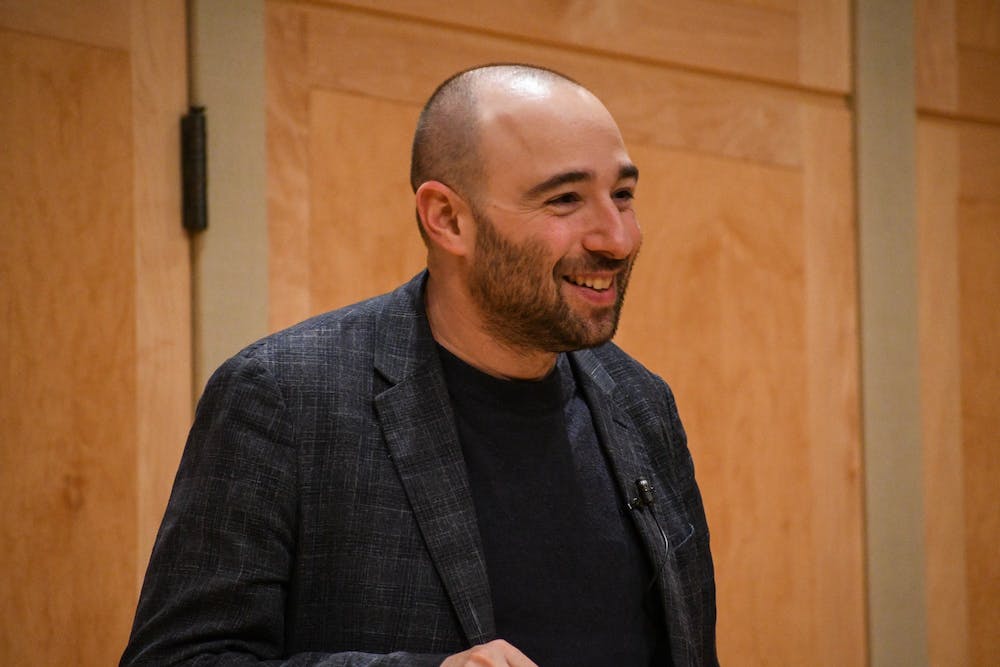
I haven’t red Mounk’s new book, The Identity Trap: A Story of Ideas and Power in Our Time, but I was fortunate to catch his interview with Glenn Lowry (see below). Nearly everything Mounk says about woke ideology in this interview I have been saying on my blog Freedom and Reason for years. In the interview, Mounk reflects on a significant transformation in the beliefs of his social circle over the past decade, noting a substantial shift in left-wing ideologies in America. In 2023, the understanding of being left-wing is markedly different from that of 2005 or 2010. This change is attributed to the proliferation of new ideas, often termed “woke” (Mounk doesn’t like the word) or linked with identity politics, though Mounk prefers the term “identity synthesis” to encapsulate the nuanced evolution. Acknowledging historical instances of white identity politics, Mounk argues that the current left’s ideology is distinctive, rooted in influences such as postmodernism, post-colonialism, and critical race theory. Key intellectual figures like Michel Foucault, Edward Said, and Gayatri Spivak have significantly shaped the discourse on power, identity, and oppression.
I have written about this, but it bears repeating: one of the difficult things to deal with in light of the rapid shift in left-wing sensibilities is that I remained stubbornly resistant to the ideas that currently corrupt left-wing thought, which alienated a lot of colleagues and friends (even family). Unaware that it is in fact those around me who have changed, many people came to perceive me as the one who has changed; they see themselves as on the left, so the perception was that I had moved to the right. To be sure, I have changed in some ways; but that change has come about by recognizing that there was programming during my graduate school experience that put into my epistemic system ideas from post-colonial studies and critical race theory, a system that was not yet sophisticated enough to exclude bad ideas. The new millennium found me reviewing and reassessing my understanding of the world and the myriad ways thinkers attempt to grasp it and purging from the system the worst of those ideas I found there.
I have also taken great pains to emphasize that woke is not Marxist. This is one of the most satisfying moments of this interview is Mounk explaining why woke progressive ideology—critical race theory, inter sectionalism, post colonial studies, race essentialism—is not is not Marxist, neo-Marxist, or cultural Marxism, or any of those other labels that both the left and the right attempt to attach to progressive ideology. Today’s progressivism is postmodernist. Whatever monsters one wishes to credit to Karl Marx, the man is not the creator of this one.
Lowry asks Mounk to trace the intellectual and political history of the identity synthesis. Mounk begins with Foucault, who rejected grand narratives and grand theoretical attempts to structure our comprehension of the world and history, attempts that encompassing both philosophical liberalism and Marxism. Foucault’s skepticism extends to the notion of societal progress, especially concerning the treatment of the mentally ill, criminals, and sexual minorities. Departing from conventional perspectives, Foucault redefines power, rejecting the naive top-down view associated with laws, bureaucratic states, and enforcing police forces, and focusing instead on power as deeply embedded in our discourses, evident in conversations and audience engagement, where the framing of ideas becomes an exercise of power. This intellectual solvent effectively enables critiques of democratic institutions, as well as post-war France’s limitations, albeit lacking a distinctly activist stance, positing that any set of discourses could be as oppressive as the next, leaving no definitive ground for refusal.
In the subsequent phase, post-colonial thinkers are drawn to these ideas, seeking to reconstruct their newly independent countries without adopting Western ideologies like liberalism or Marxism. Recognizing the need for more than critique, they endeavor to infuse politics into postmodernism. Edward Said emerges as a pioneer in this field, utilizing Foucault’s discourse concept as a primary tool. Said goes beyond exposing discourses, employing them as a form of political power. In works such as Orientalism, Said endeavors not only to reveal how the West’s representation of the East justified colonial rule but also to invert the discourse, providing a means to resist. This marks the genesis of discourse critique as a political tool, a politicized form of discourse critique that is observable in contemporary politics. We see the fruit of Said’s labor in the mob on the street. We also see these ideas in contemporary feminist politics, where engagements range from advocating for abortion rights to scrutinizing and critiquing cultural artifacts like the Barbie movie.
Another significant contributor to this trajectory is Gayatri Spivak, an Indian literary theorist. Spivak accepts the critique of stable identity categories presented by figures like Foucault. Acknowledging the limitations of essentialist understandings of identity, she introduces the concept of “strategic essentialism.” While recognizing the philosophical flaws in essentialist notions, Spivak argues that, for practical purposes, identity categories are essential to advocate for the most oppressed individuals in places like Kolkata who may lack a voice. This results in a paradoxical term, acknowledging the philosophical discrepancy while asserting the strategic necessity of essentialism; Spivak underscores the paradoxical need for identity categories despite critiquing essentialist notions. The narrative further explores the popularization of these ideas, including the concept of intersectionality, in social justice movements.
Mounk puts all this together for Lowry. The movement gleans from Foucault the rejection of neutral forms of truth, embracing a perspective that challenges the idea of objective truths. Although he leaves this out in the interview, it is from Said that activists derive their fetish for marginalized and peripheral people. Spivak contributes a politicized form of discourse analysis to the intellectual toolkit, offering a lens through which activists assume control over the political dimensions of language. Enter critical race theory. From Kimberlé Crenshaw, activists adopt the popularized iteration of intersectionality, a concept that has taken on a life of its own in contemporary social justice movements. We can add to Mounk’s list queer theory and the work of individuals such as Judith Butler. This amalgamation of ideas serves as a comprehensive framework for understanding and engaging with the complexities of modern social justice activism.
Beyond intellectual history, Mounk scrutinizes the transformation of these ideas into a dominant political and cultural force, particularly evident in 2020 with the riots surrounding George Floyd’s death. In light of the protests on our streets, The Identity Trap could not have landed at a better time. Mounk also touches on the concept of the “successor ideology,” distinct from but related to “wokeism” (see my recent post The Threat of Successor Ideology). This ideology, championed by the administrative state and the technocratic elite, encompasses a set of ideas that justifies the moral norms enforced by the woke. The subsequent political economy analysis reveals how this ideology, once marginal, became the prevailing moral orthodoxy in major American institutions. Mounk highlights the paradoxes within the successor ideology, including the privileged background of many proponents and its extreme self-denunciation, where individuals are expected not only to accept guilt but to affirm it.
These intellectual currents underpin the destructive ideology pushed throughout the education system and pressed into the brains of Western youth, from k-12 through colleges and universities, by administrators, counselors, teachers, and staff. Mounk tells us how this happened. In the page of Freedom and Reason, I tell you why this is happening. This is not a communist takeover of the trans-Atlantic system. It’s the fascist destruction of Western Civilization—which is why elites in the West promote the clerical fascism of the Islamists—with a new world order as the end goal (this is what Mounk misunderstands about populism). Of course, not all of today’s youth seeks totalitarianism. But too many of them do.
So what is to be done? In The Identity Trap, Mounk argues for the restoration of liberalism in the democratic sense, advocating for core values like free speech, due process, and open inquiry. Mounk challenges the illiberal tendencies within the successor ideology and calls for a return to the Enlightenment principles that underpin a multiracial democracy. As readers of my blog know, this is my argument, as well. I look forward to getting my hands on The Identity Trap. Readers of this blog should grab a copy, too. We need more voices like Yascha Mounk.


