Before getting to the nub of today’s essay, let’s recall together some past CNN post-debate polling. Remember Biden’s 60-28 win in his first 2020 debate against Trump? Trump went on to win 75 million votes, the largest number of votes by presidential aspirant (I don’t believe Biden won 81 million votes). How about Clinton’s 62-27 win over Trump in the first debate of 2016? Clinton lost to Trump. Or Mitt Romney’s 67-25 win over then-President Barack Obama in the first debate of 2012? Romney lost to Obama. The CNN poll showed Harris winning the debate 63 percent to 37 percent among debate-watchers.
The media is attempting to demoralize Trump voters by pushing the recent poll, but history tells us that winning a debate is not winning an election. The Washington Postreports that, despite her win, debate-watchers still preferred Trump by 20 points on the economy (55-35) and 23 points on immigration (56-33). “Those are actually bigger margins than he usually racks up on these issues,” the Post noted, “so it seems possible Trump’s attacks on the Biden administration’s record on these issues landed with some effect.” So Trump supporters should not let the media blitz get them down.
Now, about this “rumor” of Haitians eating cats in Springfield, Ohio (which triggered an avalanche of hilarious cat memes, for which I am grateful), the media is being disingenuous by declaring the matter “debunked.” (So what’s new?) Animal sacrifice is core a part of Haitian Vodou tradition and plays a significant role in its rituals. In Vodou, animal sacrifice is not merely about offering animals to the spirits; it is a sacred act that reflects the deep relationship between humans, the natural order, and the spirit world. The practice is rooted in the belief that blood contains life force or spiritual energy, which helps to feed and strengthen the loa (spirits) during ceremonies.
One purpose of animal sacrifices is to honor the loa and seek their assistance, there are also practices within Vodou that involve curses or protective magic. These are typically done with the intent of defending oneself or the community. Various indigenous or traditional African religions involve animal sacrifice in their rituals; the origins of Vodou lie in the fusion of West and Central African spiritual traditions with the Catholicism imposed by French colonial rulers, forming a syncretic belief system that allows for a complex relationship between the divine, humanity, and the natural world. In this respect (and others) it’s similar to Santería, another AfroCaribbean syncretic religion that has found its way into the United States.
ABC has let Harris get away with the Charlottesville hoax, bloodbath hoax, police officers dying on J6 hoax, etc
But they fact check Trump on animals in Ohio… when he was correct
I shared the above tweet on Facebook and was asked about what I knew about animals in Ohio. I presume the question concerned Springfield, and I confessed that I haven’t been there. I suggested he ask Shaun MaQuire about it since it is his post. However, I know that dozens of citizens in Springfield are reporting that animals are missing and that the police know about it. I also know a bit about animals in South Florida. I know that Haitians eat them there and use them to put curses on people. At least they did this back in the 1980s. They put a curse on me and my business partner in Coral Cables. Twice. It was some sort of foul (I presume a chicken). Beheaded, drained of blood, hanging upside down from a tree. (I am not ruling out practitioners of Santería here.)
A cat meme
On August 12, NPR ran an exercise in prebunking on its All Things Considered program, “How Springfield, Ohio, took center stage in the election immigration debate.” The opportunity was a speech JD Vance had given on July 10 at the National Conservativism Conference, in which the Vice Presidential candidate had urged the audience to “go to Springfield, Ohio.” “I could not believe it when I first heard about it,” Vance said. “Ask the people there, whether they have been enriched by 20,000 newcomers in four years.” (For more on prebunking, see The Russia Fake News Narrative.)
The media hasn’t bothered to ask the people there—at least not the ones who are complaining—about it. Instead they have sought out the statements of city officials. “I think it’s sad that some people are using this as an opportunity to spread hate or spread fear,” says Officer Jason Via, Deputy Director of Public Safety and Operations, Springfield. “We get these reports ’the Haitians are killing ducks in a lot of our parks’ or ’the Haitians are eating vegetables right out of the aisle at the grocery store.’ And we haven’t really seen any of that.It’s really frustrating. As a community, it’s not helpful as we try to move forward,” Via says.
Listen carefully to this statement
People are culture-bearers. They bring their culture with them. Animal sacrifice is a part of Vodou tradition and plays a significant role in its rituals. This is not a conspiracy. It’s anthropology. It would be surprising that the people who are reporting the killing and eating of various animals in Springfield were wrong. Their descriptions are accurate with what I know about Haitian gustatory and religious practices. I presume these residents aren’t experts. The association of Haitians and the killing of cats goes back decades, so maybe the retelling of history has come to substitute for direct observation. We’ll see. But the claims are plausible, and I won’t dismiss them out of hand. And I certainly won’t believe the media. After all, Hunter Biden’s laptop was a hoax.
I understand why the government would lie—they have a mass immigration project they need to keep going. I understand why the corporate media isn’t doing any investigatory journalism to find out what’s happening (instead giving the city manager Bryan Heck a call and taking his word for it—the same city manager who shills for the military-industrial complex in the video above)—they don’t want to know. They also can’t answer the question because they have framed the premise of the question as racist (as if culture is race). Since the truth can’t be racist, it’s better to just take the word of an official. What I don’t understand is why the ordinary citizen in Springfield would make up something like this. “Because they’re racist” won’t work. That’s a smear to delegitimize the burden imposed upon them.
I confess that I am not an elitist, nor do I toe the woke progressive line; the testimony of ordinary working people rings more true to me that functionaries who have a political interest in (a) hiding the truth of mass immigration to keep it going and (b) delegitimizing Donald Trump, who has promised to put a stop to it.
I think it is remarkably naive to believe this couldn’t be happening—or that you can trust the media to tell you it is. It’s wrong to chalk the concern up to racism and xenophobia. These are cultures incompatible with ours and we are well beyond the ethic of assimilation. The citizens of Springfield, which number 60,000, are being saddled with the burden of 20,000 Haitian migrants, migrants they did not vote to allow into their community—a burden the government imposed on the residents there without their consent.
This is why it is sad to see Springfield resident Nathan Clark, rather than blame the policies that led to his son’s death because of the actions of a Haitian migrant, say, “I wish that my son, Aiden Clark, was killed by a 60-year-old white man.” Expressions of collective self-loathing driven by identity politics is why people believe the corporate media and official sources over the testimony of ordinary Americans; it’s self-loathing that causes people to not even bother to find out what’s going on in Springfield and in cities across the nation, to wax incredulous at stories that those who have had experience with Haitian culture knows are not only plausible, but very likely, because white people are bad.
In the last several weeks, my office has received many inquiries from actual residents of Springfield who've said their neighbors' pets or local wildlife were abducted by Haitian migrants. It's possible, of course, that all of these rumors will turn out to be false.
The lies and misrepresentations coming from Kamala Harris night before last were many (I cover many of them here Harris Lies and Distortions). But the way she dismissed thousands of death on the eve of 9/11 anniversary was despicable.
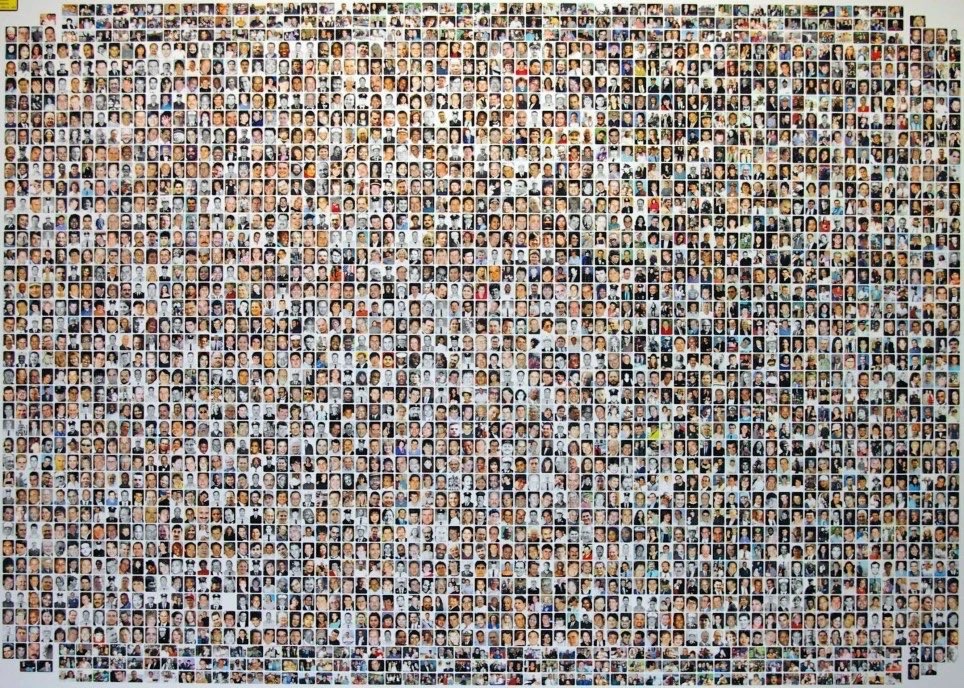
Collage of many of those who died on September 11, 2001 when Muslim terrorists flew plans in buildings
Approximately 2,977 people were killed in the attacks on September 11, 2001. This number includes passengers on the planes, workers in the World Trade Center and the Pentagon, firefighters, police officers, and emergency responders. Above are the faces of those killed on 9/11. Not quite the horror of January 6, 2021, Kamala Harris tells us. Nor does Pearl Harbor compare. The attack on Pearl Harbor on December 7, 1941, resulted in the deaths of 2,403 Americans. No, we have to go all the way back to the Civil War to find a tragedy comparable to January 6. An estimated 620,000 to 750,000 people died during the American Civil War, making it the deadliest conflict in US history. We know this because Kamala Harris told us. And since the media adores her, you can take this fact to the bank.
"She wants to do transgender operations on illegal aliens who are in prison" is the WILDEST thing I've ever heard in any debate. EVER.
The media is hailing Harris’ performance as a success. This was expected. She certainly exceeded expectations. She was given talking points, many of which were designed to provoke Trump into losing his cool, and she deftly executed them. Although Trump was never rattled, he did take the bait a few times, for example talking about the crowd sizes of the respective campaigns.
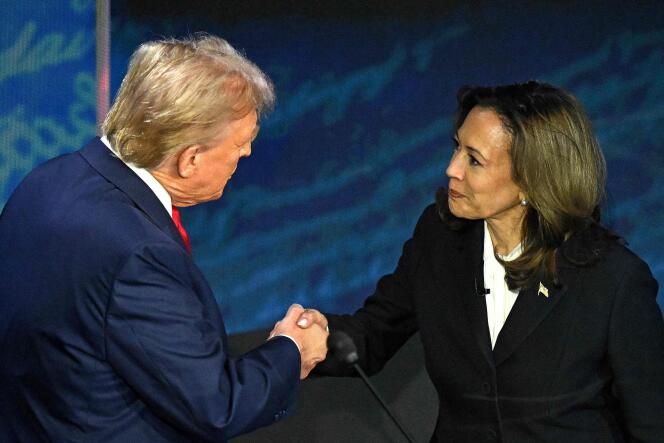
Former President and Republican presidential candidate Donald Trump shake hands with Vice President and Democratic presidential candidate during the presidential debate on September 10, 2024. (Source: AFP)
Harris’s performance was riddled with debunked claims and distortions. Her repeated insistence on the false narrative that Trump praised white supremacists in Charlottesville and incited the January 6 riot were only a few examples. She avoided direct answers on topics like abortion restrictions, opting instead for broad, sweeping statements. Harris’ attempt to distance herself from previous comments on defunding the police came off as disingenuous. Her tendency to overstate and sidestep key issues gave the impression of a candidate more focused on scoring political points than delivering substantive policy ideas.
Vice President Kamala Harris has made several claims during her public appearances and debates, many of which have been contested or debunked. She said several things at the debate last night that are false or misleading. Although moderators David Muir and Linsey Davis went out of their way to factcheck Trump in real time, they did not do the same with Harris. This left the impression that Trump was lying and Harris wasn’t. I want to review some of Harris’ lies and distortions in this essay. (I reviewed some of these before. See Three Big Lies About Trump—and Promising Developments in the Transatlantic Space.)
Harris asserted that Trump would implement Project 2025 if elected, despite Trump’s repeated denials that he has any involvement with the initiative. She also claimed that Trump would implement a sales tax if he wins, but Trump has not promised to introduce such a tax.
Regarding the January 6, 2021, Capitol riot, Harris argued that Trump incited the violence, yet the former president specifically instructed his supporters to “peacefully and patriotically make [their] voices heard.” Additionally, Harris suggested that police officers died due to the events of January 6, which is inaccurate. For example, medical examiners confirmed that Officer Brian Sicknick died of natural causes. Harris also labeled the riot the “worst attack on democracy since the Civil War,” but the riot did not pose the same threat to the nation as events like 9/11 or Pearl Harbor and what they represented.
Harris repeated the misleading claim that Trump praised white supremacists during the 2017 Charlottesville rally when he said there were “fine people on both sides.” In fact, Trump was referring to individuals on both sides of the debate regarding the preservation of historical monuments, not to extremists. He repeatedly condemned neo-nazis and white supremacists at that press conference.
Harris mischaracterized Trump’s comments by suggesting he had warned of a “bloodbath” in the event of his electoral defeat, implying that he was advocating or predicting violence. Like the “fine people on both sides” narrative, this interpretation distorts the original context of Trump’s remarks. In reality, Trump was addressing the potential economic downturn and hardships that he believed would follow if Democrats were to win the election, specifically referring to the importation of Chinese electric vehicles. His comments centered around the notion that a Democratic victory would lead to significant financial instability, rather than a call for physical conflict. Harris’s portrayal of this as a violent threat undermined the substantive economic warning Trump was attempting to convey.
In terms of Trump’s stance on abortion, Harris warned that Trump would sign a national abortion ban and appoint an “abortion monitor” to oversee pregnancies. However, Trump has consistently stated that decisions about abortion should be left to individual states. Harris also claimed that several states have “Trump abortion bans” that criminalize medical professionals and offer no exceptions for rape or incest. In reality, such laws generally include exceptions for situations where a pregnant woman’s life is at risk. Additionally, Harris denied that women are seeking late-term abortions, but data from the CDC shows that thousands of abortions are performed after 21 weeks, and this figure does not include states where abortion reporting is not mandated. Harris also inaccurately linked Trump’s abortion policies to restrictions on in vitro fertilization (IVF), claiming that Trump’s abortion bans deny couples the chance to undergo IVF. However, Trump has previously voiced support for IVF and promised to expand access to the treatment.
Harris’ denials of late-term abortions is especially problematic because under a 2015 Minnesota law, the state was previously required to report when abortions resulted in a live birth, detailing the actions taken to preserve the infant’s life and whether the child survived. Data from January 1 to December 31, 2021, revealed that five abortions resulted in live births. In three cases, no measures were taken to assist the infants, while the remaining two were provided with “comfort care measures” before they passed away. Governor Tim Walz, who is Harris’ running mate, presided over the changes to the reporting requirements.
When challenged on her position regarding law enforcement, Harris denied supporting defunding the police. Yet, she has previously advocated for “reimagining” policing and redirecting resources to other areas of government, including education and small businesses. She further denied fundraising efforts to bail out protesters following George Floyd’s death, but Harris did promote a bail fund that helped release rioters and others arrested during the 2020 unrest. As for the claim that crime rates have declined under Biden-Harris, what has actually happened is that crime reporting by police agencies and city governments has decline. Lastly, on the matter of Second Amendment rights, which protects citizen’s ability to effect the foundational right of self-defense, Harris denied supporting mandatory gun confiscation, though she has expressed support for such measures in the past.
On national security, Harris claimed that Trump’s policies weakened the United States, yet under his administration, the US southern border was more secure, and several peace agreements were brokered between Israel and Arab states. Under the Biden-Harris administration, geopolitical tensions have escalated, including Russia’s invasion of Ukraine and increased hostility from Iran-backed Hamas, as well as China’s aggressive posturing towards Taiwan and other neighboring countries.
I want to close noting Trump’s missed opportunity. Here is what he should have done: It’s his first turn to speak. He says he will answer the question, but first he needs to remind viewers at home that tomorrow is the day terrorists flew planes into the twin towers of his beloved City of New York. He reminds viewers that George Bush and Dick Cheney were on watch that day and they failed to protect America from the worst attack on United States territory since Pearl Harbor. Trump then points out that Bush refuses to endorse him and that Cheney endorses her. These are the same two men, he tells viewers, who lied the nation into war and that the President under whom she currently serves was one of the Senators who authorized the criminal invasion of Iraq. Trump finishes by telling viewers that Biden-Harris regime has thrown the world in turmoil, that they are of the class of the warmongers, and that he, Trump, will be a peace president.
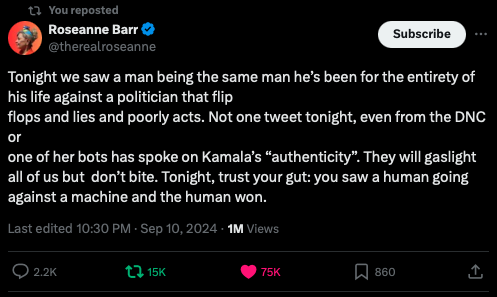
Readers will note that Trump lacks the discipline to do something like this. Perhaps. Those praising Harris say she has the discipline he lacks. However, what we see in Harris are performances. Her performances are poorly performed. She is inauthentic. To be sure, it takes some discipline to memorize talking points. And she was able to push through them despite her nerves. But she is a construct. There is no actual substance there. Trump, on the other hand, is authentic. Rosanne Barr puts the matter well in this tweet:
The image is from an unintentionally ironic Columbia University journalism school story
Once you understand how corporate state propaganda works, and what the power elite intends with its perennial resort to the Russia fake news narrative, the programming becomes obvious. A few days ago Attorney General Merrick Garland outlined a sophisticated disinformation campaign undertaken by Russia to interfere with the US presidential election. Garland warned that Russia is pumping lies into the United States using fake news outlets and “right wing” social media influencers, among them Benny Johnson, Tim Pool, and Dave Rubin.
The Department of Justice reported that it has charged two employees of a Russian state-controlled media outlet, RT, who are alleged to have paid influencers ten million dollars to distribute content with “hidden Russian government messaging.” The 2024 narrative is much the same as the 2020 and 2016 narrative. A September 2020 story “How to Combat Russian Disinformation in the US Presidential Election,” published on the Columbia University news page, well illustrates the two previous points on the propaganda timeline: “As in 2016, Russia is looking to intensify whatever can further divide American society. The Kremlin isn’t ideological. Its outlets have agitated for and against the Black Lives Matter movement, for and against vaccinations, and boosted Bernie Sanders when he seemed to be splitting the Democratic Party. The Russian goal is simply to encourage any force that can add stress to US politics and society.”
“The Justice Department’s message is clear,” Garland told those assembled: “We have no tolerance for attempts by authoritarian regimes to exploit our democratic system of government. We will be relentlessly aggressive in countering and disrupting attempts by Russia and Iran, as well as China or any other foreign malign actor, to interfere in our elections and undermine our democracy.”
The corporate state propaganda organ NPR dutifully ran the headline “DOJ says Russia paid right-wing influencers to spread Russian propaganda.” The host, Scott Simon, reported, “The US Justice Department said this week Russia is trying to use fake news to influence US policy and politics.” Then he defined “fake news” for the viewer: “That’s fraudulent news stories made to look real.” He next turned to a usual suspect, Renee DiResta, “a disinformation expert who has been called upon by Congress for her expertise.”
DiResta, who wrote Invisible Rulers: The People Who Turn Lies Into Reality, published this past June to rave reviews, says that government official are “trying to create just a general resilience by helping people understand that these kinds of messages, particularly when they’re repeated, particularly when they’re pervasive and they’re all around you, are used to turn other people into enemies and to create social divisions that really undermine the ability to reach consensus and solve collective problems, that really increase and exacerbate polarization.”
What does “general resilience” mean? The industry term for this is “prebunking.” DiResta is defining it for listeners. Here’s how it works: corporate state programmers prepare people to disbelieve anything they hear that sounds like what the programmers have identified as coming from Russian agents. This mind control trick involves sensitizing targets—the general population in this case—to specific content their brains will automatically interpret and reject as Russian “disinformation” or “fake news.” The word “general” is crucial here, since most of what will be coded as Russian disinformation is not the work of Russian agents but arguments coming from the side the Establishment is seeking to discredit and marginalize, obviously Donald Trump and information supporting his candidacy. The design is to make information and opinion that’s generated internal to the Untied States appear to be externally produced, i.e., to make the organic appear artificial or synthetic.
For example, if I make the argument that immigrants are replacing American workers (which I did a few days ago), and the public is told that Russian agents manufactured that narrative to make immigrants appear to be enemies of native born workers, then a portion of my readers will regard information about the mass immigration as Russian propaganda and therefore fake news and conclude that immigration is not harmful to the interests of native born workers and their family. Or suppose one is skeptical of the proxy war in Ukraine. Like me. If one hears a story about how some of the Ukrainian soldiers are neo-Nazis but has been conditioned to believe such a story is Russian disinformation, then the person will be more likely to disbelieve the neo-Nazi story and then either support Western funding of the proxy war or at least be ambivalent about it.
The Russian fake news narration tells Americans that criticisms of Harris-Walz, support for Trump-Vance, the funding of the proxy war in Ukraine, concern about free speech, etc., may be the work of Russian propagandists designed to undermine the narrative generated by the power elite, who are promoting Harris-Walz, portraying Trump as the enemy of democracy, promoting neoconservative foreign policy and more aggressive censorship, etc., the opposite of what the other side represents.
“Russia, Russia, Russia!”
Remember when fifty-one top intelligence officials circulated a letter misleading the public about Hunter Biden’s laptop, telling them that it was Russia disinformation? On October 14, 2020, the New York Post published a report detailing how Hunter Biden used the position and influence of his father, now-President Joe Biden, for personal gain with the apparent awareness of President Biden. Within days, top former intelligence officials signed on to a public statement, released October 19, 2020, stating that the Hunter Biden laptop story had “all the classic earmarks of a Russian information operation.” The purpose of the letter was so that when the public learned about the laptop and saw its contents they would assume the emails and photographs were fabricated by Russian agents. This is prebunking.
It is also election interference. The letter was coordinated by the Biden campaign. Top Biden campaign official, and now Secretary of State, Antony Blinken contacted former Deputy Central Intelligence Agency (CIA) Director Michael Morell to arrange for the letter. Morell assembled the intelligent officials. The letter was signed by fifty former senior intelligence officials alleging that the laptop was potentially tied to Russian disinformation efforts. Some of the notable signatories included John Brennan, former Director of the Central Intelligence Agency (CIA), Michael Hayden, former Director of the National Security Agency (NSA), Leon Panetta, former Director of the CIA and Secretary of Defense, James Clapper, former Director of National Intelligence, Avril Haines – Former Deputy Director of the CIA. This was a Deep State influence operation, carried out not against America’s adversaries on foreign soil, but against the American people, designed to interfere with the 2020 election.
The Russian fake news narrative is not content-neutral but functions to pump anti-Trump and anti-populism into mass consciousness disguised as the government protecting the public from Russian disinformation. The ruse means to make political arguments appear to not originate from genuine disagreement over issues, but to be artificially constructed and conveyed, and to make those who are critical of the power elite appear unhinged and easily duped. Only those who accept the official narrative pumped out by the corporate state media apparatus are portrayed as sane and rational. This is industrial-strength psychological warfare—and it’s being waged on the American public by their own government. NPR is a CIA cutout that functions to make the propaganda appear as journalism.
In James Cameron’s 2009 movie Avatar, humans were able to embody beings called “Na’vi.” The Na’vi are a fictional humanoid species native to the moon Pandora. Through the use of advanced technology, humans were able to remotely control and inhabit genetically engineered Na’vi bodies, known as “avatars.” This allowed humans to interact with the native population and explore Pandora more intimately to facilitating resource extraction from the moon for the sake of corporate profits.
AI generated
The avatars in Cameron’s movie are genetically engineered bodies grown in labs designed to be controlled by a human operator through a neural link. The human operator lies in a pod-like apparatus, and their consciousness is linked to the avatar’s nervous system via a neural interface. This allows the operator to experience the avatar’s sensory perceptions and control its movements as if they were physically present in the Na’vi body. The central character, Jake Sully, eventually becomes fused with his avatar, thus permanently inhabiting a new body.
One of the key concepts in Karl Marx’s theory of value is the idea of commodity fetishism, where the social relationships between people are mediated through the exchange value of commodities. Jean Baudrillard’s work takes this idea further by exploring how capitalism has evolved to a point where the sign value and symbolic representations of commodities become detached from their material attributes. He argues that in a hyperreal society, the simulated signs and symbols associated with commodities become more significant than their actual use value or exchange value.
Baudrillard’s analysis introduces the concept of the “simulacrum,” which refers to copies or representations that have no original referent or reality. In this context, Baudrillard suggests that capitalism has reached a stage where the production of commodities and their representation in media have become so detached from any original reality that they become self-referential, leading to a blurring of distinctions between reality and simulation.
The problem of “biological essentialism” is a construct to transhumanist ideology. The idea is that if we are not real bodies resulting from natural history then we can become anything we (or others) want. We can remain human (if we wish) when at the same time we become more than human by radically altering our physical bodies, such as via cyberneticization, or upload some thing that appears to others as our self into a computer program—not an avatar but some thing. Again, if being human is at all what we desire. (Maybe we desire something else.)
It also means that other things can be human (whatever that is) and humans can integrate themselves with other animals and things. It is a world in which avatars, furries, and gendered souls are real possibilities. A desire to go beyond the third order simulacra that already exist everywhere and step into the fourth order—into the Matrix.
Transhumanism is a profound expression of alienation. It’s the idea that we can escape our bodies or modify them to the point where we are something else or more than we are now. That we can be modified. It’s the fascist dream expressed by the futurism that became a fundamental element in both Italian fascism and German national socialism. It’s Filippo Marinetti’s “dreamt-of metallization of the human body”—bound up not only in a loathing of the human body and an obsession with medicalization of everything but the aesthetics of war and conquest. Of destruction.
Transgenderism is a subset of transhumanism wherein the individual is alienated specifically from his gendered body and believes that by altering it through technology he can escape its reality. It is the delusion that he can become what we thinks he is through destructive cosmetic alterations. It’s the same as the man who thinks he becomes a lizard by splitting his tongue, cutting off his nose, tattooing his body, and implanting horns and other bumps and lines under his skin. He becomes nothing but a self-harming and mutilated human being.
All this is why progressives are so enamored by the medical-industrial complex and, more broadly, scientism. It’s why those drawn to progressivism are natural allies of corporate state elites—they express the social logic of corporatism. It’s why they seek mRNA jabs. It’s why they are ready to be chipped—and chip everybody else. It’s a generation raised on latter iterations of Star Trek—the holodeck—but never taught to differentiate between science fiction and reality.
One of my areas of specialization is political economy. I put this to use recently in two essays concerning the economic record of the Biden-Harris regime, Trump v Biden Economic Performance and A Look at Four Economic Metrics. How did Biden-Harris Do? Not Good. I have also written a lot on the problem of immigration over the years, most recently We Need to Close the Borders. In this brief essay I will look at the Biden-Harris record with respect to job growth and the native born versus immigrant ratio in employment.
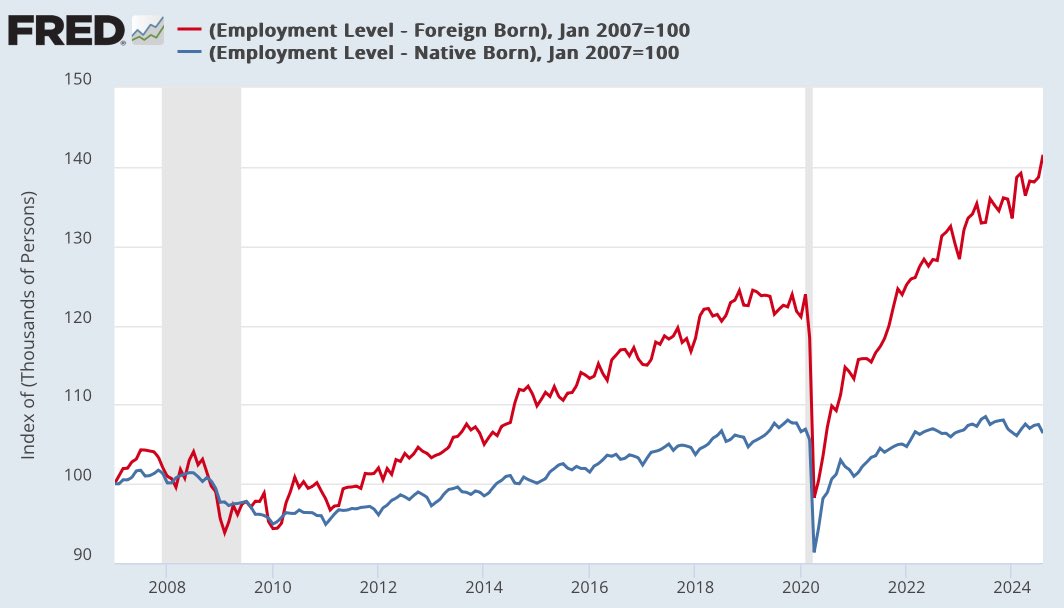
FRED is the Federal Reserve of St. Louis.
Maybe you heard about the anemic jobs reports in July and August. However, native born Americans will tell you that, whatever jobs were produced, it doesn’t feel like there is much opportunity out there for them. This is certainly true if the native born—especially if whites, who are the majority of workers in America. The public is constantly told that foreigners are not taking the jobs of native born Americans. That is untrue, as you can see in the chart. native born workers are being replaced by immigrants (legal and illegal).
The strategy of replacing native born with foreign born workers increases in the aftermath of the 2008-09 recession. Corporations favored immigrant labor throughout the remainder of the Obama-Biden regime and all through Trump’s presidency. After COVID, under Biden-Harris, the ratio of immigrant to native born increased drastically, with native born employment falling flat after 2022. So when the Harris-Walz campaign touts job growth under the current regime, they are touting growth in the employment of millions of aliens who crossed the southern US border under their watch.
If you refer to this phenomenon with the word “replacement,” you will be branded a “conspiracy theorist” and smeared as a “racist.” You will be called these names because the Party doesn’t want you talking about reality, and they believe they can silence those who speak up about it and keep silent those who haven’t yet by marginalizing them in the eyes of others. I no longer fear being called names, so I will tell you the truth about it.
I found this chart here:
Holy. Shit.
I thought this was a typo…
In just August, 635k immigrants (legal and illegal) gained a job. Meanwhile, 1.325 MILLION native-born Americans LOST their job.
Since pre-Covid, native-born workers have LOST 2 million jobs. All of the net job gains are immigrants. pic.twitter.com/neQZChaHEF
I was asked recently why I am so critical of gender ideology and in opposition so-called “trans rights.” There are several reasons covered in my many essays on the subject on Freedom and Reason, but the question gives me a chance to collect and summarize those reasons here.
Before getting to those reasons, on the matter of “trans rights,” it must be said that there are no rights enjoyed by others that are not also enjoyed by trans identifying individuals. The Bill of Rights secures the same rights for all of us. What the construct of “trans rights” is actually is a demand for privileges or special rights. Trans activists demand that people and institution behave in ways that contradict the fundamental rights all individuals enjoy.
Every individual has the right to believe in gender identity, just as he has the right to believe in a soul or the thetan and to express his belief in those things in speech and writing—just as he has the right to reject all those things (which I do). This is what it means to enjoy freedom of conscience and thought. If a man wishes to use a feminine name or to request others refer to him by feminine pronouns, then he has the right to change his name and ask others to refer to him as “she/her.” He does not have the right, however, to make rules that punish people for deadnaming him or for making them refer to him by pronouns that do not correspond to his gender (or sex). This is because everybody else enjoys the same rights as the trans identifying person. The right to express something one believes is at the same time the right deny or resist that with he does not believe.
That a Muslim believes he has a soul does not obligate me to believe in the soul along with him. Moreover, I am free to criticize his belief in such a thing. In Islam, the origin of the soul (or rūḥ) is a divine mystery created directly by Allah. The Qur’an indicates that the soul comes from Allah and is instilled into human beings by his will. The archangel Gabriel told the founder of Islam, Muhammad, this. I don’t believe it.
I express the same disbelief for the Scientologist’s belief in the thetan. In Scientology, the thetan is considered the true spiritual identity of a person. According to Scientology’s teachings it is an eternal, immortal entity that has existed since the beginning of time. Thetans are not created or born, the doctrine says, but have always existed in the universe. They have taken on bodies and accumulated “engrams,” or traumatic memories, that cloud their true nature. The goal of Scientology is to clear these engrams (through auditing) and free the thetan, restoring its ability to operate independently of the physical body and the material universe.
I have only ever met one Scientologist in my life (that I know about). It happened many years ago following my criminology class. It was the first day of classes and I began, as I often do, asking students to define crime. We quickly got into the area of morality, and I pivoted to the problem of fraud and the separation of somebody from his money with the promise of something that really can’t be delivered. I wanted to talk about Christianity, but I didn’t want to alienate the class on the first day, so I used the example of Scientology instead. There couldn’t possibly be any Scientologists in Green Bay, Wisconsin, I thought to myself. I talked about the absurdity of the doctrine and the practice of auditing, and how France regards Scientology as a dangerous cult and doesn’t recognize it as a religion (which was true at the time), even though the United States does.
After class, a student came up to me and told me about how she and her parents had moved to Green Bay from California and were devout Scientologists. My first reaction was one of incredulity. “Seriously?” I couldn’t quite read her expression. I thought she was a joker giving me a good go of it as a way of introducing herself. She struck me as effervescent. But she grew furious and got too close to me. She wasn’t kidding. She demanded an apology. I refused to apologize, appealing to free speech and academic freedom, and encouraged her to go to the chair of my department and complain, giving her the office number and the name of my chair, offering to write it down for her if need be. She just walked away in a huff. She dropped the class that day. I never saw her again.
Imagine had she complained and my chair or to the dean of my college and either arranging a meeting to talk to me about my views of Scientology. That would have been weird. Scientology is an ideology. I’m a sociologist. I criticize ideology. I don’t care if people think thetans are real. But I do care if I am punished for saying that they aren’t. Moreover, I’m a criminologist. I criticize ideologies that exploit people, especially vulnerable ones. Am I not allowed to talk about how organizations deceive people into giving them money?
I was the talk of campus several years later when I mocked the idea of a talking snake in a class of some eighty students. I was lecturing on Ludwig Feuerbach’s thesis, primarily articulated in his work The Essence of Christianity (1841), that God is a projection of human qualities and desires rather than an independent divine being. For those who are unfamiliar with the world, Feuerbach argues that humans, in their search for meaning and perfection, create God by externalizing their own ideals—such as love, power—onto an imagined deity. In Feuerbach’s view, religious belief is a reflection of human nature; God is not a supernatural entity but a human creation embodying the best aspects of humanity. God is thus a human construct, and the positive message is that individuals can reclaim these ideals as expressions of their own potential, leading to a more humanistic worldview.
After explaining his Karl Marx used Feuerbach’s insight to develop his critique of ideology, I turned to Erich Fromm’s use the biblical story of the expulsion of man from the Garden of Eden as a metaphor for human freedom and the development of self-awareness. In his view, Adam and Eve’s act of disobedience—eating from the Tree of the Knowledge of Good and Evil—symbolizes humanity’s break from a state of unconscious unity with nature, where humans lived without choice or individuality. By gaining knowledge of good and evil, humans were cast out into a world of uncertainty and independence, which Fromm saw not as a fall but as a necessary step toward becoming fully human. For Fromm, this story reflects the tension between security and freedom, with the latter being the defining aspect of human existence and the path toward self-realization.
It was at this point, having directly touched upon a biblical story, a student offered a rebuttal to my lecture in which he treated the serpent as if it were actually a talking snake, suggesting that it was the embodiment of evil. In my sociology of religion class we go deeply into this matter, but in the moment I heard myself uttering “Seriously? A talking snake?” The class laughed. He took it in stride. People still remind me of that moment and the buzz it stirred on campus.
I tolerate people’s beliefs. But, by the same token, they will have to tolerate mine, as well as my criticism of their beliefs. Mock my atheism and you will find me unfazed. Lord knows I have tolerated criticism of my beliefs or lack thereof my entire life. It’s give and take in a free society. If you want to believe in souls and thetans, fine, just be prepared to hear my opinion about it if I feel so moved or if you ask me and I feel like answering.
So what about these special rights? If Muslims and Scientologists aren’t permitted them, then how can those who subscribe to queer ideology enjoy them? Consider the objection that the rights of a man who identifies as a woman are violated when he is not allowed to enter a space that excludes men. What if men from some other religion or ideology asserted the right to enter women’s spaces?
It should be obvious to those who understand the concept of rights that what “trans rights” actually means by those making this objection. It means the destruction of women’s right to gender exclusive activities, services, and spaces. It also means trespassing upon spaces exclusive to lesbians. The fact that trans women are not women means they have no right to access, participate in, or use those things exclusive to women and lesbians. A man believing or saying he is a woman doesn’t change the reality upon which sex-based rights are established. The trans woman is demanding a privilege other men do not—and should not—enjoy. That’s a privilege, not a right.
The Reasons
First, the claim that men are or could be women is an assault upon science and truth. Gender is not a social construct but the objective result of natural history, determinable by karyotype (sex chromosomes, the Y determinative), gamete size (females have big ones, males have little ones), and most of the time by reproductive anatomy and secondary sex characteristics; there are usually obvious phenotypic differences, especially during and after puberty. Like many mammalian species, humans are sexually dimorphic and their gender is immutable (same is true for birds and reptiles, and for most amphibians and fish).
The project to confuse the public about the science of gender represents a mass exercise in gaslighting. For what purpose? To disorder common sense and the innate gender recognition faculty. A scientific materialist committed to fact and reason must therefore criticize gender ideology (queer theory and all the rest of it), the pseudoscience it’s based on (such as the repurposing of the word gender and the fiction of “gender identity”), and the consequences of crackpot ideas for individuals and society.
Second, following from this, a man who believes he is a woman is mistaken. This false perception is unlike a man’s faith in his soul, which is a nonfalsifiable proposition. In this, the analogy from above is imperfect. Unlike the thetan, what gender a man is can be confirmed by any number of objective tests—his belief is falsifiable. Because he believes he is something he is not nor can ever be, he is delusional (as opposed to being in the grip of the illusions of religion).
To require people who have a strong bond with reality to affirm the delusions of those who don’t share this bond violates freedom of conscience and thought. If men are compelled to say something out of fear of what will happen to them if they don’t, then they are forced into bad faith. Moreover, they potentially harm others by helping them sustain falsehoods about themselves. On the basis of his delusion, a man may submit himself to medical interventions that have no other objective end but to damage his body for corporate profit and ideological desire.
Men trespassing in spaces exclusive to women negates the very reason those spaces were made exclusive in the first place: to keep men out of them. Thus the construct “trans woman” is a species of deceptive mimicry predatory men use to violate girls’ and women’s safe spaces. These men know they aren’t wanted in women’s spaces, yet they persist in imposing themselves on them.
The proportion of adolescent females and girls seeking gender services has soared over the last decade
More broadly, expanding the definition of woman to include men erases sex categories. That it is men who are primarily responsible for blurring or erasing the categories confirms the misogyny that lies at the core of gender ideology. This misogyny causes girls and young women to self-loathe and seek male and non-binary identities and self-harm, which may include wrong sex hormones, double mastectomies, and even phalloplasty—medical atrocities sought to escape from what they perceive as oppressive womanhood.
Fourth, gender ideology is destructive to gay and lesbian people, telling young people and children that same-sex attraction may be a sign that they were “born into the wrong body” (an impossibility), and then suggest to them a radical conversion therapy involving social transitioning, i.e., the adoption of wrong gender pronouns and gender stereotypical expressions and roles, puberty blockers, wrong sex hormones, and radical cosmetic surgery (nullification, phalloplasty, vaginoplasty). The result of these atrocities are disfigurement, genital mutilation, loss of orgasm, sterilization, and life-long medical intervention.
Gender ideology is destructive to lesbians in particular given that many men who claim to be women remain heterosexual and, on the fallacious premise that trans women are women, redescribe their sexuality as lesbian and demand access to spaces exclusive to lesbians, who are by definition women attracted to other women. (See Lesbians Don’t Like Penises, So Our Definitions Must Change.)
(Reading back through these reasons there is a lot of overlap, so they do not break up cleanly. I thought about synthesizing the list into a single logical chain, but the chain is obvious to me, so I will leave things as they are and trust the reader to forge for themselves the links.)
Now, I am sure to be accused of bigotry for this essay, as I have been in the past for other essays. So, as I like to do, I will argue from analogy and see if anything I say in the next several paragraphs strikes the trans identifying person as bigoted. The example is disbelief in Christianity. I will argue that it is rational for a person to disbelieve in Christianity based on various historical, philosophical, and scientific considerations, and that this disbelief is not rooted in bigotry but in fact and reason.
One rational basis for disbelief is the problem of evidence. I find the empirical basis for the supernatural claims of Christianity unconvincing. I apply the same standard of evidence to religious claims as I do to other extraordinary claims, such as those in history or science, where tangible, testable evidence is expected. In the case of Christianity, my disbelief stems from an epistemological commitment to an empirical or naturalistic worldview.
I have concerns about the internal coherence of Christian doctrines. I find the concepts of the Trinity, the nature of the afterlife, the reconciliation of divine omnipotence, omniscience, and benevolence with the existence of evil logically problematic. From a philosophical standpoint, if an individual encounters contradictions within the doctrines or struggles with theodicy, he might reasonably conclude that Christianity does not provide a satisfactory explanation. I have heard attempt to explain the necessity of evil, but I am unconvinced.
Historical and textual criticism provide grounds for disbelief. The Bible, as a historical document, is the product of human authors with particular cultural biases and lacks the divine infallibility claimed by many Christians. (How could we determine the divine character of something anyway?) The fact that religious texts were shaped by historical processes and are subject to interpretation and revision makes me skeptical about their divine authority or origin. It seems to me that the Bible is itself subject to a greater morality—after all, we no longer keep slaves or sell our daughters or execute homosexuals.
Disbelief in Christianity is not inherently bigoted because it does not necessarily involve animosity or prejudice toward Christians as people. I am an atheist, but I defend the right of Christians to identify as such and practice their faith as long as it does not infringe upon my rights. My criticism of Christianity is a response to ideas, not an attack on a group of individuals. Disbelief based on evidence, reasoned reflection, or philosophical inquiry is an intellectual position. Bigotry, by contrast, involves irrational or unjust hostility toward people on the basis of their identity—and unreasonable tenacity in one’s own opinion. One can reject Christianity as a belief system while still respecting the rights and dignity of Christians, thus separating critique of ideas from prejudice against individuals or communities.
In this way, rational disbelief in Christianity reflects a commitment to intellectual integrity and critical inquiry, rather than prejudice or closed-mindedness. My disbelief in and tolerance of gender ideology is of the same character as my disbelief in and tolerance of Christianity. Just as I don’t want Christians indoctrinating children in public schools, so I don’t want gender ideologues indoctrinating children in public schools. Just as I don’t want the Christian flag flying over city hall, I don’t want the trans flag flying over city hall. Just as Christians should not be allowed to impose their rituals and rules on the rest of us, gender ideologues should not be allowed to impose their rituals and rules on the rest of us. I could continue all day with the parallels. So I will leave it there and trust that I have conveyed the point.
“I don’t like that this is a fact of life, but if you are a psycho and you want to make headlines, you realize that our schools are soft targets. And we have got to bolster security at our schools. We’ve got to bolster security so if a psycho wants to walk through the front door and kill a bunch of children, they’re not able.” —JD Vance, Vice-Presidential Candidate
Colt Gray’s mugshot
One thing that needs to be said about the case of Colt Gray, the 14-year-old suspect in the Apalachee High School mass shooting (the deadliest school shooting in Georgia’s history), is that, if this were a trans identified shooter, instead of being fed moment-by-moment details of the case as it unfolds, the public would be denied details of the case and the media would stop reporting on the story. Recall the case of Audrey Hale, the trans man who perpetrated the 2023 Covenant School shooting in Nashville, Tennessee. Hale, a 28-year-old former student of the school shot and killed three students and three staff members before being fatally shot by police. Her writings are still being kept from the public and her case has been effectively memory-holed. If Gray has a manifesto, we will likely know about it and its contents (presuming he is not also trans identifying).
Update (7:10 pm): we have learned about things he has written. See this CNN story.
A second thing that needs to be said is that mass shootings by young white males are presented as typical when in fact most mass shootings are perpetrated by young males in black-majority inner-city neighborhoods (young black males commit most homicides in the United States, with most of their victims being other young black males). White males are made to be the poster boys for a crime type in which white males are underrepresented. This is not accidental; the elevation of cases like the Apalachee High School mass shooting, while other cases are downplayed, marks the propagandistic purposes of crime stories. What underpins this particular phenomenon is identity politics, the prevailing character of which is anti-white bias.
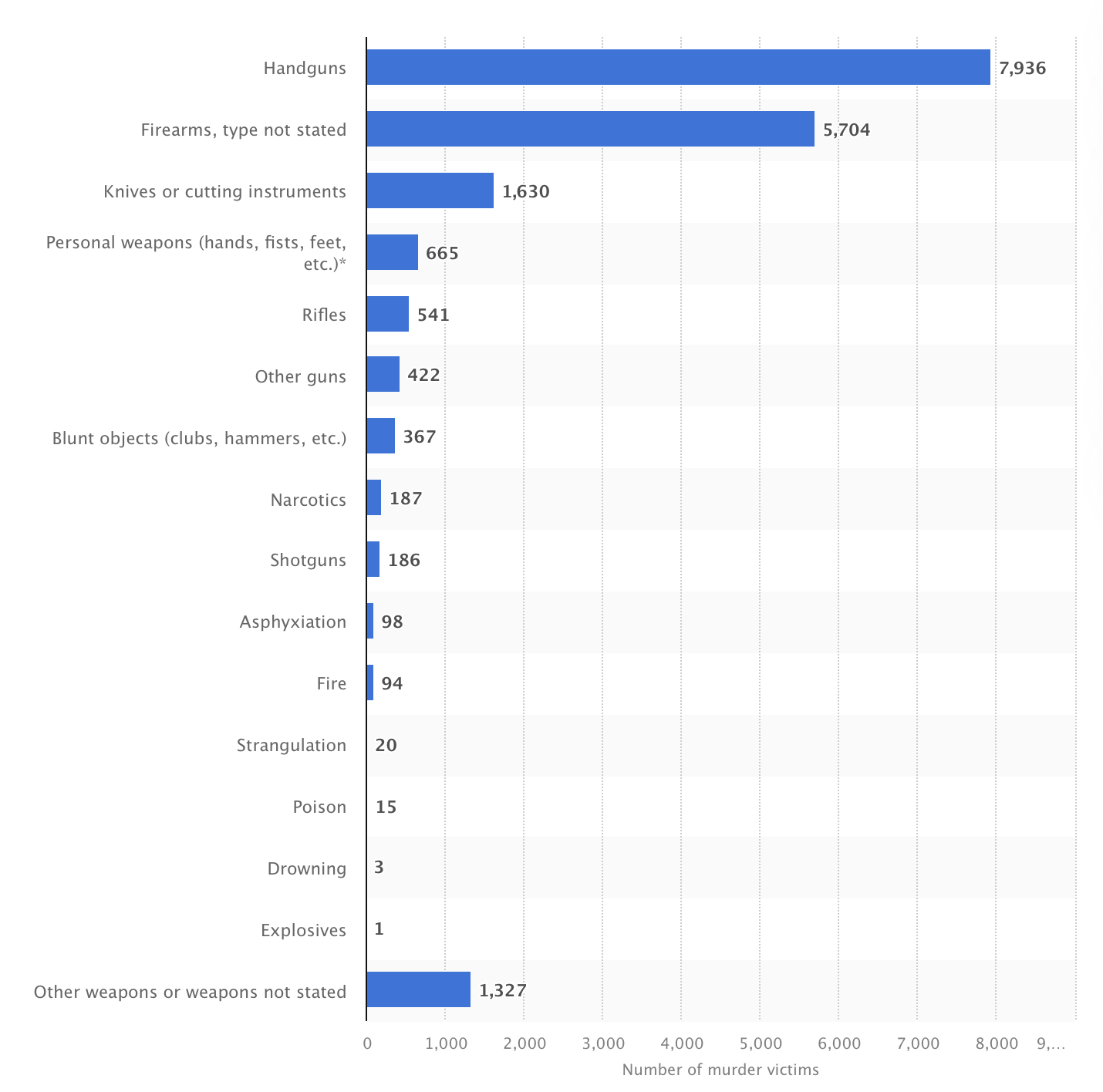
Number of murder victims in the United States in 2022, by weapon used. Source: Statista 2024
A third thing that needs to be said is that this and other recent cases of high-profile mass shootings are being used by Presidential candidate Kamala Harris and other Democrats to advance the cause of banning what they refer to as “assault weapons” or “AR-style rifles,” i.e., a particular type of rifle that has military applications. As the reader can see, the weapon of choice in murder (and this is true for suicide, as well) is the handgun. Of the 19,196 murders recorded for 2022, rifles were used to perpetrate 541 of them—fewer than were killed with personal weapons, i.e., hands, fists, feet, etc.—or 2.8 percent of murders. The reason the focus is on the so-called assault weapon is that elites believe military-style weapons are the most effective weapon in resisting government tyranny.
Ethan Crumbley stands with his attorneys, Pontiac, Michigan, December, 2023.
The fourth thing that needs to be noted, and this is what I want to focus on in this essay, is the disturbing trend in punishing a parent or parents for crimes perpetrated by their children. Recall the 2021 Oxford High School shooting in Michigan. The shooter, Ethan Crumbley, a 15-year-old student at the school, was convicted of murder in the deaths of four students and injuries to several others. In that case, the shooter’s parents, James and Jennifer Crumbley, were convicted of manslaughter for their role in the shooting and sentenced to ten to fifteen. What was their role? In sentencing the Crumbleys, Oakland County Circuit Court Judge Cheryl Matthews said James Crumbley provided “unfettered access to a gun or guns as well as ammunition in your home,” while Jennifer Crumbley “glorified the use and possession of these weapons.”
Millions of homes in the United States have unfettered access to guns and ammunition (as well as knives, clubs, poisons, etc.). In Michigan at the time Crumbley committed his crime there were no specific laws about the minimum age for possessing a firearm under parental supervision. Nor did Michigan have a specific law mandating safe storage of firearms in homes or any laws that directly addressed parental responsibility or liability for the misuse of firearms by minors in their home. The First Amendment protects a mother’s glorification of guns. The glorification of guns is part of American culture. That James and Jennifer Crumbley could be sent to prison for something they did not do, namely take a gun to school and shoot people, is an obvious case of misattribution of responsibility. Deranged by the desire for retribution, the state punished those who did not perpetrate the crime.
Colt Gray appeared in the Barrow County Courthouse in Georgia this morning for his arraignment alongside his father, Colin Gray. Judge Currie Mingledorff informed Colt that he could face life in prison if convicted of any of the four felony murder charges brought against him. Despite his age, Colt is being tried as an adult. Colt’s father was informed that he could face up to 180 years in prison. Colin faces charges including four counts of involuntary manslaughter, two counts of second-degree murder, and eight counts of cruelty to children. Colt is accused of using an AR-style rifle to open fire on students and staff at Apalachee High School in Winder, resulting in the deaths of two 14-year-old students and two teachers. The victims were students Mason Schermerhorn and Christian Angulo, as well as teachers Richard Aspinwall, 39, and Christina Irimie, 53.
Colin is alleged to have purchased the semi-automatic weapon as a Christmas gift for his son. As in the case of Crumbley, guns were a prominent feature of Gray’s home life. Last year, Georgia authorities visited the Gray residence after receiving an FBI tip about concerning messages posted on Discord, where Colt had allegedly made threats to “shoot up a middle school” and shared photos of firearms. Colin told investigators that there were guns at their home, but that his son did not have unauthorized access to them.
Georgia does not have universal background checks for gun purchases, safe storage laws, or so-called red-flag laws. As readers might imagine, there a lot of households in Georgia with lots of easily-accessible guns. Georgia law does prohibit an adult from “intentionally, knowingly, or recklessly” selling or giving a handgun to a minor. If convicted of that offense, the adult could face felony charges, which may result in prison time or a fine. However, there are exceptions to this rule. Minors may possess handguns if they are attending a hunting or firearms course, practicing on a shooting range, participating in a competition, or are at home with parental permission. These exceptions are not applicable if the minor has been convicted of a forcible felony, but Colt Gray has no convictions for forcible felonies to my knowledge. That Colin could possess guns and allow his son to use them is not a criminal offense.
In its coverage of the story, The New York Times has cited experts from the Johns Hopkins Center for Gun Violence Solutions who noted that the law’s lack of penalties for negligent storage and absence of safe storage requirements makes it less effective in reducing gun violence and firearm-related deaths among children. More than this, it makes it difficult to imagine how Colin Gray could be held responsible for the actions of his son. “Georgia’s law is not actually geared toward preventing unauthorized access of firearms by children—it’s instead focused on punishing adults who recklessly or intentionally give children handguns,” said Tim Carey, a law and policy adviser with the center. Perhaps the father can be punished for recklessly giving his so a firearm. But how does that translate into holding the father responsible for murder and putting him in prison for the rest of his natural born life?
I saw the case of James and Jennifer Crumbley as a warning sign that justice in the United States was regressing. Of course, the Crumbley case was an n=1. We now have two cases. A culture of personal responsibility underscores a fundamental principle: firearms themselves are neutral tools, their impact dependent solely on human action and intent. In communities where guns are an integral part of daily life, such as in Tennessee, the state in which I grew up, the emphasis is placed on the responsible handling and use of firearms rather than on the guns themselves as sources of violence. I grew up in a home with easy access to guns and the freedom to use those guns for legitimate purposes. It would be inconceivable then than my father would be held responsible for something I did with a firearm.
This cultural understanding acknowledges that while firearms are easily accessible, their use is governed by a deep-seated ethic of individual responsibility. The notion that “guns don’t shoot themselves,” which I find myself having to frequently remind people of, aligns with the belief that accountability lies with the person who wields the weapon. Accountability focuses on responsible gun ownership practices—safe storage, proper training, and adherence to safety protocols—rather than imposing broad restrictions that do not address the root causes of gun violence, or holding people responsible for the sins of others.
The presence of guns in the home is not inherently dangerous but rather that the potential for harm is mitigated through education and conscientious behavior. By fostering a culture of safety and respect for firearms, communities can maintain the freedoms associated with gun ownership while actively working to prevent misuse. This stance supports the idea that effective solutions to gun violence involve addressing behavioral issues and ensuring that responsible gun practices are upheld, rather than constraining access to firearms, which are a legitimate part of many people’s lives and traditions.
More broadly, and I have made this point in criticizing the fallacious logic of critical race theory, holding individuals accountable for the actions of others is ethically and morally problematic as it violates the fundamental principle of justice and personal responsibility. In enlightened legal and moral frameworks, responsibility should be directly linked to one’s own actions and intentions rather than being arbitrarily extended to others. Holding people accountable for the actions of others not only undermines the principle of fairness, but it also risks regressing to forms of justice reminiscent of primitive or collective forms of punishment, where individuals are held liable for acts they did not commit.
In modern, rational societies, justice is ideally grounded in individual accountability, ensuring that legal and moral responsibility is assigned based on direct involvement and intent. This approach reflects a rational form of justice wherein each person is judged by his own conduct. Whatever the parents of Ethan and Colt did, it cannot be murder. They neither pulled the trigger nor commanded their sons to shoot anyone. Ethan and Colt made the decision to take those guns to school and shoot those people. They are solely responsible for that decision. That both were charged as adults indicates the court’s understanding that they were mature enough to take on that responsibility and suffer the consequences of their actions.
I began this essay by quoting Vice-Presidential candidate JD Vance concerning the problem of schools as soft targets. I want to conclude by acknowledging that Vance is right and that my past criticisms of school resource officers (SROs) and target hardening were wrong. In a 2018 essay on Freedom and Reason, The Garrisoning of Our Schools, I summarized my ideas and linked to two op-eds I had recently penned, one published in the Green Bay Press Gazette (“Police in schools does not make them safer”) and another for TruthOut (“How Garrisoning Schools with Armed Resource Officers Normalizes Authoritarianism”). I was rightly thumped by those who took the time to critically respond to those columns.
In the TruthOut essay I wrote “Cops in schools neither makes schools safe nor facilitates education. The socialization of danger fosters a sense of insecurity and hopelessness, a mood on which authoritarianism thrives.” Yet, if it has not been for two SROs at Apalachee High School, Brandon King and Donovan Boyd, there would likely be more dead and injured students, staff, and teachers. Gray “was armed, an SRO engaged him, and the shooter quickly realized if he didn’t give up this would end with an officer-involved shooting,” said Barrow County Sheriff Jud Smith. Deputies and SROs were on scene within minutes after the incident was reported. “He got on the ground and a deputy took him into custody.”
Public safety is a human right. Children deserve to be safe in school. Their parents should have the peace of mind that schools are doing everything they can to keep their children safe. In light of the level of violence in our society, making schools safe will involve measures I have criticized in my past essays. Moreover, evidence indicating the deterrent effect of police presence suggests policies that put more police on our streets. Increased patrols lead to reductions in crime rates; the presence of police enhances the perceived risk of arrest. Just as I changed my mind about the systemic racism underpinning lethal civilian-police encounters when confronted with facts, so I must change my mind in light of these cases and announce that change of mind.
Federal employees are being compelled to undergo training and workshops in DEI, etc. That’s political. When the NIH tells its employees that they must misgender others, they are compelling a politics. When NIH is hiring people on the basis of race or some other tribal identity while rejecting qualified applicants, that is political.
The administrative apparatus has been captured by woke progressivism and identity politics. They don’t have to say “Vote for Democrats!” Of course that’s forbidden. Elites dissimulate politics with rules like that. Feigned neutrality acts as a fig leaf to cover politics. You’d have to be willfully blind to not see their junk hanging out.
I work in a public institution. We aren’t allowed to use our offices, our phones, our classrooms, our emails, etc., for partisan political ends. However, if you don’t know that public universities are ideologically-captured and overwhelming pro-progressive and pro-Democrat, then you’re astonishingly naive. Faculty at public universities are protected by tenure and academic freedom; they can be ideological—and really-political. But a public university must be neutral with respect to the rights of citizens.
That the administration of a university should be ideologically and politically neutral is one thing. The notion that the federal bureaucracy should be is another. This is because the Executive, like the Legislature, is elected by the people to reflect the will of the people. The entire problem with the current state of affairs in the Executive branch is that the administrative apparatus is not politically appointed. There should be no agency independence from the Executive. You deserve the bureaucracy you vote for.
Just as Congressional staff should be loyal to the congressman they serve, so should the administrative staff be loyal to the Executive they serve. That’s what we vote for when we vote for President. We don’t vote for an Executive to head a bureaucracy that works against his agenda. We vote for the agenda, and we have a right to expect that the agenda directs the bureaucracy, carries out the laws formulated by the Legislature, within the rule of law overseen by the Judiciary.
This is especially important in light of the fact that the regulatory apparatus was created by progressives and industrialists as public relations for corporate interests and has been captured by corporate elite to prevent independence from their power. This is what we mean by deconstructing the administrative state, which has come to exist beyond the control of the Executive—we mean clearing out the political operatives from the other party, removing the permanent class of progressive activists, and restoring the constitutional republic to its three branches and the principle of separation of powers.
“Agency independence” is the slogan of corporate statism. Elites seek to decouple of agencies from the Executive to capture them and have them serve the interests of the corporate state. It’s time to fix this problem for good by deconstructing the administrative state. To do this, we need a revolution at the ballot box this November.
Elon Musk buying and opening up Twitter—now X—to diverse opinions is indeed dangerous to existing social relations, specifically to the authoritarian powers that shape the grand narrative. The effect of Musk’s takeover of the social media platform founded by Jack Dorsey and comrades in 2006 has confirmed the importance of mutual knowledge in connecting people across space, allowing them to see that their common sense is in fact common. It has also helped them see the forces disrupting their common sense and to grasp that these elites are not serving the general interests but their own egos and opulence.
Elon Musk of X
It is much easier to gaslight people when they are isolated. A man sits in his room and thinks to himself, “A man cannot be or become a woman.” Then, when he ventures online, it appears as if he is alone, that the world thinks otherwise—at least he sees that those who think like he does are shamed or punished. His workplace, too, told him his common sense is wrong and that he would be disciplined if he denied it. He begins to think his thoughts are wrong. They are bad thoughts. Maybe he’s even crazy for thinking them. Is it possible that a man can change his gender? Or maybe he compromises and acts in bad faith, going along with the lies to survive. Either way, he is oppressed.
When Musk bought Twitter acquired Twitter in 2022, he ended the practice of banning and censoring people who question, among other things, queer theory—those who deadname and who refuse to use preferred pronouns (the gateway drug to gender ideology). Now our gaslit man has a chance to see that he is hardly alone. Indeed, he sees that majorities across the world agree with him. His common sense does work. He in’t crazy, after all. Of course it’s true that there are only two genders.
In mutual knowledge our man finds the courage to speak the truth. His understanding of the world is not merely saved; it expands and deepens. The man sees that the reason he doubted himself, or acted in bad faith, is because a power stands over him, the power of the corporate state possessed by woke progressivism. He not only has confirmation of his common sense; he now has the object of his oppression in his sights. He has a politics now. A politics of truth. He can see the enemies of truth.
I showed my appreciation for what Musk did by buying a verified account. Progressives like to note my blue check mark, as if this were a bad thing. I respond that they’re free riders. I’m a paying customer because I want to keep X going. In a world where authoritarian attitudes and actions are ubiquitous, X is a beacon of light. We can’t let that light go out.
Imagine if Musk had owned Twitter during the pandemic. It would have been much more difficult to convince people to wear masks, stay indoors, socially distance, get vaccinated. Progressives read this with alarm. That’s because progressives hate autonomy and liberty. They don’t want people thinking for themselves. They want to control people. They know the way to do that is to keep from them information they need to make rational decisions for themselves, their families, and their communities. They want our man alone. But he’s not alone anymore.
Among the defining characteristics of authoritarian regimes is the promotion of identity politics, where select groups are afforded privileges over others based on some intrinsic feature (like skin color), and the systematic censorship and suppression of dissenting speech, often accompanied by compelled speech.
There are lot of other signs. These regimes manipulate the rule of law, using legal mechanisms to imprison political opponents—a practice known as lawfare. They also infuse education with ideological content designed to disrupt common sense and establish a new social logic, while elites manufacture and impose culture and revise history to align with their agenda. In these regimes, justice and truth become subverted for partisan purposes; the administration of law, knowledge, and science become increasingly arbitrary and technocratic, serving the interests of those in power.
These regimes often disguise one-party rule with superficial appeals to democracy, extolling the virtues of the state while diminishing the autonomy of the individual, leading to a dependency on the government and the infantilization of the citizenry. They alienate and weaken the family structure, usurping its authority and exerting state control over children, while simultaneously ensuring subservience to oligopolistic interests.
Many Americans and others around the world have noticed that this description increasingly resembles the practices of today’s Democratic Party. We need to raise the alarm about this.
The true threat to democracy
Apologists for the Democratic Party rationalize these measures as necessary to address systemic inequalities, promote social justice, and protect marginalized groups. But even if we accept the premise that systemic inequalities and social injustices exist, and that marginalized groups require protection, the censorship, identity politics, lawfare, and manipulation of education and culture that are evident in contemporary American politics cannot be justified in these terms. These tactics, emblematic of authoritarianism, are antithetical to the core principles of freedom and democracy. Freedom and democracy and the most precious things on earth—that and the courage to resist attempts to undermine them.
At the heart of a free society lies freedom of speech and expression—the right to voice opinions, ideas, and beliefs without fear of retribution or suppression. A true democracy fosters an open marketplace of ideas where diverse perspectives can be shared and debated freely. Likewise, the principles of individualism and universalism emphasize recognizing and treating people as autonomous persons rather than as members of specific identity groups. This approach upholds our common humanity and equality under the law, advocating for policies that transcend group identities and focus on individual rights and merit.
Similarly, the rule of law with impartial justice is foundational to a fair and moral society. It demands the equal application of the law, free from political manipulation; justice should be based on objective legal principles rather than partisan interests, ensuring that the legal system remains neutral. Furthermore, academic freedom, coupled with critical thinking, is essential to a healthy society. An education system that promotes critical analysis, open inquiry, and the pursuit of knowledge based on evidence and reason is crucial. Culture should evolve organically from the people rather than being imposed from above.
These principles—freedom of speech and expression, individualism and universalism, the rule of law with impartial justice, academic freedom, and cultural integrity—must never be sacrificed for the sake of party ideology. They are the bedrock of democratic republicanism and classical liberalism, principles that have long guided the American experiment.
Embracing a warmonger
And we cannot forget this: add to the mix I identified at the outset neoconservative warmongering. Rationalizing its belligerency as a mission to spread democracy, neoconservatives advocate for the use of force to achieve geopolitical objectives. What are those objectives? A one world order based on transnational corporate power. Neoconservative policies prioritize military solutions over diplomacy, neglect the consequences of regime change, and fuel perpetual conflict in the service of powerful elite. This, too, is an expression of the ideology that moves the Democratic Party.
The growing centralization of power and the drift towards authoritarian practices within the Democratic Party, which increasingly staffs and controls the apparatus of the state, should be the focus of concern for all who care about democratic republicanism and classical liberal principles. The party’s approach to politics and speech regulation, its alignment with corporate interests, and the erosion of individual autonomy through the influence of technocratic elites parallel those in more overtly authoritarian regimes—and neoconservative warmongering. If left unchecked, these developments threaten the very foundations of American democracy, eroding the freedoms that have long been its hallmark.













 freedom and reason