The State of Cognitive Liberty at Today’s Universities

A few weeks ago I reported the results of a survey conducted by UW-Stout’s Menard Center for the Study of Institutions and Innovation and the Wisconsin Institute for Public Policy and Service that interviewed more than 10,000 University of Wisconsin System undergraduate students. Questions covered such topics as the First Amendment, whether speech considered harmful should be reported to administrators, and if speakers some students find offensive should be disinvited by campuses. 

University of Wisconsin-Stout

As I reported in the spring of last year, the survey was originally scheduled to be administered in April 2022 but was delayed for months due to opposition by administrators and faculty. Democrats worried that the survey would confirm what they and the public already knew, that the university has become a lot like a cathedral, with professors functioning as a clergy, preaching to a congregation of faithful youth, sitting in the pews and uttering amen to the faculty’s preachments.

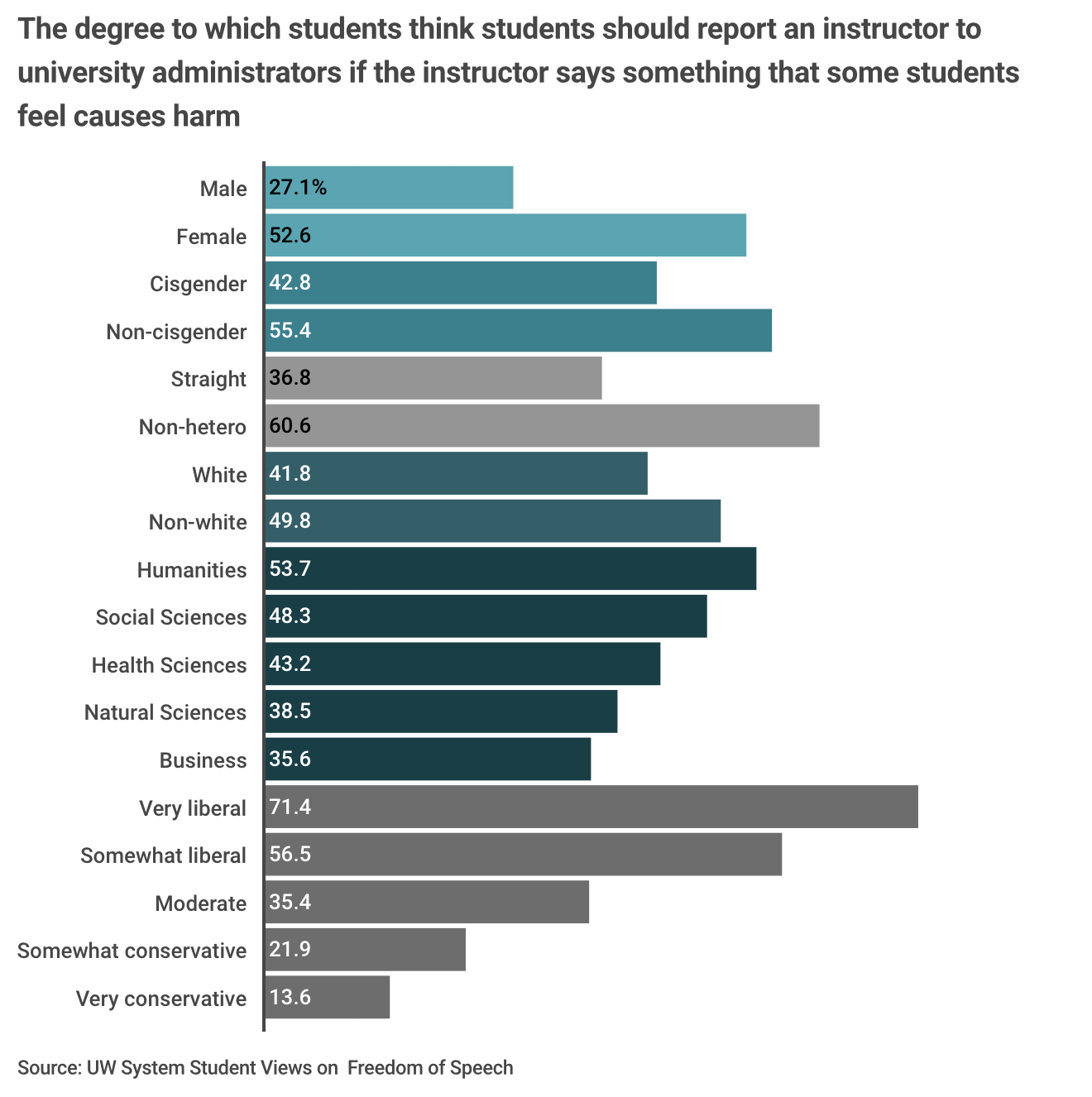
You can read the full report here. I highlighted these findings in my February 7 blog: students classified by the survey as “very liberal” were the least likely to report feeling pressured by an instructor to agree with a specific political or ideological view being expressed in class (15.1 percent), most likely to agree that university administrators should ban expressions of views they feel cause harm (40.2 percent), and most likely to agree that the students should report an instructor to university administrators if the instructor says something that some students feel causes harm (71.4 percent). A majority of students described as “somewhat liberal” also agreed that students should report teachers to administrators.

My interpretation of these results is that “very liberal” students find the campus environment one in which their views will be reflected and are the most likely to express illiberal attitudes. Indeed, the number of students expressing illiberal attitudes indicates a deep and profound authoritarianism among those students classified as “very liberal.” I clarified in that blog that this means that they are not in fact very liberal but woke progressive, a sensibility that, while rare in the world outside college, shapes the climate of college campuses across the nation.

I contrasted these attitudes with those students the survey classified as “very conservative.” With “somewhat conservative” students were not far behind them, very conservative students were most likely to report feeling pressured by an instructor to agree with a specific political or ideological view being expressed in class (64.4 percent), least likely to agree that university administrators should ban expressions of views they feel cause harm (79.7 percent), and least likely to agree that the students should report an instructor to university administrators if the instructor says something that some students feel causes harm (13.6 percent).

Some might rationalize the first finding by claiming that conservative students are prepared to overreact and feel that their ideas are repressed. But knowing what we know about the strident anti-conservative views expressed by today’s faculty, especially in the humanities and social sciences, and in light of the two other findings indicating the highest degree of tolerance for a diversity of ideas among conservative students, this could only be a rationalization. In fact, students described by the survey as “very conservative” are the most liberal.

In my February 7 blog, I spent more time clarifying terms, as well as looking at the political leanings of the general population (relying on Pew numbers for comparison), in order to show that what the survey mischaracterizes political leanings. The important point to keep in mind here is that progressives are overrepresented among academics, as well as their students in the humanities and the social sciences. Keeping this in mind helps readers understand the points I make in this blog.

The opinion that students should report teachers to university administrators if the instructor says something that some students feel causes harm was furthermore correlated to the field of study, with students majoring in the humanities and social sciences to be most Stasi-like at 53.7 percent and 48.3 percent respectively. I used this characterization in my previous blog, so I want to explain it here.

Why do I say Stasi-like? Stasi was the secret police of East Germany during the Cold War. Its primary mission was to maintain the political stability of the totalitarian government by suppressing dissent and opposition. With an estimated 90,000 full-time employees and over 170,000 informants among the population of 17 million people in East Germany, it was one of the most pervasive and oppressive secret police forces in history. The Stasi not only operated a vast network of spies and informants, it also engaged in psychological warfare, including disinformation campaigns to discredit those whose speech was believed to undermine the hegemony of the prevailing cultural and political ideology.

That almost three-quarters of the most progressive and well more than half of the somewhat progressive students, think that students should report an instructor to university administrators if the instructors say something that some student feel causes harm—with the harm they have in mind views critical of the prevailing ideologies, i.e., critical race theory, queer theory, and other crackpot standpoints advanced by progressive administrators, faculty, staff, and students—is a frightening level of repressive desire expressed by those who should be demanding an environment that doesn’t shy away from critical inquiry but makes live Karl Marx’s well-known motto regarding the importance of criticism, that is “the ruthless criticism of everything existing.” Like Marx, I am fond of the latin De omnibus dubitandum est, meaning “everything must be doubted.”

Marx believed that critical analysis was essential in understanding and changing the world. He encouraged the examination of cultural, economic, political, and social structures to expose their underlying contradictions with the goal of creating a more just and equitable society. One would think, given the “social justice” and “critical consciousness” rhetoric of the woke progressive, that those identifying themselves as such would be the least likely to report teachers who said things that students feel causes “harm,” i.e., challenges orthodoxy, given that the idea of critique means not holding back for fear of offending or upsetting people. The irony here is that, by subjecting all aspects of culture and society to critical examination, Marx believed that individuals could better understand the underlying causes of inequality and oppression, and work towards creating a more egalitarian and democratic world. But those who are most likely to identify themselves as Marxist have the opposite attitude. Of course, the Stasi, who served a regime that was at least nominally Marxist, were likely to identify themselves in the same way.

Yes, I did mean to describe this attitude as repressive. That word is used to describe a system or climate that suppresses or restricts the expression of free speech or other forms of individual liberty. We see as repressive government censorship of certain books or restricts access to information. We are also coming to see this as also true of private action in the era of corporate statism (Marxists and left-libertarians always have). However, a workplace or social environment where individuals are discouraged from expressing their opinions or ideas due to fear of retribution is also repression. Reporting teachers for saying things that some students find “harmful creates a chilling effect where teachers who might deviate from the woke progressive doctrine so pervasive in today’s university will cause those who are supposed to challenge ideology to avoid arguments and subjects they fear will cause students to report them to administrators—who are inclined to follow up on their complaints.

When I don’t there are consequences. This happened to me last week. As readers of Freedom and Reason know, I have been very critical of Black Lives Matter on my blog. I have shown that major claims BLM and other social justice activists have advanced over the last several years, that racial disparities associated with lethal police encounters and mass incarceration are the consequence of systemic racism, are refuted by the scientific research. Since, in my capacity as an expert in criminology, I talk about these issues in class. I knew it was only a mater of time before students would take issue my criticisms of BLM. I had hope this would have taken the form of challenges in class. But instead, and not unexpectedly, they reported me to administrators. They did so anonymous.

The administrator who spoke with me was very pleasant and reassured me that my political activities as a citizen in a free and open society were my business. I appreciated that. He conveyed that the students felt my speech was contrary to the mission of the program I teach in (I built the program and wrote that mission) and that this may impact retention among, not only devotees to BLM, but LGBTQ+ students, as well. This is because I am also critical of queer theory—not in class, but on my blog—and have pointed out (again on my blog) that both Antifa and BLM are trans-activist organizations. Imagine a world where we are reported to the authorities because we are critical of an ideology. Imagine furthermore that those reporting their professors to authorities for thought crimes do so anonymously. We don’t have to.

One question put to me by the administrator was whether I play Devil’s advocate in class. This was after I confessed my opposition to Black Lives Matter. He explained that he does this in his literature classes, arguing a position that he doesn’t necessarily agree with or believe in for the sake of stimulating discussion or debate, specifically to challenge or test the strength of a particular argument or idea by presenting alternative viewpoints, regardless of one’s personal beliefs. I explained that I don’t use this strategy; rather, my method is debunking mythology with facts. I do steel man arguments, I hastened to add, but I don’t think this is the same thing. I steel man arguments because burning effigies is a religious exercise. I find that distasteful.

Speaking of straw men, it is not without irony that the term “Devil’s advocate” comes from the Catholic Church, where it refers to a person who presents counterarguments during the canonization process of a potential saint. The Devil’s advocate was expected to present arguments against the saint’s worthiness for sainthood, in order to ensure that the canonization process was thorough and rigorous. In other words, the Devil’s advocate puts the potential saint’s faith to the test—as well as the faith of those involved—in order to make sure the saint could in no way afterward be said to fall short of the stature sought at the end of the status elevation ceremony.

This is not the first time I have been reported to the administration, although it is the first time by students. I have been the target of ongoing campaigns of harassment and suppression since coming to Green Bay. I want to talk about this here to establish a coherent public record of the harassment. The facts in support of the narrative I present here are well-known by multiple individuals and already a matter of public record.

In 2002, early in my professorial career, I published “Advancing Accumulation and Managing its Discontents: The US Anti- Environmental Countermovement,” in Sociological Spectrum. I would win an award for that article in 2003, and I was set to testify in a lawsuit in Connecticut, but the case never went to trial. In October 2002, at the Mid-South Sociological Association conference in Memphis, Tennessee, I presented the paper “Paper Mills and Science Mills: The Battle for the Fox River.” I wouldn’t know this yet, but my work in this area put me on the radar screen of polluting corporations who would attempt to sabotage my bid for tenure in 2004. 

In the meantime, I had turned my attention to criticisms of the Bush/Cheney regime which was warmongering over Iraq in the aftermath of the September 2001 terrorist attacks against the Untied States. I published two articles in the newsletter of the Marxist Section of the American Sociological Association, From the Left, critical of the war plans—“A Shrill Cry for War” in 2002 and “God’s Gift to Humanity” in 2003—as well a March 2003 article in The Public Eye (a publication of the anti-fascist organization Political Research Associates) “Faith Matters: George Bush and Providence.” Just before my Public Eye essay, on March 4, I gave a speech before hundreds of students and faculty at the University of Wisconsin-Green Bay (“Bush’s Dream of a Democratic Middle-East”). My polemics were delivered on the eve of the invasion of Iraq, I was highly critical of the government and the machinations of the Project for a New American Century that was driving the war push. 

Recordings from this speech, and likely additional content from classroom lectures from that semester, were played on the Bill LuMaye show (AM 1360) for several days. My colleagues heard the programs. The host and callers were incensed at my rhetoric and analysis. I was “anti-American” and a “communist.” The College Republicans, who had attempted to disrupt the March 4 teach-in, and who had likely been the source of the recordings, sought to publicly ridicule me on campus, naming me “Man of the Year” and distributing flyers around the school of my image draped in American flags. Students overwhelmingly expressed support for me and condemned the College Republicans. At another event on campus, which I did not attend, community members disrupted the proceedings complaining about the “mistreatment” of conservative students on campus. Their complaints concerned the fallout from my treatment—the College Republicans had lost their faculty sponsorship. Faculty had also rallied around me. 

Then, in May of 2004, as I was preparing to the come up for tenure that upcoming fall, the chancellor, Bruce Shepard (who later became president of Western Washington University), received an email from somebody who claimed to have “discovered” on the Internet writings by me critical of administration and faculty. The Secretary of the Faculty forwarded the letter to me (it never made it into my personnel file) and I could see that the phrases were taken from that 2002 speech in Memphis and twisted around to make it appear as if I had slandered my colleagues—at least that was the Chancellor’s spin on my words. I wrote the chancellor back explaining what was going on. He didn’t have the decency to respond. As it turned out, he had written the email in a white heat—in the presence of the university attorney, who either could not or did not try to stop him from hitting send. 

Again the faculty rallied around me and I was awarded early tenure in June of 2005. But I was now in the crosshairs of some powerful forces. I had not let up on the corporate polluters and their political operatives. And I continue to condemn the warmongers. In 2004, I delivered a keynote address at a sociology conference in Tennessee, “Threatening Uncertainties: Fossil Fuels, Climate Change, and Foreign Policy in the 21st Century,” that lambasted the Bush administration. I published an essay that same year, first in the German language, then in English in 2005 (with Pluto Press), titled “War Hawks and the Ugly American: The Origins of Bush’s Central Asia and Middle East Policy,” in the collection Devastating Society–The Neo-Conservative Assault on  Democracy and Justice. The essay came out in Arabic a year later (and Indonesian after that). The collection contained an additional essay by me criticizing the Bush energy policy. Throughout all this I continued to hammer away at the government with essays in From the Left, for example “Bush and Sharon: Securing the Realm” (2004) and “The Downing Street Memo—Why it Matters” (2006). 

In fall of 2006 and spring of 2007 I accepted two stints at the United Nations University International Leadership Institute, held in Amman, Jordan, giving two high profile lectures, in addition to running workshops and participating in roundtables with individuals from across the planet. The first was called “Youth Leadership, the Politicization of Religion, and the Future of Democracy in the Middle East” (see Journey to Jordan, November 2006) and “Democracy and Human Rights in Transition: Challenges of the Globalizing World” (see Journey to Jordan, April 2007). At the second meeting, I was confronted in the back of the room by a Bush official, serving in the US embassy in Jordan, about my political activities. He told me that he had been informed of the contents of my speech the day before and that he was there on this day to provide the administration’s position. This was right after the new US embassy building had been built and the US and Jordan had renewed their security arrangement. My institution had been working closely with the University in Jordan at Amman, a process in which I was deeply involved. Apparently word had gotten back the university about all this and I was never informed of another meeting of the committee after that. 

Me and US Embassy’s Counselor for Press and Cultural Affairs Philip Frayne

The ramifications of all this have been rather significant. Permit me to speculate here. I do not have evidence to support my suspicions. However, with the release of the Twitter files, which exposes the collaboration between the administrative state and social media companies, it seems apparent to me why, after more than ten years on Twitter, I have only 180 followers. Compare this to my number of followers on Gettr, the right-wing version of Twitter, where, despite being open about my Marxism, I have more than 700 followers, this after only being on that site for a year or so. Was my name entered into the shadow banning algorithms at the inception of the Twitter? This might explains why, when I search Google for blog entries from Freedom and Reason, certain ones of a certain character are not returned (you can probably guess which ones). (See Is Freedom and Reason Being Shadow Banned?

However, even with my marginal(ized) presence on Twitter, I still managed to find a way to get reported to the administrators of my university. Before this recent anti-BLM dustup, and after the campaign of right-wing harassment, I was reported for informing Nikole Hannah-Jones about the uptake of mRNA in the black community (see Cognitive Autonomy and Our Freedom from Institutionalized Reflex). Instead of educating the person who complained about the vital importance of academic freedom and the political and intellectual autonomy of teachers and researchers in the university’s employ, the complaint was sent down the chain of command and I was asked to consider not identifying my affiliation with the university in my Twitter profile. My response was to ask the colleague, who is also on social media, and politically active in Democratic Party politics, as well as in organized labor, whether his university affiliation also appears in his profile. There is an obvious double standard.

The soul-crushing part of the attempts to suppress me are the anonymous letters and messages from colleagues who beg me to come home to the tribe they think owns me (I even get this from some relatives). When people who have claimed to like and love you, people with whom you have had a social life, gaslight you it does some work on you emotionally. It’s also terribly disappointing because you want to respect people and that becomes very difficult in that situation. Even when they apologize, it goes to character. The point I want to make before moving on (and I am getting near the end of this blog) is how obvious suppression makes the prevailing hegemony. That quote shared on social media wrongly attributed to Voltaire is spot on: “To learn who rules over you, simply find out who you are not allowed to criticize.” That apparently white nationalist Kevin Alfred Strom penned that quote doesn’t change its power (although I am sure it does among the identitarians whose logic is necessarily rooted in the fallacy of ad hominem).

That reminds me! White supremacist Paul Nehlen sent cryptic and somewhat threatening messages to me and a colleague (who is Jewish) several years ago. The messages came as cards with text scrawled in Sharpie in big white envelopes delivered to our campus mailboxes. Why us? We turned over the messages to campus police, who returned them to us after determining that there was nothing to be done about it. The faculty around us condemned the letters. I can with almost 100 percent certainty guarantee you that I will never find faculty rallying to my side when the harassment comes from progressive students, colleagues, and community members.

* * *

During the Cold War in the United States, there was a period known as the “Red Scare” where citizens were made afraid of the perceived threat of communism and Soviet influence. This led to a culture of suspicion where people were encouraged to report any potential communist sympathizers to the authorities. As part of this culture, there were instances where students were encouraged to report their professors to authorities if they believed that they held communist beliefs or were teaching subversive material. 

These reports were made not only to government agencies such as the FBI, which would investigate the allegations and potentially take action against the accused professors, but were most frequently reported to department chairs, college deans, and chancellors and presidents of colleges and universities. Many professors had their careers destroyed and their lives ruined as a result. I don’t need to tell historians that the culture of surveillance and suspicion that developed during this time was a dark chapter in American history and a cautionary tale about the dangers of unchecked government power and the importance of protecting civil liberties. 

But I feel that I do need to tell them that it is no different now that it’s those claiming to have communist and left-wing sympathies who are reporting teachers they suspect of holding conservative beliefs and teaching subversive materials, i.e., criticism of Antifa, Black Lives Matter, critical race theory, and gender ideology. 

Resistance to facts is not only frustrating in its tenacity and therefore its function as a barrier to learning, but has become dangerous in the depth of its repressive reflex. Too many students today think it’s their duty to report their teachers to the authorities. They think this is what democracy looks like—just like students thought during the Red Scare when they reported their leftwing teachers to the authorities. And, just like during the Red Scare, compounding the problem are teachers who enable youth by failing to stand up for cognitive liberty and free speech—teachers who deny that repressive praxis is a serious problem when its the other side they think is being repressed. 

The word “censorious” is often used to describe this situation. But this is the wrong word. “Censorious” is an adjective that describes someone who is highly critical or disapproving, especially in a fault-finding way. A censorious person is quick to point out the mistakes of others, often in a harsh manner or moralistic tone. The word “censorious” describes an atmosphere, climate, environment that is highly critical or disapproving, such as a workplace or a social group where people are quick to judge or criticize one another. 

“Repressive” defines a climate or system or climate that suppresses or restricts the expression of free speech or other forms of individual liberty. This is the word we are looking for. We see as repressive government censorship of certain books or restricts access to information. We are also coming to see this as also true of private action in the era of corporate statism. 

However, a workplace or social environment where individuals are discouraged from expressing their opinions or ideas due to fear of retribution is also repression. Reporting teachers for saying things that some students find “harmful” creates a chilling effect where teachers who might deviate from the woke progressive doctrine so pervasive in today’s university will cause those who are supposed to challenge ideology to avoid arguments and subjects they fear will cause students to report them to administrators—who are inclined to follow up on their complaints. 

I admit that it has limited my own expressions—that is, I have engaged in self-censorship. 

“Repressive” refers to the act of controlling or limiting something, whether by authority or coercion. A repressive culture, regime, organization, system is one that seeks to control its citizens or members by limiting their freedoms and rights. Repressive systems use tactics such as censorship, propaganda, and surveillance to limit the flow of information and to suppress dissent or opposition. 

Such actions may be directed towards individuals, groups, or entire populations, and can have serious consequences for human rights, democracy, and social justice—even while appealing to these very things as the motive to repress. 

In a social or psychological context, repressive may refer to an individual’s attempt to suppress or deny their own thoughts, feelings, or desires. This can be harmful to an individual’s mental health and may interfere with their ability to form authentic relationships or to fully engage with the world around them. Repressive circumstances forces people to live in bad faith.

* * *

I will close on this business of retention because this is one more rationalization given to cover the pervasive authoritarian character of progressive students. It is not interesting how administrators, who in my experience promote the values of diversity, equity, and inclusion, do so while never asking whether the climate at today’s institutes of higher learning make it difficult to retain conservative and liberal students—or, for that matter, deter them from seeking a college education?

It is important for readers to understand is that the argot of DEI is not supposed to be taken on face value. One would think that diversity refers to the recognition and celebration of differences among individuals and groups, and the importance of including diverse perspectives and experiences in all aspects of society. But in practice, diversity means elevating the perspectives and experiences of nonwhite, non-cisgendered, non-heterosexual, and female above those of white, cisgendered, heterosexual men (I am using here the terminology from the UW System survey).

Equity does not refer to the creation of a level playing field where all individuals have access to the resources and opportunities needed to succeed regardless of their background or identity. Rather, diversity and equity are code words for preferences for those of minority status. And inclusion, despite appearing to emphasize practices of actively involving and valuing all individuals and creating a culture where everyone feels welcome and supported, actually means suppressing those attitude and opinions that minorities find harmful and worthy of reporting to administrators.

The reality of today’s university is that there has been an illiberal takeover of higher education by DEI activists and bureaucrats. Their work has been in stifling intellectual diversity, undermining equal opportunity and treatment, and excluding those who dissent from from the rigid orthodoxy of woke progressivism. This agenda that has been pushed down into 4k-12 education, producing students who value identity over liberty and exhibit authoritarian tendencies. By teaching young people that there are expressions that are harmful, teachers encourage young people to behave like the civilian informants that made the Stasi so effective in the repression of thought in totalitarian East Germany.

The solution? First, administrators, staff, and teachers have to explain to young people the importance of cognitive liberty and free speech to their own struggles for justice. The great civil rights victories of history occurred because the norms of free speech, association, and assembly allowed people to develop their arguments, legitimize their struggle, and persuade others to join them. We must also abolish DEI bureaucracies and end mandatory diversity and sensitivity training. Tragically, too many administrators, faculty, and staff are committed to DEI. And there is inertia in bureaucratic systems. Many colleges and universities invite, and some even require current and prospective faculty to demonstrate, often in written statements, what appear as loyalty oaths (and they are just this), their commitment to diversity, equity, and inclusion (DEI), statements used not only in hiring decisions, but in evaluations, contract renewals, tenure, and promotion decisions.

I was appointed to my current position in 2000. This was before the madness. If I were entering the job market today, I would either have to lie or find another occupation. Given how fast and how completely the institution of higher education delegitimizing itself, I would probably regret having gone to graduate school in the first place.

“Yesterday’s political correctness is today’s wokeness”

“Nothing comes from nowhere,” said Glenn Loury on Substack yesterday. “Today’s woke politics have they’re antecedent in debates about speech and censorship that have been raging in this country for some time. Back in the 1980s and ‘90s, I was a vocal opponent of political correctness on college campuses. Student activists, often supported by select faculty members, tried to purge the classroom of language and ideas they deemed unacceptable. Classic texts and harmless figures of speech came under assault in the one place where free inquiry was most vital.”

Glenn Loury, professor of economics at Brown University

Loury continued: “Yesterday’s political correctness is today’s wokeness. The continuities are impossible to ignore. And while, with the benefit of hindsight, I might revise some of what I said about political correctness in the past, it’s more imperative now than ever to push back against censoriousness, nonsensical speech codes, and the erosion of standards.”

Loury is right. We have entered another troubling period in the history of our republic. Just last week I had students report me to administrators for—get this—presenting facts in class that refute the Black Lives Matter’s narrative on lethal police encounters. How presenting facts could be seen as worthy of complaint seems bizarre, but it’s an all too common occurrence these days among those identifying as very progressive. These students found my blog and declared me to be “anti-Black Lives Matter.” Guilty as charged, I told administrators. (I will blog about this tomorrow.)

Woke progressivism is severely hobbled by the “racism of the gaps,” a species of faith-based argument (see my recent Lethal Police Encounters and Criminal Violence). Faith-belief is seen across what passes for the left today. Resistance to facts is not only frustrating in its tenacity (and in the harm it is causing to accountability and reform) but has become dangerous in the depth of its repressive reflex. Too many students today think it’s their duty to report their teachers to the authorities. They think this is what democracy looks like. Compounding the problem are teachers who enable youth by failing to stand up for cognitive liberty—or worse: denying that repressive praxis is a serious problem. 

A big piece of this is that there is no crisis justifying large-scale protest action. The perception that there are big problems is fed by myth-makers who spin narratives about systemic racism and sow mass hysteria about climate change. A genuine anxiety makes young people susceptible to these projects, as the conditions of late capitalism are felt but have been made remote not only by fake crises, but by the suppression of proletarian consciousness. There is moreover the narcissistic desire to be a part of something significant. The young want their civil rights struggle. They want a place in history. Progressive teachers do their part in encouraging them to “take action.” But without anything significant to take action about, movement politics just become reactionary, however much they dress up in clothing that looks like cultural revolution–indeed, that’s part of what makes it so reactionary.

The only way we’re going to save openness and tolerance in our institutions is to openly condemn the desire among the youth and their allies in other age cohorts to suppress speech with which they disagree and repress those with whom they disagree. This condemnation has to start well before college. I am not hopeful, frankly. The imperative of the corporate state and technocratic desire are powerful forces against freedom. But we have to try anyway. We have to be very deliberate in our work to save free speech, conscious, association, and assembly from the woke brigade.

Jimmy Carter, Trilateralist, Entering Hospice

“[The] nation-state as a fundamental unit of man’s organized life has ceased to be the principal creative force. International banks and multinational corporations are acting and planning in terms that are far in advance of the political concepts of the nation-state.” —Zbigniew Brzezinski (1969)

Former president Jimmy Carter has accepted hospice care at his house. Carter was a one-term president from 1977-1981. He was defeated in the 1980 election by Ronald Reagan. While many regard Carter as a failed president, this judgment obscures a significant period of intensive consolidation of corporate state power. Carter was not only one of the early and most influential members of the Trilateral Commission, but his administration was comprised of several members of that elite organization.

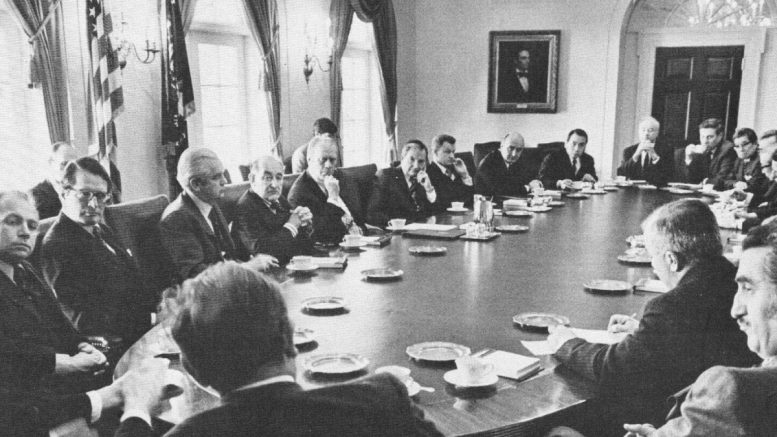
The Trilateral Commission in 1973. Founders Rockefeller and Brzezinski are siting to the left of Gerald Ford, also a member.

Carter was a member of the Trilateral Commission, a non-governmental organization (NGO) founded in 1973 by David Rockefeller, then chairman of the Chase Manhattan Bank, and Zbigniew Brzezinski. Rockefeller created the organization to coordinate policy development and political cooperation between North America, Europe, and Asia (including the Pacific Rim countries).

Carter was invited to join the Trilateral Commission in 1973 and became a member in 1974. Governor of George from 1971 to 1975, he was seen as a rising star in the Democratic Party. As a member, he attended meetings and contributed to the organization’s research and publications.

In 1975, the Trilateral Commission published The Crisis of Democracy, a report written by members of the Commission’s Task Force on the Governability of Democracies. The report was intended to address what the authors saw as a crisis in democratic governance in the United States and other Western countries.

One author of the report (the Europe chapter) was Michel Crozier, a French sociologist and political scientist. Crozier was associated with the idea of managerialism, which advocates applying managerial techniques to government operations. Another author was Samuel P. Huntington (the North American chapter), a Harvard professor also favorable to technocratic arrangements.

The report argued that the post-World War II era of economic growth had created a sense of entitlement among citizens, who were now demanding more from their governments than they were able to deliver. The authors suggested that this demand for more government services and greater participation in the political process was leading to a breakdown in the ability of democratic governments to govern effectively.

The report proposed several solutions to this crisis, including the need for greater cooperation between government and business, the need for greater technocratic expertise in government, and the need for greater control over the media to ensure that public opinion was not manipulated by special interests. In other words, The Crisis of Democracy reflected the anti-democratic and elitist attitude of its members, advocating for a greater role for technocrats and business leaders in the political process, while reducing the role of ordinary citizens. 

In 1976, Carter announced his candidacy for the presidency and while his membership in the Trilateral Commission became an issue in the campaign, the media downplayed the significance of his membership and the organization and Carter went on to defeat Gerald Ford (also a member of the Commission), who had been vice-president under Nixon. 

Following his election, Carter appointed several members of the Trilateral Commission to his administration, including Walter Mondale as vice president and Zbigniew Brzezinski as his national security advisor (Mondale would run for president in 1984). Brzezinski had been director of the Commission during the publication of The Crisis of Democracy. Brzezinski was a key architect of the Carter administration’s policy of supporting Islamist rebels in Afghanistan to draw the Soviet Union into that country. (See Sowing the Seeds of Terrorism? Capitalist Intrigue and Adventurism in Afghanistan. see also Hell on Earth or Earthly Heaven? The Totalitarian Threats Facing the West.)

Several other members of the Commission also served in the administration: Cyrus Vance served as Secretary of State from 1977 to 1980. James Schlesinger served as Secretary of Energy in 1977 before serving as Secretary of Defense from 1977 to 1979. Michael Blumenthal served as Carter’s Secretary of the Treasury from 1977 to 1979. Andrew Young served as Carter’s Ambassador to the United Nations from 1977 to 1979.

There were other politicians and policymakers who were members of the Trilateral Commission, most famously George H.W. Bush fame, who was a member of the Commission before he became vice president under Ronald Reagan in 1981. Bush was a member of the Trilateral Commission from 1973 to 1979, He served US Ambassador to the United Nations during this time, as well as Director of the Central Intelligence Agency (CIA).

Readers may remember when Bush mentioned the phrase “new world order” in a speech to a joint session of Congress on September 11, 1990. The speech was given in the context of the Gulf War, which had just begun. In the speech, Bush discussed the need for international cooperation and for the United States to play a leading role in shaping a new world order after the end of the Cold War.

“We stand today at a unique and extraordinary moment,” he said. “The crisis in the Persian Gulf, as grave as it is, also offers a rare opportunity to move toward an historic period of cooperation. Out of these troubled times, our fifth objective—a new world order—can emerge.”

Other members worth noting include Antony Blinken, Secretary of State under Biden, Jeffrey Epstein, former hedge fund manager (convicted of human trafficking in 2008), Larry Fink, BlackRock CEO since 1988 (also CFR board member and WEF trustee), Henry Kissinger, a former Secretary of State and National Security Advisor, and Paul Volcker, former Chairman of the U.S. Federal Reserve (under both Carter and Reagan).

Paul Wolfowitz, Defense Secretary under George W. Bush and president of the World Bank, was also a member. Wolfowitz was associated with the Project for the New American Century (PNAC), a neoconservative think tank that operated from 1997 to 2006 known for its advocacy of a more aggressive foreign policy and a more robust military posture for the United States.

The PNAC’s most famous publication was a 2000 report entitled Rebuilding America’s Defenses: Strategy, Forces and Resources For a New Century, which argued for increased defense spending, the development of new military technologies, and a more interventionist foreign policy. The report was influential in shaping the foreign policy priorities of the administration of President George W. Bush, several members of which had been associated with the PNAC prior to taking office. (See War Hawks and the Ugly American: The Origins of Bush’s Middle East Policy; Christian Neo-Fundamentalism and US Foreign Policy.)

Several members of the Trilateral Commission were also associated with the Project for the New American Century, including Paul Wolfowitz, who served as a member of the PNAC’s board of directors. Other prominent members of the Trilateral Commission who were also associated with the PNAC included Richard Perle, Dick Cheney, Donald Rumsfeld, and William Kristol.

They may come and go like Jimmy Carter, and George Bush before him, but these are the people who run the world. And they do it in the open. You only have to allow yourself to see it.

Lethal Police Encounters and Criminal Violence

Based on the most recent statistics, the annual rate of lethal police encounters is around 1.67 deaths per 100,000 civilians. Almost all of those deaths are explained by benchmarks, i.e., area rates of violent crime, and situational factors, i.e., suspect armed and/or a danger to officer and/or civilians. 

Bodycam video shows suspect shooting officer before being killed

Benchmarks and situational factors explain racial disparities. The only studies that don’t account for disparities using these metrics finds police more reluctant to shoot black suspects compared to white suspects. Police kill twice as many whites as blacks every year despite whites being proportionally underrepresented in serious crime and committing less than 50 percent of all murders and robberies. 

Contrary to the claims of Black Lives Matter and other woke progressive voices favored by the corporate state media, rates and patterns of lethal police encounters are functions of rates and patterns of criminal violence. The United States is remarkable among developed countries for the degree of violent crime. Public safety is a human right. The police are necessary to keep our communities safe. To be be sure, we need better trained officers. But we also need more of them.

The recent rise in crime cannot be explained by the presence of guns. Gun homicide rates are down sharply since their 1993 peak despite the fact that the number of guns per household has remained relatively stable thought out the first two decades of the new millennium and the average guns per person has increased drastically. Both the CDC and the FBI databases make clear that gun homicides is a function of who has guns not the number of or types of guns.

What explains the drop in violent crime since 1993 are policies putting more cops on the street (police presence is a deterrence) and increasing prison commitments (incapacitation keeps violent repeat offenders off the streets). What explains the recent and drastic rise in violence crime? Depolicing, decarceration, greater leniency in the criminal justice process generally, and the anti-public safety policies associated with the sharp rise of social justice politics and the myth of a racist criminal justice system (the Ferguson Effect).

* * *

Perhaps you’ve heard the phrase “God of the gaps.” This phrase gets at how god is used as an explanation for phenomena when rational explanations, those that depends on sound facts and valid interpretation, are unavailable. “God of the gaps” is an exercise in faith—a substitute for reason. As science advances, the gaps explained by god disappear. If you are prepared to accept reason, that is.

“Racism of the gaps” is the reflexive attribution of disparities between demographic groups to systemic racism. For example, although cops kill twice as many whites as blacks annually, blacks are overrepresented among those killed by the police. We are told that this is because of systemic racism in policing. Another common example is the claim that blacks are overrepresented in prison commitments because of systemic racism in the criminal justice process. As these disparities are explained by benchmarks and situational factors, the gaps close. 

However, not every believer accepts that reason explains phenomena. And they can always appeal to the nonfalsifiable nature of the god explanation to sustain their faith in the supernatural. Yet we cannot say this about the “racism of the gap” phenomenon since we can check to see if there are facts that close the gap (and there are). Still, as is the character of true believers, facts don’t change the minds of those committed to the reflexive attribution of disparities between demographic groups to systemic racism. The reflective attribution is too valuable as an ideological project.

The Second Anniversary of the Great One’s Passing

It’s the second anniversary of Rush Limbaugh’s death. On the occasion of his passing from lung cancer, I posted a remembrance on my Facebook newsfeed. It rather surprised people because I’m a Marxist and my politics are antagonistic to the man who probably represented the most unabashedly pro-capitalist voice in this history of talk radio. But I admire talent, and Limbaugh had a lot of it. Moreover, he was my companion in my morning commutes from my tiny cinderblock apartment in Knoxville, Tennessee to the University of Tennessee where I was obtaining my PhD. He was my companion for many years before that. And many year after. Indeed, I listened to Limbaugh from the beginning of his national syndication to the very end of his life. I’m reproducing the gist of that remembrance here for posterity. I have added detail in honor of the Great One.

Rush Limbaugh has advanced lung cancer
Rush Limbaugh and his golden microphone

Rightwing radio exploded the year I restarted my undergraduate career in 1988. Thanks to the rescinding of the FCC Fairness Doctrine the previous year, popular program was no longer bounded by arbitrary constraints on free speech. Reagan vetoed an attempt by Congress to preempt the inevitable end of the Doctrine in June 1987. In August of that year, under the leadership of FCC Chairman Dennis Patrick, the FCC abolished the doctrine by a 4–0 vote. The ruling was upheld by a panel of the Appeals Court for the DC Circuit, in February 1989. Democrats tried to reimpose the Doctrine in `1991, but George H. W. Bush threatened to veto the legislation. The Democrats backed down.

My mornings started out with a progressive Democrat for three hours, her gorgeous voice projected out of Nashville, Talk Radio 98.3/1510 WLAC. I’m pretty sure her name was Ruth Ann Harnish. A progressive true believer, Harnish was self-righteous and scolding and routinely owned by callers. I mean no disrespect, but the Doctrine sustained her. I admired her courage, of course. She took calls. In the buckle of the Bible Belt. Progressives always had trouble making it on AM radio (and FM radio, for that matter). That’s because progressives are joy eaters. Soon, she was cancelled.

Before she was cancelled, when she was done, Rush Limbaugh came on—for another three hours. The Rush Limbaugh Show was nationally syndicated on AM and FM radio stations in 1988. He defined right-wing radio.

Soon AM was rightwing radio day and night. Not exactly, but by progressive standards. However, one of the best of the other shows at the time was the Chuck Harder show, “For The People,” based in White Springs, Florida. Starting in 1987, working out of Tampa, often with Pat Choate as cohost, Harder had founded several networks, including the People’s Radio Network and the I.E. America Radio Network, the later bankrolled by the United Auto Workers.

Harder, a left-leaning populist—a fair-trade protectionist waging a war of resistance against the NAFTA/GATT globalist agenda—gave a platform to economic nationalists. Harder fought for the people who Hillary Clinton would years later called the “deplorables,” the average American worker who was losing their manufacturing jobs thanks to the globe-trotting transnationalist corporation.

Opposing outsourcing and exporting of jobs, plant closings and foreign relocations, mass immigration, especially the influx of illegals and porous borders, Harder was a forerunner of Steve Bannon and his crowd. His show laid a lot of the groundwork for the Ross Perot campaign and the formation Reform Party. Ravi Batra would come on. Ralph Nader, too. Later, in the 1990s, Donald Trump became a political player by working the same crowd.

Chuck Harder died on April 10, 2018 from heart failure at age 74. As long as his voice was available, I sought it out.

Yes, I listened to it all. In graduate school, in Knoxville, in the second half of the 1990s, Limbaugh and the parade of AM right and left wing populists were a way to get my head out of the international political economy and postcolonial studies—and the emerging ideologies of critical race theory and queer theory—that would come to be known as woke politics.

Obviously, I didn’t agree with most of the things Limbaugh said, but he was entertaining and I was impressed by his ability to talk cogently for three hours straight five days a week. I learned a lot from him about what my conservative friends and family think about the world.

Love him or hate him, agree or disagree with him, Limbaugh changed America. He paved the wave for the populist-nationalist movement that synthesized his spirit with the working class politics of voices like Chuck Harder. I didn’t know it then, but I sure know it now: Limbaugh was saving the republic.

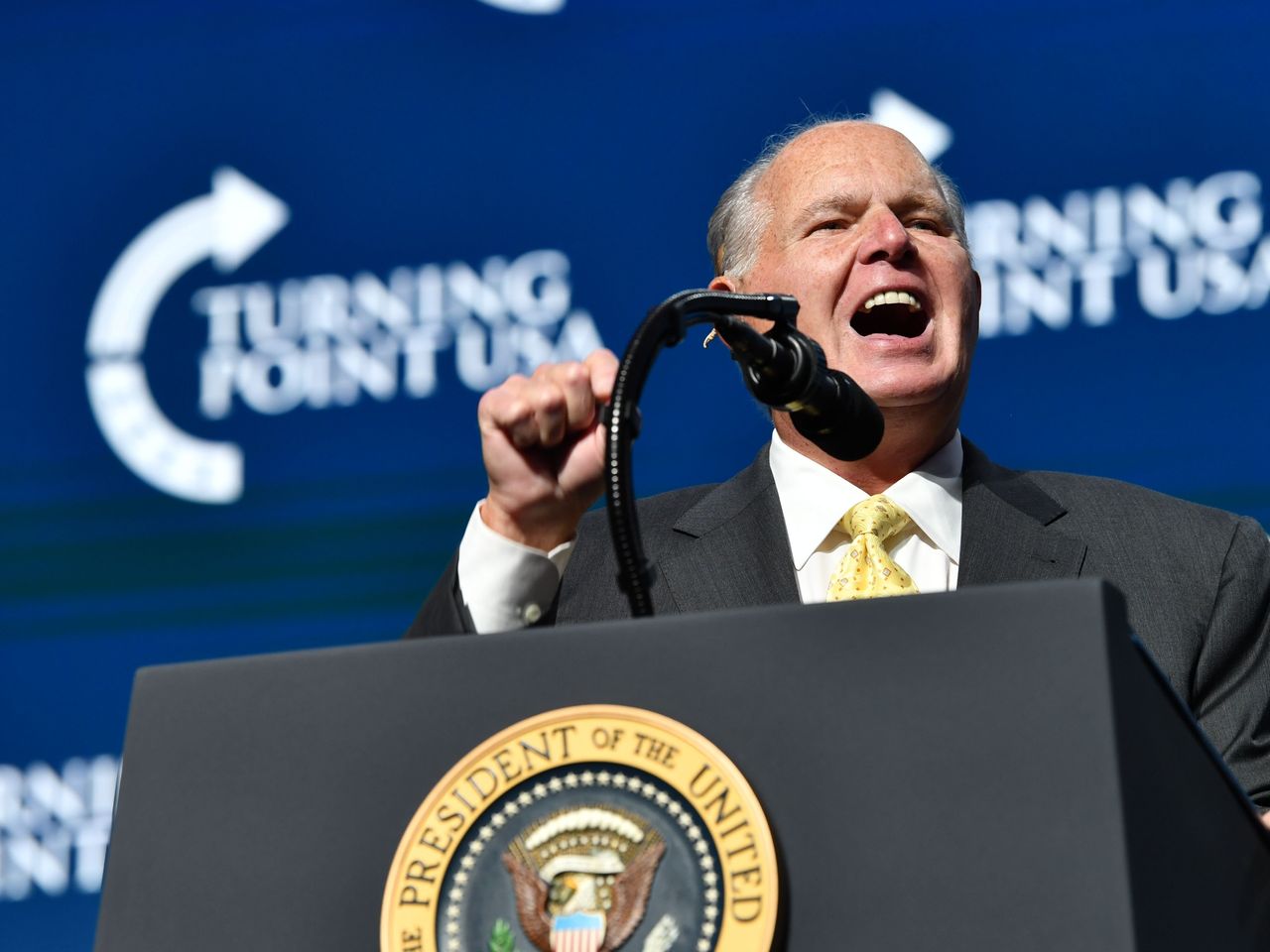
Rush Limbaugh speaks at the December 2019 Student Action Summit hosted by Turning Point USA in West Palm Beach, Florida. 

Biology is Bigotry

Just read a story in the Telegraph: “Use ‘egg-producing’ not ‘female’, say scientists in call to phase out binary language.” The subtitle: “Experts say other terms that could be problematic include man, woman, mother and father as well as ‘survival of the fittest.’”

I checked it out. The Ecology and Evolutionary Biology Language Project IEEBLP) is a real thing. Check it out: https://www.eeblanguageproject.com.

The EEBLP says our terminology is not “inclusive.”

The group says that the words “male” and “female” should be phased out in science because they reinforce ideas that sex is binary. I’m guessing this is because sex is binary and the EEBLP wants to take science denialism to the next level in the woke project to cancel the Enlightenment and stamp out humanism—and women. 

Researchers studying ecology and evolutionary biology should be encouraged instead to use terms such as “egg producing” and “sperm-producing” or to differentiate between XX and XY individuals, the EEBLP suggests. We should do this, the organization says, to avoid emphasizing “heteronormative views.” Apparently biology is bigotry.

Of course it’s better to dehumanize members of our species by reducing them to their reproductive function rather than to refer to them as “men” and “women.” Dehumanizing language has always made life better for people. 

RDS and the Demand for Affirmation

Reality denial syndrome, or RDS, is a defense mechanism characterized by refusal to acknowledge unwanted or unpleasant facts, feelings, realities, or thoughts, or the rationalization of them. Denialism for short, RDS is the act of denying reality as a way to avoid an emotionally or psychologically uncomfortable truth. I am paraphrasing standard definitions found in a Google search. These definitions are derived from diagnostic criteria developed in the domains of psychiatry/psychology.

Sigmund Freud, the founder of psychoanalysis

It can be said that RDS is a form of delusional thinking, as the RDS sufferer insists on the reality of some thing that does not really correspond to anything that is actually real or true or that is contradicted by reality. An example is belief in a god or gods.

Sigmund Freud, the founder of psychoanalysis, referred to religious belief as delusional in “The Future of an Illusion,” published in 1927. He argued that belief in the supernatural serves as a defense mechanism against anxiety and fear of the unknown. Because the god delusion was shared by millions (even billions), Freud described them as illusions, which he defined as false beliefs that people hold onto despite evidence to the contrary. Religious beliefs are perpetuated because they provide comfort to people by creating a sense of order and control in a world that is often chaotic and unpredictable. The god delusion is thus a form of magical thinking characteristic of a pre-scientific world or among those who have not yet found science.

What is it called when a person with RDS berates others for not participating in her or his denialism/delusion—participation so desired because it reinforces RDS? We see this with religious zealotry. The person insisting on dwelling in the real world who denies Allah or questions the revelation of Muhammad may in a culture governed by sharia face annihilation. He can certainly expect to be persecuted. Leaving the illusion makes him an apostate. Questing the illusion makes him a heretic. Mocking the illusion makes him a blasphemer.

Here’s another example. Humans have an evolved capacity to detect gender. It’s a trait expressed in children at a very young age. At the same time, children, in making sense of gender, incorporate into their development the sociocultural markers of gender. This sometimes produces confusion. It is a common experience of teachers to school children asking if a boy with long hair is a girl. They ask because they are confused. The evolved capacity and the acquired sociocultural understanding are in conflict. An RDS sufferer might insist, even when there are no sociocultural markers, that children deny their innate capacity, a demand that may contradict reality. This demand is made of adults, as well. However this is turned around in Orwellian fashion, the demand is that children and adults misgender the person.

Libs of TikTok provide a useful example of what I am describing. The person in the video is complaining that people do not respect the pronouns plainly written on the button the person is wearing. Anything could be on the button. Are people required to repeat what is written on a button a person is wearing? The person feels disrespected, but one might ask whether it’s respectful to others to berate them for not overriding their instinctive capacity to correctly gender a person. Is it not an act of gaslighting to tell a customer that reality isn’t real but rather that reality is what a barista says it is? What authority does this person have to determine the speech of others? Can anybody ever possess or be such an authority?

Yes, it’s a form of gaslighting obviously, and it’s a part of RDS. But it seems more than this, since not all RDS sufferers demand others participate in their delusion. Some suffer quietly. I have many Christian friends who do not demand that I affirm their illusion. They respect others enough to not do that. Those who demand others participate in their delusions are on an ego trip and most people aren’t on ego trips. For those who are, it’s not enough to be content in whatever belief they find comfortable. They demand that others share that belief. They demand that others affirm the delusion.

The personality type that often underpins such a demand is narcissism, a cluster B type. Narcissistic personality disorder (NPD) is a mental health condition in which individuals have an exaggerated or inflated sense of self-importance, feel they deserve privileges and special treatment, such as the right to transgress rules and social norms, expect to be recognized as important even without achievements (identity is often a substitute for accomplishment in this disorder), express envy over what others have, and lack of empathy, that is the ability to understand or care about the feelings of others. The lack of empathy comes with using others for the narcissist’s own purposes. There is an arrogance here that conveys the unimportance of others, for example for their cognitive liberty, i.e., the freedom to express their beliefs without consequences. Behind the narcissists demands for affirmation and attention is inner doubt in self-worth. This is why narcissists are easily upset by why they perceive as criticism. narcissists live in a bubble that is all about them. Pop their bubble and they often fall apart and lash out in fury (hence Antifa).

Again, there may also be delusional disorder at work (what used to be called paranoid disorder, which doesn’t really capture the spirit of the thing). This is a type of psychotic disorder where the sufferer can’t tell what’s real from what is imagined. A delusion is an unshakable beliefs in something that isn’t true or based on reality. A narcissist may not suffer from delusional disorder. Some narcissists suffer from some degree of psychopathy and get off on making others obey their demands. Thus the problem is sometimes a combination of cluster B types. When delusional disorder is also present, the combination of pathologies compounds the situation, sometimes to the point of danger to self and others.

Freud’s view on religion as a delusion has been widely debated and criticized by philosophers, theologians, and other scholars. Some argue that Freud’s interpretation of religion is reductionist and fails to take into account the complexity and diversity of religious experiences and beliefs. Perhaps. The same argument is made about other forms of delusion. Philosopher and even scientists and medical professionals construct elaborate rationalizations to support the delusions and denials of those of whom they make their clients and patients. As it turns out, enabling disorders is profitable.

What is it called when governmental or corporate bureaucratic systems require individuals to participate in speech and behavior that perpetuates denialism and delusional thinking? That’s is an easy one. It’s is called tyranny.

You are free to believe in anything or identify as anything. As I have said before, I am a libertarian; I have no interest in forcing anybody to think anything or be anything. But that ethic tells you that I have a keen interest in others forcing me to think something or be something. If you are free to think and be anything, then I am also free to think and be anything—within the limits of reality. Of course, living in reality is my standard. Others choose a different path. They don’t have to walk my path. But by the same token I don’t have to walk theirs. I don’t have to live in unreality. The only non-oppressive environment is one that permits us both to live freely. Otherwise, we live in a state of tyranny—the opposite of living freely. You may feel that such a state is fine as long as you are the tyrant. But know that you are making a whip for your own back.

Making Patients for the Medical-Industrial Complex

In a corporate boardroom somewhere, perhaps in more than one or two, there is a cabal of executives and operatives brainstorming. “How can we make clients and patients of children, teens, and young adults?” “How can we make vulnerable populations lifelong consumers of our commodities and services?” “We must get them while they’re young,” one tells the rest. “We must make them forever dependent on us.” “How do we do this?” “We have to make them feel that there’s something wrong with them,” he says. “They’re sick. We can heal them!” one says. “They’re broken. We can fix them!” says another. Then, in a frank moment, the man at the end of the table says, “But not really. Because, really, we’re going to sicken them. We’re going to break them.”

The corporate boardroom—where plots of mass deception are hatched

Some readers are probably recoiling at my speculations. How could those devoted to the health and wellness of people think in such a fashion? Don’t doctors take an oath? Isn’t one of the core principles of that oath primum non nocere—“first, due no harm?” This is the source of a core principle of bioethics: the principle of non-maleficence! Without crossing over into therapeutic nihilism, the essence of the principle is basic. Given the nature of an existing problem, it may be better to avoid some course of action or to take no action at all than to risk causing more harm than good. So how does a profession go from principled to unprincipled practice, to organized action that causes harm with the purpose of making clients and patients rather than finding them?

In the early 1970s, a series of federal laws and policies were enacted that changed the way hospitals and medicine worked in the United States. These changes had a profound impact on the health care system, and led to the emergence of large corporate health care systems. The rise of managed care and health maintenance organizations (HMOs) in the 1970s played a key role. HMOs became the dominant form of health insurance in the 1980s and 1990s and their emergence is associated with the consolidation of health care providers into large corporate health care systems. Large corporate health care systems were able to negotiate discounts with health insurance companies, reduce costs by centralizing services, and provide a wide range of health care services to patients.

The changes in law and policy in the early 1970s thus set the stage for the transformation of the health care system from a fragmented, locally-based system, in which doctors contracted with public hospitals and clinics and patients, and (honest) doctors delivered only the care the patient needed, to a centralized, corporate-dominated system in which doctors became employees subordinated to the dictates of corporate profit, which drives them to make clients and patients.

The very character of the corporation, recognized as a legal person, legally required to behave as a psychopath, lies at the heart of the atrocities of the medical-industrial complex. Shareholders play an important role in the operation of big corporate health care and medical groups. Health care companies are typically structured as for-profit corporations, which means that they are owned by shareholders who expect to receive a return on their investment in the form of dividends or capital appreciation. The primary responsibility of the shareholders of a corporation is to maximize their return on investment. This can be done by increasing the company’s profits, which are generated by expanding health care services—and this requires not only finding more patients, but also creating them.

The drive to maximize profits in big corporate health care and medical groups incentivizes the development of new technologies and procedures, which in turn leads to increased medical intervention and treatments. The financial resources provided by shareholders can be used to fund the research and development of new technologies and therapies. This can lead to new drugs and surgical procedures that may not be supported by strong scientific evidence. It incentivizes the overuse of medical interventions, even when these interventions may not be needed on objective medical grounds—even when these interventions sicken and break people.(See Disordering Bodies for Disordered Minds.)

Because health care is an industry in the age of corporate power. The problem of over and unnecessary intervention has eclipsed the problem of therapeutic nihilism. Indeed, a new nihilism has emerged, one that sacrifices truth and caution on the altar of acquisition and avarice. The imperative of profit maximization eclipses everything else. The corporate person is a self-interested entity concerned only with profits for shareholders, a personality developed and codified through various legal and economic theories, at the core of this the shareholder value model. The model is a business philosophy that prioritizes maximizing returns for shareholders above all other concerns. It is based on the premise that the primary purpose of a corporation is to generate profits for its owners through stock value maximization.

Everywhere this thought has occurred (or will occur), knowing the long history of marketing, propaganda, and public relations, namely that business firms can make a thing like this happen by engineering a culture that induces people to believe things that will make those commodities and services obvious to the illusion that makes them necessary (and they know a great many people are vulnerable and will believe a great many things), people are sickened and broken and made dependent on the corporations.

This culture must be one of futility, producing a profound sense of estrangement from the larger social order, its norms and values, its task and purpose, to produce in individuals the nihilism and narcissism that prepares them for reintegration with the corporate logic of consumption, resulting in what President Herbert Hoover long ago called “happiness machines.” The means of manipulating the masses towards these ends is well-tested, developed from the Freudian principles of psychodynamics, refined to be ever more effective, their intent ever more dissimulated by the gathering about the motive the legitimacy of prevailing social institutions, exploiting the deep faith the people have in the authority of health care professionals.

This is why elites have sent up the hue and cry about the crisis of legitimacy in the prevailing social institutions of corporate governance: elites need the sheep to trust the shepherd.

But the shepherd is only interested in eating them, fleecing them, or fucking them.

Internment is Assimilation and Other Absurdities

Have you seen the video shared below yet? If not, check it out (see link below). It was a group discussion about assimilation and diversity organized by Vice. The participants were from different Asian ethnicities. However, the range of viewpoints was rather less diverse. There is so much wrong with this discussion it’ll keep you entertained all the way though. Or maybe it will put you off. There are some real cringe moments for sure.

For what inspires this particular blog, check out the section from 8:46 to around 15:35, where the host asks if assimilation is a good thing or a bad thing. The second speaker in this round, Vince Dao, stuns the group by providing sociological insights into why some groups do better than other groups—reasons that do not depend on the woke progressive narrative of group oppression. Somebody asks who gets to decide to which culture immigrants should assimilate. The majority, Dao says. Those with power, he clarifies. Who has power? A woman with purple hair says it’s white people. of course she does. Dao pushes back. Check it out:

The argument that white people have the power and it is therefore their culture to which immigrants must assimilate is wrong for several reasons. Dao makes a good case (Dao has his own YouTube channel, which can be found here). I want to make some points of my own.

On September 8, 2020, I posted to Freedom and Reason a FAR Podcast episode and the script The Myth of White Culture. You can read there all of the supposed traits of white culture, traits that comprise a system that must be rejected because it was built by white people and therefore projects their whiteness, which is a bad thing.

The suggestion that white people collectively comprise the ruling class and, therefore, the dominant culture associated with a white-majority society represents an ideology of oppression is designed (quite literally, as I document in the podcast cited above) to obscure the fact that the dominant culture is Western culture, born in Enlightenment, and has nothing to do with race. The Enlightenment occurred in Europe not because of white people, but because complex cultural, religious, and social forces and trends converged in that region to create a system emphasizes reason, limited government, and the primacy of the individual, a system marked by humanism, liberalism, and secularism.

Perhaps the most significant characteristic of Western culture is that it liberates the individual from the tribe and reintegrates that individual into a culture where his individuality is prized more than his group membership. A black man, emancipated from the legacy institution of slavery, his liberation thanks to the Enlightenment, now has a chance to become a fully actualized human being. A woman, emancipated from the suffocating strictures of Islam, an option in the West, throwing off the limitations placed on her by a patriarchal ideology that systematically privileges men, now has a chance to determine her own live on her own terms. A gay man is free of the doctrines of the religions that loathe him and marry his lover.

However, for the racist and antiracist alike, culture is a projection of racial type—it must be for the claim that Western culture is white supremacist because it occurs in the context of the trans-Atlantic system that is distinguished in part as having a white majority. It is the equivalent of saying that Japanese culture is racist because that country’s majority is Japanese in the ethnic sense of nation. Japanese culture may be racist, but it is not because Japan is full of Japanese or that Japanese people expect immigrants to abide by the national culture in the broader sense of nationalism.

The culture to which immigrants are expected to assimilate in the United States has nothing intrinsically to do with race or race oppression. It has to do with integrating with the most free and open society yet produced by humankind. The regressive force weakening the West is the extremist form of multiculturalism pushed by progressives (see The Democratic Party and the Doctrine of Multiculturalism). Cultural pluralism undermines national integrity and weakens the rule of law. Indeed, this is the point of cultural pluralism (see An Architect of Transnationalism: Horace Kallen and the Fetish for Diversity and Inclusion. See also The Democratic Party and the Doctrine of Multiculturalism).

Assimilation is emancipation

I find it fascinating that the argument advanced by the progressives in the Vice debate isn’t immediately understood as racist itself, specifically an expression of anti-white bigotry, which is rampant in the West today, especially in America. White people are the only racial group about which anything can be said with impunity—even celebrated (see Is There Systemic Anti-White Racism?). It is not merely acceptable to say that whites today are responsibility for things done in the past by people who look like them; condemning whites with the ancient and backwards doctrine of blood guilt is encouraged (Disney Says, “Slaves Built This Country.” Did They?) and even required (The Bureaucratic Tyranny of DEI). There is even allowed—in the face of the Fourteenth Amendment—a program called affirmative action that discriminates against whites in college admissions and employment. In fact, you risk being called a racist for opposing it.

Saying white people are in power because the average white person has a higher income and is wealthier than, say, the average black, is like saying that Chinese people are in power because they, too, on average, have higher incomes and are wealthier than black people. Rationalizing the fact that Chinese people on average do better than whites by defining Chinese people as “white adjacent” is obnoxious. (For the record, Dao is also right about the racial character of anti-Asian hate and violence. See The Rise in Anti-Asian Hate Crimes. Trump-inspired? Not Quite. That whites as a group are blamed for crimes disproportionately committed by black people is a useful illustration of the anti-white bigotry that has become reflexive in today’s America.)

The same thing happens when ethnicity becomes the alleged source of power. The claim that Jews are controlling the West’s dominant institutions is well-understood to be an anti-Semitic trope. What you can say is that Jews on average do better than non-Jews. Treat them as possessing some collective power based on their Jewishness suggests to other than you may be a neo-Nazi (or an Islamist, however that brand of anti-Jewish sentiment tends to be ignored by progressives). But it’s okay to say that whites control the West’s dominant institutions. Whites run society. This has caused some Jews to deny they’re white, often explicitly to get out of being accused of enjoying white privilege (see Race, Ethnicity, Religion, and the Problem of Conceptual Conflation and Inflation). But the premise is wrong, not because Jews aren’t white (most are in fact white, as are other Semitic peoples), but because whites are not in power. Whites have enjoyed no systemic power in America since the 1960s.

Conceptualizing power in racial or ethnic terms misidentifies the actual source of power in a capitalist society: class power rooted in economic inequality. Power in a capitalist society emerges from the differential possession of the means of generating income and wealth. The greater one’s possession of these means (land and capital), the greater power one possesses. Put another way, the availability of power depends on one’s position in the class structure not on the color of their skin. The majority of whites possess very little in material resources and thus have very little power. They don’t determine how life happens in America. They have no control over academic institutions, corporate boardrooms, the culture industry, mass media, the legal and political apparatus. They are not in a position to impose white culture on anybody—even if we supposed there were such a thing.

We hear the blood guilt argument in the claim that all whites enjoyed skin-color privilege. But in the United States, individuals regardless of skin color are equal under the law (excepting affirmative action). As noted, there are no laws or institutions in place that systemically privilege white people. These were dismantled decades ago in a series of legal decisions and legislative actions. This means that the argument that whites are in power must depends on fallacious reasoning. The claim is simply asserted as doctrine and everybody is expected to believe or risk being treated as a heretic and called a bigot or a racist.

This is why Dao leaves those around him stunned. They can’t believe somebody is actually saying the things Dao is saying. But reality has its own integrity and truth and honesty require us to speak against the myth that’s being disseminated to justify the managed decline of the America republic (cultural pluralism and anti-white bigotry are tactics used by transnationalists to dismantle the nation-states of the West). And, so, the woman with the purple hair dismisses Dao as a Republican, as a right-winger, as if this invalidates his argument. Indeed, the populist-nationalist style of republicanism Dao advocates owns the progressive left on this issue.

To get technical for a moment, the fallacy that’s being committed by members of the Vice panel is what we call “reification” or the “fallacy of misplaced concreteness.” This a type of error in reasoning that occurs when an abstract idea or concept is treated as if it were a concrete, physical entity. This error can take several forms, but it essentially involves taking a conceptual, statistical, symbolic, or theoretical representation of a thing and treating it as if it were the real thing. When someone refers to “whites” and “blacks” as if these groups were biological distinct or homogeneous or that each concrete person so identified carries the average of the category, they’re committing the fallacy of reification.

The reality is that there is tremendous variation within racial groups. Moreover, much if not most of the differences between groups is the result of cultural, historical, and environmental factors, not biology or ongoing oppression. Thus when people use race to explain differences in income, education, or other socio-economic outcomes, they’re committing the fallacy of reification. Actual things, such as class, sex, and geographic location, play a much larger role in determining socio-economic outcomes. To the extent that subcultural differences shape the thought and behavior of individuals, which is a piece of Dao’s argument, this is an argument against cultural pluralism and for assimilation.

The demand is not that individuals assimilate to so-called white culture for racist reasons. Indeed, a feature of racist systems is to not promote assimilation, but to compel apartness—the opposite of assimilation. Jim Crow segregation in America and the apartheid system of South Africa did not operate on assimilationist desire but the desire to keep blacks away from and subordinated to whites. Immigrants are encouraged to assimilate because there was a desire to integrate individuals into the national cultural order. Historically, most immigrants to America didn’t have to be convinced to assimilate. When the purple-haired lady asserts that President Roosevelt’s executive order interning Japanese-Americans during WWII is an example of assimilation, and the others around her bobble heads, we are witnessing an Orwellian moment where a thing has becomes its anthesis.

“White” is a demographic category that is based on a racialize construct. It is not analogous to a person’s position in the class structure, which involves an objective association between the individual and his position with respect to the means of production. One’s location in the class structure is an actual thing. Those who claim white people are in power because of their racial identity assume that each person who is identified as white is a concrete personification of the category of “whiteness,” which is an abstraction. This leads people to confuse the average white person, a statistical invention, with actual white persons who could be anything (except not white by definition). People believe whites comprise a group with common cultural, economic, and political commitments. I don’t capitalize the word “white” and “black” because these are not proper names.

Vince Dao interviewed at CPAC 2021, Orlando, Florida

A moment Ago I noted that to the extent that subcultural differences shape the thought and behavior of individuals this is an argument against cultural pluralism and for assimilation. This is another flaw of the argument—that cultural attitudes and values associated with particular ethnic groups do not explain group averages. Culture plays a significant role in shaping group differences because the beliefs, norms, and values of people within a cultural group determines and shapes the conduct of the individuals socialized in those beliefs, norms, and values.

Cultural beliefs and practices influence the way people interact with each other, the way they view themselves and others, and their attitudes towards various social, political, and economic issues. Certain cultural values place a high emphasis on individualism, stress the importance of community and personal responsibility. Other cultures submerge the individual in group identity and socialize them in belief, norms, and values that sabotage their ability to be successful and fully actualized as human beings.

Differing cultural values can lead to differences in how individuals within a group approach decision-making, relationships, and other aspects of life. Cultural beliefs shape the opportunities and resources that are available to different groups. As noted, certain cultural beliefs about gender roles limit the educational and professional opportunities available to women, e.g., as we see in Islam. this is what Dao was saying And he’s correct.

Finally, Dao suggests that, if the United States were truly a white supremacist country, a Vice panel where anti-white bigotry went unchecked would be highly unlikely. He points out that across America, in all the dominant institutions, it’s not white people who are being privileged and promoted, but nonwhites. How does it happen in a white supremacist nation that anti-white bigotry goes unpunished, even celebrated, while non-whites are preferred and advanced? Why would institutions rooted in white supremacy eliminate the allegedly racist qualifications and tests that discriminate against nonwhites?

If a space alien were to visit earth, and if he paid attention to such things, he would wonder why it was that those with darker skin were more likely to be selected for positions over those with lighter skin even when the lighter-skinned applicants were more qualified for the position than the darker-skinned persons. If he was told that this is because the lighter-skinned applicants are the oppressors, he would surely be curious to learn why an oppressive system privileges the oppressed. The answer to that question explains why so many people today are stepping into it.

A Proper Communist Party Should Oppose the Corporate State Not Glorify It

People’s World is the newspaper of the Communist Party USA. The paper has been around for almost a century (founded as the Daily Worker founded in 1924). For the sake of keeping our feet on the planet’s surface, a proper communist should oppose the corporate state, not glorify it. A communist should know what fascism is—in all its myriad iterations—and help his comrades understand this. Communism at its best is about consciousness raising and speaking truth to power.

Here’s the link to the article, if you want to read the rest.

Is this crop of communists so deluded as to believe the establishment in Washington DC represents Joseph Weydemeyer’s “dictatorship of the proletariat”? I know a lot of right-wingers who believe that, but they’re almost as far off the mark as the communists who wrote this article. For conservatives, it’s a problem of generalizing totalitarianism to everything. Communists are supposed to know better. The “dictatorship of the proletariat” is not among fascism’s manifestations.

The authors of he piece are Mark Gruenberg and John Wojcik. Gruenberg is editor of Press Associates Inc., which I think is People’s World. According to the People’s World profile page, Gruenberg is “holy terror when going after big corporations and their billionaire owners. Really? A union meat cutter (not to be confused with a butcher), Wojcik is editor-in-chief of People’s World. He, too, should know that Matt Gaetz and Anna Paulina Luna aren’t fascists. Wojcik is the author of another recently published People’s World article “House approves revenge panel to settle Trump scores and defend insurrectionists. I will come to this in a moment.

But, first, what is fascism? Franz Neumann (a Marxist legal scholar) defines fascism as a political ideology and governing strategy characterized by authoritarianism and corporatism that rests atop the structure of totalitarian monopoly capitalism. Fascism is a response by banking and corporate power to capitalist crisis, its operatives establishing an extended state apparatus integrating all aspects of society—culture, economics, education, and politics. Fascism thus represents a new form of political and social organization. Neumann emphasizes the importance of grasping the underlying economic and social factors that give rise to the corporate state, as well as the psychological and cultural factors that make it appealing to certain segments of the population. Like other critical theorists, Neumann emphasizes the role of the media and cultural institutions in shaping public opinion and reinforcing the fascist ideology (which may not own that label).

On the surface, the difference between old and new fascism is the question of nationalism. This has confused many people. To be sure, the old fascists pushed an extreme ethnonationalist line. At the same time, the end sought by national socialists was a new world order. The Nazis were globalists, and, in alliance with fascist Italy and imperial Japan conquered much of the world before the liberal democracies of the West in alliance with the Soviet Union defeated them. The new fascism no longer hides behind the rhetoric of ethnonationalism (it has been replaced by multiculturalism). But the other characteristics are manifest. We find the business sector collaborating with technocracy and the administrative state, and the media and cultural institutions busy shaping public opinion and reinforcing the ideology of the corporate state, namely progressivism, the other ideological projection of corporatism. (See Totalitarian Monopoly Capitalism: Fascism Yesterday, Today, and Tomorrow for an in-depth analysis.)

As obvious as the situation is, Gruenberg and Wojcik don’t get it. Only a couple of weeks before this latest article, they penned an article in People’s World carrying the title, “Big business is behind extreme right takeover of the House.” Partisan devotion is so thick here that Gruenberg and Wojcik can only see the hand of big business when it elects Republican candidates. For them, the Democratic Party is a priori not fascist, therefore the hand of big business in that party’s affairs become an invisible one. That’s the way logic works in their world

To be charitable, the inability to see reality does not come about because the role of big business in the Democratic Party is minimal but because capitalist accumulation is paramount and the relations complex. For more than a century, the Democratic Party has performed the structural role of steering mechanism, shepherding the capitalist system through its inevitable cycles of crises. Its more structural and less obvious instrumental features may make its political-economic character harder to detect, but it is not difficult to figure it out. Performing the structural role has involved integrating organized labor into the party structure, giving the appearance of solidarity with the people. In contrast, the Republican Party is seen as being more pro-business—and is portrayed as such by the propaganda system. However, the Democratic Party is bankrolled by corporate and financial industries. Banking and big corporate donors, along with the technology and entertainment sectors, are among the largest contributors to the Democratic Party and its candidates. Overall, Democrats raise and spend more money than the Republicans.

We may also be charitable and say that cognitive dissonance plays a major role in producing the blindness. As most readers know, cognitive dissonance is a psychological phenomenon marked by mental discomfort or stress that results from simultaneously holding two or more conflicting beliefs, ideas, or values. Intrapsychic conflict may become acute when an individual encounters new information that challenges his existing beliefs or when he makes choices based on beliefs that are inconsistent with his values. When the individual who expresses beliefs he thinks align with the platform of a particular party learns that the real politics and policies of the party are in conflict with those beliefs, especially when they strike at his ethical sensibilities, he will experience cognitive dissonance. To resolve the discomfort, the person may change his political beliefs to align with his moral beliefs. Or, he may rationalize the inconsistency by “finding reasons to support the policy—or by adjusting his ethical sensibilities.

For example, the person may believe that it is wrong as a matter of principle for the FBI to run counterintelligence programs on American citizens and their political organizations. This individual may recognize this as an expression of fascism and say so when the surveillance apparatus and harassment campaign are aimed at the organizations and movements with which he associates. But when the party he supports defends such programs—and not only that but is actually directly involved initiating them and enabling them—the individual must rationalize the situation or completely change his political loyalties. The discomfort caused by cognitive dissonance in this case is powerful enough to cause individuals to ignore or reject information that contradicts their existing beliefs and committments.

This is how we find supporters of the Democratic Party defending the national security state’s assault on the fundamental liberties and rights that lie at the heart of the American Republic as a defense of democracy, while those endeavoring to get to the bottom of the causal forces behind the deep state war on democracy as those “threatening democracy. Remember the Orwellian slogans “Freedom is slavery! We might add to Orwell’s list the slogan “Technocracy is Democracy! The FBI colludes with media companies to suppress the First Amendment rights of American citizens and that’s not fascism, but the Freedom Caucus that forces the House to create the Judiciary’s Subcommittee on the Weaponization of Government is? And I thought the CPUSA was down with popular front politics and tactics.

The FBI conducted extensive surveillance of the CPUSA throughout the 20th century as part of that agency’s broader efforts to counteract perceived threats to national security and the government. The FBI used a variety of tactics to gather information on the CPUSA and its members, including infiltrating the organization with agents and informers, wiretapping, and intercepting and reading correspondence. The FBI also conducted surveillance of individuals who were associated with the CPUSA or suspected of being members, including political activists, labor leaders, and intellectuals. The FBI’s harassment of CPUSA violated the constitutional rights of American citizens. But it was rationalized as a “defense of democracy, even though it was the opposite of that. It was an assault on democracy.

Did the CPUSA oppose the Church Committee hearings in the 1970s that exposed FBI’s excesses against its organization and allies? No. Quite the opposite. In response to the Church Committee revelations (and the CPUSA knew the FBI was surveilling it and disrupting its operations), the CPUSA and its supporters criticized the FBI’s actions as a violation of their constitutional rights and an abuse of government power. They argued that the FBI’s efforts to monitor and disrupt their activities were politically motivated and aimed at suppressing political dissent and free speech. Even before the Church Committee revelations, the CPUSA took legal action to challenge the FBI’s surveillance tactics. In the Communist Party of the United States v. Subversive Activities Control Board (1967), while the Supreme Court upheld the government’s power to surveil the CPUSA, its judges confirmed that the First Amendment protected the CPUSA’s right to advocate for its political views.

In the end, the FBI’s harassment campaign took a toll on the CPUSA and contributed to a sharp decline in its membership and influence. Perhaps this is what the CPUSA is hoping will happen with the populist figures and organizations its leaders and members smear as fascists. If so, then they don’t stand on the principles that undergirded their criticism of the FBI’s harassment of them. So what good is the organization? Cynically, the liberal principles that finally put an end to government suppression of the CPUSA are to them only instruments to be taken up when advance the organization’s own politics.

This is the ACLU new stance. In the past, the ACLU defended the rights of all individuals regardless of their political beliefs or ideologies. In 1978, the ACLU defended the First Amendment rights of neo-Nazis who planned to march in Skokie, Illinois, a predominantly Jewish community with a large number of Holocaust survivors. The ACLU argued that the right to free speech, even if it was offensive or unpopular, was protected under the Constitution. In the face of criticism that the ACLU was giving a platform to hate speech, the ACLU stood fast in upholding its commitment to free speech and the position that defending the rights of the neo-Nazis was necessary to protect the rights of all individuals.

Today, the ACLU has turned its attention inward to root out what is describes as systemic racism within its own organization. To remedy the problem of white supremacy among its ranks, it has deployed the hammer of inclusion against its leadership and staff. At one time the ACLU defended the right of people to hold and express contrary views on race matters. Today, the whiff of opinion that diverges from the woke doctrine will get you censored and expelled. (I didn’t wait for the ACLU to expel me. I resigned in protest last year.)

Gus Hall, the long-time chairman of the CPUSA, must be rolling in his grave. In his 1987 Working class USA: the power and the movement, he advocated a “bill of rights socialism.” (I have a copy on my book shelf signed by Gus.) Hall was a strong advocate for free speech and believed that all individuals should have the right to express their views, regardless of whether they were popular or controversial. He saw the right to free speech as essential to a democratic society. He argued that restrictions on speech, whether by the government or by the private sector, were a threat to the rights of individuals. To be sure, Hall found himself at odds with those who sought to restrict speech on the grounds that it was harmful or dangerous. But he believed, as I believe, as all people who care about freedom believe, that the best way to counter harmful speech is through more speech, and that censorship and restrictions on speech only serve to drive harmful ideas underground and make them more difficult to challenge.

I will confess to publishing a few op-eds in the People’s World back in the first decade of the 21st century. (See The victims of capitalism and Texas execution could end death penalty, if we act. I stand by those writings.) Since then, the editors have become divorced from reality. I mean, come on: “the now-revered Nancy Pelosi”? I’m sure Pelosi is revered by some, but by communists? Yeah, I guess these communists. But in what communist tradition do liberalism, populism, and republicanism constitute “fascism”? The CPUSA no longer represents anything communist. The organization is now a wholly-owned subsidiary of the Democratic Party. As such, the CPUSA cannot represent the interests of the proletariat.