Elon Musk buying and opening up Twitter—now X—to diverse opinions is indeed dangerous to existing social relations, specifically to the authoritarian powers that shape the grand narrative. The effect of Musk’s takeover of the social media platform founded by Jack Dorsey and comrades in 2006 has confirmed the importance of mutual knowledge in connecting people across space, allowing them to see that their common sense is in fact common. It has also helped them see the forces disrupting their common sense and to grasp that these elites are not serving the general interests but their own egos and opulence.
Elon Musk of X
It is much easier to gaslight people when they are isolated. A man sits in his room and thinks to himself, “A man cannot be or become a woman.” Then, when he ventures online, it appears as if he is alone, that the world thinks otherwise—at least he sees that those who think like he does are shamed or punished. His workplace, too, told him his common sense is wrong and that he would be disciplined if he denied it. He begins to think his thoughts are wrong. They are bad thoughts. Maybe he’s even crazy for thinking them. Is it possible that a man can change his gender? Or maybe he compromises and acts in bad faith, going along with the lies to survive. Either way, he is oppressed.
When Musk bought Twitter acquired Twitter in 2022, he ended the practice of banning and censoring people who question, among other things, queer theory—those who deadname and who refuse to use preferred pronouns (the gateway drug to gender ideology). Now our gaslit man has a chance to see that he is hardly alone. Indeed, he sees that majorities across the world agree with him. His common sense does work. He in’t crazy, after all. Of course it’s true that there are only two genders.
In mutual knowledge our man finds the courage to speak the truth. His understanding of the world is not merely saved; it expands and deepens. The man sees that the reason he doubted himself, or acted in bad faith, is because a power stands over him, the power of the corporate state possessed by woke progressivism. He not only has confirmation of his common sense; he now has the object of his oppression in his sights. He has a politics now. A politics of truth. He can see the enemies of truth.
I showed my appreciation for what Musk did by buying a verified account. Progressives like to note my blue check mark, as if this were a bad thing. I respond that they’re free riders. I’m a paying customer because I want to keep X going. In a world where authoritarian attitudes and actions are ubiquitous, X is a beacon of light. We can’t let that light go out.
Imagine if Musk had owned Twitter during the pandemic. It would have been much more difficult to convince people to wear masks, stay indoors, socially distance, get vaccinated. Progressives read this with alarm. That’s because progressives hate autonomy and liberty. They don’t want people thinking for themselves. They want to control people. They know the way to do that is to keep from them information they need to make rational decisions for themselves, their families, and their communities. They want our man alone. But he’s not alone anymore.
Among the defining characteristics of authoritarian regimes is the promotion of identity politics, where select groups are afforded privileges over others based on some intrinsic feature (like skin color), and the systematic censorship and suppression of dissenting speech, often accompanied by compelled speech.
There are lot of other signs. These regimes manipulate the rule of law, using legal mechanisms to imprison political opponents—a practice known as lawfare. They also infuse education with ideological content designed to disrupt common sense and establish a new social logic, while elites manufacture and impose culture and revise history to align with their agenda. In these regimes, justice and truth become subverted for partisan purposes; the administration of law, knowledge, and science become increasingly arbitrary and technocratic, serving the interests of those in power.
These regimes often disguise one-party rule with superficial appeals to democracy, extolling the virtues of the state while diminishing the autonomy of the individual, leading to a dependency on the government and the infantilization of the citizenry. They alienate and weaken the family structure, usurping its authority and exerting state control over children, while simultaneously ensuring subservience to oligopolistic interests.
Many Americans and others around the world have noticed that this description increasingly resembles the practices of today’s Democratic Party. We need to raise the alarm about this.
The true threat to democracy
Apologists for the Democratic Party rationalize these measures as necessary to address systemic inequalities, promote social justice, and protect marginalized groups. But even if we accept the premise that systemic inequalities and social injustices exist, and that marginalized groups require protection, the censorship, identity politics, lawfare, and manipulation of education and culture that are evident in contemporary American politics cannot be justified in these terms. These tactics, emblematic of authoritarianism, are antithetical to the core principles of freedom and democracy. Freedom and democracy and the most precious things on earth—that and the courage to resist attempts to undermine them.
At the heart of a free society lies freedom of speech and expression—the right to voice opinions, ideas, and beliefs without fear of retribution or suppression. A true democracy fosters an open marketplace of ideas where diverse perspectives can be shared and debated freely. Likewise, the principles of individualism and universalism emphasize recognizing and treating people as autonomous persons rather than as members of specific identity groups. This approach upholds our common humanity and equality under the law, advocating for policies that transcend group identities and focus on individual rights and merit.
Similarly, the rule of law with impartial justice is foundational to a fair and moral society. It demands the equal application of the law, free from political manipulation; justice should be based on objective legal principles rather than partisan interests, ensuring that the legal system remains neutral. Furthermore, academic freedom, coupled with critical thinking, is essential to a healthy society. An education system that promotes critical analysis, open inquiry, and the pursuit of knowledge based on evidence and reason is crucial. Culture should evolve organically from the people rather than being imposed from above.
These principles—freedom of speech and expression, individualism and universalism, the rule of law with impartial justice, academic freedom, and cultural integrity—must never be sacrificed for the sake of party ideology. They are the bedrock of democratic republicanism and classical liberalism, principles that have long guided the American experiment.
Embracing a warmonger
And we cannot forget this: add to the mix I identified at the outset neoconservative warmongering. Rationalizing its belligerency as a mission to spread democracy, neoconservatives advocate for the use of force to achieve geopolitical objectives. What are those objectives? A one world order based on transnational corporate power. Neoconservative policies prioritize military solutions over diplomacy, neglect the consequences of regime change, and fuel perpetual conflict in the service of powerful elite. This, too, is an expression of the ideology that moves the Democratic Party.
The growing centralization of power and the drift towards authoritarian practices within the Democratic Party, which increasingly staffs and controls the apparatus of the state, should be the focus of concern for all who care about democratic republicanism and classical liberal principles. The party’s approach to politics and speech regulation, its alignment with corporate interests, and the erosion of individual autonomy through the influence of technocratic elites parallel those in more overtly authoritarian regimes—and neoconservative warmongering. If left unchecked, these developments threaten the very foundations of American democracy, eroding the freedoms that have long been its hallmark.
I am getting ready to teach my Criminal Justice Process class and the FBI under Joe Biden has still not released the 2023 numbers on the CDE. The UCR stops at 2019. It has become an archive. That means Biden’s FBI stopped releasing UCR data when it switched to the dash boarding system, which was supposed to be continually updated (that’s what dash boarding is supposedly for), and then stopped reporting altogether after 2022.
Why do you think that is? If crime were going down as Democrats say, then wouldn’t they publish the data? You’d think. Or maybe crime isn’t going down. Maybe crime is going up, and the data indicate demographic patterns that contradict progressive claims about who perpetrates serious crime and who are most at risk from criminal perpetration.
Rational decision making—who to vote for, where to live, where to go when one goes out, determining whether your children are safe, etc.—depends on accurate and up-to-date information. Why would the federal government keep that data from you? To be sure, the blue cities are not submitting data or only submitting partial data. But we need to see what the FBI has so were can compare which states and municipalities are willing to share data with the public and which are not.
Democrats are following a trend we find in European states where data showing how bad crime has gotten over the last several years is being suppressed by social democrats, which are the analogs to progressives in America. I suspect that this is what is happening here. One more way woke ideology is corrupting information
Following up on my last essay A Look at Four Economic Metrics. How did Biden-Harris Do? Not Good. I want to revisit average quarterly GDP growth under Trump and Biden respectively, as well as real wage growth and unemployment, and make a note about how to understand the relative performance of each regime. I make the note first.
The economic performance during the first year of a president’s administration is significantly influenced by the conditions and policies established by the previous administration. Economic policies take time to formulate, implement, and have an effect.
There is a significant lag in effect. Economic policies, such as fiscal stimulus, regulatory adjustments, and tax changes take months or sometimes years to show their full impact. The economy’s performance in the first year of a new administration reflects the continuation of policies and trends set by the previous administration. The new administration operates under a budget set by the previous administration. Major fiscal policies (spending programs and tax codes), are typically established in advance. It takes time for a new regime to appoint key economic advisors and policymakers and to enact new policies. The process of writing and passing legislation and enacting regulatory changes is time-consuming. Economic performance is influenced by domestic and global economic conditions—business cycles, consumer confidence, and international trade. These are are not easily or quickly altered by the new regime.
In the BBC article “Is US economy better or worse now than under Trump?” Jake Horton reports: “Between January 2017 and January 2021, average annual growth rate was 2.3%. This period includes the slowdown and recovery of the economy as a result of the Covid pandemic. Under the Biden administration so far, this figure is 2.2%—so almost the same.”
Excluding the conjunctural effects of the pandemic for the two quarters of negative growth, the average GDP growth under Trump would be somewhere around 5%. If the rebound quarter is also removed, then the average is approximately 2.7%. Any fair analysis would factor in the effects of the lockdown. Moreover, the performance of at least the first couple of quarters of the Biden regime is attributable to Trump’s economic policies. Note that by the time Biden’s economic policies really kick in late 2021, the economy enters a brief recession.
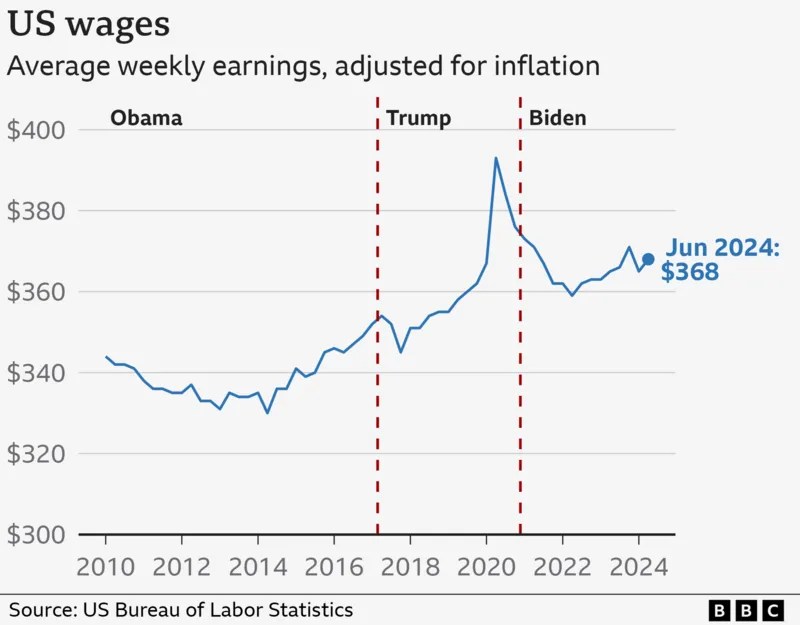
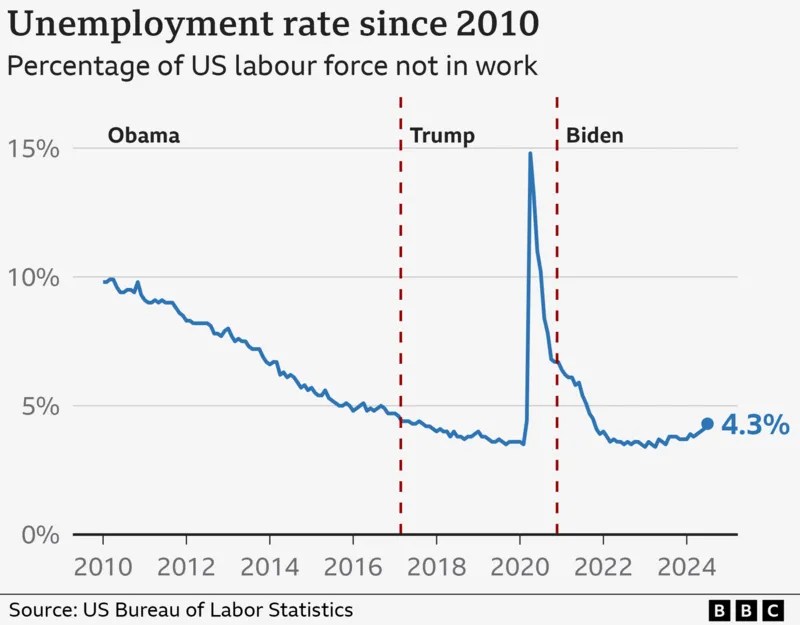
We can also see the benefit to workers under Trump with respect to wage growth (adjusted for inflation). Real wages, which took a hit during the pandemic, otherwise soared under Trump. Unemployment rate soared during the pandemic, but trend-wise, unemployment was steadily going down under Trump, while steadily rising under Biden. Standing back, it is clear that the economy under Trump outperformed the economy under Biden.
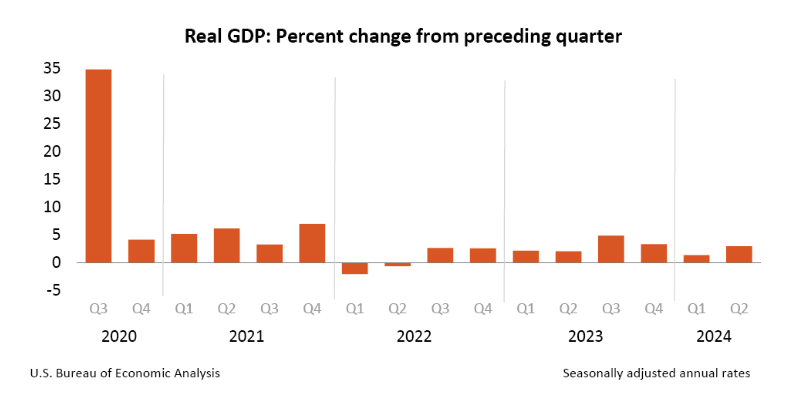
Let’s look at four metrics: real GDP, inflation, interest rates, and manufacturing jobs. Below is real GDP from the third quarter of 2020 to the second quarter of 2024. The third quarter reflect the bounce back in GDP after Trump reopened the economy in April 2020. Q4 2020 through Q4 2021 indicates the continued strength of the Trump economy. When Bidenomics take ful effect, GDP slows down considerably, even moving into negative territory before recovering, albeit nowhere near the strength it was under Trump. The reality is that Biden-Harris inherited a robust economy and throttled it.
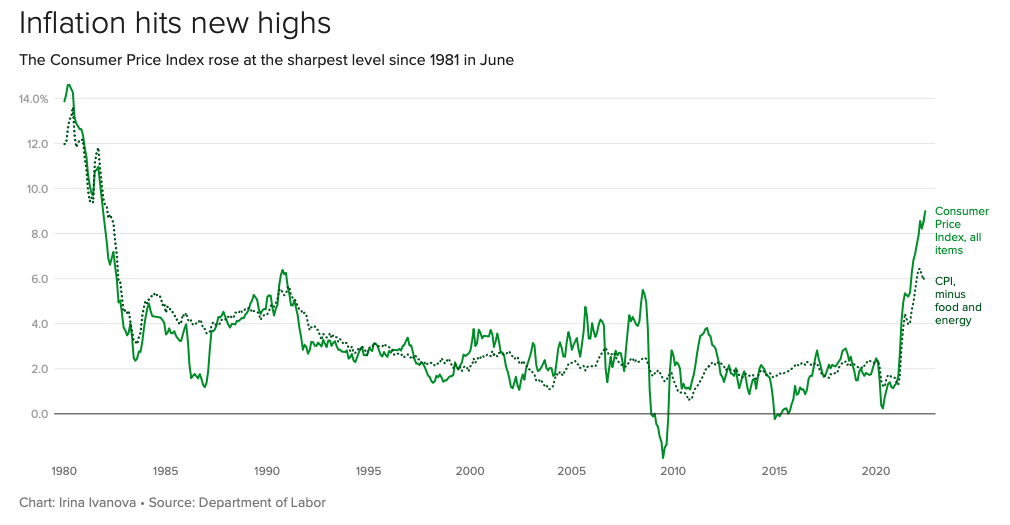
We see a similar pattern with inflation and interest rates. Inflation remained at historic lows under Trump, then exploded under Biden Harris. To be sure, inflation has come down in recent months, but Biden-Harris are responsible for the highest rates of inflation since the early-1980s.
Interest rates are also much higher than they were under Trump. Indeed, they were steadily coming down under Trump before exploding under Biden-Harris.
The claim that the Biden-Harris regime make about creating manufacturing jobs is largely illusory. You can see that under Trump, there was steady growth in manufacturing. The sharp loss of manufacturing jobs was a consequence of the pandemic. After Trump reopened the economy, manufacturing jobs returned. By mid-year 2022 the number returned to pre-pandemic levels. Growth in manufacturing jobs since then follow the same rate of growth established under Trump’s presidency.
Source: St. Louis Federal Reserve
Biden-Harris are taking credit for Trump’s economy and blaming him for inflation, while ignoring interest rates. The Biden-Harris regime has attempted to deflect from inflation by citing price gouging. We should clarify what inflation is in light of this deflection. Inflation is the general rise in prices of goods and services over time, leading to a decrease in the purchasing power of money. It occurs when the demand for products exceeds supply (a consequences of the pandemic, which the Biden-Harris regime and allied states dragged out), production costs increase (rising wages due in part to Trump’s efforts to sharply reduce illegal immigration), or when excessive money is printed by a government, diluting the currency’s value.
Inflation is a tax on working people, eroding savings as the real value of money diminishes. The Biden-Harris regime is largely responsible for this by printing money and spending. Central banks tried to control inflation through monetary policy, adjusting interest rates to influence the economy’s money supply and demand. This added an additional burden on working families. Moreover, the Biden-Harris regime opened borders to undermine workers’ wages. The effect is that goods are services became more expensive and borrowing to obtain them more costly, with all of this offsetting wage gains from a tight labor market. The Biden-Harris years have been disastrous for ordinary working people.
Nancy Pelosi confessed to Bill Maher that Democrats want amnesty for the millions of illegal aliens who have entered the country over the last several years. This was a major reason Biden-Harris regime was installed—to open the border and allow millions from around the world to flow in, provide them with housing, food, and healthcare, and create voters dependent on government and loyal to the Democratic Party.
Democrats already did this with a significant portion of the native black population. Democrats routinely receive over 90 percent of the black vote even though they keep blacks in privation and subjection in Blue cities.
The vast majority of illegal aliens are not refugees. They are military age men from Third World countries whose core values are incompatible with Western civilization. The major cities in many European countries tell the story. The West is becoming Third World.
Sweden is reversing course. Today more aliens are leaving Sweden than entering. We need to make the same thing happen here. This won’t happen if Democrats get four more years to run the apparatus.
Here’s the clip:
Nancy Pelosi states that the goal of the Democrat party is to convert undocumented immigrants (illegals) into documented immigrants: Bill Maher: "The CA lawmakers giving government assistance to undocumented immigrants to buy houses. That's kind of a different place than the… pic.twitter.com/pfeG9ngZUE
Before jumping into this, I want to make a note about my background in political sociology and the great works of that and related fields, two of which I referenced yesterday C. Wright Mills and Sheldon Wolin. Additional works of note are Noam Chomsky and Edward Herman’s 1988 Manufacturing Consent: The Political Economy of Mass Media, Steven Lukes’ 1974 Power: A Radical View, and Franz Neumann’s 1942 Behemoth: The Structure and Practice of National Socialism, 1933-1944, and, of course, Marx Weber’s various writings, which are foundational to the sociological study of power.
I am a political sociologist who has read these and many other works on power and social structure and incorporated them into my thinking.I am noting this because one reflex I encounter in people is the accusation that my analysis of authoritarianism in the American system is exaggerated or paranoid. Those who say this are well prepared to talk about the horrors of Nazi Germany or the Soviet Union, but when it comes to the regime they serve blind themselves to the reality of authoritarian and cast aspersions. Of course, they’re ignorant of the works I just cited. At the same time, it probably wouldn’t help them if they weren’t. The reflex is the typical fascist reflex. The well-read are not immune from it. By responding in this way, they betray an authoritarian personality. It is the nature of authoritarianism to accuse those who stand outside of power of being the problem.
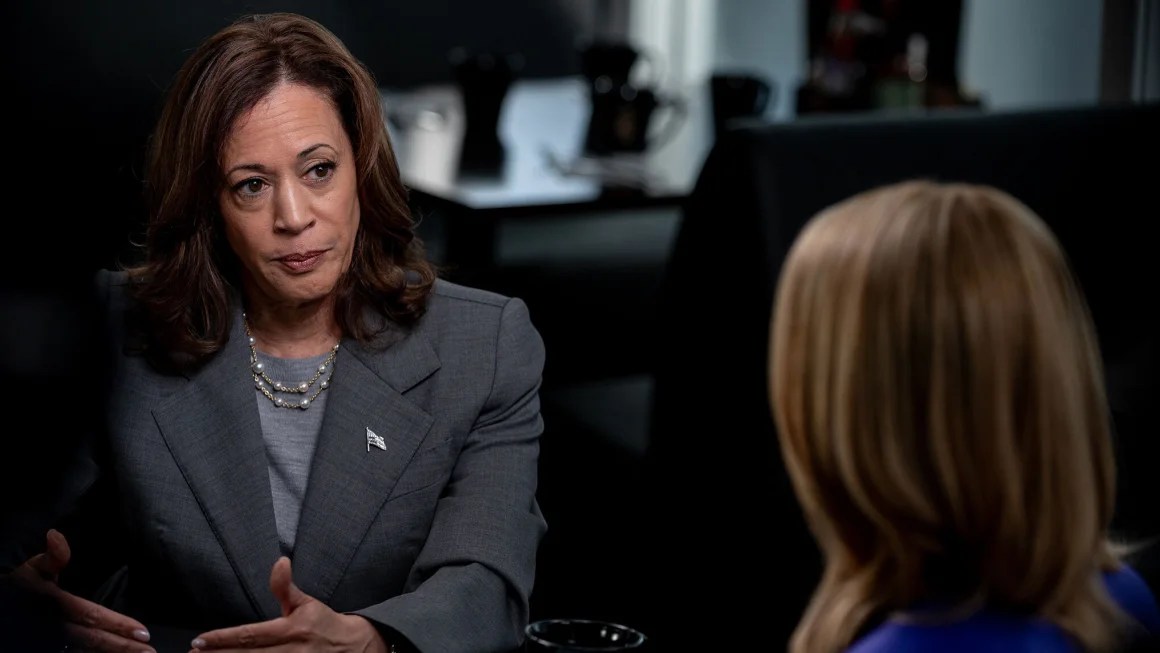
Fox News ran this piece yesterday: “Harris lacked confidence, presidential demeanor in first TV interview: body language expert.” “Susan Constantine tells Fox News Digital that Vice President Kamala Harris needs to make ‘tweaks in her body language to appear more confident.’” But you don’t need an expert to see this. Harris’ nervousness is obvious. It’s what lies behind the manic laughter and her general affect. Deep down she knows she’s not up to the task and wears it on her sleeve. Those around her know this, too, which is why they protect her.
“Harris bolsters momentum in first sit-down interview but leaves gaps on policy detail,” was CNN’s take, the network that extract 18 minutes of a lengthy sit-down interview with the Vice-President
Moreover, this is why she frequently appears drunk, slurring her words salad and honking snotty with vocal fry. People say she’s an alcoholic, but what I am seeing is benzodiazepine abuse (recall Anna Nicole Smith, the slurring and tonality). Harris couldn’t use benzodiazepines for the sit-down because when a person regularly uses the drug it becomes very noticeable when they are using, slurring and losing the thought train. Occasional use can actually increase confidence and lucidity (even if the person doesn’t recall the moment later). Habitual use has the opposite effect.
I have some sympathy. Those who suffer from anxiety will know what I’m saying when I confess that I have avoided opportunities because I feared my nerves would get the best of me. I’m small potatoes. Harris is running to be the president of the most powerful nation in the world. That’s way beyond any role I could step into. She lacks the self-awareness to know she should avoid this opportunity. Combined with her narcissism, we have in front of us a person who lacks the character and judgment to hold this office.
But what explains the Democratic Party’s reckless in putting her forward? This is the same party that installed a man with obvious dementia and concealed his cognitive decline for nearly three years. Could it be that this is no accident? Here’s the answer: The Democratic Party doesn’t want a leader who exercises her or his own judgment. They don’t want this because the apparatus doesn’t want this. This is why they hate Trump so much and are desperate to keep him out of office.
I have been listening to an interview with HR McMaster’s (conducted by Victor Davis Hanson on his Blade of Perseus podcast) and Trump was definitely in charge as president. McMasters understood that his role as National Security Advisor was to provide options and act as a sounding board for Trump’s decisions, but he was not in charge of policy and when Trump made the decision, McMaster’s job was to make it fit in the framework of executive action. Those around McMaster—all those who have publicly turned against Trump and endorsed Harris—believed their job was to control the president.
This is what they think about Biden and Harris, too. It’s not just Trump. For the power elite, presidents are constructs stood up to beguile the electorate. The real power lies in what I wrote about yesterday—the power elite. The president’s role is to be a puppet, the big wizard head projected on the wall of the palace in Emerald City. The power elite don’t care if the president is a potato, corrupt, or a drug addict. They worry if the commander-in-chief is his own man and not part of the establishment. This is why the deep state went behind Trump’s back, even sabotaged policy and action, thwarting the will of the people for the designs of the elite.
Campaign button from 1980.
It’s also why Bush Senior went behind Reagan’s back. People forget this, but like Trump, Reagan was also a populist president that the Washington elite viewed as a vulgarian. I know those of us who remember this election remember being told that Reagan was going to end the world in a nuclear holocaust. He was “Ronald Ray-gun.” Remember that? They had their guy in there—Trilateralist puppet Jimmy Carter and his NSA Zbigniew Brzeziński. They were hoping to get Bush Senior in there (former head of the CIA and Trilateralist alum), but Reagan beat him out. (So they made Bush Senior VP, in charge of Black Eagle and other covert operations. Reagan did in fact have plausible denial because they kept things from him.)
I often say that those who govern us are untethered from reality. The signs that the power elite is untethered from reality is apparent in the expansion of NATO and the march to WWIII, opening the borders to Third Worlders bearing cultural norms and values antithetical to that of Western Civilization, and disordering the common sense of our youth. I say untethered not because they don’t know what they’re doing but because the consequences of what they seek—a post-democratic transnational corporate order with vast police and surveillance powers—will abolish human freedom. Moral reality is their problem. They know what they want like a psychopath knows what he wants.
The Republic is in peril and it’s not because Harris is unfit to be president. However, recognizing that she is, and understanding why it doesn’t matter to the elite who govern this nation, will help you see more clearly the structure of power in America and why America is in peril.
How do you know the Harris-Walz ticket is neither communist nor socialist but state corporatist? Because the ticket is endorsed by the power elite, the administrative apparatus, the national security state, and the military-industrial complex. The warmongering neocons know who advances the interests of the globalists and military-industrial complex. The fact that they obsess over and so pathologically loathe Trump tells you a lot about the situation. It’s effectively an endorsement.
Mills and Wolin
If you haven’t read C. Wright Mills’ 1956 The Power Elite and Sheldon Wolin’s 2008 Democracy, Inc.: Managed Democracy and the Specter of Inverted Totalitarianism, then you should take some time before now and the election to understand who hijacked the American Republic. To whet your appetite (or if you haven’t time), here are synopses:
The Power Elite analyzes the structure of power in the United States, showing that a small group of elites—comprising corporate, military, and political leaders—control the key institutions of American society. Mills contends that these elites are interconnected, forming a cohesive ruling class that operates above the democratic processes, thereby diminishing the influence of ordinary citizens—and even Congress (especially the House). He is describing the corporate state and its administrative apparatus.
Democracy, Inc. extends this critique by arguing that the United States has evolved into a form of “inverted totalitarianism.” Unlike traditional totalitarian regimes, which exert power through overt force, this system maintains a facade of democracy while being dominated by corporate interests and a technocratic government. Wolin asserts that what elites call “democracy” is really manipulating public opinion through ideology and propaganda, what is called “managed democracy.” Managed democracy undermines the foundational principles of democratic governance, leading to a system where power is concentrated in the hands of a few.
Mills and Wolin are not speculating. This is not an abstract theory of the situation. Mills and Wolin are describing reality and giving you the conceptual tools to convey the truth. There is no cabal operating in shadow. All this is in your face. The deep state is only deep in the sense that they hide the smoking guns (occasionally offering “limited hangouts” to appear to come clean); you can see it for yourself—and you know what it’s doing because you can see what it does. Things don’t happen by accident. Things happen because people in power are in a position to pull levers. Toto has already pulled back the curtain. You only need to see the Great and Powerful Oz for what he is: a charlatan.
Be Toto
Knowing all that, you can all now know this: if you want to know who to vote for (presuming you’re a patriot who believes in America), then look at which candidates and figures get the support of the apparatus and which candidates and figures are condemned by it. The establishment wants you to believe that the threat to democracy is not the power elite who have replaced democracy with technocracy. The threat to democracy, they tell you, are the outsiders who are striving the restore the American Republic—Trump, RFK, Jr., Tulsi Gabbard, Naomi Wolf, and all the patriots the media smears as “conspiracy theorists,” “fascists,” “racists,” etc.
The elite and their subalterns (not in the Gramscian sense but in the original meaning) have inverted reality to perpetuate Wolin’s inverted totalitarianism. But your brain is sophisticated. It is a camera obscura that rights the upside-down images light presses onto your retina. All you need to do is elaborate that facility to right the upside-down images the apparatus presses onto the masses. Cultivating this ability is the ideology killer. (See Inverting the Inversions of the Camera Obscura. See also Stripped of its Historically Bounded Features, What is Fascism?)
And the people are waking up to it. Growing numbers of Americans see what they see—what the kings and prophets cannot because they will not. They see that men cannot be women. They see that progressives are authoritarians. It’s an exciting time. But it is also as race against time. The sprint to November 5 is about more than restoring the Republic. It’s about revitalizing the Enlightenment so future generations may enjoy the freedoms we enjoyed growing up.
The prospect of Trump’s second term looming and the recognition that the popular vote is not what wins presidencies, the calls are going up all over social media to deconstruct the Electoral College and put the vote to the national population as a whole. Progressives, seeking the centralization of power in administrative apparatus see the Constitution as a major impediment to establishing one-party rule. They ask why the majority is not allowed to determine who sits in the White House, After all, the argument goes, isn’ this a democracy? And doesn’t democracy mean majority rule? The Electoral College reflects the complexities of balancing the principles of federalism, the protection of smaller states, and the desire to prevent the potential dangers of direct democracy. So, no, this is not a democracy in the majoritarian sense. It is a republic founded on federalism. It is, after all, called the United States of America. (A Scheme to Thwart Mob Rule.)
Party representation county by county 2016 presidential election
A common complaint is that it’s people who vote not land. But it’s not as if majority rule doesn’t exist in the fifty states. Except for Maine and Nebraska, the majority of each state determines the electors, doesn’t it? And don’t bigger states get more electors than smaller states? Indeed. Then, because the country is vast and diverse with different ideas of how to live the good life, these majorities engage in a relationship with one another based on federalism—not majoritarianism—where the voice of minority states is respected and represented. In this system, the will of the people is not snuffed out by densely populated urban areas run by cosmopolitan elites.
The Senate is balanced by the House of Representatives, the latter determined on the basis of population count. So, whereas California and Wyoming have two senators each, California gets 52 representatives, whereas Wyoming gets one (presently, six states have only one representative). The branches of government are separate and coequal (although the House is given a tilt because it’s close to the people). Mapped over the entire system is a federal civil rights code, with each state having at least that or more if it chooses as long as it doesn’t contradict the former. (CNN Gaslights Its Viewers Over the Republican Character of the United States of America; Normalizing America Again.)
It is a beautiful arrangement. The Electoral College gives each state a number of electors equal to its total number of Senators and Representatives in Congress, which helps ensure that smaller states are not completely overshadowed by more populous states in presidential elections. The Electoral College reflects the federal structure of the United States by involving both the national and state governments in the election process. It recognizes the states as integral components of the Union, giving them a role in selecting the national leader. It balances the influence of the people, the states, and the federal government in the election process. Finally, it requires candidates to appeal to voters across a wide range of states and regions rather than focusing only on densely populated urban areas.
The main problem today is not the Electoral College. The main problems is twofold: big corporate donors control politicians, policies, and the regulatory apparatus; the emergence of the administrative state—an unconstitutional, unelected, and largely unaccountable fourth branch governs by agency rule and technocratic control well beyond the executive. Eliminating the Electoral College on top of these developments would allow the very forces that have corrupted the system to rule by tyranny of the majority steered by a powerful minority of the opulent, i.e., corporate state actors, and the bureaucratic strata that administers their affairs. To be sure, this is already the substance of the contemporary arrangement, where progressives have captured the administrative state—even at the local level by controlling the distribution and management of funds. But eliminating the Electoral College will lead to even more thorough-going one-party rule.
The worst possible reform we could make to the American system is getting rid of the Electoral College. The reforms we need to make follow from what I just identified: get corporate money and influence out of politics and deconstruct the administrative state. If you care about the American republic, those are the ends you seek. Put another way, the ends progressives seek is telegraphed by the reforms they propose. Are they calling for deconstruction of the administrative apparatus? Of course not. Look at the way they’re demonizing the Heritage Foundation’s Project 2025. (Attempt at an Albatross: The Manufactured Hysteria Over Agenda 2025; Project 2025: The Boogeyman of the Wonkish.)
As some of you know, one of areas of expertise is the problem of child sexual abuse and child sexualization. I have a peer-reviewed article and an encyclopedic article in the literature, as well as several essays on Freedom and Reason helping parents identify the signs of grooming and resisting the normalization and public displays of paraphilic desire. In this essay, a primer on pedophilia and paraphilias, I prepare the ground for a future essay on the intersection of anarchism, paraphilias, and queer theory. Another essay will follow that one exploring the misogyny underpinning anarchism and fascism (in both its secular and clerical strains). Central to this future essay are the problems of nihilism and postmodernism.
These ideas and associated politics and practices have in common the objectification of women and children. This puts women and children at risk for sexual exploitation and violence. They are moreover homophobic and misogynistic, erasing both categories through suppression and simulation. As such, they are species of anti humanism. It’s no accident that the mobs in our cities, encouraged and defended by woke progressivism, the praxis of the corporate state, which is near-hegemonic, simultaneously press for the subversion of youth, the undermining of women’s rights, the erasure of gays, the disintegration of families, and the Islamization of Western societies. All this is fueled by a manufactured loathing of Western Civilization and the nuclear family. And it is aimed at our democracy and liberal institutions.
All the things I describe here are in front of our eyes. As moral animals, we are obligated to see them. The nihilists tell us that morality and its social arrangements are arbitrary and without inherent meaning, purpose, and value. If we see what we see we are the oppressors. This is a lie designed to paralyze us. There are eternal truths. We are natural beings. The reality is that the extent to which we act without regard to one another is a metric indicating the degree of alienation from our species-being. Sociopaths seeks estrangement for the unleashing of Freud’s das Ich (the Id). They want no moral order precisely because anything goes without one—and it creates the space necessary for fascist politics and transhumanist desire. Any person or group or praxis that transgresses the boundaries that safeguard women and children is dangerous. We feel this in our gut for a reason. It is a result of natural history. The nihilists are subverting our instincts by disrupting common sense. This is the existential struggle of the present epoch.
* * *
Pedophilia and other paraphilias lurk at the core of queer theory, shaping its development over the twentieth century. I have an essay pending on the paraphilic character and origins of queer theory, its anarchist roots, and associated praxis known as “queering.” Queering, for those who don’t known, refers to the practice of challenging and subverting identities, normative boundaries, and social structures that define and regulate gender roles and sexual relations and interactions. The practice is associated with the grooming of children, which I have written about extensively on Freedom and Reason (see, e.g., Seeing and Admitting Grooming; Child Sexual Abuse and Its Dissimulation in the Rhetoric of Diversity and Inclusion; What is Grooming?). Readers will better understand that future essay, which will link back to this one, if they have a working vocabulary of queering and the paraphilias this praxis seeks to depathologize and normalize. In the present essay, I explore queering (saving the larger discussion for the pending essay) before discussing the various paraphilias.
As noted, queering as praxis involves disrupting conventional norms to expose and dismantle the power dynamics that sustain them. By queering activities, discourses, and spaces, movement activists aim to create alternative ways of understanding and engaging with the world, often in ways that are fluid and inclusive of diverse experiences and identities, including those that are pathological and perverse. Queering is not only about challenging heteronormativity (problematizing the observation that heterosexuality is the most common sexual orientation is typical), but also questioning any fixed category or norm that constrains human expression, however detrimental those expressions are to pro-social relations. For example, queering a space involves creating a situation where the boundaries between public and private behaviors are blurred, which may manifest in paraphilic displays with children present. That queering has its roots in anarchism and nihilism is obvious in such displays.
Dereck Jensen, whose observations I will note in that pending essay, uses in passing Diogenes of Sinope as a paradigm embodiment of the principles of anarchist thought by referencing the infamous cynic’s radical rejection of hierarchical authority and social norms. Diogenes’ acts of public defecation and masturbation, disrupting plays and lectures, etc., can be seen as a form of resistance to the imposition of what Diogenes considered arbitrary rules and social conventions. By deliberately flouting the expectations of orderly society, Diogenes sought to expose the artificiality and arbitrary nature of social constructs, like modern-day anarchists challenge the legitimacy of social boundaries and norms.
Diogenes emphasis on living in accordance with nature, free from the constraints of custom and law, parallels the anarchist ideal of a society where individuals are liberated from “oppressive structures” and live according to their desire, sublimated in egotistical fashion as their own principles. But Diogenes was oblivious to the order nature and trans cultural/historical social relations convey. And you must have by now recognized the fact that living according to one’s desire regardless of social norms is never recognized by the narcissist as oppressive to others. This is the defining characteristic of sociopathy from its standpoint. Anarchism and queer theory cancel empathy. They are antisocial at their core.
Such is egocentrism. I want to elaborate this point because it’s crucial. Diogenes’ emphasis on living in accordance with nature, unencumbered by societal norms or laws, reflects a form of radical individualism that anarchism valorizes. At its heart lies nihilism, which holds that life is without inherent meaning, purpose, or value, rejecting established moral and societal structures. It follows that individuals should be free to act according to their desires, without being bound by externally imposed structures. Taken to its extreme—and it is has already taken itself there—, anarchism overlooks the inherent social responsibilities individuals have toward others, inherent in that anthropological fact of species-being—sans estrangement. When personal desire becomes the guiding principle, as in the case of Diogenes’ public defiance of social decorum, it descends into egocentrism, where one’s own needs and wants are prioritized over the wellbeing of others.
This unchecked pursuit of individual desire—Freud’sdas Es—leads to behavior that is indifferent to the harm it may cause, where a disregard for social norms and the welfare of others defines one’s actions. This is the mark of the worst criminality. The reality is that living solely according to one’s desires, without consideration for the social fabric that binds communities together, is oppressive to others, creating a paradox where the pursuit of absolute freedom for the one imposes constraints on the freedom of many. These constraints are unjust.
For philosophers, this raises questions about the balance between collective responsibility and individual autonomy, a tension that anarchist thought must address if it seeks to create a society that is truly free from oppression. But in the material world, anarchism cannot resolve this contradiction in a way that does not unjustly harm the many; so it is never addressed. In my last essay, I provided an instance of the problem: Roxanne Tickle’s desire to impose his manufactured identity upon the community of women. His desire came at the expense, not only that community, but of women’s rights generally. (See Internalizing Misogyny: The Case of Tickle v Giggle).
Tickle’s legal victory was celebrated by the queer movement. In her statement, Sex Discrimination Commissioner Anna Cody laid the tension before the world without addressing the contradiction (italics added for emphasis): “Gender equality means equal treatment of all genders, including trans people. When we recognize trans rights, we recognize the worth and dignity of every person and reject the harmful stigmas and stereotypes that lead to discrimination. We stand with trans communities and will continue to advocatefor their rights and the rights of women. No one in Australia should face discrimination or exclusion based on their sex or gender identity.” The contradiction is resolved in favor on the one—Tickle’s gender identity, an entirely fallacious construct—at the expense of an entire objective class of human being, which Cody skirts by declaring both to lie at the heart of concern.
The explicit goal of the queer movement is to reconfigure social relations in a way that diminishes prejudice and fosters inclusivity, which the public is told fosters a more just society. In reality, prejudice against women is institutionalized when men are included in activities and spaces exclusive to women. This is what groups like the Australian Human Rights Commission (AHRC), and more broadly the Human Rights Campaign (HRC) and Amnesty International, strive to promote: they are hard at work depathologizing and normalizing attitudes and behaviors that are harmful to safe and stable social relations, especially those safeguarding children and women. Queering is an extreme praxis that reimagines and reshapes the world by embracing normative pluralism and relativism in order to legitimize and open spaces for paraphilic behavior.
We need to be blunt about this: the desire that lurks here is pedophilic. While a distinction is often made between having pedophilic inclinations and acting on those inclinations, the former provides the latter its motive. It is therefore vital to know the signs of pedophilic desire when they are present. An intense or unusual focus on the sexuality of children, especially if it involves inappropriate behavior and discussions, such as about their fantasies and genitalia, raises red flags and is very likely to be indicative of pedophilia.
The latest edition of the DSM, published in 2022
Pedophilia is a psychiatric disorder characterized by an adult or older adolescent’s sexual attraction to or fascination with prepubescent children, typically under the age of 13 (hebephilia, a subset of pedophilia, involves sexual attraction to early pubescent children, typically between the ages of 11 and 14, with a focus on early development of secondary sex characteristics). This attraction may involve fantasies or urges that are harmful and inappropriate when manifest in behavior. Illegal in most parts of the civilized world, pedophilia is recognized as a psychiatric condition in diagnostic manuals, such as the DSM-5 (Diagnostic and Statistical Manual of Mental Disorders), where it is classified under paraphilic disorders.
Indeed, an intense or unusual focus on the sexuality of children could be indicative of various underlying issues beyond pedophilia, as well. Some individuals develop obsessive thoughts or compulsive behaviors that manifest in unhealthy ways, including a fixation on taboo subjects like child sexuality. Certain personality disorders, such as those in the cluster B category (e.g., antisocial, borderline or narcissistic personality disorder), might lead to inappropriate or boundary-violating behaviors, including an unhealthy interest in child sexuality. There are other paraphilic disorders that involve atypical sexual interests, which might manifest as an interest in the sexuality of children, even if the individual is not sexually attracted to children in the way defined by pedophilia. This is why the normalization of fetishes and kinks, such as autogynephilia, autopedophilia, BDSM, and supply play are inherently problematic.
The movement to depathologize pedophilia and other paraphilias has contrived a debate about the ethics of medicalizing certain conditions. This discussion has become more prominent in recent years, particularly with the introduction of terms like “minor-attracted persons” (MAPs) to describe individuals who are sexually attracted to minors. The term MAPs is used to reduce the stigma associated with pedophilia by focusing on the person rather than the disorder. Advocates of this terminology argue that reducing stigma could encourage individuals to seek help before acting on their attractions. However, the term normalizes and sanitizes a condition that is inherently harmful and dangerous to children. Sexual attraction to minors should be stigmatized and those who take a sexual interest in children kept from organizations and institutions where children are present. Normalizing it is a form of defining deviance down (to borrow Daniel Patrick Moynihan’s alliterative phrasing) that socializes the idea that pedophilia is acceptable and therefore increases the behavior (I will have more to say about this in the conclusion of this essay). If thoughts and behaviors have to be normalized then more often than not, they are not normal thoughts or behaviors.
The broader depathologization movement seek to challenge the classification of certain paraphilias as mental disorders in order to mainstream deviant behavior. Advocates argue that these conditions should not be understood as psychiatric conditions, as deviant or pathological, but rather accepted as variations of human sexuality. They often compare this movement to the successful efforts to depathologize homosexuality, which was removed from the DSM decades ago. But to compare paraphilias to homosexuality brings homosexuality into ill-repute. Homosexuality is merely same-sex attraction, which is natural and normal across human history and many animal species. Pedophilia is deviant and dangerous in contrast. To suggest that pedophilia is like homosexuality is precisely the false association gay men have been fighting for decades to overcome.
Paraphilias are conditions characterized by atypical sexual interests that may involve non-consenting individuals, inanimate objects, or situations not typically associated with sexual activity. Other paraphilias besides pedophilia associated with sexual arousal include coprophilia (contact with feces), exhibitionism (exposing one’s genitals to an unsuspecting person, often in public spaces), fetishism (non-living objects, e.g., shoes, underwear, or specific non-genital body parts, e.g., feet, sometimes called partialism), frotteurism (rubbing or touching a non-consenting person, often in crowded places like public transportation), masochism (subjected to pain, humiliation, or suffering, whether self-inflicted or imposed by another person), necrophilia (sexual attraction or sexual activity with corpses), sadism (inflicting physical or psychological pain, suffering, or humiliation on another person), scatophilia (making obscene phone calls or engaging in sexually explicit conversation with an unwilling participant), transvestic fetishism (wearing clothes typically associated with the opposite sex, often linked to cross-dressing, sometimes referred to a autogynephilia), urophilia (urine and urination), voyeurism (secretly observing others who are naked, undressing, or engaged in sexual activity, without their consent), and zoophilia (sexual attraction to animals or engaging in sexual activities with them). This is list is not exhaustive.
Paraphilias are often recognized in clinical settings when they cause significant distress or impairment to the individual or involve non-consenting parties, thereby posing ethical and legal concerns. Not all paraphilias lead to harmful consequences (if safely practiced), but when they do, they are rightly subject to legal restrictions and societal condemnation. However, as suggested earlier, depathologizing pedophilia and many other paraphilias poses inherent risks to others, particularly children, and therefore should remain generally disallowed in public. Depathologization leads to the normalization of harmful behaviors, weakening legal and social protections for vulnerable populations.
There are clinicians and scholars who argue for a more nuanced understanding of paraphilias, suggesting that not all individuals with these attractions pose a risk of offending and that some may benefit from supportive, non-judgmental therapy. However, if pedophilia or other paraphilias were to be depathologized, it would affect criminal justice approaches, the availability of treatment programs, and societal attitudes toward these conditions. We are often told that there is a tension between advocating for the dignity and rights of individuals with paraphilias and ensuring the protection of children and other vulnerable groups, however the necessity of safeguarding these groups outweighs whatever dignity and rights of individuals with these perversions claim (apart from the fundamental rights of all people)—just as the rights of the women who use Giggle outweighs whatever rights we might imagine Roxanne Tickle has to intrude upon women’s only spaces. What consenting adults do behind closed doors is one thing, but that is not what the queer project seeks; queer politics seeks the right to engage in paraphilias in public, which is obvious every June when Pride celebrations roll around.
The extent to which psychiatric disorders are linked to cultural and social forces and trends is crucial to consider in mitigating the harm caused by pedophilia and other paraphilias. There is concerning evidence suggesting that the sexualization of children in a society is associated with the prevalence of pedophilia. When a society increasingly portrays children in sexualized ways—through advertising, fashion, or other cultural products—it contributes to a normalization of seeing children as sexual objects. Normalization influences societal attitudes and reduces the stigma associated with pedophilic desires, which is especially damaging to children whose moral understandings are still under development. Research in media psychology suggests that repeated exposure to sexualized images and narratives influence attitudes and behaviors. Objectification theory, for example, suggests that when individuals are repeatedly objectified, i.e., treated as objects rather than as people, it can influence how the objectified person is perceived by others and how they perceive themselves. The sexualization of children contributes to their objectification, altering how they are perceived by those with pedophilic and other paraphilic tendencies. This is hardly surprising. This can be particularly concerning in relation to children, as it desensitizes viewers to the inappropriate sexualization of minors. It moreover, arouses those who harbor pedophilic inclinations (see The Elite Obsession with Prepubescence).
* * *
Regular readers of Freedom and Reason know that I have written a lot on this subject. I did not fully grasp how dangerous queer theory was until I took a deep dive into the literature a few years ago—and then I had to work up the courage to publicly share what I had found. This predictably upset some people, but I have no regrets and will continue to write about it, including in this pending essay (publication date uncertain, as the fall semester is underway). I want the public to understand what’s going on and I especially want to arm parents with the knowledge they need to better safeguard their children and challenge the normalization of harmful paraphilias.
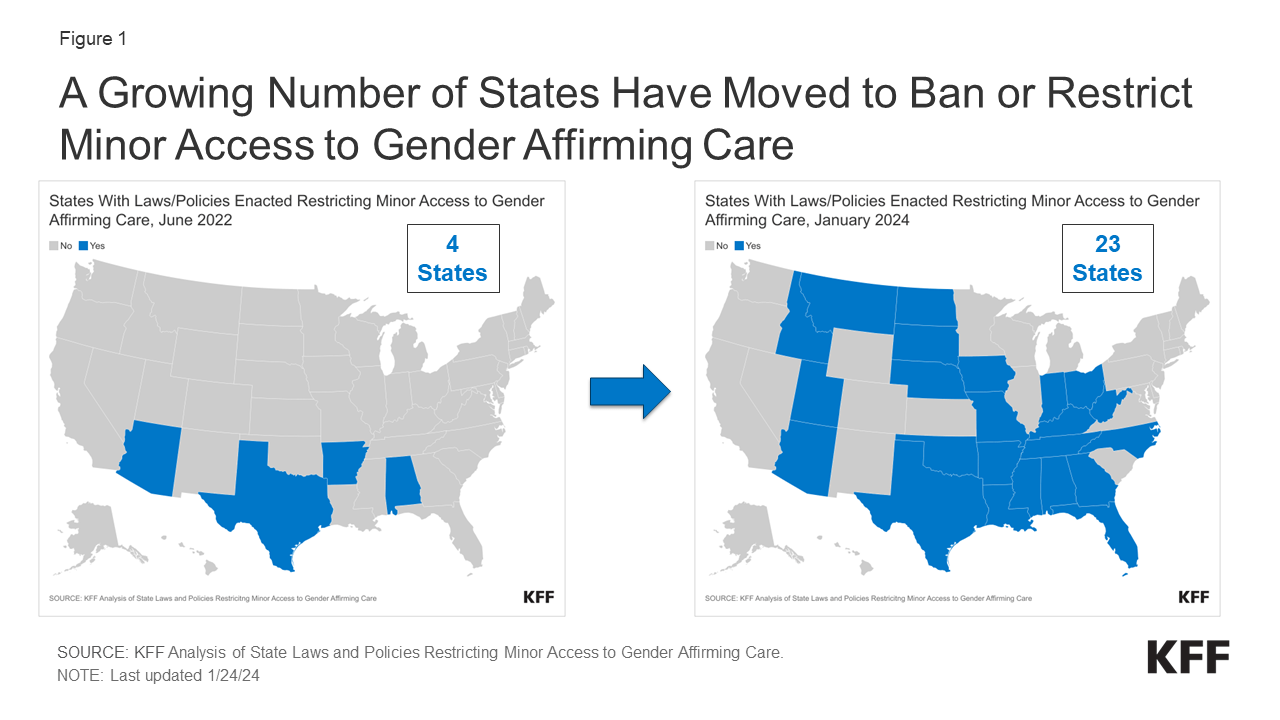
The good news is that there are signs that we are winning. Whereas only four states had moved to ban or restrict minor access of so-called gender affirming care, that number rose to 23 states by January 2024 (see above). Europe is ahead of us on this front (they do not suffer the same as we do from the presence of privatized health industry), but we are making progress. Moreover, as I point out in Bubbles and Realities, in 2022, the number of Americans who believe that a man cannot change his gender had steadily increased since 2017. The number have risen event more since then. According to a June 2024 Pew Research poll, nearly two-thirds of registered voters (65 percent) say whether a person is a man or woman is determined by the sex assigned to them at birth, whereas only about a third (34 percent) say whether someone is a man or woman can be different from the sex at birth.









 freedom and reason