Give the Football, Jesus

“This is the source of our confidence – the knowledge that God calls on us to shape an uncertain destiny.”

So Barack Obama’s god, a male god named Yahweh, who myth contends created the universe and sent his only begotten son (Jesus) to die for the sins of Obama’s congregation, sets before his worshippers no certain destiny. He created the universe so that his worshippers could make history, and it is, according to Obama, belief that their god has no definite plan that is the source of the worshipers’ confidence.

Not exactly something that should fill the faithful with confidence, it seems to me. Belief in a god or gods, if it is anything at all, is the need for certainty when everything else is uncertain. The idea that the people need to make their own destiny is disconcerting to those who pray for Yahweh to tell them what to do.

How will those Christians, Jews, and Muslims who believe Yahweh has worked out a destiny – revealed, albeit in murky phrases, in prophecies – feel about Obama interpreting the theology of the People of Book in this way? Many Muslims incessantly repeat “god willing” because they know nothing happens without Allah wishing it to. Kurt Warner, quarterback of the Phoenix Cardinals, after winning the conference championship, said that his team won because his “Lord up above…knew [he] was going do it” and, he added, he had to win it because of that.

Indeed, if Yahweh is omnipotent, if he is able to create the universe out of his imagination, then how can the future be uncertain? Why does he need human beings to shape a destiny? Don’t they need to simply realize that destiny by following Yahweh’s commandments? Would Yahweh allow human beings to make choices that in the end destroyed them and his creation?

If Yahweh made the universe and controls the universe he made, then Barack Obama is president because this is what Yahweh wanted. Everything that happens happens for a reason, Christians are fond of telling me. John McCain did not win because this was part of Yahweh’s plan. Donovan McNabb and Philadelphia Eagles lost to the Cardinals because Yahweh wanted Kurt Warner to win. Nobody knows beforehand what Yahweh wants. Afterwards we know, because if he had wanted things to be another way, then he would have made them that way. There is no uncertain destiny because Yahweh by definition knows all. History can never be something other than what it is.

Obama disagrees with those who believe Yahweh has a plan. Does he disagree with those who believe – as did George W. Bush – that Yahweh calls on certain people to realize his plan?

Obama’s position presents a logical problem for those who claim Yahweh is omnipotent. Yahweh must know what Obama and his congregation will do (even if he lets them do it, he still knows what they will do, therefore there is no uncertain destiny) or Yahweh is not omnipotent. If it is the latter, then it follows that Yahweh is a limited god. He’s not all powerful. He doesn’t control everything.

Then what – or who – does?

The Israeli-Palestinian Conflict: It’s Neither Ancient Nor Particularly Religious

Note December 4, 2023: Man, was I wrong about this.

Andrew Sullivan writes in a blog entry, “The Siege of Gaza,” the following, “The latest twist in this ancient and hopeless struggle is hard to address without equal measure of distaste for Hamas’s religious barbarism and dismay at Israel’s apparent determination to commit slow suicide.

GAZA BORDER, ISRAEL – DECEMBER 30: An Israeli soldier is wrapped in a Tallit, a Jewish prayer shawl, as he recites his morning prayers at an advance deployment area December 30, 2008 near Israel’s border with the Gaza Strip. Israel continues to reinforce its troops in advance of an expected ground invasion of the Gaza Strip. (Photo by David Silverman/Getty Images)

This is not an ancient struggle. European Jews began migrating to Palestine in the late nineteenth century and the colonization of Palestine began in earnest in the twentieth century. Before that time, Arabs, Christians, and Jews lived side by side in relative harmony. Sullivan attempts to mystify the cause of the conflict by rooting it in ancient history. Typical propaganda tactic: naturalize a conflict by making it primordial.

This is not at its core a religious struggle. This is an iteration of settler colonialism, in this particular case European Jews dispossessing indigenous Arabs of their land and lives. To be sure, religion, as it almost always does, fits in here in some way. Religion rationalizes oppression, fills the gaps in the consciousness of purpose, represents to the oppressed the heart in a heart world, the hope that finds hopelessness. But religion is not the ultimate cause of current situation.

The final cause of the situation really requires no analysis. Did Native Americans sit by idly while Europeans dispossessed them of their land and lives? Can anybody seriously claim that religious fanaticism drove Indians to massacre white settlers in North America? How should any people in possession of self-dignity act when colonized and oppressed? Sullivan’s claim that the Palestinians are guilty of “religious barbarism” is an attempt to shift the burden of responsibility: Israel is responsible for the predictable consequences of its behavior. The question for the international community is whether it will hold Israel accountable for its wrongdoing.

Israel is not committing suicide by pursuing this course of action. It’s leaders are orchestrating a situation—as they have been doing for decades—designed to incorporate Palestine into the state of Israel. Israel is the region’s sole nuclear power armed to the teeth with the most advanced weaponry the United States can provide. It enjoys the vast military arsenal of the US at its back. It enjoys the blessings of US client states in the region. If the surrounding Arab countries were likely to come to the defense of Arabs in Palestine, then Israel might be in some peril. But given the unlikelihood of such an outcome, Israel is, from a strategic imperialist point of view, strengthening its position with respect to its long-term project of consuming Palestine.

Science and Saddleback’s Rick Warren

Although it appears that Rick Warren, in anticipation of giving the invocation at Barack Obama’s inauguration, has removed from the Saddleback web site his extended thoughts on the matter of god and science (although he left up the important questions of whether our pets will be with us in Heaven), the Internet has preserved some gems.

President-elect Barack Obama with Rick Warren, pastor of Saddleback Church in Orange County, California

“If you’re asking me do I believe in evolution, the answer is no, I don’t,” said Pastor Rick to Newsweek, April 2007.

Concerning dinosaurs, Pastor Rick was asked (this was in a different interview), “How do they fit in with the idea that God created the world rather than the world evolving on it’s own? Why doesn’t the Bible talk about dinosaurs?”

Here’s Pastor Rick’s response:

The Bible tells in Genesis 1 that God made the world in seven days, and that he made all of the animals on the fifth day and the sixth day. All of the animals were created at the same time, so they all walked the earth at the same time. I know that the pictures we all grew up with in the movies were that dinosaurs roamed a lifeless, volcanic planet. Remember these are just pictures drawn by someone today! The Bible’s picture is that dinosaurs and man lived together on the earth, an earth that was filled with vegetation and beauty.

Warren insisted that the Bible does mention dinosaur-like creatures. “The Bible uses names like ‘behemoth’ and ‘tannin.’ Behemoth means kingly, gigantic beasts. Tannin is a term that includes dragon-like animals and the great sea creatures such as whales, giant squid, and marine reptiles like the plesiosaurs that may have become extinct. The Bible’s best description of a dinosaur-like animal is in Job chapter 40,” he said.

He then provided from evidence (Job 40:15-19), “Look at the behemoth, which I made along with you and which feed on grass like an ox. What strength he has in his loins, what power in the muscles of his belly! His tail sways like a cedar; the sinews of his thighs are close-knit. His bones are tubes of bronze, his limbs like rods of iron. He ranks first among the works of God.”

Perhaps the interviewer had a puzzled look on his face, for Pastor Rick commented, “This should not sound so strange. After all, God tells us that he created all the land animals on the sixth day of creation, the same day that he created mankind. Man and dinosaurs lived at the same time. There was never a time when dinosaurs ruled the earth. From the very beginning of creation, God gave man dominion over all that was made, even over the dinosaurs.”

Warren had not always believed that the Bible and science were incompatible. This is because, according to him, he had not made a full study of the Bible:

I found that, although I’d understood the science side of the equation, I needed to take some more time to read what the Bible really had to say about this subject. Not having taken the time to really read the Bible, I was very ignorant about what it had to say. Let me give you one example. I discovered that the problem of sin, as addressed in the Bible, was much more serious than I had previously thought. When I realized that the world was clearly a perfect place as God created it, and that this perfection was ruined by the sinful choice of Adam and Eve, it really started me thinking. Did the Bible teach evolution or did it teach the creation of a first man and woman named Adam and Eve? If we evolved, which human being would have made the choice that brought sin into this world? Since God clearly says that it is our sin that brought death into our world, how could there have been death for billions of years before the arrival of the first man who sinned on the earth? As I asked questions about this issue and studied what the Bible had to say, I found it to be one of the greatest times of learning in my life as a new believer. My prayer is that you will have this same experience!

Don’t pray for me, Pastor Rick. This is what understanding the “science side of the equation” looks like? If God first made the world perfect, then how could Adam and Eve make only the biggest blunder ever in the history of the universe? Yahweh created man and woman to fuck everything up? What definition of perfect are we working with here? Did Yahweh do this so that some of us could burn in everlasting hellfire for refusing to believe this bullshit story? And he gave this fuckup Adam dominion over everything, including dinosaurs? Why don’t interviewers interrupt these asshats and point out the idiocy of their opinions?

Mike the Mad Biologist’s comment is perfect, “Radiometric dating is probably something homosexuals do, anyway.”

I’m guessing all these questions are above Obama’s pay grade.

The Savage and Civilized Man

People are horrified to learn of the practice of human sacrifice by the Triple Alliance in modern-day Mexico, of the thousands of persons—criminals, slaves, and war captives—fed annually the god Huitzilopochtli to keep the sun rising every day, to make the giver of life victorious in its eternal struggle with the forces of darkness. Some claim that Cortés exaggerated the numbers of those sacrificed to justify conquest. Some claim the killings never took place, that it is a racist lie.

Of course, the killings did take place, as the historical record plainly shows. For the sake of making a point about how we should think about these deaths, let’s assume that Cortés’ figure of “three to four thousand souls” annually. Charles C. Mann, in his book 1491, which chronicles the history and prehistory of the Americans before European arrival, offers this fascinating passage putting the human sacrifices in Mexico into perspective:

Criminals beheaded in Palermo, heretics burned alive in Toledo, assassins drawn and quartered in Paris – Europeans flocked to every form of painful death imaginable, free entertainment that drew huge crowds. London, the historical Fernand Braudel tells us, held public executions eight times a year at Tyburn, just north of Hyde Park. (The diplomat Samuel Pepys paid a shilling for a good view of a Tyburn hanging in 1664; watching the victim beg for mercy, he wrote, was a crowd of “at least 12 or 14,000 people.”) In most if not all European nations, the bodies were impaled on city walls and strung along highways as warnings. “The corpses dangling from trees whose distant silhouettes standout against the sky, in so many old paintings, are merely a realistic detail,” Braudel observed. “They were part of the landscape.” Between 1530 and 1630, according to Cambridge historical V. A. C. Gatrell, England executed seventy-five thousand people. At the time, its population was about three million, perhaps a tenth that of the Mexica empire. Arithmetic suggests that if England had been the size of the Triple Alliance, it would have executed, on average, about 7,500 people per year, roughly twice the number Cortés estimated for the empire. France and Spain were still more bloodthirsty than England, according to Braudel. In their penchant for ceremonial public slaughter, the Alliance and Europe were more alike that either side grasped. In both places the public death was accompanied by the readings of ritual scripts. And in both the goal was to create a cathartic paroxysm of loyalty to the government – in the Mexica case, by recalling the spiritual justification for the empire; in the European case, to reassert the sovereign’s divine power after it had been injured by a criminal act.

Apologists for colonialism exploit the accounts of human sacrifice in ancient Mexico to justify European conquest of the Americas. I have before been asked to reflect upon the thousands of human beings saved by the gallant efforts of Europeans to Christianize the native peoples of Mexico. The Europeans were, from the perspective of the rulers of civilizations throughout the Americas, seen as enemies; but, from the perspective of the victims of these indigenous empires, the Europeans were—or at least should have been—viewed as saviors. But examining the practices of the Europeans in their homelands, leaving aside the brutality of the European conquest of the Americas, the descendants of Europeans are confronted with an awful truth about their own history: Europeans engaged in human sacrifice of their own people, as well.

The thousands of executions that took place annually in Europe—of single and menopausal women, Jews, homosexuals, heretics, the disabled, and a myriad of others—were sacrifices to a powerful god, Yahweh, the creator of the sun and stars, and his representatives on Earth, the mighty sovereign figures moving with power derived from Heaven. What insanity can be attributed to the inhabitants of Mexico during fifteen hundreds can be attributed to the inhabitants of Europe during the same century (and beyond)?

The lesson to be learned is not that Europeans were more civilized than their savage contemporaries in the Americas, but that absolute power rationalized by myths of the supernatural and cloaked in elaborate popular rituals represent a certain and deadly threat to human beings. Debunking the myth of European superiority requires sober assessment not only of the practices of the colonized subject before conquest, but of the colonizer himself.

Buchanan, Obama, and Marx

In a op-ed supplied below, conservative pundit Pat Buchanan is claiming that Obama is a socialist because he is advocating a progressive income tax. He backs up his argument with a quote from the Communist Manifesto: “A progressive or graduated income tax.”

It is true that Marx and Engels advocate in the Communist Manifesto a progressive or graduated income tax. It is a recommendation in a list of ten which includes these that have also been achieved in modern capitalist society:

Free education for all children in public schools. Abolition of children’s factory labor in its present form. Combination of education with industrial production, etc.”

You will note that these ideas – progressive income taxation, public education, and so forth – have been folded into capitalism with no movement towards socialism, which is defined as a social system that involves the redistribution of productive assets from non-producers (capitalists) to producers (workers).

This is because these items are not particularly socialistic. Think about it. Do Americans reject public education because two communists recommend it? Do Americans reject child labor because communists said we should reject it? Shall we return to child labor so as not to be socialist?

Moreover, other items on Marx and Engels’ list are not particularly socialistic:

Abolition of all rights of inheritance.

Confiscation of the property of all emigrants and rebels.

Centralization of credit in the banks of the state, by means of a national bank with state capital and an exclusive monopoly.

Centralization of the means of communication and transport in the hands of the state.

Combination of agriculture with manufacturing industries; gradual abolition of all the distinction between town and country by a more equable distribution of the populace over the country.

All of these are compatible with capitalism and have functioned to preserve capitalism in crisis (and could function to entrench capitalism). State ownership of banking, for example, has been necessary to preserve the financial system attendant to capitalist production.

Just as saying that the progressive income tax is socialist is nonsense, so, too, is the claim that nationalization of banks is socialist. Nader’s claim that we have socialism for the rich while we have capitalism for the poor is thus inaccurate. While it would be true that such nationalization would be socialist in a society based upon a socialist mode of production, in a capitalist mode of production, such nationalization is capitalist.

Some of the other items on Marx and Engels’ list are more arguably socialistic:

Abolition of property in land and application of all rents of land to public purposes.

Extension of factories and instruments of production owned by the state; the bringing into cultivation of waste lands, and the improvement of the soil generally in accordance with a common plan.

Equal obligation of all to work. Establishment of industrial armies, especially for agriculture.

If land is publically owned and proceeds from the value of that land are distributed to the public, then this is an example of a socialistic arrangement. The assumption in all these things in the Communist Manifesto is that they concentrated in the hands of and administered by a workers’ state and this really is the key to understanding Marx and Engels’ argument.

Then there is this slogan: “From each according to his ability, to each according to his needs!” What should we make of this? Does this follow from Obama’s “spread the wealth around” idea?

The line comes from the Critique of the Gotha Program, which Marx penned in 1875 in response to a document produced by representatives of the contemporary socialist movement. In fact, Marx did not coin the spirit of this phrase. It is found throughout socialist literature going back to the 1840s.

Early variations on the theme of a different model of redistribution are found in the work of Saint Simon, whom we have talked about in this class (he was Comte’s mentor). Saint Simon argued that what citizens receive in wages should reflect the value of their productive output.

Marx assumes that Saint Simon’s formulation is appropriate to socialism, the lower phase of communist society, whereas his statement of principle in the Critique of the Gotha Program concerning distribution based on need is appropriate to the higher phase of communist society.

Here is what Marx writes about “the higher phase of communist society,”

[A]fter the enslaving subordination of the individual to the division of labor, and therewith also the antithesis between mental and physical labor, has vanished; after labor has become not only a means of life but life’s prime want; after the productive forces have also increased with the all-around development of the individual, and all the springs of co-operative wealth flow more abundantly – only then can the narrow horizon of bourgeois right be crossed in its entirety and society inscribe on its banners: From each according to his ability, to each according to his needs!

Marx is talking about the world after the socialist transformation takes humankind to a higher level sufficient to free individuals from particular and necessary labor in order to explore labor efforts in the creative realm, to achieve self-actualization, something capitalism systematically precludes for the majority.

In the early stages of the transformation – what Marx refers to as socialism – “The right of the producers is proportional to the labor they supply; the equality consists in the fact that measurement is made with an equal standard, labor.” That is Saint Simon’s formulation. Marx explains further in this passage:

But one man is superior to another physically, or mentally, and supplies more labor in the same time, or can labor for a longer time; and labor, to serve as a measure, must be defined by its duration or intensity, otherwise it ceases to be a standard of measurement. This equal right is an unequal right for unequal labor. It recognizes no class differences, because everyone is only a worker like everyone else; but it tacitly recognizes unequal individual endowment, and thus productive capacity, as a natural privilege. It is, therefore, a right of inequality, in its content, like every right. Right, by its very nature, can consist only in the application of an equal standard; but unequal individuals (and they would not be different individuals if they were not unequal) are measurable only by an equal standard insofar as they are brought under an equal point of view, are taken from one definite side only – for instance, in the present case, are regarded only as workers and nothing more is seen in them, everything else being ignored. Further, one worker is married, another is not; one has more children than another, and so on and so forth. Thus, with an equal performance of labor, and hence an equal in the social consumption fund, one will in fact receive more than another, one will be richer than another, and so on. To avoid all these defects, right, instead of being equal, would have to be unequal.

Marx sees this as a problem to overcome in the socialist phase. He notes that

these defects are inevitable in the first phase of communist society as it is when it has just emerged after prolonged birth pangs from capitalist society. Right can never be higher than the economic structure of society and its cultural development conditioned thereby.

To summarize, under communism, once the highest phase has been achieved, citizens redistribute the social product on the basis of need. If a family has ten members, then it will require a larger dwelling, more food, more energy – in short, a larger social provision – compared to smaller families. This is because the need is greater. A solitary man does not need the same provision that a family of ten does, therefore he will receive less (this is the way it was in ancient society).

What will be required from all, if they are able bodied, is to produce the social surplus; but, with that production put to the task of need, technology will be put in the service of freeing citizens from most necessary labor.

Finally, it has always been of particular interest to me, having grown up in the church (my father was a Church of Christ preacher, as was my maternal grandfather), that Marx’s slogan resembles most closely passages found in the New Testament.

In Acts 2:44-45, it is written:

And all that believed were together, and had all things common; And sold their possessions and goods, and parted them to all men, as every man had need.

In Acts 4:34-35 it is written,

Neither was there any among them that lacked: for as many as were possessors of lands or houses sold them, and brought the prices of the things that were sold, and laid them down at the apostles’ feet: and distribution was made unto every man according as he had need.

These passages are found in the description of the principles and character of the first Christian church, which was a commune in which all members held property in common and distributed the proceeds from that wealth on the basis of need not productive effort. In fact, these passages contain the case of a man and his wife who withheld from the church a portion of the wealth derived from the sale of land and were executed for their crime by church members (clearly, the early Christians were serious about their redistributive scheme).

Christian socialists have argued that Marx’s formulation is a secular version of the Christian principle that lays emphasis on sharing of wealth, indeed of afflicting the comfortable while comforting the afflicted, a principle that finds its expression through the New Testament in the condemnation of concentrated wealth and privilege.

Ironic, isn’t it? What would the author of the op-ed I have supplied below say if we were to note that the slogan upon which he so enthusiastically heaps piles of scorn comes from the gospels he so enthusiastically embraces?

Demagogues have long depended on the failure of adherents to foundational texts to actually study the texts about which they so faithfully adhere.
Hope for Failure

“It’s kind of hard to figure how Warren Buffett endorsed me, Colin Powell endorsed me, and John McCain thinks I’m socialist.” —Barack Hussein Obama

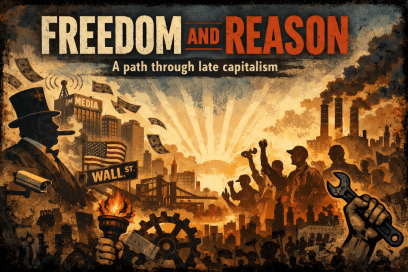
Image generated by Sora

This is how brainwashing works. Let’s take the example of a prisoner of war—his name is Tom—kept in isolation from his comrades for many days. The enemy wants to make Tom believe that the enemy’s cause is greater, that the enemy’s system is superior, and that the POW’s cause and system are wrong. The enemy tells the POW all sorts of things in an effort to break him, but Tom resists because he knows it is the enemy telling him these things. Tom knows what’s going on. Tom is his own man.

For months, we have heard that Barack Obama is a “transformational figure,” a leader who has come to take us all to higher ground. Many of Americans have resisted the man and the message because they are suspicious of both. Of course, Republicans and conservatives are suspicious. How can a progressive Democrat represent their interests? But some progressives were suspicious. How can a centrist Democrat represent progressive interests? The media continued to hammer away the Obama narrative. The man and his message are everywhere.

Then Obama rolls out the Warren Buffetts, the Colin Powells, and the Bernie Sanders—men from the right and the left, businessmen, generals, labor leaders, conservatives, liberals, and social democrats. Powell says, “Obama is a transformational figure.” Like our POW Tom, the sentiments of those who were suspicious of Obama were transformed. So many different sorts of figures, appealing to so many different sorts of people—all elites, of course—rolled out in a massive propaganda campaign represents a deft brainwashing campaign of historic proportions.

Obama’s half hour propaganda special, which appeared last night one several channels, was another key aspect of the brainwashing campaign. Did you see the way the people were responding to Obama? One man kept muttering in a whisper, tears in his eyes, “Thank you … thank you,” as Obama told him he would save his pension. The old man looked like an enraptured zealot at a Benny Hinn anointing, hands clasped together, “Thank you, sweet Jesus…. Thank you, sweet Jesus.” 

The Obama campaign believes—and given the ground of religiosity of this country, their assumption is not far off the mark—that Americans will fall for a politician who is every bit the image of an evangelical faith healer, especially progressives who want a religious leader even if they reject organized religion. Obama is pitched as a liminal figure on a divine democratic mission to save America from decay and pollution. The clouds will part and the seas will recede—he told us this himself—and a righteous leader will step through the breech to take us all to higher ground. He is “the One,” the special man who will unify his people—class, gender, racial matter no more—and lift the nation to new heights. We will be saved. Reborn in a New America.

If the ruling class succeeds in pulling off this moment, the United States political system will have entered into a political phase, one closely paralleling—of course, in its own unique American way—the personality cults of Nazi Germany and North Korea. For this reason alone, we should hope for its failure.

* * *

Note: This post was migrated from my old platform. I have added to it an image generated by Sora.

Design

What do we mean when we say something is designed or is the product of “design”? To design something is “to create, fashion, execute, or construct according to plan,” “to conceive and plan out in the mind,” “to have as a purpose,” “to devise for a specific function or end.”

For example, if we wish to make a hole in a wooden plank, we create a tool or machine, such as a drill, to accomplish that end. The drill is the product of design. It allows us to achieve some end, not accidentally, but rather on purpose. The functionality of a thing is insuffient to suggest design. Design requires creation or creative alteration with purpose, with intent. This is telic behavior – that is behavior tending toward an end or outcome.

Clearly the design of the drill is the product of intelligence. Something that appears to be drill-like or functions as a drill is not the product of intelligence. Such a thing may be used as a drill, but was not designed for that purpose – in fact, it wasn’t designed at all. An example would be the bill of a woodpecker. It functions to make holes in wood (and its functionality is not limited to making holes in wood), but it was not designed for this function. Its functionality is the result of evolution.

What is “intelligence”? Intelligence is the ability to learn from experience, to change behavior in an intentional way to adapt to environments, to demonstrate the capacity to reason, to acquire and apply knowledge, to solve problems, to comprehend or understand situations and respond appropriately and meaningfully. Intelligence is essentially a faculty of reason and thought.

That which is the product of design is presumed to be the act of an intelligence. It seems to me, then, that the idea of “intelligent design” is a redundant expression. Design presumes intelligence. Moreover, since design presupposes an intelligence, then things that are the products of design are things that are the product of intelligence. Please know that I am not making an argument here. I am merely defining terms. The bottomline is that things which are the products of design are things that are created, constructed and executed according to plan with an end in mind.

The mind is a product of social interaction and relations that root in a biological capacity that has emerged from a long evolutionary process. Natural and social histories represent an interlinked process that has produced an intelligence capable of identifying and elaborating that process.

Because the emergence of consciousness has been gradual, grasping the process was not initially accurate and remains incomplete. The methods and meaning systems used to understand the process evolved over time, eventually producing science, the most successful method for explaining the process. Early methods yielded the notion that there was an intelligence behind everything. It confused function with purpose. The modern method – the scientific method – demonstrates that most things were the result of a non-intelligent process, that function was the result of evolution, not design and purpose.

Although science has not answered every question, it has managed to properly distinguish the difference between function and purpose. This is arguably the major breakthrough in human consciousness. So-called “intelligent design,” even if we grant that it is not veiled creationism (which, of course, it is) is retrograde because it wishes to deny, retard, even reverse the progress of consciousness.

This is why, while science has yielded a wide array of applications, intelligent design has yielded nothing.

Why the Obfuscation?

I continue to find curious this whole Obama-is-a-closet-Muslim thing. Obama’s stepfather was a Muslim. Obama lived in Indonesia, a Muslim majority country for six years. Obama was enrolled in school as a Muslim, where he learned a curriculum that included Islamic studies. Obama attended Mosque. The record indicates that, during a significant stretch of his life, Obama was recognized as a Muslim.

I don’t have a problem with Obama having been recognized as a Muslim. His experiences with Islam could actually be a selling point; we need politicians who understand Islam. Moreover, I don’t have a problem with right-wingers trying to figure out exactly what Obama’s experiences with Islam are; Obama’s characterizations of his experiences are clearly deceptive. He invites skepticism.

What I do have a problem with is Obama’s constant touting of his Christian faith and denials of any significant involvement with Islam. He is downplaying perhaps his strongest selling point (there is not a lot to recommend him, frankly) while, at the same time, fueling the Islam-is-bad theme. Why, if Islam is a respectable religion, is it so terrible for Obama to have been identified as a Muslim while living in Indonesia?

Of course, context is everying. I predict that, if elected, Obama’s experiences with Islam will become a major selling point to the international community in the project to re-legitimize US global hegemony. Indeed, I suspect this is the plan: elect a black man with African roots, a popular Arabic name (Hussein), and a life history of significant experiences with Islam. Why else would the establishment get behind a half-African candidate with radical southside Chicago ties.

This brings me to the overwhelming condemnation of Jerome Corsi’s book Obama Nation and how weak the arguments are. On Larry King Live, Frank James dances around the subject of Obama’s experiences in Indonesia, treating something that is not controversial in itself as a smear that must be denied, though without any rational refutation of Corsi’s interpretation of the facts. Paul Waldman, who also appears on the program, does no better.

What becomes clear is that Obama backers realize that the facts at the core of Obama’s Indonesian experience, along with facts beyond Indonesia (his claim that he is a life-long Christian is contradicted by his own statements on faith), undermines Obama’s claims about his life-long religious experiences. What is controversial is the manner in which Obama has distorted his personal history on this matter. The corporate media is working overtime to make Obama’s deception on this matter appear innocent.

Finally, there is this example of twisted logic and the most vile type of ad hominem attack from James:

One of Corsi’s claims to credibility is his doctorate in political science from Harvard University. His Ph.D appears after his name on the cover and title page of the book.

But a Ph.D. isn’t necessarily proof that your worldview is well-grounded. Anyone who doubts that need only consider Theodore Kaczynski, the Unabomber, a University of Michigan Ph.D in mathematics.

As Frank himself notes, Kaczynski had a advanced degree in mathematics. This makes Kaczynski an expert in mathematics not politics, which is a key area of expertise at issue in a political campaign. Corsi’s degree is in – drum roll – politics. This makes him an expert in the field in which he is writing! Second, Frank is comparing Corsi to a serial murderer, and, while Corsi may be many things (e.g. apparently a bigot for having criticized the way the Catholic church covered up the widespread molestation of youth by its priests), he hasn’t been sending mail bombs to the US postal service.

I am still waiting for Obama to simply say the following: “I realize that some 12 percent of US citizens believe I am a Muslim. To them I say, ‘That’s fine,’ and then ask, ‘Vote for me anyway, since there is nothing wrong with being a Muslim.” Obama running away from a rumor that he is a member of a respectable religious movement (isn’t that we are all told?) is the problem here, not books that document the facts of Obama’s experiences with Islam.


Barack Obama: Doing the Lord’s Work

In Mein Kampf, Adolph Hitler writes, “I am convinced that I am acting as the agent of our Creator.” He also writes, “I am doing the Lord’s work.” He writes this, as well: “I believe today that my conduct is in accordance with the will of the Almighty Creator.” Persons of faith wishing to distance themselves from Hitler’s deeds insist he was an atheist. It doesn’t seem so reading the pages of Mein Kampf. It seems he saw himself as chosen by God to lead Germany back to a glorious (imagined) past. History indicates that it’s a lot scarier for a man to tell the world he’s on a mission from God than it is for a man to admit he doesn’t believe in one. Indeed, the man who doesn’t believe in supernatural things isn’t scary at all. At least not for that reason.

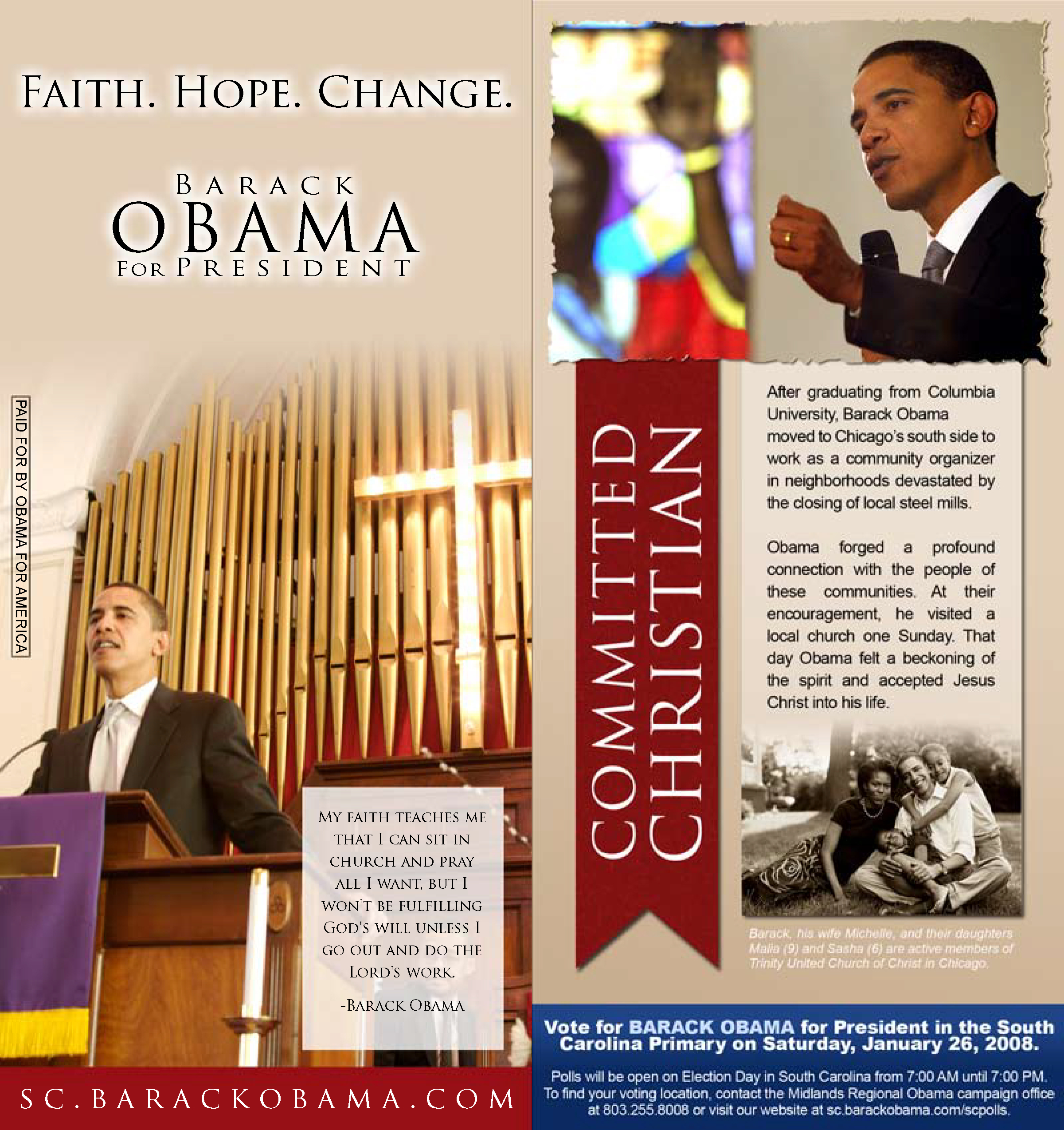
This appealing to God—to being God’s agent, to aligning one’s actions with God’s will, to doing God’s work—is what is so troubling about the Obama campaign’s Kentucky flier (see below). Obama is standing at a pulpit with a giant lit cross in the background. “Faith. Hope. Change,” reads the title. In it, it reads, “My faith teaches me that I can sit in church and pray all I want,” says Obama. “But I won’t be fulfilling God’s will unless I go out and do the Lord’s work.” In a private letter to God left at Jerusalem’s Western Wall in the summer of 2008, Obama writes, “Give me the wisdom to do what is right and just. And make me an instrument of your will.” (The controversy over his words has not been about his desire for God to make him an instrument of his will, but the fact that a newspaper published what he wrote, which is supposed to be just between Obama and God. In other words, he wasn’t just pandering.)

In the campaign literature below, “Barack Obama: Answering the Call,” echoing the story of Jesus as a boy, Obama writes that he “knew the Scriptures” but that he was “removed and detached” from the Lord. Obama was challenged to attend church by the community he was working in and, there, “learned that my sins could be redeemed. I learned that those things I was too weak to accomplish myself, He would accomplish with me if I place my trust in Him.” He writes, “I felt I heard God’s spirit beckoning me. I submitted myself to His will, and dedicated myself to discovering His truth and carrying out His works.” The title of this section is “Called to Christ.” In the section titled “Called to Bring Change” Obama compares himself to Moses, who at first was unsure of himself, but “[t]he Lord said, ‘I will be with you…. I’ll show you what to do.’” In the section “Called to Serve” Obama is said to be “[g]uided by his Christian faith” and is, therefore, trustworthy. And, in the section “Committed Christian,” Obama is quoted as saying “I believe in the power of prayer,” that found in this power is “the will” to act.

Readers of the blog will recall that Bush’s establishment of a Faith-Based Initiative by executive order in January 2001 was deeply disturbing to liberals and progressives. Marvin Olasky, author of the 1994 book The Tragedy of American Compassion, who inspired Bush’s “compassionate conservative” theme, was a chief architect of the program. John DiIulio, Jr., a political scientist known for coining (or at least popularizing) the term “super predator” that spread popular fear of black youth, was its first director. Now we learn that Obama is intent on keeping the program. On July 1, 2008, he said, “I’ll establish a new Council for Faith-Based and Neighborhood Partnerships. The new name will reflect a new commitment. This Council will not just be another name on the White House organization chart—it will be a critical part of my administration.” [Note (1.28.2009): Obama has tapped DiIulio to adapt the initiative under his presidency. He appointed pastor Joshua DuBois to head the new program.]

In a campaign stop in Lebanon, New Hampshire, on January 7, 2008, Obama told his audience that on election eve “a light will shine through that window, a beam of light will come down upon you, you will experience an epiphany … and you will suddenly realize that you must go to the polls and vote for Obama.” At his nomination victory speech in St. Paul, Minnesota, on June 3, 2008, he told the throng that “generations from now, we will be able to look back and tell our children that this was the moment when … the rise of the oceans began to slow and our planet began to heal; this was the moment when we … secured our nation and restored our image … when we came together to remake this great nation….”

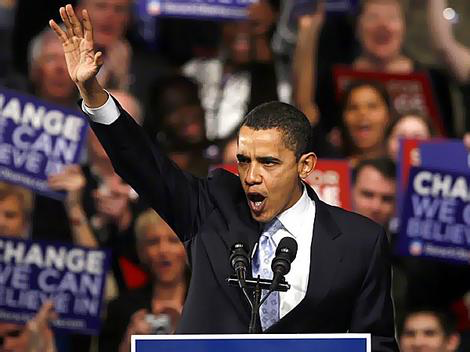
Obama delivering his victory speech, St, Paul, Minnesota

During George W. Bush’s administration, there was concern about the degree of religiosity expressed not just by those around him but, most troubling, by the president himself. (I wrote about this in 2003 in a piece titled “Faith Matters: George Bush and Providence” in The Public Eye Magazine. I was asked to speak about it at the United Nations University in Amman, Jordan in November 2006: “Journey to Jordan.” I adapted this speech for my 2007 blog entry “Christian Neo-Fundamentalism and US Foreign Policy.”) Bush believed he was chosen by God to lead the Christian world against the Axis of Evil. The press made a big deal of this. Where are the questions from the press about Obama fulfilling God’s will by doing God’s work? Where is the popular concern that Obama prays to be the instrument of God’s will? Why are liberals and progressives so apathetic about the question of church-state separation when it comes to a candidate for the Democratic Party? The hypocrisy is astounding.

The Trap of the Two Party System

Note in this piece I had not yet recognized the problem with progressivism. (comment: July 3, 2024)

The United States is a capitalist country. This means that the state is a capitalist, or bourgeois state. The two major political parties—the Democratic and Republican—are bourgeois parties and, for the most part, represent the interests of the capitalist class and its cadre of managers, as well as the capitalist system as a whole. 

As a socialist, neither one of these two major parties represents my interests. Moreover, since most citizens are working people, neither one of the two major parties represents the interests of the majority of persons living in the United States. Working people have political parties representing their interests, but these parties are small and working people for the most part are falsely consciousness of their interests. This is because of capitalist and nationalist ideologies. 

However, within the constraints of the system, there are differences between these two major parties. Usually, one of the two major parties is worse for working people. During the second half of the nineteenth century, the Republican Party, led by Abraham Lincoln was relatively better for working people mainly because of its work in limiting the spread of slavery and, ultimately, winning the war against the slaveowners that freed the slaves. This was good for the working class because it created the structural conditions for building a mass-based working class movement. Later, the Democratic Party took up the mantle of progressivism and the Republicans became the more troublesome enemies of the working class. 

Third parties have a rich tradition in the United States. In 1892, the Populist candidate polled 1,026,595 votes, or 8.5 percent of the total vote. in 1904, the Socialists won 402,810 or 3.0 percent. In the next election cycle, the socialist won 420,793 (2.8 percent). They did even better in 1912, taking 901,551 votes, representing six percent of the total. The Progressive party did even better, coming in second (ahead of the Republicans) with 4,122,721 (27.4%). The Socialists took 590,524 3.2% in 1916 and 913,693 3.4% in 1920. In 1924 the Progressives took 4,831,706 16.6%. In 1932, Socialist 884,885 2.2%. In 1944 Progressive/American Labor 1,157,328 2.4%. 

Progressives are told that if they vote for progressive politicians and parties they will help elect the regressive candidate. They are instructed to vote for the party that is more progressive in contrast to the party that is least progressive. If you vote for a third party, you are throwing your vote away. Were people in 1892 or 1912 told this? Did not those voting for the Socialist Party vote their conscious and their principle? They had good reason to know that their man wouldn’t win. So why did they cast their vote in a way that would weaken the relatively more progressive candidate? 

Is it not curious that the more we have been swayed by the don’t throw away your vote by voting on principle and conscience argument the fewer and smaller the opportunities to vote for those who represent your principles? Is it not curious that the more we are told to work within the confines of the two party system the more conservative the relatively more progressive party becomes? Does is not keep the Democrats interested in working class interests for workers to vote for socialists? It is in the interests of Democrats to do this, obviously, since they need votes to win. If they can count on progressives to reflexively vote for Democrats, then what incentive do they have to address working class and progressive citizens? Clearly, they have very little, since they have move steadily rightward with the decline of third parties.