This is huge. Texas Attorney General Ken Paxton: “Certain officials in the Defendant States presented the pandemic as the justification for ignoring state laws regarding absentee and mail-in voting. The Defendant States flooded their citizenry with tens of millions of ballot applications and ballots in derogation of statutory controls as to how they are lawfully received, evaluated, and counted. Whether well intentioned or not, these unconstitutional acts had the same uniform effect—they made the 2020 election less secure in the Defendant States. Those changes are inconsistent with relevant state laws and were made by non-legislative entities, without any consent by the state legislatures. The acts of these officials thus directly violated the Constitution.”
Texas Attorney General Ken Paxton
Texas Attorney General Ken Paxton is asking the U.S. Supreme Court to block the battleground states from casting “unlawful and constitutionally tainted votes” in the Electoral College. In the suit, Paxton claims that pandemic-era changes to election procedures in those states violated federal law and allowed voter fraud. It is not a question of whether you believe there was fraud. There was fraud. It does not matter that election officials have rejected claims of fraud. They are the ones who rigged the election. Flooding a state with millions of ballot applications in derogation of statutory controls as to how they are lawfully received, evaluated, and counted is rigging an election.
Why are so many people around you denying what happened in this election? (We know why the media is dismissing downplaying, and lying about it.) Because they are obsessed with cancelling the Trump presidency. They are also—many of them—possessed by a deep desire to cancel the United States of American. The Constitution means nothing to them. Obviously. It’s as dead and wicked as the people who wrote it. The sad truth is that there are people in the United States who loathe Trump and his followers so much that they don’t care that the executives of Georgia and other states changed the election rules arbitrarily and unconstitutionally. Furthermore, many of them believe the United States was founded by racists (i.e. white men) and is therefore an illegitimate entity and on this basis elections may be rigged in favor of their preferred candidates. They care about neither process nor principle. They only care about outcome. This is their general stance, shown by their rhetoric of equity or equality of outcome rather than equality before the law and equality of opportunity. They are illiberal and antidemocratic.
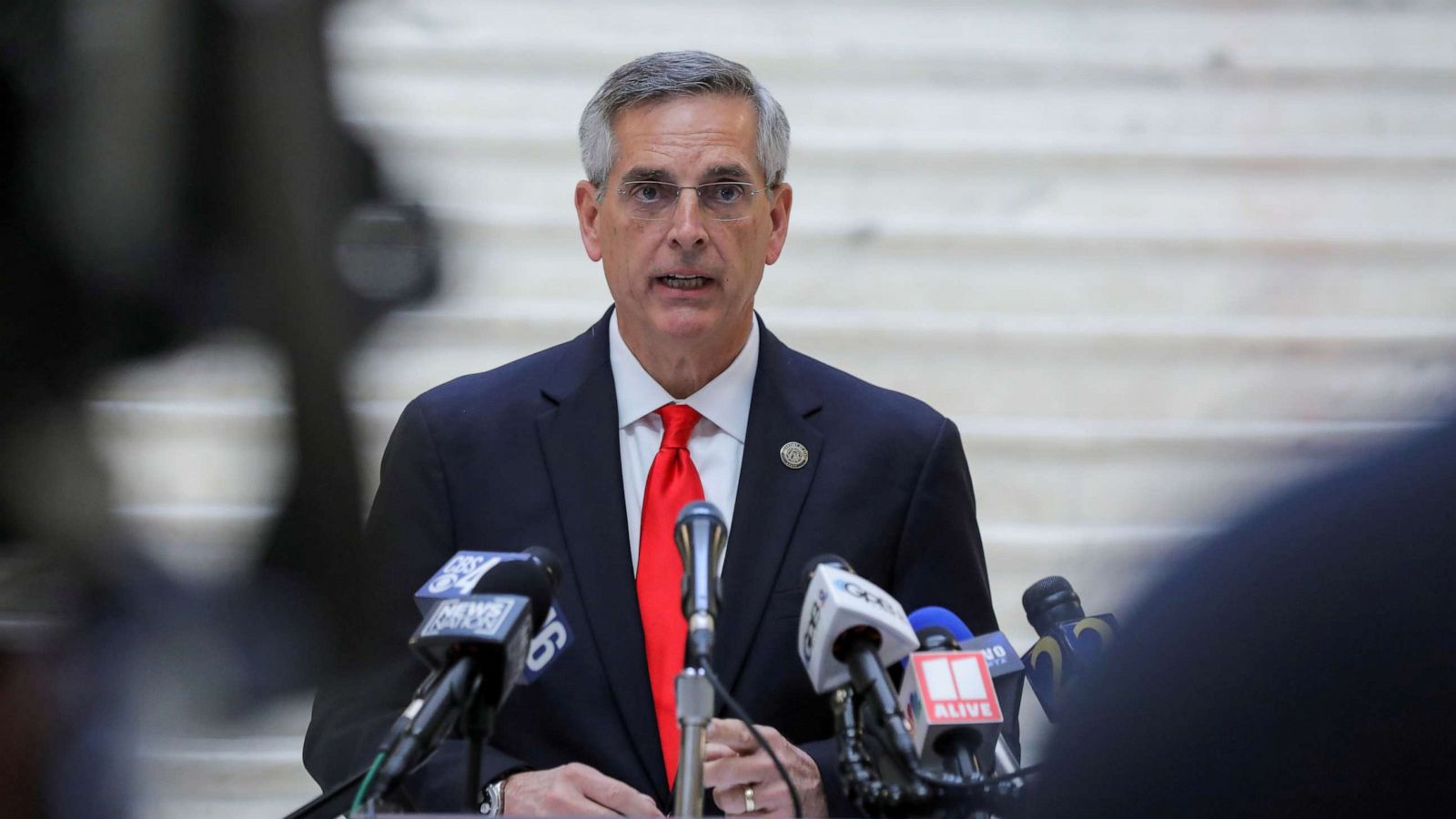
The racism angle is particularly obnoxious. Progressives howl at the prospect of overturning state certifications of the elections. They scream “disenfranchisement!” In their telling, the United States is a racist country where blacks face systematic discrimination. They wield the specter of voter suppression as justification for rigging elections. However, changing the election process—evidenced, for example, in the consent degree negotiated between Georgia Secretary of State Brad Raffensperger and failed gubernatorial candidate Stacey Abrams and approved by Governor Brian Kemp—disenfranchises the voters of the state. If a lawful election requires chain of custody, signature verification, voter ID, and other measures, as determined by the constitutions and the state legislators of these states, and if a secretary of state changes these rules by fiat, even in a pandemic, then the election is unlawful. Either the election must be held again or the state legislator must elect a slate of electors representing the will of the people to be determined by a thorough audit of the votes and the process.
Georgia Secretary of State Brad Raffensperger
The United States Constitution is not advisory. It’s law. Foundational law. Our Constitution establishes a democratic republic. The Constitution guarantees each state a republican form of government. A republic is a form of government that represents the sovereign people. The sovereign people of the republic overthrew the sovereign authority of the monarch. Only vestiges of that old authority remains in the executive (for example, the power to pardon, which was the king’s privilege). The sovereign people of a democratic republic are instead represented by elected legislators who make and change law in a deliberative and rational process. To be sure, the executive has considerable authority in administering the law and possesses some degree, albeit sharply constrained, lawmaking capacity, but on the question of the laws of democracy, state legislators determine the law. We have (and progressivism is largely responsible for this) allowed the cancer of the administrative state to metastasize. Moreover, the rights of the sovereign people of America are enshrined in the Constitution and its Bill of Rights. The executive cannot bypass the legislative branch nor arbitrarily infringe upon the civil liberties and rights of persons. The executive has been for too long usurping the power of the other branches of government. Administrators are violating the spirit of our constitutional form of government.
What matters more than who is president (although that matters are a lot) is the right of the sovereign people of republican states to a lawful election. Elections must be lawful to count. AG Paxton is not pulling a stunt. Texas is stepping up to defend the Constitution—and our democracy.
There is video of what appears to be a small team of polls workers in Fulton County, Georgia retrieving ballots in suitcases hidden beneath a covered table after clearing out Republican observers and other poll workers. The suitcases had been placed there the morning of the election. The video corroborates eyewitness testimony. Is this the proverbial smoking gun? The team (two yellow shirts, two purple shirts, along with a red shirted man) cleared out the observers and other workers under the pretense of a burst sewer pipe at the state’s largest voting precinct, State Farm Arena. The burst pipe story was widely reported by the legacy media.
WATCH: Video footage from Georgia shows suitcases filled with ballots pulled from under a table AFTER supervisors told poll workers to leave room and 4 people stayed behind to keep counting votes pic.twitter.com/AcbTI1pxn4
— Team Trump (Text TRUMP to 88022) (@TeamTrump) December 3, 2020
The legacy media reported that the burst sewage pipe delayed election officials in counting thousands of mail-in absentee ballots on Election Day. However, as you can see in the video (which they are censoring and flagging on social media), there is no evidence of a burst pipe. The video appears to show instead poll workers waiting until everybody leaves and then moving into action, retrieving ballots from a hidden location where they had been kept since that morning, and frantically processing them. They’re running multiple machines, each one capable of processing several thousand ballots an hour. Estimates of the number of ballots processed during this time is at least several thousand.
Legacy media reporting on this incident functions to provide cover for fraud, with social media dismissing the story as pre-debunked and those in charge tidying up the mess (for example Gabriel Sterling, Georgia Elections Manager, an appointee of Secretary of State Brad Raffensperger). Poll workers and the legacy media were apparently unaware or did not consider that State Farm Arena is fully equipped with surveillance cameras and the private firm in charge of security simply handed over the recording to attorney Jacki Pick, who in turn presented the evidence to the Judiciary Subcommittee Hearing on Election. The video is consistent with what is described by witnesses in other states. Citizens are now doing the work of identifying the poll workers. One of them has been identified already (see also a potential collaborator). Presentations before the State Senate detailed other evidence of fraud. It is extensive.
The fact that the media is not covering this story, which is now several hours old, illustrates the extent to which the media is in on the hustle. This is the sort of scandal that generates big advertising dollars for legacy media. Crickets.
This episode is hardly the only illustration of media complicity in fraud. The legacy media is either ignoring or falsely claiming to have debunked a mountain of evidence indicating it. For example, there are hundreds of affidavits from witnesses testifying to fraudulent and suspicious activities. A sworn affidavit is evidence. So when the media tells readers and viewers that there is no evidence of fraud, they’re lying or don’t understand what evidence is (which is not possible). These hundreds of witnesses have sworn to what they saw under penalty of perjury. They understand the consequence of lying. Unlike the media, they will be held to account for their claims. Across multiple counties in multiple states, observers and workers testifying to seeing similar things. We cannot ignore this.
But that is not all. There is a string of statistical improbabilities that, by themselves, are practical impossibilities. When, taken together, the fact pattern indicates the work of a shared algorithm that systematically switches votes from one candidate to another. A hand recount compared to a machine with multiple observations in a county in Georgia found the machine switched the same number of votes from Trump to Biden. According to John Fredericks, appear on today’s program War Room: Pandemic, there were 37 votes that flipped in Ware County Georgia. Extrapolating the percentage flip to the entire state, that adds up to more than 14,000 votes. Biden “won” Georgia by only 10,000.
As we heard during the hearing before several of Arizona’s election officials, a state with another narrow-thin margin, the design of the software suggests that one way vote swapping is accomplished is by calculating fractional votes rather than tabulating integer votes, a trick that allows for the weighting of votes in favor of one candidate or another. For example, every Trump vote may be worth 0.7, while Biden votes are weighted 1.3, or, as appears to be the cases in some counties, the 0.3 is shifted to the Libertarian candidate. One indication of this is the appearance of decimals in the final vote tallies. This shouldn’t happen in an integer-based system. Dominion and state officials are aggressively moving to wipe the machines, and other state officials are reluctant to impound and subject the machines to forensic examination. This is highly suspicious behavior. If there is nothing to worry about, it only strengthens Biden’s claim to the Presidency to impound and examine the machines.
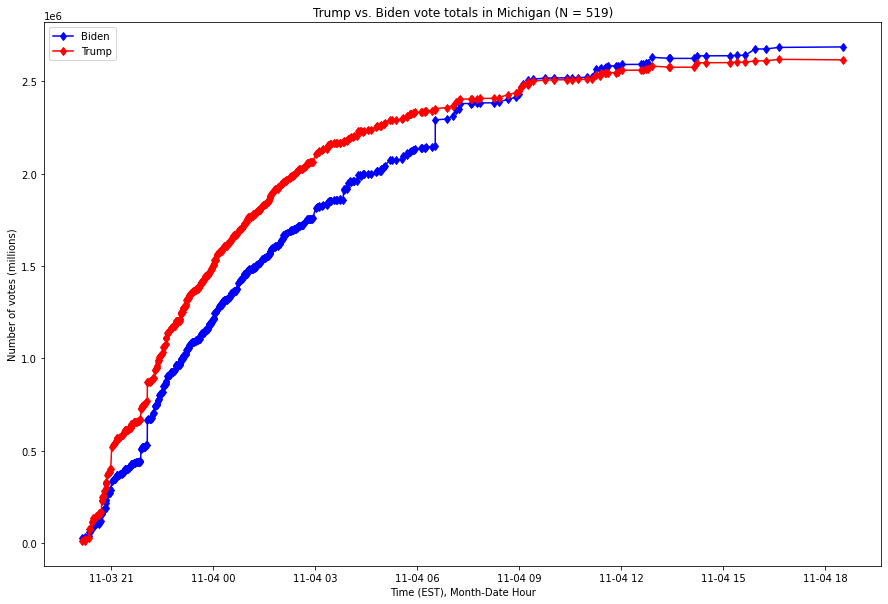
We see in multiple states a massive flip of votes of similar proportions occurring at similar times. In two states, the flip occurs within seconds. See the study Anomalies in Vote Counts and Their Effects on Election 2020. Note the time stamps. There is a near simultaneous uptick (see X axis) of similar magnitude (see Y axis). See also the study Michigan 2020 Voting Analysis Report.
There are many disturbing reports of missing and backdated mailing votes. Several whistleblowers have testified to the disappearance of 288,000 ballots and backdating of another 100,000 in Pennsylvania. They also reported that mail promoting President Trump was junked while mail for Joe Biden was delivered. The Washington Examiner reports that “a U.S. Postal Service contractor said his trailer full of 144,000-288,000 completed mail-in ballots, which he drove between New York and Pennsylvania, disappeared after he delivered it to a Lancaster, Pennsylvania, depot.” This information is gathered by the Amistad Project of the Thomas More Society. You can watch the Amistad press conference here.
Does the fraud overturn the election? Probably. At least it should. But this is a coup, so probably not. But an equally important question is why the media is not merely uninterested in this, but actively dismissing it, even smearing those who are raise questions as “conspiracy theorists”? Why is the legacy media claiming that there is either no evidence of fraud or that cases have been debunked when they haven’t? Since when have they cared about evidence? Remember how the media was all in on the Russian hoax? Remember when Biden Appointee Neera Tanden spread the conspiracy that Russian hackers switched votes in favor of Hillary Clinton in 2016? Remember the Ukraine affair? Remember how the media—they still do—misrepresent the efficacy of hydroxychloroquine while pushing remdesivir? This is not a new story. Remember how the media misled the public about WMD during Bush’s drive to invade Iraq? Remember how they covered up Bush’s incompetence in 9/11? They still are by claiming that it was Gore’s challenge of the Florida vote in 2000 that left the United States vulnerable to terrorist attacks. (For the record, Gore did get more votes than Bush in Florida.)
The reason why the media is doing this should be obvious. As I have demonstrated in several stories on this blog, the legacy media, joined by social media, is the propaganda arm of the corporatist oligopoly. As Edward Herman and Noam Chomsky tell us in Manufacturing Consent: The Political Economy of the Mass Media, “The mass media serve as a system for communicating messages and symbols to the general populace. It is their function to amuse, entertain, and inform, and to inculcate individuals with the values, beliefs, and codes of behavior that will integrate them into the institutional structures of the larger society. In a world of concentrated wealth and major conflicts of class interest, to fulfill this role requires systematic propaganda.”
Here’s another smoking gun:
How does this work? Let’s turn to Herman and Chomsky again: “Structural factors are those such as ownership and control, dependence on other major funding sources (notably, advertisers), and mutual interests and relationships between the media and those who make the news and have the power to define it and explain what it means. The propaganda model also incorporates other closely related factors such as the ability to complain about the media’s treatment of news (that is, produce ‘flak’), to provide ‘experts’ to confirm the official slant on the news, and to fix the basic principles and ideologies that are taken for granted by media personnel and the elite, but are often resisted by the general population. In our view, the same underlying power sources that own the media and fund them as advertisers, that serve as primary definers of the news, and that produce flak and proper-thinking experts, also play a key role in fixing basic principles and the dominant ideologies. We believe that what journalists do, what they see as newsworthy, and what they take for granted as premises of their work are frequently well explained by the incentives, pressures, and constraints incorporated into such a structural analysis.”
I will soon drop a blog entry detailing the structure of power for which the establishment media toil. In the meantime, here are sources to arm you against skeptics: The National Pulse and Revolver News. Until then, I will leave you with an observation. Political scientist Michael Parenti once said something like this: While the media doesn’t necessarily tell you what to think, they do tell you what to think about. In this spirit, you might want to think about why you are not thinking about what happened with Antifa violence and Black Lives Matter riots after the legacy media proclaimed Biden President-elect. Mission accomplished? #colorrevolution
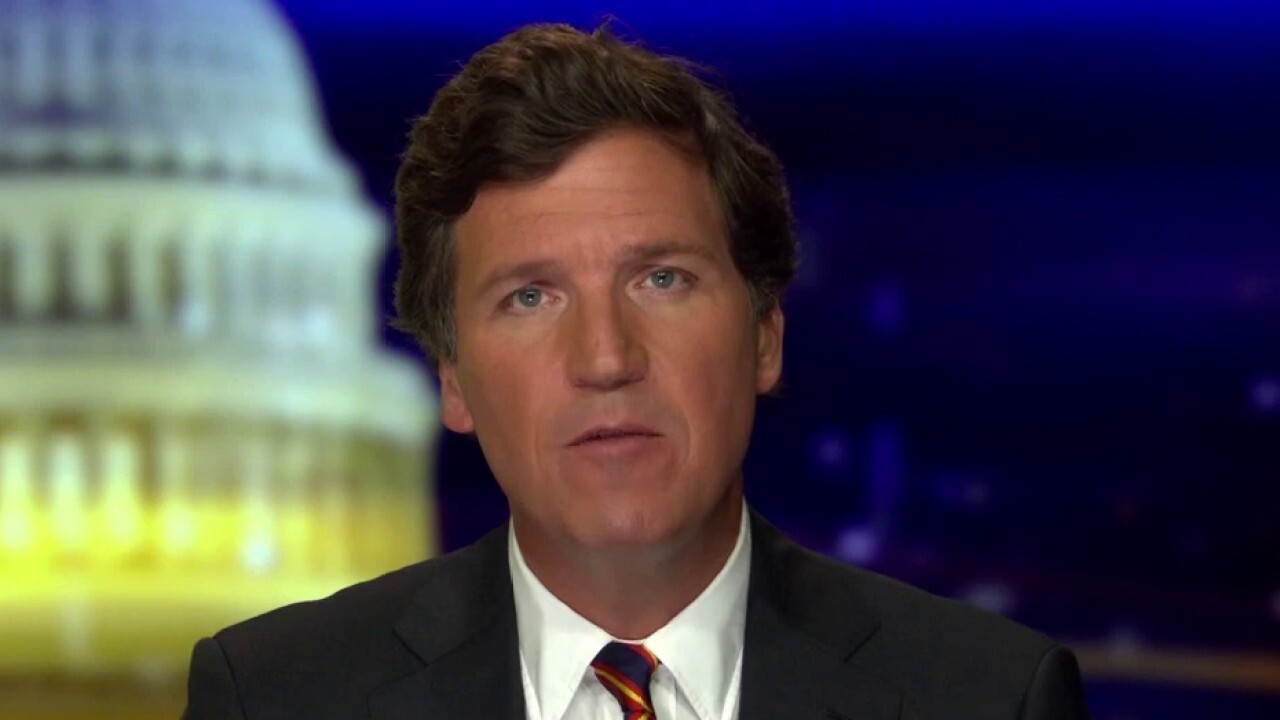
In a recent article, “The ‘diversity’ delusion and the destruction of the American meritocracy,” Tucker Carlson lays out the case against selecting political and policy leaders on the basis of race and other identity instead of on the basis of merit. I want to amplify and expound on his argument in this blog.
How does one rationally argue that an individual carries the perspective of an abstract category based on socially-selected phenotypic characteristics? Are black people a political organization that elects the men and women the Biden/Harris administration then selected to serve in government? Or are these selections academic, administrative, and corporate elites who represent a particular class perspective (that of the global corporate class)? Is the expectation that they will represent those special interests (whatever they might be) over against the interests of individuals regardless of race? Should government officials represent al Americans regardless of race? If so, then why does race matter? The suggestion that this question has an obvious answer never gets around to answering the question.
How does the race of an affluent elite man enable the representation of the perspective of poor people—whatever his race or their race? What exactly is the poor people’s perspective? Is there just one poor people’s perspective? Is it monolithic, as Biden said about the black people (over against Hispanics, who enjoy a diversity of perspectives)? If not, how many perspectives?
How does white skin give a person any superior insight into the difficulties of people who share that skin color? I am white. Am I expected to represent the white perspective (whatever that might be—if there were one) over against those with other racial stamps? How could I even begin to do this? As best I can tell, white people are as variable in their politics as any other abstract unorganized category. They are gay, straight, Christian, atheist, male, female, young, old, Democrat, Republican, liberal, conservative, progressive, etc. I may cogently speak about the situation of working class people because I study their situation, but I possess no magic on account of my skin color. My race doesn’t make me an oracle. Put another way, I am not a racist.
The collective experience of a people—assuming there were one—does not come in the body of an individual. The black demographic is not anthropomorphized in a Biden appointee to the Department of Defense. That is neither an empirical nor a rational claim. It’s a religious-like claim, actually. Tucker Carlson said it very well when he said that abstractions are not persons. (It’s as if has been reading the Freedom and Reason blog—or at least thinking rationally about what should be obvious.)
Carlson does an excellent job of exposing the fetish of identity as the neoliberal means of advancing and entrenching the existing class structure. Indeed, one of the remarkable things about Carlson’s argument is how much it dovetails with the argument of Marxist political scientist (University of Pennsylvania) Adolph Reed, Jr. See, for example, “Antiracism: a neoliberal alternative to a left.” See also, Marx, Race, and Neoliberalism.
Adolph Reed, Jr., Professor Emeritus at University of Pennsylvania
If Reed’s Marxist bona fides trouble folks, know that this argument also dovetails with the arguments of Glenn Loury (economist at Brown University) and John McWhorter (linguist at Columbia) who have devoted their careers to studying these matters. There are many more scholars who work from Carlson’s standpoint. It is a non-racist standpoint. The scholars I have cited are black, but I do not believe that their race adds any objectivity to their claims. However, they should for race identitarians. So why are these scholars routinely ignored by the legacy media?
Tucker Carlson’s is a class-analytical standpoint. It is refreshing to see in a popular pundit such a concern for working class people. Carlson, a conservative, gets their situation. In Carlson, we have a man, because of his populist-nationalist orientation, which may be possessed by black and white alike, who is unafraid exposes the true intent of the corporatist project to divide the working class with race (and other) identitarianism(s) in order to divert the proles (Hillary Clinton’s “deplorables”) from the politics that would advance their organic and material interests. For those of you on the left, I encourage you to dig into the work of Reed to gain a better understanding of the argument Carlson is making.
(By the way, when NASDAQ proposes new listing rules that require companies to “have or explain why they do not have at least two diverse directors, including one who self-identifies as female and one who self-identifies as either an underrepresented minority or LGBTQ+” do they mean to help out Rachel Dolezal? After all, Dolezal self-identifies as an underrepresented minority. Surely NASDAQ did not think through its statement as carefully as social justice demands. NASDAQ needs more woke folk on staff.)
The Hartford Courant’s editorial “Trump’s effort to steal the election is a step towards fascism in America,” subtitled “If you call yourself a patriot, you can’t support it,” is an instance of hysteria that, albeit exemplary, is hardly an outlier. But democracy is not under threat—at least not from Trump. The Trump campaign is not acting in a fascistic manner by challenging the results of 2020. The Hartford Courant is illustrative of the rampant fear mongering that has surrounded the presidency of Donald Trump since its inception.
The vote is extremely close in several states and there are significant voting irregularities across the country. Less than one percent separates Biden and Trump in Arizona, Georgia, and Wisconsin, and the processes in Michigan and Pennsylvania are suspicious. The situation is sufficient for auditing and recounting votes before certification. Allegations of fraud—both election and voter fraud—must be thoroughly investigated. The Trump campaign is contesting the vote and pursuing legal avenues. But states shouldn’t wait for lawsuits. Nor should they wait for the Trump campaign to spoon-feed them the evidence. Nor should the media. Government and media should take the initiative and make sure the election was on the up and up. I know it’s cliché, but what do they have to hide? A more revealing question might be: What do they have to lose?
There is nothing unlawful or even extraordinary happening. Al Gore did not concede the election until December 13, and in that case only one state was in doubt. Although I regret casting my vote in 2000 for Al Gore (and for John Kerry in 2004), I am proud to have supported the effort to get to the bottom of the Florida controversy. I was disappointed that the Supreme Court stopped the count. I was also disappointed the reticence of the Gore campaign to fully press the matter. We would have learned sooner than later what we now know: Al Gore won Florida in 2020. Jon Schwarz at Intercept makes two points about this: “First, we know that Gore won Florida in 2000. If a full, fair statewide recount had taken place, he would have become president. Second, Gore lost largely because, unlike Bush, he refused to fight with all the tools available to him.”
Judge Robert Rosenberg of the Broward County Canvassing Board examining a dimpled chad on a punch card ballot, November 24, 2000 during a vote recount in Fort Lauderdale, Fla.
While 2000 fell short of a robust democratic process, a thorough and transparent investigation into the voting system is what democracy and the rule of law look like. The Constitution provides a process for adjudicating the situation before us. The Founders foresaw all this and the country has in the past selected its president in a manner different from to one to which citizens are accustomed. In 1876, Republican-dominated election boards invalidated enough votes in Florida, Louisiana, and South Carolina to give those states to Rutherford Hayes. The question of what to do with the electors handed the election to Congress which, via bipartisan commission, awarded those electors to Hayes.
It is those who oppose transparency and seek to stop the process and declare Joe Biden President-Elect who seek the undemocratic path to removing Trump from office. Indeed, the Democratic Party and the establishment media have created a situation that, if Trump is selected for a second term, the nation will suffer even more chaos on the streets. Complicating the situation is that Trump supporters appear to have finally awakened to the threat the republic faces from the violent far left insurgency that was raging before Trump entered office. Many Trump supporters are prepared to meet violence with violence. (See Playing China’s Game: Obscuring the Character of American Chaos.)
Investigating the election results is important not only for determining who the next president is, or planning the next step if state elections cannot be certified, but for making sure that the way we conduct elections in this country actually reflects the will of the people in the various states. Tens of millions of people have good cause to doubt the soundness of the election process in several states. It is vital that we restore confidence in the system, not by declaring than it works and gaslighting those who are skeptical of claims that in fact does, but by thoroughly examining the process.
Biden may be president in the end; if the process follows the law, that will be the correct outcome. After a thorough and transparent examination of the evidence, we may find that the process did not work. That’s part of making it work in the future. If the House of Represents selects Trump, the process will have worked. The rule of law demands we respect that outcome. Those who seek to prevent this from happening by unlawful means are acting in a treasonous fashion. The institutions of the republic must be preserved. Otherwise, we don’t have a country.
In the controversy over the 2020 election—if you are not allowing the establishment media to redirect your attention—you’ve probably heard the names Dominion, Indra Sistemas, Scytl, Sequoia, and Smartmatic. You’re told that the darker inferences drawn from the history of these voting systems companies are “conspiracy theory.” Attorney Sidney Powell, who is pursuing this avenue most aggressively, has been removed from the Trump team interrogating the election. However, there may be something to the darker inferences and they relevant to understanding the problem with the 2020 presidential election. For purposes of background, this blog takes a look at these companies and ends on a rather disturbing note.
In 1997, in Caracas, Venezuela, three engineers employed by the Panagroup Corporation, Alfredo José Anzola, Antonio Mugica, and Roger Piñate, formed a group to develop data information software. On April, 2000, Alfredo José Anzola, in Delaware (which, as I have blogged about, has the most corporate-friendly court in the United States, the Delaware Court of Chancery, and is the charter home of a large number of global companies) incorporated Smartmatic. Antonio Mugica, the director of Panagroup, remains the company’s CEO. Smartmatic was used in the Venezuelan elections during the Chavez regime, including his recall election in 2004, with an operative of the Bolivarian government sitting on the board of a subsidiary company (Bizta). Smartmatic claims to be an American company. Does anybody believe that home bases like Boca Raton, Florida, are anything but a beard? Smartmatic claims to be US origin, but its actual ownership is hidden behind a web of holding companies in Barbados and the Netherlands.
Sequoia Voting Systems was behind the defective punch-card ballots used in Palm Beach County, Florida during the 2000 election. There is some speculation that the problem with the ballots was known and allowed to be used in a campaign to discredit the use of punchcard ballots as part of a strategy to push electronic voting machines. Florida did in fact replace punchcard systems with Sequoia touchscreen systems. (See Kim Zetter’s investigative journalism on all this in Wired in 2007.) Smartmatic acquired Sequoia in 2005 and redesigned the Sequoia system. This is crucial to understand and problems with this arrangement were understood at least as long ago as 2006, as we can see in this Lou Dobbs’ report carried on CNN.
The Dobbs report appears to have been a kick in the pants for the government agencies governing such things. In 2007, the Committee on Foreign Investment in the United States, because of Smartmatic’s ties to Venezuela, ordered that Smartmatic dump Sequoia, which is did. However, in a clever move, Smartmatic sold Sequoia to its own managers with enjoyed citizenship in the United States. You can read the company statement here: U.S. Voting Technology Leader Sequoia Voting Systems Announced New Corporate Ownership. Note the subtitle that tries too hard: “Sale Creates 100% American-Owned and Independent Company.” Hardly subtle messaging. Almost taunting, frankly. Adding to this darkness was Obama’s Treasury Department action approving these arrangements, ending a government investigation into ties between Sequoia, Smartmatic, and the Bolivarian government of Venezuela.
Sequoia technology, well known for security problems, is considered by many experts to represent a threat to the integrity of elections (see the report “Source Code Review of the Sequoia Voting System.”) The skins of Sequoia executives are thin on the matter. In 2008, Sequoia threatened Professor Ed Felten and a Princeton University team investigating the security of the Sequoia (Smartmatic) system, what Sequoia vice-president Edwin Smith, in what was essentially a cease and desist order, characterized as “non-compliant analysis” (see the article “E-Voting Firm Threatens Ed Felten If He Reviews Its E-Voting Machine”).
Enter Dominion Voting Systems. The Ontario-based company acquired Sequoia Voting Systems in 2010. Earlier that year, Dominion also acquired another voting system company, Premier Election Solutions, a subsidiary of Diebold Election System. Recall that Diebold was embroiled in controversy in the early 2000s due to reliability issues and security problems, as well as political bias among its executives. (Thin skins here, as well. In 2007, Diebold was caught editing its Wikipedia page). With this acquisition Dominion became the second- largest provider of voting machines in the United States (Election Systems and Software is the largest, with its own storied history) and the largest provider of machines in Canada. By acquiring Sequoia, which again runs on Smartmatic design, Dominion deploys that design, with all its flaws, in elections across the United States. While Smartmatic can claim that it does not own Dominion nor provide it with any software and equipment, the fact is that Dominion’s processes are Smartmatic’s. However claiming that one company doesn’t own another is a technicality in a system with interlocking directorates and other techniques of conglomeration.
It has been reported that Indra Sistemas, based in Spain, a competitor of Dominion’s, played some role in the 2020 scandals. Indra specializes in digital voting. According to Rudolph Giuliani, Dominion and Smartmatic are associated though Indra as an intermediary. Moreover, Scytl, another Spanish based company provided products and services to city, county, and state clients across the United States. What products and services does Scytl provide? Election night reporting, online election worker training, online voter education, and election ballot delivery. Scytl claims no association with Indra, Smartmatic, or Dominion. We shall see. There are lot of questions to be answered. I have a lot of irons in the fire, so I encourage readers to follow up on this and stay tuned to ongoing developments.
Petter Neffenger, Chairman of the Board of Smartmatic, tapped by Joe Biden to lead transition efforts in the Department of Homeland Security
I will close with a particularly troubling development. The current chairman of Smartmatic’s board of directors, Peter Neffenger, was recently appointed as a member of Joe Biden’s “Transition Team” to leads efforts related to the Department of Homeland Security. Neffenger also sits on the Atlantic Council’s Adrienne Arsht Center for Resilience and Northeastern UNiversity’s Global Resilience Institute. I have a blog entry coming out on the interconnectivity of Dominion, Smartmatic, and other companies specializing in voting machines and software. These transnational companies represent a national security threat. Are they are now moving internal to Democratic Party’s takeover of the Executive branch of the United States government?
Americans in the Heartland are finally fighting back. And in so doing playing into the hands of those who have from the inception of his presidency portrayed the populist movement as a fascistic counterrevolution against democracy. It is an other-fulfilling prophecy: an internecine struggle of political direction is spreading. Chaos is burgeoning. Newsweek prepares its readers with the headline: “GOP Civil War, Inspired by Trump, Grips Georgia, Threatens Other States.” But, really, Newsweek, and the establishment media have been preparing its audience for civil war for years.
As part of the project, The Atlantic stands reality on its head.It is fitting that Edward Steinfeld, author of Playing Our Game: Why China’s Rise Doesn’t Threaten the West, a propagandist for the managed decline of the American republic, would be the one to flip the dialectic. Steinfeld’s article “Mao’s Lesson for Trump’s America,” subtitled “Beware of leaders willing to set their own country on fire,” uses the pretense of analogy to invert the truth of what actually threatens American democracy. Steinfeld’s self-delusions appears authentic. And it is breathtaking.
Steinfeld writes, “In the United States now, I witness things that I never thought I would live to see at home, but that feel ominously reminiscent of the Chinese experience. I see a national leader defiantly rejecting the most fundamental and time-honored of governance institutions, while refusing even to entertain a peaceful transition of power. I see a national leader and much of the public trafficking in wild conspiracy theories about the country’s public institutions, and openly contemplating resolutions through violence and vigilante action. I see various societal leaders, including President Donald Trump, stoking the fires of intra-societal resentment and hatred. And I see the opportunists and abettors reveling in their transgressions of norms, embracing the chaos, and relishing their own moment in the sun. Oh, how tantalizing it is to play with fire and risk burning down the house.”
Remove the name of President Donald Trump and Steinfeld has near-perfectly captured the character of the campaign to portray America as an illegitimate nation, a country hopelessly compromised by systemic racism, its majority stubbornly resisting redemption to preserve the white supremacy that privileges them. The Reckoning proceeds through violence and vigilante action while stoking the fires of intra-societal resentment and hatred. Its opportunists and abettors revel in the transgressions of norms. Embracing the chaos, they relish their moment in the sun. They play with fire at the risk of burning down the house. Indeed, this is what they seek—house burning down.
Trumpism cannot be an analogy for Mao Zedong thought. To claim otherwise is absurd on its face. Trumpism is about preserving the nation-state and democratic-republicanism, as well as the Westphalian system. Trumpism is self-consciously populist and proletarian. Mao Zedong thought—and the modern Chinese Communist Party—is about explicit dismantling democratic-republicanism and civil libertarianism, the foundation of the American republic, and replacing it with bureaucratic collectivism (effectively state monopoly capitalism). The Third Worldism of Mao Zedong thought seeks to dismantle the Westphalian system to clear the path for a neo-feudalist order run by administrators and bureaucrats. Mao Zedong thought is about regressing the world proletariat into tribal serfdom.
The neo-Maoists confuse class consciousness, disrupting class struggle with the fracturing ideology of identity, as illustrated by critical race theory, which seeks to upend the foundation of Western jurisprudence and negate the principles of individual equality and personal sovereignty. The New Left is not merely un-American. It is anti-American. It is anti-Western. Steinfeld does not believe China’s rise threaten the West. Neither does the media-proclaimed President-Elect. “They’re not bad folks, folks.” But Chinese imperialism does threaten the West. It always has. China is more than an economic powerhouse; it is an ideological agenda unfolding: socialism with Chinese characteristics. And it dovetails with with the ambitions of transnational corporate power under late capitalism.
It’s not Trump fomenting Cultural Revolution. The leaders willing to set their own country on fire are in the Democratic Party. The fire is prepared by progressive academics and activists who encourage America’s youth to “reject the most fundamental and time-honored of governance institutions.” It is an obvious fact that they have set the country alight with their “wokeness.” We are being subjected to a color revolution. It’s not just an American problem, either. Europe is burning, too. And the agents of that chaos dance to the same tune. They mean to dance on the grave of the West. This is Mao’s dream come true.
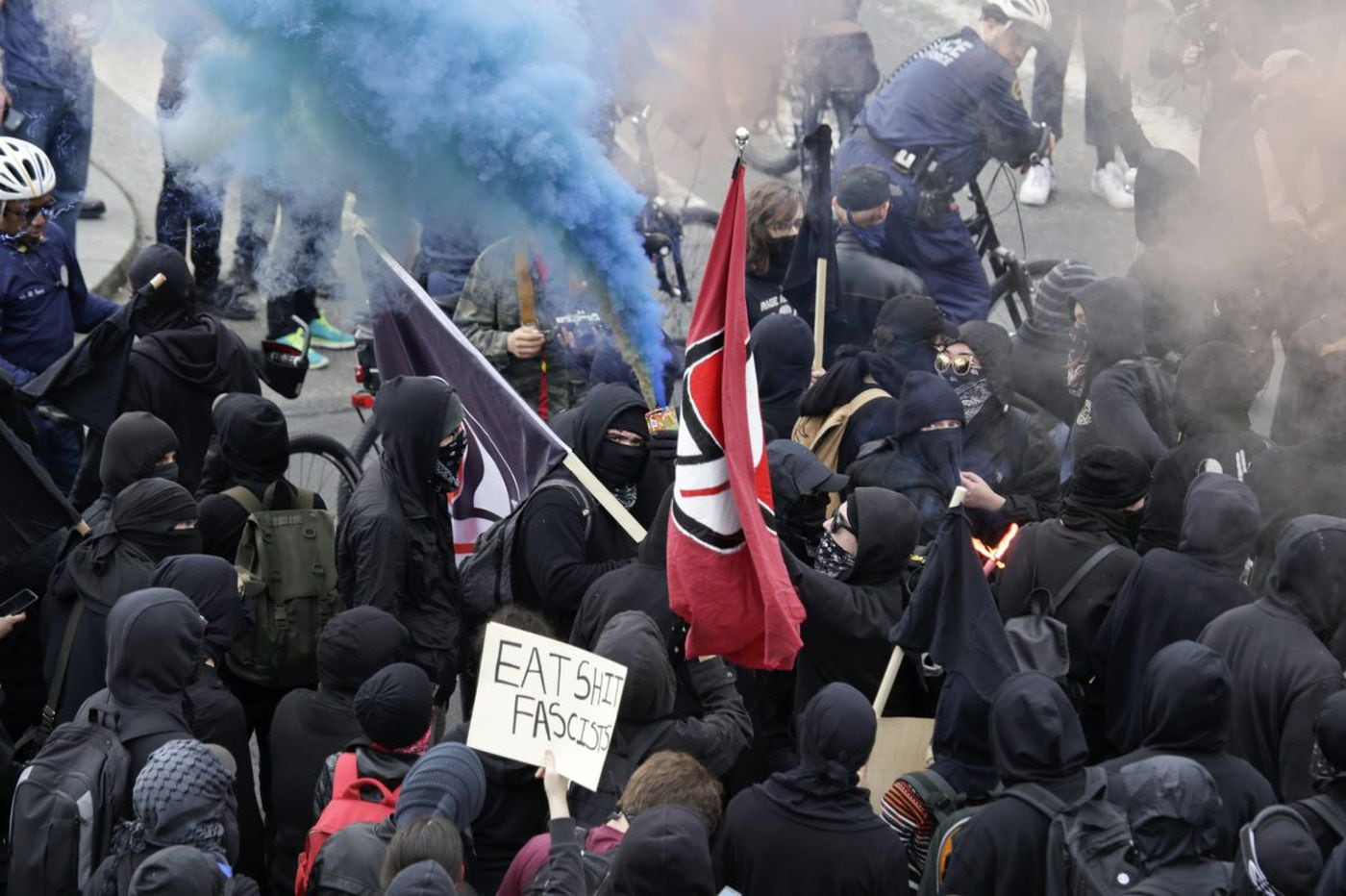
Philadelphia Antia, 2017
Are Trump supporters out in the streets assaulting police officers and citizens, burning buildings and cars, looting stores, toppling statues and defacing monuments, marching into restaurants demanding patrons raise their fists and proclaim loyalty to the ambitions of some members of a particular racial group? Are Trump supporters demanding employees of corporations and universities participate in struggle sessions requiring them to adopt a view of history that makes all white people guilty of racism? Are conservative students attacking speakers on college campuses and mobbing professors and deans with slogans and epithets? It is not the administrative state and establishment media that manufacture conspiracies about “white terror” over against what we can see with our own eyes?
Know this coming. Expect it. The establishment media will portray the resistance of ordinary Americans, citizens finally fed up with the trashing of the country they love, tired of being constant gaslighted over race and gender, exposing the color revolution, as the “white terror.” Because they will defend their country, they will be the reactionaries. They are conservative and traditionalist by definition. Because their country is racist, they will be declared racist just for defending her, just as they are racists just for demanding secure borders and the rule of law.
Steinfeld writes of China during the Cultural Revolution, “Workplaces, neighborhoods, and even entire cities descended into internecine warfare as faction battled faction, colleague raged against colleague, student pummeled student, and, in many cases, family member turned on family member.” How deeply does a man have to be indoctrinated to write these words and not see immediately that they apply not to the orange object of his fever dream but to those with whom he fellow-travels?
And this “if, God forbid, the social pressures deepen enough for violence to erupt on the streets, thus providing Trump an opportunity to declare an insurrection.” Violence has already erupted on our streets. Left-wing rebels have already declared an insurrection. The question is: are we allowed to resist this?
“Through it all, Mao wallowed in narcissism, delighting in the chaos he had willed upon the nation,” Steinfeld writes. “As violence began to spread at the very start of this period, the chairman famously rhapsodized in a letter to his wife, ‘There is great disorder under heaven—the situation is excellent.’ Five months later, on the evening of his birthday in December 1966, he would raise a toast: ‘To the unfolding of nationwide all-round civil war!’ In retrospect, Mao’s adoration of chaos, and his indifference to the carnage wrought by it, should have come as no surprise.”
If only there were life after death, Mao could revel in his legacy, as those who move in the spirit of his thought aim to destroy the greatest democratic republic in world history. While members of its paid intelligentsia applaud.
“Under the impact of propaganda, not necessarily in the sinister meaning of the word alone, the old constants of our thinking have become variables. It is no longer possible, for example, to believe in the original dogma of democracy; that the knowledge needed for the management of human affairs comes up spontaneously from the human heart. Where we act on that theory we expose ourselves to self-deception, and to forms of persuasion that we cannot verify. It has been demonstrated that we cannot rely upon intuition, conscience, or the accidents of casual opinion if we are to deal with the world beyond our reach.”— Walter Lippmann, Public Opinion (1922)
In Senate hearings earlier this week, Senator John Kennedy (Louisiana) congratulated Jack Dorsey of Twitter and Mark Zuckerberg of Facebook for founding “extraordinarily successful companies,” which, he noted, enjoy “enormous power” that flows from success. “You’re not companies,” he remarked, “you’re countries,” adding, importantly, “at least in terms of power.”
The Senator then lay a trap.
“Mr. Dorsey, do you believe everything you read?”
Dorsey: No.
Kennedy: Why not?
Dorsey: I think it’s healthy to have skepticism about everything and then have a mindset of verifying it and using as much information as possible to do so.
Kennedy: Do you have somebody on your staff who protects you from reading things that they think you shouldn’t?
Dorsey: No.
Kennedy then turned to Zuckerberg: “Mr. Zuckerberg, do you believe everything you read?”
Zuckerberg: No, Senator.
Kennedy: Why not?
Zuckerberg: Because of a lot of things are incomplete or incorrect.
Kennedy: So you exercise your own judgment?
Zuckerberg: Yes, Senator.
Kennedy: Okay. Do you have somebody on your staff whose job is to filter things that they think you should not be reading?
Sensing where Kennedy was going, Zuckerberg responded with: “Senator, not externally, although I would hope that the teams that I work with internally do their best to make sure that the information that they’re presenting me with are always accurate.”
Kennedy then asked, “What if your companies had a rule that said, ‘Okay, people aren’t morons. I would like to treat people as they treat me. That is that I can read what I want to read and exercise my own good judgment about whether I choose to believe it, so here’s the rule we’re adopting. If you go on Twitter or Facebook, you can’t bully people. You can’t threaten people. Maybe this is a subset of both of those, but you can’t commit a crime with your words, and you can’t incite violence. But other than that, you can print any damn thing you want to, and we’ll let our users judge.’ Give me your thoughts on that.”
After indulging Dorsey by allowing a rambling defense of Twitter policies, Senator Kennedy put the same question to Zuckerberg.
Zuckerberg: Senator, in principle, I agree with what you are saying, although I think that there are more categories of harm than just the ones that you’ve mentioned. But I think the basic principle behind what you’re saying is a definition of free expression that says that people should be able to share their opinions broadly, except if it’s going to cause imminent or irreparable harm to another person, which even the most ardent first amendment supporters agree that you shouldn’t be able to yell “fire” in a crowded theater if there’s not actually a fire, because that could put people in the risk of imminent harm. So, you mentioned terrorism, you mentioned child exploitation and bullying as forms of harm, and I think a lot of the debate is around what are other forms of harm? For example, we’re in the middle of a pandemic, and we’ve assessed that misinformation about COVID and treatments that could put people in additional risk of getting the disease or not seeking the right treatment if they have it, that those are also things that could cause imminent harm. We’ve taken the position that select—
“Mr. Zuckerberg, let me interrupt you.” Having sprung the trap, Kennedy lowered the boom: “I’m not saying you’re wrong by doing what you just described, but that makes you a publisher, and that creates problems with Section 230.”
What is Section 230? Section 230 is a provision in what is popularly known as the Communications Decency Act, or, formally, Title V of the Telecommunications Act of 1996, that provides immunity from liability for providers and users of content on platforms, what is called an “interactive computer service,” who host third-party information. The statute specifically states: “No provider or user of an interactive computer service shall be treated as the publisher or speaker of any information provided by another information content provider.” In other words, a service such as Facebook is, in effect, a bulletin board where users post content. Facebook doesn’t exercise editorial discretion over what is posted, and therefore is not a publisher responsible for the content provided. At least that is supposed to be the way it works. By allowing some content while excluding other content, content that is protected speech under the First Amendment to the US Constitution, Facebook exercises editorial control and is thus actually a publisher of content. As a publisher of content, it is liable for that content.
Kennedy had remarked at the beginning of his questioning, “You’re not companies, you’re countries.” Indeed, as I argued in “Defending the Digital Commons,” for Project Censored, the practical outcome of allowing monopolies to censor speech is that, in a world run by private corporations, if we allow that, i.e. corporations acting as de facto government authorities, there is no legal guarantee of free speech. The social media giants must therefore be brought under the control of the sovereign (the people organized as nation-state) and compelled to adhere to the standards of free speech enshrined in the US Bill of Rights, the European Convention on Human Rights (ECHR), the International Covenant on Civil and Political Rights (ICCPR), and the Universal Declaration of Human Rights (UDHR). Governments must recognize social media platforms as public utilities and places of accommodations, open and public services or spaces operated by private entities with a legal obligation to respect the established rules of civil authority and civil rights. Either these companies operate under the logic of Section 230, or they lose immunity from liability for content.
I cited the ECHR, ICCPR, and UDHM because this is a global struggle. There is a system of international norms and rights established by the Westphalian system. In a report published by the University of Michigan, “‘Extremely aggressive’ internet censorship spreads in the world’s democracies,” a University of Michigan team used Censored Planet, an automated censorship tracking system launched in 2018 by Roya Ensafi, to collect more than 21 billion measurements over 20 months in 221 countries in order to show that the free speech rights of citizens of the world’s freest countries are threatened by power of interactive computer services.
“What we see from our study is that no country is completely free,” said Ram Sundara Raman, one of the authors of the report. “Today, many countries start with legislation that compels internet service providers to block something that’s obviously bad like child sex abuse material. But once that blocking infrastructure is in place, governments can block any websites they choose, and it’s usually a very opaque process. That’s why censorship measurement is crucial, particularly continuous measurements that show trends over time.” He argues, consistent with international norms and rights, “We imagine the internet as a global medium where anyone can access any resource, and it’s supposed to make communication easier, especially across international borders,” he said. “We find that if this upward trend of increasing censorship continues, that won’t be true anymore.”
“I just think one point of view is that, at some point,” Senator Kennedy continued, “we’ve got to trust people to use their own good judgment to decide what they choose to believe and not believe and not try to assume that we’re smart and they’re stupid, and that we can discern believable information and information that shouldn’t be believed, but everybody else is too stupid to do it.”
One of the chief indicators that Zuckerberg is not up for defending the free speech rights of Facebook users is his poor understanding of law and expert opinion in this area. Zuckerberg’s claim that “even the most ardent first amendment supporters agree that you shouldn’t be able to yell ‘fire’ in a crowded theater if there’s not actually a fire, because that could put people in the risk of imminent harm” is a prime example of his ignorance of where thinking is on this matter.
The analogy is well-known and comes from Justice Oliver Wendell Holmes, Jr.’s opinion in Schenck v. United States (1919), a ruling that unanimously upheld the conviction of Charles Schenck, a member of the Socialist Party of Philadelphia, who had organized the mailing of thousands of fliers to young men asking them to resist conscription in World War I, of violating the Espionage Act of 1917. “The most stringent protection of free speech would not protect a man in falsely shouting fire in a theatre and causing a panic,” Holmes wrote in his opinion. “The question in every case is whether the words used are used in such circumstances and are of such a nature as to create a clear and present danger that they will bring about the substantive evils that Congress has a right to prevent.” Schenck v. United States was sharply curtailed in Brandenburg v. Ohio (1969), a ruling that limited control of speech to that likely to incite imminent lawlessness.
Focus on this notion of falsely yelling fire in a crowded theater. Zuckerberg must mean that Facebook censors false claims. That is what its censors tell you when they label or exclude posts. For example, when users share video of doctors and scientists make claims not authorized by the World Health Organization, they are in some fashion censored. But contradicting the WHO is not necessarily making false claims. Nor were members of the Socialist Party of Philadelphia falsely yelling fire. WWI was very real. There are doctors and scientists who contradict the WHO using clinical experience and scientific research. The Supreme Court Schenck v. United States was not actually combating false claims but claims contrary to powerful interests—the state and corporations to wage war for power and profit. Holmes is not saying that dangerous speech is in itself at issue, but rather that there is justification for censoring false claims that are dangerous—at the same time he is ruling that claims that are neither dangerous nor false may be censored. It is the worst possible standard to advance not just because it is contrary to principle, but also because it is self-contradictory.
However, maybe it’s not out of ignorance that Facebook’s policies are implemented in a manner that functions to perpetuate irrational fear of SARS-CoV-2 by censoring information that contradicts the WHO and other official bodies, or suppress Donald Trump’s vote. Facebook and Twitter (and Google) acted to shape mass opinion in a manner beneficial to the candidate of the transnational corporate elite. They did that by spreading hysteria and defaming the people. By denying access to information, much of the public had to formulate opinion without the benefit of information relevant to its interests.
Because mass reliance upon new media is so great, and because it is more open than old media to viewpoint diversity, it is vital for democracy that social media platforms remain open systems where information may be freely transmitted so that citizens can use their own judgment to form their own opinions and to reach consensus with those who share their interests and values. This is what a public utility would allow for, just as we are free to share ideas in the public square, through the mail, and over the telephone. Facebook and Twitter are no longer utilities operating in that manner. They have become destructive to the open society. They have become key components in the practice of elite hegemony formation.
In the practice of thought control, redirection and the strategic withholding of information is far more effective than telling people what to think. I see this all the time in my line of work. It’s a common tactic in the academy to curate arguments found in sources designated as appropriate while disallowing or disparaging arguments found elsewhere. Gatekeeping and reputationalism shape the parameters of acceptable thought. The attempt to bring in outside views makes one an outsider. The system is reinforced with esteem, money, promotion, and titles. As a result, academics are deeply indoctrinated, overwhelmingly tied to the Democratic Party, reflexively operating on progressive-technocratic assumptions. Alternative viewpoints are excluded or marginalized in educational institutions such that very smart people operate from profoundly fractured consciousness. They neglect their duty. Curious students become problems to be managed, not citizens encouraged to think for themselves.
Media fact-checking is an attempt to translate this practice to the popular realm for the purposes of manipulating mass opinion. “Independent fact checkers” determine what is true and false and thus what can and cannot be heard, read, and seen. It is a view of speech that assumes the public is not up to the task of deciding matters for itself. Social media is a technology elites use to shape mass opinion; it is not for the masses to develop their own opinions and reach a popular consensus. In two influential books, Public Opinion (1922) and The Phantom Public (1925), journalist Walter Lippmann called this the “manufacture of consent.” The masses were, in his view, the “bewildered herd” necessarily controlled by “a specialized class,” his class. In his view, the news is that which is officially-available. Unofficial information should be generally unavailable. The function of the news is to shape public opinion in the interests of the enlightened. In a 1947 article, “The Engineering of Consent,” propagandist Edward Bernays explains how it works in advertising and marketing. This is not democracy, but technocracy.
Reflecting on the power of technocracy, John Livingston and Robert Thompson, in their 1966 The Consent of the Governed, write, “Consent that is thus engineered is difficult to distinguish in any fundamental way from the consent that supports modern totalitarian governments. Were the manipulated voter to become the normal voter, the government he supports could hardly be said to rest on his consent in any traditional sense of that word.” Today, it is desired that the government the voter supports is the corporation. However, the Internet has opened the public up to unofficial and private information. Because the masses use unofficial and private information to develop their own opinions, open and organic systems are dangerous to the interests of the elites, interests that are necessarily antagonistic to those of the people in a capitalist society.
It is not that persuasion is wrong. The problem is power. Power allows for the persuaders, the influencers, to augment argument with strategies of gatekeeping and reputationalism to filter information. This is what makes something propaganda. Dorsey and Zuckerberg’s view of speech is in the tradition of propagandists Lippmann and Bernays, and, as such, profoundly undemocratic and illiberal. Indeed, the view of speech among progressives generally is profoundly undemocratic and illiberal. We see this in cancel culture and political correctness. Progressives are explicit in their rejection of the values of the Enlightenment. They flip principle on its head, claiming that free speech is tyrannical. But progressivism is the technocratic expression of corporate governance. Corporate governance is an expression of bureaucratic tyranny, of state monopoly capitalism, which is not very different from the bureaucratic collectivism of the state capitalism that the Chinese Communist Party calls “socialism with Chinese characteristics.”
This is the Weberian iron cage. Weber told us that the cage would destroy charisma, enchantment, and freedom. Dorsey and Zuckerberg are animals pacing Weber’s cage. You can see the deadening in their expressionless faces.
Explosive stuff over the last few days on the 2020 election. The Trump campaign is dropping a lot of side suits (which the media is making a big deal about) to pursue the overarching problems of the election: focused and intensive ballot harvesting in Democratic counties, including selective curing of ballots, no thorough cross-county vetting of mail-in ballots (I write about the anomalous rejection rates in Georgia on my blog), and the machines used in the election, Dominion Voting Systems Corp and its vulnerabilities, especially remote vote switching.
See Steve Cortes’ chalk talks on the War Room Pandemic show today. If you understand statistical inference, from Cortes’ presentations alone you can see this election is fraught with statistical improbabilities for Biden that must be investigated. Here’s Cortes’ Twitter feed:
The National Pulse has just dropped a scientific analysis of the reported Pennsylvania vote (https://thenationalpulse.com). What it suggests is a fraud scheme similar to the 2008 sub-prime mortgage meltdown—which Obama avoided investigating (instead handing the states 45 billion dollars of taxpayer money governors used to buy loyalty from powerful constituents). Biden votes in key states he needed to win are obviously too convenient to be trusted.
Biden’s win is not just quantitatively suspicious. Qualitatively they don’t make sense. Sleepy Joe Biden, who hardly campaigned, outperformed rockstar Barrack Obama? Enthusiasm for Trump was through the roof. His rallies were like Obama’s (and Bernie Sander’s rallies, who losses in 2016 and 2020 are suspicious in themselves). The argument that minority opposition to Trump drove turnout is absurd in the face of the massive gains Trump made in the minority vote.
If this were happening in a Third World country we would be talking about a stolen election. I know progressives are happy about Biden’s apparent win, but they cannot continue to talk about election integrity if they are telling us that there is nothing to see here.
Liberals didn’t envision this. Liberals believe in the individual. Equality before the law, equality of opportunity—these lie at the heart of liberal thinking, not abstract groupings based on race and other identities or quality of outcome.
The New York Times meant to write that progressives envisioned a multiracial coalition and voters of all races and ethnicities have other ideas. Progressives are the ones pushing group-based rights and notions of equity, not liberals. Kamala Harris even narrated a cartoon about it. See here:
The New York Times has long conflated liberalism and progressivism in an attempt to falsely divide conservatives and liberals who, while differing in many ways, don’t differ much on the fundamental premise of America, namely a republic where personal sovereignty and individual liberty reign.
At any rate, it didn’t work out so well for progressives, did it? The electorate rejected their agenda. In addition to being blown out on the affirmative action question in California, and Republicans likely retaining control of Senate, Democrats have so far lost seven seats in the House. Padding Biden’s tally with Californians voting out of reflexive hatred of the Orange Man in the White House does not a mandate make. Indeed, despite elites engineering Trump’s defeat, the vote remains close in several key states. There was no Blue Wave. And, improbably, the loser had the coat tails (see The Watchdog is a Sheepdog).
Maybe it was the divisive identitarian politics that animated Antifa and Black Lives Matter that put voters off the Democrats. It doesn’t seem that working people want what progressives are peddling. Perhaps that’s why Silicon Valley is aggressively censoring conservative and liberal content on social media. Desperate to obscure the backlash against identity politics and political correctness, they can’t stop reassuring the public that the Associated Press has called the race for Joe Biden and Kamala Harris. It feels like they are reassuring themselves.
Trump gained considerably in black and Hispanic support. US Senator from Florida, Marco Rubio, boasted that the Republican Party had become a multiracial and multiethnic party. But, as Pedro Gonzales pointed out today on Steve Bannon’s War Room Pandemic show (see below), diversity politics suffers from a core problem: if the preachers of multiracialism/multiculturalism argue that the government must, instead of investing in development and infrastructure projects benefitting the working class generally, create race-based plans that favor some races and ethnicities over other races and ethnicities, what amounts to a racial spoils system, they must depend on the myth that there are no white people in this country who could use scholarships, that there are no downscale white communities that could use capital infusion, and so on. It’s a myth experience debunks.
In 2016, Bernie Sanders said, “When you’re white, you don’t know what it’s like to be living in a ghetto. You don’t know what it’s like to be poor.” I hear others making points along this line. You might not see such claims as immediately and profoundly wrong if you don’t study demographics the way I do. I’m a professional sociologist, I have to keep up with such things. The fact is that more than two-thirds of poor Americans are white. Put another way, there are more than twice as many poor white people as there are poor people of all other races combined.
The elites know this, and that’s why the white privilege argument is drilled into our heads, why we are told that no matter how down on his luck a white man may be, all whites are privileged. They say this of course to downplay the suffering of the majority of working class workers in order to pit them against non-white minorities who are in reality their comrades. It’s an old divide and rule tactic.
The latest target of progressives is the white woman. Julie Kohler of Democracy Alliance, a white woman, appeared on MSNBC to say that “white women have taken an active role in the maintenance of white supremacy.” “[W]hite women,” she says, “weaponize their identities against, especially, black men.” There’s a lot of other nonsense in what Kohler say, which you can see for yourself, if you care to.
Amidst a lengthy MSNBC segment attacking white women, the Democracy Alliance’s @juliekkohler1 says: "white women have taken an active role in the maintenance of white supremacy … white women weaponize their identities against, especially, black men" pic.twitter.com/VSRjbRd8gf
The truth is that progressives weaponize race to wage class war on behalf of corporate power. They weaponize racism to marginalize working people in order to blunt criticism of woke ideology and corporate power. Elites mean to confuse class consciousness and stifle class struggle by sowing racial and ethnic division and waging racial and cultural warfare. Their vision weaves together a coalition of minorities they claim are oppressed and wield their grievances, even when minorities don’t claim them, even when they resist them, as a battering ram against the proletariat. They push for open borders, while decrying assimilation as racist, then, to enlarge their coalition, claim the newcomers are victims of a pervasive white supremacy. There could be no other reason for borders but racism. Since whites are the majority, whites are necessarily the subjects of attack. The tactic marginalizes workers by undermining their moral authority, portraying them as backwards ignorant rubes, as racists and xenophobes. The deplorables.
Biden means to throughly institutionalize the progressive racism, as Bloomberg points out, “putting racial disparities high on the agenda as he assembles his administration” (see Biden Fills Economic Posts With Experts on Systemic Racism). “revious administrations haven’t made race scholarship such a clear priority,” Bloomberg tells its readers. “Biden and Vice President-elect Kamala Harris are emphasizing diversity as they prepare to assume power next year. Women comprise more than 50% of the new administration’s landing teams, according to the transition team, and more than 40% of advisers are from groups that are historically underrepresented in the federal government, like racial minorities, people with disabilities and those who identify as LGBTQ.”
Bloomberg quotes Anna Gifty Opoku-Agyeman, co-founder of the Sadie Collective, a nonprofit working to get more Black women in economics. “Having these individuals who are representative of their community in the actual room where they can voice their perspective and have their perspective actually translate to policy—it matters more than you think.” Bloomberg paraphrases her hopefulness: “Next, she said, she will watch to see whether progressive-leaning advisers can drive policy change.” What makes “these individuals” “representative of their community”? Their racial identities. In other words, moral entrepreneurs pressing to speak for others on the basis of superficial phenotypic traits.
But ever larger proportions of Asian, black, and Hispanic workers are seeing through the ruse. They see how they’re being used by progressives for the sake of a racial politics that has disadvantaged and endangered them. They see the high crime rates and social disorganization in their communities. They see their businesses failing, looted and burned. They see their personal development assumed to result from tokenism and not from creativity, initiative, and sacrifice. To be sure, not everybody knows they’re being used; but when the scales fall from enough eyes, movements emerge.
“To psychologically healthy individuals,” McWhorter elaborates, “the fact that Trump wouldn’t want to be their friend may seem an abstraction, as they will never meet him, have fulfilling lives that have nothing to do with him, and are quite sure that they are as good as him anyway. To these people, Trump’s policies, or even just some of them, or even just the cut of his jib, may seem more important than what Trump would say about them in private—or public.”
He then chastises the woke among us: “This outlook arguably represents a more sophisticated sensibility than the pitchfork attitude of many on racism. Think of those who since the 1980s have rejected the Great Books canon because the authors were white and almost always racist. Ahead of the curve? Maybe. Or one could see this condemnation of people for being unable to see beyond their time as simplistic and even anti-intellectual. Many, in fact, do.”
McWhorter recently appeared on the Glenn Loury show featuring Shelby Steele. Steele was on promoting his documentary, “What Killed Michael Brown?” McWhorter puts the question to Shelby. Watch the conversation below:
Nationwide, around 750,000 mail-in ballots were rejected in the 2016 and 2018 elections, most of those in 2018, where one out of every seven ballots were rejected. Overall, that’s about 1.2 percent of the total ballots returned, tens of thousands of them rejected because signatures didn’t match. That suggests fraud.
In 2020, more than 500,000 ballots were rejected in the primaries nation-wide. In Wisconsin, for example, 23,000 ballots were rejected during the primaries, a number greater than Trump’s margin of victory in the state in 2016. That’s 1.8 percent of mail-in ballots (964,433).
How did Wisconsin do in the November 2020 election? As of Tuesday last week, the Wisconsin Elections Commission determined that only 1,506 mail-in ballots—out of 1.45 million ballots returned—had problems. That’s an astonishing low 0.1 percent. The difference between Trump and Biden in Wisconsin? Around 20,000 votes.
If the 1.2 percent rejection rate had held across the country for the 2020 election, an election in which many more millions more people voted by mail than previously, 780,000 mail-in ballots would be rejected.
In Georgia, nearly 5 million citizens voted. Applying the 1.2 percent metric, one would expect 60,000 or so rejected mail-in ballots in the state. The difference between Trump and Biden in Georgia? 15,000. We know mail-in balloting favored Joe Biden.
Looking at the percent of county-level ballots rejected in Georgia in the November 2020 election, the vast number of counties were between 0.0 and 0.1 percent (there are a few 0.2% counties, one 0.5%, and one 0.9%.), replicating Wisconsin’s highly improbable improvement in rejection rates. This is a stunning level of voter competence. How did this happen with so little experience voting by mail?
We were told there is an audit of votes in Georgia, so maybe we will get an answer. Not so fast. They don’t appear to actually be auditing the ballots in Georgia. They’re recounting. What does it accomplish to recount votes without a deep-dive verification process? Sounds like a massive waste of taxpayer money.
So the question remains: How does mail-in balloting move from hundreds of thousands of votes rejected upon examination to fractions of a percent discrepancies in an election in which a vastly larger proportion of voters voted by mail than any time in the nation’s history? In the middle of a pandemic?
Democrats are big on election integrity. At least they say they are. So what are Democrats doing about making sure this election was maximally valid? Democrats and the media told us for months that we would not know who won the presidency on the evening of November 3. It will take time to count all the votes and resolve all the disputes, they said. It would be the first time mail-in voting would constitute such a large proportion of the votes counted. Be patient, they begged us. Be understanding, they implored. Experts expected well more than one percent of mail-in ballots to be rejected.
The early morning November 4 vote flips in key states that produced Biden’s victory were mail-in ballot dumps. Just like they told us. How do they know? With polling specularly wrong, they seemed to know how the election would go down.
The media is telling us that there was no fraud. The headlines never note “Trump’s claims” about the election, but frame the campaign’s statements as “Trump’s false claims.” What they aren’t asking is more telling. Why must we settle for these election results without asking why the hundreds of thousands of rejected mail-in ballots the experts expected never materialized? Isn’t the media supposed to be a watchdog and ask the tough questions?
Instead, if you do ask tough questions, you’re branded a “sore loser” or a “conspiracy theorist.” The gaslighting continues.
/https://static.texastribune.org/media/files/f5fdb1dff4d6fd788cba66ebaefe08d0/Paxton_GOP_Convention_2018_BD_TT.jpg)






 freedom and reason