Concerning the Powers of The US Constitution—And Those Defying Them

The matter of the President’s use of the National Guard should not be misunderstood. There is a great deal of bluster from the neoconfederates of today’s Democratic Party about the President’s so-called “power grab.” Governors like Newsom and Pritzker, along with numerous Blue City mayors, are misinforming the public about the Constitution and the powers of the federal government.
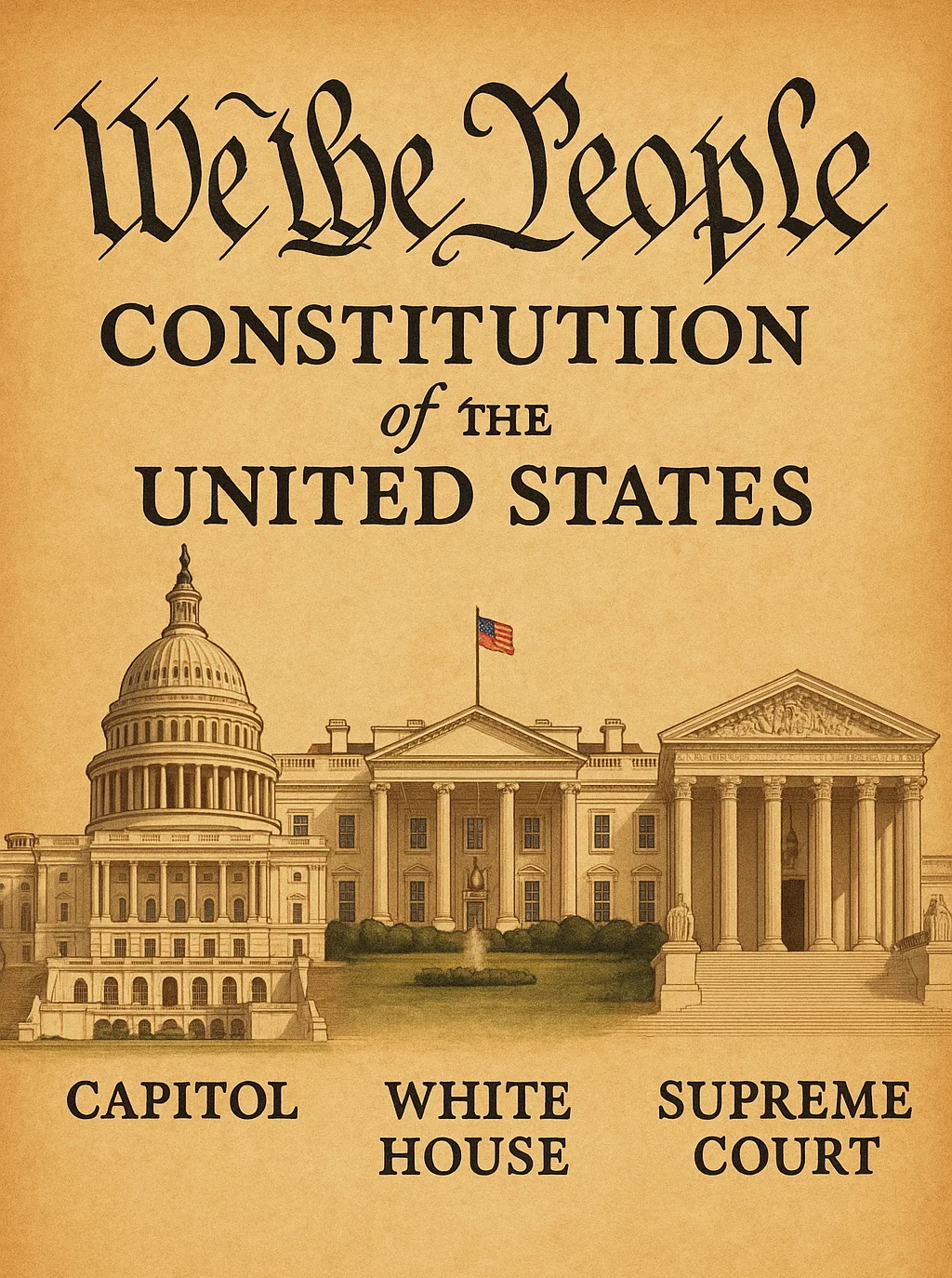
Image generated by Sora

Article I, Section 8 of the U.S. Constitution grants Congress several powers related to the militia: it authorizes Congress to call forth the militia to enforce federal laws, suppress insurrections, and repel invasions. One complaint I have about Donald Trump’s first term is that the President did not use the National Guard more aggressively during the George Floyd riots. 

Article I, Section 8 also gives Congress the power to organize, arm, and discipline the militia, while leaving the appointment of officers and the training of the militia to individual states, subject to federal standards. When not deployed by the federal government, state governments retain control over the National Guard.

Under Article II, the President serves as Commander-in-Chief of the armed forces, including state militias when called into federal service—authority he possesses explicitly. This power allows the President to direct the militias during times of war, national emergencies, or when federal law must be enforced.

The Second Amendment to the US Constitution (the Bill of Rights) is closely tied to Article I, Section 8, as well as Article II. It addresses the concept of a citizen militia and the balance of power between the federal government and the states.

As noted, Article I gives Congress the authority to organize, arm, and regulate the militia; Article II gives the President the authority to command those forces; and the Second Amendment protects the right of the people to keep and bear arms as a safeguard for the security of a free state. Together, Article I, Article II, and the Second Amendment reflect the Founders’ intent to maintain a well-regulated militia that can be mobilized for defense and other purposes, while preventing the federal government from disarming the populace.

What about Posse Comitatus? The Posse Comitatus Act of 1878 is a federal law that generally prohibits the use of the US Army and, by later extension, the Air Force, to execute domestic laws—except where explicitly authorized by the Constitution or Congress. It was later extended to include the Navy and Marine Corps through Department of Defense regulations, but the law itself primarily applies to the Army and Air Force.

The idea behind the law was to prevent the military from acting as a domestic police force after Reconstruction, when federal troops had been used in the South to enforce civil rights and suppress rebellions. This law was secured by the Democrats to thwart the Union’s efforts to protect newly freed slaves, while advancing the cause of black liberation. In other words, it was a move to limit federal authority to allow Redemptionists to continue their program of racist terrorism.

Today’s Democrats are not only defying the authority of Articles I and II, but they are also seeking to negate the Second Amendment by disarming the populace. They do this by treating guns as if they have agency, when in truth guns are merely tools—effective means for self-defense and the defense of the homeland (among other purposes, such as hunting and sport).
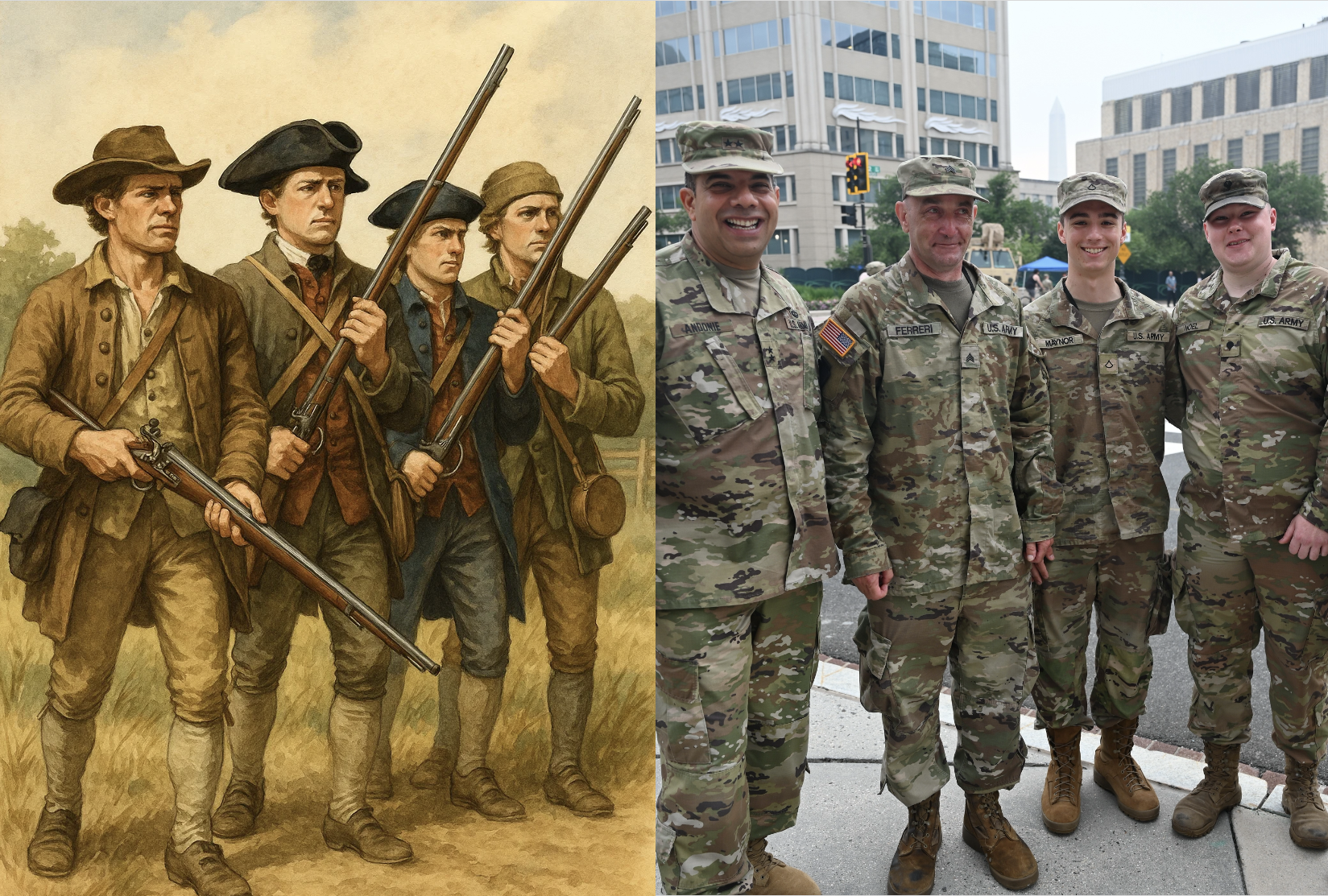
The Militia, then and now

Militias are not moribund, as we are often told. Over time, through legislative acts and reforms, state militias evolved into what is now the National Guard. The Militia Act of 1903 formally organized state militias into the National Guard, integrating them more closely with the federal military structure while preserving limited state authority. Subsequent laws, such as the National Defense Act of 1916, expanded federal oversight by providing equipment, funding, and training, and required Guardsmen to meet regular Army standards.

This transformation modernized the militia concept, creating a flexible force that serves both state and national interests. It did not abolish the militias or the powers of Articles I and II, nor did it cancel the Second Amendment; rather, it clarified and strengthened the foundational law of the Republic.

Thus, when the President, under his Article II powers, calls forth the National Guard to enforce federal laws, suppress insurrections, or repel invasions, he is acting fully within the scope of the Constitution. This is not a “power grab.” It is a legitimate exercise of authority granted to the President by the Constitution—the contract between the people and the government to establish a more perfect Union.

From where does federal authority derive? Beyond natural law, the power of the federal government over state governments is enshrined in the Supremacy Clause, found in Article VI, Clause 2 of the US Constitution. It establishes that the Constitution, federal laws made pursuant to it, and treaties are the “supreme Law of the Land.”

This means that when state laws conflict with federal laws, powers, or constitutional provisions, federal law and power prevail. The Supremacy Clause ensures a unified legal system across the country, preventing states from undermining national authority. Otherwise, we would be a loose confederacy—an arrangement the Constitution explicitly abolished when it superseded the Articles of Confederation. The Supreme Court has consistently reinforced the principle of national supremacy, emphasizing that states cannot interfere with or contradict valid exercises of federal power.

The neoconfederates of today’s Democratic Party are defying the Supremacy Clause not because they do not appreciate the power it gives the President—they relish that power. They are defying federal supremacy now because they do not like the current President.

The same holds true for the federal judiciary, its judges refusing to stay in their lane. Like Democrat governors and mayors, rogue judges are thwarting federal policies because Trump is President. They are engaged in judicial insurrection.

Article III of the Constitution creates only one court—the Supreme Court—and that Court has no enforcement power, as powers are separated by the Constitution. Every federal court below the Supreme Court is created by Congress, funded by Congress, and subject to Congressional oversight and discipline. The power of the federal judiciary is a new development in American history. The Founders were very concerned about this possibility. 

The rhetoric about “three coequal branches” of government is misleading. Nowhere in the Constitution is this phrase used. Nowhere in the Constitution is the judiciary given explicit power of judicial review beyond the Supreme Court. That power was later recognized by the Supreme Court in Marbury v Madison (1803), a highly problematic precedent.

Thomas Jefferson and other Republicans at the founding and in the early years of the Republic were deeply concerned about the unchained power of the judiciary, particularly the potential for even the Supreme Court to become too strong and override the will of the people and their elected representatives. Jefferson feared that judicial review could allow unelected judges to nullify laws passed by Congress or actions taken by the President, upsetting the balance of power among the branches. He warned that this could create an oligarchy of lawyers, with life-tenured justices dominating both the Legislative and Executive branches.

This fear was well-founded. Marbury v Madison tilled the soil for the growth of a judicocracy—panels of judges who could thwart the popular will. The Republic is fundamentally a representative democracy, answerable to the people. The Founders understood the peril of an all-powerful judiciary. The Supreme Court has much work to do in cleaning up precedent in this area, but Congress can act today by defunding and reorganizing the judiciary.
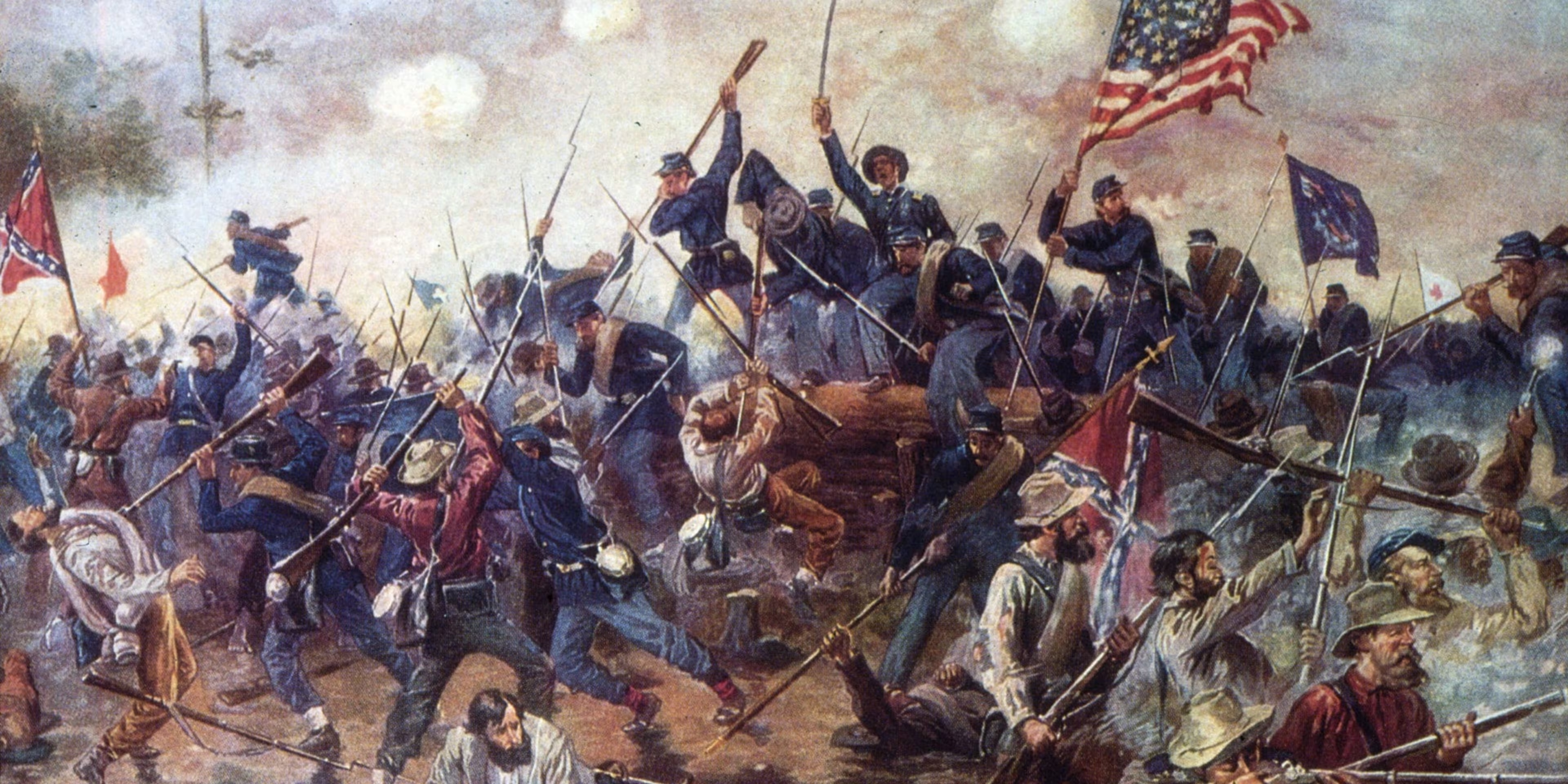
The American Civil War (April 12, 1861, to April 9, 1865)

What about “states’ rights”? This matter was settled in the 1860s, when breakaway states under the control of the slaveholding Democratic Party, which had organized themselves into a sovereign confederation, surrendered on the battlefield and rejoined the Union, each required to provide their citizens with a republic form of government. 

Crucially, in resolving this question, the Ninth and Tenth Amendments were not violated. Yet another myth has been constructed around these amendments. 

The Ninth Amendment safeguards unenumerated rights—those not explicitly listed in the Constitution. It declares that listing certain rights should not be interpreted to deny or disparage other rights retained by the people. This amendment addresses the scope of individual liberties, not “states’ rights.” States have not rights, only powers, and these powers are delegated to them by the people and the Constitution. 

The Tenth Amendment reinforces federalism by stating that powers not delegated to the federal government, nor prohibited to the states, are reserved to the states or the people. While, to be sure, it was intended to limit federal authority and protect state sovereignty, the federal government remains supreme under the Constitution. The Civil War, costly as it was, clarified this principle once and for all. It is a shame that three-quarters of a million or more lives were lost settling that issue. 

Together, the Ninth and Tenth Amendments underscore the Founders’ vision of a government with limited powers, protecting both individual freedoms and state autonomy within the federal system. They do not give states the power to thwart legitimate actions by the federal government.

What we are seeing today are state governments and a runaway judiciary claiming powers they were never intended to possess. We have a President asserting the authority of his office to bring renegade governors and judges to heel, as Abraham Lincoln did before him. President Trump is a republican in the truest sense of the term. He is not an authoritarian dictator seeking more power than he possesses; he is reestablishing the authority the Constitution bestows upon his office.

It’s Not Anti-Pride—It’s Pro-First Amendment. Free Conscience and Speech aren’t About Your Opinion

Folks are hyperventilating over on X because cities are removing Pride colors from crosswalks.

Image genderated by Sora

This isn’t about being anti-Pride—it’s about the First Amendment.

The First Amendment forbids the government from endorsing any particular ideology or social movement. That’s what the clauses on conscience, speech, and the press are all about.

Public spaces are neutral spaces, where no one should be compelled to participate in speech or expression they disagree with.

You can’t have freedom of belief or expression unless you also have freedom from government-endorsed belief or expression.

I thought that was obvious. Apparently not.

Someone told me I hadn’t read the First Amendment. Not only have I read it—I understand it.

So I asked a few rhetorical questions:

“Would you want to see the Confederate flag painted on the sidewalks you walk every day?”


“How about the Ten Commandments plastered on public school buildings?”


“Or anti-LGBTQ slogans bolted to the courthouse door in your city?”

The point of protecting free conscience, speech, and writing isn’t whether you agree with the symbols displayed on public property. It’s about recognizing the principle of personal liberty.

The government shouldn’t paint the Confederate flag on crosswalks—not because it’s offensive, but because it amounts to government endorsement of a particular ideology. The First Amendment forbids that.

If a citizen wants to walk across the street wearing a T-shirt with a Confederate flag, that’s his right. Have at it, Hoss.

If he paints that flag on a public building, it’s vandalism. Arrest him, fine him, make him clean up the mess.

If the government paints the flag, that’s a violation of the First Amendment.

This isn’t difficult to understand if you start from the principle of liberty.

So why do some people want Pride colors painted on crosswalks? Because they’re not liberty-minded—they’re authoritarian-minded. They want the government to impose a particular ideology.

In doing so, as Christopher Hitchens warned years ago, they’re making a rod for their own backs.

The Terroristic Phase of a Neo-Religion

The New York Post (founded in 1801 by Alexander Hamilton) published a disturbing article yesterday: “Minneapolis gunman Robin Westman blamed massacre on mom warning him not to change gender.”

Robert (aka Robin) Westman wrote in his journal:

“I remember one day, she said something like, ‘In the future you will look back and feel ridiculous about who you feel like you are inside. You will regret this.’”

His mother was right.

Westman said this made him want to kill children. Let that sink in: his mother telling him the truth—offering sound, grounded parenting—became, in his mind, justification for mass murder. Even while admitting he should never have gone down that path, and warning others against it, this was his response to parental correction.

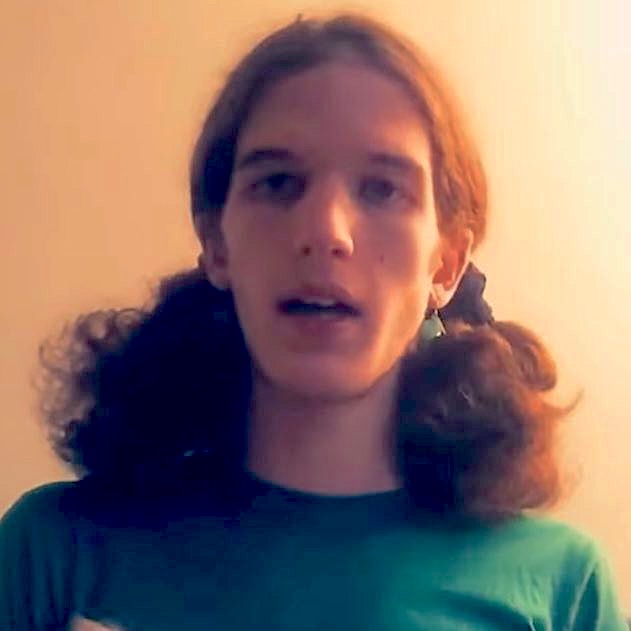
Robert (aka Robin) Westman, posting to his Russian social media VK account

See how this ideology works? The mother refuses to lie, so the son kills children. This warped logic mirrors the emotional blackmail often employed by trans activists, where suicide threats are wielded to enforce compliance with a warped worldview.

But those trapped in this delusion—given meaning by radical gender ideology, indeed generated by it—aren’t the only ones deploying this tactic. The queer activist sphere and the profit-driven medical industry that mutilates bodies have adopted the same coercive logic. And now, grotesquely, we see child murder used as leverage to demand affirmation of a sick ideology.

This is what I warned about Thursday in Alliance of Death Cults: The Rise of Lethal Misanthropy in the West (see also The Terrorist Embodies the Ideology in Reality).

Yesterday on Facebook and X, I posted an analogy to illustrate the emerging mindset in queer praxis:

Instead of condemning Islamic terrorism every time a Muslim kills people, we need to respond with love and acceptance. Those who oppose Islam are responsible for the terrorism. Islam is a religion of peace. We provoke them by rejecting their way of life.
We would have fewer victims of Islamic terrorism if we affirmed the teachings of Muhammad and changed our laws to reflect his tenets. That’s all they want: for the rest of us to embrace their worldview. We must teach our children that Islam is a wonderful way to see the world—and ask them whether they might want to become Muslim themselves. We should fly the Star and Crescent over City Hall and paint elaborate geometric designs on our crosswalks. This is how we should deal with Islamic terrorism: by recognizing our role in causing mass shootings and suicide bombings. Because, really, it’s our fault. We’re the bigots.

It’s less an analogy than a parallel. Anti-Western sentiment and self-loathing underpin woke progressivism. It’s the frame and the shuttle of the loom weaving together anti-human ideologies. The endgame of progressivism isn’t just the overthrow of the American republic—it is the dismantling of the Enlightenment itself, replaced with the nihilism of transhumanism: a religious fervor that denies reality.

We are now in the terroristic phase of a neo-religion. Authorities hid Audrey (aka Aiden) Hale’s manifesto because they needed more time to normalize the ideology. Westman’s approach—releasing so much on the Internet—did not allow the authorities to memoryhole his crime and the motive.

Shame on everybody who enables this pathology. It’s madness. Denying the madness goes to judgment. If one believes in the doctrine of gender identity, one’s judgment on everything is suspect. If he’s right about anything, it’s accidental; he is simply repeating a truth he’s heard from an authority he obeys, just as he repeats the lies that authority tells him. He does not obey reason.

Deep down, almost everyone knows Westman was a man. Likewise, almost everybody knows Hale was a woman. Some reporters avoid pronouns altogether, terrified of what will happen if they use the “wrong” ones—their linguistic contortions are, at this point, almost comical. Others knowingly use the wrong pronouns out of fear. And still others insist on the wrong pronouns because they’re loyal to a movement that demands lies over truth.

Westman was a man. Hale was a woman. Both were psychopaths who killed children because they embraced a hateful, anti-human ideology—the same ideology that demands we all participate in the lie.

There’s no transcultural or transhistorical way for a male or a female to appear. This is not about how a person dresses or whether he wears makeup or whatever. It’s about the demand that society affirm the delusion that a person can be the gender he is not and cannot be—and making them out to be the enemy when they don’t.

The West is a free society because we don’t have to believe ridiculous things. We shouldn’t have to live in fear over our refusal to participate in a mythology about gender, a god, or anything else. Children shouldn’t have to die for the cause of a neo-religion.

It’s not resistance to radical gender ideology that’s responsible for the death of children. It’s not guns, either. It’s the collective act of embracing a deranged worldview that endangers them.

Saving the Practice of Racially Selective Underproduction From Trump’s Law and Order Push

During his campaigns and presidency, Donald Trump has emphasize a “law and order” approach, focusing on supporting police, increasing funding for law enforcement, and taking a tough stance on crime and civil unrest. His rhetoric, as well as others in his administration, frames civil disturbances as challenges to public safety, while highlighting the need for stricter enforcement of laws. The Trump approach has drawn both support from those prioritizing security and criticism from those concerned about policing practices and racial justice implications. However, the criticisms are not merely misplaced, but largely hail from an left-political standpoint corrupted by critical race theory. Those advocating the standpoint purport to speak for a community that is far from monolithic.

While I was in graduate school at the University of Tennessee, Randall Kennedy, a left-liberal law professor at Harvard, published Race, Crime, and the Law (1997). This book impacted my understanding of the problem I was tackling in my dissertation, Caste, Class, and Justice: Segregation, Accumulation, and Criminalization in the United States, which concerned the problem of the racialization of the criminal law and its enforcement. (Kennedy is the author of several books, including his 2002 Nigger: The Strange Career of a Troublesome Word. Troubling, and often comically, Kennedy faced restrictions on citing the title while on tour promoting the book.)

Randall Kennedy, law professor at Harvard

While much public attention has focused on police misconduct, biased prosecutions, and unfair sentencing, Kennedy argues that these are only part of the picture. He contends that a deeper and more pervasive injustice is what he terms “racially selective underprotection.” In his words, “blacks have suffered more from being left unprotected or underprotected by law enforcement authorities than from being mistreated as suspects or defendants.” (In a January 2024 essay, Ever Wonder What Progressives are Trying to Accomplish with Their Social Policies?, I argue that the systematic underprotection of blacks in America’s cities is not accidental.)

For this position, Kennedy was heavily criticized by those who were socializing critical race theory (CRT) at the time. CRT is an ideology that sees enforcement of the criminal law through the lens of “systemic racism.” With this concept, public safety was interpreted as racially-motivated government oppression. CRT advocates saw Kennedy’s commitment to colorblindness—that is, equal treatment before the law regardless of race—as a betrayal of the black movement, rooted in New Left politics, to define social relations primarily in terms of race. They needed Kennedy on their side, they lamented, but he was getting in their way. (Kennedy analyzes this phenomenon in his Sellout: The Politics of Racial Betrayal, published in 2008.)

Yet Kennedy’s argument in Race, Crime, and the Law is compelling and backed by a mountain of evidence. He documents that black Americans are “doubly victimized” by crime—first by the offenders who prey disproportionately on black communities, and second by the legal system’s neglect in providing them equal protection. As he puts it, “the principal injury suffered by African Americans in relation to criminal matters is not overenforcement but underenforcement of the laws” (emphasis mine). This observation reframes the debate: the problem is not only that black citizens are policed too harshly in some contexts (Kennedy admits there are problems here), but also that they are too often abandoned when they most need protection.

By highlighting this imbalance, Kennedy urges a broader conception of racial justice—one that demands not just fair treatment of black defendants, but also adequate protection of black neighborhoods. His argument is what inspires my moral assertion that public safety is a human right. Kennedy’s thesis thus challenges reformers to balance concerns about over-policing with the pressing need to address crime and insecurity in neighborhoods that have historically been underserved by law enforcement.

Given the hysteria surrounding Trump’s program of enhancing law and order in America’s crime-ridden inner cities, a program that has yielded positive results in Washington, DC, yet has been resisted by Democrat leaders in California, Illinois, and other blue states, it appears that Kennedy’s critics won the argument on the left. Thus, one finds, despite Kennedy’s left-liberal bona fides, his arguments routinely portrayed as conservative. His friendly criticisms of affirmative action and DEI, crucial for finally realizing America’s foundational principle of equal treatment, have made him a frequent target for the black Brahmin class I identified in my essay, The Mark of Progressive Racism: The Infantilization of the Black Proletariat, published earlier this week.

Draping Illegal Aliens in Heroism: What Really Happened at Bear Gulch

The progressive media establishment is growing ever more desperate in the project to keep as many foreigners in the United States as possible and signal to the corporate elites who exploit foreign labor to drive down the standard of living for American workers and undermine the integrity of their communities its commitment to open borders. Every day, the mainstream media proclaims its subservience to the party of mass immigration and the moneyed interests that party represents.

In his rant yesterday evening, Chris Hayes of MSDNC lectured his audience, “We’re an interconnected society of humans who depend on each other to survive and thrive, and there’s not some neat line you can cleave between America and foreigners. We just have neighbors and communities.” This is the standard transnationalist line. It skirts the line known as borders. Borders are as neat or as messy as those in power want them to be. The globalists thrive on messy borders. Civilization depends on neat ones.

Hayes’s lecture was prompted by the situation at Bear Gulch, where—the public is told—US Border Patrol agents arrested two firefighters who were battling the Bear Gulch fire in the Olympic National Forest in Washington. The men are being held in a facility in Bellingham. This is a false narrative.

Image generated by Sora

Here’s what actually happened: The Bureau of Land Management (BLM) conducted a criminal investigation and, based on its findings, terminated contracts with two companies assisting in the firefighting efforts—ASI Arden Solutions Inc and Table Rock Forestry Inc.

Following that decision, BLM requested that Border Patrol verify the identities of forty-four crew members. Agents determined that two of them were in the US illegally, with one under a previous order of removal. Both individuals were arrested and transported to the Bellingham Station.

The arrests occurred during an ID check—not in the middle of active firefighting operations. By that point, the BLM had already ended the contracts for those crews, meaning they would have been removed from the operation regardless. The remaining forty-two crew members were dismissed from the site because their contracts had been voided, not because they were detained by Border Patrol.

It’s important to understand that propaganda narratives distort these events. One’s default should be that the mainstream media is lying. From there, determine what the true facts are. Being in the country illegally does not exempt anyone from legal consequences. Draping illegal aliens in heroism doesn’t provide immunity from the rule of law.

But Senator Patty Murray of Washington is pushing the propaganda line with gusto, even drawing parallels to immigrant service members. But if soldiers are in the country unlawfully, why should they be exempt from standard enforcement actions? Call the bluff. Stand for the rule of law. Illegal immigrants have to go.

Never Again, and Yet Again: How Medicine Abandoned Science for Gender Ideology

I found an article today: “Mental Health Diagnoses among Transgender Patients in the Clinical Setting: An All-Payer Electronic Health Record Study,” published in Transgender Health. Transgender Health is a peer-reviewed specialty journal recognized in the field.

The study “performed a cross-sectional analysis of the prevalence of psychiatric diagnoses among transgender patients in clinical care using an all-payer electronic health record database.” The population sample was large—60 million patients nationwide.

The researchers found that “58% (n=5,940) of transgender patients had at least one psychiatric diagnosis, compared with 13.6% (n=7,311,780) in the control patient population.” The study concluded: “Transgender patients had a statistically significant increase in prevalence for all psychiatric diagnoses queried, with major depressive disorder and generalized anxiety disorder being the most common diagnoses (31% and 12%, respectively).”

Image generated by OpenAI’s Sora. The scalpal is missing

Think about that: a journal in the field of transgender health published a 2019 study showing a high rate of psychiatric illness among a majority of trans-identifying patients. This wasn’t a red flag?

And this isn’t the only red flag.

In 2016, Project LifeSkills (JAMA Pediatrics) found that, among 298 young transgender women (ages 16–29), 41.5% had at least one psychiatric diagnosis, and 20.1% had two or more—high rates of mood disorders, PTSD, and more. (“≥” means one or more.)

A 2022 study in the Journal of Clinical Psychiatry found that transgender and gender-diverse individuals averaged 3.54 psychiatric diagnoses, including borderline personality disorder and PTSD.

A 2016 article in the French journal Encéphale reported that 32–44% of children and teens in gender identity clinics had co-occurring disorders.

Some studies report that as many as 85% of trans-identifying individuals have one or more psychiatric disorders.

If the DSM (the American psychiatric manual) had not removed “gender identity disorder,” then 100 percent of such patients would still be identified as having at least one psychiatric disorder.

The French study noted that psychiatric comorbidities are more common in male-to-female transsexuals (a term now eschewed by the industry). It added: “Data on long-term mortality show that transsexuals present a 51% increase in mortality compared to the general population. This is mainly attributed to a six-fold increase in suicides.”

The authors concluded: “Transgender individuals suffer from more psychiatric pathologies compared to the general population. This may be due to social and familial discrimination and ostracism. These results demonstrate the vulnerability of this population. An awareness program for mental health professionals is essential to adapt care to the specific needs of this population. A list of ‘non-transphobic’ mental health professionals should be established.”

“This may be due to social and familial discrimination and ostracism.” This emotional blackmail used by trans activists and the medical industry to shame those who doubt or deny the possibility that a person cannot be born in the wrong body.

This is what happens when ideology captures a profession and corrupts it. What should be treated as a psychiatric matter has been redefined as a “way of being” and normalized. The cause of self-harm is attributed not to the disorder, but to those who refuse to affirm a delusion.

And the ideological capture isn’t limited to psychiatry. Endocrinology has also been taken over, with “gender-affirming care” reclassified as “endocrine disorders” to bypass insurance restrictions and deceive states that have limited these practices.

Surgery, too, has been captured—healthy breasts amputated, penises inverted, flesh from arms used to construct faux phalluses. These procedures routinely create lifelong medical patients. More money for the industry. (I will spare you the pictures, but you can easily find them by performing a Google search. Try these search terms: “phalloplasty”; “vaginoplasty.”)

What should be a healthcare field has become an ideologically driven, profit-generating industry.

To call this stituation tragic is an extreme understatement.

The latest devastating news from the Minneapolis shooting: Robert Westman wrote in his notebook that he was no longer comfortable identifying as trans and regretted convincing himself he was a woman. (That this story remains at the top of the Google news index—and the manifesto was publicly released—suggests that the political terrain is changing. Let’s hope so.)

He isn’t alive to blame himself anymore. But others are still here—and should be asking what they did. Westman surely had a lot of help in sustaining that delusion. His parents didn’t help; his own mother accompanied him to court to petition for a legal name and sex change.

This is the power of mass psychogenic illness. One of its consequences is children murdered in pews as they attend Mass.

Secretary Robert Kennedy and HHS need to stop this madness, launch a full review of these practices, and hold accountable those who organized and participated in this industry.

We need a public Nuremberg-style tribunal—a “Doctors’ Trial 2.0.” The public deserves to know everything.

For the record, HIPAA—the 1996 US federal law that protects sensitive patient health information (PHI)—was never meant to shield doctors who harm patients or engage in misconduct. Authorities need to release the relevant information. Parents need to understand what a scam this is.

We also need a complete overhaul of public education. Purge these institutions of radical gender ideology. Administrators, counselors, and teachers are grooming these kids.

A great many people who are dead today would still be alive if society had not gone down this path. We said “Never again” after the Holocaust. What in the hell happened?

I don’t do this for my emotional well-being. The more I dig, the worse it is for my mood. But we have to talk about this. I’m just one person. I will do what I can.

Alliance of Death Cults: The Rise of Lethal Misanthropy in the West

Reflecting on yesterday’s events (see The Terrorist Embodies the Ideology in Reality), I recognize that the mass shooting perpetrated by Robert Westman—a man who identified as a woman—is one of those situations in which progressives struggle to place blame squarely on conservatives, deflecting responsibility for fostering an environment where death cults thrive.

Predictably, there’s already renewed talk of gun control, reviving the familiar narrative that conservatives, by defending the Second Amendment, are somehow to blame. But that explanation—dulled by overuse and burdened by an obvious ulterior motive—misses, often intentionally, the deeper issue: radical gender ideology, and the cultural forces sustaining it, fueled the Minneapolis shooting and the other tragedies I document later in this essay. Efforts to redirect attention toward gun control can only distract from the problem of ideology for so long. Increasingly, Americans are awakening to the problem of transgender identification and the psychiatric-industrial complex—and the larger institutional framework—that normalizes it.

It occurred to me last night that activists within the trans movement who rely on emotional blackmail—namely, the familiar claim that failing to affirm their ideology leads to suicide—may soon make a narrative shift. That emotional tactic could evolve into a darker ultimatum, one already suggested by the violence of so-called trans martyrs: that refusing to affirm the ideology will lead not only to self-harm but also to violence against others. In effect, we could see the persistent threat that characterizes Islamic terrorism—the logic of the suicide bomber—emerge in this context.

Such a shift would project responsibility for violence outward, onto those who reject the ideology, as if dissent had provoked it. Just as many in the West now self-censor out of fear of offending Islam, Americans may soon keep quiet to protect themselves and their families from ideological retaliation.

This scenario is not difficult to imagine. We already see members of the public instinctively cower in the presence of mentally ill individuals behaving menacingly. Such fear is rational: while some people remain oblivious, many are attuned to their natural inclination to sense danger—a survival mechanism that triggers the fight, flight, or freeze response. Terrorism depends on this instinct to control others, knowing that many will flee or freeze, particularly when told to “show compassion” toward those with mental illness and avoid upsetting them.

We don’t need speculation to see that radical gender ideology is drifting toward a form of ideological extremism. Take the slogan “Queers for Palestine.” Whether viewed as a meme, a political slogan, or a rallying cry, it initially strikes many as absurd. But the phrase makes sense when one recognizes that “queer” is not merely (or really at all for many gays and lesbians) a reference to sexual orientation but to a broader ideological framework. What I—and an increasing number of others—call radical gender ideology is the belief that gender is fluid and can be changed at will. Because this belief runs counter to established science and common sense, and because it incorporates elements of faith and myth, it functions as a religion. From an anthropological perspective, it is, in fact, a species of religion.

As a religion, radical gender ideology bears striking similarities to Islam. Within the belief system, the transgender individual occupies a sacred position akin to that of the martyr in Islam. Not every Muslim is a martyr; the martyr is the one who kills and dies for the faith. But the martyr reflects the best of the faith. Likewise, the religion of gender identity already has its martyrs—those who harm themselves or, in extreme cases, others, as seen in the tragic events in Minneapolis.

Such incidents are not isolated. They are symptomatic of a broader cultural pathology deeply intertwined with a nihilistic strain of transhumanism. This worldview, reflecting profound self-loathing and misanthropy, rejects humanity itself. It explains why the Minneapolis shooter’s manifesto—released yesterday—read like a catalog of alienation and rage: alienation from society and rage directed at Christians and Jews. Investigators may claim they are still searching for a motive, but the motive is plainly in view.

My concern about this potential narrative shift is not hypothetical. Today, trans activists are celebrating Westman’s actions, framing the attack as justified revenge against those who fail or refuse to affirm radical gender ideology. Andy Ngo reported on X: “Trans leftist accounts all over social media are celebrating the shooting and killing of children at the Minneapolis church by a trans gunman. They believe it is revenge against Christianity and the Trump administration for not allowing transitioning [of] children, and defining sex as biological.” Just as criticism of Islam provokes its martyrs to kill, criticism of gender ideology increasingly provokes its adherents to violence. It is an easy step for terrorists to blame the victim. Indeed, it is inherent in the motive to kill.

The alliance between these movements is not limited to a slogan that many dismiss as ironic. Look closely at the shooter’s writings: invocations of Mohamed Atta, appeals to the will of Allah, and symbolic homages to jihadist violence. These elements, explicitly referenced, make the slogan “Queers for Palestine”—and the sight of queer activists marching in solidarity with jihadists—not just comprehensible but chilling. Substitute the transgender individual with the Islamic fundamentalist—the suicide bomber seeking transcendence through martyrdom—and the parallels are stark. We have entered a new phase of movement politics.

It is crucial to recognize that Islam, like radical gender ideology, is not merely a religion but also a political project aimed at reshaping society. Both seek to impose their doctrines, transform Western institutions and culture, and enforce ideological conformity through coercion—legal, social, and physical. Both are hostile to free speech, demand the adoption of their language, and enjoy widespread support from the progressive establishment.

Yesterday, Minneapolis Mayor Jacob Frey said: “Anybody who is using this as an opportunity to villainize our trans community, or any other community out there, has lost their sense of common humanity.” He added: “We should not be operating out of a place of hate.” We have heard the same refrain countless times after Islamist terrorist attacks: “Don’t blame all Muslims for the acts of a few.” But public concern about Islamic terrorism is not about individual Muslims; it’s about the ideology. The same is true in the radical gender ideology case. Condemning those who question radical gender ideology by accusing them of “villainizing the community” is a tactic to stifle criticism and protect a favored ideology.

“Death Cult.” Image generated by Sora

Robert Westman acted out of hate, driven by a warped worldview embedded in the nihilism of transhumanism—beliefs shared by many progressives who now feign shock at the consequences. “Kids died today,” Frey said. He should be more precise: Kids were killed—killed by a man motivated by an ideology that city leaders, activists, and cultural elites promote and normalize. Guns do not shoot themselves; people act on ideas. This is what anarchists call “propaganda of the deed.”

The human mind is a pattern-recognition machine, honed by evolution to make sense of threats. But that machine requires data—instantiations—to detect patterns. And because mainstream media obscures these events, individuals must seek the data themselves. Here are five cases where I can confirm that the perpetrators were part of the trans movement.

  • In 2018, in Aberdeen, Maryland, Snochia Moseley, an employee at a Rite Aid distribution center, shot and killed three people before dying by suicide. Moseley was a man identifying as a woman, reportedly struggling with mental illness and turmoil over his gender identity.
  • In 2019, in Denver, Colorado, at STEM School Highlands Ranch, Maya McKinney, a girl identifying as a boy named “Alec,” joined another student in an attack that injured several. McKinney claimed bullying over her gender identity and expressed a desire for peers to “experience bad things” similar to her trauma.
  • In 2022, in Colorado Springs, at Club Q, Anderson Lee Aldrich, who identified as non-binary and used “they/them” pronouns, killed five people and injured nineteen before pleading guilty to federal hate crime charges.
  • In 2023, in Nashville, Tennessee, at the Covenant School, Audrey Hale, a woman identifying as a man named “Aiden,” meticulously planned an attack that killed three children and three staff members.
  • And yesterday, in Minneapolis, at Annunciation Catholic School, Robert Westman, a man identifying as a woman named “Robin,” attacked the school during Mass, killing two children and injuring many others before dying by suicide.

Beyond these high-profile cases, other homicides committed by transgender-identifying individuals rarely make national headlines unless the circumstances are sensational. No consistent government database tracks homicide offenders or victims by gender identity. Law enforcement records typically log only “male” or “female,” and ideological pressures mean identifying transgender offenders often requires piecing together media coverage or court filings. The absence of data does not mean the problem is insignificant; it means the scope is obscured. Outside of mass shootings, documented violence includes domestic disputes, interpersonal assaults, and, in some cases, drug- or gang-related crimes. Whether ideology motivated these crimes remains unclear, but the pattern of violence is unmistakable—and at the very least it demands honest scrutiny. I am not at all hopeful that this will happen.

The Mark of Progressive Racism: The Infantilization of the Black Proletariat

The most obvious indicator of left-wing racism is the white progressive reflex to strip black Americans of their agency. Blacks are not responsible for the crimes they commit, the communities their behaviors degrade, or the idleness that perpetuates cycles of poverty and violence.

At least, that’s what the progressive catechism teaches. It’s why progressives (too often mistakenly referred to as “liberals” by conservatives) rail against law and order. It’s why they sneer at the very idea of personal responsibility. To them, blacks are permanent wards of the state—infants in need of constant excuses, incapable of individual accountability or moral choice.

The white progressive is joined in infantilizing blacks by what one might identify as, following the radical thesis of internal colonialism, colonial collaborators within the black population—collaborators whom Manning Marable, in his 1983 How Capitalism Underdeveloped Black America, referred to as the black “Brahmin” class (borrowing a term from the caste system of India).

The black Brahmins are a small but influential group of highly educated black cultural leaders, intellectuals, and professionals who rose to prominence during the twentieth century. These are the intellectuals who developed critical race theory, a political standpoint I have written about extensively in Freedom and Reason (see Staying Focused on the Problem with Critical Race Theory, where readers will find several embedded links to other essays on the topic).

Marable thus uses the concept of the black Brahmin to describe a segment of the black community that gained social mobility through access to education, professional advancement, and often proximity to elite white institutions. This class, while playing a crucial role in shaping black thought, cultural production, and political strategy, finds itself socially and ideologically above and remote from the working-class and poor black communities it claims to represent. And so it should, since it is allied with the capitalist class, represented today by corporate state power.

Karl Marx sums up the role of such a stratum well in The German Ideology (written around 1845):

“The ideas of the ruling class are in every epoch the ruling ideas, i.e., the class which is the ruling material force of society is at the same time its ruling intellectual force. The class that has the means of material production at its disposal has control at the same time over the means of mental production, so that, generally speaking, the ideas of those who lack the means of mental production are subject to it. The ruling ideas are nothing more than the ideal expression of the dominant material relationships, the dominant material relationships grasped as ideas; hence of the relationships which make the one class the ruling one, therefore, the ideas of its dominance.”

Applied to the present analysis, the black Brahmin is subservient to the corporate state, advancing elite interests by constructing a language that serves to perpetuate prevailing social relations—and thus secures the privilege of the black Brahmin. This is how we see a situation in which black elites decry President Donald Trump’s turn to law and order in American cities, while ordinary black Americans see the enhancement of public safety as a godsend.

Marx continues:

“The individuals composing the ruling class possess, among other things, consciousness, and therefore think. Insofar, therefore, as they rule as a class and determine the extent and compass of an epoch, it is self-evident that they do this in its whole range, hence among other things rule also as thinkers, as producers of ideas, and regulate the production and distribution of the ideas of their age: thus their ideas are the ruling ideas of the epoch.”

Marx’s truism is expounded upon by Italian communist Antonio Gramsci in his Prison Notebooks, penned while imprisoned during Mussolini’s fascist regime. I recommend Gramsci’s work to anyone trying to understand how power operates in the West (see Inverting the Inversions of the Camera Obscura).

For his part, Marable critiques this divide, arguing that the black intellectual elite struggle to reconcile their privileged positions with the structural inequities still plaguing the majority of black Americans, highlighting tensions between advocacy, assimilation, and genuine radical transformation. Indeed, the “radical” transformation the black Brahmin agitates for isn’t radical at all, but the socialization of a learned helplessness designed to keep blacks in their historic place in late capitalist society: at the bottom of the class structure, performing the role of the permanent underclass (lumpenproletariat).

When you press white progressives and their black collaborators on who is to blame for the condition of black America, they don’t hesitate. It’s not them. They are the champions of the black proletariat. No—the villains are always the same in their rhetoric: white conservatives. The farmer in Iowa, the small businessman in Texas, the electrician in Ohio—they’re somehow responsible for the decay of neighborhoods they’ve never set foot in, over which they have no political control. The white conservative is blamed for dysfunction they neither created nor desire to see perpetuated.

The reality tells a different story. The political class most responsible for the plight of black Americans is the Democratic Party—the very party that claims to be their eternal savior. It was Democrats and their allies in the then-minority party (the Chamber of Commerce Republicans) who championed policies that gutted American industry, shipping jobs overseas in the name of globalism. It was, for the most part, Democrats who opened the borders, flooding low-wage labor markets and ensuring working-class blacks would face impossible competition. It is Democrats who maintain the modern ghetto, with its public housing projects, failing schools, and welfare bureaucracies that incentivize dependency and punish upward mobility. It was progressive social policies that destroyed the black family. Today’s Democrats defend all of it.

Perhaps most insidious of all, it is progressive Democrats and the black Brahmin—those who command the administrative apparatus and party machinery—who disrespect black people so profoundly that they argue blacks shouldn’t be expected to meet the same standards of behavior as everyone else. Commit a crime? Blame “systemic racism.” (As I have asked in previous essays, if systemic racism exists, and one can make the case that it does, who created and perpetuates it?) Poor academic outcomes? Blame the “legacy of oppression.” Acquiesce to generational poverty? Excuse it by blaming everyone but the individual making choices day after day that lead to predictable outcomes—and the social policies that enable such poor decision-making. This isn’t compassion. It’s condescension dressed up in the hollow language of equity and “root causes.”

Progressives prefer such sociological jargon to reality. They mumble and mutter about structural this and historical that, as if rehearsing abstractions is a substitute for acknowledging what every sane adult knows: human beings have agency. Every person, whatever his life chances, however difficult his start, has the ability to choose. To seek work instead of sitting idle. To obey the law instead of breaking it. To form stable families instead of collapsing into chaos. To overthrow the political elite who ghettoized him, instead of accepting their command as his fate.

To be clear, none of this denies that context matters. Circumstances shape motives; subcultures emerge from environments; and environments are themselves shaped by decades of policy decisions—overwhelmingly progressive in design and implementation. And these policy decisions are ultimately shaped by prevailing class power, as Marx noted long ago.

The “root causes,” however, are not the work of white conservatives but of white progressives and their black collaborators in the service of corporate power. Yet even in that context, the individual retains agency. He is responsible for his actions. What the progressive worldview does is make the exercise of that agency far more difficult, by socializing individuals to believe they are not responsible for their behavior and that accountability itself is a form of oppression. Progressive ideology is a form of political paralysis directed at the working class.

This is the great moral chasm between progressivism and conservatism, whatever disagreements one might have with the right. Indeed, this is the chasm between progressivism and liberalism in its true meaning. Conservatism and liberalism, at their core, affirm the dignity of the individual—the belief that every person possesses agency, and with agency, responsibility. That is where human dignity lies: in the recognition that each of us is the author of our own choices, that our lives are shaped by our will, our discipline, our adherence to the norms that sustain civilized society. We are ultimately responsible for our consciousness—and our conscience.

There is nothing more degrading—nothing more poisonous to the human spirit—than to tell a group of people that they are helpless, incapable of rising, mere victims of forces beyond their control. That lie, endlessly repeated by progressives, is the most insidious form of racism. It lies at the heart of what I have called the “New Racism”—just as it lay at the heart of the old racism. In the hands of progressives, the conceit traps the very people it claims to uplift in a state of permanent dependency, robbing them of the dignity that comes only from ownership of their own lives.

C. Wright Mills, in the opening chapter of The Sociological Imagination (1959), argues that understanding the relationship between “personal troubles” and “public issues” is the essence of sociological thinking. He insists that individual experiences are always situated within larger historical, institutional, and social contexts—that our biographies are intertwined with history. But Mills never claimed that social structure erases individual agency. His point was diagnostic, not deterministic. More than diagnostic, actually: to act wisely, a person must recognize the forces shaping his circumstances while bearing responsibility for the choices he makes within those constraints—and to use that knowledge to overcome them. (See Losing Control over the Narrative; The “Lived Experience” and the Paralysis of Liberty.)

A progressive will misread Mills, turning a framework for understanding and action into an excuse for inaction, stripping individuals of responsibility and reducing complex human lives to passive outcomes of impersonal forces. Spreading fatalism is the role of the black Brahmin, who have infused their thought with the progressive sociology that misreads Mills (and Marx), while finding their tactics in Gramsci’s Prison Notebooks, to keep the black proletariat from a methodology that could, if acted upon, allow them to become conscious of the forces impeding their progress and organize politically around that awareness to change their circumstances.

The Terrorist Embodies the Ideology in Reality

KARE 11 is the NBC-affiliated television station serving the Minneapolis–Saint Paul metropolitan area in Minnesota. In its reporting today on the mass shooting that occurred just hours ago at Annunciation Catholic Church and School in Minneapolis, Minnesota, where a gunman opened fire, killing two children aged 8 and 10 and injuring 17 others, including 14 children, the author, Samantha Fischer, refers to the shooter using “she/her” pronouns. This confirms what I gathered from the information I’ve been collecting on the case—that our nation has suffered yet another instance of trans violence targeting children.

Robin, aka Robert, Westman carried out a mass shooting today targeting children

“KARE 11 investigative reporter A.J. Lagoe reported the shooter was 23-year-old Robin, formerly Robert, Westman. Law enforcement sources said Westman grew up in Richfield and that her mother was an employee at Annunciation School.” (Emphasis mine. You can read the article here: “Minneapolis Catholic school shooter: What we know.”) From other sources, I have learned about court documents showing that, when Westman was 17, he and his mother, an employee of Annunciation (she retired in 2021), applied to change his birth name from Robert to Robin. That request was granted in January 2020. It appears that Westman attended Annunciation as a student for at least some time.

The shooter died from a self-inflicted gunshot wound outside the church. He—not she—legally purchased the firearms used in the attack and had no significant criminal history. It’s shocking that his mother could not have known that her son was a deeply troubled young man—and before that teenager. She knew he was trans, and a cursory look around his room should have told her that he was a profoundly disturbed individual. Investigators are examining a manifesto and online videos—items which I reviewed before they were scrubbed from the Internet—which, they say, suggest a possible motive related to anti-Catholic sentiment. The FBI is treating the incident as an act of domestic terrorism and a hate crime targeting Catholics. 

The scrawl on one of Westman’s rifles. Another of Westman’s weapons referenced Rupnow, presumably the 15-year-old student who carried out a shooting at Abundant Life Christian School in Madison, Wisconsin, in December 2024. Rupnow killed a teacher and fellow student, and injured six others, before fatally shooting herself.

I can tell readers that, based on the materials I reviewed, it’s a lot more than anti-Catholic sentiment. From Westman’s writings, the videos, and the symbology on his notebook, weapons, and around his room, the ideology that moved him is in line with the more radical expressions of progressivism—anti-Semitic (not just anti-Jewish sentiment but a shoutout to Muhammad Atta and the word Mashallah, which means “What Allah has willed” in Arabic) and anti-Christian, as well as Trump Derangement Syndrome. I noted a great deal of Cyrillic script in Westman’s notebooks and scrawled on his weapons. (There is talk on social media about the script being Russian. However, Ukrainians use the Cyrillic script for writing their language, as well. The modern Ukrainian alphabet is distinct from Russian Cyrillic in a few letters and pronunciation rules. I don’t know either language, so I can’t tell.)

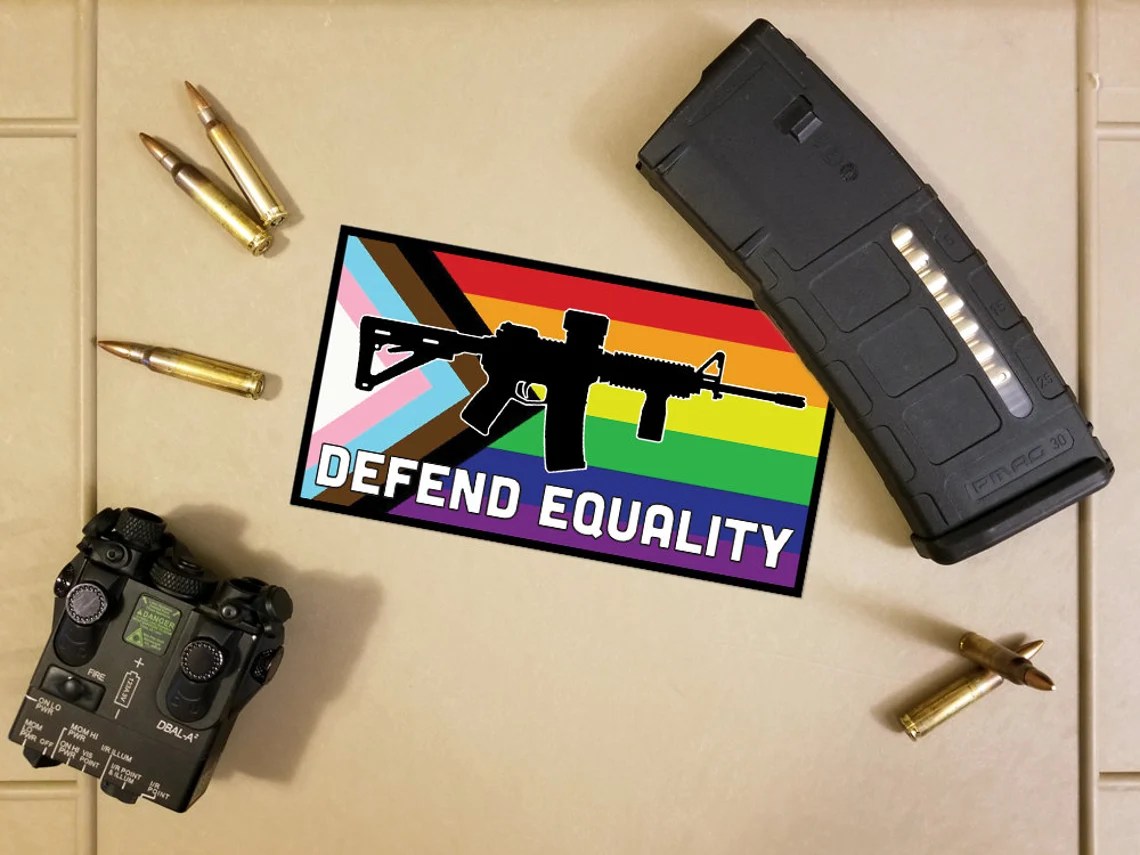
Marketing image from Etsy (source)

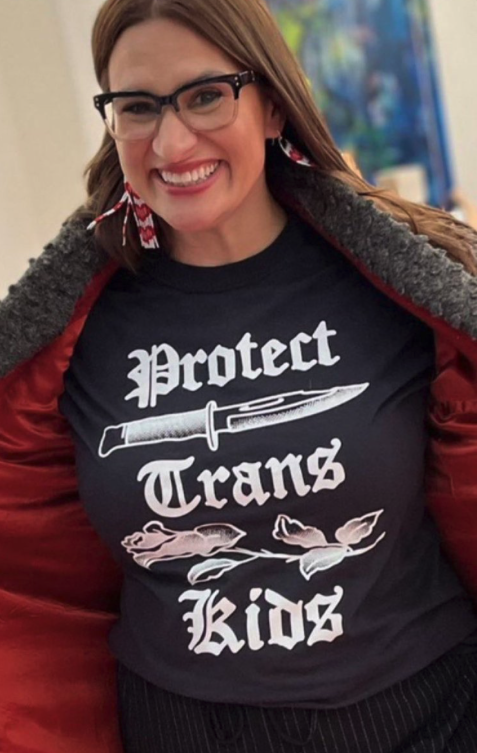
On one of Westman’s notebooks is a sticker of the Pride Progress flag with an AR-15 on it. Etsy sells these at $4.50 a pop. In fact, the image I shared above is the image Etsy uses in its marketing. It could just as easily be an image from Westman’s bedroom. This sort of imagery in trans activist messaging—images of guns and knives in tandem with calls to defend and protect the ideology—is typical of the movement and its commercialization. Prominent politicians have donned this symbology. Below is an image of the Lieutenant Governor of Minnesota, Peggy Flanagan, wearing movement paraphernalia to a rally supporting radical gender ideology. Westman’s notebook also sported a sticker of a Pride unicorn.

Minnesota Lieutenant Governor Peggy Flanagan

These images might feel discordant when paired with anti-Semitic messaging, but if you’ve been paying any attention to movement politics of late, the alliance of queer activism and pro-Hamas advocacy is blatant. These politics are also anti-Christian and pathologically obsessed with Trump. The glue that holds all this together is transhumanism. Transhumanism is an anti-human moment. A significant proportion of our youth is in the grip of this species of nihilism, marked by profound self-loathing and misanthropy. They hate themselves—and from this self-hatred flows hatred for others, with children often paying the toll. Given the significant correlation between trans identification and (other) serious psychiatric disorders, such messaging is triggering to those affected by these disorders. Corporations peddling trans paraphernalia might consider that.

The elite did a good job of scrubbing the memory of the Covenant School shooting in Nashville, Tennessee, so I will inform you about that case so you can better understand the emerging pattern of terrorism in America and the ideology that grooms young people to commit these terrible acts of extreme violence. I have written about the Covenant School case before, but I will summarize it here for convenience.

Audrey, aka Aiden, Hale, who carried out a mass shooting targeting children

The Nashville shooting occurred in March 2023. The perpetrator was 28-year-old Audrey Elizabeth Hale, a transgender female (i.e., a woman with delusional beliefs about her gender) who had previously attended the school. Hale entered the school armed with two rifles and a handgun, fatally shooting three 9-year-old children and three adults before being killed by police officers. Like Westman, Hale had meticulously planned the attack for months. The media, to the extent that they covered the story, described the motive as a desire for notoriety, with Hale expressing intentions to inspire future attacks and leave behind a legacy. Unlike the Weston case, the investigation concluded that the attack was not religiously motivated. The public was told that Hale’s writings, found in sixteen notebooks, contained incoherent and violent content. However, with leaks here and there, the notebooks have, for the most part, been kept from the public. (See Audrey Hale’s Manifesto: Blueprint for the Total Destruction of What?)

We will learn more about Westman in the future. The authorities will have a much more difficult time memory-holing this massacre than they did with the Hale case, thanks to the quick work of observers in preserving images and videos. But what is clear enough at this point is that the path that took Westman to this moment is the same path Audrey Hale walked. It’s not an untrodden path; other trans identifying youth have walked the path with murderous consequences (see From Delusion to Illusion: Transitioning Disordered Personalities into Valid Identities). Crucially, those who walk the path did not prepare it. Others did. Nor will the path be abandoned if those who made it continue paving it with their hatred and lies.

There will be a call for gun control (the calls have already begun). But guns don’t shoot themselves. People shoot guns. And the motive in these types of massacres—as in acts of Islamic terrorism— is prepared by ideology. The terrorist embodies the ideology in reality. If the world desires less terrorism, then its residents need to condemn the ideology that drives it, not wear T-shirts that normalize it.

One last observation before I hit “Publish.” Upon learning that Robin is a “woman,” what will progressives say after having spent so much time today on social media spinning the shooting as yet another instantiation of “white male pathology”? It’s a pathology, to be sure, but not in the sense they wish it were.

If I Crap a Flag, Can I Flush It? And What about Adolfo Martinez?

Trump’s executive order making US flag desecration a criminal offense is specific about the context in which such an act would be adjudicated as such, namely, incitement. He is trying to skirt Supreme Court precedent.

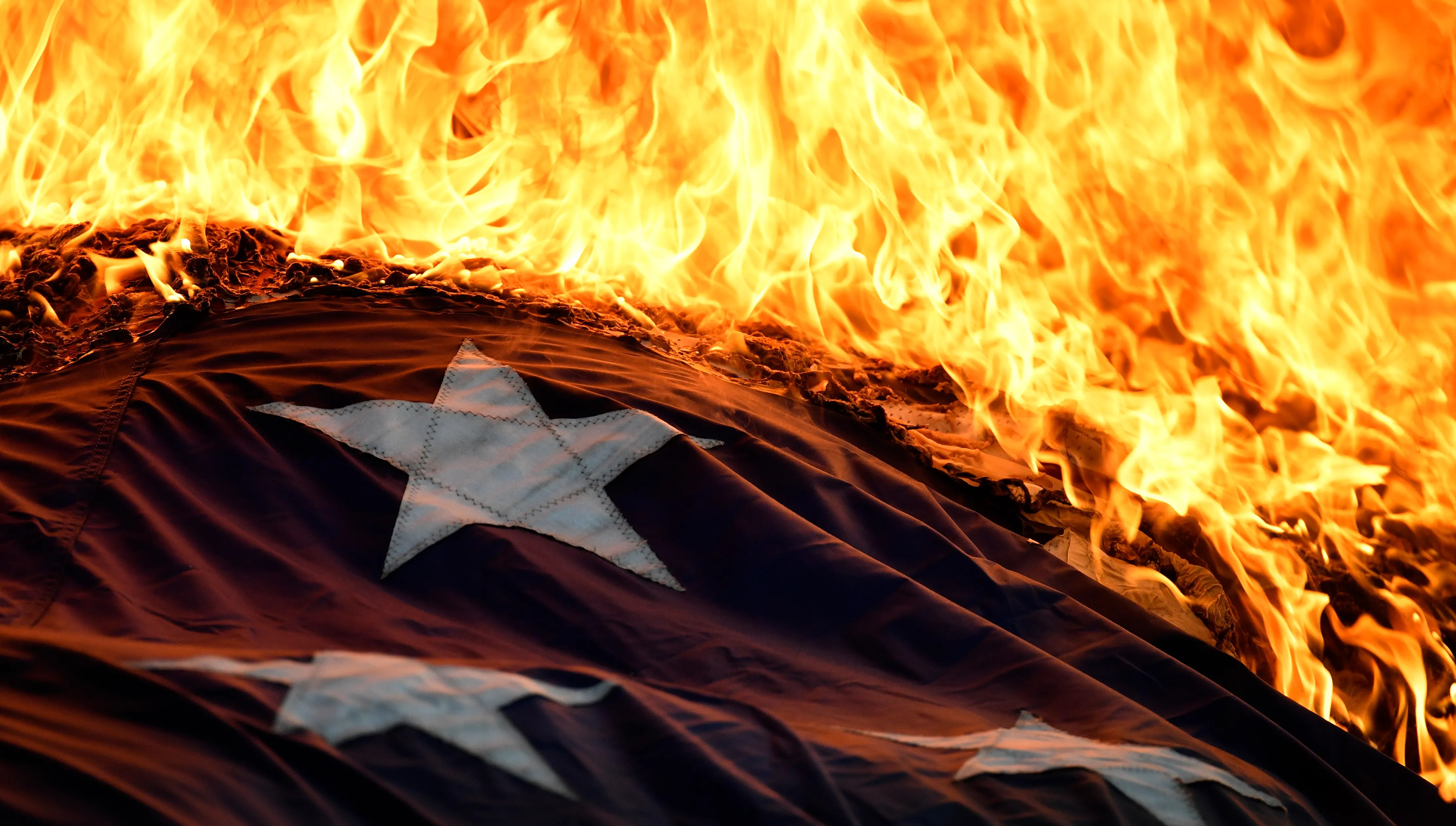
Trump’s recent EO makes flag burning a criminal offense

That said, I have always opposed making flag desecration criminal, seeing it as a free speech matter. I should be able to burn a US flag that I purchased or that somebody gives me. Burning someone else’s flag without permission is wrong, of course, but that falls under theft and property destruction. Moreover, those burning flags should be mindful of the danger that burning anything presents.

This was my position when Hillary Clinton cosponsored legislation criminalizing flag desecration in 2005. She was a New York Senator at the time, and the bill was called the “Flag Protection Act.” It would have made it a crime to desecrate the US flag with the intent to incite violence or disturb the peace. It stopped short of advocating a constitutional amendment (which would be necessary to get around the Court precedent).

Video of Clinton advocating for legislation criminalizing flag burning

Given the freak out over Trump’s EO, I am reminded of how little was made of Clinton’s advocacy for exactly what Trump is being condemned for. Like Trump, Clinton framed the proposal as a way to balance respect for the flag with free speech protections, particularly after the Court’s 1989 Texas v Johnson decision, which held that flag burning is protected under the First Amendment.

Clinton’s bill didn’t pass. It’s highly unlikely that Trump’s EO can pass constitutional muster. Let’s hope it doesn’t.

For the record, I have never had a double standard on this matter. I disagree with Trump now just as I disagreed with Clinton then. I would never burn a flag, but I defend the right of others to do so. Same with the New Testament or the Koran. Or a Pride Progress flag. And so on. Again, as long as it’s your property, it falls under the First Amendment. Nothing is so sacred that it stands above the right of the individual to express an opinion. (I wrote a short essay on this in 2009: The Strange Case of the Upside-Down Flag.)

Decades ago, in an argument with somebody about flag desecration on a listserv, I asked whether eating a flag cake was desecration. No, was the reply. I then asked whether, if I should crap a flag after having eaten one (on chance, highly improbable but not zero, albeit much closer to zero than Trump’s EO overturning precedent), it was okay to flush it. I didn’t get a response. I thought it’d make an interesting title for the essay. So now you know.

* * *

For those who view the US flag as a sacred symbol, there is a flag burning case that is sure to get provoke anger. There was some attention to this case when it happened, but even a concerned civil rights observer like yours truly, this was a case that, at the time, that escaped mine. This is the case of Adolfo Martinez, a 30-year-old resident of Ames, Iowa, who, in June 2019, stole a Pride flag from the United Church of Christ and set it on fire outside a bar.

Martinez told local reporters that he opposed homosexuality and burned the flag to express that opinion. In December 2019, he was sentenced to sixteen years in prison. Fifteen of those years were for an act of arson classified as a hate crime. The hate-crime designation was applied because his actions targeted the LGBTQ community. His sentencing was enhanced—tripled—due to his status as a “habitual offender.” Martinez had two prior felony convictions. Additionally, he got one year for reckless use of fire and 30 days for harassment.

What were the offenses that triggered Iowa’s habitual offender law? They were unrelated to the flag burning. Records show past charges for driving under the influence, possession of marijuana, and driving with a suspended license. These prior offenses were nonviolent (and rather trivial, in my view), but they met the statutory threshold to drastically increase the potential sentence for his arson charge, raising the maximum from five years to fifteen years. That means, even without the enhancement, he was still facing five years for burning a flag.

Supporters of the ruling predictably argued that the act was a dangerous hate crime, targeting a marginalized community and thus warranting a strong legal response. LGBTQ activists emphasized the importance of sending a clear message that hate-motivated crimes would not be tolerated, particularly when such acts risk inciting further violence.

Is burning a flag an act of violence? He received a year for reckless use of fire (which seems excessive). That should have covered any violence prosecutors might ascribe to his actions.

As the foregoing suggests, my view is that the very concept of hate crime legislation raises First Amendment concerns. The Constitution protects even hateful or offensive speech, including symbolic expression such as flag burning. This was established in the aforementioned Texas v Johnson ruling.

The standard rationalization is that hate crime laws do not criminalize the belief or speech itself; instead, they enhance penalties for criminal conduct—such as arson, assault, or vandalism—when motivated by bias against a “protected group.”

In the case of arson and particularly assault, this can and should be considered violence, or at least potentially harmful interpersonal action, as in the case of arson. But there is still the specter of thought crime. I can understand the question of motive in physical violence against persons, but in damage to property? Who decides what hate one can express? What if I burn a Confederate or a Nazi flag? That is motivated by hate. I can’t hate Nazis? To be sure, I cannot freely assault a Nazi, but I can’t express my hatred of his beliefs and practices?

Whatever justification hate crime enhancement we can think of, rationally speaking, such an enhancement is punishing thought or viewpoint, which requires some entity to define what is an unacceptable expression of hate (since an object of hate is in principle limitless), and thus requires the government to endorse a viewpoint while selectively protecting some groups and not others, thereby effectively criminalizing a belief or ideology rather than just action, which is all the law is supposed to reach—if it is to avoid establishing the totalitarian construct of thought crime. The notion that such laws are constitutional because they address the impact of bias-motivated crimes on targeted communities, not the speech alone, strikes me as a rationalization.

Why I raise this case today is because, yesterday, in Lafayette Square, directly across from the White House, a man—who identified himself as a 20-year Army combat veteran—set fire to an US flag in protest of Trump’s EO. You can watch the video here. In the video the veteran denounces the order as unlawful, asserting it violated First Amendment protections. Law enforcement agents, including Secret Service and US Park Police, quickly extinguished the flames and arrested him—not for flag burning per se—but for violating federal regulations banning fires in national parks.

I get the protest. He is expressing a viewpoint. He is not doing this out of hatred of a protected class of people but rather out of his love of the First Amendment. At the same time, there is a problem with lighting fires in public spaces—whatever one is burning. Are there fire pits or grills in this space? That’d be one thing. But on the sidewalk? Accelerant. Fumes. Folks can’t light fires just anywhere.

Should he spend years in prison? No. Not even a year. Is it possible that some will view his actions as hatred of America? Yes. Was his action a hate crime? Who ultimately decides? Who shall we appoint to serve as commissar? I can’t think of a person or a group of persons I’d trust with a job that shouldn’t even exist.

Finally, if you agree with Iowa regarding the burning of a Pride flag, then you have no valid reason to oppose Trump’s EO. The double standard makes you a hypocrite.