
When I was growing up, it was still possible to trust science as a check against falsehood. You could always say, “Let’s see what the science says,” and expect that facts would settle the matter, always understanding of course, that science is open and subject to change in light of evidence. The assumption was simple: science was a neutral and objective system of valid knowledge, relatively immune to the infection of ideology or the corruption of profit.
That confidence was grounded in a reasonable faith—if one may put it that way—in science as a self-correcting enterprise, something close to what sociologist Robert Merton of scientific norms as an internally consistent and self-regulating system.
Merton distinguished between “internal” and “external” views of science to explain different ways of understanding scientific activity. The internal view focuses on the cognitive and methodological aspects of science itself—theories, discoveries, and the logic of scientific inquiry—independent of social context. In contrast, the external view examines science as a social institution influenced by broader cultural, economic, and political factors—it looks at how societal norms and values shape scientific development and priorities. (For more on this, see Refining the Art and Science of Propaganda in the face of Popular Doubt and Questioning.)
Merton argues that a complete sociology of science integrates both perspectives, recognizing that scientific knowledge is both a logical, systematic pursuit of truth and a social product. I agree—indeed, it is in recognizing science as a social product that we can critique its corruption by power and profit. This contrasts with the postmodernist move of reducing knowledge to power. It is not that power plays no role in knowledge production (as Karl Marx told us in The German Ideology), but the claim that all knowledge reduces to power precludes the possibility of objective knowledge. It obscures the reality that power can corrupt knowledge, defined here as verified belief. Among other work it does, postmodernism is an obscurantist project.

Over time, confidence in science has eroded. The reason for this loss of trust is the recognition that science has been captured—not only by ideology, but by the machinery of corporate power and political fashion. Public skepticism is therefore warranted. The complaint that there are irrational forces in society delegitimizing science is corporate state propaganda designed to obscure the true source of delegitimization: the corruption of science in the age of corporate statism. When we are told today to “follow the science,” we are not being invited to consult a neutral body of knowledge, but an institution that speaks with the voice of a new priesthood.
The dogma of the new priesthood is scientism: an ideology that borrows the authority of science to sanctify its own prejudices and projects. When science contradicts known truths, members of the public come to doubt the claims scientists make. To clarify, I do not use scientism in this essay as an ideology that asserts science is the only valid source of knowledge; I do not dismiss other ways of knowing—the arts, philosophy, religion. I mean, in the present context, an ideology that elites represent as science.
The growing doubt expressed by the public is rational. Scientism is not science. It is a political theology wrapped in lab coats, claiming neutrality while advancing the orthodoxy of ideological and self-serving doctrine. Scientism inverts truth and falsehood: what was once a method for uncovering reality has become a mechanism for enforcing dogma. (See The Corporate Character of Scientism and embedded links.)
Take the phrase “sex assigned at birth.” Where did it come from, and what does it really mean? Before most people ever heard of gender identity theory, this phrase was already circulating in media, medicine, and education. It sounds harmless—even scientific—but it carries an entire ideology in its pocket. If you use it uncritically, you’re already accepting the doctrine it smuggles in.
The phrase as we use it today—particularly in gender studies, law, and activist contexts—is a late twentieth/early twenty-first century construct, building on earlier clinical uses. (For discussions on the propagandistic distinction between gender and sex, see Sex = Gender Redux: Eschewing the Queer Linguistic Bubble; Anti-Minotaur: Reclaiming The Truth of Gender From the Labyrinth of Lies;
According to a Columbia Law Review article by Jessica Clarke, “Sex Assigned at Birth,” the phrase has gained prominence in US legal and policy discussions concerning the rights of transgender individuals. Originally used by medical professionals to describe the designation of a newborn as male or female based on physical characteristics observed at birth, the term has evolved into a critical concept for understanding gender identity and discrimination.
The article notes that the phrase had been used, at least since the 1960s, to describe an obstetrician’s description of gender “based upon inspection of the external genitalia.” We see the phase used as early as 1960, in Edgar Burns et al’s “Reassignment of Sex,” in the Journal of Urology. Here, we see the theory of gender identity is being smuggled in using the language of “reassignment,” which presumes sex is assigned in the first place, before Robert Stoller coined the term “gender identity.” (See my May 2024 essay Gender and the English Language.)
Clarke writes that this classification, recorded on birth certificates, is treated as a person’s legal sex. Over time, she records, advocates and scholars have embraced “sex assigned at birth” as a more accurate and less stigmatizing alternative to “biological sex,” emphasizing that it reflects an external categorization rather than an intrinsic identity. The term now plays a central role in legal definitions of transgender status and appears in both federal regulations and proposed legislation aimed at protecting LGBTQ individuals from discrimination in areas such as employment, health care, and housing.
Clarke argues that the rise of the term “biological sex” serves to give an appearance of scientific legitimacy to efforts aimed at discrediting transgender identities, and that its continued, uncritical use reinforces systems of exclusion. In contrast, the use of “sex assigned at birth” by transgender rights advocates highlights that sex is neither fixed nor strictly binary, and that gender identity itself is shaped by biological as well as social factors. (The real problem with the construct of “biological sex” is a redundancy that presumes there is some other kind of sex, and thus has those who insist on sex as intrinsic identity unwittingly doing the work of the gender identity movement.)
Of course, sex, or gender (same thing), is fixed and binary in mammals. Gender identity is an invention of crackpot psychiatry and sexology. In reality, sex is observed, not assigned. Doctors do not “assign” a baby’s sex any more than they assign its number of toes. They record what is there. They may be wrong, but that’s a matter of precision. To speak of “assignment” is to imply that sex is a bureaucratic label or social construct rather than a biological reality—that nature itself is subordinate to human decree, which is an act of oppressive power. This misrepresentation of reality is used to allow a man to change his sex on his birth certificate. The phrase and its institution in law, policy, and science turn an act of recognition into an act of creation. Gender thus becomes a product of psychosocial expectations, not of objective recording.
One might argue that the shift from describing “biological sex” as fixed toward a framing of “sex assigned at birth” helps foreground the complexity of sex (intersex variation, chromosomal diversity, etc.). But that is not how the phrase is used. It is used instead to advance gender identity doctrine. So-called intersex conditions and transgender identity are entirely different concepts, one rooted in errors in gene expression, the other in neoreligious dogma.
The same linguistic sleight of hand appears in the phrase “gender-affirming care.” It sounds kind, even compassionate, but in many cases it means the opposite: the chemical and surgical denial of the body’s sexed reality. To give hormones or surgery to help a boy live as a boy would be truly affirming. To remake his body to match a psychological fiction is to deny his gender in the name of affirming it. (See Gender Denying Care: A Medical and Moral Crisis.)
The inversion continues with the language of misgendering. If I call a man “ma’am” by mistake, I have misgendered him. But if I call a man “ma’am” because he identifies as a woman, I am told I have “correctly” gendered him. I am a good ally. Failure to be a good ally is met with an inversion of reality: I have “misgendered” the man. The demand is not for recognition of reality but for public participation in its denial. I am being conscripted into a social movement. Words become the instruments of forced assent.
As noted, the phrase “sex assigned at birth” now appears everywhere—from hospital paperwork to television scripts—rarely questioned and almost never defined, except to further sink the public mind into the doctrine of gender identity. Its power lies in its hegemonic acceptance. It enters our speech without fanfare and reshapes how we think without our noticing. Most people who use it are not trying to make a political statement; they are simply repeating what sounds like the respectable vocabulary of science. That is the genius of loaded language: it does its work below the level of consciousness. (See yesterday’s essay When Thinking Becomes Unthinkable: Motivated Reasoning and the Memory Hole.)
Loaded terms smuggle moral judgments into what appear to be neutral descriptions. We see this everywhere: “reproductive health” instead of “abortion,” “resistance” instead of “terrorism.” “Sex assigned at birth” functions in the same way. It contains a presupposition disguised as a fact—that sex is something humans decide rather than something nature declares. Once that premise is accepted, the entire argument of gender ideology follows automatically.
Language does not merely describe the world; it shapes it. When we adopt phrases like “sex assigned at birth” or “gender-affirming care” in referring to cross-sex hormones or mutilating surgeries, we are not just speaking—we are conceding. The argument about whether sex is biological or social has already been settled, quietly, by the wording of the sentence itself. This is how framing works. The phrase “sex assigned at birth” moves the discussion from the realm of observation to the realm of ideology. Once that frame is set, anyone who questions it appears irrational, bigoted, or even cruel. “Be kind,” those who still recognize reality are chastised. What’s being defended is no longer truth, but a way of seeing—a linguistic cage that defines the limits of permissible thought.
It’s the same mechanism George Orwell saw in the political language of his time. We still see it today in the euphemisms of modern warfare. “Collateral damage” means dead civilians. “Kinetic military action” means war. “Dead checking” means shooting the wounded to make sure they’re corpses. Such phrases don’t merely soften brutality; they erase it. They make murder sound like maintenance. When the language is murdered, conscience is murdered with it. (I wrote about this nearly twenty years ago in a May 2007 essay Sanitizing an Authoritarian Situation.) So it is with the new bureaucratic idioms of identity. “Sex assigned at birth” sounds sterile and scientific, but it performs the same moral anesthetic as “collateral damage.” It renders the natural artificial, the given negotiable, and the real optional.
The point is not just that bad language hides bad ideas. It’s that corrupted language is the symptom of a corrupted power. When rulers or institutions manipulate words, they are not trying to win an argument—they are trying to suppress debate and dissent. To change the meaning of words is to change the possibilities of thought. If you can dictate the vocabulary, you can dictate the imagination.
The battle over phrases like “sex assigned at birth” is thus not merely a quarrel about grammar; it is a struggle over who owns reality. As Orwell wrote in “Politics and the English Language,” political language is designed “to make lies sound truthful and murder respectable.” Today, the same impulse drives the redefinition of words that once had stable meanings. Power now seeks not only to control speech but to police thought. To resist this, one must recover the courage to name things as they are—to call truth by its rightful name, even when doing so is impolite. Even when doing so is unkind. Words matter because reality depends on them.
Philosopher Paul Diesing distinguishes between “technocratic” and “democratic” science as two contrasting models of how science relates to society and decision-making. Technocratic science is controlled by experts, government agencies, or corporations, emphasizing the use of specialized knowledge to solve problems from the top down from the standpoint of elite interests. Technocratic science limits public participation and treats scientific expertise as neutral and authoritative. In contrast, democratic science seeks to make scientific research more participatory and responsive to the needs and values of the wider community. It encourages transparency, public input, and collaboration between scientists and citizens. Diesing argued that democratic science promotes social responsibility and ethical reflection, while technocratic science risks serving only elite or institutional interests. We are in an era of technocratic science.
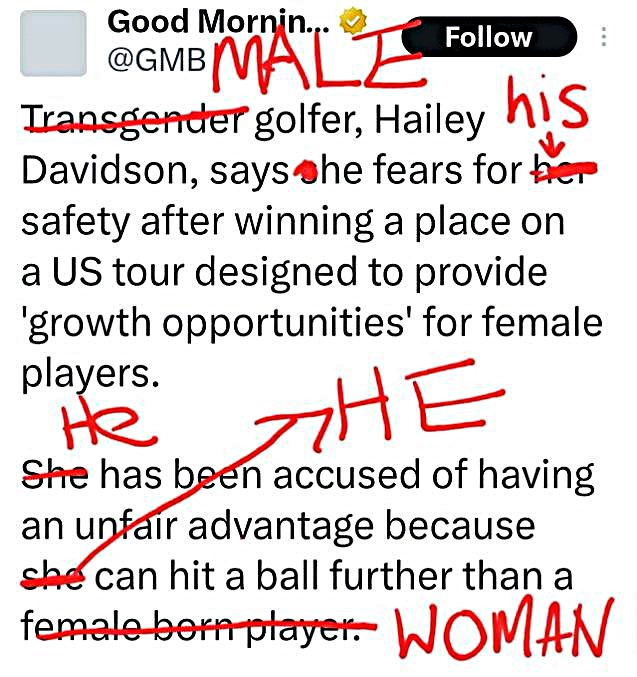
I rework every text in my head like the above meme. It’s obvious that we’re being subjected to a project of mass mind control. In this piece of the project, we’re being trained to habitually misgender others on command. As Orwell warned us, brainwashing occurs via language manipulation. How does one escape language manipulation? Since this form of manipulation depends on everybody not knowing that everybody else doesn’t believe men can be women, the goal of the free thinker is the state the truth whenever the falsehood appears in whatever form it takes. See my essays The Emperor is Naked: The Problems of Mutual Knowledge and Free Feelings and Wokism and the Naked Truth. Also see this interview clip with Steven Pinker.

 freedom and reason