
In The Disenlightenment: Politics, Horror, and Entertainment, playwright David Mamet—who appeared on Steve Bannon’s War Room yesterday—argues that liberalism, once a worldview he embraced, has been co-opted by elites who manipulate culture, language, and media to consolidate power and erode traditional values.
Mamet contends that “disenlightenment” fosters a society driven by conformity and sentimentality rather than reason, transforming governance into an oppressive tool—akin to Circe turning men into swine.
I ordered Mamet’s book (which was just released) and look forward to reading it. Mamet summarized his critique on the program: the left’s emphasis on social consciousness has become a hollow performance that undermines individual freedom and meritocracy.
In contrast, Mamet champions a constitutional conservatism rooted in logic and personal responsibility. His shift, he explained, reflects a growing disillusionment with what he sees as the Democratic Party’s abandonment of its core principles—especially during the Biden years, when unelected bureaucrats wielded unchecked power.
I discussed some of these ideas in yesterday essay on Freedom and Reason: In the Shadow of Serfdom: Revisiting Liberalism in the Age of Progressivism. However, one point from the interview that I did not address, which I want to touch on here, involves the Jewish tradition of justice and the danger of mercy when it is allowed to displace justice.

Several years ago, a colleague gave me a copy of The TANAKH: The Holy Scriptures, the new JPS translation according to the traditional Hebrew text. It’s a wonderful translation. Mamet’s remarks prompted me to return to it, especially given the present context in which progressives increasingly defend the practice of “defining deviance down” in the name of compassion, humanitarianism, and mercy.
In Jewish tradition, the pursuit of justice (tzedek) is a foundational moral imperative. It is emphasized throughout the Torah and prophetic literature. The oft-cited verse from Deuteronomy—Tzedek, tzedek tirdof (“Justice, justice you shall pursue”)—underscores justice not merely as a legal standard, but as a sacred duty.
Yet the tradition doesn’t stop at justice alone. Mercy (rachamim) is also a divine attribute to be emulated. Jewish thought maintains that while justice ensures accountability and fairness, mercy tempers strict judgment with compassion—making space for redemption and rehabilitation.
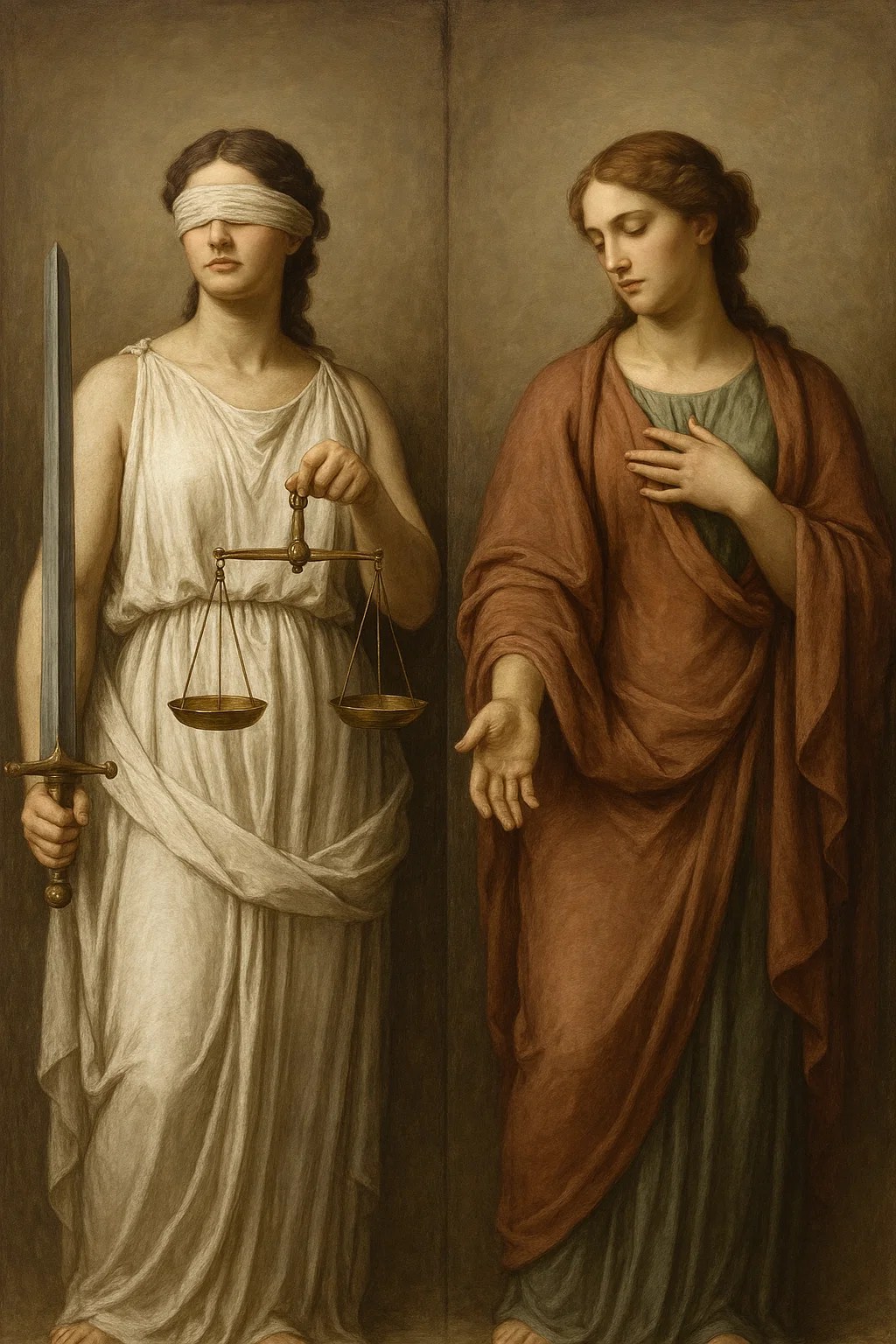
This balance is key. Mercy must not replace justice. When mercy becomes unmoored from justice, it risks devolving into sentimentality and favoritism. The result is moral confusion, what I’ve called misplaced humanitarianism (see On the Problem of Misplaced Humanitarianism).
Indeed, the Talmud warns against excessive leniency that leads to injustice: “He who is kind to the cruel ends up being cruel to the kind.” Mamet reminded me of this scripture. When mercy is extended to wrongdoers at the expense of their victims, justice is not merely undermined—it is perverted. The consequence is not peace, but the empowerment of wrongdoing and the betrayal of the innocent.
Mercy without justice also corrodes social trust. A society that tolerates corruption, violence, or exploitation under the guise of compassion ceases to be one where the rights of citizens are protected.
Even God in Jewish theology is portrayed as balancing judgment (din) with mercy, illustrating that neither attribute is sufficient alone. True mercy must operate within the framework of justice—not apart from it. Detached from justice, mercy ceases to be virtue and becomes abdication.
Jewish tradition honors mercy only when it reinforces justice. True compassion does not ignore wrongdoing; it confronts it with both humanity and accountability. Justice ensures moral order; mercy ensures it remains humane. The danger lies in confusing one for the other.
This confusion is not abstract. It has concrete political consequences. In today’s progressive movement, mercy—lacking the foundation of justice—is often selectively applied: granted to those deemed marginalized or ideologically aligned, but withheld (or inverted into retribution) against those labeled oppressive or privileged. In a word: conservative, heterosexual, white.
This is not mercy within justice—it’s factionalism masquerading as compassion. By excusing criminality, erasing standards, refusing to uphold laws equally, and selectively prosecuting ideological opponents, progressives weaponize justice. Their so-called mercy becomes a mask for moral bias—a counterfeit justice rooted not in universal principle, but political allegiance. In doing so, they betray both justice and mercy.
There’s a reason they call it “social justice.” It is not about individuals judged by a universal standard, but about group identities arranged in an ideological hierarchy. In this worldview, some groups are inherently good, others inherently bad—determined not by actions, but by their place in the hierarchy.
So, it depends on who is rioting. If conservatives riot, it’s a “threat to democracy”—and indefinite detention, denial of bail, and harsh sentencing are rebranded as justice. No mercy for them. But when those deemed marginalized riot, we are told: “This is what democracy looks like.” Police, under progressive leadership, often stand down as property is destroyed and people assaulted.
Recall the summer of 2020. Now imagine the rioters were conservative. Hard to do, perhaps—conservatives don’t typically riot over election results or racially charged incidents involving white victims. But try. What would the progressive reaction have been? You don’t have to guess.
Why, when a group of black individuals assaults a white person—a common enough occurrence—is there silence from Democrats? When conservatives point it out, they’re accused of racial provocation. But if white individuals (a rare occurrence) assault a black person, it becomes national news, framed as “systemic racism.” And if riots follow, progressives hail them as a “just” and “mostly peaceful” uprising.
So, it’s not compassion, humanitarianism, or mercy that drives progressives to define deviance down. It’s rhetoric. False rhetoric. It’s ideologically applied “justice” in the service of corporate and political interests. There is elite utility in chaos and double standards.
This is the peril of mercy untethered from justice: it invites tyranny under the guise of virtue. Hence the term “virtue signaling.” It is not real virtue. It is a distortion of justice—and Jewish tradition warns precisely against such distortion.
Perhaps this is part of the reason progressives often show hostility toward Jews: the Jewish moral tradition stands in the way of their ideological program. This antipathy is evident in the Red-Green alliance that many progressives defend—and in which some actively participate.
True justice, pursued sincerely and consistently, does not ask who the accused is—it asks what the act was. Justice is blind not because it lacks compassion, but because it rejects favoritism. When justice becomes retribution dressed in political garb, it ceases to be justice at all.
I wrote about this problem in a recent essay: Deviance as Doctrine: The Post-Liberal Moral Revolution. Listening to Mamet, I found another compelling way of putting the matter.

 freedom and reason