
The Hodgetwins have been posting solid memes recently. Here’s one about the left’s penchant for elevating criminals and illegal aliens to the status of saints. We saw this with the recent attempt to recollect the energy from the Summer of Love. The attempt was a failure, but the spirit is persists, and they eagerly await the next black swan moment.
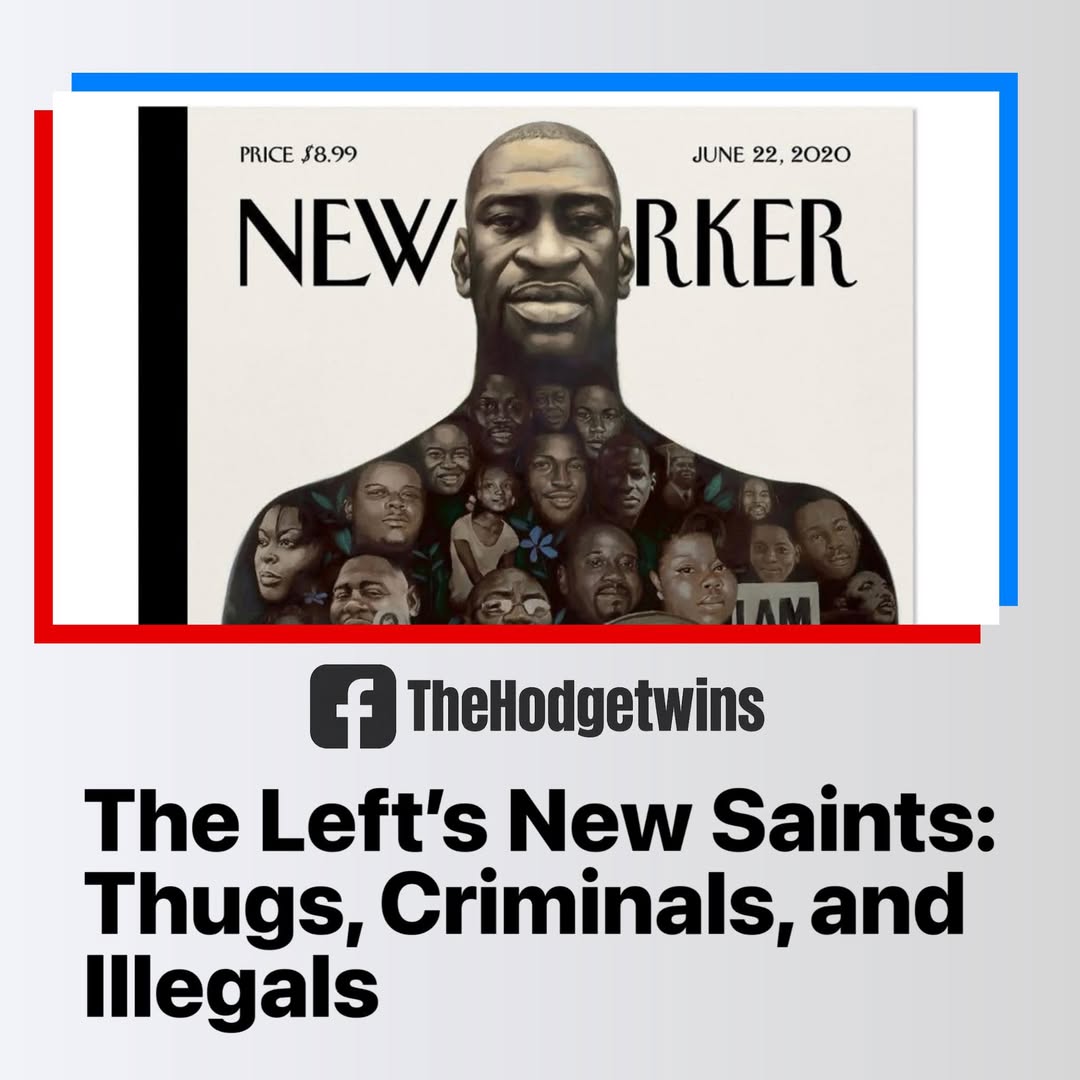
It’s true. Today’s left—progressives, the Democratic Party, the legacy media—makes heroes of criminals and illegal aliens and sexual deviants. At first glance, this seems irrational, even cultish. It feels like madness. And indeed, some of it is. The true believers are ridiculous people. But beneath the surface lies a deeper logic. Defining deviance down—and more than that, valorizing it—serves several ideological and strategic functions.
To those who prioritize personal responsibility and the rule of law—normal people—this behavior appears absurd. But for many on the left, elevating individuals deemed marginalized by legal or political systems is a form of resistance. By valorizing criminals and illegal aliens, progressives believe they are critiquing institutions they portray as unjust. When illegal immigrants are portrayed sympathetically, for instance, progressives believe they’re exposing a dehumanizing, racist immigration regime—thereby casting immigration enforcement advocates as racists themselves.
This perspective is rooted in a broader moral framework that privileges structural explanations—abstract, academic theories—over the concrete realities of individual behavior and common sense. Progressives often interpret criminality and illegal status not as moral or legal failures, but as products of imperialism, racism, poverty, and systemic injustice. Where a rational moral worldview excuses wrongdoing only in extreme circumstances (e.g., duress or self-defense), the progressive framework casts poverty and oppression as redeeming forces. Wrongdoers become victims—and in the moral schema of the left, victims are saints. Criminals and illegal immigrants who are caught and punished become martyrs in the woke religion.
Within this worldview, lawbreakers are reframed exclusively as victims of circumstance, then elevated as moral symbols. Punishment becomes inherently unjust, and those who enforce it are branded as cruel, authoritarian, or lacking compassion. This produces a moral inversion, where transgression is reinterpreted as virtue—because it exposes systemic injustice and challenges the legitimacy of the system itself.
In this moral universe, victimhood becomes the highest form of moral authority. Those who ally with the victims are the high priests of the highest form of moral authority. Those oppressed by institutional or state—especially if they are poor, non-white, or gender-nonconforming—are believed to possess a deeper insight into truth and justice. Their suffering doesn’t just excuse their transgressions—it ennobles them. Breaking the law, crossing borders illegally, overstaying visas—these become acts of civil disobedience. Borders and laws, in this view, are not neutral frameworks but tools of oppression.
This ethos defines much of the Democratic Party coalition and the media ecosystem that sustains it. The left builds a broad political tent that includes immigrants, urban populations, and select minority groups—communities more likely to encounter criminal justice or immigration enforcement. But rather than acknowledge patterns of behavior that make individuals more likely to subject to rule enforcement, progressives argue that the rules themselves are oppressive, designed to criminalize the marginalized.
Defending and humanizing these populations serves political ends beyond moral posturing. It energizes activism, drives fundraising, and mobilizes voters. Media portrayals of sympathetic lawbreakers attract others who feel excluded or resentful—especially those who see in these stories a validation of their own failures or grievances. Each narrative becomes a weaponized anecdote, turning tragedy into ideological ammunition.
The glorification of deviance, then, becomes a strategy of political rebellion—a way of redefining justice itself. Progressives believe that the justice system isn’t truly about fairness but about maintaining control—by their enemies: conservatives, nationalists, populists, republicans, traditionalists. They see such the system as punishing the poor, policing black and brown bodies, and protecting entrenched privilege—especially white privilege. “Law and order” becomes a dog whistle, not a principle. You have heard them say this.
If the current justice system protects a historically unjust status quo, then “real” justice must be radically reimagined. In place of punishment, there must be repair (i.e., redistribution of property and wealth); instead of guilt, context and circumstance; instead of retribution, liberation! This rhetoric dominates academia and activist circles, where transgression is viewed as revelation, and the deviant cast as prophet.
This redefinition of justice reflects a deeper philosophical shift: locating moral truth not in authority derived from the popular will, law, or tradition, but in the “lived experience” of the marginalized. Those who were historically criminalized—felons, illegal immigrants, trans sex workers—are elevated not despite their deviance, but because of it. Their nonconformity becomes a sign of moral clarity. They are fetishized as saints in a secular, postmodern religion.

We saw this dynamic in the canonization of George Floyd, and again in the sympathetic portrayal of violent offenders and gang members—some even linked to groups like MS-13. These individuals are held up as symbols, challenging traditional categories of good and evil, legal and illegal, just and unjust. This is not simply a shift in tone—it is a deliberate reorientation of the moral compass, a cultural inversion where north becomes south, right becomes wrong, and deviance becomes virtue.
The purpose of redefining justice in this way is revolutionary: to deconstruct systems perceived as built on domination and to replace them with their moral antithesis. The glorification of deviance is not an accident or a misstep—it is a blueprint for a new moral order. An order that is not moral at all.
And there’s a strategic logic, too. By turning lawbreakers into martyrs, progressives generate emotionally compelling narratives that mobilize support and delegitimize the existing system. Each viral case becomes a parable—a story of injustice meant to indict the broader society. These are not individual tragedies—they are political arguments.
But this is not the revolution of the Old Left. This is a revolution from above. What appears as bottom-up idealism is top-down destabilization—enabled and encouraged by elite institutions. When traditional norms (family, gender, law, merit, nation, religion) are dismantled, society becomes disoriented and fragmented—and thus more governable by centralized bureaucratic and technocratic authority. In this view, disorder is not a bug—it’s a feature. Progressives want disorder. They want chaos.
Under the guise of liberation, powerful interests weaken the institutions that once mediated between the individual and the state—churches, families, communities. The result is an atomized, rootless individual dependent on state systems, corporate infrastructure, and managerial oversight.
The new governing class—corporate HR departments, media conglomerates, elite bureaucrats, NGO technocrats—marries progressive values with technocratic methods. The new moral language diversity, equity, and inclusion legitimizes their tools: dependency, surveillance, speech control, algorithmic governance, regulation. This system does not require liberty or self-government. In fact, it prefers citizens who are detached from stable identities—familial, religious, national, or otherwise—because such individuals are easier to mold, monitor, and manage.
Corporations don’t champion progressive causes because they are “woke” in the way the true believer is woke. They do so because it serves their interests. Labor flexibility benefits from the breakdown of family and gender norms. A population untethered from tradition is more mobile, more dependent, more exploitable. Market expansion thrives on commodified identities—every new invented gender or oppressed subculture becomes a niche consumer audience. Reputational management is easier when progressive causes obscure monopolistic practices, labor exploitation, and global entanglements.
What we’re seeing—around crime, immigration, and especially the reengineering of sex and gender norms—is part of a larger cultural project: the systematic dismantling of civilizational boundaries. Norms are what hold civilizations together. When they are disrupted, people lose their bearings. They become more susceptible to top-down redefinition of truth, morality, and reality.
In this environment, defining deviance down—or reversing it into virtue—is a way to erase inherited proven moral frameworks and replace them with new norms, not set by rational law oe tradition, but by elite decree. These decrees don’t come from voters, but from a professional class embedded in academia, bureaucracy, and transnational institutions.
This is the trajectory of post-liberal governance. Here, classical ideals like free speech, individual liberty, and rule of law are subordinated to amorphous goals like “equity,” “inclusion,” and “safety”—defined and enforced by unelected experts. And in nearly every case, these terms are turned against their original meanings. “Inclusion” becomes the justification for men entering women’s spaces. “Equity” becomes the rationale for discriminatory practices. “Safety” becomes the excuse for censorship and control.
The administrative-managerial state doesn’t rule through force. It rules through dependence, credentialism, and the illusion of moral progress. Under this regime, transgression isn’t a moral lapse—it’s a tool of transformation. Deviance is instrumentalized to centralize control and dismantle the nation-state model, particularly in the West. Indeed, the West is the chief target of deconstruction.
In this light, the glorification of deviance is not a contradiction. It is the strategy. By sowing disorder, delegitimizing traditional norms, and destabilizing civilizational institutions, progressive ideology—backed by corporate power and technocratic ambition—clears the way for a new order. One built not on law, liberty, or responsibility, but on bureaucratic control, identity politics, and permanent social flux.
What appears as moral activism is, in fact, the cultural front of a deeper systemic power shift—one aimed not at reforming society, but reprogramming it entirely.

 freedom and reason