Ask yourself, do you see a lot of American-made cars in Europe? Not really. Why? Tariffs. Do you see a lot of European trucks in the United States. Not really? Again, tariffs. The European Union (EU) imposes tariffs on passenger vehicles imported from the United States to protect European industries. Does the United States put tariffs on EU passenger vehicles? Yes, but these tariffs are much lower than those imposed by the European Union. The EU tariff on passenger vehicles from the US is on average four times greater than the tariffs the United States imposes on EU passenger vehicles. That’s a lot of US cars not sold in Europe because the EU has made them cost prohibitive for a lot of European workers. There is a high tariff on light trucks (including pickup trucks and vans) imported into the US. The effect of these tariffs has been to protect those industries in America—and in protecting those industries, protecting manufacturing jobs for Americans.
What would be an effective way of compelling the EU to lower tariffs on US passenger vehicles? I think you can figure that out. The more fundamental question is whether you want your government to protect domestic automotive and other manufacturing and good paying jobs for Americans. Should Americans have good paying jobs? The corporate state doesn’t think so. Here’s why:
The progressive political class, which comprises the heart of the Democratic Party, serves those transnational corporate interests that seek lower wages in the United States because they benefit economically while spreading the myth than lower wages will correct the long-term fall in profits. To be sure, absolute and relative lower wages generate greater surplus value, but this occurs at the expense of aggregate purchasing power and hence undermines the system capacity to realize surplus value as profit in the market. This is the cause of periodic business recessions and overall lower standards of living, so it is no small matter.
Historically, tariffs had been a cornerstone of US economic policy, particularly for Republicans who saw them as a means to protect domestic industries. However, by the time Franklin Roosevelt assumed the presidency in 1933, the transnationalists—the same crowd that encouraged mass immigration—had convinced the masses that the Great Depression proved the harmful effects of high tariffs, particularly the Smoot-Hawley Tariff of 1930, which had exacerbated global economic decline by reducing international trade. (You will note that the tariff of 1930 occurred after the Stock Market crash of 1929 that triggered the depression.)
Roosevelt’s approach to tariffs marked a significant departure from the protectionist policies of his predecessors. Under the Reciprocal Trade Agreements Act (RTAA) of 1934, the administration gained the authority to negotiate bilateral trade agreements without requiring full congressional approval for each deal (not in itself a bad tool). The act shifted US trade policy from unilateral tariff-setting to a more multilateral, reciprocal framework. The RTAA allowed Roosevelt to reduce tariffs in exchange for similar concessions from other countries, fostering a climate of free trade hoping to revive global commerce during the depression.
Roosevelt’s tariff policies aligned with his broader New Deal goals of economic recovery and international cooperation (i.e., transnationalization). By reducing trade barriers, his administration aimed to open foreign markets to American goods, alleviate domestic overproduction, and strengthen ties with key trading partners. All this laid the groundwork for the post-World War II global economic system, eventually culminating in the establishment of institutions like the General Agreement on Tariffs and Trade (GATT) and the World Trade Organization (WTO).
In Volume III of Capital, Karl Marx suggested that technological innovation can lead to a falling rate of profit by increasing the organic composition of capital (the ratio of constant capital to labor). However, the same effect can also be obtained by offshoring production and the importation of cheap foreign labor.
Everything the corporate class does—automation and mechanization, efficiency regimes, offshoring, mass immigration—undermines the capacity of the system to maintain a stable or growing rate of profit because it undermines effective organic demand by generating and exacerbating the redundancy of human labor. To be sure, the consumer can always spend beyond his means, but that amasses personal debt that enriches financial institutions, leading to greater concentration of wealth and providing more money capital for investments that advance the process of labor redundancy and wage suppression. Citizens who don’t have jobs, if a society is compassionate, drive up public debt as government becomes the provider for those who should (and could) be working. In this way, the costs of globalization are externalized, expecting the government to complete the cycle of capitalist production.
By reducing tariffs and encouraging international trade, Roosevelt aimed to alleviate overproduction in US industries by opening foreign markets to American goods. This may have temporarily bolstered profits in export-oriented industries that benefited from expanded markets. However, increased competition from imports compressed profit margins in industries facing foreign manufacturing. The reduction in tariffs and the resulting global economic integration led to intensified competition, which put downward pressure on prices and, by extension, profit rates. It also put downward pressure on wages. As international trade grew, US firms faced new competitive pressures that spurred capitalists to invest in labor-saving technologies.
A key factor contributing to the falling rate of profit is overproduction, where the market cannot absorb all goods at profitable prices. While freer trade may provide temporary relief by opening foreign markets, it at the same time integrates US capital more deeply into global cycles of production and crisis. The reduction in trade barriers exacerbated competitive pressures globally, contributing to an environment where profit rates continued to stagnate or decline.
Moreover, Roosevelt’s policies, including those reducing tariffs, were part of a broader New Deal agenda that included labor protections, wage increases, and social welfare programs. While these reforms improved domestic demand and stabilized the economy, they also increased labor costs for capitalists. This inorganic redistribution of surplus value from capital to labor also contributed to a compression in the rate of profit, especially in industries reliant on domestic market.
Tariffs did not cause the Great Depression. The perception that they did legitimized the transnationalist strategy of integrating the US work force into the global capitalist economy to the detriment of the American worker. We were tricked. We have pursued globalist economic strategies for long enough to know that it hurts American workers. Transnational corporations don’t care about American workers—and neither do the political elites that serve their interests. We need an economic nationalism focused on putting American workers first. We do that by raising tariffs on imports and forcing other economies to open their markets to our products.
It should have been obvious that a car and its parts manufactured in other countries creates few if any high-paying manufacturing jobs in America. Only cars and parts manufactured in the United States will accomplish that in any significant way. Tariffs will force other economies to allow our passenger vehicles to be competitive in other economies, and this will create more manufacturing jobs in America. So when Democrats tell you tariffs are bad, ask them who they are bad for. Obviously tariffs are good for European workers (who are still voting for the cultural elitism Americans rejected at the ballot box on November 5). If tariffs are good for European workers, why wouldn’t they be good for Americans workers, too? The answer to this question is obvious. And that’s precisely why the globalists don’t want tariffs.
The Daily Beast spins the practice of cerebral hygiene by blaming “MAGA trolls” for the exodus of progressives from X to Bluesky. Bluesky is a social media platform designed to be an alternative to centralized platforms like Twitter, initially aiming to create a more open internet. It was initiated by Jack Dorsey, co-founder and former CEO of Twitter, to explore new models for social media that prioritize openness and user agency. The project gained traction in response to criticisms of centralized platforms regarding censorship, algorithmic control, and data privacy. However, what attracts progressives to Bluesky is the opposite of openness; they like its restrictive character and its focus on policing “rightwing” speech.
(As an aside, Threads is a text-based social media platform created by Meta, the parent company of Facebook, Instagram, and WhatsApp. It’s integrated with Instagram and serves as a competitor to X. Threads allows users to share text updates, images, and videos, and it promotes public conversations using an interface familiar to Instagram users. This essay isn’t about Threads, but I thought if you didn’t know what it was, I would tell you. The Daily Beast needed to make Bluesky appear as if it is soaring; Threads is an easy target.)
Cerebral hygiene is a concept associated with the French sociologist Auguste Comte. It refers to the practice of maintaining intellectual purity by deliberately avoiding the influence of other thinkers’ ideas when developing one’s own theories or analyses. I hijacked the term years ago to describe the ideologue who deliberately avoids watching or reading the opinions of those with whom he thinks he will disagree, fearful that he might learn something and then change his mind on account of it. The problem isn’t the one thing he might learn, but the possibility that this one thing may cause his entire worldview to unravel.
This is a problem in today’s political scene: ideologues avoid engaging with opposing viewpoints out of fear not only of contamination, but of destabilization. Cerebral hygiene is a defensive posture: insulating one’s worldview against challenges that could force a re-evaluation of deeply held beliefs. It’s not about preserving intellectual autonomy (which is a silly idea anyway) but maintaining the coherence of an identity tied to those beliefs. The fear isn’t necessarily learning something new; it’s the domino effect that a single contradiction might trigger, potentially unraveling a carefully constructed ideological framework.
My reframing means to leverage psychological and sociological issues, such as cognitive dissonance and confirmation bias. By avoiding dissenting perspectives, individuals protect themselves from the discomfort of confronting evidence that challenges their worldview, which would in turn imperil their identity. Of course, this insulation comes at the cost of genuine understanding, intellectual growth, and meaningful dialogue, all of which are necessary for functional democratic systems, means with which populations might build consensus over the important issues facing the nation. What begins as a strategy for intellectual “purity” can devolve into a form of intellectual stagnation, driven more by fear than by a commitment to truth.
I must clarify something; I do not wish the reader to think that I am accusing liberals of such a practice. The Daily Beast is not really talking about liberals; those leaving X are progressives. Liberalism and progressivism are opposites. (Online progressive rags like The Daily Beast like to confuse their readers and retard political IQs by making opposites synonyms and synonyms opposites.) Liberals believe in free speech and open information systems and the production of knowledge that aligns with reality. Progressives believe in none of those things. There’s too much truth on X, so progressives search for platforms that support their narrow worldview and desire for illusion. They found one in Bluesky.
One of the reasons Republicans won overwhelmingly on November 5 was the proletariat and the entrepreneur waking up to the realization that progressivism is an authoritarian corporatist tendency that stifles independent thought and smothers individual autonomy. Rather than run down rightwing rabbit holes, they listened to what progressives were saying and developed a compelling counterargument to their various and delusional opinions. They listened and heard the so-called left speaking in the language of collectivism and identitarianism and said “fuck that.” X users fleeing to Bluesky are only going to make harder for progressives to recapture lost ground. If they don’t confront the enemy, they will lose even more ground. After all, cerebral hygiene was why they lost so much ground in the first place—that and their ideas are shit.
Tulsi Gabbard, the former Democratic congresswoman and 2020 presidential candidate, has been nominated by President-elect Donald Trump to serve as Director of National Intelligence (DNI). The Establishment has raised concerns over her foreign policy positions, which have included criticism of US involvement in Ukraine, and her alleged alignment with Syria’s Bashar al-Assad and Russia’s Vladimir Putin. From the standpoint of the corporate state, Tulsi’s strident opposition to Islamic terrorism notwithstanding, these views and actions make her unsuitable for the post to which she has been appointed.
It is no exaggeration to say that Gabbard is viewed by the Establishment as an enemy of the state. On August 4, 2024, whistleblowers with the Federal Air Marshal Service revealed that Gabbard and her husband were added to a secret Transportation Security Administration (TSA) program called “Quiet Skies,” effectively placing the couple on a domestic terror watchlist. This is remarkable not only given Gabbard’s political career, but also in light of the fact that she has served as a Lieutenant colonel in the US Army Reserve since 2021, having previously served in Hawaii Army National Guard from 2003 to 2020, seeing deployment overseas as both an Army military police platoon leader and a Civil Affairs officer.
Tulsi Gabbard speaks during a Trump campaign rally, October 22, 2024 in Greensboro, North Carolina.
The action against Gabbard and Establishment demands for FBI background checks on all of Trump’s appointees echoes past attempts by corporate state elites to discredit, harass, and suppress those whose ideas elites find threatening to the neoconservative and neoliberal status quo.
This is not the first time our nation has been here. Remember the Attorney General’s List of Subversive Organizations (AGLOSO), a tool of the United States Department of Justice (DOJ) created during the early years of the Cold War? The list was established in 1942 under Executive Order 9835, signed by President Harry Truman in 1947, as part of the federal government’s broader efforts to root out “communist influence” and ensure the loyalty of federal employees. The list included organizations deemed subversive due to their ties to organizations considered dangerous to US security. The list was made public in 1948. At that time, it included 78 organizations. Over time, the list expanded to include 154 organizations, with 110 identified as communist or communist-front groups. These groups ranged from explicitly political organizations, like the Communist Party USA, to groups accused of covertly advancing subversive agendas.
AGLOSO was a mark of the period popularly known as “McCarthyism” (so named after Wisconsin Senator Joseph McCarthy who famously kept lists on subversives)—witch-hunts with vague and sweeping criteria leading to overreach and infringement on civil liberties. With limited evidence and plenty of innuendo, the Establishment used AGLOSO and other lists to suppress dissent and punish individuals for their political affiliations and opinions.
The lists contributed to a broader atmosphere of fear and political repression, and while the use of AGLOSO waned in the 1950s and 1960s as the Red Scare subsided and public opposition to such measures grew, and one would have hoped that the lessons of Cold War-era excesses in the name of national security would have been internalized and future excesses avoided, the FBI’s CointelPro programs of the 1960s-70s targeting such leftwing organizations as the Black Panther Party and the American Indian Movement, some of which enjoyed a limited hangout in the high-profile Church Committee hearings of 1975, demonstrated that lessons were not learned. (See The Black Panthers: Black Radicalism and the New Left.)
Nor were lessons learned from the CointelPro scandal. The current actions of the DOJ, the Attorney General, and the FBI echo the AGLOSO and CointelPro, only now they are aimed at allegedly right-leaning groups and individuals, a new iteration of political repression where dissenting voices, particularly those from conservative, libertarian, or populist movements, are subject to heightened scrutiny under the pretext of national security or public safety.
Conservatives and liberal allies point to federal agencies targeting individuals and organizations associated with political movements that oppose the current administration’s policies or challenge mainstream narratives. This scrutiny involves labeling groups as threats due to alleged ties to domestic terrorism and the spread of misinformation (see Church 2.0). Examples cited include investigations into organizations promoting election integrity, opposition to COVID-19 policies, or criticisms of progressive social agendas. (See The “Control of Misinformation” and the Deterioration of the Integral State; The Hi-Tech Custodial/Surveillance State.)
The FBI—the same agency political elites are demanding Trump subject his political appointees to via background checks—has pursued certain right-wing entities, such as parents protesting school board policies, as potential domestic terrorism threats under the USA PATRIOT Act. Similarly, the DOJ’s focus on groups involved in the January 6 Capitol riot lumped thousands of peaceful political activists with a handful of violent offenders. (See MDM is the New WMD: DHS Issues a New NTAS Bulletin; Establishing the One-Party State.)
Like AGLOSO, these measures create a climate of suspicion that undermines civil liberties and democratic freedoms. Government agencies have weaponized their authority to stigmatize political opposition and silence dissent, effectively chilling the exercise of free speech and assembly. The double standard in enforcement, such as the lack of equivalent attention to left-leaning groups, for example those involved in violent protests during the summer of 2020, demonstrates the ideological bias at work. (The same double standard is at work in the UK; see EngSoc—Jail Time for Gendering in the UK?Indigenous English Rise Against Modern-Day Colonialism.) This selective approach mirrors the undemocratic nature of AGLOSO, targeting political affiliations and ideologies rather than specific illegal activities.
The modern iteration of AGLOSO represents a broader struggle over the boundaries of governmental power and the right to dissent. The targeting of right-leaning groups is part of a larger campaign to marginalize movements that challenge the influence of elites, corporate power, or centralized authority, particularly within a framework of managed democracy (see Sheldon Wolin). Such actions have eroded trust in federal institutions, deepened partisan divides, and undermined the democratic principles of fairness and equality before the law. This is why deconstructing the Administrative States and abolishing the Deep State are imperatives in the struggle to reclaim the American Republic. (See Tasks for the Rebel Alliance.)
I don’t see progressives here or on Twitter or in the Cathedral condemning the Biden administration for authorizing Ukraine to fire long-range missiles into Russia or for Ukraine using that authorization to actually fire long-range missiles into Russia, thus bringing the world to the brink of WWIII (see Will WWIII Begin in Eurasia?).
Live fire testing at White Sands Missile Range, N.M., on Dec. 14, 2021, of early versions of the Army Tactical Missile System the Biden Administration just authorized Ukraine to use against Russia.
Where does principle exist in this crowd? To be sure, any side that will erase women as a sex class can be presumed to lack principle altogether, but I have in the past heard a lot of antiwar noise from the folx. When it was Bush and Cheney doing the warmongering, they were in the streets raising a ruckus. Of course, that was before the Democratic Party made perfectly clear that they had become the party of Bush and Cheney.
Anthony Blinken, US Secretary of State, and Jake Sullivan, US National Security Advisor, are behind this and both should stand before a tribunal to answer for their crimes against humanity. Biden should stand before the same tribunal, except that he’s a potato who doesn’t know what room he’s in at any given moment. For the same reason the government didn’t bring him to trial for his theft of classified documents, they would likely leave him be for authorizing a state the CIA and State Department installed in Ukraine in 2014 to fire US-made missiles into Russia.
Joe Biden flanked by Secretary of State Anthony Blinken and National Security Advisor Jake Sullivan
However, Barack Obama is still of sound mind and body. Since Obama was President when the CIA and State overthrew the democratically-elected government of Ukraine in the Maidan Revolution (see History and Sides-Taking in the Russo-Ukrainian War), he should stand before the tribunal and made to answer for his wicked deeds.
There is a correlation between states that shield criminal aliens from Immigrations and Custom Enforcement (ICE), voter ID laws, and states won by Kamala Harris in the 2024 Presidential Election. Most states with policies shielding criminal aliens went for Harris; the correlation between voter ID laws and Blue states is particularly robust.
Could it be that states Democrats control eschew voter ID knowing that illegal immigrants will vote for Democrats because of all the support Democrats lavish upon them? Could this be why Democrats want open borders—so they inflate their votes?
Most recent Electoral College map
The continuous stream of votes weeks after the election has pushed Trump slightly below the 50 percent mark; according to Cook’s Political Report, Trump’s percentage share of the popular vote is 49.9 percent. California and New York still have three percent of the votes left to count.
Third Party candidates collectively racked up 2.9 million votes in November, with Green Party candidate Jill Stein winning 775,186, independent candidate RFK, Jr., 748,235 (RFK, Jr., endorsed Trump), Libertarian Party’s Chase Oliver 639,252, and various other candidates collecting 754,925. Excluding these votes (not one electoral vote among them), the two major party candidates garnered a total of 151,428,086 votes between them, Trump received 50.8 percent of these votes. Yet, progressives are desperate to manufacture the illusion that Trump’s victory was something less than significant.
Trump presently has 76,957,993 votes recorded. His vote count will almost certainly exceed 77 million, which would be not only the largest number of votes ever won by a Republican, but exceed any reasonable vote total attributed to Joe Biden in the 2020 election. By how much would require an audit, but 81.3 million is a rather incredible number. (Harris’ 74,470,093 figure is also like inflated, again because her votes were driven up in those states that do not require voter ID, where immigrants are groomed to vote in elections.)
Trump won the popular vote, 58 percent of electoral votes, including all the swing states. Republicans captured the Senate and retained the House. Republicans control 37 of 50 governors’ mansions. Eighty percent of countries shifted red or towards red. Democrats have lost at all levels. Yet here’s Representative Jim Clyburn denying that Donald Trump won in a landslide and has a mandate:
Humans have an innate capacity for language. Our species has evolved over tens of thousands of years of natural selection the capacity, variable as all traits are, to acquire and process language. But this doesn’t mean that the man with a keen linguistic facility is an intelligent man.
It is important to understand that intelligence and language are distinct things. Intelligence in humans refers to cognitive abilities that involve abstraction and reasoning, while language is the faculty for the transduction and processing of symbolic and semiotic information.
MIT professor Noam Chomsky popularized and elaborated the concept of the language faculty as part of his work on universal grammar and the innate basis of language
People can speak well and know a lot while not being very intelligent. People can be highly intelligent and have difficulty in conveying thought in speech and writing or both. Put another way, those who lack the capacity for higher-order abstraction and reasoning often sound intelligent when they are really not very intelligent at all; then there is the neurodivergent individual who struggles to express himself but who can readily see and accept the truth.
Working in academia for more than thirty years, I am constantly reminded of the fact that people can obtain advanced degrees, publish in scientific journals, and give talks without notes and without stammering, while at the same time believing the most absurd and impossible things, for example that men can be or become women.
It is important to be aware of this distinction so as not to be beguiled by the glib individual. I am talking about the man who speaks or writes in a way that is confident and fluent but insincere and superficial. The glib individual might come across as overly smooth or persuasive, but he is shallow or dismissive of complex issues and obvious things. He lacks a genuine concern for others or a depth understanding of the subject matter.
A chief indicator that an individual is not very intelligent is the easy resort to sophistry rather than a serious effort to use valid logic and sound inference. When a person attempts to affirm the absurd or impossible he exposes his lack of intelligence, since facility in valid logic and sound inference would cause him to reject the absurd and impossible whatever his facility in language.
You may be wondering why when you type “transwoman” your device may (and this is typical) separate it in two words, rendering “trans woman.” Your device may also (typically) underline the term in red as if it is a mispelling.
You may object to the auto splitting because it suggests that transwomen constitute something like “black women,” etc.—that is, not a prefix but a modifier, as if transwomen constitute a subclass of women instead of what they are, namely men.
The device hijacking your brain
This is indeed the point of your device separating the term into two parts (or flagging it as a misspelling): your device is automatically substituting the rules of queer ideology for reality-based understanding.
It’s a conditioning action in which a device trains its user to write and think in a particular way—in a way the user may not wish to, indeed in a manner contrary to reality-based understanding. The objective is to entrench the habits of doublethink by changing grammar and the meanings of words. (See Neutralizing the Gender-Detection Brain Module.)
I didn’t think about this until recently, and I have been separating the words for months in several essays on Freedom and Reason. They got me.
If you think I am imaging this, and this is how I learned that they got me, the GLAAD directive makes it clear: “A woman who was assigned male at birth may use this term to describe herself. She may shorten it to trans woman. (Note: trans woman, not ‘transwoman.’) Some may prefer to simply be called women, without any modifier.” (See Glossary of Terms: Transgender.)
GLAAD is a major queer lobbying group. GLAAD and other queer lobbying organizations have colonized Big Tech and compelled them to program the systems we use in our daily lives in a way that rewires our brains.
The construct “authentic self,” currently circulating on social media as Representative Nancy Mace of South Carolina’s 1st District announces her resistance to the transgressive praxis of the gender project, is a paradigm of what George Orwell warned about in Nineteen Eighty-Four, where the Party turns words into their opposites to chill the air and manipulate the populace. What is identified as the “authentic self” in gender ideology is in reality a simulated sexual identity. Its desired function is not only to dissimulate misogyny—demanding that men be permitted to invade women’s spaces and assume opportunities reserved for that sex class for purposes of genuine equity—but to disorder organic common sense by disrupting the human being’s evolved capacity to see the real.
Rep. Nancy Mace
The simulation is never the reality, yet the populace and its representative are expected to engage in doublethink, at least flawlessly appearing to accept the simulation as real. Doublethink is the ability Orwell identified of the indoctrinated ability to hold two contradictory beliefs simultaneously and accept both as true. If transwomen were women, then the prefix means nothing. At the same time, in its actual meaning, “across from” or on the “other side of,” in this case literally the “opposite of,” all men are transwomen in the sense that they stand opposite of women. As slogan, the construct is a form of cognitive dissonance institutionalized by a totalitarian regime to control thought and suppress dissent. The term is thus an instantiation of the process by which individuals reconcile conflicting realities to align with the Party’s official narrative.
The folx work from the blindness of doublethink. The “folx” are the woke progressives who failed to deceive the majority of Americans on November 5, 2024. There is a lot of be excited about the fact that Donald Trump and his “Team of Rivals” won the popular vote, winning the largest number of votes than any GOP candidate in history (closing in on 77 million votes, more than two and half million more votes than the major opponent). Trump won 58 percent of electoral votes—the majority of states—including every swing state. Republicans retook the Senate and retained control the House. Republicans now control 37 of 50 governor’s mansions. The political realignment is deep and profound, with eighty percent of counties across the United States trending red in the voting. It’s clear that a majority of Americans want to uproot the woke progressive sensibilities that are upending their lives. In the face of deep and profound corporate state hegemony, the will of the reality-based citizen prevailed. Common sense is still alive and kicking.
But the woke progressive ideologue still controls the apparatus—the Academic-Industrial Complex, the Cathedral, the Culture Industry, the Medical-Industrial Complex. Identity politics, DEI, and the rest of it still pervade our institutions, channeling the resentment of the proles the Party has sacrificed on the alter of corporate profit and cultural decadence. The apparatus must be deconstructed and the people liberated. And we don’t have a lot of time to get this done. The United Kingdom under the thumb of Labour has become Airstrip One. This is the fate that awaits the United States if Democrats regain power. House elections are less than two years away. November 5 should be the beginning of the end of our long national nightmare. But to be this, the moment needs seizing. Tomorrow’s historical question of whether America awakened in time will be determined by citizen actions today.
A big part of that struggle is to reclaim language from the Ministry of Truth. The problem of gender ideology is central to this struggle. But so is the language we use to describe our political standpoints. This is why I am so tenacious when it comes to grasping the meaning of the word “liberal” and insisting that we use this word with reference to its actual meaning. We therefore must also clarify the meaning of “conservative” and “progressive.”
Perhaps the main difference between the conservative, as originally understood, and a liberal person is that the latter openly embraces modernity. I see a lot of criticism of modernity from self-identified conservatives. But what is modernity? Modernity is the shift away from agrarian, feudal, and traditional relations towards industrialization, secularism, and urbanization, those developments associated with the rise of rationality, science, and technology. Modernity is the concrete embodiment of Enlightenment ideals: individualism and personal autonomy, progress (not progressivism, another inversion that conceals regressive tribal desire), humanism, reason and science, and skepticism of authority. Modernity is aligned politically with the development of capitalism, the modern nation-state, and republicanism. Modernity is the state that takes man away from the primitive and tribal politics of identity and pushes him towards rational individualism and nationalism.
If one takes a moment to reflect on this, he will see that most modern conservatives are substantially liberal. The conservative of old—the monarchist and traditionalist of the Ancien Régime—is a reactionary, out of place in the modern world. What the modern conservative—the man who lacks self-awareness of his liberal sensibilities—is really reacting to is postmodernity and the project to abandon modernity for totalitarianism and transhumanism, a desire rooted in anarchist and nihilistic sensibles, i.e., authoritarian desires organizing and organized by the corporate state. Liberals reject all that, as all that is inherently destructive to the Enlightenment values liberals and modern conservatives embrace. As such, one cannot be both liberal and progressive. When people identify as both, they are admitting they’re either purveyors or victims of doublethink.
Propaganda poster from the Star Wars franchise
A few days ago on Facebook, I used the movie franchise Star Wars as a metaphor to remind progressives who saw in that series of what is happening in the actual world. I wanted to remind them of this to help them find the liberal that may still be lurking in their bosom—to join the fight to restore the Old Republic. In the first installment of the franchise, the Rebel Alliance prevailed. Speaking metaphorically, 2016 repented the destruction of the Death Star. But the Empire remains and persists and always coming after the Rebel Alliance. The Empire struck back in 2020. And they’re not done after the Return of Jedi. The Empire hates the American Creed—federalism, civil liberties, and popular sovereignty—because the Creed stands in the way of the Agenda. The Agenda: the Empire wants to make America something other than what it is meant to be. Progressives cheered on the Alliance in theaters. And when Disney infused the franchise with woke progressivism, many progressives resisted. We need to help the progressive now grasp the spirit of those sympathies, to find their inner liberalism—their authentic self. That’s the spirit of the American Revolution.
If a white man murders a black man, and his motive is racism, are other white men responsible for his actions? From an ethical and legal standpoint, the actions of one individual cannot be automatically attributed to others who share similar characteristics, such as race, unless there is direct evidence of complicity or shared responsibility. In a case where a white man murders a black man motivated by racism, the culpability rests solely on the individual who committed the act unless others actively participated, encouraged, or conspired in the crime.
I had nothing to do with this
If a white man murders a black man, and his motive is racism, are his offspring responsible for his actions? No, his offspring are not responsible for his actions. Responsibility for a crime or immoral act lies solely with the individual who committed it, not with his descendants. This principle aligns with both legal doctrines, which prohibit assigning guilt to others based on familial ties, and ethical reasoning, which emphasizes individual accountability.
These moral truths apply to all crimes. Individuals are solely responsible for their own actions, and guilt cannot be inherited or transferred to others, including offspring or family members. Ethical frameworks and legal systems universally uphold this principle, emphasizing individual accountability rather than collective or familial blame. The alternatives are barbaric and primitive.
Given these principles, which are correct, how are reparations paid to ethnic or racial groups for wrongs committed against them by members of other ethnic or racial groups acts of justice? Is it not unjust to assign blame to those who committed no wrongdoing, to hold them accountable for the actions of others, most of whom are dead? Who are the living victims? The actual victims are buried in the same ground as the perpetrators. Most are dead and gone. Any perpetrator alive can be help responsible—as an individual.
The same is true with land acknowledgments. A land acknowledgment is a formal statement that recognizes the indigenous peoples as the traditional stewards of the land and pays respect to the history and culture of the communities that lived on and cared for it before colonization. These acknowledgments often highlight specific tribes or nations historically connected to the area and express solidarity with ongoing efforts for justice and reconciliation.
What justice is being sought? To shame those who live today for actions taken by people who are now deceased? To extract from the living reparations for the actions of the dead—to take from those who did nothing to give to those who suffered no injury? What is being reconciled? The historical and ongoing injustices faced by indigenous peoples due to colonization? Colonialism is in the past. The past cannot be changed.
Much of world history involves the conquest, colonization, and domination of one group by another. This pattern has occurred across civilizations, empires, and eras, as societies have often expanded through warfare, subjugation, and exploitation of others. Examples include the Roman Empire’s expansion across Europe, North Africa, and the Middle East; the Mongol conquests across Asia and Europe; the spread of Islamic caliphates; and European colonization of the Americas, Africa, and Asia. Conquest and colonization have shaped borders, cultures, languages, religions, and economies throughout history. The contexts, scales, and consequences of these processes vary widely, but the principles of justice remain firm: no collective or intergenerational penalty allowed.
I teach social theory at a midsized state college in the Midwest. Social theory in my program is not separated into two courses, so I have to teach both classical and contemporary theory in one fourteen-week semester. Because so much contemporary theory is either rooted in classical theory or postmodernist nonsense, most of the content covers classical theory, with emphasis on Karl Marx, Emile Durkheim, Max Weber, and George Herbert Mead. Because the role religion plays in social life is crucial to understanding human action, I have built in a substantial sociology of religion component.
I have suggested to my students a connection between Weber’s Protestant Ethic thesis and Marx’s critique of Bruno Bauer’s The Jewish Question. In today’s essay, I explore whether Marx anticipates Weber’s thesis concerning the spirit of capitalism and the role played by Protestantism in that development.
I want to begin with Weber’s observations in Ancient Judaism, published posthumously in 1921, which focuses on the unique socioreligious structure and historical consciousness that shaped Jewish life and thought. Why I start here will become obvious soon enough. Unlike the cyclical or unchanging worldviews of some Eastern religions, the Jewish perspective portrayed the world as a dynamic, historical process with a clear purpose and endpoint. Weber highlights how Jewish theology framed the world as a temporary structure awaiting a divinely mandated reordering of things, one that would ultimately reestablish Jewish dominance and harmony with God’s will. Weber describes an ethical rationalism in Jewish thought that shapes a unique approach to social conduct, one emphasizing moral accountability and responsibility over magical or mystical elements.
This ethic, according to Weber, forms a core part of the Western (Europe and North America) and Middle Eastern (West Asia and North Africa) ethical foundation from which both Christianity and Islam emerge respectively. Judaism thus represents a crucial turning point—a “pivot”—in Western and Middle Eastern social evolution, marking a shift toward a future-oriented, ethical framework that has influenced broader cultural and religious traditions.
Max Weber
In the story of the Jewish people, a dialectical process involving transformative forces is apparent. From a biblical perspective, God throws obstacles before the Jews for them to overcome and move to a higher unity. In the Hebrew Bible, the figure of Satan, which means “adversary” or “accuser,” is quite different from the Christian conception. Satan in Judaism is not an autonomous source of evil opposing God but rather a divine agent tasked with testing human resolve and moral integrity. In the Jewish view, obstacles are not inherently evil but instead provide opportunities for growth, self-discovery, and greater unity with God. (For more on the Christian conception of Satan, see my Zoroastrianism in Second Temple Judaism and the Christian Satan, which I penned on Christmas Eve 2018 while at my Mother’s house in Tennessee.)
Judaism’s focus on testing and overcoming obstacles cultivates a worldview grounded in engagement with the material world. While many religious texts focus on stories about the exploits of the gods, the Hebrew Bible is the story of a people. Rather than perceiving worldly existence as something to transcend (as might be found in Christian or Gnostic views), Judaism sees human action in history and the world as crucial. Through action, effort, and struggle, one realizes divine purposes, bringing creation closer to its ideal form. This engagement with the material and historical world has been foundational in Jewish thought and practice, producing an ethic of resilience and a worldly focus that values tribal ties and historical progress.
This theme of struggle and synthesis was influential for Georg Hegel, whose dialectical approach sees history as an unfolding process in which contradictions drive development. The process is one of becoming, a process where progress emerges through conflict and resolution, emphasizing the movement of concepts through contradiction, negation, mediation, and sublation (Aufhebung), revealing the inherent unity within opposition and a higher unity through resolution. Hegel finds inspiration in the Jewish conception of history as dynamic and directed by challenges. He views history as the realm in which human freedom and rationality unfold through struggle, ultimately seeking unity in a higher order of things. Though Hegel developed his dialectic in the light of a broader Christian philosophical framework, his emphasis on worldly struggle and progress through contradictions shows a strong resonance with this aspect of Jewish thought.
In Ancient Judaism, Weber discusses how the Jewish God’s demands are often exacting, framing obstacles as tests of moral and spiritual resilience. This view leads to a focus on ethical action, rather than merely escaping the world or achieving personal salvation. Weber suggests that this historical outlook sets Judaism apart from many ancient religions, as it emphasized moral behavior within the material world as a central aspect of fulfilling the divine will. Weber also connects this worldview to the notion of a dialectical process (albeit he doesn’t work from an explicitly Hegelian standpoint). Weber describes how the Jewish people faced cycles of suffering and redemption, interpreting each setback as part of a divine plan that requires human agency for its fulfillment. This focus on historical engagement and overcoming adversities through human action aligns with Hegel’s view that history is a dynamic process of development driven by conflict and resolution.
“For the Jew,” Weber writes in Ancient Judaism, “the social order of the world was conceived to have been turned into the opposite of the one promised for the future, but in the future it was to be overturned so that Jewry could be once again dominant. The world was conceived as neither eternal nor unchangeable, but rather as being created. Its present structure was a product of man’s actions, above all those of the Jews, and of God’s reaction to them. Hence the world was a historical product designed to give way to the truly God-ordained order.” The God-ordained order is the achievement of the highest unity. “There existed in addition a highly rational religious ethic of social conduct,” Weber continues, “free of magic and all forms of irrational quest for salvation; it was inwardly worlds apart from the path of salvation offered by Asiatic religions. To a large extent this ethic still underlies contemporary Middle Eastern and European ethics. World-historical interest in Jewry rests upon this fact.” From this he draws a profound observation: “Thus, in considering the conditions of Jewry’s evolution, we stand at a turning point of the whole cultural development of the West and the Middle East.”
* * *
In his essay “Zur Judenfrage” (“On the Jewish Question”), published in 1844 in Deutsch-Französische Jahrbücher, nearly eighty years before the appearance of Ancient Judaism, Marx explored the relationship between Judaism and the socioeconomic structures of society, particularly within the context of Christianity and civil society, i.e., the capitalist mode of production. Marx proceeds via a critique mainly of Bruno Bauer’s Die Judenfrage (The Jewish Question), published in 1843, but also Bauer’s “Die Fähigkeit der heutigen Juden und Christen, frei zu werden” (“The Capacity of Present-day Jews and Christians to Become Free”), published in Georg Herwegh’s Einundzwanzig Bogen aus der Schweiz.
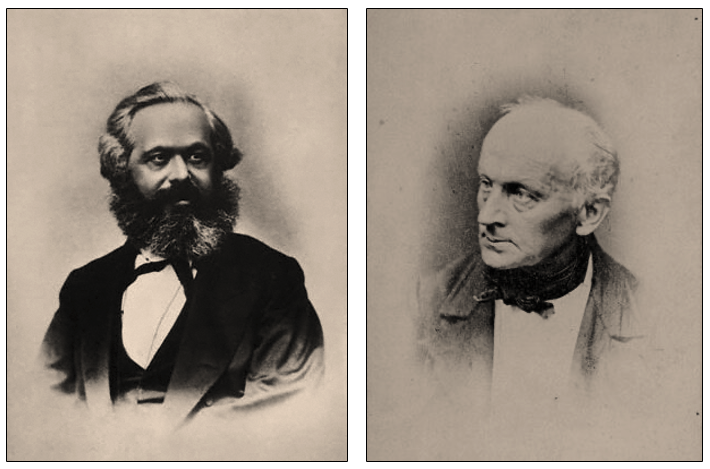
Karl Marx and Bruno Bauer
Bauer argues that Jews should not be granted political emancipation until they relinquish their religious identity. In his view, the persistence of a distinct Jewish identity is incompatible with the secular, universal rights needed for modern citizenship. Bauer contends that true political emancipation requires the abolition of religion altogether. He sees religion as a barrier to universal human rights and believes that a secular state, free from religious influence, is necessary for genuine emancipation. Bauer criticizes the special privileges that various religious groups, especially Jews, seek within the state, arguing that such privileges undermined the principles of equality and universal rights. Crucially, in Bauer’s way of thinking (and this is true for Marx, as well) the Jewish identity is centered on religious belief and not matters of ethnicity or race.
In his critique of Bauer, as he is wont to do, Marx shifts the focus from religious identity to economic and social structures, exploring the nature of political emancipation and the broader context of human emancipation beyond political rights. He criticizes Bauer for not recognizing the deeper socioeconomic dimensions of emancipation and, as expected, argues for a more radical transformation of society. In this shift, Marx contends that Judaism’s practical spirit has flourished within Christian societies; the Jew is not an isolated religious figure, but a representative of the broader societal tendencies toward egoism and practical need. Now we come to it; the thesis of the present essay thus becomes explicit: is it the case that the Protestant ethic Weber identifies in his earlier work The Protestant Ethic and the Spirit of Capitalism (1904-05) as enabling the development of the capitalist spirit is actually the perfection of Judaism in the totalization of capitalist relations identified by Marx.
By egoism, Marx means individualism, which is the political emancipation offered by the liberal state, which is to say that liberalism elevates individual self-interests over communitarian ethics, a process I have referred to in the past as “detribalization.” Liberated from their tribe, the individual is reincorporated into the national structure emphasizing equality under the rule of law. This focus is associated with Marx’s interest in alienation, where individuals become disconnected from communal bonds and social solidarity and thus estranged from other men and self (since self is also a social product). Marx thus distinguishes between political and human emancipation, the latter involving the transformation of social relations to overcome the alienation inherent in capitalist society. Under these new arrangements, human beings are free to develop their capacities in conjunction with others, rather than in competition with them. (See The Postmodern Condition: Human Nature, Tribalism, and the Future of the Nation-State.)
Marx identifies practical need and egoism as the core principles of civil, or bourgeois society. He argues that in the monotheism of the Jew money becomes a deity—indeed, the central deity. In Marx’s view, money as the ultimate value degrades all other aspects of human and natural life into mere commodities. The dominance of money, Marx contends, has secularized the Jewish god, transforming Yahweh into a universal symbol of self-interest and economic exchange. Moreover, Judaism reduces human relations, including gender relations, to transactions. This commodification extends to all aspects of life under the influence of money and private property, reflecting a broader societal contempt for nature and intrinsic human values. Marx also critiques the Jewish emphasis on legalistic adherence, viewing it as a reflection of the bureaucratic and self-interested nature of civil society.
Judaism reaches its zenith with the perfection of civil society, Marx observes, which occurs within the Christian world. Christianity facilitates the complete separation of civil society from the state, promoting egoism and atomistic individualism. He describes Christianity as the theoretical elevation of Judaism’s practical concerns, while Judaism represents the common practical application of Christian principles; thus Christianity and Judaism are interlinked, with Christianity emerging from Judaism and ultimately merging back into it. This interdependence reflects a broader process of alienation and commodification in society, where human and natural values are subjugated to the imperatives of money and self-interest.
Marx argues that the tenacity of the Jew is not due to his religion per se, but to the underlying human basis of his religion, namely egoism. In modern civil society, egoism is universally realized and secularized, making it impossible to convince the Jew of the unreality of his religious nature. Marx concludes that the nature of the Jew is not merely a reflection of individual narrowness but embodies the broader societal narrowness shaped by practical need and self-interest. Thus Marx equates Jewish identity with capitalist practices, suggesting that the “worldly religion of the Jew” is “huckstering” (meaning to promote or sell) and implies that the emancipation of Jews is intertwined with the emancipation of society from capitalism.
Marx writes that “Judaism reaches its highest point with the perfection of civil society, but it is only in the Christian world that civil society attains perfection. Only under the dominance of Christianity, which makes all national, natural, moral, and theoretical conditions extrinsic to man, could civil society separate itself completely from the life of the state, sever all the species-ties of man, put egoism and selfish need in the place of these species-ties, and dissolve the human world into a world of atomistic individuals who are inimically opposed to one another.” He continues: “From the outset the Christian was the theorizing Jew, the Jew is, therefore, the practical Christian, and the practical Christian has become a Jew again.” Then, controversially, “The social emancipation of the Jew is the emancipation of society from Judaism.”
Marx argues that true emancipation, whether for Jews or others, cannot be achieved solely through political means within a capitalist society, which he sees as inherently alienating. Political emancipation is only partial freedom; it allows individuals to be legally equal but does not address the deeper social structures that lead to economic inequality and human alienation. Political rights, in Marx’s view, give individuals formal freedoms without transforming the social conditions that foster real human liberation. Marx thus suggests that “solving” the Jewish question, which is at once the solution for the broader problem of human emancipation, requires transcending the capitalist system altogether. He views capitalism, the “world of hucksters,” as a system that perpetuates division and self-interest. Emancipation for any marginalized group, including Jews, would only be possible if society as a whole were liberated from the constraints of private property and class antagonism.
Marx argues that the traits he associates with Judaism—egoism, materialism (in the commercial sense), and self-interest—find their full expression and “perfection” within a Christianized civil society, one where economic self-interest dominates and individuals exist as atomized entities, disconnected from collective “species-ties.” In this worldview, Marx sees Christianity—and he is I presume speaking of Protestantism here—as the “theorizing” form of Judaism, where the separation of the state and individual material interests becomes complete. The goal of “social emancipation,” in Marx’s view, requires freeing society from the egoistic values he attributes to “Judaism,” thus abolishing the primacy of individual material gain over collective human connection.
Marx’s solution to the Jewish question thus lies in winning the struggle for a communist society, ie., classless and stateless social arrangements, where people are not defined by economic, religious, or social divisions but by their collective humanity, or species-being (Gattungswesen). For Marx, humans, unlike other animals, are capable of consciously shaping their world through labor and are inherently collaborative beings. By abolishing private property and class exploitation, Marx envisions a world in which individuals could attain true freedom and community beyond the limitations imposed by capitalist society and return to harmony with the species-being. The Jew thus goes away not in the eliminationist or genocidal sense offered by the Nazi but rather in the sense that, without the need for religious or other ideological affinities, there are no religious groups at all. In other words, Christians and Muslims go away with the Jews; in all cases, the people remain.
* * *
Weber and Marx offer distinct, yet intersecting interpretations of Judaism in relation to social and historical development, each viewing Judaism through the lens of broader cultural dynamics. Weber’s perspective centers on Judaism’s foundational impact on Western and Middle Eastern ethical development, particularly its rational, future-oriented ethics. For Weber, Judaism’s unique historical view—one that saw the current world order as provisional and human actions as pivotal to its unfolding—was revolutionary. He argues that Judaism introduced a linear, purposeful, even teleological conception of history, with a moral order that emphasized individual responsibility and rational conduct. This ethical rationalism, he suggests, laid groundwork for Western moral systems, differentiating it from other ancient religious traditions. (Some take it further than this. For example, Yale professor David Gelernter argues that Judaism calls upon Jews to be separate themselves from other groups in order to sit in judgment based on their moral standpoint. See my 2009 essay An Obnoxious Chauvinist.) For Weber, Judaism represents a turning point that helped shape the Western focus on law and morality, making it a crucial element in understanding the origins of contemporary Western ethics.
Marx approaches Judaism not as an ethical foundation but as a metaphor for the self-interested materialism he critiques in modern capitalism. He frames Judaism within the socio-economic context of civil society, asserting that “Judaism” is synonymous with the values of egoism, individualism, and materialism. In Marx’s view, these qualities find their ultimate expression in the capitalist world shaped by Christianity. He sees Christianity as enabling civil society to split from the state, allowing individual economic interests to eclipse communal ties. This structure, for Marx, represents the dominance of economic individualism over collective social values, where the individual operates solely out of self-interest, creating a fractured society that is “emancipated” from shared humanity and ethical bonds. In his polemic, the “social emancipation of the Jew” equates to society’s liberation from the “Judaism” that he equates with capitalist egoism, suggesting a need for social cohesion beyond individual material concerns.
In examining both theorists together, some might suppose opposing evaluations. Weber sees Jewish ethics as an essential contribution to a rational moral order, one that elevated the West’s ethical landscape. For Marx, the values he associates with Judaism—refracted through his critique of economic life in a Christian-dominated world—symbolize the rise of alienation and egoism that need to be overcome. Weber’s view is grounded in the ethical and historical developments Judaism inspired, which he considers essential to the development of Western civilization.
But are these opposing evaluations as some might suppose? As implied above, I don’t think so. As noted, well before Ancient Judaism, Weber published his two-part essay The Protestant Ethic and the Spirit of Capitalism in the journal Archiv für Sozialwissenschaft und Sozialpolitik (Archive for Social Science and Social Policy). There he articulates how religious asceticism initially drove the development of a rational order that would later become foundational to capitalism.
For Weber, a particular ethic embedded in certain Protestant denominations, particularly Calvinism, fostered a mindset conducive to capitalism. Weber believed that Calvinist principles, such as the doctrine of predestination and the importance of a “calling,” encouraged individuals to pursue hard work, discipline, and frugality as a means of demonstrating their worthiness. Over time, these values contributed to a rational economic ethos, supporting the growth of capitalist structures, particularly in Western Europe and America.
Paradoxically, with the rise of capitalism, material accumulation and organized efficiency replaced the spiritual motivations that originally guided work, and over time the religious framework gave way to secularized capitalism, which no longer relied on a religious ethic, but continued to demand structured, disciplined labor. Weber believed that capitalism transformed its original religious values into a self-perpetuating system that, in the end, destroyed the very values that had underpinned it. This has been termed by contemporary theoretician George Ritzer “irrationality of rationality.”
Weber writes in his essay, “Since asceticism undertook to remodel the world and to work out its ideals in the world, material goods have gained an increasing and finally an inexorable power over the lives of men as at no previous period in history. Today the spirit of religious asceticism—whether finally, who knows? —has escaped from the cage.” He continues: “But victorious capitalism, since it rests on mechanical foundations, needs its support no longer. The rosy blush of its laughing heir, the enlightenment, seems also to be irretrievably fading, and the idea of duty in one’s calling prowls about in our lives like the ghost of dead religious beliefs.” Then, “In the field of its highest development, in the United States, the pursuit of wealth, stripped of its religious and ethical meaning, tends to become associated with purely mundane passions, which often actually give it the character of sport.”
For Weber, this secularized rationality under capitalism finds a situation where the once spiritually motivated Protestant ethic has faded, leaving workers trapped in impersonal systems. Capitalism, which once rested on an Enlightenment optimism, moved by a Promethean spirit, had become or was everywhere becoming “stripped of its religious and ethical meaning.” The “pursuit of wealth” becomes “associated with purely mundane passions,” a shift that Weber sees most vividly in the United States where labor becomes a rationalized, mechanized pursuit that transforms individuals into components of a larger system, valuing economic productivity over personal fulfillment or spiritual meaning.
“Military discipline is the ideal model for the modern capitalist factory,” observes Weber. “Organizational discipline in the factory has a completely rational basis. With the help of suitable methods of measurement, the optimum profitability of the individual worker is calculated like that of any material means of production.” He continues: “On this basis, the American system of ‘scientific management’ triumphantly proceeds with its rational conditioning and training of work performances, thus drawing the ultimate conclusions from the mechanization and discipline of the plant. The psycho-physical apparatus of man is completely adjusted to the demands of the outer world, the tools, the machines—in short, it is functionalized, and the individual is robbed of his natural rhythm as determined by his organism; in line with the demands of the work procedure, he is attuned to a new rhythm though the functional specialization of muscles and through the creation of an optimal economy of physical effort.”
Under such systems, individuals become highly specialized, functionally attuned to machines and industrial demands that strip them of their “natural rhythm.” Scientific management involves training individuals to become so attuned to the needs of the factory or bureaucratic state that their very psycho-physical apparatus is reshaped to maximize efficiency. Here, Weber captures a profound dehumanization: individuals are no longer valued for their intrinsic humanity or creativity, but rather for their utility within the rationalized system. Weber writes, “This whole process of rationalization, in the factory as elsewhere, and especially in the bureaucratic state machine, parallels the centralization of the material implements of organization in the hands of the master. Thus, discipline inexorably takes over ever larger areas as the satisfaction of political and economic needs is increasingly rationalized. This universal phenomenon more and more restricts the importance of charisma and of individually differentiated conduct.”
This observation is echoed in Antonio Gramsci’s Prison Notebooks, where he discusses the “animality of man.” Gramsci, a Marxist, critiques the asceticism promoted by bourgeois and bureaucratic ideologies, which seek to regulate not only labor but also leisure and private life. This Puritanical control denies individuals the full range of their human experience, including the “animal” pleasures of the body, such as enjoyment, rest, and play. Such a system enforces a mechanical efficiency that prioritizes productivity and obedience, stripping people of the very pleasures and freedoms that make life meaningful. Thus Gramsci viewed the functional denial of human vitality as part of a broader strategy to maintain social order. By suppressing instincts and channeling energy exclusively into work or compliant behavior, hegemonic systems prevent individuals from fully experiencing their humanity. This is a subtle but effective way of dehumanization: not by reducing people to animals in a crude way, but by denying them access to the joys and instincts that connect them to their natural being.
Weber argues that rationalization extends beyond the factory and workplace to the bureaucratic state, where power and control are increasingly centralized. This centralization of material resources in the hands of the master not only reflects the economic concentration that Marx critiqued but also a social concentration of power that restricts personal agency. Weber explains that bureaucratic discipline colonizes the lifeworld, creating a highly organized, depersonalized social structure where individual charisma or freedom loses significance. This mirrors Marx’s argument on alienation, where workers are estranged from the products of their labor and from each other, treated as interchangeable units within a mechanized, impersonal process.
Thus both Weber and Marx scrutinize the impact of capitalist rationality on the human spirit, albeit through distinct frameworks, one idealist, the other materialist. Marx argues that capitalism alienates individuals by reducing them to productive inputs, estranged from the products they create and from one another. For Marx, the capitalist system objectifies human beings, exploiting them for their labor while concentrating the means of production in the hands of a few, thereby intensifying class divisions and rendering workers increasingly powerless. In The Protestant Ethic and the Spirit of Capitalism, Weber similarly laments capitalism’s reduction of individuals to cogs in the bureaucratic machinery, where disciplined labor has become an impersonal, mechanized process devoid of spiritual meaning or ethical grounding.
Both theorists thus critique the rationalization inherent in capitalist structures, which transform work from a potentially meaningful or ethical activity into an instrument of profit. Weber traces the historical roots of this transformation to the ascetic Protestant ethic, which sanctified disciplined labor as a calling. Yet as capitalism secularized, this sense of purpose evaporated, leaving behind a disenchanted economic structure driven by efficiency rather than ethical fulfillment. Where Protestantism once infused work with religious value, modern capitalism has stripped labor of meaning, leaving “the ghost of dead religious beliefs.” Marx and Weber both recognize this dehumanizing shift, but while Marx more explicitly attributes it to class exploitation and the concentration of capital, Weber attributes it to the consequences of a general culture of rationalization, where individuals become subsumed within impersonal systems governed by economic calculation.
In the end, they’re talking about the same thing. Weber’s depiction of the capitalist system echoes Marx’s notion of alienation. In his analysis of “scientific management,” Weber describes how capitalist organization trains workers to conform to the demands of machinery, optimizing their physical and mental capacities to fit the needs of industrial production. This functionalization mirrors Marx’s description of estrangement from species-being, in which labor becomes something external to the worker—a mere means to survive, rather than a fulfilling or self-actualizing activity. In this context, both thinkers recognize the depersonalizing effect of capitalist rationality, which treats labor not as a source of human dignity but as a commodity to be measured, optimized, and controlled.
Both Marx and Weber also observe the concentration of power within the capitalist system. Marx attributes this concentration to class dynamics, where the “master” class monopolizes the means of production, systematically disempowering workers. Weber similarly sees capitalism concentrating control, focusing on the bureaucratic machinery that centralizes authority in a way that restricts individual autonomy. For Weber, the bureaucratic state and capitalist enterprise both contribute to a form of disenchantment, where rationalization encroaches on every aspect of life, ultimately subordinating personal values and autonomy to the dictates of a system that prioritizes efficiency over humanity.
* * *
Both The Protestant Ethic and Ancient Judaism explore how different ethical systems, stemming from unique theological frameworks, impact the society’s orientation towards the world, including economic activities. However, while Protestantism’s ethics dovetailed with and supported the rise of capitalism, Judaism’s ethical monotheism did not prioritize worldly success in the same way, remaining more focused on survival and cohesion within a specific cultural and religious identity. Therein lies the antithesis that finds its higher unity in the capitalist system. The Jewish approach to economic life, according to Weber, must be understood in the context of the broader ethical and social framework provided by their religion. Weber emphasizes the role of Jewish law in regulating economic behavior; the intricate legal system developed by ancient Jewish scholars sought to ensure that economic activities were conducted ethically and justly. For example, laws concerning fair weights and measures, were aimed to prevent the exploitation of market life.
Marx’s essay in response to Bauer’s arguments against Jewish emancipation in Germany is really a springboard to discuss the nature of political and human emancipation. Marx contends that true emancipation requires the separation of church and state and then the abolition of all religious distinctions. This is one of many arguments Marx makes that anticipate Roberto Unger’s concept of “super liberalism,” a critique of liberalism that pushes beyond its traditional boundaries, reimagining how individuals can interact in ways that transcend established norms of personal autonomy, rights, and social organization to recover human solidarity.
In Unger’s view, traditional liberalism emphasizes individual rights, personal freedom, and legal structures to protect individuals from interference. However, he argues that liberalism in this conventional form fails to address deeper issues of social inequality, economic disparity, and the limitations imposed by rigid institutional frameworks. (This view is obviously inspired by Isiah Berlin’s observation of the distinction between “negative” and “positive” liberty, which was anticipated even earlier by Erich Fromm in his Escape from Freedom.)
In the nineteenth century, debates about Jewish emancipation were deeply entwined with broader questions about citizenship, statehood, and secularism. Marx’s intervention in this debate reflects his attempt to push beyond the immediate issue of Jewish rights to address the deeper, structural problems of capitalist society. His ultimate goal is the abolition of all forms of alienation, whether religious, political, or economic. Marx’s critique of Judaism can thus be seen as part of a broader critique of religion and its role in society, where he argues that political emancipation, the granting of equal rights within the state, does not equate to human emancipation, which is the liberation from economic and social constraints. For Marx, religion, including Judaism, represents an ideological barrier to true human freedom because it perpetuates a false consciousness that obscures the material realities of economic exploitation.











 freedom and reason