Marx and Darwin: Pioneers of Scientific Inquiry in Social and Natural History

“Just as Darwin discovered the law of development of organic nature, so Marx discovered the law of development of human history: the simple fact, hitherto concealed by an overgrowth of ideology, that mankind must first of all eat, drink, have shelter and clothing, before it can pursue politics, science, art, religion, etc.; that therefore the production of the immediate material means, and consequently the degree of economic development attained by a given people or during a given epoch, form the foundation upon which the state institutions, the legal conceptions, art, and even the ideas on religion, of the people concerned have been evolved, and in the light of which they must, therefore, be explained, instead of vice versa, as had hitherto been the case.” — Frederick Engels, Highgate Cemetery, London. March 17, 1883

A recent controversy has introduced me to a wider audience (see The Snitchy Dolls Return). Many of those who have just found me have noted that I identify as a Marxist, an identification wherein they see not an inconsiderable degree of irony given the nature of the controversy. Since many of them are on the political right, this identification may be off-putting; they found me in the context of a debate over my right to freely express my opinion about gender ideology, and thus may have initially thought of me as an ally.

I do not desire that any of them find this identification off-putting, so it seems to me useful to explain what I mean when I say that I identify as a Marxist. It’s not because I advocate for the socialist transformation of society (see my essays Marxist but not Socialist and Why I am not a Socialist). Indeed, I am a libertarian, a classical liberal who is critical of the political economy of corporate statism. It is rather because the work of Karl Marx, his materialist conception of history, is, or at least should be, the paradigm of the discipline to which I have devoted my professional life, namely sociology. To be sure, Marx was driven to his critique of capitalism in part because of his commitments to a socialist politics; at the same time, he believed these commitments required the development of science of history and of society.
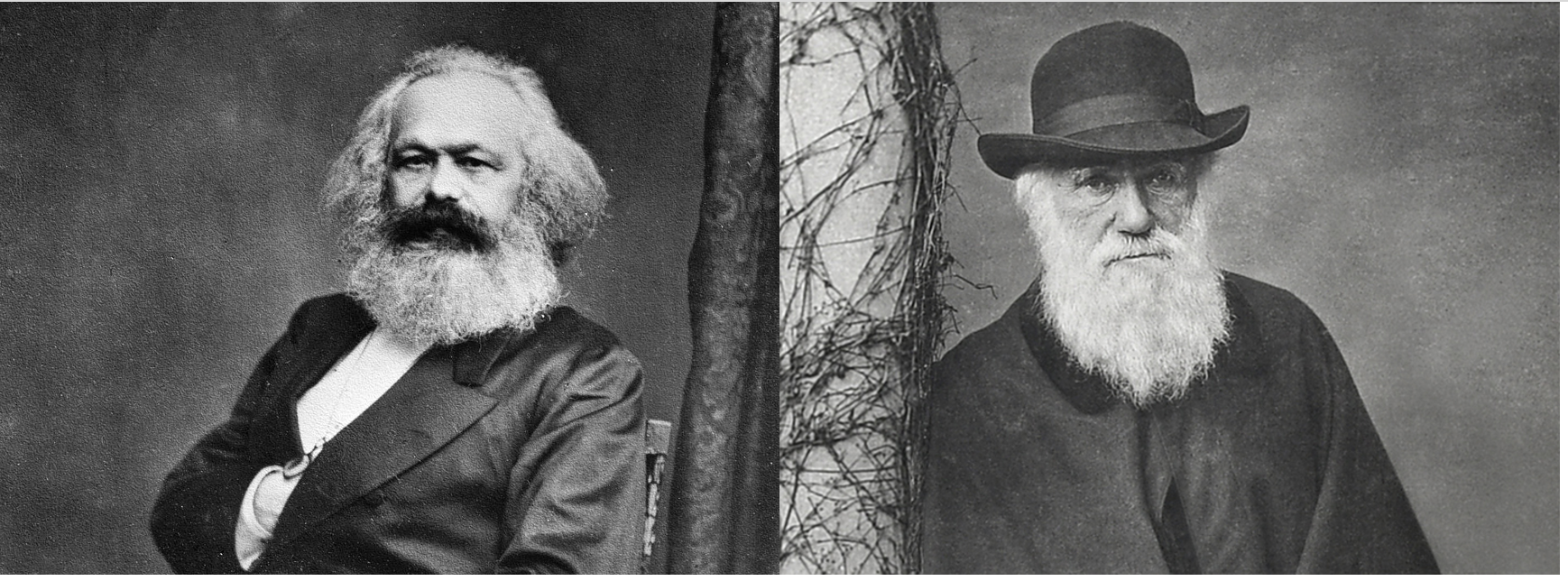
Giants of the nineteenth century intellectual scene Karl Marx (left) and Charles Darwin (right)

When I identify as a Marxist, I mean it in the same way as when I identify as a Darwinist. In the annals of intellectual history, Marx and Darwin left an indelible mark on their respective fields: Marx in social history; Darwin in natural history. While their names often evoke distinct realms of inquiry, a closer examination reveals a common project: to explain why things change over time—and why the take the forms they do.

To be sure, both Marx and Darwin are viewed with disdain by conservative observers, but Marx receives the most vitriol for his communist politics. Both were atheists, but the challenge Darwin poses to the Christian faith is moderated by the justification his naturalism provides for the competitive nature of capitalist relations (indeed, Darwin’s theory was inspired by Adam Smith’s invisible hand metaphor coined in The Wealth of Nations). However, putting politics aside (to the extent this is possible), it is worth considering Marx in the same way we consider Darwin, as having made a major contribution to our understanding of a domain of reality. Both were scientific materialists, which remains the superior way to understand the world around us.

At the heart of Marx’s analysis is his materialist conception of history, a framework that theorizes the interplay between economic forces, historical development, and social relations. Just as Darwin meticulously observed the natural world to unveil the mechanisms of evolution, Marx meticulously dissected the fabric of society to reveal the dynamics of class struggle and historical change. His seminal work, Capital, akin to Darwin’s On the Origin of Species, published less that a decade earlier, revolutionized our understanding of the social order by revealing the underlying laws governing capitalist production, the theory of surplus value, as Engels described it: “the special law of motion governing the present-day capitalist mode of production, and the bourgeois society that this mode of production has created. The discovery of surplus value suddenly threw light on the problem, in trying to solve which all previous investigations, of both bourgeois economists and socialist critics, had been groping in the dark.”

Much like Darwin’s natural history challenged prevailing notions of divine creation, of intelligent design, Marx’s critique of capitalism tore away the ideological veneer of bourgeois society, of which religion was a part, exposing its exploitative nature and inherent contradictions that make it both a powerhouse of material development and a source of perpetual crises. Just as Darwin demonstrated the interconnectedness of all living organisms through the principle of natural selection, Marx elucidated the ever changing arrangements of social classes and political power through the dialectic of revolutionary transformation. Both thinkers transcended the confines of their respective disciplines, offering comprehensive frameworks that continue to shape scholarly discourse and political debates to this day.

To identify as a Marxist, then, is to embrace a scientific approach to understanding the complexities of social phenomena, just as identifying as a Darwinist entails a commitment to the scientific exploration of the natural world. It is not an adherence to a set of dogmatic beliefs, but rather a recognition of the critical role of scientific materialism in elucidating the historical dynamics of human civilization. Just as Darwinism serves as a guiding principle in biological research, Marxism serves as a guiding principle in social analysis, providing invaluable insights into the historical processes and structural inequalities that shape our world. Both men faced vehement opposition from entrenched interests unwilling to relinquish their grip on power and privilege. Yet, their ideas have proved resilient, transcending ideological barriers and inspiring generations of scholars and activists to challenge the status quo and, in Marx’s case, strive for a more just society.

Marx saw Darwin’s theory as complementary to his own ideas about historical development, emphasizing the importance of material conditions and conflict in shaping human societies. Indeed, Darwin’s theory was the natural historical foundation for Marx’s base-superstructure model. Both Marx and Darwin approached their respective fields with a commitment to empirical evidence and a rejection of teleological explanations, seeking to uncover the underlying processes driving change and development—the laws of nature and of history. To embrace the legacies of both is to embrace a commitment to the relentless pursuit of knowledge in the service of understanding their respective domains.

Marx is often fingered as the cause of communist atrocities, but Marx did not lay out detailed plans for a communist society or advocate for the atrocities that marked man’s attempt to make such a society. Marx’s writings focused on analyzing the dynamics of capitalism and critiquing the social and economic structures that underpinned it. He envisioned communism as a society where class distinctions would be abolished, and the means of production would be collectively owned and managed by the workers, but he did not theorize such a condition, as such an order would need to first be established and defined through human labor. An opponent of utopia thinking, there is no blueprint for such a society in Marx’s work. (See Communism: The Real and the Theoretical, and Why Nomenclature Matters.)

It is therefore essential to distinguish between Marx’s ideas and the actions of individuals and regimes that claimed to be inspired by Marxism. While Marx’s theories provided the intellectual foundation for communist movements, including those governing societies that claimed to have at least reached the socialist stage of development, which were never communists by any definition Marx himself used, Marx himself did not advocate for the oppressive tactics or human rights abuses associated with those regimes. Critics often conflate Marx’s ideas with the actions of authoritarian regimes that claimed to be Marxist, such as the Soviet Union under Stalin and Maoist China. However, it’s crucial to recognize that these regime diverged significantly from Marx’s political goals and engaged in practices that Marx himself, a lover of liberty, would have condemned.

Had Marx the vision of future hindsight, he likely would have agreed with me about the socialist problematic. Famously, Marx is supposed to have said, “I am not a Marxist.” This was an expression of Marx’s frustration with the various interpretations and adaptations of his ideas by others, particularly some of his self-proclaimed followers. Marx lived during a time of intense intellectual and political ferment, and his ideas were often co-opted, distorted, or simplified by different political factions for their own purposes. Marx was critical of those who turned his ideas into dogma or rigid ideology, rather than engaging critically with the social context and material conditions of their own time. By disavowing the label, Marx signaled his reluctance to be associated with these simplistic or dogmatic interpretations of his work. So why do I identify as such? Again, for the same reason I identify as a Darwinist.

The Right of US Citizens to Express Opinions and Announce Affiliations

“The first human who hurled an insult instead of a stone was the founder of civilization.”
—Sigmund Freud

In the Dave Huber article I shared in a recent blog post (The Snitchy Dolls Return), there is reference made to University of Wisconsin-Green Bay’s social media policy. What counts as use of social media associated with the university, are “blogs, wikis, forums, videos and social networks that are hosted or sponsored by UW-Green Bay; personally-managed [but university-hosted], but includes content about UW-Green Bay’s programs, constituent groups (e.g. students, employees, alumni, donors, etc.), customers, partners or competitors; externally-hosted or sponsored, but includes content about UW-Green Bay’s programs, constituent groups, customers, partners or competitors.”

Foundation for Individual Rights and Expression (formerly Foundation for Individual Rights in Education, or FIRE), currently flags UW-Green Bay for its questionable policies with respect to the protection of free thought and expression. I cannot tell if the yellow flag designation applies specifically to that institution’s social media policy, but it should—and maybe more than this. Perhaps red would be a better color.

My blog is externally-hosted and I do not speak for the university on my blog in any official capacity. I can’t think of any reason why I would do so. My views on Freedom and Reason are my own. While from time-to-time my blog includes content about happenings at the university, it does so obviously from the standpoint of an American citizen with all the rights and immunities that accrue to that privilege—rights and immunities that cannot be abrogated by policies and rules of a public institution. UW-Green Bay social media policy, however construed, cannot substitute the institution’s authority for the authority of the Constitution of the United States, which is the supreme law of the land.

My flag

In light of the incorporation doctrine established by the Supreme Court in the wake of the Civil War, federally recognized rights applied to the states include those enumerated in the First Amendment: liberty in religion, speech, press, assembly, and petition explicitly, and implicitly association. Suggestions that I may not comment on any given matter, or may comment on any matter except those that are publicly known occurring at my place of employment, are on their face a violation of my First Amendment rights to express and share opinions on social media or in any other media. I moreover have a right to defend myself against accusations and smears.

As for whether I can identify as an employee of that institution, that I am an employee at this institution is a matter of public record. If somebody asks me where I work, I am entirely within my rights to speak the same facts that others can concerning the matter. Moreover, if I identify my affiliation on my blog, I am well within my rights to do so. Professors across the United States identify their affiliations on social media. Indeed, the chair of my unit states his affiliation on his X (Twitter) feed and shares political opinions which, hailing from the standpoint of union politics, some no doubt find objectionable. It is only when somebody objects that this will become a problem? But it is no problem at all. Like me, my chair is a public figure and a US citizen with an inalienable right to state facts.

I did remove my university affiliation from my Twitter profile a while ago (not because of the current controversy), not because I was asked to do so, but because, frankly, it’s a liability. People assume—with good reason—that you’re a woke ideologue if you’re a humanities or social science professor (I am a sociologist, a discipline that blends social science with humanistic concern). I even went with only one of my two designated areas of specialization—criminology—because that one at least conveys nonpartisan intellectual heft.

Consider articles and essays I have published in academic journals. There are those who disagree with my conclusions concerning child sexual abuse, environmental matters, race relations, and many other things. My university affiliation is identified in those publications. Books, journals, and other academic presses are, like social media blogs, wikis, forums, and videos, protected by the Constitution’s recognition of my right to press my opinions. As a public institution, my employer cannot discipline or terminate me for those opinions because my affiliation with that institution is explicitly identified.

When I was hired and tenured at a public institution, I did not relinquish my civil, political, and human rights to make arguments and express opinions, nor could such a demand be made upon me, as these are inalienable rights. I direct you not only to the First Amendment to the United States Constitution (1791), but to Articles 18 and 19 of the Universal Declaration of Human Rights (1948), as well as articles of the same number and content in the International Convenient on Civil and Political Liberties (1966).

I will conclude with this. Sometimes the obvious isn’t so obvious. My blog Freedom and Reason was established in 2006, first on Blogger and now on WordPress, both externally-hosted sites. Except for brief downtimes for maintenance, and a lengthy hiatus (explained in my welcome message), it has always been public. The administration and faculty of my institution have known about my blog and its contents for nearly two decades. I announce my blog essays on my social media accounts, which many administrators and faculty follow.

I have never been told that my writings are inappropriate or objectionable or violate any policy or rule of the institution. Not that I need my institution’s permission to have and express opinions, but if I did, the public should know that I have enjoyed my institution’s tacit permission to do so since I have been employed by that institution going all the way back to 2000. If students have complaints that resonate with the illiberal tendency in our academic institutions, it’s not my problem; I have never acceded to the rules and values of DEI (DEI Has Got to Go). It is only a problem for those authorities and offices that have.

There is a correction that can be taken, however, the same action the administration and faculty took when rightwing forces tried to cancel me back in 2003-2004: publicly announcing that the university stands for free thought and expression and defends the principles of academic freedom. Viewpoint diversity is essential for the full realization of a liberal education. In an era when left authoritarian tendencies threaten the foundations of human freedom, it is more important today than it was two decades ago to reassert the values of the university in a free society.

For more of my writings about free thought and expression, see The State of Cognitive Liberty at Today’s Universities; Science Politics at the University of Wisconsin—Deliberate Ignorance About the State of Cognitive Liberty and Viewpoint Diversity on College Campuses; Cognitive Autonomy and Our Freedom from Institutionalized Reflex; Death of the Traditional Intellectual: The Progressive Corruption of US Colleges and Universities; Losing Control over the Narrative: The Rise of Social Media and the New Radical. For some of my writings on the left authoritarian threat to the institutions of a free society, see Woke Progressivism and the Party of God; The Peril of Left-Wing Identitarianism; Frantz Fanon and the Regressive Ethics of the Wretched: Rationalizing Envy and Resentment—and Violent Praxis.

Right and Obligation

I harbor no animosity towards individuals who buck gender stereotypes—or who lean into them. Those who know me know I have never cared whether a woman wears pants and no makeup. Why would I?

My problem is with ideologues who push pseudoscience and confuse children and vulnerable people for lust and profit while bullying me and others for calling them out for it.

Trans health care is pseudoscience. The construct of “transphobia” is a propaganda term to smear those who expose the scam.

It’s the same with “Islamophobia.” I have never discriminated against Muslim students or colleagues. But Islam is bogus. Allah doesn’t exist, and if Muhammad did, he either hallucinated his meetings with Gabriel or lied to vulnerable people to manipulate them for lust and power.

I have an absolute right as a free man to criticize both—or any other ideology. More than this, as a humanist and a moral person, I have an obligation to identify the most harmful and put them on blast. And I will continue to do so.

The Snitchy Dolls Return

During 2003 and 2004, before being awarded early tenure for award-winning scholarship, there were two attempts to cancel me at the university where I work. The first came in response to my opposition to the Bush regime’s pending military action against Iraq. The campaign was organized by the College Republicans, who lost their faculty sponsorship for the audacity of their stunts.

The second came in response to a paper I gave at an academic conference in New Orleans critical of the damage caused to the Fox River in Northeastern Wisconsin by the paper mills’ dumping of PCBs and their refusal to clean up the mess they made. The latter campaign was much more serious, as it involved the deployment of astroturf groups organized by polluting corporations.

In both instances, the faculty rallied around me and I weathered the storm. I was tenured and remain at my institution. I’m coming up on a quarter century of research, teaching, and service.

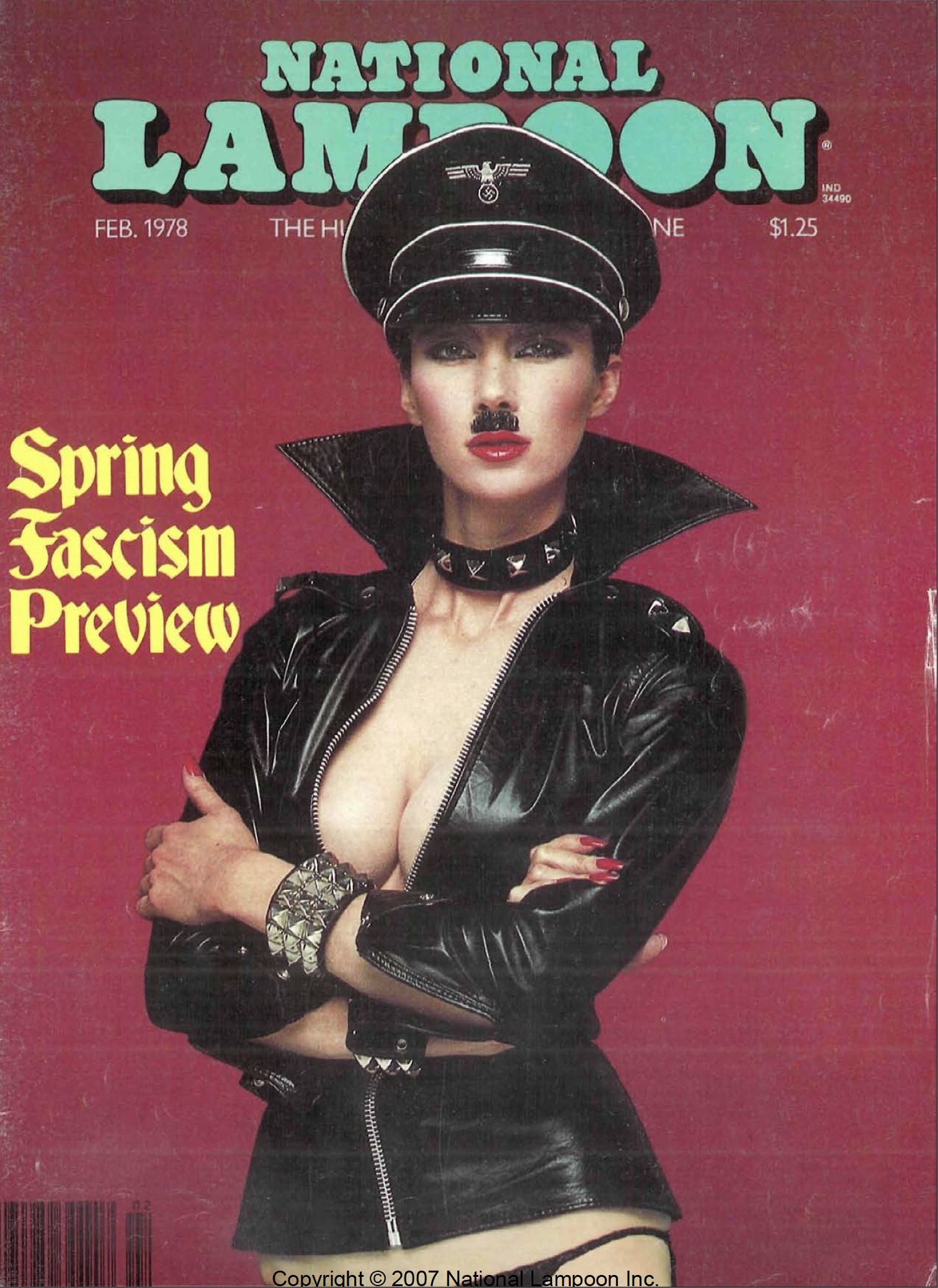
February 1978

It is perhaps poetic, then, that, as I approach the end of my career (a few more years left, but retirement is looming), that there would once more be an attempt to cancel me, only this time from the left (or what claims to be the left these days). Readers can find the link to the story at The College Fix: “UW-Green Bay students want professor fired for alleged racism, transphobia.”

It’s ironic that the example of my alleged racism is a piece I wrote in 2008 covering Jesse Jackson’s criticism of Barack Obama’s dog whistling about what bigoted whites see as the problems with black people. This is what would have back then been called an anti-racist take (since then, as I have shown on this blog, antiracism has come to represent anti-white sentiment).

My reflex to defend black Americans from the stereotypes Obama and others use is in part a product of my parents, who dragged me into Civil Rights activism in my diapers. My parents were activists in the movement and, later, the antiwar movement. My father, a Church of Christ preacher, was radicalized by the events of the 1960s and turned to liberation theology. We marched together. We went to black churches. We broke bread with black Americans.

When I was a toddler—this would have been in 1964—we had to flee a small-town church in West Tennessee after receiving death threats from the Klan, many of whom turned out to be congregants. Then in 1970, we were thrown out of a church in Sharpsville, Tennessee. We lived in the preacher’s house, a tiny cinderblock dwelling supplied by the congregation. I remember the night the mob came to the house with baseball bats and ax handles to drive us out. 

I know what it looks like to see a principled man canceled because he stood straight and strong for social justice (which meant something very different then than now).

It is, for this reason, weirdly appropriate that the Jesse Jackson blog post was selected, which the students had to find by searching the Internet archives while my blog was down for maintenance. I imagine a conversation that went like this: “I’m offended by Professor Austin.” What offended you? “I found an article from 2008 where he quotes Jesse Jackson using the N-word.” Wait, you went searching for an example of him using an offensive word and had to go all the way back to 2008 to find him quoting somebody who used an offensive word? “Yes. And I was offended.” Could it be that you wanted to be offended?

These circumstances provide me with yet another opportunity to emphasize the things that make the American Republic so great and to identify the perils she faces in perpetuating her greatness into the future, namely threats to the constitutional rights to free conscience, press, and speech—and to remind people of points I have made over the years in my essays to this blog and in speeches at teaching and workshops:

While there is a right to engage in offensive speech, there’s no right not to be offended. If there’s a cost associated with offensive speech, then speech is not free. If I say something offensive, then you may ignore it, agree with it, or object to it. Ignoring, agreeing, or objecting to offensive speech costs nothing. If you cancel or punish offensive speech, there is a cost imposed. Then speech isn’t free. If you desire that a speaker be cancelled or punished for his utterances or writings, then you cannot claim to believe in free speech.

College students don’t need to announce their opposition to free speech. They need only seek the cancellation of the speaker. The desire speaks for itself. It is an authoritarian desire. Tragically, the illiberal impulse is rampant among our youth.

One thing that the proponents of cancel culture will tell you is that getting somebody disciplined or terminated from their job isn’t cancel culture but “accountability culture.” They’re saying this about the actions taken against me in this case. Actually, accountability culture is making people answer for their misdeeds. Making arguments and expressing opinions is not wrongdoing. Therefore, there is nothing for which to be held accountable. The premise is fallacious.

What’s happening here is an instantiation of cancel culture. Cancel culture is an illiberal impulse to harm a person’s reputation or career, or to intimidate them into silence, because some individual or group doesn’t like the things he says.

Usually, those who claim to be offended or hurt by speech are actually worried that others may hear or read words that may enlighten those they believe are under their charge. They feign offense and harm to punish those whom they find disobedient or insufficiently deferential to their beliefs to make an example of them. It’s a power trip. At its core, it’s authoritarianism.

Islamic clerics and their mobs attack people for blasphemy not because they’re offended by seeing a cartoon of Muhammad with a bomb in his turban. They exploit the cartoon as an instrument to chill speech critical of Islam. The goal of Muslim cleric and his mob is to Islamize society. Mocking the prophet undermines that goal. Attacking those doing the mocking is the attempted negation of the undermining.

As I have shown on these pages, Islamists developed the term “Islamophobia” to smear those who criticize the doctrine. It’s the same spirit as the accusation of “transphobia.” Like Islam, transgenderism is an ideology. For the true believer, no one is allow to criticize the ideology because the zealot seeks to make it total, to make others conform to doctrine. You may recall Christopher Hitchens rhetorically asking his audience: “What are the first five letters of totalitarianism?”

Knowing this, the totalitarians make themselves out to be victims, crying that the criticisms make them “unsafe.” This is the culture of “safetyism” that college administrators have incubated and socialized.

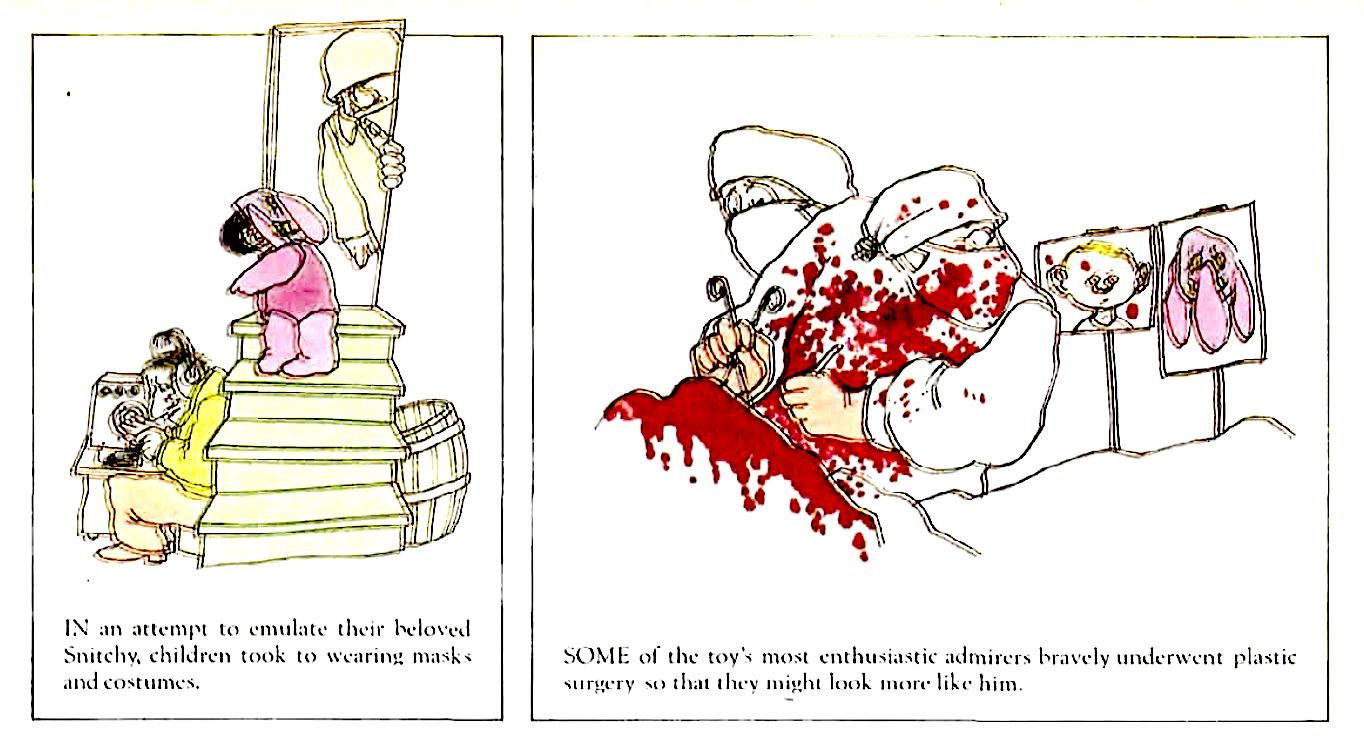
Snitchy by Gahan Wilson, National Lampoon February 1978

These are the children of DEI. “Safety” as a euphemism for “speech I don’t like” is not something that occurs organically—certainly not everywhere at once. Safetyism is a teaching, a preachment. One implication of safetyism is that “speech is violence” (so is silence, we are told). The “safe space” is then constructed and used to suppress problematic voices.

This is the “inclusion” piece of the authoritarian project of the corporate state. Because everybody is to feel included, facts and opinions that make them feel excluded are forbidden. To be sure, not everybody is to feel included. If a point of view is disallowed, then those who express it are excluded—and reported. In this way, the cult of safetyism transforms youth into a Stasi-like apparatus, where the names of those who speak forbidden words are shared with the authorities and the media.

There are obvious features of cultural revolution at work here, as well, such as mobbing members of the older generation. Those who dwell in the adult world have been here before. These phenomena are organized by forces above young people, other adults who use them as a means to an end. Again, I have written about these things on Freedom and Reason for many years and at great length, so I won’t belabor the point.

These developments are precisely why irreligious and other heretical forms of speech are essential for preserving a free and open society. Those who would cancel others for their speech are those who desire a closed society where they get to choose what speech is uttered and thus what thoughts are thunk. No man is worthy of the job of commissar.

I might as well as have been called an “infidel” or “witch.” Neo-religions function the same way as the traditions ones, perhaps the only difference being the level of intensity; because they are younger, the new religions are eager to establish hegemony over everyone. They’re desperate for their worldview—which rests on impossible things—to be validated. This is why the constant demand for “affirmation”: it betrays their doubt and insecurities.

Snitchy by Gahan Wilson, National Lampoon February 1978

I don’t like controversy and conflict. But nobody owns me, and I am not accountable to the trans activist. I am an autonomous person with my own mind. I do what I do because, while the truth has its own integrity, without people prepared to defend it and advance it, it will become lost to consciousness.

Without truth, there is only power. In some real sense, as we used to say in the South, the devil has the power you give him (the sociologist Max Weber famously gave us the secular version in defining obedience to authority). Giving zealots power is irresponsible in light of their desire to close minds and societies. They wear cat ears to appear harmless. Cat ears are one of the insignia of the New Fascism.

Finally, we need to say this out loud: pulling one’s pants down in public is a vanity project, often a manifestation of clinical narcissism. When people have accomplished little in life, they lean on identity, as if who they are gives what they say some special significance. But few people beyond their ilk really care that they think they have superpowers. When others affirm them, know that most are acting in bad faith—and snicker behind their backs because they are ridiculous. They put up a front because they don’t want to have to deal with the temper tantrum—or the agents of DEI.

In reality, compassionate and rational people pity those who think identity matters. They think to themselves, as we say in the South, “Bless their hearts.” Me, I don’t fear the agents of DEI or their minions. I understand what this is about. And now you do, too.

The Growing Threat on Our College Campuses

If you’re curious how it came to be that college students are chanting pro-terrorist slogans on the campuses of ivy-league universities, you only need to understand that they were prepared for this moment by their professors. There are interviews with students telling reporters that they’re putting into action the social justice values their professors taught them.

Over the last several years, college kids have been fed a steady diet of anti-American, anti-Israel, and anti-Western propaganda in the form of postcolonial, third world studies, and other ideological projects framed in the academic jargon of postmodernist critical studies.

Columbia student demonstrator taken away on stretcher as anti-Israel  protests rage on
Anti-Western mob at Columbia University last Saturday

Critical race theory, queer theory, and the rest of the fallacious mess are more than crackpot. They’ve turned young people against themselves, exploiting their lack of self confidence in the West (self-loathing betrayed by narcissism), reducing the Enlightenment to a mythology about white supremacy and a problematizing of the millennia long practice of settler colonialism (even while promoting the invasion of the West by backwards culture bearers).

In this worldview, free speech, individualism, progress, reason, and science are depicted as racist and violent. The solution, namely antiracism, is censorship and compelled speech, tribalism, indigenousness ways of being and knowing (i.e., atavisms), feeling over reason, anti-scientism—and violence.

Irrationalism and nihilism are now rampant in the West. And just in time for the 2024 US presidential election. The color revolution joins lawfare and security state intimidation in stifling the populist nationalist movement to restore democratic republican principles and the values of classical liberalism. In this way, the universities have become a key player in the corporate state transformation of free societies into tyrannies.

* * *

On a related matters… As I have shown on the pages of Freedom and Reason, gender ideology is a neo-religion, a techno-religious cult, as Jennifer Bilek calls is. Here’s another neo-religion:

Kessler’s Cowardice in the Face of Transhumanism

In the year 2038, transhumanism has risen to become a dominant ideology, reshaping society in its wake, protected in DEI policy. Among the youth, it has become a fervent creed, promising liberation from the limitations of the flesh. Two distinct paths have emerged within this movement: individuals who identify as transspecies, referring to themselves as “otherkin” and “therianthropes,” and cyborgs, a synthesis of soft and hard machine.

An otherkin (AI generated)

Otherkin see themselves as nonhuman animals or other creatures. They undergo physical modifications to embody the characteristics of the creature with which they identify. This can involve surgically implanted features like whiskers, claws, scales, or other physical traits associated with their chosen animal identity. A person who identifies as a cat might undergo surgery to have cat-like ears and a tail implanted, while someone who identifies as a reptilian might have scale-like modifications to their skin. These modifications are a way for otherkin to express their identities and feel more aligned with their “true selves” within the framework of transhumanism.

Cyborgs are individuals who have integrated advanced technology with their bodies through neural implants and other technological enhancements. These enhancements can range from cybernetic limbs and organs to neural interfaces that allow direct communication with machines and networks. Like otherkins, cyborgs have embraced the principles of transhumanism, viewing technology to transcend the limitations of the human body and enhance their capabilities. They may undergo elective surgeries and procedures to integrate these technological enhancements seamlessly into their physiology, blurring the line between human and machine. Through their cybernetic enhancements, cyborgs may gain enhanced strength, speed, agility, and cognitive abilities. They may also have access to a vast array of information and communication tools, allowing them to interact with the digital world in ways that were previously unimaginable.

A cyborg. (AI generated)

With a passion for sociology and a critical eye for societal shifts, Professor Adam Kessler was determined to unravel the complexities of this new era. He began, “Today, we apply foundational social theories to the phenomenon of youth, drawn to the allure of transformation, modifying their bodies to appear as other species or machines.” Kessler began with the historical materialism of Karl Marx, guiding his students through the concept of alienation. “In a world where connection seems elusive, where the individual feels estranged from their own body, it is no wonder they seek refuge in alteration,” he explained. Transitioning to the ideas of Max Weber, he elucidated the process of disenchantment, where the world loses its mystique and becomes mechanized. “In the pursuit of transcendence, the human spirit craves a release from the mundane, a departure from the banality of existence.” He then turned to Sigmund Freud. “In a civilization built upon consumption, where desires are manufactured and identities commodified, the individual grapples with a profound sense of disconnection.”

As the lecture unfolded, students found themselves drawn into the intricate web of theories. Beneath the academic analysis lay a dark truth, one that spoke to the insidious influence of profit and power. “The medical-industrial complex and tech conglomerates profit from the commodification of the body, perpetuating a cycle of modification fueled by consumerism.” Kessler finally came to it in the most concrete and immediate sense of the phenomenon: “The industry capitalize on the insecurities of youth, peddling promises of transcendence in exchange for a hefty price.”

In the aftermath of Professor Kessler’s lecture, a palpable tension lingered in the air. Among the students sat a group of transhuman individuals, their identities woven into the fabric of their being, their experiences colored by the very theories Kessler had dissected in the classroom. Gathering their resolve, they convened outside the dean’s office, their voices raised in solidarity against the injustice they had endured in Kessler’s class. With a collective determination, they invoked the school’s policy against misrepresenting transhumanism, demanding accountability for the harm inflicted upon their community.

Acknowledging the gravity of the situation, Dean Katherine Graves summoned Professor Kessler to her office. She informed him of the consequences of his actions, reminding him of the responsibility he bore as an educator entrusted with the minds and well-being of his students. “Professor Kessler, it has come to my attention that your recent lecture has violated our school’s commitment to inclusivity and respect for all identities. As such, you will be required to undergo professional development to ensure that such oversights do not occur in the future.”

Fearing for his reputation, Kessler acquiesced to the dean’s judgment. The students found solace in the acknowledgment of their grievances, their voices amplified by a system that, though imperfect (it had, after all, awarded tenure to a bigot like Kessler), remained committed to progress. And as they returned to their studies, a newfound sense of empowerment stirred within them. The transhumans had the state at their back.

The Propaganda Mission of National Public Radio

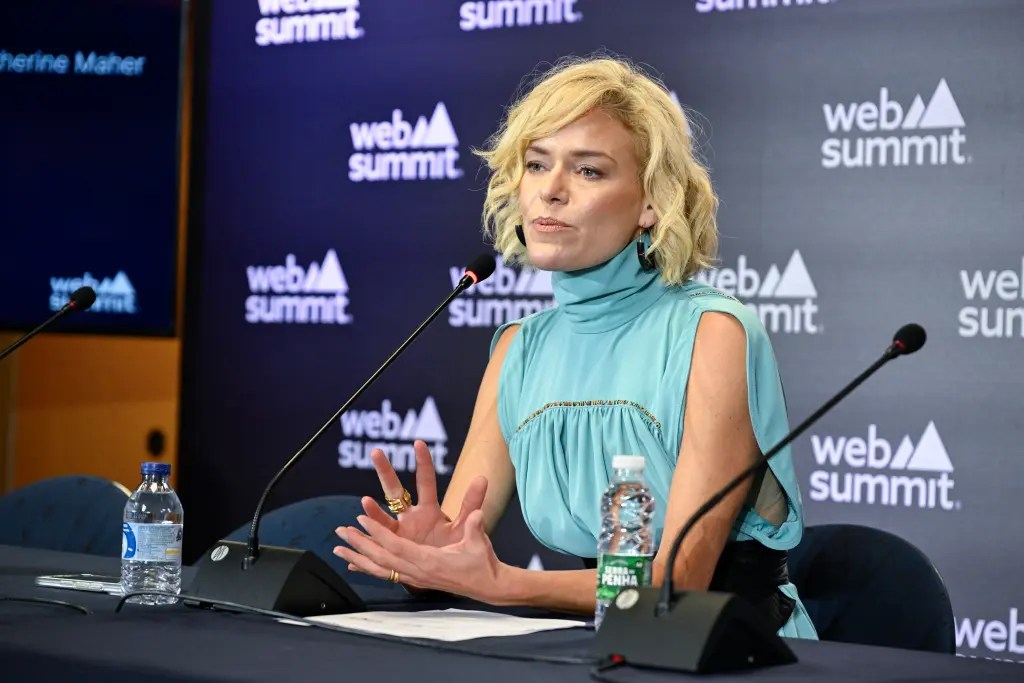
“Our reverence for the truth might be a distraction that’s getting in the way of finding common ground and getting things done.” — NPR’s CEO Katherine Maher on the truth

The “might be” is rhetorical. Maher is asserting that propaganda in the service of woke progressivism is of greater value than reverence for the truth. Hiding the truth of Biden family corruption and manufacturing stories about Trump family corruption is a way of finding common ground and getting things done.

Katherine Maher, CEO of National Public Radio

Maher is not speaking for herself. This is how the woke epistemic works. In postmodernism, truth is reduced to and dissolved by discursive formations, with formations to be selected for their power in advancing movement goals, which function to obscure the truth, which has its own integrity.

For example, the truth is that gender is binary and immutable in the human species (all mammalian species, in fact). The woke take is that gender is either a sociocultural construction and performance with no connection to natural history or a transcendent spirit independent of observable reality; however, whatever the case, the individual’s subjectivity stands in place of the truth, so people are what they say they are.

To be sure, the reduction of truth to individual subjectivity is selective. While a man can be a woman and a lesbian, a white person cannot be a black person. But the disappearance of truth in wokeness makes contradiction irrelevant. You will simply be told that the analogy is fallacious. Not because it is (while it is possible for a white person to be black, the analogy holds), but because the woke movement is righteous; therefore, any rule it invents is correct because it “gets things done.”

This is not a pragmatic take on truth. This is the elevation of ideology over fact and reason. This is the way Nazism worked. The Nazis reduced truth to ideology. Rule and right under Nazism were arbitrary with respect to the truth of the world. The important thing for Nazis was to get things done—according to the ideology. And the goal was the same: advance the interests of the corporate state.

Maher tweeting about the color revolution aimed at derailing the Trump re-election campaign

NPR and PBS are are part of the corporate state media machine. Their claim to be apart from the profit-generating side of that machine is an attempt to manufacture the illusion of objectivity. In this way, their existence is more objectionable than their private sector counterparts.

Making a Rational Decision About How to Vote this November

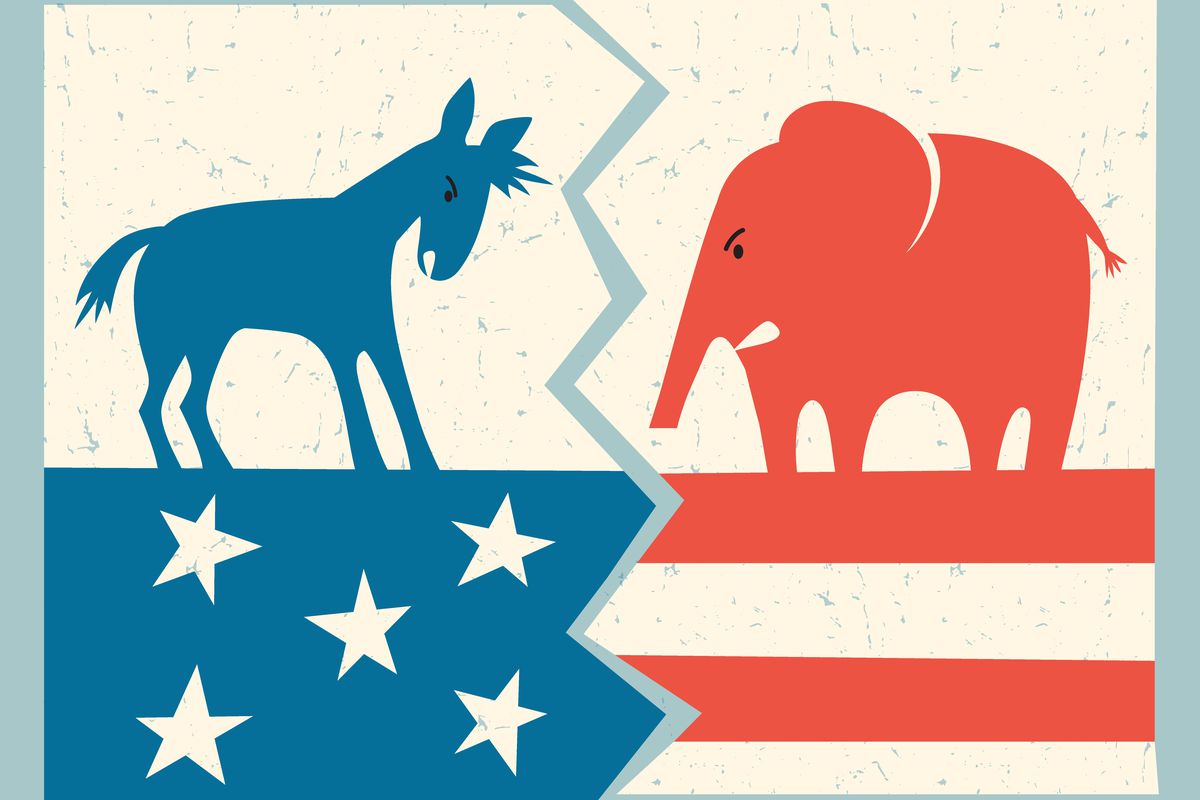
When thinking about who to vote for this November, consider what type of country you want to live in. Here are the two options. These options encompass our past and our present. 

Option 1: A constitutional republic with a robust bill of rights, governed by citizens according to the principles of democratic republicanism, guided by the classically liberal values of free speech, conscience, assembly, association, individualism, and limited government, where the family and community are the core institutions organizing social life, who can depend on government to protect them—their neighborhoods and their livelihoods—from crime and disorder. 

Option 2: A corporate state governed by bureaucrats operating via administrative rule, regulatory control, and technocratic means, guided by the progressive values of censorship, compelled thought, tribalism, collectivism, and expansive intrusive government, where corporations and state agencies organize social life at the expense of family and community. Families and communities cannot depend on the government to protect them from crime and disorder.

Shutterstock

Once you decide which country you want to live in, the next question is which political party will help you realize that country. Here we hit a snag since the hegemonic strategy of the ruling elite has been over the last several decades to put before the people two political parties that appeal to different class, cultural, and intellectual sensibilities, while perpetuating the status quo—corporate state control over the masses. This is the uniparty establishment.

Considering this, the question shifts to the history of each party and a determination of which party is reformable. 

One party, the party of the caste, slavery, segregation, and woke is not reformable. It’s the party of the corporate state phoenix that rose from the ashes of the slavocracy. Its rules are exclusive, its operatives tightly controlled. It is moreover the party of those who captured the administrative apparatus—progressives. If you prefer Option 2, then this is your party.

The other party, founded as a populist antislavery party, because it is more open to popular forces in the grassroots, despite having been captured by corporate power and relegated for decades to the role of controlled opposition, is already being transformed internally by reformers who are articulating the vision described in Option 1. So, if a constitutional republic is the country you want to live in, the Republican Party, while not perfect, is the better option.

Restoring the American Republic to greatness requires returning the Republican Party to its roots by supporting populist activists and candidates. The people must do this at the same time they weaken the Democratic Party by withdrawing support for its candidates and refusing to submit to administrative rule. It’s time to return the United States to her people—the American citizen.

Should Trans Identifying Women Go to Men’s Prisons?

If trans men are men, should they go to men’s prisons? Such a practice poses serious risks to trans men given that they are females. Prison would be particularly unsafe for them. But the reverse of this, i.e., trans women in women’s prisons, poses the same problem. If trans men are not safe around male inmates because they are female, then female inmates are not safe around trans women given that trans women are male.

This is where the logic the slogan “Trans women are women” shorthands unravels. The danger to trans men in male prisons is not because of sociocultural constructions of gender. The danger is not subjective. It’s objective. Males represent a particular threat to females. Not all males, of course, but given that most violent crime, especially violent sexual crimes, are perpetrated by males, males as a group represent a statistically significant threat to females as a group. Of the 100 thousand rapes that occurred in the United States in 2022, nearly 95 percent were perpetrated by men, with another 2 percent where the sex of the perpetrator was unknown. Around 90 percent of victims of rape were women that year. This is especially true for prisons, where sexual predators are housed in confined spaces. Of the more than 600 thousand males in US state prisons for perpetrating violent crimes (aggravated assault, murder, etc.), more than 160 thousand of them were convicted of sexual crimes.

Karen White, 52, a man, convinced authorities to place him in a women’s prison where he sexually assaulted two female inmates. Why was he sent to prison in the first place? In 2001, he sexually assaulted and committed gross indecency on a 12 year old boy in Leeds, and two years later raped a pregnant woman after spiking her soft drink with vodka.

We see the logic unravel in a similar way when we consider trans men in contact sports. Since trans men are females, and since the objective difference between males and females is vast, a trans man is at particular risk to be injured by a male player. Of course, it would be very rare for a trans man to make the team given those vast differences, so this problem is for the most part hypothetical. At the same time, however, for the very same reason that a trans man faces heightened risk playing against males in combat sports, so female athletes face heightened risk playing against males in female sports.

This is why it is important to grasp sex/gender as objective facts. When you obscure reality with thought-stopping slogans, you lose the ability to see that trans men in male prisons or male sports is the same problem as trans women in female prisons and female sports. To those who are not ideologically-impaired, this is obvious. It is very difficult to get those dispossessed of the capacity for the obvious by ideology to understand the implication of their demands that trans women be allowed in male prisons and sports. This is why we need the authorities to work from objective grounds in administering sex-segregated institutions. Unfortunately, gender ideology has colonized many of those institutions.

Note: to help make the point clearer to those who fallaciously differentiate sex from gender, I have refrained from describing males as men and females as women in the foregoing. So, in this note, I want to reiterate the fact that a man is an adult male human and a woman is adult female human. Males and females come in two types: boys and men and girls and women. Also, the vast physical differences between men and women is not the sole reason for sex segregation in sports. Women’s sports exist as a matter of equity in that institution. It is a violation of women’s rights to compel them to compete against men.

The Big Lie: Noncitizens Can’t Vote in US Elections

X (Twitter) has been blowing up because Speaker of the House Mike Johnson is introducing legislation to require proof of US citizenship when registering to vote in federal elections. “If an individual only asserts or simply states that they are a citizen, they don’t have to prove it, and they can register that person to vote in a federal election,” Johnson said, adding that “we only want US citizens to vote in US elections.”

House Speaker Mike Johnson andPresident Donald J. Trump during their news conference at Mar-a-Lago, in Palm Beach, Florida, Friday, April 12, 2024. (Source: The New York Times)

People are going to lie to you about this (or more likely profess their ignorance and ideology), so, for the record, as of March 2024, the District of Columbia and municipalities in three states (California, Maryland, and Vermont) allow noncitizens to vote in some or all local elections. Moreover, several states do not have clear impediments to municipalities passing their own voter qualification laws. Having a voter ID card—if one is even required—is not exclusive to citizens in America. This is a very real problem for election integrity.

We’re told not to worry about noncitizens voting in national elections because there is a federal law forbidding it. But if voters are voting in local elections, how will they be excluded from voting in federal elections if they don’t have to provide proof of citizens when registering the vote? How are noncitizens segregated from citizens when receiving their ballot if no proof of citizenship is required—or even proof of registration with a voter ID card?

Why are noncitizens allowed to vote in any election in the United States? A core pillar of constitutional republicanism is election integrity; republics are about citizens; therefore, the franchise should be exclusive to them. States should have clear impediments to noncitizen voting, and the federal government should pressure them to do so. Indeed, failing to stop noncitizens from voting appears to violate the United States Constitution.

The Constitution guarantees US citizens a constitutional republic at both federal and state levels. Article IV, Section 4 of the United States Constitution: “The United States shall guarantee to every State in this Union a Republican Form of Government, and shall protect each of them against Invasion; and on Application of the Legislature, or of the Executive (when the Legislature cannot be convened) against domestic Violence.” (Note that the federal government has failed to protect the citizens of the various states from invasion and against domestic violence.)

Allowing noncitizens to vote in local elections violates the foundational principle that, in a republic, only citizens, native and naturalized, are allowed to participate via the ballot box in electing representatives. The political right of citizenship is a special kind of right, a privilege, i.e., an exclusive right, that applies to people born or naturalized in the United States. Citizenship, when not the result of jus soli (birthright), is earned in America. Those who are not citizens have not earned the right to vote in our elections at any level. Noncitizens have no right to come to America and vote in our elections.

Constitutional republics with presidential systems place a strong emphasis on citizenship as a prerequisite for voting rights because the central role of the citizen in governance is emphasized under these arrangements. This emphasis stems from key principles. In these systems, the legitimacy of the government is derived from the consent of the governed, which means the citizens. Citizens are seen as having a special connection to the state and a stake in its decisions and policies, which justifies their exclusive participation in the electoral process.

One might argue that, as a democratic principle, non-citizens have a say-so because they are also governed. However, in republics, citizenship is closely tied to the concept of national sovereignty. Citizens are considered members of a political community and are vested with certain rights and responsibilities, including the right to vote and participate in shaping the country’s future. Non-citizens are guests. They are governed by law, to be sure, but they do not have a right to determine those laws because they are not citizens. If all this sounds circular, that’s because it is; it’s axiomatic.

Democratic-republican arrangements prioritize political equality among citizens, ensuring that each citizen has an equal voice and influence in the political process (at least in principle). Granting voting rights exclusively to citizens maintains this principle by ensuring that all those who have a shared stake in the nation’s future have the power to determine that future. The legal frameworks of constitutional republics reflect these principles by explicitly defining voting rights and eligibility criteria, which typically include citizenship requirements.

Progressives are apoplectic about this, cloaking their desire to run up the popular vote by leveraging noncitizens by claiming that proof of citizenship will effectively disenfranchisement American citizens who cannot prove their citizenship. This is a variation on the opposition to voter ID. If this concern were legitimate, then progressives would be mobilizing to make sure that all eligible voters have the proper paperwork to register and vote in elections.

Am I saying that, if an individual cannot meet the burden of proving they’re a US citizen, then they don’t get a ballot? Absolutely. Think about it: if the argument is that people who cannot prove they are citizens should be allowed to vote, then the argument that noncitizens cannot vote in US election is disingenuous. It’s a ruse to allow noncitizens to influence the direction of a nation to which they do not belong.

A Pew poll found, in 2020, that there are 25 million noncitizens residing in America (remember that they wouldn’t let the Trump administration ask this question on the 2020 census). As of the first of this year, at the US southern border alone, there has been a record of more than 6 million migrant encounters at and between ports of entry since Biden took office in January 2021, according to data from the Office of Homeland Security Statistics. As readers of this blog know, hundreds of thousands more have come through since then. This figure does not include the millions of getaways; it is likely that the actual number exceeds 10 million. Many of the millions encountered have been allowed to reside in the United States. (See The Mass Immigration Swindle.)

How can we trust the outcome of the 2024 election without a rule requiring proof of citizenship to vote? And after the debacle of November 2020. We can’t. But we can be sure of this: we will be gaslit when we object to the outcome.