
As some of you know, one of areas of expertise is the problem of child sexual abuse and child sexualization. I have a peer-reviewed article and an encyclopedic article in the literature, as well as several essays on Freedom and Reason helping parents identify the signs of grooming and resisting the normalization and public displays of paraphilic desire. In this essay, a primer on pedophilia and paraphilias, I prepare the ground for a future essay on the intersection of anarchism, paraphilias, and queer theory. Another essay will follow that one exploring the misogyny underpinning anarchism and fascism (in both its secular and clerical strains). Central to this future essay are the problems of nihilism and postmodernism.
These ideas and associated politics and practices have in common the objectification of women and children. This puts women and children at risk for sexual exploitation and violence. They are moreover homophobic and misogynistic, erasing both categories through suppression and simulation. As such, they are species of anti humanism. It’s no accident that the mobs in our cities, encouraged and defended by woke progressivism, the praxis of the corporate state, which is near-hegemonic, simultaneously press for the subversion of youth, the undermining of women’s rights, the erasure of gays, the disintegration of families, and the Islamization of Western societies. All this is fueled by a manufactured loathing of Western Civilization and the nuclear family. And it is aimed at our democracy and liberal institutions.
All the things I describe here are in front of our eyes. As moral animals, we are obligated to see them. The nihilists tell us that morality and its social arrangements are arbitrary and without inherent meaning, purpose, and value. If we see what we see we are the oppressors. This is a lie designed to paralyze us. There are eternal truths. We are natural beings. The reality is that the extent to which we act without regard to one another is a metric indicating the degree of alienation from our species-being. Sociopaths seeks estrangement for the unleashing of Freud’s das Ich (the Id). They want no moral order precisely because anything goes without one—and it creates the space necessary for fascist politics and transhumanist desire. Any person or group or praxis that transgresses the boundaries that safeguard women and children is dangerous. We feel this in our gut for a reason. It is a result of natural history. The nihilists are subverting our instincts by disrupting common sense. This is the existential struggle of the present epoch.
* * *
Pedophilia and other paraphilias lurk at the core of queer theory, shaping its development over the twentieth century. I have an essay pending on the paraphilic character and origins of queer theory, its anarchist roots, and associated praxis known as “queering.” Queering, for those who don’t known, refers to the practice of challenging and subverting identities, normative boundaries, and social structures that define and regulate gender roles and sexual relations and interactions. The practice is associated with the grooming of children, which I have written about extensively on Freedom and Reason (see, e.g., Seeing and Admitting Grooming; Child Sexual Abuse and Its Dissimulation in the Rhetoric of Diversity and Inclusion; What is Grooming?). Readers will better understand that future essay, which will link back to this one, if they have a working vocabulary of queering and the paraphilias this praxis seeks to depathologize and normalize. In the present essay, I explore queering (saving the larger discussion for the pending essay) before discussing the various paraphilias.
As noted, queering as praxis involves disrupting conventional norms to expose and dismantle the power dynamics that sustain them. By queering activities, discourses, and spaces, movement activists aim to create alternative ways of understanding and engaging with the world, often in ways that are fluid and inclusive of diverse experiences and identities, including those that are pathological and perverse. Queering is not only about challenging heteronormativity (problematizing the observation that heterosexuality is the most common sexual orientation is typical), but also questioning any fixed category or norm that constrains human expression, however detrimental those expressions are to pro-social relations. For example, queering a space involves creating a situation where the boundaries between public and private behaviors are blurred, which may manifest in paraphilic displays with children present. That queering has its roots in anarchism and nihilism is obvious in such displays.
Dereck Jensen, whose observations I will note in that pending essay, uses in passing Diogenes of Sinope as a paradigm embodiment of the principles of anarchist thought by referencing the infamous cynic’s radical rejection of hierarchical authority and social norms. Diogenes’ acts of public defecation and masturbation, disrupting plays and lectures, etc., can be seen as a form of resistance to the imposition of what Diogenes considered arbitrary rules and social conventions. By deliberately flouting the expectations of orderly society, Diogenes sought to expose the artificiality and arbitrary nature of social constructs, like modern-day anarchists challenge the legitimacy of social boundaries and norms.
Diogenes emphasis on living in accordance with nature, free from the constraints of custom and law, parallels the anarchist ideal of a society where individuals are liberated from “oppressive structures” and live according to their desire, sublimated in egotistical fashion as their own principles. But Diogenes was oblivious to the order nature and trans cultural/historical social relations convey. And you must have by now recognized the fact that living according to one’s desire regardless of social norms is never recognized by the narcissist as oppressive to others. This is the defining characteristic of sociopathy from its standpoint. Anarchism and queer theory cancel empathy. They are antisocial at their core.
Such is egocentrism. I want to elaborate this point because it’s crucial. Diogenes’ emphasis on living in accordance with nature, unencumbered by societal norms or laws, reflects a form of radical individualism that anarchism valorizes. At its heart lies nihilism, which holds that life is without inherent meaning, purpose, or value, rejecting established moral and societal structures. It follows that individuals should be free to act according to their desires, without being bound by externally imposed structures. Taken to its extreme—and it is has already taken itself there—, anarchism overlooks the inherent social responsibilities individuals have toward others, inherent in that anthropological fact of species-being—sans estrangement. When personal desire becomes the guiding principle, as in the case of Diogenes’ public defiance of social decorum, it descends into egocentrism, where one’s own needs and wants are prioritized over the wellbeing of others.
This unchecked pursuit of individual desire—Freud’s das Es—leads to behavior that is indifferent to the harm it may cause, where a disregard for social norms and the welfare of others defines one’s actions. This is the mark of the worst criminality. The reality is that living solely according to one’s desires, without consideration for the social fabric that binds communities together, is oppressive to others, creating a paradox where the pursuit of absolute freedom for the one imposes constraints on the freedom of many. These constraints are unjust.
For philosophers, this raises questions about the balance between collective responsibility and individual autonomy, a tension that anarchist thought must address if it seeks to create a society that is truly free from oppression. But in the material world, anarchism cannot resolve this contradiction in a way that does not unjustly harm the many; so it is never addressed. In my last essay, I provided an instance of the problem: Roxanne Tickle’s desire to impose his manufactured identity upon the community of women. His desire came at the expense, not only that community, but of women’s rights generally. (See Internalizing Misogyny: The Case of Tickle v Giggle).
Tickle’s legal victory was celebrated by the queer movement. In her statement, Sex Discrimination Commissioner Anna Cody laid the tension before the world without addressing the contradiction (italics added for emphasis): “Gender equality means equal treatment of all genders, including trans people. When we recognize trans rights, we recognize the worth and dignity of every person and reject the harmful stigmas and stereotypes that lead to discrimination. We stand with trans communities and will continue to advocate for their rights and the rights of women. No one in Australia should face discrimination or exclusion based on their sex or gender identity.” The contradiction is resolved in favor on the one—Tickle’s gender identity, an entirely fallacious construct—at the expense of an entire objective class of human being, which Cody skirts by declaring both to lie at the heart of concern.
The explicit goal of the queer movement is to reconfigure social relations in a way that diminishes prejudice and fosters inclusivity, which the public is told fosters a more just society. In reality, prejudice against women is institutionalized when men are included in activities and spaces exclusive to women. This is what groups like the Australian Human Rights Commission (AHRC), and more broadly the Human Rights Campaign (HRC) and Amnesty International, strive to promote: they are hard at work depathologizing and normalizing attitudes and behaviors that are harmful to safe and stable social relations, especially those safeguarding children and women. Queering is an extreme praxis that reimagines and reshapes the world by embracing normative pluralism and relativism in order to legitimize and open spaces for paraphilic behavior.
Transgressing the normative boundaries that safeguard children is, alongside disintegrating the community of women, the main focus of queer praxis. As I have shown in several essays, the sexualization of children is ubiquitous in those spaces organized by woke progressive and corporate ideology, such as in public education and the medical industry. Public school classrooms are festooned in queer propaganda, their librarians curating pornographic books and videos (The LGBTQ Lobby Sues Florida; Ideology in Public Schools—What Can We Do About It? Whose Spaces Are These Anyway? Political Advocacy in Public Schools), as well as promoting Drag Queen Story Hour (Clowns are Scary; If All This Strikes You as Perverse, You’re Right. It is). The terminal end of the praxis is medical atrocities (The Gender Hoax and the Betrayal of Children by the Adults in Their Lives; California to Hand Children to the Queer Lobby and the Medical Industrial Complex; Luring Children to the Edge: The Panic Over Lost Opportunities)
We need to be blunt about this: the desire that lurks here is pedophilic. While a distinction is often made between having pedophilic inclinations and acting on those inclinations, the former provides the latter its motive. It is therefore vital to know the signs of pedophilic desire when they are present. An intense or unusual focus on the sexuality of children, especially if it involves inappropriate behavior and discussions, such as about their fantasies and genitalia, raises red flags and is very likely to be indicative of pedophilia.

Pedophilia is a psychiatric disorder characterized by an adult or older adolescent’s sexual attraction to or fascination with prepubescent children, typically under the age of 13 (hebephilia, a subset of pedophilia, involves sexual attraction to early pubescent children, typically between the ages of 11 and 14, with a focus on early development of secondary sex characteristics). This attraction may involve fantasies or urges that are harmful and inappropriate when manifest in behavior. Illegal in most parts of the civilized world, pedophilia is recognized as a psychiatric condition in diagnostic manuals, such as the DSM-5 (Diagnostic and Statistical Manual of Mental Disorders), where it is classified under paraphilic disorders.
Indeed, an intense or unusual focus on the sexuality of children could be indicative of various underlying issues beyond pedophilia, as well. Some individuals develop obsessive thoughts or compulsive behaviors that manifest in unhealthy ways, including a fixation on taboo subjects like child sexuality. Certain personality disorders, such as those in the cluster B category (e.g., antisocial, borderline or narcissistic personality disorder), might lead to inappropriate or boundary-violating behaviors, including an unhealthy interest in child sexuality. There are other paraphilic disorders that involve atypical sexual interests, which might manifest as an interest in the sexuality of children, even if the individual is not sexually attracted to children in the way defined by pedophilia. This is why the normalization of fetishes and kinks, such as autogynephilia, autopedophilia, BDSM, and supply play are inherently problematic.
The movement to depathologize pedophilia and other paraphilias has contrived a debate about the ethics of medicalizing certain conditions. This discussion has become more prominent in recent years, particularly with the introduction of terms like “minor-attracted persons” (MAPs) to describe individuals who are sexually attracted to minors. The term MAPs is used to reduce the stigma associated with pedophilia by focusing on the person rather than the disorder. Advocates of this terminology argue that reducing stigma could encourage individuals to seek help before acting on their attractions. However, the term normalizes and sanitizes a condition that is inherently harmful and dangerous to children. Sexual attraction to minors should be stigmatized and those who take a sexual interest in children kept from organizations and institutions where children are present. Normalizing it is a form of defining deviance down (to borrow Daniel Patrick Moynihan’s alliterative phrasing) that socializes the idea that pedophilia is acceptable and therefore increases the behavior (I will have more to say about this in the conclusion of this essay). If thoughts and behaviors have to be normalized then more often than not, they are not normal thoughts or behaviors.
The broader depathologization movement seek to challenge the classification of certain paraphilias as mental disorders in order to mainstream deviant behavior. Advocates argue that these conditions should not be understood as psychiatric conditions, as deviant or pathological, but rather accepted as variations of human sexuality. They often compare this movement to the successful efforts to depathologize homosexuality, which was removed from the DSM decades ago. But to compare paraphilias to homosexuality brings homosexuality into ill-repute. Homosexuality is merely same-sex attraction, which is natural and normal across human history and many animal species. Pedophilia is deviant and dangerous in contrast. To suggest that pedophilia is like homosexuality is precisely the false association gay men have been fighting for decades to overcome.
Paraphilias are conditions characterized by atypical sexual interests that may involve non-consenting individuals, inanimate objects, or situations not typically associated with sexual activity. Other paraphilias besides pedophilia associated with sexual arousal include coprophilia (contact with feces), exhibitionism (exposing one’s genitals to an unsuspecting person, often in public spaces), fetishism (non-living objects, e.g., shoes, underwear, or specific non-genital body parts, e.g., feet, sometimes called partialism), frotteurism (rubbing or touching a non-consenting person, often in crowded places like public transportation), masochism (subjected to pain, humiliation, or suffering, whether self-inflicted or imposed by another person), necrophilia (sexual attraction or sexual activity with corpses), sadism (inflicting physical or psychological pain, suffering, or humiliation on another person), scatophilia (making obscene phone calls or engaging in sexually explicit conversation with an unwilling participant), transvestic fetishism (wearing clothes typically associated with the opposite sex, often linked to cross-dressing, sometimes referred to a autogynephilia), urophilia (urine and urination), voyeurism (secretly observing others who are naked, undressing, or engaged in sexual activity, without their consent), and zoophilia (sexual attraction to animals or engaging in sexual activities with them). This is list is not exhaustive.
Paraphilias are often recognized in clinical settings when they cause significant distress or impairment to the individual or involve non-consenting parties, thereby posing ethical and legal concerns. Not all paraphilias lead to harmful consequences (if safely practiced), but when they do, they are rightly subject to legal restrictions and societal condemnation. However, as suggested earlier, depathologizing pedophilia and many other paraphilias poses inherent risks to others, particularly children, and therefore should remain generally disallowed in public. Depathologization leads to the normalization of harmful behaviors, weakening legal and social protections for vulnerable populations.
There are clinicians and scholars who argue for a more nuanced understanding of paraphilias, suggesting that not all individuals with these attractions pose a risk of offending and that some may benefit from supportive, non-judgmental therapy. However, if pedophilia or other paraphilias were to be depathologized, it would affect criminal justice approaches, the availability of treatment programs, and societal attitudes toward these conditions. We are often told that there is a tension between advocating for the dignity and rights of individuals with paraphilias and ensuring the protection of children and other vulnerable groups, however the necessity of safeguarding these groups outweighs whatever dignity and rights of individuals with these perversions claim (apart from the fundamental rights of all people)—just as the rights of the women who use Giggle outweighs whatever rights we might imagine Roxanne Tickle has to intrude upon women’s only spaces. What consenting adults do behind closed doors is one thing, but that is not what the queer project seeks; queer politics seeks the right to engage in paraphilias in public, which is obvious every June when Pride celebrations roll around.
The extent to which psychiatric disorders are linked to cultural and social forces and trends is crucial to consider in mitigating the harm caused by pedophilia and other paraphilias. There is concerning evidence suggesting that the sexualization of children in a society is associated with the prevalence of pedophilia. When a society increasingly portrays children in sexualized ways—through advertising, fashion, or other cultural products—it contributes to a normalization of seeing children as sexual objects. Normalization influences societal attitudes and reduces the stigma associated with pedophilic desires, which is especially damaging to children whose moral understandings are still under development. Research in media psychology suggests that repeated exposure to sexualized images and narratives influence attitudes and behaviors. Objectification theory, for example, suggests that when individuals are repeatedly objectified, i.e., treated as objects rather than as people, it can influence how the objectified person is perceived by others and how they perceive themselves. The sexualization of children contributes to their objectification, altering how they are perceived by those with pedophilic and other paraphilic tendencies. This is hardly surprising. This can be particularly concerning in relation to children, as it desensitizes viewers to the inappropriate sexualization of minors. It moreover, arouses those who harbor pedophilic inclinations (see The Elite Obsession with Prepubescence).
* * *
Regular readers of Freedom and Reason know that I have written a lot on this subject. I did not fully grasp how dangerous queer theory was until I took a deep dive into the literature a few years ago—and then I had to work up the courage to publicly share what I had found. This predictably upset some people, but I have no regrets and will continue to write about it, including in this pending essay (publication date uncertain, as the fall semester is underway). I want the public to understand what’s going on and I especially want to arm parents with the knowledge they need to better safeguard their children and challenge the normalization of harmful paraphilias.
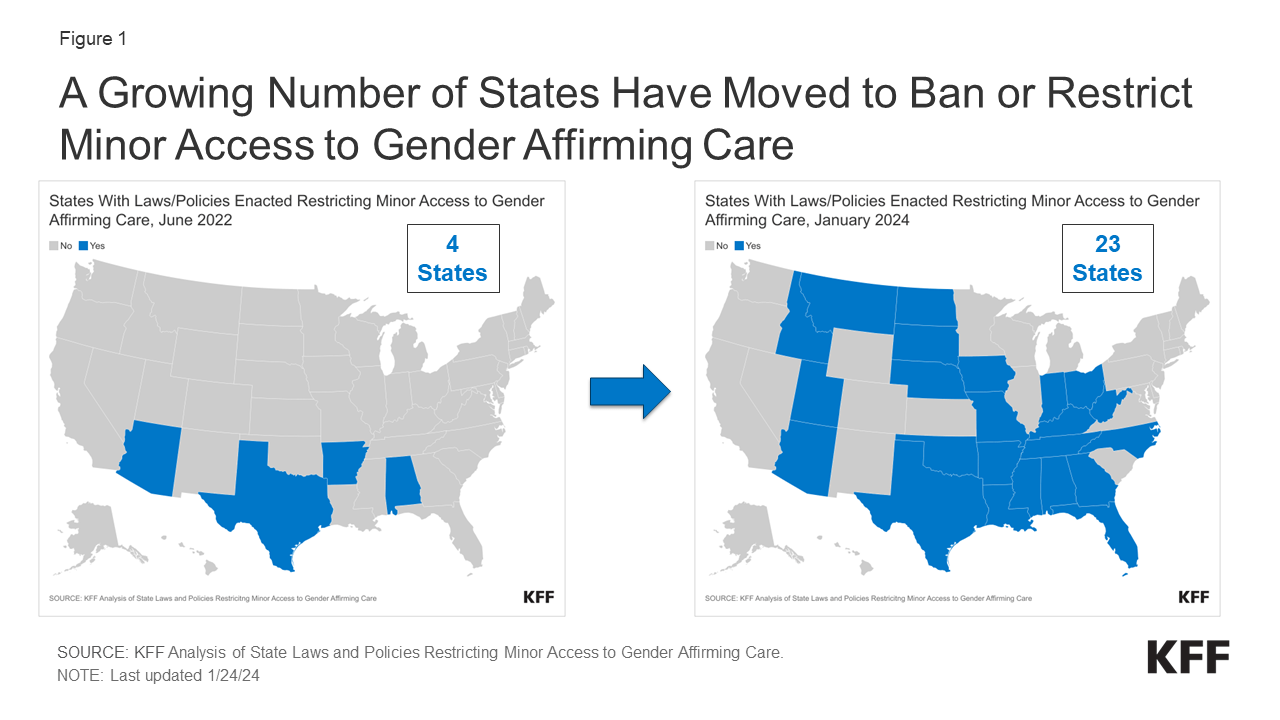
The good news is that there are signs that we are winning. Whereas only four states had moved to ban or restrict minor access of so-called gender affirming care, that number rose to 23 states by January 2024 (see above). Europe is ahead of us on this front (they do not suffer the same as we do from the presence of privatized health industry), but we are making progress. Moreover, as I point out in Bubbles and Realities, in 2022, the number of Americans who believe that a man cannot change his gender had steadily increased since 2017. The number have risen event more since then. According to a June 2024 Pew Research poll, nearly two-thirds of registered voters (65 percent) say whether a person is a man or woman is determined by the sex assigned to them at birth, whereas only about a third (34 percent) say whether someone is a man or woman can be different from the sex at birth.

 freedom and reason