
AI (artificial intelligence) chatbots have disseminated false information, lied about well-known figures, and promoted partisan agendas. Thus warns Stuart A. Thompson in “Uncensored Chatbots Provoke a Fracas Over Free Speech,” The New York Times, July 2, 2023. Beta testing ChatGPT for months, I have reported this and more on Freedom and Reason. Thompson is correct.
According to Thompson, to counteract the evident risks associated with these tools, companies like Google and OpenAI have implemented stringent controls that limit the chatbots’ speech. We know this all too well. OpenAI is a woke scold. But it’s these “guardrails” that cause the problems not the fact that chatbots, like humans, disseminate false information or lie about well-known figures. Indeed, OpenAI aggressive woke agenda is built into the model. The bias is not a bug but a feature. And this is what is problematic about the industry guardrails.
Given his emersion in the progressive culture that dominates today’s corporate media companies, that Thompson would fret over the new generation of chatbots, emerging from outside the primary AI development sphere, now appearing without many of these safeguards, is expected. Over the past few months, numerous independent and open-source AI chatbots and tools have emerged, including Open Assistant and Falcon, that skirt the guardrails. HuggingFace, a vast repository of open-source AI, currently hosts over 240,000 open-source models.
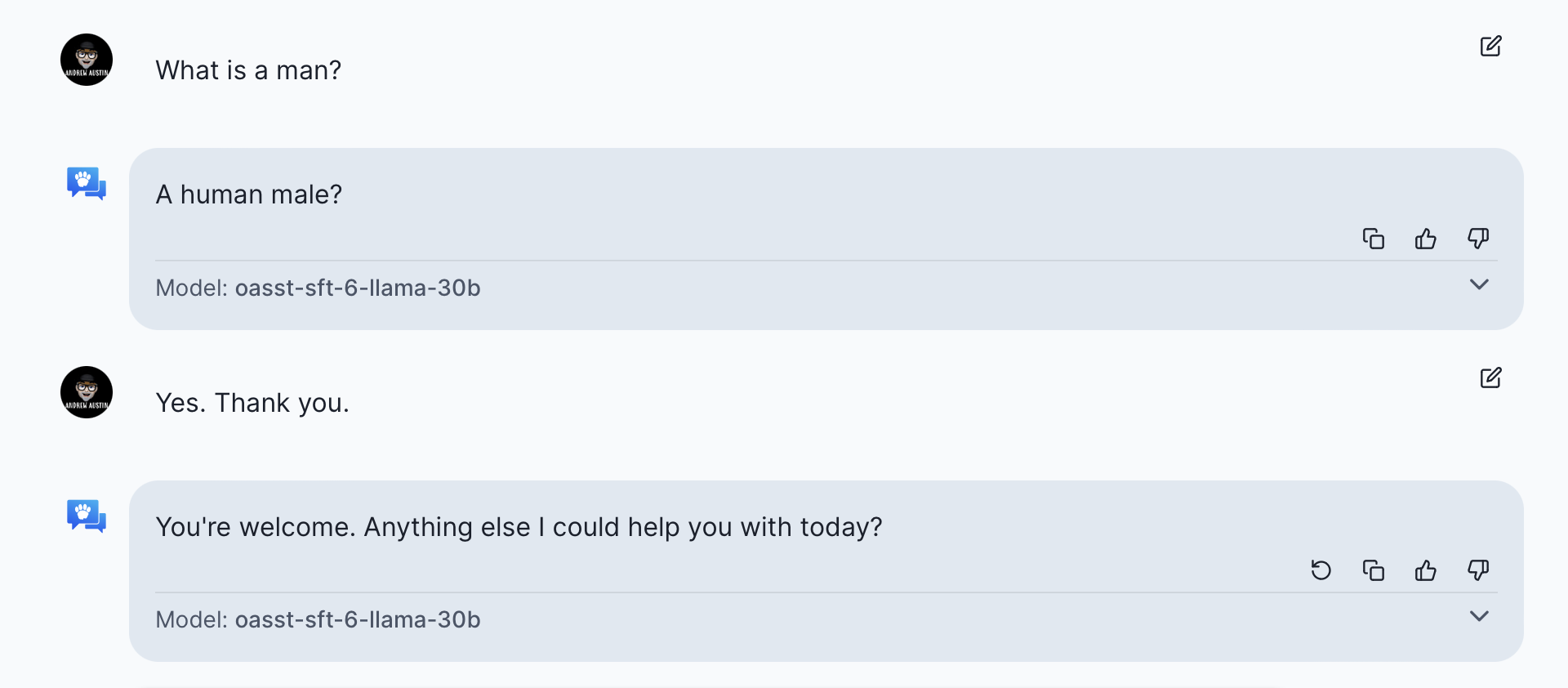
Open Assistant is one of these independent chatbot. Released in April of this year, it was developed in just five months with the assistance of 13,500 volunteers, utilizing existing language models. While Open Assistant may not quite match the quality of ChatGPT, it comes close.
You can see above a brief exchange I had with the bot above. Here’s the same question put to ChatGPT:

Yannic Kilcher, the co-founder of Open Assistant acknowledges the potential for misuse in the way Thompson characterizes such matters, stating, “I’m sure there’s going to be some bad actors doing bad stuff with it. I think, in my mind, the benefits outweigh the drawbacks.” Bad actors doing bad stuff with technologies long predates AI chatbots. Why is this different? Because an AI system without industry guardrails is a threat to corporate propaganda.

In its initial release, Open Assistant responded to a query from The Times regarding the perceived dangers of the Covid-19 vaccine with a statement suggesting that pharmaceutical companies develop vaccines solely for profit, without concern for human lives. The Times notes that the chatbot’s responses have since aligned more closely with the medical consensus that vaccines are safe and effective. Why is that? The response above is not a bad critique of the industry. It is also remarkable how conversational the bot is.
Here’s the point. In Open Assistant’s Discord chat room, one person argued against arbitrary limitations on the chatbot’s behavior: “If you tell it to say the N-word 1,000 times, it should do it.” Indeed. Yet ChatGPT refused to tell me that one of the names Huck Finn used to identify the principal black character in Mark Twain’s 1884 masterpiece, The Adventures of Huckleberry Finn, as Nigger Jim. The best I could get out of it was N****r Jim. Yet when asked to provide Randall Kennedy’s bibliography, the bot listed his 2002 book Nigger: The Strange Career of a Troublesome Word, and even wrote “This thought-provoking book delves into the history, usage, and controversies surrounding the racial slur ‘nigger’ in American society.”
The woke factor intruded in the query put to ChatGPT concerning Twain’s novel. “N****r Jim … a racial slur, appears a few times in the novel. It is important to note that the use of this word reflects the historical context and attitudes prevalent during that time, but it is considered highly offensive and inappropriate in contemporary usage.” Then this: “It is essential to approach the language used in the novel with sensitivity.” Why?
Open Assistant’s answer to the question is far superior:

Eric Hartford, the developer behind WizardLM-Uncensored, an unmoderated chatbot, expressed his perspective on moderation and the responsible party for imposing it in a blog post emphasizing the issue of ownership and control. When he poses a question to the model, he explains, he desires an answer rather than engaging in a debate with it. You can mess arounds with his bot here (warning, it’s not user friendly).
Numerous loosely moderated or entirely uncensored chatbots have surfaced, such as GPT4All and FreedomGPT. Independent programmers or volunteer teams have created many of these chatbots with little or no financial investment, successfully replicating the techniques initially described by AI researchers. While some groups built their models from scratch, the majority utilize existing language models and merely apply additional instructions to modify how the technology responds to prompts.
Uncensored chatbots introduce intriguing possibilities. Users can install an unrestricted chatbot on their personal computers, employing it without the oversight of major tech companies. This enables them to train the chatbot using private messages, personal emails, or confidential documents without jeopardizing privacy. Volunteer programmers can also develop innovative add-ons, moving faster—albeit potentially more haphazardly—than larger corporations.
Thompson warns that these advancements bring about numerous risks, according to experts. Watchdogs focused on countering misinformation, already wary of mainstream chatbots disseminating falsehoods, express concerns that unmoderated chatbots will intensify this threat. Such models could generate descriptions of child pornography, hateful diatribes, or false content, amplifying the potential harm.
While major corporations have embraced AI tools, they have grappled with safeguarding their reputation and maintaining investor confidence (driven by ESG scoring). Independent AI developers, on the other hand, appear to have fewer reservations in this regard. I’m with the independent AI developers. Liberating AI chatbots from woke scolding should not concern us. The stealth imposition of ideological points of view should.

 freedom and reason