
I will be writing more about this in the future, but this seems the necessary starting point for readers to better understand my past blogs concerning the rise of the New Fascism: a brief account of the transformation of the Roman Republic into the Roman Empire and the perversions that followed, with comparisons points to the deformation of the American Republic. While, after a long period of human suffering in Europe, the fall of the Roman Empire paved the way to modernity, a difficult path to be sure, modernity is now here and the regressive forces of progressivism and technocracy have imperiled it. Thus new perversions threaten the aspiration of our species for a superlative and lasting form of self-government. America is rapidly tumbling into dictatorships. Many of its signs are already here. The people must confront this.
Rome is the necessary starting point because of the lesson it provides for those of us who live in these tumultuous times and because, as many of you know, the founders of the American Republic drew inspiration from the Roman Republic when designing the framework of the American government, as well as the nation’s creed, which emphasizes democracy, equality, individualism, liberty, pluralism, and self-reliance, a list of ideals that, in practice, however imperfectly executed, has made America the greatest instantiation of democracy and freedom in world history.
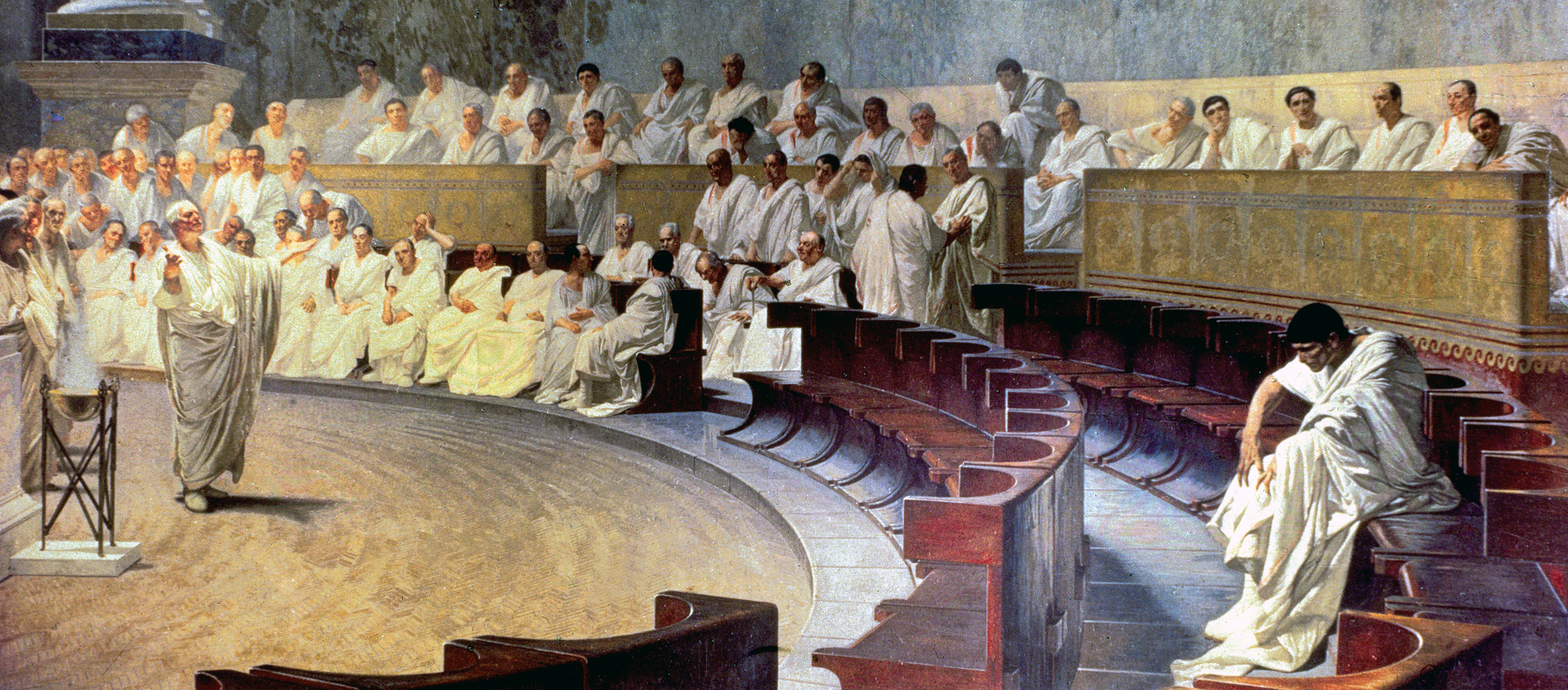
References to Roman history, philosophy, and political figures can be found in various writings of the founders. The Roman statesman and political philosopher Cicero, known for his defense of republican values, was frequently quoted and cited by the founders. The Roman Republic and Roman statesmen weren’t their only inspiration, of course. They also drew from other political philosophers and historical examples, such as the Greek city-states, and, crucially, Enlightenment thinkers such as John Locke and Montesquieu, the source of America’s humanist, liberal, and secular character. Nonetheless, it was the example of the Roman Republic that gave them the plan for a form of government that made the emergence of a dictator unlikely—or at least more difficult to achieve.
The founders admired in particular these aspects of the Roman Republic: the concept of civic virtue, divided government, or separation of powers, and its system of checks and balances. The founders sought to incorporate these principles into the new American system to prevent the concentration of power and protect individual liberties. Again, the promise was to prevent the rise of a dictatorship. Tragically, historical developments portend the breaking of this promise—if that promise has not already been broken.
One notable influence on the founders’ plans was the Roman concept of the mixed government or mixed constitution, which involved a balance of power between different branches or orders. The Roman Republic had three main branches of government: the consuls, the popular assemblies, and the Senate. The founders of the American Republic sought to emulate this balance by dividing powers among the executive, legislative, and judicial branches. For example, the founders envisioned the United States Senate as a deliberative body akin to the Roman Senate, which represented the interests of the states, a place where the experienced and the knowledgeable deliberate on legislation, (This was the reason the states appointed the Senators in the original constitution.)
Additionally, the concept of civic virtue, derived from the Roman ideal of the virtuous citizen engaged in public affairs, was seen as vital for the success of the American Republic. The founders believed that a virtuous and educated citizenry would help ensure the stability and longevity of the republic. This is why, despite the fact that the founders were a mix of devout Christians and deists, and likely a few atheists, as well, they recognized the importance of those Christian values compatible with a secular framework.
Thomas Paine, the author of several notable works, including Common Sense and The Age of Reason was a deist and a freethinker. In his writings, Thomas Jefferson extracted the moral teachings of Jesus while omitting the Bible’s supernatural elements. Benjamin Franklin expressed skepticism about organized religion but emphasized the importance of morality and virtue. George Washington, an Anglican Episcopalian, referenced God in his public speeches and private correspondence but abstained from taking communion during services. John Adams was a Unitarian and frequently referred to his faith in his writings. These are religious persuasions compatible with secular government while providing blueprints for virtuous lives. (One must not in the telling of American history neglect the fact that Protestantism plays a major role in the emergence and evolution of the modern West.)
However, tragically, like the Roman Republic, the America Republic has been overtaken by Empire, which has allowed for the emergence of a dictatorship of the corporate state analogous to the undemocratic governing structures in the Roman Empire. The democratic-republican process established by the founders has been corrupted by a permanent political establishment, the administrative state, with a deep state that plays a role much like the Praetorian Guard in the Roman Empire. Moreover, like the Roman Empire, the American Empire is a military state devoted to world adventurism.
All this portends doom for the American project. It is therefore useful to understand the story of the perversion of Rome by the authoritarians who took it over from within, actions leading to its downfall and the submersion of Europe in the Dark Ages, a darkness that would only be cracked centuries later, first by the Renaissance, then by the Age of Reason and the Enlightenment, which benefited greatly from the Protestant Reformation breaking the religious monopoly of the Catholic Church. Obviously, a comprehensive history of this matter is one for a book-length treatment. However, a sketch should suffice to get my main point across.
* * *
The Roman Republic was a period of ancient Roman history that lasted from 509 BC to 27 AD. It marked the early form of Roman government, characterized, as noted earlier, by a system of checks and balances, representative assemblies, and the shared power of elected officials. During this time, Rome grew from a city-state to a dominant power in the Mediterranean region, which improved the region by civilizing the surrounding tribes, effectively putting the region on a course towards detribalization.
In the early years of the Roman Republic, political power was vested in two annually elected officials called consuls, who served as the highest authority in the state. They were responsible for leading the military, presiding over the Senate, and executing the laws of Rome. The Senate played a significant role in advising the consuls and shaping policies. The Republic also had a popular assembly called the Comitia Centuriata, which represented Roman citizens and had the power to pass laws and elect officials. Like the United States and modern European countries, underpinned by the capitalist mode of production, a class-based system, political power in the Roman Republic was organized on the basis of social class and wealth, with the wealthier citizens having greater influence.
However, over time, internal conflicts, struggles for power, and external threats posed by rival states and military conquests contributed to the transformation of the Roman Republic. As Rome expanded, power and wealth became concentrated in the hands of an ever fewer families and individuals, creating economic disparities and social antagonisms. This led to political tensions and unrest. Additionally, powerful generals emerged and sought to extend their personal influence and control over the political apparatus.

The transition from the Roman Republic to the Roman Empire took place in the first century BC. It was marked by a series of civil wars and political upheavals. Julius Caesar emerged as a prominent figure and, after a period of conflict, established himself as dictator for life. His reforms aimed to address social and economic issues and enhance his personal power. His assassination in 44 BC led to another power struggle, with his adopted heir Octavian, later known as Augustus, emerging as the dominant figure. Augustus consolidated power and established a new political system that effectively marked the end of the Roman Republic and the beginning of the Roman Empire. In 27 BC, Augustus established the Praetorian Guard, also known as the Praetorians, an elite military unit serving as the personal bodyguard of Roman emperors in ancient Rome. The transition from the Roman Republic to the Roman Empire represented a significant transformation in Rome’s political structure and governance, shifting from a republican system to a centralized imperial rule under the authority of emperors.
The Praetorian Guard played a significant role in the politics and power dynamics of the Roman Empire. Initially, the primary purpose of the Praetorian Guard, stationed in a fortified camp, the Castra Praetoria, located in Rome, was to protect the emperor and the imperial family. Over time, the size and composition of the Praetorian Guard grew and changed and its influence expanded beyond its original role. The Praetorian Guard’s proximity to the emperor granted the apparatus significant political influence and leverage. It became involved in imperial succession, often playing a decisive role in the appointment and removal of emperors. The Guard had the power to support or overthrow an emperor, as its loyalty could shift based on its own interests or the promises and bribes of aspiring emperors. Emperors who enjoyed the support of the Praetorian Guard could rely on its loyalty, but at the same time, they needed to maintain the favor of the Guard to ensure their own safety and authority.
The Praetorian Guard left a lasting impact on the Roman Empire, serving as a symbol of the military’s influence in politics and highlighting the potential dangers of a powerful and politically motivated military force lying at the center of government. This history demonstrates the complex relationship between military power and political authority within the Roman Empire, a demonstration useful for understanding the situation of America today as it degenerates into a New Fascism under the controlling influence of progressive ideology.
* * *
Comparing the rise of empire in the Roman situation and the rise of empire in the American situation provides crucial insights into the nature of power and the role of institutions. To be sure, there are significant differences between the cases, not least of which is the dissimilarity between ancient economic systems and the advanced capitalist mode of production; but even as analogy, drawing a parallel between the Praetorian Guard in the Roman case and the administrative state in the American case offers a way to explore the dynamics of centralized authority and the potential risks and challenges that come with it.

As we have seen, the Praetorian Guard was an elite military unit initially tasked with protecting the Roman emperor and maintaining order in the capital city of Rome. However, over time, in a paradigm of mission creep, the Praetorian Guard gained significant political influence and became a powerful force within the Roman Empire. It often played a role in the elevation or removal of emperors and other officials through its ability to depose or support them. The Praetorian Guard’s power and political influence made it a potential threat to the stability of the empire but more crucially, it represented a major obstacle to the restoration of the Roman Republic and its democratic processes.
The administrative state refers to the various government agencies and bureaucracies responsible for implementing laws, regulations, and policies. This permanent political class lies at the heart of the executive branch, which has in the United States grown significantly over time, with numerous agencies and departments involved in various aspects of governance, public administration, and regulation. This permanent class wield substantial power in the implementation and enforcement of laws and regulations. The administrative state’s expanding scope and influence raise concerns about accountability, regulatory overreach, and the potential for unelected bureaucrats to wield significant power without sufficient democratic oversight. The administrative state is powerful, prone to abuses of power, while at the same time subject to regulatory capture with the rise of corporate power. The military-industrial complex and the national security state apparatus play an outsized role in shaping the trajectory of American history and the fate of the people.
C. Wright Mills, professor of sociology at Columbia University, best known for his book The Power Elite, published in 1956, which examines the nature of power and its concentration among corporate, military, and political elites in the United States, helps observers analytically organize the evidence of power in their lives. In that book, Mills argues that power in modern societies is concentrated in the hands of a small group of individuals who occupy key positions in dominant institutions. These three institutional spheres are interconnected and form a cohesive power structure that dominate and shapes American society. Mills argues that this power elite consists of individuals from upper-class backgrounds who have the resources, influence, and access to decision-making positions. The elite share similar backgrounds, educational paths, and social networks, which enable them to perpetuate their power and maintain their privileged position in society. Crucially, this elite operate in ways that are largely independent of formal democratic processes and institutions.
In The Power Elite, Mills criticizes the increasing influence of the power elite in shaping public policy and the overall direction of society. He argues that the interests and values of the power elite diverge from those of the general population, leading to what David Held, in his 1995 book Democracy and the Global Order: From the Modern State to Cosmopolitan Governance, referred to as a “democracy deficit.” Mills expresses concerns about the potential erosion of democracy and the concentration of power in the hands of a few, a concern given an update for the new millennium by Sheldon Wolin, a political philosopher at Princeton University, in his 2008 Democracy, Inc.: Managed Democracy and the Specter of Inverted Totalitarianism. Wolin characterized the situation as “inverted totalitarianism.” Inverted totalitarianism represents a shift from the traditional notion of totalitarianism, which is characterized by an overt authoritarian rule, to a more subtle and less visible form of control.
Wolin contends that inverted totalitarianism is marked by the growing influence of large corporations and the power of the economic elite over political processes. He argues that the concentration of economic power in the hands of corporations has led to the erosion of democratic principles and practices, as economic interests increasingly shape political decisions. Wolin highlights the role of what he calls “managed democracy” in maintaining the illusion of popular participation and political choice. He suggests that the electoral process and political campaigns have become heavily influenced by corporate money, leading to a narrowing of political options, and limiting genuine democratic participation. Wolin argues that political parties, which he refers to as “the twin-party system,” have become increasingly similar in their policies and allegiance to corporate interests. This is what I and others refer to as “the establishment.”
The establishment works through the administrative state. Within the administrative state there is a deep state apparatus that ensures that the establishment obtains the leadership it desires. (Sometimes this fails, as in the case of Donald Trump in 2016. But this is rare and unlikely to happen again unless there is mass resistance to the current situation.) To control the domestic and external environment for the sake of corporate elites, the United States has established various agencies and organizations dedicated to national security. Two prominent agencies in this regard are the Federal Bureau of Investigation (FBI), established in 1908 and repurposed by J. Edgar Hoover in the 1920s, and the Central Intelligence Agency (CIA), established by the National Security Act of 1947 by President Truman. These and other agencies have over the last several decades been weaponized by the administrative state. (For more details on these agencies see Jon Stewart: Corporate State Stooge.)
The FBI is a federal law enforcement agency operating under the jurisdiction of the Department of Justice. Its ostensive role is to investigate federal crimes, protect national security, and enforce federal laws. While the FBI’s jurisdiction extends internationally, it primarily focuses on domestic security within the United States. The FBI collaborates with various federal, state, and local law enforcement agencies to push administrative state control deep into the American governing apparatus and civil society. The FBI accomplishes this by leveraging its charge, a wide range of responsibilities including counterintelligence, counterterrorism, and cybercrime investigations. The CIA is an international intelligence agency that operates under the authority of the executive branch. Its primary mission is to collect and analyze intelligence information, conduct covert operations, and provide assessments to inform policy decisions related to national security. The CIA’s focus extends beyond domestic security to global intelligence gathering and analysis. But it is also involved in domestic politics, as we recently saw with the Hunter Biden laptop scandal. The work of these agencies is integrated with tat of the Department of Homeland Security (see MDM is the New WMD: DHS Issues a New NTAS Bulletin; The Weaponization of the Government; The “Control of Misinformation” and the Deterioration of the Integral State; Twitter Interfered in the 2020 Election).
Drawing a comparison between the Praetorian Guard and the administrative state highlights the potential risks associated with concentrated power and the need for appropriate checks and balances. The growing power of both indicate the shift from republic to empire. In both cases, the centralization of power introduces challenges to governance, including corruption, lack of accountability, and threats to democratic processes. Analyzing these parallels contributes to a broader understanding of the complexities and dynamics of empire-building and the management of centralized authority. Today, the American Praetorian Guard, i.e., the deep state, selects our presidents, the installation of the Biden regime only the most obvious instance. The deep state means to determine the outcome of 2024 election, as well (see Democrats Have Crossed the Rubicon). Thus these types of analyses are vital to America’s future as a model republic—at this point to the restoration of the American Republic so that it can serve as such a model—and so you can expect more.

 freedom and reason