The FAR Podcast Episode # 21 Marx and Americanism: From One Revolutionary to Another

The following is the text I worked from in my podcast published on July 4, 2020. I said a whole lot more so give the podcast a listen! Subscribe and comment.

In his 1865 letter to President Abraham Lincoln, on the occasion of Lincoln’s reelection in midst of civil war, the great communist revolutionary Karl Marx, on behalf of the International Working Men’s Association, praises the United States as “the idea of one great Democratic Republic.”

Marx writes that America is the place where “the first Declaration of the Rights of Man was issued.” Marx is talking about our great Bill of Rights. The right to free speech and a free press, the right to assembly, to petition the government for a redress of grievances. The right of persons to be free from arbitrary search and seizure, to be secure in their papers and effects, to remain silent, and so forth.

In the pages of The Washington Post, in an op-ed titled “It is time to reconsider the global legacy of July 4, 1776,” Elizabeth Kolsky writes, “The nation’s democracy was founded as a slave society.” “The knee to [George] Floyd’s neck has provided black and indigenous peoples with a metaphor to express their own centuries-long experiences of and struggles against systemic racism. These protests are not only expressions of solidarity with black Americans—they represent a collective reckoning with a past that is not past.”

Putting aside superstitious notions of living persons owning centuries-long experiences of anything, does Marx see the United States as a hopeless project on account of chattel slavery? Marx understands that slavery was widespread in the world of his time. Slavery was not an invention of the West nor was it unique to America. America was not founded as a slave society; it was founded as a nation in the context of the slave mode of exploitation, which was one among other modes of exploitation.

Marx sees the Civil War as the work of a great nation overcoming an historical injustice mankind had long endured (still endures outside of the West). With abolition, a “barrier to progress has been swept off by the red sea of civil war,” he writes. Marx continues, “From the commencement of the titanic American strife since the beginning of the conflict, the workingmen of Europe felt instinctively that the star-spangled banner carried the destiny of their class.”

I hear this a lot, “But Marx said working people have no country.” What did he mean by that? Marx tells the worker movement and the world in the Communist Manifesto that “the struggle of the proletariat with the bourgeoisie is at first a national struggle.” He writes, “The proletariat of each country must, of course, first of all settle matters with its own bourgeoisie,” he writes.

Marx was a theorist of globalization. He was a nationalist. He understood the importance of democratic-republican machinery and national economy to effect change for communities. It was in the context of the capitalist nation-state that the working class were move from a class-in-itself to a class-for-itself.

“The real fruit of their battles lies, not in the immediate result, but in the ever expanding union of the workers,” Marx writes. “This union is helped on by the improved means of communication that are created by modern industry, and that places the workers of different localities in contact with one another.”

At the same time, Marx recognized the dynamic of the system and the machinations of the capitalist class in thwarting the worker movement. “This organization of the proletarians into a class, and, consequently into a political party,” he writes, “is continually being upset again by the competition between the workers themselves.”

One of the strategies the bourgeoisie uses is bourgeois nationalism. Bourgeois nationalism is the practice of fracturing the proletariat (the working class) by dividing the people by ethnicity, race, and religion. Thus, after liberating business, culture, and religion, fractions of the bourgeoisie attempt retribalize it.

Such a move is always obviously to disrupt the class consciousness that threatens to strengthen proletarian politics. Anyone can see that. Or at least should see it. We see it in the practice of bourgeoise nationalism today in the doctrine of multiculturalism, the importation of culture-bears with different religious sensibilities, and the selection of collaborators among them (tokenism).

The promotion of identity politics in the United States is the child of the cultural pluralism of Horace Kallen, representative of the progressive cosmopolitan crowd, who, writing in the pages of the progressive magazine The Nation in 1915, and ultimately for the interests of the industrialist, deceitfully claimed that cultural relativism would provide a greater national unity. This is the argument in defense of open borders.

In his in a letter, from London, to Sigfrid Meyer and August Vogt in New York, in 1870, Marx observed that the English bourgeoisie sent Irish labor made redundantly through the rationalization of land use “to the English labor market,” a practice that “forces down wages and lowers the material and moral position of the English working class.” The effect of this was to divide the working class into “hostile camps, English proletarians and Irish proletarians.”

In a confidential communication on Bakunin, Marx writes that the English working class “feels national and religious antipathies for him [the Irish].” And insofar as the English worker identifies with the ruling class and regards himself a member, and falls into supporting English colonization in Ireland, he strengthens its power.

Marx writes, “This antagonism is artificially kept alive and intensified by the press, the pulpit, the comic papers, in short, by all the means at the disposal of the ruling classes. This antagonism is the secret of the impotence of the English working class, despite its organization. It is the secret by which the capitalist class maintains its power. And the latter is quite aware of this.”

The ruling class consciously purses a strategy of divide and rule. As I have shown on my blog in numerous essays, it was not until the American working class won restrictions on mass immigration and sharply reduced the proportion of foreign born workers in the population that we see a unified working class movement that won, in many aspects before the European countries, rights for workers. Yet another blow struck for progress.

But if people are taught to believe that the United States is no different today than it was when Jim Crow prevailed, or the brutality of the Gilded Age, or worse, no better than the days when blacks were chattel, then the interpretation of selectively presented facts shaped by that framing comes out wrong and potentially destructive. Privation may lend this feeling energy, but it is the interpretation of American history that is malignant. Ideas matter.

So, while the New Left, the progressives and the identitarians, have abandoned the cause of democracy and liberty and fly other flags, I will fly the flag of carries the destiny of my class—the working class. Our destiny lies through populist-nationalism organized around working class interests.

* * *

Our common future lies through republicanism and the rule of law and our common social class location, in our solidarity as working people.

As Karl Marx wrote in his first article for the Rheinische Zeitung in 1842, echoing John Locke, “laws are in no way repressive measures against freedom, any more than the law of gravity is a repressive measure against motion, because while, as the law of gravitation, it governs the eternal motions of the celestial bodies, as the law of falling it kills me if I violate it and want to dance in the air. Laws are rather the positive, clear, universal norms in which freedom has acquired an impersonal, theoretical existence independent of the arbitrariness of the individual.”

Marx reveals in his work a profound republicanism steeped in communalism. “A statute book is a people’s bible of freedom,” he writes. He’s right about that. There is no freedom without security.

Monument Redux: What the Defacers and the Topplers are Really After

In yesterday’s blog, on the eve of the Fourth of July, I asked, “Why can’t we agree to leave Jefferson and Lincoln where they are? Why can’t we agree to stop talking about it and get on with celebrating the greatest country that ever existed? If you want to know the answer to these questions, ask yourself this one: what do people get out of relitigating history? They’re after something.” What are they after?

The President of the United States gave Americans a heads-up at his Independent Day celebration at the foot of Mount Rushmore yesterday. “Make no mistake,” Trump said: “this left-wing cultural revolution is designed to overthrow the American Revolution.” The president continued, “To make this possible, they are determined to tear down every statue, symbol, and memory of our national heritage.” He warned that, if successful, this movement “would destroy the very civilization that rescued billions from poverty, disease, violence, and hunger, and that lifted humanity to new heights of achievement, discovery, and progress.”

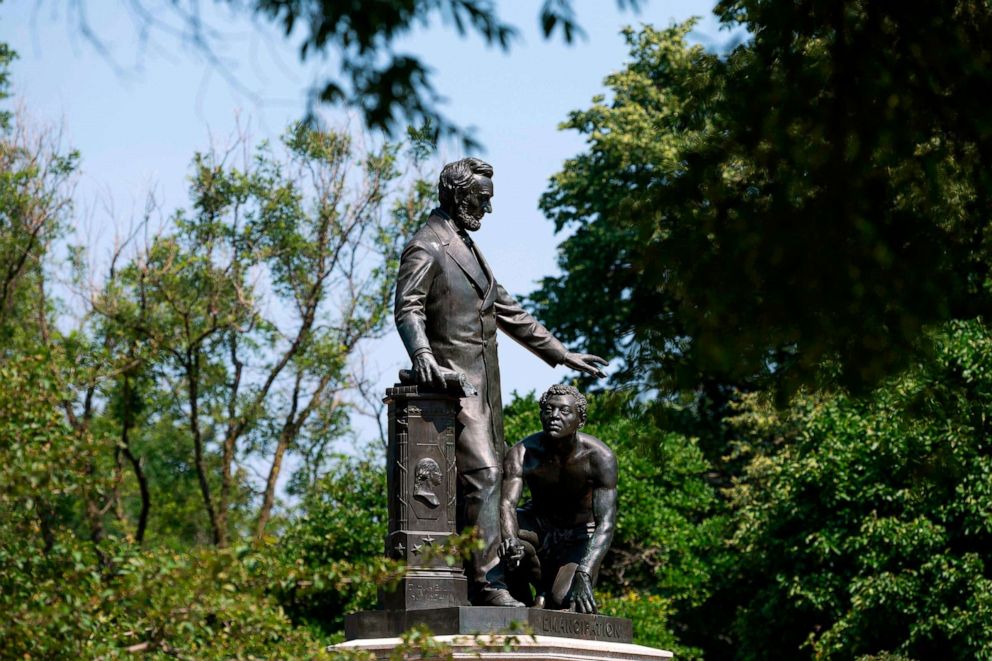
The Emancipation Memorial in Lincoln Park. Freed slaves raised money for the monument. There is a campaign to remove it and there have been efforts to deface and topple it.

It was crucial at this time, with the anarchy in our streets only the most visible manifestation of rapidly spreading anti-Americanism, that the President of the United States stood up for the republic and its history. He called out “cancel culture” by name and correctly assessed the problem: “our children are taught in school to hate their own country, and to believe that the men and women who built it were not heroes, but that were villains.” Trump told his audience, “The radical view of American history is a web of lies—all perspective is removed, every virtue is obscured, every motive is twisted, every fact is distorted, and every flaw is magnified until the history is purged and the record is disfigured beyond all recognition.”

The establishment—The New York Times, The Washington Post, CNN—painted the president’s speech as divisive, as if he had created cancel culture, as if he invented Antifa.

The false narrative the president assails, a narrative predicated on race-thinking, obscures the nation’s profound record of progress. Despite having dismantled systemic racism in the form of de jure segregation more than half a century ago, despite having made discrimination based on race illegal with the Civil Rights Act of 1964, despite having embarked on an extensive program of reparations, the United States is said to be under the control of “a regime of white supremacy” (to quote a prominent “critical race theory” scholar). They want us to believe that talking about our record of achievement treats “the exercise of racial power as rare and aberrational rather than as systemic and ingrained.” But the exercise of racial power is not systemic or engrained. It is rare and aberration. Such obviously false statements reveal the goal that lies behind them: to make the exercise of racial power appear as systemic and ingrained and thus discredit the nation. The New Left sees racial power as a method to radically reconstruct society.

I have been explaining to people, and I want conservatives to understand this, that the issue with monuments is not to be confused with the Confederate flag or the racially-insensitive mascots of sports teams. States have been removing Confederate flags from their capitols. That’s what happens when a regime is overthrown. You don’t fly the Nazi flag over Germany after defeating Nazism. That’s obvious. You don’t fly the Confederate flag over America for the same reason. This is why I have been a life-long opponent of the Confederate flag flying on public property. Sports teams are removing racial-insenitive mascots. To be sure, it has taken too long. But it’s happening. Protests that push governments and corporations to change these things are to be appreciated for their existence and persistence. That’s what the First Amendment is all about.

Nobody’s liberty is compromised by lowering the flag of a defeated nation or changing a team name or mascot. If people want to fly the Confederate flag on their trucks or their homes, wear it on their clothes, or tattoo it on their bodies, or do the same with a swastika or an Indian head, that’s okay by those who love liberty—even if it offends them—because it is okay by our Constitution. These are expressions of personal freedom. If people want to keep lawn jockeys, they should be allowed to display them. Same with nativity scenes. Government doesn’t get to decide these things for us. If displays offend people, then look away. I’m offended by Black Lives Matter flags. BLM is a racially divisive project. Others are offended by the thin blue line flag. Being offended by a display or a flag is no reason to demand the government to force others to take them down. However, if they fly that flag over a state house or display the nativity on public grounds, then there’s a problem.

Free speech is part of the legacy we celebrate with monuments and statues to the founders and defenders of our way of life. People ask why we can see swastikas in America but not in Germany. Is it because we have Nazis here and there are none in Germany? No. There are Nazis in both countries (albeit not very many). The reason for the difference is that Germany practices aggressive government thought control. The United States is constitutionally limited in how much thought control the government can impose. That’s because the sovereign people demanded liberty from excessive government control. Thankfully we had men like James Madison and his ilk to write that into our Constitution. Germany’s ban on Nazis symbols and flags exposes real shortcomings in Germany’s grasp of free speech and civil liberties. Many European countries have a very poor grasp of civil liberties. We don’t want to be like them. We are fortunate to have our First Amendment. Robust freedom of speech is part of what makes the United States republic a role model for the rest of the world. Whatever Madison did that we would judge wrong, that is not why we erect a statue to his memory. We erect a statue to Madison’s memory because of what he did right.

The New Left wants to tear down this freedom with cancel culture. The president told his audience last night about a political movement demanding allegiance to its ideology being promoted in “our schools, our newsrooms, even our corporate boardrooms.” He called out the political weapon of “cancel culture”: “driving people from their jobs, shaming dissenters, and demanding total submission from anyone who disagrees.” He told his audience that cancel culture is “alien to our culture and our values, and it has absolutely no place in the United States of America.” He’s right. It is the culture of freedom that is under assault. “If you do not speak its language, perform its rituals, recite its mantras, and follow its commandments,” the president continued, “then you will be censored, banished, blacklisted, persecuted, and punished.” He promised: “It’s not going to happen to us.” But the regime of unfreedom is already controlling the sovereign people. It is happening to us.

Why the attack on monuments to our founders and to those who kept the union together and moving forward? I hope it’s becoming clear to you. It’s not really about removing an offensive symbols. The New Left is not reluctant to be offensive. The real goal is to delegitimize the ideals of the republic while looting other people’s property—and using race as a lever. The goal to delegitimize the idea that individuals are responsible for their actions and replace it with a bogus theory that seeks to make all white people racist and guilty of past deeds. In other words, to hold whites as a group responsible for the failures of individuals.

According to the American ethos, my boys are not born in debt to or have to apologize for the wrongful acts of other people. Neither of them would expect anybody to do that for them. They will stand on their own two feet. They will take responsibility for their actions and suffer on account of their own failures. Anything they expect from the government they expect will be available for everybody else. I have yet to read an argument that does not appeal to supernatural logic that could reasonable justify holding children responsible for slavery or Jim Crow of the genocide of the American Indian. We live in a secular nation where such superstitious thought is not supposed to move law and policy. That’s also in our First Amendment.

There is a meme circulating on social media with a picture of a little Japanese girl with a demand that she apologize for Pearl Harbor. It doesn’t take long to get past the initial shock of the image to see its implications. To suppose that this little girl owes Americans an apology or anything else for what the Japanese did to America seventy years ago is absurd. I think everybody will agree with that. Of course, the meme is pointing out that that there are a lot of people walking around who think a white baby is born indebted to black people for slavery and Jim Crow.

WWII took fathers from sons and sons from fathers. The damage Germany inflicted on the world continues to be felt today. No child born in Germany today owes any American anything for what his ancestors did. Germans don’t need to seek absolution from Americans for anything. They don’t need to remove any monuments or censor any words on America’s account. We must reject blood guilt. To be sure, we should learn from history. But we should not use history to extort money from people or to humiliate those who didn’t make it.

That people must reach into the past for justice tells us there’s not a lot of injustice in the present—at least not the injustice they claim they seek.

The Endless Relitigating of the Past as a Postmodern Condition

In 2016, in the context of the protests over the Keystone pipeline, Inside Sources asked me my opinion of the criticism that white environmentalists were hijacking the indigenous concerns of the Standing Rock Sioux tribe and other American Indian tribal nations across the country. Part of the concern for the indigenous was that the pipeline ran through sacred grounds. I disagreed with the suggestion that the American Indian protest was being hijacked by environmentalists at the expense of the concerns of American Indians. I pointed out that environmentalists and others have legitimate concerns about the pipeline. I emphasized that “the Dakota Access Pipeline involves land that could affect millions of people downstream.” Moreover, I said, “there is the larger issue of fossil fuels and climate change.”

I worked my answer around the problem of “the sacred.” I was then as I am now interested in people not tribes. But the news today has inspired to make sure that my opinion about such matters is clear: I always hesitate add my voice to the framing of the issue of Indian lands in terms of claims of sacred spaces since I do not believe lands can be sacred in this way. That would require me to accept a premise of which I am deeply skeptical as well as eschew my commitment to the individualism of democratic-republicanism over against tribal thinking and practice. If the lands are public, then this is a matter for the government to decide. I opposed the pipeline on rational grounds.

File:Mount Rushmore detail view (100MP).jpg
The Mount Rushmore National Monument in the Black Hills in Keystone, South Dakota

On June 29, the chairman of the Cheyenne River Sioux Tribe, Harold Frazier, called for the removal of Mount Rushmore National Memorial. This has become a national issue because President Donald Trump has planned to celebrate our nation there for the Fourth of July. “The United States of America wishes for all of us to be citizens and a family of their republic yet when they get bored of looking at those faces we are left looking at our molesters,” Frazier wrote. The “Great Sioux Nation,” was betrayed by a country that carved faces into “our sacred land on what the United States calls Mount Rushmore.” Frazier is not alone. A campaign to remove the monument is gathering energy.

Keep in mind that the first site chosen for the monument (the Needles) was rejected because of objection from the Sioux. The sculptor and tribal representatives agreed to build the moment on Mount Rushmore. The monument idea moved from a narrow regional appeal to a more inclusive and national display by including four great liberal and populist figures of world democracy. I am well aware of the treaty disputes that saw the United States claim parts of the Black Hills as public property and the transfer of land in 1876 as the result of the Great Sioux War (known for, among other things, Custer’s last stand). I am also aware of the politics of the sculptor. The politics of artists do not impress me. I am interested in the product and what it speaks to and what it inspires.

Although I reject the concept of sacred land as it is often cast in supernatural terms, I do wonder why it appears to be the case that some are entitled to sacred lands and symbols while others are not. Are we not right to be skeptical of the claim that land was in some mystical way given to anybody? (Check out the conflict in the Middle East for guidance on that question.) Mount Rushmore carries the faces of four great Americans—George Washington, who led the American colonists in the War of Independence and served as the first president of the new republic, Thomas Jefferson, who penned the Declaration of Independence, Theodore Roosevelt, a conservationist, a populist, and a progressive, and Abraham Lincoln, who saved the republic and emancipated blacks from the indignity of chattel slavery. Together, these four men represent the Great American Nation, a nation of people who threw off monarchy to establish a democratic republic that built the most advanced and prosperous nation in history and led the world in liberating people from the bondage of servitude. In as much as we can regard a monument to such achievement and progress as sacred, Mount Rushmore is sacred.

I have long wondered about the principle in operation here. Is there one? If it were discovered that Stonehenge, constructed from 3000 BC to 2000 BC, were built on sacred ground should it be torn down? On whose authority is that land sacred? Sacred to whom? There is some suggestion that it is an ancient burial ground. There appears to have been an earlier structure there, possibility thousands of years older. Should we leave it up but have no speeches delivered there? Should we prevent tourists from visiting? What should the people do? Don’t drive dirt bikes through it. Don’t deface it with graffiti. Don’t plant flags on it. Don’t push over its stones. Anathemas and curses are fine. They don’t do anything. But tear it down? Deface it? Cover it up? It think that is probably against the law.

If some of the people who built Stonehenge were slaveholders, do we know whether the people who lived there before the people who built Stonehenge were also slave holders? They may very well have been. It could be that they were slaveholders but that those who built Stonehenge were not. We don’t know any of this, but it is certainly possible. We can be certain of the horrors of human sacrifices to the Huitzilopochtli at the Templo Mayor, the main ritual structure at Tenochtitlan. Should we tear down the structures built by the Aztecs because the builders were arguably the worst human beings who ever lived? Are we supposed to mourn the fate of the Aztecs as the hands of Spaniards or cheer for the surrounding tribes the Spaniards liberated from genocidal maniacs obsessed with blood sacrifice? Are we to mention the strict hierarchical organization of Aztec society as justification for defacing their monuments? I’m guessing that those monuments are also protected by the law.

The horrors of human sacrifice at the hands of the Aztecs

Looking at all the monuments and structures around the world, weren’t many (most?) of them built by men who owned slaves? Men who conquered other men? Who killed other men? Weren’t many of these structures in fact built by slaves? I’m pretty sure all the ancient Egyptian monuments were built by slaves. I’m pretty sure they weren’t the only ones. Should we tear these down as well? Are men of reason expected to be no better than the Islamists who blow up statues of Buddha? Or those who chiseled off the nose of the Great Sphinx? Or the Bedouins who shot at the urn at Al-Khazneh in Petra to force it to give up its treasure?

“But those statues and monuments mean something to somebody, to history,” I can hear voices objecting. Indeed! So what about our statues and monuments? On what grounds are we not allowed to have and preserve statues, monuments, and historic structures? On what grounds are we forbidden to venerate the deeds of our ancestors by throwing down sacred markers of their accomplishments and sacrifices as other peoples do? It can only be because there is a need to delegitimize our history. Be honest. If our history were venerated in the same way that others insist we venerate theirs, then we would not be having this conversation.

Nick Tilsen, president and CEO of the NDN Collective (an “Indigenous-led organization dedicated to building Indigenous power [though] narrative change [to] decolonize…and movement-build…], has said, “Stealing our land and then carving the faces of four white men who were colonizers, who committed genocide against Indigenous people, is an egregious act of violence.” If we must abandon, shutter, deface, demolish, etc. Mouth Rushmore on these grounds, then we must do the same with everything else, no? We’re not talking about the mascot of an NFL team (lose the mascot, Washington). The men on the mountain represent America. If some Americans choose not to be included in that construct that’s their business. If these are genocidal and violent men, then America is a genocidal and violent nation. But that cannot possibility be the whole story.

Notice how the argument turns on race: “four white men.” That’s what is so objectionable. Did not the Sioux war with the Iroquois? Intertribal warfare carried devastating effects for people throughout America (take a look at the 1770 episode at the Dalles of the St. Croix between the Dakota and Ojibwe). Nobody thinks about that. The injection of race into the matter means that intertribal warfare with large-scale killing and enslavement is okay if it was between Indians. (This style of thinking is part of what lies behind disregard for the large-scale warfare occurring daily in the inner cities of the United States. Since blacks are killing their own, it’s not as significant as when whites are killing blacks. Race determines who gets to use the sacred words. I can insult my sister. You can’t. And so on.) Don’t forget that the Dakota War began when, in the summer of 1862 Indians wiped out a white family to initiate of a campaign of terror against white settlements. Most of you never forgot about that because you never learned about it. It’s not that America or Americans have not done horrible things. It’s that America and Americans never cornered the market horrible things.

What is “the sacred”? That which is connected with gods or dedicated to a religious purpose and so deserving veneration, my dictionary says. I’m an atheist, so pardon my skepticism about the sacred and my reluctance to accept the claims of others on the matter. Is that because I’m bereft of the ecumenical spirit? Maybe. But why should the ecumenical spirit cause somebody to hate their own icons? Is that why BLM and Antifa are tearing down the statues and monuments of abolitionists? Because they’re tolerant of the totems of others? Is it because the mythologies of the Sioux nation—the mythologies of any people—mean little or nothing to me? Maybe it’s because I stand in awe of the accomplishments of man and not in the imaginary entities and forces of primitive religion (or any religion). Do I find religion and history interesting? Yes, I do. That’s why I oppose the toppling of Buddha or the ransacking of museums by Islamists. It’s also why I oppose the toppling of statues of Lincoln and the demolition of Mount Rushmore. Whether your desire is atavistic or you pine for the Year Zero, you cannot stand apart from the forward direction of time without bending the arrow out of line.

Maybe I do have a sense of the sacred. But what is sacred to me is not the theological or the spiritual or the magical. I reject the primitive. What is sacred to me is found in the great ideas and products of history, those that don’t organizes us into tribes, but rather bring us together in the republican spirit that puts human rights and individual liberty first, that insists on the secular, that attempts to grasp the objective world, while curating the stories and respecting the artifacts of historical actors. The promise of the Enlightenment has always been detribalizing—the liberation of individuals from traditional structures and reintegrating them under the rule of law. That system is better and history proves it. Do the comparative work. I want men of science and reason on the sides of mountains. To be sure, that is not sacred in any transcendent sense. Nothing is. Nothing can be. But it is nonetheless important to symbolically mark the humanistic and democratic values that have created the most free and successful civilization in human history. My message to everybody is this: assimilate to the humanist ideal and these can be your statues, too. If you don’t want that, that’s your prerogative, of course. But we can’t keep fighting the same battles.

What would Frazier have us do with Mount Rushmore really? Blow it up? Drape it? Re-sculpt it? Efface the memory of great deeds of great men? Whatever he is allowed to do, I’m guessing. He is obsessed with identity it sounds like. Just some expression of mastery over those faces will do as long as it is dramatic. Those faces are, after all, white. White people were, in the face of their modernizing presence, “maggots.”

Why are we having this conversation now? It’s not just Trump’s visit to Mount Rushmore. It’s because the gospel of identity politics is preached daily by politicians and professors. Determined to delegitimize the American republic, the cultural managers teach our children to self-loathe and admire the exotic, elevating romanticism (multiculturalism, ecumenicalism) above the rational. If history teaches us anything it’s this: that path does not take us to a place where human rights are respected.

Try this: Mount Rushmore means something to me. Nobody has any better claim to the significance of that monument or any other than do I on the basis of skin color. I’m not saying my claim is necessarily better (although it is). I am saying that considering my claim to the sacred as inferior on the basis of skin color is not merely wrong—it’s racist. That the faces carved on that mountain are white is no reason to remove them.

Let’s be clear: that is the reason people want to remove those faces. Have you heard? All whites are racist. Only whites can be racist. Whites are colonizers. “White settler colonialism.” Is there any other kind? No other race has ever been. Whites commit genocide and practice slavery. No other race ever has. This is why the idols of others can and must stand while the monuments of the West must fall. They are the simulacra of personified blood guilt. This is a war against modernity and the Enlightenment.

Aztec pyramid of Santa Cecilia Acatitlan

I think we would all agree that we should leave Stonehenge and the Sphinx where they are. We don’t need to know whether the people who built those structures were racists. They probably were something analogous to it. They probably practiced slavery. We know some (most) did. We know they killed people in war (most did). We know that humans were probably sacrificed at the Aztec pyramid of Santa Cecilia Acatitlan. When Hernán Cortés and his conquistadors conquered the Aztec empire in 1521 scores of people were liberated from terror—at least terror at the hands of Aztecs. Should we tear down the pyramid of Santa Cecilia Acatitlan? Should we even spend any time talking about it?

Why can’t we agree to leave Jefferson and Lincoln where they are? Why can’t we agree to stop talking about it and get on with celebrating the greatest country that ever existed? If you want to know the answer to these questions, ask yourself this one: what do people get out of relitigating history? They’re after something.

Happy Fourth of July! If you want to celebrate more of them in future, you had better know what you’re up against.

Corporations Own the Left. Black Lives Matter Proves it.

“The ideas of the ruling class are in every epoch the ruling ideas, i.e. the class which is the ruling material force of society, is at the same time its ruling intellectual force. The class which has the means of material production at its disposal, has control at the same time over the means of mental production, so that thereby, generally speaking, the ideas of those who lack the means of mental production are subject to it.” —Karl Marx, The German Ideology (1845)

I hear it argued in the context of reparations that we should consider who did the labor in American history. Why is it so easy to erase the role of proletarian labor in that history? Because the exploitation, impoverishment, displacement, killing and wounding of proletarian labor continues. The capitalist system is founded upon it. To be sure, we need to account for the history of slavery and racism. But dwelling on past injustice distracts from present injustice. And maybe that’s the point.

I wrote “maybe” above because it sits nicely in that sentence. Of course I mean that is the point. That’s why corporations are funding Black Lives Matter to the tune of hundreds of millions of dollars and have been for years. BLM is rolling in so much dough that they can hand out six-figure multiyear grants to their affiliates like candy (What’s Really Going On with #BlackLivesMatter). It’s why the media are pushing the BLM agenda. It’s why the globalists are behind the movement. It’s why the Democratic Party leadership takes a knee wearing the Kenta cloth of the Ashanti Kingdom (see Democrats Pander While Managing America’s Decline).

Watch Out: There's A 'Big' Black Lives Matter Scam About

The corporate elite and their political and administrative functionaries and the intelligentsia are taking a page from history. They’re using race to divide the working class. Again. This time they’re eschewing the pseudoscience of racialism and using instead New Left and postmodernist jargon as cover while framing a different scapegoat: the white deplorable. It’s new and improved racism. Corporations would never fund a proletarian movement against capitalism. The corporate media will never support any movement destructive to the interests of the class they defend. They are using racial division to thwart the working class populist movement sweeping the trans-Atlantic world, the movement rejecting the corporatist-globalist establishment led by the Democratic Party in the United States and inspiring the Brexit movement in the United Kingdom.

According to the Smithsonian National Museum of African American History and Culture exhibit on “Whiteness”: “Since white people in America hold most of the political, institutional, and economic power, they receive advantages that nonwhite groups do not.” But it’s not white people who command the dominant institutions of the nation. It’s capitalists and their functionaries. This is why most poor people are white while the media promotes the myth of “white privilege.” The corporate elite know that there would be no poor blacks if poverty were eliminated for all people. They don’t care about poverty per se. They only care about finessing it. Same with crime and punishment. Obviously. They’re capitalists. They care about keeping proletarian consciousness and politics disorganized. You’re naïve if you think otherwise.

Marx tells in The German Ideology, “The ruling ideas are nothing more than the ideal expression of the dominant material relationships, the dominant material relationships grasped as ideas; hence of the relationships which make the one class the ruling one, therefore, the ideas of its dominance.” Black Lives Matter illustrates the relevance of his argument to today’s situation. Antiracism is a project of neoliberal capitalism. The project means to create the illusion of justice through proportional representation of identity groups. It’s tokenism on a grand scale. This is why the principle of equality is replaced by the ideology of diversity, equity, and inclusion. Inclusion in what? A society predicated on material equality? Substantive economic justice? Hell no. Rather inclusion in the administrative apparatus of the corporate state. It’s the way kings manage tribes. It’s an exercise in legitimation. It’s about control: co-opt enough of the opposition to defang it. Make them feel important. Marginalize the rest. As Adolphe Reed, Jr., tells us in his 2016 essay “How Racial Disparity Does Not Help Make Sense of Patterns of Police Violence,” “antiracism is not a different sort of egalitarian alternative to a class politics but is a class politics itself: the politics of a strain of the professional-managerial class whose worldview and material interests are rooted within a political economy of race and ascriptive identity-group relations.” (See my Zombie Politics: the Corporatist Ideology of Antiracism.)

You can see the capitalist agenda in the actions BLM takes. For an example consider BLM’s partnership with organizations advocating on behalf of immigrants, including illegal immigrants, and its demands to abolish Immigration and Customs Enforcement (ICE). Immigration has proven devastating to the American workers (see The Immigration Situation), especially black workers. This in turn impacts crime rates and rates of incarceration. A NBER study finds that “immigration has more far-reaching consequences than merely depressing wages and lowering employment rates of low-skilled African-American males: its effects also appear to push some would-be workers into crime and, later, into prison” (see Effects of Immigration on African-American Employment and Incarceration).

In a study examining the period between 1960 and 2000, a period covering the opening of the United States mass immigration, including the effects of NAFTA, George Borjas and colleagues find a strong relationship between immigration, black wages, black employment rates, and black incarceration rates. “As immigrants disproportionately increased the supply of workers in a particular skill group,” they conclude, “the wage of black workers in that group fell, the employment rate declined, and the incarceration rate rose.” (See Immigration and African-American Employment Opportunities: The Response of Wages, Employment, and Incarceration to Labor Supply Shocks.)

Specifically concerning illegal immigration, a US Commission on Civil Rights the Commission report published in 2010 reports estimates finding that illegal workers account for as much as a third of total immigrants in the United States, that illegal immigration increases the supply of low-skilled, low-wage labor, which throws native-born workers employed in the low-skilled labor market, who are disproportionately black, into competition with immigrants. The panel found that employers use ethnic networks among illegal immigrants to recruit workers and that employers say they prefer immigrants to blacks because of the latter’s perceived inferior work ethic. Of course, employers prefer immigrants because they can exploit them at a higher rate than native-born workers (see The Koch Brothers and the Building of a Grassroots Coalition to Advance Open Borders). As I have written about on Freedom and Reason, Bernie Sanders in his previous populist phrase got the issue of immigration (see Bernie Sanders Gets it on Open Borders Rhetoric—At Least He Did in 2015). However, as his politics have converged with those of Black Lives Matter, so his views on this matter have changed. In terms of electoral politics, there is no viable populism on the Democratic side of the aisle.

Marx pointed out long ago that one of the strategies the capitalists use to disorganize the working class is bourgeois nationalism. Bourgeois nationalism is the practice of fracturing the proletariat (the working class) by dividing the people by ethnicity, race, and religion. Thus, after liberating business, culture, and religion from the state, fractions of the bourgeoisie work to retribalize society. Such a move is always obviously to disrupt the class consciousness that threatens to strengthen proletarian politics. Anyone can see that. Or at least should see it. We see it in the practice of bourgeoise nationalism today in the doctrine of multiculturalism, the importation of culture-bears with different religious sensibilities, and the selection of collaborators among them, the practice of tokenism veiled in the virtue of diversity. The promotion of identity politics in the United States is the child of the the cultural pluralism of Horace Kallen, representative of the progressive cosmopolitan crowd, who, writing in the pages of the progressive magazine The Nation in 1915, and ultimately for the interests of the industrialist, deceitfully claimed that cultural relativism would provide a greater national unity. I have discussed this in detail on Freedom and Reason. This is the argument in defense of open borders. It is central to the logic of BLM advocacy.

Marx grasped the tactic in his in a letter, from London, to Sigfrid Meyer and August Vogt in New York, in 1870, where he observed that the English bourgeoisie sent Irish labor made redundantly through the rationalization of land use “to the English labor market,” a practice that “forces down wages and lowers the material and moral position of the English working class.” The effect of this was to divide the working class into “hostile camps, English proletarians and Irish proletarians.” In a communication on Bakunin, Marx writes that the English working class “feels national and religious antipathies for him [the Irish].” And insofar as the English worker identifies with the ruling class and regards himself a member, and falls into supporting English colonization in Ireland, he strengthens its power. Insightfully, Marx writes, “This antagonism is artificially kept alive and intensified by the press, the pulpit, the comic papers, in short, by all the means at the disposal of the ruling classes. This antagonism is the secret of the impotence of the English working class, despite its organization. It is the secret by which the capitalist class maintains its power. And the latter is quite aware of this.”

Thus we have the ruling class consciously pursing a strategy of divide and rule. As I have shown on my blog in numerous essays, it was not until the American working class won restrictions on mass immigration and sharply reduced the proportion of foreign born workers in the population that we see a unified working class movement that won, in many aspects before the European countries, rights for workers. Yet another blow struck for progress. But if people are taught to believe that the United States is no different today than it was when Jim Crow prevailed, or the brutality of the Gilded Age, or worse, no better than the days when blacks were chattel, then the interpretation of selectively presented facts shaped by that framing comes out wrong and potentially destructive. Privation may lend this feeling energy, but it is the interpretation of American history that is malignant. And it is this interpretation of history that Black Lives Matter pushes. Ideas matter. BLM is is not a pro-worker.

That there are those on the left who believe that corporations can be good faith actors in the struggle for justice testifies to the capacity possessed by corporations to warp popular consciousness. Just stop and consider the fact that a therapeutic like Robin DiAngelo’s White Fragility declaring all whites racist and claiming that only whites can be racist can become a best-selling book used in diversity training in corporations and universities and then try to imagine a scenario where a book critical capitalism and the bourgeoisie could enjoy the same status. Such phenomena reveal perhaps more explicitly than anything could the extent and entrenchment of corporate power than the current situation. “The ideas of the ruling class are in every epoch the ruling ideas.” Indeed. The ruling class owns the left.

In The German Ideology, Marx writes, “The individuals composing the ruling class possess among other things consciousness, and therefore think. Insofar, therefore, as they rule as a class and determine the extent and compass of an epoch, it is self-evident that they do this in its whole range, hence among other things rule also as thinkers, as producers of ideas, and regulate the production and distribution of the ideas of their age: thus their ideas are the ruling ideas of the epoch.” Black Lives Matter powerfully illustrates the argument Marx made more than a century and a half ago. We would do well to listen to what the man had to say today in preparing our response to the corporate war on the working class.

Policy Presuming “White Privilege” Violates Equal Protection Under the Law

I often preface my remarks concerning race and the criminal justice system by making sure my audience knows that I am a civil libertarian and a proponent of policing reform. I recognize that there are racial disparities in police practices, most notably in investigative stops that move under the cover of traffic stops. These practices must be considered as a matter of public policy and our commitment to due process.

The Routine Traffic Stop: How Officers Have Used License Plate ...
Traffic stops are a common occurrence in America

Each year, around twelve percent of drivers in the United States are stopped by the police. That figure is almost double among racial minorities. While it is true that racial minorities are overrepresented in Index crime statistics—in fact, in the case of blacks, overrepresentation in the most serious crimes is greater than it is in traffic stops—the probable cause requirement of the Fourth Amendment is not triggered by abstract demographic overrepresentation.

Put another way, police officers operating on the basis of cognitive stereotypes, however much those stereotypes are supported by aggregate statistics, runs afoul of the US Constitution. This is not to suggest that all or even most of the overrepresentation in traffic stops is due to stereotyping. Police are more likely to interact with blacks because of black overrepresentation in serious criminal offending. But there are also stops motivated by profiling on the basis of perception of race (as well as perception of class and sex). To the extent that these are occurring, governments should confront the problem.

I use Charles R. Epp and associates Pulled Over: How Police Stops Define Race and Citizenship (2014) in my criminal justice course to engage students about this issue. I recommend this book to readers of my blog.

All that being said, unjustified overrepresentation (if demonstrable) should not be characterized as “white privilege.” If a police officer or department is stopping more blacks than those of other races without probable cause, then that’s an example of race discrimination, specifically racial profiling. In addressing a problem such as racial profiling, we have to call things what they are and not engage in the hyperbole of antiracist ideology.

The construct “white privilege” make no sense from a rational justice standpoint. I have said this before, but it bears repeating: It is not a privilege to not be pulled over without probable cause. Not being pulled over when the police do not have a legitimate reason to pull over a driver is the right of all civilians. The police cannot stop and detain people without probable cause. (Except for border control, I oppose checkpoints for this reason.) Constitutional rights are not privileges.

This right is found in the Fourth Amendment in the US Bill of Rights and it applies to all the people equally. The right of the people to be secure in their persons, houses, papers, and effects, against unreasonable searches and seizures, shall not be violated, and no warrants shall issue, but upon probable cause, supported by oath or affirmation, and particularly describing the place to be searched, and the persons or things to be seized. If this rule of law is not being applied equally, then the right of the people is being violated.

This is why I argue from the equal protection/rights position. Equality before the law is all-inclusive—the principle as fundamental law secures the legal principle of due process for all the people.

Because of the problem of racialized chattel slavery in our history, in which the sphere of “the people” did not include all individuals residing in the nation, the US government clarified the extent of this right in another amendment to the US Constitution, the Fourteenth Amendment: No state shall make or enforce any law which shall abridge the privileges or immunities of citizens of the United States; nor shall any state deprive any person of life, liberty, or property, without due process of law; nor deny to any person within its jurisdiction the equal protection of the laws.

The Fourteenth Amendment was added specifically to address the problem of race discrimination. To be sure, the Supreme Court corrupted the meaning of the amendment in Plessy v Ferguson (1896), but this corruption was rooted out by a later Court (Brown v Board of Education, 1954). A decade later, Congress moved to criminalize race discrimination by government and in public accommodations in the historic Civil Rights Act of 1964.

This progress could occur because of a national commitment to the principle of equal protection—because the just-minded pursued the goal of fully realizing a rational and humanist ethic in practice. It did not occur because of a desire to invert the racial hierarchy. Racial equality is about aligning practice with creed. That has always been the promise of America.

Equal protection under the law makes it possible to hold individuals and organizations accountable for race discrimination. White privilege rhetoric, in contrast, shifts the blame from individuals and organizations we can potentially hold accountable for discrimination to an abstract system where there can be no accountability under the law.

Because the construct of white privilege rests on the fallacy of misplaced concreteness, by supposing all individuals identified with an arbitrary demographic category enjoy a dispensation (it is plainly false that those identified as white in fact escape the arm of the law—and that has always been true), the construct of white privilege can do no good work.

Indeed, as racialized abstraction, a mode of tribalism, blame for inequalities on the basis of the white privilege notion becomes antagonistic and divisive. It’s a pernicious concept. The rhetoric of white privilege asserts the primitive ethic of collective punishment based on blood guilt. It is religious-like in character. It is not a rational principle, but one based on racial reification. It is, as such, a species of racialist thinking.

Pursuing such an irrationalism in law and policy risks destructive official practices, practices violative of constitutional principle, by providing a dispensation to members of an arbitrary demographic category. We hear this in calls for racially-differential policing practices—the rhetoric of “policing our own communities.” Such an action would represent formal or de jure re-racialization of the law and law enforcement. This would not only represent an injustice in principle, but an injustice in practice; it would undermine public safety, which is foundational to individual liberty and human rights.

Differential treatment of persons on the basis of race violates the Fourth and Fourteenth Amendments, the latter written to specifically guarantee equal rights to all citizens in the United States because our slavery was an obstacle to the full realization of the former. Policing must, therefore, to square with the law, occur on a race neutral basis. If equal protection results in higher rates of arrests, convictions, and incarceration for members of some races, and no bias can be demonstrated, then an accusation of discrimination cannot be sustained. As I have written about in recent blogs, while we can identify race prejudice and acts of race discrimination, there is no systemic race bias in criminal justice in America.

Inequality is not prima facie evidence of inequity. To presume that it is, and develop policy around a false inference, establishes the regime of systemic discrimination against persons of disfavored categories. The rhetoric of white privilege identifies in its very term the disfavored race whose status under the cover of law is to be degraded: white people. This is the wrong path to go down.

The problem of racism is not solved by inverting presumed racial hierarchies. The problem of racism is solved by ending racist policies and punishing racist actors.

What’s Really Going On with #BlackLivesMatter

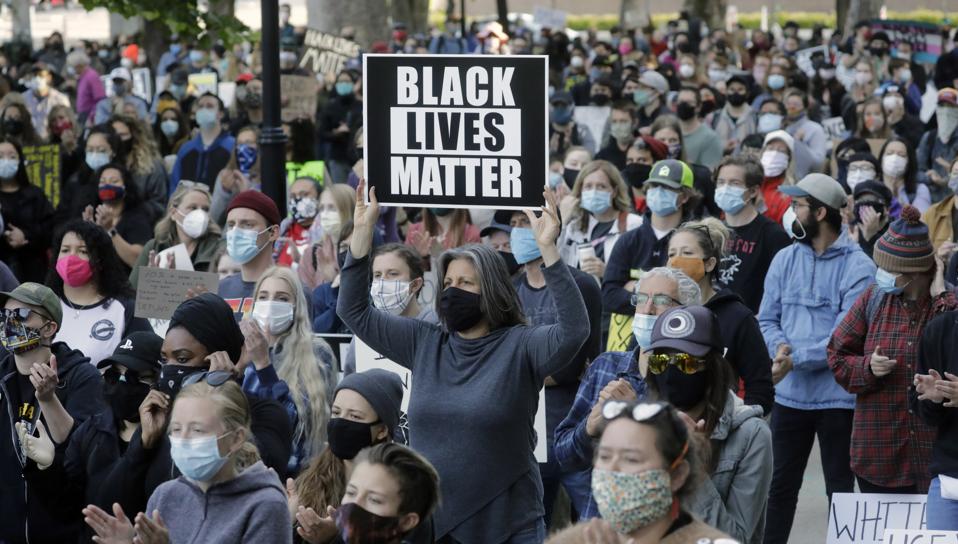
People are very clearly confused about what is going on in America today with #BlackLivesMatter. Reading posts and comments on various social media, it’s obvious the public believes that the protests in the streets either represent a popular uprising against capitalism, which some seem rather excited about, or at least they aren’t objecting too loudly, or represent a noble network of progressive organizations pushing a moderate policing reform agenda. 

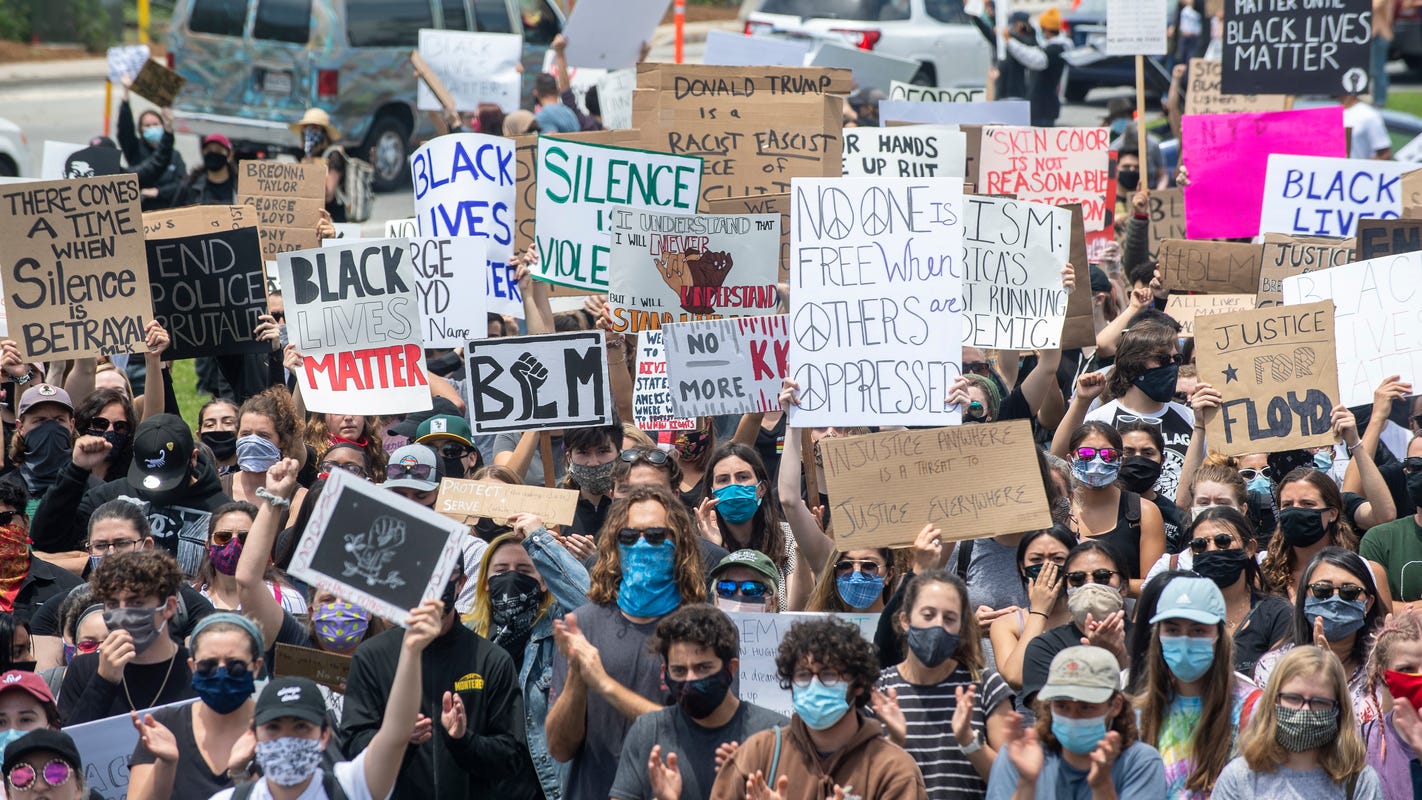
In California local law enforcement keep eye on protests from afar
Protestors march in Salinas, California, early June

The latter interpretation is obviously false. As calls go up for reparations, restructuring Western society consistent with globalist ambition, revising history and culture, it becomes clear that BLM has something more radical in mind. Moreover, given the paucity of evidence showing racial bias in the criminal justice system, the movement’s goals would have to be more ambitious than police reform. There is, in truth, very little to reform. At least not along racial lines. The patterns are explained by the demographics of criminal offending. (See The Myth of Systemic Racism in Lethal Police-Civilian Encounters.) 

Another interpretation, the one often supposed by the political right, is wrong, as well. The corporate money and power behind BLM tells us it is not a proletarian uprising. BLM is funded by wealthy investors and several of the largest corporations in America and around the world. It’s easy to find out who they are. They do not hide it. The Black Lives Matter Global Network Foundation has so much money that affiliated chapters may apply for unrestricted grant funding of up to $500,000 in multi-year grants. Those Marxists who thought it was their moment will have to wait some more for the revolution. They won’t find it here.

The protestors on the streets, foot soldiers available because of the COVID-19 disruption in the economy, education, and sports, are what the public relations industry called “Astroturf”—fake grassroots organized and coordinated by corporatist-globalist powers, Democratic Party functionaries, and the academic and media intelligentsia. I published an in-depth article on this tactic by the rightwing end of the political spectrum in 2002, Advancing Accumulation and Managing its Discontents: The U.S. Antienvironmental Countermovement (see The Anti-Environmental Countermovement for a summary and brief talk). The strategy is the same. These tactics are used on both the left and the right.

In the present circumstances, transnationalist powers—banks, corporations, foundations and think tanks—are using faux-popular appearances to sow racial division and disrupt class consciousness. This is not to say that many of those out in the streets don’t actually believe they’re involved in an uprising. There are true believers among them (I have an upcoming blog on the social psychology of all this). But those calling the shots know they aren’t involved in an uprising. Not against the establishment, at least. 

The long-term objective of the protests it seems to me is to weaken the institutions, thought, and practices of democratic republicanism. The denationalization project, evidenced in the policies and practices of neoliberalism, neoconservatism, and transnationalization, has been unfolding for decades. In the near term, the objective is to disorganize the economic nationalist wing of the capitalist class (small businesses and farms and domestic industries) and its populist allies in the working class. (See Democrats Pander While Managing America’s Decline.)

The election of Trump, the success of the Brexit movement (which globalists delayed for years only to see a seismic shift in labor sympathies towards the Conservatives), the rise of nationalist-populist movements throughout much of the West, the popular demands for rolling back offshoring and mass immigration—all this panicked the globalists. Black Lives Matter is one tactics to regain the advantage.

What we are seeing is a war being waged by corporations and their allies on democracy and freedom on several fronts. The anarchy on the street is one level. Through ground-level action, elites aim to disorganize communities, disrupt policing, and create general chaos. Mob violence is designed to put the public on edge, to bully them into passivity and compliance. Toppling and defacing statues and other public works, ignoring the complexities of historical figures and institutions, all this aims to rework historical memory and popular understanding of the past and the progress America has made over its many years of its existence. It is classic delegitimization work, it purpose to bring the validity of the nation into question, to undermine the American creed and her moral authority, making the next step—dissolution in some fashion—easier.

This delegitimization project is found, as well, at the universities. Indeed, a lot of the protestors are students (past and present) operating with an anti-American program developed and installed over several decades in the public education system, libraries, museums, and popular culture. (I have an upcoming blog on the social psychology of all this.) The Black Lives Matter platform makes it explicit. This is jargon of postmodernism. Alienated and disaffected youth, the bored and the misfit, have been handed a philosophy.

There is a popular media parallel to the academic propaganda. The character of that propaganda is so obvious not much needs to be said about it (Russia election interferences, the Ukraine affair, etc.). However, social media platforms are now making open war on the republic, censoring government officials, as well as marginalizing political figures and speech that challenge globalization project. (See The Conspiracy to Overthrow an American President; Zuckerberg is Insufficiently Totalitarian.)

The goal of the propaganda is to make the antagonisms not appear as between those who want to keep their country and those who want to integrate the American (and Western) worked with the transnational institutions of global capitalism, which is the real struggle, but instead to appear as racial conflict, the warring tribes already cast: rightwing reactionary and backwards whites bent on keeping the privilege that oppresses blacks and other minorities, those marginalized groups who enjoy the advocacy of forward-thinking progressive academics, corporations, and politicians. 

One’s choice of comrades in this case is complicated by the extent to which delusional thinking has penetrated the political left and ostensibly rational institutions. It raises the costs to one’s person in unique ways. But a choice is nonetheless necessary for the sake of the republic. Truth has its own integrity and demands someone speak for it.

The Associated Press symbolically inverts the presumed racial hierarchy, while Merriam-Webster engages in newspeak

In a June 19, 2020 editorial, AP changes writing style to capitalize “b” in Black, the Associated Press announces that it will double down on the racist tradition of essentializing blacks by elevating the word to a formal noun. The racial designations are now “Black” and “white.” Confirming that its move is politically-racially motivated, the AP “expects to make a decision within a month on whether to capitalize the term white.”

In a related matter, according to CNN, A Missouri woman asked Merriam-Webster to update its definition of racism and now officials will make the change. Kennedy Mitchum was troubled by the practice of those with whom she argued to cite the dictionary definition of “racism” to prove they weren’t racist.

Curating this before it disappears

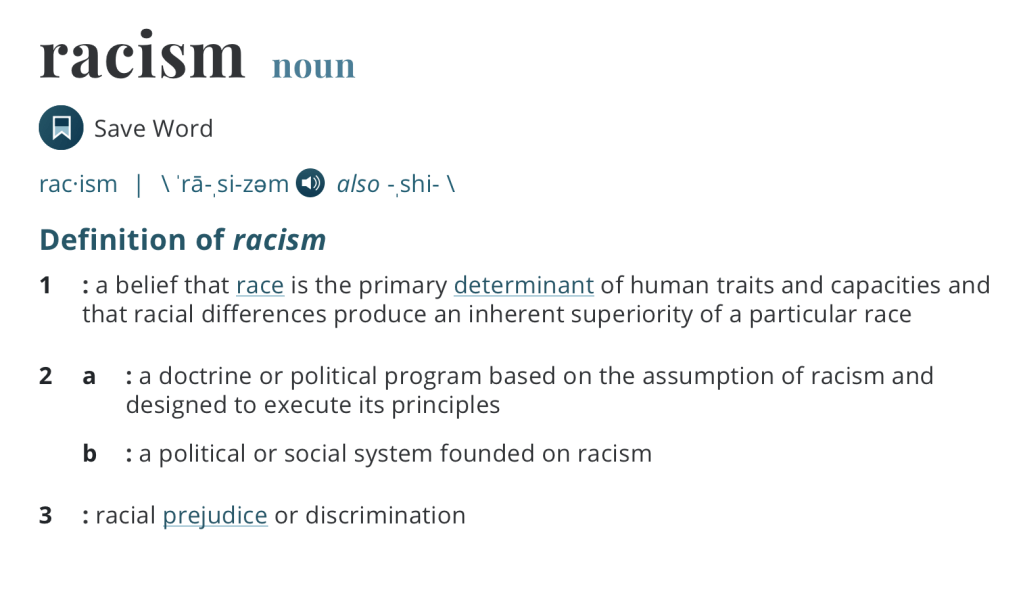
Merriam-Webster defines racism as “a belief that race is the primary determinant of human traits and capacities and that racial differences produce an inherent superiority of a particular race.” That is the definition of racism. However, because that definition did not allow Mitchum to leverage the notion of “systemic racism” to sustain a charge of racism against her opponents (vague definitions are better to argue with from an ideological standpoint), she wrote to Merriam-Webster and demanded her definition be substituted.

Peter Sokolowski, an editor-at-large at Merriam-Webster, told CNN that their entry also defines racism as “a doctrine or political program based on the assumption of racism and designed to execute its principles” (that’s good, too) and “a political or social system founded on racism,” (this definition lacks identification of necessary implementing machinery). Sokolowski then said, “I think we can express this more clearly to bring the idea of an asymmetrical power structure into the language of this definition.” Ah, the idea of an asymmetrical power structure. That’s what Mitchum wanted. That’s what AP’s change in capitalization assumes.

The change in AP’s editorial policy means to convey, according to the AP, “an essential and shared sense of history, identity and community among people who identify as Black, including those in the African diaspora and within Africa” (apparently the AP doesn’t like the Oxford comma). That’s a lot of people who don’t know each other. The move seeks to formalize the lumping of a myriad of ethnicities, groups with different languages, traditions, and so forth, into a monolithic racialized group. This is the work of pan-Africanism. (I am assuming that the editorial board at the AP are intelligent and intentional actors. If not, I can still say that the move functions towards this end.)

“The lowercase black is a color, not a person,” AP explains. It follows that the uppercase “Black” is a person. Presumably, unless whites are to be defined differently than blacks in the system of race thinking, the lowercase white is a color, not a person. If blacks have to have capital “B” so they’re persons, then are white people not persons? Isn’t leaving them as a color and not persons dehumanizing? To what extent, we many wonder, will these considerations enter at all into the heads of AP’s editors? We should, in any case, assume they should.

Why would the AP need a month to think about whether whites get to be persons, too? Don’t “White people” have “an essential and shared sense of history, identity and community among people who identify as [White], including those in the [European] diaspora and within [Europe]”? Ah, but can this “history, identity and community” be anything but racist? Can it be anything but racists the other way around?

Either capitalize both or capitalize neither. Me, I will capitalize neither. Race is not a proper noun. It is a racial category that really needs to go away, not become more formalized. I was infuriated when TruthOut, in 2016, in copyediting an article of mine, differentially capitalized the racial terms. But, I thought, “Well, this is a woke publication.” But now my iPhone autocapitalizes “Black people”—but not “white people.” Should my technology be a neutral platform? Shouldn’t AP be a neutral wire service?

* * *

Both “racism” and “racialism” as terms appear in the first decade of the twentieth century and are synonymous. Racism (or racialism) is an ideology in which it is assumed that dividing the human species into subgroups around superficial phenotypic differences (which merely reflect ancestry, since offspring inherit their parents’ genes) reflects a deeper unseen biological or constitutional reality that represents a natural hierarchically. This hierarchy is organized on the basis of ideal types (lumping of phenotypic characteristics) or indicated by group averages (for example, IQ). A racist believes that whites, blacks, and other racial groups differ in cognitive ability, behavioral proclivity, occupational aptitude, and moral integrity. 

As such, the concept of race commits the fallacy of misplaced concreteness, i.e. the reification of abstractions using arbitrary classification with no basis in sound empirical generalization. The upshot is that there are no actual races. It is an invalid construct manufactured via a false abstraction. Thus racism (or racialism) manufacture race.

As I have explained in previous writings, the idea of race in science emerges from the synthesis of animal husbandry, plant breeding, and evolutionary biology (natural history) in the 18th and 19th centuries and was debunked many decades ago. It was, like many myths, based on a facially plausible inference. But, like other myths that make naturalistic claims, the inference collapses upon closer empirical examination. 

In contrast to race realists, who believe there really are races, I am what you might call a race skeptic—I do not believe there are races because I see no compelling evidence for believing such claims. But I am more than a skeptic. Because I know that there is a destructive ideology that constructs race, I am for abolishing the construction altogether. The most stubborn form of racialization in the current context is foundational to the work of progressives.

There is a version of racism that roots in tribalism where essentialist claims are vaguer. Some other etiological myth explains the perceived differences in this style of racism. These present with a religious-like character. For example, in religion, there is a belief that God created the different racial types.

To take another example, the progressive ideology of antiracism, there is a myth of social power that is supposed to work beyond consciousness to elevate the status of some groups while diminishing the status of others. You hear this in the rhetoric of “white privilege” and “systemic racism.” These are quasi-religious constructs.

This mythology imagines power asymmetries (which are asserted without concrete evidence) falsely inferred from grouped differences that are then said to justify organizing some racialized groups culturally, politically, and socially, while condemning other groups for doing so. This understanding finds a slogan like “black power” to be qualitatively different than “white power,” i.e., good against bad, because it assumes that the former is justified and legitimized by the racial hierarchy it supposes exists. As I pointed out in the my previous blog entry, it is all very circular.

One of the ways the neoracialists gloss over ideology is through academic elevation of the normal concept of institution from a concrete and formal structure of law and policy to an abstraction sociologists call a “social institution.” This is what allowed Stokely Carmichael, along with political scientist Charles Hamilton, to declare in the mid-1960s, at the very moment that the problem of institutional racism was solved by its dismantling, that institutional racism was the problem that needed solving. They coined the term in the 1967 book Black Power: The Politics of Liberation. (Carmichael had popularized the term “black power” a year earlier.) Institutional racism was, according to them, “less overt, far more subtle” in its workings. As such, it was a useful mystification, a glittering generality, allowing the propagandist to assert its existence without any empirical rigor.

Carmichael and Hamilton’s construction is obviously wrong. To be sure, a concrete system that operates on the basis of racial designations, that is any empirically identifiable structure of formal institutions (law, policy) that advances/rewards some individuals while limiting/punishing others on the basis of race, is a racist system. For example, Jim Crow segregation in the US and the Apartheid system in South Africa are historic examples of racist systems. These systems were constructed to provide individuals designated as white with preferential treatment in housing and occupation. A current example of institutionalized racism is affirmative action, wherein individuals designated as black enjoy preferential treatment in education and employment. Absent these institutions there is no system of racism, therefore no systemic racism.

The accusation “racist” is being hurled about a lot lately. It follows from what I have argued that a racist is a person who believes such things are true, namely that there are races, that their members differ from each other in some regular way, and that the members of some racial groups should have more or have less good and bad things based on their racial designation.

If a person does not believe such things are true, then that person is a nonracist. That does not mean the person does not engage in racial thinking. We must recognize that there is a popular recognition of race in our society. Indeed, race thinking is a global phenomenon. We are taught race thinking from very early in life. It is, moreover, reproduced in demographic information. One cannot pretend they do not think racially even if he wishes it were not so—even when he knows it is not so. But this is not racism. Racism is as I defined it above.

What about antiracism? An antiracist is a person who supposes the existence of a racial system with embedded power asymmetries and then struggles to subordinate the perceived oppressor in order to correct history. This moves the thinking beyond merely racial into racially-oppressive action.

For the record, I am a nonracist. I reject both racism and antiracism. The attempt to claim that nonracism is an impossible position is a theological claim, not a scientific claim. The vast majority of people are likewise nonracist. The United States is not a racist society.

* * *

When associated with imagined communities—as opposed to a material reality like social class or a biological reality like sex—the notion of “social power” risks committing the fallacy of misplaced concreteness. This fallacy denotes the false move of hypostatizing a conceptual apparatus as an actual part of reality. It’s sloppy and lazy thinking, to be sure. But there are other reasons influencing the error. And the error carries toxic effects.

Let me explain this with an autobiographical account. My opinion on the question of systemic racism changed when I tightened up my thinking. Maybe I can help others with this story.

As readers of my blog know, I am an atheist. I grew up in a Christian culture but the religion never took hold of me. Therefore, with respect to Christianity, I have never considered myself a heretic or an apostate because I was never baptized. A heretic is a person who speaks against his religion. A apostate is a person who leaves his religion. So, in that space, I have always been an infidel. I cannot regret not believing in something that is not real.

Because I was brought up in antiracism and even participated in it—indeed, I was as an academic on the inside as the cult became a religion—I do have regrets. I did fall for theology of antiracism. I have come out of it, I am happy to announce (as if that wasn’t obvious already). I started out as a heretic and now I am an apostate. I now know what it feels like to leave a religion. It feels good.

But it also feels bad because it’s embarrassing when you reflect on the words that once fell out of your mouth. It is moreover difficult because all those who want you to keep believing in antiracism because they have put it central to their lives. They become extremely disappointed in you. They wonder what happened to you. They even even abusive in their disillusionment. They think you have become degraded in your thinking even when you are clearly subjecting your belief to the same skepticism that they themselves apply to, say, religious belief. They believe you have betrayed them. They expected that you would always be who they thought you were. The left has become religious-like in doctrine and intensity and this reaction is a typical manifestation of that attitude.

There were many events that help me self-deprogram (9-11, Christopher Hitchens, Sweden 2018, etc.). I will tell the full story one day. But, for now, here is one of those moments. It bears directly on what I have written above about definitions.

I was lecturing to my students in Foundations of Social Research on common errors in thinking. This was early in the semester. I was on the PowerPoint slide concerning the fallacy of misplaced concreteness. I was talking about how scientists build elaborate models to use as heuristics to tentatively explore the world around them and how that method runs the risk of hypostatizing elements of the model, and even the model itself, as the reality it’s attempting to grasp. Scientists become seduced by their grand ideas. They also get sloppy. They lazily take shortcuts. Via one or all of these avenues, they wind up treating an abstract conceptual system as the concrete reality they are striving to ascertain. This is the problem of reification.

I had given this lecture many times. But this time it hit me: When I talk about systemic or institutional racism I am doing exactly what I am telling my students not to do—I am reifying a conceptual apparatus. I am eliding the fact that the institutions of racism—the real, concrete institutions, i.e. the law, policies—were dismantled when I was a little kid. I’m in my fifties, yet here I am in my classes talking about racism as if it is still this overarching system shaping our everyday lives. I am also committing the error of mystification. And the ecological fallacy.

Eschewing methods of determining the intentions of human beings, indeed, not even bothering to try, I was essentially finding people categorically guilty of a crime for which they had not be adjudicated. I had been using abstractions—demography, social institutions, social facts, etc.—as if they have some actual power to do something. I had imaginary people—personifications of abstract groups—dangling from wires. Here I was denying agency, ignoring concrete behavior, actual situations, and the beliefs people hold, assigning to every individual an abstract statistical average that throws the reality of their lives into a tangled briar patch of jargon. I was guilty of confusing inequality with inequity.

Then another thought occurred to me: Because people act on the basis of the things they believe, because they react on the basis of so-shaped perceptions, these imaginary reified structures I am conveying from a position of authority might influence people to think and act in ways that are destructive to solidarity, democracy, equality, liberty—all the humanist ideals I proclaim as my values. Here I am, a Marxist, obscuring the material structures of exploitation and deprivation, giving legitimacy to cosmological thinkings by committing the ecological fallacy, i.e., drawing inferences about individual thought and behavior deduced from statistical data drawn from groups to which those individuals are supposed to belong.

I then starting looking at claims I had been making about systemic racism. Obviously, it is wrong to suppose that I can know anything about a person because he is white. He could be anything. It wasn’t like he was a devotee to a ideological system like Islam or Nazism. I cannot substitute for him a group average since that would be only a sophisticated form of racial stereotyping. Intersecting demographic categories didn’t make things much clearer, I could plainly see. Age? Sex? There are only aggregate facts.

In a recent blog, I used an example used by psychologist Valarie Tarico—the notion that a queer female East Indian Harvard grad with a Ph.D. and E.D. position is more oppressed [has less social power, etc.] than the unemployed third son of a white Appalachian coal miner. Tarico’s example exposes the absurdity of the claim as straightaway obvious. The Oppression Olympics is a ridiculous proposition. Yet actors in our institutions are making policy out of this.

I next considered the assumption that disparities mean bias and how one might test that assumption empirically, since you can’t ask every individual their views. One way of doing this would be to test propositions using group level data in a way that permits reasonable inferences about context. The most obvious was lethal officer-civilian encounters, since it was motivating #BlackLivesMatter, a group I was suspicious of from the git-go. As it turns out, I didn’t need to do that work. It has already been done (see my review The Myth of Systemic Racism in Lethal Police-Civilian Encounters). If the proposition is put in the form of a testable hypothesis, the claim of systemic racism is easily debunked.

In Teaching for diversity and social justice: A sourcebook (Routledge), racism is defined this way: “The systemic subordination of members of targeted racial groups who have relatively little social power in the United States (Blacks, Latino/as, Native Americans, and Asians), by the members of the agent racial group who have relatively more social power (Whites). This subordination is supported by the actions of individuals, cultural norms and values, and the institutional structures and practices of society” (88-89).

This is not a definition. It’s assumptions reveal it to be propaganda. It arbitrarily and eternally locates individuals in oppressor/oppressed and perpetrator/victim categories based on perceived race and imagined hierarchies of social power. What is the evidence that whites have more racial power? If it is because there are statistical differences between the groups, then (a) those differences cannot prove themselves (the proposition therefore remains untested); (b) the categories arbitrarily racially organize individuals race (this is hypostatizing race). The entire exercise disappears concrete individuals whom we can no nothing about based on skin color into abstract demographic categories where grouped averages are claimed to speak for individuals.

This is the great error of sociology. It results from the attempt early in the development of the discipline to graft the methods of natural history onto the study of a qualitatively different domain of social phenomena (what is called “positivism”). It became, as C. Wright Mills put it, enamored by its own grand theatrical structure. This error is repeated because the discipline of sociology still refuses to establish itself upon the materialist conception of history. It is like evolutionary biology has never accepted the natural history approach of Charles Darwin.

And so sociology has become corrupted by ideology. The definition of racism given in Teaching for diversity and social justice: A sourcebook is part of a political-ideology of antiracism that finds its roots in New Left thinking, shaped by Critical Theory, Mao Zedong thought, and French poststructuralism/postmodernism, and represents another manifestations of the essentializing action of racial thinking. Why it has become the operational definition for those in power, as well as in the streets, is because it is disruptive to proletarian class consciousness the actual subjects of exploitation and oppression in the material mode of production we call capitalism.

Antiracism enjoys the material support of corporate power because it undermines class solidarity. Everybody is talking about white privilege today because the culture industry, using the legitimating power of academic jargon, has effectively injected it into popular discourse.

* * *

“This revision would not have been made without your persistence in contacting us about this problem,” Merriam-Webster editor Alex Chambers said in the email to Kennedy Mitchum. “We sincerely thank you for repeatedly writing in and apologize for the harm and offense we have caused in failing to address this issue sooner.”

Translation: we are using your email and your race to cover the corporate project to change popular thought in a direction that serves the interests of corporate power. We did not before recognize the propaganda tactic you alerting us to.

The AP means to invert the racial hierarchy, while Merriam-Webster is openly engaged in newspeak. That is damning evidence of the power of the cultural managers who shapes was thought.

As Marx and Engels write in The German Ideology (1845): “The ideas of the ruling class are in every epoch the ruling ideas, i.e. the class which is the ruling material force of society, is at the same time its ruling intellectual force. The class which has the means of material production at its disposal, has control at the same time over the means of mental production, so that thereby, generally speaking, the ideas of those who lack the means of mental production are subject to it.”

The Myth of Systemic Racism in Lethal Police-Civilian Encounters

In light of the scientific literature on the matter of officer-involved shootings, the greater criminal justice system, and race relations, which does not support core claims made by #BlackLivesMatter and its New Left allies, indeed, that contradict those claims, independently-minded scholars must dissent from the growing demand that that we declare ourselves allies to what amounts to a regressive countermovement against freedom and reason and an assault on the truth. In this essay I expose the myth of systemic racism in lethal police-civilian encounters.

For the record, for those who do not know what I do for a living, I am a professional criminologist tenured at a public university who has spent more than a quarter century studying patterns of crime and punishment. In the 1990s, as a graduate student at a major public university, a milieu shaped by neomarxist and postmodernist epistemologies, I came to believe that systemic racism in part explained disparities in the criminal justice system.

My dissertation, Caste, Class, and Justice: Segregation, Accumulation, and Criminalization in the United States (2000), was influenced by epistemological notions embedded in the approaches of critical race theory and the social reality of crime. I won’t elaborate these here, but the core methodological error I make on their account is conceptualizing race relations as existing on the same ontological plane as class relations. I hope it will suffice to note that sociology, as do other domains of science, elaborates conceptual schemes in order to tap the unseen structures of relations the world and thus risks reifying its constructions. While class relations are material relations, since they exist in economic institutions, the concrete institutions of segregation were dismantled more than half a century ago. A system of categories remains in demography. But demographic categories don’t do anything. Therefore, to assume systemic racism on the basis of grouped differences commits the fallacy of misplaced concreteness.

After spending a number of years after graduate school finding my way out of New Left ideology—what I now recognize as left-idealist romanticism—I discovered that what I had believed about race and criminal justice was misguided. A testament to the power and the problem of ideology, the facts were “hidden” in plain view. I want to tell you about those facts in this essay because many others are making the same errors I made those many years ago. (I critique the fallacy in previous blog entries, so I won’t rehearse that argument here. But you can see an example of my writing on this topic in this essay: Zombie Politics: the Corporatist Ideology of Antiracism.)

* * *

In testing the claim of systemic racism in criminal justice, William Wilbanks, in The Myth of a Racist Criminal Justice System, published in 1987, produces a comprehensive survey of contemporary research studies, searching for evidence of discrimination by police, prosecutors, judges, and prison and parole officers. Among the specific areas considered in his analysis are provisions of counsel, police deployment, use of deadly force, bail decisions, plea bargaining, sentencing patterns, and inmate classification and discipline. Wilbanks finds that, although individual cases of racial prejudice and discrimination do occur in the system, there is insufficient evidence to support a charge of systematic racism against blacks in the criminal justice system, which is the main issue animating #BlackLivesMatter. Wilbanks summarizes: “At every point, from arrest to parole, there is little or no evidence of an overall racial effect.” 

Wilbanks’ findings have been repeated in numerous scholarly reviews and studies. Here are several over them spanning a quarter century (I provide a bibliography at the conclusion of the essay). I emphasized that most of these studies focus specifically on the matter of lethal officer-civilian encounters.

  • Robert Sampson and Janet L. Lauritsen, in a comprehensive review of studies of the criminal justice system, published in the pages of Crime and Justice, in 1997, find “little evidence that racial disparities result from systematic, overt bias.”
  • Heather Mac Donald, in The War on Cops, a comprehensive review of the evidence published in 2016, finds no evidence of racially biased policing. (See her recent editorial in The Wall Street Journal.)
  • Roland Fryer, in a paper published in the Journal of Political Economy in 2018, finds no racial differences in either the raw data or when contextual factors are taken into account when turning his attention to the most extreme use of force, i.e. officer-involved shootings. 
  • Joseph Cesario and colleagues, report in 2018, in Social Psychological and Personality Science, that, adjusting for crime, no systematic evidence of anti-black disparities in fatal shootings, fatal shootings of unarmed citizens, or fatal shootings involving misidentification of harmless objects. The authors conclude that, when analyzing all shootings, exposure to police, given crime rate differences, accounts for the higher per capita rate of fatal police shootings for blacks. 
  • Charles Menifield and colleagues find, in a study published in Public Administration Review in 2019, that although minority suspects are disproportionately killed by police (a rough average across various sources produce a rate that is for blacks about 2.5 times the rate for whites), white officers appear to be no more likely to use lethal force against minorities than nonwhite officers.
  • In a study published in Journal of Crime and Justice, in 2019, Brandon Tregle and colleagues, when focusing on violent crime arrests or weapons offense arrests, find that blacks appear less likely to be fatally shot by police officers. 
  • David Johnson and colleagues, in the pages of the 2019 Proceedings of the National Academy of Sciences, find that it is the rate of violent crime, not the race of the officer, that determines police shootings. In what is known as the “exposure hypothesis,” serious criminal activity increases the likelihood of officer-civilian interaction and this influences the frequency of policing shootings. As do Menifield and colleagues, Johnson and associates find that, taking crime rates into account, the bias in shootings appears to be against whites
  • Katelyn Jetelina and associates, in the American Journal of Public Health, find that, controlling for other factors, the observed significant relationships between race/ethnicity dyads and use of force dissipated.
Charlotte Protests Escalate After Black Man Killed By Police ...
Police officers face off with protesters on the I-85 during protests following the death of Keith Lamont Scott, shot by a black police officer on Sept. 21, 2016 in Charlotte, N.C.

Contextualizing police-civilian interaction is necessary in explaining police use of force. If we look at crime statistics for blacks and whites for the year 2018, we find significant overrepresentation of blacks in serious criminal offending. Blacks are responsible for more half of all murders and more than half of robberies. Blacks account for one-third of all arrests for aggravated assault, burglary, larceny-theft, and motor vehicle theft. Moreover, contradicting the claim that violence against blacks by whites is the typical, while most serious crime is intra-racial, whites are disproportionately victims of crime perpetrated by blacks, and not just per capita, but in frequencies. And not by a little.

One finds these disproportionalities in crime reports going back for years. The persistence of black overrepresentation in serious crime is documented by the Uniform Crime Report, a collection of crimes reported to the police, arrest and clearance rates collected from thousands of police department across the nation, published by the FBI. It is also found in the National Crime Victimization Survey, conducted by the Justice Department. These reports are published annually. These are the two major crime surveys produced on crime in the United States. 

I want to emphasize that most blacks do not commit serious crime. There is nothing intrinsic to being black that makes a person crime prone. Race is not a biological or constitutional entity. It is a social construct. Overrepresentation of blacks in serious crime is a persistent demographic fact. But the assertion of systemic racism rests on interpretation of disparities in demographic representation, therefore we must take the facts together. Controlling for rates of serious crime and considering the context of the encounters, the racial disparity in policing killings is explained. #BlackLivesMatter is based on a myth, the myth of racial bias in lethal (and even less-than-lethal) officer-civilian encounters.

The demographic profile of crime indicate these concrete circumstances: When police are called to a crime scene, or when they have probable cause that a crime is occurring or has occurred, they are more likely to interact with blacks on a per capita basis than they are with whites. Because of black overrepresentation in serious crime, these encounters are more likely to involve serious interactions. If the suspect officers encounter is armed and resisting, then the suspect will be at higher risk of being killed or injured. So will police officers (who are every year killed in the line of duty). Police officers share with all civilians a right to defend themselves. They are, moreover, charged with putting themselves in harm’s way.

Critical Race Theory (CRT) scholar Kimberlé Crenshaw writes that the problem with liberal accounts of the law is “treating the exercise of racial power as rare and aberrational rather than as systemic and ingrained.” The way Crenshaw puts the matter suggests that there is the evidence of systemic and ingrained racism is abundant. In fact, police shootings of unarmed black men, to take the master complaint, are in fact highly unusual. Police interact with civilians millions of times each year. There are approximately 42 million black people in the United States. The number of unarmed blacks killed by the police for all of 2019? Around a dozen. Given such frequencies, police officers killing unarmed black men is rare and aberrational. We should celebrate this fact. Instead, we hear the crowd chanting the slogan: “Defund the police.”

On the larger question of systemic racism in the criminal justice system, scientific studies find little empirical support for the claim of systemic racism in the criminal justice system as a whole. A close examination of prison demographics in light of crime statistics finds that the ascertained patterns are, as they are with officer-involved shootings, largely explained by patterns of criminal offending. Even Michael Tonry, a public intellectual highly critical of US prison policy, had to acknowledge in his 1995 book Malign Neglect: Race, Crime, and Punishment that racial disparities in the criminal justice system are mainly due to differences in criminal activity among races.

John Pfaff points out, in his 2017 book Locked In: The True Causes of Mass Incarceration-and How to Achieve Real Reform, more than half of the 1.3 million inmates in state prisons are there for violent offenses (aggravated assault, murder, rape, and robbery) and many tens of thousands more are incarcerated for burglary or other serious property crimes. Given the demographics of criminal offending, blacks are not overrepresented among prisoners relative to their involvement in serious crime. Moreover, the moral necessity of ending the drug war accepted, racial disparities in the enforcement of drug prohibition only minimally skew this pattern.

(On that last score, Pfaff’s work bring into question Michele Alexander’s popular 2012 The New Jim Crow: Mass Incarceration in the Age of Colorblindness, a book I dropped from the reading list in my undergraduate criminal justice class because its race-centric approach distorts student understanding of the problem. I would likely use the book in a graduate seminar to illustrate the problem of ideological thinking, but undergraduates cannot be burdened with a hefty reading list. We have to get straight away to the truth. Pfaff’s Locked In has replaced it. I have my hands full having to correct misrepresentations in the otherwise excellent The Rich Get Richer and the Poor Get Prison, by Jeffery Reiman.)

The obsession with race reflected in the work of Alexander, CRT scholars, and others gives short shrift to the matter on which we should focus our attention: social class. The United States is a capitalist society. Police and the greater criminal justice apparatus constitute a system that manages social problems systematically generated by the capitalist mode of production. Those displaced and underserved by an economic system based on the accumulation of capital are overrepresented in our prisons and jails. To be sure, historic forces have played a role in producing the demographic overrepresentation of blacks in the criminogenic conditions capitalism systemically produces, but the claims presented by #BlackLivesMatter and its allies concerning systemic racism in policing and the criminal justice are not supported by the evidence. As I stated at the outset, they are contradicted by the evidence.

Finally, advocacy of the #BlackLivesMatter understanding of the problems of police brutality obscures the progress democratic societies have made on this front. As Samuel Walker, arguably the most important expert in police accountability, tells us, “Whether the benchmark is one-hundred years, fifty years, or only twenty years ago, it is possible to see significant reforms in police management, crime fighting tactics, police personnel standards and training, the diversity of the work force, constitutional standards for policing, and the accountability of officers for their actions in critical situations.” We should acknowledge progress made in this area and keep our attention on continuing that progress. This means rejecting the regressive policies of depolicing and the #BlackLivesMatter interpretation of racial disparities in policing and the criminal justice system.

Bibliography

Alexander, Michelle. 2010. The New Jim Crow: Mass Incarceration in the Age of Colorblindness. The New Press.

Cesario, Joseph, D. J. Johnson, and W. Terrill. 2018. “Is There Evidence of Racial Disparity in Police Use of Deadly Force? Analyses of Officer-Involved Fatal Shootings in 2015–2016.” Social Psychological and Personality Science 10(5): 586-595.

Crenshaw, Kimberlé, Neil Gotanda, Gary Peller, and Kendall Thomas. 1996. Critical Race Theory: The Key Writings That Formed the Movement. The New Press.

Pfaff, John. 2017. Locked In: The True Causes of Mass Incarceration-and How to Achieve Real Reform. Basic Books. 

Fryer, Ronald G. 2018. “An Empirical Analysis of Racial Differences in Police Use of Force.” Journal of Political Economy 127(3): 1210-1261.

Jetelina, Katelyn K., Wesley G. Jennings, Stephen A. Bishopp, Alex R. Piqueri, and Jennifer M. Reingle Gonzalez. 2017. Dissecting the Complexities of the Relationship Between Police Officer–Civilian Race/Ethnicity Dyads and Less-Than-Lethal Use of Force. American Journal of Public Health 107(7): 1164-1170.

Johnson, David J., Trevor Tress, Nicole Burkel, Carley Taylor, and Joseph Cesario. 2019. “Officer characteristics and racial disparities in fatal officer-involved shootings.” Proceedings of the National Academy of Sciences. 116(32) 15877-15882.

Mac Donald, Heather. 2016. The War on Cops: How the New Attack on Law and Order Makes Everyone Less Safe. Encounter Books. 

_______________. 2020. The Myth of Systemic Police Racism. Wall Street Journal, June 3. 

Menifield, Charles E. 2019. “Do White Law Enforcement Officers Target Minority Suspects?” Public Administration Review 79(1) 56-68.

Sampson, Robert J. and Janet L. Lauritsen. 1997. Racial and Ethnic Disparities in Crime and Criminal Justice in the United States. Crime and Justice 21:311-374.

Tonry, Michael. 1995. Malign Neglect: Race, Crime, and Punishment in America. Oxford University Press.

Tregle, Brandon, Justin Nix and Geoffrey P. Alpert. 2019. “Disparity does not mean bias: making sense of observed racial disparities in fatal officer-involved shootings with multiple benchmarks.” Journal of Crime and Justice 42(1): 18-31. 

Walker, Samuel. 2012. “Institutionalizing Police Accountability Reforms: The Problem of Making Police Reforms Endure,” Saint Louis University Public Law Review 32:1.

Walker, Samuel and Carol Archibald. 2013. The New World of Police Accountability. Sage.

Wilbanks, William. 1987. The Myth of a Racist Criminal Justice System. Brooks/Cole Publishing Company.

_______________. 1987. “The Myth of a Racist Criminal Justice System.” Journal of Contemporary Criminal Justice 3(2):88-93.

Cultural Marxism: Real Thing or Far-Right Antisemitic Conspiracy Theory?

You may be hearing a lot about “Cultural Marxism” lately. Steven Bannon is all over it in his podcast War Room (See The Economic Nationalism of Steven K. Bannon for my views on Bannon). The New York Times denies there is even such a thing as Cultural Marxism. It’s an “far-right antisemitic conspiracy theory,” it claims. The NYTimes is not alone. The Establishment seems obsessed with denying this thing called Cultural Marxism, always pairing it with the rightwing of American politics. So the right has a view on a thing and that makes it what it is. Way to leverage an ideology in order to engage in denialism.

The online open source encyclopedia Wikipedia takes up the line: “In contemporary usage, the term Cultural Marxism refers to a far-right antisemitic conspiracy theory which claims that the Frankfurt School is part of an ongoing academic and intellectual effort to undermine and destroy Western culture and values. According to the conspiracy theory, which emerged in the late 1990s, the Frankfurt School and other Marxist theorists were part of a conspiracy to attack Western society by undermining traditionalist conservatism and Christianity using the 1960s counterculture, multiculturalism, progressive politics and political correctness.” (See Frankfurt School.) I don’t normally cite Wikipedia, but I have a point to make.

I can be of some help here. I am a Marxist—a libertarian Marxist not one of these New Left Marxoids. I have read deeply into the body of literature produced by the Cultural Marxists (you should see my library!). But perhaps more importantly, for more than quarter century, I have been on the inside of the style of politics emanating from the Frankfurt School. I am, after all, an academic in a public university, an institution that is, as you probably know, seriously woke. I am in a position to testify to the fact that Cultural Marxism is not a far-right antisemitic conspiracy theory. Quite the contrary.

Cultural Marxism, or Critical Theory, is a very real tradition in Marxism and really does work through the “1960s counterculture, multiculturalism, progressive politics, and political correctness” that animates activism to this very day. Get your hands on the 1965 neo-Marxist collection A Critique of Pure Tolerance, by Herbert Marcuse, Barrington Moore Jr., and Robert Paul Wolff. Read Marcuse’s essay in particular: “Repressive Tolerance.” It’s a call for political correctness. Marcuse was a prominent member of the Frankfurt School. From the Wikipedia entry on Marcuse: “His Marxist scholarship inspired many radical intellectuals and political activists in the 1960s and 1970s, both in the United States and internationally.” That essay I cited is just one instantiation of a large literature of illiberal scholarship that feeds the New Left ideology. There is no guessing here. Marcuse advocated a synthesis of Marx, Freud, and Heidegger (see his 1955 Eros and Civilization). That’s right. Heidegger. Don’t know who that is? Look into it.

Is Wikipedia pushing an “antisemitic conspiracy theory”? Hardly. Why would identifying Cultural Marxism as being influential on elite culture be antisemitic anyway? Because Marxist intellectuals are disproportionately Jewish? That doesn’t make Marxism a Jewish cabal. It’s insulting to say that people shouldn’t criticize or recognize the fact of Cultural Marxism because to do so is “antisemitic.” That’s like saying that we cannot criticize the Nation of Islam because its scholars are black. You’re skin color or ethnic identity does not immunize your ideas from criticism. Who said all Jews agree with Cultural Marxism?

I benefitted from Marcuse’s 1964 book One-Dimensional Man. It’s an important book (I like C. Wright Mills, Guy Debord, Richard Grossman, and Sheldon Wolin more, but you should read One-Dimensional Man). But it is not a book that challenges corporatism from a liberal standpoint. Not even from a Marxist standpoint (which is, on these issues, liberal; see my Defending the Digital Commons: A Left-Libertarian Critique of Speech and Censorship in the Virtual Public Square). I have also benefitted from other Frankfurt School scholars, especially the work of Franz Neumann, Walter Benjamin, Georg Rusche and Otto Kirchheimer. I even appreciate the arguments of Theodor Adorno and Max Horkheimer. The notion that we’re supposed to deny that these ideas have profoundly influenced the mode of thinking of university administrators and professors of humanities and social sciences is asking us to participate in denialism.

I would be pulling my hair out if I were a young conservative coming through the modern woke general education program of today’s university. So much of what is taught as the Gospel truth amounts to compelled speech. Faculty are subjected to it, as well. Frankfurters have to be in for some criticism like everybody else. They have have a huge impact on our politics. What you are seeing on our streets today is in part thanks to their methods (and to destructive ideas of the French poststructuralist and postmodernists movement, Mao Zedong thought and the Cultural Revolution, and anarchist egoism/nihilism).

The Wikipedia entry on the Frankfurt School also contains the following: “The works of the Frankfurt School are understood in the context of the intellectual and practical objectives of critical theory. In Traditional and Critical Theory (1937), Max Horkheimer defined critical theory as social critique meant to effect sociologic change….” It continues: “The purpose of critical theory is to analyze the true significance of the ruling understandings (the dominant ideology) generated in bourgeois society, by showing that the dominant ideology misrepresents how human relations occur in the real world, and how such misrepresentations function to justify and legitimate the domination of people by capitalism.” And this: “In the praxis of cultural hegemony, the dominant ideology is a ruling-class narrative story, which explains that what is occurring in society is the norm.” Good stuff. Why run away from it? Because it gives too much away. Just don’t believe anything anybody says about it.

The problem with Cultural Marxism, for both the left and corporate power, is that Critical Theory does not separate out all the rational elements of the West—all the things Marx defended—from the deformation of liberalism by corporatism. Marx sought to overthrow capitalism to bring the values of liberalism into full manifestation by de-alienating man from man and man from nature. He never sought to overthrow values of liberalism themselves. Private control over capitalism is in contradiction to the values of modernity, of which Marx was an advocate. You don’t throw the baby out with the bathwater.

Given the perversion of socialism wrought by Cultural Marxism, whatever its insights, we have to recognize that, in practice, this direction has not on balance been a good thing. Indeed, Critical Race Theory is one of its obnoxious children. And this fathered Black Lives Matter. Just look at our streets today. This is not a revolutionary movement. It’s a corporatist-globalist wet dream. And that, comrades, is one hell of a paradox for something claiming Marxist roots.