
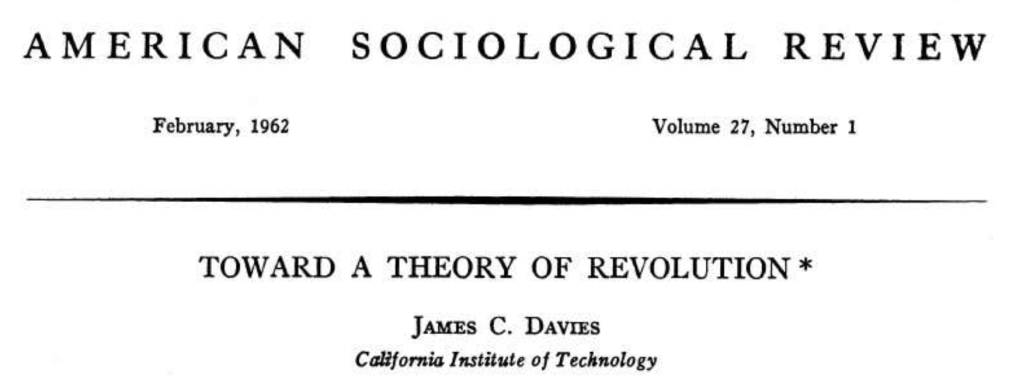
This is a super important article from my discipline from the year I was born: James C. Davies (California Institute of Technology), “Towards a Theory of Revolution,” published in the American Sociological Review in 1962.
Exhorting proletarians of all nations to unite in revolution, because they had nothing to lose but their chains, Marx and Engels most succinctly presented that theory of revolution which is recognized as their brain child. But this most famed thesis, that progressive degradation of the industrial working class would finally reach the point of despair and inevitable revolt, is not the only one that Marx fathered. In at least one essay he gave life to a quite antithetical idea. He described, as a precondition of widespread unrest, not progressive degradation of the proletariat but rather an improvement in workers’ economic condition which did not keep pace with the growing welfare of capitalists and therefore produced social tension.
I have been socializing this thesis to my students and comrades for decades, but it was not until yesterday, in a wide-ranging phone conversation with my father (who is also a sociologist), that I was reminded of the origin of this truth nugget.
I want to connect Davies thesis, often referred to as Davies’ J-Curve, with some of my recent arguments concerning street crime. The point of despair that results in inevitable revolt results not in revolution but in primitive rebellion—street criminality—the expression of the lumpenproletariat, abject and demoralized, when there are no avenues for constructive consciousness-raising through worker organization and education.
For example, I pointed out in my entry on the radical black proletarian movement in the United States the following: “One consequence of the demise of the Black Panther Party was the shattering of the truce the Panthers had negotiated among street gangs. With inner city conditions rapidly deteriorating amid the mounting crisis of late capitalism, gang violence escalated over the next two decades.” (For more on this see my Demoralization and the Ferguson Effect.)
This is why the ruling class, after ingratiating itself to a segment of the proletariat (for example, the cultural manager), smashes the rest of them. The elite know that powerlessness begets powerlessness—and that affluence, if one is not bought out, affords one power.
The idea that the worse off are the workers, the more desperate their situation, the more totalitarian the bureaucracy, the more people are inclined to rise up against their oppressors, is misguided. The people rise up when they reach a certain level of affluence, gain access to knowledge and an understanding of networks, understand their power in numbers and their interests in common, are in possession of an adequate theory of the world, and develop a practice around these. This development makes the people dangerous.
The ruling class organized to disorganize the labor movement in the post-WWII period because it had to stop the progression to democratic socialism with an American character. As I have written about, it needed to raise the rate of profit, which had fallen with the rise of labor (as it should). However, it has yet to accomplish this, and economic growth has remained relatively stagnant compared to previous periods in American history.
Update (3.23.2025) In the video posted below, in announcing this blog entry, I go into greater detail about my thinking concerning the J-curve theory while also riffing on the medical and scientific-industrial complex, and more generally the problem of the progressive technocratic apparatus and the corporate state. I assure the audience that all these tie together and promise to make those connections in future blogs. However, in the midst of the COVID pandemic, my mind, as were the minds of many others, turned to the problems associated with the government response to the coronavirus, As a consequence, the podcast feels a bit disorganized at the end, especially for those unfamiliar with my writings. At any rate, here it is:

 freedom and reason