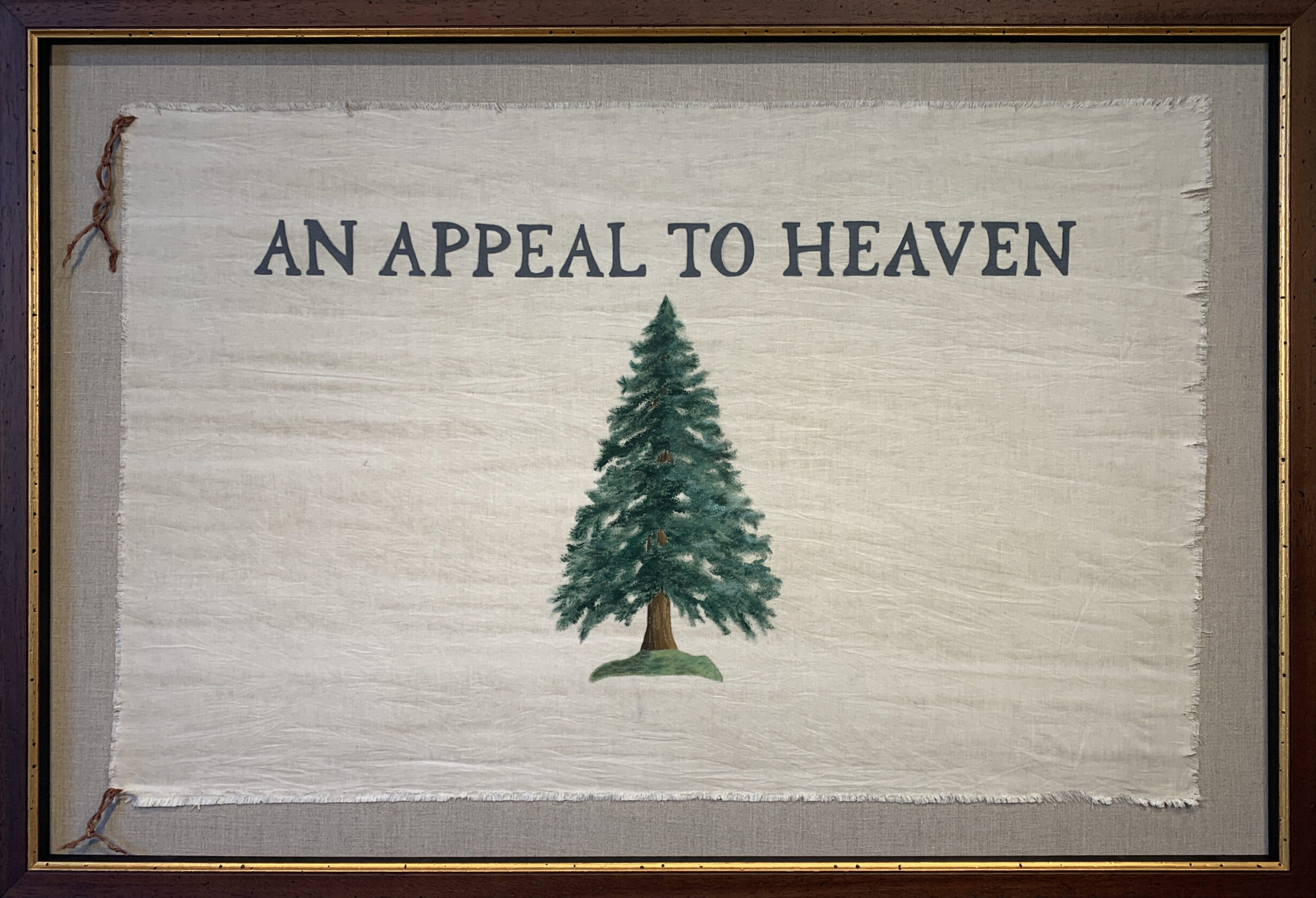
This is “An Appeal to Heaven” flag controversy. You know the flag with the pine tree on it? Also known as the Pine Tree Flag? Do you know what this flag means? What it stands for? You should if you’re a patriotic American. This flag holds historical significance in your history. It was a symbol used by colonists in the struggle for independence against monarchy. Washington’s forces were among many who flew the flag. Men died on the battlefield and at sea carrying this flag. Don’t let those sacrifices escape your thoughts on this Memorial Day weekend—or the ideals for which those sacrifices were made.
An Appeal to Heaven Flag
This phrase “an appeal to heaven” originates in John Locke’s writings on natural rights, which influenced many of the founding fathers of the United States. The phrase can be inferred from a passage in the Second Treatise (Chapter 3) of Locke’s Two Treatises of Government. There, Locke discusses the principles of natural rights and the consent of the governed. The passage justifies resistance to tyranny and the right of individuals to overthrow oppressive regimes. It’s pretty obvious that Thomas Jefferson cribbed Locke’s words from this passage in penning the Declaration of Independence, July 4, 1776:
Where-ever law ends, tyranny begins, if the law be transgressed to anothers harm; and whosoever in authority exceeds the power given him by the law, and makes use of the force he has under his command, to compass that upon the subject, which the law allows not, ceases in that to be a magistrate; and, acting without authority, may be opposed, as any other man, who by force invades the right of another. This is acknowledged in subordinate magistrates. He that hath authority to seize my person in the street, may be opposed as a thief and a robber, if he endeavours to break into my house to execute a writ, notwithstanding that I know he has such a warrant, and such a legal authority, as will empower him to arrest me abroad. And why this should not hold in the highest, as well as in the most inferior magistrate, I would fain know. Why he that hath authority to seize my person upon my own land, and carry me into prison, if I refuse to submit to the magistrate, shall not also be opposed, if he endeavors to take me when I am going about my business, without any disobedience, and shall execute no legal authority upon me; I am sure it is a very intelligible proposition to say, every man has a right to punish the offender, and be the executioner of the law of nature.
An appeal to heaven moreover reflects the idea that when all other recourse fails, individuals have the right to appeal to a higher power or natural law for justice and protection. As I recently noted in Rise of the Domestic Clerical Fascist and the Specter of Christian Nationalism (see also Manufacturing Moral Panic Over Christianity), this is not a Christian nation, but the revolutionaries who founded this nation were for the most part Christians (with a few Deists among them) and they believed in providence. References to the “Creator” and “Nature’s God” in the Declaration are not accidental. These were men moved by higher purpose. These were men who understood that our rights come not from man but must be secured by men. These were men wont to make an appeal to heaven.
Today, while the details of the flag’s history may be elusive to many (not to the corporate state’s propaganda corp), it is recognized by those who fly it to be a symbol of American resilience and the constant struggle to keep liberty alive. But leave it to the propagandists of the corporate state, that force that wishes to take us back to a New Feudalism, to make serfs of us, to make a flag extolling the virtues of individual liberty and democratic freedom out to be a symbol of reaction. The establishment media and progressives are telling you that Samuel Alito is a bad fellow because he flies a hateful flag over his Long Beach home in New Jersey. This is not a flag of hate. It’s a flag of love—love for freedom and individual autonomy.
Of course the flag is hateful in their eyes. They despise individual liberty and democratic freedom. They’re statists, the servants of corporate power. They hate MAGA because it’s MAGA that makes explicit its intent to deconstruct the unconstitutional unelected fourth branch of government—the administrative state—and return the country to its democratic republican and classical liberal foundations. You have to understand that freedom and democracy are anathema to authoritarianism and fascism. The illiberal mind reacts to liberty the way a flatworm flips when exposed to light. Rank-and-file progressives are genuinely triggered by the symbols of liberty. At this rate, I’m expecting Old Glory herself will be depicted as a reactionary symbol in the run-up to November 5.
One more thing before I hit the end-of-rant button. Have you noticed that words and symbols mean whatever progressives say they mean? A woman is not an adult female human. The word “woman” can mean anything a progressive says it means when it advances the woke agenda. It can even mean a man. A dinosaur emoticon is a trans symbol. Don’t use if it you’re not part of the tribe. The okay hand signal is a fascist signal. The upside flag, the universal sign of distress, means “Stop the Steal.” How are progressives able to do this? Because they have captured our sense-making institutions. The only way to stop the madness is to put them out of power. November 5th can’t come fast enough.
Did you read Mark Krikorian’s essay today, “100 years ago, the US took a break from immigration—and America thrived” punished in The New York Post? You should. Krikorian is executive director of the Center for Immigration Studies. “Only by taking an extended breather was America able to successfully assimilate the 25 million-plus newcomers who’d arrived after 1880,” he writes. He continues: “Immigrant communities were thus not continually refreshed with newcomers; that, combined with vigorous and self-confident Americanization efforts in schools and elsewhere, forged the strong common national identity that helped America prevail over Nazism and Communism.”
President Lyndon Johnson signs the Immigration and Naturalization Act of 1965 that threw open the country to mass immigration
In these essays and the several in between, I show how the greatest period in American history occurred between closing the borders in 1924 and reopening them in 1965. The period was marked by rising wages and standards of living, safe and orderly communities, racial integration, women’s rights, and a high level of patriotism. I have documented that the desire for open borders was a transnationalist plot to disorder America dating from the early 20th century and showed how the destructive policy of multiculturalism was introduced as “cultural pluralism.” You know it in the way the “melting pot” metaphor became the “salad bowl.” Sounds better that way. You know it by the way the imperative of assimilation/integration was reframed as nativism/xenophobia. (See An Architect of Transnationalism: Horace Kallen and the Fetish for Diversity and Inclusion; The Work of Bourgeois Hegemony in the Immigration Debate; The Progressive Politics of Mass Immigration.)
Source: Migration Policy Institute
All this was organized by corporate power to destroy the working class and the cultural integrity necessary for democratic republic governance. One of the things that came along with rising wages and better standards of living was a fall in the rate of profit. A national economic strategy depended on cooperation of the labor, and union density and collective bargaining tied wages and benefits to productivity, thus allowing the working class to take a greater share of the surplus value produced by their labor. To restore higher profit rates (at least to attempt to), the corporate states launched a war on labor and the left, crushing the organizations of private sector labor (which expanding public sector unions thus securing loyalty to the administrative state and its extensions).
In the first decade of the new millennium, I taught a course called Power and Change in America. One of the texts we read was Patricia Cayo Sexton’s War on the Labor and the Left. Sexton covers a lot of history. In the post-World War II period, she explores the nuanced tactics employed against labor, spanning from the inception of welfare capitalism to contemporary challenges such as deindustrialization, corporate restructuring, the influence of anti-labor consultants, deregulation, privatization, and labor-management cooperation. Sexton’s main point is that the weakness of labor stems from the unparalleled wealth and influence of corporations, highlighted by their control over the mass media apparatus.
In her work, Sexton didn’t merely downplay the role immigration played in undermining organized labor, her commitments political commitments were such (her first book was Spanish Harlem: The Anatomy of Poverty, published in 1965, and focused on Puerto Rican immigrants) that she sought to show that previous accounts of American exceptionalism that emphasizes divisions in the labor force based on race and immigration were incorrect. Sexton was wrong about the impact of immigration on the fortunes of labor. She is hardly along on the left in making this error. The fact is that the single best thing we could accomplished for the American family in the present moment is closing the borders and deporting the millions the Democrats invited into this country—or at least, as Krikorian suggests, affording the foreigner time to assimilate. Of course, that depends on whether the identitarians and multiculturalists would allow that to happen. I doubt they would. The bottom line is that we cannot have millions of illegal immigrants undermining our communities, diminishing our wages, and compromising our elections.
* * *
As an aside (a personal note, really), in 1969, Sexton authored The Feminized Male: Classrooms, White Collars and the Decline of Manliness. The book is hard to come by, so my summary here is based on several reviews of the book in the social science literature. Sexton argues that the feminized male’s challenges stem from the dynamics with women. With limited authority in the workplace, women often exert control over husbands, sons, and children. Her criticisms extend to white-collar society, which is seen as fostering excessive passivity. Regarding masculinity, she defines it as adhering to male values and behavior norms. These include autonomy, courage, mastery, technological proficiency, and toughness in body and mind. At the same time, emphasis is placed on avoiding stereotypes in gender roles. Instead, society should value individual talents over conformity to traditional gender expectations. Sounds like an interesting read.
That younger self was almost eight years ago. When I penned the essay I criticize here, I was only a few weeks away from my appearance on Project Censored 94.1 KPFA Berkeley and several other markets in California and nationwide (you can listen to the show here)). On that show, I made a rebuttal to anti-Black Lives Matter commentaries, in particular a July 9, 2016 op-ed by Manhattan Institute fellow Heather Mac Donald, “The Myths of Black Lives Matter,” published in the The Wall Street Journal. I was invited to be a guest because of an op-ed, “Changing the Subject From the Realities of Death by Cop,” published in the July 20, 2016 issue Truthout.
I have since walked back my critique of Mac Donald’s work (see, e.g., my June 2019 essay The Problematic Premise of Black Lives Matter). More than this, I now find her analysis compelling, confirmed by careful empirical scholarship (see my review of the literature in a June 2020 essay, The Myth of Systemic Racism in Lethal Police-Civilian Encounters). I will not rehearse my thoughts on the question of racism in the criminal justice system in today’s contribution. Instead, I critique my July 20, 2016 essay titled Identity and Possibility when I was on the cusp of my awakening. Over the next few years, reconsideration of my inventory of opinions, accelerated by my experience in Sweden during the summer of 2018, would shake me out of the progressive bubble my existence as a university professor had me floating in. This process would see me find my way home to my core liberal sensibilities and renew my commitment to scientific materialism.
My younger self in my messy office, 2016
Standing back, the spirit of “Identity and Possibility” moves in the right direction; however, the language used reflects my socialization (on reflection what I thought was survival) in the woke factory of higher education. In a dialectical fashion, the critique will correct errors and highlight what remains correct. My hope is that this will serve to illustrate the process an increasing number of those who identify as “on the left” are going through, rediscovering leftwing populism and the centrality of democratic-republicanism to the ethic of individualism, self-governance, and self-actualization. The words in italics are from the original essay. I include all the text here unaltered, but if you wish to read the piece as you would find it, here’s the link again: Identity and Possibility.
We are born without any labels. Depending on when and where a person is born, a number of labels are assigned. I did not choose to be white. I did not choose to be a boy (and, now, a man). I did not choose to be heterosexual. I did not choose to be an American. All of these labels represent historically-variable and socially-constructed things that, taken together, comprise identity. The identity is imposed and learned. There is nothing essential about these categories. They are, nonetheless, social facts.
Perhaps “label” isn’t the right word (see Othering Through Labeling). For this essay, I will substitute for it the term identity. That’s what I meant, I think. We are born with an identity, some features of which indicate objective reality, while other features are ascribed, or assigned. (The word “label” makes identity feel too subjective.) A man’s core identity is not what or who one thinks he is but what and who he is. I did not choose to be white, this is true; whiteness is an ascribed status and I cannot jettison it. Whiteness is not an assignment. Same with ethnicity. My origin will forever be American (just as my wife, who is a US citizen, will forever be Swedish). Race and nation are, to be sure, historical things. As such, they are socially constructed things to a significant extent. At the same time, the constellation of phenotypic characteristics that make up my racial identity are rooted in biology. Natural history is not socially constructed.
I was not assigned male at birth, even if that status is significantly ascribed in the sense that it is not achieved (although some men could be better at manhood). However, even if aspects of my gender are ascribed, my identity as a man is a natural fact that cannot be changed. It is true, then, that I did not choose to be a boy and now a man, but not in the way I suggest in the essay. Being a man is not an imposition that I learned to live with. Neither is my whiteness. Race and gender are essential categories, as well as what French sociologist Émile Durkheim calls “social facts” (that is, in their relations and roles). I cannot change my core identity even if I might wish to resist the social impositions associated with them. (Gender comes with essential features that run much deeper than those that come with race. I am a distinct genotype relative to my female counterpart.)
At the time I wrote “Identity and Possibility,” I would likely have told you with some caveats that gender was assigned but changeable. This was before my gender critical current self. Back then, I thought the “T” in LGBTQ was gay adjacent. I did not know the “Q” was a methodology of transgressing the normative boundaries that, among other things, safeguard children (I will be dropping a lengthy essay on the methodology of queering soon). Then, in this process of awakening I am describing, I investigated the origins of gender ideology. No rational person survives that journey with the same mind he had when he began it.
This is why so many people cover their eyes and plug their ears of keep their mouths shut. Self-education is understandably scary; even the dimly aware intuitively worry that if one opinion falls, then many more may follow. As opinions as rationalizations fall away, the falsity of the negative heuristics that protect the hard core of the system becomes naked and a change of paradigm may occur (borrowing language here from Hungarian philosopher of science Imre Lakatos). Paradigm shift is for many people a terrifying prospect because it usually means alienation from the tribe.
Three wise monkeys, Andreas Magnusson
I could emphasize the labels assigned to me and embrace an identity that I did not choose. If I embrace my white heterosexual male identity, and pursue this as a politics, then I become racist, sexist, and heterosexist person. Yet, as a person who is forced to wear the white heterosexual man label whether I embrace it or not, I am still marked as an oppressor. I must take the blame for something I did not choose to be. If I attempt to refuse to wear the label, then I am denying my privilege. Thus, I am not even allowed to complain about this situation, because to do so is an expression of privilege.
I am wrong to say that I would be a racist, heterosexist, and sexist person if I embrace my white heterosexual male identity. Obviously, it would be absurd to reject my heterosexuality. Indeed, at 62 years of age, I still lean into it every chance I get. When I wrote this essay, I would described myself as “antiracist” (and “antifascist,” “antitheist,” etc.), believing along with other proponents of critical race theory (albeit with less zealotry) that it was not enough to be neutral on the question—one had to be something of a race traitor and actively denounce his white male privilege. As the race hustlers tell us: “One cannot be a non-racist in a racist world.” I am ashamed to admit that I used to believe this. Am I still an atheist and an ardent opponent of fascism and racism? Of course. These commitments have only been deepened.
When I look back at this essay, part of me is embarrassed to have written it. I have had to resist the urge to unpublish the essay. I didn’t even remember it until the other day when searching for a recent post Facebook returned what would become the essay. Lemons into lemonade, I suppose. At any rate, it is true that, whether I reject or embrace my identity, I will be forced to suffer the consequences of that identity. White men have become the bane of existence for those keen on othering themselves. Even if I deny this in the next paragraph, there are those who will try to force me onto the horns of a false dilemma—that if I deny white privilege I express white privilege. Damned if you do….
However, I am not stuck on the horns of a dilemma. I can choose to be an person who criticizes and struggles against the oppressive structures that have made me a white heterosexual man. This is morally compelling because these are the same structures that make a person a black homosexual woman, with all the forms of oppression that come with those labels. I can recognize, to take one of those labels, that we do not live in a colorblind society while, at same time, believe that it would be desirable to live in a society where color labels are no longer applied and carry no meaning except as facts in history books.
On the bright side, you can see movement in my thought. I am still (self)shackled by the imposition of identity back then, which is to say that constructed identity portrayed in the woke scheme of oppressor-oppressed, but I wish for a world in which identity no longer matters. After all, I am not responsible for being born the way I am. Today, I would put it this way: I wish for a world in which identities are no longer used to advance the woke schemes that breed antipathy towards individuals based on the unchosen parts of their identities. (See my July 2020 essay The New Left’s War on Imaginary Structures of Oppression in Order to Hide the Real Ones; see also The Origin and Character of Antiracist Politics.)
We were recently treated to an example of the kind of thinking I am criticizing here, albeit I assure you I was never this bad (my voluminous writings back me up on this), but sometimes a ridiculous example illustrates the point in an immediate and unambiguous way. So here is The View’s Sunny Houston arguing that Caitlin Clark’s popularity is due to several privileges: racial, appearance, and height.
Sunny Hostin suggests Caitlin Clark's popularity connected to 'White privilege' and 'pretty privilege' | https://t.co/UloIlv3yKC
I have come to wonder whether those who are oppressed by the imposed categories of a multilayered system of oppression are actually pursuing radical politics by embracing the labels assigned to them and retreating into groups based on them. I understand why Martin Luther King, Jr., in combating the psychological trauma of white supremacy, told children that their skin was beautiful. But was King seeking to reify the prevailing racial categories and build a new society based on the color differences the oppressor originally developed to maintain the capitalist order? No. Clearly he wasn’t. So why are others?
My thinking is moving even further in the right direction in this passage. I want for everybody, as did MLK, Jr., the lifting of the imposition of the ideological commitments ascribed to the categories of identity that we cannot change. Putting this another way, why organize society around the phenotypic differences the ruling class emphasizes as a fundamental part of its exploitation of labor? To be sure, we must continue to recognize gender to safeguard girls and women from male oppression, but the reality underpinning this safeguarding is irrelevant to the question of race given its qualitatively different biological character. Nor does it make any sense to organize society on the basis of sexual orientation (not to be confused with gender identity). Who cares who loves who or what men consensually do behind closed doors?
Am I allowed the observation that none of these labels are essential and to express a desire for a world in which there are no labels? Or am I making an error in thinking this is, or for wanting it to be possible? If the latter, what is my error?
My final paragraph is wrong in denying that identity in some of its features is essential, but I have explained this already, and the spirit here is righteous in its desire for a world in which the unchosen pieces of identity is no reason to restrict freedom or limit self-actualization. Nor should opinion trigger such restrictions and limitations. As Thomas Jefferson told the Danbury Baptist Church, government can only reach action (see my post The Virginia Statute for Religious Freedom where I embed Jefferson’s 1802 remarks in sharing passages from Jefferson’s Virginia Statute for Religious Freedom, enacted into state law on January 16, 1786).
We might say that, although my head was a bit muddled in the summer of 2016, my heart was in the right place, except that is not exactly correct. More accurately, the university life, being something akin a total institution (not completely but pretty damn close), graduate school programming coupled with the obligations that come with tenure had me somewhat at a disadvantage in the emerging age of woke politics. As social psychologist Jonathan Haidt tells us (see the YouTube clip above), 2016 was only a few years after the cultural revolution—with its cancelling and safetyism—was becoming palpable. Swept up in the social currents while stationed at one of the core nodes of knowledge production, I was pushed to a point where I found elements of the worldview I had uncritically accepted incredulous. This would not have happened is my rational self was still present and critically taking it all in. I found my way out. I am not sure everybody can.
There is much more to the story of my intellectual and political evolution. Obviously. Awakening is a process. My blog documents this. Perhaps this essay isn’t as significant of a moment of self-reckoning that I find it today. In hindsight, however, given the drastic shift in several of my positions only a few years later, triggered by my horror at seeing firsthand Sweden’s sharp decline in the wake of the Islamic invasion, I believe it was. Thanks for reading my blog. I commit to you that I will always be honest with you when I make errors in thinking.
As we approach the 2024 presidential election, which will also see the whole of the House and a third of the Senate up for grabs, it is becoming increasingly difficult to keep my blog essays and posts to one a day. I will do my best to resist this. But today will be one of the days that I can’t. So here’s an afternoon post.
Doesn’t the man who tends to the First Amendment—freedom of conscience, speech, press, assembly, petition, association—also have First Amendment rights? Only the progressive left is allowed to have a politics? What if Samuel Alito owns a gun? Can he still sit in judgment of the Second Amendment? Just like the Harrison Butker frenzy, we are once more seeing a pathetic and transparent attempt to manufacture a controversy. (I thought call out culture was for the young and dunderheaded?)
Ruth Bader Ginsberg was one of the most politically active justices in the history of the Court. Where were the demands for an investigation of her associations or recusal from key cases in which she clearly had ideological investments? Yet, when Samuel Alito expresses his politics, progressives lose their shit. They don’t merely criticize the justice (that’s fair game), they call for investigations and demand the judge recuse himself from interested cases (we’d hope they’d all be interested cases). They do the same with Clarence Thomas, another outspoke conservative (who is especially despised by progressives because he is the wrong kind of black man, the kind of black man who probably won’t vote for Biden). It’s not just the judges they go after. They go after their wives, too. Progressives really don’t believe in free speech and association. But most of you already knew this.
Democrats believe conservatives have no right to their politics. They don’t believe in an independent judiciary. They’re exploiting the presence of conservative justices to simultaneously delegitimize and politicize the court. Progressives want recusals because this raises the relative number of progressive judges, which they believe helps they interests before the Court. They’re laying the groundwork for court packing if Biden wins reelection.
(It’s looking bad for Biden, but given the full spectrum campaign against Trump, the former president may not be around to trounce him. It’s not only the lawfare being waged in courts across the nation, but the palpable desire to see bodily harm done to Trump. We learned yesterday that the warrant to raid Trump’s Mar-a-Lago estate—likely to retrieve, among other documents, the one detailing Crossfire Hurricane, the Obama-Clinton plot to initiate the coup against the Trump presidency—authorized the FBI to use lethal force against occupants of the estate. Newly unsealed court document reveal that DOJ and FBI were prepared for Secret Service resistance during the raid.)
We are reminded why they want recusals and more progressive justices by today’s ruling in Alexander v. South Carolina State Conference of the NAACP, where the majority held that courts must generally credit lawmakers’ assertions that their goal in redistricting was partisan, which is permissible, rather than based on race, which is not (see The NYTimes coverage here). “We start with a presumption that the legislature acted in good faith,” Justice Alito wrote for the majority. Right, because if maps were drawn to benefit Democrats in states like South Carolina, then it would have to be based on race. Democrats accuse Republicans of racism, not because Republicans draw the maps based on race, but because Republicans don’t draw maps to advantage Democrats.
Since progressives control the institutions that manufacture and control the narrative, even rational people sometimes work within the hegemonic assumptions and are tricked by the antiracist narrative, which is actually the cover for racist law and policy. That’s why it’s so important to extract oneself from the system of tacit assumptions and think through the problem rationally. Progressives are aggressively politicizing the Court because, in the corporatist model, in the racial system Democrats have maintained for centuries (the chattel slavery, Jim Crow, affirmative action, DEI), racism is cloaked in the legitimacy of the law—and to do that the party needs to reduce the presence of and undermine the authority of colorblind jurisprudence and its defenders.
Democrats employ subterfuge to hide their corporate statism, the fascism of which becomes more obvious every day, by smearing Trump as a fascist. Consider the freakout over the video produced by the Dilley Meme Team (named for its founder Brenden Dilley), shared by a Trump operative on his social media platform Truth Social early Monday morning while Trump was in a Manhattan courtroom defending himself from a zombie case arranged by the Department of Justice. The video was initially reported as a campaign ad. “This was not a campaign video, it was created by a random account online and reposted by a staffer who clearly did not see the word, while the President was in court,” Karoline Leavitt, a campaign spokeswoman, said in a statement.
Joe Biden comparing Donald Trump to Hitler
Soon Biden was piling on, remarking, “A unified Reich? That’s Hitler’s language, that’s not America’s.” (See Reductio ad Hitlerum and the Witch Problem.) The Biden campaign is now punctuating its absurdity daily. “Reich” is the German word for “nation.” The faux-news articles in the video in question, styled like newspapers from the early 1900s, recycles text from reports on World War I, including references to “German industrial strength” and “peace through strength.” The outrage depends on ignorance of basic history and the incurious character of the average Biden supporter. When was World War I? July 1914–November 1918. Hitler came to power in January 1933. (Associating Trump with Hitler has been around for a while. See my June 2018 essay Immigration, Deportation, and Reductio ad Hitlerum. Trump isn’t the only target of the smear. See, e.g., “DeSantis is a Nazi” and the Hysterical Left’s Anti-Working Class Politics.)
In an op-ed masquerading as a news article published by The NYTimes, Chris Cameron tells readers about a recycled headline in the video that suggests that a second Trump term would reject globalism, misleading his audience by claiming that the term “has been widely adopted on the far right and that scholars say can be used as a signal of antisemitism.” Actually, “globalist” is a term used by left-wing international political economists. One of two areas of specialization in my PhD credential is political economy. I have shelves overflowing with left wing critiques of globalism, globalization, and transnationalism. It’s the bread and butter of international political economy. Progressives do the same thing with the word “cosmopolitan,” linking it to antisemitism, as well.
The NYTimes is lying without shame here—and they think they can get away with it because they think you don’t know enough to know they’re lying. They’re not only trying to tie Trump to antisemitism to deepen the propaganda portraying Trump as fascistic (for the most part, the man is a typical liberal from Queens), but they’re also trying to whitewash the role of transnational corporations in the practices of off-shoring and mass immigration that is hammering the working class. Indeed, Joe Biden (not a Jew) has been one of the major proponents and enablers of globalization since the late 1970s.
But Cameron is a like a dog on a bone. He writes that “Mr. Trump has repeatedly denounced Jews who vote for Democrats, accusing them of hating their religion and Israel. In one video this month, he said that ‘if Jewish people are going to vote for Joe Biden, they have to have their head examined.’” Is that more offensive than what Joe Biden said about black people? Remember what he told Charlemagne? “Well I tell you what, if you have a problem figuring out whether you’re for me or Trump, then you ain’t black.” Trump didn’t say that Jews who voted for Biden weren’t Jews. He was perplexed why Jews would vote for Biden. So am I. I am also perplexed why blacks would vote for the man or his party.
A note before I make my critique. This man, Thomas Willet, a London-based PhD candidate, constantly joins homophobia and transphobia as if they’re similar things. They’re not. Homophobia is fear and loathing of people based on sexual orientation. Transphobia is a propaganda term that, like the construct “Islamophobia,” is used by propagandists to smear people who accept the fact that gender is binary and immutable.
I have corrected Willet on his feed about this but he insists on doing it anyway, which means that he is purposefully muddying the waters. In this case, he joins the fallacious pairing with gender critical views. Gender critical views have no inherent bearing on the question of homosexuality. They concern the claims of trans activists that men can be women and that this delusion or doctrine entitles trans identifying people to trespass upon activities and spaces reserved for women. In reality, trans activism is anti-women’s rights.
Homophobia and transphobia shouldn’t be welcome in the workplace. GC views are, at their heart, transphobic; they invalidate trans people and their rights. Believe what you want, but to act upon GC thought is to discriminate against trans people.
What Willet is effectively articulating is a call for organizations and institutions to discipline and punish people who advocate for and defend sex-segregated spaces and the rights of women. If a woman’s place of employment changes its policy to allow men to use the women’s bathroom, and she objects, then she will be the one said to discriminating against trans identifying employees not the company for compelling her and her female coworkers to use the toilet with a man. This is despite the fact that her gender is the protected characteristic. This is (at least it should be) an obviously illiberal point and, if put in practice, the establishment of an authoritarian policy framework.
This is a massive problem with gender ideology that people should have picked up on a long time ago: the cooptation of the rhetoric of discrimination and oppression to discriminate against and oppress women, to deconstruct the regime of sex segregation that not only protects women from intimidation and violence, but makes possible opportunities that they would not otherwise have access to because of the inherent differences between men and women. The grand irony here is that those who go on about equity deny it when and where it actually matters.
Willet’s argument is a variation on the riff about trans genocide and erasing trans people by denying gender ideology. “My identity is not an ideology,” we hear it repeated ad nauseam. But gender identity is the central component of a quasi-religious doctrine. As such, it is an ideology. It’s not like race, where, if I denounce all the alleged features of whiteness (punctuality, rationality, attention to the written word) then I am no longer white. It’s not even like gender, where if I denounce all the things that make me a man (the desire to be a father, to defend my family, to make sure their needs are met), I am no longer one.
A person is trans because he says he is and it changes what and who he really is (a man) nary a jot. A free people enjoy religious liberty, which includes any religious-like ideology—really any ideology, as we can’t have the state picking and choosing which deeply held convictions are allowed and disallowed. Naturally, the right includes those who reject other ideologies. Of course it does. I’m not a Muslim and the government should not make me so—not in a free society. Likewise, religious freedom and free speech necessarily include those who do not accept gender ideology and express instead gender critical views. Just as one is free to express his opinions, he is free from having to accept opinions expressed by others.
Note that Willet says that gender critical views invalidate trans people and their rights. I hear this line all the time from trans activists. But whether denying somebody’s beliefs invalidates them as believers is not the problem of the denier. Do Muslims cease to exist because I find the doctrines of Islam invalid? It’s a ridiculous argument, really. Muslims keep on existing whatever I believe about their religion. They don’t like it that I deny the validity of their beliefs, to be sure, and many of them wish the government would punish those who do, and if they get their wish you and I and generations to come will live in a totalitarian society. It is the same with gender ideology. The desire to compel any of us to accept the premise that trans women are women instead of affirm the truth that they are not, and moreover reorganize our society on that basis, signals as clearly as anything could totalitarian desire.
“Religious Zealots” (AI generated)
The desire for total control over others is most strongly expressed by those whose faith in their own beliefs is weak, even if that weakness lurks beneath the zealotry. It explains the zealotry. This is what lies behind the demand for “affirmation” (which has taken the place of the worn out “validation”). Suppose the myth of Muhammad receiving sharia from the archangel Gabriel were exploded and the billions of devotees to Islam suddenly came to reject the doctrine based on the myth. There would be no Muslims. Do I wish those billions would come to see the light? Of course. I am a humanist. But the fact that I already see the light doesn’t disappear those who don’t. Obviously. Look at what’s happening to Sweden. Or Minnesota.
It’s not news to me that people don’t believe the same things I do. I may disagree with them (and they may disagree with me). But I don’t labor to drive them from their livelihoods or destroy their reputations. I don’t surround them and intimidate them. The only reason I write about gender ideology and Islam is that these zealots can’t leave the rest of us alone. Rational people who care about freedom and human rights don’t do things that harass people over their beliefs and opinions. Fascism is beneath them. People who care about other humans beings don’t behave like the Stasi and report others to the authorities for the things they say or agree with and their associations.
We are all human beings, and respecting human rights means respecting the freedom to believe what one will—and to not believe what one won’t—and associate with whom they wish to and assemble to express their opinions collectively. When female employees as a university join their voices and raise them to demand spaces safe for women, they aren’t engaged in an act of discrimination against men any more than denying Muslims the hallways where others travel for their daily prayers to Mecca discriminate against the followers of Muhammad—or telling leather freaks they can’t show up for work (or parade around where children are present) in all kinds of leather. If you’re into bondage and humiliation, there are other spaces appropriate to those kinds of expressions. Don’t let my opinion that it’s weird stop you.
That Willet is based in the United Kingdom only testifies to the fact that the illiberal threats to freedom and democracy are trans-Atlantic (indeed, they are worldwide).
“you can’t use…beliefs to discriminate against others.” Then why are organizations allowing men who say their women to trespass on women’s opportunities and spaces? This is discriminatory towards women. Isn’t gender/sex a protected characteristic?
You may doubt that what I am about to tell you is real. It sounds like a hoax. It’s not. I checked. It’s real. Illinois Democrats have passed a bill (HB 4409) that changes the term “offender,” as in criminal offender, you know, murderers and carjackers, to—wait for it—“justice-impacted individual.”
Maybe you aren’t surprised. Maybe you already know that this is just the latest move by Democrats to make it harder for the proles to talk with each other about the real world. Maybe, like me, you’ve read Orwell’s “Politics and the English Language” or Nineteen Eighty-Four and understand the function of newspeak.
J.I.I.V.E “established to educate and register those Justice Impacted Individuals who want to make their votes count”
It’s a term that has been floating about for awhile, as you can see above. To give you a flavor of what’s behind the term. the Minnesota social justice organization JIIVE (Justice Impacted Individuals Voting Effectively) claims that its “dynamic system allows the social welfare organization and political action committee political power to guide, educate, register, and effectively influence campaigns to regain equity that has been stolen through the slave trade system.” This is the attitude behind the term, which a brief Internet search indicates that the term has become ubiquitous in the leftwing penology jargon.
Here is a challenge for you. What is it that a “justice-impacted individual” does to cause him to be impacted by justice? Can somebody come up with a Orwellian euphemism for this? You know, the way the impact of doctors killing patients is lessoned in the popular mind by calling such events “therapeutic misadventures”? Or the way torture is euphemized as “enhanced interrogation” (“Verschärfte Vernehmung,” in the original German, a term coined in 1937 by Gestapo chief Heinrich Müller).
The newspeak dictionary overflows with examples. But we can’t have justice-impacted individual “perpetrating crimes.” We need euphemisms for “perpetrating” and “crimes.” We also need to recode “crime victims.” What term should we use there to confuse people about what’s happening?
Some members of the Illinois house have pointed out that changing the term across government documents will cost taxpayers thousands of dollars. That’s a problem. But the much greater problem is the continual downplaying by Democrats of street crime—and who is overrepresented in the perpetration of street crime.
What is the goal here? That’s obvious, isn’t it? Changing language changes thought. Confusing language confuses thought. The goal is to create a specialized language that sanitizes the harm Democrat policies cause the citizens and make it harder for the people to be able to produce mutual knowledge around the intersection of progressive urban policy and street crime.
I don’t know if you heard Joe Biden’s speech at Morehead College the other day (I report on here: The Hunt Family and the Basket of Deplorables). He told the all-male graduates of the historically-black college that black men are dying in the streets. But he didn’t tell them who is killing them. This is called lying by omission. Biden’s goal was to make the graduates believe that white civilians and police officers are killing black men in the streets. In reality, the perpetrators are soon to be described as “justice-impacted individuals.”
Did you see Michael Cohen’s op-ed in The Daily Beast, “The Antisemitic Innuendo in Harrison Butker’s College Commencement Speech.” Progressives are relentless this election season. Antisemitism is rampant on college campuses in pro-Hamas demonstrations the corporate media adores, but when Butker alerts the audience to a very real problem with the propagandistic definition of antisemitism used in new federal legislation, the Daily Beast uses that very propagandistic definition to accuse Butker of antisemitism (and once more misrepresenting his remarks concerning women and the family for good measure).
The bill in question is House Resolution 6090 (118th Congress), the Antisemitism Awareness Act of 2023, that “provides statutory authority for the requirement that the Department of Education’s Office for Civil Rights take into consideration the International Holocaust Remembrance Alliance’s (IHRA) working definition of antisemitism when reviewing or investigating complaints of discrimination based on race, color, or national origin in programs or activities that receive federal financial assistance.” Those of us who have been following the trajectory of this definition have long worried that Congress would adopt as its working definition the IHRA’s laundry list of antisemitic manifestations.
What does that list include? Everything and the kitchen sink (you can read it here), including what Butker references in his speech, the suggestion that Jews participated in killing Jesus. Alongside this example is the example of blood libel, a false accusation historically leveled against Jewish communities alleging that they kidnap and murdered Christian children to use their blood in religious rituals, particularly for Passover. This accusation has been a recurring theme throughout history, often leading to persecution and even massacres of Jewish communities. The blood libel persists, and so we educate and advocate for religious tolerance. But the question of whether Jews participated in the killing of Jesus—assuming Jesus is a historical figure—is a historical question.
Jesus was a Jew, the Messiah according to the Christian tradition, predicted in Second Temple Judaism, and the point of the Gospel of John (who was also a Jew) was to bring everybody to worship the King of the Jews. It states in John’s gospel that somebody wrote all this down so that people might believe Jesus is the Messiah, the Son of God, and seek salvation in that belief.
Jesus before the Sanhedrin (circa 1500-1505 by Gandolfino da Roreto)
Jews don’t believe Jesus is the Messiah obviously. According to Jewish teaching, the Messiah has yet to appear. Thus Jews during the first century CE regard Jesus’ claims (or claims attributed to him) to be heresy. At trial, under Mosaic law, Jesus was convicted of a number of crimes, including practicing sorcery/witchcraft, performing exorcisms, violating the Sabbath restriction, threatening to destroy the temple, and, of course, claiming to be the Messiah (Jesus was quite the troublemaker). The adjudication of case took place in the Sanhedrin, a Jewish judicial body, with the high priest Caiaphas presiding. Up to that point, I think it is safe to say that the matter was a Jewish affair.
Because the Jewish people under Roman colonial rule did not have the authority to put a man to death, Jesus was turned over to Pontius Pilate, the governor (or prefect) of Roman-occupied Judea. There Jesus was to be tried for his claim to be the King of the Jews. The Jewish elders asked Pilate to condemn Jesus (i.e., execute him), arguing that Jesus had transgressed Roman law, as well, since by claiming to be king he had committed a treasonous act against the true emperor, who was at that time Tiberius.
There’s a lot I am going leave out, obviously. But an item that should be mentioned is when Pilate sends Jesus to appear before Herod Antipas, since Jesus was a Galilean and that was Herod’s jurisdiction. Not insignificantly, Herod was the son of Herod the Great who, while of Edomite and Nabatean descent, was raised as a Jew. Herod found Jesus to be of no threat and sent him back to Pilate. This is important because in John’s gospel, Pilate also seems to find Jesus to be no threat and, more than sit in judgment of the man, appears to advocate for him during the proceedings. John describes Pilate as very troubled by the whole affair, having the man pacing back and forth.
Hence the controversy over whether John minimizes the actions of the governor while exaggerating the role of the Jewish authority. Two points are key here, and together they have to do with the problem of legitimacy that translate power into authority: (1) in law and theory, provincial governors possessed total control over their respective jurisdictions; (2) in practice, provincial governors worked closely with leaders of the provinces under their jurisdiction to secure hegemony.
To be sure, it was Pilate who ultimately ordered the execution of Jesus, obvious of course since, as noted earlier, the Jewish elites did not have the authority to carry out capital punishment. However, according to John’s account, while Pilate ordered the execution, he appears to have done so reluctantly, aggressively pushed into the deed by the Sanhedrin. To say that it is antisemitic to recall this history and apply this interpretation—and anybody who knows the story of Catholicism knows that the Gospel of John plays a central role in that story—almost feels designed to make Catholicism, especially the Latin Mass variety, appear inherently antisemitic.
For those readers who do not know the significant of John’s Gospel, it is this Gospel that emphasizes Jesus’ divinity, presenting him as the living and eternal word of God who became incarnate for the salvation of humanity. The concept of the Logos (the Word), through which all things were created, the incarnation of Jesus as the Word made flesh, and the promise of eternal life through belief in him (salvation) are unique elements in John’s Gospel. Many foundational Catholic teachings find their origin in the Gospel of John. The sacraments, especially baptism and the Eucharist, the doctrine of the Trinity, which teaches the unity of God in three persons—Father, Son, and Holy Spirit—all these are found there. John’s Gospel also provides key insights into Jesus’ ministry, the miracles, his teachings on love. And then there is the passion, Jesus’ death and resurrection. Indeed, John’s Gospel provides the most detailed account of the passion. It is John’s Gospel that is centered in the Catholic liturgy, particularly during Easter.
Does Butker believe that Jews as a mass have agency and that Jesus was killed by the entire Jewish population past and present? I don’t know. I know he didn’t say that. What he said was “Congress just passed a bill where stating something as basic as the biblical teaching of who killed Jesus could land you in jail.” To determine whether jail is among the consequences of the legislation readers can determine for themselves by reading the text of the bill. But was Butker accurate when he said that the matter of who killed Jesus is a biblical teaching? Yes, he was. Is he right to be concerned that Congress would pass legislation establishing any consequences for expressing opinions based on biblical teaching? For sure. The First Amendment protects religious liberty and the right to express one’s beliefs and opinions. Yet the fact that the House of Representatives legislated on the basis of IHRA’s working definition of antisemitism received minimal media attention. How many days are we out from Butker’s speech? It’s still front-page news.
The campaign to cancel Harrison Butker is one of the most extreme cases of woke progressive fury I have seen to this point. This story has dominated the news cycle for several days now, as the speech is mined for new seams of outrage. I never thought I would say this, but the progressive left is really starting to sound Christophobic. The loathing of Christendom is part and parcel of the anti-conservatism/traditionalism, anti-family, and anti-whiteness of the woke left. No doubt Butker is getting it with both barrels because the left is losing their shit over the pending return to power of Trump and the MAGA Republicans. The heightened race baiting—seen in Joe Biden’s Morehead College speech (see the coda to The Hunt Family and the Basket of Deplorables) and the resurrection of the “Hands up, don’t shoot” myth (The Problematic Premise of Black Lives Matter)—is yet another indicator of the panic.
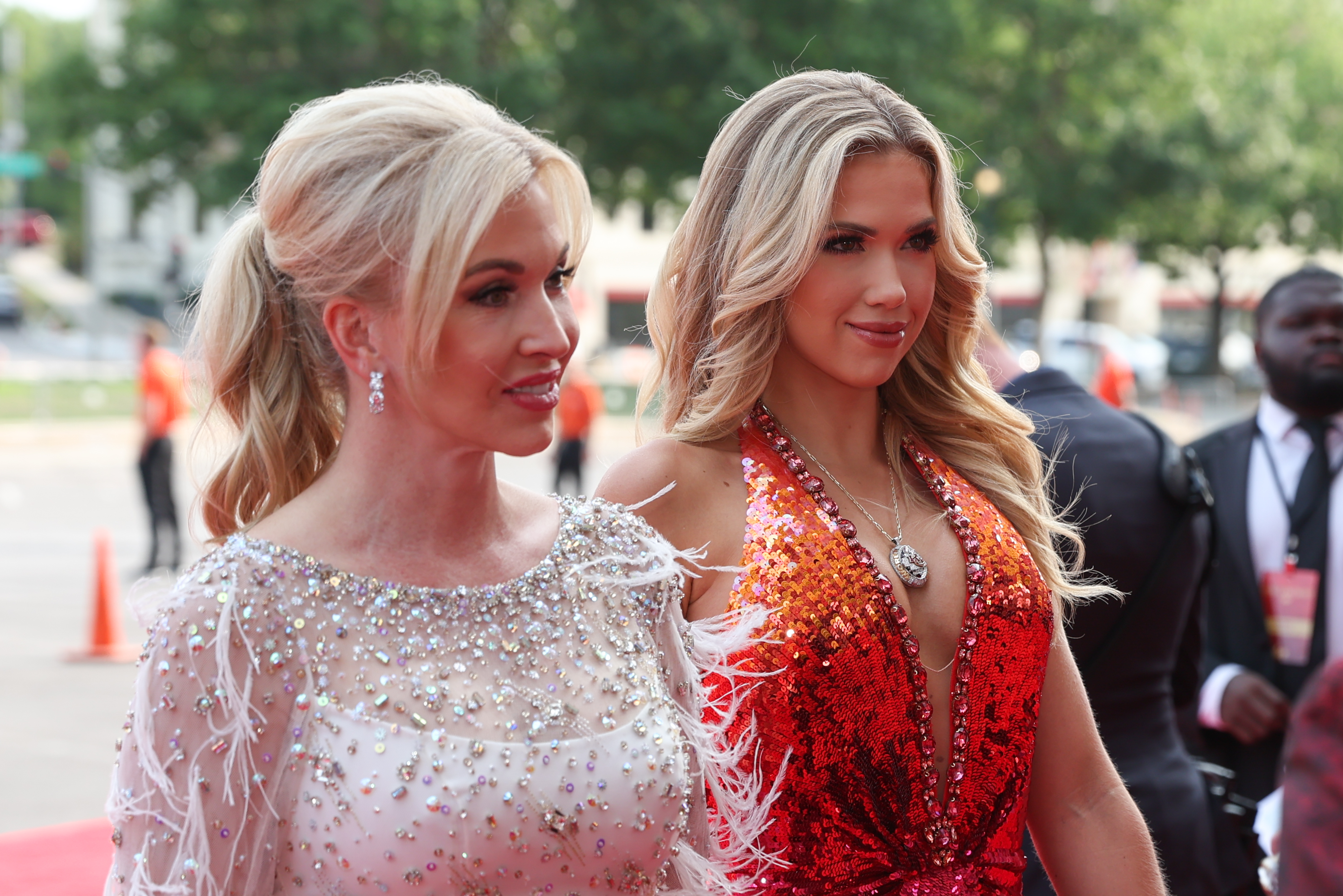
Kansas City Chiefs CEO Clark Hunt’s wife, Tavia, and eldest daughter, Gracie, are talking publicly about Harrison Butker’s commencement speech at Benedictine College. Tavia has been married to Clark for more than three decades. She’s a homemaker. Both Tavia and Gracie has good things to say about Butker.
Tavia and Gracie Hunt
“I’ve always encouraged my daughters to be highly educated and chase their dreams,” she wrote on Instagram. “I want them to know that they can do whatever they want (that honors God). But I also want them to know that I believe finding a spouse who loves and honors you as or before himself and raising a family together is one of the greatest blessings this world has to offer.”
“Affirming motherhood and praising your wife, as well as highlighting the sacrifice and dedication it takes to be a mother, is not bigoted,” she continued. “It is empowering to acknowledge that a woman’s hard work in raising children is not in vain. Countless highly educated women devote their lives to nurturing and guiding their children. Someone disagreeing with you doesn’t make them hateful; it simply means they have a different opinion.”
She then encouraged people to “celebrate families, motherhood and fatherhood.” “Our society desperately needs dedicated men and women to raise up and train the next generation in the way they should go,” she wrote. “We need more dialogue (and VALUES, IMO) in this country and less hate.”
Her daughter Gracie shared her thoughts on Fox and Friends. “I’ve had the most incredible mom who had the ability to stay home and be with us as kids growing up.” She continued: “I understand that there are many women out there who can’t make that decision. But for me and my life, I know it was really formative and in shaping me and my siblings into who we are.”
Asked if she understood what Harrison was talking about in his speech (slightly condescending), Gracie responded, “For sure, and I really respect Harrison and his Christian faith and what he’s accomplished on and off the field.”
So Harrison Butker is probably not going to lose his gig—and not just because of his talent on the field. He reflects company values.
Hillary Clinton making her “basket full of deplorables” remark
What we’re seeing in the progressive reaction to Butker’s speech is the same sentiment expressed by Hillary Clinton when she described Americans in the heartland as “a basket of deplorables.” Remember that? That was about two months out from getting beaten in the 2016 presidential election which was supposed to be her coronation.
“You know, to just be grossly generalistic, you could put half of Trump’s supporters [tens of millions of Americans] into what I call the basket of deplorables. (Laughter/applause) Right? (Laughter/applause) They’re racist, sexist, homophobic, xenophobic, Islamophobic—you name it.” She added, “Now, some of those folks—they are irredeemable, but thankfully, they are not America.”
Actually, Hillary, they are America.
Nancy Pelosi at the Oxford Union
The same sentiment was expressed just recently by former House Speaker Nancy Pelosi who called those who may see themselves as part of the populist movement just “poor souls who are looking for some answers.” “We’ve given answers to them, but they’re blocked by some of their views on guns.” Oh, so you given people the answers. Then she lifted a line from Obama: “They have the three Gs: guns, gays, God.”
Democrats are sailing towards disasters this November 5 and running down ordinary Americans is only hardening popular opinion against the party. The controversy over Butker’s speech is amplifying the elitist attitude widespread among Democrats. They can’t help themselves, though, even when it’s politically stupid to keep jerking knees.
* * *
Biden at Morehouse College
On May 19, Joe Biden gave the keynote address at the Morehouse College commencement, a historically-black all-male college in Atlanta. Biden vowed “to call out the poison of white supremacy,” and “to root out systemic racism.” That’s the bit that stood out to me. Biden elaborated: “You started college just as George Floyd was murdered and there was a reckoning on race. It’s natural to wonder if democracy you hear about actually works for you. What is democracy if black men are being killed in the street? What is democracy if a trail of broken promises still leave black—black communities behind? What is democracy if you have to be 10 times better than anyone else to get a fair shot? And most of all, what does it mean, as we’ve heard before, to be a black man who loves his country even if it doesn’t love him back in equal measure?” And Bukter’s speech was polarizing?
Here are these words again with annotations containing corrections and clarifications: “You started college just as [career criminal] George Floyd [overdosed] and there was a reckoning on race [arson, assault, intimidation, looting, murder]. It’s natural to wonder if democracy you hear about actually works for you [given that the Democratic Party represents the interests of corporate elite with open borders and all the rest of it]. What is democracy if black men are being killed in the street [by other black men in progressive-run cities]? What is democracy if a trail of broken promises [by Democrats] still leave black communities behind? What is democracy if you have to be ten times better than anyone else to get a fair shot [if we have to discriminate against whites and other races and ethnicities attempting parity]? And most of all, what does it mean, as we’ve heard before, to be a black man who loves his country even if it [the Democratic Party] doesn’t love him back in equal measure?”
I remarked recently on my Facebook feed, “Not a fan of Mitch McConnell, but mad props for keeping Merrick Garland off the Supreme Court. The man is utterly without principle.” This was before he was found in contempt of Congress by the House Oversight and Judiciary Committees (see AG Garland Found in Contempt and MTG’s Hypothesis Confirmed). Somebody responded that he was a lot better than the Republican appointees on the Court. So I added that Garland was an authoritarian, as well. I was then asked for an example. I gave several. This essay is based on my response.
Merrick Garland, US Attorney General
Merrick Garland’s authoritarianism and lack of principle are well documented. More than any attorney general in recent memory, Garland has not merely politicized the Department of Justice but weaponized it against the political opponents of the Democratic Party and the corporate state establishment. The evidence for this is extensive.
Garland has initiated legal actions to block the implementation of state laws, effectively pitting the federal government against elected state bodies aligned with their constituents’ preferences. These actions undermine the principle of federalism that lies at the heart of our republican system of governance. He has, moreover, pursued in a highly selective manner matters where the DOJ might have cause to act, a pattern indicative of political bias. For example, Garland has sued red states over redistricting yet left alone blue states to gerrymander. Eschewing strict adherence to evidence-based pursuit of justice for crimes falling beyond state jurisdiction, Garland’s pursuit of criminal prosecutions is typically framed in such a way as to capture mass media attention. He uses his position as propagandist for the administrative state and the Democratic Party.
Garland has employed federal investigatory powers in a coercive manner even when cases haven’t reached the courtroom. For those that have reached the courtroom, Garland’s actions have been disproportionate. Taking up the second first, his pursuit of January 6 protestors has been relentless even though only a handful of protestors were involved in violent confrontation with police officers. The vast majority of those present in and around the Capitol at best committed misdemeanors (trespassing and obstruction of official proceedings, for the most part, the latter elevated to felony obstruction), yet hundreds were kept in pretrial detention for months and some for years. When tried, prosecutors recommended prison terms of excessive length. Nearly 1300 individuals have been arrested and charged so, most of them convicted, and nearly 500 thrown into prison.
The DOJ’s creation of a task force used to intimidate parents challenging school boards over masks and vaccine mandates, school closures, the distribution of pornographic materials, the employment of SEL, as well as gender and race indoctrination in public schools is an example of his abuse of federal power. Garland claims those persons were targeted for violent action or making threats of violence. But most incidents involved neither violence nor threats of violence. When hauled before Congress to explain this, Garland perjured himself over the memo in question and misled Congress about why he wasn’t dismantling the task force. Even senior FBI veterans sounded the alarm over Garland’s misuse of anti-terrorism tools to intimidate concerned parents. Undeterred, Garland enlarged the program to include the intimidation of citizens with FBI’s “knock and talk” tactics.
Garland has issued policy directives that circumvent congressional legislation, positioning the Justice Department not just as an enforcer but a determiner of law. Indeed, Garland’s selective application of federal statutes is notorious. No charges were brought against individuals protesting and threatening violence against individuals outside a Supreme Court justice’s home, which is against federal law, yet Garland pursued charges again Mark Houck, a Pennsylvania anti-abortion demonstrator who peacefully protested outside an abortion clinic. Thankfully, Houck was acquitted, but he and his family had to suffer the terrifying experience of a federal SWAT raid on his house. Douglass Mackey was not so lucky. The DOJ went after Douglass Mackey for satirical voting ads on Twitter and secured a prison sentence.
In the raid of Trump’s Mar-a-Logo to retrieve documents implicating the Obama Administration in an unlawful counterintelligence operation (Crossfire Hurricane) against Hillary Clinton’s political opponent, Donald Trump, Garland allowed the leak of classified information by the DOJ (remember that Edward Bernays-style frameup?) classified information manipulated by FBI agents. This is why the documents trial has been indefinitely suspended. In the resurrected zombie case in Manhattan, Garland deployed a top prosecutor in his Washington officer, Matthew Colangelo, to handle the case because Alvin Bragg wasn’t up to prosecuting a case for which there is no underlying felony. The DOJ is playing a central role in the lawfare campaign being waged against the front runner for the President of the United States.
Having a man like this on the Supreme Court knowing that he might have an opportunity to rule on matters of the First, Second, and Fourth Amendments, etc., was so terrifying of a prospect that the Republican Party took the extraordinary step of not even allowing his nomination to proceed to a congressional vote. Thank God. Imagine had Garland not been stopped and Clinton had won the 2016 election. Given their illiberal governing philosophy, with two of three more Supreme Court justices, these authoritarians would have control over the court for a generation—a truly terrifying possibility. We dodged a huge bullet in 2016 with the election of Trump. After the 2020 steal, it only made sense that Garland would be the Attorney General of the United States. You can add to his unprincipled and authoritarian character a desire to hit back at the party that kept him off the Supreme Court.
My response is based on numerous sources. Most helpful were articles and op-eds published in the National Review over the last couple of years.
Did you miss it? Or did you see the coverage that put the “newsworthy” exchanges in the wrong order? The House Oversight Committee Congress (as did House Judiciary) found US Attorney General Merrick Garland in contempt of Congress for withholding an audio recording bearing on the question of whether Joe Biden is fit to be president and therefore should be criminally prosecuted for stealing top secret documents when he was vice-president or whether, on the other hand, he is unfit to be president and therefore incompetent to stand trial for his actions which put the nation’s security at risk. The Biden regime exerted executive privilege at the last minute because the audio of him disclosing to a ghostwriter state secrets he illegally obtained while vice-president has him on the horns of a dilemma.
We all know about the corrupt and compromised man in the White House. Today, I want to sort out for you the chaos occurring during debate and deliberation that overshadowed the vote itself. Like ozone in the atmosphere, you could feel the storm coming. Georgia Rep. Marjorie Taylor Greene (R)) was sensing that Texas Rep. Jasmine Crockett (D) and New York Rep. Alexandria Ocasio-Cortez (D) were seething. One giveaway was Crockett’s response to Greene query to the committee whether any Democrat present had employed the services of party operative Loren Merchan, the daughter of Juan Merchan, the judge overseeing the zombie case against Trump in Manhattan.
Jasmine Crockett and Marjorie Taylor Greene, members of the House of Representatives
Greene’s query, while rhetorical, was not unsolicited. Maryland Rep. Jamie Raskin (D) wanted to ensure that members of his party were not taking any actions on the Oversight Committee in order to solicit campaign contributions. This was in response to the usual clown show by Florida Rep. Jared Moskowitz (D), who insulted the chair, Kentucky Rep. James Comer (R) without objection. Greene wanted to make it transparent that at least once member of the party on the committee, New York Rep. Daniel Goldman (D), had in fact retained the services of the judge’s daughter. Greene also knew Crockett and Ocasio-Cortez are easily triggered and, when drawn into a cat fight, resort to embarrassing themselves by trash talking. Both Crockett and Ocasio-Cortez are well spoken, but when triggered channel (or revert to) the argot of the street. So Greene tested her hypothesis by casually commenting on Crockett’s false eyelashes.
Greene (recognized by the chair for five minutes): “I’d like to know if any of the Democrats on this committee are employing Judge Merchan’s daughter.”
Crockett: “Please tell me what that has to do with Merrick Garland.”
Raskin: “Is she a porn star?”
Greene: “Oh, Goldman that’s right.”
Crockett: “Do you know what you are here for?”
Greene: “I don’t think you know what you’re here for. I think your fake eyelashes are messing up what you’re reading.”
Crockett: “Ain’t nuthin—”
And the cat fight was on. Hypothesis confirmed. After Massachusetts Rep. Stephen Lynch (D) called into question Comer’s ethics. Ocasio-Cortez made a point of order to take down Greene’s words. “That is absolutely unacceptable! How dare you attack the physical appearance of another person.”
Greene: “Aww, are your feelings hurt?”
Ocasio-Cortez: “Oh girl, baby girl—”
Green: “Oh really?
Ocasio-Cortez: “Don’t even play.”
Greene: “Baby girl? I don’t think so.”
The motion to strike Greene’s words was seconded, and Greene sat triumphally while the parliamentarians got busy trying to sort it all out. Ocasio-Cortez persisted in waxing indignant, continually repeating “Not today,” while rapping her fingernails on her desk (the woke progressive version of Nikita Khrushchev’s shoe on the table). At one point, Ocasio-Cortez said to those seated around her, “She’s not used to people talking back to her. She don’t want to say sorry to nobody for nothing. She’s going to learn.” When the committee reconvened, Greene agreed to strike her words. This wasn’t enough for Ocasio-Cortez, who demanded an apology, as well. Greene refused to apologize and then challenged Ocasio-Cortez to a debate.
Greene: “Yeah, you don’t have enough intelligence.”
More chaos ensued, with Democrats moving to strike those words, too. Channeling her inner Frank Zappa, Greene responded sardonically, “Oh, they cannot take the words.”
What followed was a discussion of parliamentary rules about ad hominem attacks and a demand by Raskin to repeat Greene’s words that she agreed to strike. Raskin attempted to repeat the words himself, something about Crockett taking off her fake eyelashes, to which Comer looked at him and said, “Really? I mean….” (Translation: You have got to be kidding me. That’s what triggered all this?”) Comer then asked the clerk to report the words. They suspended while the clerk reviewed the audio to determine the words. During the pause, Greene quipped, “Release the audio.” (There was also a call to have the media leave the well of the chamber until somebody pointed out that nobody called for the removal of the Netflix crew who accompanied Hunter Biden during his brief appearance in that chamber.
Eventually Comer got around to ruling that, while indecorous, the words did not rise to the level of ad hominem. Comer asked everybody to agree to treat each other with comity, including in his list Moskowitz (he had not forgotten Moskowitz’s snide remark). Raskin appealed the ruling. There was a motion by Republicans to table the appeal. The appeal was tabled. Comer recognized Greene to speak (you will recall that it had been her turn to speak since the beginning of the chaos).
At that point, rather than moving on, Crocket raised a point of order with a sideways insult aimed at Greene. “I’m just curious, just to better understand your ruling, if someone on this committee then starts talking about somebody’s bleach-blonde, bad-built, butch body, that would not be engaging in personalities, correct?”
“A what now?” Comer replied. “I have no idea what you just said.”
Amid the crosstalk and calls for Crockett to calm down, Crockett could be heard to say, “’Cause this is what y’all do. Don’t tell me to calm down ’cause y’all talk noise and then you can’t take it. If I come and talk shit about her, y’all gonna have a problem.”
Ocasio-Cortez made a second motion to take down Greene’s words about Ocasio-Cortez’s intelligence and after debate over the rules and a brief recess, the committee finally got back to business and Rep. Green was allowed to complete her opening statement. Her speech was important. She condemned the lawfare against Trump and his associates and called on the committee to find Garland in contempt. But perhaps more important than her speech was her successful goading of the opposition into exposing its performative attempt at political discourse.










 freedom and reason